


Abstract
Background: Pathological complete response (pCR) following neoadjuvant systemic therapy is an important prognostic indicator in triple-negative breast cancer (TNBC). Nevertheless, identifying clinicopathological characteristics associated with treatment response remains essential. This study aimed to evaluate factors associated with pCR and the relationship between pCR and survival outcomes in patients with TNBC receiving neoadjuvant therapy. Methods: In this retrospective cohort study, 153 patients with stage I–III TNBC who received neoadjuvant systemic therapy followed by surgery between April 2010 and January 2025 were evaluated. Clinicopathological characteristics, including age, menopausal status, body mass index (BMI), histological grade, HER2 status, Ki-67 proliferation index, tumor-infiltrating lymphocytes (TILs), clinical tumor stage, clinical nodal stage, and neoadjuvant treatment regimen were analyzed. Factors associated with pCR were evaluated using basic and expanded multivariable logistic regression models. The basic model included treatment regimen, histological grade, and clinical nodal status, while the expanded model additionally included HER2 immunohistochemical category, Ki-67, and clinical T stage. Complete-case analysis was performed to address missing data. Overall survival (OS) and event-free survival (EFS) were evaluated using the Kaplan–Meier method. Results: The basic multivariable logistic regression model included 143 patients and identified clinical node positivity as independently associated with lower odds of achieving pCR (adjusted OR = 0.285; 95% CI: 0.119–0.682; p = 0.005). Histological grade 3 (adjusted OR = 3.117; p = 0.010) and a pembrolizumab-containing treatment regimen (adjusted OR = 4.194; p = 0.015) were associated with higher odds of achieving pCR; however, the overall test for treatment regimen was not statistically significant (p = 0.112). In the expanded model (n = 133), clinical node positivity remained independently associated with lower odds of achieving pCR (adjusted OR = 0.318; 95% CI: 0.129–0.783; p = 0.013). Although the directions of the associations were maintained for histological grade 3 (p = 0.094) and the pembrolizumab-containing regimen (p = 0.052), neither association reached statistical significance. Tumor-infiltrating lymphocyte (TIL) data were available for only 67 patients, and no statistically significant association between TIL levels and pCR was observed in this subgroup. Patients who achieved pCR had more favorable overall survival (OS) and event-free survival (EFS) outcomes than those with residual disease. Conclusions: Baseline clinical nodal status was consistently associated with pathological complete response (pCR) across different multivariable models in patients with triple-negative breast cancer (TNBC). Findings regarding histological grade and pembrolizumab-containing neoadjuvant treatment regimens should be interpreted with caution, as these associations did not reach statistical significance in the expanded model. The high proportion of missing tumor-infiltrating lymphocyte (TIL) data further limits conclusions regarding this biomarker. Our study provides real-world evidence on neoadjuvant treatment response and survival outcomes and highlights the need for larger prospective cohorts to further investigate the relationships among clinical nodal status, histological grade, the tumor immune microenvironment, and response to immunotherapy.
1. Introduction
Triple-negative breast cancer (TNBC) accounts for approximately 10–20% of all breast cancer cases worldwide and is associated with a more aggressive clinical course compared with other molecular subtypes of breast cancer [1,2]. The absence of estrogen receptor (ER), progesterone receptor (PR), and human epidermal growth factor receptor-2 (HER2) overexpression and amplification limits the use of endocrine and HER2-targeted therapies, leaving cytotoxic chemotherapy as the main systemic treatment option. TNBC is characterized by higher rates of early recurrence and mortality, particularly within the first three to five years after diagnosis [1,2].
Neoadjuvant systemic therapy is an established treatment approach for patients with high-risk early-stage triple-negative breast cancer (TNBC) [3]. Beyond potentially increasing the feasibility of breast-conserving surgery, it enables assessment of tumor response to systemic treatment before definitive surgery. Pathological complete response (pCR), defined as the absence of residual invasive disease in both the breast and axillary lymph nodes (ypT0/is ypN0), is strongly associated with favorable long-term survival outcomes, particularly in patients with TNBC [4,5].
Although triple-negative breast cancer (TNBC) is generally considered chemosensitive, pathological complete response (pCR) is achieved in only approximately one-third of patients receiving conventional anthracycline- and taxane-based neoadjuvant chemotherapy [6]. Randomized clinical trials have demonstrated that incorporating platinum agents into neoadjuvant chemotherapy can increase pCR rates [6]. More recently, immune checkpoint inhibitors have been investigated in combination with neoadjuvant chemotherapy. In the KEYNOTE-522 trial, adding pembrolizumab to chemotherapy significantly increased pCR rates and subsequently improved event-free survival [7]. Similarly, the IMpassion031 trial demonstrated improved pCR rates with the addition of atezolizumab to neoadjuvant chemotherapy [8].
Given the biological heterogeneity of triple-negative breast cancer (TNBC), identifying clinicopathological factors associated with pathological complete response (pCR) remains an important clinical objective [2]. Clinical tumor stage, nodal status, proliferation markers such as Ki-67, and immune microenvironment characteristics, including tumor-infiltrating lymphocytes (TILs), have been investigated as potential factors associated with treatment response [2,9]. Earlier studies, for example, evaluated immune-related predictors in patients receiving conventional anthracycline- and taxane-based neoadjuvant chemotherapy [9]. More recent clinical trials have investigated treatment strategies incorporating platinum agents and immune checkpoint inhibitors [3,6]. These evolving treatment approaches underscore the importance of reassessing factors associated with pCR in contemporary clinical practice.
The primary aim of this study was to identify clinicopathological and treatment-related predictors of pathological complete response in patients with triple-negative breast cancer treated with neoadjuvant therapy in a real-world clinical setting. We also evaluated the association between pCR and survival outcomes, including event-free and overall survival. Importantly, this cohort spans a 15-year period during which neoadjuvant treatment strategies for TNBC evolved from conventional anthracycline- and taxane-based chemotherapy to the incorporation of platinum-containing regimens and, more recently, chemoimmunotherapy. Accordingly, this study provides real-world evidence not only regarding predictors of treatment response and long-term outcomes, but also regarding the implementation of evolving evidence-based neoadjuvant treatment strategies in routine clinical practice.
2. Materials and Methods
2.1. Study Design and Patient Population
This retrospective observational study included patients diagnosed with triple-negative breast cancer (TNBC) who received neoadjuvant systemic therapy followed by definitive surgery at a single tertiary center between April 2010 and January 2025.
Eligibility criteria were defined as follows:
- Age ≥ 18 years
- Histologically confirmed stage I–III TNBC
- Receipt of at least four cycles of neoadjuvant systemic therapy prior to surgery
- Availability of pretreatment core needle biopsy and postoperative surgical pathology reports
- Availability of sufficient clinical and demographic records to establish study eligibility.
During the study period, the medical records of 167 patients registered as having early-stage triple-negative breast cancer (TNBC) in the institutional database were retrospectively reviewed in order of patient record number. Fourteen patients were excluded because their estrogen receptor (ER) and/or progesterone receptor (PR) expression levels were between 1% and 10%, thereby failing to meet the study’s hormone receptor negativity criteria. The remaining 153 patients who met the eligibility criteria constituted the final study cohort. Hormone receptor negativity was defined as ER and PR expression of less than 1% for each receptor. No patients in the final study cohort had an unknown follow-up status due to loss to follow-up.
This study was approved by the institutional ethics committee (approval number: 2025/010.99/20/9; date: 29 September 2025). The study was conducted in accordance with the principles of the Declaration of Helsinki. Due to the retrospective nature of the study, the requirement for additional informed consent was waived by the ethics committee.
Clinical and pathological data were retrospectively retrieved from electronic medical records and pathology reports. Collected variables included age at diagnosis, menopausal status, body mass index (BMI), histological grade, HER2 status, Ki-67 proliferation index, tumor-infiltrating lymphocyte (TIL) levels, clinical tumor stage (cT), clinical nodal stage (cN), neoadjuvant treatment regimen, and postoperative pathological findings.
2.2. Clinical Axillary Staging and Surgical Assessment
Before neoadjuvant systemic therapy, all patients underwent physical examination and axillary ultrasonography for clinical axillary assessment. In patients with suspicious axillary lymph nodes, nodal involvement was evaluated pathologically using fine-needle aspiration biopsy or core needle biopsy, and nodal positivity was confirmed when present. Baseline clinical nodal status was determined based on clinical examination, imaging findings, and available biopsy results obtained before neoadjuvant treatment.
Following neoadjuvant therapy, surgical assessment of the axilla was performed using sentinel lymph node biopsy (SLNB), axillary lymph node dissection (ALND), or both procedures. Information regarding the surgical procedures performed and the pathological findings of the excised lymph nodes was retrospectively retrieved from patient medical records.
Baseline clinical nodal staging and postoperative pathological nodal assessment were considered separately in the analyses.
2.3. Pathologic Assessment
Triple-negative breast cancer was defined as estrogen receptor (ER) and progesterone receptor (PR) expression < 1% by immunohistochemistry and HER2 negativity defined as an immunohistochemistry score of 0–1+, or an IHC score of 2+ with negative fluorescence in situ hybridization (FISH), according to the American Society of Clinical Oncology/College of American Pathologists (ASCO/CAP) guidelines [10,11].
Biomarker data were retrospectively extracted from available pretreatment core needle biopsy reports and postoperative surgical pathology reports. Ki-67 proliferation index was categorized as low (<20%) or high (≥20%) [12].
Tumor-infiltrating lymphocytes were evaluated according to the recommendations of the International TILs Working Group and categorized as low (≤20%) or high (>20%) [13].
Pathologic complete response (pCR) was defined as the absence of residual invasive disease in both the breast and axillary lymph nodes following completion of neoadjuvant therapy, corresponding to ypT0 ypN0 or ypTis ypN0 [4]. Residual ductal carcinoma in situ (DCIS) was considered compatible with pathological complete response (pCR), provided that no residual invasive disease or lymph node metastasis was present [4].
At our institution, histopathological examinations of breast cancer specimens were performed as part of routine diagnostic practice by an experienced team of pathologists specializing in breast pathology, who jointly reviewed cases when necessary. Data on histological grade, Ki-67 proliferation index, tumor-infiltrating lymphocytes (TILs), and other pathological parameters were retrospectively extracted from existing diagnostic pathology reports. Histopathological slides were not re-evaluated specifically for this study, and no centralized pathological review was performed.
As the study period spanned approximately 15 years, the frequency of assessment and reporting of certain pathological parameters varied over time. In particular, Ki-67 and TIL assessments were not systematically performed in all patients; therefore, these variables were analyzed only when data were available in the existing pathology records.
2.4. Neoadjuvant Treatment Regimens
Patients received anthracycline- and taxane-based neoadjuvant chemotherapy regimens according to institutional treatment protocols. Treatment regimens included:
- Anthracycline + taxane (AC-T)
- Anthracycline + carboplatin + taxane (AC-Cb-T)
- Anthracycline + carboplatin + taxane combined with immune checkpoint inhibitor therapy
- Other (taxane alone, anthracycline alone)
The choice of treatment regimen was based on clinical stage, physician decision, and evolving treatment standards during the study period.
During the study period, pembrolizumab was not reimbursed by the national health insurance system, thereby limiting access to this treatment. All 19 patients (12.4%) who received pembrolizumab-containing neoadjuvant therapy paid for their treatment out of pocket.
2.5. Adjuvant Treatment
Postoperative adjuvant systemic treatment was determined according to pathological response, treatment administered in the neoadjuvant setting, and individual clinical characteristics.
In patients with residual invasive disease following neoadjuvant therapy, adjuvant capecitabine was administered based on clinical eligibility and the treatment standards applicable during the study period.
For patients treated with pembrolizumab in the neoadjuvant setting, data regarding the continuation of immune checkpoint inhibitor therapy (pembrolizumab) in the adjuvant setting were recorded. Pembrolizumab was not covered by the national health insurance reimbursement system throughout the study period; therefore, its use in both the neoadjuvant and adjuvant settings was limited.
2.6. Survival Outcomes
Overall survival (OS) was defined as the time from initiation of neoadjuvant therapy to death from any cause. Patients who were alive at the last follow-up were censored at the date of last contact.
Although dates of death were available for deceased patients, reliable information on the causes of death could not be obtained; therefore, breast cancer–specific survival (BCSS) could not be evaluated separately.
Event-free survival (EFS) was defined as the time from initiation of neoadjuvant therapy to the first documented disease recurrence, or death from any cause. Patients who did not experience any of the predefined events were censored at the date of their last available disease assessment.
Follow-up duration was calculated from the initiation of neoadjuvant therapy to the date of last clinical follow-up.
2.7. Statistical Analysis
Statistical analyses were performed using IBM SPSS Statistics software (version 25). Continuous variables were assessed for normality using the Kolmogorov–Smirnov and Shapiro–Wilk tests. Normally distributed variables were reported as mean ± standard deviation, while non-normally distributed variables were presented as median (range).
Categorical variables were expressed as frequencies and percentages. Associations between clinicopathological variables and pCR were initially evaluated using univariable analyses. The chi-square test or Fisher’s exact test was used for categorical variables, and Student’s t-test or Mann–Whitney U test was used for continuous variables when appropriate.
Management of Missing Data and Multivariable Logistic Regression Analysis
Owing to the retrospective design of the study, data on certain clinicopathological variables were not available for all patients. No single or multiple imputation procedures were performed to address missing data. In univariable comparisons, each variable was analyzed using data from patients with available and valid observations for that variable.
Two multivariable binary logistic regression models were constructed to evaluate clinicopathological factors associated with pathological complete response (pCR). The dependent variable was defined as pCR status (1 = pCR achieved; 0 = pCR not achieved). Independent variables were entered simultaneously into the models using the Enter method.
The basic model (Model 1) included neoadjuvant treatment regimen, histological grade, and baseline clinical nodal status. These variables were selected based on their clinical relevance and the associations observed in univariable analyses.
The expanded model (Model 2) additionally included HER2 immunohistochemical category (scores 0–1+ vs. 2+/FISH-negative), Ki-67 level (<20% vs. ≥20%), and clinical T stage (T0–T2 vs. T3–T4). This model was developed to assess whether the associations observed in the basic model persisted after adjustment for additional clinicopathological variables and to evaluate the contribution of these variables to model fit.
A complete-case analysis approach was used for multivariable regression analyses, whereby only patients with complete data for all variables included in the respective model were analyzed. Model 1 included 143 patients, whereas Model 2 included 133 patients.
To distinguish potential sample-related effects arising from differences in the patient populations included in the two models, Model 1 was refitted using the same 133 patients included in Model 2. The nested models were then directly compared within this common sample using a likelihood ratio test.
Because TIL data were unavailable for a substantial proportion of patients, this variable was not included in the multivariable logistic regression models.
To evaluate the potential impact of changes in neoadjuvant treatment approaches over the study period, patients were categorized into three treatment eras according to the year of neoadjuvant treatment initiation: 2010–2017, 2018–2022, and 2023–2025. These periods were defined considering the introduction of platinum-based regimens and the increasing use of pembrolizumab-containing regimens. The distribution of neoadjuvant treatment regimens and pCR rates across treatment eras was examined using cross-tabulations. Differences in pCR rates between treatment eras were assessed using Pearson’s chi-square test.
To assess the potential confounding effect of treatment era, an additional sensitivity analysis was performed by incorporating treatment era as a categorical variable into the basic multivariable logistic regression model. Treatment regimen, histological grade, and baseline clinical nodal status were retained in this model, with the 2010–2017 period serving as the reference category. The analysis was restricted to patients with complete data for all variables included in the model.
Regression results were reported as adjusted odds ratios (ORs) with corresponding 95% confidence intervals (CIs) and p-values. Overall model significance was assessed using the omnibus test, while model fit was evaluated using Nagelkerke’s pseudo-R2 and the Hosmer–Lemeshow goodness-of-fit test. A two-sided p-value < 0.05 was considered statistically significant.
Survival outcomes were estimated using the Kaplan–Meier method and compared using the log-rank test. Cox proportional hazards regression analysis was used to estimate hazard ratios (HRs) and corresponding 95% confidence intervals.
A two-sided p value < 0.05 was considered statistically significant.
3. Results
3.1. Patient Characteristics
During the study period, the medical records of 167 patients registered as having early-stage triple-negative breast cancer (TNBC) in the institutional database were reviewed. Of these, 14 patients (8.4%) were excluded because their estrogen receptor (ER) and/or progesterone receptor (PR) expression levels ranged from 1% to 10%, thereby failing to meet the study’s diagnostic criteria for TNBC. The remaining 153 patients (91.6%) constituted the final study cohort. No patients were lost to follow-up. The median follow-up duration was 31.5 months (range: 6.2–157.5 months). Pathologic complete response (pCR) was achieved in 65 patients (42.5%), while 88 patients (57.5%) had residual disease after neoadjuvant therapy. Among the 65 patients who achieved pathological complete response (pCR), 60 (92.3%) had no residual invasive or in situ carcinoma in the breast and no axillary lymph node metastases (ypT0 ypN0). The remaining five patients (7.7%) had residual ductal carcinoma in situ (DCIS) only, with no axillary lymph node involvement (ypTis ypN0). These two subgroups accounted for 39.2% and 3.3% of the entire study cohort, respectively. Accordingly, the overall pCR rate was 42.5%, based on the ypT0/is ypN0 definition.
During the follow-up period, 27 deaths and 37 EFS events were recorded.
The median age of the entire cohort was 50 years (range: 27–77). The median age was 48 years in patients who achieved pCR and 51 years in those who did not, with no statistically significant difference between the groups.
3.2. Univariable Analysis of Factors Associated with pCR
Menopausal status was not significantly associated with treatment response. Pathologic complete response was achieved in 46.1% of premenopausal patients and 39% of postmenopausal patients (p = 0.375).
Similarly, body mass index was not associated with pCR. Patients with BMI < 30 had a pCR rate of 49.4%, compared with 40.4% among patients with BMI ≥ 30 (p = 0.291).
Histological grade demonstrated a significant association with pCR. Patients with grade 3 tumors achieved pCR more frequently than those with grade 1–2 tumors (47.1% vs. 28.6%, p = 0.040).
HER2 status did not reach statistical significance, although a numerical trend toward lower pCR rates was observed among patients with HER2 score 2 (FISH-negative) tumors compared with those with HER2 score 0–1 tumors (29% vs. 45.9%, p = 0.090).
A similar trend was observed for the Ki-67 proliferation index. Patients with Ki-67 ≥ 20% demonstrated higher pCR rates than those with Ki-67 < 20%; however, this difference was not statistically significant (p = 0.073).
Tumor-infiltrating lymphocyte levels were not significantly associated with pCR among patients with available data (p = 0.866).
Clinical tumor stage showed a borderline association with pCR. Patients with cT0–2 tumors achieved higher pCR rates compared with those with cT3–4 tumors (46.2% vs. 26.7%, p = 0.053).
In contrast, clinical nodal status demonstrated a strong association with treatment response. Patients with clinically node-negative disease achieved pCR significantly more frequently than patients with nodal involvement (61.5% vs. 35.5%, p = 0.005).
The neoadjuvant treatment regimen was also significantly associated with pCR (p = 0.048). The highest pCR rate was observed among patients treated with anthracycline, carboplatin, and taxane combined with anti–PD-1 therapy (68.4%). This was followed by anthracycline + carboplatin + taxane (46.2%), anthracycline + taxane (34.8%), and other regimens (30.8%).
Clinicopathological characteristics of the study population and the results of the univariable analysis are summarized in Table 1.
Table 1.
Clinicopathological characteristics of patients and their associations with pCR.
3.3. Neoadjuvant Treatment Regimens and Pathological Complete Response by Treatment Era
Patients were categorized into three treatment eras according to the year of neoadjuvant treatment initiation: 2010–2017 (n = 24), 2018–2022 (n = 59), and 2023–2025 (n = 70). The distribution of treatment regimens across these periods is presented in Table 2. Platinum-containing regimens were introduced in 2018, whereas pembrolizumab-containing regimens were first administered in 2022, with their use increasing particularly during 2023–2025. The pCR rates were 33.3% (8/24), 28.8% (17/59), and 57.1% (40/70) across the three treatment eras, respectively. The difference in pCR rates among treatment eras was statistically significant (Pearson’s χ2(2) = 11.491; p = 0.003).
Table 2.
Distribution of neoadjuvant treatment regimens and pCR by treatment era.
3.4. Axillary Surgical Procedures
Among the 153 patients, 76 (49.7%) underwent sentinel lymph node biopsy (SLNB) alone, 41 (26.8%) underwent axillary lymph node dissection (ALND) alone, and 36 (23.5%) underwent both procedures following neoadjuvant systemic therapy. Overall, SLNB was performed in 112 patients (73.2%) and ALND in 77 patients (50.3%). All patients underwent at least one axillary surgical procedure.
3.5. Multivariable Logistic Regression Analysis
Two multivariable logistic regression models, designated as the basic and expanded models, were constructed to evaluate clinicopathological factors associated with pathological complete response (pCR).
The basic model (Model 1), which included neoadjuvant treatment regimen, histological grade, and baseline clinical nodal status, was fitted using data from 143 patients with complete information on the relevant variables. Of these patients, 60 (42.0%) achieved pCR, whereas 83 (58.0%) did not. The overall model was statistically significant (χ2(5) = 21.587; p = 0.001; Nagelkerke R2 = 0.188).
In Model 1, baseline clinical nodal positivity was independently associated with lower odds of achieving pCR (adjusted OR = 0.285; 95% CI: 0.119–0.682; p = 0.005). Histological grade 3 was associated with higher odds of achieving pCR compared with grades 1–2 (adjusted OR = 3.117; 95% CI: 1.312–7.404; p = 0.010).
Patients receiving a pembrolizumab-containing neoadjuvant regimen had higher odds of achieving pCR than those receiving the reference anthracycline–taxane regimen (adjusted OR = 4.194; 95% CI: 1.315–13.382; p = 0.015). However, the overall Wald test for the treatment regimen variable was not statistically significant (p = 0.112).
The expanded model (Model 2), which additionally included HER2 immunohistochemical status, Ki-67 category, and clinical T stage, was fitted using data from 133 patients with complete information on all included variables. Of these patients, 58 (43.6%) achieved pCR, whereas 75 (56.4%) did not. The expanded model was also statistically significant overall (χ2(8) = 23.845; p = 0.002; Nagelkerke R2 = 0.220).
In Model 2, baseline clinical nodal positivity remained independently associated with lower odds of achieving pCR (adjusted OR = 0.318; 95% CI: 0.129–0.783; p = 0.013).
Although the estimated associations continued to favor higher odds of achieving pCR for histological grade 3 (adjusted OR = 2.285; 95% CI: 0.870–6.005; p = 0.094) and the pembrolizumab-containing treatment regimen (adjusted OR = 3.262; 95% CI: 0.989–10.756; p = 0.052), neither association reached statistical significance in the expanded model. The overall test for the treatment regimen variable was also not statistically significant (p = 0.169).
Clinical T3–T4 stage (adjusted OR = 0.512; p = 0.190), Ki-67 ≥ 20% (adjusted OR = 2.704; p = 0.405), and HER2 immunohistochemical score 2+/FISH-negative status (adjusted OR = 0.521; p = 0.234) were not independently associated with pCR at a statistically significant level when compared with their respective reference categories.
To avoid confounding the model comparison by differences in sample size and patient composition, Model 1 was refitted using the same 133 patients included in Model 2. In this common sample, the basic model remained statistically significant overall (χ2(5) = 18.718; p = 0.002; Nagelkerke R2 = 0.176). The directions of the associations observed for baseline clinical nodal positivity (OR = 0.279; p = 0.005), histological grade 3 (OR = 2.747; p = 0.024), and the pembrolizumab-containing regimen (OR = 3.425; p = 0.039) were consistent with those observed in the original basic model comprising 143 patients.
In the likelihood ratio comparison performed using the same 133 patients, the addition of HER2 status, Ki-67, and clinical T stage did not result in a statistically significant improvement in model fit (Δχ2 = 5.126; degrees of freedom = 3; p ≈ 0.163).
The regression results of the basic and expanded models are presented in Table 3. Details of the direct model comparison performed within the common sample are provided in Table 4.
Table 3.
Basic and expanded multivariable logistic regression analyses of clinicopathological factors associated with pCR.
Table 4.
Comparison of basic and expanded logistic regression models in the same 133 patients.
To assess the potential confounding effect of treatment era, treatment era was added as a categorical variable to the basic multivariable logistic regression model. This additional analysis included 143 patients, and the overall effect of treatment era was not statistically significant (p = 0.347). After adjustment for treatment era, the adjusted odds ratio for the pembrolizumab-containing regimen compared with the anthracycline–taxane regimen was 3.159 (95% CI: 0.873–11.440; p = 0.080). Histological grade 3 (aOR = 3.102; p = 0.011) and baseline clinical nodal positivity (aOR = 0.349; p = 0.023) remained significantly associated with pCR. The Hosmer–Lemeshow goodness-of-fit test indicated no significant evidence of poor model fit (p = 0.853).
Regarding postoperative adjuvant systemic treatment, 47 of the 88 patients (53.4%) with residual disease (non-pCR) received adjuvant capecitabine. Information on adjuvant systemic treatment was unavailable for the remaining 41 patients with residual disease. Among patients who achieved pCR, only one patient continued pembrolizumab in the adjuvant setting after having initiated it as part of neoadjuvant therapy; no additional adjuvant systemic treatment was administered to the remaining patients who achieved pCR.
3.6. Survival Outcomes According to pCR Status
Survival analyses demonstrated a strong association between pathologic complete response and survival outcomes.
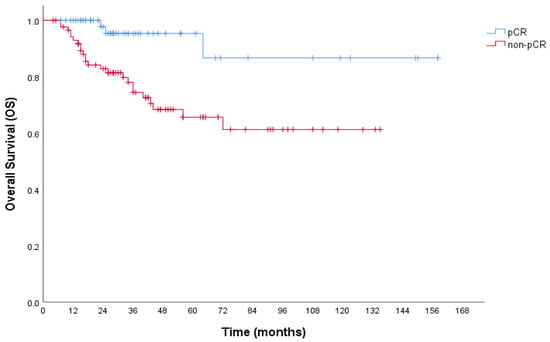
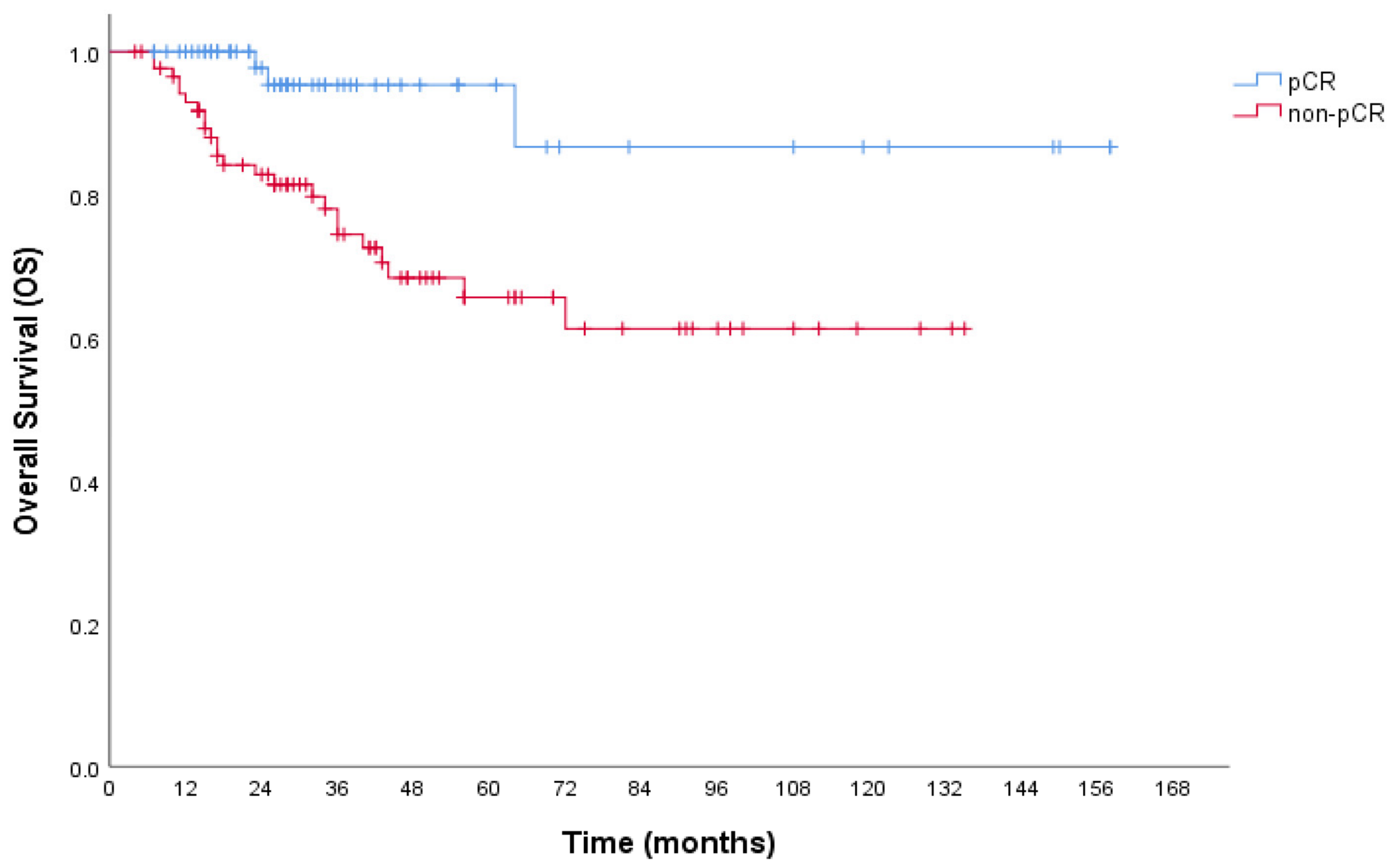
Patients who achieved pCR demonstrated significantly improved overall survival compared with those with residual disease. During follow-up, only three deaths (4.6%) occurred in the pCR group compared with twenty-four deaths (27.3%) in the non-pCR group (log-rank p = 0.003). Median overall survival was not reached in either group during the follow-up period. However, the Kaplan–Meier curves demonstrated a clear separation between the groups, indicating a substantial survival advantage associated with achieving pCR. The Kaplan–Meier curves for overall survival according to pCR status are shown in Figure 1.
Figure 1.
Kaplan–Meier curves for overall survival according to pathologic complete response (pCR) status. Patients achieving pCR demonstrated significantly improved overall survival compared with patients with residual disease following neoadjuvant therapy (log-rank p = 0.003).
In the univariable Cox proportional hazards regression analysis, patients who did not achieve pathological complete response (pCR) had a significantly higher hazard of death compared with those who achieved pCR (HR = 5.244; 95% CI: 1.576–17.449; p = 0.007).
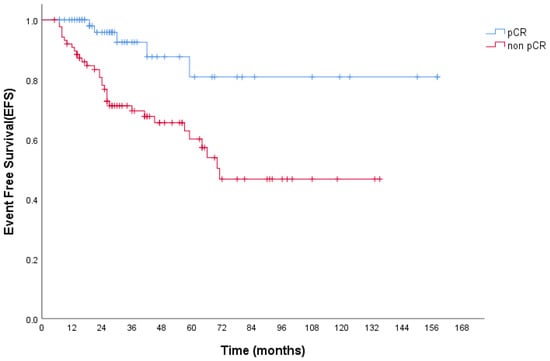
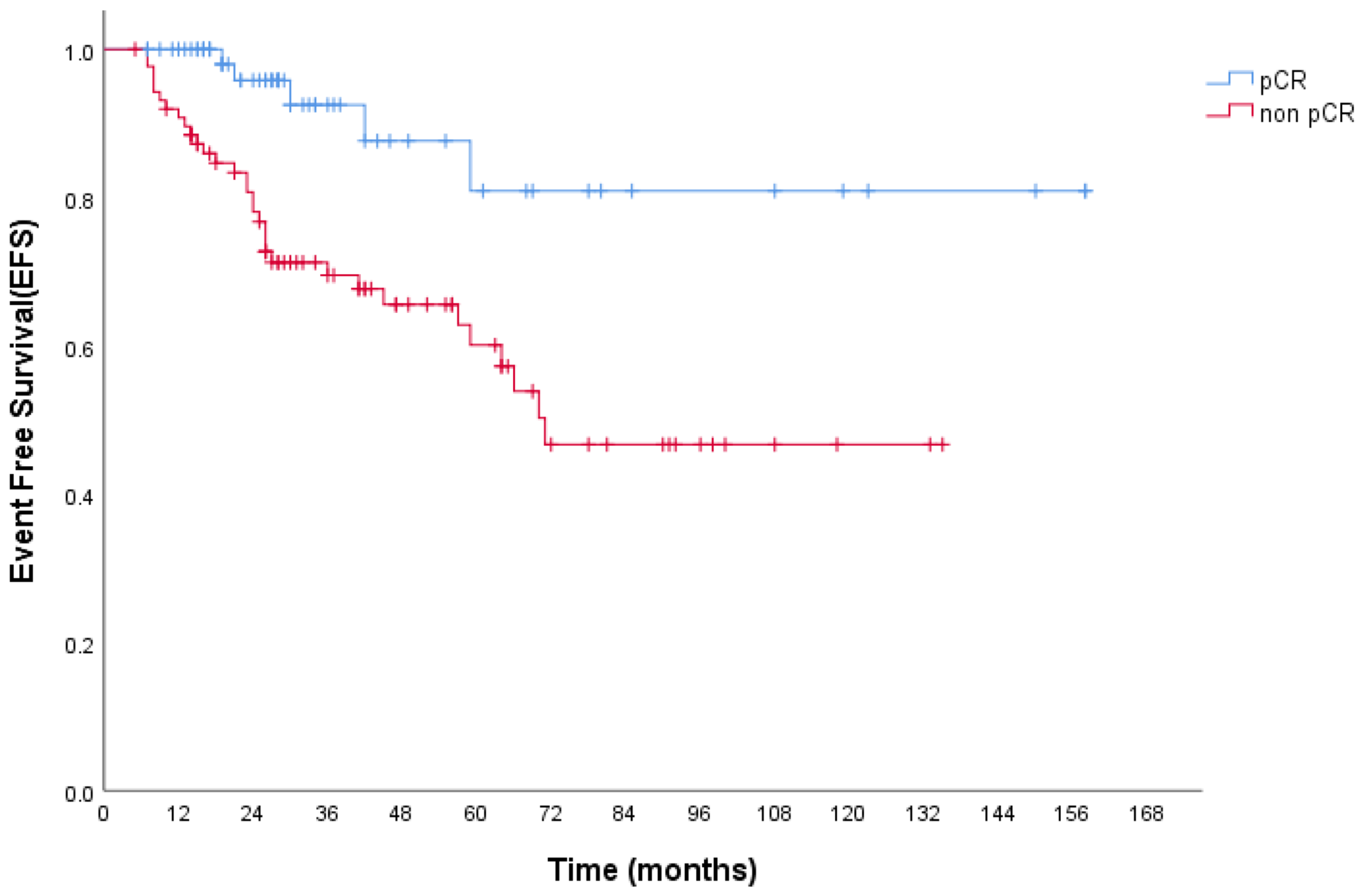
A similar pattern was observed for event-free survival. Kaplan–Meier analysis demonstrated a significant difference in event-free survival between the two groups (log-rank p = 0.001). A total of five EFS events (7.7%) were recorded in the pCR group, compared with 32 events (36.4%) in the non-pCR group.
Median EFS was not reached in the pCR group but was 71 months in the non-pCR group. The Kaplan–Meier curves illustrating event-free survival according to pCR status are presented in Figure 2.
Figure 2.
Kaplan–Meier curves showing event-free survival (EFS) according to pathological complete response (pCR) status. Patients who achieved pCR had significantly better EFS than those who did not achieve pCR (log-rank χ2 = 11.152; p = 0.001). Short vertical tick marks on the curves indicate censored observations.
In the univariable Cox proportional hazards regression analysis, patients who did not achieve pCR had a significantly higher hazard of an EFS event compared with those who achieved pCR (HR = 4.341; 95% CI: 1.690–11.152; p = 0.002).
A summary of overall survival and event-free survival outcomes according to pCR status is presented in Table 5.
Table 5.
Overall survival and event-free survival according to pathological complete response status.
4. Discussion
In this retrospective cohort of patients with triple-negative breast cancer (TNBC) treated with neoadjuvant systemic therapy, baseline clinical nodal status emerged as the factor most consistently associated with pathological complete response (pCR). Clinical nodal positivity was independently associated with lower odds of achieving pCR in both the basic and expanded multivariable logistic regression models. Histological grade 3 and pembrolizumab-containing treatment were associated with higher odds of pCR in the basic model, but these associations did not remain statistically significant after additional clinicopathological variables were included. Moreover, the overall association between treatment regimen and pCR was not statistically significant in either model. Patients who achieved pCR also demonstrated more favorable event-free and overall survival outcomes than those with residual disease, consistent with the established prognostic significance of pCR in TNBC [4,5]. By evaluating clinicopathological characteristics and treatment-related factors across a period of evolving neoadjuvant strategies, this study provides real-world evidence on treatment response. Nevertheless, the findings should be interpreted as associations rather than as a validated basis for selecting or intensifying neoadjuvant treatment.
Pathologic complete response is an important prognostic indicator of long-term survival outcomes in triple-negative breast cancer. In the pooled analysis conducted by Cortazar et al. (CTNeoBC), which included more than 11,000 patients from multiple neoadjuvant trials, the achievement of pCR was strongly associated with improved event-free and overall survival, particularly in aggressive subtypes such as TNBC [4]. Our findings are consistent with this large pooled analysis, as patients achieving pCR in our cohort demonstrated significantly improved overall survival and event-free survival compared with those with residual disease.
In our study, baseline clinical nodal status was the clinicopathological factor most consistently associated with pathological complete response (pCR). Clinical nodal positivity was independently associated with lower odds of achieving pCR in the basic multivariable model comprising 143 patients (adjusted OR = 0.285; 95% CI: 0.119–0.682; p = 0.005). This association persisted in the expanded model comprising 133 patients, which additionally included HER2 immunohistochemical category, Ki-67 proliferation index, and clinical T stage (adjusted OR = 0.318; 95% CI: 0.129–0.783; p = 0.013).
These findings suggest that pretreatment nodal involvement is an important clinical characteristic associated with the likelihood of achieving pCR. Nevertheless, baseline nodal positivity may reflect greater initial disease burden and other clinicopathological characteristics that influence treatment response. Furthermore, because pCR in our study required the absence of residual invasive disease in both the breast and axillary lymph nodes, baseline nodal status should be interpreted in relation to the composite pathological endpoint. The observed association therefore does not establish a causal relationship between nodal involvement and treatment sensitivity. Given the retrospective design and the number of variables assessed, these findings require confirmation in independent patient cohorts.
Pathological complete response rates also differed across neoadjuvant treatment regimens. The highest observed pCR rate was recorded among patients who received pembrolizumab combined with anthracycline-, taxane-, and platinum-based chemotherapy. In the basic multivariable model, this regimen was associated with higher odds of achieving pCR compared with the reference anthracycline–taxane regimen (adjusted OR = 4.194; 95% CI: 1.315–13.382; p = 0.015). However, the overall Wald test for treatment regimen was not statistically significant (p = 0.112), indicating that the individual regimen comparison should be interpreted cautiously.
In the expanded model, the estimated association for the pembrolizumab-containing regimen remained in the same direction but did not reach statistical significance (adjusted OR = 3.262; 95% CI: 0.989–10.756; p = 0.052). The overall treatment regimen test also remained nonsignificant (p = 0.169). Moreover, only 19 patients received pembrolizumab, and the use of chemoimmunotherapy was concentrated in the later years of the study period. These factors introduce substantial uncertainty and potential confounding by treatment era. Accordingly, the observed differences between treatment regimens should be considered exploratory and cannot establish an independent treatment benefit or a causal effect of pembrolizumab.
Given the approximately 15-year study period, we examined whether changes in neoadjuvant treatment practices over time might have influenced the observed associations. Pathological complete response (pCR) rates differed significantly across treatment eras (p = 0.003), with the highest rate observed in 2023–2025. However, when treatment era was included in the basic multivariable logistic regression model, its overall association with pCR was not statistically significant (p = 0.347). Following adjustment for treatment era, the estimated odds ratio for the pembrolizumab-containing regimen decreased from 4.194 to 3.159, and the comparison with conventional anthracycline–taxane chemotherapy was no longer statistically significant (p = 0.080). These results suggest that the temporal distribution of treatment regimens should be considered when interpreting treatment-related associations. Because pembrolizumab was predominantly administered in the later study period and the number of treated patients was small, the observed differences cannot establish a treatment effect independent of calendar period or other potential confounders.
Our observations should be considered alongside evidence from randomized trials investigating platinum-based chemotherapy and immune checkpoint inhibitors in early-stage triple-negative breast cancer (TNBC). In CALGB 40603, adding carboplatin to neoadjuvant chemotherapy increased pCR rates [6]. The KEYNOTE-522 trial demonstrated higher pCR rates with pembrolizumab-containing chemotherapy and subsequently reported improved event-free survival [3,7]. Similarly, IMpassion031 showed an increase in pCR rates when atezolizumab was incorporated into neoadjuvant chemotherapy [8].
Unlike these randomized trials, treatment allocation in our cohort was determined by clinical practice rather than randomization. Treatment approaches also changed over time, and access to pembrolizumab was limited by the absence of reimbursement and the need for patients to finance treatment themselves. Together with the small number of patients receiving pembrolizumab, these factors limit the comparability of treatment groups and preclude causal conclusions regarding the relative effectiveness of the regimens evaluated.
A proposed biological rationale for combining chemotherapy with immunotherapy is that certain cytotoxic agents can promote immunogenic tumor cell death and modulate innate and adaptive antitumor immune responses [14]. However, these mechanisms were not directly investigated in our cohort.
Histological grade 3 was associated with higher odds of achieving pathological complete response (pCR) compared with grades 1–2 in the basic multivariable model (adjusted OR = 3.117; 95% CI: 1.312–7.404; p = 0.010). Although the direction of this association was maintained in the expanded model, it was no longer statistically significant (adjusted OR = 2.285; 95% CI: 0.870–6.005; p = 0.094). This attenuation should be interpreted in light of both the additional covariate adjustment and the difference in sample size between the models. Importantly, a similar reduction in the estimated association was observed when the models were compared in the same 133 patients. These findings do not exclude a potential relationship between histological grade and treatment response but indicate that its independent contribution remains uncertain in our cohort.
Clinical T stage, Ki-67 category, and HER2 immunohistochemical category were also not significantly associated with pCR in the expanded model. Notably, only eight patients had a Ki-67 proliferation index below 20%, contributing to imprecision in the estimated association for this variable (adjusted OR = 2.704; 95% CI: 0.260–28.108; p = 0.405). Consequently, the nonsignificant findings for these clinicopathological variables should not be interpreted as evidence of an absence of association with treatment response.
No statistically significant association between tumor-infiltrating lymphocyte (TIL) levels and pCR was observed among patients with available TIL data (p = 0.866). However, TIL assessments were available for only 67 of the 153 patients, and their reporting was not systematic throughout the study period. Previous studies, including a pooled analysis by Denkert et al., have reported an association between greater lymphocytic infiltration and higher pCR rates in triple-negative breast cancer (TNBC) [15]. Differences in cohort characteristics, TIL assessment and categorization, and the substantial proportion of missing data in our study limit direct comparisons. Therefore, our findings should not be interpreted as excluding a potential contribution of the tumor immune microenvironment to neoadjuvant treatment response.
When the basic and expanded logistic regression models were compared within the same 133 patients, the addition of HER2 immunohistochemical category, Ki-67, and clinical T stage increased Nagelkerke’s pseudo-R2 from 0.176 to 0.220. Nevertheless, the likelihood ratio test did not demonstrate a statistically significant improvement in model fit (Δχ2 = 5.126; df = 3; p ≈ 0.163). Thus, the additional variables were not shown to provide a statistically significant improvement over the basic model in this sample. By contrast, baseline clinical nodal status remained associated with pCR across both models, supporting the relative consistency of this finding after adjustment for different sets of clinicopathological variables.
An important strength of this study is its use of real-world clinical data collected over approximately 15 years, capturing changes in neoadjuvant treatment practices for triple-negative breast cancer (TNBC). Platinum-containing regimens were introduced at our institution in 2018, followed by pembrolizumab-containing chemoimmunotherapy in 2022, with greater use during 2023–2025. This longitudinal perspective allows the description of pathological complete response (pCR) across treatment approaches used during different periods of routine clinical practice. Another strength is the evaluation of pathological response and survival outcomes within the same cohort. Patients achieving pCR had significantly more favorable event-free survival and overall survival than those with residual disease, consistent with the established prognostic significance of pCR in TNBC [4]. Although median overall survival was not reached, the observed separation of Kaplan–Meier curves and the estimated hazard ratios supported a strong association between pCR and favorable prognosis. Nevertheless, these survival comparisons were not adjusted for potential confounders, including differences in postoperative systemic treatment. Adjuvant capecitabine has been shown to improve outcomes in patients with residual invasive disease after neoadjuvant chemotherapy [16]. In our cohort, capecitabine use was documented in 47 of 88 patients with residual disease, whereas adjuvant treatment information was unavailable for the remaining 41 patients. Consequently, the potential contribution of postoperative treatment to the observed survival differences could not be evaluated independently.
Study Limitations
Several limitations should be considered when interpreting our findings. First, this was a single-center, retrospective, nonrandomized study, with potential selection bias, unmeasured confounding, and limited generalizability. The approximately 15-year study period was accompanied by changes in treatment strategies, clinical documentation, pathological assessment, and axillary surgical practices, potentially introducing heterogeneity between patient groups. Furthermore, because the study included only patients who underwent surgery after neoadjuvant therapy, patients who did not proceed to surgery were not represented. This selection may have affected the assessment of treatment response and survival outcomes.
Missing clinicopathological data represent another important limitation. Tumor-infiltrating lymphocyte (TIL) assessments were available for only 67 patients, with data missing for 86 patients (56.2%). Because TIL reporting practices evolved during the study period, missingness may have been associated with treatment era or other patient characteristics. Consequently, TIL analyses were restricted to patients with available measurements, and this variable was excluded from multivariable regression because of the substantial proportion of missing data. Additional missing observations for Ki-67, histological grade, and clinical staging reduced the number of patients included in the basic and expanded logistic regression models to 143 and 133, respectively. Complete-case analysis may have introduced selection bias and reduced the precision of the estimated associations.
Pathological variables were retrospectively extracted from routine diagnostic reports without centralized reassessment of histological slides. Although examinations were conducted by experienced breast pathologists, standardized assessment procedures could not be verified across the entire study period, and interobserver agreement was not systematically evaluated. These considerations are particularly relevant to TIL and Ki-67 measurements. In addition, gene expression-based molecular subtype classification was unavailable, preventing exploration of potential differences in treatment response across molecular subgroups of TNBC.
Treatment-related comparisons were also limited by changes in clinical practice over time and the lack of random treatment allocation. Pembrolizumab was administered to only 19 patients, all of whom paid for treatment out of pocket because it was not reimbursed. Consequently, treatment selection may have been influenced by clinical, temporal, and socioeconomic factors. Although a sensitivity analysis incorporated treatment era, residual confounding could not be excluded. The small sizes of some treatment and biomarker subgroups, particularly the Ki-67 < 20% category, also contributed to imprecise estimates. Furthermore, the number of parameters estimated in the expanded model relative to the available sample raises concerns about possible overfitting, and the regression findings require external validation.
Finally, the survival analyses were limited by the number of observed events and the information available in retrospective records. Reliable causes of death were unavailable, preventing a separate analysis of breast cancer-specific survival. The number of survival events was insufficient to support comprehensive multivariable survival modeling. In addition, survival time was measured from the initiation of neoadjuvant therapy, whereas pCR status was determined after surgery; therefore, the retrospective comparison of survival according to subsequent pathological response may be affected by selection and time-related biases. Complete postoperative treatment information was also unavailable for all patients, preventing adequate adjustment for adjuvant systemic therapies. Accordingly, associations between pCR and survival should be interpreted as observational rather than causal.
Despite these limitations, the consistent association between baseline clinical nodal status and pCR across different multivariable models represents a finding worthy of further investigation. Confirmation in larger, independent, prospectively assembled cohorts is needed before these observations can inform individualized treatment selection.
5. Conclusions
In this single-center retrospective cohort of patients with triple-negative breast cancer (TNBC) treated with neoadjuvant systemic therapy, baseline clinical nodal positivity was consistently associated with lower odds of achieving pathological complete response (pCR) across the basic and expanded multivariable logistic regression models. Although histological grade 3 and pembrolizumab-containing treatment were associated with higher odds of pCR in the basic model, these associations did not remain statistically significant in the expanded model, and the overall tests for treatment regimen were nonsignificant. No significant association between tumor-infiltrating lymphocyte (TIL) levels and pCR was observed, although substantial missing data limited the interpretation of this finding. Patients achieving pCR had more favorable event-free and overall survival outcomes than those with residual disease. Overall, these findings emphasize the potential clinical relevance of baseline nodal status while underscoring the need for cautious interpretation of treatment-related and biomarker associations. Larger independent studies with standardized pathological assessments and more complete treatment and follow-up data are needed to validate these observations.
Author Contributions
Conceptualization, T.K.; methodology, T.K.; investigation, T.K.; data curation, T.K., S.Y. and E.T.; formal analysis, T.K. and N.S.B.; writing—original draft preparation, T.K.; writing—review and editing, H.O. and N.T.; visualization, T.K.; supervision, H.O. and N.T.; project administration, H.O. and N.T. All authors have read and agreed to the published version of the manuscript.
Funding
This research received no external funding.
Institutional Review Board Statement
The study was conducted in accordance with the Declaration of Helsinki and approved by the Scientific Research Ethics Committee of Kartal Dr. Lütfi Kırdar City Hospital (approval number: 2025/010.99/20/9; date of approval: 29 September 2025).
Informed Consent Statement
The requirement for informed consent was waived by the Ethics Committee due to the retrospective nature of the study.
Data Availability Statement
The data that support the findings of this study are available from the corresponding author upon reasonable request. The data are not publicly available due to privacy and ethical restrictions related to patient confidentiality.
Conflicts of Interest
The authors declare no conflicts of interest.
References
- Foulkes, W.D.; Smith, I.E.; Reis-Filho, J.S. Triple-negative breast cancer. N. Engl. J. Med. 2010, 363, 1938–1948. [Google Scholar] [CrossRef] [Scilit] [PubMed]
- Bianchini, G.; Balko, J.M.; Mayer, I.A.; Sanders, M.E.; Gianni, L. Triple-negative breast cancer: Challenges and opportunities of a heterogeneous disease. Nat. Rev. Clin. Oncol. 2016, 13, 674–690. [Google Scholar] [CrossRef] [Scilit] [PubMed]
- Schmid, P.; Cortes, J.; Pusztai, L.; McArthur, H.; Kümmel, S.; Bergh, J.; Denkert, C.; Park, Y.H.; Hui, R.; Harbeck, N.; et al. Pembrolizumab for Early Triple-Negative Breast Cancer. N. Engl. J. Med. 2020, 382, 810–821. [Google Scholar] [CrossRef] [Scilit] [PubMed]
- Cortazar, P.; Zhang, L.; Untch, M.; Mehta, K.; Costantino, J.P.; Wolmark, N.; Bonnefoi, H.; Cameron, D.; Gianni, L.; Valagussa, P.; et al. Pathological complete response and long-term clinical benefit in breast cancer: The CTNeoBC pooled analysis. Lancet 2014, 384, 164–172. [Google Scholar] [CrossRef] [Scilit] [PubMed]
- von Minckwitz, G.; Untch, M.; Blohmer, J.U.; Costa, S.D.; Eidtmann, H.; Fasching, P.A.; Gerber, B.; Eiermann, W.; Hilfrich, J.; Huober, J.; et al. Definition and impact of pathologic complete response on prognosis after neoadjuvant chemotherapy in various intrinsic breast cancer subtypes. J. Clin. Oncol. 2012, 30, 1796–1804. [Google Scholar] [CrossRef] [Scilit] [PubMed]
- Sikov, W.M.; Berry, D.A.; Perou, C.M.; Singh, B.; Cirrincione, C.T.; Tolaney, S.M.; Kuzma, C.S.; Pluard, T.J.; Somlo, G.; Port, E.R.; et al. Impact of the addition of carboplatin and/or bevacizumab to neoadjuvant once-per-week paclitaxel followed by dose-dense doxorubicin and cyclophosphamide on pathologic complete response rates in stage II to III triple-negative breast cancer: CALGB 40603 (Alliance). J. Clin. Oncol. 2015, 33, 13–21. [Google Scholar] [CrossRef] [Scilit] [PubMed]
- Schmid, P.; Cortes, J.; Dent, R.; Pusztai, L.; McArthur, H.; Kümmel, S.; Bergh, J.; Denkert, C.; Park, Y.H.; Hui, R.; et al. Event-free Survival with Pembrolizumab in Early Triple-Negative Breast Cancer. N. Engl. J. Med. 2022, 386, 556–567. [Google Scholar] [CrossRef] [Scilit] [PubMed]
- Mittendorf, E.A.; Zhang, H.; Barrios, C.H.; Saji, S.; Jung, K.H.; Hegg, R.; Koehler, A.; Sohn, J.; Iwata, H.; Telli, M.L.; et al. Neoadjuvant atezolizumab in combination with sequential nab-paclitaxel and anthracycline-based chemotherapy versus placebo and chemotherapy in patients with early-stage triple-negative breast cancer (IMpassion031): A randomised, double-blind, phase 3 trial. Lancet 2020, 396, 1090–1100. [Google Scholar] [CrossRef] [Scilit] [PubMed]
- Denkert, C.; Loibl, S.; Noske, A.; Roller, M.; Müller, B.M.; Komor, M.; Budczies, J.; Darb-Esfahani, S.; Kronenwett, R.; Hanusch, C.; et al. Tumor-associated lymphocytes as an independent predictor of response to neoadjuvant chemotherapy in breast cancer. J. Clin. Oncol. 2010, 28, 105–113. [Google Scholar] [CrossRef] [Scilit] [PubMed]
- Wolff, A.C.; Hammond, M.E.; Hicks, D.G.; Dowsett, M.; McShane, L.M.; Allison, K.H.; Allred, D.C.; Bartlett, J.M.; Bilous, M.; Fitzgibbons, P.; et al. Recommendations for human epidermal growth factor receptor 2 testing in breast cancer: American Society of Clinical Oncology/College of American Pathologists clinical practice guideline update. J. Clin. Oncol. 2013, 31, 3997–4013. [Google Scholar] [CrossRef] [Scilit] [PubMed]
- Allison, K.H.; Hammond, M.E.H.; Dowsett, M.; McKernin, S.E.; Carey, L.A.; Fitzgibbons, P.L.; Hayes, D.F.; Lakhani, S.R.; Chavez-MacGregor, M.; Perlmutter, J.; et al. Estrogen and Progesterone Receptor Testing in Breast Cancer: ASCO/CAP Guideline Update. J. Clin. Oncol. 2020, 38, 1346–1366. [Google Scholar] [CrossRef] [Scilit] [PubMed]
- Dowsett, M.; Nielsen, T.O.; A’Hern, R.; Bartlett, J.; Coombes, R.C.; Cuzick, J.; Ellis, M.; Henry, N.L.; Hugh, J.C.; Lively, T.; et al. Assessment of Ki67 in breast cancer: Recommendations from the International Ki67 in Breast Cancer working group. J. Natl. Cancer Inst. 2011, 103, 1656–1664. [Google Scholar] [CrossRef] [Scilit] [PubMed]
- Salgado, R.; Denkert, C.; Demaria, S.; Sirtaine, N.; Klauschen, F.; Pruneri, G.; Wienert, S.; Van den Eynden, G.; Baehner, F.L.; Penault-Llorca, F.; et al. The evaluation of tumor-infiltrating lymphocytes (TILs) in breast cancer: Recommendations by an International TILs Working Group 2014. Ann. Oncol. 2015, 26, 259–271. [Google Scholar] [CrossRef] [Scilit] [PubMed]
- Emens, L.A. Chemoimmunotherapy. Cancer J. 2010, 16, 295–303. [Google Scholar] [CrossRef] [Scilit] [PubMed]
- Denkert, C.; von Minckwitz, G.; Darb-Esfahani, S.; Lederer, B.; Heppner, B.I.; Weber, K.E.; Budczies, J.; Huober, J.; Klauschen, F.; Furlanetto, J.; et al. Tumour-infiltrating lymphocytes and prognosis in different subtypes of breast cancer: A pooled analysis of 3771 patients treated with neoadjuvant therapy. Lancet Oncol. 2018, 19, 40–50. [Google Scholar] [CrossRef] [Scilit] [PubMed]
- Masuda, N.; Lee, S.J.; Ohtani, S.; Im, Y.H.; Lee, E.S.; Yokota, I.; Kuroi, K.; Im, S.A.; Park, B.W.; Kim, S.B.; et al. Adjuvant Capecitabine for Breast Cancer after Preoperative Chemotherapy. N. Engl. J. Med. 2017, 376, 2147–2159. [Google Scholar] [CrossRef] [Scilit] [PubMed]

Disclaimer/Publisher’s Note: The statements, opinions and data contained in all publications are solely those of the individual author(s) and contributor(s) and not of MDPI and/or the editor(s). MDPI and/or the editor(s) disclaim responsibility for any injury to people or property resulting from any ideas, methods, instructions or products referred to in the content. |
© 2026 by the authors. Licensee MDPI, Basel, Switzerland. This article is an open access article distributed under the terms and conditions of the Creative Commons Attribution (CC BY) license.