


Abstract
Biologic therapies are expanding treatment options for chronic obstructive pulmonary disease (COPD), but their development raises unresolved questions about patient selection and the assessment of treatment benefit. This narrative review critically discusses clinical evidence, selected emerging programmes and challenges in translating targeted therapies into practice. Mepolizumab and dupilumab have demonstrated reductions in exacerbations in eosinophil-selected populations. Trials of interleukin-33 (IL-33) or ST2 inhibition enrolled patients without a blood eosinophil threshold, and reduced exacerbations in some but not all of these trials: tozorakimab met its primary endpoint in both OBERON and TITANIA, astegolimab in ALIENTO but not in ARNASA, and itepekimab in AERIFY-1 but not in AERIFY-2. Within these programmes the point estimates were numerically larger at higher blood eosinophil counts, so the absence of an enrolment threshold broadens the populations in which efficacy has been demonstrated but does not establish that eosinophils lack predictive value. Two of the three IL-33 programmes also enriched for former smokers, replacing a biomarker criterion in part with a behavioural one. Blood eosinophil variability, discordance between circulating and airway inflammation, and the distinction between prognostic and predictive biomarkers further complicate treatment selection. Emerging strategies include inhibition of multiple inflammatory pathways, earlier biologic initiation and reassessment of background inhaled therapy. Exacerbation prevention remains a central therapeutic objective, although exacerbation rates alone cannot establish modification of the underlying disease course, and no trial has prespecified a responder definition, a reassessment interval or a stopping rule. Prospective evaluation of disease stability and complementary functional and imaging measures may provide a broader understanding of treatment effects. Future research should prioritise validated predictors of response, applicability to routine clinical populations, long-term safety and harmonised, clinically meaningful outcomes to support effective and sustainable use of biologic therapies in COPD.
1. Introduction
For most of its therapeutic history, COPD has been treated as a disease of airflow obstruction rather than a disease of inflammation. Long-acting bronchodilators remain the foundation of management, and inhaled corticosteroids are recommended for defined subgroups rather than for the disease as a whole; their action is nonetheless pharmacologically broad and mechanistically imprecise [1]. This approach has delivered symptomatic benefit and a reduction in exacerbations, but it has not altered the trajectory of the disease and it applies the same intervention to patients whose underlying biology differs substantially. The 2026 report of the Global Initiative for Chronic Obstructive Lung Disease marks the transition: for the first time it positions two biologic agents as add-on therapy for exacerbation-prone eosinophilic COPD, while noting explicitly that efficacy, cost-effectiveness and generalisability all remain limited [2].
The recognition that COPD is heterogeneous at the level of inflammatory mechanism is not new. What is new is the availability of agents precise enough to test it. Over the past five years monoclonal antibodies developed initially for severe asthma have been evaluated in COPD, and a subset has succeeded. However, the translation was neither automatic nor complete.
The period between 2024 and 2026 has produced an unusually high number of studies, and many of them have come after the most recent comprehensive review of the pipeline was written [3]. Two type 2 agents obtained regulatory approval. A phase 3 trial of an interleukin-5 (IL-5) receptor antagonist in a carefully enriched population did not support registration [4]. Between May and September 2026 alone, four pivotal alarmin trials reported: ALIENTO and ARNASA in one publication, with a prespecified pooled analysis, and OBERON and TITANIA in another [5,6,7]. Simultaneously a second wave of agents entered late-phase development, including the first bispecific antibody and the first receptor-level antagonist of thymic stromal lymphopoietin (TSLP) studied in this disease [8].
Notably, the most recent synthesis of the field closed by observing that lessons from ongoing trials, patient stratification among them, could be used to refine the design of future studies [9]. This review takes up that observation directly. We ask three questions. What is currently in development, and how has the distribution of targets changed? What can be learned from the longer record of unsuccessful development that preceded it? And are the trials now recruiting designed to answer the questions clinicians actually face? Section 3 address the first, Section 4 the second, and Section 5, Section 6 and Section 7 the third.
2. Methods
This is a narrative review reported with reference to SANRA [10]. Embase, Scopus and ClinicalTrials.gov were searched from 1 January 2019 to 12 October 2026, which was the date of the final search. MEDLINE-indexed records are retrieved within both Embase and Scopus; PubMed was used additionally for backward and forward citation chasing and to verify the bibliographic metadata of every included reference against the publisher record.
Three groups of terms were combined with the Boolean operator AND: (i) COPD, as controlled vocabulary and as free text (COPD, chronic obstructive pulmonary disease, emphysema, chronic bronchitis); (ii) named biologic agents, comprising mepolizumab, benralizumab, depemokimab, dupilumab, itepekimab, tozorakimab, astegolimab, tezepelumab, ecleralimab, solrikitug, lunsekimig, felcorekibart, infliximab, etanercept and canakinumab, together with free-text terms for the agent class; and (iii) molecular targets, comprising interleukin-5 and its receptor, the interleukin-4 receptor alpha subunit, interleukin-13, interleukin-33, ST2 and IL1RL1, TSLP, CXCR2, tumour necrosis factor alpha, interleukin-1 beta and phosphoinositide 3-kinase delta. Class terms were deliberately not exploded in Embase, because explosion of the Emtree terms for biological therapy and for monoclonal antibody retrieved a predominantly oncological literature and increased the yield roughly tenfold without adding relevant records. The search strings as executed in each interface, the number of records retrieved from each source, the number remaining after deduplication and the complete selection flow are provided in Table S1. ClinicalTrials.gov was queried by condition combined with each named agent and each molecular target, restricted to interventional studies of phase 2 or above; the registry census was closed on 30 September 2026 and is provided in full as a supplementary data package.
The 1 January 2019 start date was chosen because late-phase biologic development in COPD, which is the subject of this review, begins with the publication of GALATHEA and TERRANOVA. Trials that predate this window are nonetheless discussed, and they were identified by citation chasing from the retrieved records rather than by the database searches: METREX and METREO, published in 2017, and the programmes targeting neutrophilic and innate inflammation considered in Section 4, which span 2007 to 2015. Section 4 could not be written without them. We state this discrepancy between the search window and the literature discussed rather than implying that the older trials were retrieved systematically.
Titles and abstracts were screened by a single reviewer (P.-V.M.) and full texts were retrieved for every record considered potentially relevant; single-reviewer screening is a limitation of this review and is acknowledged as such. Priority was given to randomised controlled trials of phase 2b or above, to their prespecified pooled analyses, and to registry records for trials without a primary publication. Where a trial has no indexed primary publication, it is identified by its registry number and its results are not reported as published findings; where results are available only as a conference abstract or a sponsor announcement, the nature of the source is identified in the text. No formal risk-of-bias assessment was undertaken and no quantitative synthesis was attempted, so that no pooled estimate generated by the authors appears anywhere in this review. A self-assessment against the six SANRA items is provided in Table S2.
Studies of asthma-COPD overlap were excluded. Although biologic agents have been used in this population and a body of literature exists, asthma–COPD overlap lacks a consensus definition and its trial populations are recruited on asthma-based eligibility criteria, so that including it would have conflated two distinct regulatory and mechanistic pathways. This was a deliberate editorial decision by the authors rather than a consequence of the search strategy; it is consistent with the trials themselves, each of which excludes a current or prior diagnosis of asthma and of asthma-COPD overlap.
3. Where We Stand
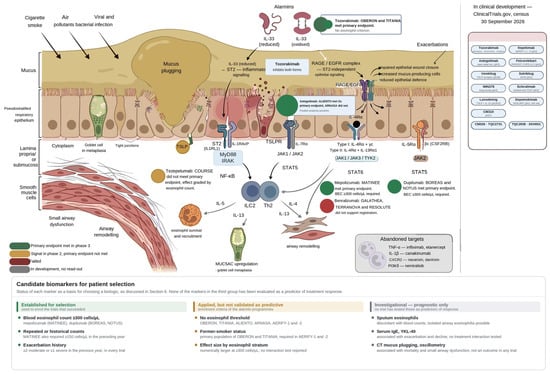
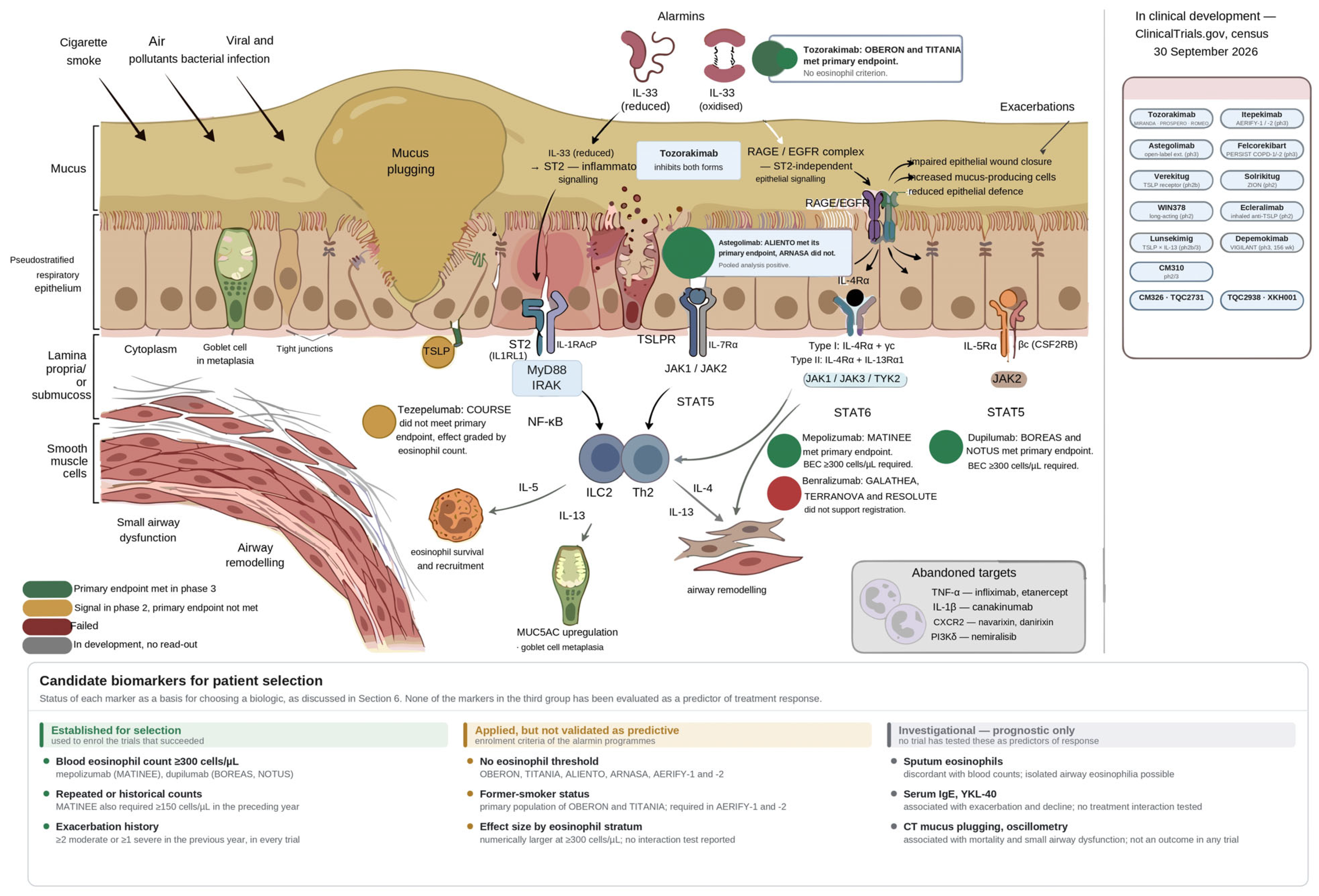
Four mechanistic groups have reported clinical data in COPD. The agents, their targets, the pathways they interrupt and the biomarkers proposed to select patients for them are shown in Figure 1. The eligibility criteria and primary endpoint results of the late-phase trials are given in Table 1; the text below summarises what each programme established and, where trials of the same target diverged, why that divergence matters.
Figure 1.
Inflammatory pathways targeted by biologic agents in COPD, the agents directed at each node, and the biomarkers proposed to select patients for them. Cigarette smoke and other inhaled injury act on the airway epithelium, which releases the alarmins IL-33 and TSLP. IL-33 signals through ST2 and, in its oxidised form, through an ST2-independent RAGE/EGFR complex; TSLP signals through the TSLP receptor. Downstream type 2 signalling converges on IL-4, IL-5 and IL-13, eosinophil recruitment and mucus hypersecretion. Agents are shown at the node they engage, with the outcome of their late-phase programme indicated; targets abandoned after unsuccessful development are shown separately. The lower band shows the candidate selection biomarkers discussed in Section 6 and their current status. Rate ratios and trial details are given in Table 1.
Table 1.
Late-phase trials of biologic agents in COPD that have reported a primary endpoint, with their eligibility criteria and results.
Interleukin-5 and its receptor—Mepolizumab was initially evaluated in METREX and METREO. In METREX, which enrolled an unselected population and stratified it by eosinophil count, the annual rate of moderate or severe exacerbations was reduced by 18% in the modified intention-to-treat population with an eosinophilic phenotype, defined as a blood eosinophil count of at least 150 cells/µL at screening or at least 300 cells/µL during the previous year (rate ratio 0.82, 95% CI 0.68–0.98; adjusted p = 0.04), whereas no between-group difference was seen in the overall population (0.98, 0.85–1.12) [11]. In METREO, in which all patients met the eosinophilic criterion, neither the 100 mg nor the 300 mg dose reached significance after adjustment for multiplicity. A greater effect was observed at higher screening eosinophil counts in both trials, and a subsequent combined analysis supported eosinophil-directed selection [12]. MATINEE then enrolled patients with a blood eosinophil count of at least 300 cells/µL at screening, together with a count of at least 150 cells/µL documented during the preceding 12 months, and demonstrated a 21% reduction in the annualised rate of moderate or severe exacerbations over 52 to 104 weeks (0.79, 0.66–0.94) [13].
Benralizumab did not significantly reduce the annualised rate of moderate or severe exacerbations in GALATHEA or TERRANOVA, whose primary analyses were conducted in patients with blood eosinophil counts of at least 220 cells/µL. No dose reached significance in either trial, and the dose-response relationship was not monotonic: in GALATHEA the rate ratios were 0.96 for 30 mg and 0.83 for 100 mg, and in TERRANOVA 0.85, 1.04 and 0.93 for 10, 30 and 100 mg respectively [14]. The subsequent RESOLUTE trial also did not meet its primary endpoint, according to sponsor-reported results [4]. Depemokimab, an ultra-long-acting anti-IL-5 antibody, has demonstrated efficacy in severe eosinophilic asthma and in chronic rhinosinusitis with nasal polyps, and is now in phase 3 development in COPD [15,16,17].
Interleukin-4 receptor α—Dupilumab reduced the annualised rate of moderate or severe exacerbations by 30% in BOREAS (rate ratio 0.70, 95% CI 0.58–0.86) and by 34% in NOTUS (0.66, 0.54–0.82). Both trials enrolled patients with a blood eosinophil count of at least 300 cells/µL and persistent exacerbations despite inhaled triple therapy [18,19].
Epithelial alarmins: interleukin-33 and ST2—This is where the field has moved on, and where the most consequential recent data lie. Six late-phase trials of three agents directed at the IL-33 axis have now reported, and they do not all point the same way. Because the pattern of replication is itself the most informative feature of this programme, the individual trial results are given below rather than the pooled estimates alone.
Tozorakimab, an anti-IL-33 antibody, is being evaluated in the LUNA programme, which comprises OBERON, TITANIA, MIRANDA and the PROSPERO extension [20]. OBERON and TITANIA enrolled current and former smokers with no eligibility criterion related to blood eosinophil count, and prespecified the cohort of former smokers as the primary analysis population. The annualised rate of moderate or severe exacerbations was reduced in both trials: rate ratio 0.71 (95% CI 0.57–0.88; p = 0.002) in OBERON and 0.66 (0.55–0.80; p < 0.001) in TITANIA among former smokers, with corresponding estimates of 0.70 (0.58–0.85) and 0.71 (0.59–0.84) in the overall populations of current and former smokers [7]. An earlier phase 2a trial, FRONTIER-4, did not meet its primary endpoint but provided the exploratory signals on which the phase 3 programme was built [21].
Astegolimab, which targets the IL-33 receptor ST2, was evaluated in ALIENTO (phase 2b) and ARNASA (phase 3) in patients with COPD and frequent exacerbations, irrespective of blood eosinophil count or the presence of chronic bronchitis. The two trials diverged, and so did the two dosing schedules. In ALIENTO, astegolimab every two weeks met the primary endpoint (rate ratio 0.85, 95% CI 0.72–1.00; p = 0.049) whereas every four weeks did not (0.93, 0.79–1.10; p = 0.38), a result that broke the trial’s fixed-sequence testing procedure. In ARNASA the pattern reversed: every two weeks did not reach statistical significance (0.85, 0.72–1.01; p = 0.068) while every four weeks did (0.82, 0.70–0.98; p = 0.024) [5]. The prespecified pooled analysis of 2682 participants showed a 15% reduction with every-two-week dosing (0.85, 0.76–0.96; p = 0.0077) and a 12% reduction with every-four-week dosing (0.88, 0.78–0.99; p = 0.0265), together with a nominally significant 32% reduction in severe exacerbations (0.68, 0.52–0.87; p = 0.0028) [6]. The pooled estimate is the most precise summary available for this agent, and it was prespecified; it should nonetheless be read alongside the individual trials, in which the primary endpoint was met in one of two and the ordering of the two doses was not consistent. The phase 2a COPD-ST2OP trial had not met its primary endpoint [22].
Itepekimab, also an anti-IL-33 antibody, followed a third trajectory. Its phase 2a trial did not meet its primary endpoint in the overall population (relative risk 0.81, 95% CI 0.61–1.07; p = 0.13), but a prespecified subgroup analysis showed a reduction in exacerbations confined to former smokers (0.58, 0.39–0.85; p = 0.0061), with no benefit in current smokers (1.09, 0.74–1.61; p = 0.65); the same study reported that loss-of-function variants in IL33 are associated with reduced COPD risk, and gain-of-function variants in IL33 and IL1RL1 are associated with increased risk [23]. On that basis AERIFY-1 and AERIFY-2 restricted eligibility to former smokers. The outcome was again split: the annualised exacerbation rate was reduced by 27.1% (p = 0.0019) with every-two-week dosing and by 20.5% (p = 0.0213) with every-four-week dosing in AERIFY-1, but by 1.6% (p = 0.88) and 12.4% (p = 0.22) in AERIFY-2 [24]. These results are currently available as a conference abstract and a sponsor announcement; no primary publication was indexed at the time of our final search, and the registry records are cited accordingly [25,26].
Two mechanistic observations may help to account for this pattern, and neither is reducible to the eosinophil. First, the three antibodies do not engage IL-33 identically. Structural work on the clinical antibodies shows that tozorakimab binds an epitope at IL-33/ST2 binding site 1 and completely occludes ST2 engagement, whereas itepekimab and etokimab bind a site 2 epitope and only partially inhibit ST2 binding; this difference tracks with their relative potency in cellular assays [27]. Second, IL-33 signals through more than ST2: oxidised IL-33 activates an ST2-independent RAGE/EGFR signalling complex associated with epithelial dysfunction and mucus hypersecretion in COPD-derived cultures [28]. An antibody directed at the cytokine can neutralise both routes; an antibody directed at the receptor cannot. Whether either consideration explains the trial results is unproven, and we present them as hypotheses. They are, however, sufficient reason not to treat inhibition of the IL-33 axis as a single intervention with a single expected effect.
Thymic stromal lymphopoietin (TSLP)—Tezepelumab did not meet the primary endpoint of reducing the annualised rate of moderate or severe exacerbations in the phase 2a COURSE trial. Prespecified subgroup analyses suggested greater potential benefit at higher blood eosinophil counts, although these findings remain inconclusive [29]. Ecleralimab, an inhaled anti-TSLP antibody fragment, attenuated allergen-induced bronchoconstriction and airway eosinophilia in mild atopic asthma and has also been investigated in an exploratory COPD trial [30,31]. Notwithstanding the negative phase 2a result, tezepelumab entered two phase 3 trials in moderate to very severe COPD in 2025, each with a planned enrolment of 990 participants [32,33]; they are among the few late-phase programmes in this field for which a negative signal-finding study was followed by pivotal development, and their eligibility criteria will therefore be informative about what the field now believes the relevant population to be.
Taken together, these findings highlight differences in patient selection across biologic programmes. Mepolizumab and dupilumab have demonstrated benefit in eosinophil-selected COPD populations, whereas the trials targeting IL-33 or its receptor enrolled patients without an eosinophil threshold and reduced exacerbations in some but not all of those trials. A systematic review of phase 2 and 3 trials of biologics in COPD reached the same conclusion from the opposite direction: in the overall populations of trials that applied no eosinophil limit, no agent reduced exacerbations, while within trials the effect was generally larger in patients with higher baseline counts [34].
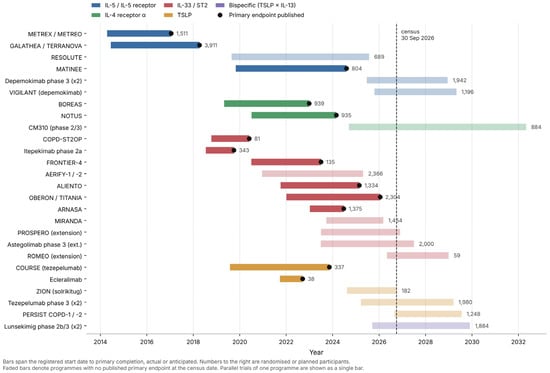
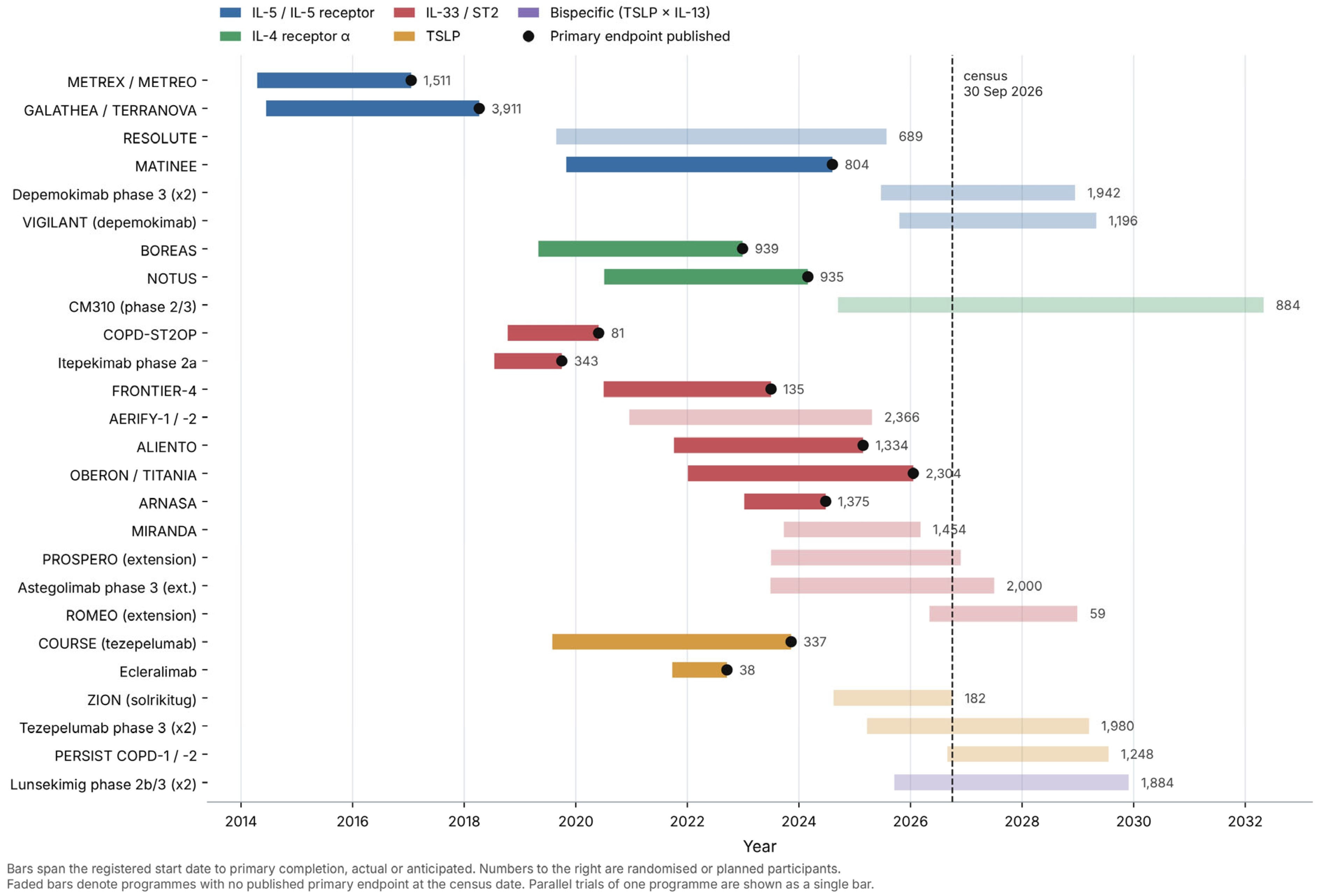
The composition of the pipeline has shifted accordingly. Of 36 registered interventional studies of phase 2 or above evaluating a biologic agent in COPD identified in ClinicalTrials.gov as of 30 September 2026, 17 evaluate agents directed at an epithelial alarmin, which is IL-33, ST2 or TSLP; 11 target the IL-5 axis; three target the IL-4 receptor alpha subunit; two are bispecific constructs; one targets a chemokine receptor; and for two the molecular target is not stated in the registry record. Thirty-one are industry sponsored. The chronology is shown in Figure 2. A decade ago, the field was defined by the IL-5 axis and by the eosinophil that selects for it; it is now defined by the epithelium, and the selection criterion for the epithelial agents has not yet been established.
Figure 2.
Chronology of registered interventional studies of phase 2 or above evaluating a biologic agent in COPD, grouped by molecular target, as recorded in ClinicalTrials.gov on 30 September 2026. Each bar spans the interval from study start to primary completion, actual or anticipated. Studies with a published primary endpoint are marked; those without a reported read-out are shown faded. The shift in the field from the IL-5 axis towards the epithelial alarmins is visible as a change in the composition of the pipeline after 2021.
4. Lessons from Therapies Targeting Neutrophilic and Innate Inflammation
Before the recent advances in biologic therapy, several approaches targeting neutrophilic and innate inflammatory pathways were investigated in COPD, with limited clinical success. These programmes included both biologic agents and small-molecule inhibitors. Infliximab, an anti-TNF-alpha antibody, did not improve the Chronic Respiratory Questionnaire total score in a randomised trial involving 234 patients [35]. A numerical imbalance in malignancies raised safety concerns and prompted subsequent long-term follow-up [36]. Etanercept likewise did not demonstrate superiority to prednisone in the treatment of acute COPD exacerbations [37]. Canakinumab, an anti-IL-1 beta antibody, was also investigated in an exploratory trial, but no later-phase respiratory programme was subsequently registered [38].
Results with small-molecule inhibitors were heterogeneous. The CXCR2 antagonist navarixin improved lung function at the highest tested dose, but treatment discontinuations associated with reductions in neutrophil counts raised tolerability concerns [39]. Early signals with the CXCR2 antagonist danirixin were not confirmed in a larger phase 2b trial, which showed no improvement in respiratory symptoms or health status and raised concerns about exacerbations and pneumonia [40,41].
A pilot study also identified CXCL8-independent neutrophil activation, suggesting that blockade of a single chemokine pathway may not adequately address the complexity of neutrophilic inflammation [42]. Similarly, inhaled nemiralisib did not improve lung function in a large phase 2b trial conducted during acute COPD exacerbations [43].
These findings illustrate the difficulty of translating biological plausibility into clinical benefit, and they constitute our answer to the second question posed in the introduction. Differences in safety, patient selection and trial design may all contribute to unsuccessful development. Another potential limitation we would like to highlight is the lack of validated predictive biomarkers that would allow us to identify patients who might benefit most from these interventions. Selection based primarily on clinical characteristics could mask therapeutic effects that are limited to a specific subgroup. However, this remains a hypothesis. Indeed, by contrast, blood eosinophil counts have provided a readily available means of enriching COPD populations in trials of mepolizumab and dupilumab. Although variable over time and imperfectly related to airway eosinophilia, this biomarker offers a practical selection tool [44,45]. Its availability may have contributed to successful development, alongside differences in target biology and pharmacology. Nevertheless, biomarker-based enrichment does not guarantee efficacy. The failure of RESOLUTE to meet its primary endpoint despite eosinophil-based selection illustrates the need to refine predictive biomarkers and treatment selection [4]. The lesson is not that enrichment works and its absence does not, but that neither a biomarker nor its absence substitutes for a mechanism that the agent demonstrably interrupts in the patient in front of the clinician.
5. Emerging Therapies, Patient Selection and Treatment Goals
The development of biologic therapies is expanding beyond established cytokine targets to include epithelial alarmins and approaches that simultaneously inhibit more than one inflammatory pathway. These programmes offer opportunities to explore different treatment strategies, although their clinical value will depend on demonstrating efficacy and identifying the patients most likely to benefit.
Selected examples include felcorekibart, a receptor-level TSLP antagonist being evaluated in the two PERSIST COPD trials, and lunsekimig, a bispecific antibody construct targeting both TSLP and IL-13 that is undergoing phase 2b/3 evaluation in two parallel trials restricted to an eosinophilic phenotype [46,47,48]. The latter combines inhibition of an upstream epithelial signal with a downstream effector cytokine. Whether this approach provides additional clinical benefit remains to be established, and the central question it raises is not pharmacological but one of selection: no biomarker-guided framework exists for deciding which patients require blockade of two pathways rather than one [8].
Development is also beginning to address questions beyond the addition of a biologic to existing maintenance therapy. The depemokimab VIGILANT trial tests earlier treatment initiation [49], while a separate extension study of the lunsekimig programme examines inhaled corticosteroid withdrawal during continued biologic treatment [50]. These designs may help clarify when biologic therapy should be introduced and how it might influence background treatment, and they are the first in this field to pose a question other than whether adding the agent to optimised inhaled therapy reduces exacerbations. The ongoing late-phase programmes, and the question each is designed to answer, are set out in Table 2.
Table 2.
Ongoing late-phase biologic programmes in COPD, with the question each programme is designed to answer.
As the range of candidate therapies broadens, patient selection remains a central challenge. Blood eosinophil counts and clinical characteristics provide practical eligibility criteria, but may not fully capture the mechanisms targeted by individual agents. Integrating pathway-related biomarkers with physiological and imaging measures is therefore an important direction for future research. Another key aspect concerns the design of clinical trials around a specific endpoint. Indeed, while it is true that a clinical trial may primarily address the question encoded by its endpoint, among all approved products this question recurs frequently and is consistent: does the agent reduce the annualised rate of moderate or severe exacerbations? This is a reasonable primary endpoint. It is also a recent convention. The near-universal adoption of the annualised exacerbation rate is therefore a choice the field made within the last two decades, and one it could revise. An agent that reduces exacerbation frequency during treatment may be preventing events, altering the disease process, or both; the endpoint cannot distinguish between them. The distinction matters for decisions clinicians make routinely: whether treatment can be interrupted, whether benefit accrues or plateaus, and whether early initiation differs from late. Interpretation also depends on how recurrent events, treatment discontinuation, missing follow-up and death are handled. Different estimands and analytical assumptions can influence the estimated treatment effect [51,52]. These considerations are relevant when comparing results across programmes and interpreting annualised exacerbation rates.
One interesting proposal is to consider disease stability. This operational definition combines the absence of moderate or severe exacerbations with the absence of worsening from baseline in the COPD Assessment Test score or FEV1, and provides a complementary framework for evaluating the benefits of treatment in various settings [53]. Its authors present the definition as preliminary and identify the open questions explicitly: over what interval stability should be assessed, against what thresholds, and how a composite should be constructed [54]. Post hoc analysis of phase 3 data shows that stability is attainable: it was achieved by 22% of patients receiving triple therapy in IMPACT at 52 weeks, by 46% in FULFIL at 24 weeks, and by 18% of patients receiving mepolizumab added to triple therapy at 52 weeks; patients stable at week 28 had a 45.7% lower risk of subsequent moderate or severe exacerbation and a 51.7% lower risk of all-cause mortality [53,55]. Exacerbation reduction and disease stability address related but distinct questions: whether treatment prevents acute events, and whether patients maintain a favourable clinical state over time. Prospectively incorporating stability measures alongside established endpoints could help assess whether the benefits of biologic therapy extend across multiple domains. We would stress, however, that stability and disease modification are not the same claim and should not be allowed to merge. Stability describes a clinical state maintained over a defined interval; disease modification is an assertion about the trajectory of the disease and requires longitudinal evidence that treatment alters it, including after treatment is withdrawn. A trial showing that more patients are stable on a biologic would not, on its own, establish the second claim.
6. Unresolved Questions in Patient Selection and Assessment
6.1. Who Should Be Treated?
Eligibility criteria derived from trial populations do not fully reflect the heterogeneity of COPD encountered in clinical practice. An analysis applying the criteria of sixteen industry-sponsored phase III and IV exacerbation prevention trials to a real-world COPD cohort found substantial variation in the proportion of eligible patients [56]. Although not specific to biologic therapies, these findings illustrate the potential limitations of extrapolating trial results to broader clinical populations. Real-world studies can help establish how many patients meet biologic trial criteria and characterise those who fall outside them. Where suitable data are available, target trial emulation may complement randomised evidence by examining comparative treatment outcomes in routine care, subject to the limitations of observational data [57].
For therapies whose evidence base relies on eosinophil-selected populations, an immediate practical question is how repeated measurements should inform treatment eligibility. In a primary-care cohort of 27,557 patients with COPD, the intraclass correlation for repeated blood eosinophil counts over one year was 0.64, increasing to 0.70 after excluding patients receiving systemic corticosteroids or antibiotics [44]. These findings indicate reasonable repeatability at the population level, while allowing clinically relevant variation within individual patients. Although repeatability estimates alone do not establish an optimal sampling strategy, a multi-source decision-analytic simulation specifically addressed this question. Among patients with intermittent eosinophilia, three measurements over 12 months were estimated to detect at least one blood eosinophil count above 300 cells/µL in 81% of cases, compared with 43% after a single measurement [45]. These findings support integrating historical and repeated measurements into eligibility assessment, although the proposed strategy requires prospective validation.
It is worth noting that the trials themselves have already moved in this direction, which makes the question less theoretical than it appears. MATINEE required a count of at least 300 cells/µL at screening together with a count of at least 150 cells/µL documented in the preceding year, and the eosinophilic phenotype in METREX and METREO was defined by a screening count of at least 150 cells/µL or a historical count of at least 300 cells/µL [11,13]. In practical terms, three elements are available to the clinician before a biologic is started and none of them requires a new test. The first is the eosinophil trajectory rather than a single value: repeated counts recorded outside exacerbations and away from systemic corticosteroids, interpreted as a pattern. The second is the exacerbation history that defined eligibility in every one of these trials, which was typically two or more moderate or one severe exacerbation in the preceding year, since a patient who does not exacerbate cannot demonstrate the benefit these agents produce. The third is the adequacy of background inhaled therapy, including inhaler technique and adherence, because the trials enrolled patients who were exacerbating despite optimised therapy and roughly three-quarters of them were receiving triple therapy; a biologic added to an unoptimised regimen is being asked to compensate for something else. None of these three is a predictive biomarker, and we do not present them as such. They are the elements of a defensible decision in the absence of one.
The results of trials targeting epithelial alarmins raise a related but distinct question: which biomarkers best predict response to these therapies? Tozorakimab, astegolimab and itepekimab have all been studied in populations enrolled without an eosinophil threshold [5,6,7,24]. This broadens the populations in which benefit has been demonstrated, but it does not establish that eosinophil counts have no predictive value, and the trials themselves argue against that reading. In the pooled astegolimab analysis the rate ratio for every-two-week dosing was 0.87 (95% CI 0.77–0.99) in patients with counts below 300 cells/µL and 0.73 (0.52–1.03) in those at or above that threshold; when split at 150 cells/µL the estimates were 0.82 (0.70–0.97) and 0.88 (0.74–1.04) [6]. In the pooled tozorakimab programme the gradient was more orderly: 0.77 (0.62–0.94) below 150 cells/µL, 0.75 (0.60–0.92) between 150 and 300, and 0.57 (0.44–0.74) at or above 300 [7]. These are subgroup analyses without formal tests of treatment-by-biomarker interaction, and the astegolimab strata are not monotonic, so they cannot establish effect modification. What they do establish is that the hypothesis of a larger effect at higher eosinophil counts survives these trials rather than being refuted by them. Assessing its truth requires treatment-effect analyses across the full range of eosinophil values, with prespecified interaction tests, rather than the dichotomies that current reporting provides.
Experimental studies provide a rationale for considering markers beyond circulating eosinophils. Oxidised IL-33 can activate an ST2-independent RAGE/EGFR signalling pathway associated with epithelial dysfunction and mucus hypersecretion in COPD-derived cultures [28]. Tozorakimab inhibits ST2-mediated IL-33 signalling and prevents activation of this alternative pathway. The distinction is also relevant when interpreting astegolimab, which targets ST2 rather than IL-33 itself. Blood eosinophils therefore remain a practical selection tool for therapies supported by eosinophil-enriched trials, while additional predictors are needed to refine selection for the emerging agents. The challenge is to determine which accessible biomarkers capture relevant pathway activity and, crucially, predict differential treatment benefit.
6.2. Smoking Status as a Selection Variable
The attention on eosinophils has obscured a second enrichment criterion that the IL-33 programmes applied explicitly. OBERON and TITANIA enrolled current and former smokers but prespecified the cohort of former smokers as the population for the primary endpoint and capped the enrolment of current smokers, who accounted for approximately 21% of those randomised [7]. AERIFY-1 and AERIFY-2 restricted eligibility to former smokers altogether, defined as having not smoked for at least six months, a decision that followed directly from the phase 2a subgroup result [23,24]. The statement that these trials did not require a blood eosinophil threshold is therefore accurate but incomplete. In two of the three IL-33 programmes a biomarker-based criterion was replaced, at least in part, by a behavioural one.
Whether smoking status modifies the treatment effect is not settled by the available data, but the direction is consistent across the three agents. In the phase 2a itepekimab trial the relative risk was 0.58 (95% CI 0.39–0.85) in former smokers and 1.09 (0.74–1.61) in current smokers [23]. In the separate current-smoker cohort of AERIFY-2, every-two-week itepekimab was associated with a 7.1% reduction in exacerbations (p = 0.66) [24]. In the pooled OBERON and TITANIA analysis the rate ratio was 0.68 (0.59–0.79) among former smokers and 0.79 (0.60–1.04) among current smokers [7]. The astegolimab pooled analysis, which did not restrict or prespecify by smoking status, reported efficacy that was generally consistent regardless of current or former smoking [6]. None of these programmes reported a formal treatment-by-smoking-status interaction test, the current-smoker strata were small, and their confidence intervals overlap those of the former smokers. These are therefore subgroup observations and not demonstrations of effect modification; it is equally possible that the apparent attenuation reflects the smaller stratum sizes and the higher event rates in continuing smokers.
A mechanistic rationale for an interaction nonetheless exists, and it is specific to this axis. The pathogenic activity attributed to IL-33 in COPD depends in part on its oxidation state, and cigarette smoke is a direct source of the oxidative stress that generates oxidised IL-33 and drives the epithelial injury associated with it [28]. Continued smoking might therefore either amplify the available target or shift signalling towards the ST2-independent route. The two possibilities predict opposite consequences for an antibody directed at the receptor as opposed to one directed at the cytokine, and they are not distinguishable from the trial data as reported.
The practical consequences are immediate. If an IL-33-directed agent is approved on the basis of a former-smoker population, prescribing will require that smoking status be established rather than assumed, and that it be re-established during treatment: relapse is common, and smoking status was handled as a baseline stratification variable rather than as a time-varying covariate in all of these trials. Documented smoking cessation therefore becomes part of the eligibility assessment in a way that it is not for the eosinophil-selected agents, and a patient who resumes smoking moves outside the population in which efficacy was demonstrated without any change in the biomarker. This also leaves an evidence gap in precisely the group with the greatest exposure to the putative mechanism. Trials that enrol current smokers in adequate numbers and prespecify the interaction would be considerably more informative than further subgroup reports.
6.3. Prognostic and Predictive Biomarkers
In COPD, biomarkers for guiding biologic treatment selection remain less established than in severe asthma. The distinction that matters is between a biomarker that identifies patients at higher risk of a poor outcome, which is prognostic, and one that identifies patients in whom a particular treatment produces a larger effect, which is predictive. The two are often conflated, and they require different evidence: a prognostic claim rests on an association with outcome in any population, whereas a predictive claim rests on an interaction between the biomarker and the treatment and therefore requires randomised data analysed across biomarker strata. Almost all of the candidate biomarkers discussed below have been evaluated only for the first.
Total immunoglobulin E is elevated in over 30% of patients with COPD, is higher in men with recent exacerbations, and predicts lung function decline in the highest tertile [58]. YKL-40 correlates with neutrophilic inflammation and with exacerbation history when measured in serum, but with symptom burden when measured in sputum, so that its interpretation depends on the compartment sampled [59]. These findings support a potential relevance to disease characterisation; we would emphasise that they do not establish validated thresholds for selecting patients for a specific biologic therapy, and that neither marker has been examined for interaction with any biologic treatment in a randomised trial. On present evidence they are prognostic associations of uncertain magnitude, and the step from such an association to a selection criterion is the step that the development history in Section 4 shows to be the difficult one.
Blood eosinophils illustrate the same distinction in the opposite direction, since here the predictive evidence is the stronger part. In a population-based study of 57,209 patients, receiver-operating-characteristic analysis did not identify a blood eosinophil threshold that reliably discriminated exacerbation risk [60]. The relationship between eosinophil count and previous exacerbations was non-monotonic, while greater variability in repeated counts was associated with more frequent exacerbations. These findings concern exacerbation risk, which is a prognostic question, and should not be interpreted as evidence against the ability of eosinophils to predict treatment response, for which the trial evidence summarised above is considerably more favourable. A biomarker can be a poor prognostic discriminator and a useful predictive one; the two properties are logically independent. The association with variability also raises the possibility that longitudinal patterns contain information beyond an isolated count or its average. Averaging repeated measurements may improve estimation of a patient’s usual eosinophil level, but may obscure fluctuations that could carry additional information. Whether variability adds prognostic or predictive value beyond absolute counts requires further investigation.
Compartmental differences introduce another limitation. Blood and sputum eosinophil counts are related but discordant in COPD [61]. Evidence from asthma illustrates the potential clinical relevance of this discordance: in a post hoc analysis of ATLANTIS, 17% of patients with low blood eosinophils had isolated sputum eosinophilia [62]. These patients had greater airflow obstruction, greater small airway dysfunction and an approximately threefold higher rate of previous exacerbations than those with low eosinophil counts in both compartments. These findings cannot be directly extrapolated to COPD, but raise the possibility that blood-based selection may fail to identify some patients with airway eosinophilic inflammation. Whether such patients benefit from eosinophil-targeted biologics in COPD remains unknown.
6.4. Small Airway Dysfunction and Mucus Plugging
Small airway dysfunction is an important component of COPD that may not be fully characterised by conventional spirometry. Oscillometry and imaging could complement FEV1 by providing additional information about functional and structural abnormalities. Their value in biologic trials will depend on measurement reproducibility, responsiveness to treatment and association with clinically meaningful outcomes.
CT-detected mucus plugging represents a related but distinct structural trait. Plugs may persist over time and occur without reported cough or sputum production [63]. In COPDGene, greater mucus plug burden was associated with higher all-cause mortality after adjustment for relevant clinical and imaging characteristics [64]. Experimental evidence linking IL-33 signalling to epithelial dysfunction and mucus hypersecretion provides a rationale for investigating mucus-related outcomes during targeted treatment [65].
We would be explicit about the status of this proposal, because it is easily overread. Neither oscillometry nor CT-assessed mucus plugging has been evaluated as a predictor of response to any biologic in COPD. No biologic trial in COPD has reported either measure as a prespecified outcome, no threshold has been defined for either, and the association between mucus plug burden and mortality is an observational finding in an untreated cohort. The proposition that baseline mucus plugging might identify patients more likely to respond to IL-33 blockade is a hypothesis generated by mechanistic plausibility, and we advance it as nothing more than that; the same applies to small airway dysfunction. What can be said is narrower and still useful: combining spirometry with complementary functional and imaging assessments may help characterise treatment effects beyond exacerbation reduction, and incorporating such measures prospectively, with their reproducibility and responsiveness established first, is the only way to find out whether they predict anything. Demonstrating disease modification would additionally require longitudinal evidence that treatment alters the course of disease.
Current evidence and unmet needs in biologic treatment selection, including the potential contribution of treatable traits and complementary assessments, are summarised in Table 3.
Table 3.
Patient selection for biologic therapies in COPD: evidence and unmet needs.
7. Safety, Cost and the Practical Conduct of Treatment
7.1. Long-Term Safety
Across the late-phase programmes, adverse events have been balanced against placebo and no class-specific signal has emerged. In OBERON and TITANIA, adverse events occurred in 70.4% versus 77.2% and in 80.1% versus 79.8% of tozorakimab and placebo recipients respectively [7]. In the pooled astegolimab analysis, the rates of adverse events (365 versus 408 per 100 patient-years), serious adverse events (39 versus 48), major adverse cardiovascular events (2.9 versus 3.7) and deaths (2.3 versus 3.1) were all numerically lower with every-two-week astegolimab than with placebo, and deaths in the individual trials were balanced across groups, with three of 2676 participants dying of a cause considered treatment-related by the investigator [5,6]. In MATINEE the incidence of any adverse event was similar between groups and serious adverse events or death occurred in 25% versus 28% [13]. In BOREAS and NOTUS, adverse events leading to death occurred in 1.7% versus 1.5% and in 1.5% versus 2.6% respectively [18,19].
Two caveats constrain what can be concluded from this. The first is duration. Controlled exposure is short relative to the treatment duration that is contemplated in practice: 52 weeks in all of these trials except MATINEE, which continued to 104 weeks [13]. Dedicated long-term extensions exist, including PROSPERO for tozorakimab and a double-blind safety extension for itepekimab, but their controlled follow-up is limited and, for the agents still in development, not yet reported [20,66]. The second is that the concerns specific to this class are not the ones that routine adverse-event tabulation detects well. Sustained neutralisation of an epithelial alarmin in a population with structurally abnormal airways and a high burden of respiratory infection warrants attention to infection and to malignancy over years rather than months. The experience with infliximab, in which a numerical excess of malignancy prompted a dedicated long-term follow-up study, is the precedent for taking this seriously in the absence of a signal at one year [35,36]. The pattern of failure among the small-molecule inhibitors is instructive in the same way: navarixin and danirixin were limited by neutropenia and by concerns about pneumonia and exacerbation respectively, rather than by a failure to engage their target [39,40]. Post-authorisation surveillance and registry follow-up will therefore carry more of the evidential weight for this class than for agents whose mechanism is unrelated to host defence.
7.2. Guidelines, Cost-Effectiveness and Access
GOLD 2026 positions dupilumab and mepolizumab as add-on therapy for exacerbation-prone eosinophilic COPD, while noting continuing limitations in efficacy, cost-effectiveness and generalisability and identifying inequitable access to advanced interventions as an unresolved problem [2]. Those limitations are not incidental to the question of patient selection; they are another form of it. Markov analyses conducted from a middle-income health-system perspective estimated incremental cost-effectiveness ratios of approximately US$12,900 per quality-adjusted life-year for dupilumab and US$45,200 for mepolizumab, each added to triple therapy, both exceeding the local willingness-to-pay threshold, with dupilumab becoming cost-effective only at a monthly drug cost below roughly US$240 [67,68]. These estimates are specific to the setting in which they were derived and should not be transferred to other health systems. What they identify is the variable that determines access, which is price rather than effect size, and the direction of the problem if agents effective without eosinophil selection are approved: the eligible population widens considerably, and the budget consequence scales with it. A selection criterion is, among other things, a rationing instrument, and the field should be explicit that removing one has fiscal as well as clinical consequences.
7.3. Defining Response, Reassessing Treatment and Stopping
This review has argued that the annualised exacerbation rate cannot distinguish event prevention from modification of the disease course. The same limitation has an immediate clinical counterpart that is rarely stated: a rate is a property of a population over a year, and it tells the clinician sitting with an individual patient at month six very little. No randomised trial of a biologic in COPD prespecified a responder definition, a reassessment interval or a stopping rule, and none of the approved agents is accompanied by one.
In severe asthma the equivalent gap was addressed, imperfectly, by consensus: an international Delphi process defined a super-responder as a patient showing improvement across three or more domains over 12 months, with major criteria comprising elimination of exacerbations, an improvement in control of at least twice the minimal clinically important difference, and cessation of maintenance oral corticosteroids [69]. No equivalent instrument has been developed for COPD, and the asthma definition does not transfer, because its components behave differently in this disease: exacerbations are the primary outcome rather than a response marker, FEV1 responses to biologics are small, maintenance oral corticosteroid use is uncommon, and the symptom instruments were developed for other purposes.
Three decisions therefore rest on clinical judgement rather than on evidence: what constitutes an adequate response, when that judgement should be made, and whether treatment can be interrupted once a patient is stable. The disease-stability construct discussed in Section 5 is the most promising candidate for the first, because it is defined at the level of the individual patient over a specified interval rather than as a population rate, and because its components are already recorded in routine care [53,55]. Using it to guide treatment continuation would require prospective validation in treated cohorts, which has not been undertaken. Until it is, two observations seem defensible. The absence of a stopping rule is not evidence that treatment should be indefinite. And randomised withdrawal designs, applied after a defined period of stability, would answer the question directly and are feasible now; their absence from a pipeline of 36 registered studies is itself a finding about how this field has chosen to allocate its evidence-generating capacity.
8. Conclusions
Biologic therapies are expanding the therapeutic possibilities for COPD, with emerging programmes targeting epithelial alarmins and multiple inflammatory pathways. Recent trials of IL-33 and ST2 inhibition enrolled patients without a blood eosinophil threshold and reduced exacerbations in some, but not all, of those trials: tozorakimab met its primary endpoint in both OBERON and TITANIA, astegolimab in ALIENTO but not in ARNASA, and itepekimab in AERIFY-1 but not in AERIFY-2 [5,6,7,24]. These findings broaden the populations in which benefit has been demonstrated, while leaving important questions about treatment selection unresolved. Blood eosinophils remain a practical selection tool for therapies supported by eosinophil-enriched trials, and within the alarmin programmes the effect estimates were numerically larger at higher eosinophil counts, so the absence of an enrolment threshold is not evidence that the biomarker is uninformative. Two of the three IL-33 programmes also enriched for former smokers, and the apparent attenuation of effect in current smokers deserves prospective testing rather than further subgroup reporting. For the emerging agents, further work is needed to establish which clinical characteristics and biomarkers predict treatment benefit. Biological plausibility, prognostic association and predictive utility should be distinguished when developing these strategies, and most of the candidate biomarkers currently proposed for COPD have been evaluated only for the second of the three.
Exacerbation prevention remains a central therapeutic objective, but complementary assessments could provide a broader understanding of treatment effects. Prospective evaluation of disease stability, together with selected functional and imaging measures such as oscillometry and CT-assessed mucus plugging, may help characterise benefits across multiple domains; none of these measures has yet been evaluated as a predictor of response, and we present them as research priorities rather than as selection tools. Their inclusion should be guided by feasibility, reproducibility and clinical relevance. Demonstrating disease modification requires additional longitudinal evidence and should not be inferred from stability. Alongside these questions, the practical ones remain open: controlled safety data extend to one year in all but one trial, cost-effectiveness is unfavourable at current prices in the analyses available, and no responder definition, reassessment interval or stopping rule has been prespecified anywhere in this literature.
Future research should therefore refine both whom to treat and how treatment success is assessed. Validated predictors of response and harmonised, clinically meaningful outcomes will be important for translating an expanding range of biologic therapies into effective and sustainable COPD care.
Supplementary Materials
The following supporting information can be downloaded at https://www.mdpi.com/article/10.3390/biomedicines14112460/s1, Table S1: Sources searched, the search strings as executed, and the selection flow; Table S2: Self-assessment of this review against the six SANRA items.
Author Contributions
Conceptualization, P.-V.M. and S.I.; methodology, P.-V.M. and S.I.; investigation and literature search, P.-V.M. and S.I.; data curation, P.-V.M. and S.I.; writing original draft preparation, P.-V.M.; writing, review and editing, P.-V.M., S.I., L.C., G.V., Y.R., S.B., V.O., A.R. and R.S.; supervision, R.S. All authors have read and agreed to the published version of the manuscript.
Funding
This research received no external funding.
Institutional Review Board Statement
Not applicable. This review used publicly available published literature and publicly accessible clinical trial registry records; no patient-level data were accessed.
Informed Consent Statement
Not applicable.
Data Availability Statement
No new data were created. All data discussed in this review are available in the cited publications, in the cited ClinicalTrials.gov records, and in the Supplementary Materials described above.
Conflicts of Interest
The authors declare no conflicts of interest.
References
- Mathioudakis, A.G.; Vestbo, J.; Singh, D. Long-Acting Bronchodilators for Chronic Obstructive Pulmonary Disease: Which One(S), How, and When? Clin. Chest Med. 2020, 41, 463–474. [Google Scholar]
- Cazzola, M.; Bajpai, J.; Calzetta, L.; Matera, M.G.; Rogliani, P. GOLD 2026: Transforming COPD Management with Early Intervention, Multi-dimensional Assessment, and Personalized Care. Drugs 2026, 86, 581–597. [Google Scholar] [CrossRef] [Scilit]
- Cheng, S.-L. Beyond Eosinophil Depletion: IL-5 as a Context-Dependent Regulator of Airway Immune Networks. Int. J. Mol. Sci. 2026, 27, 4077. [Google Scholar] [CrossRef] [Scilit]
- Update on the RESOLUTE Phase III Trial for Fasenra in Chronic Obstructive Pulmonary Disease. 2025. Available online: https://www.astrazeneca.com/content/astraz/media-centre/press-releases/2025/update-on-resolute-phase-iii-trial.html (accessed on 12 October 2026).
- Papi, A.; Greening, N.J.; Bhatt, S.P.; Roche, N.; Celli, B.; Wedzicha, J.A.; Agustí, À.; Tal-Singer, R.; Han, M.K.; Janssens, W.; et al. Safety and efficacy of astegolimab for COPD with frequent exacerbations regardless of baseline blood eosinophil counts (ALIENTO and ARNASA): Randomised, double-blind, placebo-controlled, phase 2b and 3 trials. Lancet 2026, 407, 2027–2039. [Google Scholar] [CrossRef] [Scilit]
- Wedzicha, J.A.; Agustì, À.; Brightling, C.E.; Calverley, P.; Chalmers, J.D.; Greening, N.J.; Han, M.K.; Mohan, D.; Ng, J.; Papi, A.; et al. Astegolimab for chronic obstructive pulmonary disease with frequent exacerbations: Pooled analysis of the ALIENTO and ARNASA trials. Am. J. Respir. Crit. Care Med. 2026, 212, 2050–2060. [Google Scholar] [CrossRef] [Scilit]
- Sciurba, F.C.; Watz, H.; Bourdin, A.; Janssens, W.; Martinez, F.J.; Zheng, J.; Berge, M.v.D.; Bonini, M.; Han, M.K.; Singh, D.; et al. Tozorakimab to Prevent COPD Exacerbations. N. Engl. J. Med. 2026, NEJMoa2606998. [Google Scholar] [CrossRef] [Scilit]
- Cheng, Y.; Ding, J.; Li, Z.; Tong, J.; Yang, C. The dawn of the dual-target era in respiratory disease: Promise, pitfalls, and a roadmap for bispecific antibodies. Front. Immunol. 2026, 17, 1906783. [Google Scholar] [CrossRef] [Scilit]
- Agusti, A.; Singh, D.; Faner, R. Treatment of chronic obstructive pulmonary disease: Current pipeline and new opportunities. Nat. Rev. Drug Discov. 2026, 25, 98–115. [Google Scholar] [CrossRef] [Scilit]
- Baethge, C.; Goldbeck-Wood, S.; Mertens, S. SANRA—A scale for the quality assessment of narrative review articles. Res. Integr. Peer Rev. 2019, 4, 5. [Google Scholar] [CrossRef] [Scilit]
- Pavord, I.D.; Chanez, P.; Criner, G.J.; Kerstjens, H.A.; Korn, S.; Lugogo, N.; Martinot, J.-B.; Sagara, H.; Albers, F.C.; Bradford, E.S.; et al. Mepolizumab for Eosinophilic Chronic Obstructive Pulmonary Disease. N. Engl. J. Med. 2017, 377, 1613–1629. [Google Scholar] [CrossRef] [Scilit]
- Pavord, I.; Chapman, K.; Bafadhel, M.; Sciurba, F.C.; Bradford, E.S.; Harris, S.S.; Mayer, B.; Rubin, D.B.; Yancey, S.W.; Paggiaro, P. Mepolizumab for Eosinophil-Associated COPD: Analysis of METREX and METREO. Int. J. Chronic Obs. Pulm. Dis. 2021, 16, 1755–1770. [Google Scholar] [CrossRef] [Scilit]
- Sciurba, F.C.; Criner, G.J.; Christenson, S.A.; Martinez, F.J.; Papi, A.; Roche, N.; Bourbeau, J.; Korn, S.; Bafadhel, M.; Han, M.K.; et al. Mepolizumab to Prevent Exacerbations of COPD with an Eosinophilic Phenotype. N. Engl. J. Med. 2025, 392, 1710–1720. [Google Scholar] [CrossRef] [Scilit]
- Criner, G.J.; Celli, B.R.; Brightling, C.E.; Agusti, A.; Papi, A.; Singh, D.; Sin, D.D.; Vogelmeier, C.F.; Sciurba, F.C.; Bafadhel, M.; et al. Benralizumab for the Prevention of COPD Exacerbations. N. Engl. J. Med. 2019, 381, 1023–1034. [Google Scholar] [CrossRef] [Scilit]
- Wechsler, M.E.; Jackson, D.J.; Bernstein, D.; Korn, S.; Pfeffer, P.E.; Chen, R.; Saito, J.; Martinez, G.d.L.; Dymek, L.; Jacques, L.; et al. Twice-Yearly Depemokimab in Severe Asthma with an Eosinophilic Phenotype. N. Engl. J. Med. 2024, 391, 2337–2349. [Google Scholar] [CrossRef] [Scilit]
- Gevaert, P.; Desrosiers, M.; Cornet, M.; Mullol, J.; De Corso, E.; Turel, N.K.; Maspero, J.; Fujieda, S.; Zhang, L.; Sousa, A.R.; et al. Efficacy and safety of twice per year depemokimab in chronic rhinosinusitis with nasal polyps (ANCHOR-1 and ANCHOR-2): Phase 3, randomised, double-blind, parallel trials. Lancet 2025, 405, 911–926. [Google Scholar] [CrossRef] [Scilit]
- GlaxoSmithKline. A Randomized, Double-Blind, Placebo-Controlled, Parallel-Group, Multicenter Study of the Efficacy and Safety of Depemokimab in Adult Participants with COPD with Type 2 Inflammation. Clinical Trial Registration NCT06959095, clinicaltrials.gov. 1 October 2026. Available online: https://clinicaltrials.gov/study/NCT06959095 (accessed on 12 October 2026).
- Bhatt, S.P.; Rabe, K.F.; Hanania, N.A.; Vogelmeier, C.F.; Cole, J.; Bafadhel, M.; Christenson, S.A.; Papi, A.; Singh, D.; Laws, E.; et al. Dupilumab for COPD with Type 2 Inflammation Indicated by Eosinophil Counts. N. Engl. J. Med. 2023, 389, 205–214. [Google Scholar] [CrossRef] [Scilit]
- Bhatt, S.P.; Rabe, K.F.; Hanania, N.A.; Vogelmeier, C.F.; Bafadhel, M.; Christenson, S.A.; Papi, A.; Singh, D.; Laws, E.; Patel, N.; et al. Dupilumab for COPD with Blood Eosinophil Evidence of Type 2 Inflammation. N. Engl. J. Med. 2024, 390, 2274–2283. [Google Scholar] [CrossRef] [Scilit]
- Watz, H.; Sciurba, F.C.; Bonini, M.; Yañez, A.; Bourdin, A.; Zheng, J.; De Soyza, A.; Janssens, W.; Berge, M.v.D.; Xu, J.-F.; et al. Phase III LUNA clinical programme: Design of four randomised, double-blind, placebo-controlled studies assessing the efficacy and safety of tozorakimab in patients with symptomatic COPD and a high risk of exacerbations. BMJ Open Respir. Res. 2026, 13, e004145. [Google Scholar] [CrossRef] [Scilit]
- Singh, D.; Guller, P.; Reid, F.; Doffman, S.; Seppälä, U.; Psallidas, I.; Moate, R.; Smith, R.; Kiraga, J.; Jimenez, E.; et al. A phase 2a trial of the IL-33 monoclonal antibody tozorakimab in patients with COPD: FRONTIER-4. Eur. Respir. J. 2025, 66, 2402231. [Google Scholar] [CrossRef] [Scilit]
- Yousuf, A.J.; Mohammed, S.; Carr, L.; Ramsheh, M.Y.; Micieli, C.; Mistry, V.; Haldar, K.; Wright, A.; Novotny, P.; Parker, S.; et al. Astegolimab, an anti-ST2, in chronic obstructive pulmonary disease (COPD-ST2OP): A phase 2a, placebo-controlled trial. Lancet Respir. Med. 2022, 10, 469–477. [Google Scholar] [CrossRef] [Scilit]
- Rabe, K.F.; Celli, B.R.; Wechsler, M.E.; Abdulai, R.M.; Luo, X.; Boomsma, M.M.; Staudinger, H.; Horowitz, J.E.; Baras, A.; Ferreira, M.A.; et al. Safety and efficacy of itepekimab in patients with moderate-to-severe COPD: A genetic association study and randomised, double-blind, phase 2a trial. Lancet Respir. Med. 2021, 9, 1288–1298. [Google Scholar] [CrossRef] [Scilit]
- Rabe, K.F.; Martinez, F.J.; Bhatt, S.P.; Wen, F.-Q.; Schonffeldt, P.; Mroz, R.M.; Korn, S.; Papi, A.; Devouassoux, G.; Goulaouic, H.; et al. Efficacy and Safety of Itepekimab in Former Smokers with Chronic Obstructive Pulmonary Disease: AERIFY-1 and AERIFY-2 Trials. Am. J. Respir. Crit. Care Med. 2026, 212, aamag286.124. [Google Scholar] [CrossRef] [Scilit]
- Sanofi. Randomized, Double-Blind, Placebo-Controlled, Parallel Group Phase 3 Study to Evaluate the Efficacy, Safety, and Tolerability of Itepekimab in Patients with Moderate-to-Severe COPD (AERIFY-1). Clinical Trial Registration NCT04701983, clinicaltrials.gov. Available online: https://clinicaltrials.gov/study/NCT04701983 (accessed on 12 October 2026).
- Sanofi. Randomized, Double-Blind, Placebo-Controlled, Parallel-Group Phase 3 Study to Evaluate the Efficacy, Safety, and Tolerability of Itepekimab in Patients with Moderate-to-Severe COPD (AERIFY-2). Clinical Trial Registration NCT04751487, clinicaltrials.gov. Available online: https://clinicaltrials.gov/study/NCT04751487 (accessed on 12 October 2026).
- Chen, J.; Wang, Y.; Wang, X. Structures of clinical antibodies bound to IL-33 uncover two distinct epitopes underlying differential efficacy. MAbs 2026, 18, 2639673. [Google Scholar] [CrossRef] [Scilit]
- Strickson, S.; Houslay, K.F.; Negri, V.A.; Ohne, Y.; Ottosson, T.; Dodd, R.B.; Huntington, C.C.; Baker, T.; Li, J.; Stephenson, K.E.; et al. Oxidised IL-33 drives COPD epithelial pathogenesis via ST2-independent RAGE/EGFR signalling complex. Eur. Respir. J. 2023, 62, 2202210. [Google Scholar]
- Singh, D.; Brightling, C.E.; Rabe, K.F.; Han, M.K.; Christenson, S.A.; Drummond, M.B.; Papi, A.; Pavord, I.D.; Molfino, N.A.; Almqvist, G.; et al. Efficacy and safety of tezepelumab versus placebo in adults with moderate to very severe chronic obstructive pulmonary disease (COURSE): A randomised, placebo-controlled, phase 2a trial. Lancet Respir. Med. 2025, 13, 47–58. [Google Scholar] [CrossRef] [Scilit]
- Gauvreau, G.M.; Hohlfeld, J.M.; FitzGerald, J.M.; Boulet, L.-P.; Cockcroft, D.W.; Davis, B.E.; Korn, S.; Kornmann, O.; Leigh, R.; Mayers, I.; et al. Inhaled anti-TSLP antibody fragment, ecleralimab, blocks responses to allergen in mild asthma. Eur. Respir. J. 2023, 61, 2201193. [Google Scholar] [CrossRef] [Scilit]
- Novartis Pharmaceuticals. A 12-Week Randomized, Participant-and Investigator-Blinded, Placebo-Controlled, Parallel Group Study to Explore the Efficacy, Pharmacodynamics, Safety, and Pharmacokinetics of Two Doses of Inhaled CSJ117 in Adults with Chronic Obstructive Pulmonary Disease (COPD). Clinical Trial Registration NCT04882124, clinicaltrials.gov. 25 November 2022. Available online: https://clinicaltrials.gov/study/NCT04882124 (accessed on 12 October 2026).
- AstraZeneca. A Randomised, Double-Blind, Placebo-Controlled, Parallel Group, Multicentre, Phase III Study to Evaluate the Efficacy and Safety of Tezepelumab in Adult Participants with Moderate to Very Severe Chronic Obstructive Pulmonary Disease. Clinical Trial Registration NCT06878261, clinicaltrials.gov. Available online: https://clinicaltrials.gov/study/NCT06878261 (accessed on 12 October 2026).
- AstraZeneca. A Randomised, Double-Blind, Placebo-Controlled, Parallel Group, Multicentre, Phase III Study to Evaluate the Efficacy and Safety of Tezepelumab in Adult Participants with Moderate to Very Severe Chronic Obstructive Pulmonary Disease. Clinical Trial Registration NCT06883305, clinicaltrials.gov. Available online: https://clinicaltrials.gov/study/NCT06883305 (accessed on 12 October 2026).
- Brightling, C.E.; Rabe, K.F.; Singh, D.; Han, M.K.; Bhutani, M.; Bourbeau, J.; Nair, P.; Drummond, M.B.; Gandhi, E.A.; Sindhwani, N.S.; et al. Efficacy of Biologics in Patients with Moderate to Very Severe COPD: A Systematic Review. Int. J. Chronic Obstr. Pulm. Dis. 2026, 21, 603471. [Google Scholar] [CrossRef] [Scilit]
- Rennard, S.I.; Fogarty, C.; Kelsen, S.; Long, W.; Ramsdell, J.; Allison, J.; Mahler, D.; Saadeh, C.; Siler, T.; Snell, P.; et al. The Safety and Efficacy of Infliximab in Moderate to Severe Chronic Obstructive Pulmonary Disease. Am. J. Respir. Crit. Care Med. 2007, 175, 926–934. [Google Scholar] [CrossRef] [Scilit]
- Rennard, S.I.; Flavin, S.K.; Agarwal, P.K.; Lo, K.H.; Barnathan, E.S. Long-term safety study of infliximab in moderate-to-severe chronic obstructive pulmonary disease. Respir. Med. 2013, 107, 424–432. [Google Scholar] [CrossRef] [Scilit]
- Aaron, S.D.; Vandemheen, K.L.; Maltais, F.; Field, S.K.; Sin, D.D.; Bourbeau, J.; Marciniuk, D.D.; FitzGerald, J.M.; Nair, P.; Mallick, R. TNFα antagonists for acute exacerbations of COPD: A randomised double-blind controlled trial. Thorax 2013, 68, 142–148. [Google Scholar] [CrossRef] [Scilit]
- Novartis Pharmaceuticals. A Randomized, Double-Blind, Placebo Controlled, Exploratory Study to Assess the Safety and Efficacy of Multiple Doses of ACZ885 in Chronic Obstructive Pulmonary Disease (COPD) Patients. Clinical Trial Registration NCT00581945, clinicaltrials.gov. 28 June 2011. Available online: https://clinicaltrials.gov/study/NCT00581945 (accessed on 12 October 2026).
- Rennard, S.I.; Dale, D.C.; Donohue, J.F.; Kanniess, F.; Magnussen, H.; Sutherland, E.R.; Watz, H.; Lu, S.; Stryszak, P.; Rosenberg, E.; et al. CXCR2 Antagonist MK-7123. A Phase 2 Proof-of-Concept Trial for Chronic Obstructive Pulmonary Disease. Am. J. Respir. Crit. Care Med. 2015, 191, 1001–1011. [Google Scholar] [CrossRef] [Scilit]
- Lazaar, A.L.; Miller, B.E.; Donald, A.C.; Keeley, T.; Ambery, C.; Russell, J.; Watz, H.; Tal-Singer, R. CXCR2 antagonist for patients with chronic obstructive pulmonary disease with chronic mucus hypersecretion: A phase 2b trial. Respir. Res. 2020, 21, 149. [Google Scholar] [CrossRef] [Scilit]
- Lazaar, A.L.; Miller, B.E.; Tabberer, M.; Yonchuk, J.; Leidy, N.; Ambery, C.; Bloomer, J.; Watz, H.; Tal-Singer, R. Effect of the CXCR2 antagonist danirixin on symptoms and health status in COPD. Eur. Respir. J. 2018, 52, 1801020. [Google Scholar] [CrossRef] [Scilit]
- Keir, H.R.; Richardson, H.; Fillmore, C.; Shoemark, A.; Lazaar, A.L.; Miller, B.E.; Tal-Singer, R.; Chalmers, J.D.; Mohan, D. CXCL-8-dependent and -independent neutrophil activation in COPD: Experiences from a pilot study of the CXCR2 antagonist danirixin. ERJ Open Res. 2020, 6, 583–2020. [Google Scholar] [CrossRef] [Scilit]
- Fahy, W.; Homayoun-Valiani, F.; Cahn, A.; Robertson, J.; Templeton, A.; Meeraus, W.H.; Wilson, R.; Lowings, M.; Marotti, M.; West, S.L.; et al. Nemiralisib in Patients with an Acute Exacerbation of COPD: Placebo-Controlled, Dose-Ranging Study. Int. J. Chronic Obs. Pulm. Dis. 2021, 16, 1637–1646. [Google Scholar] [CrossRef] [Scilit]
- Landis, S.H.; Suruki, R.; Hilton, E.; Compton, C.; Galwey, N.W. Stability of Blood Eosinophil Count in Patients with COPD in the UK Clinical Practice Research Datalink. COPD J. Chronic Obstr. Pulm. Dis. 2017, 14, 382–388. [Google Scholar] [CrossRef] [Scilit]
- Mari, P.-V.; Coppola, A.; Ielo, S.; Scala, R.; de Corso, E.; Ojetti, V.; Ricci, A.; Baglioni, S.; Carriera, L. How many blood eosinophil measurements are needed to identify COPD patients eligible for biologic therapy? A multi-source decision analysis simulation. Eur. J. Intern. Med. 2026, 107012. [Google Scholar] [CrossRef] [Scilit]
- GlaxoSmithKline. A Randomized, Double-Blind, Placebo-Controlled, Parallel-Group, Multicenter Study of the Efficacy and Safety of GSK5784283 (Felcorekibart) in Participants 40 to 80 Years of Age with Moderate to Very Severe COPD (PERSIST COPD-2). Clinical Trial Registration NCT07780656, clinicaltrials.gov. 24 September 2026. Available online: https://clinicaltrials.gov/study/NCT07780656 (accessed on 12 October 2026).
- Sanofi. A Phase 2b/Phase 3, Randomized, Double-Blind, Placebo-Controlled, Multicenter Study, to Investigate the Efficacy and Safety of Lunsekimig in Adult Participants with Inadequately Controlled Chronic Obstructive Pulmonary Disease (COPD) Characterized by an Eosinophilic Phenotype. Clinical Trial Registration NCT07190209, clinicaltrials.gov. 19 September 2026. Available online: https://clinicaltrials.gov/study/NCT07190209 (accessed on 12 October 2026).
- GlaxoSmithKline. A Randomized, Double-Blind, Placebo-Controlled, Parallel-Group, Multicenter Study of the Efficacy and Safety of GSK5784283 (Felcorekibart) in Participants 40 to 80 Years of Age with Moderate to Very Severe COPD (PERSIST COPD-1). Clinical Trial Registration NCT07780669, clinicaltrials.gov. Available online: https://clinicaltrials.gov/study/NCT07780669 (accessed on 12 October 2026).
- GlaxoSmithKline. A Multicenter, Randomized, Double-Blind, Parallel Group, Placebo-Controlled Study of the Efficacy and Safety of Early Depemokimab Initiation as Add-On Treatment in COPD Patients with Type 2 Inflammation. Clinical Trial Registration NCT07177339, clinicaltrials.gov. 27 July 2026. Available online: https://clinicaltrials.gov/study/NCT07177339 (accessed on 12 October 2026).
- Sanofi. An Extension Study to Evaluate the Long-Term Safety and Efficacy of Lunsekimig, Including Inhaled Corticosteroid Withdrawal, in Adults with Chronic Obstructive Pulmonary Disease (COPD) Who Completed Studies EFC18243 or EFC18244. Clinical Trial Registration NCT07793409, clinicaltrials.gov. Available online: https://clinicaltrials.gov/study/NCT07793409 (accessed on 12 October 2026).
- Roger, J.H.; Bratton, D.J.; Mayer, B.; Abellan, J.J.; Keene, O.N. Treatment policy estimands for recurrent event data using data collected after cessation of randomised treatment. Pharm. Stat. 2019, 18, 85–95. [Google Scholar] [CrossRef] [Scilit]
- Hartley, B.; Drury, T.; Lettis, S.; Mayer, B.; Keene, O.N.; Abellan, J.J. Estimation of a treatment policy estimand for time to event data using data collected post discontinuation of randomised treatment. Pharm. Stat. 2022, 21, 612–624. [Google Scholar] [CrossRef] [Scilit]
- Singh, D.; Han, M.K.; Bhatt, S.P.; Miravitlles, M.; Compton, C.; Kolterer, S.; Mohan, T.; Sreedharan, S.K.; Tombs, L.; Halpin, D.M.G. Is Disease Stability an Attainable Chronic Obstructive Pulmonary Disease Treatment Goal? Am. J. Respir. Crit. Care Med. 2025, 211, 452–463. [Google Scholar] [CrossRef] [Scilit]
- Hsiao, Y.-H.; Chen, Y.-F. Refining the Concept of Disease Stability in Chronic Obstructive Pulmonary Disease: Bridging Complexity and Clinical Practice. Am. J. Respir. Crit. Care Med. 2025, 211, 1307–1308. [Google Scholar] [CrossRef] [Scilit]
- Singh, D.; Stacey, R.; Halpin, D.M.G.; Bhatt, S.P.; Crawford, J.; Drury, T.; Di Boscio, V.; Kolterer, S.; Han, M.K. Defining disease stability in chronic obstructive pulmonary disease: Evidence from phase 3 clinical trials. Am. J. Respir. Crit. Care Med. 2026, 212, 2036–2049. [Google Scholar]
- Pahus, L.; Burgel, P.-R.; Roche, N.; Paillasseur, J.-L.; Chanez, P. Randomized controlled trials of pharmacological treatments to prevent COPD exacerbations: Applicability to real-life patients. BMC Pulm. Med. 2019, 19, 127. [Google Scholar] [CrossRef] [Scilit]
- Hernán, M.A.; Wang, W.; Leaf, D.E. Target Trial Emulation: A Framework for Causal Inference from Observational Data. JAMA 2022, 328, 2446. [Google Scholar]
- Lommatzsch, M.; Speer, T.; Herr, C.; Jörres, R.A.; Watz, H.; Müller, A.; Welte, T.; Vogelmeier, C.F.; Bals, R. For the COSYCONET Study Group. IgE is associated with exacerbations and lung function decline in COPD. Respir. Res. 2022, 23, 1. [Google Scholar]
- Suzuki, Y.; Saito, J.; Kikuchi, M.; Sato, S.; Fukuhara, A.; Rikimaru, M.; Tomita, H.; Kazama, K.; Saito, K.; Harigane, R.; et al. Clinical utility of YKL-40 for understanding pathophysiology of obstructive airway disorders. Allergol. Int. 2026, 75, 52–61. [Google Scholar] [CrossRef] [Scilit]
- Miravitlles, M.; Monteagudo, M.; Solntseva, I.; Alcázar, B. Blood Eosinophil Counts and Their Variability and Risk of Exacerbations in COPD: A Population-Based Study. Arch. Bronconeumol. 2021, 57, 13–20. [Google Scholar] [CrossRef] [Scilit]
- Singh, D.; Watz, H.; Beeh, K.M.; Kornmann, O.; Leaker, B.; Colgan, B.; Lucci, G.; Emirova, A.; Nandeuil, M.A.; Santoro, D.; et al. COPD sputum eosinophils: Relationship to blood eosinophils and the effect of inhaled PDE4 inhibition. Eur. Respir. J. 2020, 56, 2000237. [Google Scholar] [CrossRef] [Scilit]
- Kuks, P.J.M.; Aabed, A.M.A.; Premereur, L.C.A.; Kraft, M.; Siddiqui, S.; Fabbri, L.M.; Beghé, B.; Rabe, K.F.; Papi, A.; Brightling, C.E.; et al. Clinical phenotyping of asthma patients with elevated sputum eosinophils and low blood eosinophils: A post-hoc analysis of the multicentre ATLANTIS cohort. eBioMedicine 2026, 130, 106366. [Google Scholar] [CrossRef] [Scilit]
- Fahy, J.V. The pathobiology and treatment of mucus plugs in asthma and COPD: State of the art. Eur. Respir. J. 2026, 67, 2502358. [Google Scholar] [CrossRef] [Scilit]
- Diaz, A.A.; Orejas, J.L.; Grumley, S.; Nath, H.P.; Wang, W.; Dolliver, W.R.; Yen, A.; Kligerman, S.J.; Jacobs, K.; Manapragada, P.P.; et al. Airway-Occluding Mucus Plugs and Mortality in Patients with Chronic Obstructive Pulmonary Disease. JAMA 2023, 329, 1832–1839. [Google Scholar] [CrossRef] [Scilit]
- Tancevski, I.; Sonnweber, T. Targeting IL-33 in COPD: Mechanistic lessons from clinical trials and the path forward. Respir. Res. 2026, 27, 323. [Google Scholar] [CrossRef] [Scilit]
- Sanofi. A Double-Blinded Extension Study to Evaluate the Long-Term Safety and Tolerability of Itepekimab in Patients with Chronic Obstructive Pulmonary Disease (COPD) Who Participated in Either EFC16750 or EFC16819 Clinical Studies. Clinical Trial Registration NCT06208306, clinicaltrials.gov. Available online: https://clinicaltrials.gov/study/NCT06208306 (accessed on 12 October 2026).
- Buendía, J.A.; Manrique Acevedo, L.F.; Celis Preciado, C. Beyond triple therapy: Is dupilumab a cost-effective option for COPD with type 2 inflammation? Respir. Med. 2025, 247, 108254. [Google Scholar] [CrossRef] [Scilit]
- Buendía, J.A.; Guerrero Patiño, D.; Muñoz Mejia, O.; Preciado, C.C. Clinical efficacy and cost-effectiveness of mepolizumab for COPD with type 2 inflammation. BMC Pulm. Med. 2026, 26, 101. [Google Scholar] [CrossRef] [Scilit]
- Upham, J.W.; Le Lievre, C.; Jackson, D.J.; Masoli, M.; Wechsler, M.E.; Price, D.B.; Panel, D. Defining a Severe Asthma Super-Responder: Findings from a Delphi Process. J. Allergy Clin. Immunol. Pract. 2021, 9, 3997–4004. [Google Scholar] [CrossRef] [Scilit]

Disclaimer/Publisher’s Note: The statements, opinions and data contained in all publications are solely those of the individual author(s) and contributor(s) and not of MDPI and/or the editor(s). MDPI and/or the editor(s) disclaim responsibility for any injury to people or property resulting from any ideas, methods, instructions or products referred to in the content. |
© 2026 by the authors. Licensee MDPI, Basel, Switzerland. This article is an open access article distributed under the terms and conditions of the Creative Commons Attribution (CC BY) license.