


Abstract
Psoriasis is a chronic, immune-mediated inflammatory disease whose management remains limited by treatment costs, routes of administration, and suboptimal adherence, despite major advances in biologic therapies targeting the interleukin-23 (IL-23)/T helper 17 (Th17) axis. In this context, the cutaneous endocannabinoid system has emerged as a promising therapeutic target because of its involvement in keratinocyte proliferation and differentiation, local immune regulation, inflammation, pruritus, and neuroimmune signaling. This narrative review synthesizes evidence retrieved from PubMed, Scopus, and Web of Science regarding the role of the cutaneous endocannabinoid system in psoriasis and the therapeutic potential of phytocannabinoids derived from Cannabis sativa. Preclinical studies indicate that cannabinoids can exert anti-inflammatory, antiproliferative, antipruritic, and neuroimmunomodulatory effects through multiple molecular targets relevant to psoriatic pathophysiology. However, these compelling biological findings have not yet been consistently translated into clinical efficacy. The available randomized controlled trials are limited by small sample sizes, heterogeneous formulations and routes of administration, and divergent findings concerning objective disease severity, although potential benefits for symptoms such as pruritus and sleep disturbances have been reported. Overall, cannabinoid-based interventions represent a biologically plausible therapeutic strategy under investigation for psoriasis, particularly as adjunctive or symptom-oriented interventions. Nevertheless, adequately powered clinical trials using standardized formulations, well-defined cannabinoid compositions and dosing regimens, clinically appropriate routes of administration, and longer follow-up periods are urgently needed to establish their efficacy, safety, and role in clinical practice.
1. Introduction
Psoriasis is a chronic, immune-mediated inflammatory dermatosis affecting 2% to 3% of the world population [1]. Beyond its cutaneous manifestations, characterized by well-demarcated erythematous, scaly plaques [2], the disease is now understood as a systemic condition, frequently associated with psoriatic arthritis, metabolic syndrome, cardiovascular disease, and psychiatric comorbidities [1,3]. Its pathophysiology centers on the interleukin-23 (IL-23)/T helper 17 (Th17) cell axis, sustained by a self-reinforcing circuit involving dendritic cells, T lymphocytes, and activated keratinocytes [1,4]. Advances in understanding these pathways have enabled highly effective targeted therapies, including biologics directed against tumor necrosis factor alpha (TNF-α), interleukin-17 (IL-17), and IL-23, as well as small-molecule inhibitors of intracellular targets such as tyrosine kinase 2 (TYK2) [5,6]. Despite this expanded arsenal, no available therapy is curative, many highly effective biologic therapies are costly and require parenteral administration [7], and poor adherence, particularly to topical therapies, remains a relevant obstacle to long-term disease control [8,9]. This scenario highlights a real gap in psoriasis therapeutics, with a need for strategies that combine efficacy, safety, accessibility, and greater patient acceptability, especially for mild-to-moderate cases [10,11].
It is in this context that the endocannabinoid system has emerged as a therapeutic target of growing interest in psoriasis, particularly in its cutaneous component. Widely distributed in keratinocytes, immune cells, and sensory nerve fibers, the cutaneous endocannabinoid system participates in epidermal proliferation, differentiation, inflammation, and local immune regulation [12,13], and a recent large-scale RNA-sequencing study found differential expression of multiple components of this expanded system in lesional psoriatic skin [14]. Beyond the skin, endocannabinoid signaling also modulates stress-related neuroimmune circuits that may intersect with psoriasis, such as the release of neuropeptides by sensory nerves [15,16]; however, because systemic evidence remains far less developed than cutaneous evidence, this review emphasizes the cutaneous endocannabinoid system.
Compounds derived from Cannabis sativa, particularly cannabidiol (CBD), exert anti-inflammatory, antiproliferative, and immunomodulatory effects in cellular and animal models of psoriasiform inflammation [17,18], modulating targets such as cannabinoid receptor type 1 (CB1), cannabinoid receptor type 2 (CB2), and other molecular pathways detailed in Section 6 [19]. This multiplicity of targets raises the hypothesis that cannabinoids may act on disease dimensions poorly addressed by current therapies, such as pruritus and the neurogenic component of stress [20], although it also implies lower pharmacological predictability, a point revisited later in this review.
Even so, clinical evidence remains limited. A recent meta-analysis across general dermatology found a modest but significant benefit of cannabinoids on pruritus, without proven benefit on other objective outcomes [21], and a randomized, placebo-controlled trial of oral CBD in psoriasis found no significant reduction in disease severity, although it suggested transient benefits on pruritus and sleep-onset latency [22]. This gap between preclinical promise and clinical uncertainty is the starting point of this review.
2. Methods
This article was designed as a narrative review to provide an integrative overview of the biological rationale, preclinical evidence, and emerging clinical evidence regarding the use of cannabinoids in psoriasis. Literature searches were conducted in PubMed, Scopus, and Web of Science through July 2026. Search terms included “psoriasis”, “cannabinoids”, “cannabidiol”, “endocannabinoid system”, “CB1”, “CB2”, “keratinocytes”, “IL-23”, “Th17”, and related combinations. No publication-year restriction was applied because of the limited and emerging nature of the literature specifically addressing cannabinoids in psoriasis.
Priority was given to original studies directly addressing psoriasis, psoriatic skin, keratinocytes, immune cells from patients with psoriasis, or experimental models of psoriasiform inflammation. Relevant mechanistic studies of the cutaneous endocannabinoid system and high-quality reviews were additionally considered when primary psoriasis-specific evidence was limited or when broader biological context was required. Reference lists of relevant articles were also examined to identify additional pertinent studies. Studies without direct relevance to these domains, or without sufficient information to support the outcomes discussed, were not prioritized for inclusion.
Because this was a narrative rather than a systematic review, study identification and selection were not intended to be exhaustive, and no formal risk-of-bias assessment, evidence grading, or quantitative synthesis was performed. During evidence synthesis, particular attention was given to the experimental context of each study, distinguishing findings obtained in human psoriasis, human cell or tissue models, animal models, and other preclinical systems.
During manuscript preparation, ChatGPT (GPT-5.6, OpenAI, San Francisco, CA, USA) was used to assist with the grammatical revision and the generation and visual refinement of Figure 1. The figure and its scientific content were critically reviewed and verified by the authors, who take full responsibility for the final content.
3. General Aspects of Psoriasis
This review focuses on plaque psoriasis, the predominant clinical form, accounting for more than 80% of cases and the one most extensively studied in relation to cannabinoid-based interventions [1,23]. Its hallmark keratinocyte hyperproliferation and abnormal differentiation shorten epidermal maturation time from approximately 28 days to 3 to 5 days [1,24], a process directly relevant to the antiproliferative mechanisms of cannabinoids discussed in Section 7. Pruritus, pain, and burning sensation are frequent accompanying symptoms and are revisited throughout this review because of their relevance to symptom-oriented cannabinoid research [4]. Disease severity is assessed primarily through the Psoriasis Area and Severity Index (PASI), which combines the extent of skin involvement with the intensity of erythema, infiltration, and desquamation and is considered the reference standard in clinical studies [25].
4. Pathophysiology and Risk Factors
4.1. The IL-23/Th17 Axis and the Keratinocyte
Psoriasis arises from the interaction between genetic susceptibility and coordinated dysregulation of innate and adaptive immune responses, with the interleukin-23 (IL-23)/Th17 axis playing a central role [1,4]. In the initiation phase, self-DNA released by stressed or damaged keratinocytes and by neutrophil extracellular traps (NETs) forms complexes with the antimicrobial peptide LL-37 (cathelicidin), which activate plasmacytoid dendritic cells (pDCs) through Toll-like receptor 9 (TLR9) and induce the release of type I interferons (IFNs), such as IFN-α, that in turn promote the activation of myeloid dendritic cells [1,4,24]. Myeloid dendritic cells are a major source of IL-23, which sustains the expansion of Th17 cells; these cells produce IL-17A, IL-17F, and IL-22, promoting keratinocyte hyperproliferation and continuous recruitment of inflammatory cells to the skin [1,26,27]. Keratinocytes actively amplify this circuit by producing cytokines such as IL-1β, IL-6, TNF-α, and IL-36, while resident memory T cells persist in the epidermis even after clinical resolution, contributing to recurrence at previously affected sites [1,28,29,30]. In response to IL-17, keratinocytes also release neutrophil-attracting chemokines such as C-X-C motif chemokine ligand 1 (CXCL1) and C-X-C motif chemokine ligand 8 (CXCL8) [31]; recruited neutrophils can in turn form NETs, providing additional LL-37 and self-DNA and thereby feeding back into the innate arm of the circuit [1,4,24]. This self-reinforcing circuit, summarized in Figure 1, provides the biological basis for current targeted therapies and a rationale for investigating endocannabinoid system modulation [1].
Figure 1.
Proposed sites of cannabinoid action within the psoriatic inflammatory circuit. The background depicts the core pathogenic pathways of psoriasis, based on current understanding of psoriasis pathophysiology [1] (black arrows). Environmental triggers (trauma, infection, stress, drugs) promote the release of LL-37 and self-DNA from stressed or damaged keratinocytes and neutrophil extracellular traps (NETs). LL-37–self-DNA complexes activate plasmacytoid dendritic cells (pDCs) through TLR9 [1,4,24]. Type I IFNs released by pDCs activate myeloid dendritic cells (mDCs), whose IL-23 sustains Th17 cells. Th17-derived IL-17 and IL-22 activate keratinocytes, which release CXCL1 and CXCL8 and recruit neutrophils, promoting NET formation and amplification of the inflammatory circuit. Keratinocyte-derived IL-36 further contributes to the amplification of inflammation through a positive feedback loop involving dendritic-cell-mediated responses. In parallel, substance P released from sensory nerve endings activates keratinocytes via ERK and mast cells, contributing to inflammation and pruritus. Numbered boxes summarize the experimental findings discussed in Section 7, and colored arrows indicate their cellular targets: (1) AEA reduces keratinocyte proliferation and induces cell death through sequential CB1R and TRPV1 engagement and increased intracellular Ca2+ [32]; (2) THC, CBD, CBG, and CBN inhibit keratinocyte proliferation independently of CB1R and CB2R [33]; (3) CB1R activation by ACEA reduces K6/K16 expression [34]; (4) CBD inhibits NF-κB-driven transcription in TNF-α-stimulated keratinocytes [35]; (5) AEA reduces IL-12/IL-23 production through CB1R-mediated mTOR inhibition, limiting Th1/Th17 polarization [36]; (6) MAGL inhibition reduces the ALOX12–12-HETE axis and attenuates psoriasiform inflammation through a CB2R-dependent mechanism [37]; (7) CB1R activation in sensory neurons reduces substance P release [20]; (8) CBD reduces the proportion of IL-17-producing cells within the CD3+, Th, and NKT cell compartments of peripheral blood cells from patients with psoriasis [38]; and (9) CBD reduces NETosis-associated markers in neutrophils from patients with psoriasis [39]. Box colors indicate the experimental system: red, human experimental models (human keratinocytes or skin organ culture); green, cells derived from patients with psoriasis; blue, murine imiquimod (IMQ)-induced psoriasis-like models. ↑, increase; ↓, decrease. The schematic integrates findings obtained in heterogeneous experimental systems and does not imply equivalent levels of evidence across mechanisms or established clinical efficacy in psoriasis. Abbreviations: 12-HETE, 12-hydroxyeicosatetraenoic acid; ACEA, arachidonyl-2′-chloroethylamide; AEA, anandamide; ALOX12, arachidonate 12-lipoxygenase; CB1R/CB2R, cannabinoid receptor type 1/type 2; CBD, cannabidiol; CBG, cannabigerol; CBN, cannabinol; CXCL, C-X-C motif chemokine ligand; ERK, extracellular signal-regulated kinase; IFN, interferon; IL, interleukin; IMQ, imiquimod; K6/K16, keratins 6 and 16; MAGL, monoacylglycerol lipase; m DC, myeloid dendritic cell; mTOR, mechanistic target of rapamycin; NETs, neutrophil extracellular traps; NF-κB, nuclear factor kappa B; NKT, natural killer T cell; pDC, plasmacytoid dendritic cell; Th, T helper; THC, Δ9-tetrahydrocannabinol; TLR9, Toll-like receptor 9; TNF-α, tumor necrosis factor alpha; TRPV1, transient receptor potential vanilloid 1.
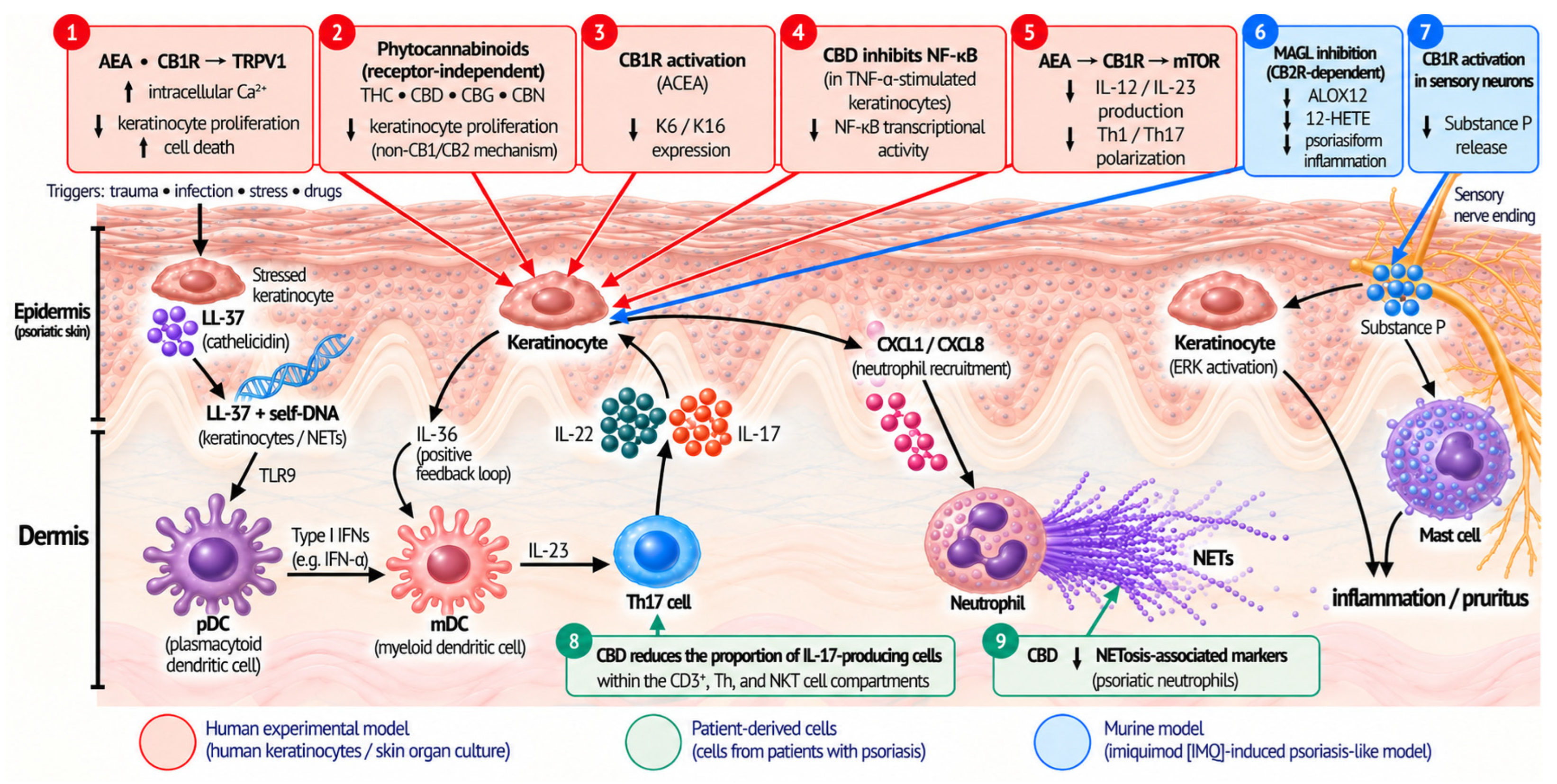
Cannabinoid signaling may intersect with this keratinocyte–immune cell feedback loop at multiple levels. Cannabinoid receptors are expressed in both keratinocytes and immune cells involved in psoriatic inflammation [40,41]. In human keratinocytes, CB1 activation suppresses IL-12 and IL-23 production through mechanistic target of rapamycin (mTOR) inhibition, thereby limiting signals that promote Th1/Th17 polarization [36]. This is particularly relevant to psoriasis because IL-23 sustains the Th17 response and the downstream production of IL-17A, IL-17F, and IL-22 that drives keratinocyte activation and hyperproliferation. CB1 signaling has also been implicated in limiting keratinocyte hyperproliferation [34], suggesting potential modulation of both immune signaling and epidermal responses within this reciprocal inflammatory circuit. CB2 signaling may provide an additional regulatory component, as genetic CB2 deficiency exacerbates psoriasiform inflammation in experimental models [42], whereas increased CNR2 (CB2 gene) messenger RNA (mRNA) expression has been reported in human psoriatic lesions on RNA sequencing [14]. Although these findings derive from different experimental systems and do not establish a unified mechanism in human psoriasis, together they support a biologically plausible interface between cannabinoid signaling, keratinocyte activity, and immune dysregulation that warrants further investigation.
4.2. Risk Factors, Triggers, and the Neurogenic Component
In addition to genetic susceptibility, several modifiable factors may trigger or exacerbate psoriasis in predisposed individuals, including obesity, smoking, alcohol consumption, streptococcal infection, physical trauma (Koebner phenomenon), certain medications, and short-term exposure to air pollutants such as particulate matter and nitrogen dioxide [43,44,45,46,47,48]. Among these factors, psychological stress is particularly relevant to the present review, as it involves dysregulation of the hypothalamic–pituitary–adrenal axis and local release of substance P, promoting mast cell and dendritic cell activation within a neurogenic inflammatory circuit [49,50]. We propose that this neurogenic component represents a point of intersection with endocannabinoid signaling, since CB1 activation in sensory neurons modulates substance P-mediated pathways [20], a conceptual link further explored in Section 7.4.
5. Current Treatment and Its Limitations
Current psoriasis management ranges from topical therapies, particularly corticosteroids and vitamin D analogues for localized disease [6,10], to conventional systemic agents [5] and biologic therapies [51,52] for more extensive or severe disease. Treatment goals have become increasingly stringent, with a 90% reduction in PASI score from baseline (PASI 90) and Dermatology Life Quality Index (DLQI) ≤ 1 now favored over the historically accepted 75% reduction (PASI 75) [5,6]. Despite substantial therapeutic advances, limitations related to cost, treatment burden, and adherence persist, reinforcing the rationale for investigating complementary therapeutic strategies with distinct mechanisms of action [7,8,9].
6. The Endocannabinoid System in Psoriasis
6.1. Structure and Function
The endocannabinoid system (ECS) is a lipid-signaling network involved in the regulation of multiple physiological processes, including immune responses, nociception, metabolism, and tissue homeostasis [15,53,54]. Its core components comprise the cannabinoid receptors CB1 and CB2, the endogenous ligands anandamide (AEA) and 2-arachidonoylglycerol (2-AG), and the enzymes responsible for their biosynthesis and degradation [15]. CB1 is highly expressed in the central nervous system, whereas CB2 is particularly abundant in immune cells, although both receptors are also expressed in several peripheral tissues and cell populations [15,55]. CB2 expression has been demonstrated across multiple human leukocyte populations, including eosinophils, neutrophils, monocytes, and B and T lymphocytes [56].
AEA and 2-AG are produced on demand from membrane lipid precursors through distinct enzymatic pathways. N-acylphosphatidylethanolamine phospholipase D (NAPE-PLD) is a major biosynthetic pathway for AEA, whereas diacylglycerol lipases (DAGLα/β) generate 2-AG. AEA is primarily hydrolyzed by fatty acid amide hydrolase (FAAH), whereas 2-AG is predominantly degraded by monoacylglycerol lipase (MAGL), with α/β-hydrolase domain-containing 6 (ABHD6) and 12 (ABHD12) providing additional routes of 2-AG hydrolysis [57]. As discussed below, several of these enzymes are themselves altered in psoriasis.
Beyond the canonical CB1/CB2 system, endocannabinoids and related lipid mediators interact with additional molecular targets, including G protein-coupled receptor 55 (GPR55), transient receptor potential (TRP) channels, and peroxisome proliferator-activated receptors (PPARs), collectively contributing to the broader endocannabinoidome or expanded endocannabinoid system [54]. Through these canonical and non-canonical pathways, endocannabinoid signaling can influence immune-cell activity, including responses involving T lymphocytes, macrophages, and dendritic cells [16].
6.2. The Cutaneous Endocannabinoid System
The skin functions as a neuroimmunoendocrine organ in which endocannabinoid signaling contributes to communication among epidermal, immune, neural, and adnexal compartments [13,58]. CB1 and CB2 receptors are widely distributed throughout human skin, including epidermal keratinocytes, cutaneous nerve fibers, mast cells, macrophages, hair follicles, sebaceous glands, and eccrine sweat glands, with receptor distribution varying across cell types and epidermal layers [40,41].
Among its major functions, the cutaneous endocannabinoid system participates in the regulation of keratinocyte proliferation, differentiation, and survival, as well as local immune responses and epidermal homeostasis [41,59]. Human keratinocytes possess functional machinery for endocannabinoid signaling, including the capacity to synthesize, bind, and metabolize AEA [60]. AEA can modulate epidermal differentiation through CB1-dependent mechanisms, illustrating that endocannabinoid effects on keratinocyte biology are receptor- and context-dependent [60].
This regulatory interface is particularly relevant to psoriasis, in which epidermal differentiation and immune signaling are simultaneously disrupted, converging with the same IL-12/IL-23–Th1/Th17 inflammatory axis central to psoriatic pathogenesis [36].
6.3. Evidence of Endocannabinoid System Dysregulation in Psoriasis
A large-scale RNA sequencing study involving more than 400 lesional, non-lesional, and healthy skin samples demonstrated differential expression of multiple components of the expanded endocannabinoid system in lesional psoriatic skin [14], including cannabinoid receptors, PPARs, and TRP channels discussed individually below.
Evidence from psoriasis models and patient-derived samples indicates that endocannabinoid metabolism is dysregulated, although the pattern varies across biological compartments. In keratinocytes obtained from patients with psoriasis vulgaris, FAAH and MAGL activities have been reported to be increased, accompanied by reduced levels of AEA and 2-AG [61]. In a tissue-engineered psoriatic skin model generated from patient-derived cells, FAAH2 expression was reduced, whereas MAGL, ABHD6, and ABHD12 expression was increased compared with healthy skin substitutes; total N-acylethanolamine (NAE) and monoacylglycerol (MAG) levels, however, did not differ significantly between the models [62]. Consistent with increased MAGL activity, more recent evidence showed increased MAGL protein levels, detected by Western blotting and immunohistochemistry, in both imiquimod-induced psoriasiform mouse skin and human psoriatic skin biopsies, whereas FAAH protein levels were not significantly altered in the mouse model [37]. In peripheral blood mononuclear cells from patients with psoriasis vulgaris, FAAH and MAGL activities were also increased compared with healthy controls, despite concomitantly elevated AEA and 2-AG levels [63]. Similar findings, with elevated AEA and 2-AG despite increased FAAH and MAGL activity, have been reported in granulocytes and plasma from patients with psoriasis [64]. Together, these observations suggest that endocannabinoid metabolism is altered in psoriasis, but that the direction and functional consequences of these changes appear to depend on the tissue and cellular compartment examined.
Consistent with the CB2 findings discussed in Section 4.1, CNR2 (the gene encoding CB2) mRNA expression was increased in lesional skin on RNA sequencing [14], although this transcriptomic finding does not by itself establish increased CB2 protein availability at the cell membrane. Selective pharmacological activation of CB2 has also been shown to attenuate lesion severity, epidermal thickening, inflammatory cytokine production, and immune-cell infiltration in imiquimod-induced models [65], providing additional functional evidence for this receptor.
PPARG and PPARA mRNA expression, by contrast, was reduced in lesional skin on RNA sequencing [14]. Experimental evidence supports an important role for PPARγ in epidermal homeostasis, as epidermis-specific deletion of Pparg (the murine gene encoding PPARγ) in mice disrupts barrier-related gene expression and leads to spontaneous inflammatory skin lesions, although this phenotype is not specific to psoriasis [66]. PPARα is likewise involved in keratinocyte differentiation and cutaneous immune regulation, but evidence directly linking its function to psoriasis is less consistent. Earlier studies of human psoriatic epidermis reported either moderately reduced PPARα expression or no consistent difference between involved and uninvolved skin, while anti-inflammatory effects of PPARα signaling have been demonstrated more clearly in other inflammatory skin conditions, such as atopic and allergic contact dermatitis [67]. PPARD mRNA expression was also found to be increased in lesional skin on RNA sequencing [14]. Its functional role in psoriasis remains controversial. Although sustained PPARδ activation has been associated with keratinocyte hyperproliferation and psoriasis-like changes in experimental models [68], other studies have reported effects related to keratinocyte differentiation and epidermal barrier homeostasis [69,70]. These findings suggest that PPARδ signaling may exert context-dependent effects in the skin, and its increased expression in psoriatic lesions should therefore not be interpreted as evidence of a uniformly pro-inflammatory role [14,68,69,70,71].
Among TRP channels, TRPV3 mRNA expression was increased in lesional skin on RNA sequencing [14]. Functional studies in human epidermal keratinocytes show that TRPV3 activation can elicit a strong nuclear factor kappa B (NF-κB)-mediated pro-inflammatory response, although it can also suppress keratinocyte proliferation and induce cell death, indicating that its biological consequences extend beyond a simple pro-proliferative role [72]. TRPV4 mRNA was reported to be reduced at the transcriptomic level in lesional skin [14]; however, functional evidence suggests a more complex relationship. TRPV4 expression has been reported to be increased in keratinocytes from human psoriatic skin, while genetic deletion of Trpv4 (the murine gene) or pharmacological inhibition of TRPV4 attenuated psoriasiform inflammation in experimental models [73]. These apparently discordant findings may reflect differences in analytical level, cellular compartment, or disease context, and caution against inferring functional direction solely from transcriptomic expression. TRPA1 mRNA expression was also increased in lesional skin on RNA sequencing [14]. Its functional contribution remains unresolved, as TRPA1 deficiency attenuated psoriasiform inflammation in one imiquimod-induced model [74], whereas an independent study using genetic and pharmacological approaches reported a protective role for TRPA1 in the same general experimental paradigm [75]. These opposing findings indicate that increased TRPA1 expression cannot currently be interpreted as uniformly pro- or anti-inflammatory.
Together, these findings provide evidence that endocannabinoid system dysregulation is associated with lesional psoriatic skin, rather than merely a hypothesis extrapolated from other dermatological conditions. It should be noted that a transcriptomic study based on differential expression demonstrates association, not causality; as illustrated above for TRPV4 and TRPA1, changes in gene or protein expression do not always predict the direction of a receptor’s functional contribution to disease, and the findings summarized here do not allow for inference as to whether endocannabinoid system alteration is a cause, consequence, or epiphenomenon of the psoriatic inflammatory process. Nevertheless, these findings support the biological relevance of the expanded endocannabinoid system in psoriasis while emphasizing that individual components, including the metabolic enzymes and receptors discussed above, may exert distinct, and in some cases opposing, effects depending on cellular and experimental context. Collectively, these receptor-level and metabolic alterations delineate several points at which exogenous phytocannabinoids could, in principle, interact with dysregulated endocannabinoid signaling in psoriasis, a possibility examined in detail in Section 7.
7. Mechanisms of Cannabinoid Action in Psoriasis
7.1. General Biological Rationale
Interest in cannabinoids stems from the convergence between psoriasis pathophysiology and the regulatory functions of the cutaneous endocannabinoid system, detailed in Section 6. Different phytocannabinoids can interact with CB1, CB2, TRP channels, and PPARs, molecular targets involved in keratinocyte biology and inflammatory regulation [19,76]. Their ability to engage multiple targets provides a pharmacological rationale for investigation in psoriasis; however, this pleiotropic activity also complicates the attribution of observed effects to individual molecular pathways.
7.2. Anti-Inflammatory and Immunomodulatory Effects
In human keratinocytes, AEA-mediated CB1 activation suppresses IL-12 and IL-23 production through inhibition of mTOR signaling, thereby limiting their capacity to promote Th1/Th17 polarization [36] (Figure 1, box 5). In human keratinocytes stimulated with TNF-α, CBD inhibited NF-κB-driven transcription, a pathway that controls the expression of several pro-inflammatory mediators released by keratinocytes [35] (Figure 1, box 4). In peripheral blood mononuclear cells from patients with psoriasis, CBD has demonstrated immunomodulatory effects, reducing the release of IFN-γ and TNF-α, shifting dendritic cell-driven T-cell responses from a Th1 toward a Th2 profile, impairing monocyte migration and dendritic cell maturation, and enhancing natural killer cell cytotoxicity [77]. In a separate study, in vitro CBD pretreatment of peripheral blood cells from patients with psoriasis reduced the proportion of IL-17-producing cells within the CD3+, T helper (Th), and natural killer T (NKT) cell compartments, as well as IFN-γ production within the CD3+ compartment; in contrast, IFN-γ-producing Th, T cytotoxic, and natural killer cells increased after CBD exposure, indicating that its effects on T-cell cytokine profiles are not uniformly suppressive [38] (Figure 1, box 8). CBD has also been reported to reduce NET formation in neutrophils isolated from patients with psoriasis [39] (Figure 1, box 9). Because IL-17 acts on keratinocytes to induce neutrophil-attracting chemokines such as CXCL1 and CXCL8 [26,31], a reduction in IL-17-producing cells could, in principle, attenuate neutrophil recruitment to psoriatic skin. This link remains inferential, however, as the CBD-induced reduction in IL-17 was observed in peripheral blood cells in vitro [38], and downstream effects on keratinocyte chemokine production or neutrophil infiltration were not assessed. Together with the direct effect of CBD on NET formation [39], these findings suggest that CBD might influence neutrophil-driven inflammation at more than one level, a hypothesis that warrants testing in integrated experimental models.
7.3. Regulation of Keratinocyte Proliferation and Differentiation
Δ9-tetrahydrocannabinol (THC), CBD, cannabigerol (CBG), and cannabinol (CBN) have been shown to inhibit the proliferation of hyperproliferative human keratinocytes in vitro in a concentration-dependent manner, through a mechanism reported to be independent of CB1 and CB2 receptors [33] (Figure 1, box 2). In organ-cultured human skin and HaCaT keratinocytes, CB1 activation by the selective agonist arachidonyl-2′-chloroethylamide (ACEA) reduced the expression of keratins K6 and K16, which are characteristically upregulated in psoriatic epidermis [34] (Figure 1, box 3). In addition, in cultured human keratinocytes and organ-cultured human skin, AEA suppressed keratinocyte proliferation and induced cell death through the sequential engagement of CB1 and TRPV1, an effect attributed to TRPV1-mediated Ca2+ influx and the consequent rise in intracellular Ca2+ [32] (Figure 1, box 1). Together, these findings raise the possibility that CB1 activation converges on both the proliferative and differentiation programs of psoriatic keratinocytes, although whether a single CB1-dependent pathway underlies both effects, or whether they represent independent mechanisms, has not been directly tested.
7.4. Neuroimmunomodulation and Pruritus Control
Given the neurogenic component of psoriasis and its proposed intersection with endocannabinoid signaling, the neuroimmunomodulatory effects of cannabinoids represent a relevant area of investigation. In a murine model of psoriasiform inflammation, CB1 activation in sensory neurons reduces inflammation and pruritus, while its blockade produces the opposite effect, mediated by the release of substance P, which activates the extracellular signal-regulated kinase (ERK) pathway in keratinocytes and promotes mast cell accumulation [20] (Figure 1, box 7).
Complementary evidence implicates endocannabinoid metabolism in psoriasiform inflammation and pruritus. In an imiquimod-induced murine model, pharmacological inhibition of MAGL reduced both skin inflammation and scratching behavior through a CB2R-dependent mechanism and suppressed the arachidonate 12-lipoxygenase (ALOX12)–12-hydroxyeicosatetraenoic acid (12-HETE) lipid axis. These effects were reversed by CB2R antagonism or genetic deletion, supporting a functional MAGL–CB2R–ALOX12–12-HETE pathway in this experimental setting [37] (Figure 1, box 6). This pharmacological effect is notable given that MAGL activity is itself increased in psoriatic skin and keratinocytes (Section 6.3), suggesting that MAGL inhibition may act, at least in part, by correcting a disease-associated enzymatic imbalance rather than acting through an unrelated pathway, although this interpretation remains to be directly tested.
An additional mechanism has also been proposed for cannabinoid receptor signaling in keratinocytes, with experimental studies implicating CB1/CB2-related pathways in the regulation of pruritogenic mediators such as IL-13 and IL-31 [78]. Because this evidence derives primarily from chronic-pruritus models rather than psoriasis-specific clinical studies, its relevance to psoriatic itch remains mechanistically plausible but not yet established. These neuronal and epidermal pathways are nevertheless consistent with the most recent aggregate clinical evidence, which identifies pruritus as the dermatologic symptom with the most consistent cannabinoid-associated benefit [21].
8. Preclinical and Clinical Evidence
8.1. Preclinical Evidence
Preclinical studies provide functional support for the potential involvement of cannabinoids in psoriasis-related processes, complementing the antiproliferative mechanism described in Section 7.3 [33]. In vitro studies have further demonstrated effects on keratinocyte lipid metabolism and pathways involved in tissue remodeling. In keratinocytes derived from patients with psoriasis, CBD (4 μM) modified the phospholipid profile under basal conditions and following ultraviolet B (UVB) irradiation [61,79]. Additional experiments using patient-derived psoriatic keratinocytes showed that CBD reduced matrix metalloproteinase (MMP)-1, MMP-2, MMP-3, and MMP-7 levels and attenuated the UVB-induced increase in several angiogenesis-related factors [80].
Experimental animal models further support the involvement of cannabinoid signaling in psoriasiform inflammation. Genetic deficiency of CB2 exacerbated imiquimod-induced dermatitis and itch, providing functional evidence for a regulatory role of this receptor [42]. In the same type of experimental model, topical CBD delivered through lipid-stabilized nanoparticles significantly reduced cumulative psoriasis-like severity scores compared with untreated controls across several stabilizer formulations, with select formulations also reducing cutaneous IL-17A levels; formulation-specific results are detailed in Table 1 [81].
Table 1.
Studies on cannabinoid-based interventions in the treatment of psoriasis, organized by type of evidence.
In a 2026 study, topical CBD also demonstrated anti-inflammatory activity in imiquimod-induced psoriasiform inflammation. CBD at 0.01% and 0.1% reduced psoriasis-like disease severity and histopathological alterations, while the 0.1% formulation reduced the expression of several inflammatory mediators, including Il1b, Il6, Il12b, Il17a, Il22, and Tnf, together with reduced Janus kinase 2 (JAK2), signal transducer and activator of transcription 3 (STAT3), and phosphorylated STAT3 levels [18]. In addition, modulation of endocannabinoid metabolism has emerged as another experimental strategy, whereby pharmacological inhibition of monoacylglycerol lipase (MAGL) reduced psoriasiform inflammation and scratching behavior through a CB2R-dependent mechanism and suppressed the ALOX12–12-HETE lipid axis in an imiquimod-induced murine model [37].
Overall, these studies demonstrate biological activity of cannabinoid-related interventions across several psoriasis-relevant experimental systems. However, the evidence remains predominantly preclinical, and substantial heterogeneity in experimental models, cannabinoid formulations, delivery systems, and molecular targets limits direct comparison between studies and precludes extrapolation of these findings to clinical efficacy.
8.2. Clinical Evidence
Clinical evidence for cannabinoid-based interventions in psoriasis remains limited and heterogeneous, comprising small uncontrolled studies, case reports, and a small number of randomized controlled trials. Differences in cannabinoid composition, route of administration, concomitant ingredients, disease severity, and outcome measures further limit direct comparison across studies.
Palmieri and coworkers retrospectively evaluated a topical ointment enriched with CBD at an unspecified concentration, applied twice daily for three months in 20 patients with different dermatological conditions, including five patients with psoriasis. In the psoriasis subgroup, PASI improved significantly at day 90 (p < 0.001); however, baseline and final PASI values were not reported [82]. Interpretation is limited by the very small psoriasis subgroup, the uncontrolled retrospective design, and the multicomponent composition of the ointment, which contained CBD alongside several botanical ingredients, precluding attribution of the observed improvement specifically to CBD. Further, there is a single case of a 33-year-old man with psoriasis vulgaris treated with multiple topical THC-containing preparations, including cream, soap, and hair oil. Clinical improvement was reported following treatment initiation, followed by continued use as maintenance therapy. However, the absence of a control group, the simultaneous use of multiple preparations, and the lack of a validated quantitative psoriasis severity measure substantially limit interpretation of efficacy [83].
More robust evidence was provided by Puaratanaarunkon et al. [84] in a dual-centre, split-body, double-blind, randomized, placebo-controlled trial involving 51 patients with mild plaque psoriasis and 108 paired target plaques. A 2.5% CBD ointment or placebo was applied twice daily for 12 weeks. Across the follow-up period, CBD-treated plaques showed a modest but statistically significant improvement in Local Psoriasis Severity Index (LPSI) compared with placebo (coefficient = −0.197; 95% confidence interval (CI), −0.370 to −0.024; p = 0.026). Among individual LPSI components, scaling was also significantly lower on the CBD-treated side (coefficient = −0.094; 95% CI, −0.173 to −0.015; p = 0.020). Although the randomized, double-blind, split-body design reduces between-patient variability, the study was restricted to mild plaque psoriasis and assessed localized target lesions rather than whole-body disease severity.
Charoenying and cols [85] conducted a randomized, single-blind crossover study involving 20 patients with psoriasis. Formula A, containing THC (1.35 mg/g) and CBD (1.25 mg/g), reduced mean PASI from 24.32 ± 11.81 at baseline to 16.66 ± 12.15 after eight weeks, with a statistically significant reduction reported from week 4 onward. The study also evaluated Formula B, which contained the same concentrations of THC and CBD combined with the ThaiBio® polyherbal formulation. Because Formula B contained additional active botanical components, its clinical effects cannot be attributed specifically to cannabinoids and were therefore not considered here as cannabinoid-specific efficacy evidence. The single-blind, crossover design and small sample size further limit the strength of the evidence from Formula A as well.
Recently, in 2026, a randomized, double-blind, placebo-controlled trial was performed evaluating oral CBD (30 mg twice daily; 60 mg/day) for 12 weeks in 28 patients with psoriasis, of whom 26 completed the study. Mean PASI changed from 5.5 ± 1.0 at baseline to 5.3 ± 0.7 at week 12 in the CBD group (p = 0.482) and from 3.7 ± 0.5 to 3.8 ± 0.8 in the placebo group (p = 0.912), with no significant between-group difference at week 12 (p = 0.152). Other measures of psoriasis severity, including body surface area (BSA), Physician Global Assessment (PGA), Patient Global Assessment (PtGA), and self-assessed Simplified Psoriasis Index severity (saSPI-s), likewise showed no significant benefit. Regarding sleep outcomes, CBD reduced sleep onset latency at week 6 (p = 0.030), an effect not sustained at week 12; sleep efficiency was maintained in the CBD group, whereas the placebo group showed a significant decline (p = 0.003) [22]. Overall, oral CBD was well tolerated but did not significantly improve psoriasis severity.
Overall, the available clinical evidence remains insufficient to establish the efficacy of cannabinoid-based therapies for psoriasis. Although preliminary topical studies have reported improvements in disease severity, the evidence is based on small samples and heterogeneous formulations and study designs. Importantly, the placebo-controlled trial of oral CBD did not demonstrate a significant improvement in PASI. These findings highlight the need for larger, adequately powered randomized controlled trials using standardized cannabinoid formulations, clearly defined doses, and validated outcomes encompassing both psoriasis-specific severity and relevant comorbidities.
Studies involving mixed dermatological populations without separately reported psoriasis-specific outcomes were not considered direct evidence of efficacy in psoriasis. Likewise, studies evaluating multicomponent formulations were not considered cannabinoid-specific efficacy evidence when the effects attributable to cannabinoids could not be distinguished from those of other active ingredients. These criteria were applied to avoid attributing clinical effects to cannabinoids when the study design did not permit such an inference.
9. Heterogeneity of the Available Evidence
The contrast between preclinical promise and clinical uncertainty, evident throughout this review, does not stem from a single cause but from the overlap of five sources of heterogeneity that are rarely considered together.
The first is the molecule. THC, CBD, CBG, and CBN are not interchangeable; each has a distinct pharmacological profile and interacts differently with CB1, CB2, TRP channels, PPARs, and other molecular targets [19]. Attributing a clinical effect to “cannabinoids” generically, without specifying the compound evaluated, hinders comparison across studies and the development of consistent conclusions.
The second is formulation, including dose and concentration. Purified cannabinoids, standardized extracts, and non-standardized botanical preparations may present substantially different pharmacological profiles, even when derived from the same plant. Concentration may also influence the magnitude of the biological response, as topical CBD at 0.01% and 0.1% produced different degrees of anti-inflammatory activity in an imiquimod-induced murine model [18]. More broadly, the context-dependent effects observed for some endocannabinoid-related targets, such as PPARδ, further caution against extrapolating findings across experimental conditions [68,69,70,71]. Therefore, studies using the same cannabinoid but different concentrations, formulations, or exposure conditions should not be assumed to be pharmacologically equivalent.
The third is the route of administration. Topical, transdermal, and oral administration result in substantially different patterns of local exposure, systemic bioavailability, metabolism, and potential adverse effects. This distinction is particularly relevant in psoriasis, where topical administration may target cutaneous pathways while limiting systemic exposure, whereas oral administration introduces additional pharmacokinetic variability. Consequently, findings obtained with one route cannot be directly extrapolated to another.
The fourth is the outcome assessed. Studies have used heterogeneous endpoints, including PASI, LPSI, individual lesion characteristics, pruritus, sleep parameters, and inflammatory biomarkers. Improvement in a symptom such as pruritus does not necessarily indicate improvement in objective disease severity, and changes in experimental biomarkers cannot be interpreted as equivalent to clinical efficacy. This distinction is particularly important given the currently limited evidence suggesting that symptomatic and objective outcomes may respond differently to cannabinoid-based interventions [21,22].
The fifth is the population studied, particularly baseline disease severity. In the trial by Roongpisuthipong et al., 96% of participants had mild-to-moderate psoriasis at baseline [22]. The relatively low baseline disease burden may have limited the magnitude of detectable change in PASI, although this cannot be established as the reason for the absence of a significant treatment effect. Differences in baseline severity and patient characteristics across studies therefore further complicate direct comparison of efficacy signals.
Together, these five sources of heterogeneity, namely molecule, formulation and dose, route of administration, outcome assessment, and study population, may help explain why promising preclinical findings have not yet translated into consistent clinical evidence. Future studies should therefore report these variables in a standardized manner and account for them explicitly in study design and interpretation.
10. Clinical Perception, Barriers, and Regulatory Aspects
10.1. Dermatologists’ Perceptions of Cannabinoid Use
Clinical practice remains characterized by considerable uncertainty regarding cannabinoid use in psoriasis. In a survey of the National Psoriasis Foundation Medical Advisory Board, 83.3% of dermatologists were uncertain whether psoriasis constituted an indication for medical cannabis, while 79.2% of respondents reported insufficient knowledge to explain its risks and benefits [86]. Only 16.7% had received prior education on medical cannabis, although all respondents expressed interest in learning more. Among dermatologists, 55.5% considered medical cannabis safe for their patients, and none considered it unsafe [86]. Notably, 54.2% of respondents reported that at least 10 patients had asked about medical cannabis during the preceding year, whereas only 21.7% had previously recommended it [86].
This mismatch between patient interest and clinician preparedness is consistent with the limited and heterogeneous clinical evidence discussed in Section 8. Rather than indicating established clinical acceptance, the available survey data highlight persistent gaps in evidence-based education and guidance regarding cannabinoid use in psoriasis.
10.2. Regulatory Aspects
The regulatory status of cannabinoid-based products varies considerably across jurisdictions and underwent substantial changes in 2026, without international harmonization (Table 2) [87,88]. Regulatory classification depends not only on the cannabinoid itself, but also on product composition, intended use, route of administration, and jurisdiction, and the four jurisdictions summarized in Table 2 illustrate markedly different regulatory entry points, from pharmaceutical approval to food, cosmetic, and cannabis-specific authorization frameworks.
Notably, each jurisdiction has at least one approved cannabinoid-based medicine, including Epidiolex, Epidyolex, Sativex, or Mevatyl, depending on the jurisdiction. However, none is authorized for psoriasis, underscoring that a regulatory precedent for cannabinoids as medicines exists without extending to this indication. A related pattern, also evident in Table 2, is the gap between formal regulatory pathways and practical availability. In Australia, a pharmacist-only supply pathway for low-dose CBD has existed since 2021, yet no product currently meets its requirements [89]. In the European Union, a cosmetic safety opinion on topical CBD [90] should not be conflated with authorization for psoriasis treatment.
These jurisdictional differences create additional challenges for product standardization, clinical-trial comparability, and the translation of cannabinoid research into dermatological practice.
Table 2.
Current regulatory landscape for cannabinoid-based products in selected jurisdictions.
11. Gaps and Future Perspectives
Despite the biological rationale and growing preclinical evidence summarized in this review, translation into clinical practice remains limited by several important gaps.
First, psoriasis-specific clinical evidence remains scarce, limited to the two randomized controlled trials discussed in Section 8. Current quantitative synthesis derives primarily from broader dermatological evidence rather than psoriasis-specific meta-analysis [21]. Larger, adequately powered randomized trials using pharmacologically characterized products and the standardized reporting discussed in Section 9 are therefore required before efficacy can be established.
An important unanswered question is whether cannabinoid-based interventions could have a role as adjunctive rather than replacement therapies. Available studies have not established whether cannabinoids provide additional benefit when combined with standard topical therapies, conventional systemic agents, or biologics. Future studies should therefore distinguish monotherapy from add-on treatment and assess whether symptom-oriented effects, particularly pruritus relief, provide clinically meaningful benefit beyond established therapy.
Long-term safety represents another major evidence gap. Existing psoriasis-specific trials have involved small samples and relatively short treatment periods, limiting the ability to detect uncommon, cumulative, or delayed adverse effects, drug–drug interactions, or formulation- and route-specific risks. Population representativeness is similarly limited, as children, pregnant individuals, and patients with relevant comorbidities remain poorly represented or absent from the available evidence. Such exclusions are often ethically appropriate given the limited long-term safety data on cannabinoids in these populations, but they nonetheless restrict the generalizability of current findings.
Beyond cutaneous outcomes, the systemic nature of psoriasis raises the question of whether orally administered phytocannabinoids could influence disease dimensions not directly addressed by topical treatment or by the cutaneous focus of this review. Psoriasis is associated with a substantial burden of extracutaneous and neuropsychiatric comorbidities, including psoriatic arthritis and cardiometabolic disorders [1,3], as well as anxiety and depression [97]. The endocannabinoid system participates in immune, inflammatory, and neurobehavioral regulation [98]. On this basis, systemic cannabinoid administration could theoretically influence both cutaneous inflammation and selected comorbidity-related outcomes, although this possibility remains largely unexplored in psoriasis-specific clinical studies. Future trials should therefore assess not only PASI and local symptoms but also systemic inflammatory markers, quality of life, sleep, psychological outcomes, and relevant comorbidities. Such a multidimensional approach may be particularly informative when comparing topical and systemic routes of administration.
Finally, ongoing research may help address some of these limitations. The CanPatch trial protocol proposes evaluating a CBD-containing transdermal patch in patients with mild-to-moderate plaque psoriasis, with localized disease severity, pruritus, safety, and microbiome-related measures among its planned outcomes [99]. A second ongoing study, from our research group, CBDermis (ClinicalTrials.gov registration number NCT07839455), is, to our knowledge, the first clinical trial designed to directly compare topical and oral Cannabis sativa administration in patients with psoriasis vulgaris. In this 37-participant, 180-day study, participants receive either a cream or an oral oil, both full-spectrum formulations containing CBD, THC, and CBG at 20 mg/mL each (1:1:1), as separate monotherapies during the first 60 days, followed by combined topical and oral administration during the subsequent 120 days, with clinical severity, safety, and quality-of-life outcomes assessed longitudinally. As efficacy results from these ongoing studies have not yet been published, they are presented here as examples of current research directions rather than as evidence of therapeutic efficacy.
Together, these gaps define a research agenda centered on adequately powered, psoriasis-specific trials; standardized, pharmacologically characterized formulations; evaluation of adjunctive strategies; patient-centered outcomes; and longer-term safety and population-representativeness data. Such evidence is necessary before the role of cannabinoid-based interventions within established psoriasis treatment algorithms can be determined.
12. Conclusions
Cannabinoid-based interventions represent an emerging area of investigation in psoriasis, supported by a biologically plausible interaction with the cutaneous endocannabinoid system and preclinical evidence converging across multiple disease-relevant pathways. However, as discussed throughout this review, these findings have not yet translated into consistent clinical efficacy, and the heterogeneity noted above continues to limit interpretation. Placebo-controlled evidence remains insufficient to support cannabinoids as established therapies for psoriasis.
Rather than replacing current evidence-based treatments, cannabinoids may warrant investigation as adjunctive interventions, particularly for the management of residual symptoms such as pruritus. However, their efficacy, safety, and clinical value as add-on therapies remain unestablished and require dedicated controlled trials.
Establishing this role with confidence will depend on adequately powered trials, standardized formulations, and longer-term safety data. Until then, cannabinoids should be regarded as a promising but investigational therapeutic approach in psoriasis, warranting continued research rather than premature clinical adoption.
Author Contributions
Conceptualization, E.K., F.C.-d.-S. and F.P.N.; Investigation, E.K. and D.T.P.; Writing—Original Draft, E.K.; Writing—Review & Editing, E.K., F.C.-d.-S. and F.P.N.; Supervision, F.P.N. All authors have read and agreed to the published version of the manuscript.
Funding
E.K. was supported by a scholarship from Fundação Araucária through the NAPI Cannabis e Doenças Crônicas program (Agreement No. 152.2024; Project No. 22.413.283-2).
Institutional Review Board Statement
Not applicable.
Data Availability Statement
No new data were created or analyzed in this study. Data sharing is not applicable to this article.
Acknowledgments
The authors thank CAPES, NAPI Cannabis, and Fundação Araucária. During the preparation of this manuscript, the authors used ChatGPT (GPT-5.6, OpenAI, San Francisco, CA, USA) to assist with the generation and visual refinement of Figure 1. The authors reviewed and verified the final figure and take full responsibility for its scientific content.
Conflicts of Interest
FPN is a partner in a Cannabis research organization focused on clinical trials.
References
- Armstrong, A.W.; Blauvelt, A.; Callis Duffin, K.; Huang, Y.H.; Savage, L.J.; Guo, L.; Merola, J.F. Psoriasis. Nat. Rev. Dis. Primers 2025, 11, 45. [Google Scholar] [PubMed]
- Gisondi, P.; Bellinato, F.; Girolomoni, G. Topographic differential diagnosis of chronic plaque psoriasis: Challenges and tricks. J. Clin. Med. 2020, 9, 3594. [Google Scholar] [CrossRef] [Scilit] [PubMed]
- Parisi, R.; Iskandar, I.Y.K.; Kontopantelis, E.; Augustin, M.; Griffiths, C.E.M.; Ashcroft, D.M. Global Psoriasis Atlas. National, regional, and worldwide epidemiology of psoriasis: Systematic analysis and modelling study. BMJ 2020, 369, m1590. [Google Scholar] [CrossRef] [Scilit] [PubMed]
- Griffiths, C.E.M.; Armstrong, A.W.; Gudjonsson, J.E.; Barker, J.N.W.N. Psoriasis. Lancet 2021, 397, 1301–1315. [Google Scholar] [CrossRef] [Scilit] [PubMed]
- Sbidian, E.; Chaimani, A.; Guelimi, R.; Garcia-Doval, I.; Hua, C.; Hughes, C.; Naldi, L.; Kinberger, M.; Afach, S.; Le Cleach, L. Systemic pharmacological treatments for chronic plaque psoriasis: A network meta-analysis. Cochrane Database Syst. Rev. 2023, 7, CD011535. [Google Scholar] [CrossRef] [Scilit] [PubMed]
- Nast, A.; Altenburg, A.; Augustin, M.; Bachmann, F.; Boehncke, W.H.; Cornberg, M.; Geerdes-Fenge, H.; Häcker, B.; Härle, P.; Klaus, J.; et al. S3 guideline for the treatment of psoriasis vulgaris, adapted from EuroGuiDerm—Part 1: Treatment recommendations and monitoring. J. Dtsch. Dermatol. Ges. 2026, 24, 122–137. [Google Scholar] [CrossRef] [Scilit] [PubMed]
- Drakos, A.; Torres, T.; Vender, R. Emerging oral therapies for the treatment of psoriasis: A review of pipeline agents. Pharmaceutics 2024, 16, 111. [Google Scholar] [CrossRef] [Scilit] [PubMed]
- Belinchón, I.; Rivera, R.; Blanch, C.; Comellas, M.; Lizán, L. Adherence, satisfaction and preferences for treatment in patients with psoriasis in the European Union: A systematic review of the literature. Patient Prefer. Adherence 2016, 10, 2357–2367. [Google Scholar] [CrossRef] [Scilit] [PubMed]
- Piragine, E.; Petri, D.; Martelli, A.; Janowska, A.; Dini, V.; Romanelli, M.; Calderone, V.; Lucenteforte, E. Adherence and persistence to biological drugs for psoriasis: Systematic review with meta-analysis. J. Clin. Med. 2022, 11, 1506. [Google Scholar] [CrossRef] [Scilit] [PubMed]
- Elmets, C.A.; Korman, N.J.; Prater, E.F.; Wong, E.B.; Rupani, R.N.; Kivelevitch, D.; Armstrong, A.W.; Connor, C.; Cordoro, K.M.; Davis, D.M.R.; et al. Joint AAD-NPF guidelines of care for the management and treatment of psoriasis with topical therapy and alternative medicine modalities for psoriasis severity measures. J. Am. Acad. Dermatol. 2021, 84, 432–470. [Google Scholar] [CrossRef] [Scilit] [PubMed]
- Brazilian Society of Dermatology. Brazilian Consensus on Psoriasis 2024: Treatment Algorithm, 4th ed.; SBD: Rio de Janeiro, Brazil, 2024. [Google Scholar]
- Sheriff, T.; Lin, M.J.; Dubin, D.; Khorasani, H. The potential role of cannabinoids in dermatology. J. Dermatol. Treat. 2020, 31, 839–845. [Google Scholar] [CrossRef] [Scilit] [PubMed]
- Tóth, K.F.; Ádám, D.; Bíró, T.; Oláh, A. Cannabinoid signaling in the skin: Therapeutic potential of the “C(ut)annabinoid” system. Molecules 2019, 24, 918. [Google Scholar] [CrossRef] [Scilit] [PubMed]
- Turk, J.N.; Kirchhof, M.G. Differential expression of endocannabinoid receptors in lesional and non-lesional skin of psoriasis patients: Insights into pathogenesis and potential therapeutic targets. J. Cutan. Med. Surg. 2026, 30, 56–61. [Google Scholar] [CrossRef] [Scilit] [PubMed]
- Lu, H.C.; Mackie, K. An introduction to the endogenous cannabinoid system. Biol. Psychiatry 2016, 79, 516–525. [Google Scholar] [CrossRef] [Scilit] [PubMed]
- Chiurchiù, V.; Battistini, L.; Maccarrone, M. Endocannabinoid signalling in innate and adaptive immunity. Immunology 2015, 144, 352–364. [Google Scholar] [CrossRef] [Scilit] [PubMed]
- Baswan, S.M.; Klosner, A.E.; Glynn, K.; Rajgopal, A.; Malik, K.; Yim, S.; Stern, N. Therapeutic potential of cannabidiol (CBD) for skin health and disorders. Clin. Cosmet. Investig. Dermatol. 2020, 13, 927–942. [Google Scholar] [CrossRef] [Scilit] [PubMed]
- Kim, M.S.; Lee, J.H.; Kim, S.W.; Bang, C.H. Cannabidiol alleviates imiquimod-induced psoriasis by inhibiting JAK2-STAT3 in a mouse model. Biomedicines 2024, 12, 2084. [Google Scholar] [CrossRef] [Scilit] [PubMed]
- Yoo, E.H.; Lee, J.H. Cannabinoids and their receptors in skin diseases. Int. J. Mol. Sci. 2023, 24, 16523. [Google Scholar] [CrossRef] [Scilit] [PubMed]
- Liu, X.; Li, L.; Jiang, J.; Ge, W.; Huang, Y.; Jin, Z.; Liu, X.; Kong, Y.; Zhan, M.; Zeng, X.; et al. Role of type I cannabinoid receptor in sensory neurons in psoriasiform skin inflammation and pruritus. J. Investig. Dermatol. 2023, 143, 812–821. [Google Scholar] [CrossRef] [Scilit] [PubMed]
- Sermsaksasithorn, P.; Nopsopon, T.; Samuthpongtorn, C.; Chotirosniramit, K.; Pongpirul, K. Cannabis and cannabinoids in dermatology: A systematic review and meta-analysis of quantitative outcomes. Front. Pharmacol. 2025, 16, 1609667. [Google Scholar] [CrossRef] [Scilit] [PubMed]
- Roongpisuthipong, W.; Klangjareonchai, T.; Kurathong, S.; Roongpisuthipong, A. Efficacy and safety of cannabidiol oil in psoriasis: A randomized, double-blind, placebo-controlled trial. J. Dermatol. Treat. 2026, 37, 2604448. [Google Scholar] [CrossRef] [Scilit] [PubMed]
- Nestle, F.O.; Kaplan, D.H.; Barker, J. Psoriasis. N. Engl. J. Med. 2009, 361, 496–509. [Google Scholar] [PubMed]
- Rendon, A.; Schäkel, K. Psoriasis pathogenesis and treatment. Int. J. Mol. Sci. 2019, 20, 1475. [Google Scholar] [CrossRef] [Scilit] [PubMed]
- Fredriksson, T.; Pettersson, U. Severe psoriasis—Oral therapy with a new retinoid. Dermatologica 1978, 157, 238–244. [Google Scholar] [CrossRef] [Scilit] [PubMed]
- Blauvelt, A.; Chiricozzi, A. The immunologic role of IL-17 in psoriasis and psoriatic arthritis pathogenesis. Clin. Rev. Allergy Immunol. 2018, 55, 379–390. [Google Scholar] [CrossRef] [Scilit] [PubMed]
- Hawkes, J.E.; Yan, B.Y.; Chan, T.C.; Krueger, J.G. Discovery of the IL-23/IL-17 signaling pathway and the treatment of psoriasis. J. Immunol. 2018, 201, 1605–1613. [Google Scholar] [CrossRef] [Scilit] [PubMed]
- Ma, F.; Plazyo, O.; Billi, A.C.; Tsoi, L.C.; Xing, X.; Wasikowski, R.; Gharaee-Kermani, M.; Hile, G.; Jiang, Y.; Harms, P.W.; et al. Single cell and spatial sequencing define processes by which keratinocytes and fibroblasts amplify inflammatory responses in psoriasis. Nat. Commun. 2023, 14, 3455. [Google Scholar] [CrossRef] [Scilit] [PubMed]
- Cheuk, S.; Wikén, M.; Blomqvist, L.; Nylén, S.; Talme, T.; Ståhle, M.; Eidsmo, L. Epidermal Th22 and Tc17 cells form a localized disease memory in clinically healed psoriasis. J. Immunol. 2014, 192, 3111–3120. [Google Scholar] [CrossRef] [Scilit] [PubMed]
- Whitley, S.K.; Li, M.; Kashem, S.W.; Hirai, T.; Igyártó, B.Z.; Knizner, K.; Ho, J.; Ferris, L.K.; Weaver, C.T.; Cua, D.J.; et al. Local IL-23 is required for proliferation and retention of skin-resident memory TH17 cells. Sci. Immunol. 2022, 7, eabq3254. [Google Scholar] [CrossRef] [Scilit] [PubMed]
- Reich, K.; Papp, K.A.; Matheson, R.T.; Tu, J.H.; Bissonnette, R.; Bourcier, M.; Gratton, D.; Kunynetz, R.A.; Poulin, Y.; Rosoph, L.A.; et al. Evidence that a neutrophil–keratinocyte crosstalk is an early target of IL-17A inhibition in psoriasis. Exp. Dermatol. 2015, 24, 529–535. [Google Scholar] [CrossRef] [Scilit] [PubMed]
- Tóth, B.I.; Dobrosi, N.; Dajnoki, A.; Czifra, G.; Oláh, A.; Szöllősi, A.G.; Juhász, I.; Sugawara, K.; Paus, R.; Bíró, T. Endocannabinoids modulate human epidermal keratinocyte proliferation and survival via the sequential engagement of cannabinoid receptor-1 and transient receptor potential vanilloid-1. J. Investig. Dermatol. 2011, 131, 1095–1104. [Google Scholar] [CrossRef] [Scilit] [PubMed]
- Wilkinson, J.D.; Williamson, E.M. Cannabinoids inhibit human keratinocyte proliferation through a non-CB1/CB2 mechanism and have a potential therapeutic value in the treatment of psoriasis. J. Dermatol. Sci. 2007, 45, 87–92. [Google Scholar] [CrossRef] [Scilit] [PubMed]
- Ramot, Y.; Sugawara, K.; Zákány, N.; Tóth, B.I.; Bíró, T.; Paus, R. A novel control of human keratin expression: Cannabinoid receptor 1-mediated signaling down-regulates the expression of keratins K6 and K16 in human keratinocytes in vitro and in situ. PeerJ 2013, 1, e40. [Google Scholar] [CrossRef] [Scilit] [PubMed]
- Sangiovanni, E.; Fumagalli, M.; Pacchetti, B.; Piazza, S.; Magnavacca, A.; Khalilpour, S.; Melzi, G.; Martinelli, G.; Dell’Agli, M. Cannabis sativa L. extract and cannabidiol inhibit in vitro mediators of skin inflammation and wound injury. Phytother. Res. 2019, 33, 2083–2093. [Google Scholar] [CrossRef] [Scilit] [PubMed]
- Chiurchiù, V.; Rapino, C.; Talamonti, E.; Leuti, A.; Lanuti, M.; Gueniche, A.; Jourdain, R.; Breton, L.; Maccarrone, M. Anandamide suppresses proinflammatory T cell responses in vitro through type-1 cannabinoid receptor-mediated mTOR inhibition in human keratinocytes. J. Immunol. 2016, 197, 3545–3553. [Google Scholar] [CrossRef] [Scilit] [PubMed]
- Lin, S.; Liu, X.; Jiang, J.; Ge, W.; Tao, Q.; Liu, S.; Ouyang, Z.; Yang, Y.; Li, M.; Chen, H. MAGL inhibition relieves psoriasiform inflammation and pruritus via modulation of ALOX12-12-HETE axis in mice. Inflammation 2026, 49, 92. [Google Scholar] [CrossRef] [Scilit] [PubMed]
- Tsiogkas, S.G.; Apostolopoulou, K.; Papagianni, E.D.; Mavropoulos, A.; Dardiotis, E.; Zafiriou, E.; Bogdanos, D.P. Cannabidiol mediates in vitro attenuation of proinflammatory cytokine responses in psoriatic disease. Cannabis Cannabinoid Res. 2024, 9, 134–146. [Google Scholar] [CrossRef] [Scilit] [PubMed]
- Wójcik, P.; Garley, M.; Wroński, A.; Jabłońska, E.; Skrzydlewska, E. Cannabidiol modifies the formation of NETs in neutrophils of psoriatic patients. Int. J. Mol. Sci. 2020, 21, 6795. [Google Scholar] [CrossRef] [Scilit] [PubMed]
- Ständer, S.; Schmelz, M.; Metze, D.; Luger, T.; Rukwied, R. Distribution of cannabinoid receptor 1 (CB1) and 2 (CB2) on sensory nerve fibers and adnexal structures in human skin. J. Dermatol. Sci. 2005, 38, 177–188. [Google Scholar] [CrossRef] [Scilit] [PubMed]
- Bíró, T.; Tóth, B.I.; Haskó, G.; Paus, R.; Pacher, P. The endocannabinoid system of the skin in health and disease: Novel perspectives and therapeutic opportunities. Trends Pharmacol. Sci. 2009, 30, 411–420. [Google Scholar] [CrossRef] [Scilit] [PubMed]
- Li, L.; Liu, X.; Ge, W.; Chen, C.; Huang, Y.; Jin, Z.; Zhan, M.; Duan, X.; Liu, X.; Kong, Y.; et al. CB2R deficiency exacerbates imiquimod-induced psoriasiform dermatitis and itch through the neuro-immune pathway. Front. Pharmacol. 2022, 13, 790712. [Google Scholar] [CrossRef] [Scilit] [PubMed]
- Carrascosa, J.M.; Rocamora, V.; Fernandez-Torres, R.M.; Jimenez-Puya, R.; Moreno, J.C.; Coll-Puigserver, N.; Fonseca, E. Obesity and psoriasis: Inflammatory nature of obesity, relationship between psoriasis and obesity, and therapeutic implications. Actas Dermosifiliogr. 2014, 105, 31–44. [Google Scholar] [CrossRef] [Scilit]
- Miura, S.; Ichimura, Y.; Sela, U.; Garcet, S.; Salud-Gnilo, C.; Li, X.; Gonzalez, J.; Murai-Yamamura, M.; Yamamura, K.; Rambhia, D.; et al. Staphylococcus aureus and Streptococcus pyogenes induce psoriasis-related transcriptomes augmented by IL-17A and TNF-alpha. J. Investig. Dermatol. 2023, 143, 1613–1617. [Google Scholar] [CrossRef] [Scilit] [PubMed]
- Weiss, G.; Shemer, A.; Trau, H. The Koebner phenomenon: Review of the literature. J. Eur. Acad. Dermatol. Venereol. 2002, 16, 241–248. [Google Scholar] [CrossRef] [Scilit] [PubMed]
- Balak, D.M.W.; Hajdarbegovic, E. Drug-induced psoriasis: Clinical perspectives. Psoriasis 2017, 7, 87–94. [Google Scholar] [CrossRef] [Scilit] [PubMed]
- Szentkereszty-Kovács, Z.; Gáspár, K.; Szegedi, A.; Kemény, L.; Kovács, D.; Tőrőcsik, D. Alcohol in psoriasis—From bench to bedside. Int. J. Mol. Sci. 2021, 22, 4987. [Google Scholar] [CrossRef] [Scilit] [PubMed]
- Bellinato, F.; Adami, G.; Benini, C.; Gatti, D.; Idolazzi, L.; Fassio, A.; Rossini, M.; Girolomoni, G.; Gisondi, P. Association between short-term exposure to environmental air pollution and psoriasis flare. JAMA Dermatol. 2022, 158, 375–381. [Google Scholar] [CrossRef] [Scilit] [PubMed]
- Gisondi, P.; Del Giglio, M.; Girolomoni, G. Psychological stress and salivary cortisol levels in patients with plaque psoriasis. J. Pers. Med. 2021, 11, 1069. [Google Scholar] [CrossRef] [Scilit] [PubMed]
- Singh, H.; Taliyan, R. Neurogenic inflammation and immune dysregulation in psoriasis. Am. J. Pathol. 2026, 196, 633–643. [Google Scholar] [CrossRef] [Scilit] [PubMed]
- Gordon, K.B.; Langley, R.G.; Warren, R.B.; Okubo, Y.; Stein Gold, L.; Merola, J.F.; Peterson, L.; Wixted, K.; Cross, N.; Deherder, D.; et al. Bimekizumab safety in patients with moderate to severe plaque psoriasis: Pooled results from phase 2 and phase 3 randomized clinical trials. JAMA Dermatol. 2022, 158, 735–744. [Google Scholar] [PubMed]
- Strober, B.; Thaçi, D.; Sofen, H.; Kircik, L.; Gordon, K.B.; Foley, P.; Rich, P.; Paul, C.; Bagel, J.; Colston, E.; et al. Deucravacitinib versus placebo and apremilast in moderate to severe plaque psoriasis. J. Am. Acad. Dermatol. 2023, 88, 40–51. [Google Scholar] [CrossRef] [Scilit] [PubMed]
- Simankowicz, P.; Stępniewska, J. The role of endocannabinoids in physiological processes and disease pathology: A comprehensive review. J. Clin. Med. 2025, 14, 2851. [Google Scholar] [CrossRef] [Scilit] [PubMed]
- Cristino, L.; Bisogno, T.; Di Marzo, V. Cannabinoids and the expanded endocannabinoid system in neurological disorders. Nat. Rev. Neurol. 2020, 16, 9–29. [Google Scholar] [CrossRef] [Scilit] [PubMed]
- Munro, S.; Thomas, K.L.; Abu-Shaar, M. Molecular characterization of a peripheral receptor for cannabinoids. Nature 1993, 365, 61–65. [Google Scholar] [CrossRef] [Scilit] [PubMed]
- Simard, M.; Rakotoarivelo, V.; Di Marzo, V.; Flamand, N. Expression and functions of the CB2 receptor in human leukocytes. Front. Pharmacol. 2022, 13, 826400. [Google Scholar] [CrossRef] [Scilit] [PubMed]
- Hourani, W.; Alexander, S.P.H. Cannabinoid ligands, receptors and enzymes: Pharmacological tools and therapeutic potential. Brain Neurosci. Adv. 2018, 2, 2398212818783908. [Google Scholar] [CrossRef] [Scilit] [PubMed]
- Martins, A.M.; Gomes, A.L.; Vilas Boas, I.; Marto, J.; Ribeiro, H.M. Cannabis-based products for the treatment of skin inflammatory diseases: A timely review. Pharmaceuticals 2022, 15, 210. [Google Scholar] [CrossRef] [Scilit] [PubMed]
- Ramer, R.; Hinz, B. Cannabinoid compounds as a pharmacotherapeutic option for the treatment of non-cancer skin diseases. Cells 2022, 11, 4102. [Google Scholar] [CrossRef] [Scilit] [PubMed]
- Maccarrone, M.; Di Rienzo, M.; Battista, N.; Gasperi, V.; Guerrieri, P.; Rossi, A.; Finazzi-Agrò, A. The endocannabinoid system in human keratinocytes: Evidence that anandamide inhibits epidermal differentiation through CB1 receptor-dependent inhibition of protein kinase C, activation protein-1, and transglutaminase. J. Biol. Chem. 2003, 278, 33896–33903. [Google Scholar] [PubMed]
- Jarocka-Karpowicz, I.; Biernacki, M.; Wroński, A.; Gęgotek, A.; Skrzydlewska, E. Cannabidiol effects on phospholipid metabolism in keratinocytes from patients with psoriasis vulgaris. Biomolecules 2020, 10, 367. [Google Scholar] [CrossRef] [Scilit] [PubMed]
- Simard, M.; Tremblay, A.; Morin, S.; Rioux, G.; Flamand, N.; Pouliot, R. N-eicosapentaenoyl-ethanolamine decreases the proliferation of psoriatic keratinocytes in a reconstructed psoriatic skin model. Sci. Rep. 2023, 13, 12113. [Google Scholar] [CrossRef] [Scilit] [PubMed]
- Wójcik, P.; Biernacki, M.; Wroński, A.; Łuczaj, W.; Waeg, G.; Žarković, N.; Skrzydlewska, E. Altered lipid metabolism in blood mononuclear cells of psoriatic patients indicates differential changes in psoriasis vulgaris and psoriatic arthritis. Int. J. Mol. Sci. 2019, 20, 4249. [Google Scholar] [CrossRef] [Scilit] [PubMed]
- Ambrożewicz, E.; Wójcik, P.; Wroński, A.; Łuczaj, W.; Jastrząb, A.; Žarković, N.; Skrzydlewska, E. Pathophysiological alterations of redox signaling and endocannabinoid system in granulocytes and plasma of psoriatic patients. Cells 2018, 7, 159. [Google Scholar] [CrossRef] [Scilit] [PubMed]
- He, Y.; Jia, H.; Yang, Q.; Shan, W.; Chen, X.; Huang, X.; Liu, T.; Sun, R. Specific activation of CB2R ameliorates psoriasis-like skin lesions by inhibiting inflammation and oxidative stress. Inflammation 2023, 46, 1255–1271. [Google Scholar] [CrossRef] [Scilit] [PubMed]
- Konger, R.L.; Derr-Yellin, E.; Zimmers, T.A.; Katona, T.; Xuei, X.; Liu, Y.; Zhou, H.M.; Simpson, E.R., Jr.; Turner, M.J. Epidermal PPARγ is a key homeostatic regulator of cutaneous inflammation and barrier function in mouse skin. Int. J. Mol. Sci. 2021, 22, 8634. [Google Scholar] [CrossRef] [Scilit] [PubMed]
- Dubrac, S.; Schmuth, M. PPAR-alpha in cutaneous inflammation. Dermatoendocrinology 2011, 3, 23–26. [Google Scholar] [CrossRef] [Scilit] [PubMed]
- Romanowska, M.; al Yacoub, N.; Seidel, H.; Donandt, S.; Gerken, H.; Phillip, S.; Haritonova, N.; Artuc, M.; Schweiger, S.; Sterry, W.; et al. PPARδ enhances keratinocyte proliferation in psoriasis and induces heparin-binding EGF-like growth factor. J. Investig. Dermatol. 2008, 128, 110–124. [Google Scholar] [CrossRef] [Scilit] [PubMed]
- Schmuth, M.; Haqq, C.M.; Cairns, W.J.; Holder, J.C.; Dorsam, S.; Chang, S.; Lau, P.; Fowler, A.J.; Chuang, G.; Moser, A.H.; et al. Peroxisome proliferator-activated receptor (PPAR)-beta/delta stimulates differentiation and lipid accumulation in keratinocytes. J. Investig. Dermatol. 2004, 122, 971–983. [Google Scholar] [CrossRef] [Scilit] [PubMed]
- Blunder, S.; Pavel, P.; Minzaghi, D.; Dubrac, S. PPARdelta in affected atopic dermatitis and psoriasis: A possible role in metabolic reprograming. Int. J. Mol. Sci. 2021, 22, 7354. [Google Scholar] [CrossRef] [Scilit] [PubMed]
- Pinnelli, V.B.K.; Surendra Babu, T.; Jayashankar, C.A.; Bhanu, P.; Murthuza, A.A.; Thipani Madhu, M.; Srilekha, N.; Sam, K.T.; Hussain, M.H.; Akshay, A.S.; et al. Peroxisome proliferator-activated receptors (PPARs) in psoriasis: Metabolic intersections, molecular mechanisms, and potential treatments. Cureus 2026, 18, e104583. [Google Scholar] [CrossRef] [Scilit] [PubMed]
- Szöllősi, A.G.; Vasas, N.; Angyal, Á.; Kistamás, K.; Nánási, P.P.; Mihály, J.; Béke, G.; Herczeg-Lisztes, E.; Szegedi, A.; Kawada, N.; et al. Activation of TRPV3 regulates inflammatory actions of human epidermal keratinocytes. J. Investig. Dermatol. 2018, 138, 365–374. [Google Scholar] [CrossRef] [Scilit] [PubMed]
- Amalia, S.N.; Baral, H.; Fujiwara, C.; Uchiyama, A.; Inoue, Y.; Yamazaki, S.; Ishikawa, M.; Kosaka, K.; Sekiguchi, A.; Yokoyama, Y.; et al. TRPV4 regulates the development of psoriasis by controlling adenosine triphosphate expression in keratinocytes and the neuroimmune system. J. Investig. Dermatol. 2023, 143, 2356–2365. [Google Scholar] [CrossRef] [Scilit] [PubMed]
- Zhou, Y.; Han, D.; Follansbee, T.; Wu, X.; Yu, S.; Wang, B.; Shi, Z.; Domocos, D.T.; Carstens, M.; Carstens, E.; et al. Transient receptor potential ankyrin 1 (TRPA1) positively regulates imiquimod-induced, psoriasiform dermal inflammation in mice. J. Cell. Mol. Med. 2019, 23, 4819–4828. [Google Scholar] [CrossRef] [Scilit] [PubMed]
- Kemény, Á.; Kodji, X.; Horváth, S.; Komlódi, R.; Szőke, É.; Sándor, Z.; Sétáló, G., Jr.; Kelemen, B.; Tóth, B.I.; Pintér, E.; et al. TRPA1 acts in a protective manner in imiquimod-induced psoriasiform dermatitis in mice. J. Investig. Dermatol. 2018, 138, 1774–1784. [Google Scholar] [CrossRef] [Scilit] [PubMed]
- Wroński, A.; Jarocka-Karpowicz, I.; Stasiewicz, A.; Skrzydlewska, E. Phytocannabinoids in the pharmacotherapy of psoriasis. Molecules 2023, 28, 1192. [Google Scholar] [CrossRef] [Scilit] [PubMed]
- Pagano, C.; Ciaglia, E.; Coppola, L.; Lopardo, V.; Raimondo, A.; Monfrecola, G.; Lembo, S.; Laezza, C.; Bifulco, M. Cannabidiol exerts multitarget immunomodulatory effects on PBMCs from individuals with psoriasis vulgaris. Front. Immunol. 2024, 15, 1373435. [Google Scholar] [CrossRef] [Scilit] [PubMed]
- Todurga Seven, Z.G.; Çakır Gündoğdu, A.; Ozyurt, R.; Özyazgan, S. The effects of cannabinoid agonist, heat shock protein 90 and nitric oxide synthase inhibitors on increasing IL-13 and IL-31 levels in chronic pruritus. Immunol. Investig. 2022, 51, 1938–1949. [Google Scholar] [CrossRef] [Scilit] [PubMed]
- Łuczaj, W.; Dobrzyńska, I.; Wroński, A.; Domingues, M.R.; Domingues, P.; Skrzydlewska, E. Cannabidiol-mediated changes to the phospholipid profile of UVB-irradiated keratinocytes from psoriatic patients. Int. J. Mol. Sci. 2020, 21, 6592. [Google Scholar] [CrossRef] [Scilit] [PubMed]
- Gęgotek, A.; Atalay, S.; Wroński, A.; Markowska, A.; Skrzydlewska, E. Cannabidiol decreases metalloproteinase activity and normalizes angiogenesis factor expression in UVB-irradiated keratinocytes from psoriatic patients. Oxid. Med. Cell. Longev. 2021, 2021, 7624389. [Google Scholar] [CrossRef] [Scilit] [PubMed]
- Zamansky, M.; Yariv, D.; Feinshtein, V.; Ben-Shabat, S.; Sintov, A.C. Cannabidiol-loaded lipid-stabilized nanoparticles alleviate psoriasis severity in mice. Molecules 2023, 28, 6907. [Google Scholar] [CrossRef] [Scilit] [PubMed]
- Palmieri, B.; Laurino, C.; Vadalà, M. A therapeutic effect of CBD-enriched ointment in inflammatory skin diseases and cutaneous scars. Clin. Ter. 2019, 170, e93–e99. [Google Scholar] [CrossRef] [Scilit] [PubMed]
- Friedman, A.J.; Momeni, K.; Kogan, M. Topical cannabinoids for the management of psoriasis vulgaris: Report of a case and review of the literature. J. Drugs Dermatol. 2020, 19, 795. [Google Scholar] [CrossRef] [Scilit] [PubMed]
- Puaratanaarunkon, T.; Sittisaksomjai, S.; Sivapornpan, N.; Pongcharoen, P.; Chakkavittumrong, P.; Ingkaninan, K.; Temkitthawon, P.; Promgool, T.; Waranuch, N.; Asawanonda, P. Topical cannabidiol-based treatment for psoriasis: A dual-centre randomized placebo-controlled study. J. Eur. Acad. Dermatol. Venereol. 2022, 36, e718–e720. [Google Scholar] [CrossRef] [Scilit] [PubMed]
- Charoenying, T.; Lomwong, K.; Boonkrong, P.; Kruanamkam, W. Therapeutic potential of topical cannabis for the treatment of psoriasis: A preliminary clinical evaluation of two different formulations. J. Curr. Sci. Technol. 2024, 14, 6. [Google Scholar] [CrossRef] [Scilit]
- Nussbaum, D.; Desai, S.; Gonzalez-Lopez, A.; Hawkes, J.E.; Gondo, G.; Friedman, A. Practices and perspectives on medical cannabis and cannabinoids: A survey of the national psoriasis foundation medical advisory board. JAAD Int. 2022, 9, 23–25. [Google Scholar] [CrossRef] [Scilit] [PubMed]
- Jardim, C.; Delgado-Charro, M.B. The regulatory environment surrounding cannabis medicines in the EU, the USA, and Australia. Pharmaceutics 2025, 17, 635. [Google Scholar] [CrossRef] [Scilit] [PubMed]
- U.S. Food and Drug Administration (FDA). Regulation of Cannabis and Cannabis-Derived Products, Including Cannabidiol (CBD). Available online: https://www.fda.gov/media/191782/download (accessed on 21 September 2026).
- Therapeutic Goods Administration (TGA). Medicinal Cannabis: Access Pathways and Usage Data. Available online: https://www.tga.gov.au/resources/explore-topic/medicinal-cannabis-hub/medicinal-cannabis-access-pathways-and-usage-data (accessed on 21 September 2026).
- Scientific Committee on Consumer Safety (SCCS). Scientific Advice on Cannabidiol (CBD) (CAS/EC No. 13956-29-1/689-176-3) Used in Cosmetic Products, SCCS/1685/25. Available online: https://health.ec.europa.eu/publications/sccs-scientific-advice-cannabidiol-cbd-casec-no-13956-29-1-689-176-3-used-cosmetic-products_en (accessed on 21 September 2026).
- U.S. Food and Drug Administration (FDA). EPIDIOLEX (Cannabidiol) Oral Solution: Prescribing Information. NDA 210365. 2020. Available online: https://www.accessdata.fda.gov/drugsatfda_docs/label/2020/210365s005s006s007lbl.pdf (accessed on 2 October 2026).
- U.S. Congress. H.R. 6500, Continuing Appropriations Act, 2027. Section 2019: Delay of Hemp-Derived Cannabinoid Product Provisions—119th Congress. 2026. Available online: https://www.congress.gov/bill/119th-congress/house-bill/6500 (accessed on 15 June 2026).
- European Medicines Agency. Epidyolex (Cannabidiol): European Public Assessment Report (EPAR), EMA/458106/2019. Available online: https://www.ema.europa.eu/en/medicines/human/EPAR/epidyolex (accessed on 30 September 2026).
- European Commission. Decisions Terminating the Procedure for Authorising the Placing on the Market of Cannabidiol as a Novel Food. Available online: https://food.ec.europa.eu/food-safety/novel-food/decisions-terminating-procedure_en (accessed on 21 September 2026).
- Agência Nacional de Vigilância Sanitária (ANVISA). Esclarecimentos a Respeito do Registro do Medicamento Mevatyl; ANVISA: Brasília, Brazil, 2017. [Google Scholar]
- Agência Nacional de Vigilância Sanitária (ANVISA). Resolução da Diretoria Colegiada (RDC) No. 1.015, de 2 de Fevereiro de 2026. Available online: https://anvisalegis.datalegis.net/action/ActionDatalegis.php?acao=abrirTextoAto&tipo=RDC&numeroAto=00001015&seqAto=000&valorAno=2026&orgao=RDC%2FDC%2FANVISA%2FMS&codTipo=&desItem=&desItemFim=&cod_menu=1696&cod_modulo=134&pesquisa=true (accessed on 21 September 2026).
- Qin, B.; Pang, H.; Huang, Y.; Chen, C.; Yang, Y.; Tian, Y.; Zhang, Y. Comorbid mechanisms of psoriasis and mental disorders: An analysis of inflammatory and psychosocial interactions. Front. Psychiatry 2026, 17, 1807845. [Google Scholar] [CrossRef] [Scilit] [PubMed]
- Hill, M.N.; Patel, S. Translational evidence for the involvement of the endocannabinoid system in stress-related psychiatric illnesses. Biol. Mood Anxiety Disord. 2013, 3, 19. [Google Scholar] [CrossRef] [Scilit] [PubMed]
- Sermsaksasithorn, P.; Asawanonda, P.; Phutrakool, P.; Ondee, T.; Chariyavilaskul, P.; Payungporn, S.; Pongpirul, K.; Hirankarn, N. Efficacy and safety of cannabis transdermal patch for alleviating psoriasis symptoms: Protocol for a randomized controlled trial (CanPatch). Med. Cannabis Cannabinoids 2024, 7, 99–110. [Google Scholar] [CrossRef] [Scilit] [PubMed]

Disclaimer/Publisher’s Note: The statements, opinions and data contained in all publications are solely those of the individual author(s) and contributor(s) and not of MDPI and/or the editor(s). MDPI and/or the editor(s) disclaim responsibility for any injury to people or property resulting from any ideas, methods, instructions or products referred to in the content. |
© 2026 by the authors. Licensee MDPI, Basel, Switzerland. This article is an open access article distributed under the terms and conditions of the Creative Commons Attribution (CC BY) license.