


Abstract
Background: Limited real-world data (RWD) may provide important information regarding diagnostic and treatment patterns in patients (pts) with AL Amyloidosis. The aim was to analyze the characteristics, treatment approach and clinical outcome of patients in the real-world settings. Materials and Methods: RWD of 60 pts diagnosed with AL amyloidosis were analyzed. Advanced cardiac involvement, Mayo Clinical Stage (CS) IIIa and IIIb, and Revised-Mayo CS III and IV, has been found in 26.7%, and 16.7%, or 33.3% and 16.7%, respectively. Bortezomib (Bz)-based regimens were applied in 36 pts (60%), and alkylating-based regimens in 24 pts (40%). In 8 pts (13.3%) treated initially with CyBorD induction, high-dose therapy with Melphalan and autologous stem cell transplantation (HDT + ASCT) was applied as the first line of treatment. Results: The overall response rate (ORR, ≥partial response) was achieved in 40 pts (70%). Patients treated with Bz-based induction followed by HDT + ASCT achieved significantly better hematologic (p = 0.001), cardiac (p = 0.004) and renal response rates (p = 0.002) in comparison to CyBorD or Alk-based regimens alone. There was no difference in PFS between those groups (p = 0.733), but patients treated with CyBorD + HDT + ASCT had significantly durable OS (p = 0.039). Univariate analysis pointed out the predictive influence of cardiac involvement (Mayo CS and Revised Mayo CS), ASCT eligibility, and hematologic, cardiac, renal and composite response rates. Conclusions: Advanced cardiac involvement and cardiac and hematologic response still retain adverse prognostic impact on the clinical outcome. Bz-based combinations significantly improved the survival of patients with AL amyloidosis, regardless of HDT + ASCT treatment.
1. Introduction
With an average worldwide incidence of 5.1–12.8 newly diagnosed patients/1.000.000 inhabitants annually, light chain amyloidosis (AL amyloidosis) is a rare plasma cell dyscrasia [1,2,3]. The present mainstream of AL amyloidosis treatment is focused on reducing the plasma cell secretion of free light chains and preventing further organ damage. The treatment choice is mainly based on the presence of cardiac involvement as a major limiting criterion for treatment with high-dose therapy and autologous stem cell transplantation [4,5]. Current recommendations indicate Bz-based regimens as the standard first-line treatment, preferably in combination with monoclonal anti-CD38 antibody, Daratumumab, followed by HDT + ASCT in accordance with transplant eligibility criteria, which are present in ≈20% newly diagnosed patients. The treatment approach of relapsed/refractory (R/R) AL amyloidosis, similarly to the treatment of R/R multiple myeloma, is based on the previously applied treatments and duration of response [6,7,8,9,10]. Considering that the antifibrillar drugs Birtamimab and Anselamimab failed to achieve the primary endpoint in clinical trials, clone-directed therapies remain the standard of care for AL amyloidosis patients [11,12]. Due to the rare characteristics of this disease, the RWD is accompanied by challenges in the diagnosis and treatment of AL amyloidosis [13,14].
The goal of this study was to analyze the prognostic significance of clinical characteristics and different staging indices in patients with AL amyloidosis treated outside of clinical trials, and their impact on treatment approach and follow-up in the RWD settings.
2. Materials and Methods
2.1. Patients
A total of 60 patients (pts) with AL amyloidosis, newly diagnosed during the period of time from January 2015 to July 2023, at the Ward for multiple myeloma and related plasma cell disorders, Clinic of Hematology, University Clinical Center of Serbia, were enrolled in this retrospective study. In the analyzed group, adult patients older than 18 years were included, with a minimum follow-up period and/or OS ≥ 6 months. The diagnosis and organ involvement criteria were based on the recommendations of the International Society of Amyloidosis (ISA) Working Group. The amyloid deposits were revealed by examination of tissue biopsies stained with Congo red and/or Thioflavin T, followed by immunohistochemical typing in abdominal fat tissue biopsy, bone marrow, gingiva, or affected organ biopsy, in the presence of monoclonal plasma cell proliferative disorder and amyloid-related systemic syndrome (affecting one or more organs) [15,16,17]. All pts with a localized form of AL amyloidosis were excluded from the study. Presence of specific chromosomal abnormalities [CAs: del (13q); IgH rearrangement; t (11;14); del (17p); amp (1q); del (1p)] were detected in 12 pts by applying interphase fluorescence in situ hybridization (iFISH) in 25 pts with ≥10% monoclonal plasma cells in the bone marrow, performed in accordance with the current International Myeloma Working Group recommendations and European Society for Medical Oncology Clinical Practice Guidelines. According to European Society of Cardiology Guidelines (2021); echocardiographic signs of cardiac amyloidosis included left ventricular wall thickness ≥ 12 mm in the presence of 2 following criteria: grade ≥ 2 of diastolic dysfunction, reduced tissue Doppler s’, e’ and a’ waves velocities (<5 cm/s), and decreased global longitudinal left ventricular strain (<−15%). Cardiac magnetic resonance criteria included 2 mandatory findings, such as diffuse subendocardial or transmural late gadolinium enhancement (LGE) and abnormal gadolinium kinetics, as well as increased extracellular volume (ECV ≥ 0.4%) if it was present [18]. The patients’ characteristics are summarized in Table 1.
Table 1.
Distribution of patients in accordance with demographic, laboratory and imaging characteristics.
Patients were staged in accordance with the cardiac risk models: Mayo 2004, Revised Mayo 2012 and European 2015 modification of Mayo 2004 [19,20,21]. Regarding renal impairment, patients were stratified by the Palladini model [15,22,23,24]. (Table 2).
Table 2.
Distribution of patients in accordance with staging systems.
2.2. Treatment
In accordance with the current presence of organ involvement and access to new treatment modalities at the time of diagnosis, patients (pts) were treated as follows: (1) Bz-based regimens (CyBorD) in 22 pts (36.7%); (2) CyBorD followed by HDT + ASCT in 8 pts (13.3%); (3) alkylating (Alk)-based chemotherapy in 22 pts (36.7%); and (4) Alk-based chemotherapy followed by HDT + ASCT in 2 pts (3.3%). In relapse, which was recorded in 19 pts (31.7%), patients were treated with alkylating agents (7/19 pts), Daratumumab-based immunochemotherapy (5/19 pts), Bortezomib (2/19 pts), and low-dose Lenalidomide (1/19 pts), while 4/19 pts died due to complications of heart failure before initiating the second-line treatment. Treatment response was evaluated according to hematological and organ response ISA-updated criteria and composite hematological and organ response (CHOR) criteria [25,26,27].
The study was performed according to the guidelines of the Declaration of Helsinki Principles and Good Clinical Practice.
2.3. Statistical Analysis
The clinical characteristics of patients were analyzed using descriptive statistics. Statistical analysis included the following testing methods: t-test, Mann–Whitney test, chi-square test, and Fisher’s exact probability test. OS was the main endpoint of the present study, and PFS was included as an additional endpoint. OS was measured from the diagnosis until the last follow-up or death, while PFS was measured from the diagnosis until the last follow-up or the occurrence of an event (progression, relapse, or death). Time to event curves were plotted with the Kaplan and Meier method, and comparisons among groups were made using the Log Rank and Kruskal–Wallis test. A cross-tab test was performed to identify the adverse group of patients. Statistical significance was set at p ≤ 0.05. All statistical analyses were conducted using IBM SPSS Statistics 22.0 (R software environment v4.3.0; R Core Team 2023).
3. Results
3.1. Treatment Response
Overall hematologic response rate (ORR, ≥partial response, PR) was achieved in 40 pts (70%): complete response (CR) was recorded in 8 pts (13.3%), very good partial response (VGPR) in 11 pts (18.3%), and PR in 21 pts (35%). Considering organ response, 33 pts (62.3%) had cardiac response, 38 pts (63.3%) achieved renal response, and liver response was recorded in 6 pts (66.7%). Complete cardiac response was observed in 8 pts (15.7%), very good partial response in 6 pts (11.8%), and partial response in 19 pts (37.2%). Complete renal response was present in 11 pts (20.7%), very good partial response in 3 pts (5.6%), and partial response in 24 pts (45.2%). Composite response (CHOR 1) was achieved in 41 pts (68.3%) (Table 3). Patients in the CHOR 2 group were characterized with significantly higher cardiac involvement according to Mayo CS (68.4% of the patients were in IIIa and IIIb CS; p = 0.002) and Revised-Mayo CS (73.7% in Revised-Mayo CS III and IV; p = 0.002).
Table 3.
Treatment response to induction therapy.
Patients treated with Bz-based induction followed by HDT + ASCT had a significantly better response rate (≥PR) in comparison to CyBorD alone (8 pts, 100% vs. 21 pts, 75%; p = 0.001). Additionally, patients treated with CyBorD alone had a significantly better response rate in comparison to Alk-based regimens alone (21 pts, 75% vs. 9 pts, 40.9%; p = 0.001). Patients treated with CyBorD + HDT + ASCT achieved the highest rate of CR and VGPR in comparison to CyBorD alone and Alk-based regimens alone (75% vs. 28.6% vs. 13.6%, respectively). The highest level of overall cardiac response was observed in the CyBorD + HDT + ASCT group (7 pts, 100%), while in the CyBorD group overall cardiac response was confirmed in 17 pts (70.8%), and in the Alk-based group in 8 pts (38.1%), with statistical significance between groups (p = 0.004). Overall renal response followed a similar trend to a cardiac response, with 8 pts (100%) in the CyBorD + HDT + ASCT group vs. 21 pts (80.8%) in the CyBorD group vs. 8 pts (42.1%) in the Alk-based group (p = 0.002). The examined groups did not differ significantly in terms of age (p = 0.318), sex distribution (p = 0.874), Mayo clinical stage (p = 0.147), Revised-Mayo clinical stage (p = 0.117), or renal stage (p = 0.899). Both of the two patients treated with Alk-based regimens followed by ASCT achieved complete hematologic response accompanied by complete organ response.
3.2. Survival Analysis
Two patients treated with Alk-based regimens followed by ASCT were excluded from the survival analysis. The PFS for these two patients was 37 months and 58 months, respectively, while OS was 48 months and 63 months, respectively.
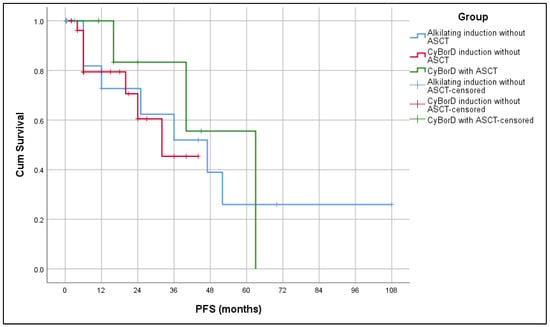
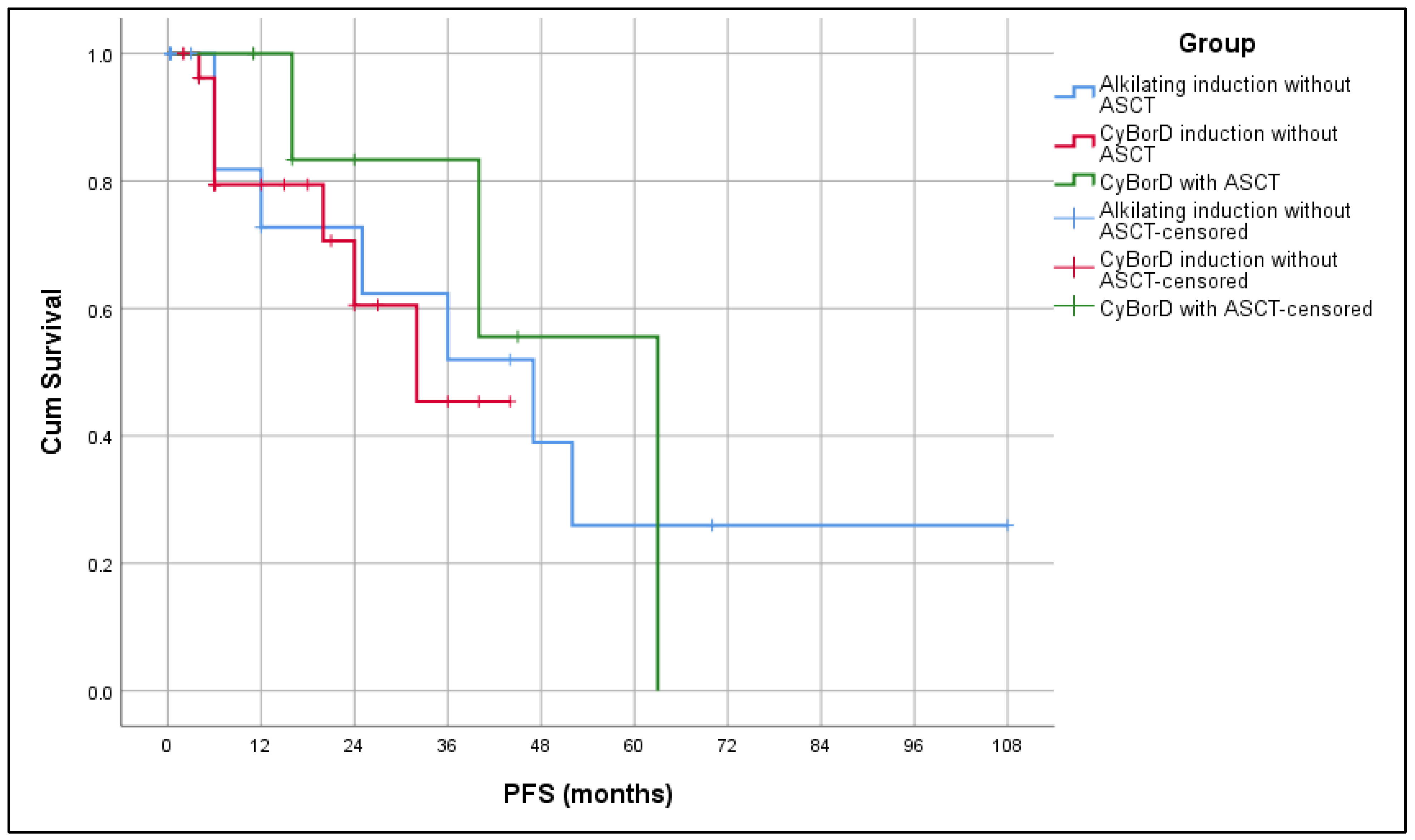
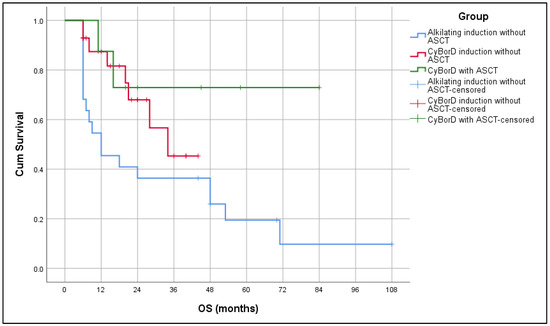
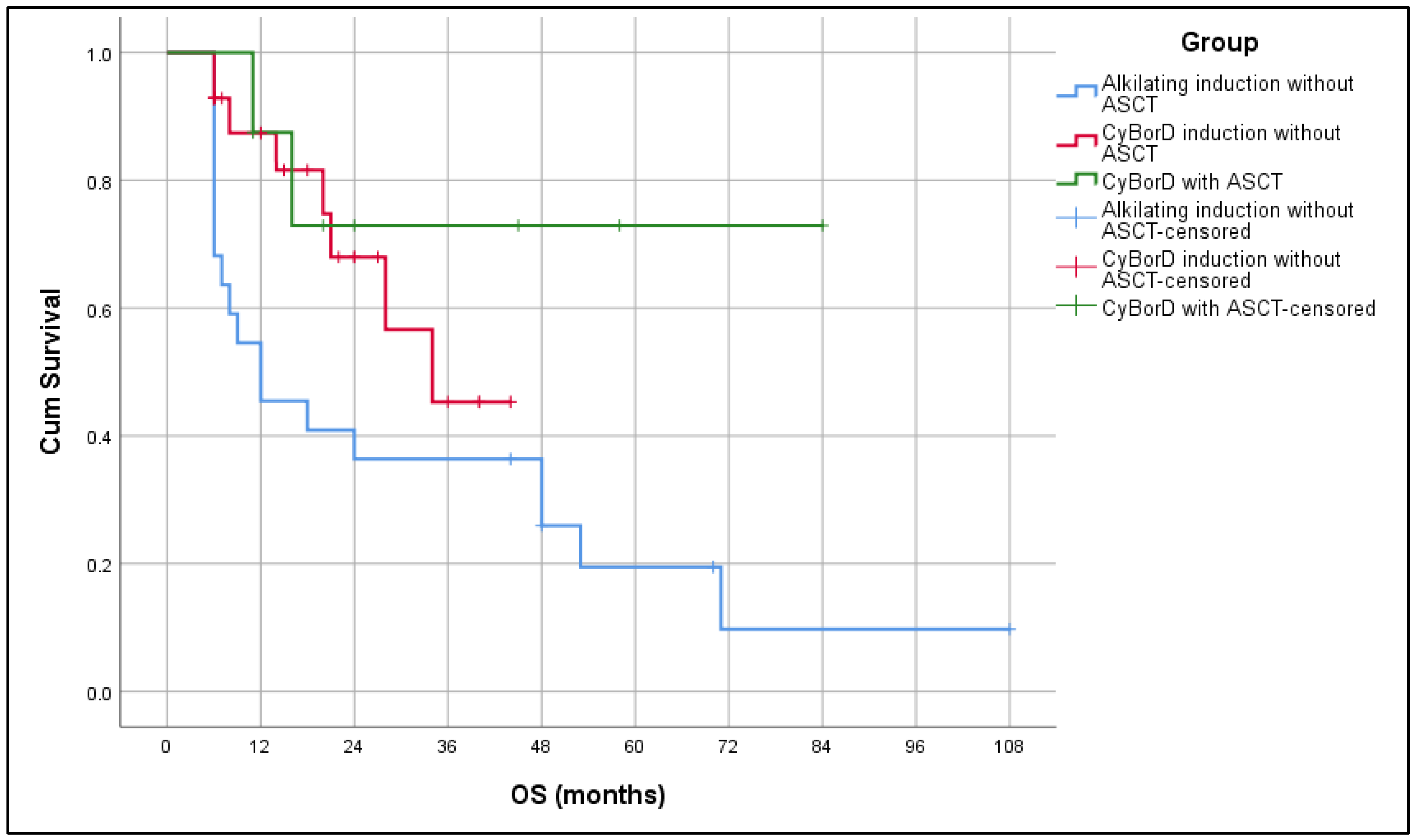
The median PFS by Kaplan–Meier analysis for the whole group was 34 months (range: range: 13–54 months), while the median OS for the whole group was 48 months (range: 21.6–74.3 months). Median OS in the Alk-based group was 12 months, and in the CyBorD group 34 months, while in CyBorD + ASCT median OS was not reached. While a difference in PFS was not observed between groups (p = 0.733) (Figure 1), there was a statistically significant difference in OS (p = 0.039). The CyBorD + ASCT group had the longest survival (Figure 2).
Figure 1.
Kaplan–Meier analysis of progression-free survival (PFS) in accordance with applied treatment.
Figure 2.
Kaplan–Meier analysis of overall survival (OS) in accordance with applied treatment.
Univariate analysis pointed out the impact of the following patients’ characteristics on the OS: clinical stage according to Mayo CS and Revised Mayo stratification, hematologic, cardiac, renal and composite response, while the influence of ASCT eligibility had borderline statistical significance (Table 4). OS was not influenced by the age (p = 0.126; HR 1.03 (0.99–1.07)), gender (p = 0.584; HR 0.81 (0.39–1.71)), number of affected organs (p = 0.564; HR 1.14 (0.73–1.78)), elevated LDH (p = 0.317; HR 1.45 (0.68–3.05)), renal CS (p = 0.262; HR 0.73 (0.42–1.26), or infiltration of the bone marrow with ≥10% plasma cells (p = 0.368; HR 1.41 (0.66–2.98)).
Table 4.
Prognostic factors of impact on the OS by the univariate model.
4. Discussion
Early recognition and diagnostics of patients with AL amyloidosis are still challenging [28,29]. Due to the rarity of the disease, merging RWD from different countries and centers provides information of essential importance regarding characteristics of the disease, treatment approaches, patient follow-up, and outcomes outside of clinical trials [13,30]. In comparison to the patients’ data from the EMN23 observational RWD study, in our cohort, the majority of the patients had a higher frequency of cardiac (85%) and renal (88.3%) involvement, implying the necessity of earlier recognition and diagnostics. Regarding the diagnostics, in the majority of our patients, amyloid deposition was present in fat tissue biopsies (70%) and/or bone marrow biopsies (35%) as the two most common sites, in accordance with the published data, accompanied by findings of verified clonal immunoglobulin lambda light chain disease in 42 pts (70%) [31]. Echocardiography was performed in all patients, with signs of cardiac amyloidosis found in 66.1% of patients. However, with magnetic resonance imaging, a significantly more sensitive tool for cardiac amyloidosis, amyloid depositions were found in 86.7% patients in the analyzed group. Conducting the differential diagnostics of transthyretin (ATTR) cardiac amyloidosis, technetium pyrophosphate scintigraphy was performed in 12 patients, resulting in negative uptake of tracer (Perugini score 0) in all 12 patients, which is in concordance with scintigraphy findings in patients with AL amyloidosis [32,33]. A high proportion (43.4%) of our patients had advanced cardiac involvement (Mayo CS IIIa and IIIb), probably as a result of late diagnosis, which correlates with the results of the larger study groups (44.2%) [30].
Considering Daratumumab’s limited availability as the first-line treatment at the time of conducting this analysis, a Bortezomib-based induction regimen such as CyBorD was the most commonly used in the group of transplant-eligible patients and patients with potentially reversible contraindications for treatment with HDT + ASCT. Historically, alkylating-based regimens were the standard of care for a long period of time for transplant-ineligible patients with cardiac involvement, before the introduction of new treatment modalities as Bortezomib and especially anti-CD38 monoclonal antibody Daratumumab [34]. In accordance with the ISA recommendation, two-thirds of our patients were treated with Bortezomib-based combinations in the first line of treatment [9,10]. The selected treatment approach was chosen based on the standard of care at the time of diagnosis and accessibility of new treatment modalities, as well as on the extent of the involvement of affected organs, age, and comorbidities.
Regarding the treatment response, a higher frequency of ORR (≥PR) was achieved in patients treated with Bortezomib-based combos, with or without HD Melphalan and ASCT, in comparison to the low response rate in the group treated without Bortezomib (CyBorD + HDT + ASCT: ORR 100%, CyBorD: ORR 75% vs. Alk-based group without HDT + ASCT: ORR 40.9%), which correlates to the EMN23 treatment results [30]. Similar treatment results were observed in the European collaborative study previously published in 2015 by Palladini et al. [21]. Regarding OS, our study demonstrated the superiority of Bortezomib regimens (with or without HDT + ASCT consolidation) over standard, conventional chemotherapy (p = 0.039), especially in the group with HDT + ASCT consolidation after Bortezomib-based induction with the longest OS. There was no difference in PFS between groups in our study (p = 0.733), probably due to the shorter follow-up period of the patients treated with Bortezomib-based regimens in circumstances of limited accessibility to such treatment.
Currently, immunochemotherapy with anti-CD38 antibody Daratumumab represents the optimal first-line treatment approach based on the highest rate of hematologic CR and VGPR, as well as deep organ responses, based on the results of the ANDROMEDA trial [34]. If immunochemotherapy is available as the first-line treatment, in the case of CR achievement, HDT followed by ASCT could be delayed to the first suggestion of hematologic relapse [10]. High-dose Melphalan and ASCT, with or without induction treatment, remains the standard first-line treatment in a modest number of patients without advanced cardiac involvement if immunochemotherapy is unavailable [35]. Pre-transplant induction therapy can decrease the risk of relapse, and in combination with ASCT it can greatly increase the rate of CR up to 60%, with more than 50% patients with an OS longer than 15 years [36]. The data published by Sidana et al. additionally pointed out the importance of the Melphalan full dose (200 mg/m2) for longer OS [37]. In the analyzed group of patients, patients treated with CyBorD + HDT + ASCT had statistically longer OS in comparison to both non-transplant groups (p = 0.039). However, transplant eligibility is strongly influenced by the cardiac stage of disease as the main limiting factor for intense treatment, consequently leading to longer OS for patients with an early cardiac stage despite the treatment modality. Furthermore, the achievement of early hematological response accompanied by a decrease in amyloidogenic free light chains is mandatory for preventing further cardiac damage [10,31].
Due to multi-organ involvement, the necessity of including organ response criteria has been raised. The first composite model that incorporates both hematologic and organ response was introduced by Sidana et al. [25]. The score pointed out that patients in the favorable CHOR 1 group had significantly better outcomes compared to the CHOR 2 group, as was confirmed in our patients as well (HR 3.92, 95% CI 3.86–20.61, p < 0.01). Clinical stratification in accordance with the Mayo and Revised-Mayo staging system, followed by cardiac response at the end of induction, strongly influenced the OS in our study group, as well as the poor treatment outcome. The majority of patients in the CHOR 2 group had advanced cardiac involvement (68.4% in Mayo CS IIIa and IIIb CS; 73.7% in R-Mayo CS III and IV), indicating that cardiac involvement remains the leading prognostic factor [3,14,38].
5. Conclusions
In summary, AL amyloidosis presents a unique diagnostic and treatment challenge due to its diverse clinical manifestations and organ involvement, particularly in the context of cardiac disease. Bortezomib-based treatment, followed by HDT and ASCT and achievement of hematologic and organ response, retains its prognostic impact on the overall survival if treatment with anti-CD38 immunochemotherapy is unavailable.
Author Contributions
All authors contributed to the study conception and design. Material preparation, data collection and analysis were performed by M.M., A.S., N.V., Z.B. and J.B. The first draft of the manuscript was written by M.M. and all authors commented on previous versions of the manuscript. All authors read and approved the final manuscript. M.M.: Gathered data, designed, wrote—original draft preparation and reviewed the manuscript. A.S.: Gathered data, reviewed the manuscript; N.K.: Gathered data, reviewed the manuscript; N.V.: Gathered data, reviewed the manuscript; M.P.J.: Reviewed the manuscript; D.S.S.: Reviewed the manuscript; R.M.: Reviewed the manuscript; Z.B.: Formal analysis of data and reviewed the manuscript; D.L.: Reviewed the manuscript; A.R.: Reviewed the manuscript; M.T.B.: Reviewed the manuscript; J.B.: Conceptualized, designed, wrote—review and editing, supervision and reviewed the manuscript. All authors have read and agreed to the published version of the manuscript.
Funding
This research received no external funding.
Institutional Review Board Statement
Ethical approval of this retrospective study was obtained from the Internal Review Board of Clinic of Hematology University Clinical Centre of Serbia (Approval Code:2252, Date: 18 September 2024) in the view that all the data originated from the procedures performed as part of routine care.
Informed Consent Statement
Informed consent for using personal data was obtained from all participants included in the study.
Data Availability Statement
The data that support the findings of this study are not openly available due to reasons of sensitivity and are available from the corresponding author upon reasonable request. Data are located in controlled access data storage at the Clinic of Hematology, University Clinical Centre of Serbia.
Conflicts of Interest
All authors certify that they have no affiliations with or involvement in any organization or entity with any financial interest or non-financial interest in the subject matter or materials discussed in this manuscript.
References
- Benson, M.D.; Buxbaum, J.N.; Eisenberg, D.S.; Merlini, G.; Saraiva, M.J.M.; Sekijima, Y.; Sipe, J.D.; Westermark, P. Amyloid nomenclature 2020: Update and recommendations by the International Society of Amyloidosis (ISA) nomenclature committee. Amyloid 2020, 27, 217–222. [Google Scholar] [CrossRef] [Scilit] [PubMed]
- Gertz, M.A.; Dispenzieri, A. Systemic amiloydosis recognition, prognosis and therapy—A systemic review. JAMA 2020, 324, 79–89. [Google Scholar] [CrossRef] [PubMed]
- Baker, K.R. Light chain Amyloidosis: Epidemiology, staging, and prognosticaction. Methodist DeBakey Cardiovasc. J. 2022, 18, 27–35. [Google Scholar] [CrossRef] [Scilit]
- Merlini, G.; Bellotti, V. Molecular mechanisms of amyloidosis. N. Engl. J. Med. 2003, 349, 583–596. [Google Scholar] [CrossRef] [Scilit] [PubMed]
- Palladini, G.; Milani, P.; Merlini, G. Management of AL Amyloidosis. Blood 2020, 136, 2620–2627. [Google Scholar] [CrossRef] [Scilit]
- Hwa, Y.L.; Gertz, M.A.; Kumar, S.K.; Lacy, M.Q.; Buadi, F.K.; Dingli, D.; Kapoor, P.; Zeldenrust, S.R.; Leung, N.; Hayman, S.R.; et al. Prognostic restaging at the time of second-line therapy in patients with AL amyloidosis. Leukemia 2019, 33, 1268–1272. [Google Scholar] [CrossRef] [Scilit]
- Abdallah, N.; Dispenzieri, A.; Muchtar, E.; Buadi, F.K.; Kapoor, P.; Lacy, M.Q.; Hwa, Y.L.; Fonder, A.; Hobbs, M.A.; Hayman, S.R.; et al. Prognostic restaging after treatment initiation in patients with AL amyloidosis. Blood Adv. 2021, 5, 1029–1036. [Google Scholar] [CrossRef] [Scilit]
- Milani, P.; Cibeira, T.M. Monitoring patients with light chain (AL) amyloidosis during and after therapy: Response assessment and identification of relapse. Hemato 2022, 3, 98–108. [Google Scholar] [CrossRef] [Scilit]
- Wechalekar, A.D.; Cibeira, T.M.; Gibbs, S.D.; Jaccard, A.; Kumar, S.; Merlini, G.; Palladini, G.; Sanchorawala, V.; Schönland, S.; Venner, C.; et al. Guidelines for non-transplant chemotherapy for treatment of systemic AL amyloidosis: EHA-ISA working group. Amyloid 2022, 29, 3–17. [Google Scholar] [CrossRef] [Scilit]
- Sanchorawala, V.; Boccadoro, M.; Gertz, M.; Hegenbart, U.; Kastritis, E.; Landau, H.; Mollee, P.; Wechalekar, A.; Palladini, G. Guidelines for high dose chemotherapy and stem cell transplantation for systemic AL amyloidosis: EHA-ISA working group guidelines. Amyloid 2021, 29, 1–7. [Google Scholar] [CrossRef] [Scilit]
- ClinicalTrials.gov. Study NCT04973137. 2021. Available online: https://clinicaltrials.gov/study/NCT04973137 (accessed on 26 October 2025).
- ClinicalTrials.gov. Study NCT04512235. 2020. Available online: https://clinicaltrials.gov/study/NCT04512235 (accessed on 26 October 2025).
- Jimenez-Zepeda, V.H.; Reece, D.; Rigo, R.; Gogna, P.; Kong, S.; Hu, X.Y.; Chapani, P.; Cheung, W.Y.; Brenner, D.R.; Plante, R.; et al. Understanding real-world treatment patterns and clinical outcomes in AL amyloidosis patients diagnosed in Canada: A population-based cohort study. eJHaem 2022, 3, 1262–1269. [Google Scholar] [CrossRef] [Scilit] [PubMed]
- Chatzileontiadou, S.; Zegkos, T.; Frouzaki, C.; Apsemidou, A.; Efthimiadis, G.; Parcharidou, D.; Papaioannou, M. Real world data on light chain cardiac amylioidosis: Still a delayed diagnosis. Front. Oncol. 2022, 12, 944503. [Google Scholar] [CrossRef] [Scilit] [PubMed]
- Gertz, M.A.; Comenzo, R.; Falk, R.H.; Fermand, J.P.; Hazenberg, B.P.; Hawkins, P.N.; Merlini, G.; Moreau, P.; Ronco, P.; Sanchorawala, V.; et al. Definition of organ involvement and treatment response in immunoglobulin light chain amyloidosis (AL): A consensus opinion from the 10th International Symposium on Amyloid and Amyloidosis. Am. J. Haematol. 2005, 79, 319–328. [Google Scholar] [CrossRef] [Scilit]
- Benson, M.D.; Berk, J.L.; Dispenzieri, A.; Damy, T.; Gillmore, J.D.; Hazenberg, B.P.; Lavatelli, F.; Picken, M.M.; Röcken, C.; Schönland, S.; et al. Tissue biopsy for the diagnosis of amyloidosis: Experience from some centres. Amyloid 2021, 29, 8–13. [Google Scholar] [CrossRef] [Scilit]
- Rajkumar, S.V.; Dimopoulos, M.A.; Palumbo, A.; Blade, J.; Merlini, G.; Mateos, M.V.; Kumar, S.; Hillengass, J.; Kastritis, E.; Richardson, P.; et al. International Myeloma Working Group updated criteria for the diagnosis of multiple myeloma. Lancet Oncol. 2014, 15, e538–e548. [Google Scholar] [CrossRef] [Scilit]
- Garcia-Pavia, P.; Rapezzi, C.; Adler, Y.; Arad, M.; Basso, C.; Brucato, A.; Burazor, I.; Caforio, A.L.P.; Damy, T.; Eriksson, U.; et al. Diagnosis and treatment of cardiac amyloidosis: A position statement of the ESC Working Group on Myocardial and Pericardial Diseases. Eur. Heart J. 2021, 42, 1554–1568. [Google Scholar] [CrossRef] [Scilit] [PubMed]
- Dispenzieri, A.; Gertz, M.A.; Kyle, R.A.; Lacy, M.Q.; Burritt, M.F.; Therneau, T.M.; Greipp, P.R.; Witzig, T.E.; Lust, J.A.; Rajkumar, S.V.; et al. Serum cardiac tropo-nins and N-terminal pro-brain natriuretic peptide: A staging system for primary systemic amyloidosis. J. Clin. Oncol. 2004, 22, 3751–3757. [Google Scholar] [CrossRef] [Scilit]
- Kumar, S.; Dispenzieri, A.; Lacy, M.Q.; Hayman, S.R.; Buadi, F.K.; Colby, C.; Laumann, K.; Zeldenrust, S.R.; Leung, N.; Dingli, D.; et al. Revised prognostic staging system for light chain amyloidosis incorporating cardiac biomarkers and serum free light chain measurements. J. Clin. Oncol. 2012, 30, 989–995. [Google Scholar] [CrossRef] [Scilit]
- Palladini, G.; Sachchithanantham, S.; Milani, P.; Gillmore, J.; Foli, A.; Lachmann, H.; Basset, M.; Hawkins, P.; Merlini, G.; Wechalekar, A.D. A European collaborative study of cyclophosphamide, bortezomib, and dexamethasone in up front treatment of systemic AL amyloidosis. Blood 2015, 126, 612–615. [Google Scholar] [CrossRef] [Scilit]
- Palladini, G.; Hegenbart, U.; Milani, P.; Kimmich, C.; Foli, A.; Ho, A.D.; Vidus Rosin, M.; Albertini, R.; Moratti, R.; Merlini, G.; et al. A staging system for renal outcome and early markers of renal response to chemotherapy in AL amyloidosis. Blood 2014, 124, 2325–2332. [Google Scholar] [CrossRef] [Scilit]
- Kastritis, E.; Gavriatopoulou, M.; Roussou, M.; Migkou, M.; Fotiou, D.; Ziogas, D.C.; Kanellias, N.; Eleutherakis-Papaiakovou, E.; Panagiotidis, I.; Giannouli, S.; et al. Renal outcomes in patients with AL amyloidosis: Prognostic factors, renal response and impact of therapy. Am. J. Hematol. 2017, 92, 632–639. [Google Scholar] [CrossRef] [Scilit]
- Drosou, M.; Vaughan, L.E.; Muchtar, E.; Buadi, F.K.; Dingli, D.; Dispenzieri, A.; Fonder, A.L.; Gertz, M.A.; Go, R.S.; Gonsalves, W.I.; et al. Comparison of the current renal staging, progression and response criteria to predict renal survival in AL amyloidosis using Mayo cohort. Am. J. Hematol. 2021, 96, 446–454. [Google Scholar] [CrossRef] [Scilit]
- Sidana, S.; Milani, P.; Binder, M.; Basset, M.; Tandon, N.; Foli, A.; Dispenzieri, A.; Gertz, M.A.; Hayman, R.S.; Buadi, K.F.; et al. A validated composite organ and hematologic response model for early assessment of treatment outcomes in light chain amyloidosis. Blood Cancer J. 2020, 10, 41. [Google Scholar] [CrossRef] [Scilit]
- Palladini, G.; Dispenzieri, A.; Gertz, M.A.; Kumar, S.; Wechalekar, A.; Hawkins, P.N.; Schönland, S.; Hegenbart, U.; Comenzo, R.; Kastritis, E.; et al. New criteria for response to treatment in immunoglobulin light chain amyloidosis based on free light chain measurement and cardiac biomarkers: Impact on survival outcomes. J. Clin. Oncol. 2012, 30, 4541–4549. [Google Scholar] [CrossRef] [Scilit]
- Muchtar, E.; Dispenzieri, A.; Leung, N.; Lacy, M.Q.; Buadi, F.K.; Dingli, D.; Grogan, M.; Hayman, S.R.; Kapoor, P.; Hwa, Y.L.; et al. Depth of organ response in AL amyloidosis is associated with improved survival: Grading the organ response criteria. Leukemia 2018, 32, 2240–2249. [Google Scholar] [CrossRef] [Scilit] [PubMed]
- Merlini, G.; Dispenzieri, A.; Sanchorawala, V.; Schönland, S.O.; Palladini, G.; Hawkins, P.N.; Gertz, M.A. Systemic immunoglobulin light chain amyloidosis. Nat. Rev. Dis. Prim. 2018, 4, 38. [Google Scholar] [CrossRef] [Scilit] [PubMed]
- Weiss, B.M.; Hebreo, J.; Cordaro, D.V.; Roschewski, M.J.; Baker, T.P.; Abbott, K.C.; Olson, S.W. Increased serum free light chains precede the presentation of immunoglobulin light chain amyloidosis. J. Clin. Oncol. 2014, 32, 2699–2704. [Google Scholar] [CrossRef] [Scilit]
- Palladini, G.; Schönland, S.; Merlini, G.; Milani, P.; Jaccard, A.; Bridoux, F.; Dimopoulos, M.A.; Ravichandran, S.; Hegenbart, U.; Roeloffzen, W.; et al. The management of light chain (AL) amyloidosis in Europe: Clinical characteristics, treatment patterns, and efficacy outcomes between 2004 and 2018. Blood Cancer J. 2023, 13, 19. [Google Scholar] [CrossRef] [Scilit]
- Palladini, G.; Merlini, G. How I treat AL amyloidosis. Blood 2022, 139, 2918–2930. [Google Scholar] [CrossRef] [Scilit] [PubMed]
- Brownrigg, J.; Lorenzini, M.; Lumley, M.; Elliott, P. Diagnostic performance of imaging investigations in detecting and differentiating cardiac amyloidosis: A systematic review and meta-analysis. ESC Heart Fail. 2019, 6, 1041–1051. [Google Scholar] [CrossRef] [Scilit]
- Bokhari, S.; Castaño, A.; Pozniakoff, T.; Deslisle, S.; Latif, F.; Maurer, M.S. (99m)Tc-pyrophosphate scintigraphy for differentiating light-chain cardiac amyloidosis from the transthyretin-related familial and senile cardiac amyloidoses. Circ. Cardiovasc. Imaging 2013, 6, 195–201. [Google Scholar] [CrossRef] [Scilit]
- Efstathios, K.; Palladini, G.; Minnema, M.C.; Wechalekar, A.D.; Jaccard, A.; Lee, H.C.; Sanchorawala, V.; Gibbs, S.; Mollee, P.; Venner, C.P.; et al. Daratumumab-based treatment for immunoglobulin light-chain amyloidosis. N. Engl. J. Med. 2021, 385, 46–58. [Google Scholar]
- Sanchorawala, V. High-Dose Melphalan and Autologous Peripheral Blood Stem Cell Transplantation in AL Amyloidosis. Acta Haematol. 2020, 143, 381–387. [Google Scholar] [CrossRef] [Scilit] [PubMed]
- Sidiqi, M.H.; Aljama, M.A.; Buadi, F.K.; Warsame, R.M.; Lacy, M.Q.; Dispenzieri, A.; Dingli, D.; Gonsalves, W.I.; Kumar, S.; Kapoor, P.; et al. Stem cell transplantation for light chain amyloidosis: Decreased early mortality over time. J. Clin. Oncol. 2018, 36, 1323–1329. [Google Scholar] [CrossRef] [Scilit] [PubMed]
- Sidana, S.; Sidiqi, M.H.; Dispenzieri, A.; Buadi, F.K.; Lacy, M.Q.; Muchtar, E.; Dingli, D.; Hayman, S.R.; Gonsalves, W.I.; Kapoor, P.; et al. Fifteen year overall survival rates after autologous stem cell transplantation for AL amyloidosis. Am. J. Hematol. 2019, 94, 1020–1026. [Google Scholar] [CrossRef] [Scilit]
- Gertz, M.A. Immunoglobulin light chain amyloidosis: 2022 update on diagnosis, prognosis, and treatment. Am. J. Hematol. 2022, 97, 818–829. [Google Scholar] [CrossRef] [Scilit]

Disclaimer/Publisher’s Note: The statements, opinions and data contained in all publications are solely those of the individual author(s) and contributor(s) and not of MDPI and/or the editor(s). MDPI and/or the editor(s) disclaim responsibility for any injury to people or property resulting from any ideas, methods, instructions or products referred to in the content. |
© 2025 by the authors. Licensee MDPI, Basel, Switzerland. This article is an open access article distributed under the terms and conditions of the Creative Commons Attribution (CC BY) license (https://creativecommons.org/licenses/by/4.0/).