Contributions of Australian University Departments of Rural Health to Indigenous Health Intervention Research: A Narrative Review

 , , , , , and
Highlights
- Successful interventions often use multicomponent approaches, combining systemic changes with individual-level supports to address complex health issues.
- Sustainability of interventions is associated with adequate resourcing, systemic embedding of programs, and clear pathways for ongoing care. Strong organisational leadership and collaboration are essential to embed interventions into healthcare systems, increase capacity building, and sustain long-term impact.
- Effective interventions in Indigenous health require meaningful community engagement to ensure alignment with needs, priorities and cultural values. Culturally safe interventions should include Indigenous stakeholders in co-design processes, with leaders, staff and students supported by cultural safety training and experiential learning opportunities.
- Targeting underlying determinants of health such as economic, social, psychological and environmental factors fosters participation and achieves sustainable outcomes. Interventions must address barriers like access to services, resources, and literacy levels.
Abstract
1. Introduction
2. Methods
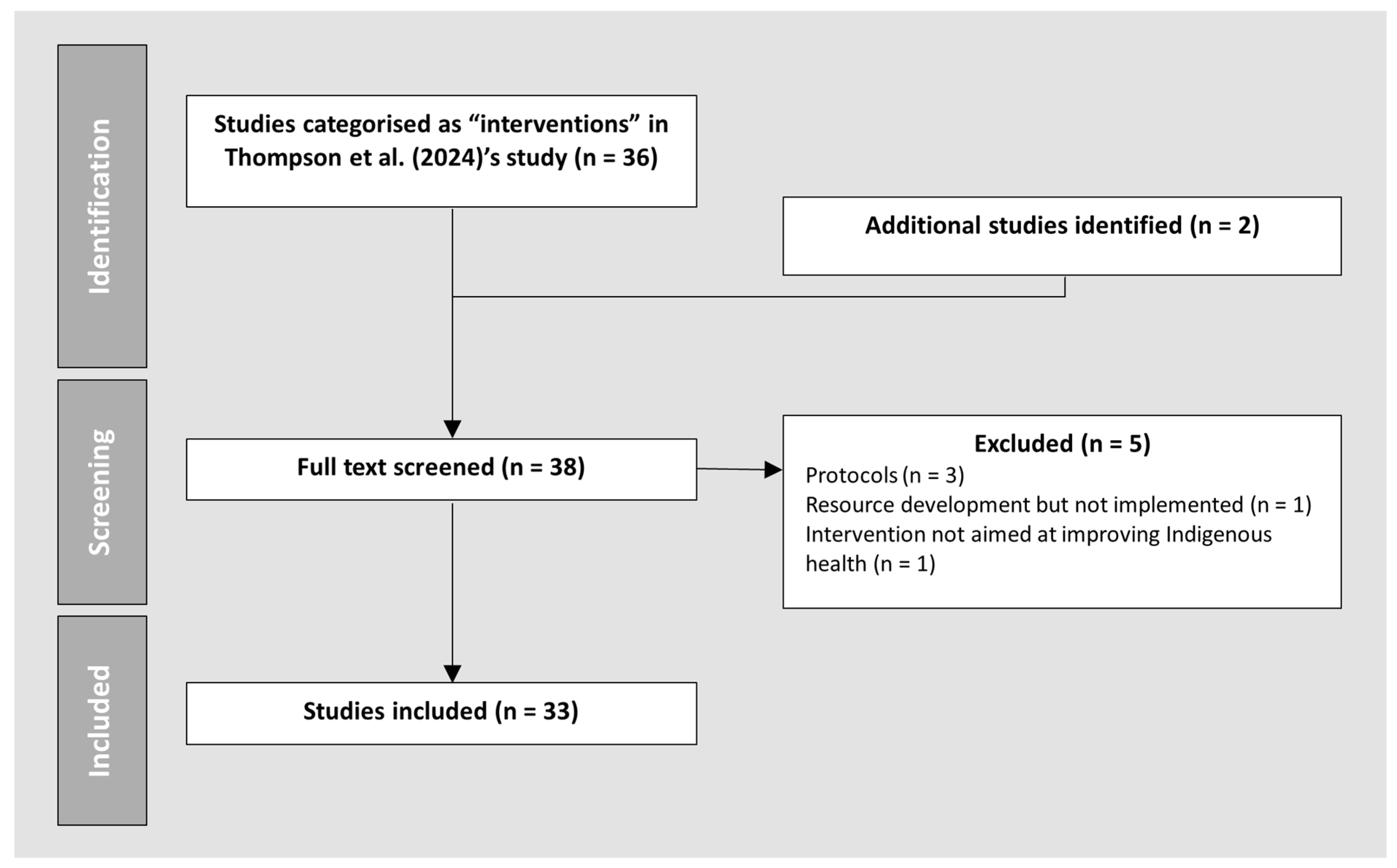
2.1. Identification and Screening
2.2. Data Extraction
2.3. Data Analysis
3. Results
3.1. Characteristics of the Papers Reviewed
3.2. Key Themes and Learnings
3.2.1. Principles of Engagement and Design
Building and Strengthening Partnerships
Multi-Component Interventions
Preparation, Planning and Resourcing
3.2.2. Considerations for Improving Healthcare Systems
Increasing Efficiency of Healthcare Services
Reducing Barriers to Attendance
Interpreters
Organisational Leadership and Cultural Security
3.2.3. Considerations for Improving Healthcare Workforce
Developing the Healthcare Workforce
Ongoing Capacity Building
Experiential Learning
3.2.4. Sustainability
4. Discussion
4.1. Limitations
4.2. Recommendations
5. Conclusions
Supplementary Materials
Author Contributions
Funding
Institutional Review Board Statement
Informed Consent Statement
Data Availability Statement
Acknowledgments
Conflicts of Interest
References
- Australian Institute of Health and Welfare. Rural and Remote Health. Available online: https://www.aihw.gov.au/reports/rural-remote-australians/rural-and-remote-health (accessed on 15 January 2026).
- Walsh, S.; Dettwiller, P.; Puah, L.; Beks, H.; Versace, V.; Jones, M. Decentralised clinical trials in rural Australia: Opportunities and challenges. Aust. J. Rural Health 2024, 32, 582–587. [Google Scholar] [CrossRef] [Scilit] [PubMed]
- Barclay, L.; Phillips, A.; Lyle, D. Rural and remote health research: Does the investment match the need? Aust. J. Rural Health 2018, 26, 74–79. [Google Scholar] [CrossRef] [Scilit] [PubMed]
- World Health Organization. WHO Guideline on Health Workforce Development, Attraction, Recruitment and Retention in Rural and Remote Areas. Available online: https://www.who.int/publications/i/item/9789240024229 (accessed on 19 February 2026).
- World Health Organization. Primary Health Care on the Road to Universal Health Coverage: 2019 Global Monitoring Report: Executive Summary. Available online: https://www.who.int/publications/i/item/primary-health-care-on-the-road-to-universal-health-coverage-2019-monitoring-report (accessed on 15 January 2026).
- Gausia, K.; Thompson, S.C.; Lindeman, M.A.; Brown, L.J.; Perkins, D. Contribution of university departments of rural health to rural health research: An analysis of outputs. Aust. J. Rural Health 2015, 23, 101–106. [Google Scholar] [CrossRef] [Scilit]
- Walsh, S.M.; Versace, V.L.; Thompson, S.C.; Browne, L.J.; Knight, S.; Lyle, D.M.; Argus, G.; Jones, M. Supporting nursing and allied health student placements in rural and remote Australia: A narrative review of publications by university departments of rural health. Med. J. Aust. 2023, 219, 14–19. [Google Scholar] [CrossRef] [Scilit] [PubMed]
- Sanson-Fisher, R.W.; Campbell, E.M.; Perkins, J.J.; Blunden, S.V.; Davis, B.B. Indigenous health research: A critical review of outputs over time. Med. J. Aust. 2006, 184, 502–505. [Google Scholar] [CrossRef] [Scilit]
- Thompson, S.C.; Taylor, E.V.; Hoang, H.; Hall, L.; Sangelaji, B.; Green, C.; Lethborg, C.; Hutchinson, J. An overview of outputs of Aboriginal- and Torres Strait Islander-related publications from University Departments of Rural Health in Australia; 2010–2021. Aust. J. Rural Health 2024, 32, 906–917. [Google Scholar] [CrossRef] [Scilit]
- Department of Health, Disability and Ageing. National Aboriginal and Torres Strait Islander Health Plan 2021–2031. Available online: https://www.health.gov.au/resources/publications/national-aboriginal-and-torres-strait-islander-health-plan-2021-2031?language=en (accessed on 15 January 2026).
- Coffin, J. Rising to the challenge in Aboriginal health by creating cultural security. Aborig. Isl. Health Work. J. 2007, 31, 22–24. [Google Scholar]
- Australian Institute of Health and Welfare. Cultural Safety in Health Care for Indigenous Australians: Monitoring Framework. Available online: https://www.aihw.gov.au/reports/indigenous-australians/cultural-safety-health-care-framework/contents/background-material (accessed on 15 January 2026).
- McGuffog, R.; Bryant, J.; Booth, K.; Collis, F.; Brown, A.; Hughes, J.T.; Chamberlain, C.; McGhie, A.; Hobden, B.; Kennedy, M. Exploring the reported strengths and limitations of Aboriginal and Torres Strait Islander health research: A narrative review of intervention studies. Int. J. Environ. Res. Public Health 2023, 20, 3993. [Google Scholar] [CrossRef] [Scilit]
- Hickey, S.; Roe, Y.; Gao, Y.; Nelson, C.; Carson, A.; Currie, J.; Reynolds, M.; Wilson, K.; Kruske, S.; Blackman, R.; et al. The Indigenous Birthing in an Urban Setting study: The IBUS study: A prospective birth cohort study comparing different models of care for women having Aboriginal and Torres Strait Islander babies at two major maternity hospitals in urban South East Queensland, Australia. BMC Pregnancy Childbirth 2018, 18, 431. [Google Scholar] [CrossRef] [Scilit]
- Parker, E.J.; Misan, G.; Chong, A.; Mills, H.; Roberts-Thomson, K.; Horowitz, A.M.; Jamieson, L.M. An oral health literacy intervention for Indigenous adults in a rural setting in Australia. BMC Public Health 2012, 12, 461. [Google Scholar] [CrossRef] [Scilit]
- Reddy, S.; Wakerman, J.; Westhorp, G.; Herring, S. Evaluating impact of clinical guidelines using a realist evaluation framework. J. Eval. Clin. Pract. 2015, 21, 1114–1120. [Google Scholar] [CrossRef] [Scilit]
- Lopes, J.; Lindeman, M.; Taylor, K.; Grant, L. Cross cultural education in suicide prevention: Development of a training resource for use in Central Australian Indigenous communities. Adv. Ment. Health 2012, 10, 224–234. [Google Scholar] [CrossRef]
- Reser, D.; Simmons, M.; Johns, E.; Ghaly, A.; Quayle, M.; Dordevic, A.L.; Tare, M.; McArdle, A.; Willems, J.; Yunkaporta, T. Australian Aboriginal techniques for memorization: Translation into a medical and allied health education setting. PLoS ONE 2021, 16, e0251710. [Google Scholar] [CrossRef] [Scilit]
- Braun, V.; Clarke, V. Using thematic analysis in psychology. Qual. Res. Psychol. 2006, 3, 77–101. [Google Scholar] [CrossRef] [Scilit]
- Commonwealth of Australia. National Aboriginal and Torres Strait Islander Health Plan 2013–2023. Available online: https://www.health.gov.au/sites/default/files/documents/2021/02/national-aboriginal-and-torres-strait-islander-health-plan-2013-2023.pdf (accessed on 15 January 2026).
- Harfield, S.; Pearson, O.; Morey, K.; Kite, E.; Canuto, K.; Glover, K.; Gomersall, J.S.; Carter, D.; Davy, C.; Aromataris, E.; et al. Assessing the quality of health research from an Indigenous perspective: The Aboriginal and Torres Strait Islander quality appraisal tool. BMC Med. Res. Methodol. 2020, 20, 79. [Google Scholar] [CrossRef] [Scilit]
- Brimblecombe, J.; Ferguson, M.; Chatfield, M.D.; Liberato, S.C.; Gunther, A.; Ball, K.; Moodie, M.; Miles, E.; Magnus, A.; Mhurchu, C.N.; et al. Effect of a Price Discount and Consumer Education Strategy on Food and Beverage Purchases in Remote Indigenous Australia: A stepped-wedge randomised controlled trial. Lancet Public Health 2017, 2, e82–e95. [Google Scholar] [CrossRef] [Scilit]
- Cairns, A.; Geia, L.; Kris, S.; Armstrong, E.; O’Hara, A.; Rodda, D.; McDermott, R.; Barker, R. Developing a community rehabilitation and lifestyle service for a remote Indigenous community. Disabil. Rehabil. 2022, 44, 4266–4274. [Google Scholar] [CrossRef] [Scilit]
- Carey, T.A.; Schouten, K.; Wakerman, J.; Humphreys, J.S.; Miegel, F.; Murphy, S.; Arundell, M. Improving the quality of life of palliative and chronic disease patients and carers in remote Australia with the establishment of a day respite facility. BMC Palliat. Care 2016, 15, 62. [Google Scholar] [CrossRef] [Scilit]
- Chapple, K.; Kowanko, I.; Harvey, P.; Chong, A.; Battersby, M. ‘Imagine if I gave up smoking …’: A qualitative exploration of Aboriginal participants’ perspectives of a self-management pilot training intervention. Aust. J. Prim. Health 2016, 22, 147–152. [Google Scholar] [CrossRef] [Scilit]
- Fernando, S.; Tadakamadla, S.; Kroon, J.; Lalloo, R.; Johnson, N.W. Predicting dental caries increment using salivary biomarkers in a remote Indigenous Australian child population. BMC Oral Health 2021, 21, 372. [Google Scholar] [CrossRef] [Scilit] [PubMed]
- Isaacs, A.; Lampitt, B. The Koorie Men’s Health Day: An innovative model for early detection of mental illness among rural Aboriginal men. Australas. Psychiatry 2014, 22, 56–61. [Google Scholar] [CrossRef] [Scilit]
- Lalloo, R.; Tadakamadla, S.K.; Kroon, J.; Jamieson, L.M.; Ware, R.S.; Johnson, N.W. Carious lesions in permanent dentitions are reduced in remote Indigenous Australian children taking part in a non-randomised preventive trial. PLoS ONE 2021, 16, e0244927. [Google Scholar] [CrossRef] [Scilit]
- Passey, M.E.; Stirling, J.M. Evaluation of ‘Stop Smoking in its Tracks’: An intensive smoking cessation program for pregnant Aboriginal women incorporating contingency-based financial rewards. Public Health Res. Pract. 2018, 28, e28011804. [Google Scholar] [CrossRef] [Scilit]
- Rae, K.; Weatherall, L.; Blackwell, C.; Pringle, K.; Smith, R.; Lumbers, E. Long conversations: Gomeroi gaaynggal tackles renal disease in the Indigenous community. Australas. Epidemiol. 2014, 21, 44–48. [Google Scholar]
- Haigh, M.; Shahid, S.; O’Connor, K.; Thompson, S.C. Talking about the not talked about: Use of, and reactions to, a DVD promoting bowel cancer screening to Aboriginal people. Aust. N. Z. J. Public Health 2016, 40, 548–552. [Google Scholar] [CrossRef] [Scilit] [PubMed]
- O’Connor, E.; Kerrigan, V.; Aitken, R.; Castillon, C.; Mithen, V.; Madrill, G.; Roman, C.; Ralph, A.P. Does improved interpreter uptake reduce self-discharge rates in hospitalised patients? A successful hospital intervention explained. PLoS ONE 2021, 16, e0257825. [Google Scholar] [CrossRef] [Scilit] [PubMed]
- Ralph, A.P.; de Dassel, J.L.; Kirby, A.; Read, C.; Mitchell, A.G.; Maguire, G.P.; Currie, B.J.; Bailie, R.S.; Johnston, V.; Carapetis, J.R. Improving Delivery of Secondary Prophylaxis for Rheumatic Heart Disease in a High-Burden Setting: Outcome of a Stepped-Wedge, Community, Randomized Trial. J. Am. Heart Assoc. 2018, 7, e009308. [Google Scholar] [CrossRef] [Scilit]
- Read, C.; Mitchell, A.G.; de Dassel, J.L.; Scrine, C.; Hendrickx, D.; Bailie, R.S.; Johnston, V.; Maguire, G.P.; Schultz, R.; Carapetis, J.R.; et al. Qualitative Evaluation of a Complex Intervention to Improve Rheumatic Heart Disease Secondary Prophylaxis. J. Am. Heart Assoc. 2018, 7, e009376. [Google Scholar] [CrossRef] [Scilit]
- Reeve, C.; Thomas, A.; Mossenson, A.; Reeve, D.; Davis, S. Evaluation of an ear health pathway in remote communities: Improvements in ear health access. Aust. J. Rural Health 2014, 22, 127–132. [Google Scholar] [CrossRef] [Scilit]
- Bailie, R.; Matthews, V.; Larkins, S.; Thompson, S.; Burgess, P.; Weeramanthri, T.; Bailie, J.; Cunningham, F.; Kwedza, R.; Clark, L. Impact of policy support on uptake of evidence-based continuous quality improvement activities and the quality of care for Indigenous Australians: A comparative case study. BMJ Open 2017, 7, e016626. [Google Scholar] [CrossRef] [Scilit]
- Durey, A.; McEvoy, S.; Swift-Otero, V.; Taylor, K.; Katzenellenbogen, J.; Bessarab, D. Improving healthcare for Aboriginal Australians through effective engagement between community and health services. BMC Health Serv. Res. 2016, 16, 224. [Google Scholar] [CrossRef] [Scilit]
- Guy, R.J.; Ward, J.; Causer, L.M.; Natoli, L.; Badman, S.G.; Tangey, A.; Hengel, B.; Wand, H.; Whiley, D.; Tabrizi, S.N.; et al. Molecular point-of-care testing for chlamydia and gonorrhoea in Indigenous Australians attending remote primary health services (TTANGO): A cluster-randomised, controlled, crossover trial. Lancet Infect. Dis. 2018, 18, 1117–1126. [Google Scholar] [CrossRef] [Scilit]
- Reeve, C.; Humphreys, J.; Wakerman, J.; Carter, M.; Carroll, V.; Reeve, D. Strengthening primary health care: Achieving health gains in a remote region of Australia. Med. J. Aust. 2015, 202, 483–487. [Google Scholar] [CrossRef] [Scilit]
- Shephard, M.; O’Brien, C.; Burgoyne, A.; Croft, J.; Garlett, T.; Barancek, K.; Halls, H.; McAteer, B.; Motta, L.; Shephard, A. Review of the cultural safety of a national Indigenous point-of-care testing program for diabetes management. Aust. J. Prim. Health 2016, 22, 368–374. [Google Scholar] [CrossRef] [Scilit]
- Spaeth, B.A.; Shephard, M.D.S. Clinical and Operational Benefits of International Normalized Ratio Point-of-Care Testing in Remote Indigenous Communities in Australia’s Northern Territory. Point Care J. Near-Patient Test. Technol. 2016, 15, 30–34. [Google Scholar] [CrossRef] [Scilit]
- Bennett-Levy, J.; Singer, J.; DuBois, S.; Hyde, K. Translating E-Mental Health Into Practice: What Are the Barriers and Enablers to E-Mental Health Implementation by Aboriginal and Torres Strait Islander Health Professionals? J. Med. Internet Res. 2017, 19, e1. [Google Scholar] [CrossRef] [Scilit]
- Bennett-Levy, J.; Singer, J.; Rotumah, D.; Bernays, S.; Edwards, D. From Digital Mental Health to Digital Social and Emotional Wellbeing: How Indigenous Community-Based Participatory Research Influenced the Australian Government’s Digital Mental Health Agenda. Int. J. Environ. Res. Public Health 2021, 18, 9757. [Google Scholar] [CrossRef] [Scilit] [PubMed]
- Biles, J.; Deravin, L.; Seaman, C.E.; Alexander, N.; Damm, A.; Trudgett, N. Learnings from a mentoring project to support Aboriginal and Torres Strait Islander nurses and midwives to remain in the workforce. Contemp. Nurse 2021, 57, 327–337. [Google Scholar] [CrossRef] [Scilit]
- Khalil, H. Successful implementation of a medication safety program for Aboriginal Health Practitioners in rural Australia. Aust. J. Rural Health 2019, 27, 158–163. [Google Scholar] [CrossRef] [Scilit] [PubMed]
- Kong, A.; Dickson, M.; Ramjan, L.; Sousa, M.S.; Jones, N.; Srinivas, R.; Chao, J.; Goulding, J.; George, A. Aboriginal Health Workers Promoting Oral Health among Aboriginal and Torres Strait Islander Women during Pregnancy: Development and Pilot Testing of the Grinnin’ Up Mums & Bubs Program. Int. J. Environ. Res. Public Health 2021, 18, 9576. [Google Scholar] [CrossRef] [Scilit]
- Lin, I.B.; Coffin, J.; O’Sullivan, P.B. Using theory to improve low back pain care in Australian Aboriginal primary care: A mixed method single cohort pilot study. BMC Fam. Pract. 2016, 17, 44. [Google Scholar] [CrossRef] [Scilit] [PubMed]
- Prout, S.; Lin, I.; Nattabi, B.; Green, C. ‘I could never have learned this in a lecture’: Transformative learning in rural health education. Adv. Health Sci. Educ. Theory Pract. 2014, 19, 147–159. [Google Scholar] [CrossRef] [Scilit] [PubMed]
- Schoen, D.E.; Gausia, K.; Glance, D.G.; Thompson, S.C. Improving rural and remote practitioners’ knowledge of the diabetic foot: Findings from an educational intervention. J. Foot Ankle Res. 2016, 9, 26. [Google Scholar] [CrossRef] [Scilit]
- Thackrah, R.D.; Thompson, S.C. Confronting uncomfortable truths: Receptivity and resistance to Aboriginal content in midwifery education. Contemp. Nurse 2013, 46, 113–122. [Google Scholar] [CrossRef] [Scilit]
- Thackrah, R.D.; Thompson, S.C. ‘Friendly racism’ and white guilt: Midwifery students’ engagement with Aboriginal content in their program. Forum Public Policy 2013, 2013, 12. [Google Scholar]
- Thackrah, R.D.; Thompson, S.C.; Durey, A. Exploring undergraduate midwifery students’ readiness to deliver culturally secure care for pregnant and birthing Aboriginal women. BMC Med. Educ. 2015, 15, 77. [Google Scholar] [CrossRef] [Scilit]
- Thackrah, R.D.; Thompson, S.C.; Durey, A. Promoting women’s health in remote Aboriginal settings: Midwifery students’ insights for practice. Aust. J. Rural Health 2015, 23, 327–331. [Google Scholar] [CrossRef] [Scilit]
- Tsey, K.; Chigeza, P.; Holden, C.A.; Bulman, J.; Gruis, H.; Wenitong, M. Evaluation of the pilot phase of an Aboriginal and Torres Strait Islander Male Health Module. Aust. J. Prim. Health 2014, 20, 56–61. [Google Scholar] [CrossRef] [Scilit]
- Lock, M.J.; Walker, T.; Browne, J. Promoting cultural rigour through critical appraisal tools in First Nations peoples’ research. Aust. N. Z. J. Public Health 2021, 45, 210–211. [Google Scholar] [CrossRef] [Scilit]
- Durey, A.; Thompson, S.; Wood, M. Time to bring down the twin towers in poor Aboriginal hospital care: Addressing institutional racism and misunderstandings in communication. Intern. Med. J. 2012, 42, 17–22. [Google Scholar] [CrossRef] [Scilit]
- Bourke, L.; Thompson, S.; Freire, K.; McNeil, R.; Harvey, P.; Brown, L.; Debenham, J. Impacts of University Departments of Rural Health to Their Regions Through Intellectual Capital. Aust. J. Rural Health 2025, 33, e70081. [Google Scholar] [CrossRef] [Scilit]
- Copeland, S.; Muir, J.; Turner, A. Understanding Indigenous patient attendance: A qualitative study. Aust. J. Rural Health 2017, 25, 268–274. [Google Scholar] [CrossRef] [Scilit] [PubMed]
- Lutschini, M. Engaging with holism in Australian Aboriginal health policy—A review. Aust. N. Z. Health Policy 2005, 2, HP050215. [Google Scholar] [CrossRef] [Scilit]
- Lê, Q.; Auckland, S.; Nguyen, H.B.; Murray, S.; Long, G.; Terry, D.R. The socio-economic and physical contributors to food insecurity in a rural community. Sage Open 2015, 5, 1–21. [Google Scholar] [CrossRef] [Scilit]
- Aitken, K.; Von Treuer, K. Organisational and leadership competencies for successful service integration. Leadersh. Health Serv. 2014, 27, 150–180. [Google Scholar] [CrossRef] [Scilit]
- Clark, G. Organisational culture and safety: An interdependent relationship. Aust. Health Rev. 2002, 25, 208–216. [Google Scholar] [CrossRef] [Scilit] [PubMed]
- World Health Organization. What Do We Know About Capacity Building? An Overview of Existing Knowledge and Good Practice; World Health Organization: Geneva, Switzerland, 2001. [Google Scholar]
- Collin, K.; Van der Heijden, B.; Lewis, P. Continuing professional development. Int. J. Train. Dev. 2012, 16, 155–163. [Google Scholar] [CrossRef] [Scilit]
- Garvin, D.A.; Edmondson, A.C.; Gino, F. Is Yours a Learning Organization? Available online: https://hbr.org/2008/03/is-yours-a-learning-organization (accessed on 17 February 2026).
- Universities Australia. Guiding Principles for Developing Indigenous Cultural Competency in Australian Universities. Available online: https://universitiesaustralia.edu.au/wp-content/uploads/2019/06/Guiding-Principles-for-Developing-Indigenous-Cultural-Competency-in-Australian-Universities.pdf (accessed on 17 February 2026).
- Luke, J.; Verbunt, E.; Bamblett, M.; Salamone, C.; Gafforini, S.; Zhang, A.; Thomas, D.; Eades, S.; Gubhaju, L.; Kelaher, M.; et al. Is all that glitters gold? Assessing the quality and ethics of ‘gold standard’randomised controlled trials conducted in Aboriginal and Torres Strait Islander settings. First Nations Health Wellbeing-Lowitja J. 2023, 1, 100007. [Google Scholar] [CrossRef] [Scilit]
- Council of Australian Governments. National Indigenous Reform Agreement on Closing the Gap. Available online: https://www.closingthegap.gov.au/national-agreement (accessed on 19 February 2026).


| Included | Excluded | |
|---|---|---|
| Time Period | 2010–2021 | Published prior to 2010 and after 2021 |
| Language | English | Languages other than English |
| Type of article | Peer-reviewed full text articles describing intervention outcomes | Grey literature, conference procedures, published abstracts only, study protocols, commentaries |
| Scope | Intervention studies that aim to change an outcome in Indigenous health, including clinical interventions, community interventions and health promotion, systemic interventions, service delivery interventions | Non-intervention studies, such as studies that measure/describe problems or symptoms only without any actions aimed to change an outcome Interventions that do not consider Indigenous health in the study design |
| Article authorship | At least one author was affiliated with a UDRH | No authors have UDRH affiliation |
| Setting/location | Australia | Outside of Australia |
| Phase | Actions Taken by the Research Team |
|---|---|
| 1: Familiarising with the data | Authors read and re-read the papers and noted down initial ideas about the papers. |
| 2: Generating initial codes | Authors extracted excerpts from each paper into a table. Authors answered the following questions for each paper in a table: What was the nature of the intervention? Why did they do the intervention? What worked? What did not work? What recommendations were made? |
| 3: Searching for themes | Authors summarised the information in phase 2, answering the following question for each paper: What were the key learnings from this paper? |
| 4: Reviewing themes | Similar key concepts were grouped together, and authors identified over-arching themes of the key concepts. |
| 5: Defining and naming themes | The themes were named to summarise the key concepts that were grouped together. Authors discussed these, referenced the excerpts from the papers when in doubt and came to a consensus. |
| 6: Writing the report | Informed by existing frameworks [10,20,21] and following team discussions, the authors discuss the findings in this paper. |
| Location Remoteness | Number of Publications |
|---|---|
| Multiple levels of remoteness | 9 |
| Remote or very remote | 8 |
| Inner or outer regional | 6 |
| Major city | 5 |
| Unclear | 5 |
| Location by state | |
| National (Australia wide) | 1 |
| Research conducted across multiple states | 4 |
| New South Wales (NSW) | 6 |
| Northern Territory (NT) | 6 |
| Queensland | 2 |
| Victoria | 2 |
| Western Australia (WA) | 11 |
| Unclear | 1 |
| Themes | Key Concepts |
|---|---|
| Principles of engagement and design | Importance of building/strengthening partnerships and collaboration Follow-up is needed to investigate long-term effects Multi-component interventions are needed Importance of well-planned interventions Importance of adaptations of content/delivery to be appropriate for target groups |
| Considerations for improving healthcare systems | Approaches to increase efficiency of healthcare appointments When repeated appointments are required, reducing barriers to attendance are important in increasing engagement Improved engagement of Indigenous patients is enhanced by developing cultural security in systems and educating staff/students Top-down organisational cultural security is essential Use of interpreters is valuable |
| Considerations for improving healthcare workforce | Importance of ongoing capacity building Importance of mentorship and support for the current Indigenous workforce Importance of experiential learning Need for inclusion of detailed/specific education about topics in Indigenous culture |
| Sustainability | Sustainability of interventions Sustainability of improvements in outcomes |
| Themes | Recommendations |
|---|---|
| Principles of engagement and design |
|
| Considerations for improving healthcare systems |
|
| Considerations for improving healthcare workforce |
|
| Sustainability of interventions |
|
Disclaimer/Publisher’s Note: The statements, opinions and data contained in all publications are solely those of the individual author(s) and contributor(s) and not of MDPI and/or the editor(s). MDPI and/or the editor(s) disclaim responsibility for any injury to people or property resulting from any ideas, methods, instructions or products referred to in the content. |
© 2026 by the authors. Licensee MDPI, Basel, Switzerland. This article is an open access article distributed under the terms and conditions of the Creative Commons Attribution (CC BY) license.
Share and Cite
Bay, S.; Fyfe, K.P.; McVicar, A.; Walke, E.; Green, C.; Taylor, E.V.; Hoang, H.; Hall, L.; Lethborg, C.; Thompson, S.C. Contributions of Australian University Departments of Rural Health to Indigenous Health Intervention Research: A Narrative Review. Healthcare 2026, 14, 595. https://doi.org/10.3390/healthcare14050595
Bay S, Fyfe KP, McVicar A, Walke E, Green C, Taylor EV, Hoang H, Hall L, Lethborg C, Thompson SC. Contributions of Australian University Departments of Rural Health to Indigenous Health Intervention Research: A Narrative Review. Healthcare. 2026; 14(5):595. https://doi.org/10.3390/healthcare14050595
Chicago/Turabian StyleBay, Samantha, Katrina P. Fyfe, Annette McVicar, Emma Walke, Charmaine Green, Emma V. Taylor, Ha Hoang, Lisa Hall, Carrie Lethborg, and Sandra C. Thompson. 2026. "Contributions of Australian University Departments of Rural Health to Indigenous Health Intervention Research: A Narrative Review" Healthcare 14, no. 5: 595. https://doi.org/10.3390/healthcare14050595
APA StyleBay, S., Fyfe, K. P., McVicar, A., Walke, E., Green, C., Taylor, E. V., Hoang, H., Hall, L., Lethborg, C., & Thompson, S. C. (2026). Contributions of Australian University Departments of Rural Health to Indigenous Health Intervention Research: A Narrative Review. Healthcare, 14(5), 595. https://doi.org/10.3390/healthcare14050595