Determinants of Safety Climate in Industrial Settings: A Systematic Review of Measurement Instruments

 , , and
Abstract
1. Introduction
2. Methods
2.1. Study Design
2.2. Eligibility Criteria
2.3. Search Strategy
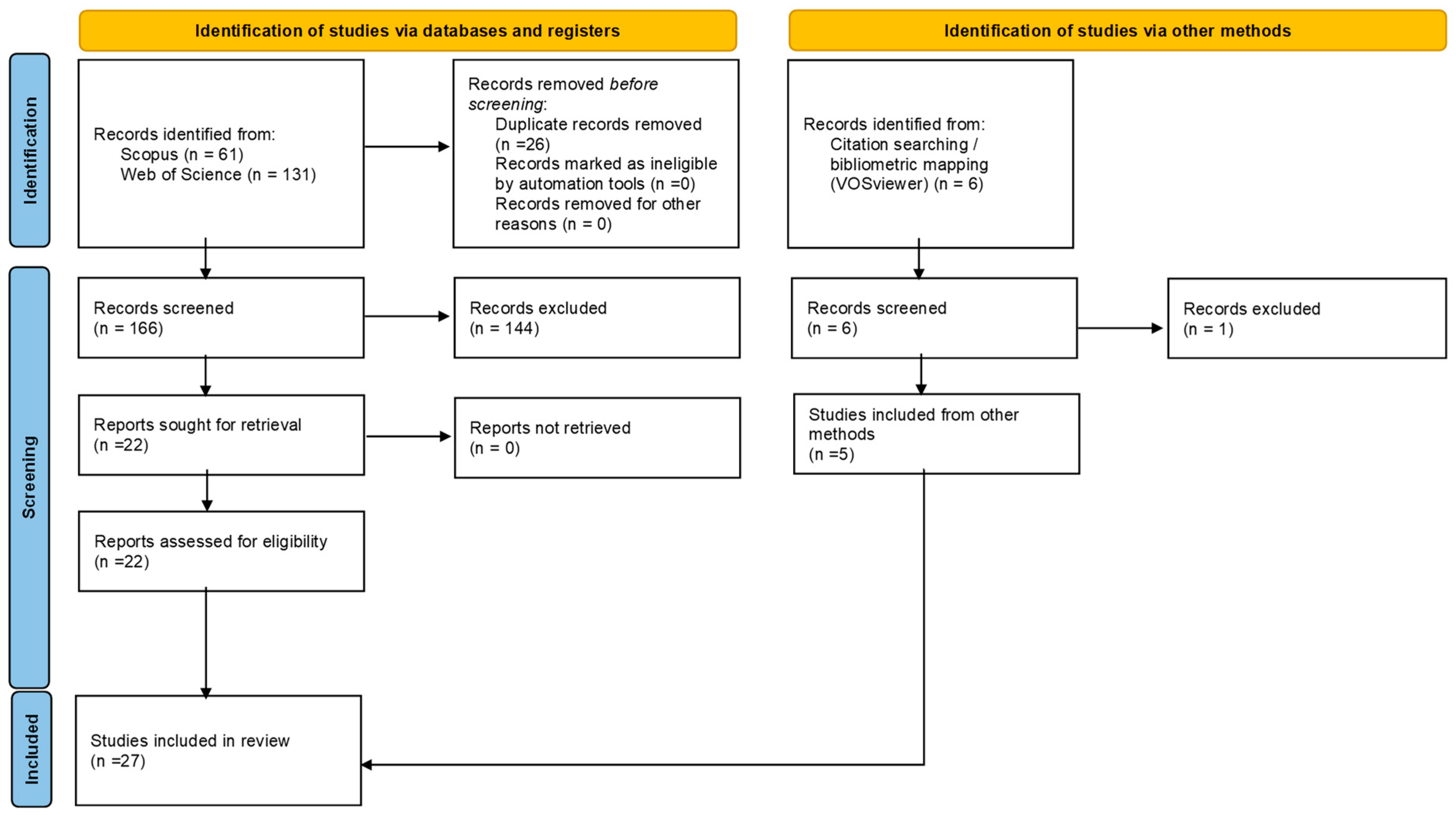
2.4. Study Selection Process
2.5. Data Extraction
2.6. Methodological Quality Assessment Using COSMIN
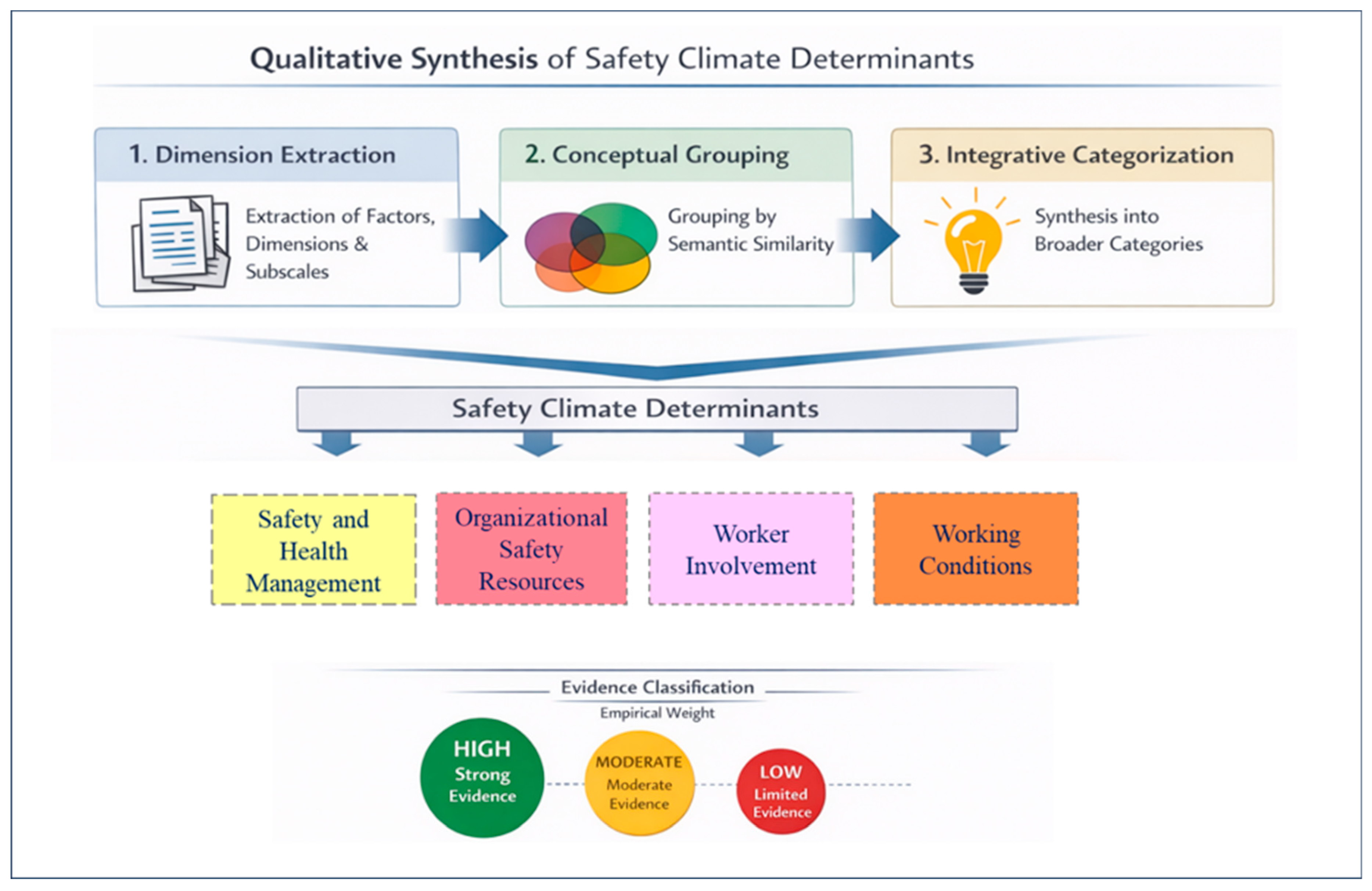
2.7. Qualitative Synthesis of Safety Climate Determinants
- (i)
- Dimension extraction: All factor, dimension, and subscale names were extracted verbatim from the original instruments.
- (ii)
- Conceptual grouping: Dimensions were grouped according to conceptual similarity, considering semantic equivalence and theoretical function, in order to reduce terminological heterogeneity across instruments.
- (iii)
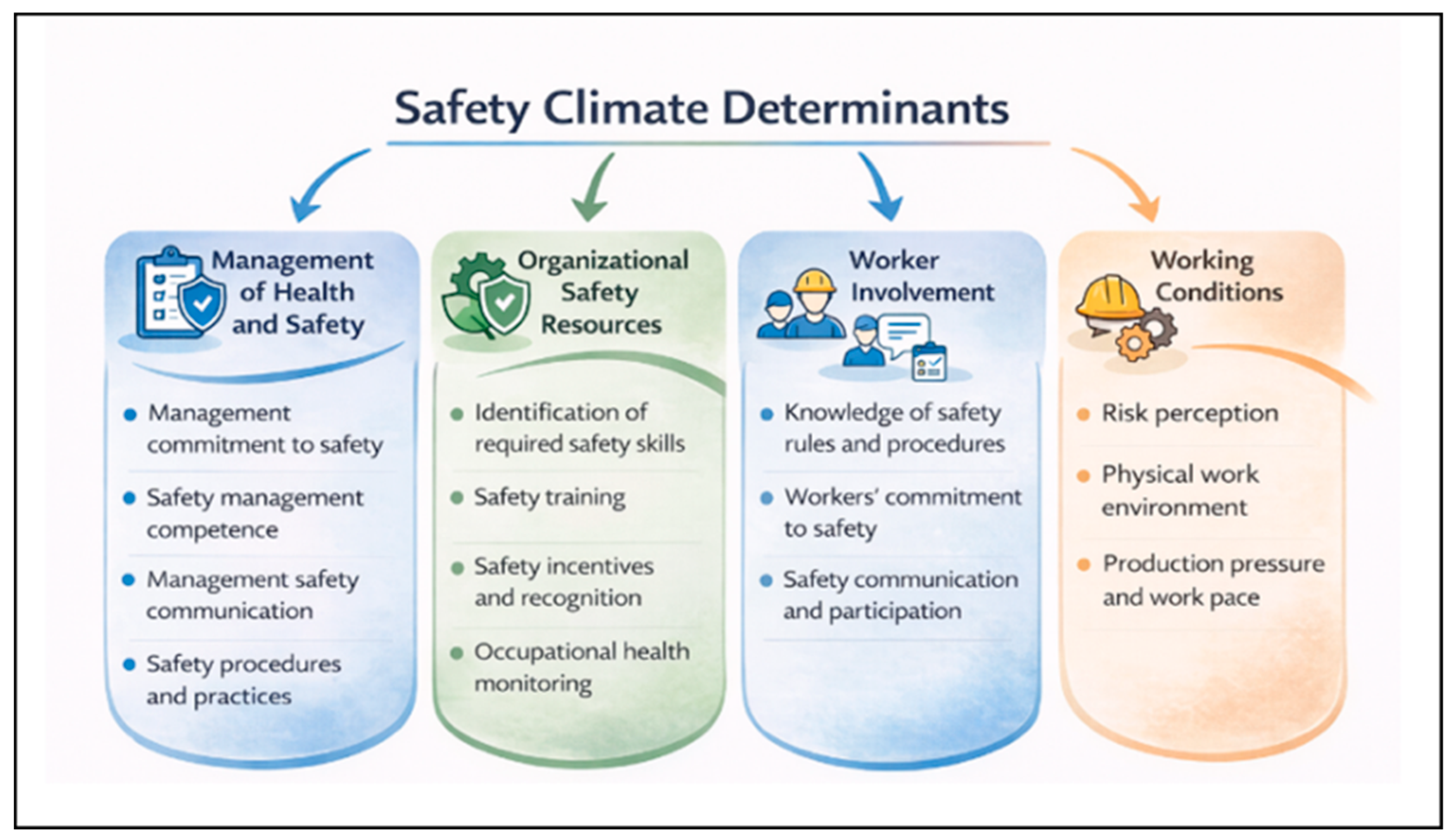
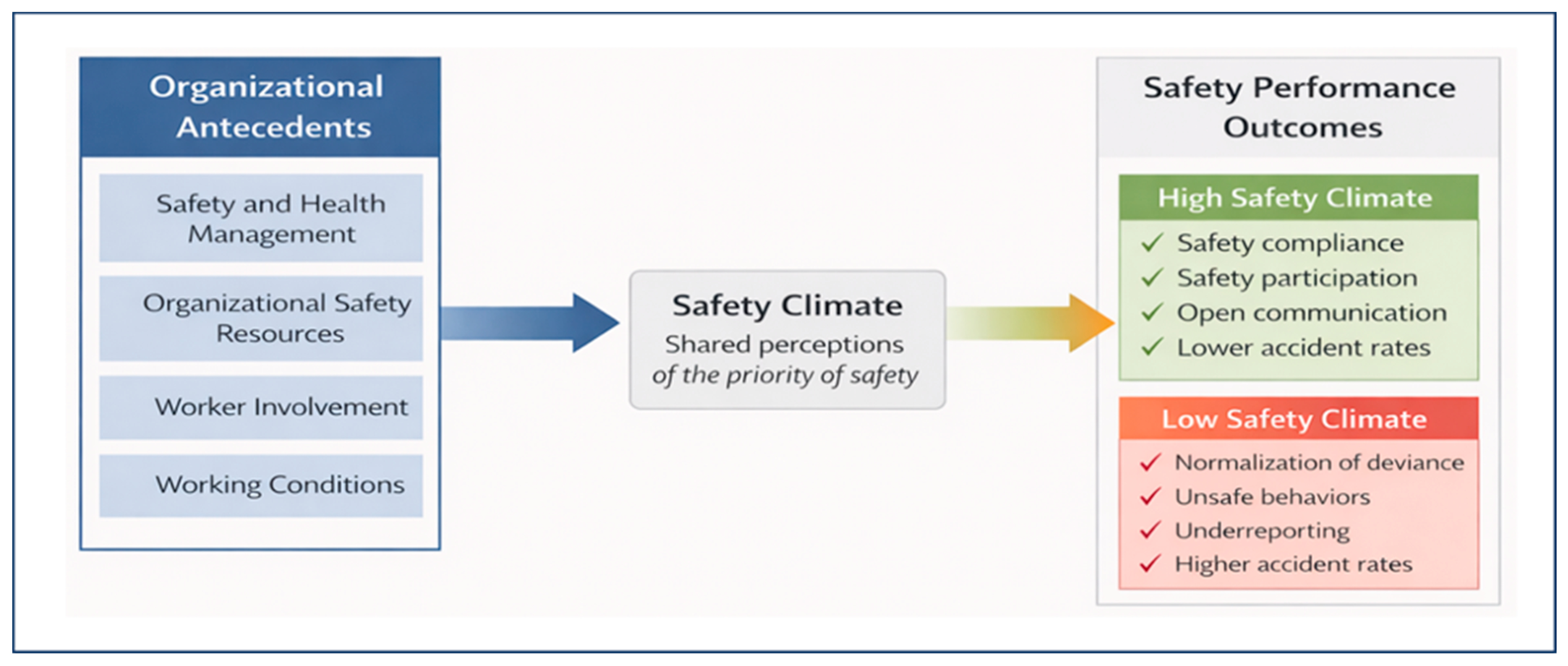
- Integrative categorization: The resulting groupings were synthesized into broader conceptual categories representing the main determinants of safety climate, while preserving the original theoretical meaning of the factors. The definition of these categories considered both the empirical recurrence of factors and their conceptual relevance, in line with classical and contemporary safety climate models (e.g., [3,5]). For each identified category, the requirements delimiting its conceptual scope were identified and systematized. This process resulted in the definition of four safety climate determinants: Management of Health and Safety, Organizational Safety Resources, Worker Involvement, and Working Conditions.
3. Results
3.1. General Characteristics of the Studies
3.2. Psychometric Properties of the Instruments
3.3. Integrative Structure of Safety Climate Determinants
4. Discussion
4.1. Critical Synthesis of Psychometric Evidence
4.2. Synthesis of Safety Climate Determinants
4.3. Conceptual Model
4.4. Psychometric Implications for Safety Climate Measurement and Instrument Development
4.5. Limitations and Directions for Future Research
5. Conclusions
Supplementary Materials
Author Contributions
Funding
Institutional Review Board Statement
Informed Consent Statement
Data Availability Statement
Conflicts of Interest
Appendix A

| Reference | Content Validity | Structural Validity | Internal Consistency | Reliability (Test–Retest) | Criterion/Construct Validity | Responsiveness | Invariance/Comparability | Overall Quality |
|---|---|---|---|---|---|---|---|---|
| [3] | Inadequate No formal content validation; items derived from theoretical frameworks only. | Inadequate Early exploratory evidence only; no CFA/IRT/invariance testing. | Inadequate Internal consistency not reported. | NA | Adequate Associations with safety inspections are consistent with the theory. | NA | NA | Inadequate Strong theoretical contribution, but structural, content, and reliability analyses are limited. |
| [5] | Inadequate Solid theoretical model and systematic conceptual development, but with no formal testing by experts and/or the target population. | Adequate Hierarchical CFA supported; no invariance or IRT analyses. | Adequate α ≥ 0.70 across dimensions with CFA-confirmed structure. | NA | Very good Validated relationships with safety performance, motivation, and knowledge. | NA | NA | Adequate Robust CFA-based structure and construct validity; limitations in content validity and invariance. |
| [13] | Inadequate Items based on literature and previous experience, but without systematic expert or target-population validation. | Inadequate EFA conducted; structure not confirmed by CFA. | Inadequate α around 0.70–0.80 across dimensions; no confirmatory testing of structure. | NA | Adequate Predicts safe behavior; limited hypothesis testing. | NA | NA | Inadequate Solid theoretical basis, but lacks item development, content validity testing, and CFA-based structural validity. |
| [12] | Inadequate Strong theoretical basis, but no structured expert review or cognitive testing. | Inadequate Strong EFA with a large sample; no CFA. | Inadequate Internal consistency acceptable; no CFA. | NA | Adequate Validation of multilevel effects on safety performance. | NA | NA | Inadequate Theoretically grounded multilevel model, but psychometrically inadequate. |
| [9] | Very good Strong theoretical foundation and iterative expert-based development, complemented by face validity testing with lay participants. | Very good EFA, CFA, and Rasch analysis applied. | Very good α > 0.80 across all dimensions, and Rasch analysis supports internal consistency. | NA | Very good Predicts motivation, safety perceptions, and behaviors. | NA | NA | Very good Strong psychometric evidence and Rasch analysis; however, no full invariance or test–retest reliability. |
| [14] | Adequate Expert evaluation conducted; I-CVI > 0.78 indicates systematic content validation. | Adequate PCA and CFA with acceptable fit (RMSEA 0.05–0.06; CFI 0.85); PCA instead of FA and CFI < 0.90. | Very good global α = 0.96; subscales 0.62–0.93; interpreted after CFA. | Adequate ICC 0.93, but small sample (n = 26). | Adequate external comparisons of accident history. | NA | NA | Adequate Strong structure and reliability, but inadequate construct validity determine the overall rating. |
| [15] | Inadequate No item development, no expert review, no cognitive testing, or insufficient reporting. | Inadequate Structure confirmed, but without robust EFA/CFA. | Inadequate α between 0.70–0.80; structure not confirmed by CFA. | NA | NA | NA | NA | Inadequate Theoretically interesting, but does not meet COSMIN standards for measurement property evaluation. |
| [16] | Inadequate The study derived items from classical safety climate dimensions but did not report expert panel or target population evaluations. | Inadequate The study described a clear factorial structure but omitted CFA and invariance testing. | Inadequate α > 0.85; robust internal consistency; no CFA. | NA | NA | NA | NA | Inadequate No item development, no content validity, only EFA (no CFA), internal consistency not interpretable, and no construct validity testing. |
| [8] | Very good. Developed from an extended version validated by experts. | Very good Strong CFA with a large sample and good fit indices. | Very good α > 0.85; strong convergent validity. | NA | Very good Associations with sleep, health, and shift work. | NA | NA | Very good Strong structural validity, high internal consistency, and robust theoretical and empirical support. |
| [17] | Inadequate Only translation/face review; no COSMIN content-validity assessment. | Very good Solid factorial structure, excellent fit indices, adequate sample size. | Very good Global α = 0.94; strong consistency within dimensions. | NA | NA | NA | Adequate Comparability with the original version. | Inadequate Good CFA and reliability, but lacks content validity, invariance, test–retest, and construct hypotheses. |
| [1] | Inadequate Used pre-existing instruments without evaluating item relevance, so there is no content validity. | Inadequate Structure based on predefined cultural dimensions; no CFA. | Inadequate Acceptable internal consistency across nine dimensions; no CFA. | NA | NA | NA | NA | Inadequate The article is not a psychometric study and does not evaluate any measurement properties of the instruments used. |
| [2] | Adequate Items adapted from Zohar & Luria and refined with IRT, supported by expert-based selection. | Very good IRT (GRM) is used to select items with high information and strong structural evidence. | Very good α ≥ 0.89; IRT-based item refinement supports internal consistency. | NA | Very good High correlations with the full-scale version. | NA | Very good IRT supports cross-version comparability. | Adequate Strong and innovative psychometric evidence. |
| [18] | Inadequate The studies did not document new expert evaluations or content assessments, as they relied solely on previously validated instruments. | Very good EFA and CFA confirmed a multidimensional structure. | Very good α > 0.80 across dimensions; CFA supports factor structure. | NA | NA | NA | NA | Inadequate Inadequate due to lack of content validity, measurement error, reliability, and invariance. |
| [19] | Inadequate Translation/back-translation performed, but no formal expert analysis of relevance/comprehensiveness. | Inadequate Structure supported by EFA, but no CFA. | Inadequate α between 0.75 and 0.84; no CFA confirmation. | NA | NA | NA | NA | Inadequate No content or structural validity; internal consistency not interpretable. |
| [20] | Very good Strong theoretical foundation; extensive expert review and systematic development. | Very good CFA confirmed a robust second-order model with excellent fit. | Very good α between 0.94 and 0.98; CFA confirms structure. | NA | Very good A meta-analysis confirmed that safety climate is a robust predictor of accidents, injuries, and safety behaviors. | NA | NA | Very good Excellent structural, internal, and construct validity; strong invariance evidence across samples. |
| [21] | Inadequate Combined use of validated instruments; no new content validation. | Inadequate The study applied existing scales without conducting a structural analysis. | Inadequate α between 0.75 and 0.84; no CFA confirmation. | NA | NA | NA | Inadequate Only mean comparisons; no MG-CFA, DIF, or IRT. | Inadequate No structural validity or internal consistency evaluation; psychometric evidence is minimal. |
| [22] | Inadequate Uses validated NOSACQ-50 without performing new expert or target-population content validation. | Inadequate The study used the NOSACQ-50 without any structural evaluation in the sample. | Inadequate α between 0.70–0.92; not validating structure. | NA | NA | NA | NA | Inadequate Consistent associations and acceptable reliability; no structural or invariance evaluation. |
| [36] | Inadequate Uses a validated questionnaire translated; limited content assessment beyond translation. | Inadequate No EFA/CFA/IRT; dimensionality not assessed. | Inadequate α = 0.84; structural validity not established. | NA | NA | Very good Clear responsiveness to training. | NA | Inadequate No structural, construct, or internal consistency evaluation beyond α; very limited psychometric evidence. |
| [24] | Inadequate Uses LSCAT and Zohar scales with face validity only; no systematic expert or population evaluation. | Inadequate Only descriptive statistics/correlations; no factor analysis or model evaluation. | Inadequate α = 0.70 (LSCAT) and 0.96 (ZSCQ); no structural confirmation. | NA | Adequate Differences between production and non-production groups; | NA | Inadequate Group comparisons only; no MG-CFA, DIF, or IRT. | Inadequate No content validity; no structural validity; analyses limited to descriptive comparisons. |
| [25] | Very good Validated Polish version based on structured expert review and adaptation process. | Inadequate Replicates prior EFA; no CFA/IRT performed in this sample. | Inadequate α = 0.61–0.88; some dimensions marginal, no CFA. | NA | Adequate Significant differences between occupational groups. | NA | Adequate Comparability among the three groups of workers. | Inadequate Acceptable reliability and construct associations; lacks confirmatory structural testing. |
| [26] | Inadequate Use of previously validated instruments with literature-based adaptation; limited direct content validation. | Very good CFA indicated a good fit; strong convergent/discriminant validity. | Very good α between 0.78 and 0.86 with a confirmed CFA model. | NA | Adequate Association with self-reported accidents. | NA | NA | Inadequate No content validity, despite strong CFA and reliability. |
| [27] | Very good The study followed a systematic approach for the translation, cultural adaptation, and expert review. | Inadequate EFA conducted; no CFA. | Inadequate α > 0.80; strong reliability but no CFA. | NA | Adequate Correlations with organizational variables. | NA | NA | Inadequate Acceptable structure (EFA), reliability, and construct associations; lacks deeper psychometric testing. |
| [28] | Inadequate Adapted from the HSE questionnaire without formal expert evaluation or cultural adaptation. | Inadequate No EFA/CFA/IRT; only correlations reported. | Inadequate α between 0.689 e 0.868; borderline reliability; no CFA. | Adequate Test–retest (n = 30; 10-day interval) with Spearman r > 0.69, indicating temporal stability; ICC not reported. | Adequate Exploratory correlations with demographic variables. | NA | NA | Inadequate No content validity assessment, no structural validity (no CFA/EFA), internal consistency not interpretable, and no construct validity testing. |
| [29] | Inadequate Qualitative triangulation and open-ended item generation, but no structured expert panel. | Inadequate Qualitative exploratory study; no structural model to evaluate. | Inadequate Qualitative study; no internal consistency measures. | NA | Adequate Emerging dimensions comparable to the literature. | NA | NA | Inadequate Qualitative and exploratory only; lacks quantitative psychometric evaluation. |
| [30] | Very good Systematic review and co-creation with HSE managers; strong evidence of content relevance and coverage. | Very good Using a sample of 1688 workers, the analysis employed both EFA and CFA, yielding eight final dimensions. | Very good α > 0.80; short version also validated. | NA | Very good Strong convergent and known-groups validity across sectors. | NA | Very good Multilevel invariance across organizational, supervisor, and peer levels. | Very good Strong structural validity, strong internal consistency, and strong construct validity; robust evidence across levels. |
| [31] | Inadequate No direct assessment with experts/target population; relies on prior NOSACQ-24 conceptual foundation. | Very good CFA with adequate fit (CFI ≥ 0.95; RMSEA ≤ 0.06) across multiple independent samples. | Very good α > 0.85 across all factors. | NA | Very good Correlations with accidents and risk perception. | NA | NA | Inadequate Strong structural validity; missing content validity and reliability; no content validity. |
| [32] | Inadequate Items adapted from validated scales; pre-test with workers, but no structured expert evaluation. | Inadequate EFA revealed three factors; no CFA. | Inadequate α between 0.78 and 0.86; although EFA only. | NA | Adequate Predictors of perceived safety performance. | Adequate Factors showed direct relationships with performance perception. | NA | Inadequate Good reliability and construct associations; lacks CFA, IRT, invariance, and test–retest analyses. |
References
- Haslam, C.; O’Hara, J.; Kazi, A.; Twumasi, R.; Haslam, R. Proactive occupational safety and health management: Promoting good health and good business. Saf. Sci. 2016, 81, 99–108. [Google Scholar] [CrossRef]
- Huang, Y.-H.; Lee, J.; Chen, Z.; Perry, M.; Cheung, J.H.; Wang, M. An item-response theory approach to safety climate measurement: The Liberty Mutual Safety Climate Short Scales. Accid. Anal. Prev. 2017, 103, 96–104. [Google Scholar] [CrossRef]
- Zohar, D. Safety climate in industrial organizations: Theoretical and applied implications. J. Appl. Psychol. 1980, 65, 96–102. [Google Scholar] [CrossRef]
- Luo, T. Safety climate: Current status of the research and future prospects. J. Saf. Sci. Resil. 2020, 1, 106–119. [Google Scholar] [CrossRef]
- Griffin, M.A.; Neal, A. Perceptions of safety at work: A framework for linking safety climate to safety performance, knowledge, and motivation. J. Occup. Health Psychol. 2000, 5, 347–358. [Google Scholar] [CrossRef] [PubMed]
- Clarke, S. The relationship between safety climate and safety performance: A meta-analytic review. J. Occup. Health Psychol. 2006, 11, 315–327. [Google Scholar] [CrossRef]
- Zohar, D.; Huang, Y.H.; Lee, J.; Robertson, M. A mediation model linking dispatcher leadership and work ownership with safety climate as predictors of truck driver safety performance. Accid. Anal. Prev. 2014, 62, 17–25. [Google Scholar] [CrossRef]
- Nielsen, M.B.; Hystad, S.W.; Eid, J. The Brief Norwegian Safety Climate Inventory (Brief NORSCI)—Psychometric properties and relationships with shift work, sleep, and health. Saf. Sci. 2016, 83, 23–30. [Google Scholar] [CrossRef]
- Kines, P.; Lappalainen, J.; Mikkelsen, K.L.; Olsen, E.; Pousette, A.; Tharaldsen, J.; Tómasson, K.; Törner, M. Nordic Safety Climate Questionnaire (NOSACQ-50): A new tool for diagnosing occupational safety climate. Int. J. Ind. Ergon. 2011, 41, 634–646. [Google Scholar] [CrossRef]
- Page, M.J.; McKenzie, J.E.; Bossuyt, P.M.; Boutron, I.; Hoffmann, T.C.; Mulrow, C.D.; Shamseer, L.; Tetzlaff, J.M.; Akl, E.A.; Brennan, S.E.; et al. The PRISMA 2020 statement: An updated guideline for reporting systematic reviews. Syst. Rev. 2021, 10, n71. [Google Scholar] [CrossRef] [PubMed]
- Mokkink, L.B.; de Vet, H.C.W.; Prinsen, C.A.C.; Patrick, D.L.; Alonso, J.; Bouter, L.M.; Terwee, C.B. COSMIN Risk of Bias checklist for systematic reviews of Patient-Reported Outcome Measures. Qual. Life Res. 2018, 27, 1171–1179. [Google Scholar] [CrossRef] [PubMed]
- Zohar, D.; Luria, G. A multilevel model of safety climate: Cross-level relationships between organization and group-level climates. J. Appl. Psychol. 2005, 90, 616–628. [Google Scholar] [CrossRef]
- Cooper, M.D.; Phillips, R.A. Exploratory analysis of the safety climate and safety behavior relationship. J. Safety Res. 2004, 35, 497–512. [Google Scholar] [CrossRef]
- Ghahramani, A.; Khalkhali, H.R. Development and Validation of a Safety Climate Scale for Manufacturing Industry. Saf. Health Work. 2015, 6, 97–103. [Google Scholar] [CrossRef]
- Kouabenan, D.R.; Ngueutsa, R.; Mbaye, S. Safety climate, perceived risk, and involvement in safety management. Saf. Sci. 2015, 77, 72–79. [Google Scholar] [CrossRef]
- Liu, X.; Huang, G.; Huang, H.; Wang, S.; Xiao, Y.; Chen, W. Safety climate, safety behavior, and worker injuries in the Chinese manufacturing industry. Saf. Sci. 2015, 78, 173–178. [Google Scholar] [CrossRef]
- Yousefi, Y.; Jahangiri, M.; Choobineh, A.; Tabatabaei, H.; Keshavarzi, S.; Shams, A.; Mohammadi, Y. Validity Assessment of the Persian Version of the Nordic Safety Climate Questionnaire (NOSACQ-50): A Case Study in a Steel Company. Saf. Health Work. 2016, 7, 326–330. [Google Scholar] [CrossRef] [PubMed]
- Flatau Harrison, H.; Griffin, M.A.; Gagne, M.; Andrei, D. Assessing shortened safety climate measures: Simulating a planned missing data design in a field setting. Saf. Sci. 2018, 104, 189–201. [Google Scholar] [CrossRef]
- Yangok, A.; Choosong, T. Factors related to safety climate in production line workers of food manufacturing. Int. J. Eng. Technol. (UAE) 2018, 7, 18–22. [Google Scholar] [CrossRef][Green Version]
- Beus, J.M.; Payne, S.C.; Arthur, W.; Muñoz, G.J. The Development and Validation of a Cross-Industry Safety Climate Measure: Resolving Conceptual and Operational Issues. J. Manag. 2017, 45, 1987–2013. [Google Scholar] [CrossRef]
- Sukapto, P.; Octavia, J.R.; Pundarikasutra, P.A.D.; Ariningsih, P.K.; Susanto, S. Improving occupational health and safety and in the home-based footwear industry through implementation of ILO-PATRIS, NOSACQ-50 and participatory ergonomics: A case study. Int. J. Technol. 2019, 10, 908–917. [Google Scholar] [CrossRef]
- Lagerstrom, E.; Magzamen, S.; Kines, P.; Brazile, W.; Rosecrance, J. Determinants of safety climate in the professional logging industry. Safety 2019, 5, 35. [Google Scholar] [CrossRef] [PubMed]
- Omidi, N.; Jafari Eskandari, M.; Omidi, M.R. Research Paper: The Effect of Safety Training Intervention on Safety Climate Among the Operational Staff of West Oil and Gas Company. Health Emergencies Disasters Q. 2021, 7, 15–20. [Google Scholar] [CrossRef]
- Zakaria, J.; Che Hassan, C.R.; Hamid, M.D.; Sukadarin, E.H. Safety climate factors at selected chemical manufacturing plant in Malaysia. Process Saf. Prog. 2020, 39, e12096. [Google Scholar] [CrossRef]
- Stasiła-Sieradzka, M.; Chudzicka-Czupała, A.; Znajmiecka-Sikora, M. Work safety climate. Comparison of selected occupational groups. PLoS ONE 2020, 15, e0243056. [Google Scholar] [CrossRef]
- Igić, D.; Vuković, M.; Urošević, S.; Mladenović-Ranisavljević, I.; Voza, D. The relationship between ethical leadership, organizational commitment and Zero Accident Vision implementation in the defense industry. Int. J. Occup. Saf. Ergon. 2021, 27, 1076–1086. [Google Scholar] [CrossRef]
- Choosong, T.; Rungruang, S.; Choomalee, K.; Sirirak, T. Exploratory Analysis of the Nordic Safety Climate Questionnaire-Thai Version and Safety Climate among Thai Employees. Int. J. Occup. Saf. Health 2022, 12, 171–179. [Google Scholar] [CrossRef]
- Kiani, M.; Asgari, M.; Abbas Gohari, F.; Rezvani, Z. Safety climate assessment: A survey in an electric power distribution company. Int. J. Occup. Saf. Ergon. 2022, 28, 709–715. [Google Scholar] [CrossRef]
- Razali, A.M.; Zin, R.M.; Ali, Q. Perceptual attitudes towards safety climate among employees of a manufacturing firm: A qualitative approach. Probl. Perspect. Manag. 2022, 20, 107–116. [Google Scholar] [CrossRef]
- Todaro, N.M.; Testa, F.; Rizzi, F.; Vizzoto, F.; Curcuruto, M. Safety climate in high safety maturity organisations: Development of a multidimensional and multilevel safety climate questionnaire. Saf. Sci. 2023, 166, 106231. [Google Scholar] [CrossRef]
- Summers, D.; Harries, J.; Kirby, N.; Sarris, A. The validity and measurement equivalence of a brief safety climate questionnaire across casual and permanent workers. Saf. Sci. 2023, 159, 106034. [Google Scholar] [CrossRef]
- Yunusa-Kaltungo, A.; Ray, S.; AlSanad, S.; Sokunbi, I.; Manu, P.; Cheung, C.M.; Mohandes, S.R. Assessment of safety climate perception of maintenance workers during major overhauls, outages, shutdowns or turnarounds (MoOSTs). Qual. Reliab. Eng. Int. 2024, 40, 2936–2953. [Google Scholar] [CrossRef]
- Alruqi, W.M.; Hallowell, M.R.; Techera, U. Safety climate dimensions and their relationship to construction safety performance: A meta-analytic review. Saf. Sci. 2018, 109, 165–173. [Google Scholar] [CrossRef]
- Wu, C.; Song, X.; Wang, T.; Fang, D. Core Dimensions of the Construction Safety Climate for a Standardized Safety-Climate Measurement. J. Constr. Eng. Manag. 2015, 141, 04015018. [Google Scholar] [CrossRef]
- Cheng, Y.-H. Railway safety climate: A study on organizational development. Int. J. Occup. Saf. Ergon. 2019, 25, 200–216. [Google Scholar] [CrossRef]
- Omidi, M.R.; Eskandari, M.J.; Omidi, N. Investigating the Effect of Safety Training on the Safety Climate of Employees Working in Kermanshah Province, Iran Oil Refining Company. Health Emergencies Disasters Q. 2020, 6, 23–28. [Google Scholar] [CrossRef]


| Reference | Objective | Nº Items/Dimensions | Context/Target Population | Psychometric Methods Used | COSMIN Profile |
|---|---|---|---|---|---|
| [3] | To develop and validate a scale to measure the safety climate in industrial settings | 40 items/eight dimensions | Metal fabrication, food processing, the chemical industry, and the textile industry | Exploratory Factor Analysis (EFA) to identify the dimensional structure and eliminate items with low factor loadings. | Inadequate |
| [5] | To investigate the influence of safety climate perceptions on safe work behavior | 81 items/10 dimensions | Industrial sector in Australia | Confirmatory Factor Analysis (CFA) using covariance-based structural equation modeling (CB-SEM) to validate the theoretical structure of the instrument. | Adequate |
| [13] | To examine the relationship between safety climate perceptions and safe behavior, with a focus on training and managerial support | 50 items/seven dimensions | Industrial sector in the United Kingdom | Evidence of predictive validity based on correlations and linear regression. | Inadequate |
| [12] | To develop and test a multilevel model of safety climate | 16 items/three dimensions | Metallurgical, food, plastic, and chemical sectors (country not specified) | EFA and internal consistency (Cronbach’s α). | Inadequate |
| [9] | Researchers developed the Nordic Occupational Safety Climate Questionnaire (NOSACQ-50) to measure workplace safety climate | 50 items/seven dimensions | The food industry sector in Sweden and the construction sector in the Nordic countries | EFA, CFA, Rasch, Cronbach’s α, Criterion Validity, and Multilevel Analysis. | Very good |
| [14] | To develop and validate a scale for the manufacturing industry | 45 items/seven dimensions | Workers from Iranian refineries and petrochemical plants | Content validity by experts, CFA, and Cronbach’s α. | Adequate |
| [15] | To investigate the relationship between workplace safety climate perception, frontline managers’ risk perception, and their involvement in safety management | 50 items/eight dimensions | Nuclear power plants in France | Cronbach’s α; no structural analysis reported. | Inadequate |
| [16] | To investigate the relationships between safety climate, safety behavior, and injuries | 21 items/four dimensions | Workers from factories and industrial plants in China | EFA and Cronbach’s α. | Inadequate |
| [8] | To validate the BriefNORSCI as a brief measure of safety climate | 11 items/three dimensions | Workers from the Norwegian offshore oil industry | CFA, RMSEA, CFI, TLI, Construct Validity. | Very good |
| [17] | To develop and validate the Persian version of the NOSACQ-50 and assess the safety climate among a group of steel industry workers | 48 items/six dimensions | Steel industry in Iran | EFA, CFA, Cronbach’s α, and Pearson correlation test. | Inadequate |
| [1] | To investigate the relationship between safety culture, organizational attitudes, and workers’ well-being. | 18 items/eight dimensions | Industrial sector in the United Kingdom | Cronbach’s α; no factor analysis reported. | Inadequate |
| [2] | To apply IRT to reduce safety climate scales | 19 items/four dimensions | Various industrial sectors (country not specified) | IRT with a two-parameter model to estimate item discrimination and difficulty. | Adequate |
| [18] | To evaluate the effectiveness of the safety climate questionnaire reduction using planned missing data | 7 items/four dimensions | Hospital, mining, construction, and oil sectors in Australia | CFA and the multiple imputation technique to reduce items while maintaining predictive validity. | Inadequate |
| [19] | To assess the safety climate by identifying factors related to safety perceptions and accidents | 50 items/seven dimensions | Food industry in Thailand | Cronbach’s α; no structural validation reported. | Inadequate |
| [20] | To develop and validate a safety climate measure applicable across multiple sectors | 30 items/seven dimensions | Various industrial sectors (country not specified) | Construct validity with multilevel CFA and criterion validity via correlations. | Very good |
| [21] | To assess safety conditions and ergonomic practices in informal footwear workshops | 50 items/seven dimensions | Footwear industry in Indonesia | Content validity by experts, Cronbach’s α, and correlations for predictive analysis. | Inadequate |
| [22] | To quantify the safety climate and analyze the perceptions of workers and supervisors | 50 items/seven dimensions | Reforestation industry in Montana, USA | Previously validated instrument (NOSACQ-50); no new psychometric analysis. | Inadequate |
| [23] | Evaluate the impact of a training program on safety climate | 43 items/11 dimensions | Oil and gas industry in Iran | Content validity assessed by experts and Cronbach’s α. | Inadequate |
| [24] | Analyze the structural factors of safety climate in a chemical plant | 43 items/nine dimensions | Chemical industry in Malaysia | Content validity assessed by experts and Cronbach’s α. | Inadequate |
| [25] | To compare safety climate perceptions across different occupational groups | 50 items/10 dimensions | Industrial sector in Poland | Content validity evaluated by experts, EFA. | Inadequate |
| [26] | To evaluate how leadership, ethics, organizational commitment, and workers’ perceptions influence the implementation of the Zero Accident Vision within the military sector | 18 items/10 dimensions | Military industry in Serbia | CFA and Cronbach’s α. | Inadequate |
| [27] | To validate the NOSACQ-50 adapted to the Thai context and to evaluate how workers and leaders perceive safety issues in the manufacturing and healthcare sectors | 42 items/five dimensions | Hospital and business sectors in Thailand | Content validity, Construct Validity through EFA, covariance-based structural equation modeling (CB-SEM), and Cronbach’s α. | Inadequate |
| [28] | To investigate the safety climate and its correlations with demographic variables | 43 items/11 dimensions | Energy sector in the United Kingdom | Cronbach’s α, Spearman correlation, and Descriptive statistics. | Inadequate |
| [29] | To investigate employees’ perceptions of the safety climate through a mixed-methods approach | 11 items/11 dimensions | Workers from the medical equipment sector in Malaysia | CFA and Qualitative Content Analysis. | Inadequate |
| [30] | To develop a safety climate scale for organizations with high management maturity | 40 items/eight dimensions | Energy, oil, and manufacturing and printing sectors in Italy | Construct validity via EFA and CFA; convergent and discriminant validity based on the Fornell–Larcker criterion. | Very good |
| [31] | To validate a shortened version of the NOSACQ-50 for continuous monitoring of safety climate | 24 items/seven dimensions | Various industrial sectors in Australia | CFA; Validity through Pearson correlations. | Inadequate |
| [32] | To investigate critical factors such as training and accident reporting in critical events | 49 items/three dimensions | Cement industry in Nigeria | EFA with PCA and Varimax rotation and Cronbach’s α. | Inadequate |
| Category of Determinants | Conceptual Requirement | Empirical Recurrence | Studies That Reported the Determinants |
|---|---|---|---|
| Health and Safety Management | Management commitment to safety | High | [1,3,4,5,8,13,14,16,17,20,24,28,29,30,31,32,33] |
| Safety management competence | High | [4,5,8,14,17,31,33] | |
| Management safety communication | High | [1,2,3,5,20,30,31] | |
| Safety procedures and practices | High | [1,14,18,28,30,33,34] | |
| Identification of required skills | Low | [5,14,20,31] | |
| Organizational safety resources | Safety training | High | [1,2,5,13,14,16,18,20,24,28,29,30,32,33,34,35] |
| Safety incentives and recognition | Low | [3,5,20,28,30] | |
| Occupational health monitoring | Low | [1,13,25,29] | |
| Worker involvement | Knowledge of safety rules and procedures | Low | [5,14,20] |
| Workers’ commitment to safety | Moderate | [3,5,17,20,24,29,31] | |
| Safety communication and participation | Moderate | [1,2,3,5,20,30,32] | |
| Working conditions | Risk perception and acceptance | Moderate | [1,13,15,17,27,29] |
| Physical work environment | Moderate | [1,3,24,25] | |
| Production pressure and work pace | Moderate | [3,13,25,28,29] |
Disclaimer/Publisher’s Note: The statements, opinions and data contained in all publications are solely those of the individual author(s) and contributor(s) and not of MDPI and/or the editor(s). MDPI and/or the editor(s) disclaim responsibility for any injury to people or property resulting from any ideas, methods, instructions or products referred to in the content. |
© 2026 by the authors. Licensee MDPI, Basel, Switzerland. This article is an open access article distributed under the terms and conditions of the Creative Commons Attribution (CC BY) license.
Share and Cite
Silva, J.M.d.; Bornia, A.C.; Silva, J.M.N.d.; Fernandes, R.d.S. Determinants of Safety Climate in Industrial Settings: A Systematic Review of Measurement Instruments. Healthcare 2026, 14, 596. https://doi.org/10.3390/healthcare14050596
Silva JMd, Bornia AC, Silva JMNd, Fernandes RdS. Determinants of Safety Climate in Industrial Settings: A Systematic Review of Measurement Instruments. Healthcare. 2026; 14(5):596. https://doi.org/10.3390/healthcare14050596
Chicago/Turabian StyleSilva, Jaqueline Matias da, Antonio Cezar Bornia, Jonhatan Magno Norte da Silva, and Rafael da Silva Fernandes. 2026. "Determinants of Safety Climate in Industrial Settings: A Systematic Review of Measurement Instruments" Healthcare 14, no. 5: 596. https://doi.org/10.3390/healthcare14050596
APA StyleSilva, J. M. d., Bornia, A. C., Silva, J. M. N. d., & Fernandes, R. d. S. (2026). Determinants of Safety Climate in Industrial Settings: A Systematic Review of Measurement Instruments. Healthcare, 14(5), 596. https://doi.org/10.3390/healthcare14050596