


Abstract
Background/Objectives: Evidence-based practice (EBP) underpins safe care in every setting, and its demands are heightened in critical care. International recruitment has staffed Saudi Arabian intensive care units (ICUs) with nurses educated in many countries. This study examined how these nurses perceive, adapt to, and implement EBP, and what barriers and facilitating processes shape their experiences. Methods: A focused ethnography was conducted in six critical care units across three Riyadh hospitals (two public, one private) between September and December 2025. Data comprised semi-structured interviews with 15 nurses, 312 h of participant observation, approximately 45 informal conversations, and 175 unit documents, analysed using reflexive thematic analysis. Results: Five interconnected themes were developed: (1) diverse EBP conceptualisations shaped by educational and cultural traditions; (2) adaptive implementation strategies drawing on complementary team expertise; (3) information-access and language barriers; (4) cultural negotiations balancing evidence with religious and familial values; and (5) collaborative knowledge-sharing systems. Hierarchy-based silencing, contested protocol adaptations, and fragile informal support constrained implementation. Conclusions: Adaptive capacity depended on institutional structures rather than on diversity itself, and cultural background was intertwined with education, experience, and professional hierarchy. Equitable evidence access, formalised mentorship, tiered education, cultural-adaptation pathways, and inclusive leadership are promising strategies that require evaluation.
1. Introduction
Evidence-based practice (EBP), the integration of best available research evidence with clinical expertise and patient values, is foundational to safe care in all settings; its demands are heightened in critical care, where rapid decision-making must balance complex competing demands [1,2]. Saudi Arabia’s Vision 2030 strategy has driven substantial healthcare investment and international nursing recruitment, creating intensive care units (ICUs) staffed by nurses educated in many countries, with preparation ranging from hospital-based diplomas to research-focused master’s programmes [3,4]. Saudi Arabian hospitals have relied on internationally recruited nurses for decades, but the scale of current recruitment and the number of educational systems represented within a single unit have grown. This diversity creates dual dynamics: multiple perspectives can enrich clinical decision-making, yet linguistic barriers, educational hierarchies, and cultural differences in authority norms can introduce inconsistencies in evidence appraisal and clinical action [5,6].
1.1. EBP in Critical Care
Contemporary critical care EBP encompasses systematic identification, appraisal, and implementation of research findings across ventilator management, sedation, infection prevention, and family-centred care. While systematic implementation is associated with reduced mortality and shorter hospital stays, realising these benefits requires sustained institutional commitment and ongoing practice support [7,8]. The pace and cognitive demands of ICU work can conflict with time required for evidence appraisal; modern EBP frameworks therefore recognise that optimal decisions require weighing research evidence alongside clinical expertise and patient preferences (a principle especially salient in culturally diverse settings) [9,10].
1.2. Multicultural Teams and EBP Integration
Healthcare globalisation has produced environments in which professionals from diverse backgrounds collaborate on a daily basis. Language is a particularly important factor. In multicultural Saudi Arabian hospitals, nurses, physicians, patients, and families often do not share a first language, so clinical communication routinely moves between Arabic, English, and other languages [5]. Research, by contrast, is published predominantly in English, so nurses for whom English is a second or third language may find it harder to read, appraise, and apply. Cultural norms regarding deference to authority can complicate evidence adoption when questioning established practices is discouraged [11]. In multicultural teams, differences in educational preparation, professional socialisation, and cultural values can enhance clinical decision-making or undermine collective implementation, depending on whether institutional structures value diverse perspectives [12,13].
1.3. Middle Eastern Context
Middle Eastern healthcare systems have undergone rapid modernisation while navigating religious, social, and cultural factors shaping clinical practice [14]. In Islamic scholarship, daleel denotes the proof or evidence on which a judgement rests, a concept consistent with the EBP expectation that clinical decisions be justified; applying contemporary research in the care of Muslim patients and families nonetheless requires attention to religious values and family roles [15]. In Saudi Arabia, a largely expatriate nursing workforce adds further complexity, because nurses and patients often differ in language, culture, and religion [16,17].
1.4. Barriers and Facilitators
Established EBP barriers include time constraints, limited database access, insufficient appraisal skills, weak institutional support, and resistance to change [18,19]. In multicultural settings, additional barriers arise from language differences, educational diversity, and hierarchical cultural norms. Facilitators include leadership support, accessible resources, continuing education, mentorship, and inclusive leadership valuing diverse contributions [20,21,22].
1.5. Research Gap and Aims
Despite growing policy emphasis on EBP in Saudi Arabian healthcare, most published research examines adoption within single-culture cohorts or focuses on technical barriers rather than cultural processes through which multicultural teams collectively negotiate evidence use [18,23]. Earlier Saudi Arabian studies measured organisational readiness for EBP [6] or used interviews to describe how organisational culture shapes adoption [23]; both relied on what nurses reported. A focused ethnography adds observation of how evidence is sought, discussed, and adapted during shifts, and analysis of the policies and resources that frame this work, so that what nurses say can be compared with what they do. This study addresses that gap by exploring two research questions: (1) How do critical care nurses from diverse cultural backgrounds perceive and enact EBP in Saudi Arabian clinical settings? (2) What cultural negotiations, structural barriers, and facilitating processes shape their collective implementation experiences?
2. Materials and Methods
2.1. Study Design and Epistemological Positioning
This focused ethnographic study, situated within social constructionism, examined how participants’ understandings of “evidence,” “best practice,” and “cultural appropriateness” are socially constructed through professional socialisation, educational systems, and cultural positioning rather than existing as fixed categories. Focused ethnography enabled in-depth examination of cultural phenomena within bounded professional contexts through integration of sustained observation with in-depth interviewing [24,25]. The study is reported in accordance with the Consolidated Criteria for Reporting Qualitative Research (COREQ) [26]; see Supplementary File S2. Because the design combined interviews with observation and documentary analysis, the Standards for Reporting Qualitative Research (SRQR) were also followed [27]; see Supplementary File S3. Consistent with a constructionist position, the researchers’ interpretations were treated as part of how knowledge was produced rather than as bias to be removed (Section 2.7).
2.2. Researcher Positionality and Reflexivity
The research team comprised the six authors, all nursing faculty members at King Saud University with backgrounds in medical-surgical nursing, community and psychiatric mental health nursing, and nursing administration and education. Interviews and observation were conducted by two authors (A.M.A. and B.M.A.), both male Saudi Arabian registered nurses and nurse educators with PhD qualifications and training in qualitative research, and with experience in critical care nursing and qualitative interviewing; the other authors contributed to analysis and debriefing, one of them acting as a critical friend (Section 2.7). Neither interviewer held an employment, supervisory, or teaching role in the study units or had a prior working relationship with any participant. During the consent process, participants were told that the interviewers were university nurse educators and researchers, that their interest in the topic arose from research and teaching in evidence-based critical care rather than from any managerial role in their hospitals, and that the study was independent of their employers. As Saudi Arabian academics studying a predominantly expatriate workforce, the team were insiders to the national and institutional context but outsiders to most participants’ cultures of origin and professional education. This position eased access and helped the team interpret references to Saudi Arabian family and religious norms, but it also risked normalising local authority structures and misreading practices rooted in other nursing traditions, such as the apprenticeship-style learning from senior nurses described by diploma-prepared participants or the formal database training described by those with bachelor’s or master’s degrees. Power relations also required attention: interviews were conducted in English, a second language for the interviewers and for every participant, by male Saudi Arabian academics, whereas most participants were expatriate nurses whose employment and residence were tied to their hospital contracts, and eight were women. To reduce the risk that participants would offer institutionally approved answers, the interviewers stressed their independence from employers, invited participants to answer in their own words without concern for grammar, allowed time for participants to find words, and paraphrased answers to check meaning. To make these risks visible, each author kept a reflexive journal recording assumptions, emotional responses, and moments of surprise or discomfort. Fortnightly debriefings were used to challenge emerging interpretations and seek disconfirming evidence, and in each session one author was assigned to argue the opposing reading. The purpose of these sessions was not agreement on codes but a fuller and more defensible interpretation; where readings differed, each was tested against the wider dataset. Examples of how reflexive discussion changed the analysis are given in Section 2.7.
2.3. Setting
Data were collected from participants from six critical care units across three tertiary hospitals in Riyadh, two public and one private. Hospital A (public teaching hospital) contributed a medical ICU and a cardiac ICU; Hospital B (public teaching hospital) contributed a medical ICU and a neurocritical care unit; and Hospital C (private hospital) contributed a medical ICU and a surgical ICU. Of the 15 participants, 5 worked at Hospital A, 4 at Hospital B, and 6 at Hospital C.
2.4. Participants
Participants were recruited through purposive sampling supplemented by snowball sampling. Purposive sampling sought variation in region of origin, highest qualification, years of critical care experience, gender, and unit, because the research questions concerned how such differences shaped EBP. Nurses were approached through unit nursing leadership, study announcements, and posters in each unit, and enrolled participants were invited to refer eligible colleagues. To limit the influence of recruitment through nursing leadership, managers only circulated study information; nurses contacted the researchers directly, and managers were not told who took part. Inclusion criteria: registered nurse with critical care certification or equivalent; minimum one-year critical care experience in Saudi Arabia; willingness to participate in interviews and observation; ability to consent in English. English was required because the interviewers did not share the first language of eight of the 15 participants and because an interpreter would have introduced a third party into interviews about workplace hierarchy; the consequences of this criterion are considered in Section 4.4. Temporary or agency nurses were excluded because their short contracts and rotation between units did not allow the repeated observation within one unit that the design required, and because few met the criterion of one year of critical care experience in Saudi Arabia. All nurses approached were told, verbally and in writing, that participation was voluntary, that their identity would not be disclosed to managers or colleagues, and that taking part or declining would have no effect on their employment, contracts, or appraisals. Eighteen nurses were approached; two declined (scheduling constraints), one withdrew before interview, yielding 15 participants (Table 1).
Table 1.
Participant characteristics (n = 15).
2.5. Ethical Considerations
Ethical approval was granted by the Institutional Review Board (IRB) of King Saud University on 26 August 2025 (Ref. No. KSU-HE-25-951). Permission to conduct observation was also obtained from the nursing director of each hospital and the manager of each participating unit. Written informed consent was obtained following detailed explanation of purposes, procedures, confidentiality, voluntariness, and withdrawal rights. Cultural sensitivity procedures included scheduling flexibility for prayer times and explicit assurance that participation would not affect employment. Staff present during observation sessions were informed about the study at handover meetings and through notices posted in each unit; any staff member could ask not to be observed, in which case their actions and words were not recorded. No staff member made this request. Patients and relatives were not study participants; their involvement was recorded only as context for the participating nurse’s actions, without names or identifying details, and the observers did not take part in clinical care. Only information relevant to the participating nurses and the study objectives was recorded. Non-participating staff and patients were not identified in field notes, and potentially identifying details were excluded. Transcripts and field notes were stored on password-protected university computers, and participants were identified only by codes (P01 to P15).
2.6. Data Collection
Data were collected between 15 September and 22 December 2025, after ethical approval.
Semi-structured interviews (n = 15): One of the two interviewers conducted one interview with each participant, in English, in a private conference room with no one else present, using the guide in Supplementary File S1. Interviews with the seven Arabic-speaking participants were also conducted in English so that every interview used the language of the units’ clinical documentation and of the research under discussion. Because English was no participant’s first language, participants were told they could use words from their own language when an English term did not come easily, and interviewers checked their understanding by paraphrasing. The guide was pilot tested with three nurses, which led to minor revisions to improve clarity and flow. Interviews lasted 42–78 min (mean 58 ± 12) and were audio-recorded. Recordings were transcribed verbatim by a professional transcription service, and each transcript was returned to the participant for verification; seven participants provided minor clarifications. In addition, a summary of the preliminary themes was returned to eight participants for comment; their feedback supported the interpretation and led only to minor clarifications, with no new themes added.
Participant observation (312 h): Conducted by A.M.A. and B.M.A. across day, evening, and night shifts at all six units over 14 weeks. Sessions were scheduled in advance with unit managers on a rotating timetable so that each unit was visited on weekdays and weekends and across all three shifts; sessions lasted 4 to 6 h, and the distribution of hours by unit and shift is given in Supplementary File S6. The observers took an observer-as-participant role: they attended handovers, ward rounds, and bedside work and asked brief clarifying questions, but did not provide clinical care. Each participant was observed on more than one occasion (median 4; range 3 to 6 sessions per participant), and the work of non-participating nurses was not recorded. Structured field-note templates documented evidence-seeking behaviours, clinical decisions, team discussions, and cultural interactions, and notes were written immediately after each session. To address reactivity, the observers spent the first two days in each unit without recording field notes so that staff became used to their presence, recorded in their notes any comments staff made about being observed, and treated such changes in behaviour as data rather than only as a threat to validity [28]. Repeated observation over 14 weeks also made sustained performance for the observer less likely.
Informal conversations (approximately 45): Opportunistic interactions during shifts, documented in field notes.
Document analysis: Hospital and unit EBP-related policies and protocols, orientation manuals, continuing education records, and quality improvement reports were reviewed at each site (175 documents in total: Hospital A, 70; Hospital B, 60; Hospital C, 45). Hospitals A and B each had a hospital-wide nursing policy requiring protocols to be reviewed against current evidence by a nursing practice committee; Hospital C had a protocol-review policy but no policy on access to research databases. Documents were read for what they required of nurses, what resources they provided, and how they described evidence, and their summaries were coded alongside the other data.
2.7. Data Analysis
Analysis followed Braun and Clarke’s [29] reflexive thematic approach, in which themes are patterns of shared meaning developed through the researchers’ interpretation rather than found in the data, and researcher subjectivity is treated as an analytic resource [30]. The six phases (familiarisation, coding, generating initial themes, reviewing, defining and naming, and writing up) were used flexibly and recursively. Interview transcripts, field notes, records of informal conversations, and document summaries were imported into NVivo 14 (Lumivero) and analysed together, so that observational and documentary data could confirm, extend, or contradict interview accounts. Two authors independently coded three initial transcripts, generating 87 initial codes that were provisionally grouped into five broad categories: EBP conceptualisations, implementation strategies, barriers, cultural negotiations, and knowledge sharing. Independent coding was not used to establish agreement, and no inter-coder reliability statistic was calculated. Its purpose was to show where the same extract could be read differently, so that the reasons for each reading could be made explicit and discussed [30]. A third author acted as a critical friend, questioning coding decisions and proposing alternative interpretations rather than adjudicating between coders. One coder then coded all remaining data, and the other independently coded every third transcript so that team discussion stayed grounded in shared material.
Theme development moved through three stages, summarised in Supplementary File S4. First, codes were clustered into the five broad categories above, which at this stage were descriptive summaries of topics. Second, the team asked what the codes within and across categories showed about how evidence was understood and used, which produced eight candidate themes: diverse conceptualisations of EBP, adaptive implementation strategies, information access and language, cultural negotiation, knowledge sharing, technology adaptations, authority dynamics, and religious considerations. Third, candidate themes were reviewed against the coded extracts and the full dataset. The candidate theme ‘technology adaptations’ was absorbed into Theme 2 because smartphone searching and multilingual reference cards were means by which teams adapted rather than a separate pattern of meaning. The candidate themes ‘authority dynamics’ and ‘religious considerations’ were absorbed into Theme 4 because, in the data, both were things nurses negotiated alongside research evidence rather than separate experiences. The five final themes were then defined, named, and checked for internal coherence and for distinctness from one another.
Reflexive discussion changed the analysis at several points. Early in coding, the team read P07’s reluctance to question a senior physician mainly as a cultural norm of deference. The author assigned to argue the opposing reading noted that P07 was diploma-prepared and had learned through apprenticeship to senior nurses, and that the person P07 would have had to question held formal authority over treatment; the interpretation was revised to treat silencing as the joint product of educational socialisation, professional hierarchy, and cultural expectation (Section 4.2). Similarly, the team first attributed the scarcity of cross-cultural EBP discussion on night shifts to national homogeneity; reviewing the field notes showed that night teams were also smaller, so Theme 2 reports team composition and opportunity for interaction as the observed pattern without claiming a single cause.
Consistent with reflexive thematic analysis, data saturation was not used as a stopping criterion [29]. Sample adequacy was judged instead by information power [31]: the aim was focused, participants were chosen for their direct experience of EBP in multicultural teams, interviews were long (mean 58 min) and conducted by researchers with critical care experience, and interview data were supplemented by 312 h of observation, approximately 45 informal conversations, and 175 documents. The sample included variation in region of origin (four regions), qualification (diploma to master’s degree), critical care experience (2 to 18 years), gender, and unit type, although Saudi Arabian nurses were few and nurses originating from Western countries were absent (Section 4.4). Data collection ended when the team judged that the combined dataset held enough depth and variation to answer the research questions and that further interviews were unlikely to change the interpretation of the themes.
Interview transcripts provided the primary material on participants’ meanings and experiences; field notes and documents were used to situate these accounts in observed practice and written policy and to identify where practice departed from what participants described. Integration took place at the level of each candidate theme: the team listed the supporting interview extracts, field notes, informal conversations, and documents, and recorded where sources agreed, where observation or documents added detail, and where they contradicted interview accounts. This matrix is provided in Supplementary File S5.
2.8. Trustworthiness
Following Lincoln and Guba [32], credibility was enhanced through prolonged engagement (14 weeks across all shifts), comparison across four data sources (Supplementary File S5), collaborative reflexive discussion of coding, member reflections (transcript verification by all participants and comments on theme summaries from eight participants, used to add participants’ perspectives to the interpretation rather than to confirm a single correct reading), and peer debriefing with two external experts. Transferability was supported through thick description. Dependability was maintained through an audit trail of coding decisions and theme development (Supplementary File S4). Confirmability was addressed through reflexive journals and team debriefings.
3. Results
3.1. Participant Characteristics
Fifteen nurses from eight countries in Asia and Africa participated (Table 1). The mean age was 33.2 ± 5.8 years. Critical care experience ranged from 2 to 18 years (mean 8.4 ± 4.6), and experience in Saudi Arabia ranged from 1 to 12 years (mean 5.1 ± 3.1). Educational levels ranged from diploma (n = 2) to master’s degree (n = 3), with 10 holding a bachelor’s degree. Eight participants were women and seven were men. To protect anonymity, characteristics are reported in aggregate in Table 1 and are not linked to participant identifiers. Participants worked at Hospital A (n = 5), Hospital B (n = 4), and Hospital C (n = 6). English was not the first language of any participant; seven reported Arabic as their first language and eight another Asian language. No participant originated from Western Europe, North America, or Australasia; the implications are considered in Section 4.4.
3.2. Thematic Findings
Five interconnected themes were developed that explain how multicultural EBP is implemented in critical care settings (Table 2). These themes reflect how nurses interpret evidence, adapt practices, navigate structural barriers, and collaboratively exchange knowledge within multicultural teams. Quotations are identified by participant number; observational material is identified as field notes, and documentary material as document analysis. For each theme, observational and documentary material is reported alongside interview accounts, with points where sources agreed or diverged; Supplementary File S5 maps each theme to its data sources.
Table 2.
Summary of the five themes of multicultural EBP implementation.
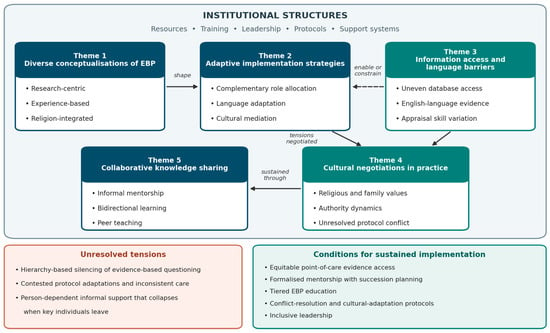
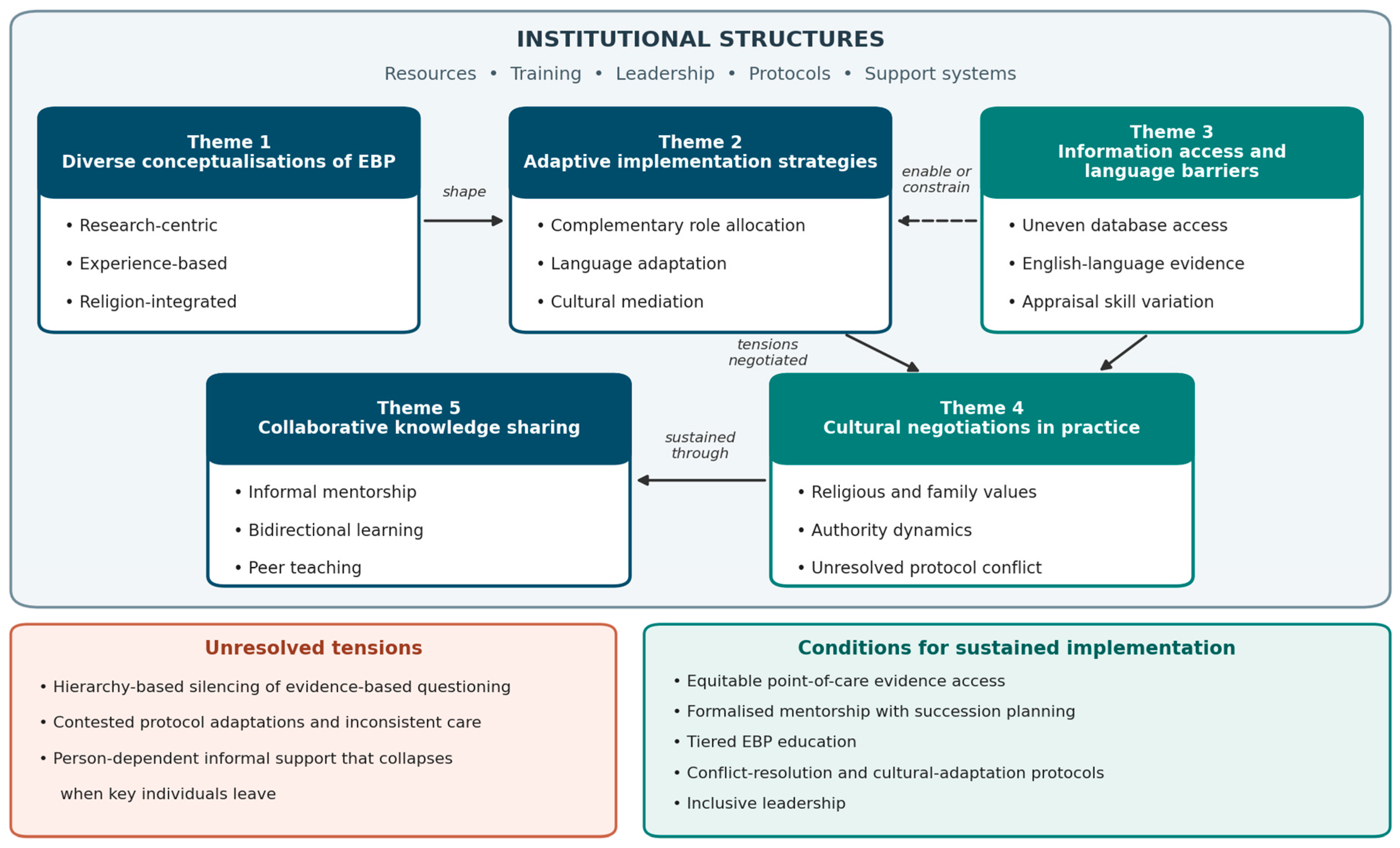
Figure 1 shows the five themes within the institutional structures that shaped them (outer band: resources, training, leadership, protocols, and support systems). Arrows show the relationships identified in the analysis: diverse conceptualisations of EBP (Theme 1) shaped the adaptive strategies teams developed (Theme 2); information access and language (Theme 3) enabled or constrained those strategies; tensions arising from both were worked through in cultural negotiation (Theme 4); and collaborative knowledge sharing (Theme 5) sustained what negotiation produced. The lower panels summarise the unresolved tensions and the structural conditions on which sustained implementation depended.
Figure 1.
Thematic map of the interconnected themes in multicultural evidence-based practice implementation in critical care.
3.2.1. Theme 1: Diverse Conceptualisations of EBP Across Cultures
Nurses held markedly different understandings of EBP. Nurses whose bachelor’s or master’s degree programmes had included research-methods teaching described EBP in formal, research-centric terms emphasising randomised controlled trials and systematic reviews. P01 explained: “We learned to search databases, evaluate study quality, implement based on strong evidence.” Nurses who had qualified through hospital-based diploma programmes, in which learning took place mainly through apprenticeship to senior nurses, described EBP more broadly: “I rely on what my seniors taught me: decades of bedside experience. For me, that is also evidence.” (P07). For P07, the authority of experienced colleagues carried equal or greater weight than published research, a belief likely to shape which practices such nurses regard as safe and when they see a reason to change them. Field notes recorded the same contrast at a handover in Hospital A: when a colleague questioned a repositioning schedule, one nurse cited a recent guideline, whereas another explained that this was how she had been taught, and the schedule was kept unchanged.
Some Middle Eastern-educated participants also integrated religious and ethical dimensions: “EBP includes ensuring interventions respect patient dignity, family involvement, and religious beliefs. The best evidence must be compatible with our values.” (P08). These conceptualisations did not divide neatly by country of origin: qualification, years of experience, and the units in which nurses had first worked in critical care also shaped them, and the groupings above describe tendencies among these participants rather than characteristics of national groups.
Disconfirming case: Conceptual diversity did not invariably enrich practice. P14 observed: “When I share what I learned in [my home country], colleagues listen politely but then go back to the guideline. My experience doesn’t count the same way.” This illustrates how educational hierarchy can suppress rather than bridge conceptual diversity.
3.2.2. Theme 2: Adaptive Implementation Strategies in Multicultural Teams
Teams developed pragmatic strategies including collaborative role allocation, language adaptation, and cultural mediation. P05 described: “I find and read research; my Egyptian colleague has excellent assessment skills; my Filipino teammate teaches patients and families. We each contribute what we do best.”
Teams created multilingual quick-reference cards and visual flowcharts; document analysis showed that these were informal materials kept at nursing stations rather than approved unit documents. On a day shift at Hospital B, one nurse located an updated sepsis-bundle recommendation while a colleague who shared the family’s language explained the change to relatives (field notes). However, adaptive capacity was context-dependent: night-shift teams, which were smaller and more nationally homogeneous, rarely engaged in cross-cultural EBP discussion. As P11 explained: “On nights, we are usually two or three nurses from the same country. We just follow protocols as written.” The observed pattern linked adaptive strategies to team composition and opportunities for cross-cultural interaction; the data did not establish workload or team size as independent explanatory factors.
3.2.3. Theme 3: Navigating Information Access and Language Barriers
Language shaped how nurses read research. P14 explained: “I understand main ideas in articles, but statistical details are difficult. I focus on clinical implications and ask colleagues.” Access to research was also uneven. Document analysis showed that two of the three hospitals (A and B) provided institutionally supported bedside access to CINAHL and the Cochrane Library, whereas Hospital C did not provide comparable subscription access. At Hospital C, nurses relied on free-access resources and searched for evidence on personal smartphones. Interviews, observation, and documents agreed on this point: participants described the workaround, field notes recorded nurses checking drug and protocol information on their own phones during shifts, and no institutional document provided for it.
Multiple participants questioned Western-derived evidence applicability. P10: “Most research is from Europe or America. Our patients are from Saudi Arabia, Yemen, Ethiopia, Bangladesh, meaning the evidence may not apply the same way.” Information literacy varied substantially, and some participants relied on colleagues to interpret study methods and statistics.
3.2.4. Theme 4: Cultural Negotiations in Practice Integration
EBP implementation required continuous negotiation among research evidence, cultural values, religious practices, and patient preferences. P13: “We adapted the early mobility protocol for Muslim patients who prefer same-gender caregivers and adjusted timing for prayer schedules.”
Authority dynamics suppressed evidence-based questioning. P07: “I would not correct a senior doctor even if I read a study that says something different.” This reluctance can be read in more than one way: as a cultural expectation of deference to seniors, as a product of P07’s apprenticeship-based training (Theme 1), and as a response to a professional hierarchy in which physicians held final authority over treatment decisions. The data do not allow these explanations to be separated, and they are discussed together in Section 4.2.
Unresolved tension: P10 described a wound-care disagreement: “We have debated for months. The research says one thing, the consultant prefers another, and some nurses use methods from their home countries. There is no final decision.” Participants described this lack of closure as producing inconsistent practice, illustrating that cultural negotiation without institutional conflict-resolution structures can result in stalemate rather than synthesis. Adaptations could also stay private: one nurse (P15) adjusted the timing of a sedation interruption to fit a family visit, a decision that was neither documented nor discussed with colleagues. Because the clinical details were not recorded, we cannot judge whether the change was clinically appropriate; the example shows how an accommodation made outside the protocol and without team agreement can weaken continuity of care and leave accountability unclear.
3.2.5. Theme 5: Collaborative Knowledge Sharing Across Cultural Boundaries
Teams developed knowledge-sharing mechanisms exceeding formal structures. P12: “My Filipino colleague taught me family-centred care; my Indian colleague shared assessment techniques. I help them understand Saudi culture.” Observation captured this in practice when P02 spent an unplanned 15 min teaching a colleague to search the Cochrane Library during a shift (field notes). Informal mentorship networks were, however, person-dependent and fragile. P06 recalled: “When our senior Filipino colleague transferred, we lost our main database searcher. Nobody replaced that role.” None of the orientation manuals or job descriptions reviewed defined a mentor or EBP-champion role (document analysis).
4. Discussion
In this study, multicultural critical care teams showed considerable adaptive capacity for EBP implementation, negotiating across educational traditions, linguistic barriers, cultural values, and institutional constraints through collaborative strategies. However, this capacity was structurally mediated rather than inherent to diversity. Because the findings come from 15 nurses in six units of three hospitals, they describe processes in these settings rather than their prevalence.
4.1. Conditions That Constrained Adaptive Capacity
Educational hierarchies suppressed rather than bridged conceptual diversity (disconfirming case, Theme 1). Informal knowledge-sharing networks depended on particular individuals and dissolved when they left (Theme 5). Unresolved protocol conflicts, such as the months-long disagreement over wound-care practice described by P10, left practice inconsistent (Theme 4). Information-access disparities reflected institutional provision rather than individual deficits: two of the three hospitals provided subscription-database access for bedside nurses, and where such access was unavailable, participants described using free online resources and personal smartphones as ad hoc workarounds. In our sample this difference followed the public–private divide: both public teaching hospitals provided subscription access and the private hospital did not. Continuing education records at Hospital C also listed fewer EBP-related sessions than those at the public hospitals, whereas staffing patterns and protocol-review processes did not differ noticeably between sectors. With only one private hospital, we cannot say whether these differences reflect the sector or this hospital alone.
The barriers our participants described (uneven database access, language demands, and variable appraisal skills) mirror those reported in Saudi Arabian surveys and reviews [18,21,22], but the multicultural setting changed how they operated. Access problems were compounded by language, and appraisal skills were distributed unevenly across educational traditions, so a single barrier, such as limited database access, was a greater obstacle for nurses who also had to read research in a second language or had received little training in appraisal. Saudi Arabian studies have linked organisational culture to readiness for and adoption of EBP [6,23], and international evidence suggests that EBP culture and implementation leadership reinforce each other [33]. Our findings suggest a mechanism behind these associations: where leaders provided no forum for resolving disagreement, cultural negotiation stalled, as in the wound-care dispute, and where no one was formally responsible for peer support, knowledge networks dissolved when individuals left. This pattern fits the integrated Promoting Action on Research Implementation in Health Services (i-PARIHS) framework, which treats facilitation as the active ingredient that brings evidence, recipients, and context together [34]. The informal database searchers, translators, and cultural mediators identified in this study were acting as unappointed facilitators. Hierarchy-based silencing can be read as low psychological safety, a shared belief that the team is not safe for interpersonal risk-taking [35]. A participant whose training emphasised deference described being unwilling to question a senior clinician even when they held contradicting evidence (Theme 4), and the language and cultural communication barriers documented in multicultural Saudi Arabian hospitals [5] are likely to deepen this effect.
Psychological safety in healthcare teams depends on professional status and on whether leaders invite contributions: lower-status professionals feel less safe to speak, and leader inclusiveness narrows that gap [36]. Read this way, silencing in our data was not simply a matter of participants’ cultural origins. It arose where a nurse’s position in the professional hierarchy and an education that taught deference to experience coincided, and it was most visible when the person to be questioned was a senior physician; for expatriate nurses, employment tied to the hospital may have added to the perceived risk of speaking. Building psychological safety is therefore a task for unit leadership and nurse–physician relationships, not only for individual nurses’ assertiveness, and it matters for patient safety because evidence that is not voiced cannot change practice [11].
4.2. Culture, Education, and Organisation as Intertwined Explanations
Several findings that participants framed in cultural terms have other plausible explanations, and the design does not allow them to be separated. Differences in how nurses conceptualised EBP coincided with differences in qualification and in whether nurses’ education had included research methods; a diploma-prepared and a master’s-prepared nurse from the same country would be expected to differ for reasons unrelated to culture. Critical care experience ranged from 2 to 18 years, and more experienced nurses may rely more on clinical expertise whatever their origin. Variation in implementation also followed institutional resources (database access differed between hospitals), staffing patterns (night shifts were smaller and more nationally homogeneous), and unit-specific practices such as which protocols were in force and how decision-making was divided between physicians and nurses. We therefore treat multiculturalism in these units as an interaction among individual background, educational preparation, professional position, and organisational conditions rather than as a property of national groups. Statements about nurses from particular regions describe patterns among these participants and should not be read as characteristics of those nationalities.
The cultural adaptations reported in Theme 4 also differ in kind. Adjusting the timing of early mobilisation around prayer, or assigning a same-gender caregiver, changes how an evidence-based intervention is delivered without changing its content, and such adaptations sit within person-centred care. Changing the timing of a sedation interruption is different: current guidelines recommend light sedation achieved through either daily sedation interruption or nurse-protocolised targeted sedation [37], so a change to the schedule alters a safety-critical intervention. Because the clinical details of P15’s decision were not recorded, we cannot say whether it was appropriate. What the example shows is that, without a route for discussing, approving, and documenting adaptations, nurses made them alone, leaving accountability unclear and continuity of care dependent on informal handover. Units need to distinguish adaptations that nurses may make independently, those that require multidisciplinary agreement and documentation, and those that should not be made.
4.3. Implications for Practice and Proposals for Future Testing
Some implications follow directly from the findings. At Hospital C, nurses lacked subscription database access and used personal smartphones; giving all bedside nurses point-of-care access to the same databases responds directly to this gap. Informal database searchers and mentors were lost when individuals left (Theme 5), so units could identify these roles, recognise them in job descriptions, and plan for succession. Protocol disagreements such as the wound-care dispute persisted because no unit-level forum brought them to a decision (Theme 4); hospital protocol-review policies existed at all three sites but did not reach disputes of this kind. This points to a defined route, such as a unit practice council or joint nurse–physician protocol review, through which disputed practices are brought to a decision and documented. Adaptations of protocols for religious or family reasons should be recorded and communicated at handover.
Other proposals go beyond what an exploratory qualitative study can establish and should be treated as strategies for future implementation and evaluation rather than as interventions shown to work. These include structured cultural-adaptation pathways with checklists that distinguish adaptations nurses may make independently from those requiring multidisciplinary agreement; multilingual evidence summaries; continuing professional development tiered to nurses’ educational baselines; formal mentorship programmes with protected time and succession planning; and leadership development that prepares nurse managers and senior physicians to invite questions from staff whose training or position discourages speaking up [36]. Each could be tested in pragmatic implementation studies guided by frameworks such as i-PARIHS [34], measuring both implementation processes and patient outcomes.
4.4. Limitations
This study examined perceptions and observed practices but did not measure patient outcomes; statements about care consistency and patient safety therefore describe participants’ accounts and observed processes rather than measured effects. The focused ethnographic design in critical care units may limit transferability to other clinical specialties where patient acuity, workflow, or evidence demands differ substantially. With two public teaching hospitals and one private hospital, differences between hospitals could reflect sector, size, or local leadership, and these cannot be separated. Voluntary participation likely introduced selection bias toward nurses with positive attitudes about cultural diversity, and recruitment through unit nursing leadership may have favoured nurses whom managers regarded as engaged with EBP. The language criterion is a particular concern for Theme 3. Requiring consent and interviews in English excluded nurses with less English proficiency, the group most likely to face the barriers that Theme 3 describes. Theme 3 therefore probably understates these barriers: difficulties reported by participants able to discuss research in English are likely to be greater for colleagues who could not, and those colleagues may also have had less access to the peer networks described in Theme 5. Conducting interviews in English may also have constrained the expressive range of participants for whom it was a second or third language. Saudi Arabian nurses were under-represented, which may have limited local perspectives; no participant originated from Western Europe, North America, or Australasia, although a small number of nurses from these regions worked in the study units; and temporary and agency nurses were excluded, although they form part of the multicultural workforce in many Saudi Arabian ICUs. How short placements affect these nurses’ access to evidence and to unit knowledge networks remains unexplored. Observation was shared between two authors, which may have introduced variation in field-note detail, although structured field-note templates were used to limit this. Although observational and documentary data were integrated into each theme (Supplementary File S5), interview material remains the most detailed source, and observation may have altered staff behaviour despite the steps described in Section 2.6.
5. Conclusions
In this study, critical care nurses from diverse cultural backgrounds in Saudi Arabia showed considerable adaptive capacity for implementing EBP through collaborative strategies that often exceeded formal organisational supports. Yet persistent challenges limited this capacity: hierarchy-related silencing that prevents evidence-based questioning, unresolved protocol conflicts that participants described as producing inconsistent care, fragile informal support systems that collapse when key individuals depart, and uneven institutional infrastructure that creates inequitable evidence access.
These findings challenge both uncritically positive accounts that frame diversity as an inherent asset and deficit-oriented perspectives that treat cultural differences primarily as obstacles. In these units, the relationship between multicultural workforce composition and EBP implementation depended on institutional conditions, including resource access, mentorship, education, procedures for cultural adaptation, and leadership, and on how cultural background combined with education, experience, and professional position. Given the qualitative design and three-hospital sample, this relationship should be examined in other settings rather than assumed.
Future intervention research should test the structural recommendations emerging from this work (particularly formalised mentorship programmes, tiered EBP education, and cultural-adaptation protocols), examining their effects on both implementation processes and patient outcomes across diverse multicultural healthcare settings.
Supplementary Materials
The following supporting information can be downloaded at: https://www.mdpi.com/article/10.3390/healthcare14234110/s1, Supplementary File S1: Semi-structured interview guide; Supplementary File S2: COREQ checklist; Supplementary File S3: SRQR checklist; Supplementary File S4: Analytical progression from initial codes to final themes; Supplementary File S5: Integration of data sources by theme; Supplementary File S6: Distribution of observation hours by unit and shift.
Author Contributions
Conceptualisation, T.E., W.M.A. and A.M.A.; methodology, T.E., A.M.A. and F.F.A.; investigation, M.A., A.M.A. and B.M.A.; formal analysis, T.E., M.A., A.M.A., B.M.A. and F.F.A.; validation, W.M.A. and B.M.A.; data curation, A.M.A.; writing (original draft), T.E. and A.M.A.; writing (review and editing), W.M.A., M.A., B.M.A. and F.F.A.; supervision and project administration, W.M.A.; funding acquisition, W.M.A., T.E. and W.M.A. contributed equally to this work and share first authorship. All authors have read and agreed to the published version of the manuscript.
Funding
This research was supported by the Ongoing Research Funding Program (ORF-2026-1579), King Saud University, Riyadh, Saudi Arabia. The funding body had no role in the design of the study; data collection, analysis, interpretation of data, or writing of the manuscript.
Institutional Review Board Statement
The study was conducted in accordance with the Declaration of Helsinki and approved by the Institutional Review Board (IRB) of King Saud University (Ref. No. KSU-HE-25-951; date of approval: 26 August 2025).
Informed Consent Statement
Written informed consent was obtained from all participants involved in the study.
Data Availability Statement
Raw data are not publicly available because of the risk of participant identification. De-identified materials are available from the corresponding author on reasonable request, subject to ethical approval.
Acknowledgments
The authors thank all participating nurses who generously shared their experiences and time, making this research possible.
Conflicts of Interest
The authors declare no conflicts of interest.
Abbreviations
The following abbreviations are used in this manuscript:
| BSN | Bachelor of Science in Nursing |
| COREQ | Consolidated Criteria for Reporting Qualitative Research |
| EBP | Evidence-based practice |
| ICU | Intensive care unit |
| i-PARIHS | Integrated Promoting Action on Research Implementation in Health Services |
| IRB | Institutional Review Board |
| MSN | Master of Science in Nursing |
| SD | Standard deviation |
| SRQR | Standards for Reporting Qualitative Research |
References
- Melnyk, B.M.; Fineout-Overholt, E.; Stillwell, S.B.; Williamson, K.M. Evidence-based practice: Step by step: The seven steps of evidence-based practice. Am. J. Nurs. 2010, 110, 51–53. [Google Scholar] [CrossRef] [Scilit] [PubMed]
- Agure, S.; Miyeso, B.; Abdullahi, L. Interventions to enhance the use of evidence based decision making for quality care among nurses: A systematic review. East Afr. Health Res. J. 2024, 8, 148–153. [Google Scholar] [CrossRef] [Scilit]
- Suleiman, A.K.; Ming, L.C. Transforming healthcare: Saudi Arabia’s Vision 2030 healthcare model. J. Pharm. Policy Pract. 2025, 18, 2449051. [Google Scholar] [CrossRef] [Scilit] [PubMed]
- Alsufyani, A.M.; Alforihidi, M.A.; Almalki, K.E.; Aljuaid, S.M.; Alamri, A.A.; Alghamdi, M.S. Linking the Saudi Arabian 2030 vision with nursing transformation in Saudi Arabia: Roadmap for nursing policies and strategies. Int. J. Afr. Nurs. Sci. 2020, 13, 100256. [Google Scholar] [CrossRef] [Scilit] [PubMed]
- Alharazi, R.M.; Abdulrahim, R.J.; Mazuzah, A.H.; Almutairi, R.M.; Almutary, H.; Alhofaian, A. Barriers and factors affecting nursing communication when providing patient care in Jeddah. Clin. Pract. 2025, 15, 19. [Google Scholar] [CrossRef] [Scilit] [PubMed]
- Cleary-Holdforth, J.; Leufer, T.; Baghdadi, N.A.; Almegewly, W. Organizational culture and readiness for evidence-based practice in the Kingdom of Saudi Arabia: A pre-experimental study. J. Nurs. Manag. 2022, 30, 4560–4568. [Google Scholar] [CrossRef] [Scilit] [PubMed]
- Connor, L.; Dean, J.; McNett, M.; Tydings, D.M.; Shrout, A.; Gorsuch, P.F.; Hole, A.; Moore, L.; Brown, R.; Melnyk, B.M.; et al. Evidence-based practice improves patient outcomes and healthcare system return on investment: Findings from a scoping review. Worldviews Evid. Based Nurs. 2023, 20, 6–15. [Google Scholar] [CrossRef] [Scilit] [PubMed]
- Melnyk, B.M.; Hsieh, A.P.; Messinger, J.; Thomas, B.; Connor, L.; Gallagher-Ford, L. Budgetary investment in evidence-based practice by chief nurses and stronger EBP cultures are associated with less turnover and better patient outcomes. Worldviews Evid. Based Nurs. 2023, 20, 162–171. [Google Scholar] [CrossRef] [Scilit] [PubMed]
- Tringale, M.; Stephen, G.; Boylan, A.M.; Heneghan, C. Integrating patient values and preferences in healthcare: A systematic review of qualitative evidence. BMJ Open 2022, 12, e067268. [Google Scholar] [CrossRef] [Scilit] [PubMed]
- Alkhamees, M.; Alasqah, I. Patient-physician communication in intercultural settings: An integrative review. Heliyon 2023, 9, e22667. [Google Scholar] [CrossRef] [Scilit] [PubMed]
- Okuyama, A.; Wagner, C.; Bijnen, B. Speaking up for patient safety by hospital-based health care professionals: A literature review. BMC Health Serv. Res. 2014, 14, 61. [Google Scholar] [CrossRef] [Scilit] [PubMed]
- McLaney, E.; Morassaei, S.; Hughes, L.; Davies, R.; Campbell, M.; Di Prospero, L. A framework for interprofessional team collaboration in a hospital setting: Advancing team competencies and behaviours. Healthc. Manag. Forum 2022, 35, 112–117. [Google Scholar] [CrossRef] [Scilit] [PubMed]
- Gomez, L.E.; Bernet, P. Diversity improves performance and outcomes. J. Natl. Med. Assoc. 2019, 111, 383–392. [Google Scholar] [CrossRef] [Scilit] [PubMed]
- Katoue, M.G.; Cerda, A.A.; García, L.Y.; Jakovljevic, M. Healthcare system development in the Middle East and North Africa region: Challenges, endeavors and prospective opportunities. Front. Public Health 2022, 10, 1045739. [Google Scholar] [CrossRef] [Scilit] [PubMed]
- Attum, B.; Hafiz, S.; Malik, A.; Shamoon, Z. Cultural competence in the care of Muslim patients and their families. In StatPearls; StatPearls Publishing: Treasure Island, FL, USA, 2025. Available online: https://pubmed.ncbi.nlm.nih.gov/29763108/ (accessed on 2 October 2026).
- Almalki, M.; FitzGerald, G.; Clark, M. The nursing profession in Saudi Arabia: An overview. Int. Nurs. Rev. 2011, 58, 304–311. [Google Scholar] [CrossRef] [Scilit] [PubMed]
- Alshammari, M.; Duff, J.; Guilhermino, M. Barriers to nurse-patient communication in Saudi Arabia: An integrative review. BMC Nurs. 2019, 18, 61. [Google Scholar] [CrossRef] [Scilit] [PubMed]
- Alqahtani, J.M.; Carsula, R.P.; Alharbi, H.A.; Alyousef, S.M.; Baker, O.G.; Tumala, R.B. Barriers to implementing evidence-based practice among primary healthcare nurses in Saudi Arabia: A cross-sectional study. Nurs. Rep. 2022, 12, 313–323. [Google Scholar] [CrossRef] [Scilit] [PubMed]
- Saunders, H.; Stevens, K.R.; Vehviläinen-Julkunen, K. Nurses’ readiness for evidence-based practice at Finnish university hospitals: A national survey. J. Adv. Nurs. 2016, 72, 1863–1874. [Google Scholar] [CrossRef] [Scilit] [PubMed]
- Melnyk, B.M.; Fineout-Overholt, E.; Gallagher-Ford, L.; Kaplan, L. The state of evidence-based practice in US nurses: Critical implications for nurse leaders and educators. J. Nurs. Adm. 2012, 42, 410–417. [Google Scholar] [CrossRef] [Scilit] [PubMed]
- Alzahrani, N.S.; Almarwani, A.M. Facilitators and barriers affecting evidence-based practice among nurses in Saudi Arabia: A systematic review. Appl. Nurs. Res. 2026, 87, 152029. [Google Scholar] [CrossRef] [Scilit] [PubMed]
- Alsadaan, N.; Ramadan, O.M.E. Barriers and facilitators in implementing evidence-based practice: A parallel cross-sectional mixed methods study among nursing administrators. BMC Nurs. 2025, 24, 403. [Google Scholar] [CrossRef] [Scilit] [PubMed]
- Alodhialah, A.M. Exploring the influence of organizational culture on evidence-based practice adoption among nurses in tertiary hospitals: A qualitative study. BMC Nurs. 2025, 24, 1029. [Google Scholar] [CrossRef] [Scilit] [PubMed]
- Roper, J.M.; Shapira, J. Ethnography in Nursing Research; SAGE Publications: Thousand Oaks, CA, USA, 2000. [Google Scholar]
- Hammersley, M.; Atkinson, P. Ethnography: Principles in Practice, 4th ed.; Routledge: London, UK, 2019. [Google Scholar]
- Tong, A.; Sainsbury, P.; Craig, J. Consolidated criteria for reporting qualitative research (COREQ): A 32-item checklist for interviews and focus groups. Int. J. Qual. Health Care 2007, 19, 349–357. [Google Scholar] [CrossRef] [Scilit] [PubMed]
- O’Brien, B.C.; Harris, I.B.; Beckman, T.J.; Reed, D.A.; Cook, D.A. Standards for reporting qualitative research: A synthesis of recommendations. Acad. Med. 2014, 89, 1245–1251. [Google Scholar] [CrossRef] [Scilit] [PubMed]
- Monahan, T.; Fisher, J.A. Benefits of ‘observer effects’: Lessons from the field. Qual. Res. 2010, 10, 357–376. [Google Scholar] [CrossRef] [Scilit] [PubMed]
- Braun, V.; Clarke, V. Thematic Analysis: A Practical Guide; SAGE Publications: London, UK, 2022. [Google Scholar]
- Braun, V.; Clarke, V. One size fits all? What counts as quality practice in (reflexive) thematic analysis? Qual. Res. Psychol. 2021, 18, 328–352. [Google Scholar] [CrossRef] [Scilit]
- Malterud, K.; Siersma, V.D.; Guassora, A.D. Sample size in qualitative interview studies: Guided by information power. Qual. Health Res. 2016, 26, 1753–1760. [Google Scholar] [CrossRef] [Scilit] [PubMed]
- Lincoln, Y.S.; Guba, E.G. Naturalistic Inquiry; SAGE Publications: Beverly Hills, CA, USA, 1985. [Google Scholar]
- Hu, S.; Liu, S.; Li, X.; Zhao, J.; Chen, J.; Chen, W.; Hu, J. Organizational evidence-based practice culture, implementation leadership, and nurses: A bidirectional mediation model. Int. Nurs. Rev. 2025, 72, e13054. [Google Scholar] [CrossRef] [Scilit] [PubMed]
- Harvey, G.; Kitson, A. PARIHS revisited: From heuristic to integrated framework for the successful implementation of knowledge into practice. Implement. Sci. 2016, 11, 33. [Google Scholar] [CrossRef] [Scilit] [PubMed]
- Edmondson, A. Psychological safety and learning behavior in work teams. Adm. Sci. Q. 1999, 44, 350–383. [Google Scholar] [CrossRef] [Scilit]
- Nembhard, I.M.; Edmondson, A.C. Making it safe: The effects of leader inclusiveness and professional status on psychological safety and improvement efforts in health care teams. J. Organ. Behav. 2006, 27, 941–966. [Google Scholar] [CrossRef] [Scilit]
- Devlin, J.W.; Skrobik, Y.; Gélinas, C.; Needham, D.M.; Slooter, A.J.C.; Pandharipande, P.P.; Watson, P.L.; Weinhouse, G.L.; Nunnally, M.E.; Rochwerg, B.; et al. Clinical practice guidelines for the prevention and management of pain, agitation/sedation, delirium, immobility, and sleep disruption in adult patients in the ICU. Crit. Care Med. 2018, 46, e825–e873. [Google Scholar] [CrossRef] [Scilit] [PubMed]

Disclaimer/Publisher’s Note: The statements, opinions and data contained in all publications are solely those of the individual author(s) and contributor(s) and not of MDPI and/or the editor(s). MDPI and/or the editor(s) disclaim responsibility for any injury to people or property resulting from any ideas, methods, instructions or products referred to in the content. |
© 2026 by the authors. Licensee MDPI, Basel, Switzerland. This article is an open access article distributed under the terms and conditions of the Creative Commons Attribution (CC BY) license.