


Abstract
Background/Objectives: Human papillomavirus (HPV) causes various cancers in both sexes, yet HPV vaccination uptake among adolescent boys in South Korea remains notably low. Despite the importance of parental decision-making, fathers’ roles in HPV vaccination have been understudied. This study identified factors influencing fathers’ intentions to vaccinate their adolescent sons against HPV and tested a structural model based on the Information–Motivation–Behavioral Skills (IMB) model. Methods: A cross-sectional online survey was conducted with 253 fathers of sons aged 12–17 years in South Korea. Data were analyzed using confirmatory factor analysis, structural equation modeling, and bootstrapping. Results: The hypothesized model demonstrated adequate fit (GFI = 0.97, AGFI = 0.90, SRMR = 0.05, RMSEA = 0.08, NFI = 0.95, TLI = 0.93, CFI = 0.97) and explained 43.7% of the variance in vaccination intention. Seven of 11 hypothesized paths were supported. Self-efficacy had the strongest direct effect on vaccination intention (β = 0.39), followed by subjective norms (β = 0.21), perceived barriers (β = −0.12), and attitudes toward HPV vaccination (β = 0.11). Self-efficacy fully mediated the relationship between knowledge and vaccination intention and partially mediated the effects of attitudes and subjective norms. Social support had no significant effect on self-efficacy or vaccination intention. Conclusions: These findings identify self-efficacy as a central mechanism underlying fathers’ HPV vaccination intentions. Father-targeted interventions may benefit from strengthening self-efficacy through practical guidance, while also addressing subjective norms, attitudes, and perceived barriers, to promote HPV vaccination among adolescent sons.
Keywords:
human papillomavirus; intention; adolescent; male; father; structural equation modeling; South Korea 1. Introduction
Human papillomavirus (HPV) causes various cancers in both males and females, including anal, oropharyngeal, and penile cancers. According to global estimates for 2024, approximately 750,000 new cancer cases worldwide were attributable to HPV infection [1]. HPV vaccination prior to sexual debut is the most effective preventive measure [2]. In South Korea, the national HPV immunization program was introduced for adolescent girls in 2016 and expanded to include 12-year-old boys in May 2026 [3,4]. The expansion of national vaccination support to adolescent boys represents an important policy development in HPV prevention in South Korea. As financial barriers to vaccination are reduced, understanding fathers’ knowledge, attitudes, and other factors associated with vaccination decision-making remains important for promoting HPV vaccination among adolescent boys.
Adolescent vaccination largely depends on parental consent and decision-making, as parents are the key decision-makers regarding HPV vaccination for their children [5]. In South Korea, parents’ attitudes, subjective norms, perceived behavioral control, and self-efficacy have been identified as significant predictors of their intention to vaccinate their sons against HPV [6,7]. However, prior studies on parental HPV vaccination decision-making have predominantly focused on mothers [7,8], with research on fathers remaining limited [9]. Fathers serve as role models and advisors for their sons’ sexual health, and paternal communication has been associated with adolescent males’ sexual health service use and perceived paternal role modeling [10]. Furthermore, a dyadic study of Korean parents found that fathers’ perceived severity of HPV and perceived benefits of vaccination influenced mothers’ intention to vaccinate their sons [11], highlighting the importance of fathers in HPV vaccination decision-making. However, few studies have examined the cognitive and social factors shaping fathers’ HPV vaccination intentions within a comprehensive theoretical framework.
The Information–Motivation–Behavioral Skills (IMB) model [12] provides a theoretical framework for explaining this decision-making process. The model proposes that information and motivation influence health behavior both directly and indirectly through behavioral skills, with self-efficacy representing a central component of behavioral skills. This framework is particularly relevant to HPV vaccination because parental vaccination decisions may involve not only knowledge about HPV and the vaccine but also personal and social motivations and confidence in carrying out vaccination-related actions. Previous studies have examined HPV vaccine knowledge, attitudes, perceived barriers, subjective norms, and self-efficacy in relation to HPV vaccination intention, with significant associations reported for several of these factors [11,13,14,15]. Social support has also been associated with parental HPV vaccination intention [16], while self-efficacy has been examined as an important factor in obtaining HPV vaccination [17]. However, these factors have largely been examined separately or among mothers, female adolescents, and female young adults. Consequently, how information, personal and social motivational factors, and self-efficacy operate together in shaping fathers’ intentions to vaccinate their adolescent sons remains insufficiently understood.
Therefore, this study aimed to construct and test a structural equation model of fathers’ intentions to vaccinate their adolescent sons against HPV based on the IMB model. Specifically, the model examined HPV vaccine knowledge as an information factor; attitudes toward HPV vaccination and perceived barriers as personal motivational factors; subjective norms and social support as social motivational factors; and HPV vaccination self-efficacy as a behavioral skill factor. By examining both direct and indirect pathways among these factors, this study sought to clarify the mechanisms underlying fathers’ HPV vaccination intentions for their adolescent sons.
1.1. Literature Review
1.1.1. Fathers’ Role in HPV Vaccination Decision-Making
Adolescent HPV vaccination is strongly influenced by parental consent and decision-making. Parents’ knowledge of and attitudes toward HPV and the vaccine, as well as social influences, have been identified as major factors associated with their HPV vaccination decision-making and intentions for their sons [5,6]. However, previous studies on parental HPV vaccination have primarily focused on mothers, while fathers have received relatively limited attention as independent decision-makers.
Differences in perceptions of and decision-making regarding HPV vaccination have been reported between mothers and fathers. Previous research found that fathers were less likely than mothers to have heard of HPV and had lower levels of awareness regarding the possibility of HPV infection in males, the availability of HPV vaccination for males, and the recommended age for vaccination [11]. However, fathers’ perceived severity of HPV and perceptions of the benefits of the vaccine were also found to influence mothers’ intentions to vaccinate their sons against HPV. These findings suggest that fathers may influence not only their own vaccination decisions but also decision-making processes within the family.
Fathers may play an important role in shaping their sons’ sexual health behaviors, including the use of sexual health services [10]. In addition, parental self-efficacy regarding HPV vaccination has been associated not only with parents’ intentions to vaccinate their children but also with adolescents’ own intentions to receive the vaccine [18]. These findings suggest that fathers’ cognitive and motivational characteristics, as well as their confidence in their ability to facilitate vaccination, may influence decisions regarding their children’s HPV vaccination.
Nevertheless, fathers’ involvement in the actual HPV vaccination process appears to be relatively limited. In a study by Lucero et al. [19], fathers were less likely than mothers to report receiving a healthcare provider’s recommendation for their children to receive HPV vaccination. They were also less likely to report that their children had received the HPV vaccine or that they intended to have their children vaccinated. A systematic review likewise found that, in some studies, fathers tended to demonstrate lower acceptance of HPV vaccination for their sons than mothers [20]. These findings suggest that although fathers are important figures who may influence their sons’ sexual health and preventive health behaviors, they remain relatively less involved in receiving information about HPV vaccination, obtaining recommendations from healthcare providers, and participating in actual vaccination-related decision-making.
Therefore, fathers should be examined as independent decision-makers regarding HPV vaccination rather than being treated merely as a subgroup of parents. Whereas previous studies have primarily focused on differences between fathers and mothers in their perceptions or vaccination intentions, insufficient attention has been paid to how fathers’ intentions to vaccinate their sons against HPV are shaped by cognitive, motivational, and social factors and through what pathways these factors influence intention. To address this research gap, it is necessary to systematically examine the formation of fathers’ intentions to vaccinate their adolescent sons against HPV within a theoretically grounded framework.
1.1.2. Information–Motivation–Behavioral Skills Model and HPV Vaccination Intention
The IMB model was proposed by Fisher and Fisher [12] as a theoretical framework for explaining and predicting HIV prevention behaviors and has since been applied to various health behaviors. The IMB model categorizes the major determinants of health behavior into three components: information, motivation, and behavioral skills, and explains how these factors contribute to health behavior. Specifically, the model assumes that information and motivation can influence behavior directly and indirectly through behavioral skills, which refer to the ability and confidence to perform the behavior [12,21]. This framework emphasizes that health behavior does not result solely from acquiring relevant knowledge; rather, personal and social motivation, together with confidence in one’s ability to perform the behavior, are also necessary.
In the IMB model, information refers to accurate and practical knowledge necessary to perform a health behavior [12]. In the present study, information was conceptualized as HPV vaccine knowledge. Knowledge of the HPV vaccine provides the cognitive foundation for vaccination-related decision-making, including knowledge of HPV infection and transmission, vaccine effectiveness and safety, and recommended vaccination schedules. Previous studies have reported that HPV vaccine knowledge is associated with vaccination intention through self-efficacy, while behavioral skills are positively associated with HPV vaccination willingness [22,23]. However, other studies have reported a direct effect of knowledge on vaccination intention [24,25], suggesting that the pathways through which knowledge influences vaccination intention may vary depending on the population and context.
Motivation refers to the factors that shape an individual’s willingness to engage in a health behavior. In the IMB model, motivation is divided into personal motivation and social motivation [12,21]. Personal motivation includes an individual’s attitudes toward a health behavior and beliefs and evaluations regarding its outcomes. Accordingly, in the present study, attitudes toward HPV vaccination, reflecting positive or negative evaluations of vaccination, and perceived barriers, referring to anticipated psychological, physical, and financial difficulties associated with vaccination, were conceptualized as personal motivational factors. Previous studies have reported that positive attitudes toward HPV vaccination are associated with higher self-efficacy and stronger vaccination intentions, whereas perceived barriers related to cost, adverse effects, safety, and accessibility may undermine self-efficacy and vaccination intention [15,22,23,24].
Social motivation refers to perceptions of the expectations and support of significant others regarding the performance of a health behavior [21]. In the context of HPV vaccination, Fisher [26] further specified social motivation in terms of perceived support from significant others, such as spouses and healthcare providers, and the motivation to comply with their expectations. Accordingly, the present study included subjective norms regarding HPV vaccination and social support as social motivational factors. Subjective norms refer to the extent to which individuals perceive that significant others, such as spouses and healthcare providers, expect or recommend HPV vaccination. Previous studies have found that subjective norms significantly influence self-efficacy and vaccination intention [14,23,27]. In addition, social support from family members, spouses, and others may strengthen self-efficacy and facilitate health behavior by providing informational, emotional, and practical resources [21,26]. Given that fathers’ decisions regarding HPV vaccination are also made within a social context shaped by spouses, healthcare providers, and other significant individuals, these factors warrant consideration.
Behavioral skills encompass both the skills required to perform a behavior and self-efficacy, which refers to confidence in one’s ability to perform the behavior successfully [12,21]. In the present study, HPV vaccination self-efficacy was conceptualized as fathers’ belief in their ability to successfully carry out the actions necessary to have their sons vaccinated against HPV. Within the IMB model, self-efficacy is a key mediating factor through which information and motivation are translated into health behavior. Studies of HPV vaccination have also identified associations between self-efficacy and knowledge, attitudes, subjective norms, and perceived barriers, while self-efficacy has consistently emerged as an important factor explaining parents’ HPV vaccination intentions [11,22,23,27]. In particular, some studies have identified pathways through which knowledge, attitudes, and subjective norms influence HPV vaccination intention via self-efficacy, supporting its potential role as a key mechanism linking informational and motivational factors to vaccination intention [14,23].
Taken together, the IMB model provides an appropriate theoretical framework for explaining fathers’ intentions to vaccinate their adolescent sons against HPV because it describes how information and personal and social motivation are linked to health behavior through behavioral skills, represented by self-efficacy. Accordingly, the present study aimed to examine both the direct effects of HPV vaccine knowledge and personal and social motivational factors on fathers’ intentions to vaccinate their adolescent sons against HPV and their indirect effects through HPV vaccination self-efficacy. By integrating the structural relationships among factors associated with HPV vaccination that have previously been examined separately, this study sought to clarify the mechanisms underlying HPV vaccination intention among fathers of adolescent sons, a population that has received relatively limited research attention.
1.1.3. Hypothesized Model and Research Hypotheses
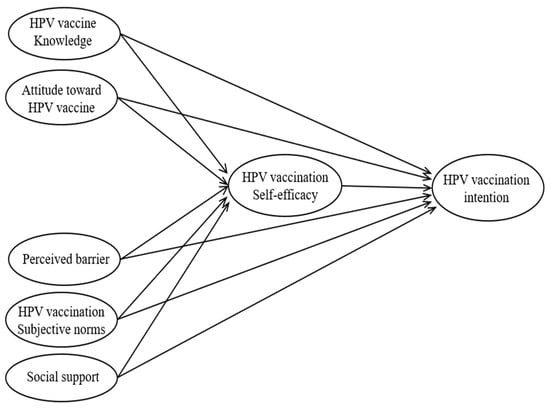
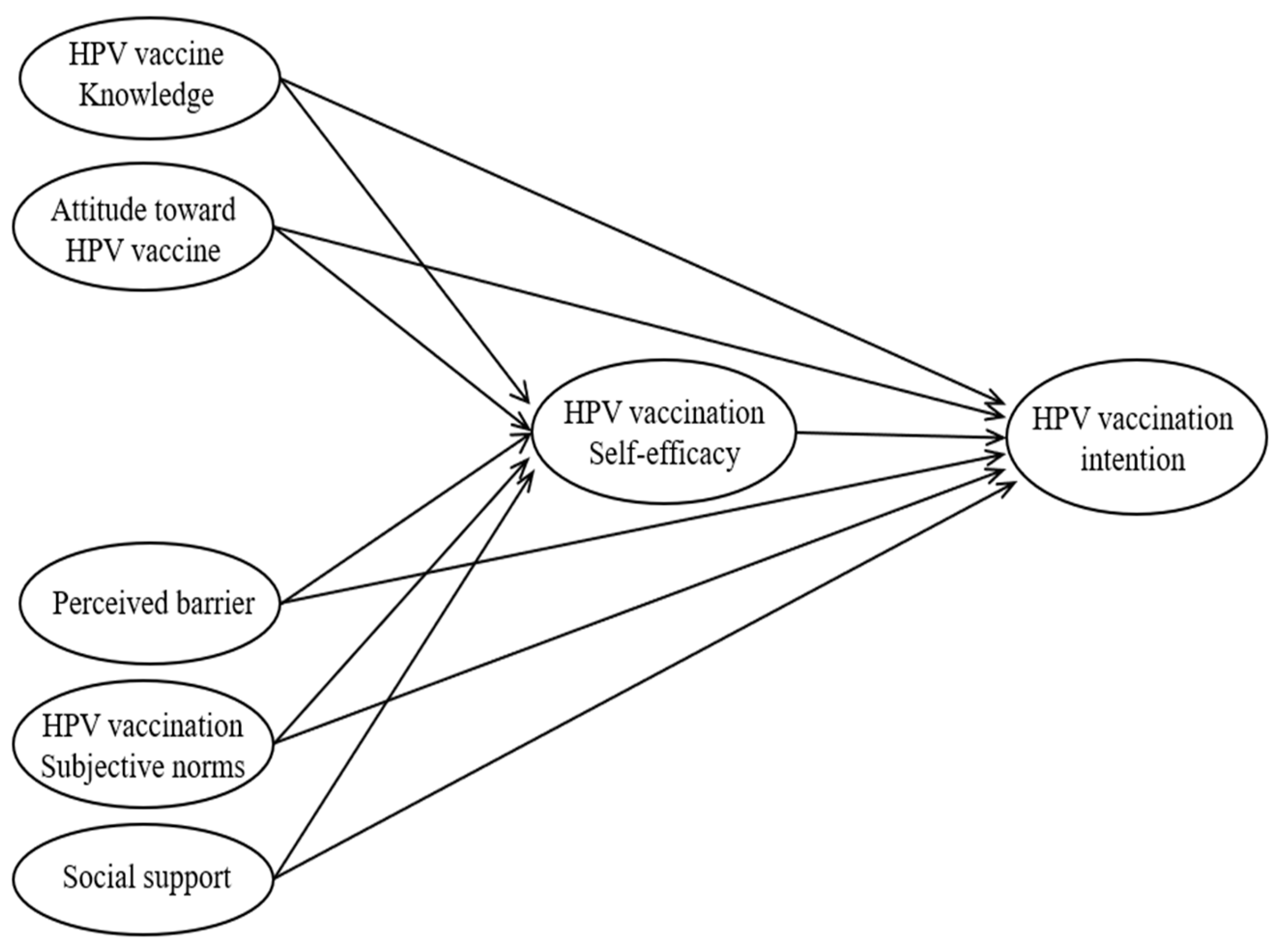
Based on the IMB model and previous research, the present study developed a hypothesized model to explain fathers’ intentions to vaccinate their adolescent sons against HPV. In the hypothesized model, HPV vaccine knowledge was specified as the information factor; attitudes toward HPV vaccination and perceived barriers were specified as personal motivational factors; and subjective norms regarding HPV vaccination and social support were specified as social motivational factors. HPV vaccination self-efficacy was specified as the behavioral skill factor, and fathers’ intentions to vaccinate their adolescent sons against HPV were designated as the final outcome variable.
According to the IMB model, information and motivation indirectly influence health behavior through behavioral skills, although they may also exert direct effects depending on the nature of the health behavior [12,21]. Accordingly, the present study established a hypothesized model to examine both the direct effects of informational and motivational factors on HPV vaccination self-efficacy and vaccination intention and their indirect effects on vaccination intention through self-efficacy (Figure 1).
Figure 1.
Hypothetical IMB-based structural model of fathers’ HPV vaccination intention for adolescent sons. HPV = human papillomavirus; IMB = Information–Motivation–Behavioral Skills.
Based on this model, the following hypotheses were formulated.
Hypothesis 1.
HPV vaccine knowledge will have a positive effect on HPV vaccination self-efficacy.
Hypothesis 2.
Attitudes toward HPV vaccination will have a positive effect on HPV vaccination self-efficacy.
Hypothesis 3.
Perceived barriers will have a negative effect on HPV vaccination self-efficacy.
Hypothesis 4.
Subjective norms regarding HPV vaccination will have a positive effect on HPV vaccination self-efficacy.
Hypothesis 5.
Social support will have a positive effect on HPV vaccination self-efficacy.
Hypothesis 6.
HPV vaccine knowledge will have a positive effect on HPV vaccination intention.
Hypothesis 7.
Attitudes toward HPV vaccination will have a positive effect on HPV vaccination intention.
Hypothesis 8.
Perceived barriers will have a negative effect on HPV vaccination intention.
Hypothesis 9.
Subjective norms regarding HPV vaccination will have a positive effect on HPV vaccination intention.
Hypothesis 10.
Social support will have a positive effect on HPV vaccination intention.
Hypothesis 11.
HPV vaccination self-efficacy will have a positive effect on HPV vaccination intention.
2. Materials and Methods
2.1. Study Design
This study was a cross-sectional, online survey-based structural equation modeling study designed to examine factors associated with fathers’ intentions to vaccinate their adolescent sons against HPV.
2.2. Participants
The participants were fathers of adolescent sons aged 12 to 17 years. Fathers whose sons had already received HPV vaccination were excluded. This criterion was applied to focus on fathers who had not yet arranged HPV vaccination for their sons and whose intentions regarding future vaccination remained relevant to the study outcome.
For structural equation modeling (SEM) using maximum likelihood (ML) estimation, sample size requirements depend on model complexity and estimation conditions rather than a single fixed threshold [28]. Considering the proposed model and the feasibility of recruitment, the target sample size was set at approximately 250 participants. Allowing for an anticipated exclusion rate of 10%, the recruitment target was calculated as 278 participants (250/0.90 = 277.78, rounded up).
Of the 278 initial participants recruited through the online panel, 25 were excluded during pre-analysis data quality screening based on a predefined protocol for identifying invalid and careless responses [29]. The exclusion criteria identified straight-lining patterns—defined as consistently selecting a single identical response option across multiple scales that included opposing conceptual directions and reverse-coded items, indicating a lack of logical engagement. The final analytic sample consisted of 253 complete and logically consistent responses.
2.3. Measurement
2.3.1. General Characteristics
General characteristics were assessed using nine items: fathers’ age, sons’ age, presence of siblings, fathers’ education level, monthly household income, awareness of the HPV vaccine, awareness that males can be infected with HPV, awareness that HPV vaccination is available for males, and awareness of HPV vaccination costs.
2.3.2. HPV Vaccine Knowledge
HPV vaccine knowledge was assessed using a 16-item instrument comprising 11 items on HPV knowledge and five items on HPV vaccine knowledge [30,31]. Each correct response was scored as 1, whereas incorrect and “do not know” responses were scored as 0. The overall knowledge score was calculated as the proportion of correct responses across all 16 items. Scores for each subdomain were calculated as the proportion of correct responses within that subdomain, with scores ranging from 0 to 1. Higher scores indicate greater knowledge. Content validity was evaluated by six experts, with both the item-level content validity index (I-CVI) and scale-level content validity index (S-CVI) being 1.00. The Kuder–Richardson 20 (KR-20) coefficient was 0.87 in this study.
2.3.3. Attitudes Toward HPV Vaccination
Attitudes toward HPV vaccination were assessed using a modified version of the 11-item instrument originally developed by Kang and Moneyham [32]. To ensure conceptual relevance to the study population and alignment with the IMB framework, content validity was evaluated by five experts. Five items with an I-CVI ≤ 0.60 were excluded: three items regarding risky sexual behavior and two items concerning the general importance of prevention that conceptually overlapped with the information (knowledge) component of the IMB model. The remaining six items achieved an I-CVI of 1.00 [33]. In this study, the revised six-item scale demonstrated good internal consistency (Cronbach’s α = 0.83), and confirmatory factor analysis showed acceptable standardized factor loadings ranging from 0.74 to 0.93 (0.84, 0.89, 0.93, 0.82, 0.77, and 0.74). Higher scores indicate more positive attitudes toward HPV vaccination.
2.3.4. Perceived Barriers
Perceived barriers to HPV vaccination were assessed using a previously developed and modified instrument [34,35]. With permission from the original developer, the wording was adapted to refer specifically to “my son.” The instrument consists of six items rated on a 7-point Likert scale, with higher scores indicating greater perceived barriers to HPV vaccination. Cronbach’s α was 0.84 in this study.
2.3.5. Subjective Norms
Subjective norms regarding HPV vaccination were assessed using a previously developed and translated instrument [36,37]. To reflect the study population of fathers, the referent was modified from “parents” to “my wife,” and the vaccination target was specified as “my child.” The instrument consists of six items rated on a 5-point Likert scale, with higher scores indicating stronger perceived social expectations regarding HPV vaccination. Cronbach’s α was 0.86 in this study.
2.3.6. Social Support
Social support was assessed using the Multidimensional Scale of Perceived Social Support (MSPSS) [38,39]. The MSPSS consists of 12 items rated on a 7-point Likert scale and comprises three subscales: spousal, family, and friend support. Higher scores indicate greater perceived social support. Cronbach’s α was 0.96 in this study.
2.3.7. HPV Vaccination Self-Efficacy
HPV vaccination self-efficacy was assessed using a previously developed and translated six-item instrument [40,41]. Each item is rated on a 5-point Likert scale, with higher scores indicating greater confidence in carrying out actions related to HPV vaccination. Cronbach’s α was 0.90 in this study.
2.3.8. HPV Vaccination Intention
HPV vaccination intention was assessed using a previously developed and translated five-item instrument [36,37]. Each item is rated on a 7-point Likert scale, with higher scores indicating stronger intention to vaccinate one’s son against HPV. Cronbach’s α was 0.93 in this study.
2.4. Data Collection
Data were collected from 11 February to 28 February 2026, using a self-administered online questionnaire hosted by Macromill Embrain Easy Survey, a professional survey research company in Republic of Korea. Participants were recruited via region-based quota sampling from the company’s online research panel rather than a probability-based stratified random sample. Regional quotas were proportionally allocated according to the male population distribution across all 17 provinces and metropolitan cities in South Korea based on population statistics from the Korean Statistical Information Service (KOSIS) [42]. The survey company distributed survey links to panel members, and a pre-screening stage confirmed demographic eligibility, including sex, age, region, number and sex of children, children’s age, and cohabitation status with the son. Only those confirmed as eligible were presented with a full explanation of the study purpose and procedures, followed by an informed consent form. Participation was entirely voluntary, and only those who provided consent proceeded to complete the survey questionnaire.
2.5. Data Analysis
Data were analyzed using IBM SPSS Statistics version 27.0 and IBM SPSS Amos version 29.0 (IBM Corp., Armonk, NY, USA) Missing data were examined prior to the main analysis; no missing data were found in the final dataset, as the online survey was designed to require a response to each item before proceeding.
Descriptive statistics were used to summarize participant characteristics and measured variables. Differences in HPV vaccination intention according to participant characteristics were examined using independent t-tests and one-way ANOVA as exploratory analyses. Reliability was assessed using Cronbach’s α and KR-20, and validity was examined through confirmatory factor analysis (CFA). Convergent validity of latent variables was evaluated using average variance extracted (AVE) and construct reliability (CR), while discriminant validity was assessed by comparing the squared correlations between latent variables with AVE values. Normality was examined using skewness and kurtosis, and multicollinearity was assessed using tolerance and variance inflation factor (VIF). Model parameters were estimated using the maximum likelihood (ML) method, and model fit was evaluated using χ2/df, goodness-of-fit index (GFI), adjusted goodness-of-fit index (AGFI), standardized root mean square residual (SRMR), root mean square error of approximation (RMSEA), normed fit index (NFI), Tucker–Lewis index (TLI), and comparative fit index (CFI). The significance of indirect and total effects was tested using bootstrapping with 5000 iterations.
2.6. Ethical Considerations
This study was conducted in accordance with the Declaration of Helsinki and was approved by the Institutional Review Board of the Changwon National University (approval No. 7001066-202511-HR084). All participants were fully informed regarding the study purpose, confidentiality, voluntary participation, and their right to withdraw at any time prior to providing informed consent. Collected data were anonymized and used solely for research purposes.
3. Results
3.1. General Characteristics of Participants
The demographic characteristics of participants are shown in Table 1. The mean age was 49.07 ± 4.38 years, and most participants had completed a university degree or higher (85.4%). Less than half of the participants were aware that males can be infected with HPV (45.1%) or that HPV vaccination is available for males (47.0%).
Table 1.
General characteristics of participants (N = 253).
3.2. Descriptive Statistics and Differences in HPV Vaccination Intention by General Characteristics
The mean scores of the measured variables are presented in Table 2. All variables met the criteria for univariate normality, with absolute skewness values lower than 2 and absolute kurtosis values lower than 3.
Table 2.
Descriptive statistics of measured variables (N = 253).
Exploratory bivariate analyses of HPV vaccination intention according to general characteristics are presented in Table 3. Significant differences in vaccination intention were observed according to the presence of siblings (t = 2.25, p = 0.026), awareness of the HPV vaccine (t = 4.54, p < 0.001), awareness of HPV infection in males (t = 2.96, p = 0.003), and awareness that HPV vaccination is available for males (t = 3.26, p = 0.001). Fathers who were aware that HPV vaccination was available for males reported higher vaccination intention (mean = 4.65, SD = 0.96) than those who were unaware (mean = 4.28, SD = 0.85).
Table 3.
Differences in HPV vaccination intention by general characteristics (N = 253).
3.3. Correlations Among Variables
Correlations among the measured variables are presented in Table 4. HPV vaccination self-efficacy and HPV vaccination intention were significantly correlated with most variables, and HPV vaccination intention showed the strongest correlation with self-efficacy (r = 0.58, p < 0.001).
Table 4.
Correlations among measured variables (N = 253).
In addition, multicollinearity diagnostics were performed to evaluate the impact of the high correlation between spousal support and family support (r = 0.85). The tolerance values and variance inflation factors (VIF) for all study variables were well within acceptable limits. Specifically, the VIF values were 4.14 for spousal support and 4.06 for family support (tolerance values of 0.24 and 0.25, respectively), while all other variables exhibited VIF values ranging from 1.26 to 1.75. These findings indicate that multicollinearity was not a serious concern the stability of the structural model.
3.4. Measurement Model and Structural Model Fit
Confirmatory factor analysis (CFA) was conducted to examine the validity of the measurement instruments. All standardized factor loadings were ≥0.45. Reliability assessed using Cronbach’s α ranged from 0.83 to 0.96, and KR-20 for the HPV knowledge items was 0.87. For latent variables, convergent validity was confirmed with AVE values of 0.58–0.71 and CR values of 0.74–0.88, and discriminant validity was supported as all AVE values exceeded the squared correlations between latent variables.
The hypothetical structural model demonstrated adequate fit (χ2/df = 2.52, GFI = 0.97, AGFI = 0.90, SRMR = 0.05, RMSEA = 0.08, NFI = 0.95, TLI = 0.93, CFI = 0.97) [43], explaining 28.2% of the variance in HPV vaccination self-efficacy and 43.7% in HPV vaccination intention.
3.5. Structural Model Results
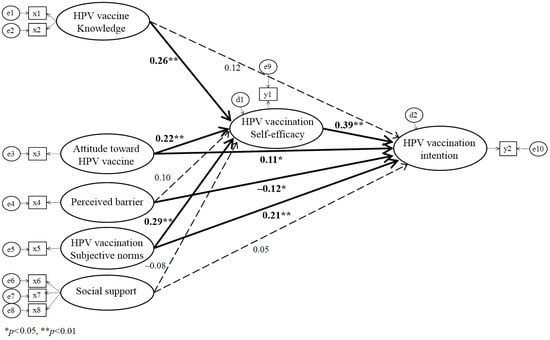
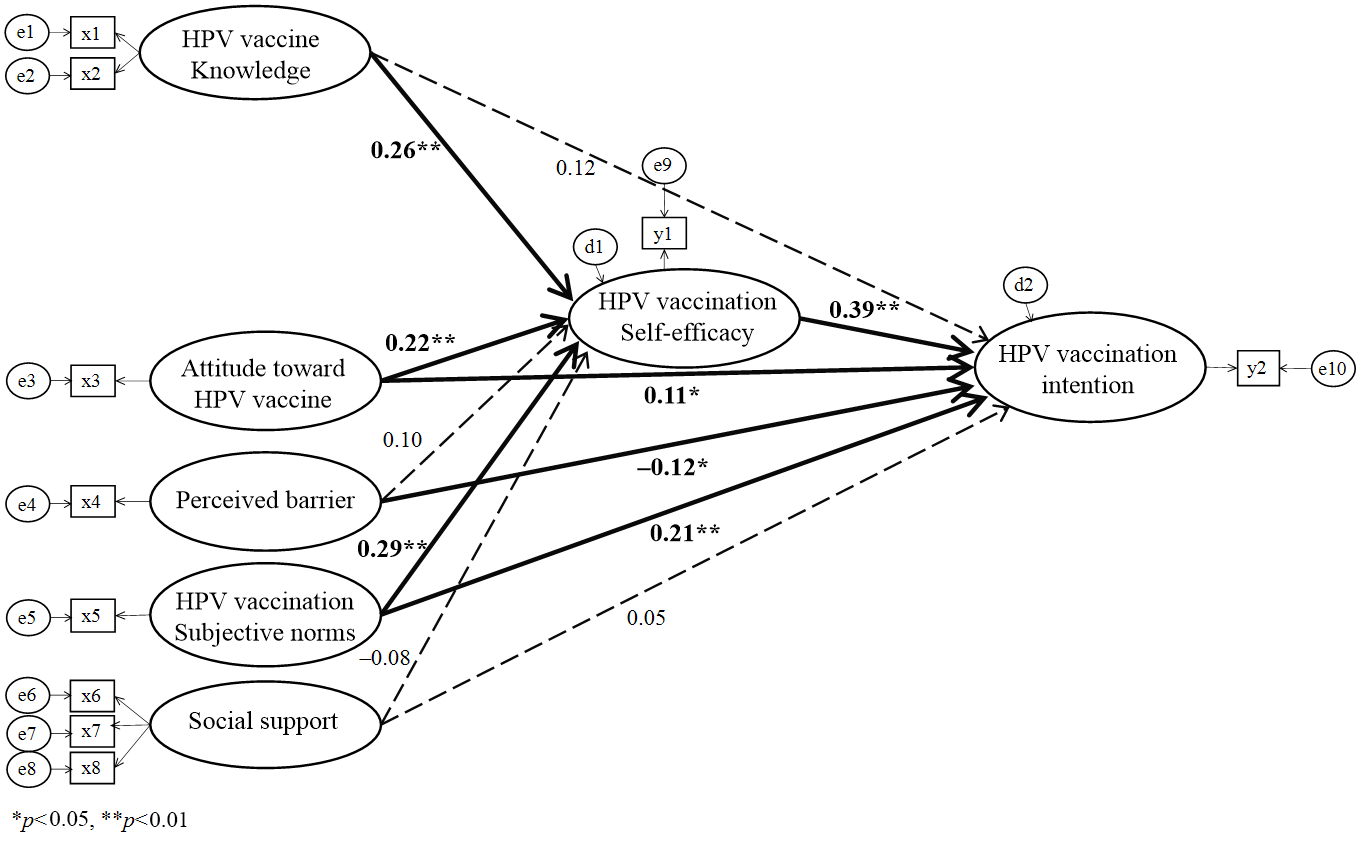
Of the 11 paths examined, seven paths were statistically significant. HPV vaccination self-efficacy (β = 0.39, p < 0.001), subjective norms (β = 0.21, p < 0.001), perceived barriers (β = −0.12, p = 0.033), and attitudes toward HPV vaccination (β = 0.11, p = 0.043) showed significant direct effects on HPV vaccination intention (Figure 2). HPV vaccine knowledge (β = 0.26, p < 0.001), attitudes toward HPV vaccination (β = 0.22, p < 0.001), and subjective norms (β = 0.29, p < 0.001) showed significant direct effects on self-efficacy. Perceived barriers and social support showed no significant effects on self-efficacy, and HPV vaccine knowledge and social support showed no significant direct effects on vaccination intention. HPV vaccination self-efficacy fully mediated the path from HPV vaccine knowledge to vaccination intention, and partially mediated the paths from attitudes toward HPV vaccination and subjective norms to vaccination intention. Direct, indirect, and total effects are presented in Table 5.
Figure 2.
Structural equation model of fathers’ HPV vaccination intention for adolescent sons.
Table 5.
Direct, indirect, and total effects of the structural model (N = 253).
4. Discussion
This study constructed and tested a structural equation model of fathers’ HPV vaccination intentions for their adolescent sons based on the IMB model. The hypothesized model demonstrated adequate fit (χ2/df = 2.52, GFI = 0.97, AGFI = 0.90, SRMR = 0.05, RMSEA = 0.08, NFI = 0.95, TLI = 0.93, CFI = 0.97) and explained 43.7% of the variance in HPV vaccination intention. Of the 11 hypothesized paths, seven were statistically significant. These findings provide empirical support for the applicability of the IMB model to understanding fathers’ HPV vaccination decision-making, while also indicating that the relative contributions of information, motivation, and behavioral skills may differ in the context of parental decision-making for adolescent vaccination.
The mean HPV vaccination intention score among fathers was 4.45 ± 0.92 out of 7, which was lower than the score of 5.04 ± 1.26 reported among mothers of elementary school-aged sons using the same instrument [7]. This difference should be interpreted cautiously because the two studies involved different samples and were conducted in different contexts; nevertheless, it is consistent with previous evidence suggesting that fathers may be less engaged than mothers in HPV vaccination decision-making. Although behavioral intention is an important predictor of subsequent behavior [44], stronger intentions do not necessarily translate into actual vaccination. Previous research has identified an intention–behavior gap [45], and a longitudinal study of HPV vaccination found that parental intention predicted subsequent uptake, although other factors also contributed to vaccination decisions [46]. In practice, financial costs, access to vaccination services, and scheduling difficulties may further hinder the translation of intention into action. Therefore, the present findings should be interpreted as explaining fathers’ vaccination intentions rather than actual vaccination behavior. Future longitudinal studies should examine whether these intentions lead to HPV vaccination uptake and identify barriers encountered during implementation.
HPV vaccination self-efficacy, subjective norms, perceived barriers, and attitudes toward HPV vaccination had significant direct effects on vaccination intention, with self-efficacy showing the strongest effect. This finding is consistent with previous studies identifying self-efficacy as an important determinant of HPV vaccination intention [11,13,23,24]. In the context of parental decision-making, self-efficacy may represent fathers’ confidence in their ability to obtain relevant information, discuss vaccination with family members or healthcare providers, and arrange vaccination for their sons. Thus, interventions that provide fathers with actionable information, clear guidance on where and how to obtain vaccination, and opportunities to address concerns may be more effective than information provision alone. However, the model explained 28.2% of the variance in self-efficacy, suggesting that additional factors not included in the present model may be relevant to fathers’ vaccination-related confidence. Future studies could explore other potential factors, including previous vaccination experiences, healthcare accessibility, and vaccination-specific support from healthcare providers.
Subjective norms also had a significant direct effect on vaccination intention. This finding suggests that fathers’ perceptions of the expectations or recommendations of significant others, such as spouses and healthcare providers, may be particularly relevant to their vaccination decisions [13,46]. Notably, subjective norms were significant whereas general social support was not, suggesting that vaccination-specific social expectations may be more influential than broader perceptions of emotional or interpersonal support. This distinction may be especially important when designing interventions for fathers. Involving spouses in vaccination discussions and ensuring that healthcare providers directly communicate HPV vaccination recommendations to fathers may strengthen perceived normative support for vaccination.
Perceived barriers had a significant negative direct effect on vaccination intention, whereas their effect on self-efficacy was not significant. This pattern suggests that practical or perceived obstacles to HPV vaccination may reduce fathers’ intentions independently of their confidence in carrying out vaccination-related actions. Previous studies have identified concerns regarding vaccine safety, cost, accessibility, and other practical constraints as barriers to HPV vaccination [8,47,48]. These findings should be interpreted in the context of the vaccination policy at the time of data collection, when HPV vaccination for adolescent boys was not covered by the national immunization program. Therefore, interventions should not focus exclusively on psychological determinants but should also reduce practical barriers by providing clear information about vaccine eligibility, cost, vaccination sites, and procedures. Attitudes toward HPV vaccination also had a significant direct effect on intention, consistent with previous findings that favorable evaluations of vaccination are associated with greater willingness to vaccinate children [32,49]. These results indicate that fathers’ vaccination intentions are shaped by both their evaluation of HPV vaccination and the practical feasibility of acting on that evaluation.
HPV vaccine knowledge did not have a significant direct effect on vaccination intention, which differs from previous studies reporting positive associations between knowledge and intention [24,25]. However, knowledge significantly influenced intention indirectly through self-efficacy. This finding suggests that possessing HPV-related knowledge alone may not be sufficient to strengthen fathers’ vaccination intentions; rather, information may become behaviorally relevant when it contributes to confidence in making and implementing vaccination decisions. Accordingly, educational interventions for fathers should move beyond providing factual information about HPV and the vaccine and include practical components that help fathers apply this information to vaccination decision-making.
Social support had no significant direct effect on either HPV vaccination self-efficacy or vaccination intention. This finding may partly reflect the way social support was operationalized in the present study. The MSPSS assesses general perceived support from spouses, family members, and friends and may not capture vaccination-specific informational or instrumental support. In contrast, subjective norms directly assess perceived expectations regarding vaccination and were significantly associated with both self-efficacy and intention. Thus, the findings may indicate the importance of distinguishing general social support from vaccination-specific social influence within the social motivation component of the IMB model. Future studies should examine whether vaccination-specific forms of social support, such as assistance in obtaining vaccine information, discussing concerns with healthcare providers, or arranging vaccination appointments, contribute differently to fathers’ vaccination decisions.
HPV vaccination self-efficacy fully mediated the relationship between HPV vaccine knowledge and vaccination intention and partially mediated the relationships of attitudes and subjective norms with vaccination intention. These findings are consistent with previous studies reporting a mediating role of self-efficacy in HPV vaccination-related decision-making [14,15,22,23]. The indirect pathway from knowledge through self-efficacy is particularly noteworthy because it suggests a mechanism through which information may contribute to vaccination intention even in the absence of a significant direct effect. In contrast, attitudes and subjective norms were associated with intention both directly and indirectly through self-efficacy, indicating that motivational factors may influence vaccination intention through multiple pathways. Overall, these findings are broadly consistent with the IMB proposition that information and motivation may contribute to health-related outcomes through behavioral skills [12] while also suggesting that the relative importance of these pathways may vary across specific determinants.
The findings may also have implications for HPV vaccination promotion following the recent expansion of national vaccination support to adolescent boys in South Korea. However, because the data were collected before the policy expansion, the present study cannot determine its effects on fathers’ vaccination intentions. Nevertheless, the findings suggest that strategies focusing on HVP vaccination self-efficacy, healthcare provider recommendations, family communication, and practical barriers may complement policy-level support. Future studies could examine fathers’ vaccination intentions and actual vaccination uptake following the policy expansion.
Strengths and Limitations
This study has several strengths. First, it extends the existing literature by focusing specifically on fathers of adolescent sons, a population that has received relatively limited attention in previous HPV vaccination research. Second, this study applied the IMB model to simultaneously examine cognitive, personal motivational, social motivational, and behavioral skill factors associated with fathers’ HPV vaccination intentions. The use of structural equation modeling further enabled the examination of both direct and indirect pathways, providing a more comprehensive understanding of how these factors are related to vaccination intention. In particular, identifying HPV vaccination self-efficacy as a key mechanism linking information and motivational factors to vaccination intention provides a theoretically grounded basis for developing father-targeted interventions. Finally, the findings provide evidence of fathers’ HPV vaccination intentions before the expansion of national vaccination support to adolescent boys in South Korea.
Several limitations should be considered when interpreting the findings. First, the use of an online panel sample may have introduced selection and response biases. The exclusion of fathers whose sons had already received HPV vaccination and the high proportion of university-educated fathers (85.4%) may further limit the generalizability of the findings to the broader population of fathers.
Second, the cross-sectional design precludes causal or temporal interpretations of the relationships among the study variables. In addition, although the sample size met the recommended minimum for structural equation modeling, the relatively small sample (N = 253) may have limited the statistical power to detect small effects. Accordingly, non-significant paths, such as the path from perceived barriers to self-efficacy, should be interpreted with caution rather than as evidence of the absence of an effect. The structural model also did not adjust for demographic characteristics, including fathers’ age, education, and household income. Future studies with larger samples and adjusted models are needed to examine the robustness of these relationships.
Third, some measurement instruments were modified for the present study, and their psychometric properties require further validation in fathers of adolescent sons. Notably, the attitude scale was shortened from 11 to 6 items, which may have narrowed the content of the original construct and limits direct comparison with studies that used the full instrument. In addition, the measure of general perceived social support may not adequately capture vaccination-specific informational, emotional, and practical support. Furthermore, the concurrent use of self-reported measures may have introduced common method bias.
Fourth, the study assessed fathers’ vaccination intentions rather than actual vaccination behavior. Because intention does not necessarily translate into vaccination uptake, longitudinal studies are needed to examine whether the identified factors are associated with subsequent vaccination behavior.
Finally, the data were collected before the expansion of national HPV vaccination support to 12-year-old boys in May 2026. Therefore, fathers’ perceptions of vaccination costs, accessibility, and intentions may differ under the revised policy, limiting the applicability of the findings to the current policy context. Moreover, because the study was conducted in South Korea, the findings should be interpreted within its sociocultural and healthcare context.
5. Conclusions
This study applied the IMB model to identify factors associated with fathers’ intentions to vaccinate their adolescent sons against HPV. Self-efficacy emerged as a key factor associated with vaccination intention, mediating the relationships between knowledge, attitudes, subjective norms, and intention. Perceived barriers were negatively associated with intention, whereas general social support showed no significant association. These findings suggest that father-targeted vaccination strategies may benefit from strengthening self-efficacy, addressing practical barriers, and supporting informed decision-making. Future IMB-based vaccination research may benefit from assessing vaccination-specific informational, emotional, and practical support rather than relying solely on general social support measures. Longitudinal and intervention studies could further examine whether these factors are associated with actual HPV vaccination uptake.
Author Contributions
Conceptualization, J.B. and H.K.; methodology, J.B. and H.K.; formal analysis, J.B. and H.K.; investigation, J.B.; data curation, J.B.; writing—original draft preparation, J.B.; writing—review and editing, J.B. and H.K.; supervision, H.K. All authors have read and agreed to the published version of the manuscript.
Funding
This research received no external funding.
Institutional Review Board Statement
The study was approved by the Institutional Review Board of Changwon National University on 17 December 2025 (Approval No. 7001066-202511-HR084).
Informed Consent Statement
Informed consent was obtained from all subjects involved in the study.
Data Availability Statement
The datasets generated and/or analyzed during the current study are not publicly available due to participant confidentiality concerns, but are available from the corresponding author on reasonable request.
Acknowledgments
This research was supported by the ANCHOR program through the Jeju ANCHOR center, funded by the Ministry of Education (MOE) and the Jeju Special Self-Governing Province, Republic of Korea (2026-ANCHOR-17-003). We would like to thank Jungeun Kim, of Samsung Changwon Hospital for providing expert consultation and valuable advice that contributed to the quality and completion of this study.
Conflicts of Interest
The authors declare no conflicts of interest.
Abbreviations
The following abbreviations are used in this manuscript:
| HPV | Human papillomavirus |
| IMB | Information–Motivation–Behavioral Skills |
| I-CVI | Item-level content validity index |
| S-CVI | Scale-level content validity index |
| KRW | Korean won |
References
- Rumgay, H.; Georges, D.; Huang, Y.; Hirabayashi, M.; Shah, R.; de Martel, C.; Park, J.Y.; Soerjomataram, I.; Clifford, G.M. Global burden of cancer attributable to infections in 2024: A worldwide incidence analysis. Lancet Oncol. 2026, 27, 1237–1248. [Google Scholar] [CrossRef] [Scilit] [PubMed]
- Centers for Disease Control and Prevention. About HPV. Available online: https://www.cdc.gov/hpv/about/ (accessed on 4 August 2026).
- Korea Disease Control and Prevention Agency. HPV National Immunization Program: Program Overview and Implementation History; KDCA: Cheongju, Republic of Korea, 2024; Available online: https://www.kdca.go.kr/bbs/kdca/55/259932/download.do (accessed on 17 November 2026).
- Korea Disease Control and Prevention Agency. HPV Vaccination under the National Immunization Program Begins for 12-Year-Old Boys on 6 May 2026; KDCA: Cheongju, Republic of Korea, 2026; Available online: https://www.kdca.go.kr/kdca/2847/subview.do?enc=Zm5jdDF8QEB8JTJGYmJzJTJGa2RjYSUyRjQxJTJGMzEwOTQ3JTJGYXJ0Y2xWaWV3LmRvJTNG (accessed on 17 November 2026).
- Perez, S.; Tatar, O.; Gilca, V.; Shapiro, G.K.; Ogilvie, G.; Guichon, J.; Naz, A.; Rosberger, Z. Untangling the psychosocial predictors of HPV vaccination decision-making among parents of boys. Vaccine 2017, 35, 4713–4721. [Google Scholar] [CrossRef] [Scilit] [PubMed]
- Kang, E.H.; Lee, E.H. Updated theory of planned behavior in predicting parents’ intentions to vaccinate their sons in elementary school against human papillomavirus. J. Korean Acad. Community Health Nurs. 2021, 32, 195–204. [Google Scholar] [CrossRef] [Scilit]
- Park, E.Y.; Kim, T.I. Factors influencing mothers’ intention to vaccinate their elementary school sons against human papillomavirus. Korean J. Women Health Nurs. 2020, 26, 37–48. [Google Scholar] [CrossRef] [Scilit] [PubMed]
- Choi, J.; Markham, C.; Tamí-Maury, I.; Kim, S.; Cuccaro, P. Maternal perceptions of vaccinating boys against human papillomavirus (HPV) in Seoul, South Korea: A descriptive exploratory qualitative study. PLoS ONE 2023, 18, e0282811. [Google Scholar] [CrossRef] [Scilit] [PubMed]
- Suárez, P.; Wallington, S.F.; Greaney, M.L.; Lindsay, A.C. Exploring HPV knowledge, awareness, beliefs, attitudes, and vaccine acceptability of Latino fathers living in the United States: An integrative review. J. Community Health 2019, 44, 844–856. [Google Scholar] [CrossRef] [Scilit] [PubMed]
- Guilamo-Ramos, V.; Thimm-Kaiser, M.; Benzekri, A. Paternal communication and sexual health clinic visits among Latino and Black adolescent males with resident and nonresident fathers. J. Adolesc. Health 2023, 73, 567–573. [Google Scholar] [CrossRef] [Scilit] [PubMed]
- Bark, J.; Kim, H.; Ryu, S.I. Impact of human papillomavirus vaccination knowledge, health beliefs, and self-efficacy on vaccination intention in adolescent sons in Korea: A descriptive survey study. J. Korean Biol. Nurs. Sci. 2025, 27, 49–59. [Google Scholar] [CrossRef] [Scilit] [PubMed]
- Fisher, J.D.; Fisher, W.A. Changing AIDS-risk behavior. Psychol. Bull. 1992, 111, 455–474. [Google Scholar] [CrossRef] [Scilit] [PubMed]
- Yi, Y.; Xiu, S.; Shi, N.; Huang, Y.; Zhang, S.; Wang, Q.; Yang, L.; Cui, T.; Wang, Y.; Shen, Y.; et al. Perceptions and acceptability of HPV vaccination among parents of female adolescents 9–14 in China: A cross-sectional survey based on the theory of planned behavior. Hum. Vaccin. Immunother. 2023, 19, 2225994. [Google Scholar] [CrossRef] [Scilit] [PubMed]
- Stout, M.E.; Christy, S.M.; Winger, J.G.; Vadaparampil, S.T.; Mosher, C.E. Self-efficacy and HPV vaccine attitudes mediate the relationship between social norms and intentions to receive the HPV vaccine among college students. J. Community Health 2020, 45, 1187–1195. [Google Scholar] [CrossRef] [Scilit] [PubMed]
- Christy, S.M.; Winger, J.G.; Mosher, C.E. Does self-efficacy mediate the relationships between social-cognitive factors and intentions to receive HPV vaccination among young women? Clin. Nurs. Res. 2019, 28, 708–725. [Google Scholar] [CrossRef] [Scilit] [PubMed]
- Khalil, G.E.; Fisher, C.L.; Chi, X.; Hansen, M.D.; Sanchez, G.; Gurka, M.J.; Staras, S.A.S. The role of personal social networks in parental decision-making for HPV vaccination: Examining support and norms among Florida parents. Vaccines 2025, 13, 667. [Google Scholar] [CrossRef] [Scilit] [PubMed]
- Lismidiati, W.; Hasyim, A.V.F.; Parmawati, I.; Wicaksana, A.L. Self-efficacy to obtain human papillomavirus vaccination among Indonesian adolescent girls. Asian Pac. J. Cancer Prev. 2022, 23, 789–794. [Google Scholar] [CrossRef] [Scilit] [PubMed]
- VanderDrift, L.E.; Vanable, P.A.; Bonafide, K.E.; Brown, J.L.; Bostwick, R.A.; Carey, M.P. Using actor-partner interdependence modeling to understand HPV vaccine acceptance. PLoS ONE 2017, 12, e0181662. [Google Scholar] [CrossRef] [Scilit] [PubMed]
- Lucero, D.; Moreno, V.A.; Delgado, D.; Hernandez Nieto, A.; Rodriguez-Cruz, N.; Le, Q.; Lindsay, A.C. Understanding HPV vaccine initiation and intention among Central American immigrant parents in the United States: The role of vaccine literacy and healthcare provider recommendations. Vaccines 2025, 13, 130. [Google Scholar] [CrossRef] [Scilit] [PubMed]
- Radisic, G.; Chapman, J.; Flight, I.; Wilson, C. Factors associated with parents’ attitudes to the HPV vaccination of their adolescent sons: A systematic review. Prev. Med. 2017, 95, 26–37. [Google Scholar] [CrossRef] [Scilit] [PubMed]
- Fisher, W.A.; Fisher, J.D.; Harman, J. The information-motivation-behavioral skills model: A general social psychological approach to understanding and promoting health behavior. In Social Psychological Foundations of Health and Illness; Suls, J., Wallston, K.A., Eds.; Blackwell Publishing: Malden, MA, USA, 2003; pp. 82–106. [Google Scholar] [CrossRef] [Scilit]
- Wang, H.; Wang, X.; Chen, P.; Xu, H.; Liu, Y.; Kang, R.; Zheng, L.; Sun, X.; Sun, X.; Qiao, Y.; et al. Factors influencing Chinese female college students’ willingness to receive human papillomavirus vaccine: A cross-sectional study based on information-motivation-behavioral skills model. Hum. Vaccin. Immunother. 2022, 18, 2140550. [Google Scholar] [CrossRef] [Scilit] [PubMed]
- Nam, K.A.; Lee, Y.E. Influencing factors on intention to receive human papillomavirus vaccination in mothers of elementary school girls: Focusing on the mediating effects of self-efficacy. J. Korean Soc. Matern. Child Health 2021, 25, 130–141. [Google Scholar] [CrossRef] [Scilit]
- Degarege, A.; Krupp, K.; Fennie, K.; Srinivas, V.; Li, T.; Stephens, D.P.; Madhivanan, P. An integrative behavior theory derived model to assess factors affecting HPV vaccine acceptance using structural equation modeling. Vaccine 2019, 37, 945–955. [Google Scholar] [CrossRef] [Scilit] [PubMed]
- Zhou, M.; Qu, S.; Zhao, L.; Campy, K.S.; Wang, S. Parental perceptions of human papillomavirus vaccination in central China: The moderating role of socioeconomic factors. Hum. Vaccin. Immunother. 2019, 15, 1688–1696. [Google Scholar] [CrossRef] [Scilit] [PubMed]
- Fisher, W.A. Understanding human papillomavirus vaccine uptake. Vaccine 2012, 30, F149–F156. [Google Scholar] [CrossRef] [Scilit] [PubMed]
- Wang, L.D.L.; Lam, W.W.T.; Fielding, R. Determinants of human papillomavirus vaccination uptake among adolescent girls: A theory-based longitudinal study among Hong Kong Chinese parents. Prev. Med. 2017, 102, 24–30. [Google Scholar] [CrossRef] [Scilit] [PubMed]
- Kline, R.B. Principles and Practice of Structural Equation Modeling, 5th ed.; Guilford Press: New York, NY, USA, 2023. [Google Scholar]
- Curran, P.G. Methods for the detection of carelessly invalid responses in survey data. J. Exp. Soc. Psychol. 2016, 66, 4–19. [Google Scholar] [CrossRef] [Scilit]
- Kim, H.W.; Ahn, H.Y. Study on the knowledge of human papilloma virus in female university students. Korean J. Women Health Nurs. 2007, 13, 13–20. [Google Scholar] [CrossRef] [Scilit]
- Park, W.H. Parents’ Knowledge, Acceptance and Influencing Factors on Human Papillomavirus (HPV) Vaccine for Their Children. Master’s Thesis, Eulji University, Daejeon, Republic of Korea, 2014. [Google Scholar]
- Kang, H.S.; Moneyham, L. Attitudes toward and intention to receive the human papilloma virus (HPV) vaccination and intention to use condoms among female Korean college students. Vaccine 2010, 28, 811–816. [Google Scholar] [CrossRef] [Scilit] [PubMed]
- Polit, D.F.; Beck, C.T.; Owen, S.V. Is the CVI an acceptable indicator of content validity? Appraisal and recommendations. Res. Nurs. Health 2007, 30, 459–467. [Google Scholar] [CrossRef] [Scilit] [PubMed]
- Hong, M.J.; Lee, Y.J.; Lee, K.M.; Heo, J.H.; Yoon, N.H. Factors influencing COVID-19 vaccination intention among Korean college students. Korean J. Health Educ. Promot. 2022, 39, 1–10. [Google Scholar] [CrossRef] [Scilit]
- Zhang, Y. The Effect of Exposure to Human Papilloma Virus (HPV) Prevention Campaign on Vaccination Intention in China: Focusing on the Mediating Effect of Health Belief and the Moderating Effect of Gender. Master’s Thesis, Sejong University, Seoul, Republic of Korea, 2023. [Google Scholar]
- Gerend, M.A.; Shepherd, J.E. Predicting human papillomavirus vaccine uptake in young adult women: Comparing the health belief model and theory of planned behavior. Ann. Behav. Med. 2012, 44, 171–180. [Google Scholar] [CrossRef] [Scilit] [PubMed]
- Kim, S.Y. Factors Influencing Human Papillomavirus Vaccination in College Students Using the Theory of Planned Behavior. Master’s Thesis, Chung-Ang University, Seoul, Republic of Korea, 2018. [Google Scholar]
- Zimet, G.D.; Dahlem, N.W.; Zimet, S.G.; Farley, G.K. The multidimensional scale of perceived social support. J. Pers. Assess. 1988, 52, 30–41. [Google Scholar] [CrossRef] [Scilit]
- Kim, M.; Yeom, H.E.; Jung, M.S. Validation and psychometric properties of the multidimensional scale of perceived social support among Korean breast cancer survivors. Asia Pac. J. Oncol. Nurs. 2022, 9, 229–235. [Google Scholar] [CrossRef] [Scilit] [PubMed]
- Lipschitz, J.M.; Fernandez, A.C.; Larson, H.E.; Blaney, C.L.; Meier, K.S.; Redding, C.A.; Prochaska, J.O.; Paiva, A.L. Validation of decisional balance and self-efficacy measures for HPV vaccination in college women. Am. J. Health Promot. 2013, 27, 299–307. [Google Scholar] [CrossRef] [Scilit] [PubMed]
- Lee, E.N.; Bae, S.H.; Choi, E.H.; Hwang, H.J.; Lee, Y.O.; Cho, J.R. Factors influencing human papillomavirus vaccination adoption stages based on the precaution adoption process model. Asian Oncol. Nurs. 2015, 15, 89–96. [Google Scholar] [CrossRef] [Scilit]
- Statistics Korea. Statistical Table. Available online: https://kosis.kr/search/search.do (accessed on 4 August 2026).
- Hu, L.T.; Bentler, P.M. Cutoff criteria for fit indexes in covariance structure analysis: Conventional criteria versus new alternatives. Struct. Equ. Model. 1999, 6, 1–55. [Google Scholar] [CrossRef] [Scilit]
- Ajzen, I. From Intentions to Actions: A Theory of Planned Behavior. In Action Control: From Cognition to Behavior; Kuhl, J., Beckmann, J., Eds.; Springer: Berlin/Heidelberg, Germany, 1985; pp. 11–39. [Google Scholar] [CrossRef] [Scilit]
- Sheeran, P.; Webb, T.L. The intention–behavior gap. Soc. Personal. Psychol. Compass 2016, 10, 503–518. [Google Scholar] [CrossRef] [Scilit]
- Hofman, R.; van Empelen, P.; Richardus, J.H.; de Kok, I.M.C.M.; de Koning, H.J.; van Ballegooijen, M.; Korfage, I.J. Predictors of HPV vaccination uptake: A longitudinal study among parents. Health Educ. Res. 2014, 29, 83–96. [Google Scholar] [CrossRef] [Scilit] [PubMed]
- Holman, D.M.; Benard, V.; Roland, K.B.; Watson, M.; Liddon, N.; Stokley, S. Barriers to human papillomavirus vaccination among US adolescents: A systematic review of the literature. JAMA Pediatr. 2014, 168, 76–82. [Google Scholar] [CrossRef] [Scilit] [PubMed]
- Newman, P.A.; Logie, C.H.; Lacombe-Duncan, A.; Baiden, P.; Tepjan, S.; Rubincam, C.; Doukas, N.; Asey, F. Parents’ uptake of human papillomavirus vaccines for their children: A systematic review and meta-analysis of observational studies. BMJ Open 2018, 8, e019206. [Google Scholar] [CrossRef] [Scilit] [PubMed]
- Huang, Z.; Ji, M.; Ren, J.; Sun, X.; Boulton, M.L.; Zikmund-Fisher, B.J.; Wagner, A.L. Effect of the framing of HPV vaccination on parents’ willingness to accept an HPV vaccine. Vaccine 2022, 40, 897–903. [Google Scholar] [CrossRef] [Scilit] [PubMed]

Disclaimer/Publisher’s Note: The statements, opinions and data contained in all publications are solely those of the individual author(s) and contributor(s) and not of MDPI and/or the editor(s). MDPI and/or the editor(s) disclaim responsibility for any injury to people or property resulting from any ideas, methods, instructions or products referred to in the content. |
© 2026 by the authors. Licensee MDPI, Basel, Switzerland. This article is an open access article distributed under the terms and conditions of the Creative Commons Attribution (CC BY) license.