


Abstract
Background/Objectives: Imaging is a routine part of cancer follow-up and is often accompanied by distress, commonly called “scanxiety.” This study described imaging-related distress and habitual coping strategies. Methods: In this cross-sectional study, 150 adults with solid tumors completed the Turkish short form of the COPE inventory before a scheduled follow-up imaging examination and the Impact of Event Scale-Revised (IES-R), referenced to the examination, after the scan and before the disclosure of results. Results: The mean IES-R total score was 63.3 ± 7.3 (range 47–78), indicating markedly elevated event-related stress symptoms, with avoidance as the most prominent dimension. Acceptance, planning, turning to religion, and positive reinterpretation were the most frequently used coping strategies, whereas behavioral disengagement, substance use, and denial were rarely used. In exploratory multivariable models, treatment context and time since diagnosis were not associated with distress. Patients with lung cancer had nominally higher distress (B = 4.41; 95% confidence interval [CI] 0.95–7.87), which did not remain significant after correction across distress outcomes. No coping strategy was associated with distress after correction for multiple testing. Conclusions: Imaging-related distress was high, and habitual coping was not associated with lower distress. Longitudinal studies with repeated pre-scan, pre-disclosure, and post-disclosure assessments are needed.
1. Introduction
Improvements in cancer detection and treatment have produced a growing population of people living with, or after, cancer. Imaging plays a central role in their care: it is used to assess treatment response and to detect recurrence or progression, and for many patients it is repeated at regular intervals for years. Each scan is therefore a recurring event in which patients face the possibility of unfavorable news.
The anxiety and distress that surround these examinations, from the days before the scan until the results are disclosed, are commonly referred to as “scanxiety” [1,2]. Scanxiety has been described across cancer types and phases of care, including advanced disease and post-treatment surveillance [3,4,5]. Patients consistently identify the uncertainty about results, rather than the procedure itself, as its main source, and describe the interval between the scan and the disclosure of results as particularly stressful [2,6]. Scan-related distress is closely linked to fear of cancer recurrence or progression [7,8], which may persist for years after treatment [9,10], and it has been associated with poorer quality of life and, in some patients, with avoidance of follow-up care [2,11].
How patients deal with this recurring stressor is equally important. In the transactional model of stress, coping refers to the cognitive and behavioral efforts people make to manage demands they appraise as taxing [12]. Strategies such as planning, acceptance, and positive reinterpretation are generally associated with better adaptation, whereas denial and behavioral disengagement have been linked to poorer outcomes [13]. Reviews of the scanxiety literature have noted that the coping strategies of patients undergoing imaging, and their relationship with distress, have received little attention, and that most available data come from North America, Europe, and Australia [2].
The primary aim of this study was to describe imaging-related distress and coping strategies in oncology patients undergoing follow-up imaging in Türkiye. The secondary aims were to explore, as hypothesis-generating analyses, whether distress and coping were associated with clinical and demographic characteristics, and whether coping strategies were associated with distress.
2. Materials and Methods
2.1. Study Design and Participants
This cross-sectional study was conducted at the Department of Medical Oncology, Başkent University Ankara Hospital, a tertiary oncology center, between November 2021 and March 2022; enrollment began only after ethics approval was obtained on 17 November 2021. It is reported in accordance with the Strengthening the Reporting of Observational Studies in Epidemiology (STROBE) guidelines for cross-sectional studies. Consecutive adult outpatients with solid tumors who were scheduled for follow-up imaging were invited to participate. The numbers of patients invited, declining participation, and excluded were not systematically recorded.
Patients were eligible if they were 18 years of age or older, had a histologically confirmed solid tumor, and were scheduled for computed tomography (CT), positron emission tomography/computed tomography (PET/CT), magnetic resonance imaging (MRI), or ultrasonography as part of their oncological follow-up. Patients with cognitive impairment or acute psychiatric instability that precluded completion of the questionnaires were excluded. Each patient was assessed once, on the day of a single imaging examination: the coping questionnaire was completed before the examination and the distress questionnaire after it. Each questionnaire took approximately 10 min. The questionnaires were self-administered; for patients who were unable to read (n = 16), the items were read aloud by the researcher and the patients’ responses were recorded verbatim. The Impact of Event Scale-Revised (IES-R) was completed after the imaging examination and before the results were disclosed to the patient. This study was approved by the Baskent University Institutional Review Board and Ethics Committee (Project no: KA21/412; decision no. 21/153, dated 17 November 2021). All participants provided written informed consent before enrollment, and the study was conducted in accordance with the Declaration of Helsinki.
Sociodemographic characteristics (age, sex, education, employment, marital status, children, smoking, alcohol use, and psychiatric history) and clinical characteristics (tumor type, stage, time since diagnosis, current treatment, and imaging modality) were obtained from patient interviews and medical records. Treatment context was classified into three groups according to the purpose of imaging. The neoadjuvant/adjuvant group comprised patients receiving curative-intent treatment, in whom imaging was performed to assess treatment response or to detect recurrence. The remission group comprised patients who had completed curative-intent treatment and had no evidence of disease, in whom imaging was performed to detect recurrence. The metastatic/palliative group comprised patients with metastatic, inoperable, or palliatively treated disease, in whom imaging was performed to assess treatment response or progression. Time since diagnosis was categorized as less than 1 year, 1–3 years, and more than 3 years. For analysis, tumor type was grouped as breast, lung, colorectal, and other cancers.
2.2. Measures
Coping. Coping was assessed with the Coping Styles Scale Brief Form, a 28-item Turkish short form of the COPE inventory [13] developed and validated by Bacanlı et al. [14]. Items are rated from 1 (“I never do this”) to 4 (“I usually do this”) and form 14 two-item subscales: planning, positive reinterpretation, restraint, suppression of competing activities, use of instrumental social support, use of emotional social support, acceptance, turning to religion, humor, focus on and venting of emotions, denial, mental disengagement, behavioral disengagement, and substance use. Each subscale score ranges from 2 to 8, and a score of 6 or more, corresponding to an average item response between “moderately” and “usually,” was taken to indicate frequent use. In line with the standard instructions, patients were asked how they generally respond to difficult or stressful events; the scale therefore reflects habitual coping tendencies rather than coping with the imaging examination.
Distress. Distress was assessed with the Impact of Event Scale-Revised (IES-R) [15], using its validated Turkish version [16]. The IES-R has been recommended for scanxiety research because it can be referenced to a defined event [2]. Patients rated the 22 items with reference to the imaging examination, considering symptoms over the preceding 7 days, on a scale from 0 (not at all) to 4 (extremely). Scores were calculated for intrusion (items 1, 2, 3, 6, 9, 14, 16, and 20; range 0–32), avoidance (items 5, 7, 8, 11, 12, 13, 17, and 22; range 0–32), and hyperarousal (items 4, 10, 15, 18, 19, and 21; range 0–24), and a total score (range 0–88) was obtained by summing the subscales. A total score of 33 has been proposed as a cutoff for probable post-traumatic stress disorder in trauma-exposed populations [17]. Because this threshold has not been validated for imaging-related distress, it was reported only descriptively to allow comparison with other studies and was not interpreted as indicating clinically significant scan-related anxiety; we refer to IES-R scores as event-related stress symptoms. The Turkish IES-R has been validated in trauma-exposed populations [16] but not specifically for imaging-related distress; in the absence of a validated scanxiety-specific instrument, event-anchored measures such as the IES-R have been recommended as an interim approach [2]. Because the IES-R was completed once, after the examination but before the disclosure of results, and covers the preceding 7 days, it mainly reflects anticipatory and waiting-period distress referenced to the imaging event; it does not capture changes in distress across the scan cycle or distress after results are received.
Scoring and data verification. Both questionnaires were completed on paper forms. Subscale scores were calculated manually by the researcher from the paper forms according to the published scoring keys and entered into the study database; item-level responses were not entered electronically. All entered values were checked for out-of-range scores, and identified entry errors were corrected against the original forms.
2.3. Statistical Analysis
No a priori sample size calculation was performed; all eligible patients who consented during the study period were included. The analyses of clinical correlates were therefore exploratory. Categorical variables are presented as numbers and percentages, and continuous variables as mean ± standard deviation (SD), median (interquartile range, IQR), and range.
Associations of clinical and demographic characteristics with distress were examined with multivariable linear regression models in which the IES-R total score and each subscale were regressed simultaneously on treatment context, time since diagnosis, tumor type, sex, and age. Results are reported as unstandardized coefficients (B) with 95% confidence intervals (CI), and the overall contribution of each categorical variable was tested with a partial F test. Disease stage was not entered because it was almost completely determined by treatment context (81 of 87 patients in the metastatic/palliative group had stage IV disease; variance inflation factor 3.6 when both were included). In the final models, all variance inflation factors were below 1.7. Model assumptions were evaluated by examining residual distributions (Shapiro–Wilk test, skewness, and kurtosis), heteroscedasticity (Koenker–Breusch–Pagan test), and influential observations (Cook’s distance > 4/n). Heteroscedasticity-consistent (HC3) standard errors and models excluding potentially influential observations were fitted as sensitivity analyses. Because the regression models were fitted for four correlated distress outcomes, p values for the tumor-type effects were additionally adjusted across outcomes with the Benjamini–Hochberg procedure. The same models were fitted for each of the 14 coping subscales. Because the absence of a statistically significant difference does not indicate that groups are similar, equivalence of IES-R total scores between groups was tested with the two one-sided tests (TOST) procedure using Welch’s t test [18]. Because no minimally important difference has been established for the IES-R in the imaging context, the equivalence margin was defined after data collection as ±0.5 SD of the total score in our sample (±3.65 points), a commonly used threshold for a minimally important difference in patient-reported outcomes [19]; groups were considered equivalent when the 90% CI of the mean difference lay entirely within this margin. Because this internal margin is narrow owing to the restricted range of scores, sensitivity analyses were performed with two external margins of 0.5 SD derived from published Turkish oncology samples assessed with the IES-R: ±5.03 points (SD 10.06) [20] and ±7.95 points (SD 15.89) [21]. The primary equivalence tests compared unadjusted group means; adjusted equivalence was additionally examined using the 90% CIs of the corresponding regression coefficients. All equivalence analyses were post hoc and exploratory.
Associations between coping strategies and distress were examined with Spearman’s rank correlation coefficient (ρ) and with multivariable linear regression models in which each coping subscale was added separately to the covariate model described above. p values for the 14 coping subscales were adjusted with the Benjamini–Hochberg false discovery rate (FDR) procedure within each set of analyses, and an FDR-adjusted q < 0.05 was considered significant. Descriptive statistics were computed with SPSS Statistics version 24 (IBM Corp., Armonk, NY, USA); regression models, model diagnostics, equivalence tests, and FDR correction were performed in Python (version 3.13; Python Software Foundation, Wilmington, DE, USA) using the NumPy (version 2.5) and SciPy (version 1.18) libraries. Descriptive statistics and unadjusted comparisons were cross-checked against the SPSS output, and the analysis code is provided in the Supplementary Materials. Generative artificial intelligence was used to assist with parts of the statistical analysis and manuscript preparation, as detailed in the Acknowledgments.
3. Results
3.1. Patient Characteristics
A total of 150 patients were included. The mean age was 63.7 ± 13.6 years (range 20–92), and 85 patients (56.7%) were women. Most patients were married (86.0%) and had children (92.7%); 20.7% were employed, 22.0% had a university education, and 10.7% were illiterate. Two patients (1.3%) had a history of psychiatric illness. The most frequent tumor types were breast (21.3%), colorectal (19.3%), and lung cancer (17.3%). More than half of the patients had stage IV disease (59.3%) and had been diagnosed within the previous year (52.7%). By treatment context, 44 patients (29.3%) were in the neoadjuvant/adjuvant group, 19 (12.7%) were in remission, and 87 (58.0%) were in the metastatic/palliative group. Treatment context and time since diagnosis were closely related (χ2 test, p < 0.001): 34 of the 44 patients in the neoadjuvant/adjuvant group had been diagnosed within the past year, whereas 16 of the 19 patients in remission had been diagnosed more than a year earlier. CT was the most frequently used imaging modality (50.7%) (Table 1).
Table 1.
Sociodemographic and clinical characteristics of the patients (N = 150).
3.2. Imaging-Related Distress
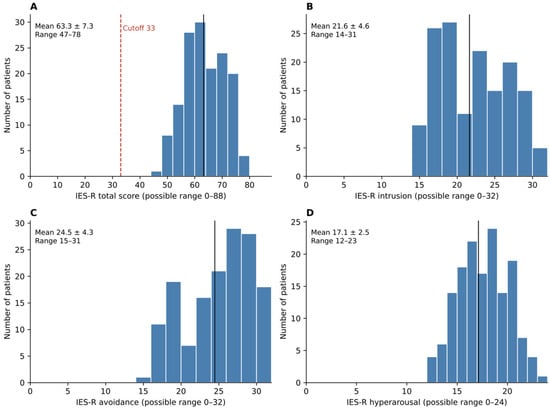
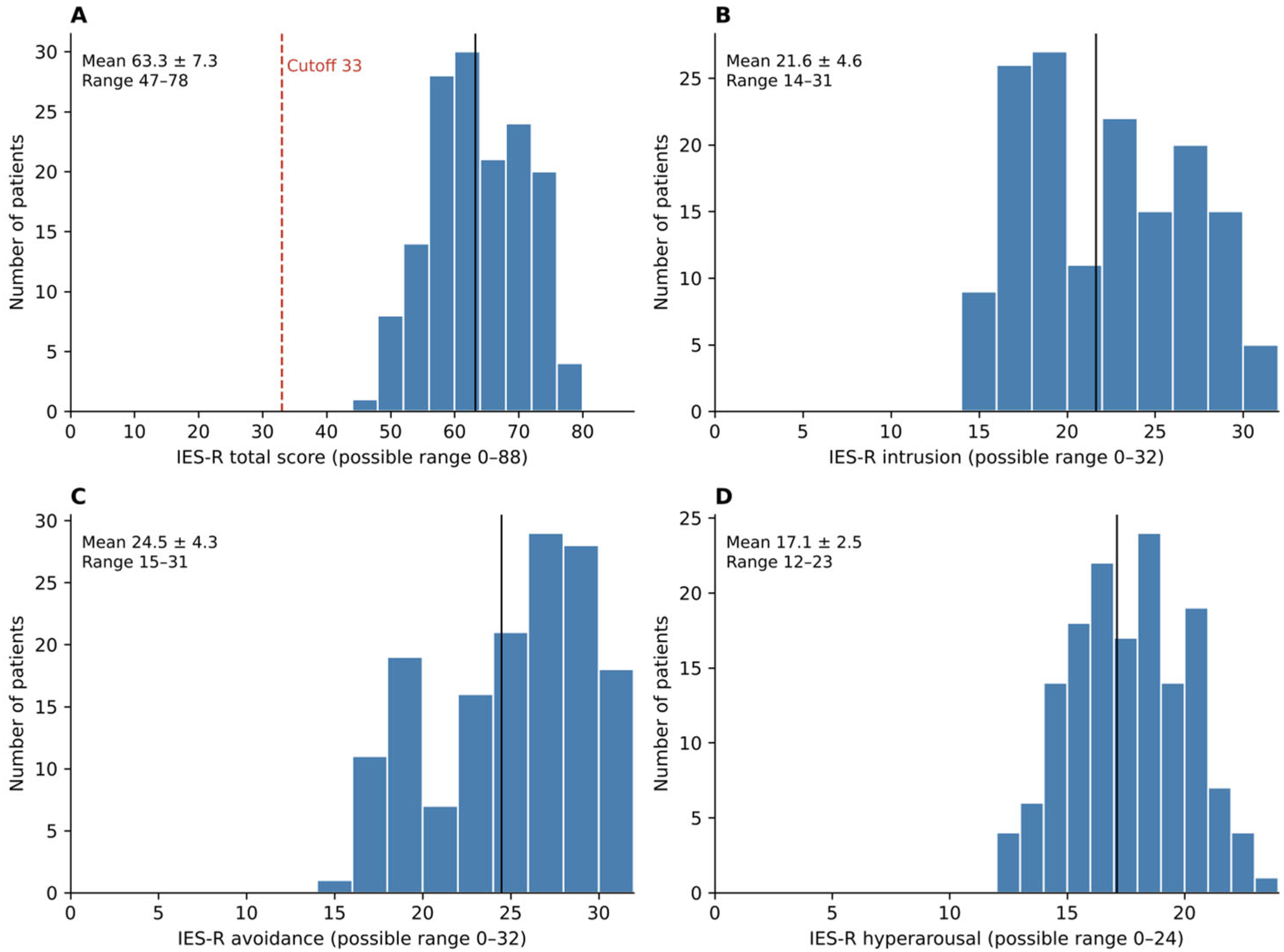
Distress related to the imaging examination was high throughout the sample (Table 2, Figure 1). The mean IES-R total score was 63.3 ± 7.3 (median 63, IQR 58–69), and scores ranged from 47 to 78; all patients therefore scored above the descriptive threshold of 33, and scores were concentrated within a narrow range (Figure 1). The mean subscale scores were 21.65 ± 4.63 for intrusion, 24.49 ± 4.33 for avoidance, and 17.13 ± 2.47 for hyperarousal. Expressed as a proportion of the maximum possible score, avoidance was the most prominent dimension (77% of the maximum), followed by hyperarousal (71%) and intrusion (68%).
Table 2.
Imaging-related distress and coping strategies in the overall sample (N = 150).
Figure 1.
Distribution of IES-R scores (N = 150). (A) Total score; (B) intrusion; (C) avoidance; (D) hyperarousal. The x-axes show the full possible range of each scale. Solid vertical lines indicate the mean; the dashed line in panel A indicates the cutoff of 33, which has not been validated for imaging-related distress. IES-R, Impact of Event Scale-Revised.
3.3. Coping Strategy Profile
Acceptance (6.29 ± 1.09) and planning (6.31 ± 1.20) were the most commonly used coping strategies and were used frequently by 75.3% and 69.3% of patients, respectively (Table 2). They were followed by turning to religion (5.88 ± 1.15; frequent use in 62.0%) and positive reinterpretation (5.80 ± 1.18; 54.7%). Focus on and venting of emotions (5.49 ± 1.29) and suppression of competing activities (5.45 ± 1.22) were each used frequently by nearly half of the patients. Use of instrumental social support (4.99 ± 1.55; 38.7%) was more common than use of emotional social support (4.34 ± 1.11; 13.3%). Behavioral disengagement (3.65 ± 1.15), substance use (3.71 ± 1.31), and denial (3.88 ± 1.11) were used frequently by fewer than 1 in 10 patients, and humor (4.03 ± 1.23) by 10.7%.
3.4. Clinical and Demographic Correlates of Distress
In multivariable analysis (n = 149; age missing for one patient), treatment context and time since diagnosis were not associated with the IES-R total score or any subscale (Table 3). Tumor type was associated with the total score (partial F test, p = 0.046): patients with lung cancer had higher total scores than those with other tumor types (B = 4.41; 95% CI 0.95–7.87; p = 0.013), mainly because of higher intrusion scores (B = 2.43; 95% CI 0.21–4.64; p = 0.032). Women had slightly higher hyperarousal scores than men (B = 0.99; 95% CI 0.05–1.92; p = 0.039), but not higher total scores. Age was not associated with distress. After correction across the four distress outcomes, neither the effect of tumor type on the total score (q = 0.186) nor the coefficient for lung cancer (q = 0.052) remained statistically significant. Residuals of the total-score model were approximately normally distributed (Shapiro–Wilk p = 0.437) and homoscedastic (Breusch–Pagan p = 0.902), and no observation had a Cook’s distance above 0.06. Residuals of the intrusion and avoidance models deviated from normality, and the avoidance model showed heteroscedasticity; however, using HC3 standard errors or excluding potentially influential observations did not change any conclusions (Supplementary Table S4). The models explained between 4% and 10% of the variance in distress scores.
Table 3.
Multivariable linear regression models of IES-R scores (n = 149).
With the internal margin, the absence of significant differences could not, in most cases, be interpreted as similarity (Table 4). Equivalence of total scores within ±3.65 points was demonstrated only between the metastatic/palliative and neoadjuvant/adjuvant groups (mean difference 0.90; 90% CI −1.40 to 3.20; p = 0.025) and between women and men (0.81; 90% CI −1.17 to 2.80; p = 0.010); all other comparisons were inconclusive. With the external margin of ±5.03 points, equivalence was found for all unadjusted comparisons except remission versus neoadjuvant/adjuvant treatment (p = 0.052), and with the wider external margin of ±7.95 points, for all comparisons. In adjusted analyses, the comparison between the remission and neoadjuvant/adjuvant groups remained inconclusive with both the internal and the narrower external margin (Supplementary Table S5).
Table 4.
Equivalence tests for IES-R total scores between groups.
3.5. Clinical Correlates of Coping
After adjustment for the other covariates, none of the 14 coping strategies were associated with treatment context (all q > 0.50), time since diagnosis (all q > 0.50), or tumor type (all q > 0.90). Unadjusted group comparisons are provided in Supplementary Tables S1–S3.
3.6. Associations Between Coping Strategies and Distress
Coping strategies were largely unrelated to distress (Table 5). In unadjusted analyses, focus on and venting of emotions were weakly and negatively correlated with the IES-R total score (ρ = −0.18, p = 0.030). In adjusted models, acceptance (B = 1.12; 95% CI 0.04–2.21; p = 0.043) and focus on and venting of emotions (B = −0.95; 95% CI −1.85 to −0.04; p = 0.041) showed nominal associations with the total score. None of these associations remained significant after FDR correction (all q ≥ 0.30).
Table 5.
Associations between coping strategies and IES-R total score.
4. Discussion
This cross-sectional study described imaging-related distress and coping strategies in oncology patients undergoing follow-up imaging. Distress related to the imaging examination was high in all patients, with avoidance as its most prominent dimension. Patients relied predominantly on acceptance, planning, religion, and positive reinterpretation, and these largely adaptive coping strategies were not associated with lower distress. Clinical correlates were weak: distress was not associated with treatment context or time since diagnosis, although equivalence could not be demonstrated for all comparisons, and patients with lung cancer reported nominally higher distress.
4.1. Level of Imaging-Related Distress
The level of distress in our sample was considerably higher than that reported in most previous studies. A scoping review found that mean scanxiety scores were low in the large majority of studies using quantitative measures [1], and a review of post-surgical surveillance concluded that scanxiety, although nearly universal, is usually of limited severity [4]. Several features of our study may explain this difference. The IES-R was referenced to the imaging examination and completed on the day of the scan, during the period between the examination and the disclosure of results, which patients consistently describe as the most stressful part of the experience [2,6]. Many previous studies used general anxiety measures without reference to the scan [2], and distress is defined and measured inconsistently across psycho-oncology research [22], which complicates direct comparisons. In addition, nearly 60% of our patients had stage IV disease, a group in which scan results directly determine whether treatment continues and in which scanxiety is common [3,5]. The IES-R cutoff, however, was developed for post-traumatic stress screening [17] and has not been validated for imaging-related distress. Our findings therefore indicate elevated event-related stress symptoms, that is, intrusive thoughts, avoidance, and arousal related to the scan, rather than clinically significant scan-related anxiety or a high prevalence of post-traumatic stress disorder. Because distress was measured only once, they also do not show how much of this distress was caused by the examination itself.
Our scores were also considerably higher than those reported in Turkish oncology samples assessed with the same instrument. In 204 patients receiving oncology treatment, the mean IES-R total score referenced to the cancer experience was approximately 29 [20], and in 385 patients receiving active treatment during the first wave of the COVID-19 pandemic, the mean score referenced to the pandemic was 20.5 [21]. Several cohort-specific factors may have contributed to this difference. First, our measure was anchored to a specific imaging examination and completed while patients were awaiting results, whereas these studies referred to the cancer experience in general or to the pandemic. Second, enrollment took place between November 2021 and March 2022, while the COVID-19 pandemic was ongoing, and concerns about infection and hospital visits may have amplified distress around hospital-based examinations. Third, the questionnaires were completed in the hospital on the day of the scan, and for illiterate patients the items were read aloud by the researcher, which may have influenced responses. Finally, a response style characterized by uniformly high ratings cannot be excluded; the narrow distribution of scores and the minimum score of 47 are consistent with this possibility, and because item-level data were not available, internal consistency and response patterns could not be examined. The absolute level of scores should therefore be interpreted with caution, whereas the relative pattern across dimensions and subgroups may be more informative.
Avoidance was the most prominent dimension. Patients appear to deal with the period around imaging largely by trying not to think or talk about the scan and its implications. This may be an understandable short-term response to an uncontrollable situation, but persistent avoidance can interfere with emotional processing and with communication between patients, families, and clinicians. Anxiety around scans has also been linked to less accurate understanding of scan results in patients with advanced cancer [23], which underlines the importance of communication during this period.
The timing of the assessment also determines what the scores represent. Scanxiety is dynamic: it typically rises before the scan, persists while results are pending, and changes after results are disclosed [2]. Because the IES-R was completed after the examination but before the disclosure of results and covered the preceding 7 days, it mainly captured distress in the days leading up to the scan and during the waiting period; that is, predominantly anticipatory distress. This construct may differ from distress measured immediately before the examination or after the results are received, and our findings should not be generalized to these phases of the scan cycle.
4.2. Clinical and Demographic Correlates
Neither treatment context nor time since diagnosis was associated with distress in multivariable models. Equivalence testing, however, refines this finding. With the internal margin, equivalence was demonstrated only between patients with metastatic disease and those receiving curative-intent treatment and between women and men. With an external margin derived from a published Turkish oncology sample, most comparisons were equivalent, but the comparison between patients in remission and those receiving curative-intent treatment remained inconclusive in both unadjusted and adjusted analyses. Because the margins were defined post hoc, these results should be regarded as exploratory. Our data therefore do not exclude clinically relevant differences in these comparisons. This is consistent with the mixed literature on time since diagnosis, in which some studies have reported higher scanxiety shortly after diagnosis or a decrease over time after surgery, whereas others have found no relationship [2,4]. Treatment context, time since diagnosis, and disease stage were also closely interrelated in our sample, so their separate contributions cannot be fully disentangled in a study of this size.
Patients with lung cancer reported higher distress than those with other tumor types, mainly through more intrusive thoughts. Scan-associated distress has been documented specifically in patients with lung cancer [5], and higher distress has been reported more generally in cancers with poorer survival, such as lung, gastric, and pancreatic cancer [22]. In these patients, the prognosis is often poor and imaging frequently determines treatment decisions. Because tumor type was not a primary hypothesis, the lung cancer group was small (n = 26), the models explained less than 10% of the variance, and the association did not remain significant after correction across the four distress outcomes, this finding should be considered hypothesis-generating and requires confirmation in larger studies. Women reported slightly more hyperarousal, in line with the higher prevalence of anxiety and post-traumatic stress symptoms reported in women [24], but total distress was equivalent between the sexes.
4.3. Coping Strategies
The coping profile of our patients was dominated by strategies generally regarded as adaptive. Acceptance, used frequently by three quarters of the patients, is considered especially useful in situations that cannot be changed, such as waiting for the result of a scan [13]. Planning and positive reinterpretation help patients organize their response to a threat and find meaning in it. The prominence of turning to religion, used frequently by nearly two-thirds of the patients, is consistent with the cultural context of our sample, in which faith commonly provides a framework for interpreting illness and uncertainty. Avoidant strategies such as behavioral disengagement, substance use, and denial were rarely used. The relatively low use of emotional social support (13.3%) compared with instrumental social support (38.7%) suggests that patients more readily sought practical information and advice than shared their feelings, possibly reflecting cultural norms or a wish to protect family members from worry. Together with the prominence of avoidance, this suggests that many patients may carry imaging-related distress without openly discussing it. Coping strategies were not associated with clinical characteristics. This differs from a Brazilian study in which patients receiving active treatment used coping strategies more often and coping use declined with age [25]. Because our scale asked how patients generally respond to stressful events, it captured habitual tendencies that would not necessarily be expected to vary with the phase of treatment.
4.4. Coping and Distress
Coping strategies were largely unrelated to distress. The nominal associations observed for acceptance and for venting of emotions were weak and did not survive correction for multiple testing. This is consistent with a study of patients with metastatic cancer in which emotional and instrumental social support were not associated with distress on the day of imaging [26]. In contrast, confidence in one’s ability to cope with a possible recurrence has been associated with lower fear of recurrence around surveillance mammography [10]. Similarly, self-compassion and psychological flexibility have been associated with lower fear of recurrence and generalized anxiety in women after cancer treatment, partly through emotion- and meaning-focused coping [27]. Coping self-efficacy, self-compassion, and flexibility are personal resources that differ from the habitual coping tendencies measured in our study, which may explain why habitual coping was not associated with imaging-related distress. The restricted range of distress scores, the modest reliability of some two-item coping subscales [14], and the separation of the two assessments around the examination may also have attenuated associations. Importantly, because the COPE short form measured how patients generally respond to stressful events rather than the strategies they used to manage the uncertainty of a specific scan, our data cannot show whether situation-specific coping around imaging is related to scan-related distress; the absence of associations should be interpreted in this light and not as evidence that coping is irrelevant to scanxiety.
4.5. Clinical Implications
Within the limits of a cross-sectional design, these findings suggest that clinicians should anticipate marked imaging-related distress in patients undergoing follow-up imaging, including those who appear to be coping well. Because the waiting period is the most stressful part of the experience [2,4], clear information about when and how results will be communicated and short intervals between scanning and the disclosure of results may benefit many patients. Brief psychological and informational support delivered around the time of imaging has reduced scan-related anxiety in previous studies [28,29], and a recent meta-analysis of randomized trials reported benefits of psychological interventions on distress in patients with cancer, although pooled effects were heterogeneous [30].
4.6. Limitations
This study has important limitations. First, it was cross-sectional: distress was measured once, after a single examination, without a pre-scan assessment, follow-up after the disclosure of results, or repeated measurements across scans. The study therefore cannot estimate changes in distress, attribute distress to the imaging examination, or describe the trajectory of scanxiety. Second, no a priori sample size calculation was performed; the numbers of patients invited, declining, and excluded were not recorded, so selection bias cannot be excluded, and several subgroups were small, particularly the remission group (n = 19); analyses of clinical correlates should therefore be regarded as exploratory, and the equivalence tests showed that several null findings were inconclusive. Third, group comparisons are susceptible to confounding by indication. Treatment context, time since diagnosis, and disease stage were strongly interrelated, and although multivariable models adjusted for tumor type, sex, and age, residual confounding by unmeasured factors such as performance status, symptom burden, prior scan results, and the reason for the current scan is likely. For this reason, we did not analyze imaging modality, which was closely linked to tumor type, sex, and treatment intent. Fourth, coping was measured as a general disposition rather than in relation to the imaging examination. Fifth, the Turkish IES-R has not been validated for imaging-related distress; the cutoff of 33 is not applicable to this context, scores were concentrated at high values, and because only subscale totals calculated from the paper forms were entered into the database, internal consistency and response patterns could not be assessed. Sixth, the questionnaires were self-administered by most patients but read aloud to illiterate patients, which may have introduced mode-of-administration effects. Finally, the study was conducted at a single center in Türkiye, and the predominance of patients with advanced disease (59.3% with stage IV disease) may limit generalizability to patients undergoing surveillance after curative treatment.
5. Conclusions
In this cross-sectional study of oncology patients undergoing follow-up imaging, event-related distress referenced to the imaging examination was high, with avoidance as its most prominent feature, and was not associated with treatment context or time since diagnosis. Patients relied mainly on acceptance, planning, religion, and positive reinterpretation, yet these habitual coping strategies were not associated with lower distress. Longitudinal studies with pre-scan, post-scan, and post-disclosure assessments across repeated examinations, adequately powered subgroups, and situation-specific coping measures are needed to clarify the course and determinants of scanxiety. In the future, larger study groups must be examined to validate the findings reported here. Based on our data, future studies would need at least 176 patients per clinical subgroup (approximately 530 patients across three treatment contexts) to detect a difference of 0.30 SD in IES-R total scores, and approximately 70 patients per group to demonstrate equivalence within ±0.5 SD, at a power of 0.80 and α = 0.05.
Supplementary Materials
The following supporting information can be downloaded at: https://www.mdpi.com/article/10.3390/healthcare14234086/s1, Table S1: Distress and coping scores according to treatment context: unadjusted group comparisons (one-way ANOVA) with multivariable-adjusted p values; Table S2: Distress and coping scores according to time since diagnosis: unadjusted group comparisons (one-way ANOVA) with multivariable-adjusted p values; Table S3: Distress and coping scores according to sex: unadjusted comparisons (independent-samples t test); Table S4: Regression diagnostics and sensitivity analyses for the multivariable models of IES-R scores (n = 149); Table S5: Equivalence tests for IES-R total scores with internal and external equivalence margins: unadjusted and adjusted comparisons; File S1: (analysis_code.py): Python code used for the regression models, model diagnostics, equivalence tests, false discovery rate correction, and sample size estimation.
Author Contributions
Conceptualization, Ş.S. and Ö.A.; methodology, Ş.S. and Y.H.A.; formal analysis, Ş.S. and M.F.S.; investigation, Ş.S., E.H. and S.R.; data curation, Ş.S.; writing—original draft preparation, Ş.S.; writing—review and editing, E.H., M.F.S., Y.H.A., S.R., A.O. and Ö.A.; supervision, A.O. and Ö.A. All authors have read and agreed to the published version of the manuscript.
Funding
This research received no external funding.
Institutional Review Board Statement
The study was conducted in accordance with the Declaration of Helsinki and approved by the Medical and Health Sciences Research Board and the Non-Interventional Clinical Research Ethics Committee of Başkent University (Project no. KA21/412; decision no. 21/153; date of approval: 17 November 2021).
Informed Consent Statement
Written informed consent was obtained from all subjects involved in the study.
Data Availability Statement
The data presented in this study are not available for sharing due to ethical and privacy restrictions. Participants were informed that their data would remain confidential and accessible only to the research team, and data sharing was not covered by the informed consent or the ethics committee approval. Aggregated data supporting the findings of this study are presented in the article and the Supplementary Materials.
Acknowledgments
The authors thank all patients who participated in this study. During the preparation of this manuscript, the authors used Claude (Anthropic; Claude Opus 5.5) for the purposes of statistical re-analysis (multivariable regression, regression diagnostics, equivalence testing, sensitivity analyses, sample size estimation, and false discovery rate correction), verification of references, and drafting and language editing of the manuscript text. The authors have reviewed and edited the output and take full responsibility for the content of this publication.
Conflicts of Interest
The authors declare no conflicts of interest.
Abbreviations
CI, confidence interval; COPE, Coping Orientation to Problems Experienced; CT, computed tomography; FDR, false discovery rate; IES-R, Impact of Event Scale-Revised; IQR, interquartile range; MRI, magnetic resonance imaging; PET/CT, positron emission tomography/computed tomography; SD, standard deviation; STROBE, Strengthening the Reporting of Observational Studies in Epidemiology; TOST, two one-sided tests.
References
- Bui, K.T.; Liang, R.; Kiely, B.E.; Brown, C.; Dhillon, H.M.; Blinman, P. Scanxiety: A scoping review about scan-associated anxiety. BMJ Open 2021, 11, e043215. [Google Scholar] [CrossRef] [Scilit] [PubMed]
- Derry-Vick, H.M.; Heathcote, L.C.; Glesby, N.; Stribling, J.; Luebke, M.; Epstein, A.S.; Prigerson, H.G. Scanxiety among adults with cancer: A scoping review to guide research and interventions. Cancers 2023, 15, 1381. [Google Scholar] [CrossRef] [Scilit] [PubMed]
- Bui, K.T.; Kiely, B.E.; Dhillon, H.M.; Brown, C.; Xu, K.; Shafiei, M.; Blinman, P. Prevalence and severity of scanxiety in people with advanced cancers: A multicentre survey. Support. Care Cancer 2022, 30, 511–519. [Google Scholar] [CrossRef] [Scilit] [PubMed]
- Khatri, R.; Quinn, P.L.; Wells-Di Gregorio, S.; Pawlik, T.M.; Cloyd, J.M. Surveillance-associated anxiety after curative-intent cancer surgery: A systematic review. Ann. Surg. Oncol. 2025, 32, 47–62. [Google Scholar] [CrossRef] [Scilit] [PubMed]
- Bauml, J.M.; Troxel, A.; Epperson, C.N.; Cohen, R.B.; Schmitz, K.; Stricker, C.; Shulman, L.N.; Bradbury, A.; Mao, J.J.; Langer, C.J. Scan-associated distress in lung cancer: Quantifying the impact of “scanxiety”. Lung Cancer 2016, 100, 110–113. [Google Scholar] [CrossRef] [Scilit] [PubMed]
- Bui, K.T.; Blinman, P.; Kiely, B.E.; Brown, C.; Dhillon, H.M. Experiences with scans and scanxiety in people with advanced cancer: A qualitative study. Support. Care Cancer 2021, 29, 7441–7449. [Google Scholar] [CrossRef] [Scilit] [PubMed]
- Simard, S.; Savard, J. Screening and comorbidity of clinical levels of fear of cancer recurrence. J. Cancer Surviv. 2015, 9, 481–491. [Google Scholar] [CrossRef] [Scilit] [PubMed]
- Soriano, E.C.; Perndorfer, C.; Siegel, S.D.; Laurenceau, J.P. Threat sensitivity and fear of cancer recurrence: A daily diary study of reactivity and recovery as patients and spouses face the first mammogram post-diagnosis. J. Psychosoc. Oncol. 2019, 37, 131–144. [Google Scholar] [CrossRef] [Scilit] [PubMed]
- Thompson, C.A.; Charlson, M.E.; Schenkein, E.; Wells, M.T.; Furman, R.R.; Elstrom, R.; Ruan, J.; Martin, P.; Leonard, J.P. Surveillance CT scans are a source of anxiety and fear of recurrence in long-term lymphoma survivors. Ann. Oncol. 2010, 21, 2262–2266. [Google Scholar] [CrossRef] [Scilit] [PubMed]
- McGinty, H.L.; Small, B.J.; Laronga, C.; Jacobsen, P.B. Predictors and patterns of fear of cancer recurrence in breast cancer survivors. Health Psychol. 2016, 35, 1–9. [Google Scholar] [CrossRef] [Scilit] [PubMed]
- Shelby, R.A.; Scipio, C.D.; Somers, T.J.; Soo, M.S.; Weinfurt, K.P.; Keefe, F.J. Prospective study of factors predicting adherence to surveillance mammography in women treated for breast cancer. J. Clin. Oncol. 2012, 30, 813–819. [Google Scholar] [CrossRef] [Scilit] [PubMed]
- Lazarus, R.S.; Folkman, S. Stress, Appraisal, and Coping; Springer: New York, NY, USA, 1984. [Google Scholar]
- Carver, C.S.; Scheier, M.F.; Weintraub, J.K. Assessing coping strategies: A theoretically based approach. J. Pers. Soc. Psychol. 1989, 56, 267–283. [Google Scholar] [CrossRef] [PubMed]
- Bacanlı, H.; Sürücü, M.; İlhan, T. An investigation of psychometric properties of Coping Styles Scale Brief Form: A study of validity and reliability. Educ. Sci. Theory Pract. 2013, 13, 90–96. [Google Scholar]
- Weiss, D.S.; Marmar, C.R. The Impact of Event Scale—Revised. In Assessing Psychological Trauma and PTSD; Wilson, J.P., Keane, T.M., Eds.; Guilford Press: New York, NY, USA, 1997; pp. 399–411. [Google Scholar]
- Çorapçıoğlu, A.; Yargıç, İ.; Geyran, P.; Kocabaşoğlu, N. Validity and reliability of Turkish version of “Impact of Event Scale-Revised” (IES-R). Yeni Symp. 2006, 44, 14–22. [Google Scholar]
- Creamer, M.; Bell, R.; Failla, S. Psychometric properties of the Impact of Event Scale—Revised. Behav. Res. Ther. 2003, 41, 1489–1496. [Google Scholar] [CrossRef] [Scilit] [PubMed]
- Lakens, D. Equivalence tests: A practical primer for t tests, correlations, and meta-analyses. Soc. Psychol. Personal. Sci. 2017, 8, 355–362. [Google Scholar] [CrossRef] [Scilit] [PubMed]
- Norman, G.R.; Sloan, J.A.; Wyrwich, K.W. Interpretation of changes in health-related quality of life: The remarkable universality of half a standard deviation. Med. Care 2003, 41, 582–592. [Google Scholar] [CrossRef] [Scilit] [PubMed]
- Öztürk, F.Ö.; Can Gür, G. The impact of core belief disruption on PTSD symptoms in cancer patients: The mediating and moderating roles of intrusion and avoidance behavior. Psychiatr. Q. 2025, 96, 497–513. [Google Scholar] [CrossRef] [Scilit] [PubMed]
- Koca, S.; Koca, E.; Okten, I.N.; Orengül, F.F.C.; Oztürk, A.; Ozçelik, M.; Oyman, A.; Çil, I.; Gümüş, M. Psychological impacts of COVID-19 pandemic in cancer patients on active treatment. Heliyon 2022, 8, e10142. [Google Scholar] [CrossRef] [Scilit] [PubMed]
- Lima, T.; Torres, A.; Carvalho, P.; Teixeira, R.J. Defining and assessing distress in oncology patients: A systematic review of the literature. Healthcare 2025, 13, 1976. [Google Scholar] [CrossRef] [Scilit] [PubMed]
- Derry, H.M.; Maciejewski, P.K.; Epstein, A.S.; Shah, M.A.; LeBlanc, T.W.; Reyna, V.; Prigerson, H.G. Associations between anxiety, poor prognosis, and accurate understanding of scan results among advanced cancer patients. J. Palliat. Med. 2019, 22, 961–965. [Google Scholar] [CrossRef] [Scilit] [PubMed]
- Tolin, D.F.; Foa, E.B. Sex differences in trauma and posttraumatic stress disorder: A quantitative review of 25 years of research. Psychol. Bull. 2006, 132, 959–992. [Google Scholar] [CrossRef] [Scilit] [PubMed]
- Meneguin, S.; Alves, I.G.; Camargo, H.T.F.; Pollo, C.F.; Segalla, A.V.Z.; de Oliveira, C. Comparative study of the quality of life and coping strategies in oncology patients. Eur. J. Investig. Health Psychol. Educ. 2024, 14, 339–350. [Google Scholar] [CrossRef] [Scilit] [PubMed]
- Morreale, M.K.; Moore, T.F.; Kim, S.; Uphold, H.S.; Mabunda, L.M.; Harper, F.W.K. Preferences for notification of imaging results in patients with metastatic cancer. Patient Educ. Couns. 2020, 103, 392–397. [Google Scholar] [CrossRef] [Scilit] [PubMed]
- Krok, D.; Telka, E.; Skalski-Bednarz, S.B. Be kind to yourself: Testing self-compassion, fear of recurrence, and generalized anxiety in women with cancer within a multiple-mediation model. J. Clin. Med. 2025, 14, 4696. [Google Scholar] [CrossRef] [Scilit] [PubMed]
- Caruso, A.; Bongiorno, L.; Vallini, L.; Russo, P.; Tomao, F.; Grandinetti, M.L. Breast cancer and distress resulting from magnetic resonance imaging (MRI): The impact of a psychological intervention of emotional and informative support. J. Exp. Clin. Cancer Res. 2006, 25, 499–505. [Google Scholar] [PubMed]
- Fernández-Feito, A.; Lana, A.; Baldonedo-Cernuda, R.; Mosteiro-Díaz, M.P. A brief nursing intervention reduces anxiety before breast cancer screening mammography. Psicothema 2015, 27, 128–133. [Google Scholar] [CrossRef] [Scilit] [PubMed]
- Paslaru, A.M.; Plesea-Condratovici, A.; Moroianu, L.-A.; Isailă, O.-M.; Rebegea, L.F.; Pavel, L.L.; Ciubară, A. Mind over malignancy: A systematic review and meta-analysis of psychological distress, coping, and therapeutic interventions in oncology. Medicina 2025, 61, 1086. [Google Scholar] [CrossRef] [Scilit] [PubMed]

Disclaimer/Publisher’s Note: The statements, opinions and data contained in all publications are solely those of the individual author(s) and contributor(s) and not of MDPI and/or the editor(s). MDPI and/or the editor(s) disclaim responsibility for any injury to people or property resulting from any ideas, methods, instructions or products referred to in the content. |
© 2026 by the authors. Licensee MDPI, Basel, Switzerland. This article is an open access article distributed under the terms and conditions of the Creative Commons Attribution (CC BY) license.