


Abstract
Background/Objectives: Inappropriate antibiotic use in children contributes to antimicrobial resistance, and parents are the main decision-makers. This study examined the direct and indirect associations of parental education, child chronic disease and parental perceptions of antibiotics with inappropriate antibiotic use, with antibiotic expectation as the mediator. Methods: This was a cross-sectional study of 241 parents attending the paediatric outpatient clinics of a hospital in Şanlıurfa, Türkiye (response rate 97.2%), interviewed face-to-face; parental perceptions of antibiotics were assessed using the Parental Perceptions on Antibiotics (PAPA) Scale. A theory-based path model was estimated by maximum likelihood, and indirect effects were tested with 5000 bootstrap resamples. Results: Higher antibiotic expectation was associated with more inappropriate use (β = 0.36, p < 0.001). Education was associated with inappropriate use only indirectly, through lower expectation (B = −0.119; 95% CI [−0.192, −0.055]). Parents of children with a chronic disease had lower PAPA scores and higher expectations, and their association with inappropriate use was indirect (B = 0.403; 95% CI [0.169, 0.672]). Higher PAPA scores were associated with less inappropriate use directly and through lower expectation (B = −0.010; 95% CI [−0.016, −0.005]). A model without direct paths from education and chronic disease fitted the data well (χ2 = 1.39, df = 2, p = 0.50; RMSEA = 0.00). Conclusions: Antibiotic expectation was the key correlate linking parental characteristics and perceptions to inappropriate antibiotic use. Expectation-focused strategies by physicians and pharmacists should be evaluated in longitudinal and intervention studies.
1. Introduction
Although antibiotics play a vital role in the management of childhood infections, the unnecessary and inappropriate use of these drugs constitutes a serious public health problem and a threat of antibiotic resistance worldwide [1,2,3]. Inappropriate antibiotic use in children manifests in various forms, such as obtaining antibiotics without a prescription and without consulting a physician, requesting that the physician prescribe antibiotics, or discontinuing treatment once symptoms subside [4,5,6]. Because parents are the primary decision-makers and implementers in their children’s healthcare utilisation and medication use, their attitudes, knowledge and perceptions are a critical factor in ensuring rational antibiotic use [2,6,7,8].
The Parental Perceptions on Antibiotics (PAPA) Scale was developed to assess, in a multidimensional manner, parents’ psychosocial factors, knowledge levels, beliefs, attitudes, adherence processes and awareness of antibiotic resistance in relation to antibiotic use [2,4]. Higher PAPA Scale scores indicate that parents have more accurate knowledge, greater awareness and more rational attitudes regarding antibiotics. Research has shown that parents’ tendency to avoid unnecessary antibiotic use increases as their PAPA Scale scores increase [2,4,9,10].
Previous studies have reported that parental education level is associated with PAPA Scale scores and antibiotic expectations. Parents with a higher level of education have been found to have markedly higher PAPA awareness scores, to be better aware that antibiotics are effective only against bacterial infections, and to be less likely to use antibiotics without a prescription or to hold inappropriate expectations [1,2,6,11]. Conversely, as education level decreases, misconceptions that antibiotics reduce fever, and the associated rates of inappropriate use, increase [11].
Evidence regarding parents of children with a chronic disease is limited. In a paediatric dentistry sample, parents of children with a chronic disease had significantly higher PAPA perception and awareness scores than parents of children without a chronic disease [2]; however, frequent contact with health services and repeated antibiotic courses may also increase expectations of treatment, so the direction of this association remains unclear.
Parents’ antibiotic expectations during clinical visits, in turn, mostly stem from misjudging symptom severity, being unable to distinguish between viral and bacterial infections, and a desire for rapid relief [12]. Community pharmacists, who are often the most accessible healthcare professionals for parents, can also address these expectations and counsel families on the correct use, storage and disposal of antibiotics [13], and pharmacist-involved interventions have reduced antibiotic prescribing in primary care [14]. In Türkiye, dispensing antibiotics without a prescription is illegal, but it has been documented in simulated patient studies [15].
According to the theory of planned behaviour, background factors such as education influence behaviour through beliefs and situation-specific cognitions rather than directly [16]. Within this framework, general perceptions of antibiotics, as measured by the PAPA Scale, can be regarded as distal beliefs, whereas the expectation of an antibiotic during an illness episode is a proximal cognition. Structural equation studies from Japan and China have linked excessive antibiotic expectations and attitudes to parents’ intentions and self-medication [17,18], but they were online surveys that did not assess reported behaviours or use the PAPA Scale.
In this context, the present study aimed to investigate the direct and indirect associations of parental education, child chronic disease and PAPA scores with inappropriate antibiotic use, with antibiotic expectation as the mediator. We hypothesised that higher PAPA scores (H1) and lower antibiotic expectation (H2) would be associated with less inappropriate use; that education (H3) and chronic disease (H4, tested non-directionally) would be associated with inappropriate use indirectly, through PAPA scores and expectation; and that education and chronic disease would have no direct association with inappropriate use (H5).
2. Materials and Methods
2.1. Study Design and Setting
This was a cross-sectional study, reported according to the STROBE guidelines [19]. The study was conducted among parents of children presenting to the Paediatric Outpatient Clinics of Şanlıurfa Mehmet Akif İnan Training and Research Hospital in Türkiye. The fieldwork was carried out between 6 July and 7 August 2026.
2.2. Participants
During the data collection period, all parents who presented to the outpatient clinic with their child under 18 years of age were consecutively approached and informed about the study; those who agreed to participate in the study and who had no language or communication barriers were included in the study. For children accompanied by both parents, only one parent was included. Parents of children with chronic neurological disease, epilepsy, or intellectual or developmental delay were not included, because these children usually receive long-term treatment under specialist follow-up. Chronic disease was recorded as a parent-reported, physician-diagnosed chronic condition.
Non-probability consecutive sampling was used because no sampling frame of attendees is available in advance in a walk-in outpatient setting. Of the 248 eligible parents approached, 7 declined, and 241 were included (response rate, 97.2%). No a priori sample size calculation was performed; a Monte Carlo power analysis showed that the sample provided 80% power to detect indirect effects when both standardised component paths were at least 0.21 [20].
2.3. Data Collection and Measures
The questionnaire prepared for the study included parents’ sociodemographic characteristics, child-related characteristics, antibiotic expectation, inappropriate antibiotic use behaviours and the Parental Perceptions on Antibiotics (PAPA) Scale. Data were collected by the researchers through face-to-face interviews, and there were no missing data. The Turkish validity and reliability study of the scale, which was developed by Alumran et al. to measure parents’ knowledge, attitudes and behaviours regarding antibiotics in childhood illnesses, was conducted by Özdemir and Ergin. The PAPA is a 31-item scale with five subdimensions, scored on a 5-point Likert-type scale. Possible scores range from 31 to 155. Higher scores indicate that the parent has better perceptions of antibiotics [4,9,10,21]. In the present sample, Cronbach’s α was 0.82 for the total scale and 0.60–0.84 for the subdimensions.
For antibiotic expectation and inappropriate antibiotic use behaviours, questions developed by the researchers on the basis of the literature [5,6,7,8,11,12] were used rather than standard scales; no formal content validation or pilot study was performed. Five questions were used for antibiotic expectation, and responses were coded dichotomously (yes = 1, no = 0). Possible scores in this domain ranged from 0 to 5. The Kuder–Richardson Formula 20 (KR-20) was used to assess internal consistency (KR-20: 0.76). Four questions were used for inappropriate antibiotic use behaviours (use without a prescription, not completing the treatment, reuse without a doctor’s recommendation and keeping antibiotics at home); responses were again coded dichotomously, and scores ranged from 0 to 4. The KR-20 value for this section was 0.64. Because the treatment completion item was phrased positively, a “no” response was scored 1. Higher scores were interpreted as a greater expectation of antibiotic prescription and greater inappropriate antibiotic use, respectively. Respondent, parental age, child age, frequency of antibiotic use in the past year and history of hospitalisation were used as covariates in sensitivity analyses. The full questionnaire is provided in the Supplementary Materials.
2.4. Statistical Analysis
The SPSS v26 software package (IBM Corp., Armonk, NY, USA) was used for descriptive statistics, univariate analyses and correlations in the analysis of the study data. Path analysis was conducted with a path analysis implementation written by the author in Python 3.11 using the NumPy, SciPy and statsmodels libraries, which applies standard maximum likelihood estimation to the covariance structure [22,23,24]. The path model (Figure 1) was specified from the hypotheses. Education (1 = primary school to 5 = postgraduate) and chronic disease (1 = present, 0 = absent) were exogenous variables with a free covariance; the PAPA score was regressed on education and chronic disease, antibiotic expectation on these three variables, and inappropriate use on all four. In the path analysis, observed variables were created from composite scores for the antibiotic expectation and inappropriate antibiotic use variables, and from the total score for the PAPA Scale. Because this model (Model 1) is just-identified (df = 0), its fit is perfect by definition; H5 was therefore tested with a nested model (Model 2) in which the direct paths from education and chronic disease to inappropriate use were fixed to zero (df = 2), using the χ2 difference test. Fit was evaluated with χ2, CFI, TLI, RMSEA and SRMR using conventional cut-off values [25]. At the end of the model, the explained variance (R2) was calculated for each endogenous (dependent) variable, and unstandardised (B) and standardised (β) coefficients were reported. In the path analysis, direct effects were evaluated based on the standard errors of the coefficients, and the level of statistical significance was set at p < 0.05. Indirect and total effects were evaluated using percentile bootstrap analysis (5000 resamples), and values whose 95% confidence intervals did not include zero were considered significant. Mediation was classified as indirect-only or complementary [26]. Because the data were cross-sectional, indirect effects were interpreted as statistical associations rather than causal mediation [27].
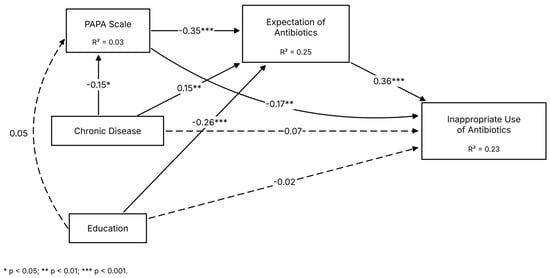
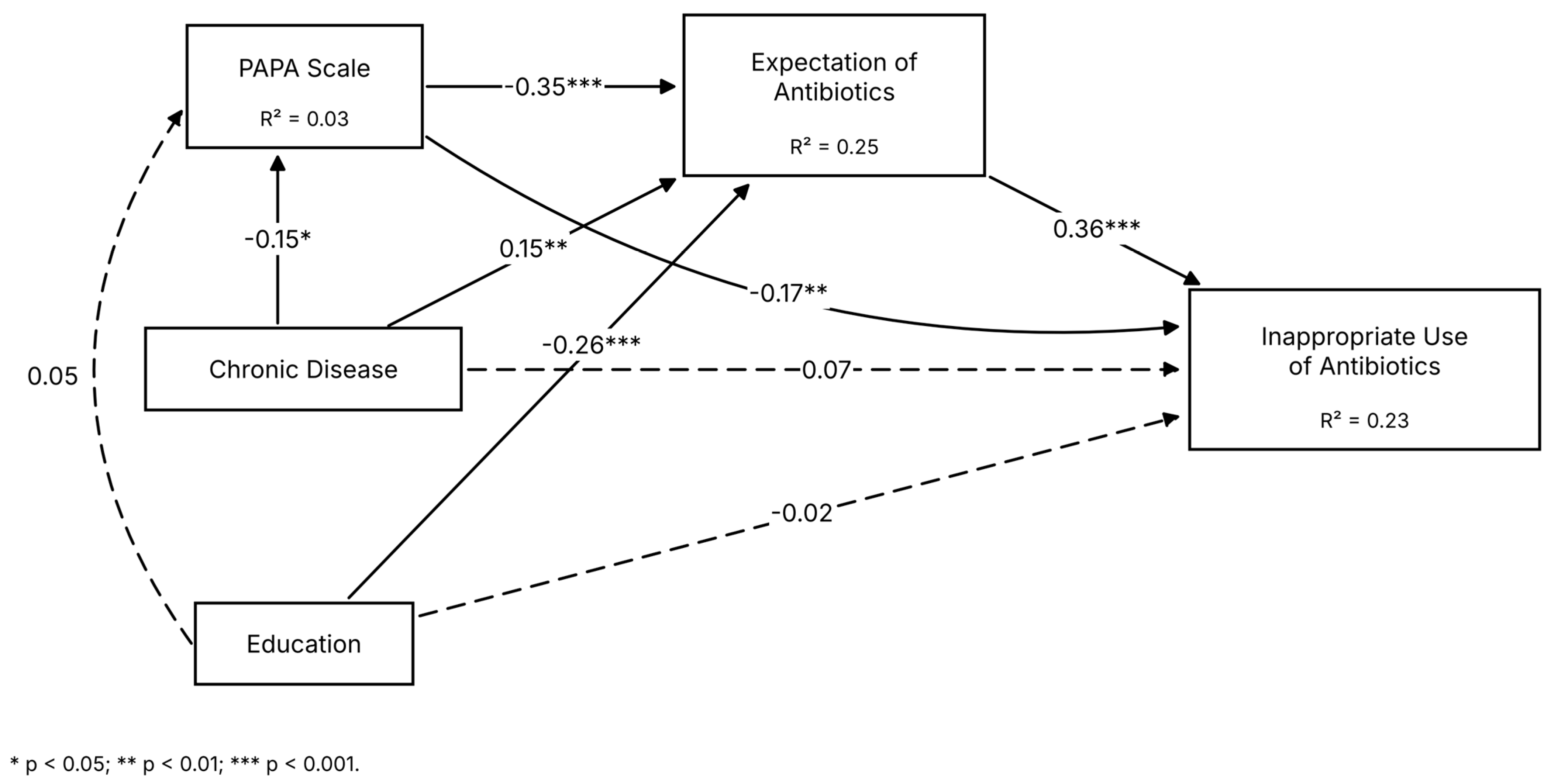
Figure 1.
Path diagram of parents’ inappropriate antibiotic use during their children’s illnesses (Model 1; standardised coefficients; dashed lines indicate non-significant paths; chronic disease coded 1 = present, 0 = absent).
Sensitivity analyses included adjustment for the covariates listed above, robust standard errors, alternative models for the count outcomes and exclusion of the PAPA subdimensions overlapping with the outcome (Supplementary Table S3). Parents of children with and without a chronic disease were compared using the Mann–Whitney U and Fisher’s exact tests.
2.5. Ethical Considerations
All procedures were conducted in accordance with the ethical standards of the Declaration of Helsinki. Ethical approval was obtained from the Harran University Ethics Committee. Institutional permission was also obtained from the hospital where the study was conducted.
3. Results
3.1. Sociodemographic Characteristics
Of the 248 eligible parents approached, 7 declined; thus, 241 parents were included (response rate, 97.2%). The mean age of the participating parents was 34.8 ± 7.0 years (min: 18, max: 54), and that of their children was 5.5 ± 4.3 years (min: 0, max: 17). Of the participants, 48.5% were mothers and 51.5% were fathers. Of the parents, 63.9% were engaged in income-generating employment, and 49.8% had a university-level education or higher. In the study group, 8.3% of the children had a chronic disease, and 28.2% had a history of previous hospitalisation. In the study group, 10.4% of the children had not received any antibiotics in the past year, whereas 52.7% had used antibiotics at least three times. The characteristics of the study group are presented in detail in Table 1.
Table 1.
Sociodemographic characteristics of the study group.
3.2. Antibiotic Expectation and Inappropriate Antibiotic Use Behaviours
When parents’ antibiotic expectations regarding their children’s infectious diseases were examined, the most frequent ‘yes’ response was expecting antibiotics from the doctor when the child had a fever (53.1%). This was followed by expecting antibiotics to be given when the child was ill (49.8%), wanting antibiotics to be given when the child had a cough (34.0%), a tendency to ask the doctor for antibiotics (24.9%) and feeling disappointed when the doctor did not prescribe antibiotics (16.6%). The KR-20 coefficient, indicating the internal consistency of the antibiotic expectation items, was 0.76 (Table 2).
Table 2.
Parents’ antibiotic expectations and antibiotic use behaviours.
Regarding antibiotic use behaviours, doctors were the first choice when seeking information about antibiotics (78.4%), followed by pharmacies (13.3%), the internet (7.9%) and older family members (0.4%). Of the parents, 74.3% stated that they generally completed the antibiotic treatment recommended by the doctor, 28.2% that they kept antibiotics at home in case they were needed, 17.8% that they reused their child’s antibiotics without a doctor’s recommendation, and 17.0% that they had previously used antibiotics without a prescription for their child. Details of parents’ antibiotic use behaviours for their children are presented in Table 2, and the KR-20 coefficient indicating the internal consistency of this domain was 0.64.
3.3. PAPA Scale and Subdimensions
Parents’ responses to the PAPA Scale are presented in Table 3; the mean total scale score was 108.49 ± 14.23. Cronbach’s α values in the present sample are also shown in Table 3.
Table 3.
Parents’ PAPA subdimension and total scores.
3.4. Correlations and Path Model
Table 4 shows the correlations among the model variables. Inappropriate antibiotic use behaviour was positively and significantly correlated with antibiotic expectation (r = 0.449) and chronic disease (r = 0.174) and negatively correlated with the PAPA score (r = −0.322) and education (r = −0.142). Antibiotic expectation was negatively correlated with the PAPA score (r = −0.394) and education (r = −0.296) and positively correlated with chronic disease (r = 0.223). Chronic disease was negatively correlated with the PAPA score (r = −0.152), whereas education was not (r = 0.064; p = 0.320).
Table 4.
Correlation matrix of the variables included in the path model.
Path analysis was performed to examine the associations of the variables with parents’ inappropriate antibiotic use during their children’s illnesses. All paths are shown in Figure 1; their unstandardised coefficients and standard errors are given in Supplementary Table S2. Higher education (β = −0.26) and higher PAPA scores (β = −0.35) were associated with lower antibiotic expectation, whereas chronic disease was associated with higher expectation (β = 0.15) and lower PAPA scores (β = −0.15); education was not associated with the PAPA score (β = 0.05). The direct effects of the parental education level and presence of chronic disease in the child variables on inappropriate antibiotic use were non-significant. The model explained 2.6% of the variance in the PAPA score, 25.0% of the variance in the Expectation of Antibiotics variable and 23.1% of the variance in Inappropriate Use of Antibiotics. Model 2, without direct paths from education and chronic disease to inappropriate use, fitted the data well and did not differ from Model 1 (Δχ2 = 1.39, Δdf = 2, p = 0.498) (Table 5).
Table 5.
Fit indices of the path models.
The total association between Education and Inappropriate Use of Antibiotics was not significant (B = −0.160; 95% CI [−0.322, 0.009]). With the mediators in the model, the direct association was not significant (B = −0.022; 95% CI [−0.179, 0.138]), whereas the indirect association via antibiotic expectation was significant (B = −0.119; 95% CI [−0.192, −0.055]). This pattern indicates indirect-only mediation (Table 6).
Table 6.
Direct, indirect and total effects on inappropriate antibiotic use.
The total association between Chronic Disease and Inappropriate Use of Antibiotics was significant (B = 0.677; 95% CI [0.073, 1.341]). With the mediators in the model, the direct association was not significant (B = 0.274; 95% CI [−0.294, 0.870]), whereas the total indirect association was significant (B = 0.403; 95% CI [0.169, 0.672]), including the pathway via antibiotic expectation (B = 0.221; 95% CI [0.041, 0.455]). This pattern indicates indirect-only mediation (Table 6).
The total association between PAPA Scale and Inappropriate Use of Antibiotics was significant (B = −0.024; 95% CI [−0.034, −0.014]). With the mediators in the model, the direct association was significant (B = −0.013; 95% CI [−0.024, −0.004]), and the indirect association was significant (B = −0.010; 95% CI [−0.016, −0.005]). This pattern indicates complementary mediation (Table 6).
3.5. Sensitivity Analyses
The conclusions were unchanged in all sensitivity analyses (Supplementary Table S3). After adjustment for covariates, the indirect associations via antibiotic expectation remained significant for education (B = −0.144; 95% CI [−0.227, −0.071]), chronic disease (B = 0.267; 95% CI [0.060, 0.522]) and the PAPA score (B = −0.010; 95% CI [−0.015, −0.005]). HC3-robust standard errors, binomial and ordinal models, exclusion of the reverse-scored item and leave-one-out analyses for chronic disease gave consistent results. When the Behaviours and Adherence subdimensions were excluded from the PAPA score, its direct association with inappropriate use was no longer significant (B = −0.005; 95% CI [−0.020, 0.008]), whereas its indirect association remained (B = −0.016; 95% CI [−0.025, −0.009]). Compared with other parents, parents of children with a chronic disease more often reported non-prescription use (40.0% vs. 14.9%; p = 0.009) and keeping antibiotics at home (55.0% vs. 25.8%; p = 0.009), and their children more often had ≥ 3 antibiotic courses in the past year (80.0% vs. 50.2%; p = 0.017) (Supplementary Table S4).
4. Discussion
The findings of this study indicate that parents’ knowledge, perceptions and attitudes regarding antibiotic use in their children do not fully align with the principles of rational drug use and, consistent with the literature, reveal a considerable level of inappropriate antibiotic expectation and risky use practices. Although the mean PAPA Scale total score of 108.49 ± 14.23 in the study group points to a moderate-to-high level of general antibiotic perception, the fact that 52.7% of the children had used antibiotics at least three times in the past year reveals a high rate of exposure [2,4,9]. Although parents’ preference for physicians as their first source of information (78.4%) and the report by the large majority (74.3%) that they complete the recommended treatment may be regarded as positive attitudes, the expectation of antibiotics from the doctor, particularly in the presence of fever (53.1%) and cough (34.0%), shows that misconceptions about the indications for antibiotics in symptomatic childhood infections persist [7,8,28,29]. Furthermore, the findings that 28.2% of parents keep antibiotics at home in case they are needed and that approximately one in six reported repeated (17.8%) or non-prescription (17.0%) antibiotic use without a doctor’s recommendation parallel the self-storage and self-medication practices reported in the literature [30,31,32,33,34,35].
The path analysis findings of this study show that antibiotic expectation was the variable most strongly associated with inappropriate antibiotic use and statistically accounted for the associations of parental education and chronic disease with this behaviour. The model explained 25.0% of the variance in antibiotic expectation and 23.1% of the variance in inappropriate antibiotic use, indicating that much of the variability in parental behaviour depends on factors not included in the model. This is consistent with structural equation studies in which antibiotic expectations and attitudes were the cognitions most proximal to parents’ intentions and self-medication [17,18].
The finding that the direct association between parental education level and inappropriate antibiotic use was non-significant (B = −0.022; 95% CI [−0.179, 0.138]), whereas the indirect association via antibiotic expectation was significant (B = −0.119; 95% CI [−0.192, −0.055]), indicates indirect-only mediation [26]; that is, more educated parents reported fewer inappropriate behaviours to the extent that they held lower antibiotic expectations. The literature also reports that parents with a higher level of education have more accurate knowledge about the aetiology of infections and the limitations of antibiotics and that their likelihood of holding inappropriate antibiotic expectations during clinical visits is consequently markedly lower [1,2,11,36,37]. Contrary to H3, education was not associated with PAPA scores, possibly because education shapes illness-specific beliefs more than the general perceptions captured by the scale.
Contrary to a previous paediatric dentistry study [2], parents of children with a chronic disease had lower PAPA scores and higher antibiotic expectations and more often reported non-prescription use and keeping antibiotics at home. The direct association of chronic disease with inappropriate use was not significant, whereas its total and indirect associations were positive. Because these children more often received repeated antibiotic courses and had more often been hospitalised, repeated exposure to antibiotics and parental anxiety may reinforce the belief that antibiotics are needed for each illness. As this group was small (n = 20) and the specific diagnoses were not recorded, these findings should be interpreted with caution.
Unlike the sociodemographic and clinical variables, both the direct (B = −0.013; 95% CI [−0.024, −0.004]) and indirect (B = −0.010; 95% CI [−0.016, −0.005]) associations of the PAPA Scale total score with inappropriate antibiotic use were statistically significant, consistent with complementary mediation [26]. Development and application studies of the PAPA Scale emphasise that the scale holistically measures the knowledge, attitude and behaviour dimensions [2,4,9,10,21]. However, the direct association was no longer significant when the Behaviours and Adherence subdimensions, which partly overlap with the outcome, were excluded, whereas the indirect association remained. Thus, the association of knowledge and resistance awareness with behaviour appears to operate mainly through expectations.
The central position of antibiotic expectation in the model suggests that ‘expectation management’ is a promising target for interventions to reduce inappropriate antibiotic use, although this should be tested in intervention studies. Physicians can actively explore parents’ possible antibiotic expectations during clinical consultations and convey physical examination findings and the viral–bacterial distinction through explanatory communication strategies [12,38,39,40]. Community pharmacists can reinforce these messages at dispensing by counselling on dose, duration, adherence, storage and disposal of leftover antibiotics and by declining requests for antibiotics without a prescription [13,14]. Consistent messages from both professions, with particular attention to families of children with chronic or recurrent conditions, may increase the effectiveness of such strategies.
Strengths and Limitations
The strengths of this study include recruitment at the point of care, face-to-face data collection with a high response rate and no missing data, the use of a validated scale and bootstrap-based tests of indirect effects supported by sensitivity analyses. Several limitations should also be considered. First, the cross-sectional design does not allow causal inferences, and the indirect effects represent statistical associations [27]; reverse relationships, such as previous behaviour shaping expectations, are possible. Second, the single-centre, non-probability sample limits generalisability. Third, data were collected in summer, when respiratory infections are less frequent [41], and the findings may differ in other seasons. Fourth, behaviours were self-reported in face-to-face interviews and may be affected by recall and social desirability bias. Fifth, the expectation and inappropriate use questions were developed without formal content validation, and the internal consistency of the inappropriate use index was modest. Finally, the chronic disease group was small, the diagnoses and indications for previous antibiotic use were not recorded, and the hypotheses were not preregistered. Longitudinal, multicentre and intervention studies are needed.
5. Conclusions
Antibiotic expectation was the strongest correlate of parents’ inappropriate antibiotic use and statistically linked parental education, child chronic disease and parental perceptions of antibiotics to this behaviour. Parents of children with a chronic disease had higher expectations and more inappropriate practices. Addressing parents’ antibiotic expectations consistently through physicians and pharmacists is a promising strategy that should be evaluated in future studies.
Supplementary Materials
The following supporting information can be downloaded at https://www.mdpi.com/article/10.3390/healthcare14234080/s1, Table S1. Descriptive statistics and covariance matrix of the model variables (N = 241). Table S2. Path coefficients of Models 1 and 2 (maximum likelihood). Table S3. Sensitivity analyses: key effects on inappropriate antibiotic use, B [95% bootstrap CI]. Table S4. Comparisons according to chronic disease status.
Author Contributions
Conceptualization, H.D., B.B. and M.Ş.; methodology, H.D., B.B. and M.Ş.; formal analysis, H.D., B.B. and M.Ş.; investigation, M.Ş.; data curation, H.D. and M.Ş.; writing—original draft preparation, H.D. and B.B.; writing—review and editing, M.Ş.; supervision, H.D. and M.Ş. All authors have read and agreed to the published version of the manuscript.
Funding
This research received no external funding.
Institutional Review Board Statement
The study was conducted in accordance with the Declaration of Helsinki and approved by the Harran University Ethics Committee (approval number: HÜ-KAEK-2026-00175; date of approval: 15 June 2026). Institutional permission was also obtained from the hospital where the study was conducted.
Informed Consent Statement
Written informed consent was obtained from all participants involved in the study. Consent for publication was also obtained; the signed written informed consent forms included the following points: (1) I was informed that the information obtained in the study could be published in scientific outlets; (2) I was informed that my identity would not be disclosed in the published materials.
Data Availability Statement
The data presented in this study are available from the corresponding author upon reasonable request; they are not publicly available in order to protect participant confidentiality. The covariance matrix of the model variables is provided in the Supplementary Materials.
Acknowledgments
During the preparation of this manuscript, the authors used Claude (Opus 5.5; Anthropic, San Francisco, CA, USA) for the purposes of language translation, language editing, grammar correction, organizing references according to the journal style and improving manuscript readability, and for assistance with checking the statistical analyses. The authors have reviewed and edited the output and take full responsibility for the content of this publication.
Conflicts of Interest
The authors declare no conflicts of interest.
Abbreviations
The following abbreviations are used in this manuscript:
| AIC | Akaike information criterion |
| BIC | Bayesian information criterion |
| CFI | comparative fit index |
| CI | confidence interval |
| HC3 | heteroscedasticity-consistent standard errors |
| KR-20 | Kuder–Richardson Formula 20 |
| PAPA | Parental Perceptions on Antibiotics |
| RMSEA | root mean square error of approximation |
| SD | standard deviation |
| SE | standard error |
| SRMR | standardised root mean square residual |
| STROBE | Strengthening the Reporting of Observational Studies in Epidemiology |
| TLI | Tucker–Lewis index |
References
- Ahmed, D.S.; AboElela, A.M.; Ismail, S.S.; Hammour, Z.E.; Fawaz, R.A.; Abdelmoniem, M.E. Pattern of antibiotic use among children caregivers: A cross-sectional study. J. Egypt. Public Health Assoc. 2024, 99, 33. [Google Scholar] [CrossRef] [Scilit]
- Çağlan, Ş.L.; Aydınoğlu, S.; Günaçar, D.N. Parental perceptions of antibiotic use in pediatric dentistry: A cross-sectional study using the PAPA scale. BMC Oral Health 2026, 26, 888. [Google Scholar] [CrossRef] [Scilit]
- Or, P.-L.; Ching, T.-Y. The effectiveness of raising Hong Kong parents’ awareness of antimicrobial resistance through an education program with peer support on social media: A randomized, controlled pilot study. BMC Public Health 2022, 22, 315. [Google Scholar] [CrossRef] [Scilit]
- Alumran, A.; Hou, X.Y.; Hurst, C. Assessing the overuse of antibiotics in children in Saudi Arabia: Validation of the parental perception on antibiotics scale (PAPA scale). Health Qual. Life Outcomes 2013, 11, 39. [Google Scholar] [CrossRef] [Scilit]
- Marsh, S.A.; Parsafar, S.; Byrne, M.K. Should my child be given antibiotics? A systematic review of parental decision making in rural and remote locations. Antimicrob. Resist. Infect. Control 2024, 13, 105. [Google Scholar] [CrossRef] [Scilit]
- Mutagonda, R.F.; Marealle, A.I.; Nkinda, L.; Kibwana, U.; Maganda, B.A.; Njiro, B.J.; Ndumwa, H.P.; Kilonzi, M.; Mikomangwa, W.P.; Mlyuka, H.J.; et al. Determinants of misuse of antibiotics among parents of children attending clinics in regional referral hospitals in Tanzania. Sci. Rep. 2022, 12, 4836. [Google Scholar] [CrossRef] [Scilit]
- Naser, A.Y.; Al-Shehri, H. Parental knowledge, attitudes and practices on the use of antibiotics among their children in Jordan: A cross-sectional study. BMJ Paediatr. Open 2025, 9, e003698. [Google Scholar] [CrossRef] [Scilit]
- Pitaloka, D.A.E.; Insyirah, A.; Oktariani, A.N.; Mardhiyyah, C.A.; Alfarafisa, N.M. Parental knowledge, attitude, and practice on self-medication of antibiotics for children in Bandung, Indonesia: A questionnaire-based survey and module-based learning intervention. BMC Pediatr. 2025, 25, 687. [Google Scholar] [CrossRef] [Scilit]
- Alumran, A.; Hou, X.Y.; Hurst, C. Validity and reliability of instruments designed to measure factors influencing the overuse of antibiotics. J. Infect. Public Health 2012, 5, 221–232. [Google Scholar] [CrossRef] [Scilit]
- Alumran, A.; Hou, X.Y.; Hurst, C. Assessing the overuse of antibiotics in children with URTIs in Saudi Arabia: Development of the parental perception on antibiotics scale (PAPA scale). J. Epidemiol. Glob. Health 2013, 3, 3–10. [Google Scholar] [CrossRef] [Scilit]
- Pierantoni, L.; Lo Vecchio, A.; Lenzi, J.; Corsi, V.; Campana, L.; Luca Trobia, G.; Amendolea, A.; Di Felice, B.; Alighieri, G.; Fabrizio, G.C.; et al. Parents’ perspective of antibiotic usage in children: A nationwide survey in Italy. Pediatr. Infect. Dis. J. 2021, 40, 906–911. [Google Scholar] [CrossRef] [Scilit]
- Poole, N.M. Judicious antibiotic prescribing in ambulatory pediatrics: Communication is key. Curr. Probl. Pediatr. Adolesc. Health Care 2018, 48, 306–317. [Google Scholar] [CrossRef] [Scilit]
- Alzard, S.; Wen, J.; Huynh, N.P.Q.; Shirkhanzadeh, S.; Tso, J.Y.; Rabino, M.; Vanevski, M.; Bryant, P.A.; Buttery, J.; Haeusler, G.M.; et al. Opportunities and barriers to pediatric antimicrobial stewardship by community pharmacists. J. Pediatr. Infect. Dis. Soc. 2024, 13, 313–316. [Google Scholar] [CrossRef] [Scilit]
- Saha, S.K.; Hawes, L.; Mazza, D. Effectiveness of interventions involving pharmacists on antibiotic prescribing by general practitioners: A systematic review and meta-analysis. J. Antimicrob. Chemother. 2019, 74, 1173–1181. [Google Scholar] [CrossRef] [Scilit]
- Okuyan, B.; Savan, M.A.; Izzettin, F.V.; Sancar, M. Evaluation of rational antibiotic dispensing in the community pharmacy setting: A simulated patient study. Acta Pharm. Sci. 2017, 55, 7. [Google Scholar] [CrossRef] [Scilit]
- Ajzen, I. The theory of planned behavior. Organ. Behav. Hum. Decis. Process. 1991, 50, 179–211. [Google Scholar] [CrossRef] [Scilit]
- Kawamura, H.; Kishimoto, K. Identifying factors improving the intention to use antibiotics appropriately in children and adults using protection motivation theory. PEC Innov. 2024, 4, 100293. [Google Scholar] [CrossRef] [Scilit]
- Pei, D.; Kreps, G.L.; Zhao, X. The role of uncertainty and negative emotion in Chinese parents’ self-medication of children with antibiotics. Int. J. Environ. Res. Public Health 2023, 20, 6603. [Google Scholar] [CrossRef] [Scilit]
- von Elm, E.; Altman, D.G.; Egger, M.; Pocock, S.J.; Gøtzsche, P.C.; Vandenbroucke, J.P. The Strengthening the Reporting of Observational Studies in Epidemiology (STROBE) statement: Guidelines for reporting observational studies. Lancet 2007, 370, 1453–1457. [Google Scholar] [CrossRef] [Scilit]
- Schoemann, A.M.; Boulton, A.J.; Short, S.D. Determining power and sample size for simple and complex mediation models. Soc. Psychol. Personal. Sci. 2017, 8, 379–386. [Google Scholar] [CrossRef] [Scilit]
- Özdemir, C.; Ergin, A. Anne ve babaların antibiyotik algıları ölçeği’nin Türkçeye uyarlanması [Validation of Turkish Parental Perception on Antibiotics Scale]. Klimik Derg. 2023, 36, 32–38. [Google Scholar] [CrossRef] [Scilit]
- Harris, C.R.; Millman, K.J.; van der Walt, S.J.; Gommers, R.; Virtanen, P.; Cournapeau, D.; Wieser, E.; Taylor, J.; Berg, S.; Smith, N.J.; et al. Array programming with NumPy. Nature 2020, 585, 357–362. [Google Scholar] [CrossRef] [Scilit]
- Seabold, S.; Perktold, J. Statsmodels: Econometric and statistical modeling with Python. In Proceedings of the 9th Python in Science Conference (SciPy 2010), Austin, TX, USA, 28 June–3 July 2010; pp. 92–96. [Google Scholar] [CrossRef] [Scilit]
- Virtanen, P.; Gommers, R.; Oliphant, T.E.; Haberland, M.; Reddy, T.; Cournapeau, D.; Burovski, E.; Peterson, P.; Weckesser, W.; Bright, J.; et al. SciPy 1.0: Fundamental algorithms for scientific computing in Python. Nat. Methods 2020, 17, 261–272. [Google Scholar] [CrossRef] [Scilit]
- Hu, L.; Bentler, P.M. Cutoff criteria for fit indexes in covariance structure analysis: Conventional criteria versus new alternatives. Struct. Equ. Model. 1999, 6, 1–55. [Google Scholar] [CrossRef] [Scilit]
- Zhao, X.; Lynch, J.G.; Chen, Q. Reconsidering Baron and Kenny: Myths and truths about mediation analysis. J. Consum. Res. 2010, 37, 197–206. [Google Scholar] [CrossRef] [Scilit]
- Maxwell, S.E.; Cole, D.A. Bias in cross-sectional analyses of longitudinal mediation. Psychol. Methods 2007, 12, 23–44. [Google Scholar] [CrossRef] [Scilit]
- Albayrak, A.; Karakaş, N.M.; Karahalil, B. Evaluation of parental knowledge, attitudes and practices regarding antibiotic use in acute upper respiratory tract infections in children under 18 years of age: A cross-sectional study in Turkey. BMC Pediatr. 2021, 21, 554. [Google Scholar] [CrossRef] [Scilit]
- Imnadze, T.; Mebonia, N.; Malania, L.; Ruadze, E. Parental knowledge, attitudes and practices on antibiotic use in children: A cross-sectional study from Tbilisi, Georgia. Antibiotics 2026, 15, 260. [Google Scholar] [CrossRef] [Scilit]
- Darweesh, O.; Kurdi, A.; Merkhan, M.; Ahmed, H.; Ibrahem, S.; Al-Zidan, R.N.; Meyer, J.C.; Godman, B. Knowledge, attitudes, and practices of Iraqi parents regarding antibiotic use in children and the implications. Antibiotics 2025, 14, 376. [Google Scholar] [CrossRef] [Scilit]
- Mallah, N.; Badro, D.A.; Figueiras, A.; Takkouche, B. Association of knowledge and beliefs with the misuse of antibiotics in parents: A study in Beirut (Lebanon). PLoS ONE 2020, 15, e0232464. [Google Scholar] [CrossRef] [Scilit]
- Paredes, J.L.; Navarro, R.; Watanabe, T.; Morán, F.; Balmaceda, M.P.; Reateguí, A.; Elias, R.; Bardellini, M.; Ochoa, T.J. Knowledge, attitudes and practices of parents towards antibiotic use in rural communities in Peru: A cross-sectional multicentre study. BMC Public Health 2022, 22, 459. [Google Scholar] [CrossRef] [Scilit]
- Shah, R.; Dutta, S.; Singhal, S.; Meena, P.; Kadeval, A. Parental awareness towards antibiotic use for upper respiratory tract infections in children. Cureus 2025, 17, e79525. [Google Scholar] [CrossRef] [Scilit]
- Sun, H.; Wang, Z.; Huang, J.; An, N.; Jiao, M.; Zhu, X.; Guo, X.; Tan, W.; Zhang, W. Prevalence of inappropriate use behaviors of antibiotics and related factors among parents in eastern China: An online cross-sectional survey. Front. Public Health 2025, 13, 1654293. [Google Scholar] [CrossRef] [Scilit]
- Yousif, R.A.; Ali, A.K.; Hassan, E.A.; Mohammed, T.N.; Aldirdiri, M.A.S.; Malik, E.M. Parental knowledge, attitudes, and practices toward antibiotic use for childhood upper respiratory tract infections in Khartoum, Sudan. Antimicrob. Resist. Infect. Control 2025, 14, 130. [Google Scholar] [CrossRef] [Scilit]
- Shamim, M.A.; Padhi, B.K.; Satapathy, P.; Siddiq, A.; Manna, S.; Aggarwal, A.K.; Al-Ahdal, T.; Khubchandani, J.; Henao-Martinez, A.F.; Sah, R. Parents’ expectation of antibiotic prescriptions for respiratory infections in children: A systematic review and meta-analysis. Ther. Adv. Infect. Dis. 2023, 10, 20499361231169429. [Google Scholar] [CrossRef] [Scilit]
- Vinker, S.; Ron, A.; Kitai, E. The knowledge and expectations of parents about the role of antibiotic treatment in upper respiratory tract infection—A survey among parents attending the primary physician with their sick child. BMC Fam. Pract. 2003, 4, 20. [Google Scholar] [CrossRef] [Scilit]
- Al-Makramani, A.A.; Shawish, A.M.; Sabi, A.Y.; Ghareeb, H.I.; Faqih, F.A.; Daghas, H.A.; Bahri, N.A.; Muyidi, A.Y.; Bajawi, R.H.; Maghrabi, E.A.; et al. Parental awareness of antibiotic use for upper respiratory tract infection in children in Jazan Region, Saudi Arabia. Cureus 2024, 16, e69438. [Google Scholar] [CrossRef] [Scilit]
- Bosley, H.; Henshall, C.; Appleton, J.V.; Jackson, D. A systematic review to explore influences on parental attitudes towards antibiotic prescribing in children. J. Clin. Nurs. 2018, 27, 892–905. [Google Scholar] [CrossRef] [Scilit]
- Lin, L.; Harbarth, S.; Hargreaves, J.R.; Zhou, X.; Li, L. Large-scale survey of parental antibiotic use for paediatric upper respiratory tract infections in China: Implications for stewardship programmes and national policy. Int. J. Antimicrob. Agents 2021, 57, 106302. [Google Scholar] [CrossRef] [Scilit]
- Suda, K.J.; Hicks, L.A.; Roberts, R.M.; Hunkler, R.J.; Taylor, T.H. Trends and seasonal variation in outpatient antibiotic prescription rates in the United States, 2006 to 2010. Antimicrob. Agents Chemother. 2014, 58, 2763–2766. [Google Scholar] [CrossRef] [Scilit]

Disclaimer/Publisher’s Note: The statements, opinions and data contained in all publications are solely those of the individual author(s) and contributor(s) and not of MDPI and/or the editor(s). MDPI and/or the editor(s) disclaim responsibility for any injury to people or property resulting from any ideas, methods, instructions or products referred to in the content. |
© 2026 by the authors. Licensee MDPI, Basel, Switzerland. This article is an open access article distributed under the terms and conditions of the Creative Commons Attribution (CC BY) license.