


Highlights
What are the main findings?
- Grounded in the Theory of Planned Behavior, Q methodology identified three patient perspectives on robot-assisted perioperative education for gynecological surgery: conditional acceptance based on content accuracy, technology-enhanced learning with low technology anxiety, and practical, self-paced learning endorsed by professionals.
- All perspectives valued professionally verified content and highly ranked the expected reduction in nurses’ workload, whereas recommendations from family, friends, and fellow patients ranked low.
What are the implications of the main findings?
- Educational robots should deliver professionally verified content consistent with nurses’ and physicians’ instructions, and complement, rather than replace, nurse-led perioperative education.
- Simple operation, repeatable playback, and relaying patient questions to nurses may accommodate patients with different levels of health literacy.
Abstract
Background/Objectives: Nursing shortages limit the time available for essential perioperative education in gynecological surgery. Educational robots may complement nurse-led education; however, patient perspectives remain unclear. Guided by the Theory of Planned Behavior (TPB), this study aimed to identify shared perspectives on robot-assisted perioperative education among these patients and describe their associated characteristics, including health literacy. Methods: Q methodology was used. Sixty hospitalized patients from two medical centers in northern Taiwan rank-ordered 40 TPB-based Q statements on a forced quasi-normal grid (−4 to +4) and completed the 16-item European Health Literacy Survey Questionnaire (HLS-EU-Q16). Q-sorts were analyzed using principal component analysis with Varimax rotation. Results: Three factors accounted for 53.26% of the variance. Factor 1 (n = 23), “conditional acceptance based on content accuracy,” prioritized the clarity and consistency of educational content. Factor 2 (n = 16), “technology-enhanced learning with low technology anxiety,” valued visual aids and topic choice and reported little technology anxiety. Factor 3 (n = 17), “practical, self-paced learning endorsed by professionals,” emphasized unrestricted, repeatable, and simple use and endorsement by healthcare professionals. All factors highly ranked the expected reduction in nurses’ workload, and recommendations from family, friends, and fellow patients were ranked low. Health literacy (0–16) was significantly higher in Factor 2 than in Factors 1 and 3. Conclusions: Patient perspectives on robot-assisted perioperative education are heterogeneous and dominated by attitudes and perceived behavioral control rather than subjective norms. These expectations, rather than the measured benefits, can inform the design of educational robots that complement nurse-led education. Prototype testing and comparative trials are needed to determine their actual benefits.
1. Introduction
Most gynecological surgeries involve the partial or total removal of female reproductive organs. These procedures carry significant physical consequences, such as menopausal changes, altered sexual function, bowel and bladder complications, lymphedema, fatigue, sleep disturbances, and pain [1,2,3]. Furthermore, they can disrupt fertility, sexual identity, and body image, with substantial effects on women’s psychological well-being [4,5]. Therefore, patients require education throughout the perioperative period, from preparation for surgery to management of postoperative recovery, symptoms, and self-care after discharge. Thus, perioperative education is an essential part of nursing care. For example, a narrative review of 34 preoperative educational intervention studies, in which interventions lasted from 2 to 60 min, reported benefits for pain management, anxiety, sleep quality, satisfaction, and quality of life [6].
However, comprehensive perioperative education is often limited in clinical practice. Staffing shortages, competing urgent tasks, and time-sensitive medication administration frequently prevent nurses from meeting patients’ educational needs during their working hours [7,8]. Technology that delivers standardized, basic knowledge can partially relieve this burden and allow nurses to focus on individualized counseling. Robots are increasingly being used in nursing, ranging from assistive robots that provide physical support to robots that socially interact with users [9,10]. Robots can deliver health information interactively through simplified interfaces, which can reduce the cognitive load on users with varying levels of technological literacy [11]. Therefore, educational robots are a promising option for delivering perioperative patient education in hospital wards.
Nevertheless, patients express concerns about safety, privacy, and the dehumanization of care, whereas healthcare professionals have raised concerns about patient trust, safety, and system maintenance [12]. Because acceptance cannot be assumed, understanding patients’ perspectives before development and implementation is essential for designing robot-assisted education that meets their needs. This is particularly relevant for patients undergoing gynecological surgery, whose educational needs encompass sensitive psychosocial and physical issues.
The acceptance of robots has frequently been examined using the Technology Acceptance Model and its extensions, including the Almere model for socially assistive robots [13,14]. These models primarily focus on perceived usefulness and ease of use. We adopted the Theory of Planned Behavior (TPB) because it additionally addresses the social context of the decision: according to the TPB, behavioral intention is shaped by attitudes toward the behavior, subjective norms, and perceived behavioral control [15]. In a hospital setting, family members, fellow patients, and healthcare professionals may influence whether a patient engages with new educational technology. The TPB has been applied to a wide range of behaviors and populations [16], and its three constructs provide a theoretically grounded structure for sampling the full range of views on robot-assisted education.
Q methodology combines qualitative and quantitative approaches to identify shared perspectives on a topic. Participants rank-order a set of statements (Q statements) according to their own perspective, and by-person factor analysis groups participants who rank the statements similarly [17,18]. This approach is increasingly used in healthcare research [19] and has been used to characterize patients’ subjective perspectives, including older adults’ perceptions of artificial intelligence-based virtual humans [20] and experiences of patients with breast cancer [21]. Unlike conventional surveys that estimate the average level of acceptance, Q methodology reveals qualitatively distinct patterns of acceptance that can inform the design of future technologies and tailored implementation.
Health literacy, defined as the ability to access, understand, appraise, and apply health information [22], may also shape patients’ perceptions of technology-based education. Individuals with higher health literacy are better equipped to use technology-based health tools [23], and higher health literacy is associated with greater trust in health information robots [24]. Therefore, examining health literacy across perspectives may help identify which patients would benefit most from robot-assisted education.
Aims
This study aimed to (1) identify shared perspectives on robot-assisted perioperative education among patients undergoing gynecological surgery using Q methodology guided by the TPB and (2) describe patient characteristics associated with each perspective, including health literacy.
2. Materials and Methods
2.1. Study Design and Participants
This study used a Q methodology design with purposive sampling. Participants were recruited from the gynecological wards of two medical centers of the MacKay Memorial Hospital system in northern Taiwan between 5 July 2024, and 31 January 2025. The following patients were included in this study: hospitalized women who (a) were aged ≥20 years, (b) were scheduled for or had undergone gynecological surgery, (c) could communicate in Mandarin or Taiwanese, and (d) were willing to participate. Patients with cognitive impairment or communication difficulties were excluded from this study. Data were collected during hospitalization, either before or after surgery. In Q methodology, the participant sample (P-set) is purposively selected to capture a range of relevant viewpoints rather than to estimate their prevalence in a wider population. Therefore, its size is determined by the study aim and anticipated diversity of viewpoints, not by a conventional statistical power calculation [18,25]. We enrolled 60 participants to capture a broad range of perspectives from women undergoing gynecological surgery. A scoping review of healthcare Q-methodology studies reported median P-set sizes of 33 for patients and other consumers and 39 for care providers [19]. These medians are offered as descriptive context and should not be interpreted as formal thresholds for an adequate sample size.
Because this study aimed to inform the future development of educational robots, the participants were asked to consider a prospective educational robot that would provide perioperative education in the ward, and their Q-sorts reflected their expectations of such a robot. Before sorting, the participants were shown images of a commercially available educational robot (Kebbi, Nuwa Robotics, Taipei, Taiwan) and provided a brief verbal description of its possible functions. The participants were allowed to ask questions that were answered before they began sorting.
2.2. Instruments
A structured questionnaire was used to collect sociodemographic characteristics (age, educational level, marital status, employment status, and surgical method) and health literacy data. Health literacy was measured using the 16-item short form of the European Health Literacy Survey Questionnaire (HLS-EU-Q16), derived from the original 47-item HLS-EU-Q47 [22,26]. The HLS-EU-Q16 assesses comprehensive health literacy. It has shown satisfactory validity and reliability in several language versions, including Asian versions [27,28,29]. It has also been used in surgical inpatients [30]. Because it is self-administered, it is recommended for individuals with sufficient reading skills [31]. Most participants in this study had a college or university education. Each item is rated on a 4-point scale, ranging from very difficult to very easy. Following the standard scoring procedure, the responses were dichotomized (very difficult or difficult = 0, easy or very easy = 1) and summed to yield a total score ranging from 0 to 16 [27]. Higher scores indicate better health literacy. Scores of 0–8, 9–12, and 13–16 indicate inadequate, problematic, and sufficient health literacy, respectively [27]. In this study, all participants answered “easy” or “very easy” to three items: understanding a doctor’s or pharmacist’s instructions on how to take a prescribed medicine, understanding health warnings about behaviors such as smoking, low physical activity, and excessive alcohol consumption, and understanding why health screenings are required. These items showed no variance, indicating a ceiling effect. Cronbach’s α for the remaining 13 items was 0.83.
2.3. Development of Q Statements
The TPB served as the framework for developing the Q statements. First, semi-structured interviews were conducted with 10 patients who had undergone gynecological surgery. The interview guide covered the three TPB constructs. Regarding attitudes, the participants were asked what they would think if an educational robot taught them about gynecological surgery care in a hospital, the possible benefits and drawbacks of such a robot, how it would differ from traditional patient education, and their expectations regarding the robot’s appearance and interaction style. Regarding subjective norms, the participants were asked who (e.g., family, friends, or healthcare providers) might influence their decision to use an educational robot. Regarding perceived behavioral control, the participants were asked whether operating the robot would be complicated or difficult and whether using it would cause pressure, worry, or fear.
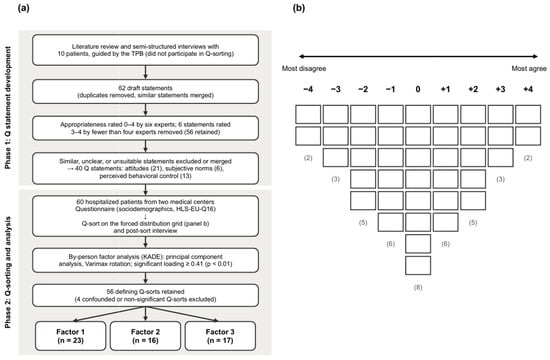
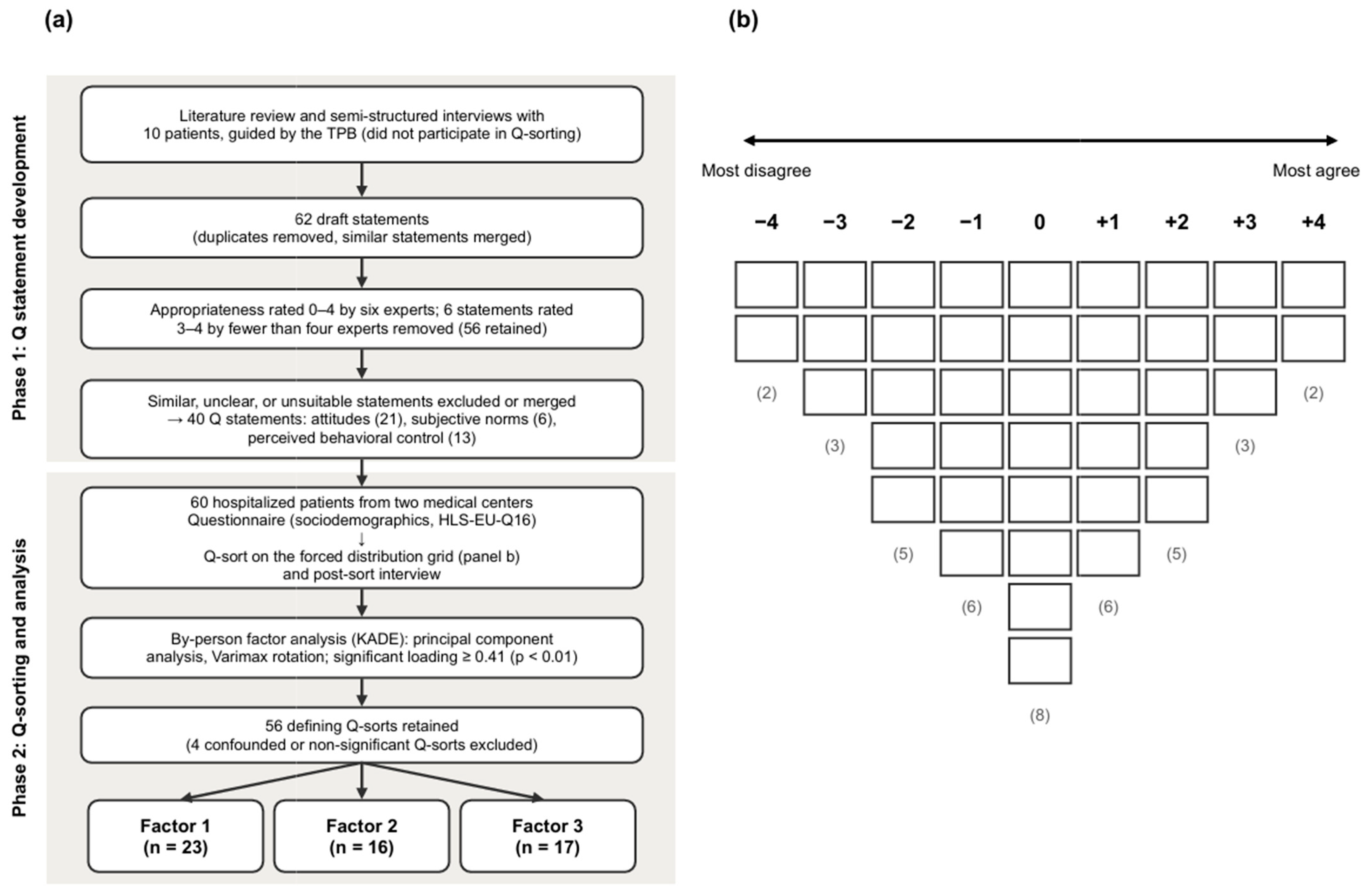
The research team extracted statements from the interview transcripts and categorized them according to the TPB constructs. Duplicates were removed, and similar statements were merged. After five meetings, this process yielded 62 draft statements. Six experts in obstetrics and gynecology (two physicians, one nurse practitioner, one head nurse, one nursing supervisor, and one deputy director of nursing) then independently rated the appropriateness of each statement on a scale of 0–4. The nursing supervisor and deputy director of nursing also had experience in Q-methodology research. Statements rated 3 or 4 by fewer than four of the six experts were removed, which eliminated six statements. Subsequently, the research team reviewed the remaining 56 statements; excluded statements that were similar, ambiguous, or unsuitable; and integrated overlapping statements, resulting in a final set of 40 Q statements (Figure 1a). This number was close to the median Q-set size of 42 statements reported in a scoping review of healthcare Q-methodology studies [19]. The statements were retained following patient interviews and expert reviews, and overlapping, ambiguous, or unsuitable statements were removed or consolidated, as described above. Thus, the Q-set size was considered in relation to the coverage of the study topic and the statement development process, rather than being treated as a fixed numerical criterion [18,19]. The Q statements were developed, sorted in Mandarin Chinese, and translated into English by the research team.
Figure 1.
(a) Flow of the study, from the development of the Q statements to factor extraction. (b) Q-sort distribution grid; numbers in parentheses indicate the number of Q statements placed in each column (40 statements in total).
The final set reflected the relative prominence of each construct in the interviews. Of the 40 statements, 21 addressed attitudes, including assistance with patient education (five statements), usage preferences (five statements), expectations of educational robots (six statements), and functional performance (five statements). Six addressed subjective norms, including nonprofessional (four statements) and professional (two statements) sources of influence. Thirteen addressed perceived behavioral control, including ease of use (five statements), perceived safety (four statements), and implementation concerns (four statements). These statements are numbered S1–S40 in Table 1.
Table 1.
Q statements and factor arrays for the three factors.
2.4. Data Collection
Data were collected in individual sessions lasting approximately 40–60 min. After completing the questionnaire, the participants read a printed list of the Q statements and pre-sorted them into three piles: statements they tended to agree with (marked “+”), those they tended to disagree with (marked “−”), and those about which they felt neutral. The participants subsequently completed the Q-sort on an electronic platform, as described in a previous study [32]. They first placed the two statements they most agreed with in the +4 column and the two they most disagreed with in the −4 column and then worked inward until all 40 statements had been placed in a forced quasi-normal distribution with nine columns (Figure 1b). After completing the Q-sort, the participants confirmed their arrangement and were briefly interviewed about their sorting experience and the reasons for their placement of statements. Their responses were recorded and used to support factor interpretation.
2.5. Data Analysis
Q-sorts were analyzed using Ken-Q Analysis Desktop Edition version 1.3.0. A 60 × 60 correlation matrix of the Q-sorts was factor-analyzed using principal component analysis, followed by varimax rotation to achieve a simple structure. The number of factors was determined by eigenvalues > 1.0, inspection of the scree plot, the requirement that each factor include at least two significantly loaded Q-sorts, the number of Q-sorts that could be classified, and the interpretability of the solution [18,25,33]. A loading was considered significant at p < 0.01 when it was ≥0.41 (2.58/√40). A Q-sort was used to define a factor when it loaded significantly and positively on that factor only. Q-sorts that loaded significantly on more than one factor (confounded), loaded negatively, or did not load significantly on any factor were excluded from the factor estimation. For each factor, a factor array was calculated from the weighted average of the defined Q-sorts. Distinguishing statements (statements that ranked significantly differently in one factor than in the other factors) and consensus statements (statements that did not distinguish between any pair of factors) were identified. Factors were holistically interpreted by considering the full factor array, including statements at both poles and distinguishing statements, together with participants’ post-sort comments [18].
Participant characteristics were compared across factors using a one-way analysis of variance for continuous variables and Fisher’s exact test for categorical variables because of small expected cell counts. Post hoc pairwise comparisons were evaluated with a Bonferroni adjustment. Statistical significance was set at p < 0.05. Analyses were performed using IBM SPSS Statistics version 29.
2.6. Ethical Considerations
As both study sites belong to the MacKay Memorial Hospital system, this study was reviewed and approved by the Institutional Review Board of MacKay Memorial Hospital (approval no. 24MMHIS164e). All participants received an explanation of the purpose and procedures of the study and provided written informed consent.
3. Results
3.1. Characteristics of the Participants
Sixty patients participated in this study, with a mean age of 44.12 ± 10.66 years. Of these, 39 (65.0%) held a college or university degree and five (8.3%) held a postgraduate degree. Most participants reported being married or in a committed partnership (n = 37, 61.7%). Forty-four (73.3%) participants were employed full-time, and 16 (26.7%) were employed part-time, unemployed, or retired. Regarding the surgical method, 29 (48.3%) participants underwent laparotomy, 14 (23.3%) laparoscopy, 12 (20.0%) hysteroscopy, and 5 (8.3%) other procedures. The mean health literacy score (0–16) was 14.35 ± 2.41.
3.2. Q-Sort Factor Analysis
Three factors were retained, with eigenvalues of 20.50, 7.50, and 3.96, explaining 34.16%, 12.50%, and 6.60% of the variance, respectively (53.26% in total), which exceeds the level generally considered acceptable in Q studies [18]. A four-factor solution was also examined because the fourth and fifth factors differed by only approximately 1% in explained variance; however, it classified only 49 participants, compared with 56 in the three-factor solution, and the scree plot flattened from the fourth factor onward. Therefore, the three-factor solution was retained. Of the 60 Q-sorts, 56 (93.3%) loaded significantly on one factor: 23 on Factor 1, 16 on Factor 2, and 17 on Factor 3. Each factor was defined by 16–23 participants, indicating that the P-set was sufficient to identify distinct perspectives. Although no fixed numerical threshold for P-set adequacy exists, these findings support the interpretability of the retained factor solution. The remaining four Q-sorts did not load significantly on any factor and were excluded from factor estimation. Table 1 presents the Q statements, factor arrays, and distinguishing statements. In the following descriptions, statement numbers and factor array scores are shown in parentheses, with asterisks indicating distinguishing statements for the factor concerned. Participants’ post-sort comments are identified by participant number.
3.2.1. Factor 1: Conditional Acceptance Based on Content Accuracy
Factor 1 explained 34.16% of the variance and included 23 participants. These participants accepted educational robots as a channel for patient education, provided that the content was accurate. Their strongest agreement, which also distinguished them from the other factors, concerned the risk that robot-delivered content might be unclear and thus affect learning quality (S39, +4 *) or might be inconsistent with information provided by healthcare professionals (S40, +4 *). They also agreed that educational robots could serve as a new learning method (S2, +3), provide health information verified by medical professionals (S5, +3), and reduce nurses’ workload (S1, +3 *). As one participant explained, “I trust certified professionals more, so I think the content and professionalism of the education should be consistent” (P11), and another noted, “If the robot’s educational content is not clear enough, I am afraid I would have doubts” (P5). Consistent with this emphasis on dependable information, they valued reliable operation (S34, +2), privacy protection (S36, +2), and instructions before use (S31, +1 *), and they were the only factor to agree, albeit mildly, that robots may not suit all age groups (S37, +1 *). By contrast, they were indifferent to flexibility-related features (S11, 0 *; S12, 0 *), and recommendations from family members (S22, −4 *), relatives or friends (S23, −4), and fellow patients (S24, −3) carried little weight: “Compared with others, I still trust what I see myself; my relatives, friends, and family are not professionals, so I think I should try it myself to find out” (P55). The robot’s appearance (S6, −3 *), size and weight (S7, −3), voice (S8, −2 *), and friendliness (S9, −2 *) were also unimportant.
3.2.2. Factor 2: Technology-Enhanced Learning with Low Technology Anxiety
Factor 2 explained 12.50% of the variance and included 16 participants, who held highly positive views of educational robots, embracing their multimedia and interactive features. They strongly agreed that robots could reduce nurses’ workload (S1, +4), that visual aids could improve their understanding of treatment (S4, +4 *), and that they valued the option of selecting topics according to their preferences (S20, +2 *). As one participant stated, “Using technology, with images, would help me better understand the educational content” (P25). They also appreciated that robots could relay their questions to nurses (S3, +3), eliminate time restrictions or pressure (S11, +3), and allow them to ask questions without worrying about asking “stupid” ones (S14, +3). A defining feature of this factor was confidence in using technology: the participants strongly disagreed that they worried about using unfamiliar technology (S33, −4 *) and disagreed that robots were unsuitable for some age groups (S37, −3 *), that the content might be inconsistent with healthcare professionals’ information (S40, −3 *), or unclear (S39, −2 *). One participant commented, “People today are becoming increasingly familiar with technology products” (P27). They were the only factor to rate the robot’s voice (S8, +1 *), voice control (S19, +1), and future potential (S15, +1) positively, whereas simple operation (S30, 0 *) and reliable operation (S34, 0 *) were less important to them than to the other factors. Opinions from the internet or other media (S25, −4) and fellow patients (S24, −3) were least influential: “Much of the information on the internet or in the media is actually false, so I think it is less important” (P13).
3.2.3. Factor 3: Practical, Self-Paced Learning Endorsed by Professionals
Factor 3 explained 6.60% of the variance and included 17 participants, who adopted a practical, function-oriented view. They strongly agreed that robots could reduce nurses’ workload (S1, +4) and valued learning without time restrictions or pressure (S11, +4), content that could be replayed as needed (S12, +3), simple and user-friendly operation (S30, +3), relaying of questions to nurses (S3, +3), and independent operation (S32, +2). The participants explained, “It must be usable independently to reduce the workload” (P14) and “It must be professional; if it is too complicated, I would not want to use it, and I would still have to trouble the nurses” (P30). Notably, this was the only factor that ranked recommendations from healthcare professionals positively (S26, +2 *), and it also rejected lay recommendations less strongly than the other factors (S22, −1 *; S24, −1 *; S25, −1 *). Conversely, the participants in this factor placed the least importance on the robot’s appearance among the three factors (S6, −4 *), size and weight (S7, −4), voice (S8, −3 *), and friendly manner (S9, −3 *), and they expressed little curiosity about the technology itself (S16, −3 *). As one participant put it, “I think the practicality of the robot is more important; the appearance does not matter at all” (P8).
3.2.4. Consensus Across Factors
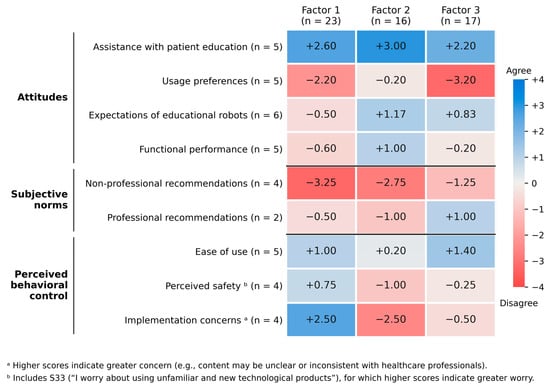
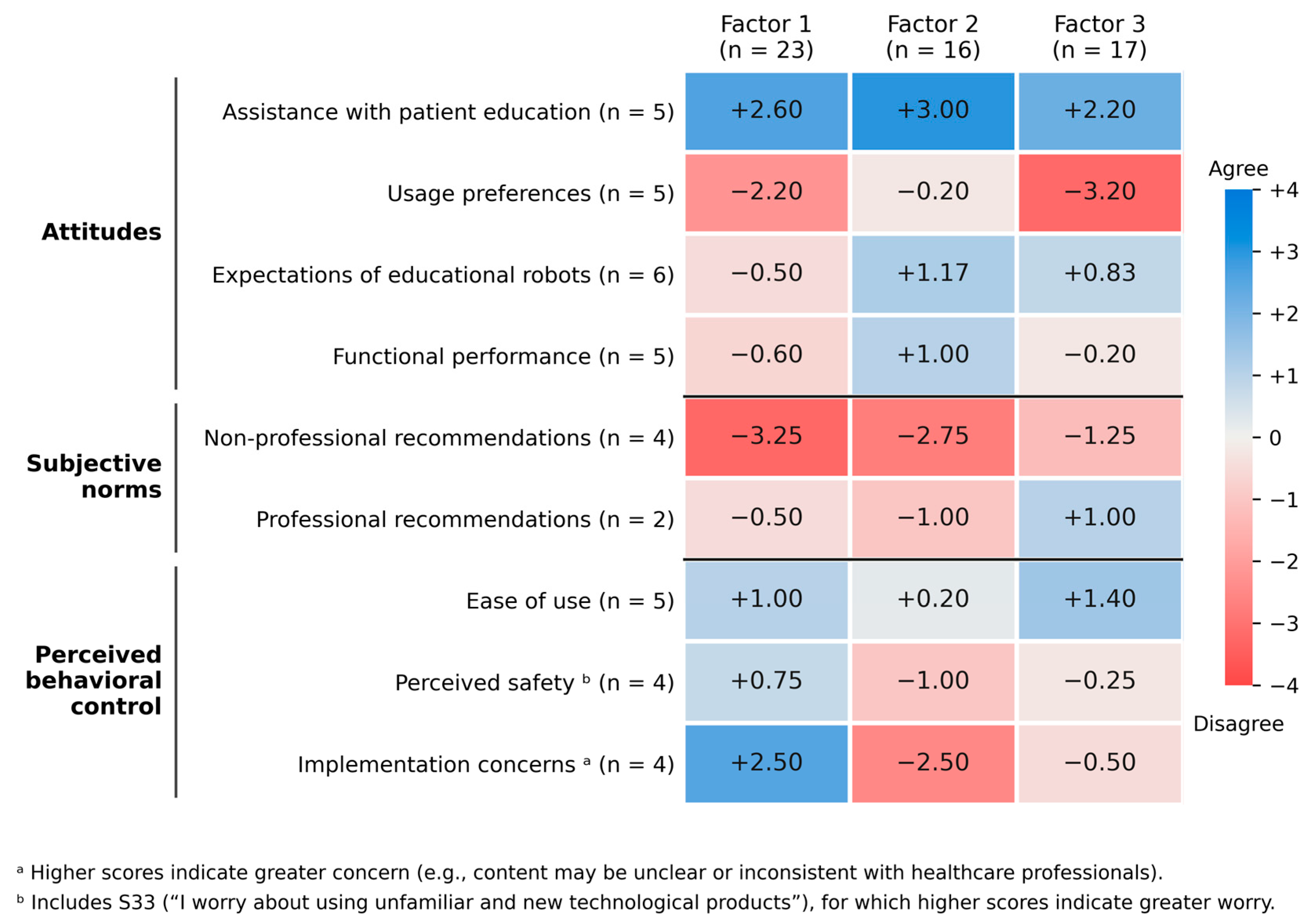
Three consensus statements did not distinguish between any pair of factors: educational robots should provide health information verified by medical professionals (S5; +3, +2, and +2 for Factors 1–3, respectively), learning with a robot should be interactive to support memory (S18; 0, +1, and 0), and robots should be easy and comfortable to use (S28; +1, +2, and +1). In addition, all three factors ranked reducing nurses’ workload among their most agreed statements (S1, +3 to +4), although this statement was ranked slightly lower in Factor 1, and all factors ranked recommendations from nonprofessionals (S22–S25) and the robot’s appearance and size (S6, S7) negatively. Figure 2 summarizes these patterns according to TPB subcategory. All factors endorsed the educational assistance of robots and ranked nonprofessional recommendations low, whereas implementation concerns most clearly separated Factor 1 from Factor 2.
Figure 2.
Mean factor array scores of the Q statements in each Theory of Planned Behavior subcategory for the three factors. Values are descriptive means of the factor array scores in Table 1 (−4 = most disagree, +4 = most agree); n indicates the number of statements in each subcategory.
3.3. Participant Characteristics According to Factor
Table 2 presents participant characteristics according to factor. The mean ages were 46.39 ± 13.38 years in Factor 1, 45.50 ± 8.56 years in Factor 2, and 40.29 ± 8.40 years in Factor 3, with no significant difference across factors. Educational level, marital status, employment status, and surgical method also did not significantly differ across factors. Health literacy scores (0–16) significantly differed across factors (Factor 1, 14.17 ± 2.64; Factor 2, 15.88 ± 0.50; Factor 3, 13.76 ± 2.14; F [2, 53] = 4.82; p = 0.012). Post hoc Bonferroni tests showed that Factor 2 scored higher than Factors 1 (p = 0.046) and 3 (p = 0.016).
Table 2.
Participant characteristics according to factor (n = 56).
4. Discussion
This study identified three distinct perspectives on robot-assisted perioperative education among patients undergoing gynecological surgery: conditional acceptance based on content accuracy (Factor 1), technology-enhanced learning with low technology anxiety (Factor 2), and practical, self-paced learning endorsed by professionals (Factor 3). These distinct perspectives indicate that patient acceptance of educational robots varies, meaning a single design or implementation strategy is unlikely to meet all patients’ needs.
To the best of our knowledge, this is the first study to use Q methodology guided by the TPB to examine patients’ perspectives on educational robots for perioperative education. Most previous studies on healthcare robots and technology acceptance have estimated the average levels of acceptance using structured questionnaires [13,34]. Such averages may obscure the coexistence of groups of patients with different priorities. By identifying three distinct perspectives, this study demonstrates that the acceptance of educational robots varies. It also provides a basis for designing education that addresses the priorities of each group.
Across all three factors, reducing nurses’ workload was among the most agreed statements, relaying questions to nurses was valued, and providing professionally verified health information was a consensus statement. Thus, patients appeared to regard educational robots primarily as a support for nurses rather than as a replacement for them, and they expected the robot’s content to carry professional authority. As one participant observed, “There really is a nursing shortage, and the burden on nurses is heavy” (P23). These findings suggest that robot-assisted education may be more acceptable when framed as a nurse-led care model. However, this finding reflects patients’ expectations. The actual effect of educational robots on nurses’ workload was not measured in this study. It is also possible that patients who were aware of nurses’ workload in the ward were inclined to endorse this statement; this possibility is considered further in the Limitations section.
From the perspective of the TPB, the most strongly endorsed statements in all three factors were related to attitudes and perceived behavioral control, whereas statements related to subjective norms were consistently ranked low. This pattern is consistent with meta-analytic evidence that subjective norms are generally weaker predictors of intention than attitudes and perceived behavioral control [35] and with evidence that perceived usefulness, ease of use, and confidence in using technology are central to the acceptance of healthcare technologies [13]. Because the Q-sort is a forced, relative ranking, these results do not indicate that social influences are irrelevant; rather, patients considered them less important than the characteristics of the robot and the learning experience. An exception was Factor 3, which positively ranked recommendations from healthcare professionals, suggesting that professional endorsement may matter more than lay recommendations when patients decide whether to use an educational robot.
Factor 1, the largest factor, was the only one whose most strongly endorsed statements were classified as reflecting perceived behavioral control, specifically implementation concerns regarding unclear or inconsistent content. However, S39 and S40, which raise concerns about the clarity of educational content and its consistency with professional advice, may also reflect patients’ attitudes toward the perceived reliability and usefulness of robot-delivered education. Therefore, Factor 1 should not be interpreted as exclusively representing perceived behavioral control. In the TPB, perceived behavioral control reflects the perceived presence of factors that may facilitate or impede the performance of a behavior [15], and uncertainty about whether robot-delivered information is accurate and consistent with professional advice may be understood as an impediment to learning from the robot. For these participants, acceptance was dependent on the assurance that the content had been verified and aligned with healthcare professionals’ guidance. This interpretation is consistent with studies showing that clear, accurate, and clinically appropriate information—alongside technological reliability—facilitates the adoption of healthcare robots [36,37]. Accordingly, for patients with this perspective, educational robots should deliver professionally verified and regularly updated content and make their consistency with nurses’ and physicians’ instructions explicit.
Factor 2 held the most positive view of educational robots, valuing visual aids, topic choice, and nonjudgmental interaction, and reported little technology anxiety. Robots that interact with users socially have shown benefits in terms of social interaction, positive affect, and psychosocial outcomes [38]. Positive interaction experiences can enhance patients’ acceptance of medical service robots [34]. Participants in Factor 2 had significantly higher health literacy than those in the other two factors. Individuals with higher health literacy are better able to access, understand, appraise, and apply health information [39], which may facilitate their use of technology-supported education [40] and self-directed learning using digital tools [41,42]. For these patients, educational robots can serve as interactive and self-directed learning tools with multimedia content and selectable topics that complement nursing instruction.
Factor 3 valued flexible, self-paced learning, simple and independent operation, and endorsement by healthcare professionals, while placing the least importance on the robot’s appearance, voice, and friendliness. Participants in this factor had lower health literacy than those in Factor 2, although their mean score fell within the sufficient range. Individuals with lower health literacy may benefit most from education that is clear, personalized, and responsive to their learning needs [39], and repeated playback and the opportunity to relay questions to nurses allow them to learn at their own pace. Their positive ranking of professional recommendations suggests that the introduction of robots by nurses and physicians may be an important facilitator for this group. This function-oriented perspective resembles the function-oriented and usage-burdened types identified in a Q study of older adults’ perceptions of artificial intelligence-based virtual humans published in Healthcare [20], which similarly found that users’ priorities ranged from emotional engagement to practical functions. Together with the low importance that all three factors placed on appearance, these findings suggest that anthropomorphic design features, which are often emphasized in social robotics [43], may be less important for perioperative education than content quality and usability.
The mean health literacy scores in the three factors (13.76 to 15.88) fell within the sufficient range. These scores were higher than those reported in other studies using the dichotomous HLS-EU-Q16. For example, the mean score was 11.2 among Arabic-speaking adults in Sweden [44]. Among university students in Bangladesh, the mean scores were 12.3 and 12.9 in physically inactive and active students, respectively [29]. In a general population sample in Romania, 59.2% were classified as having sufficient health literacy [27]. This proportion is not directly comparable with the mean scores reported above. The relatively high scores in this study may reflect the high educational level of the participants. Ceiling effects have also been previously reported. In the French version, 25% of respondents obtained the maximum dichotomized score of 16 [31]. In the Romanian sample, the three items with the highest proportions of “very easy” responses were understanding why health screenings are needed, understanding health warnings about behaviors, and understanding instructions on how to take a prescribed medicine [27]. These three items exhibited a ceiling effect. Such ceiling effects may limit the ability of the HLS-EU-Q16 to distinguish patients with relatively high health literacy.
Some functions valued by the participants, such as repeatable playback, visual aids, and topic selection, can also be provided through tablets or mobile applications. A robot can additionally use facial expressions, speech, and gestures, approach patients proactively, and engage them in two-way conversation. In this study, human-like features, such as the robot’s appearance, voice, and friendliness, were not prioritized by the participants. Previous findings on the added value of robots remain inconclusive. People respond more positively to health instructions delivered by robots than to those delivered by tablet computers [45], and physically present robots tend to be perceived more favorably than virtual agents displayed on screen [46]. In contrast, a randomized controlled study of patient information before magnetic resonance imaging found comparable knowledge transfer and higher usability ratings for tablets than for robots [47]. Therefore, future studies should compare robots with other digital education tools to clarify their respective advantages and disadvantages.
4.1. Implications for Practice and Future Development
Several implications for nursing practice and the future development of educational robots emerge from these findings, although they should be considered hypotheses to be tested. First, all three perspectives valued professionally verified content, suggesting that content should be developed and verified by the clinical team and kept consistent with the instructions that patients receive from nurses and physicians. Second, robots may be best used to complement nurse-led education, providing a clear pathway for relaying patients’ questions to nurses. Third, the three perspectives point to specific functional requirements and personalization strategies. For Factor 1, the robot could identify the clinical team responsible for each module, display its most recent review date, allow patients to choose the depth of explanation, and refer unanswered questions to nurses. For Factor 2, the robot could allow patients to select topics, presentation formats, and learning orders using optional visual aids, voice interaction, and brief quizzes. For Factor 3, the robot could provide simple controls, one-touch replay, and untimed sessions, while allowing patients to choose between independent use and staff assistance; a nurse or physician could introduce the robot. A brief preference check-in could tailor topics, format, pace, and assistance, while allowing patients to change their choices at any time. These perspectives should be used to provide flexible options rather than be used to assign patients to fixed categories.
4.2. Directions for Future Studies
When robots are introduced as a medium for patient education, patients’ expectations may influence their acceptance. In this study, health literacy significantly differed across the three perspectives, suggesting that patient expectations may be related to their health literacy. Therefore, the design of a prototype educational robot should consider patients’ health literacy and retain flexibility. The three perspectives identified in this exploratory study indicate that acceptance varies. A prototype should accommodate this diversity, because a single mode of education may not meet the needs of patients from different perspectives. Therefore, a one-size-fits-all approach should be avoided in the development and use of educational robots. According to diffusion of innovations theory, innovations are adopted at different rates by early and late adopters [48]. Therefore, a staged and tailored introduction of educational robots may be more appropriate than a uniform implementation for all patients. The participants viewed images of a commercially available educational robot and received a brief description of its possible functions, but did not interact with a functioning robot. Therefore, the findings reflect anticipated rather than observed acceptance. Expectations formed without hands-on experience may be influenced by perceived novelty or unfamiliarity, and actual interactions may either strengthen acceptance or reveal usability and workflow barriers that alter it. Future experimental studies should evaluate a functioning educational robot, measure acceptance before and after hands-on use, and assess actual engagement, usability, and knowledge outcomes. Comparing the robot with tablet- or application-based education and conducting follow-up across repeated sessions can clarify its added value and whether initial interest is sustained.
4.3. Limitations
This study has some limitations. First, the sample was drawn from two medical centers in northern Taiwan and included a high proportion of participants with college-level education and those who underwent laparotomy. However, Q methodology aims to identify the range of existing perspectives rather than estimate their prevalence [49]. Second, the participants’ perspectives were limited to 40 predefined Q statements, and views not represented in the Q statements may have been missed. Nevertheless, only 4 of 60 participants (6.7%) were non-defining (i.e., were either confounded or did not load significantly on any factor), a lower proportion than in other Q studies (e.g., 30% in a study of Taiwanese pediatricians [50]), which suggests that the Q statements captured most of the participants’ perspectives. Third, the participants had not used an educational robot, and their perspectives, therefore, reflected the expectations of a prospective robot rather than actual experience; perspectives may change after hands-on use. Fourth, the post-sort comments were brief and used to support, rather than independently establish, the interpretation of the factors. Fifth, the TPB was used to structure the interview guide and organize the Q statements. Because the statements were inductively derived from the patients’ narratives, some statements could relate to more than one construct. For example, S39 and S40 were classified as perceived behavioral control because they concerned implementation-related issues, but may also reflect patients’ attitudes toward the perceived reliability and usefulness of robot-delivered education. Therefore, interpretations based on TPB constructs should be made with caution. Sixth, because the data were collected in a hospital setting, social desirability may have contributed to the strong endorsement of reducing nurses’ workload. Seventh, detailed recruitment records were unavailable. Although 60 patients participated, the exact number of patients screened, excluded before enrollment, and declining participation could not be determined. Only approximate counts of patients who were approached and declined were available. Surgical indications (benign or malignant) and timing of data collection (before or after surgery). These factors may have influenced patients’ perspectives, and future studies should measure them. Eighth, we did not conduct a full psychometric evaluation of the HLS-EU-Q16 administered to this sample. Cronbach’s α of 0.83 reflects internal consistency for the 13 items with nonzero variance only; the three items with no variability showed item-level ceiling effects and may have had limited ability to distinguish participants. Finally, the cross-sectional design and small number of participants in each factor limited the inferences that could be drawn about health literacy, and comparisons of participant characteristics across factors should be considered exploratory.
5. Conclusions
Using Q methodology grounded in the TPB, this study identified three distinct perspectives on robot-assisted perioperative education among patients undergoing gynecological surgery: conditional acceptance based on content accuracy, technology-enhanced learning with low technology anxiety, and practical, self-paced learning endorsed by professionals. Participants holding any of the three perspectives expected educational robots to help reduce nurses’ workload and valued professionally verified content. Statements related to attitudes and perceived behavioral control ranked higher than those related to subjective norms. Health literacy was higher among participants with the technology-enhanced learning perspective than among those with the other two perspectives. Because these findings reflect patients’ expectations rather than their actual use, they should be considered a basis for designing and testing educational robots rather than evidence of their effectiveness. Prototype development and comparative trials are required to determine whether educational robots can effectively complement nurse-led perioperative education.
Author Contributions
Conceptualization, J.-L.G. and C.-M.H.; methodology, Y.-H.C. and C.-M.H.; formal analysis, J.-L.G., Y.-H.C. and C.-M.H.; investigation, Y.-H.C., H.-P.H., S.-F.C. and R.-N.J.; resources, S.-F.C. and R.-N.J.; data curation, H.-P.H. and C.-H.C.; writing—original draft preparation, J.-L.G., Y.-H.C., H.-P.H., S.-F.C., R.-N.J., C.-H.C. and C.-M.H.; writing—review and editing, J.-L.G. and C.-M.H.; supervision, J.-L.G. and C.-M.H. All authors have read and agreed to the published version of the manuscript.
Funding
This research received no external funding.
Institutional Review Board Statement
The study was conducted in accordance with the Declaration of Helsinki and approved by the Institutional Review Board of MacKay Memorial Hospital (approval no. 24MMHIS164e; date of approval: 4 July 2024).
Informed Consent Statement
Written informed consent was obtained from all participants involved in the study.
Data Availability Statement
The anonymized Q-sort data presented in this study are available upon reasonable request from the corresponding author because of privacy restrictions.
Acknowledgments
The authors thank all the patients who participated in this study. During the preparation of this manuscript, the authors used Anthropic Claude (Claude Opus 5.5) to assist with the English translation, grammar checking, and checking the consistency between the text and tables. The authors have reviewed and edited the manuscript and take full responsibility for its content.
Conflicts of Interest
The authors declare no conflicts of interest.
References
- Afiyanti, Y.; Milanti, N.A.; Putri, N.R.H. Supportive care needs in predicting the quality of life among gynecological cancer patients. Can. Oncol. Nurs. J. 2018, 28, 22–29. [Google Scholar] [CrossRef] [Scilit] [PubMed]
- Maguire, R.; Kotronoulas, G.; Simpson, M.; Paterson, C. A systematic review of the supportive care needs of women living with and beyond cervical cancer. Gynecol. Oncol. 2015, 136, 478–490. [Google Scholar] [CrossRef] [Scilit] [PubMed]
- Sekse, R.J.T.; Dunberger, G.; Olesen, M.L.; Østerbye, M.; Seibæk, L. Lived experiences and quality of life after gynaecological cancer—An integrative review. J. Clin. Nurs. 2019, 28, 1393–1421. [Google Scholar] [CrossRef] [Scilit] [PubMed]
- Goudarzi, F.; Khadivzadeh, T.; Ebadi, A.; Babazadeh, R. Iranian women’s self-concept after hysterectomy: A qualitative study. Iran. J. Nurs. Midwifery Res. 2021, 26, 230–237. [Google Scholar] [PubMed]
- La Rosa, V.; Garzon, S.; Gullo, G.; Fichera, M.; Sisti, G.; Gallo, P. Fertility preservation in women affected by gynaecological cancer: The importance of an integrated gynaecological and psychological approach. Ecancermedicalscience 2020, 14, 1035. [Google Scholar] [CrossRef] [Scilit]
- Darville-Beneby, R.; Lomanowska, A.M.; Yu, H.C.; Jobin, P.; Rosenbloom, B.N.; Gabriel, G.; Daudt, H.; Negraeff, M.; Di Renna, T.; Hudspith, M.; et al. The impact of preoperative patient education on postoperative pain, opioid use, and psychological outcomes: A narrative review. Can. J. Pain 2023, 7, 2266751. [Google Scholar] [CrossRef] [Scilit] [PubMed]
- Atomsa, L.A.; Temesgen, S.; Dechasa, A.; Ayana, M.; Amena, N.; Teklehymanot, D.; Regea, F. Preoperative patient teaching practices and associated factors among nurses working at hospitals in West Shoa Zone, Ethiopia, 2022: A cross-sectional study. Front. Public Health 2024, 12, 1498406. [Google Scholar] [CrossRef] [Scilit]
- Wang, S.; Liu, K.; Tang, S.; Wang, G.; Qi, Y.; Chen, Q. Barriers and facilitators to patient education provided by nurses: A mixed-method systematic review. J. Clin. Nurs. 2024, 33, 2427–2437. [Google Scholar] [CrossRef] [Scilit] [PubMed]
- Maalouf, N.; Sidaoui, A.; Elhajj, I.H.; Asmar, D. Robotics in nursing: A scoping review. J. Nurs. Scholarsh. 2018, 50, 590–600. [Google Scholar] [CrossRef] [Scilit] [PubMed]
- Mitzner, T.L.; Chen, T.L.; Kemp, C.C.; Rogers, W.A. Identifying the potential for robotics to assist older adults in different living environments. Int. J. Soc. Robot. 2014, 6, 213–227. [Google Scholar] [CrossRef] [Scilit] [PubMed]
- Varrasi, S.; Vagnetti, R.; Camp, N.; Hough, J.; Di Nuovo, A.; Castellano, S.; Magistro, D. Human and Robot Assistance for Cognitive Load in Younger and Older Adults: Multimodal Within-Subject Experimental Study. J. Med. Internet Res. 2026, 28, e94738. [Google Scholar] [CrossRef] [Scilit] [PubMed]
- Villaronga, E.F.; Felzmann, H.; Pierce, R.L.; De Conca, S.; De Groot, A.; Del Castillo, A.P.; Robbins, S. Nothing comes between my robot and me: Privacy and human-robot interaction in robotised healthcare. In Data Protection and Privacy: The Internet of Bodies; Hart Publishing: Oxford, UK, 2018; pp. 135–170. [Google Scholar]
- AlQudah, A.A.; Al-Emran, M.; Shaalan, K. Technology acceptance in healthcare: A systematic review. Appl. Sci. 2021, 11, 10537. [Google Scholar] [CrossRef] [Scilit]
- Heerink, M.; Kröse, B.; Evers, V.; Wielinga, B. Assessing acceptance of assistive social agent technology by older adults: The Almere model. Int. J. Soc. Robot. 2010, 2, 361–375. [Google Scholar] [CrossRef] [Scilit]
- Ajzen, I. The theory of planned behavior. Organ. Behav. Hum. Decis. Process. 1991, 50, 179–211. [Google Scholar] [CrossRef] [Scilit]
- Naskar, S.T.; Lindahl, J.M.M. Forty years of the theory of planned behavior: A bibliometric analysis (1985–2024). Manag. Rev. Q. 2026, 76, 573–632. [Google Scholar] [CrossRef] [Scilit]
- Ramlo, S. Q methodologist views on the future of Q: A study of a research community. Qual. Quant. 2024, 58, 4897–4914. [Google Scholar] [CrossRef] [Scilit]
- Watts, S.; Stenner, P. Doing Q Methodological Research: Theory, Method and Interpretation; SAGE: London, UK, 2012. [Google Scholar]
- Churruca, K.; Ludlow, K.; Wu, W.; Gibbons, K.; Nguyen, H.M.; Ellis, L.A.; Braithwaite, J. A scoping review of Q-methodology in healthcare research. BMC Med. Res. Methodol. 2021, 21, 125. [Google Scholar] [CrossRef] [Scilit] [PubMed]
- Jeong, Y.G.; Shin, S.J.; Lee, S.Y. How older adults with chronic conditions perceive artificial intelligence (AI)-based virtual humans: A Q methodology approach. Healthcare 2025, 13, 1525. [Google Scholar] [CrossRef] [Scilit] [PubMed]
- Shim, M.J.; Lee, S.Y.; Ha, O.S. Categorising subjective perceptions of middle-aged breast cancer patients using Q methodology. Healthcare 2024, 12, 1873. [Google Scholar] [CrossRef] [Scilit] [PubMed]
- Sørensen, K.; Van den Broucke, S.; Fullam, J.; Doyle, G.; Pelikan, J.; Slonska, Z.; Brand, H. Health literacy and public health: A systematic review and integration of definitions and models. BMC Public Health 2012, 12, 80. [Google Scholar] [CrossRef] [Scilit] [PubMed]
- Shiu, L.S.; Huang, Y.S.; Liu, C.Y.; Cheng, Y.S.; Chen, Y.C. eHealth literacy mediating social support and technology acceptance among patients with chronic illnesses: A cross-sectional study. J. Adv. Nurs. 2026, 82, 5049–5059. [Google Scholar] [CrossRef] [Scilit] [PubMed]
- Zhao, J.; Yang, Y.; Miao, J.; Wang, X.; Qi, D.; Zang, S. Factors associated with the level of trust in health information robots among the general population: Network analysis. J. Med. Internet Res. 2025, 27, e68299. [Google Scholar] [CrossRef] [Scilit] [PubMed]
- Brown, S.R. Political Subjectivity: Applications of Q Methodology in Political Science; Yale University Press: New Haven, CT, USA, 1980. [Google Scholar]
- Sørensen, K.; Pelikan, J.M.; Röthlin, F.; Ganahl, K.; Slonska, Z.; Doyle, G.; Fullam, J.; Kondilis, B.; Agrafiotis, D.; Uiters, E.; et al. Health literacy in Europe: Comparative results of the European health literacy survey (HLS-EU). Eur. J. Public Health 2015, 25, 1053–1058. [Google Scholar] [CrossRef] [Scilit] [PubMed]
- Coman, M.A.; Forray, A.I.; Van den Broucke, S.; Chereches, R.M. Measuring health literacy in Romania: Validation of the HLS-EU-Q16 survey questionnaire. Int. J. Public Health 2022, 67, 1604272. [Google Scholar] [CrossRef] [Scilit] [PubMed]
- Dsouza, J.P.; Van den Broucke, S.; Pattanshetty, S. Validity and reliability of the Indian version of the HLS-EU-Q16 questionnaire. Int. J. Environ. Res. Public Health 2021, 18, 495. [Google Scholar] [CrossRef] [Scilit] [PubMed]
- Sinthia, M.K.; Ferdous, M.Z.; Islam, M.S.; Pramanik, N.; Bhuiyan, M.H. Validity and reliability of the Bangla version of the European health literacy survey questionnaire (HLS-EU-Q16) for university students. BMC Public Health 2026, 26, 750. [Google Scholar] [CrossRef] [Scilit] [PubMed]
- Schönfeld, M.S.; Rinke, J.; Olotu, C.; Langebrake, C.; Kriston, L.; Kiefmann, R.; Bergelt, C. Measuring health literacy among older inpatients after elective surgery: Evaluation of the European Health Literacy Survey Questionnaire-short form (HLS-EU-Q16). Front. Psychol. 2026, 17, 1935428. [Google Scholar] [CrossRef] [Scilit] [PubMed]
- Rouquette, A.; Nadot, T.; Labitrie, P.; Van den Broucke, S.; Mancini, J.; Rigal, L.; Ringa, V. Validity and measurement invariance across sex, age, and education level of the French short versions of the European Health Literacy Survey Questionnaire. PLoS ONE 2018, 13, e0208091. [Google Scholar] [CrossRef] [Scilit] [PubMed]
- Huang, C.M.; Liao, J.Y.; Hsu, H.P.; Lin, C.Y.; Guo, J.L. Perspectives emerged from students and supervisory staff interaction in drug use prevention: A Q methodology investigation. Int. J. Environ. Res. Public Health 2020, 17, 5621. [Google Scholar] [CrossRef] [Scilit] [PubMed]
- Huang, C.M.; Hung, W.S.; Lai, J.N.; Kao, Y.H.; Wang, C.L.; Guo, J.L. Maternity staff perspectives regarding resource demands of breastfeeding supportive practices. J. Adv. Nurs. 2016, 72, 1301–1312. [Google Scholar] [CrossRef] [Scilit] [PubMed]
- Li, W.; Ding, H.; Gui, J.; Tang, Q. Patient acceptance of medical service robots in the medical intelligence era: An empirical study based on an extended AI device use acceptance model. Humanit. Soc. Sci. Commun. 2024, 11, 1495. [Google Scholar] [CrossRef] [Scilit]
- Armitage, C.J.; Conner, M. Efficacy of the theory of planned behaviour: A meta-analytic review. Br. J. Soc. Psychol. 2001, 40, 471–499. [Google Scholar] [CrossRef] [Scilit] [PubMed]
- Servaty, R.; Kersten, A.; Brukamp, K.; Möhler, R.; Mueller, M. Implementation of robotic devices in nursing care. Barriers and facilitators: An integrative review. BMJ Open 2020, 10, e038650. [Google Scholar] [CrossRef] [Scilit] [PubMed]
- Lee, Y.H.; Hsu, F.Y.; Lien, A.S.Y. Health care professionals’ perspectives of socially assistive robots in health care settings: A systematic review. J. Med. Internet Res. 2025, 27, e79634. [Google Scholar] [CrossRef] [Scilit] [PubMed]
- Nichol, B.; Feingold-Polak, R.; Levy-Tzedek, S.; Broadbent, E. Exploring the impact of socially assistive robots on health and wellbeing across the lifespan: An umbrella review and meta-analysis. Int. J. Nurs. Stud. 2024, 153, 104730. [Google Scholar] [CrossRef] [Scilit] [PubMed]
- Lee, H.Y.; Jin, S.W.; Henning-Smith, C.; Lee, J.; Lee, J. Role of health literacy in health-related information-seeking behavior online: Cross-sectional study. J. Med. Internet Res. 2021, 23, e14088. [Google Scholar] [CrossRef] [Scilit] [PubMed]
- Shiu, L.S.; Liu, C.Y.; Lin, C.J.; Chen, Y.C. What Are the Roles of eHealth Literacy and Empowerment in Self-Management in an eHealth Care Context? A Cross-Sectional Study. J. Clin. Nurs. 2023, 32, 8043–8053. [Google Scholar] [CrossRef] [Scilit] [PubMed]
- Li, S.; Cui, G.; Yin, Y.; Xu, H. Associations between Health Literacy, Digital Skill, and eHealth Literacy among Older Chinese Adults: A Cross-Sectional Study. Digit. Health 2023, 9, 20552076231178431. [Google Scholar] [CrossRef] [Scilit] [PubMed]
- Mahajan, Y.; Agarwal, P.; Chintamani, A.A.; Pahurkar, R.; Bhinde, H.N.; Sharma, V. Perceived ease of use and health literacy as determinants of mHealth app usage among older adults in India. Discov. Soc. Sci. Health 2025, 5, 142. [Google Scholar] [CrossRef] [Scilit]
- Gasteiger, N.; Hellou, M.; Ahn, H.S. Factors for personalization and localization to optimize human–robot interaction: A literature review. Int. J. Soc. Robot. 2023, 15, 689–701. [Google Scholar] [CrossRef] [Scilit]
- Bergman, L.; Nilsson, U.; Dahlberg, K.; Jaensson, M.; Wångdahl, J. Validity and reliability of the Arabic version of the HLS-EU-Q16 and HLS-EU-Q6 questionnaires. BMC Public Health 2023, 23, 304. [Google Scholar] [CrossRef] [Scilit] [PubMed]
- Mann, J.A.; MacDonald, B.A.; Kuo, I.H.; Li, X.; Broadbent, E. People respond better to robots than computer tablets delivering healthcare instructions. Comput. Hum. Behav. 2015, 43, 112–117. [Google Scholar] [CrossRef] [Scilit]
- Li, J. The benefit of being physically present: A survey of experimental works comparing copresent robots, telepresent robots and virtual agents. Int. J. Hum.-Comput. Stud. 2015, 77, 23–37. [Google Scholar] [CrossRef] [Scilit]
- Stoevesandt, D.; Jahn, P.; Watzke, S.; Wohlgemuth, W.A.; Behr, D.; Buhtz, C.; Faber, I.; Enger, S.; Schwarz, K.; Brill, R. Comparison of acceptance and knowledge transfer in patient information before an MRI exam administered by humanoid robot versus a tablet computer: A randomized controlled study. Rofo 2021, 193, 947–954. [Google Scholar] [CrossRef] [Scilit] [PubMed]
- Rogers, E.M. Diffusion of Innovations, 5th ed.; Free Press: New York, NY, USA, 2003. [Google Scholar]
- Moseya, N.; Mashegoane, S.; Govender, S.; Makhubela, M. Consciring subjects: Q methodology described. Health SA Gesondheid 2020, 25, a1163. [Google Scholar] [CrossRef] [Scilit] [PubMed]
- Tiao, M.M.; Chang, Y.C.; Ou, L.S.; Hung, C.F.; Khwepeya, M. An exploration of pediatricians’ professional identities: A Q-methodology study. Healthcare 2024, 12, 144. [Google Scholar] [CrossRef] [Scilit] [PubMed]

Disclaimer/Publisher’s Note: The statements, opinions and data contained in all publications are solely those of the individual author(s) and contributor(s) and not of MDPI and/or the editor(s). MDPI and/or the editor(s) disclaim responsibility for any injury to people or property resulting from any ideas, methods, instructions or products referred to in the content. |
© 2026 by the authors. Licensee MDPI, Basel, Switzerland. This article is an open access article distributed under the terms and conditions of the Creative Commons Attribution (CC BY) license.