


Highlights
What are the main findings?
- Adding functional strength training to progressive muscle relaxation resulted in statistically significant, although modest, improvements in physical performance and handgrip strength compared with progressive muscle relaxation alone.
- Anxiety symptoms and caregiver burden decreased over time in both groups, without significant differences between interventions.
What are the implications of the main findings?
- Incorporating functional strength training into caregiver support programs may help preserve physical function and muscle strength in older informal caregivers of people with dementia.
- Combined physical exercise and relaxation-based interventions warrant further investigation in larger trials to establish their clinical relevance and long-term effectiveness.
Abstract
Background/Objectives: Informal caregivers of people with dementia frequently experience physical and psychological challenges. This randomized controlled trial investigated whether adding functional strength training to progressive muscle relaxation (PMR) improves physical performance, muscle strength, anxiety, and caregiver burden compared with PMR alone. Methods: Forty informal caregivers (mean age approximately 73 years) were randomly allocated to functional strength training plus PMR (n = 20) or PMR alone (n = 20). The intervention lasted 10 weeks, with assessments at baseline, immediately after completion of the 10-week intervention and three-month follow-up. The primary outcome was physical performance measured using the Short Physical Performance Battery (SPPB) at 10 weeks. Secondary outcomes included handgrip strength, anxiety (HAM-A), and caregiver burden (ZBI). Results: All 40 participants completed follow-up. At 10 weeks, between-group differences in change favored the intervention group for SPPB (0.40 points; 95% CI, 0.15–0.65) and handgrip strength (0.57 kg; 95% CI, 0.15–0.98). The overall group × time interactions were significant for both outcomes (p = 0.010 and p = 0.006, respectively). Anxiety and caregiver burden decreased over time, without clear evidence of differential effects between groups. Conclusions: Adding functional strength training to PMR may offer small additional benefits in physical performance and handgrip strength among informal caregivers of people with dementia. However, the clinical relevance of these findings remains uncertain, particularly given the small sample size and the magnitude of the observed changes. Trial Registration: ClinicalTrials.gov, NCT07388186.
1. Introduction
Dementia represents a major global public health challenge. According to the World Health Organization’s updated report published in July 2026, approximately 57 million people worldwide were living with dementia in 2021, with nearly 10 million new cases occurring annually [1]. More recent European estimates indicate that approximately 9.1 million people were living with dementia in the European Union in 2025, a figure projected to reach 14.3 million by 2050 [2]. As the disease progresses, increasing cognitive, behavioral, and functional impairments often lead to greater dependence on others for daily activities. Consequently, informal caregivers, typically family members or close relatives, play a fundamental role in providing long-term assistance and support. However, the sustained demands associated with caregiving may negatively affect caregivers’ physical and psychological health, contributing to anxiety, emotional distress, and caregiver burden. A recent umbrella review encompassing different informal caregiving populations reported median prevalence estimates of 35.25% for anxiety and 49.26% for caregiver burden, highlighting the substantial psychological challenges associated with this role [3].
Beyond psychological consequences, informal caregiving may involve considerable physical demands, including assisting with mobility, transfers, and activities of daily living. These responsibilities may become particularly challenging among older caregivers, whose own aging-related changes in muscle strength and functional capacity can increase their vulnerability to physical limitations. Nevertheless, the relationship between dementia caregiving and physical decline remains insufficiently understood. A recent scoping review examining sarcopenia and its components in informal caregivers of people with dementia identified heterogeneous findings regarding muscle strength, physical performance, and frailty, emphasizing the limited evidence available and the need for interventions specifically targeting caregivers’ physical health [4]. Accordingly, strategies aimed at preserving functional capacity and muscle strength may be particularly relevant for maintaining caregivers’ independence and their ability to manage caregiving responsibilities.
Physical exercise has emerged as a potentially effective non-pharmacological strategy for improving health outcomes among informal caregivers. Prieto-Prieto et al. [5], in a randomized controlled trial involving female family caregivers of people with dementia, reported improvements in muscle strength, physical performance, and several dimensions of health-related quality of life following a nine-month home-based exercise program. Similarly, Kim et al. [6] observed improvements in physical performance, assessed using the Short Physical Performance Battery (SPPB), alongside reductions in caregiver burden and depressive symptoms following an eight-week physical activity intervention among older family caregivers. In addition, Montero-Cuadrado et al. [7] demonstrated that incorporating therapeutic exercise into usual caregiver support improved physical performance, muscle strength, anxiety, and perceived burden among caregivers of dependent individuals. More recently, a systematic review and meta-analysis including 12 studies and 1163 informal caregivers of people with cognitive decline reported beneficial effects of physical activity interventions on static balance and psychological well-being [8]. Nevertheless, evidence remains limited regarding the most appropriate exercise modalities, training characteristics, and intervention strategies for addressing the specific needs of this population.
Alongside physical exercise, relaxation-based interventions have been investigated as strategies for managing the psychological demands of caregiving. Progressive muscle relaxation (PMR) is a structured technique involving the systematic contraction and relaxation of different muscle groups, intended to reduce physiological tension and promote relaxation. Its relatively simple implementation and minimal equipment requirements make it a potentially accessible intervention within caregiver support programs. Baykal and Bilgic [9] reported reductions in anxiety, stress, depressive symptoms, and caregiver burden following a three-month PMR intervention among caregivers of people with dementia. However, the absence of a control group in that study limits causal interpretation of these findings. More broadly, a systematic review and network meta-analysis involving 85 randomized controlled trials identified several non-pharmacological approaches, including multicomponent interventions, as potentially effective for reducing caregiver burden [10]. Consistent with this evidence, the World Health Organization recommends offering psychosocial interventions, including multicomponent approaches, to caregivers of people living with dementia [11].
Although physical exercise and relaxation-based interventions have independently demonstrated promising effects, evidence regarding their integration within structured programs addressing both physical and psychological outcomes remains limited. Functional strength training may be particularly appropriate for informal caregivers because it incorporates movements resembling everyday activities, such as standing from a chair, stepping, pushing, and pulling, while targeting muscle strength, balance, and functional performance. Combining this approach with PMR could therefore address complementary dimensions of caregiver health. Importantly, determining whether functional strength training provides additional benefits beyond an established relaxation intervention requires direct comparison with an active control group receiving the same relaxation programme. Such evidence could help clarify the contribution of the exercise component and inform the development of comprehensive caregiver support strategies.
Therefore, the present randomized controlled trial aimed to evaluate the effects of a 10-week program combining functional strength training and progressive muscle relaxation, compared with progressive muscle relaxation alone, in informal caregivers of people with Alzheimer’s disease or other forms of dementia. The primary objective was to assess changes in physical performance using the SPPB. Secondary objectives included evaluating handgrip strength, anxiety symptoms, and perceived caregiver burden, as well as examining the maintenance of intervention effects at a three-month follow-up. The study was conducted according to a previously published protocol which describes the trial design and methods [12]. We hypothesized that adding functional strength training to progressive muscle relaxation would produce greater improvements in physical performance than relaxation alone. Potential additional effects on muscle strength and psychological outcomes were also examined.
2. Materials and Methods
2.1. Study Design and Setting
This study was conducted as a single-center, parallel-group randomized controlled trial with a 1:1 allocation ratio to evaluate the effects of a 10-week intervention combining functional strength training and progressive muscle relaxation compared with progressive muscle relaxation alone in informal caregivers of people living with Alzheimer’s disease or other forms of dementia.
The trial was conducted at the State Reference Centre for the Care of People with Alzheimer’s Disease and Other Dementias (Centro de Referencia Estatal de Atención a Personas con Enfermedad de Alzheimer y otras Demencias, CREA) in Salamanca, Spain. CREA is a national health and social care center dedicated to care provision, research, and innovation in the field of Alzheimer’s disease and other dementias. The center also provides activities and support programs for informal caregivers within a comprehensive care model. It served as the recruitment and intervention setting, providing facilities for participant assessments and intervention sessions.
The trial was prospectively registered at ClinicalTrials.gov (NCT07388186) before participant enrolment. A detailed study protocol was subsequently published [12]. The present study is reported in accordance with the Consolidated Standards of Reporting Trials (CONSORT) 2025 guidelines for randomized controlled trials [13].
2.2. Participants
The study population comprised informal caregivers of people diagnosed with Alzheimer’s disease or other forms of dementia who were linked to the State Reference Centre for the Care of People with Alzheimer’s Disease and Other Dementias (Centro de Referencia Estatal de Atención a Personas con Enfermedad de Alzheimer y otras Demencias, CREA) in Salamanca, Spain. An informal caregiver was defined as an individual who provided regular, unpaid care and support to a relative or close person diagnosed with Alzheimer’s disease or another form of dementia.
Participants were recruited from informal caregivers of people with Alzheimer’s disease or other forms of dementia who were linked to CREA. Recruitment was conducted between 3 February and 3 April 2026. Potentially eligible caregivers were identified and invited to participate in the study by a psychologist employed at CREA. Eligibility was verified by this professional before written informed consent and baseline assessment.
2.2.1. Inclusion Criteria
Participants were eligible for inclusion if they met all the following criteria:
- Aged 18 years or older.
- Being an informal caregiver of a person diagnosed with Alzheimer’s disease or another form of dementia.
- Providing at least 10 h of informal care per week.
- Being able to attend the intervention sessions throughout the study period.
- Being able to understand and follow the study instructions.
- Providing written informed consent before participation.
2.2.2. Exclusion Criteria
Participants were excluded if they met any of the following criteria:
- Having an acute illness or medical condition that contraindicated participation in strength exercise.
- Currently participating in a structured exercise program that could interfere with the study outcomes.
- Having a severe or uncontrolled psychiatric disorder.
- Having physical limitations that prevented completion of the functional assessments.
Eligibility for participation in the exercise program was assessed using a standardized pre-exercise health screening procedure. This screening covered participants’ current health status, relevant medical conditions, medication use, recent acute illnesses or injuries, symptoms, and physical limitations that could contraindicate exercise or require adaptations to the program or functional assessments. Medical clearance was requested when clinically indicated.
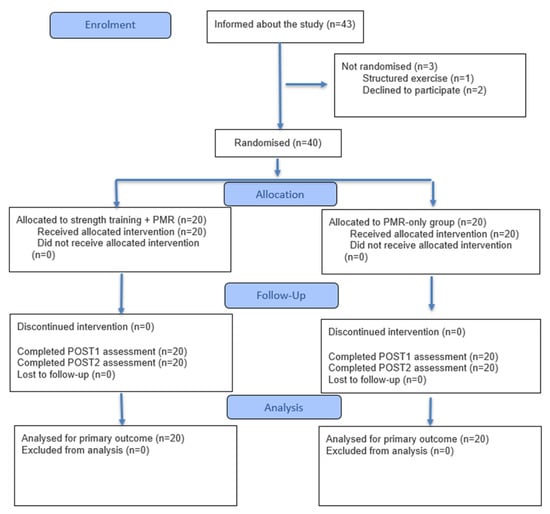
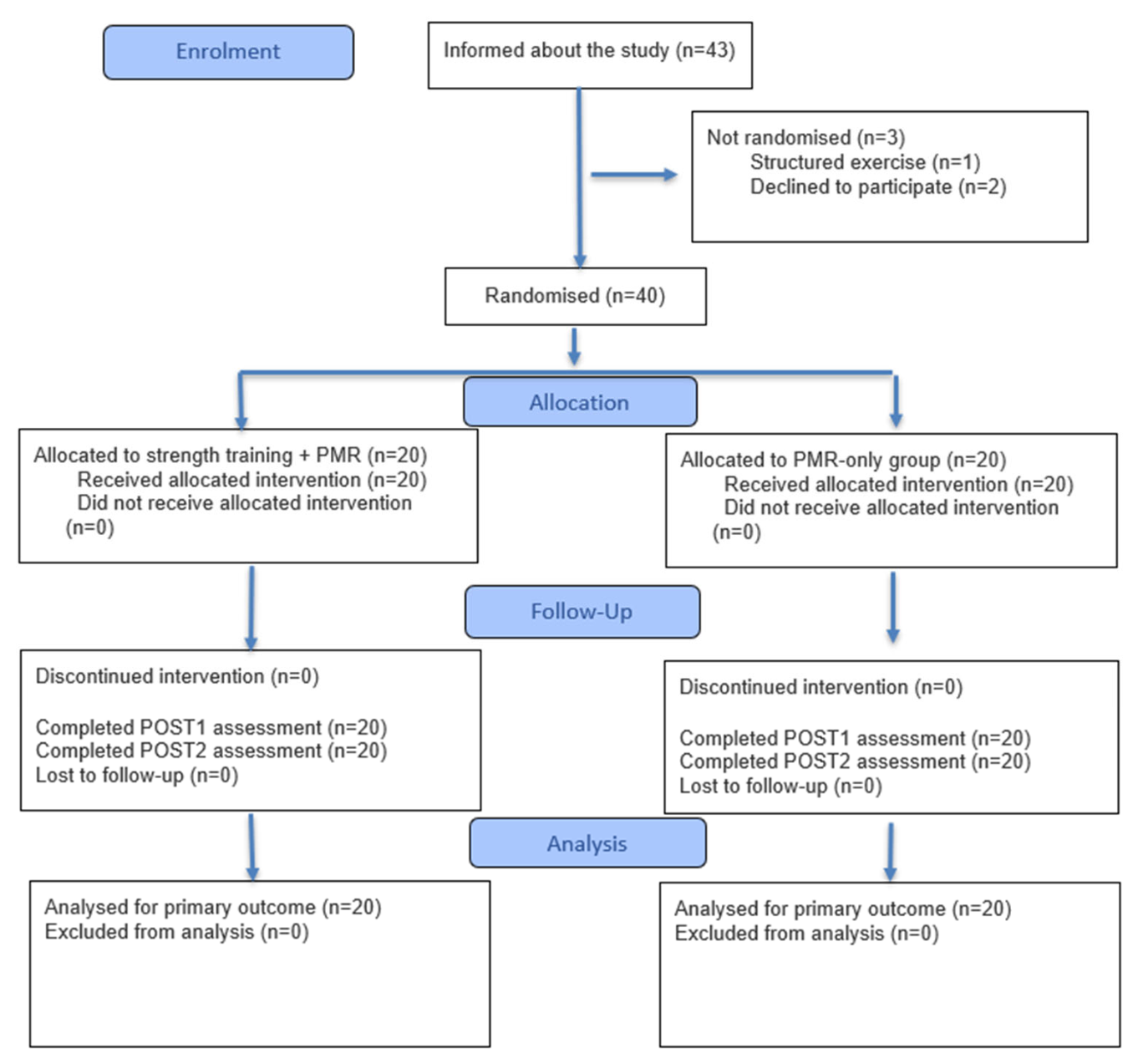
A total of 43 individuals received information about the study. Two declined participation, and one was excluded because they were participating in a structured exercise program that could interfere with the study outcomes. The remaining 40 participants provided written informed consent, completed the baseline assessment, and were randomly allocated to the intervention group (n = 20) or the control group (n = 20). All randomized participants completed the intervention and both follow-up assessments, with no losses to follow-up.
2.3. Sample Size
The sample size was calculated a priori for the study protocol based on the primary outcome, the total Short Physical Performance Battery (SPPB) score at 10 weeks. The calculation aimed to detect a target between-group difference of 1 point in the SPPB total score [14], assuming a standard deviation of 1.3 points, a two-sided significance level of 0.05, and 80% statistical power. The minimum required sample size was 27 participants per group. Allowing for an anticipated dropout rate of approximately 13%, the target sample size was increased to 31 participants per group, resulting in a total planned sample of 62 participants. The calculation was performed using G*Power version 3.1.9.7 (Heinrich Heine University Düsseldorf, Düsseldorf, Germany), as described in the published study protocol [12].
Despite the planned sample size, recruitment was limited by the number of eligible caregivers available during the recruitment period. Consequently, 40 participants were randomized, with 20 allocated to each group, and the target sample size was not reached.
2.4. Randomization and Blinding
Participants were randomly allocated in a 1:1 ratio to either the intervention group, which received functional strength training combined with progressive muscle relaxation, or the control group, which received progressive muscle relaxation alone. The randomization sequence was generated using a computer-based procedure with randomly varying block sizes by an independent researcher who was not involved in participant recruitment, baseline assessment, intervention delivery, or outcome assessment.
To ensure allocation concealment, group assignments were placed in sequentially numbered, opaque, sealed, and tamper-evident envelopes. The envelopes were stored securely and opened in numerical order only after participant eligibility had been confirmed and all baseline assessments had been completed.
Due to the nature of the intervention, blinding of participants and the physiotherapists delivering the interventions was not possible. However, outcome assessments were performed by an independent physiotherapist who was not involved in intervention delivery or other procedures that could reveal group allocation and who remained blinded to participants’ group assignments throughout the assessment period.
2.5. Intervention
The intervention was conducted over a 10-week period at the State Reference Centre for the Care of People with Alzheimer’s Disease and Other Dementias (Centro de Referencia Estatal de Atención a Personas con Enfermedad de Alzheimer y otras Demencias, CREA) in Salamanca, Spain. The intervention program was based on the protocol previously published by Sánchez-Gil et al. [12]. Participants were randomly allocated to either an intervention group, which received functional strength training combined with progressive muscle relaxation (PMR), or a control group, which received PMR alone.
The intervention began during the week of 20 April 2026, with the first session taking place on 21 April. Sessions were scheduled on Tuesdays and Thursdays. The intervention group attended two sessions per week, whereas the control group attended one session per week. All planned sessions were completed as scheduled, without modifications.
2.5.1. Intervention Group: Functional Strength Training Combined with Progressive Muscle Relaxation
Participants in the intervention group attended two sessions per week: one functional strength training session lasting 50 min and one PMR session lasting 45 min.
The functional strength training sessions were structured into three phases: warm-up, main exercise component, and cool-down. The warm-up lasted approximately 10 min and included general joint mobility exercises, progressive muscle activation, low-intensity functional tasks, and postural control activities. The main component focused on functional, multi-joint exercises targeting the lower limbs and trunk, including sit-to-stand movements, pushing and pulling tasks, step-ups, and balance exercises such as tandem stance. Exercises were performed using body weight, elastic resistance bands, light dumbbells, and balls, as appropriate.
Exercise intensity and difficulty were individually adapted according to participants’ tolerance, performance, perceived exertion, and movement technique. The program generally involved 1–3 sets of 8–12 repetitions, with rest periods between sets. Progression was achieved by adjusting resistance, repetitions, time under tension, or the level of support, while monitoring fatigue and discomfort to ensure safety.
In addition to strength training, participants attended one weekly PMR session lasting 45 min. The sessions followed a structured sequence of muscle contraction and relaxation involving the major muscle groups, progressing from distal to proximal regions in line with the progressive relaxation technique originally described by Bernstein and Borkovec [15]. Each session began with an explanation of the procedure and instructions for slow, controlled breathing. A physiotherapist verbally guided participants through the exercises, adapting the pace and instructions as needed and monitoring their safety and tolerance.
2.5.2. Control Group: Progressive Muscle Relaxation
Participants in the control group attended one PMR session per week throughout the 10-week intervention period. Each session lasted 45 min and followed the same general approach as the PMR sessions delivered to the intervention group.
The sessions consisted of a structured sequence of contraction and relaxation exercises involving the major muscle groups, progressing from distal to proximal regions. Participants were instructed in slow, controlled breathing and guided verbally by a physiotherapist in a calm environment. The pace and instructions were adapted when necessary to support participants’ understanding, comfort, and safety.
2.5.3. Attendance, Adherence, and Adverse Events
Attendance was recorded for each scheduled session throughout the 10-week intervention. Adherence was calculated as the percentage of attended sessions relative to the total number of sessions prescribed for each participant. Adequate adherence was defined as attendance at 80% or more of prescribed sessions, consistent with the study protocol [12]. Adverse events and intervention tolerability were monitored and documented throughout the intervention period.
2.6. Outcome Measures
All outcomes were assessed at three time points: baseline (13 April 2026), immediately after completion of the 10-week intervention (POST1; 26 June 2026), and at the three-month follow-up (POST2; 28 September 2026).
2.6.1. Primary Outcome
- Physical performance. The primary outcome was physical performance, assessed using the Short Physical Performance Battery (SPPB). This instrument comprises three components: standing balance, usual gait speed over 4 m, and the five-times sit-to-stand test. Each component is scored from 0 to 4, yielding a total score ranging from 0 to 12. Higher scores indicate better physical performance [16].
2.6.2. Secondary Outcomes
- Handgrip strength. Handgrip strength was measured using the ActivForce 2 handheld dynamometer (ActivBody, Inc., San Diego, CA, USA). Participants were seated in a chair with a backrest, with the forearm supported on a table, the elbow flexed at 90°, and the wrist in a neutral position. Three maximal isometric contractions were performed with each hand, with rest periods between attempts. The highest value obtained from the three trials of the dominant hand was used for statistical analysis and expressed in kilograms (kg). Higher grip strength values indicate greater muscle strength. The procedure followed standardized recommendations for grip strength measurement [17].
- Anxiety symptoms. Anxiety was assessed using the Hamilton Anxiety Rating Scale (HAM-A), a clinician-administered instrument consisting of 14 items covering psychological and somatic symptoms of anxiety. Each item is scored from 0 to 4, resulting in a total score ranging from 0 to 56. Higher scores indicate greater anxiety severity [18,19].
- Caregiver burden. Caregiver burden was evaluated using the 22-item Zarit Burden Interview (ZBI), which evaluates the perceived impact of caregiving on emotional, physical, and social well-being. Each item is scored from 0 to 4, resulting in a total score ranging from 0 to 88. Higher scores indicate greater perceived caregiver burden [20,21].
2.7. Statistical Analysis
Statistical analyses were performed using IBM SPSS Statistics, version 30.0 (IBM Corp., Armonk, NY, USA). Descriptive statistics were calculated for all study variables, with quantitative data expressed as means and standard deviations (SD).
A mixed repeated-measures ANOVA was used to examine changes across the three assessments while accounting for repeated observations within participants. This approach was considered suitable for the balanced design, with 20 participants per group and complete data at all assessment points. Time (PRE, POST1, and POST2) was included as the within-subject factor and intervention group as the between-subject factor. The main effects of time and group and the group × time interaction were examined. Residual distributions were assessed using the Shapiro–Wilk test and Q–Q plots. Homogeneity of variance between groups was assessed using Levene’s test, and covariance homogeneity was examined using Box’s M test. Sphericity was assessed using Mauchly’s test, with Greenhouse–Geisser corrections applied when this assumption was violated. ANOVA effect sizes were expressed as partial eta squared (η2p). Pairwise comparisons between assessment points used Bonferroni adjustment.
To quantify between-group effects, contrasts of the group × time model were used to estimate differences in mean changes from baseline to POST1 and POST2, calculated as change in the intervention group minus change in the control group. Pointwise 95% confidence intervals were obtained using the pooled residual covariance matrix and the t distribution with 38 degrees of freedom. These intervals were not adjusted for multiple comparisons. These model-based estimates were distinguished from the complementary exploratory comparisons using the Mann–Whitney U test.
As complementary analyses, between-group differences in change scores across three intervals (PRE–POST1, POST1–POST2, and PRE–POST2) were assessed using the Mann–Whitney U test with two-sided Monte Carlo significance estimation based on 10,000 samples and 99% confidence intervals for the estimated p-values. These comparisons were considered exploratory and were not adjusted for multiple testing.
For SPPB and handgrip strength, within-group standardized changes from baseline to POST1 and POST2 were calculated using Cohen’s dz, defined as the mean individual change divided by the standard deviation of individual changes. Changes were calculated as the follow-up score minus the baseline score. These estimates were descriptive and were not accompanied by additional significance tests. For the exploratory between-group comparisons using the Mann–Whitney U test, effect sizes were calculated as r = |Z|/√N, where Z is the standardized test statistic and N is the total sample size across both groups (N = 40).
All statistical tests were two-sided, and a significance level of p < 0.05 was adopted.
2.8. Ethical Considerations
The study was conducted in accordance with the ethical principles of the Declaration of Helsinki and applicable data protection regulations. The study protocol was reviewed and approved by the Research Ethics Committee of the University of Salamanca (approval number: 1468). All participants received information about the study objectives and procedures and provided written informed consent before participation. Participants’ confidentiality was maintained throughout the study, and personal data were handled in accordance with applicable data protection legislation.
The trial was registered at ClinicalTrials.gov (NCT07388186) on 22 January 2026. The registration record is available at https://clinicaltrials.gov/study/NCT07388186 (accessed on 20 October 2026).
3. Results
3.1. Participant Characteristics
A total of 40 participants were included in the study, with 20 allocated to the intervention group and 20 to the control group (see Figure 1). All participants completed the intervention and the three scheduled assessments: baseline (PRE), immediately after the completion of the 10-week intervention (POST1), and at the three-month follow-up (POST2). Therefore, complete longitudinal data were available for all participants, with no loss to follow-up.
Figure 1.
CONSORT flow diagram showing participant enrolment, randomization, allocation, follow-up, and analysis.
Baseline scores for caregiver burden, anxiety, physical performance, and muscle strength are presented in Table 1.
Table 1.
Baseline characteristics of the study participants.
3.2. Effects on Caregiver Burden and Anxiety
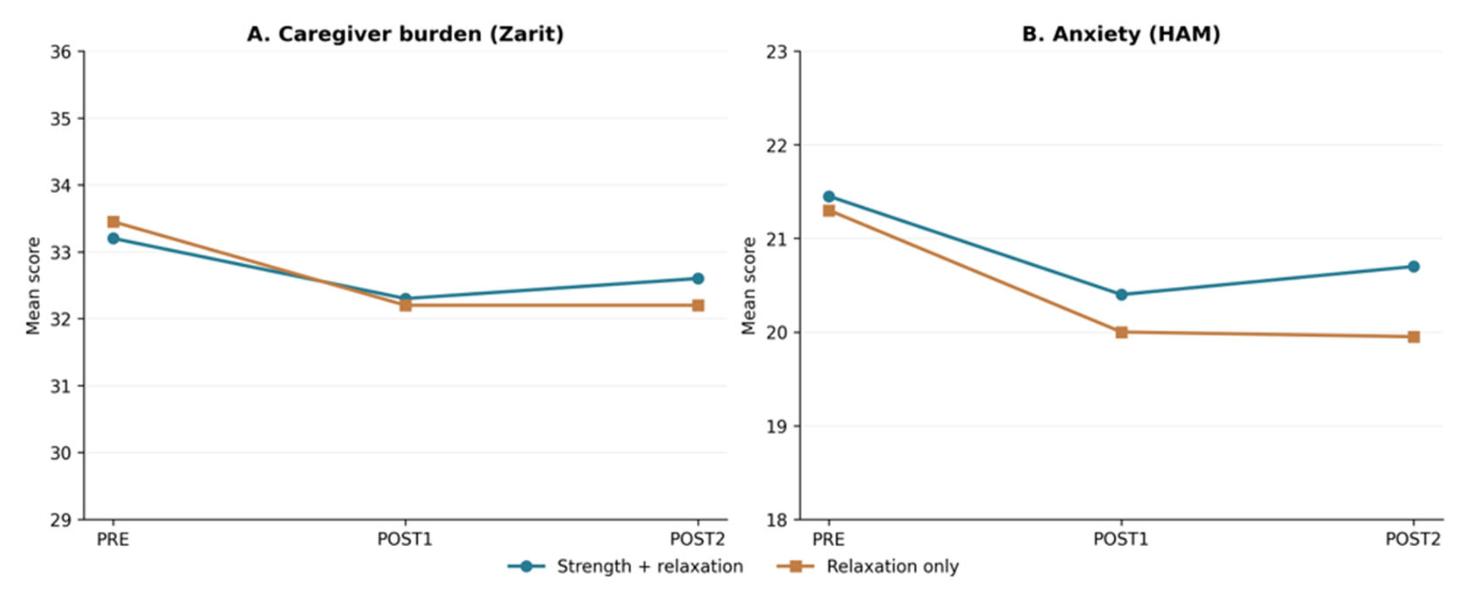
Caregiver burden, assessed using the Zarit Burden Interview, showed a significant main effect of time (F(1.62, 61.49) = 13.42, p < 0.001, η2p = 0.261), with no significant group × time interaction (F(1.62, 61.49) = 1.05, p = 0.344, η2p = 0.027). Bonferroni-adjusted pairwise comparisons showed significantly lower scores at POST1 (p < 0.001) and POST2 (p = 0.004) compared with PRE, with no significant difference between POST1 and POST2 (p = 1.000). Between-group comparisons of change scores using the Mann–Whitney U test with Monte Carlo significance estimation showed no statistically significant differences across the three intervals (all p ≥ 0.300).
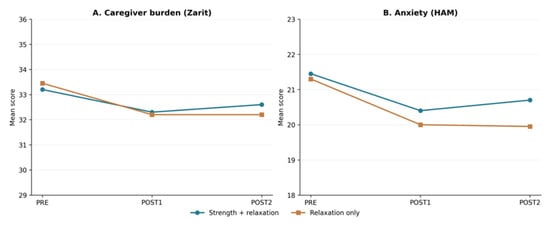
Anxiety, assessed using the Hamilton Anxiety Rating Scale (HAM-A), also showed a significant main effect of time (F(1.72, 65.37) = 22.80, p < 0.001, η2p = 0.375), with no significant group × time interaction (F(1.72, 65.37) = 1.24, p = 0.291, η2p = 0.032). Bonferroni-adjusted pairwise comparisons showed significantly lower scores at POST1 and POST2 compared with PRE (both p < 0.001), with no significant difference between POST1 and POST2 (p = 1.000). No significant between-group differences in change scores were observed across the three intervals (all p ≥ 0.377). The evolution of both outcomes is presented in Figure 2.
Figure 2.
Changes in caregiver burden and anxiety across the study period. Mean scores for (A) caregiver burden, measured using the Zarit Burden Interview, and (B) anxiety, measured using the Hamilton Anxiety Rating Scale (HAM-A), in the intervention group (n = 20) and the control group (n = 20) at baseline (PRE), immediately after the intervention (POST1), and at the three-month follow-up (POST2). Lines connect group means.
Between-group differences in mean change had confidence intervals that included zero. For caregiver burden, differences were 0.35 points (95% CI, −0.54 to 1.24) at POST1 and 0.65 points (95% CI, −0.44 to 1.74) at POST2. For anxiety, corresponding differences were 0.25 points (95% CI, −0.60 to 1.10) and 0.60 points (95% CI, −0.25 to 1.45), respectively.
3.3. Effects on Physical Performance and Muscle Strength
The mixed repeated-measures ANOVA showed significant group × time interactions for both physical performance, assessed using the Short Physical Performance Battery (SPPB) (F(1.72, 65.18) = 5.28, p = 0.010, η2p = 0.122), and handgrip strength (F(1.69, 64.09) = 5.98, p = 0.006, η2p = 0.136). The main effect of time was not significant for SPPB (F(1.72, 65.18) = 1.21, p = 0.301), whereas a significant main effect of time was observed for handgrip strength (F(1.69, 64.09) = 6.11, p = 0.006). Mean values and standard deviations at each assessment, within-group standardized changes expressed as Cohen’s dz, and between-group differences in mean change with 95% confidence intervals are presented in Table 2.
Table 2.
Changes in physical performance and handgrip strength across the study period.
The between-group difference in mean change from baseline favored the intervention group for SPPB at POST1 (0.40 points; 95% CI, 0.15–0.65) and POST2 (0.35 points; 95% CI, 0.03–0.67). Corresponding differences for handgrip strength were 0.57 kg (95% CI, 0.15–0.98) at POST1 and 0.44 kg (95% CI, 0.10–0.77) at POST2 (Table 2).
Exploratory between-group comparisons of change scores using the Mann–Whitney U test showed statistically significant differences from PRE to POST1 for both SPPB (U = 126.00, p = 0.008) and handgrip strength (U = 101.00, p = 0.008). Significant differences were also observed from PRE to POST2 for SPPB (U = 137.00, p = 0.013) and handgrip strength (U = 115.50, p = 0.023). No statistically significant between-group differences were observed in changes from POST1 to POST2 (SPPB: p = 0.434; handgrip strength: p = 0.270). These exploratory comparisons and their associated effect sizes, expressed as absolute r values, are presented in Table 3. As they were not adjusted for multiple testing, the findings should be interpreted cautiously.
Table 3.
Exploratory between-group comparisons of changes in physical performance and handgrip strength.
3.4. Intervention Adherence and Safety
All 40 randomized participants completed the intervention period and the three scheduled assessments, with no losses to follow-up. Overall attendance was 98.25% in the intervention group (393 of 400 possible attendances) and 97.0% in the control group (194 of 200 possible attendances). All participants in both groups (100%) achieved the predefined adherence threshold of at least 80% of prescribed sessions. No adverse events were reported during the study.
4. Discussion
The main findings of this randomized controlled trial suggest that combining functional strength training with progressive muscle relaxation may provide additional benefits for physical performance and handgrip strength compared with progressive muscle relaxation alone in informal caregivers of people with dementia. Reductions in caregiver burden and anxiety symptoms were observed over time in both groups, without significant between-group differences. Although these findings are consistent with previous evidence supporting relaxation-based interventions, the absence of a non-intervention control group prevents attributing these changes specifically to progressive muscle relaxation.
Previous studies have reported potential benefits of physical exercise on physical performance and muscle strength in informal caregivers of people with dementia. For example, Kim et al. [6] observed improvements in physical performance, assessed using the SPPB, following an exercise intervention for older family caregivers and Prieto-Prieto et al. [5] reported improvements in muscle strength and physical performance after a nine-month home-based exercise program in female dementia caregivers. Similarly, Montero-Cuadrado et al. [7] showed that adding therapeutic exercise to usual caregiver support improved physical performance, muscle strength, anxiety, and perceived burden in caregivers of dependent individuals. Farran et al. [22], in a 12-month randomized trial reported improved performance in the 2 min step test with a telephone-coached physical activity intervention, whereas chair-stand performance did not differ between groups. At the review level, a systematic review and meta-analysis of 12 studies including 1163 informal caregivers of people with cognitive decline reported beneficial effects of physical activity on static balance and psychological well-being [8], whereas a recent scoping review on sarcopenia and its components in caregivers of people with dementia described heterogeneous findings for muscle strength, physical performance, and frailty, and highlighted the limited available evidence [4]. Our findings of modest additional benefits in SPPB scores and handgrip strength are broadly consistent with the direction of this evidence on physical outcomes. Furthermore, a systematic review and meta-analysis by He et al. [23] suggested that multicomponent interventions may improve different dimensions of caregivers’ well-being, including caregiver burden and anxiety, and the World Health Organization recommends offering psychosocial interventions, including multicomponent approaches, to caregivers of people with dementia [11]. By comparing the combined intervention with progressive muscle relaxation alone, our trial allows us to investigate the potential additional contribution of functional strength training to physical outcomes.
Observational evidence also highlights the relevance of physical health in older caregivers. Máximo et al. [24] reported that approximately 59% of 328 community-dwelling caregivers aged 60 years or older were pre-frail and approximately 21% were frail, and Potier et al. [25], in a cohort of 82 older spousal caregivers in Belgium, observed that about one third worsened in frailty over 16 months.
Regarding physical performance, the findings suggest that adding functional strength training to progressive muscle relaxation may provide a modest additional benefit in physical performance among informal caregivers of people with dementia. The intervention group showed a mean improvement of 0.30 points in SPPB scores after the intervention, whereas the control group experienced a decrease of 0.10 points, resulting in an approximate between-group difference in change of 0.40 points. Although this difference was statistically significant in the exploratory comparisons, its clinical relevance remains uncertain. Notably, the observed difference was smaller than the 1-point between-group difference considered clinically for the sample size calculation. Furthermore, baseline SPPB scores were relatively high in both groups, potentially limiting the capacity to detect further improvements due to a ceiling effect [26]. Although the observed changes were maintained at the three-month follow-up, their magnitude does not allow us to establish a clinically meaningful improvement. Therefore, these findings should be interpreted cautiously, and further studies are needed to determine whether this intervention produces meaningful functional benefits in this population.
Regarding handgrip strength, the intervention group showed a mean increase of 0.58 kg immediately after the intervention, compared with a negligible change in the control group (0.01 kg). At the three-month follow-up, the improvement remained slightly above baseline in the intervention group (+0.31 kg), whereas a small decrease was observed in the control group (−0.13 kg). Although these findings suggest a modest additional benefit associated with functional strength training, the magnitude of the changes was relatively small and their clinical relevance remains uncertain. These findings are consistent with those reported by Montero-Cuadrado et al. [7], who observed improvements in handgrip strength after adding a therapeutic exercise program to usual care for caregivers of dependent individuals.
Regarding psychological outcomes, both anxiety and caregiver burden decreased over the study period in both groups, with no significant group-by-time interactions. Previous studies have also investigated the effects of relaxation-based and other non-pharmacological interventions on caregivers’ psychological well-being. A study evaluating progressive muscle relaxation in dementia caregivers reported reductions in anxiety, stress, depression, and caregiver burden following a three-month intervention [9]. Similarly, a systematic review and network meta-analysis by Sun et al. [10], including 85 randomized controlled trials, found that certain non-pharmacological interventions may help reduce caregiver burden, although the evidence varied according to the intervention and outcome assessed. In addition, Montero-Cuadrado et al. [7] reported improvements in anxiety and subjective caregiver burden following a therapeutic exercise program added to usual care. Although reductions in anxiety and caregiver burden were observed in both groups, these changes should be interpreted cautiously. Since all participants received progressive muscle relaxation and no non-intervention control group was included, it is not possible to determine whether these improvements resulted from the relaxation intervention, other aspects of the study program, or factors unrelated to the interventions. Furthermore, the absence of significant between-group differences suggests that adding functional strength training did not provide a detectable additional benefit in these psychological outcomes. Further research involving appropriate comparison groups is needed to clarify the effects of these interventions on caregivers’ psychological well-being.
4.1. Strengths and Limitations
Several limitations should be considered when interpreting the findings of this study. First, the study did not achieve the prespecified sample size of 62 participants, as recruitment was limited by the number of eligible caregivers available at the study center during the recruitment period. Consequently, the reduced sample size may have affected the precision of treatment effect estimates and limited the statistical power to detect clinically meaningful between-group differences, particularly for secondary outcomes. Therefore, non-significant findings should not be interpreted as definitive evidence of the absence of an intervention effect, as potentially relevant differences may have remained undetected. Similarly, statistically significant findings should be interpreted cautiously, given the uncertainty surrounding the magnitude of the estimated effects. Furthermore, recruitment from a single center may limit the generalisability of the findings to other caregiver populations and settings. In addition, the mean age of participants was approximately 73 years, meaning that the results may not be directly applicable to younger informal caregivers, whose physical condition, caregiving responsibilities, and intervention needs may differ. Therefore, caution is needed when extrapolating these findings to younger caregivers or to populations recruited in different settings. Future multicentre studies involving caregivers across a wider age range are needed to confirm the applicability of these findings to broader caregiver populations.
Second, relatively high baseline SPPB scores may have limited improvement through a ceiling effect. The observed physical changes were modest, and their clinical relevance remains uncertain. Exploratory comparisons were not adjusted for multiple testing, increasing the risk of type I errors. Departures from normality and indications of between-group covariance heterogeneity were also observed; these are not corrected by Greenhouse–Geisser adjustment. These limitations, together with the small sample size, warrant cautious interpretation of the estimates and confidence intervals.
Third, blinding participants and physiotherapists to group allocation was not feasible due to the nature of the interventions. Moreover, the intervention and control groups differed in the frequency and duration of supervised sessions, as the intervention group received an additional weekly functional strength training session. Consequently, the observed differences in physical outcomes may reflect both the specific effects of strength training and the additional intervention time and attention received by participants in the intervention group. Therefore, the observed benefits cannot be attributed entirely to the specific effects of functional strength training.
Additionally, although information on the relationship with the care recipient and employment status was available, other potentially relevant characteristics, such as duration of caregiving, weekly hours devoted to care, and relevant clinical conditions, were not available in the study dataset. This may limit the characterization of the participants and the interpretation of how their caregiving circumstances may have influenced the study outcomes.
Despite these limitations, the study has several methodological strengths. Its randomized controlled design, concealed allocation, and blinded outcome assessment helped minimize potential sources of bias. The inclusion of an active control group allowed the additional effects of functional strength training to be examined in comparison with progressive muscle relaxation alone. Furthermore, the assessment of both physical and psychological outcomes provided a comprehensive evaluation of caregivers’ health, while the three-month follow-up offered preliminary information regarding the persistence of the observed changes. High intervention adherence and the absence of losses to follow-up also represent important strengths. Overall, these findings provide preliminary evidence supporting further investigation of combined physical exercise and relaxation-based interventions in informal caregivers of people with dementia, although larger, adequately powered trials are needed to confirm their effectiveness and establish their clinical relevance.
4.2. Clinical Implications and Future Research
Future research should evaluate this combined approach in larger, adequately powered samples recruited from multiple centers to determine the consistency of the findings across different settings. Longer follow-up periods would also be valuable to establish whether the observed changes are sustained over time and to examine the clinical relevance of improvements in physical performance and muscle strength. In addition, further studies should investigate the specific contribution of each intervention component by comparing different combinations of functional strength training and progressive muscle relaxation. The inclusion of clinically meaningful outcome measures would also help determine whether the observed changes translate into tangible benefits in caregivers’ daily lives. Finally, further studies should assess the feasibility and acceptability of the program among caregivers. This would help inform the development of comprehensive interventions tailored to caregivers’ needs and suitable for sustained implementation in practice.
5. Conclusions
This randomized controlled trial provides preliminary evidence suggesting that adding functional strength training to progressive muscle relaxation may provide modest additional benefits in physical performance and handgrip strength among informal caregivers of people with dementia. However, the magnitude of these improvements was small, and their clinical relevance remains uncertain. Reductions in anxiety and caregiver burden were observed over time in both groups, without significant differences between interventions. Given the limited sample size, the relatively high baseline physical performance, and the unequal intervention exposure between groups, these findings should be interpreted cautiously. Larger, adequately powered trials are needed to confirm these preliminary findings and establish its clinical relevance.
Author Contributions
Conceptualization, A.S.-G., J.L.S.-G., F.P.-R., E.P.-S. and A.C.-C.; methodology, A.S.-G., J.L.S.-G., M.G.-M., V.S.-R., R.G.-S., F.P.-R., E.P.-S. and A.C.-C.; software, R.G.-S., J.P., F.P.-R. and E.P.-S.; validation, A.S.-G., J.L.S.-G., M.G.-M. and V.S.-R.; formal analysis, F.P.-R.; investigation, A.S.-G., M.G.-M., V.S.-R., R.G.-S., F.P.-R., E.P.-S. and A.C.-C.; resources, M.G.-M., V.S.-R. and R.G.-S.; data curation, F.P.-R. and E.P.-S.; writing—original draft preparation, A.S.-G., J.L.S.-G., F.P.-R. and A.C.-C.; writing—review and editing, A.S.-G., J.L.S.-G., M.G.-M., V.S.-R., R.G.-S., J.P., F.P.-R., E.P.-S. and A.C.-C.; visualization, A.S.-G., J.L.S.-G. and M.G.-M.; supervision, J.L.S.-G. and F.P.-R.; project administration, A.C.-C., F.P.-R. and J.L.S.-G.; funding acquisition, A.C.-C. All authors have read and agreed to the published version of the manuscript.
Funding
This research was funded by the Colegio Profesional de Fisioterapeutas de Castilla y León (Professional Association of Physiotherapists of Castile and León, Spain), INV2026-66. The article processing charge (APC) was funded by the same grant.
Institutional Review Board Statement
This study was approved on 17 December 2025 by the Institutional Review Board (IRB) at the Research Ethics Committee of the University of Salamanca (approval no. 1468).
Informed Consent Statement
Informed consent was obtained from all subjects involved in the study.
Data Availability Statement
The data supporting the findings of this study are available from the corresponding author upon reasonable request. The data are not publicly available due to ethical and privacy restrictions.
Acknowledgments
The authors would like to express their sincere gratitude to the Centro de Referencia Estatal de Atención a Personas con Enfermedad de Alzheimer y otras Demencias (CREA) and the Instituto de Mayores y Servicios Sociales (IMSERSO) for their institutional support and collaboration in facilitating the implementation of this study. The authors also thank all the informal caregivers who participated in the research for their time, commitment, and valuable contribution.
Conflicts of Interest
The authors declare no conflicts of interest.
References
- World Health Organization. Dementia. Available online: https://www.who.int/news-room/fact-sheets/detail/dementia (accessed on 20 October 2026).
- Alzheimer Europe. Prevalence of Dementia in Europe. Available online: https://www.alzheimer-europe.org/dementia/prevalence-dementia-europe (accessed on 20 October 2026).
- Soh, X.C.; Hartanto, A.; Ling, N.; Reyes, M.; Sim, L.; Majeed, N.M. Prevalence of depression, anxiety, burden, burnout, and stress in informal caregivers: An umbrella review of meta-analyses. Arch. Gerontol. Geriatr. Plus 2025, 2, 100197. [Google Scholar] [CrossRef] [Scilit]
- Goh, K.H.R.; Tsai, Q.K.T.; Huang, X. Sarcopenia in Informal Caregivers of Persons Living with Dementia: A Scoping Review. J. Clin. Med. 2026, 15, 7345. [Google Scholar] [CrossRef] [Scilit] [PubMed]
- Prieto-Prieto, J.; Madruga, M.; Adsuar, J.C.; González-Guerrero, J.L.; Gusi, N. Effects of a Home-Based Exercise Program on Health-Related Quality of Life and Physical Fitness in Dementia Caregivers: A Randomized Controlled Trial. Int. J. Environ. Res. Public Health 2022, 19, 9319. [Google Scholar] [CrossRef] [Scilit] [PubMed]
- Kim, J.Y.; Tak, S.H.; Lee, J.; Choi, H. Effects of Physical Exercise Program for Older Family Caregivers of Persons with Dementia. Am. J. Alzheimers Dis. Other Demen. 2023, 38, 15333175231178384. [Google Scholar] [CrossRef] [Scilit] [PubMed]
- Montero-Cuadrado, F.; Galán-Martín, M.Á.; Sánchez-Sánchez, J.; Lluch, E.; Mayo-Iscar, A.; Cuesta-Vargas, Á. Effectiveness of a Physical Therapeutic Exercise Programme for Caregivers of Dependent Patients: A Pragmatic Randomised Controlled Trial from Spanish Primary Care. Int. J. Environ. Res. Public Health 2020, 17, 7359. [Google Scholar] [CrossRef] [Scilit] [PubMed]
- Ahn, S.; Cobb, S.J.; Butler, R.; Abdullah, S.M.; Boltz, M.P.; Chung, M.L.; Roberson, P.N.E.; Lee, J.-A.; Zhao, X.; Anderson, J.G. Effects of Physical Activity on Health Among Informal Caregivers of People with Cognitive Decline: A Systematic Review and Meta-Analysis. West. J. Nurs. Res. 2025, 47, 770–785. [Google Scholar] [CrossRef] [Scilit] [PubMed]
- Baykal, D.; Bilgic, B. The effects of progressive muscle relaxation exercise on dementia caregivers. Geriatr. Nurs. 2024, 59, 491–497. [Google Scholar] [CrossRef] [Scilit] [PubMed]
- Sun, Y.; Ji, M.; Leng, M.; Li, X.; Zhang, X.; Wang, Z. Comparative efficacy of 11 non-pharmacological interventions on depression, anxiety, quality of life, and caregiver burden for informal caregivers of people with dementia: A systematic review and network meta-analysis. Int. J. Nurs. Stud. 2022, 129, 104204. [Google Scholar] [CrossRef] [Scilit] [PubMed]
- World Health Organization. Psychosocial Interventions for Carers of People with Dementia. Available online: https://www.who.int/teams/mental-health-and-substance-use/treatment-care/mental-health-gap-action-programme/evidence-centre/dementia/interventions-for-carers-of-people-with-dementia (accessed on 20 October 2026).
- Sánchez-Gil, A.; Sánchez-González, J.L.; Gómez-Mateos, M.; Santos-Rodríguez, V.; García-Santelesforo, R.; Pérez, J.; Pérez-Robledo, F.; Pérez-Sáez, E.; Calleja-Caballero, A. Combined functional strength training and progressive muscle relaxation in informal caregivers of people with dementia: Protocol for a randomized controlled trial. Front. Psychol. 2026, 17, 1944170. [Google Scholar] [CrossRef] [Scilit] [PubMed]
- Hopewell, S.; Chan, A.-W.; Collins, G.S.; Hróbjartsson, A.; Moher, D.; Schulz, K.F.; Tunn, R.; Aggarwal, R.; Berkwits, M.; Berlin, J.A.; et al. CONSORT 2025 Statement: Updated Guideline for Reporting Randomised Trials. BMJ 2025, 389, e081123. [Google Scholar] [CrossRef] [Scilit] [PubMed]
- Perera, S.; Mody, S.H.; Woodman, R.C.; Studenski, S.A. Meaningful Change and Responsiveness in Common Physical Performance Measures in Older Adults. J. Am. Geriatr. Soc. 2006, 54, 743–749. [Google Scholar] [CrossRef] [Scilit] [PubMed]
- Bernstein, D.A.; Borkovec, T.D. Progressive Relaxation Training: A Manual for the Helping Professions; Research Press: Champaign, IL, USA, 1973. [Google Scholar]
- Guralnik, J.M.; Simonsick, E.M.; Ferrucci, L.; Glynn, R.J.; Berkman, L.F.; Blazer, D.G.; Scherr, P.A.; Wallace, R.B. A Short Physical Performance Battery Assessing Lower Extremity Function: Association with Self-Reported Disability and Prediction of Mortality and Nursing Home Admission. J. Gerontol. 1994, 49, M85–M94. [Google Scholar] [CrossRef] [Scilit] [PubMed]
- Roberts, H.C.; Denison, H.J.; Martin, H.J.; Patel, H.P.; Syddall, H.; Cooper, C.; Sayer, A.A. A Review of the Measurement of Grip Strength in Clinical and Epidemiological Studies: Towards a Standardised Approach. Age Ageing 2011, 40, 423–429. [Google Scholar] [CrossRef] [Scilit] [PubMed]
- Hamilton, M. The Assessment of Anxiety States by Rating. Br. J. Med. Psychol. 1959, 32, 50–55. [Google Scholar] [CrossRef] [Scilit] [PubMed]
- Lobo, A.; Chamorro, L.; Luque, A.; Dal-Ré, R.; Badia, X.; Baró, E. Validación de las versiones en español de la Montgomery-Asberg Depression y Hamilton Anxiety Rating Scales para la evaluación de la depresión y de la ansiedad. Med. Clin. 2002, 118, 493–499. [Google Scholar] [CrossRef] [Scilit] [PubMed]
- Zarit, S.H.; Reever, K.E.; Bach-Peterson, J. Relatives of the Impaired Elderly: Correlates of Feelings of Burden. Gerontologist 1980, 20, 649–655. [Google Scholar] [CrossRef] [Scilit] [PubMed]
- Martín, M.; Salvadó, I.; Nadal, S.; Miji, L.C.; Rico, J.M.; Lanz, P.; Taussig, M.I. Adaptación para nuestro medio de la Escala de Sobrecarga del Cuidador (Caregiver Burden Interview) de Zarit. Rev. Gerontol. 1996, 6, 338–346. [Google Scholar]
- Farran, C.J.; Etkin, C.D.; Eisenstein, A.; Paun, O.; Rajan, K.B.; Castro Sweet, C.M.; McCann, J.J.; Barnes, L.L.; Shah, R.C.; Evans, D.A. Effect of Moderate to Vigorous Physical Activity Intervention on Improving Dementia Family Caregiver Physical Function: A Randomized Controlled Trial. J. Alzheimers Dis. Park. 2016, 6, 253. [Google Scholar] [CrossRef] [PubMed]
- He, J.; Wang, J.; Zhong, H.; Guan, C. The Effectiveness of Multi-Component Interventions on the Positive and Negative Aspects of Well-Being among Informal Caregivers of People with Dementia: A Systematic Review and Meta-Analysis. Int. J. Environ. Res. Public Health 2022, 19, 6973. [Google Scholar] [CrossRef] [Scilit] [PubMed]
- Máximo, R.O.; Lopes, I.C.; Brigola, A.G.; Luchesi, B.M.; Gratão, A.C.M.; Inouye, K.; Pavarini, S.C.I.; Alexandre, T.S. Pre-frailty, frailty and associated factors in older caregivers of older adults. Rev. Saude Publica 2020, 54, 17. [Google Scholar] [CrossRef] [Scilit] [PubMed]
- Potier, F.; Degryse, J.-M.; Bihin, B.; Debacq-Chainiaux, F.; Charlet-Renard, C.; Martens, H.; de Saint-Hubert, M. Health and frailty among older spousal caregivers: An observational cohort study in Belgium. BMC Geriatr. 2018, 18, 291. [Google Scholar] [CrossRef] [Scilit] [PubMed]
- Kameniar, K.; Mackintosh, S.; Van Kessel, G.; Kumar, S. The Psychometric Properties of the Short Physical Performance Battery to Assess Physical Performance in Older Adults: A Systematic Review. J. Geriatr. Phys. Ther. 2024, 47, 43–54. [Google Scholar] [CrossRef] [Scilit] [PubMed]

Disclaimer/Publisher’s Note: The statements, opinions and data contained in all publications are solely those of the individual author(s) and contributor(s) and not of MDPI and/or the editor(s). MDPI and/or the editor(s) disclaim responsibility for any injury to people or property resulting from any ideas, methods, instructions or products referred to in the content. |
© 2026 by the authors. Licensee MDPI, Basel, Switzerland. This article is an open access article distributed under the terms and conditions of the Creative Commons Attribution (CC BY) license.