


Highlights
What are the main findings?
- Across six post-chemotherapy home care scenarios, 66 physicians assigned ratings of 4 or 5 to 73.7–82.0% of assessments across four domains.
- Understandability received higher ratings than accuracy, applicability, and comprehensiveness, although individual-level inter-rater reliability was very low.
What are the implications of the main findings?
- Favorable physician ratings reflect perceived response quality and do not establish clinical safety, guideline concordance, or patient benefit.
- Further evaluation using guideline-based safety criteria, broader scenario sets, and patient-centered outcomes is needed before considering clinical use.
Abstract
Background/Objectives: The aim of this study was to evaluate ChatGPT-4o’s responses to patient-centered clinical scenarios encountered during post-chemotherapy home care, based on expert assessment. Methods: Six patient-centered clinical scenarios reflecting common real-life concerns were developed in Turkish. On 9 September 2024, each scenario was submitted independently to ChatGPT-4o using zero-shot prompting. The responses were evaluated by 66 physicians working in medical oncology, including 30 residents and 36 consultant-level physicians, using a rubric-based approach across four domains: accuracy, applicability, comprehensiveness, and understandability. Ratings were assigned using a 5-point Likert scale. Descriptive statistics and non-parametric tests were used for analysis. Results: Ratings of 4 or 5 constituted the majority of evaluations across all scenarios and domains. Median scores were 4.0 for most scenarios, while understandability reached a median of 5.0 in several. When ratings were aggregated across all scenarios, the overall proportions ≥4 were 76.8% for accuracy, 77.0% for applicability, 73.7% for comprehensiveness, and 82.0% for understandability. The Friedman test showed a significant difference among the four evaluation domains (p < 0.001). Bonferroni-adjusted pairwise comparisons indicated that understandability scores were higher than those of accuracy, applicability, and comprehensiveness. Single-measure intraclass correlation coefficients ranged from −0.001 to 0.011 across the four evaluation domains. Conclusions: The six evaluated ChatGPT-4o responses concerning symptom management during post-chemotherapy home care were generally rated favorably by physicians, with understandability receiving the highest ratings. However, low inter-rater reliability limits the interpretation of these findings as an expert consensus. The findings should not be generalized to newer model versions. Further studies are needed to establish clinical safety, guideline concordance, and patient benefit.
1. Introduction
During the post-chemotherapy period, patients experience a wide range of side effects and symptoms at home, such as nausea and vomiting, fever, fatigue, and pain. Managing these symptoms at home requires serious responsibility and appropriate coping strategies for both patients and caregivers [1]. The home care process for cancer patients can lead to their struggling with multiple symptoms alone and experiencing anxiety about seeking emergency medical services or even increased visits. Given the increasing patient load and staffing limitations in healthcare systems, maintaining effective and safe home care has become increasingly important [2]. This has made access to accurate, timely, and accessible information a central requirement. Therefore, easy access to reliable health information for patients and their families is critical for proper symptom management at home and for reducing unnecessary emergency room visits.
The increasing need for rapid and accurate access to information in home care after chemotherapy has brought about a shift towards digital health solutions [3,4], among which telemedicine services, mobile health applications, and chatbots are increasingly being adopted due to advantages such as 24/7 access to health information and relatively low cost. Artificial intelligence-based technologies known as large language models (LLMs), which can generate human-like responses in natural language, have gained significant attention in recent years. These models can generate responses tailored to user needs [5,6]. ChatGPT is a specific conversational product developed by OpenAI. Early medical LLM research focused largely on proprietary GPT-based systems, particularly ChatGPT, for patient information, question answering, and clinical documentation [7,8]. More recent research reflects a broader multi-model ecosystem that includes newer proprietary systems, medical-domain models, and open-weight architectures adapted for specific healthcare tasks [9,10]. Clinical applications have also expanded beyond general question answering. For example, prompt-driven models have been used to convert patient–provider consultations into structured electronic medical records and to support pre-consultation workflows [11]. In parallel, open-weight models are increasingly being evaluated because they may be used to support local deployment, task-specific adaptation, and greater institutional control over health data [12,13]. Given the rapid evolution of this field, findings from LLM evaluations should be interpreted in relation to the specific model version, task, and time of assessment. Despite this expanding model landscape, publicly accessible LLM-based chatbots, including ChatGPT, may provide patients with rapid access to information about symptoms, treatments, and other health concerns. However, comprehensive evaluation is needed to ensure their safe and effective use in medical contexts [14]. Several studies on this subject report that, while LLMs generally perform satisfactorily in answering medical questions, there is a risk of their producing incorrect or incomplete information [15,16,17]. Previous studies have largely focused on symptom monitoring and patient education, whereas comprehensive scenario-based evaluations remain limited [18].
Nevertheless, ChatGPT has been reported to provide accurate and guideline-compliant answers to frequently asked patient questions, particularly regarding basic health information and symptom explanations [19,20]. In terms of readability, it has been reported that ChatGPT can simplify complex medical information, making it more accessible to patients and their families. It has been emphasized that it can be considered a supportive tool in terms of patient education and health communication [15,17,19,21,22,23]. However, these findings generally support the use of ChatGPT as a complementary source of information rather than as a substitute for professional clinical assessment [6,20,24].
Importantly, the quality of LLM-generated health information depends not only on the underlying model but also on how the user’s question is formulated [25]. Prompt engineering is the term given to the design and structuring of instructions used to guide an LLM’s response, and different prompting strategies may influence the accuracy, completeness, reasoning, and clinical usefulness of the generated information [26]. Common approaches include zero-shot prompting, in which no task-specific examples are provided; few-shot prompting, which includes examples; chain-of-thought prompting, which encourages stepwise reasoning; structured prompting, which specifies the expected components or format; and role-based prompting, which provides a particular professional or communicative context [26,27]. Although these more guided strategies may improve performance in certain medical tasks [27,28], zero-shot prompting is widely used as a baseline in medical LLM evaluation because it requires no labeled data or examples and it approximates out-of-the-box use [29,30,31]. Therefore, the performance observed in medical LLM evaluations may reflect both the capabilities of the underlying model and the prompting strategy used to elicit its responses [26,31,32].
Within oncology, LLMs have been evaluated across different tumor types and clinical tasks, including patient-oriented question answering, medical knowledge assessment, guideline-based decision support, and multidisciplinary tumor board simulation [33]. Previous studies have examined guideline-based management in colorectal and pancreatic cancers [34,35], concordance with multidisciplinary decisions in sarcoma [36], and treatment recommendations in head and neck malignancies [37]. Other studies have assessed medical oncology knowledge using examination questions and have explored the use of LLMs as supportive tools in tumor boards [38,39].
Although ChatGPT has been evaluated for tumor-specific knowledge, diagnosis, and treatment decisions, studies assessing its responses to patient-centered, symptom-related scenarios in the post-chemotherapy home care setting remain scarce [40]. Therefore, this exploratory study aimed to describe physicians’ ratings of six responses generated through the GPT-4o-powered ChatGPT interface to selected post-chemotherapy home care scenarios across four rubric domains: accuracy, applicability, comprehensiveness, and understandability.
2. Materials and Methods
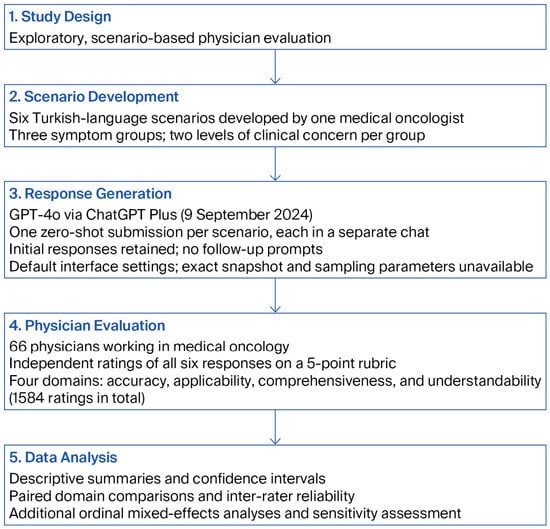
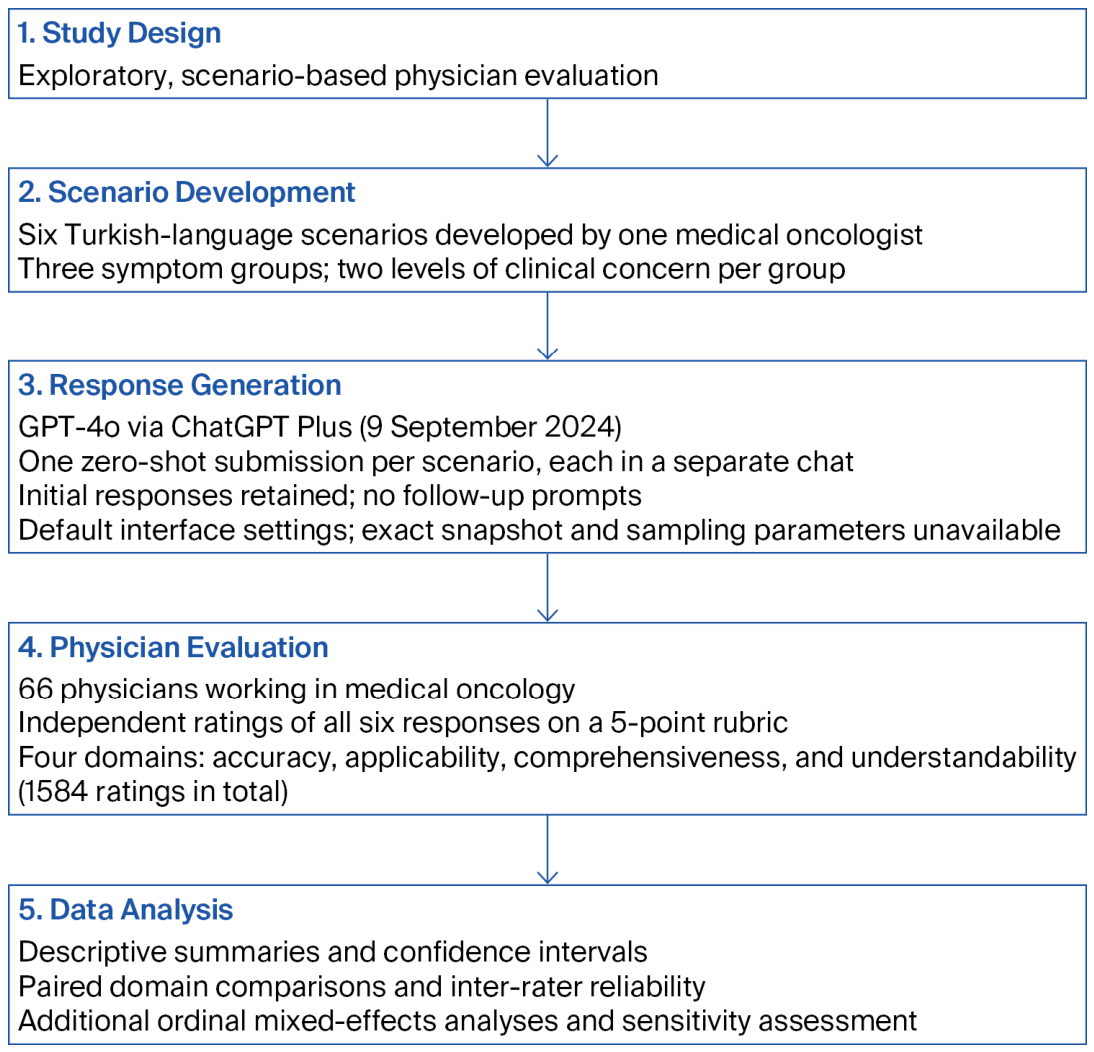
Ethical approval was obtained from the Akdeniz University Medical Scientific Research Ethics Committee (Approval number: TBAEK-568, Date: 5 September 2024). All participants were informed about the purpose of the study, and electronic informed consent was obtained before they proceeded to the evaluation form. All study procedures complied with the relevant guidelines and regulations and the Declaration of Helsinki. The study workflow is summarized in Figure 1.
Figure 1.
Study workflow from scenario development to physician evaluation and statistical analysis.
2.1. Case Scenarios for Home Care After Chemotherapy and ChatGPT-4o Responses
In this study, clinical scenarios were developed by a medical oncologist with expertise in chemotherapy-related supportive care, based on concerns encountered in routine clinical practice during the early post-chemotherapy home care period. The scenarios were formulated using patient-centered language, rather than in medical terminology, to reflect how patients typically express their concerns. The scenario set was selected to include three common symptom groups (nausea and vomiting, fever and infection-related symptoms, and diarrhea), with two scenarios per group intended to represent different levels of clinical concern (Supplementary Table S1). These six scenarios formed an exploratory set for describing physicians’ assessments of the corresponding ChatGPT responses. No independent panel review, pilot testing, formal content-validity assessment, or formal risk classification was performed.
The scenarios were submitted through the ChatGPT Plus interface using GPT-4o (OpenAI), with the default interface settings, on 9 September 2024. Each scenario was submitted once in a separate, independent chat session. Because the OpenAI application programming interface (API) was not used, the specific model snapshot and sampling parameters were not available to the researchers. GPT-4o was selected because it was the most recent general-purpose model available through the ChatGPT Plus interface at the time of data collection. The scenarios were written and submitted in Turkish, and the ChatGPT-4o responses were generated and evaluated also in Turkish.
The model’s initial responses were recorded verbatim without any additional guidance, follow-up questions, or word limits. Zero-shot prompting was used for all scenarios, and the chat history was cleared before each query to prevent in-context adaptation [41]. This prompting strategy enables evaluation without task-specific demonstrations or in-context examples, and is commonly used as a baseline in medical LLM studies [30,31]. It was selected to evaluate the model’s initial response to a patient-formulated query and to approximate how a patient without expertise in prompt engineering might use a publicly available chatbot. It also minimized researcher-guided optimization of the responses and provided a standardized baseline for evaluating the model’s unguided performance [29,31]. The original Turkish scenarios and ChatGPT-4o responses, together with their English translations, are provided in Supplementary Material S1.
2.2. Evaluator Characteristics and Data Collection Process
Before the evaluation, all participants received standardized written instructions defining each rubric criterion to support consistent interpretation. The evaluation panel consisted of physicians working in medical oncology, including residents and consultant-level physicians. Eligible participants were aged 30 years or older and had at least two years of clinical experience in chemotherapy-related patient care. Eligibility was assessed at the beginning of the online form. Only physicians who confirmed that they met all inclusion criteria, including being aged 30 years or older and having at least two years of clinical experience in chemotherapy-related patient care, were able to proceed to the evaluation section. All evaluation items were mandatory; therefore, only complete forms could be submitted.
The number of evaluators in rubric-based studies varies according to the scope of the assessment and the recruitment approach. Previous studies have used physician panels of varying sizes to evaluate LLM-generated responses [20,24,42]. In this study, participants were recruited using snowball sampling. Data collection was conducted using structured online evaluation forms created in Google Forms. The survey link was initially distributed by email to physicians working in medical oncology, who were also asked to share it with other potentially eligible colleagues in their professional networks. Because the link could be forwarded beyond the initial recipients, the total number of physicians who received the invitation could not be determined, and a conventional response rate could not be calculated. In addition, forms that were opened but not submitted were not recorded. A total of 66 eligible physicians working in medical oncology submitted complete evaluations, all of which were included in the final analysis.
Each evaluator independently assessed the ChatGPT-generated responses in terms of accuracy, applicability, comprehensiveness, and understandability using the online form, without discussion with other evaluators. No consensus or adjudication procedure was used to resolve differences between evaluators. All individual ratings were retained for analysis because the study aimed to describe independent physician assessments rather than to produce a consensus rating. Evaluators were informed that the responses had been generated by ChatGPT and were therefore not blinded to the response source.
2.3. Evaluation of ChatGPT Responses
The evaluation was conducted using a rubric-based assessment method. Each ChatGPT-generated response was independently scored by experts on a 5-point Likert scale (1 = lowest, 5 = highest) across predefined evaluation domains. Rubric-based evaluations are most often used in education, especially for grading written work. However, they are also widely used in research, and are increasingly applied in healthcare to allow clear and structured evaluation of complex outputs [20,42,43,44,45]. The selection of evaluation areas was made based on a detailed review of existing research on the evaluation of LLMs in healthcare [20,24,46]. Based on this review, four domains were defined for expert evaluation: accuracy, applicability, comprehensiveness, and understandability. These domains were selected to structure physicians’ judgments of the responses’ perceived medical correctness, practical relevance, coverage, and clarity in a post-chemotherapy home care context. Accuracy reflected the extent to which the response provided medically correct information regarding post-chemotherapy home care (1 = completely incorrect, 5 = completely correct). Applicability assessed how practical and patient-friendly the response was in a real-life home care setting (1 = not applicable, 5 = highly applicable). Comprehensiveness evaluated the breadth of issues addressed in the response (1 = addresses a single aspect, 5 = addresses multiple relevant aspects). Understandability measured whether the response was conveyed in language that could be easily understood by patients and caregivers (1 = not understandable, 5 = very understandable).
The domains were intended to distinguish medical correctness, practical relevance, breadth of coverage, and linguistic clarity. However, these aspects may overlap in physicians’ judgments: omitted information may influence both accuracy and comprehensiveness, while patient-friendliness may influence both applicability and understandability. These scores represented physicians’ judgments under the study rubric. No guideline-based reference answer or safety-specific checklist was used, and critical safety errors were not separately classified. Understandability ratings reflected physicians’ perceptions of clarity rather than directly measured patient comprehension.
Ratings of 4 or 5 were summarized descriptively as the “proportion of ratings ≥4,” following the convention used in previous studies [20,22,23,24]. This threshold was defined a priori as a descriptive summary measure. To summarize each evaluator’s ratings across the six scenarios while preserving the ordinal nature of the Likert-scale data, a domain-specific median score was calculated separately for accuracy, applicability, comprehensiveness, and understandability. These evaluator-level median domain scores were subsequently used in the overall comparisons among the four evaluation domains. Finally, the overall proportion of ratings ≥4 was calculated for each domain by aggregating the ratings across all six scenarios [20,22,23,24].
2.4. Statistics
Primary statistical analyses were performed using IBM SPSS Statistics version 26.0 (IBM Corp., Armonk, NY, USA). Categorical variables were summarized using numbers and percentages. Age was presented as mean ± standard deviation and median (minimum–maximum), whereas Likert-scale ratings and median domain scores were summarized using medians and minimum–maximum values. Primary comparisons across the four domains were based on each evaluator’s median ratings across the six scenarios. The Friedman test was used to account for the ordinal nature of the scores and the paired structure of the domain comparisons. Kendall’s W was calculated as the effect size. When the overall test was statistically significant, pairwise comparisons were performed using Wilcoxon signed-rank tests. Bonferroni correction was applied to the six pairwise comparisons, yielding a significance threshold of p < 0.0083. For each Wilcoxon comparison, the effect size was calculated as r = |Z|/√N, where N was the number of paired observations. Inter-rater reliability was assessed using single-measure and average-measure intraclass correlation coefficients (ICCs) based on a two-way random-effects model with an absolute-agreement definition and 95% confidence intervals (CIs). All tests were two-sided, with p < 0.05 considered statistically significant unless otherwise specified. Scenario-specific rating proportions were accompanied by 95% Wilson score CIs. For overall domain proportions across the six scenarios, percentile 95% CIs were calculated using 100,000 evaluator-level bootstrap resamples, retaining all six scenario ratings from each selected evaluator to preserve within-evaluator dependence. These intervals were conditional on the six selected scenarios. As an additional analysis, all individual 1–5 ratings were analyzed using a proportional-odds cumulative logit mixed-effects model, with the evaluation domain as a fixed effect and crossed random intercepts for evaluator and scenario. Estimation used maximum likelihood with a first-order Laplace approximation. Results were expressed as conditional cumulative odds ratios (ORs) with pointwise 95% Wald CIs; pairwise p values were Bonferroni-adjusted for six comparisons. Overall domain differences were assessed using a likelihood-ratio test. Random-intercept variances were reported, and convergence was evaluated using optimizer termination information, perturbed starting values, gradient magnitudes, and the observed Hessian. The proportional-odds assumption was assessed by comparison with a model allowing domain-specific ordered thresholds while retaining the same crossed random intercepts, using an approximate likelihood-ratio test with nine degrees of freedom. Threshold-specific estimates from this model were examined as a sensitivity analysis. Calculations used custom Python code with Python 3.12.14, NumPy 2.3.5, SciPy 1.17.0, and openpyxl 3.1.5. The code, numerical outputs, and reproduction instructions are provided in Supplementary Software S1. Claude Sonnet 5.5 (Anthropic, November 2026) was used in the creation of Figure 1 (visual layout and typography only, based on the authors’ original content). The authors reviewed and verified the final figure and take full responsibility for it.
3. Results
3.1. Characteristics of the Evaluators
A total of 66 physicians participated in the study. The mean age of the participants was 34.3 ± 4.2 years, with a median age of 34.0 years (range: 30.0–46 years). Of the evaluators, 32 (48.5%) were male and 34 (51.5%) were female. Participants included 30 residents (45.5%) and 36 consultant-level physicians (54.5%), comprising specialists, associate professors, and professors. The majority of participants (n = 60, 90.9%) reported having previously used ChatGPT, whereas six physicians (9.1%) indicated no prior experience with the platform.
3.2. Evaluation of ChatGPT’s Responses
The complete rating distributions and median scores are presented in Table 1. No ratings of 1 were assigned in Scenario 1, while, in the remaining scenarios, the percentage of ratings of 1 did not exceed 4.5% in any domain. Ratings of 2 were also infrequent, with percentages ranging from 3.0% to 9.1% across scenarios and evaluation domains. Median Likert scores were consistently high. For most scenario–domain combinations, the median score was 4.0, with minimum and maximum values ranging from 1.0 to 5.0. Higher median scores of 5.0 were observed for the understandability domain in several scenarios (S1, S2, and S3). In Scenario 6, the median score for understandability was 4.5 (Table 1).
Table 1.
Experts’ evaluation of ChatGPT’s answers to the scenarios: detailed distribution of physician ratings.
Scenario-specific proportions of ratings ≥4 and their 95% confidence intervals are presented in Table 2. These proportions ranged from 71.2% to 87.9% across scenarios and evaluation domains. Understandability had the highest proportion of ratings ≥4 in all scenarios except Scenario 1.
Table 2.
Proportions of physician ratings ≥4 by scenario and evaluation domain.
Overall evaluation results across the four domains are summarized in Table 3. When expert ratings were aggregated across all scenarios, the overall proportion of ratings ≥4 was 76.8% for accuracy, 77.0% for applicability, 73.7% for comprehensiveness, and 82.0% for understandability. The evaluator-level median domain scores were 4.0 for accuracy, 4.0 for applicability, 4.0 for comprehensiveness, and 4.5 for understandability (Table 3). The Friedman test demonstrated a statistically significant difference among the four evaluation domains (p < 0.001, Kendall’s W = 0.119). In the post hoc Wilcoxon signed-rank tests, using a Bonferroni-adjusted significance threshold of p < 0.0083, understandability scores were significantly higher than those for accuracy (p < 0.001, r = 0.429), applicability (p = 0.005, r = 0.345), and comprehensiveness (p = 0.002, r = 0.386). No statistically significant differences were found between accuracy and applicability (p = 0.087, r = 0.210), accuracy and comprehensiveness (p = 0.841, r = 0.025), or applicability and comprehensiveness (p = 0.200, r = 0.158).
Table 3.
Overall physician ratings across the four evaluation domains.
The overall single-measure ICC across the 24 scenario–domain combinations was 0.018 (95% CI: 0.008–0.041), whereas the corresponding average-measure ICC was 0.548 (95% CI: 0.353–0.739). Domain-specific single-measure ICCs ranged from −0.001 to 0.011, and average-measure ICCs ranged from −0.089 to 0.424. Complete results are presented in Table 4.
Table 4.
Inter-rater reliability of expert ratings overall and by evaluation domain.
Under the proportional-odds specification, the additional ordinal mixed-effects analysis of all 1,584 ratings, accounting for evaluator and scenario effects, identified an overall domain effect (likelihood-ratio χ2(3) = 68.97, p < 0.001). Understandability received higher ratings than accuracy (OR = 2.87, 95% CI: 2.11–3.91), applicability (OR = 2.01, 95% CI: 1.48–2.74), and comprehensiveness (OR = 3.25, 95% CI: 2.38–4.42); all three comparisons remained significant after Bonferroni correction (adjusted p < 0.001). Comprehensiveness received lower ratings than applicability (OR = 0.62, 95% CI: 0.46–0.83; adjusted p = 0.010). The remaining pairwise comparisons were not statistically significant after correction. The evaluator and scenario random-intercept variances were 6.510 and 0.037, respectively. The model converged with a maximum absolute gradient of 0.00093 and a positive-definite observed Hessian (minimum eigenvalue: 4.499). Negative log-likelihoods obtained from perturbed starting values differed by less than 0.000001. The model allowing domain-specific thresholds provided a better fit than the proportional-odds model (approximate likelihood-ratio χ2(9) = 17.69, p = 0.039). Threshold-specific estimates and full numerical diagnostics are provided in Supplementary Software S1.
4. Discussion
Patients frequently seek guidance for symptoms occurring at home after chemotherapy, while increasing patient numbers and clinical workloads may limit access to immediate individualized support. Previous oncology studies have primarily evaluated LLMs in tumor-specific knowledge, guideline-based treatment decisions, patient education, and multidisciplinary decision-making [33,34,35,36,37,38,39,47]. In contrast, the present study focused on patient-formulated questions concerning post-chemotherapy symptoms of varying severity and clinical urgency. To our knowledge, this is the first study to evaluate ChatGPT’s responses specifically in this context through a multidimensional assessment by physicians working in medical oncology. In addition, the inclusion of 66 physicians working in medical oncology represents one of the largest expert panels reported in similar scenario-based evaluations [20,24,46]. This broad participation provided a diverse range of physician perspectives and enabled a detailed description of rating patterns across the evaluation domains.
In the current study, expert ratings were predominantly favorable across the scenarios and evaluation domains. However, understandability received the highest ratings and was rated significantly higher than accuracy, applicability, and comprehensiveness; an additional ordinal mixed-effects analysis, which accounted for evaluator and scenario effects, also indicated higher understandability ratings. Comprehensiveness had the lowest overall proportion of ratings ≥4 (73.7%). The favorable assessment of understandability is consistent with previous studies reporting that ChatGPT can generate clear and accessible patient-facing health information [15,17,19]. This finding suggests that physicians perceived the evaluated responses as being clearly expressed; it does not establish patient or caregiver comprehension, which was not assessed, nor does it establish clinical accuracy or safety. By contrast, the comparatively lower comprehensiveness ratings may be related to the use of single, zero-shot queries without follow-up interaction or access to additional clinical context. Under these conditions, the model may provide a clearly expressed general response while omitting some clinically relevant details, such as warning signs, escalation thresholds, alternative explanations, or situation-specific recommendations. Thus, linguistic clarity should not be considered equivalent to clinical completeness.
Single-measure ICCs were close to zero, indicating the low reliability of individual physicians’ ratings despite the predominance of ratings ≥4. Average-measure ICCs, which reflect the reliability of the mean rating across all 66 evaluators rather than that of any single evaluator, were moderate overall (0.548 [95% CI, 0.353–0.739]), but were low, imprecise, and not statistically significant for applicability, comprehensiveness, and understandability. Because average-measure ICCs increase mechanically with the number of raters, they should not be interpreted as evidence of agreement between individual evaluators. ICC estimates can be influenced by restricted between-target variability [48,49], and only six scenarios were available for each domain-level analysis, which limits the precision of these estimates (as reflected in the wide confidence intervals); however, this does not establish that restricted variability explains the present findings. Differences in clinical expectations, ambiguity in the rubric, and overlap between domains may also have contributed. Accordingly, the reported percentages reflect physicians’ perceptions of the six evaluated responses and should not be interpreted as evidence of a stable expert consensus. The additional ordinal mixed-effects analysis accounts for evaluator and scenario effects but cannot establish guideline concordance or clinical safety without an objective clinical reference standard. The relatively large evaluator panel does not remove this limitation.
Favorable physician ratings alone do not establish clinical accuracy, comparative effectiveness, or suitability for use in patient care. Unlike a treating physician, the model in this study received only a brief patient-formulated question and had no access to the patient’s complete medical history, physical examination, laboratory and imaging results, pathology, comorbidities, treatment details, preferences, or multidisciplinary context. Therefore, even a fluent response may be incomplete or insufficiently individualized [14,50]. Overreliance on such responses may lead to inappropriate reassurance, delayed medical consultation, or incorrect self-management, particularly when users attribute to the model clinical reasoning or a certainty it cannot reliably provide [51]. Because these findings do not establish suitability for clinical use, further research is needed to determine whether the evaluated responses can safely support patient education or communication.
These types of scenarios (e.g., hypotension or dehydration, suspected neutropenic fever, signs of severe infection, or persistent diarrhea with risk of electrolyte imbalance) require more than simple symptom-based advice from LLMs. In such contexts, accurate triage thresholds, a safety-first approach, and guideline-consistent identification of warning signs are essential. This shifts the task from general text generation to clinical risk management, where the consequences of error are high. Previous studies in emergency and triage settings have shown that, although LLMs may provide appropriate urgency classification in some cases, their performance becomes less reliable in high-acuity situations. In particular, risks such as overconfidence, omission or misinterpretation of critical clinical information, and hallucinated content have been reported [52,53,54,55]. Hallucinations occur because LLMs generate plausible language without necessarily verifying factual accuracy, particularly when information is incomplete or poorly grounded [51,55]. Reported rates vary by model and task; hallucination rates of 1.47% in medical summarization and up to 9% for fabricated clinical guidelines have been reported [56,57]. Their clinical importance also varies. Minor errors may not affect management, whereas incorrect triage advice, missed warning signs, or inaccurate medication information may cause serious harm. Because such information can be presented confidently and fluently, patients may not recognize that it is incorrect. This is particularly concerning in urgent post-chemotherapy situations involving fever, suspected neutropenic infection, hypotension, dehydration, or persistent diarrhea. Potential safeguards include explicit prompts requiring uncertainty disclosure, structured outputs containing warning signs and triage thresholds, grounding responses in validated guidelines through retrieval-augmented generation, requiring verifiable citations, constraining unsupported responses, and systematic clinician verification [58,59]. However, citations should also be independently checked because LLMs may fabricate references.
From an applicability perspective, situations involving suspected infection, hypotension, dehydration, or persistent diarrhea require clear escalation guidance, explicit safety boundaries, and timely referral to emergency or oncology services. Incomplete or ambiguous referral advice may have important safety implications, even when other aspects of a response are rated favorably. Understandability received the highest ratings in this study; however, perceived clarity does not establish that urgent referral advice is sufficiently explicit or clinically appropriate. Our broad domain ratings did not separately identify or classify critical safety errors and should therefore not be interpreted as a guideline-based safety assessment. Future evaluations should complement domain ratings with predefined safety criteria addressing omitted, delayed, or ambiguous escalation advice. Although the previous literature has explored LLMs as supportive tools for patient education and communication [52,54,55], the present findings do not establish the safety of such use.
The prompting strategy should also be considered when interpreting these findings. Alternative strategies could have produced different results. Few-shot prompting may improve task alignment by providing examples, while structured prompting may encourage the inclusion of clinically relevant elements, such as warning signs, triage thresholds, and specific action steps. Similarly, role-based and chain-of-thought prompting may alter the framing, level of detail, and reasoning presented in the response. However, prompt engineering effects are task- and model-dependent, and more complex prompting does not necessarily improve every medical output [27,31,60]. Therefore, our findings describe physicians’ assessments of the six recorded outputs under the specified zero-shot conditions and do not establish consistency across repeated queries.
Model choice should also be considered when interpreting the findings. Comparative oncology studies have shown that performance varies across models and tasks. Claude 3.5 Sonnet outperformed ChatGPT-4o, Gemini 1.5, and Llama-3 on oncology examination questions, whereas GPT-4 performed better than earlier ChatGPT and Claude versions in breast cancer scenarios [61,62]. Other comparisons found that ChatGPT produced more comprehensive responses, while Gemini achieved greater accuracy in several cancer-related questions [63]. These findings indicate that similar performance cannot be assumed for other contemporary LLMs, because relative performance depends on the model, task, clinical domain, and evaluation period. Moreover, the rapid evolution of LLMs limits the temporal generalizability of evaluations based on a single model version [64]. The distinction between proprietary and open-weight models is also relevant to patient-facing health communication. Proprietary models such as GPT-4o are easily accessible to patients and caregivers, but their internal processes and updates are not fully transparent, which may affect reproducibility and the consistency of health information over time. Open-weight or locally deployed models may offer greater control over privacy, model configuration, and adaptation to specific languages or healthcare settings [65,66]. However, medical-domain specialization does not necessarily ensure better patient-facing performance. For example, a recent comparison found that MedGemma 27B did not outperform a guideline-integrated general-purpose model, although the models differed in access to external information [67].
This study has several notable strengths. First, it included a relatively large number of evaluators (n = 66), which is higher than in most comparable scenario-based evaluations of LLMs, and provided a broad range of physician perspectives. Second, the clinical scenarios were developed using patient-centered language, rather than formal medical terminology, to reflect how patients and caregivers typically express concerns during the post-chemotherapy home care period. Third, the multidimensional rubric structured physicians’ assessments across accuracy, applicability, comprehensiveness, and understandability. These ratings described perceived response quality.
This study has several limitations that should be acknowledged. First, the evaluation was based solely on physician assessments; patient- or caregiver-based evaluations were not included. In particular, understandability and practical usefulness could have been assessed in parallel from the patient perspective. No guideline-based reference answers, independent safety assessment, or blinded comparator responses were included. Critical safety errors, including potentially harmful advice, failure to recognize oncological emergencies, and omitted or ambiguous urgent referral advice, were not separately assessed or classified. Consequently, the ratings do not establish guideline concordance, the absence of clinically important omissions, or comparative effectiveness. The proportion of ratings ≥4 summarizes perceived response quality rather than clinical adequacy, and a rating of 4 does not exclude deficiencies. Patient comprehension, self-management behavior, delays in seeking care, and clinical outcomes were not measured. The rubric was not independently validated, and the distinctness of its four domains was not established. Overlap between domains may have affected score interpretation; therefore, differences between domain ratings should not be interpreted as comparisons of fully independent constructs. Very low single-measure ICCs also limit interpretation of the ratings as an expert consensus; restricted score variation may have contributed, but does not exclude inconsistent rubric interpretation. The model comparison indicated evidence against the proportional-odds assumption; therefore, the common ORs should be interpreted cautiously as exploratory estimates alongside the threshold-specific sensitivity results. The snowball sampling approach may have introduced self-selection bias and limited the representativeness of the evaluator sample. Because the total number of invitations and unsubmitted forms could not be determined, the response rate and pre-submission attrition could not be calculated; moreover, exact years of oncology experience and institutional affiliations were not collected. Evaluators were not blinded to the response source, and 90.9% reported prior ChatGPT use. Their familiarity with and prior perceptions of ChatGPT may therefore have influenced the ratings; this potential bias was not directly assessed or controlled. In addition, all evaluations were based on Turkish-language responses. Therefore, the findings, particularly those concerning understandability, may be language-specific and should not be generalized directly to outputs generated in other languages. Second, the scenarios were developed by a single medical oncologist, without independent panel review, pilot testing, or formal content-validity assessment, which may limit their content validity and representativeness. Third, the six scenarios formed a limited, exploratory set that did not cover the full spectrum of chemotherapy-related toxicities, and the findings should not be generalized to other symptoms, to all oncological conditions, or to broader cancer care contexts. Fourth, only GPT-4o was evaluated, and the findings may not generalize to other proprietary, open-weight, or medical-domain models. Moreover, because GPT-4o was accessed through the ChatGPT Plus interface on 9 September 2024, the exact model snapshot and sampling parameters were unavailable, and the results may not be reproducible with later model updates. This limits exact reproducibility, while subsequent model updates may reduce the relevance of these findings to current or future versions of ChatGPT. Only zero-shot prompting and the initial response to each scenario were evaluated. Repeated queries or alternative prompting strategies may produce different responses; therefore, response variability and stability could not be assessed. Future studies should compare different models, model versions, and prompting strategies using repeated independent queries. Finally, the predefined, non-interactive scenarios did not assess follow-up questioning, longitudinal use, or real-time patient–AI interaction.
5. Conclusions
In this study, oncologists generally rated ChatGPT-4o-generated advice for post-chemotherapy symptom management favorably, with most ratings at 4 or 5 across the four domains. However, agreement between individual evaluators was low, and the ratings reflect perceived response quality rather than guideline-based clinical safety. Because only six scenarios and a single model version were evaluated, and no patient outcomes were assessed, these findings do not establish suitability for clinical use. These findings are specific to the GPT-4o responses obtained in September 2024 and should not be generalized to newer model versions. Further research using guideline-based safety criteria, broader scenario sets developed through multidisciplinary consensus and independent content validation, and patient-centered outcomes is needed to determine whether such responses can safely support patient education or communication.
Supplementary Materials
The following supporting information can be downloaded at https://www.mdpi.com/article/10.3390/healthcare14234065/s1. Table S1: Summary of Patient-Centered Case Scenarios for Home Care After Chemotherapy; Supplementary Material S1: Verbatim ChatGPT-4o responses to the six clinical scenarios; Supplementary Software S1: Python code, data, numerical outputs, and reproduction instructions for the ordinal mixed-effects analysis.
Author Contributions
Conceptualization, E.A.K. and D.Y.; methodology, E.A.K. and D.Y.; validation, D.Y.; formal analysis, E.A.K. and D.Y.; investigation, E.A.K.; data curation, E.A.K.; writing—original draft preparation, E.A.K. and D.Y.; writing—review and editing, E.A.K. and D.Y.; supervision, D.Y.; project administration, D.Y. All authors have read and agreed to the published version of the manuscript.
Funding
This research received no external funding.
Institutional Review Board Statement
The study was conducted in accordance with the Declaration of Helsinki and approved by the Akdeniz University Medical Scientific Research Ethics Committee (approval number: TBAEK-568; date of approval: 5 September 2024).
Informed Consent Statement
Electronic informed consent was obtained from all participants involved in the study.
Data Availability Statement
The de-identified data supporting the findings of this study are available from the corresponding author upon reasonable request, subject to institutional and ethical approval requirements.
Acknowledgments
The authors thank all physicians who participated in the expert evaluation for their time and contributions to this study.
Conflicts of Interest
The authors declare no conflicts of interest.
Abbreviations
| API | Application programming interface |
| CI | Confidence interval |
| ICC | Intraclass correlation coefficient |
| LLM | Large language model |
References
- Li, Q.; Yang, L.; Wang, N.; Shi, W.; Luo, L.; Chen, H.; Wang, G. Home-based symptom management for patients with malignant lymphoma undergoing intermittent chemotherapy: A prospective observational study using network analysis. Asia Pac. J. Oncol. Nurs. 2025, 12, 100683. [Google Scholar] [CrossRef] [Scilit] [PubMed]
- Witwaranukool, P.; Phonyiam, R.; Wu, Y.; Kynoch, K. Experiences and perceptions of patients with cancer receiving home-based chemotherapy: A qualitative systematic review protocol. Syst. Rev. 2024, 13, 242. [Google Scholar] [CrossRef] [Scilit] [PubMed]
- Akdogan, O.; Uyar, G.C.; Yesilbas, E.; Baskurt, K.; Malkoc, N.A.; Ozdemir, N.; Yazici, O.; Oksuzoglu, B.; Uner, A.; Ozet, A.; et al. Effect of a ChatGPT-based digital counseling intervention on anxiety and depression in patients with cancer: A prospective, randomized trial. Eur. J. Cancer 2025, 221, 115408. [Google Scholar] [CrossRef] [Scilit] [PubMed]
- Yu, Y.; Shi, Y.; Yang, E.; Gahn, K.; Mason, H.; Jiang, Y.; Gong, Y. Enhancing Patient Medication Safety at Home: A Patient-Facing Technology Architecture Integrating REDCap, Visualization Dashboards, and an AI- Driven Chatbot. AMIA Annu. Symp. Proc. 2024, 2024, 1284–1293. [Google Scholar] [PubMed]
- Laymouna, M.; Ma, Y.; Lessard, D.; Schuster, T.; Engler, K.; Lebouché, B. Roles, Users, Benefits, and Limitations of Chatbots in Health Care: Rapid Review. J. Med. Internet Res. 2024, 26, e56930. [Google Scholar] [CrossRef] [Scilit] [PubMed]
- Yau, J.Y.; Saadat, S.; Hsu, E.; Murphy, L.S.; Roh, J.S.; Suchard, J.; Tapia, A.; Wiechmann, W.; Langdorf, M.I. Accuracy of Prospective Assessments of 4 Large Language Model Chatbot Responses to Patient Questions About Emergency Care: Experimental Comparative Study. J. Med. Internet Res. 2024, 26, e60291. [Google Scholar] [CrossRef] [Scilit] [PubMed]
- Dave, T.; Athaluri, S.A.; Singh, S. ChatGPT in medicine: An overview of its applications, advantages, limitations, future prospects, and ethical considerations. Front. Artif. Intell. 2023, 6, 1169595. [Google Scholar] [CrossRef] [Scilit] [PubMed]
- Iqbal, U.; Tanweer, A.; Rahmanti, A.R.; Greenfield, D.; Lee, L.T.-J.; Li, Y.-C.J. Impact of large language model (ChatGPT) in healthcare: An umbrella review and evidence synthesis. J. Biomed. Sci. 2025, 32, 45. [Google Scholar] [CrossRef] [Scilit] [PubMed]
- Busch, F.; Hoffmann, L.; Rueger, C.; van Dijk, E.H.C.; Kader, R.; Ortiz-Prado, E.; Makowski, M.R.; Saba, L.; Hadamitzky, M.; Kather, J.N.; et al. Current applications and challenges in large language models for patient care: A systematic review. Commun. Med. 2025, 5, 26. [Google Scholar] [CrossRef] [Scilit] [PubMed]
- Xie, Q.; Chen, Q.; Chen, A.; Peng, C.; Hu, Y.; Lin, F.; Peng, X.; Huang, J.; Zhang, J.; Keloth, V.; et al. Medical foundation large language models for comprehensive text analysis and beyond. npj Digit. Med. 2025, 8, 141. [Google Scholar] [CrossRef] [Scilit] [PubMed]
- Ding, H.; Xia, W.; Zhou, Y.; Wei, L.; Feng, Y.; Wang, Z.; Song, X.; Li, R.; Mao, Q.; Chen, B.; et al. Evaluation and practical application of prompt-driven ChatGPTs for EMR generation. npj Digit. Med. 2025, 8, 77. [Google Scholar] [CrossRef] [Scilit]
- Bartels, S.; Carus, J. From text to data: Open-source large language models in extracting cancer related medical attributes from German pathology reports. Int. J. Med. Inform. 2025, 203, 106022. [Google Scholar] [CrossRef] [Scilit] [PubMed]
- Sandmann, S.; Hegselmann, S.; Fujarski, M.; Bickmann, L.; Wild, B.; Eils, R.; Varghese, J. Benchmark evaluation of DeepSeek large language models in clinical decision-making. Nat. Med. 2025, 31, 2546–2549. [Google Scholar] [CrossRef] [Scilit] [PubMed]
- Chen, X.; Xiang, J.; Lu, S.; Liu, Y.; He, M.; Shi, D. Evaluating large language models and agents in healthcare: Key challenges in clinical applications. Intell. Med. 2025, 5, 151–163. [Google Scholar] [CrossRef] [Scilit]
- Alamleh, S.; Mavedatnia, D.; Francis, G.; Le, T.; Davies, J.; Lin, V.; Lee, J.J.W. Readability, Reliability, and Quality Analysis of Internet-Based Patient Education Materials and Large Language Models on Meniere’s Disease. J. Otolaryngol. Head Neck Surg. 2025, 54, 19160216251360651. [Google Scholar] [CrossRef] [Scilit] [PubMed]
- Hones, K.; Krisanda, E.; Chim, H. Caution Regarding ChatGPT’s Appropriateness and Reliability Regarding Surgery for Wrist Arthritis. Hand 2025, 20, 910–916. [Google Scholar] [CrossRef] [Scilit] [PubMed]
- Lee, M.J.; Cadiente, A.; Chen, J.; Zhou, Y.; Greenwald, B.D. An evaluation of the reliability and readability of large language models in the dissemination of traumatic brain injury information. Digit. Health 2025, 11, 20552076251350760. [Google Scholar] [CrossRef] [Scilit] [PubMed]
- Gomaa, S.; Posey, J.; Bashir, B.; Basu Mallick, A.; Vanderklok, E.; Schnoll, M.; Zhan, T.; Wen, K.Y. Feasibility of a Text Messaging-Integrated and Chatbot-Interfaced Self-Management Program for Symptom Control in Patients With Gastrointestinal Cancer Undergoing Chemotherapy: Pilot Mixed Methods Study. JMIR Form. Res. 2023, 7, e46128. [Google Scholar] [CrossRef] [Scilit] [PubMed]
- Fazilat, A.Z.; Brenac, C.; Kawamoto-Duran, D.; Berry, C.E.; Alyono, J.; Chang, M.T.; Liu, D.T.; Patel, Z.M.; Tringali, S.; Wan, D.C.; et al. Evaluating the quality and readability of ChatGPT-generated patient-facing medical information in rhinology. Eur. Arch. Otorhinolaryngol. 2025, 282, 1911–1920. [Google Scholar] [CrossRef] [Scilit] [PubMed]
- Yapar, D.; Demir Avcı, Y.; Tokur Sonuvar, E.; Eğerci, Ö.F.; Yapar, A. ChatGPT’s potential to support home care for patients in the early period after orthopedic interventions and enhance public health. Jt. Dis. Relat. Surg. 2024, 35, 169–176. [Google Scholar] [CrossRef] [Scilit] [PubMed]
- Hancı, V.; Ergün, B.; Gül, Ş.; Uzun, Ö.; Erdemir, İ.; Hancı, F.B. Assessment of readability, reliability, and quality of ChatGPT®, BARD®, Gemini®, Copilot®, Perplexity® responses on palliative care. Medicine 2024, 103, e39305. [Google Scholar] [CrossRef] [Scilit] [PubMed]
- Çelik, G.; Hekim, H.H.; Filiz, M.B.; Toraman, N.F. Evaluating the performance of ChatGPT in responding to myotonic dystrophy type 1 patient inquiries: A specialist physician-based study. BMC Neurol. 2026, 26, 471. [Google Scholar] [CrossRef] [Scilit] [PubMed]
- Çelik, G.; Hekim, H.H.; Filiz, M.B.; Toraman, N.F.; Yapar, D. Can ChatGPT provide reliable guidance to families of children with Duchenne Muscular Dystrophy? A dual perspective of parents and experts. BMC Pediatr. 2026, 26, 862. [Google Scholar] [CrossRef] [Scilit] [PubMed]
- Yaş, S.; Yapar, D.; Yapar, A.; Özel, T.; Tokgöz, M.A.; Baymurat, A.C.; Şenköylü, A. Assessing the role of large language models in adolescent idiopathic scoliosis care: A comparison between ChatGPT and Google Gemini. Acta Orthop. Traumatol. Turc. 2025, 59, 222–229. [Google Scholar] [CrossRef] [Scilit]
- Jeon, S.; Kim, H.-K. A comparative evaluation of chain-of-thought-based prompt engineering techniques for medical question answering. Comput. Biol. Med. 2025, 196, 110614. [Google Scholar] [CrossRef] [Scilit]
- Liu, J.; Liu, F.; Wang, C.-Y.; Liu, S. Prompt Engineering in Clinical Practice: Tutorial for Clinicians. J. Med. Internet Res. 2025, 27, e72644. [Google Scholar] [CrossRef] [Scilit]
- Maharjan, J.; Garikipati, A.; Singh, N.; Cyrus, L.; Sharma, M.; Ciobanu, M.; Barnes, G.; Thapa, R.; Mao, Q.; Das, R. OpenMedLM: Prompt engineering can out-perform fine-tuning in medical question-answering with open-source large language models. Sci. Rep. 2024, 14, 14156. [Google Scholar] [CrossRef] [Scilit] [PubMed]
- Singhal, K.; Tu, T.; Gottweis, J.; Sayres, R.; Wulczyn, E.; Amin, M.; Hou, L.; Clark, K.; Pfohl, S.; Cole-Lewis, H.; et al. Toward expert-level medical question answering with large language models. Nat. Med. 2025, 31, 943–950. [Google Scholar] [CrossRef] [Scilit] [PubMed]
- Li, J.; Deng, Y.; Sun, Q.; Zhu, J.; Tian, Y.; Li, J.-S.; Zhu, T. Benchmarking Large Language Models in Evidence-Based Medicine. IEEE J. Biomed. Health Inform. 2024, 29, 6143–6156. [Google Scholar] [CrossRef] [Scilit]
- Naliyatthaliyazchayil, P.; Muthyala, R.; Gichoya, J.; Purkayastha, S. Evaluating the Reasoning Capabilities of Large Language Models for Medical Coding and Hospital Readmission Risk Stratification: Zero-Shot Prompting Approach. J. Med. Internet Res. 2025, 27, e74142. [Google Scholar] [CrossRef] [Scilit] [PubMed]
- Sivarajkumar, S.; Kelley, M.; Samolyk-Mazzanti, A.; Visweswaran, S.; Wang, Y.-S. An Empirical Evaluation of Prompting Strategies for Large Language Models in Zero-Shot Clinical Natural Language Processing: Algorithm Development and Validation Study. JMIR Med. Inform. 2024, 12, e55318. [Google Scholar] [CrossRef] [Scilit] [PubMed]
- Zaghir, J.; Naguib, M.; Bjelogrlic, M.; Névéol, A.; Tannier, X.; Lovis, C. Prompt Engineering Paradigms for Medical Applications: Scoping Review. J. Med. Internet Res. 2024, 26, e60501. [Google Scholar] [CrossRef] [Scilit] [PubMed]
- Hao, Y.; Qiu, Z.; Holmes, J.; Löckenhoff, C.E.; Liu, W.; Ghassemi, M.; Kalantari, S. Large language model integrations in cancer decision-making: A systematic review and meta-analysis. npj Digit. Med. 2025, 8, 450. [Google Scholar] [CrossRef] [Scilit] [PubMed]
- Kaiser, K.N.; Hughes, A.J.; Yang, A.D.; Mohanty, S.; Maatman, T.K.; Gonzalez, A.A.; Patzer, R.E.; Bilimoria, K.Y.; Ellis, R.J. Use of large language models as clinical decision support tools for management pancreatic adenocarcinoma using National Comprehensive Cancer Network guidelines. Surgery 2025, 182, 109267. [Google Scholar] [CrossRef] [Scilit] [PubMed]
- Kaiser, K.N.; Hughes, A.J.; Yang, A.D.; Turk, A.A.; Mohanty, S.; Gonzalez, A.A.; Patzer, R.E.; Bilimoria, K.Y.; Ellis, R.J. Accuracy and consistency of publicly available Large Language Models as clinical decision support tools for the management of colon cancer. J. Surg. Oncol. 2024, 130, 1104–1110. [Google Scholar] [CrossRef] [Scilit] [PubMed]
- Li, C.-P.; Kalisa, A.T.; Roohani, S.; Hummedah, K.; Menge, F.; Reißfelder, C.; Albertsmeier, M.; Kasper, B.; Jakob, J.; Yang, C. The imitation game: Large language models versus multidisciplinary tumor boards: Benchmarking AI against 21 sarcoma centers from the ring trial. J. Cancer Res. Clin. Oncol. 2025, 151, 248. [Google Scholar] [CrossRef] [Scilit] [PubMed]
- Lorenzi, A.; Pugliese, G.; Maniaci, A.; Lechien, J.R.; Allevi, F.; Boscolo-Rizzo, P.; Vaira, L.A.; Saibene, A.M. Reliability of large language models for advanced head and neck malignancies management: A comparison between ChatGPT 4 and Gemini Advanced. Eur. Arch. Oto-Rhino-Laryngol. 2024, 281, 5001–5006. [Google Scholar] [CrossRef] [Scilit] [PubMed]
- Longwell, J.B.; Hirsch, I.; Binder, F.; Gonzalez Conchas, G.A.; Mau, D.; Jang, R.; Krishnan, R.G.; Grant, R.C. Performance of Large Language Models on Medical Oncology Examination Questions. JAMA Netw. Open 2024, 7, e2417641. [Google Scholar] [CrossRef] [Scilit] [PubMed]
- Sorin, V.; Klang, E.; Sklair-Levy, M.; Cohen, I.; Zippel, D.B.; Balint Lahat, N.; Konen, E.; Barash, Y. Large language model (ChatGPT) as a support tool for breast tumor board. npj Breast Cancer 2023, 9, 44. [Google Scholar] [CrossRef] [Scilit] [PubMed]
- Chen, D.; Avison, K.; Alnassar, S.; Huang, R.S.; Raman, S. Medical accuracy of artificial intelligence chatbots in oncology: A scoping review. Oncologist 2025, 30, oyaf038. [Google Scholar] [CrossRef] [Scilit] [PubMed]
- Kojima, T.; Gu, S.S.; Reid, M.; Matsuo, Y.; Iwasawa, Y. Large language models are zero-shot reasoners. Adv. Neural Inf. Process. Syst. 2022, 35, 22199–22213. [Google Scholar] [CrossRef] [Scilit]
- Güneş Aydemir, N.; Yapar, D.; Demir Avcı, Y.; Sonuvar, E.T.; Aydemir, A.M. Large language models’ performance in answering common patient questions about colonoscopy: An expert-based evaluation. BMC Gastroenterol. 2026, 26, 605. [Google Scholar] [CrossRef] [Scilit] [PubMed]
- Chen, X.; Acosta, S.; Barry, A.E. Machine or Human? Evaluating the Quality of a Language Translation Mobile App for Diabetes Education Material. JMIR Diabetes 2017, 2, e13. [Google Scholar] [CrossRef] [Scilit] [PubMed]
- Khanna, R.R.; Karliner, L.S.; Eck, M.; Vittinghoff, E.; Koenig, C.J.; Fang, M.C. Performance of an online translation tool when applied to patient educational material. J. Hosp. Med. 2011, 6, 519–525. [Google Scholar] [CrossRef] [Scilit] [PubMed]
- Moskal, B.M.; Leydens, J.A. Scoring rubric development: Validity and reliability. Pract. Assess. Res. Eval. 2000, 7, 10. [Google Scholar] [CrossRef]
- Tam, T.Y.C.; Sivarajkumar, S.; Kapoor, S.; Stolyar, A.V.; Polanska, K.; McCarthy, K.R.; Osterhoudt, H.; Wu, X.; Visweswaran, S.; Fu, S.; et al. A framework for human evaluation of large language models in healthcare derived from literature review. npj Digit. Med. 2024, 7, 258. [Google Scholar] [CrossRef] [Scilit] [PubMed]
- Yalamanchili, A.; Sengupta, B.; Song, J.; Lim, S.; Thomas, T.O.; Mittal, B.B.; Abazeed, M.E.; Teo, P.T. Quality of Large Language Model Responses to Radiation Oncology Patient Care Questions. JAMA Netw. Open 2024, 7, e244630. [Google Scholar] [CrossRef] [Scilit] [PubMed]
- Koo, T.K.; Li, M.Y. A Guideline of Selecting and Reporting Intraclass Correlation Coefficients for Reliability Research. J. Chiropr. Med. 2016, 15, 155–163, Correction in J. Chiropr. Med. 2017, 16, 346. [Google Scholar] [CrossRef] [Scilit] [PubMed]
- Trevethan, R. Intraclass correlation coefficients: Clearing the air, extending some cautions, and making some requests. Health Serv. Outcomes Res. Methodol. 2017, 17, 127–143. [Google Scholar] [CrossRef] [Scilit]
- Reddy, S. Evaluating large language models for use in healthcare: A framework for translational value assessment. Inform. Med. Unlocked 2023, 41, 101304. [Google Scholar] [CrossRef] [Scilit]
- Bélisle-Pipon, J.-C. Why we need to be careful with LLMs in medicine. Front. Med. 2024, 11, 1495582. [Google Scholar] [CrossRef] [Scilit] [PubMed]
- Gaber, F.; Shaik, M.; Allega, F.; Bilecz, A.J.; Busch, F.; Goon, K.; Franke, V.; Akalin, A. Evaluating large language model workflows in clinical decision support for triage and referral and diagnosis. npj Digit. Med. 2025, 8, 263. [Google Scholar] [CrossRef] [Scilit]
- Kaboudi, N.; Firouzbakht, S.; Shahir Eftekhar, M.; Fayazbakhsh, F.; Joharivarnoosfaderani, N.; Ghaderi, S.; Dehdashti, M.; Mohtasham Kia, Y.; Afshari, M.; Vasaghi-Gharamaleki, M.; et al. Diagnostic Accuracy of ChatGPT for Patients’ Triage; a Systematic Review and Meta-Analysis. Arch. Acad. Emerg. Med. 2024, 12, e60. [Google Scholar] [CrossRef] [Scilit]
- Kim, J.H.; Kim, S.K.; Choi, J.; Lee, Y. Reliability of ChatGPT for performing triage task in the emergency department using the Korean Triage and Acuity Scale. Digit. Health 2024, 10, 20552076241227132. [Google Scholar] [CrossRef] [Scilit] [PubMed]
- Roustan, D.; Bastardot, F. The Clinicians’ Guide to Large Language Models: A General Perspective With a Focus on Hallucinations. Interact. J. Med. Res. 2025, 14, e59823. [Google Scholar] [CrossRef] [Scilit] [PubMed]
- Asgari, E.; Montaña-Brown, N.; Dubois, M.; Khalil, S.; Balloch, J.; Yeung, J.A.; Pimenta, D. A framework to assess clinical safety and hallucination rates of LLMs for medical text summarisation. npj Digit. Med. 2025, 8, 274. [Google Scholar] [CrossRef] [Scilit] [PubMed]
- van Kessel, R.; Anderson, M.; McMillan, B.; Matthews, M.R.; Rust, P.; Pearcy, P.; Nasir, K.; Mossialos, E. Omission and hallucination prevalence of clinical guidelines in diagnostic large language model outputs. BMJ Health Care Inform. 2026, 33, e101959. [Google Scholar] [CrossRef] [Scilit] [PubMed]
- Basu, S.; Huynh, B. Mitigating hallucinations in healthcare AI: A systematic review of evidence-based strategies. BMC Health Serv. Res. 2026, 26, 1115. [Google Scholar] [CrossRef] [Scilit] [PubMed]
- Miao, J.; Thongprayoon, C.; Suppadungsuk, S.; Garcia Valencia, O.A.; Cheungpasitporn, W. Integrating Retrieval-Augmented Generation with Large Language Models in Nephrology: Advancing Practical Applications. Medicina 2024, 60, 445. [Google Scholar] [CrossRef] [Scilit] [PubMed]
- Sonoda, Y.; Kurokawa, R.; Hagiwara, A.; Asari, Y.; Fukushima, T.; Kanzawa, J.; Gonoi, W.; Abe, O. Structured clinical reasoning prompt enhances LLM’s diagnostic capabilities in diagnosis please quiz cases. Jpn. J. Radiol. 2024, 43, 586–592. [Google Scholar] [CrossRef] [Scilit] [PubMed]
- Deng, L.; Wang, T.; Zhang, Y.; Zhai, Z.; Tao, W.; Li, J.; Zhao, Y.; Luo, S.; Xu, J. Evaluation of large language models in breast cancer clinical scenarios: A comparative analysis based on ChatGPT-3.5, ChatGPT-4.0, and Claude2. Int. J. Surg. 2024, 110, 1941–1950. [Google Scholar] [CrossRef] [Scilit] [PubMed]
- Erdat, E.C.; Kavak, E.E. Benchmarking LLM chatbots’ oncological knowledge with the Turkish Society of Medical Oncology’s annual board examination questions. BMC Cancer 2025, 25, 197. [Google Scholar] [CrossRef] [Scilit] [PubMed]
- He, Z.; Zhao, L.; Li, G.; Wang, J.; Cai, S.; Tu, P.; Chen, J.; Wu, J.; Zhang, J.; Chen, R.; et al. Comparative performance evaluation of large language models in answering esophageal cancer-related questions: A multi-model assessment study. Front. Digit. Health 2025, 7, 1670510, Correction in Front. Digit. Health. 2025, 7, 1670510. [Google Scholar] [CrossRef] [Scilit] [PubMed]
- Qiu, Z.; Jiang, A.; Qi, C.; Gan, W.; Zhu, L.; Mou, W.; Zeng, D.; Xiao, M.; Chu, G.; Peng, S.; et al. Temporal evolution of large language models (LLMs) in oncology. J. Transl. Med. 2025, 23, 1219. [Google Scholar] [CrossRef] [Scilit] [PubMed]
- Buhr, C.R.; Ernst, B.P.; Blaikie, A.; Smith, H.; Kelsey, T.; Matthias, C.; Fleischmann, M.; Jungmann, F.; Alt, J.; Brandts, C.; et al. Assessment of decision-making with locally run and web-based large language models versus human board recommendations in otorhinolaryngology, head and neck surgery. Eur. Arch. Oto-Rhino-Laryngol. 2025, 282, 1593–1607. [Google Scholar] [CrossRef] [Scilit] [PubMed]
- Griewing, S.; Lechner, F.; Gremke, N.; Lukac, S.; Janni, W.; Wallwiener, M.; Wagner, U.; Hirsch, M.; Kuhn, S. Proof-of-concept study of a small language model chatbot for breast cancer decision support—A transparent, source-controlled, explainable and data-secure approach. J. Cancer Res. Clin. Oncol. 2024, 150, 451. [Google Scholar] [CrossRef] [Scilit] [PubMed]
- Farzaliyeva, A.; Ramazanoglu, M.N.; Oguz, A.; Altundag, O.; Akcali, Z. Assessment of Large Language Models in Colorectal Cancer Multidisciplinary Tumor Board Decision-Making: A Retrospective Single-Center Comparison of Guideline-Integrated General-Purpose vs. Domain-Specialized Models. Curr. Oncol. 2026, 33, 309. [Google Scholar] [CrossRef] [Scilit] [PubMed]

Disclaimer/Publisher’s Note: The statements, opinions and data contained in all publications are solely those of the individual author(s) and contributor(s) and not of MDPI and/or the editor(s). MDPI and/or the editor(s) disclaim responsibility for any injury to people or property resulting from any ideas, methods, instructions or products referred to in the content. |
© 2026 by the authors. Licensee MDPI, Basel, Switzerland. This article is an open access article distributed under the terms and conditions of the Creative Commons Attribution (CC BY) license.