


Abstract
Background/Objectives: Type D personality traits have been studied in relation to glycaemic control, while their association with perceived spiritual care needs remains less well understood. This study examined whether glycated hemoglobin (HbA1c) statistically accounted for the association between the Type D Scale-14 (DS14) total score and spiritual care needs in adults with type 2 diabetes. Methods: This cross-sectional, descriptive correlational study included 300 adults receiving pharmacological treatment for type 2 diabetes. Questionnaires were administered face to face, and HbA1c values were obtained from recorded routine-care laboratory results. Regression-based path analysis using 10,000 bootstrap samples estimated the statistical indirect association. Exploratory analyses examined negative affectivity and social inhibition. Results: DS14 total scores were positively correlated with HbA1c (r = 0.178, p = 0.002) and spiritual care needs (r = 0.341, p < 0.001). HbA1c was not significantly correlated with spiritual care needs (r = 0.042, p = 0.464). The direct association between DS14 total scores and spiritual care needs remained statistically significant (standardised coefficient = 0.345, p < 0.001), whereas the HbA1c-to-spiritual-care-needs path was not (standardised coefficient = −0.019, p = 0.734). The standardised indirect association was −0.003 (95% bootstrap confidence interval, −0.025 to 0.020). In exploratory adjusted analyses, negative affectivity was associated with spiritual care needs, whereas the additional association of social inhibition and its interaction with negative affectivity were not statistically supported for the total score. Conclusions: The hypothesised statistical indirect association through HbA1c was not supported. The findings distinguish glycaemic status from patient-reported spiritual care needs and support attention to both within person-centred nursing assessment; the cross-sectional design does not establish causal mediation.
1. Introduction
Diabetes mellitus represents a major global public health challenge owing to its increasing prevalence, serious complications, and substantial burden on individuals and healthcare systems [1]. Worldwide, more than 830 million people were living with diabetes in 2022, while the International Diabetes Federation estimated that 589 million adults aged 20–79 years were living with diabetes in 2024 [1,2]. These estimates concern diabetes overall, not type 2 diabetes alone. Type 2 diabetes, the predominant form, requires ongoing treatment, self-management, and monitoring. HbA1c reflects average glycaemic status over approximately the preceding 2–3 months and is used in routine diabetes care [3]. Comprehensive diabetes care encompasses psychological and social well-being alongside glycaemic management [4]. In this context, the present study found that more pronounced Type D personality traits were associated with greater perceived spiritual care needs in adults with type 2 diabetes, whereas the hypothesised statistical indirect association through HbA1c was not supported.
The relevance of social determinants to diabetes care is also reflected in studies conducted in Türkiye. In a retrospective study of 503 adults with type 2 diabetes, Yalcin et al. found that lower educational attainment was associated with several diabetes-related complications, including retinopathy, neuropathy, and coronary artery disease [5]. In a rural primary-care sample of 201 adults, Gezer et al. reported greater diabetes-related stigma among participants with very low income; moderate income was associated with lower odds of higher stigma in adjusted analysis [6]. These studies examined different outcomes, but both describe social dimensions of living with type 2 diabetes.
Type D personality comprises negative affectivity and social inhibition [7]. Negative affectivity refers to the tendency to experience negative emotions, whereas social inhibition concerns the inhibition of emotional and behavioural expression in social interactions [7]. Research in adults with type 2 diabetes has examined Type D personality in relation to medication adherence, self-efficacy, perceived social support, and glycaemic control [8,9,10,11,12]. In a six-month follow-up study, Li et al. found an association between categorical Type D classification and poorer medication adherence; the corresponding dimensional analysis did not show the same association [9]. Lin et al. reported differences in HbA1c, self-efficacy, and self-care behaviours between adults classified with and without Type D personality [11]. These findings justify studying the DS14 total score while retaining the distinction between its two dimensions.
Spiritual care needs are distinct from religious involvement and from spiritual well-being. The Spiritual Care Needs Inventory assesses patients’ perceived needs for support relating to meaning and hope and to caring and respect [13,14]. Its responses describe desired care or support and do not, by themselves, establish that needs are unmet. In chronic illness, Büssing and Koenig described spiritual needs involving connection, peace, meaning and purpose, and transcendence [15]. Research among people with diabetes has also addressed religiosity, spiritual well-being, coping, and quality of life [16,17,18,19,20,21]. These outcomes should not be equated with the perceived spiritual care needs measured in the present study.
Evidence linking spiritual dimensions with HbA1c is not uniform. In adults with type 2 diabetes, Jafari et al. observed higher overall spiritual well-being and peace scores in participants with HbA1c ≤ 7% than in those with HbA1c > 7%, while differences in meaning and faith were not statistically significant [17]. Newlin et al., studying Black women with type 2 diabetes, reported different directions of association for religious and existential well-being with HbA1c, with some estimates changing after adjustment for diabetes-specific emotional distress [18]. Neither study measured perceived spiritual care needs as the outcome or examined HbA1c as an intermediary between Type D traits and those needs. Accordingly, an indirect association through HbA1c remains a question to be tested rather than an established pathway.
The present study therefore examined whether HbA1c accounted statistically for an indirect association between the DS14 total score and perceived spiritual care needs among adults with type 2 diabetes. We hypothesised that higher DS14 total scores would be associated with (1) greater spiritual care needs and (2) higher HbA1c; that (3) higher HbA1c would be associated with greater spiritual care needs; and that (4) an indirect association through HbA1c would be observed. Because the study was cross-sectional, this analysis cannot determine temporal ordering or establish causal mediation [22].
2. Materials and Methods
2.1. Study Design and Setting
A cross-sectional, descriptive correlational design was used. The study was conducted in the Internal Medicine and Endocrinology outpatient clinics of Harran University Hospital in southeastern Türkiye. The study was reported in accordance with the Strengthening the Reporting of Observational Studies in Epidemiology (STROBE) guidelines for cross-sectional studies [23].
2.2. Participants and Sample Size
Non-probability convenience sampling was used. During the study period, a total of 300 adults with type 2 diabetes who attended the outpatient clinics, met the inclusion criteria, and agreed to participate were enrolled.
Eligible participants were aged 18 years or older, able to communicate and read and write, had been diagnosed with type 2 diabetes for at least six months, and were taking at least one prescribed antidiabetic medication. The six-month criterion was intended to exclude the initial period following diagnosis, while the medication criterion restricted the study population to adults receiving pharmacological treatment. Patients without a recorded HbA1c result were not enrolled.
The numbers of patients approached, assessed for eligibility, or declining participation were not recorded. All participants had complete questionnaire and HbA1c data, and none was excluded from the analyses.
Sample size planning was undertaken before data collection, considering the hypothesised statistical indirect association through HbA1c and the methodological framework described by Schoemann et al. [24]. The planned sample size was 199 participants. A Monte Carlo assessment of an N = 199 scenario, assuming standardised path coefficients of a = 0.25 and b = 0.25, indicated approximately 93% statistical power under these assumptions.
2.3. Data Collection
Data were collected from April to July 2023 following ethics committee approval and institutional permission.
Questionnaires were administered by a trained researcher through face-to-face interviews lasting approximately 10–15 min. All interviews were conducted in Turkish in the outpatient clinic area, individually between the participant and the researcher. No separate interview room was used, and no relatives or other persons were present during the interviews.
The researcher conducting the interviews was involved only in research activities and had no role in the participants’ clinical treatment or nursing care.
Face-to-face administration ensured a standardised questionnaire procedure and allowed participants’ procedural questions to be answered without interpreting the content of scale items.
A pilot study involving 10 adults was conducted to assess the clarity and feasibility of the questionnaires. Pilot data were not included in the analyses.
2.4. Measures
Participant Information Form. A researcher-developed form recorded participants’ age, sex, marital status, education, employment status, diabetes duration, and the presence of an additional chronic condition. The presence of an additional chronic condition was assessed using a yes/no question.
Glycated Hemoglobin (HbA1c). HbA1c reflects average glycaemic status over approximately the preceding 2–3 months [3]. HbA1c values were obtained from laboratory tests requested by physicians during routine clinical follow-up. No additional blood samples were collected, and no HbA1c measurements were performed specifically for the study. Participants showed the researcher their laboratory results available in hospital records or through the e-Nabız system.
When multiple results were available, the most recent HbA1c measurement obtained on or before questionnaire administration was selected. The maximum observed interval between HbA1c measurement and questionnaire administration was 43 days.
Spiritual Care Needs Inventory (SCNI). The 21-item inventory was developed by Wu et al. [13] and adapted and validated in Turkish by Günay İsmailoğlu et al. [14]. It comprises two domains: meaning and hope, and caring and respect.
Items are scored from 1 (definitely do not need) to 5 (definitely need). Total scores range from 21 to 105, with higher scores indicating greater perceived spiritual care needs.
In the Turkish adaptation, the meaning and hope domain consists of items 1–12 and 14 (13 items; score range 13–65), whereas the caring and respect domain comprises items 13 and 15–21 (8 items; score range 8–40) [14]. Domain scores were calculated by summing the corresponding items.
The Turkish validation study reported Cronbach’s α coefficients of 0.935 for the total scale, 0.909 for meaning and hope, and 0.897 for caring and respect [14]. In the present study, the corresponding Cronbach’s α coefficients were 0.920, 0.907, and 0.892, respectively.
The SCNI assesses individuals’ perceived needs for specified forms of care and support but does not determine whether these needs have been met. In this study, the inventory was used to assess perceived spiritual care needs among adults receiving routine outpatient diabetes follow-up.
Type D Scale-14 (DS14). The 14-item scale was developed by Denollet [7] and subsequently evaluated in the Turkish population by Öncü and Köksoy Vayısoğlu [25]. It comprises two subscales: negative affectivity (items 2, 4, 5, 7, 9, 12, and 13) and social inhibition (items 1, 3, 6, 8, 10, 11, and 14).
Items are scored from 0 to 4; items 1 and 3 are reverse-scored by subtracting the recorded response from 4 [25]. Each subscale has a possible score range of 0–28, and the total scale score ranges from 0 to 56.
In the primary statistical analysis, the DS14 total score was used as a continuous predictor. Conventional categorical Type D personality classification requires scores of at least 10 on both the negative affectivity and social inhibition subscales [7].
The Turkish validation study reported Cronbach’s α coefficients of 0.85 for negative affectivity and 0.76 for social inhibition [25]. In the present study, Cronbach’s α was 0.780 for the DS14 total score, 0.807 for negative affectivity, and 0.591 for social inhibition. Item-level reliability results for the social inhibition subscale are presented in Supplementary Table S7.
2.5. Statistical Analysis
Statistical analyses were performed using IBM SPSS Statistics, version 22 (IBM Corp., Armonk, NY, USA), and Python, version 3.12 (Python Software Foundation, Beaverton, OR, USA).
All analyses used two-sided tests with a significance level of 0.05. Continuous variables were summarised using means and standard deviations, while categorical variables were presented as frequencies and percentages. Bivariate associations were assessed using Pearson correlation analysis, with 95% confidence intervals calculated using Fisher’s z transformation.
In the primary analysis, the DS14 total score was specified as the predictor, HbA1c as the candidate mediator, and the Spiritual Care Needs Inventory total score as the outcome.
A regression-based observed-variable path analysis using ordinary least squares estimated path a (DS14 total score to HbA1c), path b (HbA1c to spiritual care needs controlling for the DS14 total score), the total association (c), the direct association (c′), and the indirect association (a × b).
The 95% percentile confidence intervals for path coefficients and indirect associations were estimated using 10,000 case-bootstrap samples. Standardised coefficients in each bootstrap sample were calculated using the standard deviations of that sample. Standard errors and two-sided t tests for regression coefficients were model-based. An indirect association was considered statistically supported when its 95% bootstrap confidence interval excluded zero [26].
Standardised coefficients were reported to describe relative association magnitudes, while unstandardised coefficients were used to retain the original measurement units.
Because of the cross-sectional design, indirect associations were not interpreted as evidence of causal mediation.
Two sensitivity analyses were conducted to assess the robustness of the findings. First, the indirect-association model was adjusted for age (years), sex (female = 1; male = 0), and diabetes duration (months). Second, HbA1c and spiritual care needs scores were compared using Welch’s t test between participants meeting both conventional Type D personality thresholds (negative affectivity ≥ 10 and social inhibition ≥ 10) and those not meeting both criteria. The adjusted regression models and indirect-association results are presented in Supplementary Table S5.
Additional exploratory analyses examined the associations of negative affectivity and social inhibition with HbA1c and spiritual care needs, both separately and jointly. Bivariate associations were assessed using Pearson correlations, followed by ordinary least-squares regression models including both subscales. These models were fitted without covariates and subsequently adjusted for age, sex, and diabetes duration.
To investigate potential interaction between the two dimensions, a negative affectivity × social inhibition product term was added to the regression models. Additional models included squared terms for both dimensions to distinguish interaction from nonlinear associations [27,28]. Both subscale scores were mean-centred before constructing product and squared terms.
Regression coefficients were reported as unstandardised estimates with 95% confidence intervals and model-based t tests. Heteroscedasticity-consistent HC3 standard errors were also examined to assess the robustness of the results. The adjusted joint and interaction models for spiritual care needs were repeated with HbA1c included as an additional predictor. Detailed results are presented in Supplementary Tables S1–S4.
The meaning and hope and caring and respect domains of the SCNI were also examined separately in exploratory analyses. Pearson correlations were used to assess the associations of each domain with the DS14 total score, negative affectivity, social inhibition, and HbA1c.
For each SCNI domain, regression models including negative affectivity and social inhibition jointly were fitted without covariates and after adjustment for age, sex, and diabetes duration.
No multiplicity adjustment was applied to exploratory analyses. No additional mediation models were fitted for the DS14 or SCNI subscales.
2.6. Ethical Considerations
Ethics approval was obtained from the Harran University Clinical Research Ethics Committee before participant recruitment (approval No. HRÜ/23.06.25; dated 10 April 2023).
Institutional permission was obtained from the university hospital before data collection. Written informed consent was obtained from all participants, and the study procedures were conducted in accordance with the principles of the Declaration of Helsinki.
3. Results
3.1. Participant Characteristics
All 300 participants were included in the analyses, with no missing data or exclusions. The mean age was 55.92 years (SD = 12.50), and 200 participants (66.7%) were women. The mean duration of diabetes was 103.79 months (SD = 84.02). The mean glycated hemoglobin (HbA1c) level was 8.57% (SD = 2.35), the mean Spiritual Care Needs Inventory (SCNI) total score was 51.43 (SD = 16.77), and the mean DS14 total score was 22.06 (SD = 10.20). According to the conventional Type D personality classification criteria, 75 participants (25.0%) met both thresholds, whereas 225 (75.0%) did not. Cronbach’s alpha coefficients were 0.920 for the SCNI total score, 0.780 for the DS14 total score, 0.807 for negative affectivity, and 0.591 for social inhibition. Participant characteristics and descriptive statistics are presented in Table 1, and item-level reliability results for the social inhibition subscale are provided in Supplementary Table S7.
Table 1.
Sample Characteristics and Study Variables (N = 300).
3.2. Associations and Indirect-Effect Model
The DS14 total score was positively correlated with HbA1c (r = 0.178; 95% CI, 0.066 to 0.285; p = 0.002) and perceived spiritual care needs (r = 0.341; 95% CI, 0.237 to 0.438; p < 0.001). In contrast, the correlation between HbA1c and perceived spiritual care needs was not statistically significant (r = 0.042; 95% CI, −0.071 to 0.155; p = 0.464).
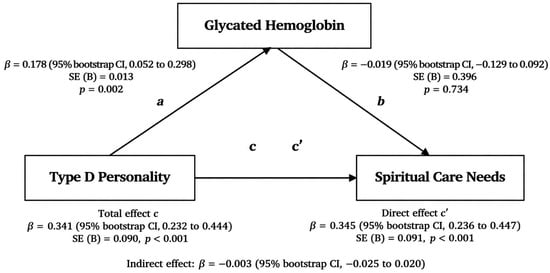
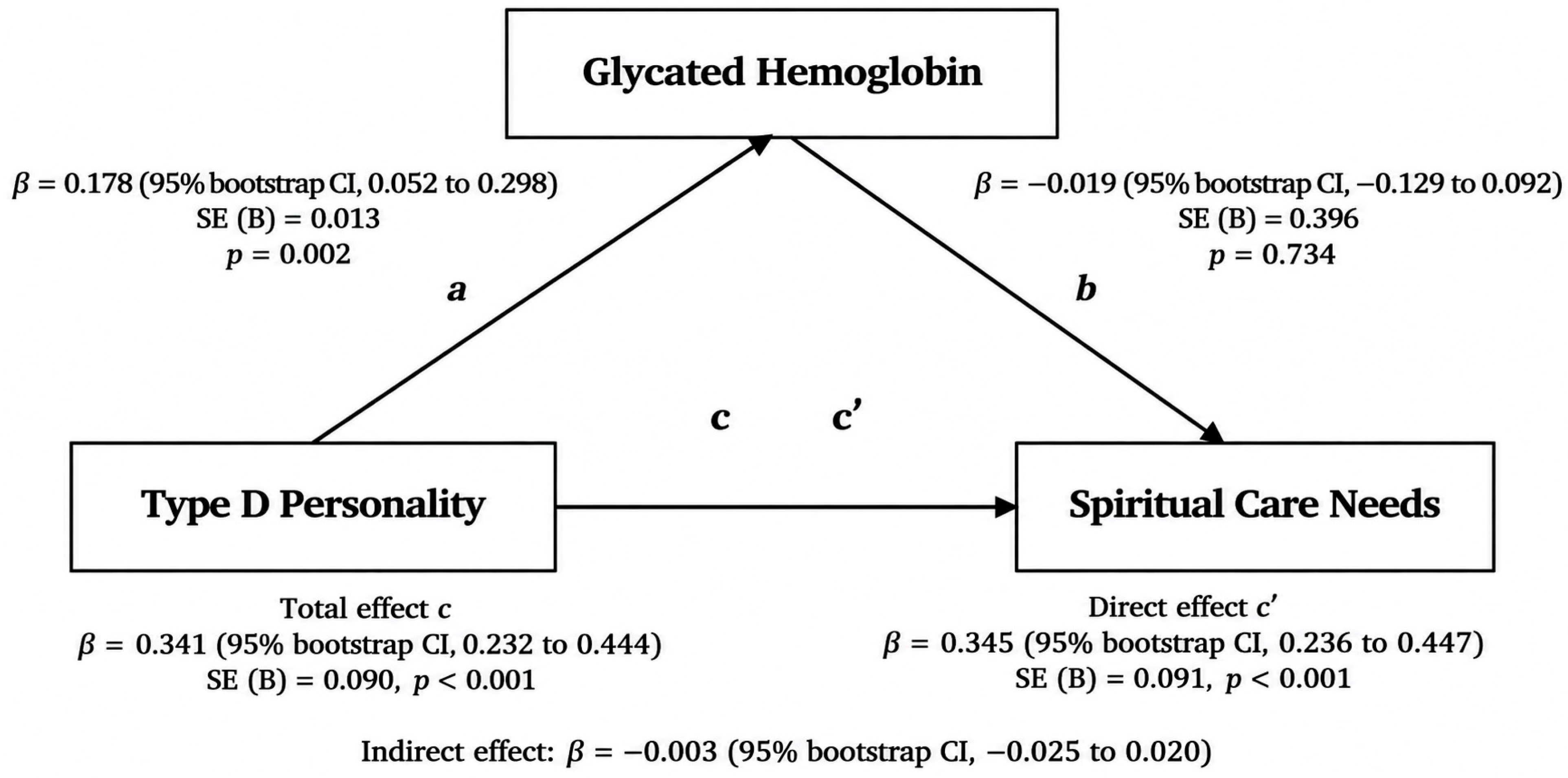
In the regression-based path analysis, the association between the DS14 total score and HbA1c (path a) was positive and statistically significant (β = 0.178; B = 0.041; SE = 0.013; 95% bootstrap CI for β, 0.052 to 0.298; p = 0.002). The total association between the DS14 total score and perceived spiritual care needs (path c) was also positive and statistically significant (β = 0.341; B = 0.561; SE = 0.090; 95% bootstrap CI for β, 0.232 to 0.444; p < 0.001). After HbA1c was included in the model, the direct association (path c′) remained statistically significant (β = 0.345; B = 0.567; SE = 0.091; 95% bootstrap CI for β, 0.236 to 0.447; p < 0.001), whereas the association between HbA1c and perceived spiritual care needs after controlling for the DS14 total score (path b) was not statistically significant (β = −0.019; B = −0.135; SE = 0.396; 95% bootstrap CI for β, −0.129 to 0.092; p = 0.734). The standardised indirect association through HbA1c was −0.003 (95% percentile bootstrap CI, −0.025 to 0.020), with a corresponding unstandardised estimate of −0.006 (bootstrap SE = 0.018). Because the confidence interval included zero, the hypothesised statistical indirect association was not supported. The model predicting HbA1c explained 3.2% of the variance (R2 = 0.032), while the total-association model explained 11.6% of the variance in SCNI scores (R2 = 0.116). Including HbA1c in the SCNI outcome model increased R2 to 0.117. These results are presented in Table 2 and Figure 1.
Table 2.
Correlations and Regression-Based Path Analysis for HbA1c as a Candidate Statistical Mediator (N = 300).
Figure 1.
Statistical indirect-effect model for the Type D Personality Scale, glycated hemoglobin, and spiritual care needs. Note. Values represent standardised regression coefficients. Path a: DS14 total score to HbA1c; path b: HbA1c to spiritual care needs adjusted for the DS14 total score; path c: total association; and path c′: direct association adjusted for HbA1c. The standardised indirect association (a × b = −0.003; 95% bootstrap CI, −0.025 to 0.020) was estimated using 10,000 bootstrap samples. Arrows represent statistical associations, not established causal relationships. CI, confidence interval; DS14, Type D Scale-14; HbA1c, glycated hemoglobin. SE(B), standard error of the unstandardised regression coefficient B; β, standardised regression coefficient; p, p-value.
In the sensitivity analysis adjusted for age, sex, and diabetes duration, the standardised indirect association remained nonsignificant (β = −0.008; 95% bootstrap CI, −0.028 to 0.012), whereas the adjusted direct association remained statistically significant (β = 0.334; B = 0.549; SE = 0.091; 95% model-based CI for B, 0.370 to 0.728; p < 0.001). The complete adjusted regression results are provided in Supplementary Table S5. In the categorical comparison, participants meeting both conventional Type D personality thresholds had higher mean perceived spiritual care needs scores than those not meeting both criteria (57.09 ± 17.52 vs. 49.54 ± 16.11; Welch’s t [118.45] = 3.30; p = 0.001; mean difference = 7.55; 95% CI, 3.01 to 12.09). Mean HbA1c levels were 8.92% (SD = 2.45) and 8.45% (SD = 2.30), respectively, with no statistically significant difference between groups (Welch’s t [120.55] = 1.45; p = 0.150; mean difference = 0.47 percentage points; 95% CI, −0.17 to 1.10).
3.3. Exploratory Analyses of the DS14 Dimensions
In exploratory bivariate analyses, negative affectivity and social inhibition were positively correlated with perceived spiritual care needs (r = 0.352, p < 0.001; and r = 0.192, p < 0.001, respectively) and HbA1c (r = 0.164, p = 0.004; and r = 0.126, p = 0.030, respectively). The two DS14 dimensions were also positively correlated with each other (r = 0.370, p < 0.001). The bivariate correlations and unadjusted joint regression models are presented in Supplementary Table S1.
In the joint regression model adjusted for age, sex, and diabetes duration, negative affectivity was positively associated with perceived spiritual care needs (B = 0.725; 95% CI, 0.450 to 1.000; p < 0.001), whereas the conditional association of social inhibition was not statistically significant (B = 0.249; 95% CI, −0.119 to 0.617; p = 0.184). In the corresponding adjusted HbA1c model, neither negative affectivity (B = 0.035; 95% CI, −0.005 to 0.075; p = 0.087) nor social inhibition (B = 0.036; 95% CI, −0.017 to 0.090; p = 0.181) showed a statistically significant association. The adjusted joint regression results are presented in Supplementary Table S2.
In the adjusted regression models including the negative affectivity × social inhibition interaction and squared terms for both dimensions, the interaction was not statistically significant for perceived spiritual care needs (B = 0.005; 95% CI, −0.056 to 0.066; p = 0.879) or HbA1c (B = 0.003; 95% CI, −0.006 to 0.012; p = 0.558). These results are reported in Supplementary Table S3. When HbA1c was included as an additional predictor in the SCNI regression models, negative affectivity remained statistically significant, whereas social inhibition and the interaction term remained nonsignificant. The pattern of statistical significance was unchanged when HC3 robust standard errors were applied. Additional model-specification and robustness results are provided in Supplementary Table S4.
3.4. Exploratory Analyses of the SCNI Domains
The exploratory analyses of the SCNI domains showed that the DS14 total score was positively correlated with both meaning and hope (r = 0.332; p < 0.001) and caring and respect (r = 0.251; p < 0.001). Negative affectivity was positively correlated with meaning and hope (r = 0.314; p < 0.001) and caring and respect (r = 0.293; p < 0.001). Social inhibition was positively correlated with meaning and hope (r = 0.225; p < 0.001), whereas its correlation with caring and respect was not statistically significant (r = 0.094; p = 0.106). Neither SCNI domain showed a statistically significant correlation with HbA1c (meaning and hope: r = 0.036, p = 0.540; caring and respect: r = 0.038, p = 0.507). The descriptive statistics, internal consistency coefficients, and correlation results for the SCNI domains are presented in Table 3.
Table 3.
Subscale Characteristics and SCNI Domain Correlations (N = 300).
In the regression models including both DS14 dimensions and adjusted for age, sex, and diabetes duration, negative affectivity was positively associated with meaning and hope (B = 0.385; 95% CI, 0.206 to 0.563; p < 0.001) and caring and respect (B = 0.340; 95% CI, 0.196 to 0.484; p < 0.001). Social inhibition showed a statistically significant positive association with meaning and hope (B = 0.269; 95% CI, 0.030 to 0.508; p = 0.027), whereas its conditional association with caring and respect was not statistically significant (B = −0.020; 95% CI, −0.213 to 0.173; p = 0.836). The complete unadjusted and adjusted SCNI domain regression results are presented in Supplementary Table S6.
4. Discussion
Adults with type 2 diabetes who had more pronounced Type D personality traits had higher HbA1c levels and reported greater perceived spiritual care needs. The positive association between Type D traits and perceived spiritual care needs remained statistically significant after adjustment for age, sex, and diabetes duration. Participants meeting the conventional categorical criteria for Type D personality also reported greater perceived spiritual care needs than those who did not meet these criteria. By contrast, the association between HbA1c and perceived spiritual care needs was not statistically significant. The confidence interval for the indirect association through HbA1c included zero (standardised estimate = −0.003; 95% bootstrap CI, −0.025 to 0.020), indicating that the hypothesised statistical mediating role of HbA1c was not supported.
The positive association between Type D personality traits and HbA1c was small (R2 = 0.032). In a systematic review of seven studies, Conti et al. [8] reported associations of Type D personality traits with difficulties in treatment adherence, self-care problems, and psychosocial difficulties among people with diabetes. Li et al. [9] found greater medication nonadherence at six-month follow-up among participants meeting categorical Type D criteria, whereas analyses treating the personality dimensions separately did not show the same association. Shao et al. [10] reported associations of Type D personality traits with lower self-efficacy and perceived social support. Lin et al. [11] found higher HbA1c levels and lower self-efficacy and self-care behaviours among participants meeting Type D criteria. Examining personality constructs other than Type D, Skinner et al. [29] reported that conscientiousness was associated with better medication adherence and blood glucose self-monitoring, although they found no independent association between personality traits and HbA1c. Mendoza-Catalán et al. [30] identified positive associations of conscientiousness and openness to experience with diabetes self-care behaviours, whereas neuroticism showed a negative association. Together, these studies describe relationships between personality and diabetes self-management while showing variation in findings concerning glycaemic control. The HbA1c finding in the present study is broadly consistent with that of Lin et al. [11]. This comparison highlights the value of examining negative affectivity and social inhibition separately as well as considering the overall Type D personality score.
Studies addressing spiritual aspects of diabetes provide further context for the association between Type D traits and perceived spiritual care needs. Choi and Hastings [16] reported that religious and spiritual beliefs played a role in experiences of coping with diabetes and self-care. Jafari et al. [17] found higher overall spiritual well-being and peace scores among participants with HbA1c levels of 7% or lower, while Newlin et al. [18] reported associations in different directions between religious and existential well-being and HbA1c. Onyishi et al. [19] discussed the potential psychosocial and behavioural benefits of spiritual beliefs and faith-based interventions in diabetes management. In a systematic review of eight studies, Weber and Doolittle [20] found that religious and spiritual characteristics were associated with better glycaemic control in some studies, although the findings were not consistent across all studies. Fincham et al. [21] reported that associations between religious coping and joint diabetes-management behaviours among couples with type 2 diabetes varied by coping pattern. Whereas the literature has largely examined religious beliefs, spiritual well-being, and diabetes management, the present study focuses on the association between Type D traits and patient-reported spiritual care needs. In exploratory analyses, the positive association of negative affectivity with spiritual care needs persisted after accounting for social inhibition, age, sex, and diabetes duration. This finding provides a basis for further examining perceived spiritual care needs in relation to the psychological dimensions of personality.
Exploratory analyses of spiritual care needs domains allowed the association to be considered across distinct areas of need. The Type D personality total score was positively associated with both meaning and hope and caring and respect; associations of HbA1c with either domain were not statistically significant. Büssing and Koenig [15] described spiritual needs in chronic illness as encompassing meaning and purpose, peace, connection, and transcendence. Wu et al. [13] and Günay İsmailoğlu et al. [14] assessed perceived spiritual care needs in the domains of meaning and hope and caring and respect. In the adjusted exploratory analysis, social inhibition was positively associated with meaning and hope, suggesting that associations between personality traits and perceived needs may vary across domains. Because differences between domain coefficients were not directly tested and no adjustment for multiple comparisons was applied, further examination of this pattern in other samples would be valuable.
The findings concerning HbA1c as a candidate statistical mediator can be considered alongside studies involving psychosocial variables. Lee et al. [12] examined diabetes distress and social isolation as parallel statistical mediators in associations between Type D personality and health outcomes among adults with type 2 diabetes, reporting indirect associations involving these variables. Lin et al. [31] reported partial statistical mediation by perceived social support in the association between Type D personality traits and depressive symptoms. Both studies addressed outcomes different from the perceived spiritual care needs examined here. Zhang et al. [32] examined trajectories of diabetes distress over 12 months in adults with type 2 diabetes, highlighting the importance of longitudinal assessment of psychosocial experiences. Although that study did not examine spiritual care needs, it provides methodological context for future longitudinal research. Taken together, these findings suggest that longitudinal investigations of the possible roles of diabetes distress, depressive symptoms, and perceived social support could contribute to a more comprehensive understanding of the relationship between Type D traits and spiritual care needs.
From a nursing perspective, the findings underscore the importance of considering psychosocial characteristics and perceived spiritual care needs alongside glycaemic status in the assessment of adults with type 2 diabetes. The greater reported spiritual care needs among individuals with more pronounced Type D traits support attention to patients’ own accounts of desired support in addition to metabolic indicators. Offering opportunities for patients to express needs relating to meaning, hope, caring, and respect, while respecting their personal preferences, is consistent with person-centred nursing care. In a randomised controlled trial involving 88 women with type 2 diabetes, Montazeri et al. [33] reported reduced diabetes distress and improved spiritual well-being following a 12-week spirituality-based intervention. Their study assessed spiritual well-being, whereas the present study addressed perceived spiritual care needs. Future nursing research examining the feasibility and effectiveness of individualised assessment and support approaches based on patient-reported spiritual care needs could contribute to the evidence base for person-centred diabetes care.
Limitations
The cross-sectional design precludes establishing temporal ordering or drawing causal conclusions about mediation. As the power analysis was based on specific assumptions, sensitivity to small indirect associations remains uncertain. Single-centre convenience sampling, the inclusion of only literate adults receiving pharmacological treatment, the absence of screening and nonparticipation records, and the local sociocultural context may have introduced selection bias and limited the generalisability of the findings, particularly to primary care populations.
The relatively low internal consistency of the social inhibition subscale (Cronbach’s α = 0.591) may have affected coefficient estimates and the stability of conventional categorical Type D classification. Item-level reliability findings are presented in Supplementary Table S7. Measurement error may bias path coefficients [34], and the reported confidence intervals do not account for this additional uncertainty. Therefore, nonsignificant social inhibition and interaction estimates should be interpreted cautiously. The use of a single recorded HbA1c value, differences in measurement timing, and uncertainty regarding laboratory comparability may also have influenced the observed associations. Furthermore, the exploratory dimensional and interaction analyses were conducted without adjustment for multiple comparisons.
The Spiritual Care Needs Inventory (SCNI) was originally developed for acute-care patients. Although internal consistency was assessed in the present sample, its psychometric properties were not comprehensively evaluated in diabetes outpatients. The instrument measures perceived spiritual care needs rather than whether those needs have been met. Administration of both questionnaires during the same interview and possible conceptual overlap between negative affectivity and needs relating to meaning and hope may have contributed to the observed associations.
The adjusted models included age, sex, and diabetes duration but not the recorded education and employment variables. Limited information on income, antidiabetic treatment characteristics, psychiatric comorbidities, and lifestyle factors leaves the possibility of residual confounding. Diabetes-related complications were not assessed separately, and additional chronic conditions were recorded only as a binary variable. Depression, anxiety, diabetes distress, perceived social support, and religious involvement were not assessed using dedicated measures, preventing examination of alternative psychological, behavioural, and social indirect pathways. Future multicentre longitudinal studies with improved measurement of social inhibition and prospectively specified indirect-association analyses could clarify temporal relationships and examine alternative psychosocial pathways.
5. Conclusions
In 300 adults with type 2 diabetes, higher DS14 total scores were associated with greater perceived spiritual care needs and higher HbA1c. The hypothesised statistical indirect association through HbA1c was not supported (standardised estimate = −0.003; 95% bootstrap CI, −0.025 to 0.020). Exploratory adjusted results indicated an association with negative affectivity, but not statistically significant additional social-inhibition or NA × SI interaction terms. These cross-sectional findings do not establish causal mediation; the study did not assess HbA1c as a screening measure for spiritual care needs or evaluate nursing interventions. Longitudinal studies are warranted.
Supplementary Materials
The following supporting information can be downloaded at https://www.mdpi.com/article/10.3390/healthcare14234042/s1. Table S1, bivariate and joint unadjusted associations of DS14 dimensions; Table S2, joint dimensional models adjusted for demographics; Table S3, full adjusted interaction models; Table S4, model-specification and robust-standard-error checks; Table S5, complete adjusted total-score mediation model; Table S6, exploratory regressions of SCNI domains; and Table S7, item-level reliability analysis of the DS14 social inhibition subscale.
Author Contributions
A.Ş.: Conceptualization, Methodology, Investigation, Data curation, Writing—original draft, Writing—review and editing, Supervision. F.Z.G.: Conceptualization, Methodology, Investigation, Formal analysis, Writing—review and editing, Supervision. All authors have read and agreed to the published version of the manuscript.
Funding
This research received no external funding.
Institutional Review Board Statement
The study was conducted in accordance with the Declaration of Helsinki and approved by the Harran University Clinical Research Ethics Committee on 10 April 2023 (approval No. HRÜ/23.06.25). Administrative permission was obtained from Harran University Hospital.
Informed Consent Statement
Written informed consent was obtained from all participants involved in the study. No identifiable participant information is included in the manuscript.
Data Availability Statement
Deidentified data are available from the corresponding author on reasonable request, subject to ethical and institutional requirements.
Acknowledgments
The authors thank the participants who contributed to this study. No generative artificial intelligence tools were used in the preparation of this manuscript.
Conflicts of Interest
The authors declare no conflicts of interest.
References
- World Health Organization. Diabetes. 11 November 2026. Available online: https://www.who.int/news-room/fact-sheets/detail/diabetes (accessed on 15 November 2026).
- International Diabetes Federation. IDF Diabetes Atlas, 11th ed.; International Diabetes Federation: Brussels, Belgium, 2025; Available online: https://diabetesatlas.org/resources/idf-diabetes-atlas-2025/ (accessed on 15 September 2026).
- American Diabetes Association Professional Practice Committee. 6. Glycemic Goals and Hypoglycemia: Standards of Care in Diabetes—2025. Diabetes Care 2025, 48, S128–S145. [Google Scholar] [CrossRef] [Scilit] [PubMed]
- American Diabetes Association Professional Practice Committee. 5. Facilitating Positive Health Behaviors and Well-being to Improve Health Outcomes: Standards of Care in Diabetes—2025. Diabetes Care 2025, 48, S86–S127. [Google Scholar] [CrossRef] [Scilit] [PubMed]
- Yalcin, B.Y.; Oyman, G.B.; Akin, A.; Mutlu, U.; Hacisahinogullari, H.; Yalin, G.Y.; Gul, N.; Selcukbiricik, O.S.; Uzum, A.K.; Karsidag, K. Low Educational Attainment Is Associated with Increased Risk of Complications in Type 2 Diabetes—A Multivariable Analysis. Clin. Diabetol. 2026, 15, 159–167. [Google Scholar] [CrossRef] [Scilit]
- Gezer, M.; Ozer, Z.Y.; Arslan, Y.K.; Yuce, S.; Okyar, C. The Burden of Stigma in Type 2 Diabetes: Evidence from a Rural Primary Care Sample in Türkiye. Med. Bull. Sisli Etfal Hosp. 2026, 60, 352–359. [Google Scholar] [CrossRef] [Scilit] [PubMed]
- Denollet, J. DS14: Standard assessment of negative affectivity, social inhibition, and Type D personality. Psychosom. Med. 2005, 67, 89–97. [Google Scholar] [CrossRef] [Scilit] [PubMed]
- Conti, C.; Carrozzino, D.; Patierno, C.; Vitacolonna, E.; Fulcheri, M. The clinical link between Type D personality and diabetes. Front. Psychiatry 2016, 7, 113. [Google Scholar] [CrossRef] [Scilit] [PubMed]
- Li, X.; Zhang, S.; Xu, H.; Tang, X.; Zhou, H.; Yuan, J.; Wang, X.; Qu, Z.; Wang, F.; Zhu, H.; et al. Type D personality predicts poor medication adherence in Chinese patients with type 2 diabetes mellitus: A six-month follow-up study. PLoS ONE 2016, 11, e0146892. [Google Scholar] [CrossRef] [Scilit] [PubMed]
- Shao, Y.; Yin, H.; Wan, C. Type D personality as a predictor of self-efficacy and social support in patients with type 2 diabetes mellitus. Neuropsychiatr. Dis. Treat. 2017, 13, 855–861. [Google Scholar] [CrossRef] [Scilit] [PubMed]
- Lin, Y.H.; Chen, D.A.; Lin, C.; Huang, H. Type D personality is associated with glycemic control and socio-psychological factors in patients with type 2 diabetes mellitus. Psychol. Res. Behav. Manag. 2020, 13, 373–381. [Google Scholar] [CrossRef] [Scilit] [PubMed]
- Lee, E.H.; Lee, Y.W.; Chae, D.; Kang, E.H.; Kang, H.J. Relationship between Type D personality and adverse health outcomes in people with type 2 diabetes: The parallel mediating roles of diabetes distress and social isolation. Nurs. Open 2023, 10, 3347–3355. [Google Scholar] [CrossRef] [Scilit] [PubMed]
- Wu, L.F.; Koo, M.; Liao, Y.C.; Chen, Y.M.; Yeh, D.C. Development and validation of the Spiritual Care Needs Inventory for acute care hospital patients in Taiwan. Clin. Nurs. Res. 2016, 25, 590–606. [Google Scholar] [CrossRef] [Scilit] [PubMed]
- Günay İsmailoğlu, E.; Özdemir, H.; Erol, A.; Zaybak, A. Validity and reliability of the Turkish version of the Spiritual Care Needs Inventory. Dokuz Eylül Üniversitesi Hemşirelik Fakültesi Elektron. Derg. 2019, 12, 255–263. Available online: https://dergipark.org.tr/tr/pub/deuhfed/article/633216 (accessed on 15 November 2026).
- Büssing, A.; Koenig, H.G. Spiritual Needs of Patients with Chronic Diseases. Religions 2010, 1, 18–27. [Google Scholar] [CrossRef] [Scilit]
- Choi, S.A.; Hastings, J.F. Religion, spirituality, coping, and resilience among African Americans with diabetes. J. Relig. Spirit. Soc. Work 2019, 38, 93–114. [Google Scholar] [CrossRef] [Scilit] [PubMed]
- Jafari, N.; Farajzadegan, Z.; Loghmani, A.; Majlesi, M.; Jafari, N. Spiritual well-being and quality of life of Iranian adults with type 2 diabetes. Evid. Based Complement. Altern. Med. 2014, 2014, 619028. [Google Scholar] [CrossRef] [Scilit] [PubMed]
- Newlin, K.; Melkus, G.D.E.; Tappen, R.; Chyun, D.; Koenig, H.G. Relationships of religion and spirituality to glycemic control in Black women with type 2 diabetes. Nurs. Res. 2008, 57, 331–339. [Google Scholar] [CrossRef] [Scilit] [PubMed]
- Onyishi, C.N.; Ilechukwu, L.C.; Victor-Aigbodion, V.; Eseadi, C. Impact of spiritual beliefs and faith-based interventions on diabetes management. World J. Diabetes 2021, 12, 630–641. [Google Scholar] [CrossRef] [Scilit] [PubMed]
- Weber, J.M.; Doolittle, B.R. Religion, spirituality and improved glycemic control among people with type 2 diabetes: A systematic review. Int. J. Psychiatry Med. 2023, 58, 617–636. [Google Scholar] [CrossRef] [Scilit] [PubMed]
- Fincham, F.D.; Seibert, G.S.; May, R.W.; Wilson, C.M.; Lister, Z.D. Religious coping and glycemic control in couples with type 2 diabetes. J. Marital Fam. Ther. 2018, 44, 138–149. [Google Scholar] [CrossRef] [Scilit] [PubMed]
- Maxwell, S.E.; Cole, D.A. Bias in cross-sectional analyses of longitudinal mediation. Psychol. Methods 2007, 12, 23–44. [Google Scholar] [CrossRef] [Scilit] [PubMed]
- Vandenbroucke, J.P.; von Elm, E.; Altman, D.G.; Gøtzsche, P.C.; Mulrow, C.D.; Pocock, S.J.; Poole, C.; Schlesselman, J.J.; Egger, M. Strengthening the Reporting of Observational Studies in Epidemiology (STROBE): Explanation and elaboration. PLoS Med. 2007, 4, e297. [Google Scholar] [CrossRef] [Scilit] [PubMed]
- Schoemann, A.M.; Boulton, A.J.; Short, S.D. Determining power and sample size for simple and complex mediation models. Soc. Psychol. Personal. Sci. 2017, 8, 379–386. [Google Scholar] [CrossRef] [Scilit]
- Öncü, E.; Köksoy Vayısoğlu, S. The validity and reliability of the Type D Personality Scale in the Turkish population. Ank. Med. J. 2018, 18, 646–656. [Google Scholar] [CrossRef] [Scilit]
- Igartua, J.J.; Hayes, A.F. Mediation, moderation, and conditional process analysis: Concepts, computations, and some common confusions. Span. J. Psychol. 2021, 24, e49. [Google Scholar] [CrossRef] [Scilit] [PubMed]
- Lodder, P. Modeling synergy: How to assess a Type D personality effect. J. Psychosom. Res. 2020, 132, 109990. [Google Scholar] [CrossRef] [Scilit] [PubMed]
- Lodder, P. A re-evaluation of the Type D personality effect. Pers. Individ. Dif. 2020, 167, 110254. [Google Scholar] [CrossRef] [Scilit]
- Skinner, T.C.; Bruce, D.G.; Davis, T.M.E.; Davis, W.A. Personality traits, self-care behaviours and glycaemic control in type 2 diabetes: The Fremantle Diabetes Study Phase II. Diabet. Med. 2014, 31, 487–492. [Google Scholar] [CrossRef] [Scilit] [PubMed]
- Mendoza-Catalán, G.; Rodríguez-Santamaría, Y.; Domínguez-Chávez, C.J.; Juárez-Medina, L.L.; Villa-Rueda, A.A.; González-Ramírez, J.; Gutiérrez-Valverde, J.M. Personality traits and self-care behaviors in adults with type 2 diabetes mellitus. Diabetes Metab. Syndr. Obes. 2022, 15, 1–6. [Google Scholar] [CrossRef] [Scilit] [PubMed]
- Lin, Y.; Xu, N.; Sui, Y.; Zou, Q.; Zhang, J.; Zhao, L. Type D personality, social support and depression in patients with diabetes: A structural equation model. Front. Endocrinol. 2026, 17, 1652252. [Google Scholar] [CrossRef] [Scilit] [PubMed]
- Zhang, Y.Y.; Li, W.; Wang, Q.Y.; Zhao, F.; Wang, Q.; Sheng, Y. Trajectory prediction model of diabetes distress in adults with type 2 diabetes mellitus: A 12-month prospective longitudinal study. Front. Psychol. 2026, 17, 1510444. [Google Scholar] [CrossRef] [Scilit] [PubMed]
- Montazeri, S.; Nickbin Poshtamsary, S.; Khanchemehr, Y.; Abdi, F.; Jahangasht Ghoozlu, K.; Erjaee, A. The Effect of a Spirituality-Based Intervention on Diabetes Distress, Spiritual Well-Being, and Quality of Life in Women with Type 2 Diabetes: A Randomized Controlled Trial. J. Nurs. Midwifery Sci. 2025, 12, e163723. [Google Scholar] [CrossRef] [Scilit]
- Cole, D.A.; Preacher, K.J. Manifest variable path analysis: Potentially serious and misleading consequences due to uncorrected measurement error. Psychol. Methods 2014, 19, 300–315. [Google Scholar] [CrossRef] [Scilit] [PubMed]

Disclaimer/Publisher’s Note: The statements, opinions and data contained in all publications are solely those of the individual author(s) and contributor(s) and not of MDPI and/or the editor(s). MDPI and/or the editor(s) disclaim responsibility for any injury to people or property resulting from any ideas, methods, instructions or products referred to in the content. |
© 2026 by the authors. Licensee MDPI, Basel, Switzerland. This article is an open access article distributed under the terms and conditions of the Creative Commons Attribution (CC BY) license.