


Abstract
Background: Depressive symptoms are frequent in rheumatoid arthritis (RA), but potentially modifiable behavioral processes that accompany depressive symptom burden have received less attention than disease activity, pain, and disability. Behavioral activation—engagement in meaningful and reinforcing activities—may be particularly relevant in RA, where pain, fatigue, and functional limitations can restrict everyday activity. We examined whether behavioral activation was associated with depressive symptom severity in adults with RA and explored concurrent associations with perceived social support and health-related quality of life. Methods: This cross-sectional analytical study included 285 Romanian adults with RA recruited from clinical settings (n = 121) and online patient communities (n = 164). Depressive symptoms were assessed using the Patient Health Questionnaire-9 (PHQ-9), behavioral activation using the Behavioral Activation for Depression Scale (BADS), and health-related quality of life using the 36-Item Short Form Health Survey (SF-36). Global self-rated quality of life and perceived social support were assessed with study-specific 5-point items. Associations were examined using correlations and a prespecified multiple linear regression model. Results: Mean PHQ-9 score was 10.3 ± 5.6 and mean BADS score was 72.8 ± 18.4. PHQ-9 scores were moderately and inversely associated with BADS scores (r = −0.47, p < 0.001), global self-rated quality of life (r = −0.42, p < 0.001), and perceived social support (r = −0.29, p < 0.001), but not with illness duration (r = 0.06, p = 0.29). In the prespecified psychosocial model, lower behavioral activation (β = −0.34, p < 0.001), poorer global self-rated quality of life (β = −0.27, p < 0.001), and lower perceived social support (β = −0.14, p = 0.011) were associated with higher PHQ-9 scores; illness duration was not (β = 0.05, p = 0.310). The model explained 31.8% of PHQ-9 variance (adjusted R2 = 0.308). In a sensitivity analysis, the BADS Activation subscale remained significantly and inversely associated with PHQ-9 depressive symptom severity after adjustment for age, sex, recruitment source, SF-36 Bodily Pain, and SF-36 Physical Functioning. PHQ-9 scores were negatively correlated with all SF-36 domains, most strongly with Mental Health (r = −0.54), Vitality (r = −0.49), and Social Functioning (r = −0.41) (all p < 0.001). Conclusions: Behavioral activation showed the largest standardized association with depressive symptom burden among the psychosocial variables included in the prespecified model. These cross-sectional findings do not establish directionality or independence from unmeasured demographic and RA-specific clinical confounding, but they support longitudinal and intervention studies testing behavioral activation as a potentially modifiable target within integrated RA care.
1. Introduction
Rheumatoid arthritis (RA) is a chronic immune-mediated inflammatory disease with consequences that extend beyond synovitis and structural joint damage. Pain, fatigue, impaired physical function, role disruption, and the demands of long-term treatment can substantially affect psychological well-being and participation in everyday life. Depression is therefore increasingly regarded as a clinically relevant comorbidity of RA rather than an incidental emotional response to chronic disease [1,2].
Depressive disorders and clinically relevant depressive symptoms occur more frequently in RA than in the general population [3]. Depression in RA has been associated with poorer patient-reported outcomes, lower treatment adherence, reduced likelihood of remission, disability, and worse treatment response [1,4,5]. Biological pathways related to systemic inflammation may contribute to this association, but psychosocial and behavioral pathways are also likely to be important [1].
Recent Romanian data have documented the clinical relevance of depressive symptoms in RA, including associations with disease activity [6]. However, Romanian evidence remains limited, and potentially modifiable behavioral processes associated with depressive symptom severity have received comparatively little attention. The present study therefore extends existing descriptive evidence by examining behavioral activation as a potentially relevant psychosocial correlate of depressive symptom burden rather than assuming that the epidemiology of depression in Romanian RA populations is already fully characterized.
Behavioral activation offers one such framework. It refers to engagement in meaningful, goal-directed, and potentially reinforcing activities and is a well-established treatment principle in depression [7,8,9]. The Behavioral Activation for Depression Scale (BADS) captures activation as well as avoidance/rumination and functional impairment [10,11]. In chronic pain populations, behavioral activation has also been studied as a treatment-relevant process [12]. In RA, however, behavioral activation has rarely been directly operationalized, despite the plausibility that pain, fatigue, mobility restrictions, and disrupted social or occupational roles may reduce access to reinforcing activities.
Social support and health-related quality of life represent complementary dimensions of adjustment to RA. A recent systematic review found that positive social support is generally associated with better quality of life in RA, although measurement approaches remain heterogeneous [7]. Health-related quality of life is likewise closely related to disease activity, fatigue, pain, and emotional health [8]. These constructs may therefore help contextualize the association between behavioral activation and depressive symptoms without implying a unidirectional causal pathway.
The primary aim of the present study was to examine the association between behavioral activation and depressive symptom severity in adults with RA. Secondary aims were to evaluate concurrent associations of depressive symptoms with perceived social support, global self-rated quality of life, health-related quality of life, and illness duration. We hypothesized that higher depressive symptom burden would be associated with lower behavioral activation, lower perceived social support, and poorer quality-of-life indicators. Because the design was cross-sectional, all analyses were interpreted as associations rather than evidence of causality or temporal precedence.
2. Materials and Methods
2.1. Study Design and Reporting
This was a cross-sectional analytical study conducted in Romania between June 2025 and February 2026. The study was designed to characterize contemporaneous associations between depressive symptom severity and behavioral, psychosocial, and health-related variables. The manuscript was structured in accordance with the Strengthening the Reporting of Observational Studies in Epidemiology (STROBE) statement for cross-sectional studies [13]. No causal or temporal inference was intended. Recruitment was conducted over a fixed study period rather than to a prospectively calculated target sample size. No formal inflation for nonresponse or incomplete questionnaires was prespecified. With the final sample of 285 participants, a two-sided test at α = 0.05 had approximately 80% power to detect an absolute Pearson correlation of about 0.17; for the observed primary BADS–PHQ-9 association (r = −0.47), the Fisher z 95% confidence interval was approximately −0.56 to −0.37. These calculations are reported as precision/sensitivity descriptors rather than as post hoc evidence of study adequacy.
2.2. Participants and Recruitment
The final sample comprised 285 adults with RA. Participants were recruited through two pathways: 121 (42.5%) from outpatient rheumatology clinics and hospital wards and 164 (57.5%) through patient-oriented online communities and rheumatology discussion groups. Clinical recruitment was conducted within the June 2025–February 2026 study window. Online invitations directed potentially eligible adults to the study information, electronic consent, eligibility questions, and questionnaire. The online pathway was based on community dissemination rather than an individually enumerated sampling frame; consequently, the number of persons who viewed the invitation and a conventional online response rate could not be determined. Site-level approach denominators were not retained in the analytical dataset, so a clinic-specific response rate could not be calculated reliably. The mixed recruitment strategy was intended to improve accessibility and geographic reach, while recognizing potential selection, diagnostic-verification, digital-access, and health-literacy differences between recruitment sources. The archived analytical materials available for manuscript revision contained the final 285 complete eligible records; the total number of survey starts or initially screened records and the number excluded before creation of the final analytical file were not retained and could not be reconstructed reliably. We therefore do not report a retrospective participant-flow count that cannot be verified from the archived source materials.
Eligibility criteria were age ≥18 years, a prior diagnosis of RA established by a rheumatologist, capacity to provide informed consent, and ability to complete the study questionnaire. For clinically recruited participants, RA diagnosis was verified from available medical documentation. For online participants, eligibility was based on self-report of a previous rheumatologist-confirmed diagnosis; therefore, diagnostic verification was less direct in this subgroup. Participants with incomplete core questionnaires, major self-reported cognitive difficulties interfering with questionnaire completion, or another primary autoimmune disease considered likely to confound interpretation were excluded. Because mandatory online fields were used for the core study variables, the primary analyses were based on complete core questionnaire data without imputation.
2.3. Data Collection
The same structured questionnaire was administered electronically or, for clinically recruited participants when required, in a supervised paper- or device-assisted format using standardized instructions. The online survey used mandatory fields for core study variables and platform settings intended to reduce duplicate submissions. Responses were anonymized before analysis, and no directly identifying personal information was included in the analytical dataset. Recruitment source (clinical versus online) was retained as a sampling descriptor and was examined in a sensitivity comparison because of the potential heterogeneity introduced by mixed-mode recruitment.
2.4. Measures
2.4.1. Depressive Symptoms
Depressive symptom severity was assessed using the Patient Health Questionnaire-9 (PHQ-9) [14]. The nine items are scored from 0 to 3, yielding a total score from 0 to 27, with higher scores indicating greater depressive symptom burden. PHQ-9 total score was the primary outcome and was analyzed as a continuous variable. The official Romanian-language PHQ-9 has undergone cross-cultural validation in a Romanian chronic-disease population, demonstrating satisfactory convergent validity and test–retest reliability [15]. Because that validation was performed in adults with type 2 diabetes rather than RA, population-specific measurement properties cannot be assumed to be identical. In the present sample, Cronbach’s α was used only as an index of internal consistency and is reported in the Results section; it was not interpreted as evidence of construct validity or temporal stability.
2.4.2. Behavioral Activation
Behavioral activation was assessed using the 25-item Behavioral Activation for Depression Scale (BADS) [10,11]. The instrument comprises four domains—Activation, Avoidance/Rumination, Work/School Impairment, and Social Impairment—and items are rated on a 7-point scale. Higher total scores indicate greater behavioral activation. The prespecified primary analyses used the BADS total score. Because the Avoidance/Rumination and impairment domains may overlap conceptually with depressive symptom burden, a focused sensitivity analysis used the Activation subscale as the principal behavioral predictor. A Romanian-language administration of the BADS was used in this study. A formal published Romanian cross-cultural validation of the 25-item form was not identified; therefore, Cronbach’s α was interpreted only as an index of internal consistency and not as evidence of construct validity, measurement invariance, or test–retest reliability.
2.4.3. Health-Related and Global Quality of Life
Health-related quality of life (HRQoL) was measured with the SF-36 [16], covering Physical Functioning, Role Limitations due to Physical Health, Bodily Pain, General Health, Vitality, Social Functioning, Role Limitations due to Emotional Problems, and Mental Health. Domain scores range from 0 to 100, with higher values indicating better perceived health and functioning. In addition, a separate study-specific 5-point item assessed global self-rated quality of life from very poor to excellent. This single-item measure was treated as a brief subjective indicator and not as a substitute for the multidimensional SF-36.
2.4.4. Perceived Social Support and Clinical Background
Perceived social support was assessed using a study-specific 5-point item addressing perceived support from family, friends, or other close persons in coping with RA. Higher scores indicated greater perceived support. Age, sex, recruitment source, and self-reported illness duration were available in the analytical file used for the reported analyses. Education, marital status, employment, and residence had been collected in the source questionnaire but were not retained in the analytical file available to the corresponding author during revision and were therefore not reconstructed. For online participants, both prior rheumatologist-confirmed RA diagnosis and illness duration were self-reported. Disease duration was available as a derived continuous variable in the analytical dataset; for responses originally collected in categories, midpoint recoding had been applied during the original data-processing stage.
2.5. Statistical Analysis
Analyses were conducted using IBM SPSS Statistics, version 26.0. Statistical significance was set at two-sided p < 0.05. Continuous variables were summarized using means and standard deviations and categorical variables using counts and percentages, consistent with the original analytical plan. Internal consistency of the PHQ-9 and BADS was assessed using Cronbach’s α. The primary analyses used complete core questionnaire data; missing values were not imputed. Because participant-level raw data were not available to the corresponding author during the revision process, additional post-hoc distributional summaries such as medians and interquartile ranges were not reconstructed from aggregate results; this constraint is acknowledged in the Limitations.
Pearson correlation coefficients were used to quantify bivariate associations among PHQ-9, BADS total score, global self-rated quality of life, perceived social support, illness duration, and SF-36 domain scores. The prespecified multiple linear regression model used PHQ-9 total score as the dependent variable and BADS total score, global self-rated quality of life, perceived social support, and illness duration as independent variables. Multicollinearity was evaluated using variance inflation factors (VIFs) and tolerance values. VIFs were 1.21 for BADS, 1.25 for global self-rated quality of life, 1.13 for perceived social support, and 1.01 for illness duration; corresponding tolerance values were 0.83, 0.80, 0.89, and 0.99, respectively, indicating no evidence of problematic multicollinearity. Unstandardized coefficients (B), standard errors, standardized coefficients (β), 95% confidence intervals, and p values are reported. The coefficients are interpreted as mutually adjusted associations within this psychosocial model rather than as effects independent of all demographic or RA-specific clinical confounding. To address the potential conceptual overlap between depressive symptoms and the BADS avoidance/impairment domains, a complementary sensitivity regression used the BADS Activation subscale as the principal predictor and adjusted for age, sex, recruitment source (clinical versus online), SF-36 Bodily Pain, and SF-36 Physical Functioning.
Because the study used mixed recruitment, clinic- and online-recruited participants were compared as a sampling-sensitivity assessment. Available comparisons included age, sex distribution, PHQ-9, BADS, global self-rated quality of life, perceived social support, and illness duration. These comparisons were interpreted as indicators of measured recruitment-source heterogeneity rather than proof of equivalence; unmeasured differences in disease severity, socioeconomic position, health literacy, digital literacy, treatment exposure, and motivation to participate remained possible.
2.6. Ethics
The study was conducted in accordance with the Declaration of Helsinki and was approved by the Institutional Research Ethics Committee of the Faculty of Medicine and Pharmacy, “Dunărea de Jos” University of Galați (Approval No. 24, 20 May 2025). Participation was voluntary and no financial incentives were provided. Clinically recruited participants provided informed consent before questionnaire administration. For online participants, informed consent was obtained electronically before access to the study questionnaire. The PHQ-9 was used as a research measure rather than a diagnostic or treatment-decision instrument. Responses were anonymized before analysis. A study-specific real-time suicide-risk escalation pathway was not embedded in the anonymous online research workflow; therefore, endorsement of PHQ-9 item 9 did not trigger participant-level clinical follow-up through the study database. This limitation is reported explicitly and should be addressed in future online studies through real-time crisis signposting and escalation procedures where identifiable follow-up is ethically and technically feasible.
3. Results
3.1. Sample Characteristics and Main Study Measures
The sample included 285 adults with RA, with a mean age of 52.4 ± 11.8 years; 242 participants (84.9%) were women and 43 (15.1%) were men. Recruitment included 121 participants (42.5%) from clinical settings and 164 (57.5%) from online patient communities. Mean self-reported illness duration was 8.7 ± 6.1 years. The mean PHQ-9 score was 10.3 ± 5.6 and the mean BADS total score was 72.8 ± 18.4. The mean global self-rated quality of life was 2.9 ± 1.0 and the mean perceived social support was 3.3 ± 1.1. Table 1 summarizes the available sociodemographic, recruitment, and principal study characteristics.
Table 1.
Overall sociodemographic, recruitment, and principal study characteristics of participants (n = 285).
3.2. Reliability of the Psychological Measures
Internal consistency was good for the PHQ-9 (α = 0.87) and BADS total score (α = 0.89). BADS subscale coefficients were 0.81 for Activation, 0.91 for Avoidance/Rumination, 0.78 for Work/School Impairment, and 0.84 for Social Impairment. These coefficients describe internal consistency only and should not be interpreted as evidence of construct validity, measurement invariance, or test–retest reliability.
3.3. Bivariate Associations with Depressive Symptom Severity
PHQ-9 scores were moderately and inversely associated with BADS total score (r = −0.47, p < 0.001) and global self-rated quality of life (r = −0.42, p < 0.001), and showed a smaller inverse association with perceived social support (r = −0.29, p < 0.001). Illness duration was not associated with PHQ-9 score (r = 0.06, p = 0.29). BADS scores were positively associated with global self-rated quality of life (r = 0.39, p < 0.001) and perceived social support (r = 0.24, p < 0.001). These correlations are presented in Table 2.
Table 2.
Bivariate correlations among depressive symptoms, behavioral activation, global quality of life, perceived social support, and illness duration.
3.4. Multivariable Associations with PHQ-9 Score
The prespecified multivariable model was statistically significant, F(4280) = 32.71, p < 0.001, and explained 31.8% of the variance in PHQ-9 scores (R2 = 0.318; adjusted R2 = 0.308). Lower BADS total score showed the largest standardized association with higher depressive symptom severity among the variables included in this model (β = −0.34, p < 0.001). Poorer global self-rated quality of life (β = −0.27, p < 0.001) and lower perceived social support (β = −0.14, p = 0.011) also remained associated with higher PHQ-9 scores, whereas illness duration was not (β = 0.05, p = 0.310). Multicollinearity diagnostics were reassuring: VIFs ranged from 1.01 to 1.25 and tolerance values from 0.80 to 0.99. Because demographic and RA-specific clinical covariates were not included, these coefficients should not be interpreted as fully confounder-adjusted effects. The results of the multiple linear regression analysis are presented in Table 3.
Table 3.
Prespecified multiple linear regression model for PHQ-9 total score.
3.5. Activation-Subscale Sensitivity Analysis
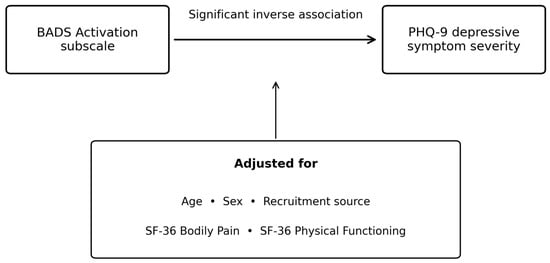
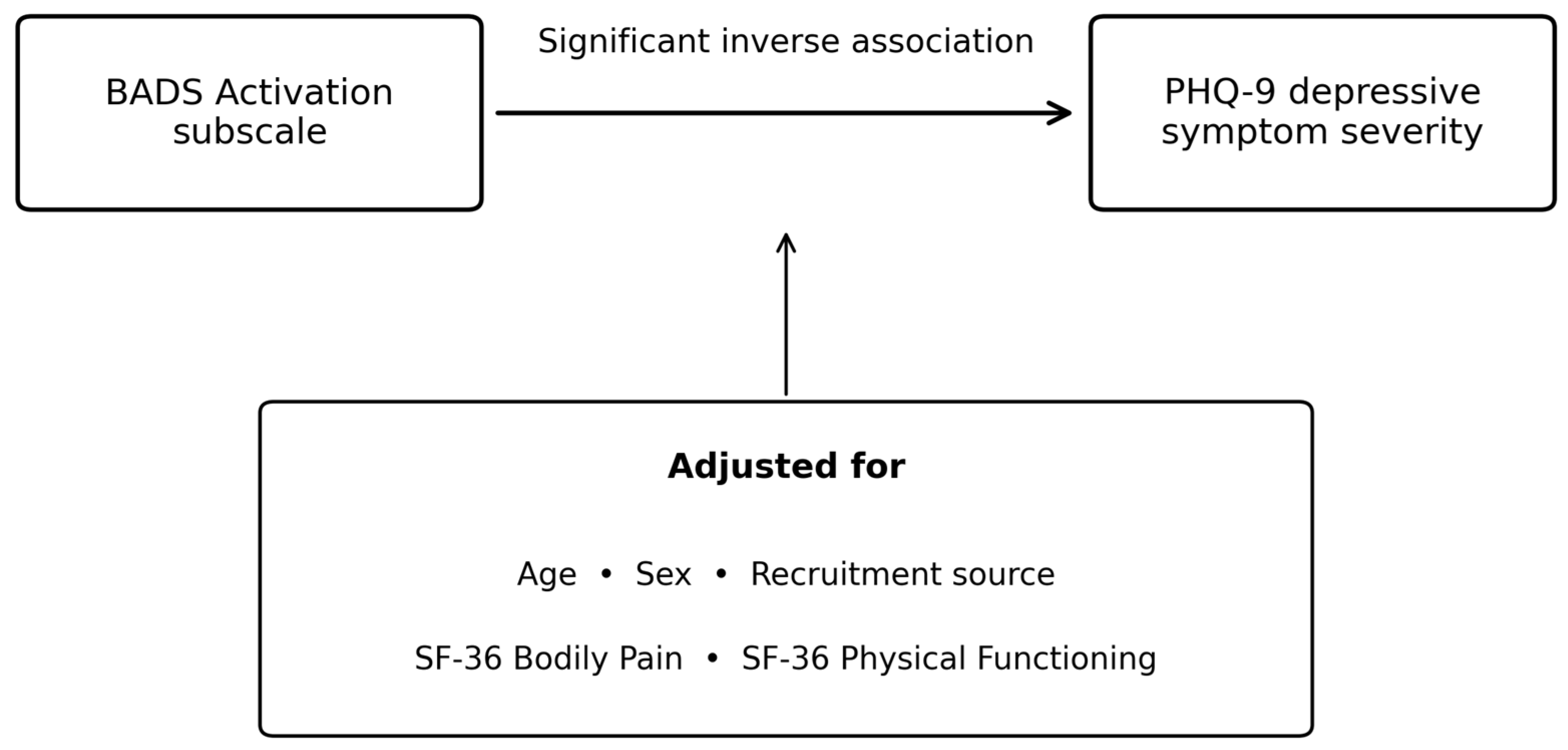
To examine whether the association between behavioral activation and depressive symptom severity was driven primarily by the avoidance/rumination or functional-impairment components of the BADS total score, a focused sensitivity analysis was performed using the BADS Activation subscale as the principal predictor. After adjustment for age, sex, recruitment source (clinical versus online), SF-36 Bodily Pain, and SF-36 Physical Functioning, higher Activation scores remained significantly and inversely associated with PHQ-9 depressive symptom severity. Thus, the principal behavioral finding was retained when the analysis focused specifically on engagement in goal-directed and potentially reinforcing activities and accounted for basic demographic, sampling, pain, and physical-function differences (Figure 1).
Figure 1.
Focused sensitivity model examining behavioral activation and depressive symptom severity. The BADS Activation subscale remained inversely associated with PHQ-9 depressive symptom severity after adjustment for age, sex, recruitment source, SF-36 Bodily Pain, and SF-36 Physical Functioning. The diagram summarizes the clinically relevant adjustment model. BADS, Behavioral Activation for Depression Scale; PHQ-9, Patient Health Questionnaire-9; SF-36, 36-Item Short Form Health Survey.
3.6. Health-Related Quality of Life
PHQ-9 scores were negatively correlated with all SF-36 domains (all p < 0.001 as seen in Table 4). The strongest correlations were observed for Mental Health (r = −0.54), Vitality (r = −0.49), and Social Functioning (r = −0.41). Associations with General Health (r = −0.36), Role Limitations due to Emotional Problems (r = −0.38), Bodily Pain (r = −0.33), Physical Functioning (r = −0.28), and Role Limitations due to Physical Health (r = −0.24) were also significant.
Table 4.
SF-36 domain scores and correlations with PHQ-9 total score.
3.7. Recruitment-Source Sensitivity Comparison
Clinic-recruited participants were slightly older than online-recruited participants (54.1 ± 10.9 vs. 51.2 ± 12.3 years; p = 0.039). In the retained comparison output, no statistically significant recruitment-source differences were identified for sex distribution, PHQ-9, BADS total score, global self-rated quality of life, perceived social support, or illness duration. These findings reduce, but do not eliminate, concern regarding recruitment-related heterogeneity because disease activity, treatment exposure, socioeconomic circumstances, digital and health literacy, and motivation to participate were not measured comprehensively.
Note: NR, exact subgroup descriptive estimate not retained in the archived statistical output available for manuscript revision. The table reports only recoverable source-specific summaries and comparison results and should not be interpreted as evidence that the two recruitment pathways were equivalent. BADS, Behavioral Activation for Depression Scale; PHQ-9, Patient Health Questionnaire-9; QoL, quality of life.
4. Discussion
The principal finding of this study is that behavioral activation was associated with depressive symptom burden in adults with RA. Among the psychosocial variables included in the prespecified multivariable model, BADS total score showed the largest standardized association with PHQ-9 score. This finding adds a behavioral dimension to the established literature linking depression in RA with pain, disability, fatigue, disease activity, and reduced quality of life [1,4,5,6]. The magnitude of the bivariate BADS–PHQ-9 association (r = −0.47) is described throughout the manuscript as moderate; we avoid characterizing it as strong.
The result is clinically and conceptually relevant because behavioral activation represents more than a general measure of well-being. It captures engagement with reinforcing activities and, in its broader framework, the balance between activation and avoidance [10,11]. RA can plausibly disrupt this balance through pain, fatigue, reduced mobility, work limitations, and loss of social roles [5,6,17]. Importantly, the focused sensitivity analysis using the Activation subscale retained an inverse association with depressive symptom severity after adjustment for age, sex, recruitment source, SF-36 Bodily Pain, and SF-36 Physical Functioning. This supports the clinical interpretation that the association was not solely driven by overlap between PHQ-9 symptoms and the avoidance/impairment components of the BADS. At the same time, the cross-sectional design and the absence of objective disease-activity and treatment covariates prevent causal or fully disease-independent interpretation.
The association with perceived social support was smaller but remained significant after accounting for behavioral activation, global self-rated quality of life, and disease duration. This is consistent with recent evidence that social support is relevant to quality of life in RA [7]. However, the present study used a single-item support measure, and the effect should not be interpreted as a comprehensive estimate of the role of social networks, received support, or relationship quality.
Depressive symptom severity was also associated with impairment across all SF-36 domains, especially Mental Health, Vitality, and Social Functioning. The strong association with the Mental Health domain partly reflects conceptual proximity to depressive symptom measurement and should not be interpreted as an independent clinical outcome. More informative for RA care are the concurrent associations with vitality, social functioning, pain, general health, and physical functioning, which illustrate the broad functional context in which depressive symptoms occur [8].
Illness duration was not associated with PHQ-9 score in either bivariate or multivariable analyses. This suggests that chronicity alone is an imprecise marker of psychological burden. Longitudinal evidence in RA indicates that contemporaneous pain, functional impairment, work disability, social factors, and disease activity can be more informative than time since diagnosis [3,5]. In the present study, several of these clinically important covariates were not available in the analytic model, so the null association with disease duration should not be overinterpreted.
A further contribution of the present study is its focus on a Romanian RA population while moving beyond prevalence alone. A recent Romanian cohort has shown that depression is clinically relevant and related to disease activity in RA [3], but the national evidence base remains limited. The present results complement rather than supersede that work by identifying behavioral activation as an underexamined correlate of depressive symptom severity. The novelty of this study therefore lies in examining a potentially modifiable behavioral construct within a Romanian RA sample, not in assuming that the epidemiology of depression in Romanian RA populations has already been comprehensively established.
4.1. Clinical Implications
The findings support assessment of psychological and behavioral functioning as part of patient-centered RA care, consistent with broader recommendations emphasizing self-management and psychosocial aspects of inflammatory arthritis [18]. They do not justify recommending behavioral activation therapy on the basis of this study alone. Rather, they identify behavioral activation as a candidate target for prospective research. Behavioral activation is an established evidence-based approach for depression [12], and recent evidence also supports its application in some chronic pain populations [13]. A logical next step is to test whether behavioral activation predicts subsequent depressive symptoms, functioning, adherence, or quality of life in RA and whether targeted interventions improve these outcomes when added to standard rheumatologic care.
4.2. Strengths
Strengths include a moderately sized sample, concurrent use of PHQ-9, BADS, and SF-36, good internal consistency of the principal psychological scales, and recruitment across both clinical and community settings. The analysis distinguishes a behavioral construct—activation—from global quality of life and perceived social support. In addition, the focused Activation-subscale sensitivity analysis addressed the principal concern regarding conceptual overlap with depressive symptoms while accounting for age, sex, recruitment source, perceived pain, and physical functioning.
4.3. Limitations
- The cross-sectional design precludes causal and temporal inference; reverse or bidirectional associations are plausible.
- The primary regression model addressed a focused psychosocial question and did not include a comprehensive set of RA-specific clinical or socioeconomic confounders. The complementary Activation-subscale sensitivity model adjusted for age, sex, recruitment source, SF-36 Bodily Pain, and SF-36 Physical Functioning, but objective disease activity or severity (e.g., DAS28), inflammatory markers, medication exposure, sleep disturbance, fatigue, comorbidities, household income, and other socioeconomic indicators were not available. Residual confounding therefore remains possible.
- Recruitment combined a clinically verified subsample with an online subsample in which prior rheumatologist-confirmed RA diagnosis and illness duration were self-reported. This creates potential diagnostic misclassification and recall bias. Clinic-recruited participants were slightly older, while the retained comparison outputs showed no statistically significant differences for the other measured variables examined. Nevertheless, differential selection and diagnostic verification remain possible, and unmeasured differences in disease severity, comorbidities, socioeconomic position, digital and health literacy, treatment access, and interest in psychosocial topics may have influenced participation.
- Some secondary descriptive information requested during peer review—such as complete source-stratified estimates, PHQ-9 threshold frequencies, participant-flow counts, and full BADS subscale descriptive outputs—was not available in the retained analytical materials accessible during revision. We therefore did not introduce unverified retrospective estimates.
- Perceived social support and global self-rated quality of life were measured with single study-specific items rather than validated multidimensional instruments, limiting construct precision.
- The PHQ-9 has published Romanian validation data in a chronic-disease population, but not specifically in RA. A formal published Romanian cross-cultural validation of the 25-item BADS was not identified; therefore, BADS findings should be interpreted with appropriate psychometric caution.
- The original analysis summarized continuous variables using means and standard deviations. Participant-level data were not available to the corresponding author during revision to generate additional post-hoc medians, interquartile ranges, or distributional plots; accordingly, the original descriptive framework was retained.
- All major psychosocial variables were self-reported, increasing the possibility of common-method variance. Depressive symptoms also overlap conceptually with some SF-36 domains, particularly Mental Health.
- Illness duration was partly reconstructed from categorical responses using midpoint values, introducing additional measurement imprecision. In addition, because the anonymous online workflow did not embed a study-specific real-time suicide-risk escalation pathway, PHQ-9 item 9 could not trigger participant-level follow-up through the research database. Future online studies using depression measures should incorporate explicit real-time crisis signposting and escalation procedures where ethically and technically feasible.
- The sample was predominantly female, which is consistent with RA epidemiology but limits inference for men. Voluntary online participation may also have favored individuals with greater digital access or interest in psychosocial topics.
5. Conclusions
Behavioral activation showed the largest standardized association with depressive symptom severity among the psychosocial variables included in the prespecified cross-sectional model. Lower activation, poorer global self-rated quality of life, and lower perceived social support were associated with greater depressive symptom burden, whereas illness duration was not. Depressive symptoms were also linked to broad reductions in health-related quality of life, especially vitality, social functioning, and mental health. In the focused sensitivity analysis, the BADS Activation subscale remained inversely associated with PHQ-9 scores after adjustment for age, sex, recruitment source, Bodily Pain, and Physical Functioning, supporting the clinical relevance of active engagement beyond the avoidance/impairment components of the total scale. These findings identify behavioral activation as a potentially useful construct for longitudinal and interventional research in RA, while the cross-sectional design and absence of objective disease-activity, treatment, comorbidity, and socioeconomic covariates require appropriately cautious interpretation.
Author Contributions
A.L.V.: conceptualization, investigation, writing—original draft preparation; G.D.: investigation, writing—review and editing; C.R.P.: methodology, formal analysis, visualization; A.-M.L.: data curation, visualization, software, writing—review and editing; D.-I.P.: resources, validation; D.C.V.: validation, supervision; A.A.Ș.B.: conceptualization, investigation. All authors have read and agreed to the published version of the manuscript.
Funding
This research received no external funding.
Institutional Review Board Statement
The study was conducted in accordance with the Declaration of Helsinki and approved by the Ethics Committee of “Dunărea de Jos” University of Galați, Faculty of Medicine and Pharmacy (Approval No. 24, 20 May 2025).
Informed Consent Statement
Informed consent was obtained from all participants involved in the study. Clinically recruited participants consented before questionnaire administration; online participants provided electronic informed consent before accessing the study questionnaire.
Data Availability Statement
The de-identified participant-level data are not publicly available because of privacy and confidentiality restrictions. Access to the source dataset would require approval from the original data custodian and, where applicable, the relevant institutional and ethics authorities.
Conflicts of Interest
The authors declare no conflicts of interest.
References
- Brock, J.; Basu, N.; Schlachetzki, J.C.M.; Schett, G.; McInnes, I.B.; Cavanagh, J. Immune mechanisms of depression in rheumatoid arthritis. Nat. Rev. Rheumatol. 2023, 19, 790–804. [Google Scholar] [CrossRef] [Scilit] [PubMed]
- Matcham, F.; Rayner, L.; Steer, S.; Hotopf, M. The prevalence of depression in rheumatoid arthritis: A systematic review and meta-analysis. Rheumatology 2013, 52, 2136–2148. [Google Scholar] [CrossRef] [Scilit] [PubMed]
- Ionescu, C.-E.; Popescu, C.C.; Agache, M.; Dinache, G.; Codreanu, C. Depression in rheumatoid arthritis: Prevalence and effects on disease activity. J. Clin. Med. 2024, 13, 2058. [Google Scholar] [CrossRef] [Scilit] [PubMed]
- Manning-Bennett, A.T.; Hopkins, A.M.; Sorich, M.J.; Proudman, S.M.; Foster, D.J.R.; Abuhelwa, A.Y.; Wiese, M.D. The association of depression and anxiety with treatment outcomes in patients with rheumatoid arthritis: A pooled analysis of five randomised controlled trials. Ther. Adv. Musculoskelet. Dis. 2022, 14, 1759720X221111613. [Google Scholar] [CrossRef] [Scilit] [PubMed]
- McQuillan, J.; Andersen, J.A.; Berdahl, T.A.; Willett, J. Associations of rheumatoid arthritis and depressive symptoms over time: Are there differences by education, race/ethnicity, and gender? Arthritis Care Res. 2022, 74, 2050–2058. [Google Scholar] [CrossRef] [Scilit] [PubMed]
- De Cock, D.; Doumen, M.; Vervloesem, C.; Van Breda, A.; Bertrand, D.; Pazmino, S.; Westhovens, R.; Verschueren, P. Psychological stress in rheumatoid arthritis: A systematic scoping review. Semin. Arthritis Rheum. 2022, 55, 152014. [Google Scholar] [CrossRef] [Scilit] [PubMed]
- Coyle, N.; Kuit, S.; Dunne, S. Investigating the association between social support and quality of life in people with rheumatoid arthritis: A systematic review of the literature. Int. J. Rheum. Dis. 2025, 28, e70234. [Google Scholar] [CrossRef] [Scilit] [PubMed]
- Feng, J.; Yu, L.; Fang, Y.; Zhang, X.; Li, S.; Dou, L. Correlation between disease activity and patient-reported health-related quality of life in rheumatoid arthritis: A cross-sectional study. BMJ Open 2024, 14, e082020. [Google Scholar] [CrossRef] [Scilit] [PubMed]
- von Elm, E.; Altman, D.G.; Egger, M.; Pocock, S.J.; Gøtzsche, P.C.; Vandenbroucke, J.P.; STROBE Initiative. The Strengthening the Reporting of Observational Studies in Epidemiology (STROBE) statement: Guidelines for reporting observational studies. Lancet 2007, 370, 1453–1457. [Google Scholar] [CrossRef] [Scilit] [PubMed]
- Kanter, J.W.; Mulick, P.S.; Busch, A.M.; Berlin, K.S.; Martell, C.R. The Behavioral Activation for Depression Scale (BADS): Psychometric properties and factor structure. J. Psychopathol. Behav. Assess. 2007, 29, 191–202. [Google Scholar] [CrossRef] [Scilit]
- Fuhr, K.; Hautzinger, M.; Krisch, K.; Berking, M.; Ebert, D.D. Validation of the Behavioral Activation for Depression Scale (BADS)—Psychometric properties of the long and short form. Compr. Psychiatry 2016, 66, 209–218. [Google Scholar] [CrossRef] [Scilit] [PubMed]
- Cuijpers, P.; Ciharova, M.; Tong, L.; Liu, Y.; Sprenger, A.A.; Miguel, C.; Karyotaki, E.; Harrer, M. Behavioral activation for depression: A comprehensive systematic review and meta-analysis. Clin. Psychol. Rev. 2026, 128, 102783. [Google Scholar] [CrossRef] [Scilit] [PubMed]
- Sanabria-Mazo, J.P.; Colomer-Carbonell, A.; Borràs, X.; Castaño-Asins, J.R.; McCracken, L.M.; Montero-Marin, J.; Pérez-Aranda, A.; Edo, S.; Sanz, A.; Feliu-Soler, A.; et al. Efficacy of videoconference group Acceptance and Commitment Therapy (ACT) and Behavioral Activation Therapy for Depression (BATD) for chronic low back pain plus comorbid depressive symptoms: A randomized controlled trial (IMPACT Study). J. Pain 2023, 24, 1522–1540. [Google Scholar] [CrossRef] [Scilit] [PubMed]
- Kroenke, K.; Spitzer, R.L.; Williams, J.B.W. The PHQ-9: Validity of a brief depression severity measure. J. Gen. Intern. Med. 2001, 16, 606–613. [Google Scholar] [CrossRef] [Scilit] [PubMed]
- Lupascu, N.; Timar, B.; Albai, A.; Roman, D.; Potre, O.; Timar, R. Validation and cross-cultural adaptation of the depression Patient’s Health Questionnaire-9 in the Romanian population of patients with type 2 diabetes mellitus. Diabetes Metab. Syndr. Obes. 2019, 12, 841–849. [Google Scholar] [CrossRef] [Scilit] [PubMed]
- Ware, J.E., Jr.; Sherbourne, C.D. The MOS 36-item short-form health survey (SF-36). I. Conceptual framework and item selection. Med. Care 1992, 30, 473–483. [Google Scholar] [CrossRef] [Scilit]
- Nikiphorou, E.; Santos, E.J.F.; Marques, A.; Böhm, P.; Bijlsma, J.W.J.; Daien, C.I.; Esbensen, B.A.; Ferreira, R.J.O.; Fragoulis, G.E.; Holmes, P.; et al. 2021 EULAR recommendations for the implementation of self-management strategies in patients with inflammatory arthritis. Ann. Rheum. Dis. 2021, 80, 1278–1285. [Google Scholar] [CrossRef] [Scilit] [PubMed]
- Dures, E.; Farisoğulları, B.; Santos, E.J.F.; Molto, A.; Feldthusen, C.; Harris, C.; Elling-Audersch, C.; Connolly, D.; Elefante, E.; Estévez-López, F.; et al. 2023 EULAR recommendations for the management of fatigue in people with inflammatory rheumatic and musculoskeletal diseases. Ann. Rheum. Dis. 2024, 83, 1260–1267. [Google Scholar] [CrossRef] [Scilit] [PubMed]

Disclaimer/Publisher’s Note: The statements, opinions and data contained in all publications are solely those of the individual author(s) and contributor(s) and not of MDPI and/or the editor(s). MDPI and/or the editor(s) disclaim responsibility for any injury to people or property resulting from any ideas, methods, instructions or products referred to in the content. |
© 2026 by the authors. Licensee MDPI, Basel, Switzerland. This article is an open access article distributed under the terms and conditions of the Creative Commons Attribution (CC BY) license.