


Abstract
Background: Musculoskeletal pain (MSP) is common among dental students and dentists. We assessed the prevalence of MSP among undergraduate dental students and postgraduate dental specialty trainees in Türkiye and its associations with demographic, lifestyle, and educational factors. Methods: In this cross-sectional study, an anonymous online questionnaire including a modified instrument based on the Standardized Nordic Musculoskeletal Questionnaire was completed by 348 trainees. Associations were analyzed using bivariate tests, multivariable logistic regression, and modified Poisson regression. Results: Past-week MSP in at least one body site was reported by 82.8% (95% CI 78.4–86.4%); neck, back, and shoulder pain by 67.2%, 69.5%, and 48.9%, respectively. In bivariate analyses, MSP was associated with female sex, coffee consumption, longer clinical sessions, more chairside practice and computer use, fewer preclinical hours, older age, and lower BMI. After adjustment, computer use remained associated with MSP (aOR 1.30 per category increase, 95% CI 1.09–1.56; adjusted prevalence ratio 1.04, 95% CI 1.02–1.06), although the primary model showed lack of fit and the association was not uniform across categories. Conclusions: MSP is highly prevalent in this convenience sample of dental trainees in Türkiye. Computer use was most consistently associated with MSP. Causality cannot be inferred from this cross-sectional design.
1. Introduction
Musculoskeletal disorders related to work are among the most common occupational health problems in dentistry. They affect bones, joints, muscles, and tendons and often cause pain, decreased productivity, absence from work, and even long-term disability [1,2,3,4]. In a systematic review of dental professionals, the reported prevalence of musculoskeletal diseases and pain ranged from 10.8% to 97.9%, with the neck, lower back, shoulders, and upper back most frequently affected [1,4,5]. Static and awkward working postures, prolonged sitting, repetitive tasks, long working hours, female sex, and high patient load consistently appear as central risk factors in systematic reviews [4,6].
Dental practitioners face many of these biomechanical challenges as early as their undergraduate training, and increasing evidence suggests that work-related musculoskeletal disorders (WMSDs) are already highly prevalent during undergraduate education. A recent systematic review and meta-analysis of 16 studies including 3761 dental students reported pooled 12-month prevalence rates of 51.0% for the neck, 45.3% for the shoulders, and 42.0% for the lower back [7]. The most frequently affected body parts are the neck, upper and lower back, and shoulders, and a substantial proportion of students report interference with daily activities [7,8]. Multinational and country-specific studies report that 71–87% of students experience pain in at least one body region and identify female sex, prolonged clinical sessions, improper posture, inadequate ergonomic awareness, a sedentary lifestyle, and tobacco use as associated factors, whereas regular physical activity appears to have a protective effect [7,9,10,11,12].
Despite the substantial burden of musculoskeletal pain (MSP) among undergraduate dental students and dentists, there are still significant gaps in the literature. Due in large part to extended static postures, repeated hand movements, and limited working fields that encourage awkward neck and back positions, dentistry is frequently classified as a high-risk occupation for WMSDs [3,4,5]. Incorrect posture and early onset of symptoms during the undergraduate years indicate that occupational risks might arise long before full-time clinical practice [13,14,15].
While there is an increasing amount of research on WMSDs among undergraduate dental students and postgraduate dental specialty trainees, the majority of these studies are cross-sectional and concentrate on prevalence rather than the combined impact of lifestyle, educational, and demographic factors [7,8,16]. In particular, only a limited number of studies have simultaneously examined physical activity patterns, smoking, coffee intake, computer use, and the duration of clinical and preclinical training in relation to MSP, and findings regarding several of these factors remain inconsistent [8,16,17,18].
To identify high-risk populations and direct focused preventive measures, such as ergonomic training and the promotion of healthy behaviors in dentistry curricula, a comprehensive evaluation of these modifiable variables is required [7,19,20]. Since early interventions could alter the course of symptoms and long-term disability, identifying such associated factors is essential [15,19,20]. In Türkiye, previous studies have mainly focused on undergraduate dental students [8,21], whereas data on postgraduate dental specialty trainees, who typically spend considerably more time in chairside practice, remain scarce. Moreover, the daily time spent in chairside practice, preclinical laboratory training, and computer use has rarely been examined together with lifestyle factors across the continuum from undergraduate education to specialty training. Therefore, the general objective of this cross-sectional study was to determine the prevalence of MSP among undergraduate dental students and postgraduate dental specialty trainees in Türkiye and to investigate its associations with demographic, lifestyle, and educational factors.
2. Materials and Methods
2.1. Study Design and Participants
This cross-sectional study was conducted among undergraduate dental students and postgraduate dental specialty trainees in Türkiye in July 2026. Postgraduate trainees were dentists enrolled in dental specialty training programs at the time of the survey; in the questionnaire, they were identified by selecting ‘graduate’ in the year-of-training item. All postgraduate participants were in the first to third year of their specialty training. Data were collected using an anonymous, self-administered online questionnaire created with Google Forms (Google LLC, Mountain View, CA, USA). Before data collection, the questionnaire was pilot-tested among 40 participants (20 undergraduate dental students and 20 postgraduate dental specialty trainees) to assess the clarity and comprehensibility of the items, after which minor wording changes were made; the pilot responses were not included in the final analysis. The form was set to accept only one response per respondent; respondents who attempted to complete the questionnaire a second time received a notification that they had already responded. Although this setting required respondents to sign in with a Google account, e-mail addresses and account information were neither collected nor accessible to the investigator, so that the responses remained anonymous. A convenience sampling approach was used. Participants could be enrolled at dental faculties and specialty training programs throughout Türkiye; the institution was not recorded in order to preserve anonymity. The questionnaire link was not shared publicly; it was distributed via a social media group of approximately 500 dental trainees and was additionally sent to the same trainees by e-mail. Both channels reached the same trainees; thus, approximately 500 individuals were invited in total. All eligible trainees who wished to participate could complete the questionnaire, and data collection was closed once the required sample size had been exceeded. Eligibility was ensured by distributing the link only to undergraduate dental students and dental specialty trainees; age ≥18 years was confirmed in the electronic consent statement at the beginning of the questionnaire. All participants provided electronic informed consent before accessing the questionnaire, and participation was entirely voluntary. To minimize response and social desirability bias, the survey was conducted anonymously, and no personally identifiable information was collected. Questionnaires with implausible values, internally inconsistent answers, or a uniform response pattern were excluded from the final analysis. The responses were accessible only to the author through a password-protected account. The survey was closed after data collection and no longer accepts responses, and the data will be retained in accordance with the institutional data retention policy.
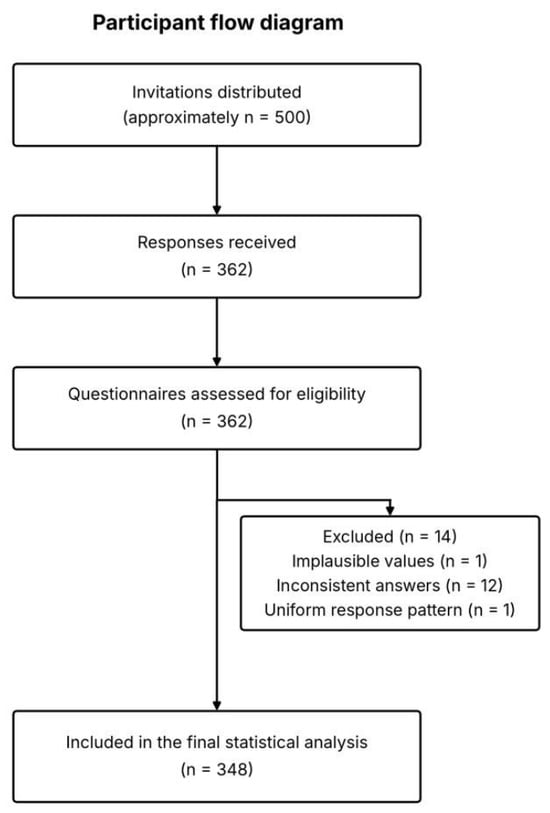
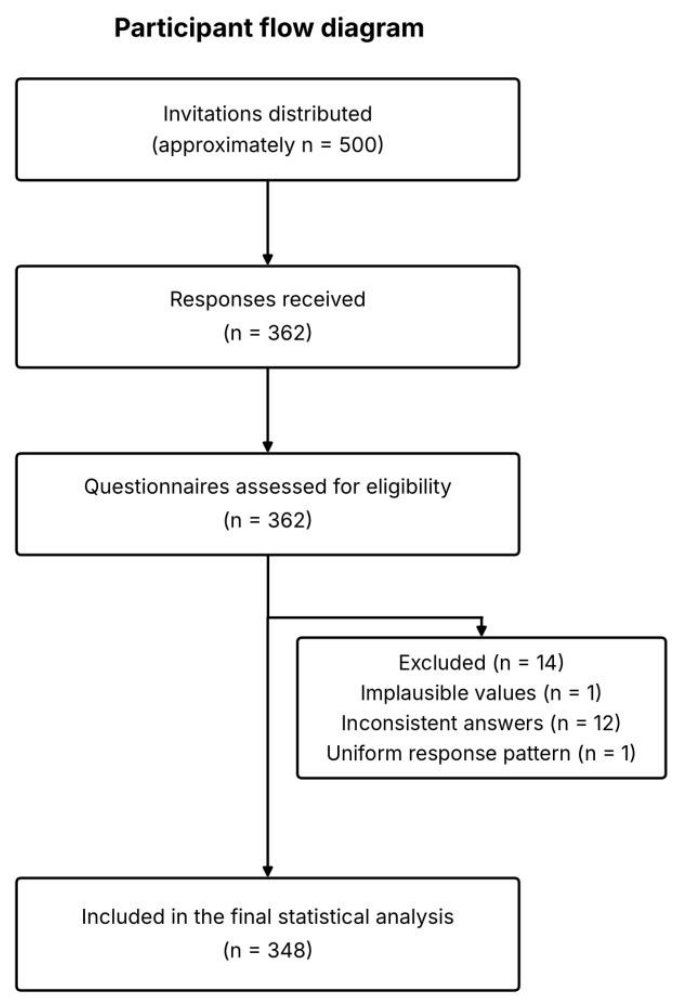
Of the approximately 500 invited trainees, 362 responded to the questionnaire (response rate, approximately 72.4%); 14 questionnaires were excluded (implausible age and weight values, n = 1; internally inconsistent answers, n = 12; uniform response pattern, n = 1), leaving 348 participants for the final analysis (Figure 1). No item-level missing data occurred for the analyzed variables. The study protocol was reviewed and approved by the Scientific and Ethical Evaluation Board for Medical Research No. 2 of Ankara Bilkent City Hospital (approval no. TABED 2-26-2524; date of approval: July 2026, before recruitment began) and was conducted in accordance with the principles of the Declaration of Helsinki.
Figure 1.
Participant flow diagram.
2.2. Questionnaire
The questionnaire consisted of three sections; the complete questionnaire (English translation) is provided in Supplementary File S1. The first and second sections are not part of the Standardized Nordic Musculoskeletal Questionnaire (NMQ); they were adapted from questionnaires used in previous NMQ-based studies of medical and dental students [16,17], with additional items on age, year of training, preclinical laboratory training, and type of sport. These items were factual and descriptive in nature and were not psychometrically validated. These variables were selected because they have been reported as potential correlates of MSP in previous studies of dental and medical students, including sex, age and stage of training, BMI, smoking, coffee consumption, exercise, history of trauma, family history of musculoskeletal disorders, and the time spent in clinical practice and computer use [7,9,10,11,12,16,17]. The first section covered demographic and personal characteristics, including age, sex, year of study or year after graduation, height and weight (from which body mass index [BMI] was calculated), smoking status and daily cigarette consumption, weekly coffee consumption, exercise habits (frequency and type of sport), history of previous trauma, and family history of trauma or musculoskeletal disorders (MSDs); an item on ethnic origin was also included but was not analyzed, as all participants were of Turkish origin. Exercise habits were self-rated using the response options ‘yes, regularly’, ‘yes, occasionally’, and ‘no, hardly at all’, without predefined thresholds for frequency or duration; participants who exercised were asked to specify the type and frequency of their sport. Weekly coffee consumption was assessed using the three-cups-per-week threshold of the original questionnaire [17], without a separate option for exactly three cups per week; the ‘other’ category comprised free-text responses that could not be assigned to the predefined categories, mostly reporting daily consumption or consumption only during examination periods. The second section covered educational and occupational exposures, including the duration of the daily clinical session (time spent in preclinical laboratory or chairside practice) and the daily time spent on computer use, chairside clinical practice, and preclinical laboratory training, recorded in predefined hourly categories.
The third section assessed MSP and was based on the structure of the NMQ [22] and its validated Turkish version [23]. The original NMQ assesses musculoskeletal trouble in nine anatomical regions over the previous 12 months and 7 days [22]. The Turkish version of the NMQ was cross-culturally adapted and validated by Kahraman et al. in 198 hospital employees and showed excellent internal consistency (Cronbach’s α = 0.896), moderate to almost perfect test–retest reliability over a 1-week interval (prevalence-adjusted bias-adjusted kappa [PABAK] = 0.57–0.90), and good construct validity, as participants reporting symptoms in a given region had significantly higher scores on the corresponding region-specific instruments (Neck Pain and Disability Scale, QuickDASH, Oswestry Disability Index, and WOMAC; p < 0.001) [23]. Because the instrument used in the present study was modified as described below, these psychometric properties cannot be assumed to apply to it; it is therefore referred to as a modified NMQ-based instrument.
To keep the online survey brief and to focus on the regions most frequently affected in dental students and professionals [7,16,24], and in line with previous population-specific and online adaptations of the NMQ [25,26,27,28,29,30,31], the NMQ was modified as follows: (i) structured items were included for three regions only—the neck, shoulders, and back, with the upper and lower back combined into a single ‘back’ item; (ii) the 7-day recall period was retained for all three regions, the 12-month recall period was retained for the neck, and a 1-month recall period was used instead of the 12-month period for the shoulders and back; (iii) the items on the prevention of normal activities were not included; and (iv) each item asked about the presence of pain, with the response options ‘yes’, ‘no’, and ‘not sure’. Pain in any other body region during the previous week was assessed with a yes/no question, followed by a free-text field in which participants specified the location of the pain; the prevalence of headache, arm pain, and leg pain was derived from these free-text descriptions. MSP in at least one body site during the past week was defined as a ‘yes’ response to the neck, shoulder, or back item or to the question on pain in any other body region; because this question was not restricted to musculoskeletal regions, responses describing headache were also counted toward this composite outcome; sensitivity analyses addressing this definition are described in Section 2.3. For analysis, responses were dichotomized as ‘yes’ versus ‘no/not sure’.
2.3. Statistical Analyses
As the primary aim was to estimate the prevalence of MSP, the sample size was determined on the basis of the precision of the prevalence estimate, using the formula n = Z2 p(1 − p)/d2. Assuming an expected prevalence of 80%, based on the range of 71–87% reported in previous studies of dental students [9,10,11,12], a 95% confidence level (Z = 1.96), and a precision (d) of ±5%, the minimum required sample size was 246 participants. The final sample of 348 participants exceeded this requirement and allowed the prevalence to be estimated with a precision of approximately ±4%.
Descriptive statistics were used to summarize participant characteristics and MSP prevalence; the 95% confidence interval (CI) for prevalence was calculated using the Wilson method. Categorical variables were presented as frequencies and percentages, whereas continuous variables were summarized as mean ± standard deviation (SD) or median with interquartile range (IQR), as appropriate. Daily computer use, chairside clinical practice, and preclinical laboratory training were recorded in categories (none, 0–1, 1–2, 2–3, 3–4, 4–5, 5–8, and >8 h) and were converted to hours using the category midpoints (e.g., none = 0 h, 0–1 h = 0.5 h, and 5–8 h = 6.5 h), with the open-ended category (>8 h) coded as 8 h, its lower bound, because no upper limit was available; these values were used to calculate means and medians. Bivariate associations between MSP and categorical predictors were evaluated using Pearson’s chi-square tests when expected counts were adequate. For tables with expected cell counts of <5, two-sided Fisher–Freeman–Halton exact tests were used. The Haldane–Anscombe correction was applied only to odds ratio (OR) and 95% CI estimates for zero-cell tables, not for significance testing. Because ORs overstate relative prevalence when the outcome is common, crude prevalence ratios (PRs) with 95% CIs (MOVER method based on Wilson intervals) were also calculated for categorical variables. For continuous variables, differences between participants with and without MSP were tested using the Mann–Whitney U test, and results were reported as median (IQR) with corresponding p values. Two-sided p values < 0.05 were considered statistically significant. The primary outcome was MSP in at least one body site during the past week; the analyses of associated factors were exploratory, and no adjustment was made for multiple comparisons. Multivariable binary logistic regression was used with past-week MSP (yes/no) as the dependent variable. The model included sex, age, training level, BMI, coffee consumption (any vs. none), exercise (regular or occasional vs. hardly at all), and the daily computer-use, chairside clinical-practice, and preclinical laboratory-session categories; the duration of the daily clinical session was not entered, as it reflects the time spent in preclinical laboratory or chairside practice, which were entered as separate variables. BMI was modeled continuously using values calculated from recorded height and weight. Ordered time categories were entered as ordinal terms (scores 0–7, with >8 h as the highest category); their ORs therefore refer to a one-category increase, not to an additional hour, and assume equal spacing between categories of unequal width. Coffee and exercise were coded as binary variables to limit model degrees of freedom; no interaction terms were fitted. The 16 ‘other’ coffee responses (daily consumption, n = 10; occasional consumption, n = 6) were classified as any consumption, so this binary term does not test the same association as the four-category bivariate comparison. Training stage was entered as undergraduate versus postgraduate level to limit the degrees of freedom and because the time-use variables were strongly structured by year of study. The model contained nine predictor degrees of freedom for 60 participants without past-week MSP; adjusted ORs (aORs) and Wald 95% CIs were reported. Two age entries containing obvious typographical errors were corrected before analysis; in both cases the intended value was evident, and the remaining responses in these questionnaires were valid. Descriptive and bivariate analyses were performed using IBM SPSS Statistics for Windows, version 23.0 (IBM Corp., Armonk, NY, USA); exact Fisher–Freeman–Halton p values were computed by complete enumeration using Python 3.12.14 and SciPy 1.17.0; the multivariable model was fitted by maximum likelihood using Python 3.12.14, NumPy 2.3.5, and SciPy 1.17.0. Covariates were selected for their clinical and epidemiological relevance as potential confounders, informed by prior literature; selection was not based solely on bivariate p values. Model convergence was checked, multicollinearity was assessed using variance inflation factors (VIFs), and discrimination and calibration were evaluated using the area under the receiver operating characteristic curve (AUC), the Brier score, the Hosmer–Lemeshow test (ten groups of 34–35 participants formed by ranking the predicted probabilities, with ties broken by record order), and the link test [32]. This study is reported in accordance with the STROBE guidelines for cross-sectional studies (Supplementary File S2).
Adjusted prevalence ratios (aPRs) were estimated using modified Poisson regression with robust standard errors [33]; logistic regression was retained as the primary model for comparability with previous studies. Sensitivity analyses varied the outcome definition (excluding headache-only cases; structured neck, shoulder, and back items only; ‘not sure’ responses as missing, with MSP classified as present if any item was ‘yes’ and as missing only if no item was ‘yes’ and at least one was ‘not sure’), the coding of computer use (hours, categories, and ≥2 vs. <2 h/day, a data-driven cut-off chosen after inspection of the category-specific prevalences), and the model (a parsimonious model of sex, training level, and the three time-use variables, selected on clinical grounds; Firth penalized estimation [34]; year of training instead of training level; and coffee consumption in three categories). For this coffee analysis only, the 16 ‘other’ responses were assigned by their free-text content: daily consumption (n = 10) to >3 cups/week and occasional consumption without a stated amount (n = 6; e.g., ‘rarely’, ‘only during examination periods’) to <3 cups/week, assuming that occasional use did not exceed three cups per week.
3. Results
Approximately 500 dental trainees were invited to participate, and 362 responded to the online questionnaire (response rate, approximately 72.4%). Fourteen questionnaires were excluded because of implausible values (n = 1), internally inconsistent answers (n = 12), or a uniform response pattern (n = 1), leaving 348 participants for the final statistical analysis. Most participants were female (70.7%), and the majority reported no history of previous trauma (87.4%) and no family history of trauma or musculoskeletal disorders (76.4%). More than half reported hardly any exercise (54.0%), while regular and occasional exercise was reported by 14.4% and 31.6% of participants, respectively. Coffee consumption was common, with 64.4% of participants consuming more than three cups per week, and 22.4% of participants were current smokers. Most participants (63.8%) reported clinical sessions lasting 0–2 h per day, whereas 22.4% reported sessions lasting 2–4 h. The mean (SD) age and BMI were 23.0 (3.1) years and 22.3 (3.3) kg/m2, respectively (Table 1).
Table 1.
Demographic characteristics of participants (n = 348).
The prevalence of MSP in at least one body site during the past week was high. Overall, 288 of 348 participants (82.8%; 95% CI 78.4–86.4%) reported MSP in at least one body site during the past week. Neck pain was reported by 67.2% of participants in the past week and 85.1% in the past 12 months. Back pain affected 69.5% in the past week and 77.6% in the past month, while shoulder pain was reported by 48.9% and 63.2% in the past week and month, respectively. Headache, arm pain, and leg pain during the past week were less frequent, at 5.2%, 6.9%, and 10.3%, respectively (Table 2).
Table 2.
Prevalence of musculoskeletal pain (MSP) among participants (n = 348).
No participant was classified as having MSP solely because of headache or a symptom without a clear musculoskeletal location: all 18 participants who described headache also reported neck, shoulder, or back pain, and the 12 participants who qualified only through the item on other body regions described pain in the arm or forearm, knee, leg, lower back, or finger. The sensitivity analysis excluding such participants was therefore identical to the primary analysis. Two of these participants reported lower back pain only in the free-text field; their responses were retained as recorded, so they are counted as having MSP in the primary analysis but not in the analysis restricted to the structured items; discordance between a structured item and the free-text field was not an exclusion criterion. When the outcome was restricted to the structured neck, shoulder, and back items, the past-week prevalence was 79.3% (276/348; 95% CI 74.7–83.2%).
‘Not sure’ responses were given by 12 (3.4%), 16 (4.6%), 24 (6.9%), 12 (3.4%), 8 (2.3%), and 8 (2.3%) participants for past-week neck, 12-month neck, past-week shoulder, past-month shoulder, past-week back, and past-month back pain, respectively. When these responses were treated as missing instead of ‘no’, the prevalence estimates increased by 1.7–4.1 percentage points (past-week neck 69.6%, shoulder 52.5%, and back 71.2%; 12-month neck 89.2%; past-month shoulder 65.5% and back 79.4%), and the prevalence of past-week MSP in at least one body site was 84.2% (288/342; 95% CI 80.0–87.7%).
In bivariate analyses, MSP in at least one body site during the past week was significantly associated with sex, coffee consumption, duration of clinical sessions, age, BMI, and several activity-related variables. Female participants had higher odds of reporting MSP compared with males (OR 2.53, 95% CI 1.43–4.48, p = 0.001). Coffee intake showed a significant association with MSP (p < 0.001), with lower odds among participants consuming fewer than three cups per week or reporting ‘other’ patterns, compared with non-consumers. Longer daily clinical sessions were related to a higher prevalence of MSP (p = 0.007), and participants with MSP reported significantly more hours of computer use and chairside clinical practice, but fewer hours in preclinical laboratory sessions. Age (p = 0.026) and BMI (p = 0.034) also differed significantly between participants with and without MSP (Table 3). Weekly MSP prevalence was 87.0% in women and 72.5% in men; therefore, the OR of 2.53 describes the odds contrast and should not be interpreted as a 2.53-fold prevalence; the corresponding crude prevalence ratio was 1.20 (95% CI 1.07–1.38; Table 3).
Table 3.
Bivariate analysis of factors associated with MSP in at least one body site during the past week.
In the multivariable logistic regression model (n = 348), computer-use category remained associated with past-week MSP (aOR 1.30 per one-category increase, 95% CI 1.09–1.56; p = 0.004; Table 4). The adjusted estimates for female sex (aOR 2.09, 95% CI 0.99–4.40; p = 0.052) and preclinical laboratory-session time (aOR 0.84, 95% CI 0.69–1.02; p = 0.075) were borderline, and those for age, training level, BMI, coffee consumption, exercise, and chairside clinical-practice time were not statistically significant. The model converged. VIFs ranged from 1.04 to 2.97, the apparent AUC was 0.758, and the Brier score was 0.130, lower than that of a null model assigning the observed prevalence to all participants (0.143). The Hosmer–Lemeshow test indicated lack of fit (χ2 = 18.00, df = 8; p = 0.021), although five of the ten groups had fewer than five expected participants without MSP, and the link test also suggested misspecification (p = 0.003). Calibration improved when computer use was modeled in hours or as categories (see below), but the link test remained significant in most alternative models; the link test was not statistically significant only for the model with computer-use categories (p = 0.055), which does not establish that this model is correctly specified.
Table 4.
Multivariable logistic and modified Poisson regression analyses of factors associated with past-week MSP (n = 348).
Modified Poisson regression yielded adjusted prevalence ratios that were closer to the null than the corresponding aORs, as expected for a common outcome (Table 4). Computer-use category was associated with a 4% higher prevalence of past-week MSP per one-category increase (aPR 1.04, 95% CI 1.02–1.06; p < 0.001). In this model, female sex (aPR 1.15, 95% CI 1.00–1.31; p = 0.048) and preclinical laboratory-session category (aPR 0.97, 95% CI 0.94–0.99 per category increase; p = 0.019) also reached nominal statistical significance, whereas their associations were borderline in the logistic model.
Participants per computer-use category (MSP prevalence) were: none, 72 (83%); 0–1 h, 90 (69%); 1–2 h, 56 (79%); 2–3 h, 36 (94%); 3–4 h, 42 (95%); 4–5 h, 20 (80%); 5–8 h, 18 (100%); >8 h, 14 (100%); prevalence did not increase uniformly.
Sensitivity analyses are summarized in Table 5. The association of computer use with MSP was in the same direction when the outcome was restricted to the structured neck, shoulder, and back items (aOR 1.19, 95% CI 1.02–1.39; aPR 1.03, 95% CI 1.01–1.06), when ‘not sure’ responses were treated as missing (aOR 1.30, 95% CI 1.07–1.57), when computer use was modeled in hours (aOR 1.38, 95% CI 1.13–1.69 per hour), and when it was modeled as a binary variable (≥2 vs. <2 h/day: 122/130 [93.8%] vs. 166/218 [76.1%] with MSP; aOR 4.46, 95% CI 1.98–10.02; aPR 1.21, 95% CI 1.12–1.32). When computer use was modeled as indicator variables, however, the 0–1 h/day category had lower odds of MSP than no computer use (aOR 0.19, 95% CI 0.08–0.48), whereas the 1–2 h/day (aOR 0.51, 95% CI 0.19–1.38) and ≥2 h/day (aOR 1.82, 95% CI 0.66–5.00) categories did not differ significantly from it (≥2 h/day vs. none: aPR 1.04, 95% CI 0.92–1.17). The binary contrast is therefore partly driven by the low prevalence in the 0–1 h/day category, which is part of its reference group. Modeling computer use as categories or in hours improved model fit (Hosmer–Lemeshow p = 0.156 and p = 0.238; Akaike information criterion 284.3 and 297.8 vs. 301.7 for the primary model), but the link test remained significant for the hours (p = 0.006), binary (p = 0.004), and parsimonious (p = 0.006) models and was not significant only for the categorical model (p = 0.055).
Table 5.
Sensitivity analyses for the association between computer use and past-week MSP.
The computer-use estimate was similar in the parsimonious model with five predictor degrees of freedom (12 participants without MSP per degree of freedom; aOR 1.28, 95% CI 1.07–1.53; Hosmer–Lemeshow p = 0.116), with Firth penalized estimation of the full (aOR 1.28, 95% CI 1.08–1.54) and parsimonious (aOR 1.27, 95% CI 1.07–1.53) models, when year of training was entered instead of training level (aOR 1.29, 95% CI 1.08–1.55; year of training, aOR 1.13, 95% CI 0.82–1.56 per step), and when coffee consumption was entered in three categories (aOR 1.33, 95% CI 1.10–1.60). In the latter model, consumption of fewer than three cups per week was associated with lower odds of MSP than no consumption (aOR 0.25, 95% CI 0.08–0.85), whereas consumption of more than three cups per week was not (aOR 0.94, 95% CI 0.29–3.10).
4. Discussion
In this study, MSP was highly prevalent among undergraduate dental students and postgraduate dental specialty trainees in Türkiye: approximately two-thirds reported neck or back pain and nearly half reported shoulder pain during the past week. Bivariate analyses showed that MSP was significantly associated with female sex, coffee consumption category, longer daily clinical sessions, more hours of computer use and chairside clinical practice, fewer hours of preclinical laboratory training, older age, and lower BMI. After adjustment, computer use was the only factor associated with MSP in both the logistic and the modified Poisson models, and the association was in the same direction in most sensitivity analyses, although it was not uniform across categories; female sex and preclinical laboratory time showed borderline adjusted associations whose statistical significance depended on the model.
In the present study, a high prevalence of MSP was observed notwithstanding a relatively young cohort with a normal mean BMI. These findings align with previous literature reporting that musculoskeletal symptoms are already common during the training period [1,7,16,35]. Epidemiological and experimental research shows that MSP is common in both sexes but occurs more often and more severely in females [5,7,10,11,12,14,24]. The higher prevalence of MSP among female participants (87.0% vs. 72.5%; PR 1.20) aligns closely with multicenter and meta-analytic data showing female sex as a robust risk factor for neck, low-back, and overall MSP among dental and other healthcare students [7,11,12,14,18,19]. Biological and psychosocial explanations have been proposed for this difference, but none of these factors was assessed in the present study. After adjustment, the association with female sex was attenuated and borderline (aOR 2.09, 95% CI 0.99–4.40; aPR 1.15, 95% CI 1.00–1.31).
Although the majority of participants reported no history of trauma or family history of MSDs, pain prevalence remained remarkably high. This finding is consistent with the view that occupational and behavioral exposures, rather than pre-existing pathology, may contribute substantially to symptoms in this population [1,2,7,16,24]. Systematic reviews and occupational studies similarly identify repetitive, forceful, static, or awkward postures and psychosocial job demands as key contributors to MSDs, even in the absence of prior trauma [6,36,37,38].
To mitigate the aforementioned physical disadvantages, physical exercise is widely recognized in the literature as a primary non-pharmacological intervention that has been associated with a lower risk of WMSDs [1,2,7,10,11,16,24]. However, over 50% of the participants in the present study reported no or hardly any exercise, although the association between exercise habits and MSP was not statistically significant in this sample; given the wide confidence intervals (e.g., regular vs. hardly any exercise: OR 0.55, 95% CI 0.26–1.19), a protective association cannot be excluded. This high proportion of participants not engaging in exercise despite widespread symptoms may be attributed to demanding academic curricula and subsequent time constraints, which often lead students to prioritize academic duties over physical wellness. Furthermore, most participants reported relatively short daily clinical exposure (0–2 h) yet still experienced considerable MSP. This finding is in line with previous reports that even limited clinical workloads, when combined with suboptimal posture and ergonomics, may be associated with neck, shoulder, and back pain early in dental education [1,3,7,10,11,14,16,24].
MSP in this cohort was extremely common during the past week and over longer recall periods, with the neck, back, and shoulders being the most affected anatomical regions. The weekly prevalence of MSP in at least one body site in this study was notably higher than the rates reported among UAE dental students (48.5% in the past week) and Malaysian medical students (45.7%), whose studies used the same questionnaire structure, body regions, and 7-day recall period [16,17]. Studies using other recall periods or outcome definitions have also reported high figures, for example 82.6% for 12-month MSP among Brazilian dental students [39], 68.9–71.1% among Indian dental students [35,40], and 81.8% for pain during clinical work among Serbian dental students [41], whereas a lower 12-month prevalence of neck pain (41.4%) was reported in North Macedonia [42]; because of these differences in recall period and definition, these figures provide context rather than a direct comparison. For the neck, for which the recall periods match, the past-week (67.2%) and 12-month (85.1%) prevalence in this sample exceeded the pooled 7-day (27.0%) and 12-month (51.0%) estimates for dental students in a recent meta-analysis [7]. Because the back item combined the upper and lower back and the shoulder and back items used a 1-month rather than a 12-month recall period, these regions were not compared with pooled lower-back or 12-month estimates.
These findings are consistent with previous reports that MSP is already common during dental training, with magnitudes comparable to those reported among practicing professionals [4,5,24]. The timing of symptom onset, however, was not assessed in the present study. Nevertheless, a prospective Czech study that followed dental students throughout their studies found a significant increase in neck pain between the first and fifth years [15]. In addition, differences in sampling methods and questionnaire modifications, including the inclusion of pain in other body regions in our composite outcome, may partly explain the higher prevalence observed here. However, restricting the outcome to the structured neck, shoulder, and back items reduced the past-week prevalence only from 82.8% to 79.3%. In a previous NMQ-based study of Turkish dental students, the neck was the most commonly affected region over the past 12 months (66.7%) and the upper back over the past 7 days (43.8%) [8].
The symptom pattern observed—where the neck and back were most frequently affected, followed by the shoulders, alongside a relatively low prevalence of headache, arm, and leg pain—mirrors previous work in dental and dental hygiene students, as well as in dentists, where axial regions consistently dominate the clinical picture [2,4,5,16,43]. However, as these symptoms were derived from free-text descriptions rather than structured items, their frequencies are likely to be underestimated. This concentration of pain in regions heavily taxed by static, flexed postures may reflect the contribution of work-related ergonomic loads during clinical training, although ergonomic exposure was not directly measured in this study. Recommendations in the literature to integrate preventive ergonomic education and workload management within dental curricula [4,16,24] therefore appear relevant to this population, although neither ergonomic exposure nor the effectiveness of such interventions was assessed here.
In bivariate analyses, MSP in at least one body site was significantly associated with several individual and activity-related factors in this cohort, and these patterns both align with and extend the current literature [7,10,12,14,18,19]. The associations between longer clinical sessions, prolonged chairside practice and computer use, and higher MSP mirror findings that prolonged sitting, increased clinical practice time, and poor ergonomics markedly increase WMSD risk in dental students, while ergonomic deficits are already evident during training [7,10,11,12,19,20,44]. These multinational data identify prolonged sedentary posture and clinical volume as strong predictors of WMSDs, whereas regular physical activity has been associated with a reduced risk [7,10,11,12,19,44]. In the present cohort, however, computer use was the only time-use variable consistently associated with MSP after adjustment; the adjusted estimate for chairside clinical practice was not statistically significant, and that for preclinical laboratory time was borderline and model-dependent.
The adjusted association with computer use should be interpreted in light of its coding. The aOR of 1.30 refers to a one-category increase on an ordinal scale with categories of unequal width, not to an additional hour of use. Prevalence did not increase uniformly across categories: participants reporting no computer use had a higher prevalence than those reporting 0–1 h/day, and when the categories were compared with no use as indicator variables, only the 0–1 h/day category differed (lower odds), whereas the ≥2 h/day category did not differ significantly from no use. In the separate binary model, use of 2 h/day or more was associated with a higher prevalence than use of less than 2 h/day; however, this contrast was partly driven by the low prevalence in the 0–1 h/day category included in the reference group, and the 2 h/day cut-off was chosen after inspection of the data. These findings therefore indicate that computer use was associated with MSP in this sample, but they do not establish a threshold or a consistent dose–response relationship. Because the purpose, device, and posture of computer use were not recorded, this association may also reflect other correlates of screen time, such as sedentary behavior or study load, and reverse causation cannot be excluded.
Participants with MSP reported fewer hours in preclinical laboratory sessions. Closer supervision during preclinical simulation might reduce ergonomic strain, but ergonomic supervision was not measured, so this explanation remains speculative. Alternatively, this finding may reflect differences in the stage of training: students spending more time in preclinical laboratories are generally in earlier academic years with less cumulative clinical exposure, whereas those with fewer preclinical hours are more likely to be engaged in chairside clinical practice, which was itself associated with MSP in the bivariate analyses of this cohort. Differences in overall academic workload may also have contributed. Reverse causation is also possible, as trainees experiencing pain may have reduced or modified their laboratory activities. After adjustment, the estimate for preclinical laboratory time was imprecise, and its statistical significance depended on the model (aOR 0.84, 95% CI 0.69–1.02; aPR 0.97, 95% CI 0.94–0.99); this association should therefore be interpreted with caution.
Coffee consumption was associated with MSP in the overall categorical comparison; however, this association did not follow a dose–response pattern. The prevalence of MSP among participants consuming more than three cups per week was nearly identical to that among non-consumers (88.4% vs. 88.2%; OR 1.02, 95% CI 0.33–3.11), and the overall association reflected the lower prevalence of MSP among participants consuming fewer than three cups per week and those in the ‘other’ category. Population-based studies have reported a positive relationship between dietary caffeine intake and chronic MSP or osteoarthritis [45,46]; however, these data mainly concern older adults with degenerative joint disease and cannot be directly extrapolated to young dental trainees. Given the cross-sectional design, the non-monotonic pattern, and the small size of some categories, this association should be interpreted with caution and may reflect unmeasured factors such as academic stress or sleep quality rather than a direct effect of caffeine [18,45,46]. Because coffee consumption was entered into the multivariable model as any versus no consumption, the adjusted estimate (aOR 0.55, 95% CI 0.17–1.76) refers to a different contrast and does not test the same association as the categorical bivariate comparison; when coffee consumption was entered in three categories, the pattern resembled that in the bivariate analysis (<3 cups/week vs. none: aOR 0.25, 95% CI 0.08–0.85; >3 cups/week vs. none: aOR 0.94, 95% CI 0.29–3.10).
In contrast to the substantial body of evidence, including longitudinal and Mendelian randomization studies, linking higher BMI to MSP in general adult populations [47,48,49,50,51,52,53,54,55], trainees with MSP in the present cohort had a slightly lower median BMI than those without MSP (21.6 vs. 22.8 kg/m2). This inverse association is most plausibly explained by confounding by sex. MSP was considerably more common among female trainees (87.0% vs. 72.5%), and female students generally have a lower BMI than their male peers; consistently, a recent study of Turkish dental students reported that female students had both a lower BMI and greater neck pain-related disability than male students, whereas BMI itself was not correlated with neck pain-related disability [21]. In the multivariable model, the adjusted estimate for BMI was close to the null (aOR 0.97, 95% CI 0.88–1.07), although its confidence interval does not exclude a modest association.
In addition, the adverse effects of excess body weight are mainly reported for overweight and obesity relative to normal weight and appear to be stronger in women [52,54,55], whereas the BMI of most participants in this young cohort was within the normal range. Moreover, the relationship between body weight and pain may be non-linear: among female dental students, neck pain has been reported to be most prevalent in both the lowest and highest weight categories [56]. The slightly older age of trainees with MSP (median 23.0 vs. 22.0 years) is likely to reflect a more advanced stage of training and greater cumulative clinical exposure. Accordingly, the inverse association between BMI and MSP observed here should not be interpreted as a protective effect of higher BMI, and future studies with larger samples should examine this relationship using sex-stratified analyses.
Overall, the bivariate associations observed for clinical workload, chairside practice, and computer use are compatible with a contribution of work-related ergonomic loads, such as prolonged static postures and suboptimal working positions; however, ergonomic exposure was not directly measured, and after adjustment, computer use was the only exposure consistently associated with MSP. The present data cannot establish whether preventive measures would reduce MSP in this population; however, previous studies and reviews have recommended integrated ergonomic, behavioral, and wellness interventions early in dental education [7,11,12,18,19,20,44].
This study has several strengths, including the use of a modified NMQ-based instrument to capture detailed MSP patterns alongside demographic, lifestyle, and educational factors, and the inclusion of both undergraduate dental students and postgraduate dental specialty trainees from a single professional track, providing contemporary data on a clearly defined high-risk group. The relatively large sample size allowed both bivariate and multivariable analyses of a broad set of educational exposures, including daily clinical, chairside, preclinical laboratory, and computer-use time, thereby extending prior work that focused predominantly on prevalence and a narrower set of exposures; computer use was the only factor associated with past-week MSP in both adjusted models.
However, the cross-sectional, self-reported, online design limits causal inference and may be affected by recall or reporting bias, and the non-probabilistic recruitment of trainees from a single country may restrict generalizability to other educational contexts and healthcare systems; in addition, because recruitment relied on convenience sampling through a single network of trainees and the participants’ institutions were not recorded, the extent to which the sample represents dental trainees across Türkiye is unknown, and the prevalence estimate should be generalized with caution. Because participation was voluntary, trainees experiencing pain may have been more likely to respond, which may have led to an overestimation of prevalence. Moreover, while the modified NMQ enabled integration of relevant behavioral and educational items, this adaptation does not include objective ergonomic or clinical assessments of MSDs. Furthermore, although the MSP items were based on the NMQ and its validated Turkish version [23], the modified instrument—with a reduced set of anatomical regions, a combined back item, a 1-month recall period for the shoulders and back, and an additional ‘not sure’ response option—was not re-validated, which may limit comparability with studies using the standard NMQ. The validity and reliability reported for the Turkish version of the NMQ [23] therefore cannot be assumed to apply to this modified instrument. In addition, the demographic, lifestyle, and educational items were adapted from previous questionnaires without formal psychometric testing.
Because numerous associations were examined, some bivariate findings, particularly those with p values close to 0.05 (e.g., age and BMI), may be due to chance, and the OR estimate for the 4–6-h clinical session category, which included no pain-free participants, is highly imprecise. The model showed reasonable discrimination (AUC = 0.758); however, the Hosmer–Lemeshow test and the link test indicated misspecification of the primary model. Calibration improved with alternative codings of computer use, but the link test remained significant in most alternative models, and it was not statistically significant only for the categorical model; the per-category aOR from the primary model should therefore be regarded as a summary estimate from an imperfectly specified model and interpreted together with the categorical results (Table 5). Because coffee and exercise were dichotomized for parsimony, dose–response patterns could not be assessed; estimates should also be interpreted in light of the 60 participants without past-week MSP, corresponding to approximately 6.7 outcome events per predictor degree of freedom, below the commonly recommended minimum of 10, although the computer-use estimate was similar in a parsimonious model with 12 outcome events per degree of freedom and with Firth penalized estimation. In addition, ordered time categories were modeled as ordinal terms, assuming a linear trend across categories of unequal width; for computer use, this assumption did not appear to hold, and the per-category estimate should be regarded as a summary of a non-uniform pattern. Finally, training stage was analyzed as undergraduate versus postgraduate training level rather than by individual year of training, which may limit the interpretation of differences in cumulative clinical exposure, although entering year of training instead did not materially change the computer-use estimate. The sensitivity analyses were performed after the initial analysis, and all analyses of associated factors should be regarded as exploratory.
5. Conclusions
MSP was highly prevalent among undergraduate dental students and postgraduate dental specialty trainees in this convenience sample from Türkiye: 82.8% reported MSP in at least one body site during the past week, most commonly in the neck, back, and shoulders. In bivariate analyses, MSP was associated with female sex, coffee consumption category, and educational exposures, including longer daily clinical sessions, more hours of chairside practice and computer use, and fewer hours of preclinical laboratory training. After adjustment, computer use was the factor most consistently associated with past-week MSP, although the association was not uniform across categories, and no threshold or consistent dose–response relationship could be established. Given the cross-sectional design and convenience sampling, these associations should not be interpreted as causal, and the prevalence estimate may not represent all dental trainees in Türkiye. Ergonomic education and preventive strategies recommended in the literature may be relevant to this population, but their effectiveness was not assessed here; longitudinal studies with objective exposure measures are needed to clarify these relationships.
Supplementary Materials
The following supporting information can be downloaded at: https://www.mdpi.com/article/10.3390/healthcare14234021/s1, File S1: Questionnaire used in the study (English translation of the original Turkish online questionnaire); File S2: STROBE Statement—checklist of items that should be included in reports of cross-sectional studies.
Funding
The author received no specific funding for this study.
Institutional Review Board Statement
The study protocol was approved by the Scientific and Ethical Evaluation Board for Medical Research No. 2 of Ankara Bilkent City Hospital (Approval No. TABED 2-26-2524). All procedures were conducted in accordance with the ethical standards of the institutional research committee and the principles of the Declaration of Helsinki.
Informed Consent Statement
Electronic informed consent was obtained from all participants prior to completing the online questionnaire.
Data Availability Statement
The data presented in this study are available on reasonable request from the corresponding author. The data are not publicly available due to privacy and ethical restrictions, as participants did not consent to public data sharing and the dataset contains indirect identifiers and health-related information.
Acknowledgments
During the preparation of this manuscript, the author used Claude (Opus 5.5; Anthropic, San Francisco, CA, USA) for the purposes of proofreading, language editing, checking the internal consistency of the reported numbers, and renumbering the references in order of citation.
Conflicts of Interest
The author declares no conflicts of interest.
Abbreviations
| aOR | Adjusted odds ratio |
| aPR | Adjusted prevalence ratio |
| AUC | Area under the receiver operating characteristic curve |
| BMI | Body mass index |
| CI | Confidence interval |
| IQR | Interquartile range |
| MSD | Musculoskeletal disorder |
| MSP | Musculoskeletal pain |
| NMQ | Nordic Musculoskeletal Questionnaire |
| OR | Odds ratio |
| PR | Prevalence ratio |
| SD | Standard deviation |
| VIF | Variance inflation factor |
| WMSD | Work-related musculoskeletal disorder |
References
- Thorat, N.C.; Sahana, S.; Chauhan, N.; Singh, T.P.; Khare, A. Prevalence of musculoskeletal pain in dentists; A systematic review and meta-analysis. J. Head Neck Physicians Surg. 2022, 10, 53–60. [Google Scholar] [CrossRef] [Scilit] [PubMed]
- Bhatia, V.; Vaishya, R.O.; Jain, A.; Grover, V.; Arora, S.; Das, G.; Abdulla, A.M.; Sainudeen, S.; Ali, A.B.M.; Saluja, P. Identification of prevalence of musculoskeletal disorders and various risk factors in dentists. Heliyon 2024, 10, e23780. [Google Scholar] [CrossRef] [Scilit] [PubMed]
- Al-Huthaifi, B.H.; Al Moaleem, M.M.; Alwadai, G.S.; Nassar, J.A.; Sahli, A.A.A.; Khawaji, A.H.; Juraybi, A.K.; Alsheri, Y.A.; Aldhorae, K.; Yaqoub, A.A.; et al. High Prevalence of Musculoskeletal Disorders Among Dental Professionals: A Study on Ergonomics and Workload in Yemen. Med. Sci. Monit. 2023, 29, e942294. [Google Scholar] [CrossRef] [Scilit] [PubMed]
- Lietz, J.; Kozak, A.; Nienhaus, A. Prevalence and occupational risk factors of musculoskeletal diseases and pain among dental professionals in Western countries: A systematic literature review and meta-analysis. PLoS ONE 2018, 13, e0208628. [Google Scholar] [CrossRef] [Scilit] [PubMed]
- Ohlendorf, D.; Naser, A.; Haas, Y.; Haenel, J.; Fraeulin, L.; Holzgreve, F.; Erbe, C.; Betz, W.; Wanke, E.M.; Brueggmann, D.; et al. Prevalence of Musculoskeletal Disorders among Dentists and Dental Students in Germany. Int. J. Environ. Res. Public Health 2020, 17, 8740. [Google Scholar] [CrossRef] [Scilit] [PubMed]
- Hulshof, C.T.; Pega, F.; Neupane, S.; van der Molen, H.F.; Colosio, C.; Daams, J.G.; Descatha, A.; Kc, P.; Kuijer, P.P.; Mandic-Rajcevic, S.; et al. The prevalence of occupational exposure to ergonomic risk factors: A systematic review and meta-analysis from the WHO/ILO Joint Estimates of the Work-related Burden of Disease and Injury. Environ. Int. 2021, 146, 106157. [Google Scholar] [CrossRef] [Scilit] [PubMed]
- Almeida, M.B.; Póvoa, R.; Tavares, D.; Alves, P.M.; Oliveira, R. Prevalence of musculoskeletal disorders among dental students: A systematic review and meta-analysis. Heliyon 2023, 9, e19956. [Google Scholar] [CrossRef] [Scilit] [PubMed]
- Sezer, B.; Kartal, S.; Sıddıkoğlu, D.; Kargül, B. Association between work-related musculoskeletal symptoms and quality of life among dental students: A cross-sectional study. BMC Musculoskelet. Disord. 2022, 23, 41. [Google Scholar] [CrossRef] [Scilit] [PubMed]
- Singh, V.P.; Nettem, S.; Soe, H.H.K.; Babji, N.A.B.; Sahari, A.-I.I.B.; Yusof, L.S.B.M.; Mathew, M. Perception of risk factors at work associated with musculoskeletal symptoms in dental students of Melaka, Malaysia: A cross-sectional study. Work 2022, 73, 969–976. [Google Scholar] [CrossRef] [Scilit] [PubMed]
- AlSahiem, J.; Alghamdi, S.; AlQahtani, R.; Bin-Jardan, L.; AlMadani, D.; Farooqi, F.A.; Gaffar, B. Musculoskeletal disorders among dental students: A survey from Saudi Arabia. BMC Oral Health 2023, 23, 795. [Google Scholar] [CrossRef] [Scilit] [PubMed]
- Daltaban, Ö.; Hatipoğlu, M.; Tanase, M.; Pistol, A.M.; Biriş, C.I.; Djuric, M.; Veljovic, T.; Redjep, E.; Mikic, M. Understanding the Burden of Work-Related Musculoskeletal Disorders in Dental Students: A Multinational Cohort Study. Eur. J. Dent. Educ. 2026, 30, 205–217. [Google Scholar] [CrossRef] [Scilit] [PubMed]
- Kassim, S.; Alblehshi, H.M.; Bakeer, H.; Almeida, M.B.; Al-Harkan, D.S.; Jambi, S.; Felemban, D.; Alaajam, W.; Althagafi, N.; Fadel, H.T.; et al. The interactive influence of gender and ergonomic factors, alongside psychosocial associations, on work-related musculoskeletal disorders in Saudi dental students: A cross-sectional study. PeerJ 2025, 13, e19798. [Google Scholar] [CrossRef] [Scilit] [PubMed]
- Vijay, S.; Ide, M. Musculoskeletal neck and back pain in undergraduate dental students at a UK dental school—A cross-sectional study. Br. Dent. J. 2016, 221, 241–245. [Google Scholar] [CrossRef] [Scilit] [PubMed]
- Sangalli, L.; Alabsy, M.; Lingle, D.; Alessandri-Bonetti, A.; Mitchell, J.C. Assessment of dental ergonomics among dental students: A retrospective study. J. Dent. Educ. 2023, 87, 1559–1569. [Google Scholar] [CrossRef] [Scilit] [PubMed]
- Hodačová, L.; Pilbauerová, N.; Čermáková, E.; Machač, S.; Schmidt, J.; Hodač, J.; Kapitán, M. The prevalence and development of neck and lower back pain and associated factors in dentistry students—A long-term prospective study. Int. J. Environ. Res. Public Health 2022, 19, 8539. [Google Scholar] [CrossRef] [Scilit] [PubMed]
- Hashim, R.; Salah, A.; Mayahi, F.; Haidary, S. Prevalence of postural musculoskeletal symptoms among dental students in United Arab Emirates. BMC Musculoskelet. Disord. 2021, 22, 30. [Google Scholar] [CrossRef] [Scilit] [PubMed]
- Alshagga, M.A.; Nimer, A.R.; Yan, L.P.; Ibrahim, I.A.A.; Al-Ghamdi, S.S.; Al-Dubai, S.A.R. Prevalence and factors associated with neck, shoulder and low back pains among medical students in a Malaysian Medical College. BMC Res. Notes 2013, 6, 244. [Google Scholar] [CrossRef] [Scilit] [PubMed]
- Lin, Y.; Zhang, X.; Li, H.; Huang, Y.; Zhang, W.; Zhang, C. Musculoskeletal pain is prevalent in Chinese medical and dental students: A cross-sectional study. Front. Public Health 2022, 10, 1046466. [Google Scholar] [CrossRef] [Scilit] [PubMed]
- Sabbagh, H.J.; Shagagi, A.M.; Basheer, H.M.; Mahmoud, R.A.; Arafah, A.M. Effect of ergonomics awareness in controlling work-related musculoskeletal-pain among dental students: A cross-sectional study. Work 2023, 76, 1125–1133. [Google Scholar] [CrossRef] [Scilit] [PubMed]
- Sandoval-Alarcón, S.; Bäumle, R.; Castellucci, H.I. Impact of ergonomic interventions on musculoskeletal health and work performance in dentists and dental students: A scoping review. Appl. Ergon. 2025, 129, 104602. [Google Scholar] [CrossRef] [Scilit] [PubMed]
- Çelik, Z.C.; Ozkeles, S.S. Neck pain and endurance capacity of deep cervical flexor muscles in dental students: A cross-sectional analysis. BMC Musculoskelet. Disord. 2026, 27, 166. [Google Scholar] [CrossRef] [Scilit] [PubMed]
- Kuorinka, I.; Jonsson, B.; Kilbom, A.; Vinterberg, H.; Biering-Sørensen, F.; Andersson, G.; Jørgensen, K. Standardised Nordic questionnaires for the analysis of musculoskeletal symptoms. Appl. Ergon. 1987, 18, 233–237. [Google Scholar] [CrossRef] [Scilit] [PubMed]
- Kahraman, T.; Genç, A.; Göz, E. The Nordic Musculoskeletal Questionnaire: Cross-cultural adaptation into Turkish assessing its psychometric properties. Disabil. Rehabil. 2016, 38, 2153–2160. [Google Scholar] [CrossRef] [Scilit] [PubMed]
- Felemban, R.A.; Sofi, R.A.; Alhebshi, S.A.; Alharbi, S.G.; Farsi, N.J.; Abduljabbar, F.H.; Farsi, J.M.A. Prevalence and Predictors of Musculoskeletal Pain Among Undergraduate Students at a Dental School in Saudi Arabia. Clin. Cosmet. Investig. Dent. 2021, 13, 39–46. [Google Scholar] [CrossRef] [Scilit] [PubMed]
- Horn, C.G.; Jensen, K.; Hartvigsen, J.; Wekre, L.L.; Skou, S.T.; Folkestad, L. Evaluation of the Nordic Musculoskeletal Questionnaire for Measuring Prevalence and the Consequence of Pain in a Danish Adult OI Population: A Pilot Study. Calcif. Tissue Int. 2024, 115, 405–412. [Google Scholar] [CrossRef] [Scilit] [PubMed]
- Matuszewska, M.; Rypicz, Ł.; Witczak, I.; Kołcz, A. The Occupational Dimension of Musculoskeletal Disorders: A Comparison of Healthcare Workers and Administrative Staff Using the NMQ-E Tool. J. Clin. Med. 2025, 14, 6187. [Google Scholar] [CrossRef] [Scilit] [PubMed]
- Aldhabi, R.; Albadi, M.; Kahraman, T.; Alsobhi, M. Cross-cultural adaptation, validation and psychometric properties of the Arabic version of the Nordic Musculoskeletal Questionnaire in office working population from Saudi Arabia. Musculoskelet. Sci. Pract. 2024, 72, 103102. [Google Scholar] [CrossRef] [Scilit] [PubMed]
- Al Amer, H.S.; Alharbi, A.A. Arabic version of the Extended Nordic Musculoskeletal Questionnaire, cross-cultural adaptation and psychometric testing. J. Orthop. Surg. Res. 2023, 18, 672. [Google Scholar] [CrossRef] [Scilit] [PubMed]
- Pugh, J.D.; Gelder, L.; Williams, A.M.; Twigg, D.E.; Wilkinson, A.M.; Blazevich, A.J. Validity and reliability of an online extended version of the Nordic Musculoskeletal Questionnaire (NMQ-E2) to measure nurses’ fitness. J. Clin. Nurs. 2015, 24, 3550–3563. [Google Scholar] [CrossRef] [Scilit] [PubMed]
- Gulati, J.; Derdzakyan, N.A.; Katyal, P.; Bejugam, D.; Timothee, P.; Hoa, M. Nordic Questionnaire Use in Work-Related Musculoskeletal Injury Surveys Among Surgeons. Laryngoscope Investig. Otolaryngol. 2026, 11, e70303. [Google Scholar] [CrossRef] [Scilit] [PubMed]
- Legault, É.P.; Cantin, V.; Descarreaux, M. Assessment of musculoskeletal symptoms and their impacts in the adolescent population: Adaptation and validation of a questionnaire. BMC Pediatr. 2014, 14, 173. [Google Scholar] [CrossRef] [Scilit] [PubMed]
- Pregibon, D. Goodness of link tests for generalized linear models. J. R. Stat. Soc. Ser. C Appl. Stat. 1980, 29, 15–24. [Google Scholar] [CrossRef] [Scilit]
- Zou, G. A modified Poisson regression approach to prospective studies with binary data. Am. J. Epidemiol. 2004, 159, 702–706. [Google Scholar] [CrossRef] [Scilit] [PubMed]
- Firth, D. Bias reduction of maximum likelihood estimates. Biometrika 1993, 80, 27–38. [Google Scholar] [CrossRef] [Scilit]
- Sunil, N.S.B.M.A.; Ganapathy, D.; Duraisamy, R. Prevalence of musculoskeletal pain among dental students. Biosci. Biotechnol. Res. Commun. 2020, 13, 363–368. [Google Scholar] [CrossRef] [Scilit]
- Bezzina, A.; Austin, E.; Nguyen, H.; James, C. Workplace Psychosocial Factors and Their Association with Musculoskeletal Disorders: A Systematic Review of Longitudinal Studies. Workplace Health Saf. 2023, 71, 578–588. [Google Scholar] [CrossRef] [Scilit] [PubMed]
- Das, S.K.; Patyal, V.S.; Ambekar, S. Modeling of risk factors leading to workrelated musculoskeletal disorders in medical practitioners. Saf. Sci. 2024, 172, 106427. [Google Scholar] [CrossRef] [Scilit]
- Bispo, L.G.M.; Moreno, C.F.; Silva, G.H.d.O.; de Albuquerque, N.L.B.; da Silva, J.M.N. Risk factors for work-related musculoskeletal disorders: A study in the inner regions of Alagoas and Bahia. Saf. Sci. 2022, 153, 105804. [Google Scholar] [CrossRef] [Scilit]
- dos Santos, R.R.; Garbin, C.A.S.; Batista, J.A.; Saliba, T.A.; Garbin, A.J.I. Prevalence of musculoskeletal pain in dental students and associated factors. Braz. J. Oral Sci. 2019, 18, e191668. [Google Scholar] [CrossRef] [Scilit]
- Meenakshi, S.; Muralidhar, N.; Nandlal, B. Postural Evaluation and Related Musculoskeletal Pain Among Under Graduate Dental Students Using Kinovea–Education on Ergonomic Principles. Int. J. Health Sci. Res. 2020, 10, 236–247. [Google Scholar]
- Pejčić, N.; Petrović, V.; Đurić-Jovičić, M.; Medojević, N.; Nikodijević-Latinović, A. Analysis and prevention of ergonomic risk factors among dental students. Eur. J. Dent. Educ. 2021, 25, 460–479. [Google Scholar] [CrossRef] [Scilit] [PubMed]
- Rendzova, V.; Nikolovska, J.; Apostolska, S.; Petričević, N. Prevalence of work-related musculoskeletal symptoms among dental students at Ss. Cyril and Methodius University Dental School in Skopje. Open Access Maced. J. Med. Sci. 2021, 9, 19–23. [Google Scholar] [CrossRef] [Scilit]
- Netanely, S.; Luria, S.; Langer, D. Musculoskeletal disorders among dental hygienist and students of dental hygiene. Int. J. Dent. Hyg. 2020, 18, 210–216. [Google Scholar] [CrossRef] [Scilit] [PubMed]
- Kumar, M.; Mishra, G.; Vaibhav, R.; Priyadarshini, S.; Simran; Turagam, N. Assessment of Knowledge about Ergonomics and Determining Musculoskeletal Disorders in Dentists: An Original Research. J. Pharm. Bioallied Sci. 2021, 13, S391–S394. [Google Scholar] [CrossRef] [Scilit] [PubMed]
- Ji, Z.; Shen, Y.; Chen, D.; Liu, Z.; Dai, J.; Dai, B.; Deng, W. Effect of caffeine intake on self-reported and genetic prediction of osteoarthritis: An epidemiological study and Mendelian randomization analysis. Front. Nutr. 2024, 11, 1405161. [Google Scholar] [CrossRef] [Scilit] [PubMed]
- Feng, K.; Li, P.; Guo, H.; Chen, Z. The impact of coffee consumption on osteoarthritis: Insights from NHANES and Mendelian randomization analysis. Front. Nutr. 2024, 11, 1434704. [Google Scholar] [CrossRef] [Scilit] [PubMed]
- Su, C.A.; Kusin, D.J.; Li, S.Q.; Ahn, U.M.; Ahn, N.U. The Association Between Body Mass Index and the Prevalence, Severity, and Frequency of Low Back Pain: Data from the Osteoarthritis Initiative. Spine 2018, 43, 848–852. [Google Scholar] [PubMed]
- Chen, N.; Fong, D.Y.T.; Wong, J.Y.H. Health and Economic Outcomes Associated with Musculoskeletal Disorders Attributable to High Body Mass Index in 192 Countries and Territories in 2019. JAMA Netw. Open 2023, 6, e2250674. [Google Scholar] [CrossRef] [Scilit] [PubMed]
- Nitecki, M.; Shapiro, G.; Orr, O.; Levitin, E.; Sharshevsky, H.; Tzur, D.; Twig, G.; Shapira, S. Association Between Body Mass Index and Nonspecific Recurrent Low Back Pain in over 600,000 Healthy Young Adults. Am. J. Epidemiol. 2023, 192, 1371–1378. [Google Scholar] [CrossRef] [Scilit] [PubMed]
- Lu, Y.; Xiao, W.; Tao, K. Global Burden of Osteoarthritis Attributable to High Body Mass Index, 1990 to 2021: Insights from the Global Burden of Disease Study 2021. Arthritis Rheumatol. 2025, 77, 1503–1511. [Google Scholar] [CrossRef] [Scilit] [PubMed]
- Li, X.; Wang, Y.; Zhang, Y.; Ma, Y.; Pan, F.; Laslett, L.; Cai, G. Longitudinal associations of body mass index and abdominal circumference with back pain among community-dwelling adults: Data from the Osteoarthritis Initiative. Spine J. 2023, 23, 1007–1014. [Google Scholar] [CrossRef] [Scilit] [PubMed]
- Brown, A.A.; Lykkegaard, J.; Thorlund, J.B.; Möller, S.; Søndergaard, J.; Ahrenfeldt, L.J. Longitudinal associations between BMI changes and musculoskeletal pain in older European males and females. Int. J. Obes. 2026, 50, 1486–1493. [Google Scholar] [CrossRef] [Scilit] [PubMed]
- Chen, X.; Tang, H.; Lin, J.; Zeng, R. Causal relationships of obesity on musculoskeletal chronic pain: A two-sample Mendelian randomization study. Front. Endocrinol. 2022, 13, 971997. [Google Scholar] [CrossRef] [Scilit] [PubMed]
- Lucha-López, M.O.; Hidalgo-García, C.; Monti-Ballano, S.; Márquez-Gonzalvo, S.; Ferrández-Laliena, L.; Müller-Thyssen-Uriarte, J.; Lucha-López, A.C. Body Mass Index and Its Influence on Chronic Low Back Pain in the Spanish Population: A Secondary Analysis from the European Health Survey (2020). Biomedicines 2023, 11, 2175. [Google Scholar] [CrossRef] [Scilit] [PubMed]
- Najafi, F.; Darbandi, M.; Neya, S.K.; Belasi, M.T.; Izadi, N.; Pasdar, Y.; Barzegar, A. Epidemiology of musculoskeletal disorders among Iranian adults: Results from a non-communicable disease cohort study. BMC Musculoskelet. Disord. 2023, 24, 315. [Google Scholar] [CrossRef] [Scilit] [PubMed]
- Yousefian, M.; Talaie, S.; Eslaminia, M. Evaluation of the frequency of lifetime musculoskeletal pain history and its relationship with height, weight and study semester among dental students. Alborz. Univ. Med. J. 2024, 13, 218–227. [Google Scholar] [CrossRef] [Scilit]

Disclaimer/Publisher’s Note: The statements, opinions and data contained in all publications are solely those of the individual author(s) and contributor(s) and not of MDPI and/or the editor(s). MDPI and/or the editor(s) disclaim responsibility for any injury to people or property resulting from any ideas, methods, instructions or products referred to in the content. |
© 2026 by the author. Licensee MDPI, Basel, Switzerland. This article is an open access article distributed under the terms and conditions of the Creative Commons Attribution (CC BY) license.