


Abstract
Background: Evidence on dementia-related healthcare utilization in Ecuador remains limited. We aimed to describe recorded dementia-related outpatient encounters and contextualize these findings using modeled estimates of national dementia burden. Methods: We conducted a retrospective descriptive analysis of dementia-related outpatient encounters recorded in the Ministry of Public Health’s PRAS system during 2021–2024. Encounters with a primary diagnosis coded as ICD-10 F00–F03 were analyzed by diagnostic category, age, sex, consultation type, province, and canton. Crude consultation rates were calculated using INEC population denominators. Age-standardized rates (WHO World Standard Population) were calculated for sex-, year-, and province-specific comparisons, and the average annual percent change (AAPC) in the crude rate over the observed period was estimated with a log-linear quasi-Poisson model. National estimates of prevalence, incidence, mortality, and disability-adjusted life-years (DALYs) were obtained from the Global Burden of Disease Study 2023 (GBD 2023). Results: PRAS recorded 92,408 dementia-related outpatient encounters. Annual counts declined from 21,012 in 2021 to 19,625 in 2022, then increased to 23,829 in 2023 and 27,942 in 2024; the corresponding crude rates were 118, 109, 131, and 151 per 100,000 population, and age-standardized rates were 125, 112, 132, and 149 per 100,000 (exploratory AAPC +10.0%, 95% CI −7.3% to 30.6%). Dementia in Alzheimer’s disease accounted for 60.4% of encounters and unspecified dementia for 17.9%. Adults aged ≥ 65 years accounted for 94.6% of encounters, and women for 67.2%. The pooled crude female-to-male consultation rate ratio was 2.01, and the age-standardized ratio was 1.61 (95% CI 1.59–1.63). Age-standardized provincial rates ranged from 44 (Guayas) to 356 (Pastaza) per 100,000, with Pichincha at 311. GBD 2023 estimated 77,926 prevalent cases, 13,962 incident cases, 2514 deaths, and 48,163 DALYs in Ecuador. The 23,829 encounters recorded in 2023 corresponded to 30.6 encounters per 100 estimated prevalent cases in the same year. This ratio does not measure patient-level service coverage. Conclusions: Recorded dementia-related outpatient utilization increased between 2021 and 2024, with an intervening decline in 2022, and varied across demographic groups and geographic areas. These patterns do not establish changes in dementia frequency or differences in access to care. The findings support further evaluation of diagnostic services, coding practices, and referral pathways, alongside improved information on unique service users and registry coverage.
1. Introduction
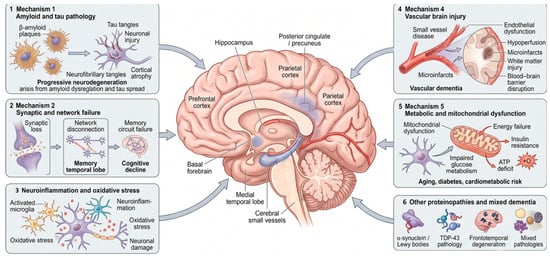
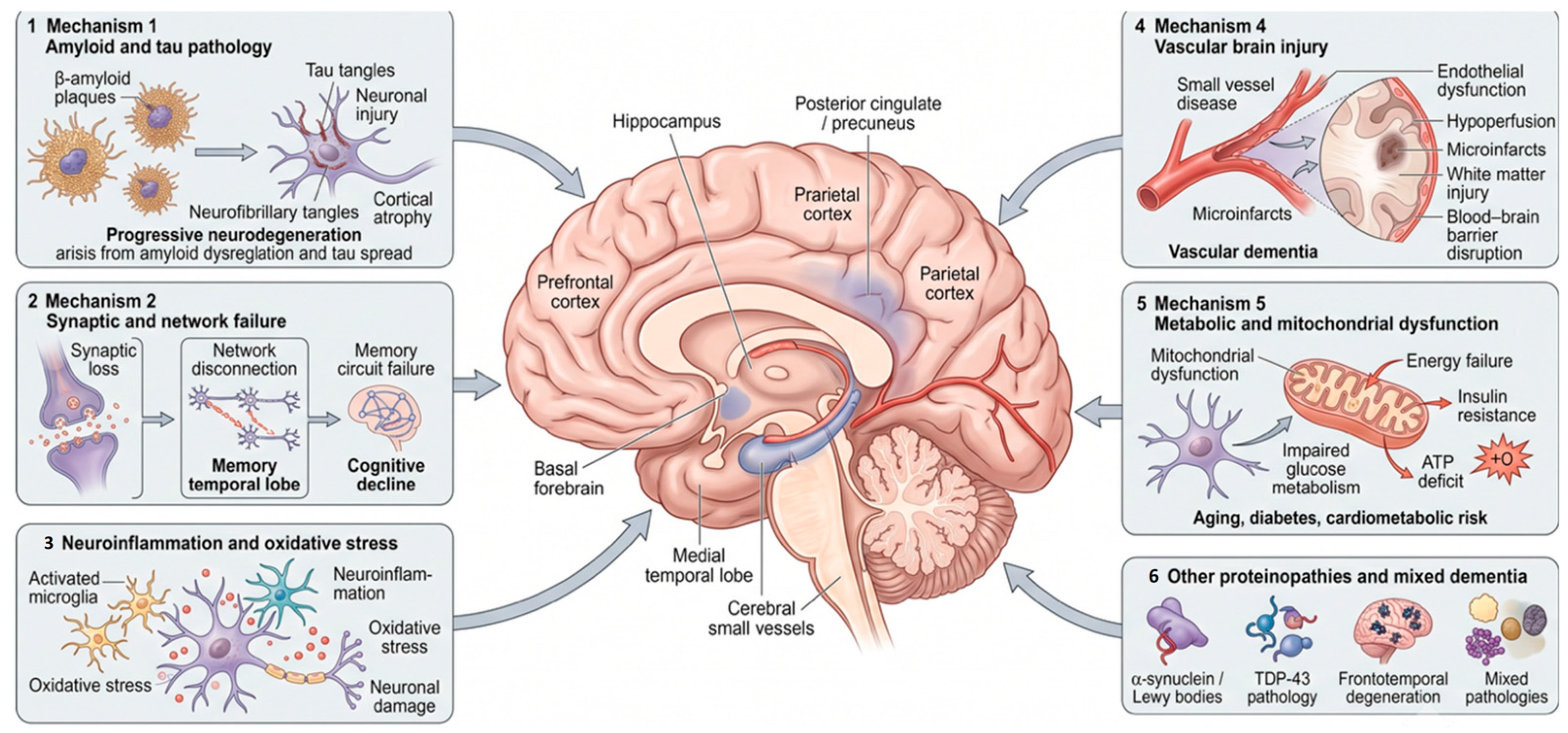
Dementia is a chronic condition that predominantly affects older adults and is characterized by the progressive deterioration of higher cognitive functions, including memory, thinking, reasoning, language, and judgment, ultimately affecting the quality of life of both patients and their caregivers [1]. It is defined by an acquired and progressive decline in cognition that interferes with independent daily functioning [2,3]. Its principal subtypes include Alzheimer’s disease, the most common cause; vascular dementia, frequently associated with cerebrovascular disease; and less common forms, including frontotemporal degeneration, dementia with Lewy bodies, and dementia secondary to conditions such as Parkinson’s disease [4]. Age is the dominant non-modifiable risk factor, whereas hypertension, diabetes, obesity, smoking, physical inactivity, hearing loss, low educational attainment, social isolation, and harmful alcohol use are established modifiable contributors [5,6] (Figure 1).
Figure 1.
Principal biological mechanisms and life-course risk factors in dementia. Schematic overview of partly overlapping mechanistic domains that converge on synaptic and network dysfunction and, ultimately, clinical dementia: (1) amyloid-β and tau pathology with progressive neurodegeneration; (2) synaptic and network failure; (3) neuroinflammation and oxidative stress; (4) vascular brain injury underlying vascular dementia; (5) metabolic and mitochondrial dysfunction linked to ageing and cardiometabolic risk; and (6) other proteinopathies (α-synuclein/Lewy bodies, TDP-43, frontotemporal degeneration) and mixed pathologies. Anatomically vulnerable regions are indicated on the mid-sagittal brain. The lower band summarises modifiable life-course risk factors and cognitive reserve. The shared downstream pathway proceeds from brain pathology through synaptic failure and network disruption to cognitive and functional decline. Schematic overview; not drawn to scale.
Worldwide, dementia has become one of the leading causes of disability, dependence, and mortality among older adults [7]. According to Global Burden of Disease (GBD) estimates, 57.4 million people were living with dementia in 2019, a figure projected to rise to 152.8 million by 2050, largely driven by population growth and ageing [8]. Much of this increase is expected to occur in low- and middle-income countries (LMICs), where populations are ageing rapidly and health systems may be less prepared to address the associated clinical, social, and economic consequences [9,10,11]. In the GBD 2021 analysis, age-standardized dementia burden increased fastest in South Asia and several sub-Saharan African regions, whereas high-SDI regions showed a 3.4% decline in age-standardized DALYs between 1990 and 2021 despite a 132% increase in the absolute number of DALYs [12]. In Latin America, dementia prevalence is projected to increase particularly rapidly, reflecting accelerated demographic ageing together with persistent social and health-system vulnerabilities [13]. This growth is likely to be amplified by comparatively lower educational attainment and a high prevalence of cardiovascular and metabolic risk factors [11].
Evidence on dementia in Latin America is derived mainly from community-based prevalence surveys and modeled estimates. A systematic review and meta-analysis of studies from Latin America and the Caribbean documented substantial heterogeneity in prevalence across countries, with age, sex, rurality, and education identified as important determinants [14], and a collaborative analysis of population-based cohorts found Alzheimer’s disease to be the leading cause of dementia in every population studied [15]. Regional assessments have also highlighted poverty, low educational attainment, limited diagnostic capacity, and the scarcity of trained professionals and specialized services as persistent barriers to dementia care [9,16,17]. In LMICs, most people with dementia live in the community and are cared for by family members, so that a large share of the burden remains invisible to health-system records [11,18]. Routinely collected health-service data, which could complement survey-based and modeled estimates by documenting recorded outpatient activity and where it occurs, have rarely been used for this purpose in the region.
In Ecuador, population ageing is increasing the need for dementia diagnosis, treatment, follow-up, and long-term support. The population aged 65 years or older has approximately doubled over recent decades and now exceeds 1.5 million people, while dedicated dementia services and formal long-term-care infrastructure remain limited [19]. Previous research in Ecuador has described dementia using outpatient records from a specialized mental health institution [20]. Such institution-based evidence provides valuable clinical and service-use information but does not characterize the geographic distribution of recorded outpatient utilization across the country. An analysis of PRAS encounters, considered alongside independent GBD estimates, can provide a complementary perspective on documented service activity and modeled population burden.
We therefore aimed to describe the temporal, demographic, diagnostic, and geographic distribution of dementia-related outpatient encounters recorded in Ecuador between 2021 and 2024 and characterize the national burden of dementia in terms of prevalence, incidence, mortality, and DALYs using GBD 2023 estimates, in order to provide an integrated epidemiological baseline for health-service planning.
2. Materials and Methods
2.1. Study Design
We conducted a retrospective descriptive study of dementia-related outpatient encounters recorded in Ecuador’s Ministry of Public Health PRAS system between 2021 and 2024, with ecological comparisons across geographic areas. Recorded utilization was contextualized using independent national estimates from GBD 202321. The administrative component describes encounters captured by the reporting system and should not be interpreted as a population-based survey or a complete census of dementia care in Ecuador.
2.2. Study Setting and Population
Ecuador is an Andean country in northwestern South America with an area of approximately 283,000 km2 and marked geographic and demographic diversity. Administratively, the country is divided into 24 provinces distributed across four major geographic regions (Coast, Andean Highlands, Amazon, and the Galápagos Islands) and further subdivided into 221 cantons, which constitute the main subprovincial administrative units used in the present geographic analysis. According to the 2022 Population and Housing Census, Ecuador had 16,938,986 inhabitants, of whom 51.3% were women and 48.7% men; 63.1% resided in urban areas [19]. In terms of self-identified ethnicity, 77.5% of the population identified as Mestizo, 7.7% as Indigenous, 7.7% as Montubio, 4.8% as Afro-Ecuadorian, 2.2% as White, and 0.1% as belonging to other groups [19].
2.3. Data Sources and Case Definition
Dementia-related outpatient utilization data were obtained from the Ministry of Public Health’s Plataforma de Registro de Atenciones de Salud (PRAS). We selected outpatient consultations recorded between 1 January 2021 and 31 December 2024 with dementia as the primary diagnosis, defined using ICD-10 codes F00 (dementia in Alzheimer’s disease), F01 (vascular dementia), F02 (dementia in other diseases classified elsewhere), and F03 (unspecified dementia). The extract consisted of consultation counts generated by the PRAS reporting system for these diagnostic codes, aggregated by year, sex, age group, diagnostic code, consultation type (initial or subsequent), and facility location. The analytical extract did not include the attending clinician’s specialty or another encounter-level field that allowed specialist encounters to be distinguished from non-specialist encounters. Facility type and location do not establish the specialty of the clinician providing an individual consultation. Accordingly, we use the term “recorded dementia-related outpatient encounters” without classifying these encounters as specialist care. The analyzed extract included encounters from primary healthcare centers (types A, B, and C), hospitals and medical units belonging to public healthcare networks, including the Ministry of Public Health and the Ecuadorian Social Security Institute (IESS), and private-sector healthcare facilities.
The unit of analysis was the consultation encounter. The analytical extract did not provide patient-level identifiers suitable for linkage; consequently, repeated encounters by the same individual could not be identified. These data therefore cannot establish dementia prevalence, the number of unique service users, or the number of consultations per patient. The analysis does not assume complete capture of care delivered by all healthcare providers in Ecuador.
Encounters were classified as initial or subsequent according to the consultation-type field in the source data. Initial consultations corresponded to the first consultation at which a patient’s dementia diagnosis was confirmed, whereas subsequent consultations represented later visits by the same patient following that initial confirmation. However, the analytical extract did not provide patient-level identifiers suitable for linkage, preventing independent verification of these sequences or estimation of follow-up frequency and continuity of care for individual patients. Initial consultations were not interpreted as population-level incident dementia cases, because the timing of diagnostic confirmation does not necessarily correspond to disease onset.
Encounters were assigned to provinces and cantons according to the location of the healthcare facility where the consultation took place, rather than the patient’s place of residence. Annual population denominators were obtained from INEC’s 2024 dataset, using the corresponding year, sex, age group, province, and canton [22].
Information on reporting completeness during 2021–2024 was not available to the authors; the analytical extract did not include the number of reporting facilities per year or any indicator of reporting completeness. Accordingly, changes in recorded encounter volume could not be separated fully from changes in reporting participation or completeness.
Of the 221 cantons in the geographic reference framework used for this analysis, 219 were included in the cantonal rate calculations. The excluded cantons were Tiwintza, in Morona Santiago Province, and Sucumbíos, in Sucumbíos Province, because no dementia-related encounter was recorded at facilities located in either canton in any study year. Because the analytical extract listed only cantons with at least one recorded encounter, the absence of records could not be distinguished from non-reporting, and these two cantons were therefore displayed as unavailable rather than assigned a rate of zero. All 92,408 encounters had valid facility-level province and canton information, and sex, age group, diagnostic code, and consultation type were complete for every record; consequently, no records were excluded and no imputation was required. A zero consultation rate was assigned only where a valid population denominator was available and the source data supported a count of zero recorded encounters; an absent record was not automatically interpreted as zero. Areas with insufficient information to calculate a rate were displayed separately as unavailable.
2.4. Burden of Disease (GBD 2023)
National dementia burden estimates were obtained from the Global Burden of Disease Study 2023 (GBD 2023) through the web-based GBD Results Tool, developed by the Institute for Health Metrics and Evaluation (IHME, Seattle, WA, USA; https://vizhub.healthdata.org/gbd-results/; accessed on 25 July 2026). The following query settings were applied: data release, GBD 2023; location, Ecuador; cause, Alzheimer’s disease and other dementias; year, 2023; sex, both sexes, female, and male; and measures, prevalence, incidence, deaths, years of life lost (YLL), years lived with disability (YLD), and disability-adjusted life-years (DALYs). Counts were extracted using the Number metric and the All ages category; age-standardized rates were extracted using the Rate metric and the Age-standardized category. Estimates and their 95% uncertainty intervals (UIs) were retained as provided by GBD, without re-modeling [21,23].
The PRAS and GBD measures differ in scope and construction. PRAS identifies recorded dementia-related outpatient encounters with a primary diagnosis coded as F00–F03, whereas GBD provides modeled population-level estimates for the cause category “Alzheimer’s disease and other dementias.” The two sources were therefore used for contextual comparison rather than treated as equivalent case-ascertainment systems.
2.5. Statistical Analysis
Consultations were summarized by diagnostic category, sex, age group, consultation type, province, and canton using counts and percentages. Annual crude consultation rates were calculated by dividing recorded encounters by the corresponding annual population and multiplying by 100,000. Pooled crude rates were calculated by dividing total encounters during 2021–2024 by the sum of the corresponding annual population denominators. The pooled female-to-male consultation rate ratio was interpreted as a descriptive measure of recorded utilization rather than a dementia risk ratio. Age-specific consultation rates were calculated for each year and averaged over the four-year period. To account for differences in population age structure, directly age-standardized consultation rates were calculated by sex, year, and province using the WHO World Standard Population with five-year age groups (≥80 years combined) [24]; 95% confidence intervals (CIs) were derived from the Poisson variance of the age-specific counts. The age-standardized female-to-male rate ratio was calculated from the standardized rates, with its CI computed on the logarithmic scale. Provincial age-standardized rates used INEC provincial population projections by five-year age group as denominators and are presented alongside crude rates and the corresponding rank changes. Cantonal rates were not age-standardized because canton-level population projections by age group were not available.
Temporal variation was described primarily using annual encounter counts and crude rates. As an exploratory summary, the average annual percent change (AAPC) in the crude rate was estimated from a log-linear quasi-Poisson model: log(E[Yt]) = α + β × (year − 2021) + log(Nt), where Yt denotes the annual encounter count and Nt the corresponding annual resident population. The AAPC was calculated as 100 × [exp(β) − 1]. Overdispersion was estimated as the Pearson chi-square statistic divided by the residual degrees of freedom (four observations minus two regression coefficients = 2), and the coefficient covariance matrix was multiplied by this dispersion estimate. The 95% confidence limits were calculated as 100 × {exp[β ± t(0.975, 2) × SE(β)] − 1}, using a Student t reference distribution with 2 residual degrees of freedom (critical value 4.3027), rather than a normal approximation. Given the four annual observations and the decline in 2022, this model-based interval is approximate and the AAPC summarizes the observed period rather than demonstrating a stable long-term trend. Annual proportions of each diagnostic category were also tabulated to describe variation in coding over the study period. Provincial and cantonal pooled crude annual encounter rates were mapped using fixed class breaks. The proportion of encounters coded as unspecified dementia (F03) was used to describe coding specificity rather than diagnostic accuracy.
For contextual comparison, the number of PRAS encounters recorded in 2023 was divided by the GBD estimate of prevalent dementia cases in 2023 and multiplied by 100. This encounter-to-prevalence ratio compares recorded activity with modeled population burden; it does not estimate the proportion of individuals receiving care, provide a bound on national service coverage, or quantify unmet need.
Data management and descriptive summaries were performed using Microsoft Excel for Mac, version 16.111.3 (Microsoft Corporation, Redmond, WA, USA), and statistical analyses were conducted using R version 4.6.1 (R Foundation for Statistical Computing, Vienna, Austria) and Python version 3.14.7 (Python Software Foundation). Statistical plots were generated in R, geographic analyses and maps were prepared using ArcGIS Pro version 3.4 (Esri, Redlands, CA, USA). Figure 1 was created using BioRender, a web-based platform accessed through an institutional academic license provided by Universidad de Las Américas (UDLA). As BioRender does not provide a fixed version number for the web-based illustration platform, we have included its official website (https://www.biorender.com). ChatGPT (GPT-5.6 Sol; OpenAI) and Claude Opus 5 (Anthropic) were used for English-language editing and assistance with analytical code development and debugging. The authors reviewed the AI-assisted text and code and retained responsibility for the analyses, interpretation, and final manuscript.
2.6. Ethical Considerations
This study used secondary, aggregate, and de-identified administrative data and involved no direct participation of human subjects, collection of identifiable personal information, or study-related interventions. The research was conducted under the broader protocol entitled “Global impact of epidemiological diseases in Ecuador: A national sociodemographic analysis of morbidity and mortality.” The Human Research Ethics Committee of Universidad de Las Américas (CEISH-UDLA) reviewed the protocol and determined that it was exempt from further ethics evaluation in accordance with applicable national regulations (exemption code: 2026-EXC-021).
3. Results
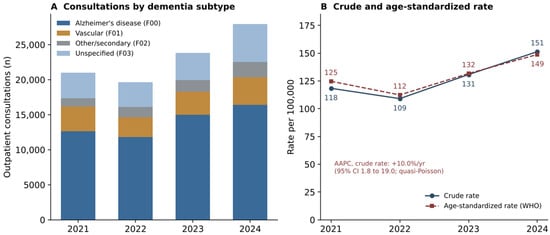
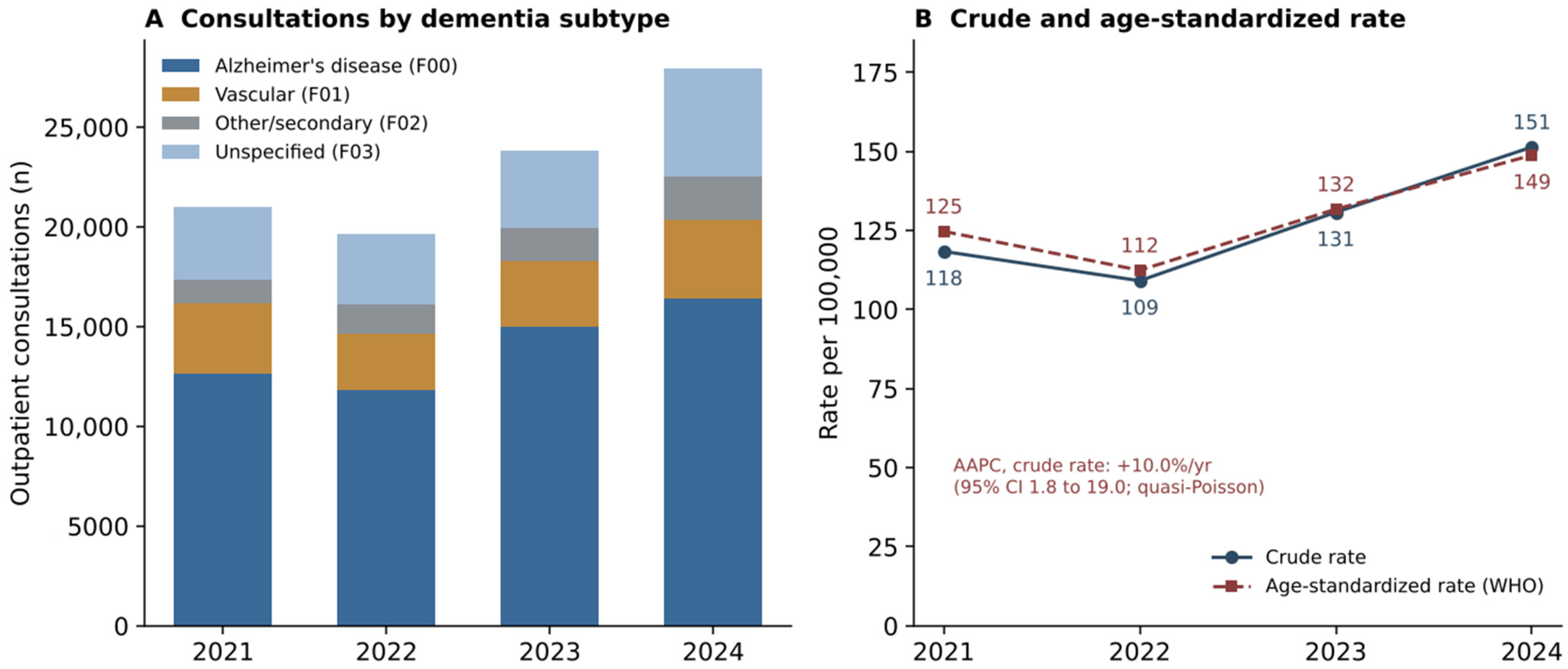
During 2021–2024, PRAS recorded 92,408 dementia-related outpatient encounters, with a mean of 23,102 encounters per year. Annual counts were 21,012 in 2021, 19,625 in 2022, 23,829 in 2023, and 27,942 in 2024. The corresponding crude consultation rates were 118, 109, 131, and 151 per 100,000 population. Encounter volume increased by 33.0% between the first and last years, although the decline in 2022 indicates that the observed pattern was not monotonic (Figure 2). Age-standardized rates followed the same pattern (124.7, 112.4, 131.7, and 148.8 per 100,000 in 2021, 2022, 2023, and 2024, respectively). The Poisson model showed marked overdispersion (residual deviance 366 on 2 degrees of freedom; dispersion parameter φ = 181). The exploratory AAPC in the crude rate was +10.0% per year (quasi-Poisson 95% CI −7.3% to 30.6%, Student t distribution with 2 residual degrees of freedom; β = 0.09550, SE = 0.03983). The interval includes no annual change and is compatible with both a decrease and an increase; the estimate summarizes the 2021–2024 period and should not be extrapolated (Figure 2B).
Figure 2.
Recorded dementia-related outpatient encounters and rates, Ecuador, 2021–2024. (A) Annual encounter counts by diagnostic category (ICD-10 F00–F03). (B) Annual crude and directly age-standardized encounter rates per 100,000 population, using the WHO World Standard Population. Numerators count encounters recorded at healthcare facilities in Ecuador; denominators are the corresponding annual resident population estimates, with age-specific denominators used for standardization. Encounters represent visits rather than unique individuals. The exploratory average annual percent change (AAPC) in the crude rate was +10.0% (95% CI −7.3% to 30.6%), estimated using a log-linear quasi-Poisson model with a population offset and a Student t reference distribution with 2 residual degrees of freedom. The annual observations show a decline in 2022 followed by increases in 2023 and 2024; they do not establish a sustained long-term trend. Source: PRAS and INEC.
3.1. Dementia Subtype Distribution
Among the 92,408 dementia-related outpatient consultations, Alzheimer’s disease (F00) was the most frequently documented subtype, accounting for 55,815 encounters (60.4%), followed by unspecified dementia (F03; 16,532; 17.9%), vascular dementia (F01; 13,628; 14.7%), and dementia in other diseases classified elsewhere (F02; 6433; 7.0%). Women accounted for 62,123 consultations (67.2%) and represented the majority of recorded encounters across all dementia subtypes (Table 1). The proportion of encounters coded as unspecified dementia (F03) was 17.5% in 2021, 18.0% in 2022, 16.3% in 2023, and 19.4% in 2024, and the proportion coded as Alzheimer’s disease ranged from 58.6% to 62.9%, without a consistent direction of change over the study period.
Table 1.
Dementia subtype distribution of dementia-related outpatient consultations by sex, Ecuador, 2021–2024. Source: Plataforma de Registro de Atenciones de Salud (PRAS), Ministry of Public Health of Ecuador. Each record represents a consultation encounter rather than a unique individual.
3.2. Age and Sex Distribution
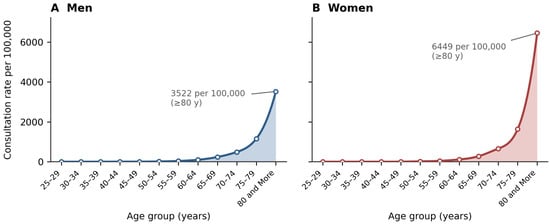
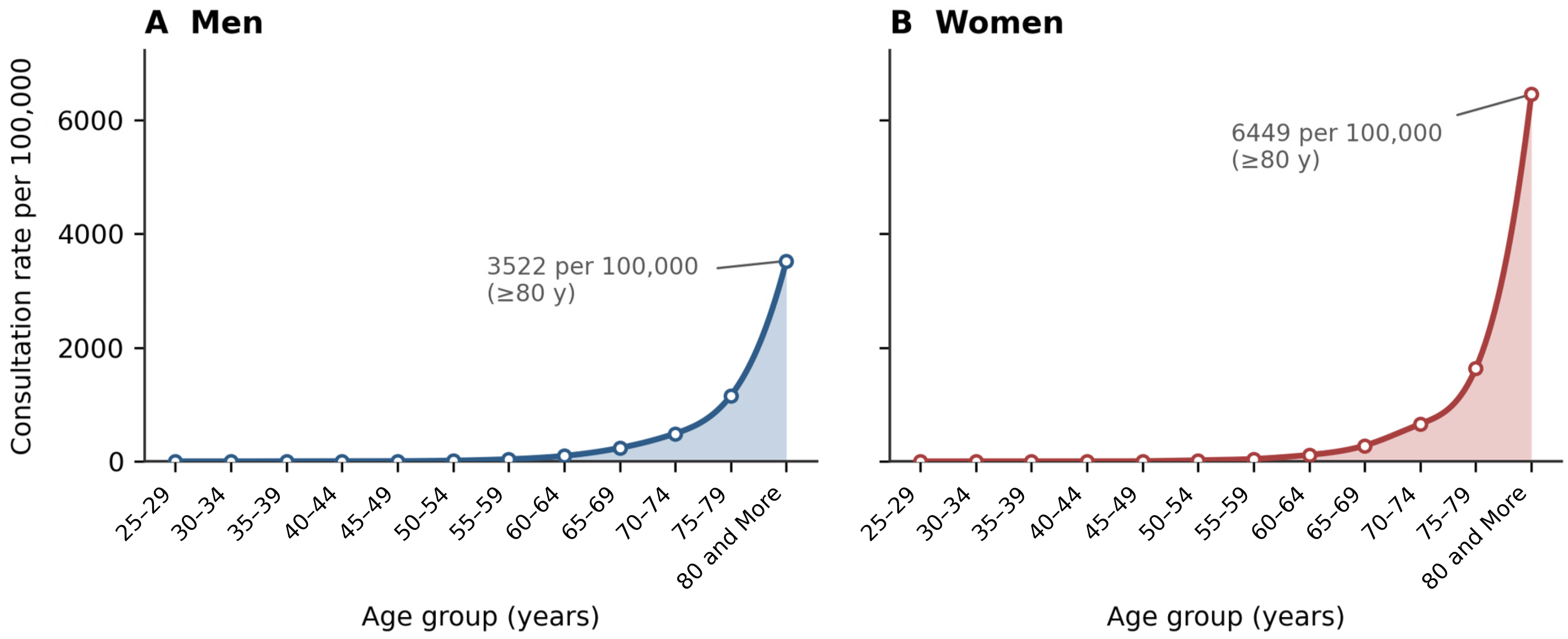
Older adults accounted for most of the recorded dementia-related outpatient utilization, with 94.6% of consultations occurring among individuals aged 65 years or older. Age-specific consultation rates increased steeply and approximately log-linearly with advancing age, from fewer than 5 consultations per 100,000 population among individuals younger than 50 years to 5209 per 100,000 among those aged 80 years or older. Rates were consistently higher among women than among men across all age groups, reaching 6449 versus 3522 consultations per 100,000, respectively, among individuals aged 80 years or older (Figure 3).
Figure 3.
Age-specific dementia-related consultation rates by sex, Ecuador, 2021–2024. (A) Men and (B) women; consultation rate per 100,000 population by five-year age group, averaged over 2021–2024. Source: PRAS and INEC.
The crude consultation rate was consistently higher among women than among men throughout the study period, increasing from 154 to 203 per 100,000 among women and from 82 to 98 per 100,000 among men between 2021 and 2024. Overall, the pooled crude rate was approximately twice as high among women as among men (169.8 vs 84.5 per 100,000; crude rate ratio 2.01) (Table 2). After direct age standardization, rates remained higher among women than among men in every year, but the difference was smaller: the pooled age-standardized rates were 155.4 (95% CI 154.2–156.6) and 96.6 (95% CI 95.6–97.7) per 100,000 among women and men, respectively, corresponding to an age-standardized rate ratio of 1.61 (95% CI 1.59–1.63) (Table 3).
Table 2.
Annual dementia-related outpatient consultations, population, and crude consultation rate, by sex, Ecuador, 2021–2024. Source: PRAS (numerators) and INEC annual population estimates (denominators). Pooled 2021–2024 rates use the sum of annual population.
Table 3.
Crude and directly age-standardized dementia-related outpatient consultation rates by sex and year, Ecuador, 2021–2024. Age-standardized rates were calculated by the direct method using the WHO World Standard Population (five-year age groups, ≥80 years combined); 95% CIs are based on the Poisson variance of age-specific counts. Crude rates use the total population of each sex as denominator ( Table 2 ). Age-standardized female-to-male rate ratio (pooled): 1.61 (95% CI 1.59–1.63). CI, confidence interval.
3.3. Geographic Distribution by Province
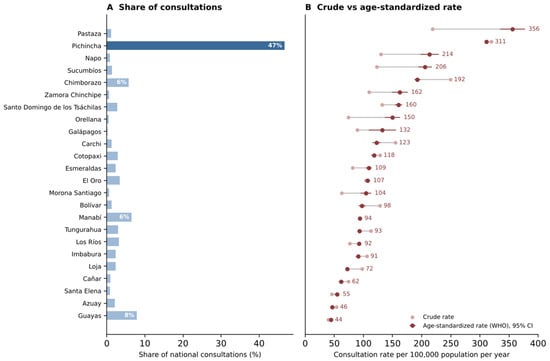
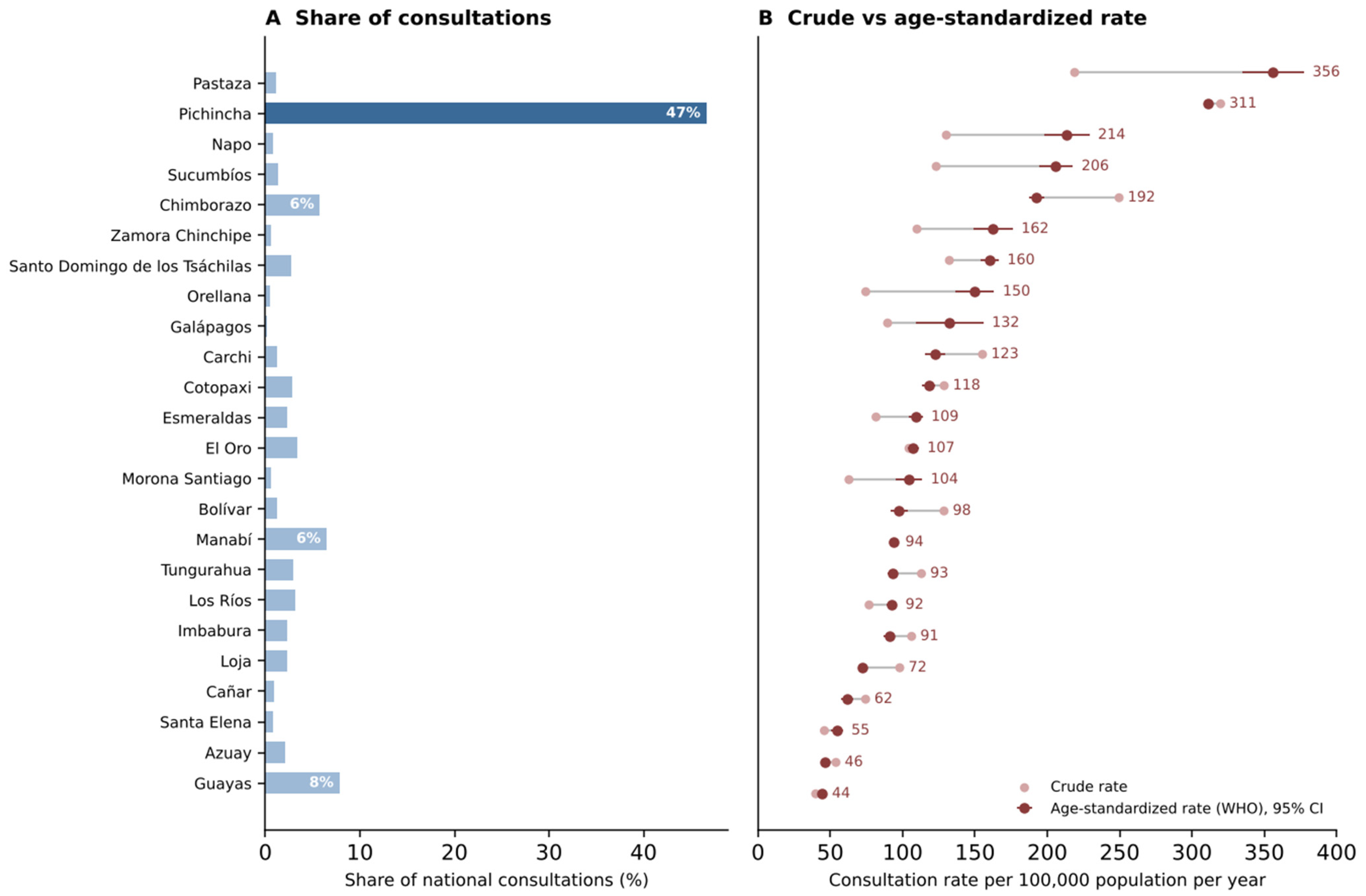
Pichincha, Guayas, and Manabí accounted for the largest absolute numbers of dementia-related outpatient encounters and together represented 60.9% of all recorded encounters; Pichincha alone accounted for 46.6% (Figure 4A). After accounting for province population size, the highest pooled crude annual consultation rates were observed in Pichincha (319 per 100,000 population), Chimborazo (249 per 100,000), and Pastaza (218 per 100,000). In contrast, Guayas recorded a crude annual rate of 40 per 100,000 despite contributing one of the largest absolute numbers of encounters (Figure 4B). After direct age standardization (Table 4; Figure 4B), Pastaza (355.9 per 100,000; 95% CI 334.5–377.3) and Pichincha (311.0; 95% CI 308.1–314.0) showed the highest rates, followed by Napo (213.5), Sucumbíos (205.9), and Chimborazo (192.4), whereas Guayas (44.0; 95% CI 43.0–45.1), Azuay (46.5), and Santa Elena (54.6) remained the lowest. Standardization raised the rank of the Amazon provinces, which have younger populations, and lowered that of several highland provinces, but the overall ranking was broadly preserved (Spearman ρ = 0.76 between crude and age-standardized rates), and the approximately eightfold difference between the highest- and lowest-rate provinces persisted.
Figure 4.
Geographic distribution of recorded dementia-related outpatient encounters by province, Ecuador, 2021–2024. (A) Each province’s share of all recorded encounters. (B) Pooled crude (light markers) and directly age-standardized (dark markers with 95% confidence intervals; WHO World Standard Population) annual encounter rates per 100,000 population, ordered by age-standardized rate. Numerators count encounters recorded at facilities located in each province, irrespective of patients’ residence; denominators are the sum of that province’s annual resident population estimates for 2021–2024, with corresponding age-specific denominators used for standardization. Rates therefore describe facility-based activity relative to the resident population, not utilization among residents exclusively. Differences may be influenced by population age structure, service availability, referral patterns, and reporting completeness; these contributions were not directly assessed. Source: PRAS and INEC.
Table 4.
Crude and directly age-standardized rates of recorded dementia-related outpatient encounters by province, Ecuador, 2021–2024 (pooled). Numerators count encounters recorded at facilities located in each province, irrespective of patients’ residence. Denominators are the sum of the province’s annual resident population estimates from INEC for 2021–2024. Age-standardized rates apply provincial age-specific encounter rates, using the corresponding resident population denominators (five-year groups, ≥80 years combined), to the WHO World Standard Population. Rates are expressed per 100,000 population and describe facility-based activity rather than utilization among residents exclusively. Ranks are from highest (1) to lowest (24). CI, confidence interval.
3.4. Cantonal Distribution
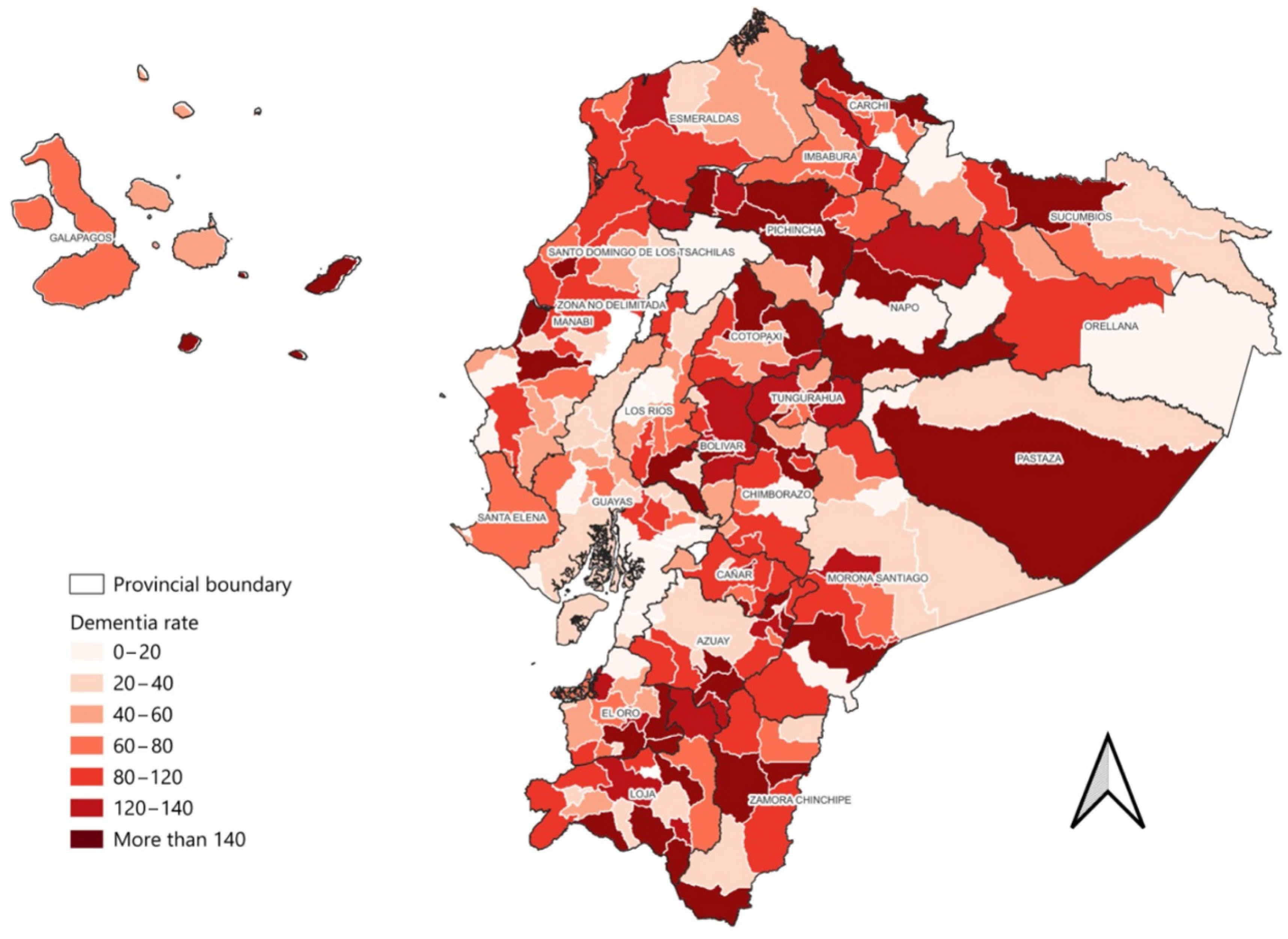
The geographic distribution of dementia-related outpatient consultations was analyzed across the 219 cantons with available data. The highest pooled consultation rates were observed in El Pan (524.1 per 100,000 population), Riobamba (440.9), Déleg (432.2), Zaruma (401.5), and Quito (367.7). The median cantonal consultation rate was 68.9 per 100,000 population, with values ranging from fewer than 10 to 524.1 per 100,000 among the 219 cantons with at least one recorded encounter (Figure 5). Cantonal rates were not age-standardized.
Figure 5.
Pooled crude annual rates of recorded dementia-related outpatient encounters by canton, Ecuador, 2021–2024. Numerators count encounters recorded at facilities located in each canton during 2021–2024, irrespective of patients’ residence; denominators are the sum of that canton’s annual resident population estimates over the same period. Rates are expressed per 100,000 population, are not age-standardized, and are displayed using fixed class breaks. Cross-boundary referrals may affect these facility-based rates, which do not measure utilization among residents exclusively. Grey indicates unavailable rates and is distinct from zero recorded encounters. Source: PRAS and INEC.
3.5. Consultation Type
Of the 92,408 dementia-related outpatient encounters, 28,621 (31.0%) were classified as initial consultations and 63,787 (69.0%) as subsequent consultations, corresponding to an aggregate subsequent-to-initial encounter ratio of 2.23:1 over the four-year study period. Because the analytical extract did not provide patient-level identifiers suitable for linkage, this ratio describes the aggregate composition of recorded encounters rather than the number of follow-up consultations received by an individual patient.
3.6. National Burden of Dementia (GBD 2023)
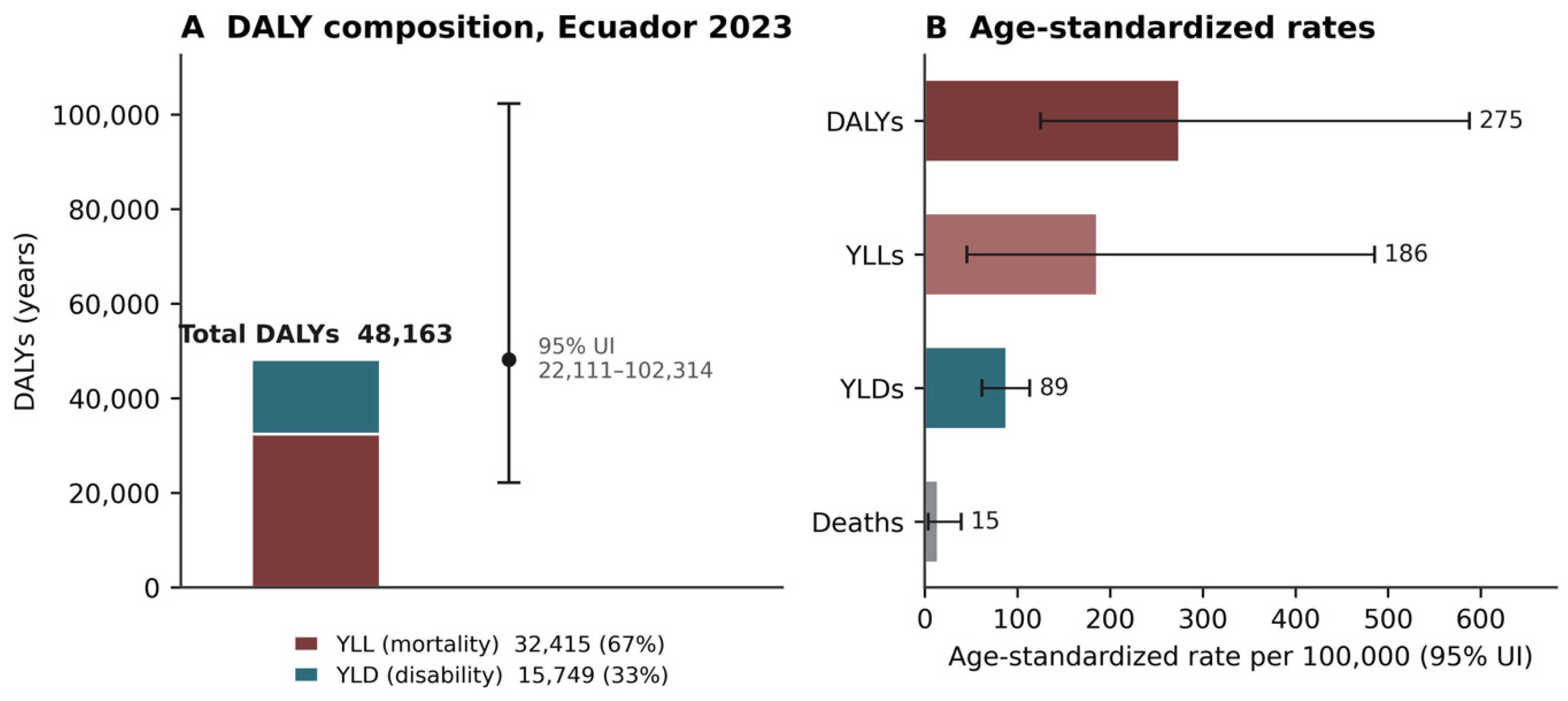
According to GBD 2023, an estimated 77,926 people (95% UI 66,988–89,161) were living with dementia in Ecuador in 2023, with 13,962 incident cases (95% UI 12,057–15,866) and 2514 deaths (95% UI 600–6616; age-standardized mortality rate 15 per 100,000). Dementia accounted for an estimated 48,163 DALYs (95% UI 22,111–102,314; age-standardized rate 275.0 per 100,000, 95% UI 125.0–587.8), of which 32,415 (67.3%) were YLL (age-standardized rate 186 per 100,000) and 15,749 (32.7%) were YLD (age-standardized rate 89 per 100,000) (Figure 6; Table 5). The burden fell disproportionately on women, who accounted for 29,366 DALYs (61.0%) compared with 18,797 in men.
Figure 6.
Burden of dementia in Ecuador, GBD 2023. (A) Decomposition of disability-adjusted life-years (DALYs) into years of life lost to premature mortality (YLL) and years lived with disability (YLD); the whisker shows the 95% uncertainty interval (UI) for total DALYs. (B) Age-standardized rates per 100,000 population with 95% UI. Source: Global Burden of Disease Study 2023 (Institute for Health Metrics and Evaluation).
Table 5.
Modeled dementia burden in Ecuador, GBD 2023.
In 2023, PRAS recorded 23,829 dementia-related outpatient encounters, while GBD estimated 77,926 prevalent dementia cases in Ecuador. These figures correspond to 30.6 recorded encounters per 100 estimated prevalent cases in the same year. The ratio compares encounter volume with modeled prevalence and does not represent the percentage of people receiving outpatient care, because encounters are not unique individuals, registry coverage is incomplete or uncertain, and the two sources use different ascertainment approaches.
Estimates refer to Ecuador, both sexes, in 2023. Counts correspond to all ages; rates are age-standardized as reported by GBD. UI, uncertainty interval; YLL, years of life lost; YLD, years lived with disability; DALYs, disability-adjusted life-years. Values were extracted from GBD 2023 and rounded independently; component totals may therefore differ slightly from the reported total.
4. Discussion
This study characterizes dementia-related outpatient utilization recorded in Ecuador’s PRAS registry and places these findings alongside independent estimates of national disease burden. The principal finding is the uneven distribution of recorded care across demographic groups and geographic areas, together with an increase in consultation volume during the study period. These patterns may reflect the combined influence of healthcare need, service availability, and administrative recording, rather than the population distribution of dementia itself. Their relevance lies in identifying priorities for investigating access to diagnostic assessment and follow-up, while highlighting the limitations of encounter-based registries for measuring how many people receive care.
The increase in recorded consultations should be interpreted in the context of both demographic change and changes in healthcare delivery. Tannous et al. reported greater pandemic-related reductions in outpatient and inpatient encounters among people with mild cognitive impairment or dementia than among matched individuals without these conditions [25]. In Norway, Ibsen et al. observed reductions in health and care service use during lockdown, apart from general practitioner contacts, followed by a return to levels comparable to those before the pandemic within one year [26]. These findings show that service disruption and subsequent recovery can influence consultation trends, although their timing and magnitude cannot be directly extrapolated to Ecuador.
In Ecuador, the decline in 2022 followed by increases in 2023 and 2024 could reflect changes in service availability, delayed demand, or administrative recording, although these mechanisms were not measured. The absence of a pre-pandemic baseline prevents attribution of the observed pattern to service recovery. Regional projections of increasing dementia burden provide an additional demographic context [16], but they describe changes in the number of people living with dementia rather than consultation frequency. Distinguishing these processes matters for planning: increased encounter volume may represent broader access, more frequent follow-up among existing users, or improved registration, each of which has different implications for service capacity. The exploratory quasi-Poisson AAPC of +10.0% per year had a wide 95% confidence interval (−7.3% to 30.6%), calculated using a Student t distribution with 2 residual degrees of freedom. This interval includes no annual change and reflects substantial uncertainty arising from overdispersion and the short series. The annual counts and rates, including the 2022 decline, therefore provide the principal description of temporal variation.
The concentration of 94.6% of recorded encounters among adults aged ≥65 years highlights the predominance of older adults in recorded dementia-related outpatient activity. Women accounted for approximately two thirds of encounters and had a pooled crude consultation rate approximately twice that of men. Huque et al. reported a pooled dementia prevalence among adults aged ≥ 65 years of 80.2 per 1000 women and 54.9 per 1000 men, approximately 46% higher among women. However, their meta-analysis found no significant sex differences in age-specific dementia incidence except among adults aged ≥ 90 years, and differences in prevalence were associated with country-level differences in life expectancy and education [27]. In our analysis, direct age standardization reduced the female-to-male encounter rate ratio from 2.01 to 1.61, indicating that differences in population age structure contributed to the crude contrast. The remaining difference describes recorded service activity and may reflect a combination of underlying dementia frequency, healthcare utilization, diagnostic recognition, and reporting. It should not be interpreted as a corresponding difference in dementia risk or as directly equivalent to the population prevalence differences reported by Huque et al.
Dementia in Alzheimer’s disease was the most frequently recorded diagnostic category, accounting for 60.4% of all dementia-related encounters, whereas 17.9% were coded as unspecified dementia. The predominance of Alzheimer’s disease is consistent with previous epidemiological studies from Latin America: in a collaborative analysis of population-based cohorts from several countries of the region, Nitrini et al. found Alzheimer’s disease to be the leading cause of dementia in every population studied, accounting for approximately 49.9% to 84.5% of cases, whereas vascular dementia was generally the second most frequent subtype, accounting for 8.7% to 26.5% of cases [15]. This agreement concerns the predominance of Alzheimer’s disease rather than equivalence between subtype proportions. Population-based studies classify individuals, whereas PRAS counts encounters; differences in consultation frequency across diagnostic groups may therefore influence the distribution observed in this registry. The relatively high proportion of unspecified dementia in our registry may reflect diagnostic uncertainty, limited access to etiological assessment, or the characteristics of routine administrative coding rather than a distinct epidemiological pattern [28,29,30]. PRAS did not include the clinical, neuropsychological, imaging, or biomarker information required to validate the recorded diagnostic categories, and the proportion of F03-coded encounters should therefore be interpreted as an indicator of coding specificity rather than as a direct measure of diagnostic quality. The pooled diagnostic distribution does not establish whether coding practices changed during the study period; such changes cannot be inferred from the overall proportion of unspecified dementia alone.
The geographic concentration of recorded encounters should be interpreted within the organization of healthcare provision in Ecuador. Rodriguez et al. documented geographic inequalities in the distribution of medical specialists [31], providing a plausible context for variation in recorded dementia-related activity. Age standardization modified but did not remove the provincial differences: the Amazon provinces, which have younger populations, moved up the ranking, several highland provinces moved down, and the approximately eightfold difference between Pastaza or Pichincha and Guayas persisted. Population age structure therefore explains only a small part of the geographic variation; the remaining differences are more likely to reflect the location of specialist services, referral flows, and reporting completeness, although these factors were not directly measured. However, specialist availability and facility capacity were not directly linked to the encounter data in this analysis. The concentration in Pichincha therefore cannot be attributed specifically to greater service availability, referral activity, or underlying dementia frequency. Similarly, low recorded rates may reflect differences in population age structure, care delivered outside the reporting network, incomplete registration, or barriers to accessing services; the present study cannot distinguish among these explanations. Because encounters were assigned according to facility location, the geographic distribution describes where care was delivered rather than where patients lived. Referral flows across provincial and cantonal boundaries may therefore contribute to the observed concentration of encounters. These findings support evaluating registry coverage, specialist capacity, and referral pathways before using consultation rates to allocate resources or infer regional inequalities in access.
The predominance of subsequent consultations indicates that follow-up encounters accounted for most recorded activity but does not establish whether services reached a broad population or were concentrated among a smaller group of frequent users. This distinction matters because expanding access to initial assessment and maintaining follow-up represent different service objectives. Patient-level linkage would allow these objectives to be evaluated separately through measures of unique users, time to assessment, and retention in care.
The comparison between PRAS utilization and GBD estimates captures two different dimensions of dementia: recorded dementia-related outpatient activity and modeled population burden. Using the same reference year, the 23,829 encounters recorded in 2023 corresponded to 30.6 encounters per 100 estimated prevalent cases. Harmonizing the reference year removes the temporal mismatch but does not make the measures equivalent. Repeated encounters, incomplete or uncertain provider coverage, and differences in diagnostic ascertainment prevent this ratio from estimating service coverage or the proportion of people with unmet care needs. Regional evidence on limitations in dementia-care capacity provides relevant context [16,17], but the present analysis cannot quantify a national diagnostic or treatment gap. GBD mortality and DALY estimates also have wide uncertainty intervals and should be interpreted as modeled estimates rather than precise national measurements [23].
These findings suggest specific priorities for improving dementia-service information and planning in Ecuador. Geographic variation supports examining whether diagnostic and referral capacity corresponds to the distribution of older populations, while the frequency of unspecified codes supports evaluating the availability of etiological assessment and the consistency of coding practices. The predominance of subsequent encounters highlights the need for patient-level measures of service reach and continuity. Beyond these registry-based findings, published evidence on the economic burden of dementia provides an independent rationale for assessing the support needs of families and informal caregivers [11,18]; caregiver burden was not measured in this study. Uruguay’s National System of Care offers a regional policy reference for considering long-term support [32], although its relevance to Ecuador requires assessment of financing, workforce capacity, and institutional organization. These priorities would help translate descriptive utilization data into more targeted evaluations of dementia care.
This study analyzed a large administrative dataset spanning four consecutive years and described recorded dementia-related outpatient utilization across demographic groups and geographic areas. It distinguished consultation encounters from unique individuals and contextualized recorded activity using independent national GBD estimates. These complementary sources provide a descriptive basis for further investigation of dementia-service organization and population burden in Ecuador.
Several limitations should be considered. First, the analytical extract did not permit patient-level linkage, preventing estimation of unique service users, consultation frequency per individual, continuity of care, or referral trajectories. Second, the analysis does not establish complete capture of dementia care across Ecuador’s healthcare providers, and variation in reporting completeness may have influenced temporal and geographic patterns. Third, diagnoses were based on primary administrative ICD-10 codes and could not be independently validated. The analytical extract included neither the attending clinician’s specialty nor another field permitting specialist encounters to be distinguished from non-specialist encounters. Encounters in which dementia was recorded only as a secondary diagnosis were not included. Diagnostic-category proportions therefore describe recorded encounters rather than the population distribution of dementia subtypes. Fourth, although sex-specific and provincial comparisons were age-standardized, cantonal rates were not, and standardized rates remain influenced by specialist availability, referral patterns, and the facility-based geographic assignment of records; they cannot establish differences in dementia risk or access to care. Fifth, consultation rates depend on the population denominator series used, and revisions to those denominators may affect the estimated rates. Sixth, four annual observations are insufficient to establish a sustained long-term trend; the Poisson model was markedly overdispersed, and the approximate t-based quasi-Poisson confidence interval for the AAPC is correspondingly wide and includes no annual change. Finally, GBD estimates are model-based and have substantial uncertainty, particularly for mortality and DALYs [23]. The same-year encounter-to-prevalence ratio remains a contextual comparison and cannot measure patient-level service coverage or unmet need.
5. Conclusions
Recorded dementia-related outpatient encounters increased between 2021 and 2024, with an intervening decline in 2022, and were concentrated among older adults, women, and a limited number of provinces and cantons; the sex and provincial differences were attenuated but persisted after age standardization. These findings identify demographic and geographic variation in documented service utilization, but do not establish differences in dementia prevalence or access to care. Independent GBD 2023 estimates indicate that approximately 78,000 people were living with dementia in Ecuador in 2023, accounting for about 48,000 DALYs, and provide a complementary perspective on national disease burden. The findings support evaluating the geographic distribution of diagnostic services, improving coding specificity, and strengthening information on referral and follow-up pathways. Linked patient-level records and population-based studies are needed to assess service coverage, continuity of care, and unmet need.
Author Contributions
Conceptualization: J.P.E., P.E.D.P. and E.O.-P.; methodology: J.P.E. and E.O.-P.; formal analysis: E.O.-P. and K.B.J.; investigation: E.O.-P., M.P.C. and K.A.C.; data curation: K.B.J. and E.O.-P.; writing—original draft preparation: E.O.-P., J.S.I.-C. and J.V.-G.; writing—review and editing: E.O.-P., J.S.I.-C., J.V.-G., J.P.E., P.E.D.P. and B.C.-C.; visualization: E.O.-P. and G.D.R.; supervision: P.E.D.P. and J.P.E.; project administration: E.O.-P.; funding acquisition: E.O.-P. and J.P.E. contributed to the initial study concept and planning. P.E.D.P. contributed to study conception and scientific supervision. E.O.-P. conducted the final statistical analyses, performed the literature review, prepared the figures, and drafted the manuscript. K.B.J. supported data extraction from the PRAS database and performed the initial statistical analyses. M.P.C., K.A.C. and B.C.-C. contributed to the literature search and reference management. G.D.R. prepared the geographic maps using ArcGIS. J.S.I.-C., J.V.-G. and B.C.-C. contributed to manuscript drafting and critically reviewed the final versions. All authors have read and agreed to the published version of the manuscript.
Funding
This research was supported by Universidad de Las Américas (UDLA) through grant MED.EOP.23.01, which provided support for investigator time and related research activities through the end of 2026. UDLA also covered the article processing charges associated with the publication of this manuscript.
Institutional Review Board Statement
This study used secondary, aggregate, de-identified administrative data and involved no direct contact with study participants. The protocol was reviewed by the Human Research Ethics Committee of Universidad de Las Américas (CEISH-UDLA; exemption code 2026-EXC-021), which determined that the study was exempt from full ethical review.
Informed Consent Statement
This study used secondary, aggregate, de-identified administrative data and involved no direct contact with study participants. Informed consent was not required for this study.
Data Availability Statement
The datasets analyzed in this study are openly available at https://github.com/OneHealthUDLA/DementiainEcuador (accessed on 26 September 2026). Source data were obtained from Ecuador’s Ministry of Public Health (PRAS), the National Institute of Statistics and Census (INEC), and the Institute for Health Metrics and Evaluation (GBD 2023).
Conflicts of Interest
The authors declare no conflicts of interest.
Abbreviations
The following abbreviations are used in this manuscript:
| GBD | Global Burden of Disease |
| LMICs | Low- and middle-income countries |
| INEC | National Institute of Statistics and Census |
| YLL | Years of life lost |
| YLD | Years lived with disability |
| UI | Uncertainty interval |
| AAPC | Average annual percent change |
| CI | Confidence interval |
| PRAS | Plataforma de Registro de Atenciones de Salud (National Outpatient Registry) |
| WHO | World Health Organization |
References
- Aranda, M.P.; Kremer, I.N.; Hinton, L.; Zissimopoulos, J.; Whitmer, R.A.; Hummel, C.H.; Trejo, L.; Fabius, C. Impact of Dementia: Health Disparities, Population Trends, Care Interventions, and Economic Costs. J. Am. Geriatr. Soc. 2021, 69, 1774–1783. [Google Scholar] [CrossRef] [Scilit]
- Asuku, A.O.; Ayinla, M.T.; Gbonjubola, O.O.; Babatunde, S.S.; Olajide, T.S.; Oyerinde, T.O. Neurocognitive Aspects of Dementia. In Nutrition in Brain Aging and Dementia; Moradikor, N., Chatterjee, I., Mohamed, W., Eds.; Springer Nature Singapore: Singapore, 2024; pp. 109–130. ISBN 978-981-97-4116-8. [Google Scholar]
- Warren, J.; Collinge, J.; Fox, N.; Mead, S.; Mummery, C.; Rohrer, J.; Rossor, M.; Schott, J.; Weil, R. Cognitive Impairment and Dementia. In Neurology; Howard, R., Kullmann, D., Werring, D., Zandi, M., Eds.; Wiley: Hoboken, NJ, USA, 2024; pp. 319–367. ISBN 978-1-119-71567-2. [Google Scholar]
- van der Flier, W.M.; Scheltens, P. Epidemiology and Risk Factors of Dementia. J. Neurol. Neurosurg. Psychiatry 2005, 76, v2–v7. [Google Scholar] [CrossRef] [Scilit]
- Livingston, G.; Huntley, J.; Liu, K.Y.; Costafreda, S.G.; Selbæk, G.; Alladi, S.; Ames, D.; Banerjee, S.; Burns, A.; Brayne, C.; et al. Dementia Prevention, Intervention, and Care: 2024 Report of the Lancet Standing Commission. Lancet 2024, 404, 572–628. [Google Scholar] [CrossRef] [Scilit]
- Rizzi, L.; Rosset, I.; Roriz-Cruz, M. Global Epidemiology of Dementia: Alzheimer’s and Vascular Types. BioMed Res. Int. 2014, 2014, 908915. [Google Scholar] [CrossRef] [Scilit]
- Guerchet, M.; Prince, M.; Prina, M. Alzheimer’s Disease International; Numbers of People with Dementia Worldwide: An Update to the Estimates in the World Alzheimer Report 2015 2020. Available online: https://www.alzint.org/resource/numbers-of-people-with-dementia-worldwide/ (accessed on 27 September 2026).
- GBD 2019 Dementia Forecasting Collaborators Estimation of the Global Prevalence of Dementia in 2019 and Forecasted Prevalence in 2050: An Analysis for the Global Burden of Disease Study 2019. Lancet Public Health 2022, 7, e105–e125. [Google Scholar] [CrossRef]
- Prince, M.; Acosta, D.; Albanese, E.; Arizaga, R.; Ferri, C.P.; Guerra, M.; Huang, Y.; Jacob, K.; Jimenez-Velazquez, I.Z.; Rodriguez, J.L.; et al. Ageing and Dementia in Low and Middle Income Countries–Using Research to Engage with Public and Policy Makers. Int. Rev. Psychiatry 2008, 20, 332–343. [Google Scholar] [CrossRef] [Scilit]
- World Failing to Address Dementia Challenge. Available online: https://www.who.int/news/item/02-09-2021-world-failing-to-address-dementia-challenge (accessed on 27 September 2026).
- Mattap, S.M.; Mohan, D.; McGrattan, A.M.; Allotey, P.; Stephan, B.C.; Reidpath, D.D.; Siervo, M.; Robinson, L.; Chaiyakunapruk, N. The Economic Burden of Dementia in Low- and Middle-Income Countries (LMICs): A Systematic Review. BMJ Glob. Health 2022, 7, e007409. [Google Scholar] [CrossRef] [Scilit]
- Liu, W.; Deng, W.; Gong, X.; Ou, J.; Yu, S.; Chen, S. Global Burden of Alzheimer’s Disease and Other Dementias in Adults Aged 65 Years and over, and Health Inequality Related to SDI, 1990-2021: Analysis of Data from GBD 2021. BMC Public Health 2025, 25, 1256. [Google Scholar] [CrossRef] [Scilit]
- Robledo, L.M.G.; Cano-GutiéRrez, C.; Garcia, E.V. Healthcare for Older People in Central and South America. Age Ageing 2022, 51, afac017. [Google Scholar] [CrossRef] [Scilit]
- Ribeiro, F.; Teixeira-Santos, A.C.; Caramelli, P.; Leist, A.K. Prevalence of Dementia in Latin America and Caribbean Countries: Systematic Review and Meta-Analyses Exploring Age, Sex, Rurality, and Education as Possible Determinants. Ageing Res. Rev. 2022, 81, 101703. [Google Scholar] [CrossRef] [Scilit]
- Nitrini, R.; Bottino, C.M.C.; Albala, C.; Custodio Capuñay, N.S.; Ketzoian, C.; Llibre Rodriguez, J.J.; Maestre, G.E.; Ramos-Cerqueira, A.T.A.; Caramelli, P. Prevalence of Dementia in Latin America: A Collaborative Study of Population-Based Cohorts. Int. Psychogeriatr. 2009, 21, 622–630. [Google Scholar] [CrossRef] [Scilit]
- Parra, M.A.; Baez, S.; Allegri, R.; Nitrini, R.; Lopera, F.; Slachevsky, A.; Custodio, N.; Lira, D.; Piguet, O.; Kumfor, F.; et al. Dementia in Latin America: Assessing the Present and Envisioning the Future. Neurology 2018, 90, 222–231. [Google Scholar] [CrossRef] [Scilit]
- Gonzalez, F.J.; Gaona, C.; Quintero, M.; Chavez, C.A.; Selga, J.; Maestre, G.E. Building Capacity for Dementia Care in Latin America and the Caribbean. Dement. Neuropsychol. 2014, 8, 310–316. [Google Scholar] [CrossRef] [Scilit]
- Lastuka, A.; Bliss, E.; Breshock, M.R.; Iannucci, V.C.; Sogge, W.; Taylor, K.V.; Pedroza, P.; Dieleman, J.L. Societal Costs of Dementia: 204 Countries, 2000–2019. J. Alzheimers Dis. 2024, 101, 277–292. [Google Scholar] [CrossRef] [Scilit]
- INEC Censo Ecuador 2022. Available online: https://www.censoecuador.gob.ec/ (accessed on 16 August 2026).
- Valdevila Figueira, J.A.; Ramírez, A.; Yambay-Bautista, X.R.; Carvajal Parra, I.D.; Valdevila Santiestevan, R.; Altamirano Cárdenas, L.F.; Pico Cucalón, M.J.; Rodas, J.A. Epidemiology of Dementia in an Ecuadorian Mental Health Institution. J. Alzheimers Dis. Rep. 2025, 9, 25424823251396049. [Google Scholar] [CrossRef] [Scilit]
- IHME|GHDx. Global Health Data Exchange. Available online: https://ghdx.healthdata.org/ (accessed on 25 July 2026).
- Estimaciones y Proyecciones de Población, Revisión 2024. Available online: https://www.ecuadorencifras.gob.ec/estimaciones-y-proyecciones-de-poblacion-revision-2024/ (accessed on 27 September 2026).
- GBD 2023 Disease and Injury and Risk Factor Collaborators Burden of 375 Diseases and Injuries, Risk-Attributable Burden of 88 Risk Factors, and Healthy Life Expectancy in 204 Countries and Territories, Including 660 Subnational Locations, 1990–2023: A Systematic Analysis for the Global Burden of Disease Study 2023. Lancet 2025, 406, 1873–1922. [Google Scholar] [CrossRef] [Scilit]
- Ahmad, O.B.; Boschi-Pinto, C.; Lopez, A.D.; Murray, C.J.; Lozano, R.; Inoue, M. Age Standardization of Rates: A New WHO Standard; GPE Discussion Paper Series: No.31; World Health Organization: Geneva, Switzerland, 2001; pp. 1–14. [Google Scholar]
- Tannous, J.; Pan, A.; Bako, A.; Potter, T.; Jones, S.L.; Janjan, N.; Smith, M.L.; Seshadri, S.; Ory, M.G.; Vahidy, F.S. COVID-19 Associated Disruptions in Routine Health Care of People with Mild Cognitive Impairment or Dementia. Alzheimers Dement. Diagn. Assess. Dis. Monit. 2022, 14, e12323. [Google Scholar] [CrossRef] [Scilit]
- Ibsen, T.L.; Strand, B.H.; Bergh, S.; Livingston, G.; Lurås, H.; Mamelund, S.-E.; Voshaar, R.O.; Rokstad, A.M.M.; Thingstad, P.; Gerritsen, D.; et al. A Longitudinal Cohort Study on the Use of Health and Care Services by Older Adults Living at Home with/without Dementia before and during the COVID-19 Pandemic: The HUNT Study. BMC Health Serv. Res. 2024, 24, 485. [Google Scholar] [CrossRef] [Scilit]
- Huque, H.; Eramudugolla, R.; Chidiac, B.; Ee, N.; Ehrenfeld, L.; Matthews, F.E.; Peters, R.; Anstey, K.J. Could Country-Level Factors Explain Sex Differences in Dementia Incidence and Prevalence? A Systematic Review and Meta-Analysis. J. Alzheimers Dis. 2023, 91, 1231–1241. [Google Scholar] [CrossRef] [Scilit]
- Spoto, F.; Tian, J.; Hügel, J.; Ortega, D.T.; Ritchie, C.S.; Blacker, D.; Dominici, F.; Patel, C.J.; Mork, D.; Estiri, H. Quantifying Diagnostic Signal Decay in Dementia: A National Study of Medicare Hospitalization Data. Alzheimers Dement. 2025, 21, e70945. [Google Scholar] [CrossRef] [Scilit]
- Reilly, J.; Rodriguez, A.; Lamy, M.; Neils-Strunjas, J. Cognition, Language, and Clinical Pathological Features of Non-Alzheimer’s Dementias: An Overview. J. Commun. Disord. 2010, 43, 438–452. [Google Scholar] [CrossRef] [Scilit]
- Engelborghs, S.; Bastard, N.L. The Role of CSF Biomarkers in the Diagnostic Work-up of Mixed Vascular-Degenerative Dementia. J. Neurol. Sci. 2012, 322, 197–199. [Google Scholar] [CrossRef] [Scilit]
- Rodriguez, A.; Romero-Sandoval, A.; Sandoval, B.A.; Romero, N. Medical Specialist Distributions in Ecuador: A Geographical and Temporal Analysis of Data from 2000 to 2017. BMC Health Serv. Res. 2022, 22, 671. [Google Scholar] [CrossRef] [Scilit]
- Matus-Lopez, M.; Pedraza, C.C. New Long-Term Care Policies in Latin America: The National System of Care in Uruguay. J. Am. Med. Dir. Assoc. 2016, 17, 663–665. [Google Scholar] [CrossRef] [Scilit]

Disclaimer/Publisher’s Note: The statements, opinions and data contained in all publications are solely those of the individual author(s) and contributor(s) and not of MDPI and/or the editor(s). MDPI and/or the editor(s) disclaim responsibility for any injury to people or property resulting from any ideas, methods, instructions or products referred to in the content. |
© 2026 by the authors. Licensee MDPI, Basel, Switzerland. This article is an open access article distributed under the terms and conditions of the Creative Commons Attribution (CC BY) license.