


Highlights
What are the main findings?
- •
- Greater workday step count is independently associated with a higher extracellular water-to-total body water ratio after adjustment for age, sex, and non-workday step count.
- •
- No significant association is observed between non-workday step count and extracellular water-to-total body water ratio.
What are the implications of the main findings?
- •
- Workday step count may help obtain information about the lower-extremity body water ratio in healthcare and office-based workers.
- •
- This study highlights the need for future studies to investigate the influence of occupational and non-occupational activity on the lower-extremity body water ratio, distinguishing standing, walking, and sitting.
Abstract
Background/Objectives: Physical activity is generally beneficial to health, but its physiological effects differ by the context wherein it is accumulated. We investigated whether physical activity on workdays and non-workdays was associated with the lower-extremity extracellular water-to-total body water ratio (ECW/TBW) in community-dwelling adult workers. Methods: In this cross-sectional study, 57 full-time healthcare and office-based workers aged ≥40 years wore an accelerometer for 1 week. Mean daily step counts and moderate-to-vigorous physical activity (MVPA) were calculated separately for workdays and non-workdays. Lower-extremity ECW/TBW was assessed using bioelectrical impedance analysis. We used multiple linear regression to examine the association between workday step count and lower-extremity ECW/TBW after adjustment for age, sex, and non-workday step count. Sensitivity analyses, adjusting for body mass index (BMI), and secondary analyses using MVPA were performed. Results: Workday, but not non-workday, step count was positively associated with lower-extremity ECW/TBW (B = 0.00071 per 1000 steps/day, 95% confidence interval [CI]: 0.00004–0.00138, p = 0.038). After adjusting for BMI, the association with workday step count was similar (B = 0.00067, 95% CI, 0.000004–0.00134, p = 0.0499), and no significant difference was observed between the regression coefficients for workday and non-workday step counts. Workday MVPA was positively associated with ECW/TBW before, but not after, adjusting for BMI. Conclusions: Workday step count was positively associated with lower-extremity ECW/TBW; however, regression coefficients did not differ significantly between workdays and non-workdays. Future studies should distinguish occupational from non-occupational activity and assess standing, walking, and sitting separately.
1. Introduction
Adequate physical activity confers beneficial effects for various health-related outcomes, including cardiometabolic health and physical function. In contrast, physical inactivity is a major risk factor for mortality, along with hypertension, smoking, and hyperglycemia, and thereby underscores the importance of physical activity for maintaining and promoting health [1,2,3,4,5,6]. Based on the evidence, physical activity guidelines from various countries recommend specific levels of physical activity [7,8]. In Japan, current guidelines recommend that adults accumulate at least 23 metabolic equivalent hours per week through activities performed at an intensity of ≥3 metabolic equivalents, comprising moderate-to-vigorous physical activity (MVPA). This target corresponds to at least 60 min of walking or comparable physical activity per day, with at least 8000 steps per day recommended as an additional reference for overall physical activity. These recommendations indicate that physical activity should be evaluated not only by total volume but also by intensity [8].
Nonetheless, the health effects of physical activity may differ depending on the context or domain in which it is performed. Occupational physical activity confers an increased risk of cardiovascular disease and mortality [9,10,11]. Therefore, physical activity performed at work may not provide the same health benefits as physical activity performed in other contexts, even at similar intensities. Therefore, when evaluating physical activity among workers, it is important to consider not only the total amount and intensity of physical activity but also the context wherein it is performed.
One possible mechanism underlying the adverse health effects associated with occupational physical activity is fluid accumulation in the lower extremities. In community-dwelling adults without known cardiovascular disease, pedal edema is associated with an increased risk of hospitalization for heart failure [12], suggesting that lower-extremity fluid accumulation may be a marker of increased cardiovascular risk.
Physiological effects on the lower extremities may vary according to the specific components of occupational activity. Prolonged work performed in an upright position, including periods of walking, can promote fluid accumulation in the lower extremities and may contribute to lower-extremity edema and chronic venous insufficiency. Furthermore, these conditions have been associated with an increased risk of cardiovascular events [13]. In contrast, walking activates the calf-muscle pump, facilitates venous return, and may reduce venous pressure and calf volume. In experimental studies, prolonged standing increased lower-leg swelling, whereas walking did not produce the same response and may thereby counteract the effects of static standing [13,14,15]. Kajitani et al. reported a positive correlation between thigh pressure and an impedance-derived index of lower-leg swelling during prolonged sitting [16], which suggests that a seated posture and mechanical loading may be relevant to lower-extremity fluid distribution. These findings suggest that various activities may have different effects on lower-extremity fluid distribution. However, the extent to which these distinct physiological responses are reflected in habitual step counts, which provide a practical measure of ambulatory activity, remains unclear. Among male workers, workday, but not non-workday, step count was significantly associated with the nighttime heart rate [17], which is a potential indicator of cardiovascular risk. These findings support the rationale for examining physical activity separately on workdays and non-workdays when investigating its physiological correlates. Workday physical activity includes activity that is performed during working hours as well as commuting, household, and leisure-time activities; however, workdays and non-workdays may represent distinct daily contexts wherein physical activity is accumulated. Therefore, examining physical activity separately according to day type may provide additional insights into its physiological associations. Especially, the association between lower-extremity fluid accumulation and free-living physical activity, including walking, that is accumulated on workdays has not been fully established.
In recent years, bioelectrical impedance analysis (BIA) has been used to assess body water distribution as a noninvasive technique that requires no specialized skills [18,19]. The extracellular water-to-total body water ratio (ECW/TBW) obtained using BIA has been used as an indicator of fluid distribution, and segmental lower-extremity ECW/TBW is associated with calf volume [20]. Therefore, lower-extremity ECW/TBW may provide an objective approach for examining the relationship between daily physical activity and relative lower-extremity body water distribution.
Accordingly, examining the association between workday step count and lower-extremity ECW/TBW may provide insights into the relationship between physical activity accumulated in different daily contexts and relative lower-extremity body water distribution. Therefore, in this study, we aimed to examine the association between workday step count and BIA-ascertained lower-extremity ECW/TBW among community-dwelling adult workers, while accounting for the non-workday step count. We hypothesized that greater workday step count would be positively associated with lower-extremity ECW/TBW, independent of the non-workday step count. As a secondary outcome, we examined the association between workday MVPA and lower-extremity ECW/TBW to evaluate the potential influence of the intensity of physical activity.
2. Materials and Methods
2.1. Study Design and Participants
This study was a secondary analysis of the cross-sectional study that was designed to collect data from August 2025 to March 2027, under a study protocol approved by the Ethics Committee of Shinshu University (approval No. 6457). The present study was subsequently approved by the same ethics committee (approval No. 6940). The inclusion criteria were (1) a community-dwelling adult, (2) aged ≥40 years, and (3) engaged in full-time employment. The age cutoff of 40 years reflects the eligibility criteria of the original study, as this secondary analysis utilized data collected in an earlier study (approval No. 6457).
The exclusion criteria were (1) having a cardiac pacemaker or other implanted metallic devices, (2) having medical conditions that substantially interfered with daily activities, and (3) requiring a walker for mobility.
2.2. Sample Size
The present study was planned as a secondary analysis while data collection for the original study was ongoing. Therefore, a sample size calculation was performed to estimate the number of participants required for the planned regression analysis. No previous studies were identified that examined the same population and outcomes as in the present study; therefore, the effect size for the sample size calculation was determined with reference to related studies. A moderate association between seated posture and changes in lower-leg fluid volume was reported previously [16]. Based on this report, therefore, a conventional moderate effect size (Cohen’s f2 = 0.15) was assumed for the sample size calculation. The required sample size was estimated using G*Power (version 3.1.9.7, Heinrich Heine University, Düsseldorf, Germany) with a fixed-model multiple linear regression approach testing an increment in R2. The calculation was based on one tested predictor, four total predictors, a significance level of 0.05, and a statistical power of 80%, resulting in a required sample size of 55 participants.
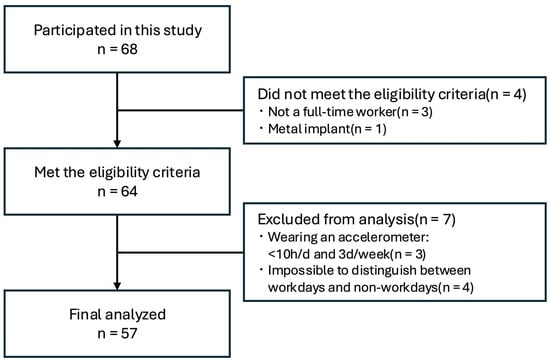
Participants were recruited at Kamijo Memorial Hospital (Nagano, Japan) through hospital postings and email announcements. A total of 68 community-dwelling adult workers were enrolled. Of the 68 participants, 64 met the eligibility criteria. Among them, three were excluded because they did not wear the accelerometer for the required duration [21], and four were excluded because they did not complete the activity diary, which makes it impossible to distinguish between working and non-working days. Consequently, 57 participants were included in the final analysis (Figure 1).
Figure 1.
Flow diagram of participant selection.
All participants received a detailed verbal and written explanation of the study, and written informed consent was obtained from each participant.
2.3. Study Procedures
Before the measurement period, participants who provided informed consent received detailed instructions regarding the preparation required for body fluid assessment by BIA. The BIA measurement was conducted under standardized pre-measurement and procedural conditions. On the day of the BIA measurement, participants underwent body water assessment, and an accelerometer was provided for physical activity measurement over the subsequent 7-day period. This procedure was intended to assess an association between habitual workday activity and lower-extremity ECW/TBW.
2.4. Assessment of Lower-Extremity ECW/TBW
Body water distribution was assessed using multifrequency BIA with the InBody BWA (InBody Japan, Tokyo, Japan). Before the measurement day, participants were instructed to follow standardized pre-measurement conditions based on established BIA recommendations and the manufacturer’s instructions [22,23]. (1) avoid food and beverages for at least 2 h and alcohol for at least 8 h before measurement; (2) empty the bladder immediately before measurement; (3) refrain from strenuous exercise for at least 8 h before measurement; and (4) wear light clothing and remove metal accessories before measurement. To minimize participant burden and facilitate participation among full-time workers, BIA assessments were scheduled according to participants’ availability. Consequently, the time of day and timing relative to work schedules were not standardized. Assessments could therefore take place on workdays or non-workdays, including before or after work on workdays. Because height and body weight are required for BIA assessment, height was measured using a stadiometer and body weight using a digital scale before the BIA measurement.
For the BIA measurement, participants were barefoot, and the electrode-contact areas at both wrists and ankles were wiped with wet wipes to prevent skin dryness. Participants then assumed a supine position on the measurement bed and rested for 10 min before the measurement, in accordance with the manufacturer’s operating instructions. Lower-extremity ECW/TBW was calculated as the mean of the ECW/TBW values for the right and left lower extremities obtained from the segmental analysis [24,25].
2.5. Physical Activity Measurements
Physical activity was measured using a uniaxial accelerometer (Lifecorder GS, Suzuken Co., Nagoya, Japan). The accuracy of step counts obtained using the Lifecorder has been validated against direct step counts recorded by researchers [26]. Participants were instructed to wear the accelerometer at the waist for at least 10 h/day, from waking until bedtime, for 7 consecutive days, except during activities with a risk of immersion, such as bathing. Detailed instructions on device use were provided individually in person. Throughout the measurement period, participants could view their measurement data on the device screen at any time.
After the 7-day measurement period, the accelerometers were returned either in person or by mail. Daily step count and time spent in MVPA were extracted using the analysis software (Lifelyzer 05 Coach, Suzuken Co., Nagoya, Japan). MVPA was defined as activity corresponding to ≥3 metabolic equivalents according to the Lifecorder intensity classification [27]. Days with ≥10 h accelerometer wear were considered valid and included in the analysis, whereas days with <10 h wearing time were excluded. Participants were included if they had data available for at least 3 valid days, comprising at least 2 workdays and 1 non-workday [9,21]. Workdays and non-workdays were identified from participant diaries completed during the physical activity measurement period. The seven-day accelerometer monitoring period was intended to characterize participants’ usual physical activity on workdays and non-workdays. At least 3 days of step-count monitoring can provide reasonably reliable estimates of mean daily step count over a week [26,28]. Accordingly, daily step counts and MVPA were averaged separately across valid workdays and non-workdays.
Because wearing an activity monitor may itself alter physical activity behavior, participants were asked to follow their daily routines throughout the measurement period [29].
2.6. Statistical Analysis
Depending on their distribution, continuous variables were summarized as either mean ± standard deviation (SD) or median [interquartile range (IQR)], whereas categorical variables were summarized as counts and percentages.
The primary analysis examined the association between workday step count and lower-extremity ECW/TBW using forced-entry multiple linear regression analysis. Lower-extremity ECW/TBW was specified as the dependent variable and workday step count as the primary independent variable. In Model 1, age and sex were included as covariates, and non-workday step count was additionally included to account for differences in overall physical activity between workdays and non-workdays. Workday and non-workday step counts were entered in units of 1000 steps/day. In Model 2, body mass index (BMI, kg/m2) was additionally included in Model 1 to assess whether the association between workday step count and lower-extremity ECW/TBW was affected by body size.
As a secondary analysis, the association between physical activity intensity and lower-extremity ECW/TBW was examined using workday MVPA as the independent variable. The same modeling strategy was used, with age, sex, and non-workday MVPA included in Model 1 and BMI additionally included in Model 2. Workday and non-workday MVPA were entered in units of 10 min/day.
Multicollinearity among independent variables was assessed using the variance inflation factor (VIF). To directly compare the associations of workday and non-workday step counts with lower-extremity ECW/TBW, a linear hypothesis test was performed to test the null hypothesis that the corresponding regression coefficients were equal (βworkday = βnon-workday). Regression model assumptions were evaluated using residual-versus-fitted plots, normal Q–Q plots, and scale–location plots to assess linearity, residual distribution, and homoscedasticity. Potentially influential observations were assessed using Cook’s distance and leverage values. Regression findings were reported using unstandardized regression coefficients (B), standard errors (SEs), 95% confidence intervals (CIs), and p-values. Model fit was evaluated using the coefficient of determination (R2) and adjusted R2. All statistical analyses were conducted with R version 4.4.2 (R Foundation for Statistical Computing, Vienna, Austria). All analyses were two-sided, and statistical significance was defined as p < 0.05.
Generative artificial intelligence (ChatGPT, GPT-5.6, OpenAI, San Francisco, CA, USA) was used to assist in generating R code for descriptive statistics, regression analyses, and data visualization. All AI-generated code was reviewed and executed by the authors, who also verified the resulting statistical outputs and figures. The selection of statistical methods and the interpretation of the results were performed solely by the authors.
3. Results
3.1. Participant Characteristics
Table 1 presents the characteristics of the participants. The mean age was 52.2 ± 9.1 years, and 39 participants (68.4%) were women. Regarding occupational distribution, 41 participants (71.9%) were healthcare workers, including 17 care workers, 16 nurses, 6 rehabilitation professionals, 1 medical technologist, and 1 dental hygienist. The remaining 16 participants (28.1%) were classified as office-based workers, including 10 clerical workers and 6 care managers whose duties were primarily desk-based.
Table 1.
Characteristics of the participants in this study.
The mean lower-extremity ECW/TBW was 0.3931 ± 0.0095. The median workday and non-workday step counts were 10,771.6 steps/day [8352.3–12,999.0] and 5908.0 steps/day [3840.0–7607.0], respectively. Among the 56 participants with available MVPA data, the median [IQR] workday and non-workday MVPA were 31.9 [23.3–40.8] and 11.7 [5.0–18.8] min/day, respectively. MVPA data were unavailable for one participant because the accelerometer intensity data required to calculate MVPA were not available, although valid step-count data were retained. Therefore, analyses of MVPA included 56 participants. Physical activity characteristics and lower-extremity ECW/TBW stratified by occupational group are presented in Supplementary Table S1. The median workday step count was 11,460.1 [9698.6–13,606.0] and 9034.3 [7411.9–10,133.8] steps/day among healthcare and office-based workers, respectively.
3.2. Relationship Between Workday Step Count and Lower-Extremity ECW/TBW
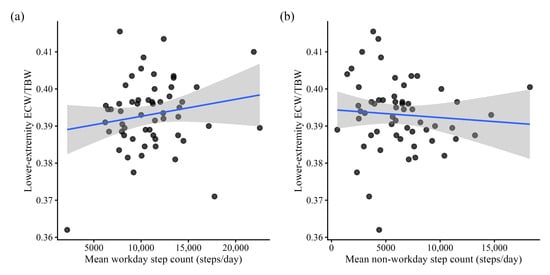
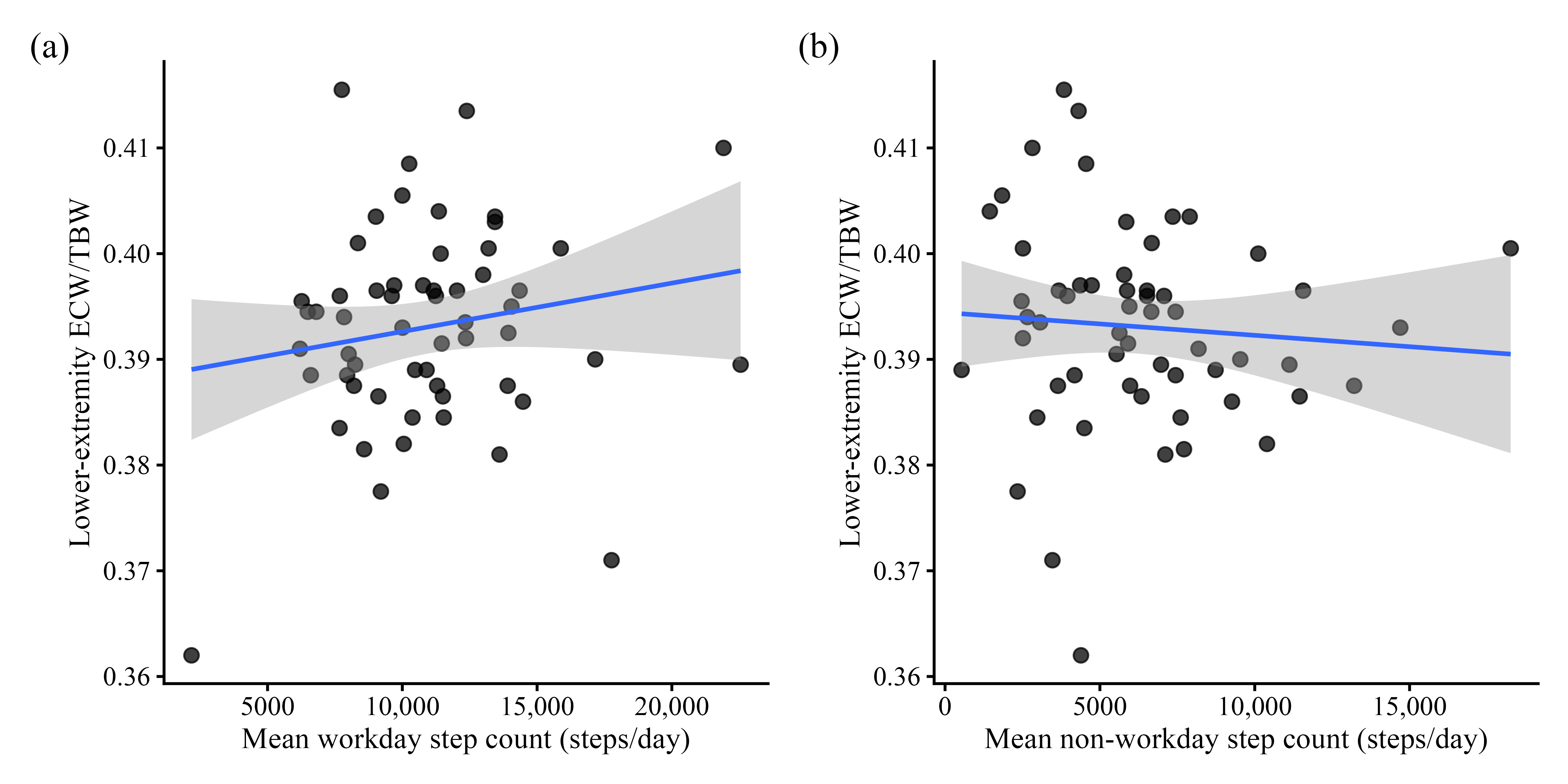
Figure 2 shows the unadjusted associations between workday and non-workday step counts and lower-extremity ECW/TBW. The association between workday step count and lower-extremity ECW/TBW is shown in Figure 2a, and respective association between non-workday step count is shown in Figure 2b.
Figure 2.
Relationship between workday/non-workday step count and lower-extremity ECW/TBW: (a) workday step count; (b) non-workday step count. Each point represents an individual participant. Solid lines represent unadjusted linear regression lines, and shaded areas indicate 95% confidence intervals.
Adjusted associations were subsequently examined using multiple linear regression analysis. Table 2 summarizes the multiple linear regression models. In Model 1, after adjustment for age, sex, and non-workday step count, workday step count was positively associated with lower-extremity ECW/TBW (B = 0.0007 per 1000 steps/day, 95% CI: 0.00004–0.0014, p = 0.038). In contrast, non-workday step count was not significantly associated with lower-extremity ECW/TBW (B = −0.0002 per 1000 steps/day, 95% CI: −0.0009–0.0005, p = 0.544). Moreover, older age and female sex were associated with higher lower-extremity ECW/TBW. The overall model was statistically significant (p = 0.003), with an R2 of 0.257 and an adjusted R2 of 0.199.
Table 2.
Multiple linear regression analysis of step count for lower-extremity ECW/TBW.
In Model 2, which was additionally adjusted for BMI, the regression coefficient for workday step count remained similar in magnitude to that observed in Model 1 (B = 0.0007 per 1000 steps/day, 95% CI: 0.000004–0.0013, p = 0.0499). Non-workday step count was not significantly associated with lower-extremity ECW/TBW. The overall model was statistically significant (p = 0.004), with an R2 of 0.280 and an adjusted R2 of 0.209. VIF values were low in both models, indicating no evidence of problematic multicollinearity.
Direct comparison of the regression coefficients showed that the coefficients for workday and non-workday step counts did not differ significantly in either Model 1 (F(1, 52) = 3.039, p = 0.087) or Model 2 (F(1, 51) = 2.331, p = 0.133). Visual inspection of the regression diagnostic plots revealed no pronounced systematic curvature in either model. The normal Q–Q plots showed approximately linear patterns in the central portions of the residual distributions, with some deviations at the tails. Influence diagnostics identified six and seven observations in Models 1 and 2, respectively, that exceeded at least one of the prespecified screening thresholds for Cook’s distance or leverage (Supplementary Figures S1 and S2 and Table S2).
3.3. Relationship Between Workday MVPA and Lower-Extremity ECW/TBW
Table 3 presents the results of the secondary multiple linear regression analyses examining the association between workday MVPA and lower-extremity ECW/TBW. Among the 56 participants with available MVPA data, workday MVPA was positively associated with lower-extremity ECW/TBW after adjustment for age, sex, and non-workday MVPA (B = 0.0016 per 10 min/day, SE = 0.00076, 95% CI: 0.00007–0.00312, p = 0.040). In contrast, non-workday MVPA was not significantly associated with lower-extremity ECW/TBW (B = −0.00054 per 10 min/day, SE = 0.00081, 95% CI: −0.00217 to 0.00109, p = 0.510). After additional adjustment for BMI, the regression coefficient for workday MVPA remained positive but was attenuated and no longer significant (B = 0.00143 per 10 min/day, SE = 0.00077, 95% CI: −0.00013–0.00298, p = 0.071). Non-workday MVPA was not significantly associated with lower-extremity ECW/TBW (B = −0.00052 per 10 min/day, SE = 0.00081, 95% CI: −0.00215–0.00111, p = 0.525).
Table 3.
Multiple linear regression analysis of MVPA for lower-extremity ECW/TBW.
4. Discussion
In this study, we examined the association between workday step count and lower-extremity ECW/TBW among community-dwelling adult workers. First, workday step count was positively associated with lower-extremity ECW/TBW after adjustment for age, sex, and non-workday step count, and the magnitude of this association was similar after adjusting for BMI; however, the statistical evidence was borderline. In contrast, non-workday step count was not significantly associated with lower-extremity ECW/TBW. Moreover, the regression coefficients for workday and non-workday step counts did not differ significantly. Therefore, the present findings do not demonstrate that the correlation between lower-extremity ECW/TBW and step count differs by day type.
Second, in the secondary analysis, workday MVPA was positively associated with lower-extremity ECW/TBW after adjustment for age, sex, and non-workday MVPA; however, the association did not remain statistically significant when BMI was additionally included in the model.
Previous studies have reported differing responses of lower-extremity fluid volume to walking and prolonged upright activity. Stick et al. reported that, in healthy young adults, both slow and fast walking tended to decrease calf volume and venous pressure after 20 min of walking compared with pre-walking values [30]. In contrast, Rücker et al. reported that calf volume increased after 150 min of standing work involving walking, regardless of the proportion of walking performed during the work period [31]. These findings suggest that calf-muscle pump activation during walking and prolonged gravitational loading during upright activity may influence lower-extremity fluid distribution through different mechanisms.
The present study extends these findings by examining physical activity accumulated during daily life rather than the immediate response to a single period of walking or standing. Unlike experimental studies focusing on immediate physiological responses to specific activities, daily step count provides a practical measure of habitual ambulatory physical activity under free-living conditions. Our findings may indicate that greater workday step count was associated with higher lower-extremity ECW/TBW, suggesting that objectively measured workday steps may provide useful information regarding relative lower-extremity body water distribution. Participants with higher workday step counts may have experienced greater cumulative gravitational loading of the lower extremities throughout the day. Prolonged upright posture increases venous hydrostatic pressure and may promote fluid movement from the intravascular space into the interstitial space [32,33]. Prolonged gravitational loading during upright activity, including walking, may have contributed to the observed association. Nevertheless, standing duration and activity were not directly assessed, and the relative contributions of walking and prolonged standing to the observed association remain uncertain. Importantly, a higher ECW/TBW ratio does not necessarily indicate increased absolute extracellular water or clinically meaningful edema. Because absolute segmental ECW, ICW, and TBW values were unavailable in the present dataset, the observed differences in ECW/TBW should be interpreted as differences in relative lower-extremity body water distribution.
Workday step count may have been accumulated during working hours, given that work typically occupies a considerable portion of the day. From this perspective, the observed association between workday step count and lower-extremity ECW/TBW may provide preliminary insights relevant to the physical activity health paradox, which suggests that occupational and leisure-time physical activity may have different health implications [34]. However, several factors warrant cautious interpretation of these findings. First, the estimated association was small, with an approximately 0.0007 higher ECW/TBW per additional 1000 steps/day, and the lower bound of the 95% confidence interval was close to zero. A clinically meaningful difference in lower-extremity ECW/TBW has not been established for community-dwelling adult workers, and the clinical significance of the observed effect size requires further investigation. Furthermore, Cook’s distance diagnostics identified potentially influential observations, suggesting that the finding may not be robust. Second, median workday step count exceeded 8000 steps/day in both healthcare workers (11,460 steps/day) and office-based workers (9034 steps/day), suggesting that both occupational groups accumulated relatively high levels of ambulatory activity on workdays. Nevertheless, the relatively small sample size limited further occupation-specific analyses. More importantly, workday step count represented total daily activity and did not distinguish occupational physical activity from commuting, household activities, or leisure-time physical activity. Therefore, the present findings should be interpreted cautiously and cannot directly support the physical activity health paradox. Future studies should separately assess physical activity during working hours and non-working hours, including leisure-time and household activities, together with posture, standing duration, and recovery periods, to clarify the relationship between activity context and lower-extremity ECW/TBW.
This secondary analysis showed a similar positive direction for workday MVPA, although the association was no longer significant after adjustment for BMI. Therefore, the present findings do not allow conclusions regarding the role of physical activity intensity or any specific physiological mechanism. Future studies combining measures of activity intensity with direct assessment of posture and activity patterns are needed to clarify these relationships.
This study has some limitations. First, lower-extremity ECW/TBW was measured only once. Differences in lower-extremity fluid status between workdays and non-workdays could not be assessed. Furthermore, within-subject measurement variability could not be evaluated, and the clinical relevance of the small, estimated association remains uncertain. In addition, BIA was performed before the subsequent seven-day activity-monitoring period. Although the monitoring period was intended to characterize participants’ habitual physical activity patterns on workdays and non-workdays, it remains uncertain whether the recorded activity accurately represented the activity performed before the BIA assessment. Therefore, the temporal relationship between daily step count and lower-extremity ECW/TBW could not be established, and the observed association should not be interpreted causally. Furthermore, cardiovascular outcomes were not assessed. Second, the cross-sectional design precludes causal inference. In addition, the timing of BIA measurements relative to the time of day and work shifts was not standardized, potentially affecting the measured ECW/TBW values. Third, detailed information on activity patterns, occupational characteristics, relevant clinical conditions, and medications affecting fluid balance was unavailable. Therefore, the underlying physiological mechanisms could not be determined, and residual confounding cannot be excluded. Finally, the relatively small sample size and predominance of healthcare and care workers may limit the precision and generalizability of the findings. Future longitudinal studies incorporating repeated, time-standardized BIA measurements and direct assessments of activity patterns in larger and more diverse populations are warranted.
5. Conclusions
In this sample of healthcare workers and office-based workers, greater workday step count is associated with higher lower-extremity ECW/TBW. However, no statistically significant difference was observed between the regression coefficients for workday and non-workday step counts. Future studies should distinguish occupational from non-occupational physical activity and assess standing, walking, and sitting separately to clarify their associations with lower-extremity body water distribution.
Supplementary Materials
The following supporting information can be downloaded at: https://www.mdpi.com/article/10.3390/healthcare14223992/s1, Table S1: Physical activity characteristics stratified by occupational group; Table S2: Influence diagnostics for multiple linear regression models; Figure S1: Regression diagnostic plots for Model 1; Figure S2: Regression diagnostic plots for Model 2.
Author Contributions
Conceptualization, K.Y., K.F. and K.M.; methodology, K.Y., K.F. and K.M.; software, K.Y.; validation, K.Y., K.F. and K.M.; formal analysis, K.Y.; investigation, K.Y. and T.M.; resources, K.Y., K.F., T.M. and K.M.; data curation, K.Y. and T.M.; writing—original draft preparation, K.Y. and K.F.; writing—review and editing, K.Y. and K.F.; visualization, K.Y.; supervision, K.M.; project administration, K.M.; funding acquisition, K.M. All authors have read and agreed to the published version of the manuscript.
Funding
This research received no external funding.
Institutional Review Board Statement
The study was conducted in accordance with the Declaration of Helsinki and approved by the Shinshu University Ethics Committee (protocol code 6940 and date of approval: 10 September 2026).
Informed Consent Statement
Informed consent was waived due to the secondary use of previously collected data for which participants had already provided written consent permitting such secondary use, subject to approval by the relevant ethics committee.
Data Availability Statement
Public access to the datasets generated and analyzed in this study is restricted to protect participant privacy and to comply with ethical requirements. De-identified data may be provided by the corresponding author upon reasonable request, provided that access is approved by the relevant ethics committee and is consistent with institutional policies and applicable data protection regulations.
Acknowledgments
The authors sincerely thank all participants for their voluntary participation and for the time and effort they devoted to this study. The authors would also like to thank Editage (www.editage.jp (accessed on 20 November 2026))) for English language editing. During the preparation of this work, the authors used ChatGPT (OpenAI) to assist in drafting R code for descriptive statistics, regression analyses, and data visualization. All AI-assisted code was reviewed and executed by the authors, and the resulting statistical outputs and figures were verified by the authors. The authors take full responsibility for the analyses and the content of this publication.
Conflicts of Interest
The authors declare no conflicts of interest.
Abbreviations
The following abbreviations are used in this manuscript:
| MVPA | Moderate to Vigorous Physical Activity |
| BIA | Bioelectrical impedance analysis |
| ECW/TBW | Extracellular water to Total body water ratio |
| IQR | Interquartile range |
| BMI | Body Mass Index |
| VIF | Variance inflation factor |
| SE | Standard error |
| CI | Confidence interval |
References
- World Health Organization. Global Health Risks: Mortality and Burden of Disease Attributable to Selected Major Risks; World Health Organisation: Geneva, Switzerland, 2009. [Google Scholar]
- Warburton, D.E.; Bredin, S.S. Reflections on Physical Activity and Health: What Should We Recommend? Can. J. Cardiol. 2016, 32, 495–504. [Google Scholar] [CrossRef] [Scilit] [PubMed]
- Warburton, D.E.; Nicol, C.W.; Bredin, S.S. Health benefits of physical activity: The evidence. Can. Med. Assoc. J. 2006, 174, 801–809. [Google Scholar] [CrossRef] [Scilit] [PubMed]
- Warburton, D.E.; Nicol, C.W.; Bredin, S.S. Prescribing exercise as preventive therapy. Can. Med. Assoc. J. 2006, 174, 961–974. [Google Scholar] [CrossRef] [Scilit] [PubMed]
- Manson, J.E.; Greenland, P.; LaCroix, A.Z.; Stefanick, M.L.; Mouton, C.P.; Oberman, A.; Perri, M.G.; Sheps, D.S.; Pettinger, M.B.; Siscovick, D.S. Walking compared with vigorous exercise for the prevention of cardiovascular events in women. N. Engl. J. Med. 2002, 347, 716–725. [Google Scholar] [CrossRef] [Scilit] [PubMed]
- Behrens, G.; Leitzmann, M.F. The association between physical activity and renal cancer: Systematic review and meta-analysis. Br. J. Cancer 2013, 108, 798–811. [Google Scholar] [CrossRef] [Scilit] [PubMed]
- U.S. Department of Health and Human Services. 2008 Physical Activity Guidelines for Americans; U.S. Department of Health and Human Services: Washington, DC, USA, 2008; p. 76.
- Ministry of Health, Labour and Welfare. Physical Activity Guide for Health Promotion 2023; Ministry of Health, Labour and Welfare: Tokyo, Japan, 2024.
- Kitano, N.; Kai, Y.; Jindo, T.; Fujii, Y.; Tsunoda, K.; Arao, T. Association of domain-specific physical activity and sedentary behavior with cardiometabolic health among office workers. Scand. J. Med. Sci. Sports 2022, 32, 1224–1235. [Google Scholar] [CrossRef] [Scilit] [PubMed]
- Holtermann, A.; Krause, N.; van der Beek, A.J.; Straker, L. The physical activity paradox: Six reasons why occupational physical activity (OPA) does not confer the cardiovascular health benefits that leisure time physical activity does. Br. J. Sports Med. 2018, 52, 149–150. [Google Scholar] [CrossRef] [Scilit] [PubMed]
- Umeda, Y.; Kinoshita, K.; Sugimura, Y.; Yang, Y.; Wai, K.M.; Li, Y.; Ihara, K. Associations Between Workday/Leisure Day Lifestyle Behavior and Cardiovascular Disease Risk Factors Among Night Shift Workers Using the Isotemporal Substitution Model. Healthcare 2025, 13, 908. [Google Scholar] [CrossRef] [Scilit] [PubMed]
- Yeboah, J.; Bertoni, A.; Qureshi, W.; Aggarwal, S.; Lima, J.A.; Kawel-Boehm, N.; Bluemke, D.A.; Shah, S.J. Pedal Edema as an Indicator of Early Heart Failure in the Community: Prevalence and Associations with Cardiac Structure/Function and Natriuretic Peptides (MESA [Multiethnic Study of Atherosclerosis]). Circ. Heart Fail 2016, 9, e003415. [Google Scholar] [CrossRef] [Scilit] [PubMed]
- Waters, T.R.; Dick, R.B. Evidence of health risks associated with prolonged standing at work and intervention effectiveness. Rehabil. Nurs. 2015, 40, 148–165. [Google Scholar] [CrossRef] [Scilit] [PubMed]
- Uda, S.; Seo, A.; Yoshinaga, F. Swell-preventing effect of intermittent exercise on lower leg during standing work. Ind. Health 1997, 35, 36–40. [Google Scholar] [CrossRef] [Scilit] [PubMed]
- Wall, R.; Garcia, G.; Läubli, T.; Seibt, R.; Rieger, M.A.; Martin, B.; Steinhilber, B. Physiological changes during prolonged standing and walking considering age, gender and standing work experience. Ergonomics 2020, 63, 579–592. [Google Scholar] [CrossRef] [Scilit] [PubMed]
- Kajitani, F.; Kato, T.; Hirao, A. Prediction of Lower Leg Swelling in Driving Posture. Appl. Sci. 2024, 14, 11788. [Google Scholar] [CrossRef] [Scilit]
- Quinn, T.D.; Kline, C.E.; Nagle, E.; Radonovich, L.J.; Alansare, A.; Barone Gibbs, B. Cardiovascular responses to physical activity during work and leisure. Occup. Environ. Med. 2022, 79, 94–101. [Google Scholar] [CrossRef] [Scilit] [PubMed]
- Chen, R.; Xu, Z.; Shi, H.; Ma, T.; Li, P.; Yuan, R.; Liu, C. Longitudinal study on the relationship between extracellular water distribution changes and muscle mass in severe sarcopenia patients using multi-frequency bioelectrical impedance analysis combined with phase angle measurements. Eur. Geriatr. Med. 2026, 17, 53–62. [Google Scholar] [CrossRef] [Scilit] [PubMed]
- Oishi, K.; Yoshida, T.; Kim, H.K.; Yokoyama, K.; Watanabe, Y.; Nakayama, Y.; Kimura, M.; Ishii, K.; Ono, R.; Yamada, Y. Association of physical activity and hydration markers with cellular health in older adults: A doubly labeled water study. Exp. Gerontol. 2025, 209, 112859. [Google Scholar] [CrossRef] [Scilit] [PubMed]
- Kim, D.S.; Won, Y.H.; Ko, M.H. Comparison of intermittent pneumatic compression device and compression stockings for workers with leg edema and pain after prolonged standing: A prospective crossover clinical trial. BMC Musculoskelet. Disord. 2022, 23, 1007. [Google Scholar] [CrossRef] [Scilit] [PubMed]
- Tudor-Locke, C.; Burkett, L.; Reis, J.P.; Ainsworth, B.E.; Macera, C.A.; Wilson, D.K. How many days of pedometer monitoring predict weekly physical activity in adults? Prev. Med. 2005, 40, 293–298. [Google Scholar] [CrossRef] [Scilit] [PubMed]
- Kyle, U.G.; Bosaeus, I.; De Lorenzo, A.D.; Deurenberg, P.; Elia, M.; Manuel Gómez, J.; Lilienthal Heitmann, B.; Kent-Smith, L.; Melchior, J.C.; Pirlich, M.; et al. Bioelectrical impedance analysis-part II: Utilization in clinical practice. Clin. Nutr. 2004, 23, 1430–1453. [Google Scholar] [CrossRef] [Scilit] [PubMed]
- Korzilius, J.W.; Oppenheimer, S.E.; de Roos, N.M.; Wanten, G.J.A.; Zweers, H. Having breakfast has no clinically relevant effect on bioelectrical impedance measurements in healthy adults. Nutr. J. 2023, 22, 55. [Google Scholar] [CrossRef] [Scilit] [PubMed]
- Ryu, H.; Park, H.C.; Kim, H.; Heo, J.; Kang, E.; Hwang, Y.H.; Cho, J.Y.; Lee, K.B.; Oh, Y.K.; Oh, K.H.; et al. Bioelectrical impedance analysis as a nutritional assessment tool in Autosomal Dominant Polycystic Kidney Disease. PLoS ONE 2019, 14, e0214912. [Google Scholar] [CrossRef] [Scilit] [PubMed]
- Shibata, K.; Adachi, T.; Kameshima, M.; Kito, H.; Tanaka, C.; Sano, T.; Tanaka, M.; Ida, M.; Jinno, H.; Kitamura, H. Prognostic impact of segmental extracellular water to total body water ratio in cardiovascular surgery patients. Clin. Nutr. 2025, 51, 81–89. [Google Scholar] [CrossRef] [Scilit] [PubMed]
- Schneider, P.L.; Crouter, S.E.; Lukajic, O.; Bassett, D.R. Accuracy and reliability of 10 pedometers for measuring steps over a 400-m walk. Med. Sci. Sports Exerc. 2003, 35, 1779–1784. [Google Scholar] [CrossRef] [Scilit] [PubMed]
- Adachi, T.; Ashikawa, H.; Funaki, K.; Kondo, T.; Yamada, S. Questionnaire-based scoring system for screening moderate-to-vigorous physical activity in middle-aged Japanese workers. J. Occup. Health 2024, 66, uiad011. [Google Scholar] [CrossRef] [Scilit] [PubMed]
- Kubota, A.; Nagata, J.; Sugiyama, M.; Ishiduka, K.; Unno, Y. How many days of pedometer monitoring predict weekly physical activity in Japanese adults? Nihon Koshu Eisei Zasshi 2009, 56, 805–810. [Google Scholar] [PubMed]
- Foong, Y.C.; Chherawala, N.; Aitken, D.; Scott, D.; Winzenberg, T.; Jones, G. Accelerometer-determined physical activity, muscle mass, and leg strength in community-dwelling older adults. J. Cachexia Sarcopenia Muscle 2016, 7, 275–283. [Google Scholar] [CrossRef] [Scilit] [PubMed]
- Stick, C.; Jaeger, H.; Witzleb, E. Measurements of volume changes and venous pressure in the human lower leg during walking and running. J. Appl. Physiol. 1992, 72, 2063–2068. [Google Scholar] [CrossRef] [Scilit] [PubMed]
- Rücker, L.; Brombach, J.; Bengler, K. Experimental study of standing and walking at work—What is compatible with physiological characteristics and human needs? Z. Arbeitswiss. 2022, 76, 333–343. [Google Scholar] [CrossRef] [Scilit]
- Stick, C.; Grau, H.; Witzleb, E. On the edema-preventing effect of the calf muscle pump. Eur. J. Appl. Physiol. Occup. Physiol. 1989, 59, 39–47. [Google Scholar] [CrossRef] [Scilit] [PubMed]
- Blättler, W.; Thomae, H.J.; Amsler, F. Venous leg symptoms in healthy subjects assessed during prolonged standing. J. Vasc. Surg. Venous Lymphat. Disord. 2016, 4, 455–462. [Google Scholar] [CrossRef] [Scilit] [PubMed]
- Quinn, T.D.; Prince, S.A.; Pronk, N.P.; Barone Gibbs, B. The physical activity health paradox: What is it, why might it happen, and where to go from here? Int. J. Behav. Nutr. Phys. Act. 2026, 23, 67. [Google Scholar] [CrossRef] [Scilit] [PubMed]

Disclaimer/Publisher’s Note: The statements, opinions and data contained in all publications are solely those of the individual author(s) and contributor(s) and not of MDPI and/or the editor(s). MDPI and/or the editor(s) disclaim responsibility for any injury to people or property resulting from any ideas, methods, instructions or products referred to in the content. |
© 2026 by the authors. Licensee MDPI, Basel, Switzerland. This article is an open access article distributed under the terms and conditions of the Creative Commons Attribution (CC BY) license.