


Abstract
Background/Objectives: Subjective social status may be relevant to refugee health, but whether it is associated with somatic symptoms beyond economic circumstances is uncertain, and refugees can rate their standing in two societies. We examined North Korean refugees’ recalled status in North Korea and current status in South Korea, both rated at the time of the survey, in relation to self-reported somatic symptoms. Methods: Adult refugees were recruited through community organizations and referrals for a cross-sectional survey (n = 410). The primary complete-case analysis (n = 391) used multiple linear regression estimated by ordinary least squares with heteroscedasticity-consistent standard errors. Results: With recalled status and demographic characteristics held constant, higher current status was associated with fewer symptoms (b = −0.092, 95% confidence interval (CI) [−0.141, −0.043]). After household income and North Korean education were added, the estimate was smaller and its interval included zero (b = −0.036, 95% CI [−0.082, 0.010]); the primary hypothesis was therefore not supported. Differences between the two ratings were not clearly related to symptoms in either direction. Per-category estimates were similar in sensitivity analyses, including analyses of alternative functional forms. Conclusions: Among North Korean refugees, perceived social standing and household income carried overlapping information about somatic symptom burden. The cross-sectional data cannot show whether income confounds this association, forms part of perceived standing, or is itself affected by health. Somatic symptoms should be assessed together with economic and perceived social circumstances, and longitudinal studies with explicit reference groups are needed.
1. Introduction
Health inequalities reflect not only differences in socioeconomic resources but also how people evaluate their position relative to others. Subjective social status refers to a person’s perceived standing in a social hierarchy; it overlaps with income and education but is not interchangeable with either. Lower subjective status has been associated with poorer psychological and physiological functioning beyond objective indicators [1] and with later declines in health [2], and meta-analyses have found associations with physical health after socioeconomic adjustment, although their size and consistency vary across outcomes and measures [3,4]. Explanations of these associations emphasize social comparison. Judging oneself to be worse off than relevant others can give rise to feelings of relative deprivation and to negative affect [5,6,7], and the cumulative burden of such stress is thought to affect health through neuroendocrine pathways [8,9]. These states may be experienced and reported as bodily symptoms. At the same time, status ratings summarize measured and unmeasured resources and may themselves be influenced by mood and health, so an association that remains after adjustment for income does not isolate a purely psychological process [9,10].
Migration adds a second frame of reference. Migrants can rate their standing in the society they left as well as in the one where they now live, and the position held before migration can serve as a reference point for judging one’s position afterwards [11]. Studies of immigrants and refugees have related differences between such ratings, often called subjective social mobility, to depression and other health outcomes [12,13,14,15,16]. In studies of this kind, the premigration rating is obtained after migration [15,17]. It is therefore a present-day recollection that may not refer to a single point in time [17], and retrospective reports can be influenced by a respondent’s current mental health [18].
For North Korean refugees (NKRs), the two ratings also refer to hierarchies organized on different principles. In North Korea, social standing has been rooted in a state-assigned classification based on family background and political loyalty (songbun), with money and market activity becoming increasingly important in recent decades [19,20]. South Korea, by contrast, is a market economy, and subjective status ratings are usually anchored to income, education, and occupation [1]; many NKRs also face continuing hardship and discrimination during their adaptation [21,22]. People in different social settings compare themselves with different others and standards [23], and status ratings are sensitive to the comparison group that respondents have in mind [24]. Identical response categories may therefore not denote equivalent positions in the two societies, and a difference between the two ratings is a contrast between two evaluations made at the time of the survey, not a measure of realized social mobility.
Somatic symptoms are a relevant outcome in this context. Among NKRs, bodily complaints have been related to physical illness [25], to perceived social support and health-related quality of life [26], and to trauma-related symptoms, loneliness, and perceived discrimination [22]. Cultural accounts caution that somatic complaints communicate distress within particular social settings and should not be read as concealed psychological problems [27], and NKRs’ own understandings of mental health change in the course of migration and settlement [28]. Whether NKRs’ perceived social standing is related to their somatic symptoms has received little attention. Kim et al. [29] related subjective and objective indicators of class before and after migration to happiness. Outside the NKR literature, changes in domain-specific status after migration have been related to mental health outcomes that include somatization [30], and subjective status and occupational mobility have been related to somatic symptoms in non-migrant samples [7,31]. To our knowledge, no study has examined recalled North Korean status and current South Korean status together in relation to somatic symptoms among NKRs.
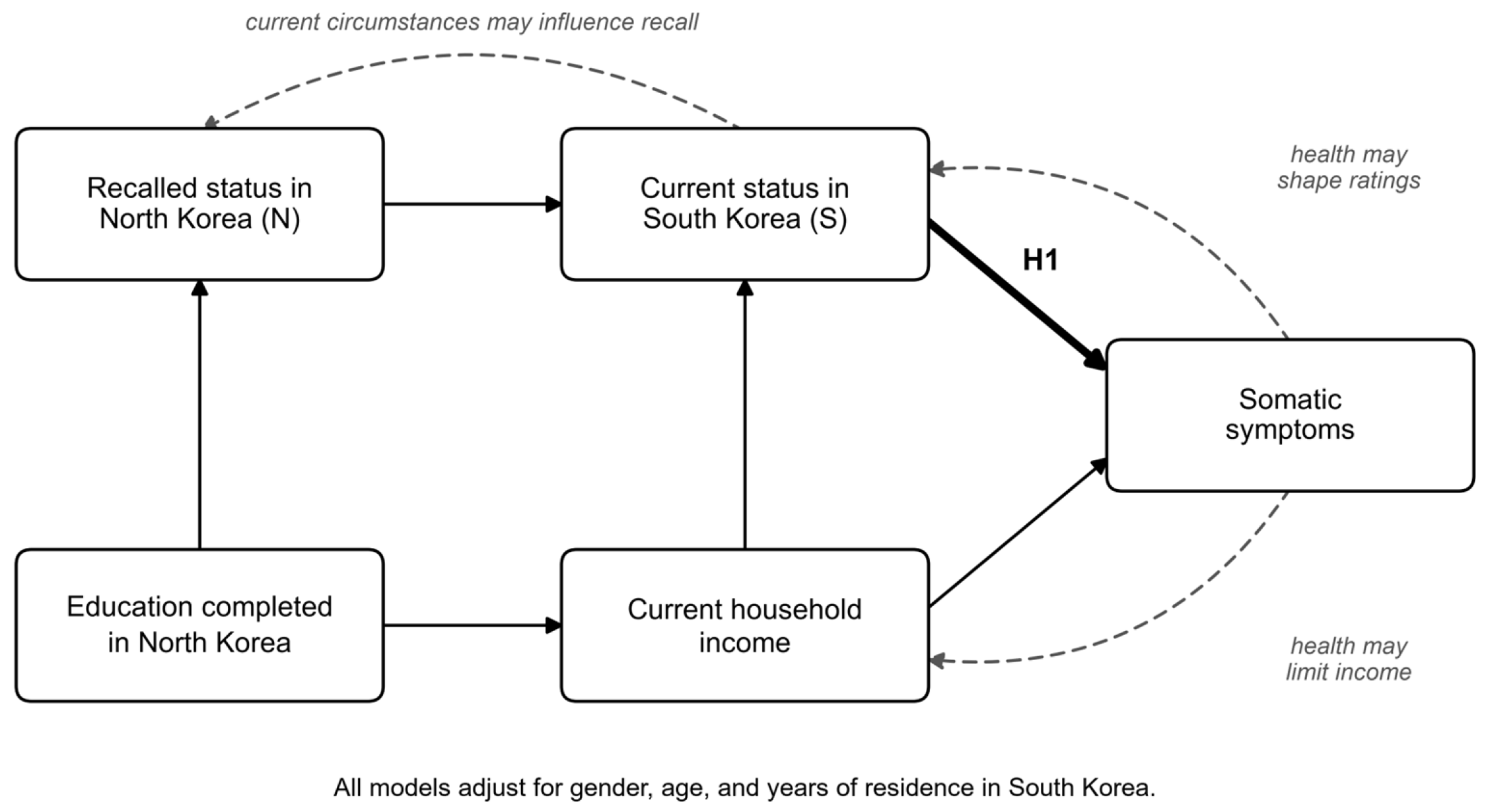
Interpreting such an association requires assumptions about the role of current economic circumstances (Figure 1). Household income may be a common cause of perceived standing and somatic symptoms, in which case it confounds their association. It may also be one of the criteria that respondents use when they rate their standing; adjusting for income then removes part of the construct of interest. Finally, poor health may reduce income and lower status ratings [9]. A cross-sectional survey cannot distinguish these structures. We therefore estimated the association of current status with somatic symptoms both without and with adjustment for household income and premigration education, and we interpret the adjusted coefficient as an association conditional on income, not as the overall association between perceived standing and symptoms. Recalled North Korean status was included as the reference point against which current standing may be judged, and education completed in North Korea as an indicator of resources acquired before migration.
Figure 1.
Conceptual framework of the study. Solid arrows show the relations assumed among the measured variables; the thick arrow is the association tested in the primary hypothesis (H1). Dashed arrows show alternative pathways that cross-sectional data cannot distinguish from the assumed relations. Recalled and current status were both rated at the time of the survey.
The present study examined these associations in a cross-sectional survey of adult NKRs living in South Korea. The primary hypothesis (H1) was that higher current subjective status would be associated with fewer somatic symptoms after accounting for recalled North Korean status, demographic characteristics, household income, and North Korean education. An exploratory analysis examined whether rating current status below or above recalled status had symmetric associations with symptoms. The design does not permit conclusions about within-person change or causal direction.
2. Materials and Methods
2.1. Study Design and Participants
We analyzed responses to a cross-sectional questionnaire survey, the 2023 Survey on the Family and Social Life of North Korean Refugees in South Korea. The first author designed the survey and directed it as principal investigator. Adults who had left North Korea and were living in South Korea were eligible. People who were under 18 years of age or who did not wish to participate were not enrolled, and there were no other exclusion criteria.
No sampling frame was available for this survey because personal and residential information about NKRs is not disclosed for security reasons; a nonprobability design was therefore used. Recruitment began at community organizations that serve NKRs in Seoul, Gyeonggi Province, and Incheon, mainly Hana Centers and community welfare centers. Hana Centers are regional adaptation centers designated by the Minister of Unification to support NKRs in adapting to the communities where they live [32]. Organizations in areas where many NKRs live were contacted, and recruitment took place at those that agreed to cooperate. Staff at the cooperating organizations posted or passed on a recruitment notice, and the research team explained the purpose and procedures of the study to those who were interested. Participants were also asked to tell other NKRs about the study (snowball sampling), and people recruited in this way were enrolled through the same procedure. After giving written informed consent, participants completed a self-administered paper questionnaire in person at a community facility, which took about 40 min, and received a gift certificate worth 20,000 Korean won (KRW). Data were collected between 23 January and 29 September 2023.
All 410 people who were screened were enrolled and completed the questionnaire. The number of people who saw the recruitment notice or heard about the study from acquaintances was not recorded, and referral chains were not tracked; a participation rate could therefore not be calculated. The study was approved by the Public Institutional Review Board of Korea (approval number P01-202301-01-015; 20 January 2023).
2.2. Measures
Somatic symptoms were measured with the 10-item Somatization scale of the Brief Psychological State Inventory for North Korean Refugees (BPSI-NKR) [33]. The BPSI-NKR is a Korean-language self-report inventory that was developed with NKRs attending the government’s resettlement education program as a screening measure of current psychological state. It consists of seven basic scales (post-traumatic stress, anxiety, depression, somatization, interpersonal sensitivity, anger, and psychosis) and two supplementary scales (family problems and alcohol problems). The developers wrote the somatization items with reference to the health-concern and somatic-complaint scales of the Minnesota Multiphasic Personality Inventory-2 and retained items according to their correlations with the somatization subscale of the Symptom Checklist-90-Revised and with the scale total. They reported internal consistency (Cronbach’s α = 0.77 for men and 0.83 for women) and two-week test–retest reliability (r = 0.74 and 0.76) but not factor-analytic evidence, scale-level convergent validity, or correlations with the other scales [33].
The ten items ask about appetite (positively worded), headache, lack of energy, nausea, heart or chest pain, a feeling of something stuck in the throat, dizziness, a blocked feeling in the head or nose, indigestion or other gastrointestinal symptoms, and sudden feelings of heat throughout the body. Participants indicated how well each statement described their recent condition (no, somewhat, or very much), and we scored the responses 0, 1, and 2. Because the original report does not give scoring rules, we reverse-scored the appetite item and, for participants who answered at least eight items, averaged the items that were answered (range 0–2); higher scores indicate more symptoms. The appetite item was reverse-scored because it is the only positively worded item (it asks whether appetite is good, whereas the other nine items describe symptoms); this scoring is consistent with the positive item–total correlations reported for this item in the development study [33]. The criterion of at least eight answered items retained respondents with one or two unanswered items while requiring that each score be based on at least 80% of the items; a sensitivity analysis was restricted to participants who answered all ten items (Table S3). All respondents met this criterion (Text S2). Both scoring rules were set before any association between subjective social status and the symptom score was estimated. Cronbach’s α was 0.894 among the 374 participants in the analysis sample who answered all items. The score reflects the self-reported burden of bodily symptoms. It is not a medical diagnosis, does not identify somatic symptom disorder, and does not indicate whether symptoms have a medical explanation or a psychological origin; because the development study did not report evidence of discriminant validity, the score may also partly reflect general psychological distress. We therefore use the term somatic symptoms and reserve somatization for the name of the scale.
Subjective social status was assessed with two single items written for this survey. Participants were asked, “What did you consider your social position in North Korea to be?” and “What do you consider your social position in South Korea to be?” (the Korean wording is given in Text S1). The response options for both items were upper, upper-middle, middle, lower-middle, and lower, which we coded from 1 (lower) to 5 (upper). The questionnaire did not define social position, name a comparison group, or list criteria, so respondents applied their own understanding; the North Korean item did not refer to a particular period before departure. Single items with a small number of labeled categories have been used to assess refugees’ premigration economic standing retrospectively [17] and subjective status in community samples [24]. However, our items were not adapted from a validated instrument, and they differ from the ladder format of the MacArthur scale [1]. Both ratings were given at the time of the survey. We denote current status in South Korea by S and recalled status in North Korea by N. Their difference (S − N) is therefore a contrast between two evaluations made at the same time, one of them retrospective, and does not measure realized social mobility; we refer to it as a perceived status difference.
Covariates were chosen on conceptual grounds as characteristics that may precede or shape both perceived standing and the reporting of symptoms: gender, age, years of residence in South Korea, education completed in North Korea (an indicator of resources acquired before migration), and current household income (Figure 1). Gender was recorded as woman or man and entered as an indicator variable (women = 1; men = 0, the reference category). Age and years of residence were calculated by subtracting the year of birth and the year of entry from 2023; age is therefore a year-based approximation. Monthly household income was reported in seven categories: basic livelihood benefits only (1) and, excluding such benefits, up to KRW 1.00 million (2), 1.00–1.99 million (3), 2.00–2.99 million (4), 3.00–3.99 million (5), 4.00–4.99 million (6), and 5.00 million or more (7). North Korean education was reported in six ordered categories from no schooling to a postgraduate degree. Both variables were entered as scores in the primary model, which assumes equal spacing between categories; for income, this assumption was relaxed in sensitivity analyses. Premigration trauma exposure and education in South Korea, which were missing for 25.6% and 9.2% of the analysis sample, were examined in sensitivity analyses. Social support, perceived discrimination, and loneliness, which have been related to somatic symptoms among NKRs [22,26], were not adjusted for because they may partly result from low social standing and would then lie on the pathway of interest. They could also confound the association, and physical illnesses were not measured, so residual confounding cannot be excluded.
2.3. Statistical Analysis
Primary analysis. The primary model (M1) was a multiple linear regression estimated using ordinary least squares (OLS), in which the somatic symptom score was regressed on S, N, gender, age, years of residence, household income, and North Korean education. Inference was based on heteroscedasticity-consistent (HC3) standard errors [34], two-sided tests, and 95% confidence intervals (CIs). The primary hypothesis concerned the coefficient for S. This coefficient compares participants who differ by one category in current status but have the same recalled status, income, and other covariates; it is a conditional, between-person association and not the overall association between perceived standing and symptoms. To show how far the estimate depended on socioeconomic adjustment, a comparison model (M0) that omitted income and North Korean education was fitted to the same participants.
Missing data. Nineteen of the 410 respondents (4.6%) lacked at least one M1 variable, most often current status (n = 8) or household income (n = 6), and were excluded. They included two respondents whose recorded birth years implied ages of 10 and 17 years; because all participants were adults, these values were regarded as recording errors, and age was set to missing. The primary analysis therefore included 391 complete cases (Tables S1 and S2). Multiple imputation of the full sample was used as a sensitivity analysis.
Exploratory analysis. To examine whether rating one’s current standing below or above one’s recalled standing was related to symptoms in different ways, S was replaced with a downward difference, D = max(0, N − S), and an upward difference, U = max(0, S − N), while N and the M1 covariates were retained. Because N is held constant, the coefficients for D and U (aD and aU) describe how the symptom score differs for each category by which current status lies below or above recalled status. They are conditional associations with perceived status differences, not effects of social mobility. Symmetry was assessed with a Wald test of aD + aU = 0.
Sensitivity, additional, and post hoc analyses. Sensitivity analyses changed one feature of M1 at a time (the grouping of the status ratings, additional covariates, multiple imputation of missing data [35], bootstrap intervals, the scoring of the outcome, the coding of income, and the exclusion of influential observations), and the linear mean function was checked with the regression equation specification error test (RESET). Three analyses of functional form were added during peer review: income entered as seven categories, status entered as categories, and a fractional logit model for the bounded outcome. A further analysis, added in the second round of review, used a symptom score calculated without the appetite item, which had the lowest corrected item–total correlation in this sample (Text S2). Two post hoc exploratory analyses, specified after the main results were known, added income and North Korean education to M0 separately and tested whether the coefficient for S differed for participants whose only income was basic livelihood benefits. All analyses were performed in Python (versions 3.12.10 and 3.13.17; Python Software Foundation, Wilmington, DE, USA) with the statsmodels package (versions 0.14.6 and 0.15.0). Specifications, statistical power, software, and complete results are given in the Supplementary Materials (Text S3; Tables S3 and S4). Reporting followed the Strengthening the Reporting of Observational Studies in Epidemiology (STROBE) statement [36].
3. Results
3.1. Participants
Of the 410 respondents, 391 (95.4%) were included in the analysis (Table 1). Their mean age was 51.57 years (standard deviation (SD) = 11.51), 233 (59.6%) were women, and they had been living in South Korea for 14.06 years on average (SD = 5.06). Most participants placed themselves in the two lowest categories in both societies (62.9% for North Korea and 58.8% for South Korea), and few chose the highest category (1.8% and 1.0%). Current status was rated lower than recalled status by 98 participants (25.1%), equal by 162 (41.4%), and higher by 131 (33.5%). Basic livelihood benefits were the only household income for 89 participants (22.8%). The mean somatic symptom score was 0.61 (SD = 0.48) on the 0–2 scale. The characteristics of the 19 excluded respondents are shown in Table S2.
Table 1.
Characteristics of the analysis sample (n = 391).
3.2. Primary Analysis
The primary hypothesis was not supported. In M1, the coefficient for current status was negative, but its CI included zero (b = −0.036, 95% CI [−0.082, 0.010], p = 0.129; standardized β = −0.080, 95% CI [−0.184, 0.023]) (Table 2). In the comparison model without income and North Korean education (M0), each higher category of current status was associated with a symptom score that was 0.092 points lower (95% CI [−0.141, −0.043], p < 0.001); the M1 estimate was thus about 61% smaller than the M0 estimate. Household income was inversely associated with symptoms in M1 (b = −0.082 per category, 95% CI [−0.114, −0.050], p < 0.001), whereas the CIs for recalled status, gender, age, years of residence, and North Korean education included zero. M0 and M1 accounted for 9.8% and 16.1% of the variance in symptom scores, respectively.
Table 2.
Associations of current and recalled subjective social status with the somatic symptom score in the comparison (M0), primary (M1), and exploratory models.
To indicate the size of these estimates, the M1 coefficient corresponds to a difference of −0.107 points (95% CI [−0.246, 0.031]), or −0.23 SD, for participants in the upper-middle status category compared with those in the lowest category. Because the score is the mean of ten items, this is equivalent to rating about one of the ten symptoms one response category lower. The corresponding difference in M0 was −0.276 points (−0.58 SD).
3.3. Exploratory Analysis of Perceived Status Differences
With recalled status held constant, each category by which current status was rated below recalled status was associated with a symptom score that was 0.092 points higher, but the CI included zero (95% CI [−0.005, 0.188], p = 0.063). The estimate for rating current status above recalled status was close to zero (b = −0.001, 95% CI [−0.051, 0.050], p = 0.977). The test of symmetry did not indicate that the two associations differed in size (aD + aU = 0.091, 95% CI [−0.022, 0.204], p = 0.116). The data therefore neither establish an asymmetry nor show that the two associations are equal.
3.4. Sensitivity and Additional Analyses
In the sensitivity analyses that retained the status score, the estimate for current status remained negative (range −0.019 to −0.052), and its CI included zero except when income was grouped into three categories (b = −0.051, 95% CI [−0.100, −0.002], p = 0.041); comparisons between groups defined by three-level ratings were also inconclusive (Table S3). RESET suggested that the linear mean function of M1 might be misspecified (p = 0.021; p = 0.029 with HC3-robust inference).
In the analyses added during peer review, RESET no longer indicated misspecification when household income was entered as seven categories (p = 0.620 and 0.694), and the income categories departed from a linear trend (F(5, 378) = 2.40, p = 0.036). These results are consistent with misspecification related to the linear income term, although other forms of misspecification cannot be excluded. Adjusted symptom scores did not differ clearly between participants with a household income of up to KRW 1.00 million and those on benefits only (difference = 0.019, 95% CI [−0.227, 0.265]) and were lower in all higher income categories (differences from −0.293 to −0.436; Table S4). The estimate for current status was −0.034 per category in this model (95% CI [−0.080, 0.013], p = 0.155) and −0.036 (average marginal effect) in a fractional logit model for the bounded outcome (95% CI [−0.081, 0.009], p = 0.116). When status was entered as four categories, the indicators for current status were not jointly significant (p = 0.184), and there was no clear departure from a linear trend (p = 0.141; trend per category = −0.030, 95% CI [−0.079, 0.019]), although the middle category differed from the lowest (b = −0.147, 95% CI [−0.290, −0.004]; Table S3). When the appetite item was omitted from the symptom score, the estimates for current status were similar to those obtained with the ten-item score (M1: b = −0.038, 95% CI [−0.087, 0.011], p = 0.127; M0: b = −0.098, 95% CI [−0.150, −0.047], p < 0.001; Table S3).
3.5. Post Hoc Exploratory Analyses
Adding household income alone to M0 changed the estimate for current status to −0.039 (95% CI [−0.085, 0.007], p = 0.095), whereas adding North Korean education alone left it unchanged (b = −0.092, 95% CI [−0.141, −0.043]). Participants who reported benefits only (n = 89) had a lower mean current status (1.63 vs. 2.53) and a higher mean symptom score (0.90 vs. 0.53) than the other participants (n = 302), but the coefficient for current status did not differ clearly between the two groups (−0.099, 95% CI [−0.280, 0.081], and −0.024, 95% CI [−0.071, 0.022], respectively; interaction b = −0.075, 95% CI [−0.261, 0.111], p = 0.429).
4. Discussion
In this cross-sectional survey of NKRs, higher perceived standing in South Korea was associated with fewer somatic symptoms when recalled North Korean standing and demographic characteristics were held constant. The association was about 61% smaller, and its CI included zero, once household income and premigration education were added; the primary hypothesis was therefore not supported. This result does not show that perceived standing is unrelated to somatic symptoms, because the interval for the adjusted estimate is compatible with a small negative association as well as with none [37]. Differences between recalled and current ratings were not clearly related to symptoms in either direction.
The association observed before socioeconomic adjustment is in line with accounts that link low perceived standing to bodily symptoms through social comparison. People who judge themselves to be worse off than relevant others report relative deprivation and negative affect [5,6,7], and the cumulative physiological burden of such stress is thought to affect health [8,9]; bodily symptoms may be one expression of this burden. For NKRs, such comparisons could involve South Korean-born neighbors, other NKRs, or, as has been proposed for other migrants [11], the position they held before migration. We did not measure social comparison, relative deprivation, or stress, so these processes are possible explanations and not findings of this study.
Within the framework in Figure 1, the difference between the two models can be read in at least three ways. If household income is a common cause of perceived standing and symptoms, the model that includes income is the appropriate one, and the association estimated without it is largely confounded. If income is one of the criteria by which respondents judge their standing, adjusting for it removes part of what the status rating measures, and the adjusted coefficient describes only the part of perceived standing that is not shared with income. If poor health reduces earnings and lowers self-rated standing [9,13], neither coefficient has a causal interpretation. The post hoc models showed that the estimate changed when income, and not education, was added, but they cannot discriminate among these readings and do not show that income explains the association. What the data support is narrower: among NKRs, current household income and perceived standing carried overlapping information about somatic symptom burden. The additional analyses also indicated that the association of income with symptoms was not linear. Adjusted symptom scores did not differ clearly between participants living on basic livelihood benefits alone and those with a household income of up to KRW 1.00 million, and they were lower in all higher income categories.
These findings can be set beside earlier work. Meta-analyses indicate that subjective status is associated with physical health after socioeconomic adjustment, with variation across outcomes and status measures [3,4]. Our adjusted estimate is compatible with an association of this kind as well as with none, and the single categorical status items, the NKR-specific symptom measure, and the simultaneous adjustment for recalled status make the comparison a narrow one. Previous studies of NKRs have related somatic symptoms to physical illness [25], to perceived social support and health-related quality of life [26], and to loneliness, perceived discrimination, and trauma-related symptoms [22]. Economic circumstances have received less attention. Not being employed was related to more somatic symptoms in one study [22]; in another, stepwise models retained unemployment and low income as correlates of other symptom dimensions but not of somatization [25]; and the third did not examine economic circumstances [26]. The present study adds household income and perceived standing in two societies to these correlates and suggests that economic and perceived social circumstances should be considered together. This is consistent with refugee health frameworks that emphasize post-migration material and social conditions alongside earlier trauma [38,39,40]. Low perceived standing may accompany limited support, discrimination, and loneliness, but we did not examine these links.
The exploratory results for perceived status differences were inconclusive. The estimate for rating one’s current standing below one’s recalled standing was positive, as studies relating downward subjective mobility to depression and poorer health would suggest [12,13,14,15], and the estimate for rating it above was close to zero. However, the CI for the downward estimate included zero, and the test of symmetry did not indicate that the two associations differed. A perceived loss of standing and a perceived gain may involve different psychosocial processes, such as the loss of valued roles in the first case and unmet expectations in the second. The present data neither support nor exclude this possibility, and any such interpretation must take into account that the two ratings may rest on different criteria.
The estimates were small relative to the 0–2 symptom scale, on which the sample mean was 0.61. In M1, participants in the upper-middle status category differed from those in the lowest category by the equivalent of about one of ten symptoms rated one response category lower (0.23 SD lower), and the CI was compatible with differences ranging from 0.52 SD lower to 0.07 SD higher. The developers did not provide norms or cut-off scores for this scale [33], and we know of no established minimal important difference; these values therefore describe magnitude and do not indicate clinical significance. Gender was not clearly related to symptom scores in this sample (women relative to men: b = −0.061, 95% CI [−0.152, 0.029]). Women generally report more somatic symptoms than men [41], and earlier studies of NKRs found higher levels among women [22,25]; this pattern was not clearly observed in the present sample. Possible reasons include the instruments used, the composition of the samples (women made up more than four-fifths of the participants in those studies and 59.6% here), our adjustment for income and perceived standing, and sampling variability. The present study was not designed to examine gender differences, and whether the association between perceived standing and symptoms differs for women and men remains to be examined.
These findings have implications for assessment, policy, and research, although the study did not evaluate any service or intervention. In clinical and counseling settings, bodily symptoms reported by NKRs call for medical evaluation and, alongside it, attention to economic strain and to how clients see their own standing. A brief question about perceived standing may open a conversation about comparison and loss that income data alone do not capture. For resettlement policy, the higher symptom scores of households in the two lowest income categories suggest that Hana Centers and community welfare services could link health screening with income and employment support for these households; whether such support reduces symptoms was not tested here. For research, longitudinal studies are needed that ask about perceived standing with explicit reference groups, such as South Korean society as a whole, other NKRs, and the community of origin; that record premigration standing soon after arrival; and that follow income, physical conditions, and symptoms over time. Such designs could help distinguish confounding, mediation, and reverse causation, which the present data cannot.
This study has several limitations. First, recalled and current status were rated at the same time. Recollections of standing in North Korea may be reconstructed in the light of current income, health, and experiences since arrival; hardship in South Korea could lead some respondents to idealize their former position and others to devalue it, and the direction of such bias is unknown [17,18]. On average, 14 years had passed since arrival in South Korea, and such a long recall period adds to this concern; current symptoms or mood may also influence both ratings. Second, identical response categories probably do not denote equivalent positions in the two societies, because the criteria and reference groups for judging standing differ [19,20,23,24]. The status items were single questions without defined reference groups, were not adapted from a validated instrument, and could not be tested for measurement equivalence. The difference between ratings should therefore be read as a perceived contrast, and the coefficients for recalled status and for downward and upward differences should be interpreted with caution. Third, recruitment through service organizations and referral chains may have over-represented NKRs who are connected to services and social networks. Women made up 59.6% of the sample, compared with about 72% of all NKRs who have entered South Korea [42]. A participation rate could not be calculated, referral chains were not recorded, and HC3 standard errors do not account for dependence within recruitment networks. Information identifying the recruiting organization was also not recorded for individual participants, so clustering by organization could not be assessed and cluster-adjusted standard errors could not be estimated. The findings cannot be generalized to all NKRs. Fourth, physical illnesses were not measured, although they are related to somatic complaints among NKRs [25], and social support, discrimination, and loneliness were not adjusted for; residual confounding is possible. Fifth, the symptom score is a self-report measure for which the development study did not report scale-level convergent or discriminant validity, so it may partly reflect general distress. Finally, the estimate for current status was similar in size across specifications, but whether its CI excluded zero depended on how income was coded, and the post hoc analyses were conducted after the main results were known.
5. Conclusions
This study examined recalled premigration and current subjective social status together in relation to somatic symptoms among NKRs. Higher perceived standing in South Korea was associated with fewer somatic symptoms when only demographic characteristics and recalled standing were taken into account, but not clearly so once household income and premigration education were included, and differences between the two ratings were not clearly related to symptoms. Perceived standing and economic circumstances thus appear to carry overlapping information about somatic symptom burden in this population, and their respective roles cannot be separated with cross-sectional data. Health assessment in resettlement services can attend to both. Longitudinal studies with explicit reference groups are needed to clarify how perceived standing, income, and bodily symptoms are related over time.
Supplementary Materials
The following supporting information can be downloaded at: https://www.mdpi.com/article/10.3390/healthcare14223974/s1, Text S1: Wording of the subjective social status items; Text S2: Item responses for the somatic symptom score; Text S3: Specification of the sensitivity and additional analyses; Table S1: Missing data in the variables of the primary model among all survey respondents (N = 410); Table S2: Characteristics of respondents included in and excluded from the primary analysis; Table S3: Estimates for current status in South Korea in the primary model and in all sensitivity and additional analyses; Table S4: Adjusted differences in the somatic symptom score by household income category (analysis (i), n = 391).
Author Contributions
Conceptualization, W.R.; methodology, W.R.; investigation, W.R.; data curation, W.R.; formal analysis, W.R. and J.P.; writing—original draft preparation, W.R., J.P. and D.J.; writing—review and editing, W.R., J.P. and D.J.; validation, J.P. and D.J.; supervision, D.J.; project administration, W.R.; funding acquisition, W.R. All authors have read and agreed to the published version of the manuscript.
Funding
This work was funded by the Ministry of Education of the Republic of Korea and the National Research Foundation of Korea, grant number NRF-2024S1A5A8028095.
Institutional Review Board Statement
The study was conducted in accordance with the Declaration of Helsinki and approved by the Public Institutional Review Board of Korea (approval number P01-202301-01-015, and date of approval 20 January 2023).
Informed Consent Statement
Written informed consent was obtained from all subjects involved in the study.
Data Availability Statement
Because the study data pertain to a sensitive population of North Korean refugees and contain personal information, they are not publicly available. Limited access may be granted by the authors on reasonable request, subject to the conditions of ethical approval and safeguards for participant confidentiality.
Acknowledgments
The authors thank the study’s participants for sharing their experiences. During the preparation of this manuscript, the authors used large language model-based tools for purposes such as translation assistance, language editing, literature search, and the checking of results. The authors have reviewed and edited the output and take full responsibility for the content of this publication.
Conflicts of Interest
The authors declare no conflicts of interest.
Abbreviations
The following abbreviations are used in this manuscript:
| BPSI-NKR | Brief Psychological State Inventory for North Korean Refugees |
| CI | Confidence interval |
| HC3 | Heteroscedasticity-consistent standard errors, type 3 |
| KRW | Korean won |
| NKRs | North Korean refugees |
| OLS | Ordinary least squares |
| RESET | Regression equation specification error test |
| SD | Standard deviation |
| STROBE | Strengthening the Reporting of Observational Studies in Epidemiology |
References
- Adler, N.E.; Epel, E.S.; Castellazzo, G.; Ickovics, J.R. Relationship of subjective and objective social status with psychological and physiological functioning: Preliminary data in healthy, White women. Health Psychol. 2000, 19, 586–592. [Google Scholar] [CrossRef] [PubMed]
- Singh-Manoux, A.; Marmot, M.G.; Adler, N.E. Does subjective social status predict health and change in health status better than objective status? Psychosom. Med. 2005, 67, 855–861. [Google Scholar] [CrossRef] [Scilit] [PubMed]
- Cundiff, J.M.; Matthews, K.A. Is subjective social status a unique correlate of physical health? A meta-analysis. Health Psychol. 2017, 36, 1109–1125. [Google Scholar] [CrossRef] [Scilit] [PubMed]
- Zell, E.; Strickhouser, J.E.; Krizan, Z. Subjective social status and health: A meta-analysis of community and society ladders. Health Psychol. 2018, 37, 979–987. [Google Scholar] [CrossRef] [Scilit] [PubMed]
- Smith, H.J.; Pettigrew, T.F.; Pippin, G.M.; Bialosiewicz, S. Relative deprivation: A theoretical and meta-analytic review. Pers. Soc. Psychol. Rev. 2012, 16, 203–232. [Google Scholar] [CrossRef] [Scilit] [PubMed]
- Mishra, S.; Carleton, R.N. Subjective relative deprivation is associated with poorer physical and mental health. Soc. Sci. Med. 2015, 147, 144–149. [Google Scholar] [CrossRef] [Scilit] [PubMed]
- O’Leary, D.; Uysal, A.; Rehkopf, D.H.; Gross, J.J. Subjective social status and physical health: The role of negative affect and reappraisal. Soc. Sci. Med. 2021, 291, 114272. [Google Scholar] [CrossRef] [Scilit] [PubMed]
- McEwen, B.S.; Seeman, T. Protective and damaging effects of mediators of stress: Elaborating and testing the concepts of allostasis and allostatic load. Ann. N. Y. Acad. Sci. 1999, 896, 30–47. [Google Scholar] [CrossRef] [Scilit] [PubMed]
- Nobles, J.; Weintraub, M.R.; Adler, N.E. Subjective socioeconomic status and health: Relationships reconsidered. Soc. Sci. Med. 2013, 82, 58–66. [Google Scholar] [CrossRef] [Scilit] [PubMed]
- Hoebel, J.; Lampert, T. Subjective social status and health: Multidisciplinary explanations and methodological challenges. J. Health Psychol. 2020, 25, 173–185. [Google Scholar] [CrossRef] [Scilit] [PubMed]
- Engzell, P.; Ichou, M. Status loss: The burden of positively selected immigrants. Int. Migr. Rev. 2020, 54, 471–495. [Google Scholar] [CrossRef] [Scilit]
- Nicklett, E.J.; Burgard, S.A. Downward social mobility and major depressive episodes among Latino and Asian-American immigrants to the United States. Am. J. Epidemiol. 2009, 170, 793–801. [Google Scholar] [CrossRef] [Scilit] [PubMed]
- Alcántara, C.; Chen, C.-N.; Alegría, M. Do post-migration perceptions of social mobility matter for Latino immigrant health? Soc. Sci. Med. 2014, 101, 94–106. [Google Scholar] [CrossRef] [Scilit] [PubMed]
- Euteneuer, F.; Schäfer, S.J. Brief report: Subjective social mobility and depressive symptoms in Syrian refugees to Germany. J. Immigr. Minor. Health 2018, 20, 1533–1536. [Google Scholar] [CrossRef] [Scilit] [PubMed]
- Costa, D.; Biddle, L.; Mühling, C.; Bozorgmehr, K. Subjective social status mobility and mental health of asylum seekers and refugees: Population-based, cross-sectional study in a German federal state. J. Migr. Health 2020, 1–2, 100020. [Google Scholar] [CrossRef] [Scilit] [PubMed]
- Platz Pereira, M.; Gottlieb, N.; Hintermeier, M.; Nutsch, N.; Bozorgmehr, K. Migration-induced subjective social mobility and its associations with self-rated mental and general health: A systematic review and narrative synthesis. Soc. Sci. Med. 2025, 383, 118459. [Google Scholar] [CrossRef] [Scilit] [PubMed]
- Bauer, J.M.; Brand, T.; Zeeb, H. Pre-migration socioeconomic status and post-migration health satisfaction among Syrian refugees in Germany: A cross-sectional analysis. PLoS Med. 2020, 17, e1003093. [Google Scholar] [CrossRef] [Scilit] [PubMed]
- Colman, I.; Kingsbury, M.; Garad, Y.; Zeng, Y.; Naicker, K.; Patten, S.; Jones, P.B.; Wild, T.C.; Thompson, A.H. Consistency in adult reporting of adverse childhood experiences. Psychol. Med. 2016, 46, 543–549. [Google Scholar] [CrossRef] [Scilit] [PubMed]
- United Nations Human Rights Council. Report of the Commission of Inquiry on Human Rights in the Democratic People’s Republic of Korea; United Nations: Geneva, Switzerland, 2014; Available online: https://documents.un.org/doc/undoc/gen/g14/108/66/pdf/g1410866.pdf (accessed on 12 November 2026).
- Choi, Y.J.; Joo, H.-M.; Whang, T.; Choi, W. Shifting determinants of socioeconomic status in North Korea: The impact of marketisation. Asian J. Soc. Sci. 2025, 53, 100183. [Google Scholar] [CrossRef] [Scilit]
- Um, M.Y.; Chi, I.; Kim, H.J.; Palinkas, L.A.; Kim, J.Y. Correlates of depressive symptoms among North Korean refugees adapting to South Korean society: The moderating role of perceived discrimination. Soc. Sci. Med. 2015, 131, 107–113. [Google Scholar] [CrossRef] [Scilit] [PubMed]
- Kang, H.; Kim, H.; Kim, O.; Chu, S.H. Somatic symptoms among trauma-exposed North Korean defectors: Prevalence, correlates, and implications. Eur. J. Psychotraumatol. 2026, 17, 2649107. [Google Scholar] [CrossRef] [Scilit] [PubMed]
- Heine, S.J.; Lehman, D.R.; Peng, K.; Greenholtz, J. What’s wrong with cross-cultural comparisons of subjective Likert scales?: The reference-group effect. J. Pers. Soc. Psychol. 2002, 82, 903–918. [Google Scholar] [CrossRef]
- Wolff, L.S.; Subramanian, S.V.; Acevedo-Garcia, D.; Weber, D.; Kawachi, I. Compared to whom? Subjective social status, self-rated health, and referent group sensitivity in a diverse US sample. Soc. Sci. Med. 2010, 70, 2019–2028. [Google Scholar] [CrossRef] [Scilit] [PubMed]
- Kim, H.H.; Lee, Y.J.; Kim, H.K.; Kim, J.E.; Kim, S.J.; Bae, S.-M.; Cho, S.-J. Prevalence and correlates of psychiatric symptoms in North Korean defectors. Psychiatry Investig. 2011, 8, 179–185. [Google Scholar] [CrossRef] [Scilit] [PubMed]
- Won, S.-D.; Lee, S.H.; Kim, S.J.; Jun, J.Y.; Shin, S.-S. Somatic symptoms as mediating factors between the perceived social support and the health-related quality of life in North Korean defectors. Psychiatry Investig. 2017, 14, 407–412. [Google Scholar] [CrossRef] [Scilit] [PubMed]
- Kirmayer, L.J.; Young, A. Culture and somatization: Clinical, epidemiological, and ethnographic perspectives. Psychosom. Med. 1998, 60, 420–430. [Google Scholar] [CrossRef] [Scilit] [PubMed]
- Yu, S.; Jang, J.; Noh, J.-W.; Kwon, Y.D.; Park, H.; Woo, J.-M. What is it to be mentally healthy from the North Korean refugees’ perspective?: Qualitative research on the changes in mental health awareness among the North Korean refugees. Psychiatry Investig. 2018, 15, 1019–1029. [Google Scholar] [CrossRef] [Scilit] [PubMed]
- Kim, B.-Y.; Jung, S.-H.; Kim, S.H. Determinants of happiness among North Korean defectors after resettlement in South Korea. Seoul J. Econ. 2025, 38, 405–436. [Google Scholar] [CrossRef]
- Ahmed, S.; Rasmussen, A. Changes in social status and postmigration mental health among West African immigrants. Am. J. Orthopsychiatry 2020, 90, 171–180. [Google Scholar] [CrossRef] [Scilit] [PubMed]
- Jonsson, F.; San Sebastian, M.; Hammarström, A.; Gustafsson, P.E. Intragenerational social mobility and functional somatic symptoms in a northern Swedish context: Analyses of diagonal reference models. Int. J. Equity Health 2017, 16, 1. [Google Scholar] [CrossRef] [Scilit] [PubMed]
- Korea Legislation Research Institute. North Korean Defectors Protection and Settlement Support Act (Act No. 20574, 20 December 2024), Article 15-2. Available online: https://elaw.klri.re.kr/eng_service/lawViewContent.do?hseq=69121 (accessed on 12 November 2026).
- Shin, H.-K.; Kim, H.K.; Lim, J. Development of the Brief Psychological State Inventory for North Korean Refugees (BPSI-NKR) [In Korean]. Korean J. Clin. Psychol. 2010, 29, 777–798. [Google Scholar] [CrossRef] [Scilit]
- Long, J.S.; Ervin, L.H. Using heteroscedasticity consistent standard errors in the linear regression model. Am. Stat. 2000, 54, 217–224. [Google Scholar] [CrossRef] [Scilit]
- White, I.R.; Royston, P.; Wood, A.M. Multiple imputation using chained equations: Issues and guidance for practice. Stat. Med. 2011, 30, 377–399. [Google Scholar] [CrossRef] [Scilit] [PubMed]
- von Elm, E.; Altman, D.G.; Egger, M.; Pocock, S.J.; Gøtzsche, P.C.; Vandenbroucke, J.P. The Strengthening the Reporting of Observational Studies in Epidemiology (STROBE) statement: Guidelines for reporting observational studies. PLoS Med. 2007, 4, e296. [Google Scholar] [CrossRef] [Scilit] [PubMed]
- Greenland, S.; Senn, S.J.; Rothman, K.J.; Carlin, J.B.; Poole, C.; Goodman, S.N.; Altman, D.G. Statistical tests, P values, confidence intervals, and power: A guide to misinterpretations. Eur. J. Epidemiol. 2016, 31, 337–350. [Google Scholar] [CrossRef] [Scilit] [PubMed]
- Hynie, M. The social determinants of refugee mental health in the post-migration context: A critical review. Can. J. Psychiatry 2018, 63, 297–303. [Google Scholar] [CrossRef] [Scilit] [PubMed]
- Li, S.S.Y.; Liddell, B.J.; Nickerson, A. The relationship between post-migration stress and psychological disorders in refugees and asylum seekers. Curr. Psychiatry Rep. 2016, 18, 82. [Google Scholar] [CrossRef] [Scilit] [PubMed]
- Silove, D.; Ventevogel, P.; Rees, S. The contemporary refugee crisis: An overview of mental health challenges. World Psychiatry 2017, 16, 130–139. [Google Scholar] [CrossRef] [Scilit] [PubMed]
- Barsky, A.J.; Peekna, H.M.; Borus, J.F. Somatic symptom reporting in women and men. J. Gen. Intern. Med. 2001, 16, 266–275. [Google Scholar] [CrossRef] [Scilit]
- Ministry of Unification. Number of North Korean Defectors Entering South Korea. Available online: https://unikorea.go.kr/web/eng_unikorea/contents/statistics_defectors (accessed on 12 November 2026).

Disclaimer/Publisher’s Note: The statements, opinions and data contained in all publications are solely those of the individual author(s) and contributor(s) and not of MDPI and/or the editor(s). MDPI and/or the editor(s) disclaim responsibility for any injury to people or property resulting from any ideas, methods, instructions or products referred to in the content. |
© 2026 by the authors. Licensee MDPI, Basel, Switzerland. This article is an open access article distributed under the terms and conditions of the Creative Commons Attribution (CC BY) license.