


Abstract
Background: Diabetes is associated with cognitive impairment and dementia, yet epidemiological risk, imaging differences, mechanistic hypotheses, and intervention outcomes do not provide interchangeable forms of evidence. Objective: This study aimed to critically integrate these domains and identify implications for cognitive assessment, diabetes self-management, and multidisciplinary care, including nursing practice. Methods: This narrative review synthesised English-language publications identified through documented PubMed/MEDLINE, Scopus, Web of Science, and complementary Google Scholar searches undertaken between April and September 2026, supplemented by a targeted appraisal of three nursing publications in November 2026. Study design, populations, comparators, endpoints, conflicting findings, and limitations guided interpretation; SANRA informed reporting, without a systematic-review or meta-analytic claim. Results: Observational syntheses support an association between diabetes and dementia, but effect estimates are heterogeneous and do not demonstrate that glycaemic interventions prevent dementia. Neuroimaging and mechanistic studies suggest several plausible pathways without establishing their individual causal contributions. Screening measures require population-sensitive interpretation and follow-up assessment. Nurse-led education and support may improve diabetes-related process or metabolic outcomes; evidence of cognitive benefit remains insufficient. Conclusions: Cognitive and functional assessment should inform individualised, safe diabetes care. Better longitudinal and interventional studies are required to establish whether multidomain, including nurse-led, care pathways improve cognitive outcomes.
1. Introduction
Diabetes and impaired brain health intersect in ageing populations and increasingly complex chronic-disease care. Type 2 diabetes (T2D) has been associated with poorer cognitive performance and a higher incidence of dementia, although the magnitude and interpretation of these associations vary by age, diabetes subtype, comorbidity, ascertainment, and study design [1,2]. Cognitive difficulties may also compromise the ability to monitor glucose, administer medication, recognise hypoglycaemia, and maintain dietary and treatment routines. Consequently, the clinical problem is not restricted to dementia risk: it also concerns whether cognition is recognised early enough to adapt diabetes care to the person’s functional capacity [3,4].
Existing evidence includes population studies, structural and functional neuroimaging, experimental work on metabolic and vascular pathways, cognitive-test research, and treatment studies. However, these sources measure different outcomes and vary in their ability to support causal and clinical conclusions. Dementia incidence cannot be equated with an imaging-derived brain-age estimate, and metabolic benefit cannot be presumed to prevent neurodegeneration [5,6,7]. The practical challenge is to connect this heterogeneous evidence to defensible cognitive assessment and multidisciplinary management decisions, including support for self-management and treatment safety.
The central gap is therefore interpretative and translational: clinically relevant evidence is often reviewed across separate domains without explicitly distinguishing the endpoints, strengths of inference, and consequences for diabetes care. A narrative synthesis can make these distinctions visible while acknowledging that it cannot produce an exhaustive evidence inventory or a new pooled estimate.
This narrative review has three objectives: (1) to integrate and critically appraise associations between diabetes and cognitive or dementia outcomes alongside neuroimaging and mechanistic findings, without treating non-equivalent endpoints as interchangeable; (2) to examine what available cognitive and functional assessment evidence can—and cannot—support in clinical diabetes care; and (3) to derive proportionate implications for individualised diabetes management, multidisciplinary and nursing practice, and the design of future research. The contribution is an endpoint-specific clinical interpretation framework rather than a new estimate of dementia risk.
Unresolved questions include the extent to which observational associations reflect confounding or reverse causation, whether specific metabolic mechanisms mediate clinical cognitive decline, the transferability of cognitive-screening thresholds, and whether programmes that improve self-care or glycaemic outcomes also improve long-term cognition. These uncertainties motivate a critical rather than purely descriptive synthesis [2,7].
The Methods Section explains the documented searches and the scope of the narrative interpretation. The Results Section examines epidemiology, imaging, mechanisms, assessment, and treatment evidence; the Discussion Section evaluates agreement, disagreement, clinical and nursing implications, research priorities, and limitations. Supplementary Table S1 traces selected consequential claims, and Supplementary Table S2 documents the search strategy and interpretation framework.
2. Methods
2.1. Review Design and Scope
This narrative review examines diabetes-related brain-health evidence across dementia risk, cognition, neuroimaging, plausible mechanisms, assessment, and clinical management. Human clinical outcomes are distinguished from experimental findings, and primary studies from secondary syntheses. The Scale for the Assessment of Narrative Review Articles (SANRA) provided a reporting framework covering the importance and aims of the review, the literature search, referencing, scientific reasoning, and the presentation of relevant outcome data [8]. An author-completed retrospective SANRA reporting appraisal of the manuscript is provided in Supplementary File S1. The six ratings relate to narrative-review reporting criteria and do not constitute an independent quality assessment, a study-level risk-of-bias assessment, or evidence of systematic-review methods. This work is not a systematic review, new meta-analysis, or diagnostic-accuracy review.
2.2. Literature Identification and Search Documentation
Literature searches were conducted from 6 April to 11 September 2026 and were limited to English-language publications. This interval identifies when the searches were executed, not the publication years eligible for consideration. Earlier foundational clinical, mechanistic, and cognitive-instrument publications were retained when necessary. Three additional publications concerning nursing case management, community-based nurse-led interventions, and diabetes self-care were considered in November 2026, after the documented search interval, as targeted supplementary evidence. Their inclusion did not constitute a comprehensive search update or change the original search dates; the sources and their appraisal are described in Supplementary Table S2.
PubMed/MEDLINE, Scopus, and Web of Science Core Collection were searched using the core expressions reported in Supplementary Table S2. Seven shorter topic-specific searches were additionally performed in Google Scholar, and results within each query were examined in the relevance order displayed by the platform. A combined total of 100 Google Scholar results was screened as a pragmatic supplementary coverage limit, rather than as a prespecified systematic sample; query-specific counts were not retained and therefore cannot be reported reliably. Google Scholar supplemented, but did not replace, the bibliographic databases. The searches addressed diabetes and prediabetes, cognition and dementia, neuroimaging, mechanisms, assessment, and treatment; no separate database search execution is documented for the illustrative domain terms in Supplementary Table S2.
The central conceptual combination is (diabetes OR prediabetes) AND (cognition OR cognitive impairment OR dementia OR Alzheimer disease OR brain ageing), with the complete database-specific expressions reproduced in Supplementary Table S2. The PubMed expression used Title/Abstract terms with an English-language filter; there is no documentation that a MeSH-expanded search was executed during the reported search period. This limitation may reduce retrieval of records predominantly identified through subject indexing. An illustrative MeSH-expanded strategy for future search updates, clearly labelled as not executed for this review, is supplied in Supplementary Table S2.
2.3. Selection and Evidence Scope
J.M.A.F. conducted the documented searches and initial relevance screening; V.G. reviewed the resulting selection, and differences about inclusion or interpretation were resolved through discussion. The approach was sequential and collaborative, not independent duplicate screening or formal blinded adjudication. Publications were selected for relevance to the review domains, interpretable outcomes, diabetes subtype, populations and comparators, design, and clinical applicability. When several sources addressed similar questions, directness of endpoints, methodological limitations and their contribution to explaining disagreement guided narrative prioritisation. The three subsequently considered nursing publications were evaluated using the same interpretative principles and distinguished from sources identified during the documented searches. These are descriptive narrative principles, not prospectively registered systematic eligibility criteria.
2.4. Evidence Organisation and Interpretation
Evidence was organised by clinical question, outcome and study design. Diabetes subtype, comparator, cognitive or imaging measure, follow-up where applicable, effect measure, confounding, temporal ordering and generalisability informed the narrative interpretation. Risk ratios, hazard ratios, brain-age coefficients and diagnostic-performance measures were not pooled or directly equated. Contradictory findings were retained as qualifications and examined in relation to populations, outcome definitions, adjustment, follow-up and evidence type rather than resolved by vote counting. To investigate potential duplication, we compared the published included-study lists of three central dementia-risk syntheses [1,9,10]. Kuo et al. [11] appeared in Cao et al. [1] and the qualitative evidence set of Li et al. [9], but not among the studies pooled for Li et al.’s all-cause dementia estimate; Huang et al. [12] contributed to the Alzheimer’s disease subgroup meta-analysis in Li et al. and to the Alzheimer’s disease meta-analysis in Wu et al. [10]. No identical primary publication was identified between the published inclusion lists of Cao et al. and Wu et al. This targeted bibliographic comparison does not exclude overlapping cohorts reported in different publications, nor does it constitute a complete citation-overlap matrix across all reviews in this article. Consequently, secondary synthesis findings were not counted as independent empirical replications. Supplementary Table S1 links selected consequential claims to their sources, including null, inconsistent and context-limited findings; it is not an exhaustive register of publications.
The evidence-context descriptions in Section 3.3 and Section 3.4.2 are qualitative interpretations rather than formal evidence grades. Supporting designs, endpoint definitions, temporality, confounding, consistency, and clinical applicability were considered. Mechanistic pathways are described as plausible, observational treatment associations as susceptible to residual confounding, and randomised results as applicable to the tested indications and populations. Nursing intervention and self-care evidence is interpreted according to its measured glycaemic, behavioural, or organisational endpoints, without assuming an effect on dementia or cognitive trajectories. No validated study-level risk-of-bias score, formal GRADE assessment, quantitative cohort-overlap metric, or new meta-analysis was undertaken. Table 1 sets out the resulting domain-specific interpretative boundaries. Supplementary Table S2 provides further methodological detail, and Section 4.3 discusses limitations.
Table 1.
Clinical Interpretation Framework Across Five Evidence Domains.
These boundaries guide the interpretation of the subsequent results and prevent extrapolation from surrogate endpoints or diabetes-care processes to dementia prevention.
3. Results
The following results comprise a thematic narrative synthesis of the cited literature. They are not findings from a newly recruited sample or an exhaustive systematic search yield.
3.1. Epidemiological Evidence
Multiple epidemiological studies and syntheses report an association between diabetes, particularly T2D, and adverse cognitive outcomes, including dementia. However, the size and consistency of associations depend on the diabetes definition, population, comparator, endpoint and analytic adjustment. Diabetes is a potentially modifiable clinical exposure, but the observation that it is associated with dementia risk does not establish that modifying glycaemia, or any specific glucose-lowering intervention, reduces dementia incidence [1,2].
Cao et al. [1] reported an association between diabetes and all-cause dementia (RR 1.59, 95% CI 1.40–1.80), with very high statistical heterogeneity (I2 = 96.4%), indicating that the pooled estimate should not be interpreted as a uniform effect across settings or populations. Associations are generally stronger for vascular dementia than for Alzheimer’s disease [2]. For Alzheimer’s disease specifically, Wu et al. [10] reported a pooled HR of 1.36 (95% CI 1.19–1.55), although the association was not statistically significant in their APOE-adjusted subgroup. For type 1 diabetes (T1D), Li et al. [9] reported a pooled HR of 1.50 (95% CI 1.25–1.80) for all-cause dementia. These estimates concern different populations and cannot establish a direct ranking of dementia risk by diabetes subtype.
Table 2 presents selected meta-analyses and large cohort studies detailing the relationship between diabetes, prediabetes, and dementia risk.
Table 2.
Selected Studies on Diabetes, Prediabetes, and Modifiers of Cognitive and Dementia Risk.
Overall, Table 2 underscores the importance of age at onset, disease duration, and prediabetes status as clinically relevant correlates of distinct brain-health outcomes, rather than evidence of interchangeable or necessarily causal effects on dementia.
Age at diabetes onset and duration are associated with dementia risk. In the Whitehall II cohort, diabetes onset at or before age 60 was associated with a dementia HR of 1.99 compared with participants without diabetes in the reported adjusted analysis [13]. Cao et al. [1] also reported elevated risk in the subgroup with diabetes duration below five years and in analyses of hypoglycaemia. A subgroup estimate for short duration does not establish that short duration is more harmful than long duration; comparator definitions, age, ascertainment, and reverse causality must be considered.
Prediabetes also merits attention. In a UK Biobank analysis, prediabetes was associated with a higher brain age gap (BAG; β = 0.22 years, 95% CI 0.10–0.34), while the corresponding estimate for diabetes was 2.01 years (95% CI 1.70–2.32) [6]. A higher BAG is an imaging-derived difference between estimated brain age and chronological age; it is not a diagnosis of cognitive impairment or dementia.
Cognitive differences are domain-specific. Executive function and processing speed are frequently affected, but the profile varies across cohorts [2,5]. In the ESTHER cohort, Xie et al. [14] found lower cognitive performance in adults with T2D and a stronger longitudinal decline in working memory. Their cross-sectional global-cognition difference was equivalent to approximately four years of age; this should not be presented as a directly measured longitudinal acceleration of global cognitive ageing.
Sex-related differences require endpoint-specific interpretation. Chatterjee et al. [15] examined sex differences in dementia risk, whereas Dove et al. [6] assessed differences in brain ageing. Such findings should not be treated as evidence of sex-specific regional brain atrophy without direct imaging data.
3.2. Neuroimaging and Structural Brain Changes
Neuroimaging studies identify structural and functional differences associated with T2D, including atrophy, white matter abnormalities, and altered connectivity [5,7]. Much of this evidence is cross-sectional; detecting an abnormality does not by itself demonstrate that it preceded, predicted, or caused subsequent cognitive decline.
In UK Biobank, Antal et al. [5] reported T2D-associated grey matter differences, particularly in the ventral striatum, cerebellum, and putamen. Their model estimated approximately 26% ± 14% acceleration of age-related grey matter effects in relation to diabetes duration. Because this estimate was derived from cross-sectional data, it is not a directly observed within-person annual atrophy rate. Other imaging syntheses also describe regional volume differences, including hippocampal involvement, with variation across populations and methods [16,17].
White matter abnormalities have also been reported in several T2D cohorts. T2D is associated with increased white matter hyperintensities (WMHs), lacunar infarcts, and microbleeds—hallmarks of cerebral small vessel disease (CVD) [7,18]. Diffusion tensor imaging (DTI) studies reveal reduced fractional anisotropy and increased mean diffusivity in major white matter tracts, indicating microstructural damage and disrupted connectivity [17,19]. These observations are compatible with, but do not prove, a contribution to differences in processing speed and executive function.
Table 3 provides a summary of the main neuroimaging findings in individuals with T2D.
Table 3.
Key Neuroimaging Findings in Diabetes and Brain Health.
Table 3 summarises the imaging modalities and the principal kinds of abnormalities reported. The clinical significance of an imaging finding depends on the accompanying cognitive and functional assessment.
Functional neuroimaging further reveals dynamic changes in individuals with T2D. Resting-state fMRI studies demonstrate disrupted connectivity within the default mode network and altered activation patterns involving the prefrontal cortex and posterior cingulate cortex, regions associated with executive control and memory processes [20,21]. Some findings have been interpreted as possible compensation, but the cross-sectional nature of much of the evidence prevents confirmation of a longitudinal compensatory sequence. Fluorodeoxyglucose positron emission tomography studies have identified associations between insulin resistance and altered cerebral glucose uptake in adults at increased risk of Alzheimer’s disease [22]. Nevertheless, altered glucose metabolism should not be regarded as direct evidence of increased amyloid or tau pathology, and the extent to which diabetes contributes independently to Alzheimer’s disease-specific neuropathological processes remains uncertain [7,23].
3.3. Pathophysiological Mechanisms
Diabetes-related brain-health differences may reflect interacting metabolic, vascular, inflammatory and neurodegenerative processes. The relative contribution and temporal ordering of these processes remain uncertain in humans, and mechanistic hypotheses should not be assumed to explain the magnitude of dementia associations observed in epidemiological studies. Cerebral small-vessel disease and related vascular abnormalities have substantial clinical and imaging support, while cerebral insulin signalling, inflammatory cascades and oxidative stress provide additional experimental and associative evidence requiring careful causal qualification [2,7].
Impaired cerebral insulin signalling is a proposed contributor to diabetes-related brain dysfunction. The “type 3 diabetes” hypothesis concerns insulin-related mechanisms in Alzheimer’s disease and is not a synonym for diabetes-associated cognitive impairment [24,25]. Experimental and human evidence implicates PI3K/Akt signalling, synaptic function, and neurotrophic pathways, but peripheral insulin resistance does not establish the presence or magnitude of cerebral insulin resistance in an individual patient [7,23].
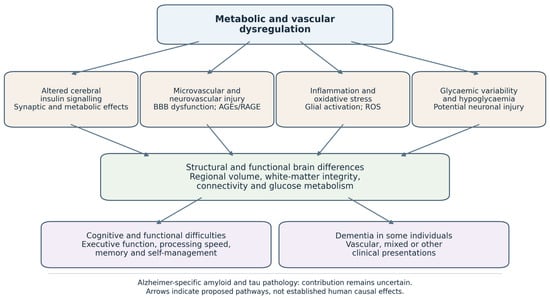
Figure 1 presents the proposed pathways linking type 2 diabetes to brain injury and cognitive outcomes. Metabolic and vascular dysregulation may contribute to the mechanisms shown, but their relationships with structural, cognitive and clinical outcomes remain conceptual rather than established causal pathways.
Figure 1.
Conceptual, non-causal map of proposed pathways linking type 2 diabetes to brain injury and cognitive outcomes. Arrows indicate conceptual or contributory links, not effect estimates or proof of human causality. Individual trajectories vary, and progression to dementia is not inevitable. The relation to Alzheimer-specific amyloid and tau pathology remains uncertain. BBB = blood–brain barrier; AGEs/RAGE = advanced glycation end-products and their receptor; ROS = reactive oxygen species. Based on Arnold et al. [23], Biessels and Despa [7], and Srikanth et al. [2].
Table 4 outlines the major pathophysiological mechanisms linking diabetes to brain injury.
Table 4.
Major Pathophysiological Mechanisms Linking Diabetes to Brain Injury.
As summarised in Table 4 and Figure 1, altered insulin signalling, vascular and neurovascular injury, and inflammatory processes constitute plausible, potentially interacting pathways. Their relative, independent contributions to clinical dementia cannot be assigned from the evidence assembled in this narrative review.
Vascular and neurovascular dysfunction is a biologically plausible contributor to diabetes-associated brain injury. Endothelial dysfunction, basement-membrane changes and pericyte loss have been implicated in cerebral small-vessel disease, with potential consequences for perfusion, blood–brain barrier integrity and clearance processes [26]. Advanced glycation end-products (AGEs) and signalling through their receptor (RAGE) may contribute to oxidative and inflammatory responses [28]. These pathways are compatible with epidemiological associations involving vascular dementia, but mechanistic plausibility and observational associations do not demonstrate that any individual pathway causes the observed excess incidence.
Chronic low-grade inflammation (“meta-inflammation”) and oxidative stress are proposed contributors to diabetes-associated neural and vascular injury. Experimental and associative findings implicate cytokines including IL-1β, IL-6 and TNF-α, reactive oxygen species, and glial responses; however, these observations do not establish that particular inflammatory mediators independently produce clinical dementia in humans [27]. Mitochondrial oxidative processes are mechanistically relevant, but the direction, magnitude and independence of their human cognitive effects remain incompletely characterised [25].
Interactions with classical Alzheimer’s disease pathology remain uncertain. Experimental mechanisms include altered tau phosphorylation and amyloid handling, but the human evidence does not establish that diabetes uniformly increases amyloid or tau burden [7,23]. Associations with cerebral glucose uptake or regional atrophy are not direct measurements of Alzheimer-specific pathology [22,30].
Hypoglycaemia and glycaemic variability are additional concerns. Observational studies associate severe hypoglycaemic episodes with dementia risk, while cognitive impairment can itself compromise self-management and increase the likelihood of hypoglycaemia [1,29]. This bidirectionality limits causal interpretation and reinforces the clinical importance of avoiding treatment-related hypoglycaemia.
3.4. Cognitive Assessment and Clinical Management Evidence
Clinical reviews and guidance identify cognitive assessment, treatment simplification, and individualised metabolic and vascular management as important components of care [2,7]. The following sections distinguish recommendations for safer care from evidence that an intervention prevents dementia.
3.4.1. Cognitive Screening and Functional Evaluation
Cognitive assessment constitutes an increasingly important dimension of diabetes management, particularly in older adults and individuals presenting with difficulties in treatment adherence, glycaemic self-management, or everyday functioning. The cognitive profile associated with diabetes is heterogeneous and may involve impairments in processing speed, executive functioning, attention, working memory, and episodic memory. Consequently, assessment strategies should extend beyond the identification of established dementia and seek to recognise subtler cognitive changes that may interfere with therapeutic decision-making, medication management, and functional independence [2,4,7].
The American Diabetes Association Professional Practice Committee for Diabetes [3] recommends cognitive screening for adults aged 65 years or older at the initial visit, annually, and whenever clinically appropriate. Assessment is also indicated when difficulties emerge in activities that depend on cognitive capacity, such as calculating insulin doses, monitoring glucose, recognising hypoglycaemic symptoms, following treatment instructions, or maintaining appropriate dietary routines. These recommendations highlight the importance of identifying cognitive difficulties before they compromise treatment safety or everyday independence. Nevertheless, screening should be distinguished from diagnosis, since an abnormal screening result requires appropriate clinical interpretation and, when indicated, a more comprehensive diagnostic evaluation.
Several brief cognitive instruments are available for use in diabetes care. The Montreal Cognitive Assessment (MoCA) evaluates multiple domains, including attention, executive functioning, memory, language, visuospatial abilities, and orientation. Its coverage of executive and attentional processes makes it particularly relevant to diabetes-related cognitive dysfunction, where impairments may occur before more obvious global cognitive deterioration. By contrast, the Mini-Mental State Examination (MMSE) provides a widely recognised measure of global cognitive functioning but has more limited coverage of executive functions and may demonstrate ceiling effects in individuals with subtle impairment. The Mini-Cog, which combines three-word recall with clock drawing, offers a shorter alternative when time and clinical resources are constrained, although its brevity limits detailed characterisation of cognitive deficits [31,32,33,34].
Importantly, diagnostic performance cannot be assumed to remain stable across populations or clinical settings. Gupta et al. [35] evaluated MoCA against a neuropsychological reference assessment in 267 participants with T2D aged at least 60 years. At MoCA < 26, sensitivity for mild cognitive impairment was 94.2% but specificity was 29.5% (overall accuracy 54.7%). MoCA < 23 offered a more balanced sensitivity and specificity (69.2% and 71.8%; accuracy 70.8%); however, the highest overall diagnostic accuracy in that study occurred at <21 (74.9%), with specificity of 91.4% and sensitivity of only 49.0%. Thus, a threshold optimising sensitivity–specificity balance is not necessarily the one maximising overall accuracy, and use of the more specific threshold would miss a larger proportion of affected participants. None of these thresholds is a universal recommendation: their applicability depends on the study population, language, education, prevalence, reference standard and clinical consequences of false-positive versus false-negative findings. Screening remains a prompt for further assessment, not a stand-alone diagnosis.
When screening identifies possible impairment, or when clinically relevant cognitive complaints persist despite an apparently normal screening result, domain-specific neuropsychological assessment may be warranted. Executive functioning and cognitive flexibility can be examined using instruments such as the Trail Making Test Part B, while Part A provides information relevant to visual attention and processing speed. The Digit Symbol Substitution Test offers a complementary assessment of processing speed, attention, and psychomotor performance. Verbal fluency tasks can provide information about lexical retrieval and executive processes, whereas word-list learning and delayed-recall measures help characterise episodic memory. A multidomain approach is particularly important because diabetes-related cognitive dysfunction cannot be adequately represented by a single global score. Nevertheless, performance on individual tasks may reflect several interacting cognitive and non-cognitive abilities, and the assessment should be interpreted as a profile rather than a collection of isolated diagnostic indicators [7,32,35].
Cognitive testing should be complemented by an assessment of everyday functioning and diabetes-specific self-management demands. Measures of instrumental activities of daily living, such as the Lawton–Brody Instrumental Activities of Daily Living framework or the Functional Activities Questionnaire, may help determine whether cognitive changes are associated with clinically meaningful difficulties in independent functioning [36,37]. Particular attention should be given to medication organisation, glucose monitoring, insulin administration, dietary planning, appointment management, and recognition of metabolic emergencies. Information obtained from patients, carers, and healthcare professionals may provide complementary perspectives, especially when impaired insight or difficulties recalling everyday errors limit the reliability of self-report.
Several clinical and methodological factors complicate cognitive assessment in people with diabetes. Acute hypoglycaemia, marked hyperglycaemia, and other intercurrent metabolic disturbances may temporarily influence attention, psychomotor performance, and memory, potentially confounding the interpretation of test results. Assessment should therefore be conducted under clinically stable conditions whenever possible, with appropriate consideration of recent glycaemic events, diabetes duration, vascular complications, medication exposure, and relevant laboratory findings. Depression, sleep disturbances, sensory impairment, educational attainment, linguistic background, and cultural factors must also be considered. Visual impairment secondary to diabetic retinopathy, for example, may affect performance on visually demanding tasks without necessarily indicating a corresponding cognitive deficit. Similarly, peripheral neuropathy or motor limitations may influence timed or graphomotor assessments. Interpretation should therefore consider whether a low score reflects cognitive impairment, non-cognitive performance limitations, or a combination of both [2,4].
Assessment must also distinguish cognitive impairment associated with diabetes from other causes of cognitive dysfunction. A low cognitive screening score does not establish Alzheimer’s disease, vascular dementia, or a diabetes-specific dementia syndrome. Diagnostic evaluation should consider symptom onset and progression, functional change, neurological findings, comorbid vascular disease, depression, medication effects, and potentially reversible contributors. Where clinically indicated, specialist assessment may include comprehensive neuropsychological testing, structural neuroimaging, and relevant laboratory investigations. Biomarkers of neurodegeneration may provide additional information in selected diagnostic contexts, although they are not substitutes for clinical and functional assessment.
Longitudinal cognitive monitoring offers additional value, particularly for individuals with established impairment or progressive functional concerns. Repeated assessments can help identify changes in executive functioning, memory, and processing speed, provided that practice effects, measurement error, test version, and changes in clinical condition are considered. Follow-up should employ validated instruments and appropriate normative or longitudinal interpretation frameworks rather than relying exclusively on changes in unadjusted total scores. Importantly, the selection and frequency of assessment must remain proportionate to the patient’s clinical needs and the consequences of the findings for management.
Table 5 summarises the principal cognitive screening, neuropsychological, and functional assessment instruments relevant to diabetes care, including their main interpretative limitations.
Table 5.
Cognitive and Functional Assessment Instruments Relevant to Diabetes Care.
As illustrated in Table 5, the selection of cognitive and functional assessment instruments should be guided by the clinical purpose of the evaluation, the cognitive domains of interest, the patient’s individual characteristics, and the potential consequences of assessment findings for diabetes management.
Ultimately, cognitive assessment in diabetes should be conceived as a multidimensional and clinically actionable process. Brief screening tools are useful for identifying individuals who may benefit from further evaluation, comprehensive neuropsychological testing provides greater diagnostic resolution, and functional assessment determines the practical implications of cognitive difficulties. The integration of these levels of assessment can support safer medication management, individualised glycaemic targets, appropriate caregiver involvement, and timely multidisciplinary referral. Nevertheless, the screening threshold should be chosen in relation to the clinical purpose and its false-positive/false-negative trade-off; additional diabetes-specific validation is needed across ages, diabetes subtypes, and educational and sociocultural contexts.
3.4.2. Prevention and Treatment Evidence
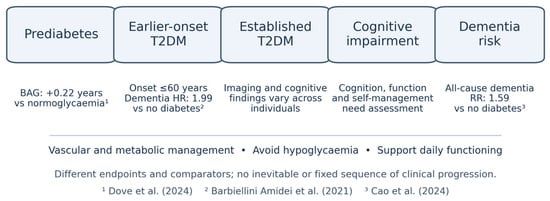
Figure 2 illustrates diabetes and brain health across the life course, emphasising risk assessment and individualised care throughout the life course. It brings together selected opportunities for cognitive and functional assessment, metabolic and vascular risk management, and support for diabetes self-management. The displayed clinical contexts do not imply a fixed sequence or inevitable progression.
Figure 2.
Life-course perspective on diabetes and brain health. Selected findings concern different endpoints and comparator populations: the prediabetes BAG estimate is relative to normoglycaemia [6]; the onset-age HR concerns dementia risk relative to participants without diabetes in the reported analysis [13]; and the dementia RR refers to the pooled association with diabetes, not specifically vascular or mixed dementia [1]. The panels are not a validated prediction model or an inevitable sequence. Risk management is relevant throughout the life course; the optimal timing and cognitive efficacy of multidomain interventions remain research questions.
Table 6 summarises clinical management strategies and distinguishes their established treatment purposes from uncertain cognitive effects.
Table 6.
Clinical Management Strategies and the Limits of Cognitive Outcome Evidence.
Table 6 and Figure 2 support a life-course approach to assessment and risk management while preserving the distinction between clinical rationale and demonstrated cognitive efficacy.
Glycaemic management requires careful individualisation. Although persistent hyperglycaemia is associated with adverse cognitive outcomes, intensive glucose-lowering strategies have not consistently demonstrated clinically meaningful cognitive benefits and may increase the risk of hypoglycaemia in vulnerable patients. Accordingly, glycaemic targets should reflect functional status, cognitive capacity, comorbidities, frailty, treatment burden, and hypoglycaemia risk rather than relying on a uniform HbA1c threshold. In individuals with established cognitive impairment, simplifying complex treatment regimens and involving carers when appropriate may improve treatment safety and feasibility. Continuous glucose monitoring may assist in detecting glycaemic excursions and recurrent hypoglycaemia, although its potential to prevent long-term cognitive decline remains uncertain [3,4,7].
Optimisation of vascular risk factors remains a central component of diabetes management and may contribute to preserving long-term brain health. Individualised blood pressure management, lipid-lowering therapy when indicated, smoking cessation, and appropriate cardiovascular risk reduction are supported by substantial evidence for cardiovascular and cerebrovascular outcomes. Although blood pressure management and statin use have also been associated with a lower incidence of dementia, the magnitude of their effects on specific cognitive outcomes and progression to established dementia remains less certain. Treatment goals should therefore be tailored to individual cardiovascular risk, functional status, comorbidities, frailty, and tolerability [2,3].
Healthy lifestyle behaviours are associated with more favourable brain-ageing measures in observational data [6]. These associations do not establish that a specific diet or exercise dose reverses brain ageing. Combining physical activity, nutritional support, and vascular risk management is clinically reasonable, but superiority over single-domain interventions for diabetes-related cognitive outcomes remains to be demonstrated in adequately powered trials.
Emerging pharmacological strategies require careful interpretation. Metformin has demonstrated potentially protective associations with cognitive outcomes in observational studies, although randomised evidence remains insufficient to establish a disease-modifying effect [38]. GLP-1 receptor agonists and SGLT2 inhibitors have attracted considerable interest because of their metabolic, vascular, and potentially anti-inflammatory effects. However, promising observational and preclinical findings should not be interpreted as evidence of established neuroprotection. Notably, the phase III evoke and evoke+ trials did not demonstrate a statistically significant reduction in clinical progression among participants with early Alzheimer’s disease receiving oral semaglutide compared with placebo [39]. These findings do not directly resolve whether GLP-1 receptor agonists may reduce the incidence of cognitive impairment or dementia in individuals with diabetes, but they emphasise the importance of distinguishing primary prevention from treatment of established neurodegenerative disease. Further adequately powered trials with prespecified cognitive endpoints are required to clarify the potential neurological benefits of glucose-lowering therapies.
In frail older adults with established dementia, treatment deintensification or simplification may be appropriate when treatment burden or hypoglycaemia risk outweighs likely benefit. Decisions should reflect the patient’s circumstances and involve patients, carers, and the multidisciplinary team as appropriate [3].
4. Discussion
4.1. Interpretation and Clinical Translation
The reviewed literature supports associations between diabetes and adverse brain-health outcomes, but a single causal account does not explain all findings. Dementia incidence, cognitive test performance, brain-age estimates and experimental molecular outcomes measure different phenomena; apparent agreement across them should not be mistaken for numerical or causal equivalence. An association with a clinical diagnosis of Alzheimer’s disease does not establish an increase in Alzheimer-specific amyloid or tau pathology [7,23]. The added value of this review lies in integrating those distinct endpoints with clinically consequential choices: when cognitive screening should trigger more detailed assessment, how self-management capacity modifies treatment safety, and why the cognitive claims made for therapeutic or mechanistic evidence must remain specific to their designs and populations.
Residual confounding by vascular disease, obesity, education, and socioeconomic circumstances remains important. Cognitive impairment can also worsen diabetes self-management, complicating the direction of associations with glycaemic control and hypoglycaemia. Prospective designs improve temporal interpretation but cannot eliminate all confounding. Similarly, cross-sectional imaging estimates of accelerated ageing cannot substitute for repeated within-person measurements [2,5].
The apparent contrast between earlier-onset diabetes and some short-duration subgroup findings should be interpreted through the design of each study. A positive estimate within a short-duration subgroup does not demonstrate that shorter duration causes greater risk than longer duration. Comparisons require aligned age, duration, reference groups, ascertainment, and follow-up. Endpoint-specific evidence is also necessary before translating sex differences in dementia incidence into claims about regional neuroanatomy [1,13,15].
Clinical assessment is actionable even when disease-modifying effects remain uncertain. Cognitive and functional findings can guide treatment complexity, carer involvement, and referral. A screening score should initiate an appropriate assessment pathway rather than establish a diabetes-specific dementia diagnosis. Assessment under stable metabolic conditions and interpretation in light of sensory, motor, educational, and linguistic factors are particularly important [4].
The intervention evidence also requires separation of prevention from treatment. Observational associations between glucose-lowering drugs and lower dementia incidence remain susceptible to treatment-selection and other biases. Conversely, the negative evoke and evoke+ results concern treatment of early symptomatic Alzheimer’s disease and do not directly settle prevention in people with diabetes [39]. Safer metabolic care and vascular risk reduction are justified clinical objectives, but the modifiability of diabetes risk factors must not be confused with proof that intensive glycaemic control or any particular intervention prevents dementia. Cognitive benefit must be demonstrated using appropriate outcomes and follow-up.
Across evidence domains, a consistent clinical inference is that cognitive and functional limitations can affect diabetes self-management even when the mechanism of cognitive change is uncertain. The 2026 Standards of Care recommend screening for cognitive impairment at the initial visit and at least annually in adults aged 65 years or older, with further assessment when self-care errors or clinical deterioration raises concern [3]. This is a recommendation for assessment and adaptation of care—not evidence that screening itself prevents dementia. Nurses and other members of the diabetes team can identify missed medication doses, difficulty interpreting glucose data, impaired hypoglycaemia recognition, or discrepancies between an agreed plan and the individual’s practical capacity, and can initiate appropriate multidisciplinary assessment.
Nursing intervention research clarifies both an opportunity and an evidential boundary. A systematic review of 21 randomised trials involving 4649 people with diabetes found that community-based nurse-led support reduced HbA1c compared with usual care (pooled mean difference −0.421, 95% CI −0.59 to −0.25), although intervention content and settings varied [41]. The measured outcome was glycaemic control; the review did not establish an effect on dementia incidence or cognitive decline. A narrative framework for lifestyle medicine case-manager nurses with T2D proposes coordinated lifestyle assessment, self-management education, and continuity of care [42], but a proposed professional role is not itself evidence of improved cognitive outcomes.
Psychosocial and communication mechanisms further complicate translation. In a small study of 91 adults with diabetes and hypertension, diabetes distress, health literacy, education, and patient–provider communication showed associations with reported self-care and counselling pathways [43]. Its cross-sectional and self-reported measures, selected rural setting, and modelling assumptions limit causal or broad population inference. Taken together, these sources support the clinical rationale for assessing distress, literacy, cognitive capacity, and practical self-management barriers while leaving the additive cognitive effect of nurse-led support untested.
For clinical practice, a proportionate pathway begins with recognising new cognitive or functional concerns, checking for reversible metabolic or acute causes, and using an appropriate brief screen as an entry point rather than a diagnosis. The team should then assess medication handling, glucose monitoring, nutrition, hypoglycaemia history, communication needs, and available carer support; simplify regimens or provide structured education where appropriate; arrange comprehensive assessment or referral for positive or clinically concerning findings; and reassess feasibility during follow-up [3,4]. These actions are justified by person-centred diabetes safety and management, without asserting proven prevention of neurodegeneration.
4.2. Future Directions and Research Priorities
The gaps identified here are endpoint-specific rather than merely technological: observational dementia associations have substantial heterogeneity; imaging and mechanistic findings lack definitive mediation evidence; screening thresholds are population-dependent; and interventions that improve HbA1c or self-care rarely establish sustained cognitive benefit. Research priorities must therefore connect a specified evidence gap to a directly measured outcome, a suitable design, and a realistic care setting [1,35,41].
Longitudinal cohorts should combine repeated cognitive and functional assessments with glucose exposure, hypoglycaemia, vascular risk, and, where feasible, imaging and appropriate biomarkers. They should distinguish T1D, T2D, and prediabetes and report age at onset, duration, social context, baseline cognitive status, and attrition. Such work would clarify temporal ordering and the extent to which imaging or biomarker variation predicts functional decline, rather than merely correlating with it [6,9,40].
Table 7 highlights key research priorities for advancing the field of diabetes and brain health.
Table 7.
Research Priorities for Advancing Diabetes and Brain Health.
In conclusion, Table 7 identifies critical areas for future investigation, particularly the need for multimodal longitudinal studies and equitable, precision-medicine approaches.
Intervention studies should distinguish three outcomes: metabolic control (such as HbA1c and hypoglycaemia), self-management safety and participation, and prespecified cognitive or functional change. Randomised studies of nurse-led case management, structured education, and multidisciplinary lifestyle support should compare clearly described intervention components with appropriate usual-care comparators, measure fidelity and engagement, and follow participants long enough for the outcome under study. Evidence that nurse-led care improves HbA1c cannot be relabelled as cognitive prevention [41,42]. Midlife interventions and multimodal assessment remain plausible research directions, but cognitive efficacy must be directly established [6].
Diagnostic research should externally validate brief cognitive measures against comprehensive neuropsychological and functional assessments in different diabetes subtypes, ages, educational and linguistic groups, and care settings. Outcomes should include false-positive and false-negative consequences, referral completion, self-management ability, treatment safety, and patient experience—not merely area under a receiver-operating curve. The distinct sensitivity, specificity, and accuracy trade-offs reported by Gupta et al. [35] illustrate why a diabetes-specific universal MoCA threshold cannot be inferred from one population. Care pathways also require implementation studies assessing nursing workload, health literacy, shared decision-making, carer burden, and the feasibility of repeat assessment [4,32,35,43].
Digital tools, continuous glucose monitoring, and prediction models should be assessed for accessibility, external validity, data burden, equity, and incremental value over careful clinical and nursing assessment. Future trials and implementation studies should document intervention harms, resource use, and acceptability; reports should distinguish process outcomes from dementia incidence and other patient-centred cognitive outcomes.
An immediate practice-research priority is to evaluate a pragmatic nurse-supported cognitive-care pathway in primary or community diabetes services: recognition of cognitive and self-care concerns; appropriate screening and referral; tailored medication and glucose-monitoring support; education adapted to literacy and cognitive capacity; and scheduled review of adherence, hypoglycaemia, and caregiver needs. Such studies should prospectively specify the primary outcome, account for clustering and baseline cognition where relevant, and avoid using improved HbA1c as a surrogate for dementia prevention. The available studies justify examining this pathway but do not yet establish its effect on cognitive decline [3,41,43].
4.3. Limitations of This Review
This is a narrative review rather than a systematic review or meta-analysis: selection was not exhaustive, and unrecognised contrary evidence may have been missed. Google Scholar results were reviewed in platform relevance order, but query-level counts were not retained; the pragmatic combined 100-result cap was not a prespecified statistical sample. Searches and initial selection were conducted by J.M.A.F., with subsequent review by V.G.; independent duplicate screening was not undertaken. The PubMed expression did not include MeSH terms. Three nursing publications were considered in a targeted appraisal after the original search period rather than through a comprehensive search update, introducing an additional limitation relating to source selection. A targeted comparison of three key dementia-risk syntheses identified some repeated primary publications but was not an exhaustive cohort-overlap or citation-overlap analysis. English-language restriction, lack of formal risk-of-bias or certainty grading, and heterogeneity in populations, measures, designs, and confounding limit the review’s completeness and inferential strength. The SANRA framework informed reporting and reasoning, but does not remedy these intrinsic limitations or imply a formal SANRA score [8].
An additional limitation concerns the heterogeneity of cognitive assessment approaches across the reviewed studies. Differences in screening instruments, neuropsychological batteries, diagnostic thresholds, normative references, and functional outcome measures complicate comparisons between populations and may contribute to inconsistent estimates of cognitive impairment. Furthermore, this narrative review did not undertake a formal comparative evaluation of the diagnostic accuracy of individual instruments. Consequently, the discussion of cognitive assessment tools should be interpreted as a clinically oriented synthesis rather than a systematic assessment of their comparative psychometric performance.
Most epidemiological, treatment-exposure, and nursing self-care studies were observational or secondary syntheses and remain vulnerable to confounding, selection, differential measurement, and reverse causation. Different definitions of diabetes, dementia, cognitive impairment, imaging, and intervention outcomes limit comparability. Nurse-led HbA1c effects and proposed case-management models were not accompanied by definitive evidence of dementia prevention; psychosocial associations from small, selected samples are not causal mechanisms. Reviews sharing primary publications are not independent replications. Settings dominated by high-income cohorts or selected services may not generalise to all populations, underscoring the need for contextual and equity-sensitive interpretation [41,42,43].
5. Conclusions
Diabetes is associated with cognitive impairment and incident dementia, while imaging studies identify structural and functional differences, and mechanistic research suggests interacting metabolic, vascular, and inflammatory pathways. These evidence streams are not interchangeable and do not establish a single causal pathway or that treatment of diabetes necessarily prevents dementia. Differences by diabetes subtype, study design, population, and endpoint must remain explicit.
Individualised glycaemic management, avoidance of hypoglycaemia, vascular risk reduction, and appropriate cognitive and functional assessment are justified by established diabetes-care and patient-safety needs. Improvements in HbA1c, education, communication, or treatment feasibility should not be misinterpreted as demonstrated reductions in cognitive decline or dementia incidence.
The review’s clinical contribution is a cautious, actionable integration of evidence: cognitive concerns should prompt appropriate screening and, when indicated, diagnostic and functional evaluation; findings should inform medication complexity, glucose monitoring, self-management education, carer involvement, and multidisciplinary follow-up. Nurses can contribute to recognising difficulties, adapting communication, supporting safer day-to-day care, and coordinating referrals. Community-based nurse-led support has evidence of improved glycaemic outcomes, but its long-term cognitive impact remains uncertain [3,41,43].
Future longitudinal and interventional research should measure cognitive and functional outcomes directly, alongside metabolic outcomes, and evaluate whether integrated, equitable nursing and multidisciplinary pathways improve self-management safety and brain health over time.
Supplementary Materials
The following supporting information can be downloaded at: https://www.mdpi.com/article/10.3390/healthcare14223962/s1, Supplementary Table S1, Selected evidence traceability matrix for diabetes and brain health; Supplementary Table S2, Search strategy and narrative synthesis framework for diabetes and brain health; Supplementary File S1, SANRA—Completed Author Checklist.
Author Contributions
Conceptualization, J.M.A.F.; methodology, J.M.A.F., V.G.; software, J.M.A.F.; validation, J.M.A.F., V.G.; formal analysis, J.M.A.F.; investigation, J.M.A.F.; resources, J.M.A.F.; data curation, J.M.A.F.; writing—original draft preparation, J.M.A.F., V.G.; writing—review and editing, J.M.A.F., V.G., N.S.; visualization, J.M.A.F.; supervision, J.M.A.F., V.G.; project administration, J.M.A.F.; funding acquisition, J.M.A.F. All authors have read and agreed to the published version of the manuscript.
Funding
This research received no external funding.
Institutional Review Board Statement
Not applicable.
Informed Consent Statement
Not applicable.
Data Availability Statement
No new participant-level data were generated or analysed. The sources supporting this narrative synthesis are cited in the article; selected evidence-traceability information and the methodological framework are provided in Supplementary Tables S1 and S2.
Conflicts of Interest
The authors declare no conflicts of interest.
References
- Cao, F.; Yang, F.; Li, J.; Guo, W.; Zhang, C.; Gao, F.; Sun, X.; Zhou, Y.; Zhang, W. The relationship between diabetes and the dementia risk: A meta-analysis. Diabetol. Metab. Syndr. 2024, 16, 101. [Google Scholar] [CrossRef] [Scilit]
- Srikanth, V.; Sinclair, A.J.; Hill-Briggs, F.; Moran, C.; Biessels, G.J. Type 2 diabetes and cognitive dysfunction-towards effective management of both comorbidities. Lancet Diabetes Endocrinol. 2020, 8, 535–545. [Google Scholar] [CrossRef] [Scilit]
- American Diabetes Association Professional Practice Committee for Diabetes. 13. Older adults: Standards of care in diabetes—2026. Diabetes Care 2026, 49, S277–S296. [Google Scholar] [CrossRef] [Scilit]
- Biessels, G.J.; Whitmer, R.A. Cognitive dysfunction in diabetes: How to implement emerging guidelines. Diabetologia 2020, 63, 3–9. [Google Scholar] [CrossRef] [Scilit]
- Antal, B.; McMahon, L.P.; Sultan, S.F.; Lithen, A.; Wexler, D.J.; Dickerson, B.; Ratai, E.M.; Mujica-Parodi, L.R. Type 2 diabetes mellitus accelerates brain aging and cognitive decline: Complementary findings from UK Biobank and meta-analyses. eLife 2022, 11, e73138. [Google Scholar] [CrossRef] [Scilit]
- Dove, A.; Wang, J.; Huang, H.; Dunk, M.M.; Sakakibara, S.; Guitart-Masip, M.; Papenberg, G.; Xu, W. Diabetes, Prediabetes, and Brain Aging: The Role of Healthy Lifestyle. Diabetes Care 2024, 47, 1794–1802. [Google Scholar] [CrossRef] [Scilit]
- Biessels, G.J.; Despa, F. Cognitive decline and dementia in diabetes mellitus: Mechanisms and clinical implications. Nat. Rev. Endocrinol. 2018, 14, 591–604. [Google Scholar] [CrossRef] [Scilit]
- Baethge, C.; Goldbeck-Wood, S.; Mertens, S. SANRA—A scale for the quality assessment of narrative review articles. Res. Integr. Peer Rev. 2019, 4, 5. [Google Scholar] [CrossRef] [Scilit]
- Li, L.; Wong, D.; Fisher, C.A.; Conn, J.J.; Wraight, P.R.; Davies, A.; Barson, E.; Pike, K.E. Increased risk of dementia in Type 1 diabetes: A systematic review with meta-analysis. Diabetes Res. Clin. Pract. 2025, 222, 112043. [Google Scholar] [CrossRef] [Scilit]
- Wu, J.; Li, J.; Qin, X.; Chen, W. Association between diabetes mellitus and risk of Alzheimer’s disease: A meta-analysis and systematic review. Front. Endocrinol. 2026, 17, 1736410. [Google Scholar] [CrossRef] [Scilit]
- Kuo, C.-L.; Lu, C.-L.; Chang, Y.-H.; Li, C.-Y. Population-Based Cohort Study on Dementia Risk in Patients with Type 1 Diabetes Mellitus. Neuroepidemiology 2018, 50, 57–62. [Google Scholar] [CrossRef] [Scilit]
- Huang, C.-C.; Chung, C.-M.; Leu, H.-B.; Lin, L.-Y.; Chiu, C.-C.; Hsu, C.-Y.; Chiang, C.-H.; Huang, P.-H.; Chen, T.-J.; Lin, S.-J.; et al. Diabetes mellitus and the risk of Alzheimer’s disease: A nationwide population-based study. PLoS ONE 2014, 9, e87095. [Google Scholar] [CrossRef] [Scilit]
- Barbiellini Amidei, C.; Fayosse, A.; Dumurgier, J.; Machado-Fragua, M.D.; Tabak, A.G.; van Sloten, T.; Kivimäki, M.; Dugravot, A.; Sabia, S.; Singh-Manoux, A. Association Between Age at Diabetes Onset and Subsequent Risk of Dementia. JAMA 2021, 325, 1640–1649. [Google Scholar] [CrossRef] [Scilit]
- Xie, K.; Perna, L.; Schöttker, B.; Kliegel, M.; Brenner, H.; Mons, U. Type 2 diabetes mellitus and cognitive decline in older adults in Germany—Results from a population-based cohort. BMC Geriatr. 2022, 22, 455. [Google Scholar] [CrossRef] [Scilit]
- Chatterjee, S.; Peters, S.A.; Woodward, M.; Mejia Arango, S.; Batty, G.D.; Beckett, N.; Beiser, A.; Borenstein, A.R.; Crane, P.K.; Haan, M.; et al. Type 2 Diabetes as a Risk Factor for Dementia in Women Compared With Men: A Pooled Analysis of 2.3 Million People Comprising More Than 100,000 Cases of Dementia. Diabetes Care 2016, 39, 300–307. [Google Scholar] [CrossRef] [Scilit]
- Moulton, C.D.; Costafreda, S.G.; Horton, P.; Ismail, K.; Fu, C.H. Meta-analyses of structural regional cerebral effects in type 1 and type 2 diabetes. Brain Imaging Behav. 2015, 9, 651–662. [Google Scholar] [CrossRef] [Scilit]
- Zhang, T.; Shaw, M.; Cherbuin, N. Association between Type 2 Diabetes Mellitus and Brain Atrophy: A Meta-Analysis. Diabetes Metab. J. 2022, 46, 781–802. [Google Scholar] [CrossRef] [Scilit]
- Moran, C.; Phan, T.G.; Chen, J.; Blizzard, L.; Beare, R.; Venn, A.; Münch, G.; Wood, A.G.; Forbes, J.; Greenaway, T.M.; et al. Brain atrophy in type 2 diabetes: Regional distribution and influence on cognition. Diabetes Care 2013, 36, 4036–4042. [Google Scholar] [CrossRef] [Scilit]
- Hsu, J.L.; Chen, Y.L.; Leu, J.G.; Jaw, F.S.; Lee, C.H.; Tsai, Y.F.; Hsu, C.Y.; Bai, C.H.; Leemans, A. Microstructural white matter abnormalities in type 2 diabetes mellitus: A diffusion tensor imaging study. NeuroImage 2012, 59, 1098–1105. [Google Scholar] [CrossRef] [Scilit]
- Chen, Y.C.; Jiao, Y.; Cui, Y.; Shang, S.A.; Ding, J.; Feng, Y.; Song, W.; Ju, S.H.; Teng, G.J. Aberrant brain functional connectivity related to insulin resistance in type 2 diabetes: A resting-state fMRI study. Diabetes Care 2014, 37, 1689–1696. [Google Scholar] [CrossRef] [Scilit]
- Xia, W.; Wang, S.; Sun, Z.; Bai, F.; Zhou, Y.; Yang, Y.; Wang, P.; Huang, Y.; Yuan, Y. Altered baseline brain activity in type 2 diabetes: A resting-state fMRI study. Psychoneuroendocrinology 2013, 38, 2493–2501. [Google Scholar] [CrossRef] [Scilit]
- Willette, A.A.; Bendlin, B.B.; Starks, E.J.; Birdsill, A.C.; Johnson, S.C.; Christian, B.T.; Okonkwo, O.C.; La Rue, A.; Hermann, B.P.; Koscik, R.L.; et al. Association of Insulin Resistance With Cerebral Glucose Uptake in Late Middle-Aged Adults at Risk for Alzheimer Disease. JAMA Neurol. 2015, 72, 1013–1020. [Google Scholar] [CrossRef] [Scilit]
- Arnold, S.E.; Arvanitakis, Z.; Macauley-Rambach, S.L.; Koenig, A.M.; Wang, H.Y.; Ahima, R.S.; Craft, S.; Gandy, S.; Buettner, C.; Stoeckel, L.E.; et al. Brain insulin resistance in type 2 diabetes and Alzheimer disease: Concepts and conundrums. Nat. Rev. Neurol. 2018, 14, 168–181. [Google Scholar] [CrossRef] [Scilit]
- de la Monte, S.M. Type 3 diabetes is sporadic Alzheimer׳s disease: Mini-review. Eur. Neuropsychopharmacol. J. Eur. Coll. Neuropsychopharmacol. 2014, 24, 1954–1960. [Google Scholar] [CrossRef] [Scilit]
- Nguyen, T.T.; Ta, Q.T.H.; Nguyen, T.K.O.; Nguyen, T.T.D.; Giau, V.V. Type 3 Diabetes and Its Role Implications in Alzheimer’s Disease. Int. J. Mol. Sci. 2020, 21, 3165. [Google Scholar] [CrossRef] [Scilit]
- Wardlaw, J.M.; Smith, C.; Dichgans, M. Small vessel disease: Mechanisms and clinical implications. Lancet Neurol. 2019, 18, 684–696. [Google Scholar] [CrossRef] [Scilit]
- Verdile, G.; Keane, K.N.; Cruzat, V.F.; Medic, S.; Sabale, M.; Rowles, J.; Wijesekara, N.; Martins, R.N.; Fraser, P.E.; Newsholme, P. Inflammation and Oxidative Stress: The Molecular Connectivity between Insulin Resistance, Obesity, and Alzheimer’s Disease. Mediat. Inflamm. 2015, 2015, 105828. [Google Scholar] [CrossRef] [Scilit]
- Prasad, K.; Mishra, M. AGE-RAGE Stress, Stressors, and Antistressors in Health and Disease. Int. J. Angiol. 2018, 27, 1–12. [Google Scholar] [CrossRef] [Scilit]
- Whitmer, R.A.; Karter, A.J.; Yaffe, K.; Quesenberry, C.P., Jr.; Selby, J.V. Hypoglycemic episodes and risk of dementia in older patients with type 2 diabetes mellitus. JAMA 2009, 301, 1565–1572. [Google Scholar] [CrossRef] [Scilit]
- Roberts, R.O.; Knopman, D.S.; Przybelski, S.A.; Mielke, M.M.; Kantarci, K.; Preboske, G.M.; Senjem, M.L.; Pankratz, V.S.; Geda, Y.E.; Boeve, B.F.; et al. Association of type 2 diabetes with brain atrophy and cognitive impairment. Neurology 2014, 82, 1132–1141. [Google Scholar] [CrossRef] [Scilit]
- Borson, S.; Scanlan, J.; Brush, M.; Vitaliano, P.; Dokmak, A. The Mini-Cog: A cognitive ‘vital signs’ measure for dementia screening in multi-lingual elderly. Int. J. Geriatr. Psychiatry 2000, 15, 1021–1027. [Google Scholar] [CrossRef] [Scilit]
- Dong, Y.; Kua, Z.J.; Khoo, E.Y.H.; Koo, E.H.; Merchant, R.A. The utility of brief cognitive tests for patients with type 2 diabetes mellitus: A systematic review. J. Am. Med. Dir. Assoc. 2016, 17, 889–895. [Google Scholar] [CrossRef] [Scilit]
- Folstein, M.F.; Folstein, S.E.; McHugh, P.R. “Mini-mental state”: A practical method for grading the cognitive state of patients for the clinician. J. Psychiatr. Res. 1975, 12, 189–198. [Google Scholar] [CrossRef] [Scilit]
- Nasreddine, Z.S.; Phillips, N.A.; Bédirian, V.; Charbonneau, S.; Whitehead, V.; Collin, I.; Cummings, J.L.; Chertkow, H. The Montreal Cognitive Assessment, MoCA: A brief screening tool for mild cognitive impairment. J. Am. Geriatr. Soc. 2005, 53, 695–699. [Google Scholar] [CrossRef] [Scilit]
- Gupta, A.; Goyal, A.; Rajan, R.; Vishnu, V.Y.; Kalaivani, M.; Tandon, N.; Srivastava, M.V.P.; Gupta, Y. Validity of Montreal Cognitive Assessment to detect cognitive impairment in individuals with type 2 diabetes. Diabetes Ther. 2024, 15, 1155–1168. [Google Scholar] [CrossRef] [Scilit]
- Lawton, M.P.; Brody, E.M. Assessment of older people: Self-maintaining and instrumental activities of daily living. Gerontologist 1969, 9, 179–186. [Google Scholar] [CrossRef] [Scilit]
- Pfeffer, R.I.; Kurosaki, T.T.; Harrah, C.H., Jr.; Chance, J.M.; Filos, S. Measurement of functional activities in older adults in the community. J. Gerontol. 1982, 37, 323–329. [Google Scholar] [CrossRef] [Scilit]
- Zhang, J.H.; Zhang, X.Y.; Sun, Y.Q.; Lv, R.H.; Chen, M.; Li, M. Metformin use is associated with a reduced risk of cognitive impairment in adults with diabetes mellitus: A systematic review and meta-analysis. Front. Neurosci. 2022, 16, 984559. [Google Scholar] [CrossRef] [Scilit]
- Cummings, J.L.; Atri, A.; Sano, M.; Zetterberg, H.; Scheltens, P.; Knop, F.K.; Johannsen, P.; Wichmann, C.A.; Mortensen Abschneider, R.; Leon, T.; et al. Efficacy and safety of oral semaglutide 14 mg (flexible dose) in early-stage symptomatic Alzheimer’s disease (evoke and evoke+): Two phase 3, randomised, placebo-controlled trials. Lancet 2026, 407, 2167–2179. [Google Scholar] [CrossRef] [Scilit]
- Kan, W.; Qu, M.; Wang, Y.; Zhang, X.; Xu, L. A review of type 2 diabetes mellitus and cognitive impairment. Front. Endocrinol. 2025, 16, 1624472. [Google Scholar] [CrossRef] [Scilit]
- Li, J.; Yang, F.; Wang, J.; Tao, Y. Effect of community-based nurse-led support intervention in the reduction of HbA1c levels. Public Health Nurs. 2022, 39, 1318–1333. [Google Scholar] [CrossRef] [Scilit]
- Cangelosi, G.; Mancin, S.; Pantanetti, P.; Nguyen, C.T.T.; Morales Palomares, S.; Biondini, F.; Sguanci, M.; Petrelli, F. Lifestyle Medicine Case Manager Nurses for Type Two Diabetes Patients: An Overview of a Job Description Framework—A Narrative Review. Diabetology 2024, 5, 375–388. [Google Scholar] [CrossRef] [Scilit]
- Misra, R.; Adelman, M.M.; Kirk, B.; Sambamoorthi, U. Relationship Among Diabetes Distress, Health Literacy, Diabetes Education, Patient-Provider Communication and Diabetes Self-Care. Am. J. Health Behav. 2022, 46, 528–540. [Google Scholar] [CrossRef] [Scilit]

Disclaimer/Publisher’s Note: The statements, opinions and data contained in all publications are solely those of the individual author(s) and contributor(s) and not of MDPI and/or the editor(s). MDPI and/or the editor(s) disclaim responsibility for any injury to people or property resulting from any ideas, methods, instructions or products referred to in the content. |
© 2026 by the authors. Licensee MDPI, Basel, Switzerland. This article is an open access article distributed under the terms and conditions of the Creative Commons Attribution (CC BY) license.