


Highlights
What are the main findings?
- •
- This study jointly examines healthy lifestyle behaviors (HLBS-II) and happiness in a bi-national sample of Turkish adults living in 26 countries abroad and in Türkiye.
- •
- No significant unadjusted difference in happiness was found between residence groups, but happiness was higher in Türkiye after sociodemographic adjustment, and formal moderated regression tests found no strong evidence that its lifestyle correlates differ between the diaspora and domestic samples.
What are the implications of the main findings?
- •
- Spiritual development and interpersonal relations were the most consistent correlates of happiness, while construct overlap and common-method variance are addressed transparently.
- •
- Migrant health and settlement services may benefit from components that strengthen social connectedness, stress management, and meaning-making alongside economic integration support.
Abstract
Background/Objectives: Evidence on how healthy lifestyle behaviors relate to happiness among migrants versus non-migrant compatriots is limited. This study examined these associations among Turkish adults living abroad and in Türkiye and tested whether they differ by place of residence. Methods: In this cross-sectional online survey, 612 Turkish adults aged 18–65 years living in 26 countries abroad (n = 501) or in Türkiye (n = 111) completed the Healthy Lifestyle Behavior Scale II (HLBS-II) and the Happiness Scale. Within-group regression and moderated regression across groups were used. Results: Participants abroad reported higher economic status but lower HLBS-II scores (p = 0.002). No significant unadjusted difference in happiness was found (p = 0.349), but happiness was higher in Türkiye after sociodemographic adjustment (B = 1.45; 95% CI 0.35 to 2.56), a difference no longer present after accounting for HLBS-II scores. In both groups, spiritual development and interpersonal relations were the strongest correlates of happiness. Interaction terms did not improve model fit (p = 0.690 and p = 0.270). Conclusions: Happiness was most strongly associated with the psychosocial dimensions of a healthy lifestyle, and better economic status abroad was not accompanied by greater happiness. Community-based health promotion that strengthens social connectedness, stress management, and meaning-making may benefit both populations.
1. Introduction
People aspire to lead happy and functional lives. Interest in positive psychological outcomes such as happiness, well-being, and life satisfaction has grown steadily since the 1980s [1] and intensified after 2020, as the COVID-19 pandemic heightened attention to mental health and well-being [2,3]. Global migration has simultaneously drawn attention to the well-being of individuals adapting to new cultural environments. Outward migration from Türkiye has accelerated sharply: 714,579 people emigrated from Türkiye in 2023, 53% more than in the previous year, and the number of emigrating Turkish citizens rose from 139,531 in 2022 to 291,377 in 2023 [4,5]. More than 7.5 million Turkish citizens now live abroad, with approximately 6.5 million of them in Western Europe [6]. These trends underline the public health importance of understanding the factors associated with well-being in diaspora communities.
Healthy lifestyle behaviors, namely health responsibility, physical activity, nutrition, spiritual development, interpersonal relations, and stress management, are established correlates of happiness and psychological well-being [7,8,9]. Individuals who adopt these behaviors report coping more effectively with stress and higher overall life satisfaction [10,11]. Such behaviors may be particularly consequential for people living abroad, where the stress and loneliness associated with cultural adaptation can undermine happiness [12], and where healthy habits and social ties may help offset these effects [13,14]. The pandemic has further reshaped lifestyle habits and highlighted the need for adaptive well-being strategies [15].
For migrant populations, health-related behaviors intersect with the acculturation process in ways that are not yet fully understood. Migrants must often rebuild social networks, adapt to unfamiliar health care systems, and manage the psychological demands of resettlement, all of which can shape whether protective health behaviors are sustained or eroded after migration [12,14]. Understanding whether the behavioral correlates of happiness observed in migrant populations mirror those of non-migrant compatriots is therefore directly relevant to migrant health research and to the planning of community health services, yet comparative bi-national evidence of this kind remains scarce. Few studies have jointly examined healthy lifestyle behaviors, assessed with the Healthy Lifestyle Behavior Scale II (HLBS-II), and happiness in Turkish samples spanning both diaspora and domestic populations, and we are not aware of a study that has formally tested whether these associations differ by place of residence.
Conceptual Framework
In this study, happiness refers to the specific construct assessed by the Happiness Scale, namely a global sense of being happy and cheerful in daily life. Happiness is closely related to, but narrower than, subjective well-being, which comprises life satisfaction and the relative predominance of positive over negative affect [16,17,18,19]; because life satisfaction and affect were not measured separately, the term happiness is used throughout and is not treated as interchangeable with subjective well-being. Seligman’s positive psychology framework proposes that happiness is cultivated through positive emotion, engagement, positive relationships, meaning, and accomplishment (PERMA) [20]. This framework was used heuristically rather than tested: its relationships and meaning components informed the expectation that the interpersonal relations and spiritual development dimensions of the HLBS-II would be most closely associated with happiness, whereas engagement and accomplishment were not assessed. Resilience has also emerged as an important correlate of happiness during global crises [21]. Healthy lifestyle behaviors are conceptualized according to Pender’s Health Promotion Model, which underpins much of community and public health nursing practice [8]. Several HLBS-II subdimensions, particularly spiritual development and interpersonal relations, overlap conceptually with happiness and related well-being constructs; this overlap is treated explicitly as an interpretive caveat rather than as evidence of novel causal determinants.
Contemporary public health frameworks additionally emphasize that population well-being depends not only on economic and material security but also on social cohesion and psychosocial resources [22,23], motivating an examination of behavioral, rather than purely structural, correlates of happiness. Applied to a migration context, this framework suggests that the well-being of both diaspora and domestic populations may be shaped less by geographic or economic circumstances per se and more by the extent to which individuals sustain psychosocial resources such as spiritual engagement, supportive relationships, and adaptive stress management, regardless of where they live.
The aims of this study were (1) to compare sociodemographic characteristics, healthy lifestyle behaviors, and happiness between Turkish adults living abroad and those living in Türkiye; (2) to identify sociodemographic and lifestyle correlates of happiness within each group; and (3) to test formally whether these associations differ by residence group. We expected healthy lifestyle behaviors, particularly their psychosocial dimensions, to be positively associated with happiness in both groups.
2. Materials and Methods
2.1. Study Design and Setting
This cross-sectional study used an anonymous, self-administered online questionnaire created in Google Forms (Google LLC, Mountain View, CA, USA) [24] and is reported in accordance with the Strengthening the Reporting of Observational Studies in Epidemiology (STROBE) guidelines (Table S1) [25]. Data were collected between 15 June and 15 November 2024. Participants were recruited through non-probability (purposive and network-based) sampling. For the diaspora sample, the survey link was shared in closed Facebook, Telegram, WhatsApp, and Instagram groups for Turkish citizens living in specific countries (e.g., groups for Turks living in Germany); group administrators and individual members were contacted one by one and informed about the study before the link was shared. Turkish embassies and consulates (through their e-mail networks), diaspora associations, and personal referrals also distributed the link. A domestic reference sample was recruited through the same types of channels within Türkiye (social media groups, associations, and personal referrals). Although the intention was to obtain a domestic sample broadly similar in sociodemographic structure to the diaspora sample, no quotas or matching procedures were applied. Religious organizations did not distribute the link, and members were reminded not to complete the questionnaire again when the link was re-shared; in addition, the form was set to accept only one response per Google account. Because the survey was self-administered online and anonymous, it could not be verified that each questionnaire was completed independently. Because the number of people who received the invitation is unknown, a conventional response rate could not be calculated, and differences by recruitment channel were not examined. The comparability of the two groups was assessed empirically by comparing their sociodemographic characteristics (Section 3.1), and the association between residence group and happiness was additionally examined after adjustment for these characteristics (Section 2.4).
2.2. Participants
Eligible participants were Turkish citizens aged 18–65 years who reported no psychological illness or psychiatric medication use. Turkish citizens born abroad were also eligible. The diaspora sample comprised individuals who had lived outside Türkiye for at least 12 months; the domestic reference sample comprised individuals who had resided in Türkiye for at least one year. Of the 557 questionnaires submitted by respondents living abroad, 56 were excluded: 5 respondents were not Turkish citizens, 41 had lived abroad for less than 12 months, and 10 reported psychological illness or psychiatric medication use or had incomplete questionnaires. All 111 questionnaires submitted by respondents in Türkiye met the eligibility criteria and were complete, so none were excluded. The final sample comprised 501 adults living abroad and 111 adults residing in Türkiye (n = 612). Participants abroad lived in 26 countries, 21 of them in Europe, and 434 (86.6%) resided in European countries (Table 1). Both samples were recruited through non-probability channels and were unequal in size; the implications for statistical power and generalizability are addressed in Section 4.4.
Table 1.
Distribution of participants living abroad by country of residence and duration of stay (n = 501).
The adequacy of the sample size for the primary analyses was evaluated with G*Power 3.1(Heinrich-Heine-Universität Düsseldorf, Düsseldorf, Germany) [26] for multiple linear regression (fixed model, R2 deviation from zero). The calculation was based on the most complex within-group model, the subscale model with eight predictors (six HLBS-II subscales, age, and sex); with a medium effect size (f2 = 0.15) [27], α = 0.05, and a power of 0.80, a minimum of 109 participants per group was required, and both the diaspora sample (n = 501) and the domestic sample (n = 111) met this requirement. The calculation was not designed to provide power for the interaction analyses. A sensitivity analysis showed that, with n = 612, the sets of interaction terms could be detected with 80% power only if they explained an additional f2 ≥ 0.024 (seven terms) or 0.025 (eight terms); smaller differences in associations between the groups may therefore have gone undetected.
2.3. Measures
Sociodemographic variables (age, sex, educational level, marital status, perceived economic status, and religious practice) were self-reported on a form developed by the researchers. Participants living abroad also reported their country of residence and length of stay abroad. Perceived economic status was measured with one item, “Considering the cost of living, your purchasing power and your monthly household income in the country where you live, how would you rate your economic situation relative to the general living standards of that country?”, scored from 1 (very bad) to 5 (very good). Religious practice was measured with one item: “According to your belief, how frequently do you engage in any act of worship or religious practice?”, answered on a five-point scale from 1 (never) to 5 (always); for the analyses, it was dichotomized as no religious practice (never) versus any religious practice (rarely to always). Both items are general self-ratings administered in Turkish. For the regression analyses, sex was coded as 0 = male and 1 = female; educational level as an ordinal variable (1 = primary school, 2 = high school, 3 = undergraduate, 4 = postgraduate); marital status as 0 = single and 1 = married; religious practice as 0 = never and 1 = rarely to always; perceived economic status as an ordinal score from 1 to 5; and length of stay abroad in years.
Healthy lifestyle behaviors were assessed with the 52-item HLBS-II, which was developed from the Health-Promoting Lifestyle Profile [7,28] and adapted to Turkish by Bahar et al. [29]. Items are rated on a 4-point Likert scale from “never” to “regularly” and form six subscales: health responsibility, physical activity, nutrition, spiritual development, interpersonal relations, and stress management. Total scores range from 52 to 208, with higher scores indicating more health-promoting lifestyle behaviors. Cronbach’s α was 0.92 in the Turkish validation study [29] and 0.94 in both the sample abroad and the sample in Türkiye in the present study.
Happiness was assessed with the Happiness Scale (HS), a six-item, unidimensional instrument developed in Turkish by Demirci and Ekşi [30] (e.g., “I am usually cheerful in my daily life”). Items are rated on a 5-point Likert scale ranging from 1 (“not at all true of me”) to 5 (“completely true of me”); there are no reverse-scored items, total scores range from 6 to 30, and higher scores indicate greater happiness. In the development study, exploratory factor analysis yielded a single factor explaining 54.1% of the variance, confirmatory factor analyses in two independent samples supported the unidimensional structure (CFI = 0.99; RMSEA = 0.061–0.069), Cronbach’s α was 0.83, and three-week test–retest reliability was 0.73; scores also correlated positively with overall well-being as measured by the PERMA Profiler (r = 0.70) [30]. In the present sample, Cronbach’s α was 0.92 (abroad) and 0.93 (Türkiye).
2.4. Statistical Analysis
Initial analyses were conducted with Statistica 13.3 (TIBCO Software Inc., Palo Alto, CA, USA); after verification of the dataset during revision, all analyses were re-run in Python 3.13 (Python Software Foundation, Wilmington, DE, USA; statsmodels 0.15 and SciPy 1.18), and the re-estimated results are reported. Descriptive statistics (frequencies, percentages, means, and standard deviations) summarized the data, and Welch’s t-tests, which do not assume equal variances, compared the two residence groups, and Cohen’s d with 95% CIs was used to express effect sizes. Because the groups were not matched, differences in HLBS-II scores were additionally estimated with regression models (analysis of covariance) adjusted for age, sex, educational level, marital status, perceived economic status, and religious practice. To examine the relative contribution of correlated subscales and the overlap of spiritual development and interpersonal relations with happiness, relative weight analysis was performed for the subscale models, and a sensitivity model including only the behavioral subscales (health responsibility, physical activity, nutrition, and stress management), age, and sex was estimated. Multiple linear regression models with the HS score as the outcome were estimated separately for each residence group using (a) sociodemographic covariates plus the HLBS-II total score (with length of stay abroad included for the diaspora sample) and (b) age, sex, and the six HLBS-II subscales. Unstandardized (B) and standardized (β) coefficients are reported. The subscale models were adjusted a priori for age and sex only, so that the number of predictors (eight) matched the a priori power analysis and remained proportionate to the smaller domestic sample (n = 111). To examine whether the subscale associations were robust to fuller adjustment, sensitivity analyses re-estimated the subscale models with the same sociodemographic covariates as the total-score models (educational level, marital status, perceived economic status, religious practice, and, for the diaspora sample, length of stay abroad). Bivariate Pearson correlations among the HLBS-II subscales and the HS score were computed, and multicollinearity was assessed with variance inflation factors (VIFs) and tolerance values, with VIF > 5 regarded as indicating problematic collinearity. Full regression results, including all coefficients with 95% confidence intervals (CIs) and p-values for significant and non-significant predictors, are provided in Supplementary Tables S2–S6.
To test formally whether predictor effects differed by residence group, rather than relying on a narrative comparison of coefficients from separately estimated models, moderated regression models including residence group (abroad = 0; Türkiye = 1) and group × predictor interaction terms were estimated on the combined sample. The contribution of each set of interaction terms was evaluated with an F-test comparing the interaction model with the corresponding main-effects model. The association between residence group and happiness was additionally estimated in a model adjusted for age, sex, educational level, marital status, perceived economic status, and religious practice, and individual group × predictor interaction coefficients are reported with 95% CIs. Sensitivity power analyses (minimum detectable effects) were performed for the between-group comparisons and interaction tests; post hoc (achieved) power was not used to interpret non-significant results. In each moderated model, all predictors and all of their group × predictor interactions were entered simultaneously (the total-score model and the subscale model, the latter including all six HLBS-II subscales). Continuous predictors were not centered; centering does not change the interaction coefficients or the tests of the interaction terms, only the interpretation of the lower-order terms. Regression assumptions were examined for every model: normality of residuals (skewness, kurtosis, and Q–Q plots), homoscedasticity (Breusch–Pagan test), linearity (RESET test and quadratic terms), multicollinearity (VIF), and influential observations (Cook’s distance > 4/n). Because heteroscedasticity was present, all models were re-estimated with heteroscedasticity-consistent (HC3) robust standard errors, which also address the unequal group sizes, and with influential observations excluded. Measurement invariance of the HS and the HLBS-II across residence groups was examined with multigroup confirmatory factor analysis (maximum likelihood) by comparing configural, metric (equal loadings), and scalar (equal loadings and intercepts) models; a decrease in CFI of no more than 0.010 was taken as support for the more constrained model. Because the domestic sample was too small for an item-level model of the 52-item HLBS-II, its six subscale scores were used as indicators of a single factor. Regression analyses were based on complete cases (listwise deletion). There were no missing data on any study variable; accordingly, all within-group models were based on n = 501 (abroad) and n = 111 (Türkiye), and all pooled models on n = 612. To examine whether lifestyle differences accounted for any adjusted group difference in happiness, the adjusted group model was re-estimated with the HLBS-II total score added. The number of participants included in each model is reported in the figure legends and supplementary tables. For the six between-group comparisons of HLBS-II subscales and the eight subscale interaction terms, Bonferroni-adjusted thresholds (α = 0.05/6 = 0.0083 and α = 0.05/8 = 0.0063, respectively) were additionally considered. Statistical significance was set at p < 0.05 (two-tailed).
3. Results
3.1. Sample Characteristics and Group Comparisons
Participants living abroad were significantly younger than those living in Türkiye (mean 38.40 vs. 41.68 years; p = 0.005) and reported higher perceived economic status (p < 0.001), whereas no significant unadjusted difference in happiness was found between residence groups (p = 0.349) (Table 2). Within the diaspora sample, women had a shorter length of stay abroad than men (mean 6.13 vs. 9.75 years; p < 0.001). Most participants living abroad were highly educated: 53.1% of women held an undergraduate and 36.8% a postgraduate degree, compared with 54.1% and 18.8% of men, respectively (Table 3). Among participants abroad, 68.9% of women were married, whereas most men were single (51.4%); among participants in Türkiye, most respondents of both sexes were married (women 61.2%; men 58.1%). Religious practice was more common among participants in Türkiye (women 63.3%; men 80.6%) than among those abroad (women 53.1%; men 47.6%).
Table 2.
Comparison of sociodemographic characteristics, healthy lifestyle behaviors, and happiness between participants living abroad and in Türkiye.
Table 3.
Sociodemographic characteristics by sex and place of residence.
Participants in Türkiye scored higher on the HLBS-II total score (p = 0.002) and on four of the six subscales, namely health responsibility, spiritual development, interpersonal relations, and stress management, whereas physical activity and nutrition did not differ between groups (Table 2). Thus, participants living abroad did not report more health-promoting lifestyle practices than those living in Türkiye. After Bonferroni correction for the six subscale comparisons (α = 0.0083), the differences in health responsibility, interpersonal relations, and stress management remained significant, whereas the difference in spiritual development (p = 0.023) did not. Because the groups differed in sociodemographic characteristics, the HLBS-II comparisons were repeated with adjustment for age, sex, educational level, marital status, perceived economic status, and religious practice: participants in Türkiye scored higher on the HLBS-II total score (adjusted difference = 12.49; 95% CI 7.67 to 17.31; p < 0.001) and on all six subscales (p ≤ 0.015), and all subscale differences except nutrition remained significant after Bonferroni correction (Supplementary Table S9). In the pooled sample (n = 612), residence group was unrelated to happiness in the unadjusted model (B = 0.478; 95% CI −0.636 to 1.593; p = 0.400). After adjustment for age, sex, educational level, marital status, perceived economic status, and religious practice, however, participants in Türkiye reported higher happiness than those abroad (B = 1.452; 95% CI 0.350 to 2.555; p = 0.010), suggesting that the higher economic status of participants abroad, which was itself positively associated with happiness (B = 2.155; p < 0.001), had masked this difference. When the HLBS-II total score was added, the group difference was no longer present (B = −0.147; 95% CI −1.081 to 0.786; p = 0.757) (Supplementary Table S6).
3.2. Correlates of Happiness Among Participants Living Abroad
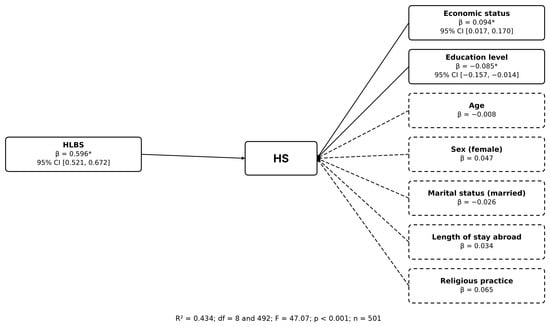
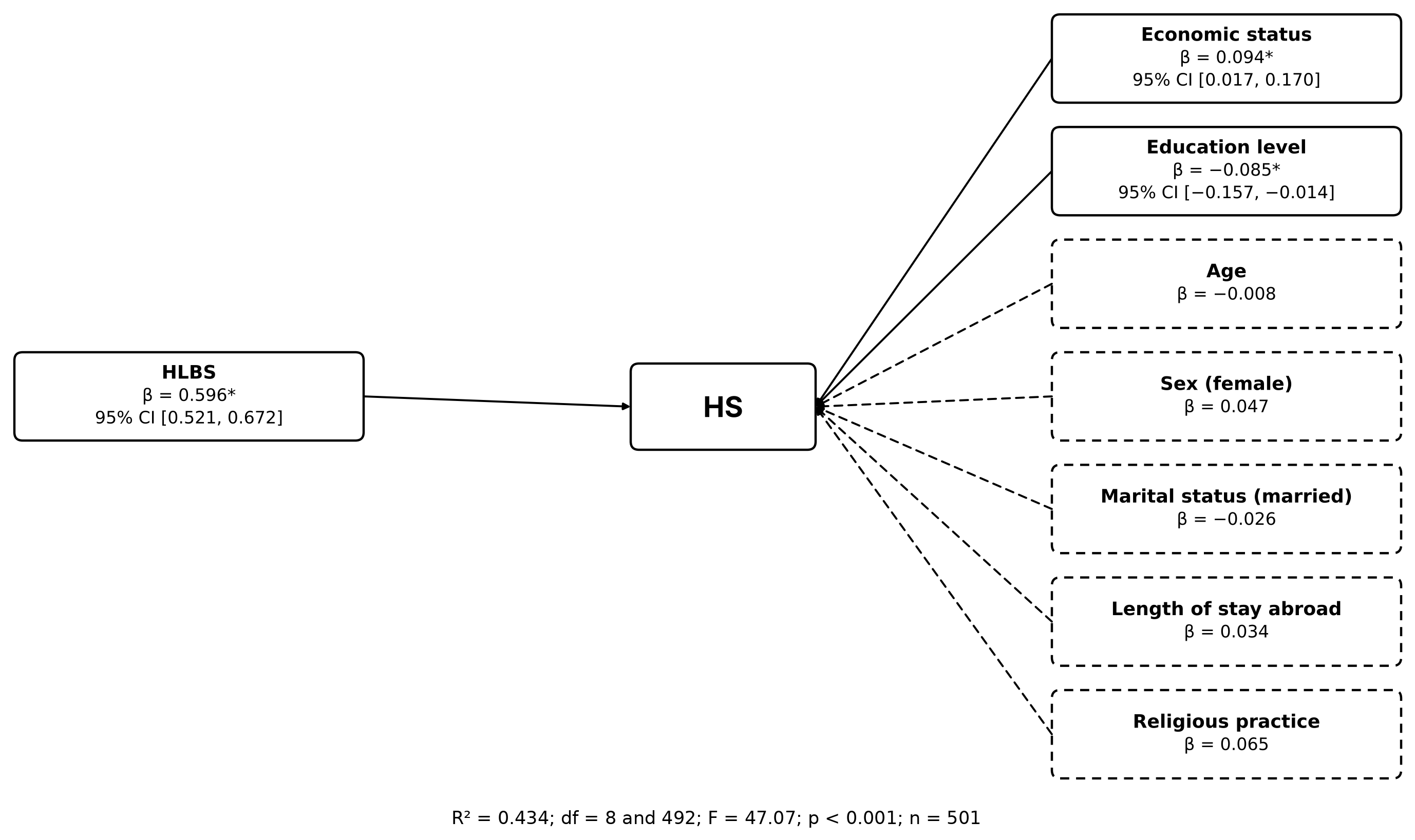
The model including sociodemographic covariates and the HLBS-II total score explained 43% of the variance in HS scores (R2 = 0.434; F(8, 492) = 47.07; p < 0.001) (Figure 1). Three predictors were significant: the HLBS-II total score (B = 0.134; β = 0.596; 95% CI 0.117 to 0.151; p < 0.001), economic status (B = 0.619; β = 0.094; 95% CI 0.115 to 1.123; p = 0.016), and educational level (B = −0.627; β = −0.085; 95% CI −1.152 to −0.102; p = 0.019), with lower educational levels associated with higher happiness. All coefficients are reported in Supplementary Table S4.
Figure 1.
Multiple regression model of sociodemographic covariates and the HLBS-II total score as correlates of happiness (HS) among participants living abroad (n = 501). Solid lines indicate significant and dashed lines non-significant associations; * p < 0.05. HLBS, Healthy Lifestyle Behavior Scale II; HS, Happiness Scale; CI, confidence interval.
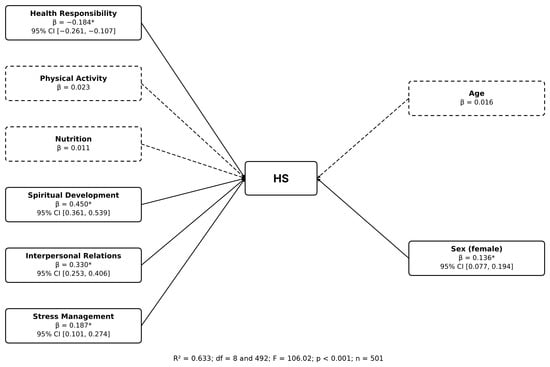
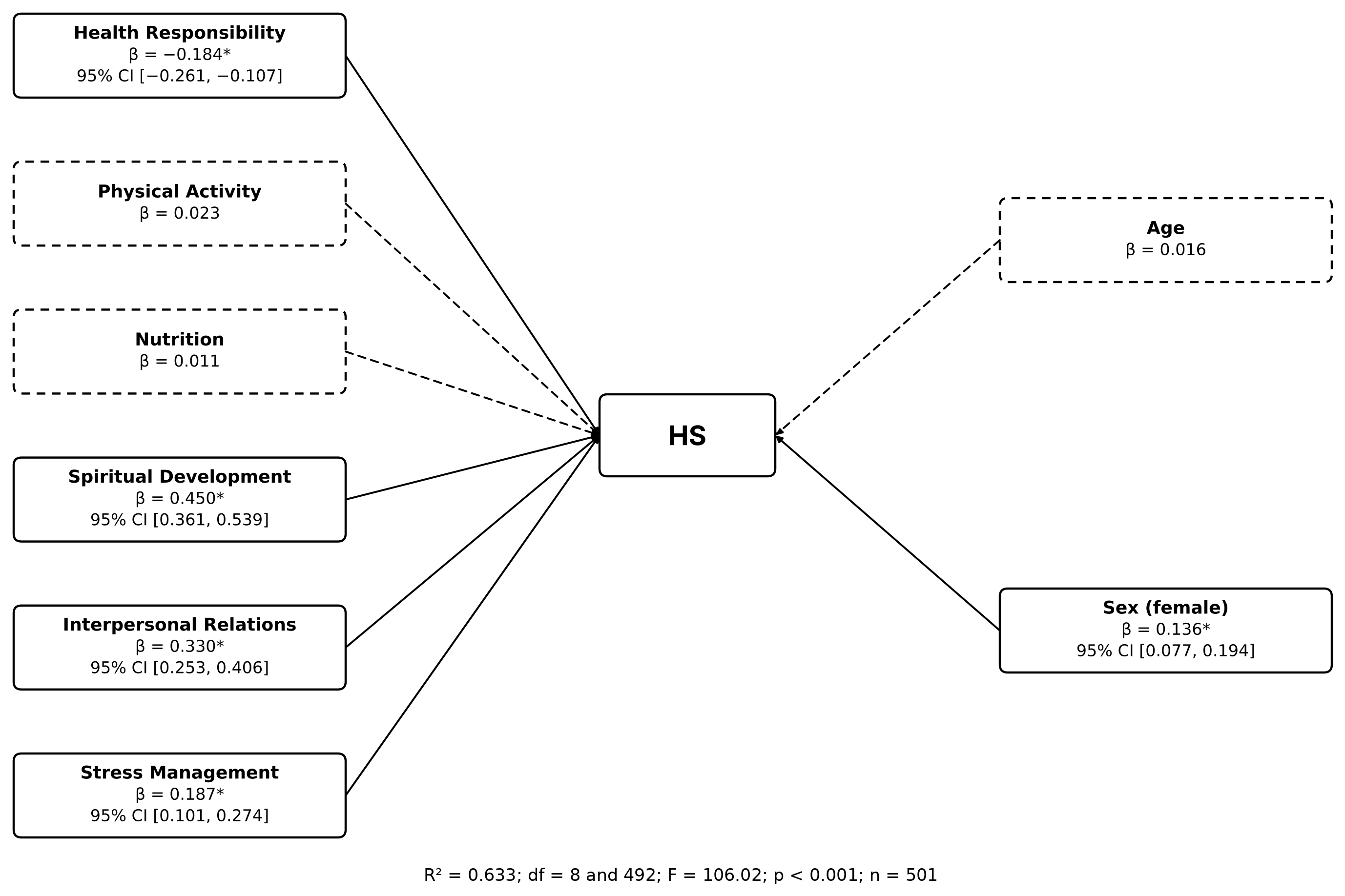
The subscale model, adjusted for age and sex, explained 63% of the variance (R2 = 0.633; F(8, 492) = 106.02; p < 0.001) (Figure 2). Spiritual development (B = 0.446; β = 0.450; 95% CI 0.359 to 0.534; p < 0.001), interpersonal relations (B = 0.383; β = 0.330; 95% CI 0.294 to 0.472; p < 0.001), and stress management (B = 0.217; β = 0.187; 95% CI 0.117 to 0.317; p < 0.001) were positively associated with happiness, health responsibility was negatively associated (B = −0.174; β = −0.184; 95% CI −0.247 to −0.101; p < 0.001), and female sex was a positive correlate (B = 1.525; β = 0.136; 95% CI 0.871 to 2.179; p < 0.001). This high explanatory power likely reflects, in part, the conceptual overlap between some HLBS-II subscales and subjective well-being constructs, as well as shared-method variance (Section 4.4). All VIFs were below 3 (range 1.06–2.72; Supplementary Table S3), indicating no problematic multicollinearity. Health responsibility was positively correlated with happiness at the bivariate level (r = 0.30; Supplementary Table S2) but showed a negative coefficient in the multivariable model, a pattern consistent with a suppression effect arising from its shared variance with the other subscales, particularly nutrition (r = 0.59) and stress management (r = 0.57); this coefficient should therefore be interpreted as a conditional association rather than as evidence that health responsibility is, in itself, inversely related to happiness. In relative weight analysis, spiritual development (37.6% of the explained variance), interpersonal relations (30.4%), and stress management (18.0%) accounted for most of the explained variance, whereas health responsibility accounted for 2.8%. In a sensitivity model including only the behavioral subscales, R2 decreased to 0.365; stress management (B = 0.669; p < 0.001) and nutrition (B = 0.117; p = 0.036) were positively associated with happiness, and health responsibility remained negatively associated (B = −0.137; p = 0.005) (Supplementary Table S10). In the sensitivity analysis adjusted for the full covariate set, the pattern of significant subscale associations was unchanged, and economic status was additionally associated with happiness (B = 0.561; 95% CI 0.152 to 0.969; p = 0.007) (Supplementary Table S5).
Figure 2.
Multiple regression model of the six HLBS-II subscales as correlates of happiness (HS) among participants living abroad, adjusted for age and sex. Solid lines indicate significant and dashed lines non-significant associations; * p < 0.05. Abbreviations as in Figure 1.
3.3. Correlates of Happiness Among Participants Living in Türkiye
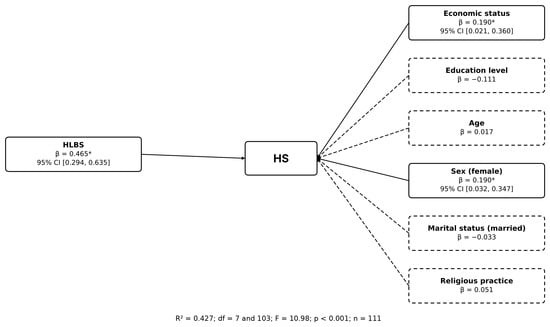
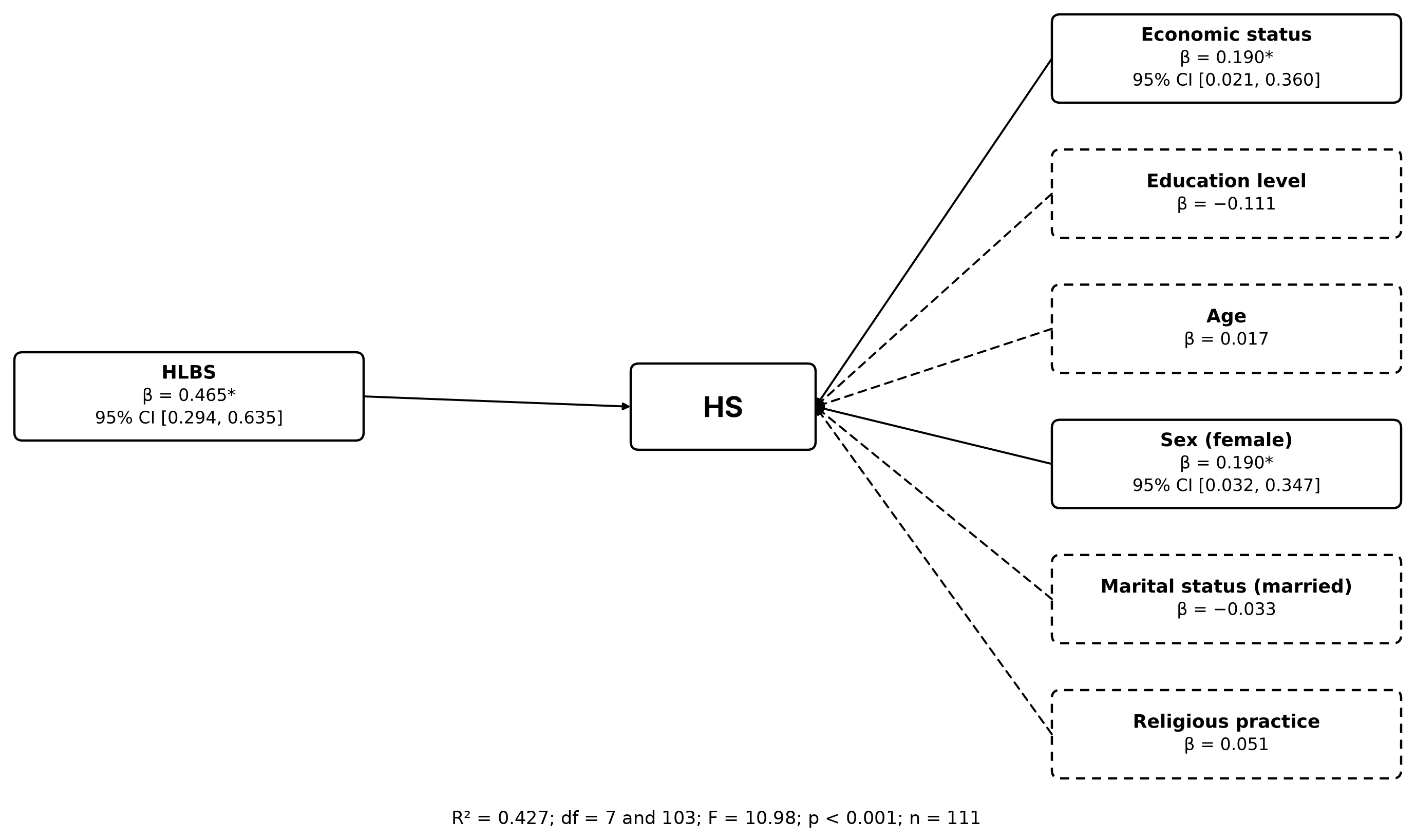
The corresponding model (without length of stay abroad) explained 43% of the variance in happiness (R2 = 0.427; F(7, 103) = 10.98; p < 0.001) (Figure 3). The HLBS-II total score (B = 0.097; β = 0.465; 95% CI 0.061 to 0.132; p < 0.001), economic status (B = 0.966; β = 0.190; 95% CI 0.105 to 1.826; p = 0.028), and female sex (B = 1.782; β = 0.190; 95% CI 0.305 to 3.260; p = 0.019) were significant.
Figure 3.
Multiple regression model of sociodemographic covariates and the HLBS-II total score as correlates of happiness (HS) among participants living in Türkiye (n = 111). Solid lines indicate significant and dashed lines non-significant associations; * p < 0.05. Abbreviations as in Figure 1.
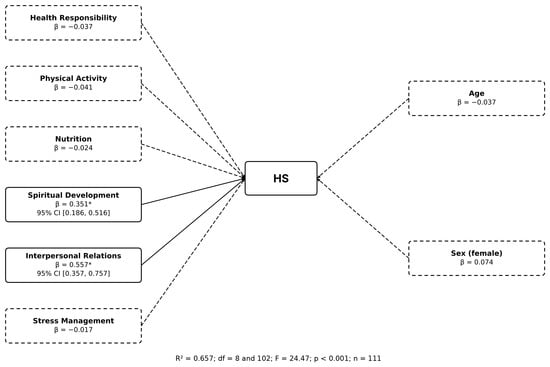
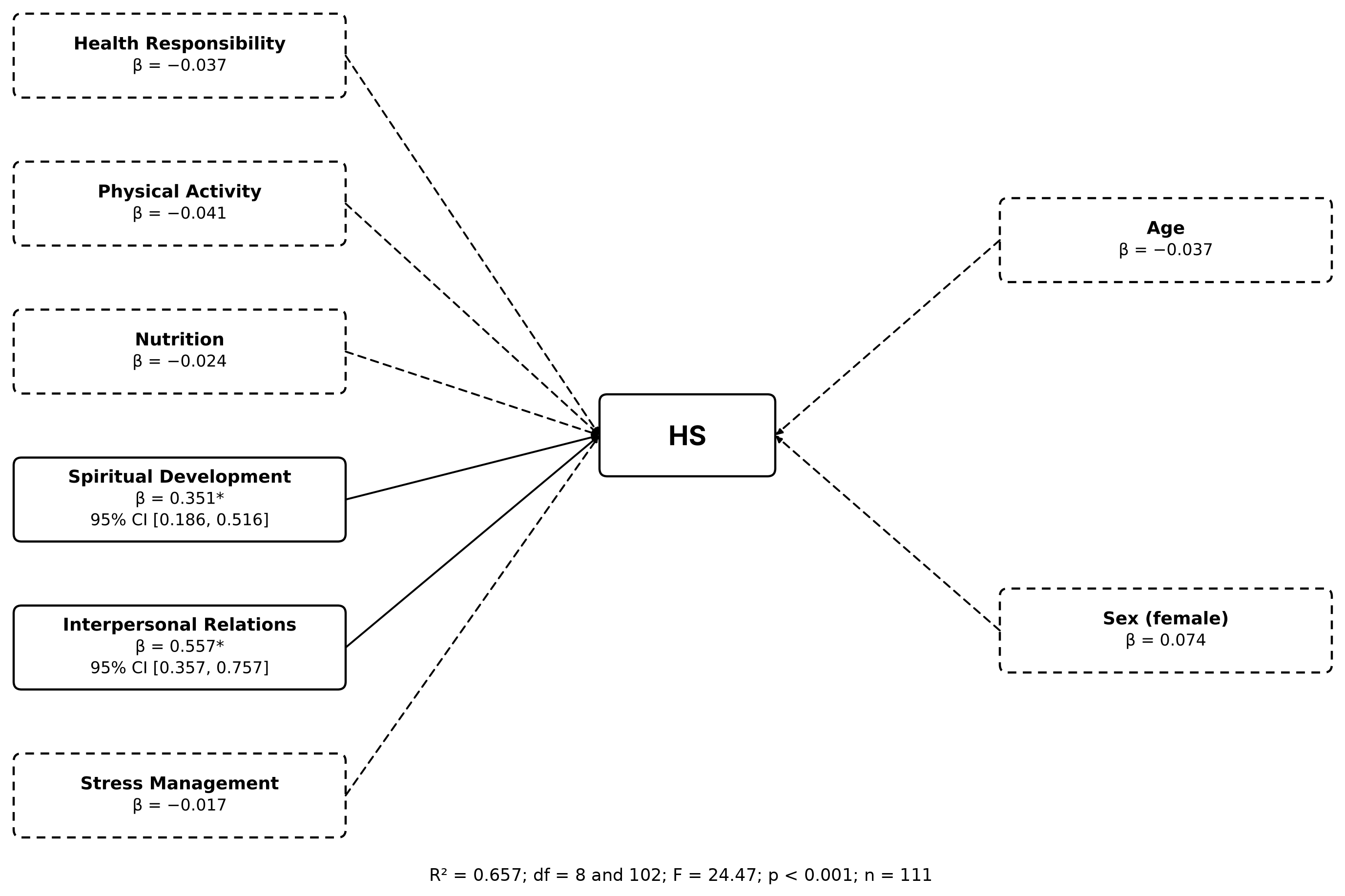
The subscale model, adjusted for age and sex, explained 66% of the variance (R2 = 0.657; F(8, 102) = 24.47; p < 0.001) (Figure 4). Only interpersonal relations (B = 0.557; β = 0.557; 95% CI 0.357 to 0.757; p < 0.001) and spiritual development (B = 0.363; β = 0.351; 95% CI 0.192 to 0.533; p < 0.001) were significant. As in the diaspora sample, this explanatory power should be interpreted in light of construct overlap and shared-method variance. All VIFs were below 4 (range 1.05–3.60; Supplementary Table S3). In the sensitivity analysis adjusted for the full covariate set (12 predictors; n = 111; maximum VIF = 4.51), interpersonal relations and spiritual development remained the only significant subscales, and religious practice was negatively associated with happiness (B = −2.216; 95% CI −3.710 to −0.722; p = 0.004) (Supplementary Table S5); because of the reduced ratio of participants to predictors, this model should be regarded as exploratory. In relative weight analysis, interpersonal relations (40.5%) and spiritual development (35.5%) accounted for most of the explained variance. In the behavioral-subscales-only model, R2 decreased to 0.303; health responsibility (B = 0.320; p = 0.008) and nutrition (B = 0.345; p = 0.027) were positively and physical activity negatively (B = −0.263; p = 0.030) associated with happiness (Supplementary Table S10).
Figure 4.
Multiple regression model of the six HLBS-II subscales as correlates of happiness (HS) among participants living in Türkiye, adjusted for age and sex. Solid lines indicate significant and dashed lines non-significant associations; * p < 0.05. Abbreviations as in Figure 1.
3.4. Formal Test of Group Differences
In the combined sample, adding seven group × predictor interaction terms (age, sex, economic status, education, marital status, religious practice, and HLBS-II total score) did not significantly improve model fit relative to the main-effects model, F(7, 596) = 0.68, p = 0.690 (n = 612). None of the individual interaction terms reached significance, although the group × HLBS-II term approached it (B = −0.037; 95% CI −0.080 to 0.006; p = 0.089), suggesting a possible but inconclusive trend toward a stronger HLBS-II–happiness association among participants abroad. For the subscale model, the set of interaction terms likewise did not improve fit, F(8, 594) = 1.25, p = 0.270 (n = 612); only the group × stress management term reached nominal significance (B = −0.234; 95% CI −0.464 to −0.003; p = 0.047), which did not survive Bonferroni correction for the eight interaction terms tested (α = 0.0063) and should therefore be interpreted cautiously until replicated. All interaction coefficients with 95% CIs are reported in Supplementary Table S6. Overall, there was no strong statistical evidence that the correlates of happiness differ between the diaspora and domestic samples; however, given the unequal group sizes and the limited power of interaction tests, these results do not establish that the associations are equivalent across groups.
3.5. Measurement Invariance and Robustness Checks
Multigroup confirmatory factor analysis showed that the one-factor model of the HS did not fit well even in the configural model (χ2(18) = 232.52; CFI = 0.923; RMSEA = 0.197), mainly because of poorer fit in the domestic sample (CFI = 0.880). Constraining the factor loadings (ΔCFI = −0.005) and the intercepts (ΔCFI = −0.007) produced only small decreases in fit. For the HLBS-II, modeled with its six subscale scores as indicators, configural fit was also poor (CFI = 0.859; RMSEA = 0.212), with ΔCFI = −0.011 for equal loadings and −0.004 for equal intercepts. Because configural fit was inadequate, measurement equivalence across residence groups could not be established, and the between-group comparisons of scale means should be interpreted with caution (Supplementary Table S7).
Residuals were approximately normally distributed in all models (skewness −0.21 to 0.05; excess kurtosis −0.78 to 0.21), and all VIFs were below 5. Breusch–Pagan tests indicated heteroscedasticity in all models (p ≤ 0.005). With HC3 robust standard errors, the significance of all coefficients was unchanged, except that economic status in the total-score model in Türkiye was no longer significant (p = 0.076); the sets of interaction terms remained non-significant (total-score model: F = 0.66, p = 0.709; subscale model: F = 1.47, p = 0.163). RESET tests suggested slight non-linearity in the diaspora models, but adding quadratic terms increased R2 by no more than 0.010, so the linear models were retained. Excluding influential observations (2–28 per model) did not change the significance of any HLBS-II predictor in the within-group models. In these analyses, marital status became negatively associated with happiness in both total-score models (abroad B = −0.81, p = 0.039; Türkiye B = −2.52, p = 0.001); among the interaction terms, group × interpersonal relations became significant (p = 0.021) and group × stress management was no longer significant (p = 0.469), whereas both sets of interaction terms remained non-significant (F = 0.93, p = 0.485; F = 1.35, p = 0.214) (Supplementary Table S8). These individual coefficients were therefore sensitive to a small number of observations and are not interpreted further.
4. Discussion
In line with prior migration research reporting comparable subjective well-being among migrants with different migration motives [31], no statistically significant unadjusted difference in happiness was found between the diaspora and domestic samples, although participants abroad reported better economic status and less health-promoting lifestyles. Because this difference was small and estimated imprecisely (d = 0.09; 95% CI −0.12 to 0.29), the absence of a significant difference should not be read as evidence that happiness is similar in the two populations. After adjustment for sociodemographic characteristics, participants in Türkiye reported higher happiness, and this difference was no longer present once healthy lifestyle behaviors were taken into account. Thus, in this sample, the better economic circumstances of participants abroad were not accompanied by greater happiness, whereas psychosocial lifestyle resources were consistently associated with it. Formal interaction tests found no strong statistical evidence that predictor effects differ by residence group; because interaction tests were underpowered relative to main effects, this should be read as an absence of evidence for differences rather than as evidence of equivalence, and the marginal HLBS-II and stress-management interactions warrant replication in larger samples.
4.1. Sociodemographic and Overall Lifestyle Correlates
Among participants abroad, overall healthy lifestyle behavior was the strongest correlate of happiness, followed by economic status, whereas education showed a small negative association. The latter may reflect overqualification and adaptation strain among highly educated migrants, whose credentials are not always fully recognized or used in host-country labor markets; education–occupation mismatch has been shown to reduce life satisfaction among university-educated immigrant workers [32]. The modest association between economic status and happiness is consistent with evidence that material resources explain a limited share of well-being relative to relational and psychological factors [33,34]. Among participants in Türkiye, the HLBS-II total score, economic status, and female sex were significant correlates (the association with economic status was not robust to heteroscedasticity-consistent standard errors), a broadly similar pattern that is consistent with, although not proof of, comparable associations across groups.
4.2. Lifestyle Subdimensions and Happiness
Across both samples, spiritual development and interpersonal relations emerged as the strongest and most consistent correlates of happiness (β = 0.450 and 0.330 abroad; β = 0.351 and 0.557 in Türkiye). This echoes findings from Turkish [35] and international samples. Spirituality and the pursuit of meaning have been positively associated with subjective well-being [36] and shown to affect happiness both directly and through resilience [37], and in an Iranian sample a health-promoting lifestyle, particularly spiritual growth, interpersonal relations, and stress management, predicted happiness [38]. Among retired older adults, health conservation, self-efficacy, social activity, and marital status were the primary predictors of life satisfaction [39], further underscoring the role of psychosocial and behavioral resources. The interpersonal relations findings align with broader evidence that social connectedness predicts life satisfaction among migrants and refugees [40] and that social support and the absence of loneliness predict life evaluation across countries [34]. Spiritual development in the HLBS-II refers to a sense of purpose, inner growth, and connectedness rather than to religious observance; in our data, it was only modestly correlated with religious practice (abroad r = 0.30; Türkiye r = 0.21), and both constructs may carry different meanings for different individuals and cultural contexts. Given their conceptual overlap with happiness, the associations of spiritual development and interpersonal relations with happiness should not be attributed exclusively to health-promoting behaviors.
Stress management was a significant correlate among participants abroad, consistent with evidence linking lower perceived stress and greater resilience to happiness [41] and with the central role of acculturative stress in migrant adaptation [12]. Related work has also described indirect pathways from health behaviors to well-being through exercise attitudes, sleep quality, emotion regulation, and body self-esteem [42,43], and among adults general health status and physical activity have been associated with life satisfaction [44,45]. A longitudinal study among university students found that authentic happiness and health-promoting lifestyle behaviors reinforce one another over time [46], suggesting that the cross-sectional associations observed here may reflect a reciprocal pattern that future longitudinal work with migrant populations should examine directly.
Health responsibility was negatively associated with happiness among participants abroad in the multivariable model. A similar small negative association has been reported among Turkish health management students, in whom all HLBS-II subscales were positively correlated with happiness, the subscales together explained approximately half of the variance in happiness (F(6, 296) = 52.36; R2 = 0.505), and stress management (β = 0.484) and spiritual development (β = 0.405) were the strongest positive predictors [35]. In our diaspora sample, health responsibility was likewise positively correlated with happiness at the bivariate level (r = 0.30), and its negative coefficient emerged only in the multivariable model, indicating a statistical suppression effect: once the variance that health responsibility shares with the other subscales is held constant, its residual component may capture illness-focused vigilance rather than health promotion more broadly. Several interpretations are possible, none of which could be tested with the present data. Heightened health vigilance may coincide with anxiety or perceived illness burden rather than well-being; alternatively, the direction may be reversed, in that individuals with poorer perceived health or greater health concerns may engage more often in health-responsible behaviors. The coefficient should therefore not be read as indicating a negative effect of health responsibility on happiness. Gender-specific patterns have also been reported elsewhere: in a Pakistani university sample, women engaged more frequently in positive health behaviors, whereas men more often rated themselves as very happy [47]. Gender roles were not assessed in the present study, so any explanation of the association between female sex and happiness in our models in terms of sociocultural roles is speculative; the association may also reflect differences in social support, response styles, or other unmeasured factors.
Migration from Türkiye is largely driven by the pursuit of better economic conditions and professional opportunities rather than by an expectation of greater happiness per se. Emigration increased markedly in 2022 [4], nearly two-thirds of young people aged 18–25 years report that they would live abroad if they had the opportunity [48], and studies of medical and nursing students show that migration intentions are reinforced by expectations of higher income, better working conditions, and academic advancement [49,50]. In this context, our finding that participants abroad, despite their better economic status, were not happier than those in Türkiye, and were less happy after sociodemographic adjustment, suggests that, although migration decisions are primarily economically motivated, subjective well-being among those who have migrated appears to be more closely associated with psychosocial resources than with economic circumstances, although the cross-sectional design precludes conclusions about change following migration. This is consistent with the broader migrant health literature indicating that successful integration depends on more than economic attainment [14,40].
4.3. Implications for Health Promotion and Public Health Nursing Practice
Because happiness in this sample was most strongly associated with psychosocial lifestyle resources (an association that partly reflects their conceptual overlap with happiness), whereas economic status showed only modest associations and living abroad was not associated with greater happiness, settlement services, diaspora associations, consulates, primary care services, and community health programs, including those delivered by public health nurses, may benefit from incorporating components that foster spiritual or existential engagement, social connectedness, and stress-management skills alongside conventional economic and language-focused integration support. Such programs could be particularly valuable for recently arrived migrants, whose social networks and coping resources are still developing. Although no significant between-group differences in the correlates of happiness were detected, equivalence cannot be assumed; programs developed in one context should therefore be adapted and evaluated in the other rather than transferred directly. Finally, because the negative coefficient for health responsibility was a conditional association rather than a direct effect, it does not by itself justify changes to health education; whether an emphasis on empowerment and self-efficacy rather than illness-focused vigilance benefits well-being remains to be tested.
4.4. Strengths and Limitations
This study has notable strengths. It compares Turkish diaspora and domestic adults on happiness and the full six-dimension structure of healthy lifestyle behaviors, with a diaspora sample spanning 26 host countries rather than a single destination. Rather than relying solely on a narrative comparison of separately estimated regression coefficients, a common approach in cross-national happiness research, it applied formal moderated regression tests, providing a more rigorous basis for comparing the behavioral correlates of happiness across residence contexts.
Several limitations should also be considered. First, the cross-sectional design precludes causal inference, and reverse or reciprocal associations are plausible. Second, the domestic sample (n = 111) was considerably smaller than the diaspora sample (n = 501); although it was adequate for the within-group regression models, it limited the precision of between-group comparisons. A sensitivity analysis indicated 80% power only for group differences of d ≥ 0.29, and several observed differences were smaller and imprecisely estimated (for example, happiness: d = 0.09; 95% CI −0.12 to 0.29); the absence of a significant difference in these variables therefore does not demonstrate similarity. Interaction tests are particularly underpowered relative to main effects (80% power only for f2 ≥ 0.024–0.025), so the absence of significant group × predictor interactions should be read as an absence of strong evidence for group differences rather than as proof of equivalence; individual interaction coefficients were also sensitive to a small number of influential observations. The smaller domestic sample also limited the number of covariates that could be included simultaneously; the fully adjusted subscale model in this group should therefore be regarded as exploratory. In addition, several between-group and interaction tests were performed, and nominally significant findings that did not survive Bonferroni correction (spiritual development in the group comparison; the group × stress management interaction) should be interpreted with caution. Third, recruitment relied on non-probability sampling through social media and diaspora networks, raising the risk of selection bias: more socially connected, digitally engaged, highly educated, or health-interested individuals may have been more likely to participate, which is particularly relevant for studies of happiness and health behaviors and limits generalizability. The country distribution of the diaspora sample also differs from that of the Turkish diaspora: Germany, which hosts by far the largest Turkish community abroad, accounted for only 16.0% of participants, whereas Poland (9.6%) was over-represented relative to its small Turkish population, probably reflecting the researchers’ academic networks; the findings may therefore not apply to long-established communities with large second- and third-generation populations. Fourth, measurement invariance of the HS and the HLBS-II across residence groups could not be established because configural model fit was inadequate, so differences in scale means between the groups may partly reflect differences in how the instruments function. Fifth, the spiritual development and interpersonal relations subscales overlap conceptually with happiness and related well-being constructs, which may inflate the explanatory power of the regression models. Sixth, all variables were self-reported, so common-method variance may have inflated the observed associations, and economic status and religious practice were assessed with single items. Seventh, sex was included as a covariate and sex-disaggregated descriptive data are reported (Table 3), but sex-stratified regression models were not estimated because the subgroups in Türkiye (49 women and 62 men) were too small for stable estimates, and gender roles were not assessed. Eighth, the HLBS-II does not assess sleep or alcohol use, behaviors that have been examined together with exercise as correlates of depressive and anxiety symptoms [51] and that may also be relevant to happiness. Finally, acculturation, host-country integration policies, and experiences of discrimination were not measured and may confound or moderate the associations observed among participants abroad.
5. Conclusions
Happiness among Turkish adults, both abroad and in Türkiye, was associated primarily with psychosocial and health-related behavioral factors, particularly spiritual development and interpersonal relations. Participants abroad reported better economic status, but no significant unadjusted difference in happiness was found (which does not demonstrate that happiness was similar), and after sociodemographic adjustment they reported lower happiness, a difference that was no longer present after accounting for healthy lifestyle behaviors. Formal tests found no strong evidence that these associations differ by residence group; however, given the limited power of interaction tests, this does not establish equivalence, and the generalizability of these correlates across migration status requires confirmation in larger and more balanced samples. Given the cross-sectional design and convenience sampling, these associations are correlational and sample-specific. Community-based health promotion that strengthens social connectedness, stress management, and the existential dimensions of well-being may benefit both diaspora and domestic populations and could usefully be incorporated into migrant health and settlement services. Longitudinal research involving migrant and non-migrant populations from a wider range of source and destination countries is needed to clarify the directionality and generalizability of these associations.
Supplementary Materials
The following supporting information can be downloaded at https://www.mdpi.com/article/10.3390/healthcare14223956/s1, Table S1: STROBE checklist for cross-sectional studies. Table S2: Bivariate correlations among HLBS-II subscales and happiness by residence group; Table S3: Multicollinearity diagnostics (VIF and tolerance) for all regression models; Table S4: Full results of the within-group regression models; Table S5: Sensitivity analyses of the subscale models adjusted for the full covariate set; Table S6: Pooled models with the adjusted residence-group effect and Group × predictor interaction coefficients. Table S7: Measurement invariance of the HS and HLBS-II across residence groups; Table S8: Regression diagnostics and robustness checks. Table S9: Welch’s t-tests, Cohen’s d with 95% CIs, and covariate-adjusted group differences in HLBS-II scores; Table S10: Relative weight analysis and behavioral-subscales-only models.
Author Contributions
Conceptualization, T.G.; methodology, T.G. and P.F.N.; formal analysis, P.F.N.; investigation, T.G. and P.F.N.; writing—original draft preparation, T.G.; writing—review and editing, T.G. and P.F.N.; visualization, T.G. and P.F.N. All authors have read and agreed to the published version of the manuscript.
Funding
This research received no external funding. The APC was funded by Dokuz Eylül University.
Institutional Review Board Statement
The study was conducted in accordance with the Declaration of Helsinki and approved by the Dokuz Eylül University Non-Interventional Research Ethics Committee (Decision No. 2024/21-07, 12 June 2024).
Informed Consent Statement
Informed consent was obtained from all subjects involved in the study. Consent was obtained electronically on the first page of the online questionnaire, which informed respondents about the purpose of the study, the voluntary and anonymous nature of participation, and how their data would be used; respondents indicated agreement by selecting “I agree” before the questionnaire items were shown, and those who did not wish to participate could decline.
Data Availability Statement
The data presented in this study are available on request from the corresponding author due to privacy and ethical restrictions. The dataset contains detailed sociodemographic information, and the small size of several country subgroups could allow indirect identification of participants. De-identified data will be shared with qualified researchers upon reasonable request and subject to approval by the Dokuz Eylül University Non-Interventional Research Ethics Committee.
Acknowledgments
The data used in this study were collected as part of a postdoctoral research project conducted at Opole University of Technology, Poland, between 25 March 2024 and 15 January 2025. The authors gratefully acknowledge Opole University of Technology and Dokuz Eylül University for institutional support, and thank Turkish consulates, diaspora associations, and social media community administrators abroad for their assistance with data collection, as well as all volunteers who participated in this study. The authors also thank İzmir İstar Danışmanlık for statistical consultancy in the original analyses. During the preparation of this manuscript, the authors used Claude Opus 5.5 (Anthropic) for language editing, text revision, manuscript formatting, and re-running the statistical analyses on the verified dataset during revision; all results were checked by the authors. The authors have reviewed and edited the output and take full responsibility for the content of this publication.
Conflicts of Interest
The authors declare no conflicts of interest.
Abbreviations
The following abbreviations are used in this manuscript:
| HLBS-II | Healthy Lifestyle Behavior Scale II |
| HS | Happiness Scale |
| STROBE | Strengthening the Reporting of Observational Studies in Epidemiology |
References
- Ryan, R.M.; Deci, E.L. On happiness and human potentials: A review of research on hedonic and eudaimonic well-being. Annu. Rev. Psychol. 2001, 52, 141–166. [Google Scholar] [CrossRef] [Scilit] [PubMed]
- Lee, S.A.; Jobe, M.C.; Mathis, A.A. Mental health characteristics associated with dysfunctional coronavirus anxiety. Psychol. Med. 2021, 51, 1403–1404. [Google Scholar] [CrossRef] [Scilit] [PubMed]
- Waters, L.; Algoe, S.B.; Dutton, J.; Emmons, R.; Fredrickson, B.L.; Heaphy, E.; Moskowitz, J.T.; Neff, K.; Niemiec, R.; Pury, C.; et al. Positive psychology in a pandemic: Buffering, bolstering, and building mental health. J. Posit. Psychol. 2022, 17, 303–323. [Google Scholar] [CrossRef] [Scilit]
- Turkish Statistical Institute. International Migration Statistics, 2022 (Bulletin No. 49457); TurkStat: Ankara, Türkiye, 2023. Available online: https://data.tuik.gov.tr/Bulten/Index?p=International-Migration-Statistics-2022-49457&dil=2 (accessed on 12 July 2025).
- Turkish Statistical Institute. International Migration Statistics, 2023 (Bulletin No. 53544); TurkStat: Ankara, Türkiye, 2024. Available online: https://veriportali.tuik.gov.tr/en/press/53544 (accessed on 24 October 2026).
- Republic of Türkiye Ministry of Foreign Affairs. The Expatriate Turkish Citizens. Available online: https://www.mfa.gov.tr/the-expatriate-turkish-citizens.en.mfa (accessed on 10 September 2025).
- Walker, S.N.; Sechrist, K.R.; Pender, N.J. The health-promoting lifestyle profile: Development and psychometric characteristics. Nurs. Res. 1987, 36, 76–81. [Google Scholar] [CrossRef] [Scilit]
- Pender, N.J.; Murdaugh, C.L.; Parsons, M.A. Health Promotion in Nursing Practice, 6th ed.; Pearson Education: Boston, MA, USA, 2011. [Google Scholar]
- Steptoe, A.; Wardle, J.; Marmot, M. Positive affect and health-related neuroendocrine, cardiovascular, and inflammatory processes. Proc. Natl. Acad. Sci. USA 2005, 102, 6508–6512. [Google Scholar] [CrossRef] [Scilit] [PubMed]
- Grant, N.; Wardle, J.; Steptoe, A. The relationship between life satisfaction and health behavior: A cross-cultural analysis of young adults. Int. J. Behav. Med. 2009, 16, 259–268. [Google Scholar] [CrossRef] [Scilit] [PubMed]
- Johnson, B.T.; Acabchuk, R.L. What are the keys to a longer, happier life? Answers from five decades of health psychology research. Soc. Sci. Med. 2018, 196, 218–226. [Google Scholar] [CrossRef] [Scilit] [PubMed]
- Berry, J.W. Immigration, acculturation, and adaptation. Appl. Psychol. 1997, 46, 5–34. [Google Scholar] [CrossRef] [Scilit]
- Neumann, R.J.; Ahrens, K.F.; Kollmann, B.; Goldbach, N.; Chmitorz, A.; Weichert, D.; Fiebach, C.J.; Wessa, M.; Kalisch, R.; Lieb, K.; et al. The impact of physical fitness on resilience to modern life stress and the mediating role of general self-efficacy. Eur. Arch. Psychiatry Clin. Neurosci. 2022, 272, 679–692. [Google Scholar] [CrossRef] [Scilit] [PubMed]
- Wang, Z.; Giovanis, E. Cultural integration, subjective identity, and well-being: Global migrants in the UK. Curr. Psychol. 2024, 43, 12634–12652. [Google Scholar] [CrossRef] [Scilit]
- Zacher, H.; Rudolph, C.W. Individual differences and changes in subjective well-being during the early stages of the COVID-19 pandemic. Am. Psychol. 2021, 76, 50–62. [Google Scholar] [CrossRef] [Scilit] [PubMed]
- Diener, E. Subjective well-being. Psychol. Bull. 1984, 95, 542–575. [Google Scholar] [CrossRef]
- Lyubomirsky, S.; Sheldon, K.M.; Schkade, D. Pursuing happiness: The architecture of sustainable change. Rev. Gen. Psychol. 2005, 9, 111–131. [Google Scholar] [CrossRef] [Scilit]
- Diener, E.; Oishi, S.; Tay, L. Advances in subjective well-being research. Nat. Hum. Behav. 2018, 2, 253–260. [Google Scholar] [CrossRef] [Scilit] [PubMed]
- Ryff, C.D. Well-being with soul: Science in pursuit of human potential. Perspect. Psychol. Sci. 2018, 13, 242–248. [Google Scholar] [CrossRef] [Scilit] [PubMed]
- Seligman, M.E.P. Flourish: A Visionary New Understanding of Happiness and Well-Being; Free Press: New York, NY, USA, 2011. [Google Scholar]
- Satici, S.A.; Kayis, A.R.; Satici, B.; Griffiths, M.D.; Can, G. Resilience, hope, and subjective happiness among the Turkish population: Fear of COVID-19 as a mediator. Int. J. Ment. Health Addict. 2023, 21, 803–818. [Google Scholar] [CrossRef] [Scilit] [PubMed]
- Kickbusch, I.; Gleicher, D. Governance for Health in the 21st Century; World Health Organization Regional Office for Europe: Copenhagen, Denmark, 2012; Available online: https://apps.who.int/iris/handle/10665/326429 (accessed on 10 January 2025).
- World Health Organization Regional Office for Europe. Health 2020: A European Policy Framework and Strategy for the 21st Century; WHO Regional Office for Europe: Copenhagen, Denmark, 2013; Available online: http://apps.who.int/iris/bitstream/10665/131303/1/Health2020Long.pdf (accessed on 7 January 2025).
- Google Forms. Available online: https://docs.google.com/forms (accessed on 2 May 2024).
- von Elm, E.; Altman, D.G.; Egger, M.; Pocock, S.J.; Gøtzsche, P.C.; Vandenbroucke, J.P. The Strengthening the Reporting of Observational Studies in Epidemiology (STROBE) statement: Guidelines for reporting observational studies. Lancet 2007, 370, 1453–1457. [Google Scholar] [CrossRef] [Scilit] [PubMed]
- Faul, F.; Erdfelder, E.; Buchner, A.; Lang, A.-G. Statistical power analyses using G*Power 3.1: Tests for correlation and regression analyses. Behav. Res. Methods 2009, 41, 1149–1160. [Google Scholar] [CrossRef] [Scilit] [PubMed]
- Cohen, J. Statistical Power Analysis for the Behavioral Sciences, 2nd ed.; Lawrence Erlbaum Associates: Hillsdale, NJ, USA, 1988. [Google Scholar]
- Walker, S.N.; Hill-Polerecky, D.M. Psychometric Evaluation of the Health-Promoting Lifestyle Profile II; Unpublished Manuscript; University of Nebraska Medical Center: Omaha, NE, USA, 1996. [Google Scholar]
- Bahar, Z.; Beşer, A.; Gördes, N.; Ersin, F.; Kıssal, A. Healthy Lifestyle Behavior Scale II: A reliability and validity study. Cumhur. Nurs. J. 2008, 12, 1–13. [Google Scholar]
- Demirci, İ.; Ekşi, H. Keep calm and be happy: A mixed method study from character strengths to well-being. Educ. Sci. Theory Pract. 2018, 18, 303–354. [Google Scholar] [CrossRef] [Scilit]
- Pollenne, D.; Vargas-Silva, C. Differences in migrants’ reason for migration and subjective well-being: Not so different after all. Comp. Migr. Stud. 2024, 12, 11. [Google Scholar] [CrossRef] [Scilit]
- Frank, K.; Hou, F. Over-education and well-being: How does education–occupation mismatch affect the life satisfaction of university-educated immigrant and non-immigrant workers? Ethn. Health 2018, 23, 884–901. [Google Scholar] [CrossRef] [Scilit] [PubMed]
- Clark, A.E.; Flèche, S.; Senik, C. Economic growth evens out happiness: Evidence from six surveys. Rev. Income Wealth 2016, 62, 405–419. [Google Scholar] [CrossRef] [Scilit] [PubMed]
- Helliwell, J.F.; Layard, R.; Sachs, J.D.; De Neve, J.-E.; Aknin, L.B.; Wang, S. (Eds.) World Happiness Report 2024; Wellbeing Research Centre, University of Oxford: Oxford, UK, 2024; Available online: https://www.worldhappiness.report/ed/2024/ (accessed on 5 September 2025).
- Demir Uslu, Y.; Gedikli, E.; Aygün, S. A study on the healthy lifestyle behaviours of health management undergraduate students. Gümüşhane Univ. J. Health Sci. 2021, 10, 398–404. [Google Scholar] [CrossRef] [Scilit]
- Deb, S.; Thomas, S.; Bose, A.; Aswathi, T. Happiness, meaning, and satisfaction in life as perceived by Indian university students and their association with spirituality. J. Relig. Health 2020, 59, 2469–2485. [Google Scholar] [CrossRef] [Scilit] [PubMed]
- Reyes-Perez, M.D.; Carreño Saucedo, L.; Sanchez-Levano, M.J.; Cabanillas-Palomino, R.; Monje-Yovera, P.F.; Jaime-Rodríguez, J.P.; Atoche-Silva, L.A.; Alarcón-Bustíos, J.M.; Fernández-Altamirano, A.E.F. The spirituality–resilience–happiness triad: A high-powered model for understanding university student well-being. Eur. J. Investig. Health Psychol. Educ. 2025, 15, 158. [Google Scholar] [CrossRef] [Scilit] [PubMed]
- Bagheri, F.; Gharehbaghy, F. The relationship between mindfulness, happiness, and healthy lifestyle. Casp. J. Health Res. 2019, 4, 44–48. [Google Scholar] [CrossRef] [Scilit]
- Gu, M.; Yu, J.; Sok, S. Factors affecting life satisfaction among retired older adults. Front. Public Health 2025, 13, 1367638. [Google Scholar] [CrossRef] [Scilit] [PubMed]
- Song, J.; Corcoran, J.; Zahnow, R. The resettlement journey: Understanding the role of social connectedness on well-being and life satisfaction among (im)migrants and refugees: A systematic review. J. Racial Ethn. Health Disparities 2025, 12, 2128–2144. [Google Scholar] [CrossRef] [Scilit] [PubMed]
- Pour, M.T.; Ismail, A.; Yusop, Y.M.; Rajabi, G. Relationships between perceived stress and resilience with happiness. Int. J. Health Sci. 2022, 6, 12146–12178. [Google Scholar] [CrossRef] [Scilit]
- Li, K.; Omar Dev, R.D.; Li, W. Physical activity and happiness of college students: Chain mediating role of exercise attitude and sleep quality. Front. Public Health 2025, 13, 1544194. [Google Scholar] [CrossRef] [Scilit] [PubMed]
- Nie, Y.; Wang, T.; Guo, M.; Zhou, F.; Ma, W.; Qiu, W.; Gao, J.; Liu, C. The relationship between physical activity, life satisfaction, emotional regulation, and physical self-esteem among college students. Sci. Rep. 2025, 15, 15899. [Google Scholar] [CrossRef] [Scilit] [PubMed]
- Lau, H.Y.; Welfel, A.S. Predictors of life satisfaction in U.S. adults: A cross-sectional analysis of health status, physical activity, employment and intersectional factors. Cureus 2025, 17, e86872. [Google Scholar] [CrossRef] [Scilit] [PubMed]
- Avşar, F.; Kızılaslan, N. Life satisfaction and healthy lifestyle behaviors of individuals according to exercise preferences of outdoor and indoor. Public Health Nurs. 2025, 42, 1261–1271. [Google Scholar] [CrossRef] [Scilit] [PubMed]
- Alizadeh, Z.; Safaian, A.; Mahmoodi, H.; Shaghaghi, A. Pathways between authentic happiness and health promoting lifestyle profiles of university students in Tabriz, Iran. Int. J. Happiness Dev. 2018, 4, 360–368. [Google Scholar] [CrossRef] [Scilit]
- Rehman, R.; Zafar, A.; Mohib, A.; Baig, M. A gender-based comparison in health behaviors and state of happiness among university students. Cureus 2018, 10, e2342. [Google Scholar] [CrossRef] [Scilit] [PubMed]
- Konrad-Adenauer-Stiftung. Turkey Youth Study 2023. Available online: https://www.kas.de/en/web/tuerkei/single-title/-/content/tuerkische-jugendstudie-2023 (accessed on 14 July 2025).
- Filiz, M.; Karagöz, M.B.; Karagöz, N. Evaluation of medical faculty students’ attitudes towards brain drain. Karadeniz J. Soc. Sci. 2022, 14, 679–692. [Google Scholar] [CrossRef] [Scilit]
- Tosunöz, İ.K.; Nazik, E. Career future perceptions and attitudes towards migration of nursing students: A cross-sectional multicenter study. Nurse Educ. Pract. 2022, 63, 103413. [Google Scholar] [CrossRef] [Scilit] [PubMed]
- Catling, J.; Hussain, I.; Khalil, A. Psychological and behavioural factors that impact on the mental health of university students. Ment. Illn. 2025, 2025, 4160351. [Google Scholar] [CrossRef] [Scilit]

Disclaimer/Publisher’s Note: The statements, opinions and data contained in all publications are solely those of the individual author(s) and contributor(s) and not of MDPI and/or the editor(s). MDPI and/or the editor(s) disclaim responsibility for any injury to people or property resulting from any ideas, methods, instructions or products referred to in the content. |
© 2026 by the authors. Licensee MDPI, Basel, Switzerland. This article is an open access article distributed under the terms and conditions of the Creative Commons Attribution (CC BY) license.