


Abstract
Background: The COVID-19 pandemic disrupted healthcare utilization and continuity of surgical care. This study evaluated changes in utilization, case mix, and in-hospital surgery completion in a tertiary hand surgery clinic across pre-pandemic, pandemic, and 2022 comparison periods. Methods: This retrospective study included 1453 presentations with a new upper-extremity complaint between 1 October and 31 December in 2019, 2020, and 2022. Demographics, traumatic origin, diagnosis, surgical indication, in-hospital surgery completion within 180 days of the surgical decision, and time to surgery among operated presentations were compared across periods. Multivariable logistic regression examined non-completion. Results: Presentation volume declined from 618 in 2019 to 232 in 2020 (−62.5%) and was 603 in 2022. The proportion of traumatic presentations increased from 50.8% to 69.8%. Fractures and dislocations became proportionally more frequent, whereas the proportions of osteoarthritis/chondral disorders and ganglion/mass/tumor diagnoses decreased. Surgical indication rates did not differ significantly (p = 0.519), but completion among indicated presentations decreased from 95.5% to 56.9% and was 95.7% in 2022 (p < 0.001). The pandemic period was associated with higher adjusted odds of non-completion versus 2019 (adjusted OR, 12.26; 95% CI, 4.64–32.41). Median decision-to-surgery time among operated presentations was 6, 12, and 7 days in 2019, 2020 and 2022 respectively. (p < 0.001). Conclusions: The pandemic period was associated with altered utilization and case mix and lower in-hospital surgery completion. In 2022, presentation volume and completion were close to 2019 values, although case mix remained different.
1. Introduction
The COVID-19 pandemic substantially reshaped healthcare delivery worldwide, disrupting multiple stages of the care pathway, from initial patient presentation to definitive surgical treatment [1,2]. Reallocation of hospital resources, postponement of elective procedures, and restrictions on face-to-face services particularly affected outpatient and elective surgical care [2,3,4,5,6]. At the same time, concerns about infection and mobility restrictions altered healthcare-seeking behavior, influencing not only the overall volume of presentations but also the characteristics of patients and conditions encountered in clinical practice [7,8,9,10].
Orthopaedic and hand surgery services were particularly affected by these disruptions. During the pandemic, elective procedures and outpatient visits declined, waiting times increased, and the diagnostic distribution of presenting patients changed [3,11]. Although overall presentations to hand trauma centers decreased, the relative frequency of complex injuries and open fractures increased. In addition, the relative preservation of hand trauma surgery despite reductions in general orthopaedic trauma procedures suggested that the demand for urgent hand surgery remained substantial even during periods of healthcare restriction [12,13]. Surgical activity subsequently increased after the marked initial decline; however, recovery was not uniform across diagnosis and procedure groups, and the magnitude and duration of disruption varied across countries and institutions [4,14,15,16].
Nevertheless, the hand surgery literature has predominantly focused on acute trauma and changes in surgical procedure volume during the pandemic [4,12,13,16]. Less is known about how such disruptions affected the broader continuum of hand surgical care, including who accessed outpatient services, how the diagnostic case mix changed, and whether patients for whom surgery was indicated were ultimately able to undergo surgical treatment. Examining the normalization period is also important because restoration of outpatient volume does not necessarily indicate complete recovery of healthcare delivery. Patient characteristics, diagnostic patterns, and access to indicated surgery may remain altered even after overall service utilization approaches pre-pandemic levels.
Therefore, the present study aimed to compare healthcare utilization, patient profile, diagnostic spectrum, and access to surgical treatment in a tertiary hand surgery outpatient clinic across pre-pandemic, pandemic, and normalization periods. We hypothesized that the pandemic would be associated with reduced outpatient utilization, a shift in case mix toward acute and traumatic conditions, reduced access to indicated surgical treatment—particularly among elective and nontraumatic cases—and longer time to surgery, with only partial recovery of these patterns during the normalization period.
2. Materials and Methods
2.1. Study Design and Patient Selection
This study was designed as a single-center, retrospective, comparative observational study conducted in the hand surgery outpatient clinic of a tertiary care hospital. The study was approved by the local ethics committee on 28 June 2022 (approval no. 2012-KAEK-15/2546) and was conducted in accordance with the principles of the Declaration of Helsinki. As part of routine outpatient care, patients were verbally informed that their clinical information could be used for scientific research, and verbal consent for such use was obtained. The ethics committee did not require additional study-specific informed consent for this retrospective review of clinical records, and no additional consent was obtained specifically for the study. The retrospective study procedures were initiated after 2023, when all three observation periods had ended.
To evaluate differences in healthcare utilization, patient profile, diagnostic case mix, and surgical outcomes across the study periods, three periods were examined: the pre-pandemic period (1 October–31 December 2019), the pandemic period (1 October–31 December 2020), and the 2022 comparison period (1 October–31 December 2022). The same calendar months were used for all three periods to minimize the effect of seasonal variability. These periods represented separate observation windows rather than continuous surveillance of service disruption and recovery.
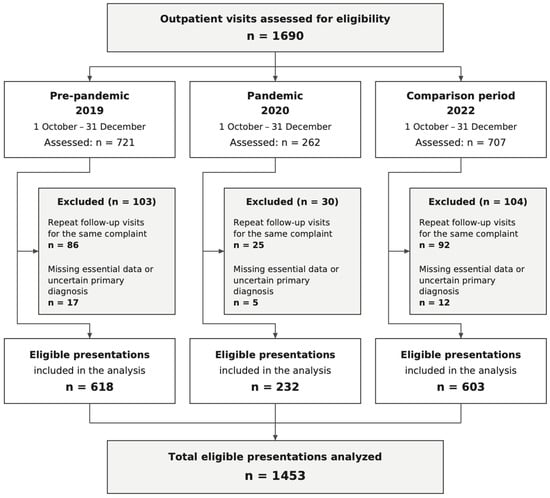
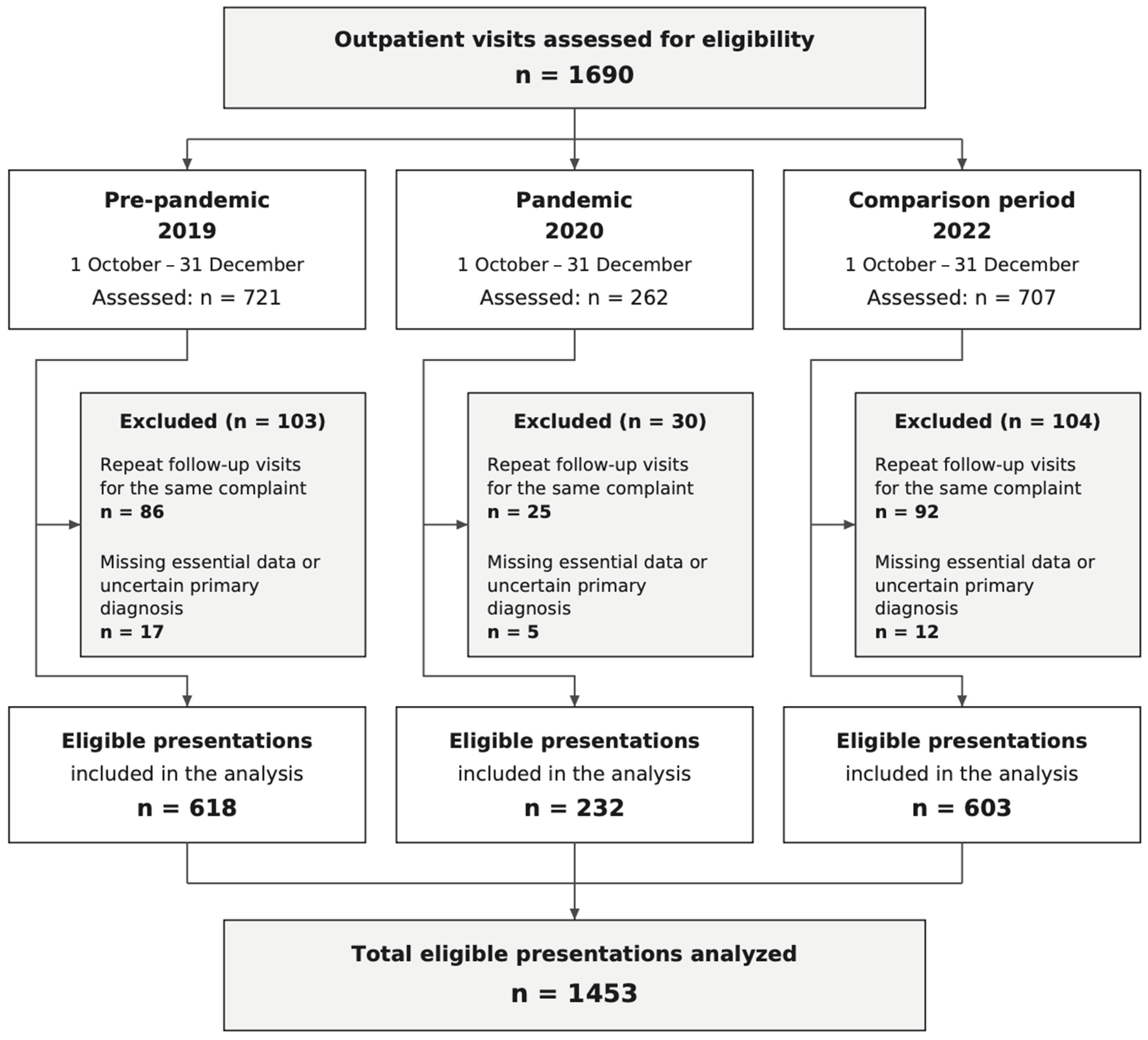
Patients who were evaluated in the hand surgery outpatient clinic for a new upper extremity complaint during the specified periods and whose primary diagnosis could be reliably determined from the clinical records were included in the study. Patients whose primary complaint was outside the scope of the study, whose primary diagnosis could not be reliably determined, or who had missing essential data required for the analysis were excluded. Repeated follow-up visits by the same patient for the same complaint were excluded, and the first eligible visit was considered the index visit. The unit of analysis was an eligible presentation for a new complaint. In 2019, 2020, and 2022, respectively, 86, 25, and 92 repeat follow-up visits for the same complaint were excluded, along with 17, 5, and 12 presentations with missing essential data or an uncertain primary diagnosis. The final study cohort consisted of 1453 eligible presentations, including 618 in the pre-pandemic period, 232 in the pandemic period, and 603 in the 2022 comparison period (Figure 1).
Figure 1.
Study selection flow diagram by study period. Repeat follow-up visits for the same complaint and presentations with missing essential data or an uncertain primary diagnosis were excluded. The final analysis included 1453 eligible presentations: 618 in 2019, 232 in 2020, and 603 in 2022.
2.2. Study Periods and Service Organization
The October–December 2020 period was selected because the hospital’s service organization during these months reflected its pandemic-related operating conditions. The corresponding calendar months in 2019 and 2022 were selected to provide comparable observation periods and minimize seasonal variability. During October–December 2020, the hospital served as a designated COVID-19 hospital. Emergency surgical care continued, while elective procedures were performed on a limited basis. Pandemic-related staff redeployment and capacity restrictions affected service organization. Hospital organization, the hand surgery team, and referral arrangements in 2022 were unchanged compared with 2019.
2.3. Data Collection and Variables
Data were obtained through retrospective review of the hospital electronic information system, outpatient clinic records, and patient files. For each eligible presentation, the date of presentation, study period, age, sex, traumatic or non-traumatic origin, anatomical region, primary clinical diagnosis, and ICD-10 code were recorded. Traumatic origin included acute injuries and conditions documented as sequelae of previous trauma; this classification did not indicate injury acuity, surgical urgency, or whether treatment was elective. Anatomical localization was classified into six groups: hand, wrist, forearm, elbow, arm/shoulder, and generalized.
The primary diagnosis was determined by evaluating the clinical records together with the ICD-10 codes. Similar conditions were grouped into 12 main diagnostic categories: fractures and dislocations; traumatic soft-tissue injuries; peripheral nerve disorders; tendinopathy and fibroproliferative disorders; osteoarthritis and chondral disorders; ligament/TFCC injuries and joint instability; ganglion, masses, and tumors; infectious or inflammatory diseases; post-traumatic sequelae or acquired structural disorders; congenital or developmental disorders; other nonspecific conditions; and cervical-origin disorders. To allow a more detailed assessment of changes in the diagnostic spectrum, the main categories were further divided into specific diagnostic subgroups. The numerical codes presented in Supplementary Table S1 identify the study-specific diagnostic classification.
Surgical indication was defined as a documented decision for surgical treatment by the treating clinician at the index visit or a subsequent evaluation. Whether surgery was subsequently performed was verified by matching outpatient clinic and operating room records. Surgery completion was defined as an operation recorded at the study institution within 180 days of the documented surgical decision. This common observation window was introduced during revision to improve comparability across periods. All presentations with a surgical indication had at least 180 days of available record coverage following the surgical decision.
The surgical indication rate was defined as the proportion of eligible presentations with a documented surgical indication among the entire study cohort. The overall surgery rate was the proportion of all eligible presentations resulting in an in-hospital operation within the specified window, whereas the surgery completion rate used only presentations with a surgical indication as the denominator. Non-completion indicated the absence of a recorded in-hospital operation within 180 days; it did not establish that the patient remained untreated elsewhere. Operations performed at other institutions and reasons for non-completion were not systematically available. Time to surgery was calculated in days from the documented surgical decision to the operation and was analyzed only among patients who underwent surgery.
Study outcomes included the number of eligible outpatient presentations, patient age and sex distribution, proportion of presentations of traumatic origin, anatomical region distribution, primary diagnostic distribution, surgical indication rate, overall surgery rate, in-hospital surgery completion within 180 days, and time from surgical decision to surgery. An additional analysis examined factors associated with in-hospital surgery non-completion.
Diagnostic classification was performed by the first author and the corresponding author using the clinical records together with the ICD-10 codes. Disagreements regarding diagnostic classification were resolved through consultation with another experienced surgeon.
2.4. Statistical Analysis
Statistical analyses were performed using IBM SPSS Statistics for Windows, version 32.0 (IBM Corp., Armonk, NY, USA). The distribution of continuous variables was assessed using the Shapiro–Wilk test, histograms, and Q–Q plots. Continuous variables were presented as medians and interquartile ranges (IQRs), while categorical variables were presented as numbers and percentages.
The Kruskal–Wallis test was used to compare age and the time from surgical decision to surgery across the three periods; when a significant overall result was identified, pairwise comparisons were performed using the Dunn–Bonferroni method. Categorical variables were evaluated using Pearson’s chi-square test. The overall distribution of the main diagnostic categories was compared using a contingency table comprising the three periods × 12 diagnostic categories, and following a significant overall result, pairwise proportion comparisons with Bonferroni correction were performed. For detailed diagnostic subgroups, Pearson’s chi-square test was used when expected cell frequencies were adequate; otherwise, the Fisher–Freeman–Halton exact test or a Monte Carlo approach was applied. Bonferroni adjustment was applied to the three pairwise comparisons between study periods within each row. Diagnostic category, detailed subgroup, and trauma-stratified analyses were exploratory.
Surgery completion proportions were reported with 95% confidence intervals calculated using the Wilson method. Multivariable binary logistic regression was performed among presentations with a documented surgical indication. Study period, age, sex, and traumatic origin were entered simultaneously, without data-driven variable selection. The pre-pandemic period, male sex, and non-traumatic origin were the reference categories, and the age association was expressed per 10-year increase. Results were reported as adjusted odds ratios with Wald 95% confidence intervals. Given the 35 non-completion events, the model was limited to these variables; diagnostic category and anatomical region were not included. Diagnoses among non-completed cases were summarized descriptively without inferential comparisons because of the small subgroup counts.
All tests were two-sided, and p < 0.05 was considered statistically significant.
3. Results
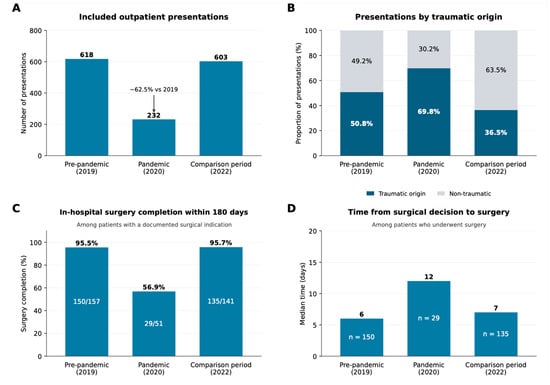
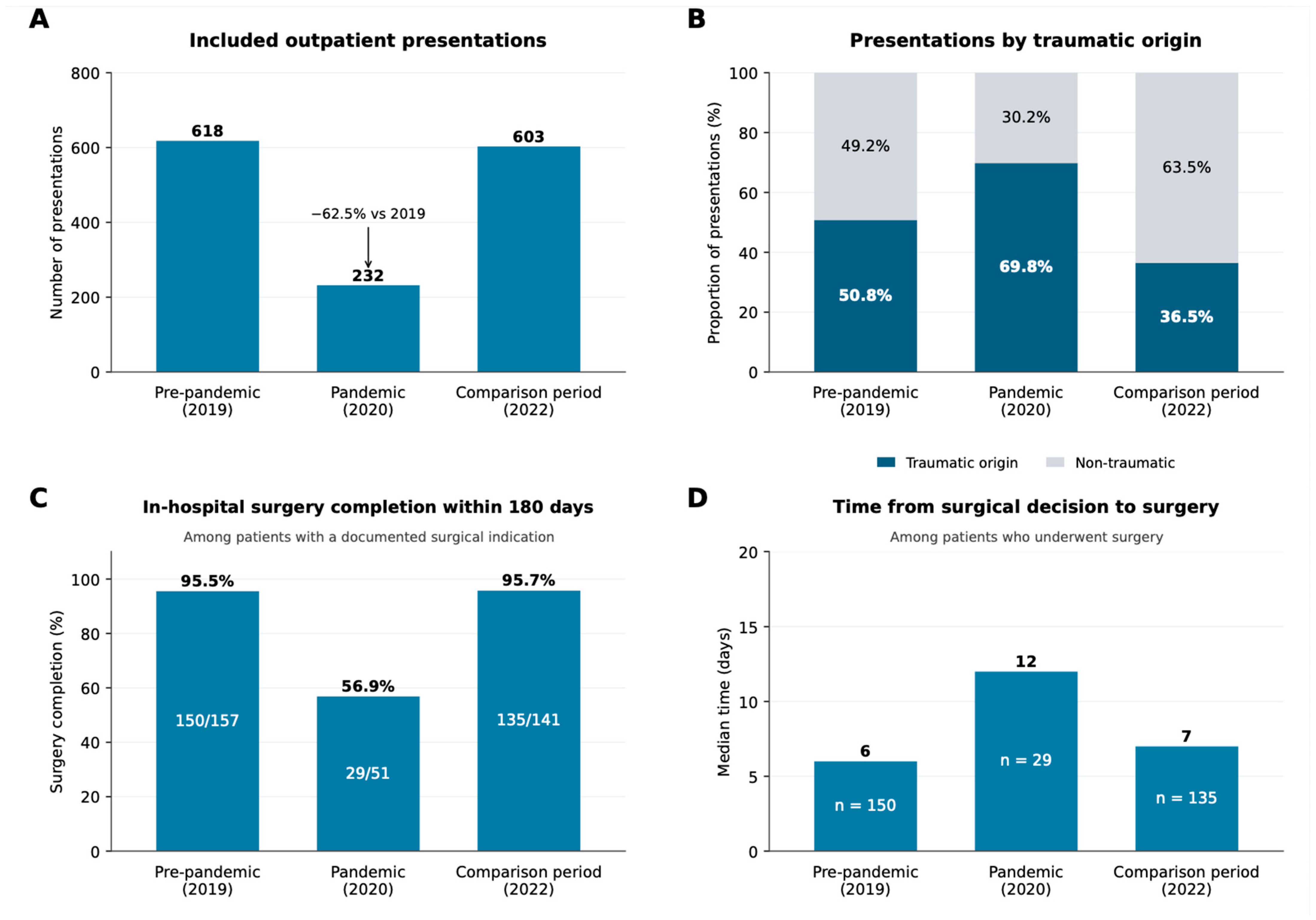
A total of 1453 eligible outpatient presentations were included: 618 in the pre-pandemic period, 232 in the pandemic period, and 603 in the 2022 comparison period. Compared with the pre-pandemic period, the number of included presentations was 62.5% lower during the pandemic and 2.4% lower in the 2022 comparison period. Median age was 40 (IQR, 21.8–55.0), 31 (IQR, 19.0–50.0), and 41 (IQR, 25.0–54.0) years in the pre-pandemic, pandemic and comparison periods respectively. (p = 0.003). The proportion of presentations involving female patients was lower during the pandemic (57.9%, 37.1%, and 59.2%; p < 0.001), whereas the proportion of presentations of traumatic origin was 50.8%, 69.8%, and 36.5%, respectively (p < 0.001) (Table 1; Figure 2A,B).
Table 1.
Patient characteristics and presentation profile by study period.
Figure 2.
Presentation patterns and surgical outcomes by study period. (A) Number of included outpatient presentations. (B) Proportions of presentations of traumatic and non-traumatic origin. (C) In-hospital surgery completion within 180 days of the documented surgical decision among patients with a surgical indication. (D) Median time from surgical decision to surgery among operated patients. Traumatic origin includes post-traumatic sequelae.
The anatomical distribution of presentations differed significantly among periods (p < 0.001). During the pandemic, the proportion of hand presentations increased from 37.7% to 56.9%, whereas the proportions of wrist and forearm presentations decreased from 41.4% to 14.7% and from 5.0% to 0.9%, respectively. The proportion of generalized complaints increased to 7.3%, while no marked temporal change was observed for elbow or arm/shoulder presentations. In the 2022 comparison period, hand and wrist presentations accounted for 34.8% and 41.8%, respectively (Table 1).
The overall distribution of diagnostic categories also differed significantly among periods (p < 0.001). The proportion of presentations classified as fractures and dislocations increased from 30.3% pre-pandemic to 47.0% during the pandemic and decreased to 21.6% in the 2022 comparison period, with all pairwise comparisons being significant. Traumatic soft-tissue injuries accounted for their highest proportion of presentations during the pandemic (20.3%), whereas peripheral nerve disorders remained similar across periods (10.5%, 8.6%, and 9.6%). In contrast, the proportion of osteoarthritis and chondral disorders decreased from 7.9% to 0.9% during the pandemic and was 9.0% in the 2022 comparison period, while ganglion, mass, or tumor diagnoses followed a similar pattern (12.0%, 1.3%, and 15.8%). Tendinopathy and fibroproliferative disorders were more frequent in the 2022 comparison period (12.9%, 11.2%, and 19.6%), whereas the proportions of ligament/TFCC injuries and joint instability decreased across periods (5.3%, 2.6%, and 1.3%). Congenital or developmental disorders were more frequent in the 2022 comparison period, while cervical-origin disorders increased during the pandemic (1.1%, 7.3%, and 2.3%). Detailed distributions and post-hoc comparisons are presented in Table 2.
Table 2.
Distribution of main diagnosis categories by study period.
The overall surgical indication rate did not differ significantly among the pre-pandemic, pandemic, and 2022 comparison periods (25.4%, 22.0%, and 23.4%; p = 0.519). Among non-traumatic presentations, however, the corresponding rates were 25.7%, 8.6%, and 19.3% (overall p = 0.004), with post hoc comparisons showing a significant difference between the pre-pandemic and pandemic periods. No significant difference was observed among presentations of traumatic origin (25.2%, 27.8%, and 30.5%; p = 0.400).
The overall in-hospital surgery rate within 180 days of the surgical decision was 24.3% in 2019, 12.5% in 2020, and 22.4% in 2022 (p < 0.001). Among non-traumatic presentations, the corresponding rates were 25.3%, 5.7%, and 19.1% in 2019, 2020 and 2022 respectively. (p < 0.001). Among presentations of traumatic origin, the corresponding rates were 23.2%, 15.4%, and 28.2% (p = 0.014), with a significant difference between the pandemic and 2022 comparison periods (Table 3).
Table 3.
Treatment decisions and surgical outcomes by study period.
Among presentations with a documented surgical indication, in-hospital surgery completion within 180 days was recorded for 150/157 presentations in 2019 (95.5%; 95% CI, 91.1–97.8%), 29/51 in 2020 (56.9%; 95% CI, 43.3–69.5%), and 135/141 in 2022 (95.7%; 95% CI, 91.0–98.0%) (p < 0.001). Completion was significantly lower during the pandemic than in either comparison period in Bonferroni-adjusted pairwise comparisons (Table 3; Figure 2C).
No in-hospital operation was recorded within 180 days for 7/157 indicated presentations in 2019 (4.5%), 22/51 in 2020 (43.1%), and 6/141 in 2022 (4.3%). Of the 22 non-completed presentations in 2020, 20 (90.9%) were of traumatic origin, comprising six fractures or dislocations and 14 traumatic soft-tissue injuries. The remaining two presentations involved a peripheral nerve disorder and a congenital or developmental disorder. Diagnoses among non-completed presentations in all three periods are summarized in Supplementary Table S2. Reasons for non-completion and information on operations performed at other institutions were not systematically available.
Among presentations resulting in in-hospital surgery (n = 150, 29, and 135, respectively), median time from the documented surgical decision to surgery was 6 days (IQR, 1–16) in 2019, 12 days (IQR, 9–27.5) in 2020, and 7 days (IQR, 3–13) in 2022 (p < 0.001), with the pandemic period differing significantly from both other periods (Table 3; Figure 2D).
The multivariable analysis included 349 presentations with a documented surgical indication, of which 35 had no in-hospital operation recorded within 180 days. After adjustment for age, sex, and traumatic origin, the pandemic period was associated with higher odds of non-completion compared with 2019 (adjusted OR, 12.26; 95% CI, 4.64–32.41; p < 0.001). Traumatic origin was also associated with higher odds of non-completion (adjusted OR, 3.56; 95% CI, 1.09–11.59; p = 0.035). The association for 2022 compared with 2019 was not statistically significant (adjusted OR, 0.95; 95% CI, 0.31–2.92; p = 0.924). Age and sex were not significantly associated with non-completion (Table 4).
Table 4.
Multivariable logistic regression analysis of in-hospital surgery non-completion within 180 days of the surgical decision.
Exploratory detailed subgroup analysis identified differences between study periods in selected traumatic injuries, entrapment neuropathies, tendinopathy and fibroproliferative disorders, degenerative joint diseases, ganglion and other masses, and cervical-origin disorders. Complete subgroup distributions and post-hoc comparisons are provided in Supplementary Table S1.
4. Discussion
The principal finding of this study is that the pandemic period was associated with lower outpatient presentation volume, a different demographic and diagnostic profile, and reduced completion of indicated surgery at a tertiary hand surgery clinic. Included presentations were 62.5% fewer than in 2019, while in-hospital surgery completion within 180 days of the surgical decision decreased from 95.5% to 56.9%. The association between the pandemic period and non-completion persisted after adjustment for age, sex, and traumatic origin. In late 2022, presentation volume and completion proportions were close to their 2019 values, although case mix remained different. These observations describe three separate periods and do not establish a continuous recovery trajectory or complete normalization.
The reduction in outpatient visits observed during the pandemic is consistent with decreases in healthcare utilization reported across different countries and specialties [9,11,17]. However, the change was not uniform across diagnostic categories. Although the proportion of presentations of traumatic origin increased from 50.8% to 69.8%, their absolute number decreased from 314 to 162. Atia et al. reported fewer hand trauma presentations but a higher surgical intervention rate, and Klietz et al. described a similar pattern [18,19]. Studies from France and Türkiye also reported changes in injury profiles or relative preservation of hand trauma surgery [12,13]. Differences across settings may reflect restrictions, referral pathways, injury mechanisms, and patient populations. Our findings are compatible with a selective reduction in non-traumatic presentations, but they cannot establish changes in population-level trauma incidence.
This selective pattern was evident in several diagnostic categories. Osteoarthritis and chondral disorders accounted for 0.9% of pandemic-period presentations compared with 7.9% in 2019, while ganglion, mass, or tumor diagnoses accounted for 1.3% compared with 12.0%. Altered healthcare-seeking behavior and deferred care are possible explanations, although these mechanisms were not directly measured. Previous studies reported postponement of nonurgent care [8], and Tawfik et al. found that 16.8% of patients delayed seeking care because of COVID-19 [20]. Deferred presentations may contribute to subsequent demand [21]. The younger age and lower proportion of female patients may similarly reflect selective utilization; demographic changes have differed across institutions [14,18,19].
A key health-services finding was the discrepancy between documented surgical indication and recorded treatment. Although indication rates did not differ significantly, the overall in-hospital surgery rate decreased from 24.3% to 12.5%. Early pandemic guidance prioritized urgent injuries over nonurgent surgery [2], and elective hand surgery restrictions were reported in Italy, Singapore, and Canada [1,21,22]. During our 2020 observation window, the hospital provided COVID-19 care, emergency surgery continued, and elective capacity was limited. Nevertheless, postponement of non-traumatic elective surgery alone cannot explain the observed non-completion pattern: 20 of the 22 non-completed presentations in 2020 were of traumatic origin, including six fractures or dislocations and 14 traumatic soft-tissue injuries. Traumatic origin included acute injuries and sequelae and did not define urgency. Consequently, these data do not establish whether the non-completed cases required urgent or elective treatment. Reasons for non-completion and operations elsewhere were not systematically available, so absence of an institutional operation cannot be equated with remaining untreated.
In the adjusted analysis, the pandemic period was associated with higher odds of non-completion than 2019 (adjusted OR, 12.26; 95% CI, 4.64–32.41). Traumatic origin was also associated with non-completion (adjusted OR, 3.56; 95% CI, 1.09–11.59). These associations indicate that the period difference was not fully accounted for by the included demographic variables and traumatic origin. They do not identify the mechanisms responsible, establish causality, or quantify relative risks. The wide confidence intervals indicate uncertainty in effect size.
Median time from surgical decision to surgery was longer in 2020 than in 2019 (12 versus 6 days). This comparison included only operated presentations: 29 of the 51 indicated presentations in 2020. Excluding the 22 non-completed presentations creates a selected subgroup, and the reported median does not describe waiting time or treatment delay among all indicated presentations. It should therefore be interpreted alongside completion proportions.
These findings support monitoring both documented surgical decisions and subsequent treatment completion during periods of service strain. Prioritization pathways, protected operative capacity, and local anesthesia or WALANT techniques in appropriately selected cases may help maintain continuity [18,22]. Linking institutional records with referral and external treatment information would also help distinguish local non-completion from treatment elsewhere. Procedure volume alone cannot separate changes in attendance, case mix, indication, and treatment delivery.
The 2022 comparison adds a later observation point. Presentation volume was 2.4% below 2019, completion was 95.7%, and median time to surgery among operated presentations was 7 days. Studies from Brazil and Japan have described recovery in surgical activity [15,16], with variation across diagnostic or procedural groups [4,16]. In our cohort, however, traumatic presentations accounted for a smaller proportion in 2022, while tendinopathy and fibroproliferative disorders were more frequent. Hospital organization, the hand surgery team, and formal referral arrangements were unchanged between 2019 and 2022. Nevertheless, unmeasured changes in healthcare-seeking behavior, referral volume, or clinical practice may have contributed to the different case mix. Similar activity levels cannot establish equivalent service needs or complete restoration of care.
The strengths of this study include the comparison of identical calendar months, the assessment of multiple stages of the surgical pathway, and a common 180-day observation window following documented surgical decisions. Adjustment for selected covariates and descriptive reporting of non-completed presentations further clarify the principal surgical outcome.
Several limitations should also be acknowledged. The retrospective, single-center design limits generalizability and causal inference. Three discrete observation windows cannot capture variation across pandemic waves or the intervening course of service activity. The findings concern eligible clinic presentations and do not represent unmet need among people who never attended. Classification by a single primary diagnosis may obscure concurrent conditions, and diagnostic categories do not reliably distinguish urgency. Severity, occupation, injury mechanism, socioeconomic circumstances, and reasons for delayed presentation were not systematically recorded. The common 180-day window, introduced during revision, standardizes observation after surgical decisions but does not capture delays preceding those decisions. Operations at other institutions were not systematically ascertained. Patient preference, infection concerns, and capacity constraints could not be distinguished as reasons for non-completion. Time-to-surgery comparisons remain subject to selection among operated presentations. With only 35 non-completion events, the regression included a limited set of variables; diagnostic category and anatomical region were omitted, and residual confounding and imprecision remain. Diagnostic and trauma-stratified analyses were exploratory, and within-row Bonferroni adjustment did not control multiplicity across all comparisons.
5. Conclusions
The pandemic period was associated with fewer outpatient presentations, a greater proportion of traumatic conditions, and lower in-hospital completion of indicated surgery. The association with non-completion persisted after adjustment for age, sex, and traumatic origin. Decision-to-surgery intervals were longer in 2020, but were assessed only among operated presentations. Activity and completion measures in late 2022 were close to 2019 values, but case mix differed and the intervening trajectory was not observed. Monitoring indications, treatment completion, and outcomes across institutions may help identify interruptions in surgical care during periods of healthcare system strain.
Supplementary Materials
The following supporting information can be downloaded at: https://www.mdpi.com/article/10.3390/healthcare14223953/s1, Suplementary Table S1: Detailed distribution of observed diagnosis subgroups by study period; Suplementary Table S2: Main diagnoses among presentations with a surgical indication but no in-hospital surgery recorded within 180 days.
Author Contributions
M.K.: Conceptualization, Methodology, Investigation, Formal Analysis, Writing—Original Draft, Writing—Review & Editing, and Project Administration. C.Ö.: Methodology, Investigation, Data Curation, Formal Analysis, Visualization, Writing—Original Draft, and Writing—Review & Editing. İ.D.: Conceptualization, Methodology, and Writing—Review & Editing. H.Ş.: Investigation, Data Curation, and Writing—Review & Editing. M.A.: Supervision and Writing—Review & Editing. All authors have read and agreed to the published version of the manuscript.
Funding
The authors received no financial support for the research and/or authorship of this article.
Institutional Review Board Statement
This study was approved by the Ankara Atatürk Sanatoryum Training and Research Hospital Clinical Research Ethics Committee (Approval No: 2012-KAEK-15/2546, Date: 28 June 2022). The study was conducted in accordance with the principles of the Declaration of Helsinki.
Informed Consent Statement
Informed consent was not applicable for this study, as it was a retrospective review with an exemption from informed consent. Before participation, patients were informed that their demographic and clinical information related to their presentation, diagnosis, and treatment could be used anonymously for scientific research.
Data Availability Statement
The data presented in this study are available on request from the corresponding author due to patient privacy and confidentiality considerations.
Conflicts of Interest
The authors declare no conflicts of interest.
References
- Toia, F.; Romeo, M.; Abate, M.; Avarotti, E.; Battiston, B.; Bruno, G.; Cannavò F, F.; Casamichele, C.; Colonna, M.; Catena, N.; et al. Impact of COVID-19 on hand surgery in Italy: A comparison between the Northern and the Southern regions. Hand Surg. Rehabil. 2021, 40, 139–144. [Google Scholar] [CrossRef] [Scilit] [PubMed]
- Ozturk, C.N.; Kuruoglu, D.; Ozturk, C.; Rampazzo, A.; Gurunian, R. Plastic surgery and the COVID-19 pandemic: A review of clinical guidelines. Ann. Plast. Surg. 2020, 85, S155–S160. [Google Scholar] [CrossRef] [Scilit] [PubMed]
- Levašič, V.; Savarin, D.; Kovač, S. The impact of COVID-19 on the orthopaedic patient in Slovenia: Hip and knee replacement surgery, 90-Day mortality, outpatient visits and waiting times. Zdr. Varst. 2022, 61, 155–162. [Google Scholar] [CrossRef] [Scilit] [PubMed]
- Liu, I.Z.; Whitehead, J.; Schlafly, M.; Pakhchanian, H.; Raiker, R.; Snoddy, M.C. Quantifying the Impact of COVID-19 on Hand and Wrist Surgery Procedural Volume: A National Analysis of 381,046 Cases. J. Hand Surg. Glob. Online 2023, 5, 151–158. [Google Scholar] [CrossRef] [Scilit] [PubMed]
- Okhovat, A.A.; Shahbazi, P.; Taghva Nakhjiri, M.; Boroujerdi, M.J.; Soleimani, M.; Azimzadeh, T.; Shafiei, S.H.; Golbakhsh, M. The impact of COVID-19 in total hip arthroplasty: A comparison study in a center without elective surgery protocols. BMC Musculoskelet. Disord. 2025, 26, 1007. [Google Scholar] [CrossRef] [Scilit] [PubMed]
- Kamacı, S.; Göker, B.; Çağlar, Ö.; Atilla, B.; Mazhar Tokgözoğlu, A. The Effect of the Covid-19 Pandemic on Orthopedic Surgeries in a Tertiary Referral Center. Jt. Dis. Relat. Surg. 2021, 32, 333–339. [Google Scholar] [CrossRef] [Scilit] [PubMed]
- Shan Wong, S.Y.; Zhang, D.; Shan Sit, R.W.; Kei Yip, B.H.; Chung, R.Y.; Man Wong, C.K.; Chun Chan, D.C.; Sun, W.; Kwok, K.O.; Mercer, S.W. Impact of COVID-19 on loneliness, mental health, and health service utilisation: A prospective cohort study of older adults with multimorbidity in primary care. Br. J. Gen. Pract. 2020, 70, E817–E824. [Google Scholar] [CrossRef] [Scilit] [PubMed]
- Mehta, N.; Hur, E.S.; Michalski, J.; Fitch, A.A.; Sayari, A.J.; Bohl, D.D.; Holmes, G.B. Initial Impact of the COVID-19 Pandemic on a US Orthopaedic Foot and Ankle Clinic. Foot Ankle Orthop. 2022, 7. [Google Scholar] [CrossRef] [Scilit] [PubMed]
- Fida, M.; Toçi, D.; Toçi, E.; Dedej, S.; Tafica, A.; Kore, A.; Vasili, E. Impact of COVID-19 pandemic in dermatology outpatient visits. Int. J. Public Health Sci. 2023, 12, 965–972. [Google Scholar] [CrossRef] [Scilit]
- Stone, D.; Johnson, C.; Patrick, C.; Rajani, R.; Li, G.; Aloman, C.; Corning, E. Surgical Volume of ACL Reconstruction, Knee Arthroscopy, and Rotator Cuff Repair Before and After the COVID-19 Pandemic: National Surgical Quality Improvement Program Data from 2015 to 2022. Orthop. J. Sports Med. 2026, 14. [Google Scholar] [CrossRef] [Scilit] [PubMed]
- Ozdemir, M.; Yaradilmis, Y.U.; Targal, A.S.; Ozturk, O.; Birinci, B. The impact of the COVID-19 pandemic on the orthopaedics outpatient clinic. Eur. Rev. Med. Pharmacol. Sci. 2023, 27, 431–436. [Google Scholar] [CrossRef] [Scilit] [PubMed]
- Tokyay, A.; Özkan, S.; Güven, N.; Türközü, T.; Adanaş, C.; Gökalp, M.A.; Koç, M.R. Impact of the first six months of the covid-19 pandemic on orthopedic and hand trauma surgery. East. J. Med. 2021, 26, 575–579. [Google Scholar] [CrossRef] [Scilit]
- Regas, I.; Pichonnat, M.; Pluvy, I.; Obert, L.; Bellemère, P.; Chaves, C.; Loisel, F. The impact of COVID-19 on hand surgery: A French retrospective comparative study in COVID-19 and non-COVID-19 hand trauma centers. Orthop. Traumatol. Surg. Res. 2023, 109, 103118. [Google Scholar] [CrossRef] [Scilit] [PubMed]
- Arianni, M.; Arnaout, A.; Castro-Obeso, J.R.; Cavit, A.; Cilli, V.; Medina, J.; Okhovatpour, M.; Yilmaz, K. Variety of Hand Surgery Cases during the COVID-19 Pandemic: Experiences from Seven Countries. J. Musculoskelet. Surg. Res. 2021, 5, 15–23. [Google Scholar] [CrossRef] [Scilit] [PubMed]
- Wataya, E.Y.; Rodriguez, K.V.T.; Macedo, L.S.; Escudero, R.B.; Sorrenti, L.; Althoff, B.F.; Herrera, A.K.A.; Rodrigues, M.P.; da Costa, A.C.; Saito, M.; et al. Impact of COVID-19 on Hand and Wrist Orthopedic Surgeries in a Private Service. Acta Ortop. Bras. 2025, 33, e276452. [Google Scholar] [CrossRef] [Scilit] [PubMed]
- Yoneda, H.; Curley, J.; Iwatsuki, K.; Saeki, M.; Takahashi, N.; Yamamoto, M. Impact of COVID-19 Pandemic on Hand Surgery Volume in Japan. J. Clin. Med. 2025, 14, 1518. [Google Scholar] [CrossRef] [Scilit] [PubMed]
- Xiao, H.; Dai, X.; Wagenaar, B.H.; Liu, F.; Augusto, O.; Guo, Y.; Unger, J.M. The impact of the COVID-19 pandemic on health services utilization in China: Time-series analyses for 2016–2020. Lancet Reg. Health West. Pac. 2021, 9, 100122. [Google Scholar] [CrossRef] [Scilit] [PubMed]
- Atia, F.; Pocnetz, S.; Selby, A.; Russell, P.; Bainbridge, C.; Johnson, N. The effect of the COVID-19 lockdown on hand trauma surgery utilization. Bone Jt. Open 2020, 1, 639–643. [Google Scholar] [CrossRef] [Scilit] [PubMed]
- Klietz, M.L.; Aitzetmüller, M.M.; Glasbrenner, J.; Raschke, M.J.; Langer, M.F.; Oeckenpöhler, S. Changes in acute and trauma hand surgery in the first COVID-19 lockdown in a German trauma center: A retrospective analysis of 338 cases. Arch. Orthop. Trauma Surg. 2022, 142, 1289–1299. [Google Scholar] [CrossRef] [Scilit] [PubMed]
- Tawfik, A.M.; Silver, J.M.; Katt, B.M.; Patankar, A.; Rivlin, M.; Beredjiklian, P.K. Patient Perceptions of COVID-19 Precautions and Their Effects on Experiences with Hand Surgery. J. Hand Surg. Glob. Online 2021, 3, 167–171. [Google Scholar] [CrossRef] [Scilit] [PubMed]
- Uhlman, K.; Churchill, I.; Dydynsky, R.; Johnston, S.; Leveille, C.; McRae, M.; McRae, M. The Impact of the COVID-19 Pandemic on Case Volume and Wait Times of Elective Hand Procedures: A Retrospective Chart Review Study. Plast. Surg. 2026, 34, 229–238. [Google Scholar] [CrossRef] [Scilit] [PubMed]
- Hwee, J.; Chiew, J.; Sechachalam, S. The Impact of Coronavirus Disease 2019 (COVID-19) on the Practice of Hand Surgery in Singapore. J. Hand Surg. 2020, 45, 536–541. [Google Scholar] [CrossRef] [Scilit] [PubMed]

Disclaimer/Publisher’s Note: The statements, opinions and data contained in all publications are solely those of the individual author(s) and contributor(s) and not of MDPI and/or the editor(s). MDPI and/or the editor(s) disclaim responsibility for any injury to people or property resulting from any ideas, methods, instructions or products referred to in the content. |
© 2026 by the authors. Licensee MDPI, Basel, Switzerland. This article is an open access article distributed under the terms and conditions of the Creative Commons Attribution (CC BY) license.