


Abstract
Background/Objectives: Obesity is a multifactorial disease that affects both physical and mental health, deteriorating health-related quality of life (HRQoL). This is an exploratory cross-sectional study aimed to evaluate the association between HRQoL and psychological distress in women with overweight and obesity. Methods: This study included 128 women aged 18–44 years with a BMI ≥ 25 kg/m2. Participants completed the Impact of Weight on Quality of Life-Lite (IWQOL-Lite) and Depression, Anxiety, and Stress Scales-21 (DASS-21) questionnaires; anthropometric and biochemical measures were also assessed, and insulin resistance indices were calculated. Associations were evaluated using Spearman’s correlation coefficients and linear regression. Results: Women with obesity exhibited significantly higher insulin resistance and lower HRQoL than those with overweight. This difference was particularly evident in domains such as physical function, sexual life, and public distress (p < 0.05). Additionally, higher levels of depression, anxiety, and stress symptoms were consistently associated with a poorer quality of life in both groups (ρ = −0.434 to −0.625). Self-esteem, public distress, and work were the domains most strongly correlated with psychological distress, and these associations largely remained significant after Bonferroni correction. Waist circumference (WC) and hip circumference (HC) were associated with public distress among women with obesity independently of age (p < 0.001), but not after further adjustment for BMI. No significant associations were found between central adiposity and DASS-21 subscales. Conclusions: HRQoL was associated with psychological distress in women with overweight and obesity, whereas central adiposity and surrogate measures of insulin resistance were not associated with DASS-21 scores. These exploratory findings serve to generate hypotheses and should be confirmed in longitudinal studies.
1. Introduction
Obesity is a chronic, multifactorial, neurobehavioral disease and has become one of the most significant public health challenges worldwide; it is predicted that by 2030, up to 1.13 billion adults will be struggling with obesity [1,2]. In Mexico, 37.4% of Mexicans over the age of 20 are overweight, and 37.1% are obese. The prevalence of obesity is higher among women (41%) than among men (33%), while being overweight is more common among men (39.9%) than among women (35%) [3].
Obesity contributes to cardiovascular conditions, musculoskeletal disorders, metabolic diseases, respiratory diseases, infertility, and certain types of cancer [4]. In addition to its physical consequences, obesity has increasingly been linked to a variety of mental health disorders and a decline in health-related quality of life (HRQoL).
Several studies indicate that people with a higher body mass index (BMI) have higher scores for symptoms of depression, anxiety, and stress at baseline [5,6]; in longitudinal studies, BMI predicted higher depression scores and lower quality of life at 10 years [7]. Similarly, anxiety is more prevalent among people with obesity in both cross-sectional studies and meta-analyses [8,9], with longitudinal evidence showing that baseline obesity predicts the onset of mood and anxiety disorders in the medium term [10]. Perceived stress, for its part, is associated with higher BMI, waist circumference (WC), and triglycerides [11], as well as a higher likelihood of obesity, mediated by health perception and maladaptive eating behaviors [12,13].
HRQoL is a multidimensional measure of self-perceived health status. Numerous studies have demonstrated lower HRQoL in people with obesity, with greater impairment observed in domains such as bodily pain, vitality, social relationships, and self-esteem [14,15,16,17,18,19]. This overall decline in mental health and quality of life associated with obesity may be attributed to various underlying biological mechanisms, such as systemic inflammation, insulin resistance, vascular dysfunction, and neuroendocrine changes [10].
However, although several of these studies have simultaneously measured quality of life, mental health, and adiposity in the same sample, few have assessed whether there is a direct association between quality of life and psychological distress (depression, anxiety, and stress symptoms), particularly among women in Latin American countries. Additionally, it remains unclear whether the psychological effects of excess weight are direct or if they are influenced by other factors. Therefore, the primary objective of this study was to examine the association between HRQoL and psychological distress (depression, anxiety, and stress symptoms) in Mexican women with overweight or obesity; secondary objectives included investigating whether anthropometric measures of adiposity and surrogate measures of insulin resistance were associated with HRQoL and psychological distress.
2. Materials and Methods
2.1. Study Design and Participants
This is an exploratory cross-sectional study that uses baseline data from an ongoing clinical trial evaluating the efficacy of individualized homeopathic treatment, combined with catgut implantation at acupuncture points, on obesity, quality of life, and mental health (International Traditional Medicine Clinical Trial Registry, ITMCTR2026001358). The study received approval from the Ethics Committee of the Escuela Nacional de Medicina y Homeopatía (ENMyH) at the Instituto Politécnico Nacional in March 2026 (registration number CBE/024/2025). Following the trial’s registration, all measurements analyzed in this study were obtained at baseline, prior to randomization and the start of treatment, and the study was conducted in accordance with the ethical principles outlined in the Declaration of Helsinki.
All participants provided written informed consent prior to study enrollment, which included the use of their data and stored serum samples for future health-related research. The participants were women aged 18 to 44 years diagnosed with overweight (BMI ≥ 25.0–29.9 kg/m2) or obesity (BMI ≥ 30.0 kg/m2) residing in Mexico City. Exclusion criteria included hypertension, type 2 diabetes, polycystic ovary syndrome, cancer, or any other chronic disease; a previous medical or psychiatric diagnosis of an eating disorder (anorexia nervosa, bulimia nervosa, or binge-eating disorder); current regular use of any medication, including hypoglycemic agents, antihypertensives, or psychotropic drugs (antidepressants, anxiolytics, antipsychotics, or mood stabilizers); current treatment for weight control, whether pharmacological or through a strict diet; pregnancy or breastfeeding; current smoking; and regular alcohol consumption (only occasional social drinking less than once a week, was permitted). All eligibility criteria were assessed through a medical history taken by a physician during the screening visit. Participants were recruited at the Polytechnic Unit for Social Integration (UPIS) of the ENMyH, a primary care clinic, through posters displayed at the clinic and a social media campaign throughout Mexico City. All eligible women evaluated between May and July 2026 were consecutively included. Of the 134 women evaluated, 6 were excluded (polycystic ovary syndrome, n = 3; hypertension, n = 1; psychotropic medication use, n = 1; incomplete questionnaires, n = 1), leaving 128 participants for analysis. No specific sample size calculation was performed for this analysis; with the available samples (overweight, n = 59; obesity, n = 69), the study had approximately 90% power (two-sided α = 0.05) to detect Spearman’s correlations of |ρ| ≥ 0.42 and |ρ| ≥ 0.39, respectively; at the Bonferroni-corrected threshold (α = 0.0033), the corresponding detectable correlations were |ρ| ≥ 0.51 and |ρ| ≥ 0.48.
2.2. Anthropometric Measurements
Anthropometric measurements were taken in the morning. Body weight was measured using an electronic scale (SECA 813, Hamburg, Germany), with participants wearing as little clothing as possible and without shoes. Height was measured using a portable stadiometer (SECA 213, Hamburg, Germany), with participants standing barefoot and with their heads aligned with the Frankfurt horizontal plane. BMI was calculated as weight (kg)/[height (m)]2. WC was measured at the midpoint between the lower costal margin and the iliac crest, and hip circumference (HC) at the point of maximum gluteal protrusion, using a standardized, non-stretchable fiber measuring tape. All measurements were taken twice by trained physicians, and the mean of the two measurements was used for analysis. The scale and stadiometer were new and factory-calibrated by the manufacturer. Based on these measurements, the waist-to-hip ratio (WHR) was calculated as WC (cm)/HC (cm), and the waist-to-height ratio (WHtR) as WC (cm)/height (cm). WC, WHR, and WHtR were used as anthropometric indicators of central adiposity.
2.3. Depression Anxiety Stress Scales-21
The Depression, Anxiety, and Stress Scales-21 (DASS-21) is a self-report instrument derived from the longer 42-item version [20]. DASS-21 consists of three subscales, each with seven items, designed to measure depression, anxiety, and stress symptoms. Each item is scored on a 4-point Likert scale ranging from 0 (does not apply to me at all) to 3 (applies to me very much). Participants rated the extent to which each statement applied to them over the past week. The questionnaire was self-administered electronically at the enrollment visit. Subscale scores were calculated as the raw sum of their seven items (range 0–21), and the total DASS-21 score was calculated as the sum of all 21 items. All scores were analyzed as continuous variables, such that higher scores indicated greater symptom severity; the DASS-21 was not used to establish clinical diagnoses, and no severity thresholds were applied. In this study, we used the Spanish version validated in Mexican university students (aged 18–38 years, approximately 70% women), which demonstrated high reliability, with Cronbach’s alpha coefficients of 0.90, 0.87, and 0.83 for depression, anxiety, and stress symptoms, respectively [21]. In the present sample, Cronbach’s alpha was 0.90 for depression, 0.81 for anxiety, 0.85 for stress, and 0.94 for the total score.
2.4. Impact of Weight on Quality of Life-Lite
The Impact of Weight on Quality of Life-Lite (IWQOL-Lite) is a validated 31-item self-report questionnaire, divided into 5 domains (Physical function, Self-esteem, Sexual life, Public distress, and Work), that assesses the quality of life in overweight and obese populations. The questionnaire was self-administered electronically at the enrollment visit. Each item was scored on a scale from 1 (always true) to 5 (never true), and the raw scores by domain and total scores were converted to a scale of 0 to 100 using the formula [(raw score − minimum possible score)/(maximum possible score − minimum possible score)] × 100, such that higher scores indicate a better quality of life. In this study, we used the Spanish-language version validated in a Mexican population, which has demonstrated excellent psychometric properties, with internal consistency of the total scale and subscales ranging from α = 0.82 to 0.95 [22]. In the present sample, Cronbach’s alpha was 0.90 for physical function, 0.92 for self-esteem, 0.89 for sexual life, 0.87 for public distress, 0.80 for work, and 0.94 for the total score.
2.5. Biochemical Assays and Measurements of Insulin and Adiponectin
Following an 8–12 h fast, 6 mL of venous blood was collected from each participant in BD Vacutainer® tubes (Becton, Dickinson and Company, Franklin Lakes, NJ, USA) containing no anticoagulant. The samples were allowed to clot for 40 min at room temperature and subsequently centrifuged at 1500× g for 10 min to obtain serum, which was then divided into aliquots. Aliquots stored at 4 °C were processed on the same day to determine fasting glucose (FG), total cholesterol (TC), and triglycerides (TG) using commercial kits (Spinreact®, Girona, Spain) on a clinical chemistry analyzer (EasyKem Plus, KONTROLab, Rio de Janeiro, Brazil). Aliquots stored at −80 °C for three months were used to determine fasting insulin (FINS) and adiponectin (Adpn) concentrations by ELISA assays (Invitrogen-Thermo Fisher Scientific, Waltham, MA, USA); each aliquot was thawed only once, avoiding repeated freeze–thaw cycles. For FINS, the Human Insulin ELISA kit (KAQ1251; Thermo Fisher Scientific, Waltham, MA, USA) was used, with an analytical sensitivity of 0.17 µU/mL and intra- and inter-assay coefficients of variation (CV) of 5.4% and 8.5%, respectively. For Adpn, the Human Adiponectin ELISA kit (BMS2032-2; Thermo Fihser Scientific, Waltham, MA, USA) was used, with an analytical sensitivity of 0.012 ng/mL and intra- and inter-assay CVs of 3.4% and 4.3%, respectively. Both assays were performed according to the manufacturer’s instructions, and absorbance was measured at 450 nm using a microplate reader (WHYM201, Poweam, Nanjing, China). All analyte determinations were performed in duplicate. FINS levels were considered elevated at values ≥ 13.30 µU/mL, which corresponds to the upper limit of the 95% reference range described for women in a large reference population [23].
2.6. Calculation of Surrogate Measures of Insulin Resistance
Insulin resistance was estimated using the Homeostasis Model Assessment for Insulin Resistance (HOMA-IR), calculated as FINS (µU/mL) × FG (mg/dL)/405, with a cut-off point of ≥2.5 reported in Mexican adults [24]. Insulin sensitivity was estimated using the Quantitative Insulin Sensitivity Check Index (QUICKI), calculated as 1/(log(FINS (µU/mL)) + log(FG (mg/dL))), with a cut-off point of ≤0.33 reported in Mexican adults [25]. Because HOMA-IR and QUICKI are both derived solely from FINS and FG, their ranks are exact inverses; therefore, they do not provide independent evidence of insulin resistance. The Triglyceride-Glucose index (TyG index), calculated as Ln [TG (mg/dL) × FG (mg/dL)/2], was used as an additional surrogate measure of insulin resistance [26]. The Homeostasis Model Assessment-Adiponectin ratio (HOMA-Adpn), calculated as FG (mmol/L) × FINS (mU/L)/(22.5 × Adpn (µg/mL)), was used with a cut-off point of >0.95 reported in a Latin American population [27], as, to our knowledge, no cut-off point has been established for Mexican adults. To convert FG values from mg/dL to mmol/L, they were multiplied by 0.0555, based on the molecular weight of glucose (180.16 g/mol).
2.7. Statistical Analysis
Data from this study were analyzed using SPSS 27.0 (IBM Corp., Armonk, NY, USA). The primary outcome was the association between the DASS-21 subscales and the IWQOL-Lite domains; secondary analyses explored the associations of both instruments with anthropometric measures, biochemical parameters, and insulin resistance surrogate measures. All planned comparisons are reported, including non-significant results. No missing data were observed for the questionnaires or for the anthropometric and biochemical variables; therefore, all analyses were conducted in the full sample. The Kolmogorov–Smirnov test assessed normality, revealing that most variables deviated from a normal distribution; thus, results are presented as medians with interquartile ranges (IQR), and the Mann–Whitney U test was used to assess differences between groups, with the Hodges–Lehmann median difference (95% CI) and the rank-biserial correlation (r) as effect sizes. Categorical variables were expressed as percentages (%) and analyzed using the chi-square test, with Cramér’s V as the effect size. The associations between the DASS-21 subscales, the IWQOL-Lite domains, anthropometric measures, and biochemical variables were assessed using Spearman’s correlation, stratified by weight status; 95% CIs were estimated using Fisher’s z transformation with the Fieller, Hartley and Pearson standard error. Unadjusted and adjusted linear regression models were used to assess the association of WC and HC with public distress in women with obesity (n = 69), the only group in which these associations remained significant after Bonferroni correction in Spearman’s correlation analysis. Beta coefficients and their 95% confidence intervals (95% CI) were calculated, and the variance inflation factor (VIF) was assessed for multicollinearity among predictors. Regression assumptions were assessed by visual inspection of normal P–P plots of the standardized residuals (normality) and scatterplots of the standardized residuals against the standardized predicted values (linearity and homoscedasticity), and with the Durbin–Watson statistic (independence of errors). Bonferroni correction was applied to Spearman’s correlation analyses for multiple comparisons, separately within each weight-status group and for each table. A two-sided p-value <0.05 was considered statistically significant, and exact p-values are reported, except when p < 0.001.
3. Results
3.1. Participant Characteristics
The participants were categorized into 2 groups according to their weight status: those with overweight and those with obesity. A comparison of general characteristics between the 2 groups is shown in Table 1. Age did not differ significantly between groups (p = 0.318).
Table 1.
Baseline characteristics of women according to their weight status.
Of the 128 participants, 59 (46.1%) were classified as overweight and 69 (53.9%) as having obesity. Women with obesity presented significantly higher anthropometric measures, including weight, BMI, WC, HC, WHR, and WHtR (all p < 0.05). Regarding metabolic parameters, women with obesity had significantly higher FINS, HOMA-IR, and HOMA-Adpn ratio, together with significantly lower Adpn and QUICKI values, compared with the overweight group (all p < 0.05); FG, TC, TG, and the TyG index did not differ significantly between groups (all p > 0.05).
Regarding HRQoL, women with obesity scored significantly lower on the physical function, sexual life, public distress, and Total IWQOL-Lite domains compared with the overweight group (all p < 0.05), while self-esteem and work demonstrated no significant differences (p = 0.099 and p = 0.075, respectively). No significant differences were observed between groups for depression, anxiety, stress symptoms, or Total DASS-21 scores (all p > 0.05).
Higher Prevalence of Insulin Resistance with Increasing Adiposity
As presented in Table 2, insulin resistance surrogate measures differed significantly between groups. Elevated FINS (≥13.30 µU/mL) was more frequent in the obesity group (91.3%) than in the overweight group (66.1%) (p < 0.001). Likewise, a higher proportion of individuals with obesity were classified as insulin resistant by HOMA-IR (≥2.5) (95.7% vs. 69.5%) and by QUICKI (≤0.33) (94.2% vs. 67.8%) (both p < 0.001). Similarly, an elevated HOMA-Adpn (>0.95) was found in 16.9% of the overweight group compared with 49.3% of the obesity group.
Table 2.
Distribution of insulin and insulin resistance surrogate measures according to weight status.
3.2. Higher Weight-Related Quality of Life Is Linked to Lower Depression, Anxiety, and Stress Symptoms, Regardless of Weight Status
Spearman’s correlations indicated negative relationships between the three DASS-21 subscales and most of the IWQOL-Lite domains in both the overweight and obese groups (Table 3). Women who reported higher levels of depression, anxiety, and stress symptoms also rated their self-esteem as lower, and this pattern held in both weight status groups (all p ≤ 0.001). Higher levels of depression, anxiety, and stress symptoms were also associated with greater discomfort in public distress (p < 0.05 in both groups; except for depression, which did not pass the Bonferroni correction in the obese group) and poorer work performance (p < 0.01 in both groups). Depression, anxiety, and stress were also related to lower scores regarding sexual life in both groups; however, these were nominal associations (p < 0.05), except for the association between depression and sexual life in the overweight group, which survived the Bonferroni correction. Physical function was less consistently associated with psychological distress; higher levels of depression (p = 0.022) and stress (p = 0.013) showed nominal associations with lower scores on physical function among overweight women, but this association was not observed among obese women (all p > 0.05).
Table 3.
Associations between the DASS-21 subscales and the IWQOL-Lite domains, stratified by weight status.
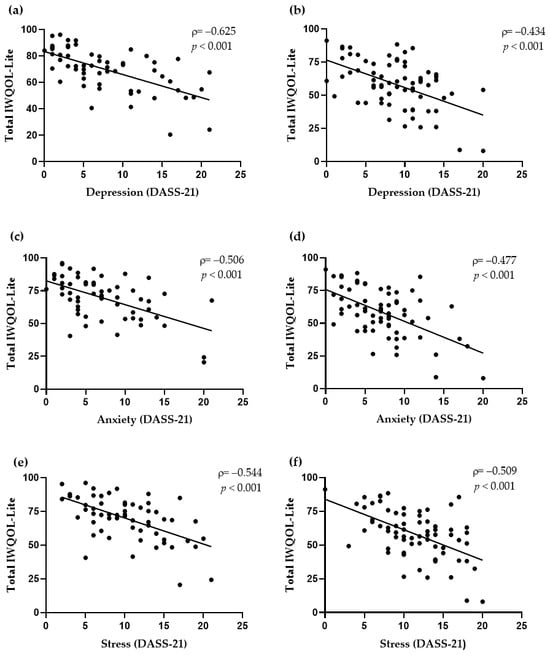
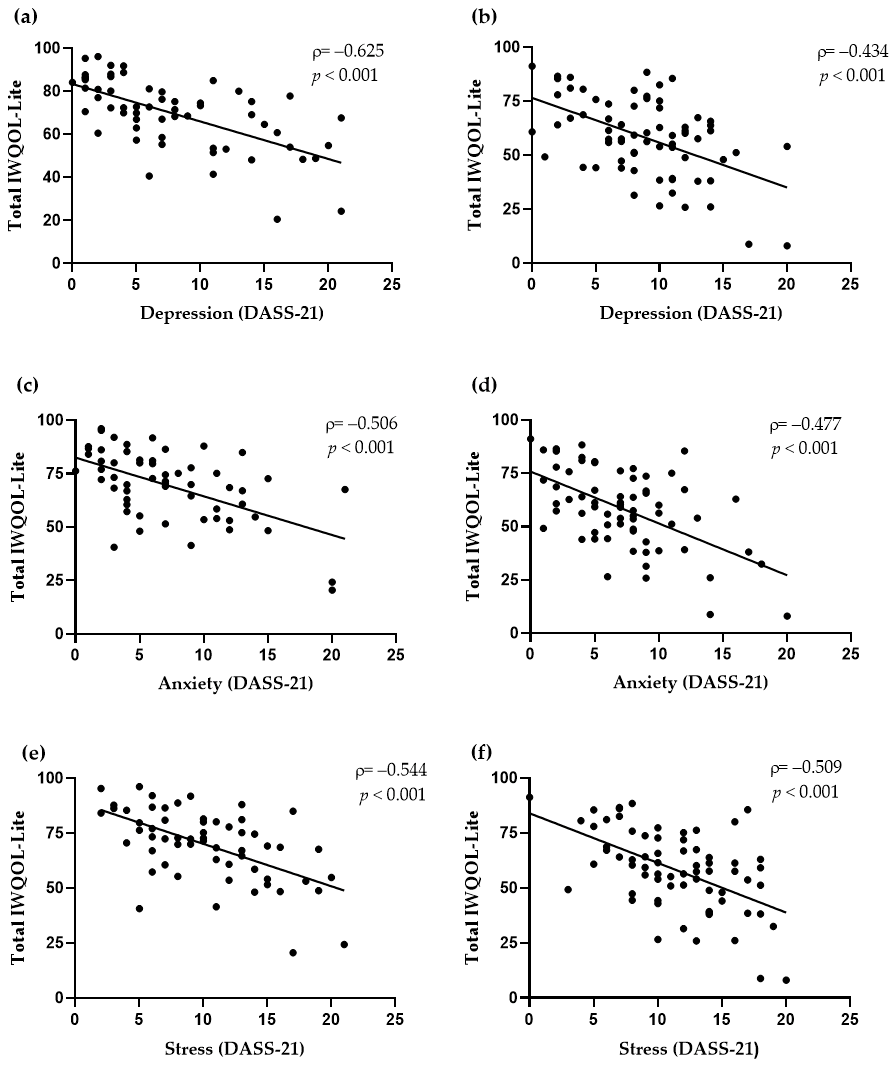
The analysis revealed a significant negative correlation between the DASS-21 scores and the total IWQOL-Lite score in both the overweight and obese groups (all p < 0.001), suggesting that greater psychological distress is associated with a poorer overall quality of life in both weight status categories, as illustrated in Figure 1.
Figure 1.
Associations between the DASS-21 subscales (Depression, Anxiety, and Stress) and Total IWQOL-Lite. Depression (a,b), Anxiety (c,d), and Stress (e,f) were significantly correlated with Total IWQOL-Lite in both the overweight group (a,c,e) n = 59 and the obesity group (b,d,f) n = 69. ρ, Spearman’s rank correlation coefficient. Straight lines represent least-squares linear fits and are shown for visual purposes only.
3.3. A Higher Degree of Central Adiposity Is Associated with Greater Public Distress Among Women with Obesity
We also investigated the relationship between psychological distress and anthropometric indicators and biochemical variables using Spearman’s rank correlation analysis. Two weak associations were identified that did not survive the Bonferroni correction (stress-Adpn in the overweight group, ρ = 0.269, p = 0.039; depression-Adpn in the obese group, ρ = −0.281, p = 0.019), whereas for the remaining variables, no statistically significant correlations were observed between indicators of central adiposity, biochemical variables, and scores on the DASS-21 subscales (Supplementary Tables S1 and S2). Regarding the relationship between IWQOL-Lite scores and biochemical variables, several nominal associations (p < 0.05) were found, including that between the TyG index and the physical function domain; however, none of these associations remained significant after Bonferroni correction (Supplementary Table S3).
We found negative associations between indicators of central adiposity and certain domains of the IWQOL-Lite questionnaire among women with obesity (Table 4), but not in overweight women (Supplementary Table S4).
Table 4.
Selected associations between the IWQOL-Lite domains and anthropometric measures in the obesity group.
Women with greater WC and HC reported higher public distress, and this association remained significant after Bonferroni correction (p < 0.001); a nominal association was observed with WHtR (p = 0.003), which did not reach the corrected threshold (α = 0.0021). Greater WC, HC, and WHtR were also associated with poorer work performance and lower IWQOL-Lite scores, although none of these associations survived correction for multiple comparisons.
3.4. Waist Circumference and Hip Circumference Are Associated with Public Distress in Women with Obesity
In addition, we examined whether WC and HC were associated with public distress in women with obesity using linear regression models (Table 5). In the crude models, both HC and WC were significantly associated with public distress (p < 0.001), each explaining a similar proportion of variance in scores (R2 = 0.217 and R2 = 0.192, respectively). After adjusting for age, these associations remained essentially unchanged for both HC and WC (p < 0.001). However, when BMI was added to the model, the associations were attenuated, and both HC and WC lost statistical significance (p = 0.081 and p = 0.085, respectively), and the VIF increased (up to 4.508 and 2.991, respectively), reflecting the strong correlation between BMI and both measures. Thus, the associations of HC and WC with public distress were independent of age but not of overall adiposity; these models describe conditional associations and do not imply causation (Supplementary Table S5).
Table 5.
Linear regression models of the association between waist circumference and hip circumference and public distress in women with obesity.
4. Discussion
In this study, we analyzed the relationship between HRQoL, psychological distress, central adiposity, and insulin resistance in overweight and obese women. Our main findings indicate that obese women had significantly higher insulin levels and surrogate measures of insulin resistance, as well as lower scores on the IWQOL-Lite scale, compared to the overweight group. Additionally, we found that lower quality of life is linked to higher levels of depression, anxiety, and stress symptoms in both overweight and obese women, with self-esteem, public distress, and work performance being the domains most strongly correlated with psychological distress. Lastly, adjusted linear regression models indicated that WC, an anthropometric indicator of central adiposity, and HC were associated with public distress among women with obesity independently of age, although these associations were no longer significant after adjustment for BMI.
Excess body fat has a negative impact on metabolic parameters [28,29,30]. Consistent with this, obese women in our cohort showed a significantly higher prevalence of hyperinsulinemia (FINS ≥ 13.30 µU/mL) and insulin resistance as measured by the HOMA-IR, QUICKI, and HOMA-Adpn indices, compared with the overweight group. Hyperinsulinemia is accompanied by increased adiposity and decreased insulin sensitivity as adipose tissue becomes dysfunctional, leading to reduced secretion of protective adipokines such as Adpn [31,32,33]. In fact, the lower Adpn levels observed in the obese group of our study support this pattern; furthermore, a recent systematic review and meta-analysis on circulating adipokines in obesity highlighted that Adpn levels were significantly lower in obese individuals than in those of normal weight [34], which is relevant because Adpn increases insulin sensitivity and reduces inflammation in adipose tissue [35]. Obesity can also negatively affect psychological health. This link between obesity and disorders such as depression, anxiety, and stress stems from multiple causes, including a low-grade pro-inflammatory state, in which dysfunctional adipose tissue secretes cytokines capable of influencing the neurotransmitter systems involved in mood regulation [36,37].
Various studies have separately documented the impact of obesity on quality of life and on depression, anxiety, and stress, although few have evaluated both dimensions simultaneously. Regarding quality of life, patients with obesity report a marked decline, with a gradient that becomes more pronounced as the weight category increases [16,17,18,38,39]. Concerning depression, anxiety, and stress symptoms, one study revealed a strong correlation between obesity and a higher prevalence of these symptoms as measured by the DASS-21, while another found that the higher the mean DASS-21 score, the higher the level of obesity [5,6]. Along the same lines, a 10-year longitudinal study of European adults showed that living with obesity, overweight, or underweight predicted lower quality of life and higher levels of depression in the future, with the strongest effect observed in people with obesity [7]. Our results complement this evidence by showing that higher scores on measures of depression, anxiety, and stress were inversely correlated with the IWQOL-Lite Total score in both overweight and obese women (ρ = −0.434 to −0.625). Self-esteem was the IWQOL-Lite domain most strongly associated with depression, anxiety, and stress symptoms in both groups. This finding is supported by a 2024 meta-analysis of data from 16 studies (n = 2972) that reported a small negative correlation between BMI and global self-esteem in adults (r = −0.11) [19]. In addition, a more recent study from 2025, which examined nearly 3000 women, found that self-esteem was the domain with the greatest impairment across all weight categories, with increasingly worse outcomes as obesity class intensified [40].
Interestingly, in our study, no surrogate measures of insulin resistance or measures of central adiposity (WC, WHR, and WHtR) and HC were significantly associated with the DASS-21 subscales in either of the two weight status groups (Supplementary Tables S1 and S2). These results differ from those observed in populations with diabetes mellitus and metabolic syndrome, in which an association has been found between insulin resistance and depression or perceived stress [41,42]. A study conducted in a predominantly obese population revealed differences between individuals with and without insulin resistance; the former had higher scores on depression and anxiety scales [43]. In this regard, we observed that the obese population had a higher HOMA-IR value, as well as numerically, but not significantly, higher scores of depression, anxiety, and stress, compared to the overweight population; however, we did not observe any significant association between these variables. The absence of significant differences in DASS-21 scores between groups may reflect the BMI distribution of our sample, which did not include women with normal weight and in which most women with obesity had class I obesity (44 of 69), as well as the limited statistical power after stratification. Regarding measures of central adiposity, our findings are consistent with those reported in Iranian adults, who also found no linear association between BMI, WHR, or WHtR and the DASS-21 [44].
In contrast, WC and HC were significantly correlated with the public distress domain of the IWQOL-Lite in women with obesity. A similar pattern was reported in overweight women in rural areas, where WC was positively correlated with a decline in the total quality of life score (r = 0.277, p < 0.001) [38]. Our finding that WC and HC were not associated with the DASS-21, but were associated with quality of life, which, in turn, was associated with psychological distress, is compatible with an indirect relationship that warrants confirmation in longitudinal studies. This is partly consistent with a study conducted in a German population. In that study, HRQoL fully mediated the relationship between BMI and symptoms of depression and anxiety [8]. In our study, after adjusting for BMI, the association of WC and HC with the public distress domain was weakened.
The main strength of this study is that it has allowed us to simultaneously evaluate several variables in the same population, enabling us to examine the relationships between central adiposity, insulin resistance, weight-related quality of life, and psychological distress, an approach that few previous studies have adopted in combination. This study also has several limitations. For example, its cross-sectional design prevents us from drawing causal inferences and does not allow us to determine the temporal or directional relationship between adiposity, quality of life, and psychological distress; reverse causality cannot be ruled out. In addition, both psychological distress and weight-related quality of life were assessed using self-report questionnaires administered during the same visit; therefore, the variance shared by the measurement method may have inflated the observed correlations. Furthermore, there is some conceptual overlap between the DASS-21 and certain domains of the IWQOL-Lite, particularly self-esteem, whose items reflect a negative self-assessment that is also captured in the depression subscale; however, the IWQOL-Lite items specifically attribute these experiences to body weight, whereas the DASS-21 assesses general emotional symptoms. Moreover, the DASS-21 assesses symptom severity and does not provide clinical diagnoses; therefore, our findings refer to depressive, anxiety, and stress symptoms rather than to psychiatric disorders.
Furthermore, the sample size when stratified by weight status may have limited statistical power and prevented more detailed subgroup analyses. Another limitation stems from the nature of the sample, as participants were recruited from an ongoing clinical trial evaluating a specific weight-control intervention, which may introduce selection bias, since individuals actively seeking treatment may systematically differ from the general population of overweight or obese women; furthermore, by not including a comparison group of normal-weight individuals, it limits our ability to determine whether the observed associations are specific to excess weight or reflect a broader pattern across the entire BMI range. In addition, several associations reached only nominal significance and did not survive correction for multiple comparisons; these should be considered exploratory, and statistical significance should not be equated with clinical relevance.
Finally, in the present study, we also did not assess potential key factors such as physical activity, dietary habits, socioeconomic status, psychiatric history, sleep problems, or digital media use. Sleep problems and Internet use have been associated with poorer mental health in young adults [45], although these data come from college students assessed using different instruments and should be considered contextual rather than specific to obesity. Future longitudinal studies should address these limitations to strengthen the evidence regarding the association between quality of life and depression, anxiety, and stress symptoms in overweight and obese individuals; similarly, larger samples could help provide more consistent evidence of the nominal associations observed between depression and Adpn, or between quality of life and the TyG index, which did not survive correction for multiple comparisons.
5. Conclusions
In conclusion, in our sample of women from Mexico City, obesity was associated with higher surrogate measures of insulin resistance and poorer quality of life compared with overweight, with significant differences in the physical function, sexual life, and public distress domains and in the total IWQOL-Lite score. Furthermore, a higher IWQOL-Lite score was consistently associated with lower levels of depression, anxiety, and stress symptoms in both weight status groups, with self-esteem, public distress, and work being the domains most strongly correlated with psychological distress. Likewise, WC and HC were associated with public distress among women with obesity independently of age, although this association was attenuated and no longer significant after adjustment for BMI. These findings suggest that HRQoL is closely linked to psychological distress in women with obesity, which justifies conducting further clinical and longitudinal studies to evaluate comprehensive strategies that take overall health status into account.
Supplementary Materials
The following supporting information can be downloaded at: https://www.mdpi.com/article/10.3390/healthcare14223879/s1, Table S1: Association between the DASS-21 subscales with biochemical parameters and insulin resistance surrogate measures, stratified by weight status; Table S2: Associations between the DASS-21 subscales and anthropometric measures, stratified by weight status; Table S3: Associations between the IWQOL-Lite domains and biochemical parameters, stratified by weight status; Table S4: Associations between the IWQOL-Lite domains and anthropometric measures, stratified by weight status; Table S5. Linear regression models of the association between WC and HC and public distress in women with obesity.
Author Contributions
Conceptualization, J.S.-S.; methodology, E.M.F.-N. and J.S.-S.; software, G.S.F.-S.; formal analysis, G.S.F.-S.; investigation, E.M.F.-N. and C.A.L.-S.; resources, J.S.-S.; data curation, J.S.-S.; writing—original draft preparation, J.S.-S. and E.M.F.-N.; writing—review and editing, J.S.-S. and E.M.F.-N.; visualization, C.A.L.-S.; supervision, C.A.L.-S.; project administration G.S.F.-S.; funding acquisition, J.S.-S. All authors have read and agreed to the published version of the manuscript.
Funding
This research received support from the Secretaría de Investigación y Posgrado at the Instituto Politécnico Nacional, México (SIP:20260697).
Institutional Review Board Statement
This study was conducted in accordance with the principles of the Declaration of Helsinki. Ethical approval was granted by the Ethics Committee of the Escuela Nacional de Medicina y Homeopatía at the Instituto Politécnico Nacional, under registration number CBE/024/2025, approval date: 4 March 2026.
Informed Consent Statement
Informed consent was obtained from all subjects involved in the study.
Data Availability Statement
The data presented in this research are available upon request from the corresponding author due to privacy.
Acknowledgments
The team would like to express its sincere gratitude to the patients and medical staff, especially Gilberto Garza Treviño, whose participation and support made this study possible.
Conflicts of Interest
The authors declare no conflicts of interest. The funders had no role in the design of the study; in the collection, analysis, or interpretation of data; in the writing of the manuscript; or in the decision to publish the results.
Abbreviations
The following abbreviations are used in this manuscript:
| HRQoL | Health-related quality of life |
| BMI | Body mass index |
| WC | Waist circumference |
| HC | Hip circumference |
| WHR | Waist-to-hip ratio |
| WHtR | Waist-to-height ratio |
| DASS-21 | Depression Anxiety Stress Scales-21 |
| IWQOL-Lite | Impact of Weight on Quality of Life-Lite |
| FG | Fasting glucose |
| TC | Total cholesterol |
| TG | Triglycerides |
| FINS | Fasting insulin |
| Adpn | Adiponectin |
| HOMA-IR | Homeostatic Model Assessment for Insulin Resistance |
| QUICKI | Quantitative Insulin Sensitivity Check Index |
| TyG | Triglyceride-Glucose index |
| HOMA-Adpn | Homeostasis model assessment-adiponectin |
| IQR | Interquartile range |
| CI | Confidence interval |
| VIF | Variance inflation factor |
| R2 | Coefficient of determination |
References
- Saeed, S.; Bonnefond, A.; Froguel, P. Obesity: Exploring Its Connection to Brain Function through Genetic and Genomic Perspectives. Mol. Psychiatry 2025, 30, 651–658. [Google Scholar] [CrossRef] [Scilit] [PubMed]
- World Obesity Atlas 2025. Available online: https://www.worldobesity.org/resources/resource-library/world-obesity-atlas-2025 (accessed on 10 August 2026).
- Barquera, S.; Hernández-Barrera, L.; Oviedo-Solís, C.; Rodríguez-Ramírez, S.; Monterrubio-Flores, E.; Trejo-Valdivia, B.; Martínez-Tapia, B.; Aguilar-Salinas, C.; Galván-Valencia, O.; Chávez-Manzanera, E.; et al. Obesidad en adultos. Salud Publica Mex. 2024, 66, 414–424. [Google Scholar] [CrossRef] [Scilit] [PubMed]
- Ferreira-Hermosillo, A.; de Miguel Ibañez, R.; Pérez-Dionisio, E.K.; Villalobos-Mata, K.A. Obesity as a Neuroendocrine Disorder. Arch. Med. Res. 2023, 54, 102896. [Google Scholar] [CrossRef] [Scilit] [PubMed]
- Jaison K., I.; Asharaf, H.; Thimothy, G.; George, S.; Jose, J.; Paily, R.; Josey, J.; Sajna, S.J.; Radhakrishnan, R. Psychological Impact of Obesity: A Comprehensive Analysis of Health-Related Quality of Life and Weight-Related Symptoms. Obes. Med. 2024, 45, 100530. [Google Scholar] [CrossRef] [Scilit]
- Efe Ertürk, N.; Ayhan, F.; Koçak, Y.; Zeyrek, E. The Relationship between Emotional Eating and Depression, Anxiety, and Stress in Turkish Adults with Obesity. BMC Psychol. 2026, 14, 509. [Google Scholar] [CrossRef] [Scilit] [PubMed]
- Rindler, G.A.; Gries, A.; Freidl, W. Associations between Overweight, Obesity, and Mental Health: A Retrospective Study among European Adults Aged 50. Front. Public Health 2023, 11, 1206283. [Google Scholar] [CrossRef] [Scilit] [PubMed]
- Herhaus, B.; Kersting, A.; Brähler, E.; Petrowski, K. Depression, Anxiety and Health Status across Different BMI Classes: A Representative Study in Germany. J. Affect. Disord. 2020, 276, 45–52. [Google Scholar] [CrossRef] [Scilit] [PubMed]
- Amiri, S.; Behnezhad, S. Obesity and Anxiety Symptoms: A Systematic Review and Meta-Analysis. Neuropsychiatrie 2019, 33, 72–89. [Google Scholar] [CrossRef] [Scilit] [PubMed]
- de Wit, L.; Have, M.T.; Cuijpers, P.; de Graaf, R. Body Mass Index and Risk for Onset of Mood and Anxiety Disorders in the General Population: Results from the Netherlands Mental Health Survey and Incidence Study-2 (NEMESIS-2). BMC Psychiatry 2022, 22, 522. [Google Scholar] [CrossRef] [Scilit] [PubMed]
- Tenk, J.; Mátrai, P.; Hegyi, P.; Rostás, I.; Garami, A.; Szabó, I.; Hartmann, P.; Pétervári, E.; Czopf, L.; Hussain, A.; et al. Perceived Stress Correlates with Visceral Obesity and Lipid Parameters of the Metabolic Syndrome: A Systematic Review and Meta-Analysis. Psychoneuroendocrinology 2018, 95, 63–73. [Google Scholar] [CrossRef] [Scilit] [PubMed]
- Kim, Y.; Woo, H. The Association between Perceived Stress and Obesity among Young Adults: Mediating Effect of Health Status. Public Health 2025, 246, 105816. [Google Scholar] [CrossRef] [Scilit] [PubMed]
- Karaağaç, Y.; Ceylan, C.; Bellikci-Koyu, E. The Relationships among Perceived Stress, Mindful Eating, Addiction-like Eating Behavior, and BMI in Adults: Exploring Gender-Specific Pathways. Eat. Behav. 2025, 57, 101989. [Google Scholar] [CrossRef] [Scilit] [PubMed]
- Kortt, M.A.; Bernardelli, L.V.; Wijeweera, A.; Charles, M.B.; Toffaha, K. The Association between Obesity and Health-Related Quality of Life: Recent Evidence from Australia. Appl. Res. Qual. Life 2026, 21, 1621–1639. [Google Scholar] [CrossRef] [Scilit]
- Okolo, D.; Akpanumo, B.; Okeke, C.H.; Aniekwe, C.E.; Ezenekwe, E.B.; Okobi, O.E.; Olaniyi, M.; Aboyeji, A. The influence of obesity on quality of life: A systematic review. J. Adv. Med. Med. Res. 2024, 36, 267–279. [Google Scholar] [CrossRef] [Scilit]
- Montero-Peregrina, E.P.; Soto-Ávila, V.; García-Rezéndiz, A.; González-López, S.; Hernández-Gómez, M.Á.; Juárez-Mendoza, R.I.; Meza-Hernández, R.M. Health-related quality of life in Mexican women with obesity. Rev. Med. Inst. Mex. Seguro Soc. 2024, 62, e5471. [Google Scholar] [CrossRef] [Scilit] [PubMed]
- Casaes, A.C.; Menezes, C.A.; Dos Santos, R.A.; Souza, B.O.L.; Cunha Silva, B.R.B.; Tabajara, Y.; Macedo, M.N.; de Jesus, K.E.M.; Fialho, T.R.d.S.; de Souza, R.d.P.; et al. Nutritional Status and Quality of Life: Urban-Rural Disparities and the Impact of Obesity. Int. J. Environ. Res. Public Health 2024, 21, 1455. [Google Scholar] [CrossRef] [Scilit] [PubMed]
- Reinbacher, P.; Draschl, A.; Smolle, M.A.; Hecker, A.; Gaderer, F.; Lanner, K.-B.; Ruckenstuhl, P.; Sadoghi, P.; Leithner, A.; Nehrer, S.; et al. The Impact of Obesity on the Health of the Older Population: A Cross-Sectional Study on the Relationship between Health-Related Quality of Life and Body Mass Index across Different Age Groups. Nutrients 2023, 16, 51. [Google Scholar] [CrossRef] [Scilit] [PubMed]
- Moyon, L.; Gonthier, C.; Brun, L.; Cabagno, G.; Somat, A.; Le Foll, D. Global Self-Esteem and Degree of Overweight/Obesity: Are They Linked in the Adult Population? A Systematic Review and Meta-Analysis. Psychol. Health 2026, 41, 200–223. [Google Scholar] [CrossRef] [Scilit] [PubMed]
- Lovibond, P.F.; Lovibond, S.H. The Structure of Negative Emotional States: Comparison of the Depression Anxiety Stress Scales (DASS) with the Beck Depression and Anxiety Inventories. Behav. Res. Ther. 1995, 33, 335–343. [Google Scholar] [CrossRef] [Scilit] [PubMed]
- Salinas-Muñoz, J.; Livia Segovia, J.H.; Campos-Uscanga, Y.; Argüelles-Nava, V.G.; Contreras-Alarcón, G.; Mota-Morales, M.D.L. Características psicométricas de la Escala de Depresión, Ansiedad y Estrés (DASS-21) en estudiantes universitarios. Investig. Educ. Médica 2024, 13, 68–78. [Google Scholar] [CrossRef] [Scilit]
- Wrzecionkowska, D.; Calleja, N. Impact of weight on quality-of-life questionnaire-Lite, Mexican version. Reliability and validity evidence. Rev. Psicol. 2022, 31, 67–79. [Google Scholar] [CrossRef] [Scilit]
- Schrank, Y.; Fontes, R.; Perozo, A.F.D.F.; Araújo, P.B.; Pinheiro, M.F.M.C.; Gomes, D.M.V.; Vieira, L.M.F. Proposal for Fasting Insulin and HOMA-IR Reference Intervals Based on an Extensive Brazilian Laboratory Database. Arch. Endocrinol. Metab. 2024, 68, e230483. [Google Scholar] [CrossRef] [Scilit] [PubMed]
- Gómez-García, A.; Nieto-Alcantar, E.; Gómez-Alonso, C.; Figueroa-Nuñez, B.; Alvarez-Aguilar, C. Parámetros antropométricos como predictores de resistencia a la insulina en adultos con sobrepeso y obesidad. Aten. Primaria 2010, 42, 364–371. [Google Scholar] [CrossRef] [Scilit] [PubMed]
- Almeda-Valdés, P.; Bello-Chavolla, O.Y.; Caballeros-Barragán, C.R.; Gómez-Velasco, D.V.; Viveros-Ruiz, T.; Vargas-Vázquez, A.; Aguilar-Salinas, C.A. Índices para la evaluación de la resistencia a la insulina en individuos mexicanos sin diabetes. Gac. Med. Mex. 2018, 154, S50–S55. [Google Scholar] [CrossRef] [Scilit] [PubMed]
- Simental-Mendía, L.E.; Rodríguez-Morán, M.; Guerrero-Romero, F. The product of fasting glucose and triglycerides as surrogate for identifying insulin resistance in apparently healthy subjects. Metab. Syndr. Relat. Disord. 2008, 6, 299–304. [Google Scholar] [CrossRef] [Scilit] [PubMed]
- Vilela, B.S.; Vasques, A.C.J.; Cassani, R.S.L.; Forti, A.C.E.; Pareja, J.C.; Tambascia, M.A.; BRAMS Investigators; Geloneze, B. The HOMA-Adiponectin (HOMA-AD) Closely Mirrors the HOMA-IR Index in the Screening of Insulin Resistance in the Brazilian Metabolic Syndrome Study (BRAMS). PLoS ONE 2016, 11, e0158751. [Google Scholar] [CrossRef] [Scilit] [PubMed]
- Ramírez-Vélez, R.; Correa-Rodríguez, M.; Calderón-González, J.C.; Dávila-Grisales, A.; González-Ruíz, K.; Correa-Bautista, J.E.; Izquierdo, M. The Association between Insulin Resistance and Cytokines in Adolescents with Excess of Adiposity. Curr. Probl. Cardiol. 2025, 50, 102925. [Google Scholar] [CrossRef] [Scilit] [PubMed]
- Yazıcı, D.; Demir, S.Ç.; Sezer, H. Insulin Resistance, Obesity, and Lipotoxicity. Adv. Exp. Med. Biol. 2024, 1460, 391–430. [Google Scholar] [CrossRef] [Scilit] [PubMed]
- Busebee, B.; Ghusn, W.; Cifuentes, L.; Acosta, A. Obesity: A Review of Pathophysiology and Classification. Mayo Clin. Proc. 2023, 98, 1842–1857. [Google Scholar] [CrossRef] [Scilit] [PubMed]
- Fryk, E.; Olausson, J.; Mossberg, K.; Strindberg, L.; Schmelz, M.; Brogren, H.; Gan, L.-M.; Piazza, S.; Provenzani, A.; Becattini, B.; et al. Hyperinsulinemia and Insulin Resistance in the Obese May Develop as Part of a Homeostatic Response to Elevated Free Fatty Acids: A Mechanistic Case-Control and a Population-Based Cohort Study. eBioMedicine 2021, 65, 103264. [Google Scholar] [CrossRef] [Scilit] [PubMed]
- Ahmed, B.; Sultana, R.; Greene, M.W. Adipose Tissue and Insulin Resistance in Obese. Biomed. Pharmacother. 2021, 137, 111315. [Google Scholar] [CrossRef] [Scilit] [PubMed]
- Gariballa, S.; Alkaabi, J.; Yasin, J.; Al Essa, A. Total Adiponectin in Overweight and Obese Subjects and Its Response to Visceral Fat Loss. BMC Endocr. Disord. 2019, 19, 55. [Google Scholar] [CrossRef] [Scilit] [PubMed]
- Sunita, S.; Ghozali, M.; Rizki Akbar, M.; Nugrahani, A.D.; Rakhmat, I.I.; Nur Fatimah, S.; Susanti Pratiwi, Y.; Ariyanto, E.F.; Nugraha, G.I.; Syamsunarno, M.R.A.A.; et al. Recent Insights into Circulating Adipokines in Obesity: Systematic Review and Meta-Analysis. Obes. Sci. Pract. 2026, 12, e70113. [Google Scholar] [CrossRef] [Scilit] [PubMed]
- Han, Y.; Sun, Q.; Chen, W.; Gao, Y.; Ye, J.; Chen, Y.; Wang, T.; Gao, L.; Liu, Y.; Yang, Y. New Advances of Adiponectin in Regulating Obesity and Related Metabolic Syndromes. J. Pharm. Anal. 2024, 14, 100913. [Google Scholar] [CrossRef] [Scilit] [PubMed]
- Chen, P.; Zhang, P.; Lin, Z.; Qiu, J.; Zou, M.; Liu, R.; Huang, L.; Sun, W. Association between Changes in Obesity Status and Neuropsychiatric Health and Brain Structure in Different Glucose Status. Front. Nutr. 2025, 12, 1676168. [Google Scholar] [CrossRef] [Scilit] [PubMed]
- Dębski, J.; Przybyłowski, J.; Skibiak, K.; Czerwińska, M.; Walędziak, M.; Różańska-Walędziak, A. Depression and Obesity-Do We Know Everything about It? A Narrative Review. Nutrients 2024, 16, 3383. [Google Scholar] [CrossRef] [Scilit] [PubMed]
- Hisar, K.M.; Yamac, S.U.; Hisar, F. Determination of Quality of Life and Related Factors in Overweight Women Living in Rural Areas. Niger. J. Clin. Pract. 2023, 26, 552–557. [Google Scholar] [CrossRef] [Scilit] [PubMed]
- Stephenson, J.; Smith, C.M.; Kearns, B.; Haywood, A.; Bissell, P. The Association between Obesity and Quality of Life: A Retrospective Analysis of a Large-Scale Population-Based Cohort Study. BMC Public Health 2021, 21, 1990. [Google Scholar] [CrossRef] [Scilit] [PubMed]
- Ko, H.-J.; Kapoor, N.; Garcia, M.M.; Jung, S.G.; Romano, J.G.U.; Hocking, S.L. Understanding the Impact of Weight on Quality of Life and Willingness to Pay for Obesity Management in the APAC Region. Clin. Obes. 2026, 16, e70066. [Google Scholar] [CrossRef] [Scilit] [PubMed]
- Ehrmann, D.; Krause-Steinrauf, H.; Uschner, D.; Wen, H.; Hoogendoorn, C.J.; Crespo-Ramos, G.; Presley, C.; Arends, V.L.; Cohen, R.M.; Garvey, W.T.; et al. Differential Associations of Somatic and Cognitive-Affective Symptoms of Depression with Inflammation and Insulin Resistance: Cross-Sectional and Longitudinal Results from the Emotional Distress Sub-Study of the GRADE Study. Diabetologia 2025, 68, 1403–1415. [Google Scholar] [CrossRef] [Scilit] [PubMed]
- Garcia-Ravelo, K.F.; Martagon, A.J.; Galán-Ramírez, G.A.; Morales-Esponda, M.; Delgado-Magaña, G.; Portillo-Martínez, I.; Farina, M.; Muñoz, E.; Sanchez, C.; Soto-Mota, A. Association between Perceived Stress and Metabolic Parameters: A Systematic Review and Meta-Analysis. Diabetol. Metab. Syndr. 2026, 18, 202. [Google Scholar] [CrossRef] [Scilit] [PubMed]
- Díaz-Carías, J.P.; Morilla Romero de la Osa, R.; Cano-Rodríguez, M. Relationship between Insulin-Biochemical Resistance Levels and the Degree of Depression and Anxiety in Patients from Honduras. Int. J. Diabetes Dev. Ctries. 2022, 43, 750–757. [Google Scholar] [CrossRef] [Scilit]
- Jibril, A.T.; Ganjeh, B.J.; Mirrafiei, A.; Firouzi, M.; Norouziasl, R.; Ghaemi, S.; Bafkar, N.; Jayedi, A.; Djafarian, K.; Shab-Bidar, S. Dose-Response Association of Obesity and Risk of Mental Health among Tehranian Residents: Result of a Cross-Sectional Study. BMC Public Health 2024, 24, 1444. [Google Scholar] [CrossRef] [Scilit] [PubMed]
- Falbová, D.; Švábová, P.; Vorobeľová, L. Lifestyle-Related Predictors of Mental Well-Being and Depressive Symptoms among Young Adult Students at a Slovak University. Bratisl. Lek. Listy 2026, 127, 4748–4760. [Google Scholar] [CrossRef] [Scilit]

Disclaimer/Publisher’s Note: The statements, opinions and data contained in all publications are solely those of the individual author(s) and contributor(s) and not of MDPI and/or the editor(s). MDPI and/or the editor(s) disclaim responsibility for any injury to people or property resulting from any ideas, methods, instructions or products referred to in the content. |
© 2026 by the authors. Licensee MDPI, Basel, Switzerland. This article is an open access article distributed under the terms and conditions of the Creative Commons Attribution (CC BY) license.