


Abstract
Background/Objectives: This study aimed to characterize adverse event (AE) reporting patterns associated with tobacco cessation medications using nationwide pharmacovigilance data from Korea. Methods: A retrospective pharmacovigilance study on tobacco cessation medications using the Korea Adverse Event Reporting System database (KIDS KAERS DB) was conducted. Descriptive analyses were performed to summarize demographic and reporting characteristics and AE patterns. Disproportionality analyses, including proportional reporting ratios (PRR), reporting odds ratios (ROR), and information components (IC), were performed to detect potential signals of disproportionate reporting. Results: A total of 779 individual case safety reports (ICSRs) involving tobacco cessation medications were included. Nicotine replacement therapy (NRT) accounted for 606 ICSRs (77.79%), followed by varenicline (n = 150, 19.26%) and bupropion (n = 23, 2.95%). Age information was unavailable for 558 ICSRs (71.63%). Among ICSRs with documented age information, the 50–59-year age group was the most frequently represented. Fifty-two serious ICSRs (6.68%) were identified, comprising 49 ICSRs involving NRT and 3 involving bupropion. SOC-level disproportionality analyses identified signals of disproportionate reporting for psychiatric disorders for bupropion and psychiatric and gastrointestinal disorders for varenicline. All identified signals remained detectable after excluding reports involving individuals aged <18 years, whereas causality-based restriction altered the detected signal patterns. Conclusions: This nationwide pharmacovigilance study identified medication-specific adverse event reporting patterns across NRT, bupropion, and varenicline. While these findings do not establish causal relationships, the observed differences in reporting patterns provide pharmacovigilance insights into the post-marketing reporting patterns of tobacco cessation pharmacotherapies and support further evaluation using pharmacoepidemiologic studies with appropriate exposure denominators.
1. Introduction
Tobacco use remains a major preventable cause of morbidity and mortality worldwide, contributing substantially to the global burden of cardiovascular disease, cancer, and respiratory disorders [1]. More than 8 million deaths are attributed to tobacco use annually, including over 7 million from direct tobacco use [1,2,3]. Despite ongoing tobacco control efforts, many individuals struggle to quit due to nicotine dependence and withdrawal symptoms [4,5]. Pharmacological interventions, including nicotine replacement therapy (NRT), varenicline, and bupropion, are widely recommended to support smoking cessation and improve quit rates [6,7].
Although these medications are generally effective and well tolerated, each has a distinct safety profile that requires consideration in clinical practice. NRT is generally well tolerated, with adverse effects primarily related to the formulation, such as skin irritation with transdermal patches and oral irritation with gum or tablets [8]. Earlier post-marketing reports raised concerns regarding neuropsychiatric and cardiovascular adverse events (AEs), particularly with varenicline and bupropion [9]. However, the EAGLES randomized trial found no significant increase in moderate-to-severe neuropsychiatric AEs with varenicline or bupropion compared with NRT or placebo, and subsequent analyses found no significant differences in major cardiovascular events among these treatments [10,11]. Consistent with these findings, subsequent regulatory assessment by the European Medicines Agency found no evidence supporting an increased risk of neuropsychiatric events with varenicline [12]. Nevertheless, continued pharmacovigilance remains important for identifying rare or unexpected AEs that may not be fully characterized in clinical trials.
Pharmacovigilance databases provide valuable opportunities to identify rare or unexpected AEs that may not be detected in pre-marketing clinical trials [13]. Spontaneous reporting systems are useful for detecting potential safety signals, although reported associations do not establish causality [14,15,16,17]. Previous pharmacovigilance studies have examined smoking-cessation medications using national and international spontaneous-reporting databases [14,15,16,17]. Previous Korean pharmacovigilance research using the Korea Adverse Event Reporting System database (KAERS DB) has primarily focused on signal detection for varenicline [17], while concurrent evaluation of AE reporting patterns across NRT, bupropion, and varenicline within the same national pharmacovigilance database remains limited. Therefore, the primary objective of this study was to characterize AE reporting patterns associated with NRT, bupropion, and varenicline in the KIDS KAERS DB and to identify potential signals of disproportionate reporting. Secondary objectives were to describe demographic characteristics, seriousness, temporal reporting patterns, and reporter characteristics at the individual case safety report (ICSR) level.
2. Materials and Methods
2.1. Study Design and Data Collection
A disproportionality analysis using individual case safety reports from KIDS KAERS DB was conducted in accordance with the strengthening the reporting of observational studies in epidemiology (STROBE) guidelines and the Reporting of A Disproportionality Analysis for DrUg Safety Signal Detection using Individual Case Safety Reports in Pharmacovigilance (READUS-PV) recommendations (Tables S1 and S2) [18,19]. This study analyzed adverse drug events (ADEs) related to tobacco cessation products, including bupropion, NRT, and varenicline spontaneously reported to the KIDS KAERS DB, constructed by the Korea Institute of Drug Safety & Risk Management (KIDS, Ministry of Food and Drug Safety), between 1 January 2014 and 31 December 2023. Because formulation and route information were not consistently available throughout the study period, smoking-cessation medications were classified at the active-ingredient level, with nicotine-containing products grouped as NRT. The causality of ADEs was assessed according to the World Health Organization-Uppsala Monitoring Centre (WHO-UMC) criteria [20]. To minimize potential indication bias, particularly for bupropion, only reports associated with tobacco cessation-related diagnoses or treatment indications were included. Reports with missing indication information or with indications that could not be clearly classified as tobacco cessation-related were excluded. Eligible cases were restricted to reports containing tobacco-related Korean Standard Classification Disease (KCD) codes, including nicotine dependence (F17), and tobacco use (Z72.0), or tobacco cessation-related efficacy terms, such as smoking cessation therapy, smoking cessation, tobacco use, tobacco withdrawal symptoms, tobacco dependence, or nicotine-related effects. The prespecified exclusion criteria were reports associated with non-tobacco cessation indications, including major depressive disorder, insomnia, or other psychiatric indications for which bupropion may be prescribed, and reports involving masked (MSK-coded) etiologic medications. The KIDS KAERS DB assigns MSK codes to medication products marketed by fewer than two pharmaceutical companies. The following data were extracted from KIDS KAERS DB: (1) patient demographics (sex and age), (2) medical histories and concurrent medications, and (3) ADE characteristics, including etiologic medication, occurrence date, causality assessment, ADE type, and seriousness. ICSRs were identified using anonymized KAERS report number (KAERS_NO), which was used to link records belonging to the same safety report across the merged tables. After merging the relevant KAERS DB tables, rows with identical values across all variables were considered exact duplicates and were removed. When multiple versions of the same ICSR were available, only the most recent version was retained for analysis in accordance with the KIDS KAERS DB data-use guidelines [21]. Descriptive characteristics and seriousness were summarized at the ICSR level. For preferred-term (PT)-level descriptive analyses, each unique ICSR–drug–PT combination was counted once. For System Organ Class (SOC)-level analyses, multiple PTs belonging to the same SOC within a single ICSR were counted only once, whereas an ICSR could contribute to more than one SOC when different reported events belonged to different SOCs. AE terms in the KIDS KAERS DB were provided as MedDRA lowest level terms (LLTs), with World Health Organization-Adverse Reaction Terminology (WHO-ART) codes provided in the database. PT- and SOC-level analyses were based on the WHO-ART-coded variables using WHO-ART version 092. No conversion between MedDRA and WHO-ART was performed, and MedDRA LLT names were retained only to describe the originally reported adverse-event terms. SAEs were defined as any ADEs involving congenital abnormalities or birth defects, life-threatening conditions, death, a persistent or significant disability or incapacity, hospitalization or prolonged existing hospitalizations, and other medically significant events, in accordance with the International Conference on Harmonization (ICH) E2D guidelines. The study protocol was approved by KIDS (Ministry of Food and Drug Safety) (KIDS KAERS DB 2407A0003), and Kyung Hee University Institutional Review Board (IRB) (No. KHSIRB-25-515(EA), approved 31 October 2025).
2.2. Statistical Analysis
Descriptive statistics were performed to summarize the demographic and reporting characteristics of the included ICSRs and AE patterns. Age was expressed as the median and interquartile range (IQR) based on the Kolmogorov–Smirnov normality test. Missing demographic information was not imputed. Age- and sex-specific descriptive analyses were conducted using available information, and the proportion of missing demographic information was reported. For PT-level analyses, each unique ICSR–drug–PT combination was counted once. For SOC-level analyses, each unique ICSR–drug–SOC combination was counted once, such that multiple PTs belonging to the same SOC within a single ICSR did not inflate the SOC count. An ICSR could contribute to more than one SOC when different reported events belonged to different SOCs. For each target medication, the comparator comprised ICSRs involving the other two smoking-cessation medications. Accordingly, the disproportionality estimates represent relative reporting within the three smoking-cessation medication groups rather than comparisons with the entire KAERS database.
Disproportionality analyses were performed for medication–SOC and medication–PT combinations reported in at least three unique ICSRs (A ≥ 3) [22,23]. A signal of disproportionate reporting (SDR) was considered present only when all of the following criteria were met: PRR ≥ 2, ROR ≥ 2, Pearson’s chi-square ≥ 4, and IC025 > 0 [24]. PRR compares the proportion of a specific AE category reported for the target medication with that reported for the comparator medications, whereas ROR compares the corresponding reporting odds [19]. IC is a Bayesian measure of disproportionality on the log2 scale that compares observed with expected reporting and incorporates shrinkage through the BCPNN framework [19]. When any cell of the 2 × 2 contingency table contained zero, 0.5 was added to all four cells using the Haldane–Anscombe correction for estimation of the PRR and ROR. Pearson’s chi-square and the Bayesian Confidence Propagation Neural Network (BCPNN) were calculated using the original, uncorrected cell counts (Table 1). For BCPNN analysis, prior parameters were set to α1 = β1 = γ11 = 1 and α = β = 2. The posterior mean E (IC) was used as the IC estimate, with approximate 95% credibility limits calculated as IC025 = E(IC) − 2√V(IC) and IC975 = E(IC) + 2√V(IC) [25,26]. The primary disproportionality analysis included all eligible ICSRs regardless of WHO-UMC causality assessment, including reports with missing or unassessed causality information. The distribution of WHO-UMC causality assessment by medication is summarized in Table S3. A sensitivity analysis was performed after excluding ICSRs with documented age < 18 years while retaining those with missing age information. An additional sensitivity analysis was conducted by restricting drug–event relationships to those classified as “certain”, “probable/likely”, or “possible” according to WHO-UMC criteria to assess the influence of causality-based restriction on SDR detection. All other eligibility criteria and analytical procedures were maintained as in the primary analysis. Statistical analyses were conducted using IBM SPSS Statistics, version 26.0 (IBM Corp., Armonk, NY, USA) and R version 4.5.1 (R Foundation for Statistical Computing, Vienna, Austria). IC and its credibility limits were calculated in R using a custom implementation of the BCPNN equations described above.
Table 1.
Definition and signal detection criteria of data-mining indices.
3. Results
3.1. Baseline Characteristics
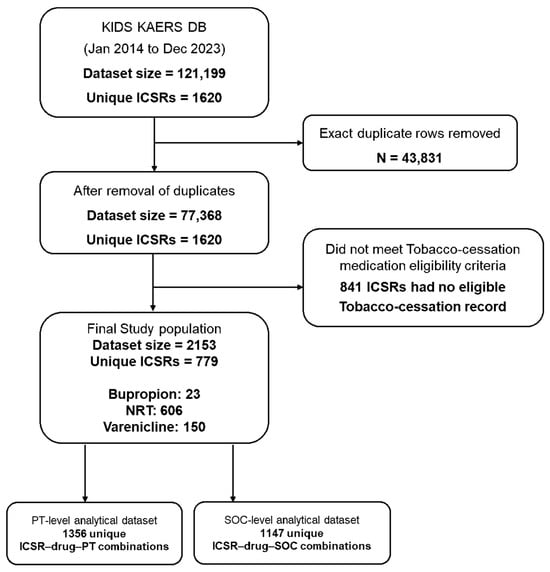
A total of 779 unique ICSRs involving tobacco cessation medications were included, comprising 1356 unique ICSR–drug–PT combinations and 1147 unique ICSR–drug–SOC combinations (Figure 1). Age information was available for 221 ICSRs and was missing for 558 ICSRs (71.63%) (Table 2). Among ICSRs with available age information, the median age was 47 years (IQR 29), and the 50–59-year age group was the most frequently represented (n = 45, 20.36%). Sixteen of the 221 ICSRs with available age information (7.24%) involved individuals aged <18 years. Sex information was available for 571 ICSRs, of which 458 (80.21%) involved male individuals. Reports from the general public constituted the largest primary reporter group (n = 341, 43.77%), followed by pharmacists (n = 251, 32.22%). NRT accounted for 606 ICSRs (77.79%), followed by varenicline (n = 150, 19.26%) and bupropion (n = 23, 2.95%). Forty-seven ICSRs (6.03%) involved at least one concomitant medication.
Figure 1.
Flow diagram of data preprocessing and ICSR selection. Dataset size refers to the number of rows in the joined dataset after each data-processing step and does not necessarily represent unique drug–event relationships.
Table 2.
Demographic and clinical characteristics of the included ICSRs (N = 779).
At the ICSR level, annual reporting patterns varied across the study period, with NRT accounting for most reports in earlier years and varenicline contributing a greater proportion of reports in 2022 and 2023 (Figure 2A). The 50–59-year age group had the largest number of reports; however, age-related patterns should be interpreted cautiously because age information was missing for 71.63% of the included ICSRs (Figure 2B). NRT was more frequently reported by the general public, whereas varenicline was relatively more common among pharmacist-reported ICSRs (Figure 2C). Regarding seriousness, only 52 serious ICSRs were identified (6.68%), comprising 49 NRT-related ICSRs and three bupropion-related ICSRs. No serious ICSRs were identified for varenicline (Table 3).
Table 3.
Distribution of serious and non-serious ICSRs by smoking-cessation medication.
3.2. ADE Types and Signal Detection
Among the 779 included ICSRs, 52 serious ICSRs were identified. The most frequently reported serious criteria were other medically important events (n = 31, 59.62%) and hospitalization or prolonged hospitalization (n = 22, 42.31%) (Table 4). As ICSR could meet more than one seriousness criterion, these categories were not mutually exclusive.
Figure 2.
Distribution of included individual case safety reports (ICSRs) by report year, age group, and primary reporter type, stratified by tobacco-cessation medication. (A) ICSRs by report year, (B) ICSRs by age group, and (C) ICSRs by primary reporter type. Age-group analyses were restricted to ICSRs with available age information (n = 221). Age information was missing for 558 of 779 ICSRs (71.63%).
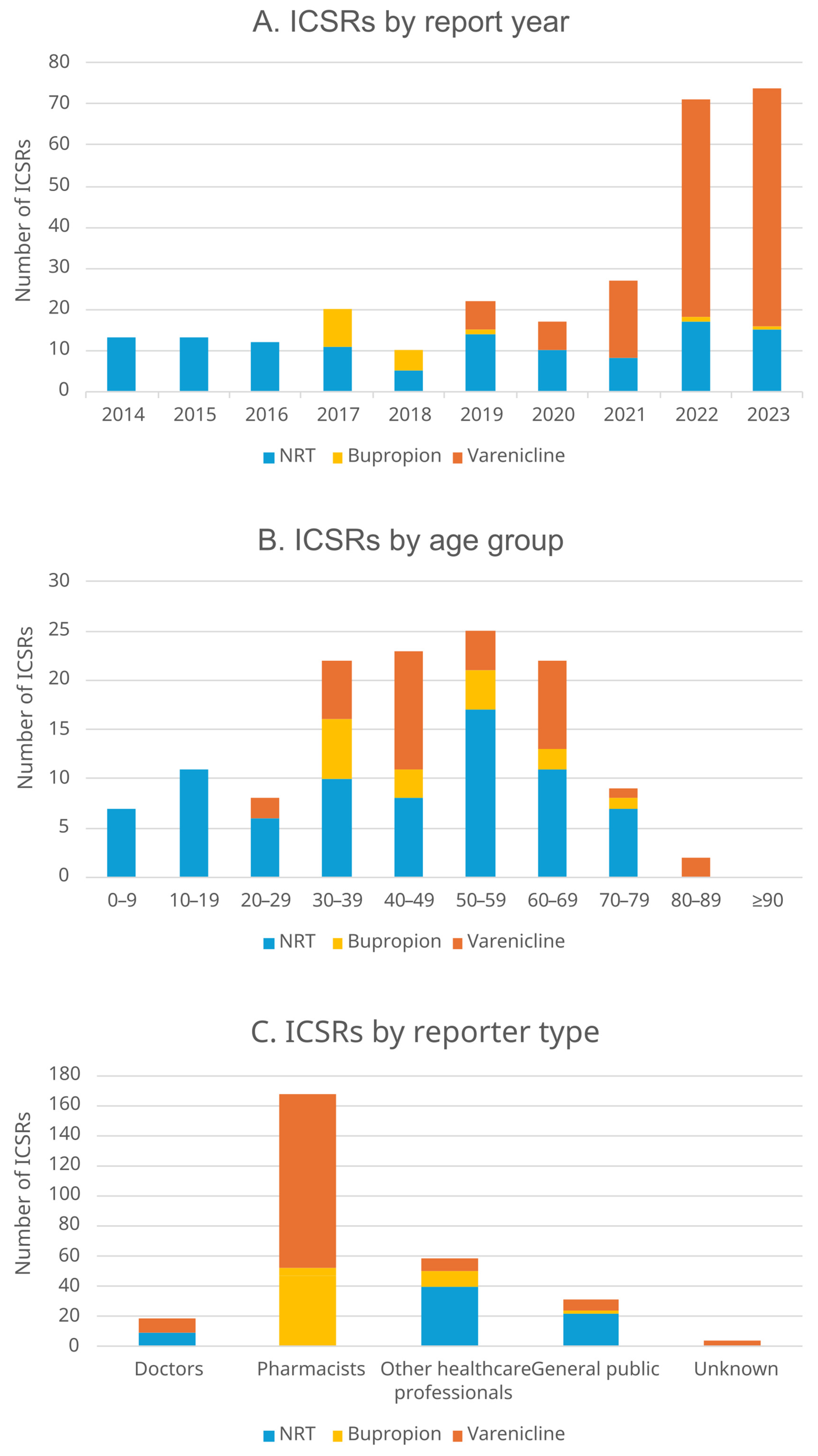
Table 4.
Seriousness criteria among serious ICSRs by tobacco-cessation medication.
In the primary disproportionality analysis, SDRs were identified for psychiatric disorders with bupropion (PRR 3.42, ROR 6.56, χ2 =24.48, IC025 = 0.43), and for psychiatric disorders (PRR 2.86, ROR 3.97, χ2 = 49.05, IC025 = 0.56) and gastrointestinal system disorders (PRR 2.28, ROR 3.59, χ2 = 48.78, IC025 = 0.43) with varenicline (Table 5). No SDRs were identified for NRT. PT-level reporting frequencies based on unique ICSR–drug–WHO-ART PT combinations are presented descriptively in Table 6. In the PT-level disproportionality analysis, three SDRs were identified for bupropion: constipation (PRR 32.87; ROR 44.12; χ2= 94.15 IC025 = 0.86), anorexia (PRR 18.78, ROR 22.53, χ2 = 43.47, IC025 = 0.23), and insomnia (PRR 5.37, ROR 7.70, χ2 = 26.36, IC025 = 0.52) (Table 7). Five SDRs were identified for varenicline: malaise (PRR 5.48, ROR 6.06, χ2 28.09, IC 1.37, IC025 0.50), dyspepsia (PRR 5.03, ROR 5.58, χ2 = 27.60, IC025 = 0.49), nausea (PRR 3.41, ROR 4.55, χ2 = 52.30, IC025 = 0.65), abnormal dreaming (PRR 146.03, ROR 165.04, χ2 = 72.88, IC025 = 1.03), and insomnia (PRR, 3.05, ROR 3.44, χ2 = 20.65, IC025 = 0.33). No PT-level SDRs met all predefined criteria for NRT. Although several PTs showed elevated PRR and ROR estimates for NRT, their IC025 values did not exceed zero and therefore did not satisfy the predefined SDR criteria.
Table 5.
SOC-level disproportionality analysis of smoking-cessation medications without causality-based exclusion (n = 779 ICSRs).
Table 6.
Frequently reported WHO-ART preferred terms by tobacco-cessation medication.
Table 7.
PT-level disproportionality analysis of smoking-cessation medications without causality-based exclusion (n = 779 ICSRs).
3.3. Sensitivity Analysis Excluding ICSRs with Documented Age < 18 Years
In the sensitivity analysis excluding 16 ICSRs with documented age < 18 years while retaining ICSRs with missing age information, 763 ICSRs were included (Table 8 and Table 9). Considering the substantial proportion of reports with missing age information, this analysis was intended to assess the influence of reports with documented pediatric age rather than to represent an adult-only population. At the SOC level, SDRs remained detectable for psychiatric disorders with bupropion (PRR 3.35, ROR 6.40, χ2 = 23.65, IC025 = 0.40), and for psychiatric disorders (PRR 2.79, ROR 3.86, χ2 = 46.68, IC025 = 0.53) and gastro-intestinal system disorders (PRR 2.27, ROR 3.57, χ2 = 48.02, IC025 = 0.42) with varenicline. No SOC-level SDRs were identified for NRT (Table 8). In the PT-level sensitivity analysis, bupropion retained SDRs for constipation (PRR 32.17, ROR 43.18, χ2 = 92.06, IC025 = 0.85), anorexia (PRR 18.39, ROR 22.05, χ2 = 42.46, IC025 = 0.23), and insomnia (PRR 5.25, ROR 7.52, χ2 = 25.59, IC025 = 0.50). Varenicline retained SDRs for malaise (PRR 5.34, ROR 5.90, χ2 = 27.08, IC025 = 0.47), dyspepsia (PRR 5.25, ROR 5.83, χ2 = 28.31, IC025 = 0.50), nausea (PRR 3.44, ROR 4.59, χ2 = 52.33, IC025 = 0.64), abnormal dreaming (PRR 142.32, ROR 160.84, χ2 = 71.06, IC025 = 1.01), and insomnia (PRR 2.97, ROR 3.35, χ2 = 19.65, IC025 = 0.30) (Table 9). Overall, the detected SDRs remained consistent with those observed in the primary analysis.
Table 8.
SOC-level disproportionality analysis after excluding ICSRs with age < 18 years (n = 763 ICSRs).
Table 9.
PT-level disproportionality analysis after excluding ICSRs with age < 18 years (n = 763 ICSRs).
In an additional sensitivity analysis restricted to drug–event relationships classified as certain, probable, or possible, 279 ICSRs were included. At the SOC level, SDRs were identified for NRT-related skin and appendage disorders (PRR 6.43, ROR 8.54, χ2 = 30.93, IC025 = 0.24) and application site disorders (PRR 50.37, ROR 59.46, χ2 26.25, IC 1.08, IC025 0.15), as well as psychiatric disorders with varenicline (PRR 2.76, ROR 3.88, χ2 21.83, IC 0.51, IC025 0.04) (Table S4). No SOC-level SDRs were identified for bupropion. At the PT level, NRT-related pruritus (PRR, 12.96; ROR, 15.26; χ2 = 21.60; IC025 = 0.08), rash (PRR, 25.92; ROR, 30.71; χ2 = 24.52; IC025 = 0.13), and application site reaction (PRR, 47.65; ROR, 55.69; χ2 = 24.70; IC025 = 0.12) met the predefined SDR criteria, whereas no PT-level SDRs were identified for bupropion or varenicline (Table S5). These findings indicate that the application of causality-based exclusion influenced the magnitude and classification of some disproportionality signals.
4. Discussion
This nationwide pharmacovigilance study characterized adverse event reporting patterns for NRT, bupropion, and varenicline using 779 unique ICSRs from the KAERS DB. In the primary ICSR-level analysis, SDRs were identified for psychiatric disorders with both bupropion and varenicline and for gastrointestinal disorders with varenicline, whereas no SDR met the predefined criteria for NRT. At the PT level, SDRs included constipation, anorexia, and insomnia with bupropion, and malaise, dyspepsia, nausea, abnormal dreaming, and insomnia with varenicline. Although application site reaction, pruritus, and rash were frequently reported with NRT, none met all predefined SDR criteria. A total of 52 ICSRs (6.68%) were classified as serious, including 49 involving NRT and three involving bupropion, while none were reported for varenicline. Two NRT-related ICSRs met the seriousness criterion of death, although their causal relationship with NRT remains uncertain. These findings are clinically relevant because all three medications are recommended for smoking cessation in current Korean clinical guidelines [27]. Nevertheless, as this study focused on signal detection rather than comparative risk estimation, the observed differences should be interpreted as relative reporting patterns rather than evidence of differences in medication safety.
The NRT findings showed reporting patterns broadly consistent with established formulation-related AE profiles. Although skin and appendages disorders and application site disorders did not meet all predefined SDR criteria, application site reaction, pruritus, and rash were frequently reported at the PT level. Previous evidence has consistently shown that NRT is associated with formulation-specific local AEs, including skin irritation with transdermal nicotine and oral or pharyngeal symptoms with orally administered formulations [28]. These findings support the clinical plausibility of the observed reporting patterns. However, standardized formulation and route information were not consistently available across the entire KAERS study period; therefore, nicotine-containing products were analyzed collectively as NRTs, and the observed reporting patterns cannot be attributed to a specific formulation. For application-site disorders, the absence of events in the comparator group results in very large PRR and ROR estimates, which should be interpreted with caution. Despite these elevated estimates, the corresponding IC025 values did not exceed zero, and the predefined SDR criteria were therefore not met.
A total of 52 serious ICSRs (6.68%) were identified in the final dataset, including 49 involving NRT and three involving bupropion, while none involved varenicline. Among these, two NRT-related ICSRs met the seriousness criterion of death. Although these reports are relevant for pharmacovigilance characterization, differences in serious ICSR counts do not allow direct comparisons of serious-event risk across medications. Serious adverse events associated with NRT have been uncommon in randomized studies, while its more established adverse effects are generally formulation-specific and non-serious [27,28]. In Korea, NRT may also be obtained as an over-the-counter medication and through public smoking-cessation programs, creating patterns of exposure and reporting that may differ from those of prescription-only therapies [27]. These differences may contribute to the distribution of spontaneous reports, although their magnitude cannot be evaluated without population-level utilization data. Thus, the observed distribution of serious ICSRs should be interpreted in the context of differences in medication utilization and reporting practices rather than as evidence of differential serious-event risk.
Varenicline showed SDRs for psychiatric and gastrointestinal disorders in the primary analysis. At the PT-level, insomnia and abnormal dreaming met the predefined SDR criteria, along with nausea, dyspepsia and malaise. These patterns are compatible with the established tolerability profile of varenicline. In the EAGLES randomized trial, varenicline was not associated with a significant increase in moderate-to-severe neuropsychiatric adverse events relative to nicotine patch or placebo [10]. Similarly, a meta-analysis of 39 randomized trials found no evidence of increased suicide, suicidal ideation, depression, or death, while showing higher frequencies of insomnia, sleep disorders, and abnormal dreams [29]. A nationwide Korean post-marketing surveillance study also reported nausea, abnormal dreams, insomnia, dyspepsia, and headache among the most commonly observed adverse events with varenicline [30]. The psychiatric and gastrointestinal SDRs observed in the present study are consistent with previously reported AE profiles and therefore should not be interpreted as evidence of increased serious neuropsychiatric or gastrointestinal risk.
Bupropion showed an SDR for psychiatric disorders at the SOC levels, while constipation, anorexia, and insomnia met the predefined SDR criteria at the PT level. However, only 23 bupropion ICSRs were available, substantially fewer than for NRT or varenicline, limiting the stability and precision of disproportionality estimation. Accordingly, these SDRs should be interpreted cautiously, particularly given the potential influence of small numbers of reports on disproportionality estimates. Previous studies have described established AE profiles for bupropion, including psychiatric and central nervous system events, and rare SAEs such as seizures have also been documented in post-marketing and regulatory safety data [31,32]. The psychiatric SDR observed in this study is broadly consistent with these established safety concerns, although no seizure-related SDR was detected. In a spontaneous reporting database, sparse reporting can substantially limit the ability to detect disproportionality, particularly when events are distributed across multiple PTs or SOCs. Furthermore, the identification of SDRs does not establish a causal relationship or indicate a higher incidence of AEs compared with other smoking-cessation medications. Further studies incorporating larger populations and comprehensive safety data are warranted to assess the robustness and clinical relevance of the identified SDRs for bupropion.
The sensitivity analysis with causality-based restriction further demonstrated the influence of report selection on signal detection. When the causality-based exclusion criteria were applied, 279 ICSRs were retained, and the pattern of detected SDRs differed from that observed in the primary analysis. At the SOC level, SDRs were identified for skin and appendages disorders and application site disorders with NRT and for psychiatric disorders with varenicline, whereas no SDRs were identified for bupropion. At the PT level, pruritus, rash, and application site reaction met the predefined SDR criteria for NRT, whereas no PT-level SDRs were identified for bupropion or varenicline. These findings demonstrate that the detection and classification of SDRs were sensitive to the application of causality-based report selection. This variability implies the influence of report-selection criteria on signal detection and emphasizes the importance of cautious interpretation of disproportionality findings from spontaneous reporting data.
Age-related findings warrant cautious interpretation. Among the 221 ICSRs with available age information, reports were broadly distributed across individuals aged 20–69 years, with the 50–59-year group being numerically the most frequently represented but without a marked concentration in any single age group. Age information was missing for 558 of the 779 ICSRs (71.63%), further limiting interpretation of age-related reporting patterns. Sixteen ICSRs with documented age involved individuals aged <18 years, all of which involved NRT. In the sensitivity analysis excluding these 16 ICSRs while retaining those with missing age information, 763 ICSRs remained, and all SOC- and PT-level SDRs identified in the primary analysis were retained. These findings suggest that the detected SDR patterns were not materially altered by the exclusion of reports with documented pediatric age. Nevertheless, the substantial proportion of missing age information precludes definitive age-specific interpretation. Further studies using more complete age information and larger populations are warranted to evaluate potential age-related differences in AE reporting patterns associated with smoking-cessation medications.
The temporal reporting pattern also warrants cautious interpretation. Changes in reporting patterns during 2021–2023 should be considered in the context of changes in the national AE reporting system. This period overlapped with the ongoing transition to an ICH E2B(R3)-based electronic adverse-event reporting system, which began before 2022 and culminated in the discontinuation of KAERS-KIDS and unification under KAERS-NeDrug in March 2023 [21,33,34]. Regulatory attention to varenicline also increased in 2021 following the detection of N-nitroso-varenicline and subsequent safety-management measures [35,36]. These changes may have affected reporting practices and reporting opportunities, including the possibility of stimulated reporting. Although the contribution of these systems and regulatory changes cannot be quantified from the present data, they provide important context for temporal reporting patterns observed in this study. Accordingly, temporal variations in reporting frequency should not be interpreted as evidence of a corresponding increase in the incidence or clinical risk of AEs.
The general public represented the largest proportion of primary reporters, accounting for 341 ICSRs (43.77%), followed by pharmacists (n = 251, 32.22%). This distribution emphasizes the contributions of both public and healthcare professionals in pharmacovigilance surveillance of smoking-cessation medications. The relatively high proportion of reports submitted by the general public may partly reflect the accessibility of NRT as an over-the-counter medication and its availability through national smoking-cessation programs in Korea, which may facilitate direct reporting of suspected AEs by individuals [27]. Moreover, the transition to KAERS-NeDrug during the study period may have influenced reporting pathways and the composition of primary reporters, although its contribution to the observed distribution cannot be determined from the available data. Among healthcare professionals, pharmacists accounted for a considerable proportion of reports on smoking-cessation medications [37]. Their frequent contact with patients during medication dispensing and counseling may provide opportunities to identify and report suspected AEs, thereby contributing to medication safety surveillance. Pharmacovigilance is an integral component of patient safety, and systematic AE reporting by both healthcare professionals and patients provides information that can support safer medication use and continuous improvement in the quality of care [38,39,40,41]. However, the observed distribution of reports across reporter groups in this study should not be interpreted as a measure of reporting quality or relative clinical contribution, because the number of reporting opportunities for each group was unavailable.
From a patient-safety perspective, this study provides pharmacovigilance evidence on spontaneous AE reporting patterns associated with three tobacco cessation medications in Korea. The ICSR-level approach reduced potential inflation from repeated counting of multiple PTs within the same SOC from a single ICSR, while the predefined SDR criteria incorporated both frequentist and Bayesian measures. As an additional methodological check, we also examined whether SDR classification changed when the Bayesian component was recalculated using an alternative Gamma–Poisson shrinkage approach (Table S6) [42]. The three SOC-level SDRs identified in the primary BCPNN analysis remained detectable, while application site disorders with NRT additionally met the predefined SDR criteria under the Gamma–Poisson approach [38,39]. These findings suggest that SDR detection may be influenced by the choice of Bayesian shrinkage method, although the primary signals remained consistent across both approaches. Early identification and continued monitoring of medication-related safety concerns through national pharmacovigilance can complement evidence from clinical trials by detecting rare, unexpected, or population-specific adverse events that may not be fully characterized before medication approval. Spontaneous reporting systems provide an important source of post-marketing safety information that can support signal detection, further safety assessment, and regulatory or clinical risk minimization measures [13,38,39]. These activities contribute to medication safety by allowing emerging safety concerns to be recognized and evaluated throughout the medication life cycle, thereby supporting safer medication use and the quality of care [38,39]. Moreover, pharmacovigilance findings are not intended to replace evidence from clinical trials or pharmacoepidemiologic studies; rather, they complement these data sources by identifying safety signals that can subsequently be evaluated using longitudinal healthcare data [13]. Thus, systematic pharmacovigilance provides a continuous link between real-world AE reporting, signal detection, and subsequent medication-safety surveillance, supporting its role as an essential component of patient safety and healthcare quality.
This study has several limitations that should be acknowledged. First, this study was based on a spontaneous reporting pharmacovigilance database, which is inherently subject to underreporting, reporting bias, and incomplete clinical information. Spontaneous reporting systems are also susceptible to stimulated reporting, notoriety bias, and differential reporting across medications and reporter groups, which may influence the observed reporting patterns independently of the underlying safety profile. Additionally, changes in AE reporting system and regulatory attention during the study period may have influenced temporal reporting patterns, although their effects could not be quantified. Second, disproportionality analysis is designed to detect potential SDRs but cannot establish causal relationships between tobacco cessation medications and AEs. Consistent with the READUS-PV recommendations, the findings should be interpreted as signals of disproportionate reporting rather than evidence of causal association or comparative safety. As population-level exposure denominators were unavailable, the analyses cannot estimate AE incidence or absolute or relative risks. Furthermore, as the available KAERS data was restricted to reports involving three prespecified smoking-cessation medications, the entire KAERS database could not be used as the comparator. The identified SDRs therefore represent relative reporting patterns among NRT, bupropion, and varenicline and may be affected by competition or masking within this restricted comparator. Furthermore, causality-based restriction reduced the dataset from 779 to 279 ICSRs and altered the detected SDR patterns, implying the influence of report selection on signal detection. Moreover, 52 serious ICSRs were identified, but the small number of serious reports for bupropion and the absence of such reports for varenicline limited meaningful assessment of medication-specific serious-event patterns or factors associated with seriousness. Third, residual confounding could not be fully addressed due to missing clinically important variables, including smoking history, nicotine dependence severity, underlying comorbidities, and concomitant medications. Confounding by indication may therefore have influenced the observed reporting patterns. Fourth, detailed treatment-related information including dosage, duration of therapy, NRT formulation, route of administration, and medication adherence was not consistently available. These factors may influence the occurrence and severity of AEs, particularly for NRT, where different formulations and dosing strategies are commonly used. The lack of standardized formulation information also prevented attribution of the observed NRT-related reporting patterns to specific formulations. Additionally, information regarding pregnancy status or pregnancy planning was not available in the KIDS KAERS DB. Therefore, we were unable to evaluate AE patterns among pregnant women or women who were planning pregnancy. Fifth, missing demographic and clinical information limited subgroup-specific interpretation. Age information was unavailable for 558 ICSRs (71.63%), limiting age-specific interpretation. In the sensitivity analysis excluding 16 ICSRs involving individuals aged < 18 years, all SDRs identified in the primary analysis remained detectable. However, the substantial proportion of missing age information limits the definitive age-specific interpretations. Thus, these findings warrant cautious interpretation of age-related reporting patterns. Furthermore, the limited clinical information made it difficult to determine whether reports involving individuals aged < 18 years reflected therapeutic use, off-label use, inappropriate dosing or accidental exposure. Because the study was based on a single national pharmacovigilance system, the findings may also have limited generalizability to healthcare systems with different prescribing practices, tobacco control policies, and pharmacovigilance structures. Despite these limitations, this study has several strengths. This study characterized post-marketing AE reporting patterns. A methodological strength of this study was the use of the ICSR as the reporting unit, with each unique ICSR–drug–PT and ICSR–drug–SOC combination counted once. This approach reduced the potential for inflation of SOC-level counts when multiple PTs belonging to the same SOC were reported within a single ICSR. Signal identification was based on predefined criteria requiring concordance across frequentist and Bayesian disproportionality measures rather than reliance on a single measure, providing a more stringent framework for identifying SDRs. The sensitivity of SDR classification to the choice of Bayesian shrinkage method was further assessed using an alternative approach. Furthermore, the study was designed and reported in accordance with the READUS-PV recommendations, enhancing the transparency, consistency, and interpretability of the disproportionality analyses. Collectively, these features enhance the relevance of the findings for ongoing pharmacovigilance surveillance and provide a basis for further evaluation in pharmacoepidemiologic investigations.
5. Conclusions
This nationwide pharmacovigilance study characterized spontaneous AE reporting patterns associated with NRT, bupropion, and varenicline in Korea using 779 unique ICSRs. SOC-level disproportionality analysis identified SDRs for psychiatric disorders with bupropion and for psychiatric and gastrointestinal disorders with varenicline, whereas no SDR was identified for NRT. At the PT level, SDRs were identified for constipation, anorexia, and insomnia with bupropion and for malaise, dyspepsia, nausea, abnormal dreaming, and insomnia with varenicline. A total of 52 serious ICSRs (6.68%) were identified, including 49 ICSRs involving NRT and 3 involving bupropion. All SDRs identified in the primary analysis remained detectable after excluding 16 ICSRs involving individuals aged < 18 years. However, causality-based restriction altered the detected SDR patterns, implying the influence of report selection on SDR detection. These findings should be interpreted as relative reporting patterns rather than estimates of incidence, clinical risk, or causal association. Overall, the results provide pharmacovigilance evidence that may help prioritize specific medication–event patterns for further evaluation and support medication-safety surveillance in clinical practice. Further studies with appropriate exposure denominators and more detailed clinical information are warranted to confirm and characterize these reporting patterns.
Supplementary Materials
The following supporting information can be downloaded at: https://www.mdpi.com/article/10.3390/healthcare14203479/s1, Table S1. STROBE checklist (page numbers based on original submission). Table S2. READUS-PV checklist (page numbers based on original submission). Table S3. Distribution of WHO-UMC causality assessments and impact of causality-based restriction. Table S4. SOC-level disproportionality analysis of adverse event reporting among smoking-cessation medications (n = 279 ICSRs). Table S5. Disproportionality analysis of PT-Tobacco cessation medication (n = 279 ICSRs). Table S6. Sensitivity analysis of signals of disproportionate reporting using an alternative Gamma–Poisson shrinkage approach.
Author Contributions
Conceptualization, J.M., and Y.J.C.; methodology, J.M., S.S., and Y.J.C.; software, J.M., E.C., and Y.J.C.; validation, E.C., and Y.J.C.; formal analysis, J.M., and E.C.; investigation, J.M., and E.C.; resources, J.M., and Y.J.C.; data curation, J.M., and E.C.; writing—original draft preparation, J.M., and Y.J.C.; writing—review and editing, Y.J.C., and S.S.; visualization, J.M., and S.S.; supervision, Y.J.C., and S.S.; project administration, Y.J.C., and S.S.; funding acquisition, Y.J.C. All authors have read and agreed to the published version of the manuscript.
Funding
This research was partially supported by National Research Foundation of Korea, funded by the Ministry of Science and ICT (MSIT) (grant numbers RS-2026-25474310, RS-2026-25594633) and the Ministry of Food and Drug Safety (grant number 21153MFDS601).
Institutional Review Board Statement
The study was conducted in accordance with the Declaration of Helsinki, and approved by Kyung Hee University institutional review board (IRB) (No. KHSIRB-25-515(EA) on 31 October 2025). The protocol for utilizing KIDS KAERS DB was approved by KIDS (Ministry of Food and Drug Safety) (KIDS KAERS DB 2407A0003).
Informed Consent Statement
Patient consent was waived due to utilization of anonymized data. This study analyzed adverse drug events (ADEs) related to tobacco cessation products, including bupropion, NRT, and varenicline spontaneously reported to the Korea Adverse Event Reporting System database (KIDS KAERS DB), constructed by the Korea Institute of Drug Safety & Risk Management (KIDS, Ministry of Food and Drug Safety), between 1 January 2014 and 31 December 2023.
Data Availability Statement
The data presented in this study are available upon request from the corresponding author and KIDS owing to the inclusion of patient information and ethical concerns.
Conflicts of Interest
The authors declare no conflicts of interest.
Abbreviations
The following abbreviations are used in this manuscript:
| ADE | Adverse Drug Event |
| AE | Adverse events |
| CI | Confidence Interval |
| IC | Information Component |
| NRT | Nicotine Replacement Therapy |
| OTC | Over-The-Counter |
| PRR | Proportional Reporting Ratio |
| ROR | Reporting Odds Ratio |
| SAE | Serious Adverse Events |
References
- De Silva, R.; Silva, D.; Piumika, L.; Abeysekera, I.; Jayathilaka, R.; Rajamanthri, L.; Wickramaarachchi, C. Impact of global smoking prevalence on mortality: A study across income groups. BMC Public Health 2024, 24, 1786. [Google Scholar] [CrossRef] [Scilit] [PubMed]
- World Health Organization. WHO Report on the Global Tobacco Epidemic, 2023. Available online: https://iris.who.int/server/api/core/bitstreams/2b09f8b0-08f3-4bef-b8a5-8c4b4e1a95ad/content (accessed on 11 April 2026).
- Pan American Health Organization. Tobacco Use. Available online: https://www.paho.org/en/enlace/tobacco-use (accessed on 11 April 2026).
- Cui, Z.Y.; Li, Y.H.; Liu, Z.; Li, L.; Nie, X.Q.; Zhou, X.M.; Cheng, A.Q.; Li, J.X.; Qin, R.; Wei, X.W.; et al. The experience of tobacco withdrawal symptoms among current smokers and ex-smokers in the general population: Findings from nationwide China Health Literacy Survey during 2018-19. Front. Psychiatry 2022, 13, 1023756. [Google Scholar] [CrossRef] [Scilit] [PubMed]
- Alyousefi, N.A.; Alquraini, R.S.; Alyahya, L.F.; Bin Hamad, N.M.; Aljuribah, D.K.; Aldossari, K.K. Factors associated with successful smoking cessation among adults in Saudi Arabia-A cross-sectional study. Healthcare 2025, 13, 1813. [Google Scholar] [CrossRef] [Scilit] [PubMed]
- Lee, C.M.; Seo, Y.B.; Paek, Y.J.; Lee, E.S.; Kang, H.S.; Kim, S.Y.; Roh, S.; Park, D.W.; An, Y.S.; Jo, S.H. Evidence-based guideline for the treatment of smoking cessation provided by the National Health Insurance Service in Korea. Korean J. Fam. Med. 2024, 45, 69–81. [Google Scholar] [CrossRef] [Scilit] [PubMed]
- World Health Organization. WHO Clinical Treatment Guideline for Tobacco Cessation in Adults. 2024. Available online: https://www.who.int/publications/i/item/9789240096431 (accessed on 11 April 2026).
- Hartmann-Boyce, J.; Chepkin, S.C.; Ye, W.; Bullen, C.; Lancaster, T. Nicotine replacement therapy versus control for smoking cessation. Cochrane Database Syst. Rev. 2018, 5, Cd000146. [Google Scholar] [CrossRef] [Scilit] [PubMed]
- Thomas, K.H.; Davies, N.M.; Taylor, A.E.; Taylor, G.M.J.; Gunnell, D.; Martin, R.M.; Douglas, I. Risk of neuropsychiatric and cardiovascular adverse events following treatment with varenicline and nicotine replacement therapy in the UK Clinical Practice Research Datalink: A case-cross-over study. Addiction 2021, 116, 1532–1545. [Google Scholar] [CrossRef] [Scilit] [PubMed]
- Anthenelli, R.M.; Benowitz, N.L.; West, R.; St Aubin, L.; McRae, T.; Lawrence, D.; Ascher, J.; Russ, C.; Krishen, A.; Evins, A.E. Neuropsychiatric safety and efficacy of varenicline, bupropion, and nicotine patch in smokers with and without psychiatric disorders (EAGLES): A double-blind, randomised, placebo-controlled clinical trial. Lancet 2016, 387, 2507–2520. [Google Scholar] [CrossRef] [Scilit] [PubMed]
- Benowitz, N.L.; Pipe, A.; West, R.; Hays, J.T.; Tonstad, S.; McRae, T.; Lawrence, D.; St Aubin, L.; Anthenelli, R.M. Cardiovascular safety of varenicline, bupropion, and nicotine patch in smokers: A randomized clinical trial. JAMA Intern. Med. 2018, 178, 622–631. [Google Scholar] [PubMed]
- European Medicines Agency. Champix: EPAR—Assessment Report—Variation. Available online: https://www.ema.europa.eu/en/documents/variation-report/champix-h-c-699-ii-0074-epar-assessment-report-variation_en.pdf?utm_source=chatgpt.com (accessed on 1 October 2026).
- Crisafulli, S.; Bate, A.; Brown, J.S.; Candore, G.; Chandler, R.E.; Hammad, T.A.; Lane, S.; Maro, J.C.; Norén, G.N.; Pariente, A.; et al. Interplay of spontaneous reporting and longitudinal healthcare databases for signal management: Position statement from the real-world evidence and big data special interest group of the International Society of Pharmacovigilance. Drug Saf. 2025, 48, 959–976. [Google Scholar] [CrossRef] [Scilit] [PubMed]
- Wang, Y.D.; Wang, Y.T.; Chen, H.H.; Bao, J.K.; Chen, S.M.; Chen, D.X. Pharmacovigilance study on adverse events of nicotine replacement therapy, bupropion, and varenicline in patients with chronic obstructive pulmonary disease. Int. J. Chronic Obstr. Pulm. Dis. 2025, 20, 1509–1524. [Google Scholar] [CrossRef] [Scilit] [PubMed]
- Beyens, M.N.; Guy, C.; Mounier, G.; Laporte, S.; Ollagnier, M. Serious adverse reactions of bupropion for smoking cessation: Analysis of the French Pharmacovigilance Database from 2001 to 2004. Drug Saf. 2008, 31, 1017–1026. [Google Scholar] [PubMed]
- Sun, H.; Chen, J.; Wu, X.; Wang, Z. Sex-stratified pharmacovigilance of gastrointestinal events associated with first-line smoking-cessation medicines: Insights from the FAERS database. PLoS ONE 2025, 20, e0336021. [Google Scholar] [CrossRef] [Scilit] [PubMed]
- Jang, M.G.; Gu, H.J.; Kim, J.; Shin, K.H. Signal detection for adverse event of varenicline in Korea Adverse Event Reporting System. Korean J. Clin. Pharm. 2022, 32, 1–7. [Google Scholar] [CrossRef] [Scilit]
- von Elm, E.; Altman, D.G.; Egger, M.; Pocock, S.J.; Gøtzsche, P.C.; Vandenbroucke, J.P. The Strengthening the Reporting of Observational Studies in Epidemiology (STROBE) statement: Guidelines for reporting observational studies. J. Clin. Epidemiol. 2008, 61, 344–349. [Google Scholar] [CrossRef] [Scilit] [PubMed]
- Fusaroli, M.; Salvo, F.; Begaud, B.; AlShammari, T.M.; Bate, A.; Battini, V.; Brueckner, A.; Candore, G.; Carnovale, C.; Crisafulli, S.; et al. The REporting of A Disproportionality analysis for DrUg Safety signal detection using individual case safety reports in PharmacoVigilance (READUS-PV): Explanation and elaboration. Drug Saf. 2024, 47, 585–599. [Google Scholar] [CrossRef] [Scilit] [PubMed]
- The Uppsala Monitoring Center. The Use of the WHO-UMC System for Standarised Case Causality Assessment. Available online: https://www.who.int/docs/default-source/medicines/pharmacovigilance/whocausality-assessment.pdf (accessed on 1 March 2026).
- Korea Institute of Drug Safety & Risk Management. User Guide for the Korea Adverse Event Reporting System Database (KAERS DB), Version 13; Korea Institute of Drug Safety & Risk Management: Anyang, Republic of Korea, 2023. Available online: https://nedrug.mfds.go.kr/bbs/148/31/ (accessed on 25 October 2025).
- Moon, S.; Ko, M.; Choi, Y.J.; Shin, S. Real-world data mining for signal detection of antipsychotics-associated adverse events using the Korea adverse event reporting system (KAERS) database. Medicina 2024, 60, 1714. [Google Scholar] [CrossRef] [Scilit] [PubMed]
- Mo, S.H.; Lee, S.H.; Choi, C.Y.; Sunwoo, Y.; Shin, S.; Choi, Y.J. A comprehensive 10-year nationwide pharmacovigilance surveillance on antibacterial agents in Korea: Data mining for signal detection of trends and seriousness of adverse events. Microorganisms 2025, 13, 136. [Google Scholar] [CrossRef] [Scilit] [PubMed]
- Evans, S.J.W.; Waller, P.C.; Davis, S. Use of proportional reporting ratios (PRRs) for signal generation from spontaneous adverse drug reaction reports. Pharmacoepidemiol. Drug Saf. 2001, 10, 483–486. [Google Scholar] [CrossRef] [Scilit] [PubMed]
- Orre, R.; Lansner, A.; Bate, A.; Lindquist, M. Bayesian neural networks with confidence estimations applied to data mining. Comput. Stat. Data Anal. 2000, 34, 473–493. [Google Scholar] [CrossRef] [Scilit]
- Bate, A.; Lindquist, M.; Edwards, I.R.; Olsson, S.; Orre, R.; Lansner, A.; De Freitas, R.M. A Bayesian neural network method for adverse drug reaction signal generation. Eur. J. Clin. Pharmacol. 1998, 54, 315–321. [Google Scholar] [CrossRef] [Scilit] [PubMed]
- Seo, Y.B.; Lee, H.; Paek, Y.J.; Lee, H.J.; Lee, C.M.; Lee, E.S.; Kimm, H.; An, H.J.; Bae, E.J.; Kim, J.S.; et al. Korean clinical practice guideline of Korean society for research on nicotine and tobacco (KSRNT) and National evidence-based healthcare collaborating agency (NECA) on treatment of tobacco use 2024. J. Korean Med. Sci. 2025, 40, e299. [Google Scholar] [CrossRef] [Scilit] [PubMed]
- Mills, E.J.; Wu, P.; Lockhart, I.; Wilson, K.; Ebbert, J.O. Adverse events associated with nicotine replacement therapy (NRT) for smoking cessation. A systematic review and meta-analysis of one hundred and twenty studies involving 177,390 individuals. Tob. Induc. Dis. 2010, 8, 8. [Google Scholar] [CrossRef] [Scilit] [PubMed]
- Thomas, K.H.; Martin, R.M.; Knipe, D.W.; Higgins, J.P.; Gunnell, D. Risk of neuropsychiatric adverse events associated with varenicline: Systematic review and meta-analysis. BMJ 2015, 350, h1109. [Google Scholar] [CrossRef] [Scilit] [PubMed]
- Ock, M.; Shin, J.S.; Ra, S.W. Safety and effectiveness of varenicline in Korean smokers: A nationwide post-marketing surveillance study. Patient Prefer. Adherence 2022, 16, 413–426. [Google Scholar] [CrossRef] [Scilit] [PubMed]
- Soyka, M. Neuropsychiatric adverse events of bupropion treatment: A brief update. Int. J. Psychiatry Clin. Pract. 2004, 8, 251–254. [Google Scholar] [CrossRef] [Scilit] [PubMed]
- Wooltorton, E. Bupropion (Zyban, Wellbutrin SR): Reports of deaths, seizures, serum sickness. CMAJ Can. Med. Assoc. J. 2002, 166, 68. [Google Scholar]
- Ministry of Food and Drug Safety. Guideline for Electronic Reporting of Adverse Drug Reactions and Adverse Events. 2021. Available online: https://www.mfds.go.kr/brd/m_1060/view.do?seq=14869&srchFr=&srchTo=&srchWord=&srchTp=&itm_seq_1=0&itm_seq_2=0&multi_itm_seq=0&company_cd=&company_nm=&page=141 (accessed on 30 September 2026).
- Ministry of Food and Drug Safety. Notice on the Reorganization of the Adverse Drug Event Reporting System. 2021. Available online: https://www.mfds.go.kr/brd/m_227/view.do?seq=33296 (accessed on 30 September 2026).
- Lang, A.E.; Patel, U.; Fitzpatrick, J.; Lee, T.; McFarland, M.; Good, C.B. Association of the Chantix recall with US prescribing of varenicline and other medications for nicotine dependence. JAMA Netw. Open 2023, 6, e2254655. [Google Scholar] [CrossRef] [Scilit] [PubMed]
- U.S. Food & Drug Administration. FDA Updates and Press Announcements on Nitrosamine in Varenicline (Chantix). Available online: https://www.fda.gov/drugs/drug-alerts-and-statements/fda-updates-and-press-announcements-nitrosamine-varenicline-chantix (accessed on 30 September 2026).
- Yu, Y.M.; Shin, W.G.; Lee, J.Y.; Choi, S.A.; Jo, Y.H.; Youn, S.J.; Lee, M.S.; Choi, K.H. Patterns of adverse drug reactions in different age groups: Analysis of spontaneous reports by community pharmacists. PLoS ONE 2015, 10, e0132916. [Google Scholar] [CrossRef] [Scilit] [PubMed]
- Kang, D.Y.; Ahn, K.M.; Kang, H.R.; Cho, S.H. Past, present, and future of pharmacovigilance in Korea. Asia Pac. Allergy 2017, 7, 173–178. [Google Scholar] [CrossRef] [Scilit] [PubMed]
- Paudyal, V.; Al-Hamid, A.; Bowen, M.; Hadi, M.A.; Hasan, S.S.; Jalal, Z.; Stewart, D. Interventions to improve spontaneous adverse drug reaction reporting by healthcare professionals and patients: Systematic review and meta-analysis. Expert Opin. Drug Saf. 2020, 19, 1173–1191. [Google Scholar] [CrossRef] [Scilit] [PubMed]
- Choi, Y.J.; Kim, M.H.; Chung, E.K.; Lee, J.K.; Yoon, J.; Yug, J.S.; Jang, D.K. Prevalence and seriousness of analgesic-induced adverse events in Korea: A 10-year nationwide surveillance. J. Patient Saf. 2020, 16, e215–e224. [Google Scholar] [CrossRef] [Scilit] [PubMed]
- Choi, Y.J.; Choi, C.Y.; Kim, C.U.; Shin, S. A nationwide pharmacovigilance investigation on trends and seriousness of adverse events induced by anti-obesity medication. J. Glob. Health 2023, 13, 04095. [Google Scholar] [CrossRef] [Scilit] [PubMed]
- Norén, G.N.; Hopstadius, J.; Bate, A. Shrinkage observed-to-expected ratios for robust and transparent large-scale pattern discovery. Stat. Methods Med. Res. 2013, 22, 57–69. [Google Scholar] [CrossRef] [Scilit] [PubMed]

Disclaimer/Publisher’s Note: The statements, opinions and data contained in all publications are solely those of the individual author(s) and contributor(s) and not of MDPI and/or the editor(s). MDPI and/or the editor(s) disclaim responsibility for any injury to people or property resulting from any ideas, methods, instructions or products referred to in the content. |
© 2026 by the authors. Licensee MDPI, Basel, Switzerland. This article is an open access article distributed under the terms and conditions of the Creative Commons Attribution (CC BY) license.