Animal-Assisted Therapy for Reducing Anxiety in Vulnerable Clinical Populations: A Systematic Review


Abstract
1. Introduction
Objectives
2. Materials and Methods
2.1. Search Procedure and Eligibility Criteria
2.2. Evaluating the Quality of Studies
2.3. Information Sources
2.4. Search Strategy
2.5. Data Selection and Collection Process
3. Synthesis Methods
4. Results
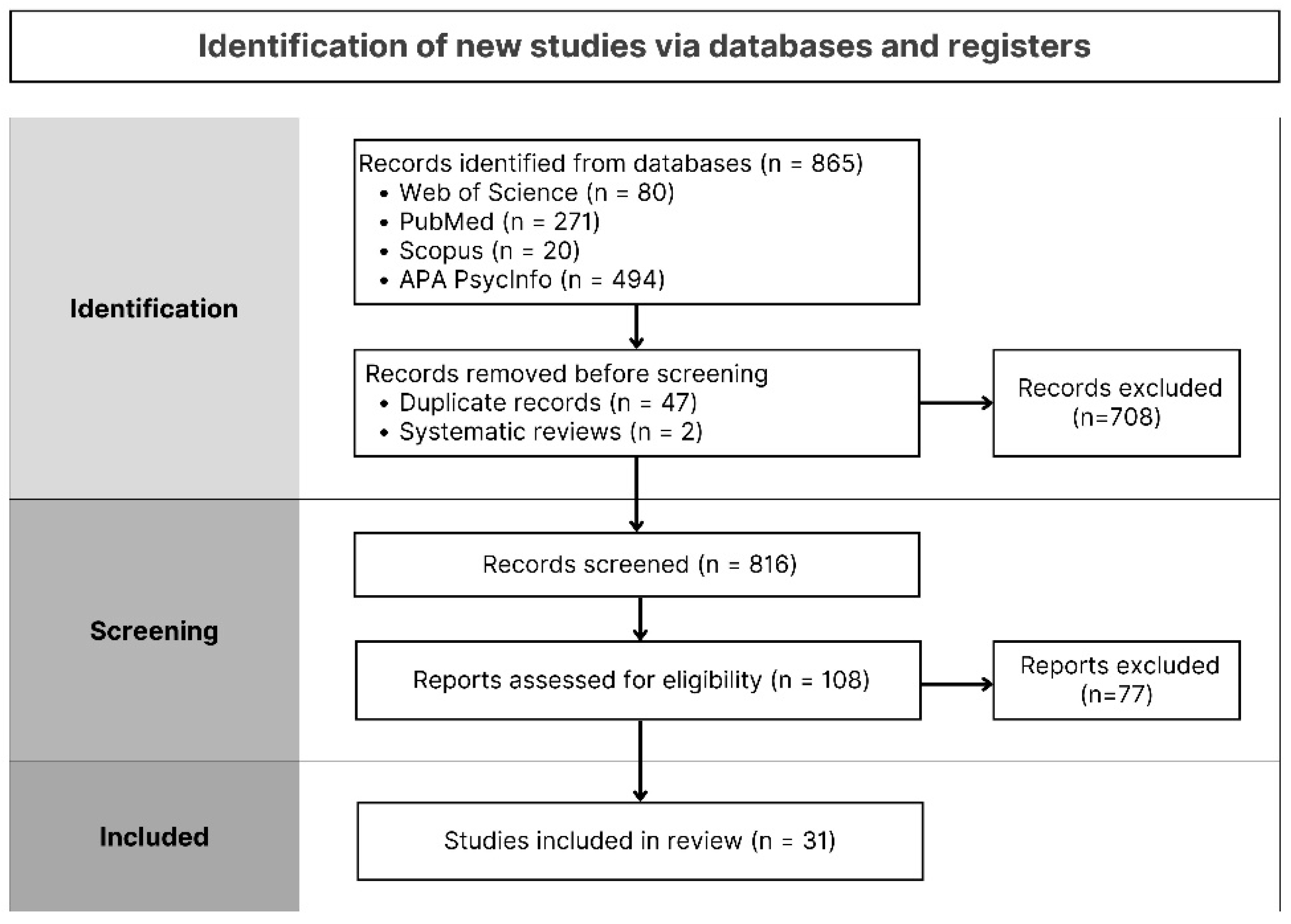
4.1. Selection of Studies
4.2. Methodological Characteristics of Animal-Assisted Therapy Interventions
4.3. Descriptive and Research Characteristics of Study Designs
4.4. Effectiveness of Animal-Assisted Therapy in Reducing Concurrent Anxiety
5. Discussion
5.1. Implications for Practice
5.2. Limitations and Further Research
6. Conclusions
Author Contributions
Funding
Institutional Review Board Statement
Informed Consent Statement
Data Availability Statement
Conflicts of Interest
References
- Institute for Health Metrics and Evaluation (IHME). Anxiety Disorders Prevalence [Dataset]. Global Burden of Disease—Mental Health Prevalence. Our World in Data. 2024. Available online: https://ourworldindata.org/grapher/anxiety-disorders-prevalence (accessed on 15 November 2023).
- World Health Organization. COVID-19 Pandemic Triggers 25% Increase in Prevalence of Anxiety and Depression Worldwide; 2 March 2022; World Health Organization: Geneva, Switzerland, 2022; Available online: https://www.who.int/news/item/02-03-2022-covid-19-pandemic-triggers-25-increase-in-prevalence-of-anxiety-and-depression-worldwide (accessed on 15 November 2023).
- Hsieh, K.; Scott, H.M.; Murthy, S. Associated Risk Factors for Depression and Anxiety in Adults With Intellectual and Developmental Disabilities: Five-Year Follow Up. Am. J. Intellect. Dev. Disabil. 2020, 125, 49–63. [Google Scholar] [CrossRef] [Scilit]
- Maresca, G.; Portaro, S.; Naro, A.; Crisafulli, R.; Raffa, A.; Scarcella, I.; Aliberti, B.; Gemelli, G.; Calabrò, R.S. Hippotherapy in neurodevelopmental disorders: A narrative review focusing on cognitive and behavioral outcomes. Appl. Neuropsychol. Child 2022, 11, 553–560. [Google Scholar] [CrossRef] [Scilit] [PubMed]
- Villafaina-Domínguez, B.; Collado-Mateo, D.; Merellano-Navarro, E.; Villafaina, S. Effects of dog-based animal-assisted interventions in prision population: A systematic review. Animals 2020, 10, 2129. [Google Scholar] [CrossRef] [Scilit]
- IAHAIO. The IAHAIO Definitions for Animal Assisted Intervention and Guidelines for Wellness of Animals Involved for Wellness of Animals. 2018. Available online: https://iahaio.org/wp/wp-content/uploads/2021/01/iahaio-white-paper-2018-english.pdf (accessed on 11 November 2023).
- Binder, A.J.; Parish-Plass, N.; Kirby, M.; Winkle, M.; Skwerer, D.P.; Ackerman, L.; Brosig, C.; Coombe, W.; Delisle, E.; Enders-Slegers, M.-J.; et al. Recommendations for uniform terminology in animal-assisted services (AAS). Hum.-Anim. Interact. 2024, 12, 1–10. [Google Scholar] [CrossRef] [Scilit]
- Pandey, R.P.; Himanshu Gunjan Mukherjee, R.; Chang, C.M. The role of animal-assisted therapy in enhancing patients’ well-being: Systematic study of the qualitative and quantitative evidence. JMIRx Med 2024, 5, e51787. [Google Scholar] [CrossRef] [Scilit]
- Helmer, A.; Wechsler, T.; Gilboa, Y. Equine-assisted services for children with attention-deficit/hyperactivity disorder: A systematic review. J. Altern. Complement. Med. 2021, 27, 477–488. [Google Scholar] [CrossRef] [Scilit]
- Wilson, E.O. Biophilia; Harvard University Press: Cambridge, MA, USA, 1984. [Google Scholar]
- Nisbet, E.K.; Zelenski, J.M. The NR-6: A new brief measure of nature relatedness. Front. Psychol. 2013, 4, 813. [Google Scholar] [CrossRef] [Scilit]
- Ein, N.; Li, L.; Vickers, K. The effect of pet therapy on the physiological and subjective stress response: A meta-analysis. Stress Health 2018, 34, 477–489. [Google Scholar] [CrossRef] [Scilit]
- Santaniello, A.; Dicév, F.; Carratú, R.C.; Amato, A.; Fioretti, A.; Menna, L.F. Methodological and terminological issues in animal-assisted interventions: An umbrella review of systematic reviews. Animals 2020, 10, 759. [Google Scholar] [CrossRef] [Scilit]
- Page, M.J.; McKenzie, J.E.; Bossuyt, P.M.; Boutron, I.; Hoffmann, T.C.; Mulrow, C.D.; Shamseer, L.; Tetzlaff, J.M.; Akl, E.A.; Brennan, S.E.; et al. Declaración PRISMA 2020: Una guía actualizada para la publicación de revisiones sistemáticas. Rev. Española Cardiol. 2021, 74, 790–799. [Google Scholar] [CrossRef]
- Sánchez-Meca, J.; Botella, J. Revisiones sistemáticas y meta-análisis: Herramientas para la práctica profesional. Papeles Psicólogo 2010, 31, 7–17. [Google Scholar]
- Ouzzani, M.; Hammady, H.; Fedorowicz, Z.; Elmagarmid, A. Rayyan—A Web and Mobile App for Systematic Reviews. Syst. Rev. 2016, 5, 210. [Google Scholar] [CrossRef] [Scilit] [PubMed]
- Arnon, S.; Fisher, P.W.; Pickover, A.; Lowell, A.; Turner, J.B.; Hilburn, A.; Jacob-McVey, J.; EMalajian, B.; Farber, D.G.; Hamilton, J.F.; et al. Equine-assisted therapy for veterans with PTSD: Manual development and preliminary findings. Mil. Med. 2020, 185, e557–e564. [Google Scholar] [CrossRef] [Scilit]
- Barker, S.B.; Knisely, J.S.; Schubert, C.M.; Green, J.D.; Ameringer, S. The effect of an animal-assisted intervention on anxiety and pain in hospitalised children. Anthrozoös 2015, 28, 101–112. [Google Scholar] [CrossRef] [Scilit]
- Bergen-Cico, D.; Smith, Y.; Wolford, K.; Gooley, C.; Hannon, K.; Woodruff, R.; Spicer, M.; Gump, B. Dog ownership and training reduces post-traumatic stress symptoms and increases self-compassion among veterans: Results of a longitudinal control study. J. Altern. Complement. Med. 2018, 24, 1166–1175. [Google Scholar] [CrossRef] [Scilit]
- Cappelen, H.; Ivarsson, A.; Jormfeldt, H. The Effects of an Equine-Assisted Therapeutic Intervention on Well-Being in Persons Diagnosed with Schizophrenia. A Pilot Study. Issues Ment. Health Nurs. 2023, 44, 104–111. [Google Scholar] [CrossRef] [Scilit] [PubMed]
- Carey, B.; Dell, C.A.; Stempien, J.; Tupper, S.; Rohr, B.; Carr, E.; Cruz, M.; Acoose, S.; Butt, P.; Broberg, L.; et al. Outcomes of a controlled trial with visiting therapy dog teams on pain in adults in an emergency department. PLoS ONE 2022, 17, e0262599. [Google Scholar] [CrossRef] [Scilit]
- Coakley, A.B.; Annese, C.D.; Empoliti, J.H.; Flanagan, J.M. The experience of animal assisted therapy on patients in an acute care setting. Clin. Nurs. Res. 2021, 30, 401–405. [Google Scholar] [CrossRef] [Scilit]
- Demiralay, Ş.; Keser, İ. The effect of pet therapy on the stress and social anxiety levels of disabled children: A randomized controlled trial. Complement. Ther. Clin. Pract. 2022, 48, 101574. [Google Scholar] [CrossRef] [Scilit] [PubMed]
- Earles, J.L.; Vernon, L.L.; Yetz, J.P. Equine-assisted therapy for anxiety and posttraumatic stress symptoms. J. Trauma. Stress 2015, 28, 149–152. [Google Scholar] [CrossRef] [Scilit]
- Fisher, P.W.; Lazarov, A.; Lowell, A.; Arnon, S.; Turner, J.B.; Bergman, M.; Ryba, M.; Such, S.; Marohasy, C.; Zhu, X.; et al. Equine-assisted therapy for posttraumatic stress disorder among military veterans: An open trial. J. Clin. Psychiatry 2021, 82, 21m14005. [Google Scholar] [CrossRef] [Scilit]
- Fiori, G.; Marzi, T.; Bartoli, F.; Bruni, C.; Ciceroni, C.; Palomba, M.; Zolferino, M.; Corsi, E.; Galimberti, M.; Moggi Pignone, A.; et al. The challenge of pet therapy in systemic sclerosis: Evidence for an impact on pain, anxiety, neuroticism and social interaction. Clin. Exp. Rheumatol. 2018, 36, 135–141. [Google Scholar] [PubMed]
- Giuliani, F.; Jacquemettaz, M. Animal-assisted therapy used for anxiety disorders in patients with learning disabilities: An observational study. Eur. J. Integr. Med. 2017, 14, 13–19. [Google Scholar] [CrossRef] [Scilit]
- Hinic, K.; Kowalski, M.O.; Holtzman, K.; Mobus, K. The effect of a pet therapy and comparison intervention on anxiety in hospitalized children. J. Pediatr. Nurs. 2019, 46, 55–61. [Google Scholar] [CrossRef] [Scilit]
- Holman, L.F.; Ellmo, F.; Wilkerson, S.; Johnson, R.S. Quasi-experimental single-subject design: Comparing seeking safety and canine-assisted therapy interventions among mentally ill female inmates. J. Addict. Offender Couns. 2020, 41, 35–51. [Google Scholar] [CrossRef] [Scilit]
- Holman, L.F.; Wilkerson, S.; Ellmo, F.; Skirius, M. Impact of animal assisted therapy on anxiety levels among mentally ill female inmates. J. Creat. Ment. Health 2020, 15, 428–442. [Google Scholar] [CrossRef] [Scilit]
- Hunt, M.G.; Chizkov, R.R. Are Therapy Dogs Like Xanax? Does Animal-Assisted Therapy Impact Processes Relevant to Cognitive Behavioral Psychotherapy? Anthrozoös 2014, 27, 457–469. [Google Scholar] [CrossRef] [Scilit]
- Johnson, R.A.; Albright, D.L.; Marzolf, J.R.; Bibbo, J.L.; Yaglom, H.D.; Crowder, S.M.; Carlisle, G.K.; Willard, A.; Russell, C.L.; Grindler, K.; et al. Effects of therapeutic horseback riding on post-traumatic stress disorder in military veterans. Mil. Med. Res. 2018, 5, 1–13. [Google Scholar] [CrossRef] [Scilit]
- Johnson, R.A.; Albright, D.L.; Marzolf, J.R.; Bibbo, J.L.; Yaglom, H.D.; Crowder, S.M.; Carlisle, G.M.; Grindler, K.; Harms, N.; Willard, A.; et al. Experiences of military veterans in a therapeutic horseback riding program. Clin. Nurs. Res. 2021, 30, 923–933. [Google Scholar] [CrossRef] [Scilit]
- Kang, K.D.; Jung, T.W.; Park, I.H.; Han, D.H. Effects of equine-assisted activities and therapies on the affective network of adolescents with internet gaming disorder. J. Altern. Complement. Med. 2018, 24, 841–849. [Google Scholar] [CrossRef] [Scilit]
- Kiesewetter, J.; Herbach, N.; Landes, I.; Mayer, J.; Elgner, V.; Orle, K.; Grunow, A.; Langkau, R.; Gratzer, C.; Jansson, A.F. Dog assisted education in children with rheumatic diseases and adolescents with chronic pain in Germany. GMS J. Med. Educ. 2023, 40, Doc44. [Google Scholar] [CrossRef] [Scilit]
- López-Fernández, E.; Palacios-Cuesta, A.; Rodríguez-Martínez, A.; Olmedilla-Jodar, M.; Fernández-Andrade, R.; Mediavilla-Fernández, R.; Sánchez-Díaz, J.I.; Máximo-Bocanegra, N. Implementation feasibility of animal-assisted therapy in a pediatric intensive care unit: Effectiveness on reduction of pain, fear, and anxiety. Eur. J. Pediatr. 2024, 183, 843–851. [Google Scholar] [CrossRef] [Scilit]
- Marchand, W.R. Potential mechanisms of action and outcomes of equine-assisted services for veterans with a history of trauma: A narrative review of the literature. Int. J. Environ. Res. Public Health 2023, 20, 6377. [Google Scholar] [CrossRef] [Scilit]
- Mattila-Rautiainen, S.; Venojärvi, M.; Rautiainen, H.; Keski-Valkama, A. The impact on physical performance, pain and psychological wellbeing of chronic low back pain patients during 12-weeks of equine-facilitated therapy intervention. Front. Vet. Sci. 2023, 10, 1085768. [Google Scholar] [CrossRef] [Scilit]
- McCullough, A.; Ruehrdanz, A.; Jenkins, M.A.; Gilmer, M.J.; Olson, J.; Pawar, A.; Holley, L.; Sierra-Rivera, S.; Linder, D.E.; Pichette, D.; et al. Measuring the effects of an animal-assisted intervention for pediatric oncology patients and their parents: A multisite randomized controlled trial. J. Pediatr. Oncol. Nurs. 2018, 35, 159–177. [Google Scholar] [CrossRef] [Scilit]
- Monroe, M.; Whitworth, J.D.; Wharton, T.; Turner, J. Effects of an equine-assisted therapy program for military veterans with self-reported PTSD. Soc. Anim. 2019, 29, 577–590. [Google Scholar] [CrossRef] [Scilit]
- Mulvaney-Roth, P.; Jackson, C.; Bert, L.; Eriksen, S.; Ryan, M. Using Pet Therapy to Decrease Patients’ Anxiety on Two Diverse Inpatient Units. J. Am. Psychiatr. Nurses Assoc. 2023, 29, 112–121. [Google Scholar] [CrossRef] [Scilit]
- Nepps, P.; Stewart, C.N.; Bruckno, S.R. Animal-assisted activity: Effects of a complementary intervention program on psychological and physiological variables. J. Evid.-Based Complement. Altern. Med. 2014, 19, 211–215. [Google Scholar] [CrossRef] [Scilit]
- Perez, M.; Cuscaden, C.; Somers, J.F.; Simms, N.; Shaheed, S.; Kehoe, L.A.; Holowka, S.A.; Aziza, A.A.; Shroff, M.M.; Greer, M.-L.C. Easing anxiety in preparation for pediatric magnetic resonance imaging: A pilot study using animal-assisted therapy. Pediatr. Radiol. 2019, 49, 1000–1009. [Google Scholar] [CrossRef] [Scilit] [PubMed]
- Romaniuk, M.; Evans, J.; Kidd, C. Evaluation of an equine-assisted therapy program for veterans who identify as ‘wounded, injured or ill’ and their partners. PLoS ONE 2018, 13, e0203943. [Google Scholar] [CrossRef] [Scilit] [PubMed]
- Shelton, A.M. An Interpretative Phenomenological Analysis of the Adult Equine-Assisted Therapy Experience (Tesis de Maestría/Doctoral); ProQuest Dissertations Publishing: Ann Arbor, MI, USA, 2022. [Google Scholar]
- Silva, N.B.; Osório, F.L. Impact of an animal-assisted therapy programme on physiological and psychosocial variables of pediatric oncology patients. PLoS ONE 2018, 13, e0194731. [Google Scholar] [CrossRef] [Scilit]
- Vegue Parra, E.; Hernández Garre, J.M.; Echevarría Pérez, P. Impact of dog-assisted therapy for institutionalized patients with dementia: A controlled clinical trial. Altern. Ther. Health Med. 2021, 27, 26–31. [Google Scholar]
- Spielberger, C.D.; Gorsuch, R.L.; Lushene, R.E.; Vagg, P.R.; Jacobs, G.A. Manual for the State-Trait Anxiety Inventory (Form Y); Consulting Psychologists Press: Palo Alto, CA, USA, 1983. [Google Scholar]
- Weathers, F.W.; Litz, B.T.; Herman, D.S.; Huska, J.A.; Keane, T.M. The PTSD Checklist: Reliability, Validity, and Diagnostic Utility. In Proceedings of the 9th Annual Conference of the International Society for Traumatic Stress Studies, San Antonio, TX, USA, 24–27 October 1993. [Google Scholar]
- Bliese, P.D.; Wright, K.M.; Adler, A.B.; Cabrera, O.; Castro, C.A.; Hoge, C.W. Validating the Primary Care Posttraumatic Stress Disorder Screen and the PTSD Checklist with soldiers returning from combat. J. Consult. Clin. Psychol. 2008, 76, 272–281. [Google Scholar] [CrossRef] [Scilit] [PubMed]
- Parra, E.V. Benefits of dog-assisted therapy in patients with dementia. Int. J. Environ. Res. Public Health 2021, 18, 1471. [Google Scholar] [CrossRef] [Scilit]
- Harper, N.J.; Dobud, W.W.; Magnuson, D. Adolescent wilderness therapy: The relationship of client outcomes to reasons for referral, motivation for change, and clinical measures. Youth 2024, 4, 382–394. [Google Scholar] [CrossRef] [Scilit]
- Brymer, E.; Araújo, D.; Davids, K.; Pepping, G.-J. Conceptualizing the human health outcomes of acting in natural environments: An ecological perspective. Front. Psychol. 2020, 11, 1362. [Google Scholar] [CrossRef] [Scilit]
- Brymer, E.; Freeman, E.L.; Richardson, M. One Health: The Well-Being Impacts of Human-Nature Relationships; Frontiers Media SA: Lausanne, Switzerland, 2019. [Google Scholar]
- Brymer, E.; Sharma-Brymer, V.; Willis, R.; Leach, M. Adventure and mental health: An ecological perspective. Front. Psychol. 2024, 15, 1352352. [Google Scholar] [CrossRef] [Scilit]
- Bettmann, J.E.; Tucker, A.R.; Tracy, J.; Parry, K.J. An Exploration of Gender, Client History, and Functioning in Wilderness Therapy Participants. Resid. Treat. Child. Youth 2014, 31, 155–170. [Google Scholar] [CrossRef] [Scilit]
- Harper, N.; Dobud, W.W. (Eds.) Outdoor Therapies: Introduction to Practices, Possibilities, and Critical Perspectives; Routledge: Abingdon, UK, 2021. [Google Scholar]
- Gabrielsen, L.E.; Fernee, C.R.; Aasen, G.O.; Eskedal, L.T. Why randomized trials are challenging within Adventure Therapy research; Lessons learned in Norway. J. Exp. Educ. 2015, 39, 5–14. [Google Scholar] [CrossRef] [Scilit]
- Fernee, C.R.; Gabrielsen, L.E.; Andersen, A.J.W.; Mesel, T. Unpacking the black box of wilderness therapy: A realist synthesis. Qual. Health Res. 2017, 27, 114–129. [Google Scholar] [CrossRef] [Scilit]


| PIO Indicator | Study Selection Criteria |
|---|---|
| Patient Population | Inclusion
|
| Intervention | Inclusion
|
| Comparison | Inclusion
|
| Outcomes | Inclusion
|
| Study design | Inclusion
|
| Author (Year) | Country | Animal | Diagnosis | Study Design | Sample | Evaluation Tools | Duration | ||||
|---|---|---|---|---|---|---|---|---|---|---|---|
| Total | Control Group | Experimental Group | Minutes | Sessions | Weeks | ||||||
| 1 Arnon et al. (2020) [17] | USA | Horse | PTSD | Pilot study | 8 | - | - | PCL-5 | 90 | 8 | - |
| 2 Barker et al. (2015) [18] | USA | Dog | Paediatrics | Quasi-experimental | 40 | - | - | NRS | 10 | 1 | - |
| 3 Bergen-Cico et al. (2018) [19] | USA | Dog | PTSD | Quasi-experimental (longitudinal) | 48 | 14 | 34 | PCL-M, PSS | 90 | 48 | 48 |
| 4 Cappelen et al. (2023) [20] | Sweden | Horse | Schizophrenia | Pilot study | 6 | - | - | HSCL-25 | 240 | 6 | 12 |
| 5 Carey et al. (2022) [21] | Canada | Dog | Pain | RCT | 97 | - | - | ESAS-r and monitor to measure frequencies | 10 | - | - |
| 6 Coakley et al. (2021) [22] | USA | Dog | Oncology and general surgery | Quasi-experimental (pre–post) | 59 | - | - | STAI, oral swabs, heart and respiratory rates | 15 | 2 | 1 |
| 7 Demiralay & Keser (2022) [23] | Turkey | Cat | Physical disability | RCT (single-blind) | 44 | 23 | 21 | PSS, SACS-R and blood pressure measurements | 45–60 | 7 | 7 |
| 8 Earles et al. (2015) [24] | USA | Horse | PTSD | Non- experimental | 16 | - | - | PCL-S y GAD-7 | 120 | 6 | - |
| 9 Fisher et al. (2021) [25] | USA | Horse | PTSD | Open trial | 63 | - | - | PCL-5 | 90 | 8 | - |
| 10 Fiori et al. (2018) [26] | USA | Dog | Systemic sclerosis | Experimental | 53 | - | - | STAI-S, STAI-T, SIAS y SPS | 50 | 20 | 1 |
| 11 Giuliani & Jacquemettaz (2017) [27] | Sweden | Dog | Intellectual disability | Observational study | 53 | - | - | STAI | 30 | 2 | - |
| 12 Hinic et al. (2019) [28] | USA | Dog | Paediatrics | Quasi-experimental | 93 | 43 | 50 | STAIC, parent background questionnaire | 8–10 | 2 | 1 |
| 13 Holman, Ellmo, Wilkerson & Johnson (2020a) [29] | USA | Dog | Women prisoners and serious mental illness | Single-case design | 19 | 11 | 8 | GAD-7, PCL y PHQ-9 | 30 | 8 | 8 |
| 14 Holman, Wilkerson, Ellmo & Skirius (2020b) [30] | USA | Dog | Women prisoners and serious mental illness | Single-case design | 6 | - | - | GAD-7 | 30 | 8 | 8 |
| 15 Hunt et al. (2014) [31] | USA | Dog | Without diagnosis | RCT | 107 | - | - | STAI-S | 20 | - | - |
| 16 Johnson et al. (2018) [32] | USA | Horse | PTSD/Brain injury | RCT (waiting-list control) | 29 | 14 | 15 | PCL-M | 40 | 6 | 6 |
| 17 Johnson et al. (2021) [33] | USA | Horse | PTSD/Brain Injury | RCT | 20 | - | - | THR (Ad hoc questionnaire) | 60 | 6 | 6 |
| 18 Kang et al. (2018) [34] | South Korea | Horse | Internet gaming disorder | Experimental | 30 | 15 | 15 | K-ECRS | 60 | 14 | 1 |
| 19 Kiesewetter, J., et al. (2023) [35] | Germany | Dog | Pain | Quasi-experimental (controlled) | 56 | 29 | 26 | STAIC | 180 | 12 | 12 |
| 20 López-Fernández, E et al. (2023) [36] | Spain | Dog | Paediatrics | Quasi-experimental (pre-experimental) | 61 | - | - | m-YPAS | 38 | 74 | - |
| 21 Marchand, WR., et al. (2023) [37] | USA | Horse | Substance abuse, PTSD | Pilot study (within-subject) | 94 | - | - | STAI | - | 1–6 | - |
| 22 Mattila-Rautiainen, S., et al. (2023) [38] | Finland | Horse | Chronic low back pain | Pilot study (within-subject) | 22 | - | - | R-BDI | 10–30 | 12 | 12 |
| 23 McCullough et al. (2018) [39] | USA | Dog | Paediatric oncology | RCT (multicentre) | 106 | 46 | 60 | STAI, STAI-CH, heart rate and respiratory rate metre. | 10–12 | 16 | 16 |
| 24 Monroe et al. (2019) [40] | USA | Horse | PTSD | Quasi-experimental | 38 | - | - | Burns Anxiety Inventory (BAI) | 90 | 8 | 1 |
| 25 Mulvaney-Roth et al. (2023) [41] | USA | Dog | Behaviour and paediatrics | Experimental | 42 adults/12 children | 14/6 | 28/6 | SAS | 5–15/5–30 | - | - |
| 26 Nepps et al. (2014) [42] | USA | Dog | PTSD/Brain injury | Experimental | 218 | 84 | 134 | BAI, spit collection, heart rate and respiration rate metre | 60 | 1 | - |
| 27 Perez et al. (2019) [43] | Canada | Dog | Paediatrics | Pilot Study | 21 | - | - | Ad hoc questionnaire | 20–60 | 1 | 1 |
| 28 Romaniuk et al. (2018) [44] | USA | Horse | PTSD | Longitudinal observational | 47 | - | - | PCL-5, DASS-21 | - | 5 | - |
| 29 Shelton, A. M. (2022) [45] | USA | Horse | Adult children of divorce | Qualitative (IPA) | 3 | - | - | Semi-structured interview via Zoom | Variable | Variable | 4 |
| 30 Silva & Osório (2018) [46] | Brazil | Dog | Paediatric oncology | Quasi-experimental | 24 | - | - | Children: Child Stress Symptom Inventory, BRUMS, heart rate. Carers: STAI | 30 | 3 | 4 |
| 31 Vegue et al. (2021) [47] | Spain | Dog | Dementia | RCT (multicentre) | 334 | - | - | CSDD-7 (anxiety subtest) | 45 | 32 | 32 |
Disclaimer/Publisher’s Note: The statements, opinions and data contained in all publications are solely those of the individual author(s) and contributor(s) and not of MDPI and/or the editor(s). MDPI and/or the editor(s) disclaim responsibility for any injury to people or property resulting from any ideas, methods, instructions or products referred to in the content. |
© 2026 by the authors. Licensee MDPI, Basel, Switzerland. This article is an open access article distributed under the terms and conditions of the Creative Commons Attribution (CC BY) license.
Share and Cite
Hernández-Espeso, N.; Bronchud, L.D.; Bernabé-Valero, G. Animal-Assisted Therapy for Reducing Anxiety in Vulnerable Clinical Populations: A Systematic Review. Healthcare 2026, 14, 260. https://doi.org/10.3390/healthcare14020260
Hernández-Espeso N, Bronchud LD, Bernabé-Valero G. Animal-Assisted Therapy for Reducing Anxiety in Vulnerable Clinical Populations: A Systematic Review. Healthcare. 2026; 14(2):260. https://doi.org/10.3390/healthcare14020260
Chicago/Turabian StyleHernández-Espeso, Nazaret, Laura Durbán Bronchud, and Gloria Bernabé-Valero. 2026. "Animal-Assisted Therapy for Reducing Anxiety in Vulnerable Clinical Populations: A Systematic Review" Healthcare 14, no. 2: 260. https://doi.org/10.3390/healthcare14020260
APA StyleHernández-Espeso, N., Bronchud, L. D., & Bernabé-Valero, G. (2026). Animal-Assisted Therapy for Reducing Anxiety in Vulnerable Clinical Populations: A Systematic Review. Healthcare, 14(2), 260. https://doi.org/10.3390/healthcare14020260