


Highlights
What are the main findings?
- After 12 weeks, the intervention group showed a mean increase in 6MWD of 35.32 m (95% CI: 27.84–42.80, p < 0.001), with 68% of participants achieving the minimum clinically important difference of +35 m.
- Significant improvements were also observed in the intervention group across all secondary outcomes, including the CAT, the CCQ, the mMRC dyspnea scale, and the HADS, indicating broad benefits in terms of symptom burden, quality of life, and emotional health.
What are the implications of the main findings?
- This metronome-cued walking program supported by mHealth technology offers a practical, scalable, and safe strategy for home-based pulmonary rehabilitation, addressing common barriers such as access to supervised center-based programs.
- The personalized, exercise-capacity-adjusted approach supports the integration of digital health tools into routine COPD management, potentially enabling more individualized care and improving long-term adherence to physical activity.
Abstract
Objectives: This study was conducted to develop and evaluate a personalized, home-based metronome-cued walking mHealth system, tailored to individual exercise capacity, and assess its effects on physical activity and quality of life in patients with chronic obstructive pulmonary disease (COPD). Methods: A single-center prospective study was conducted in 40 patients with stable COPD, who were assigned to an intervention group (IG, n = 28) and a control group (CG, n = 12). The IG received a 12-week metronome-cued walking training through the mobile health system. The initial walking intensity was set at 70% of the patient’s baseline level, as determined by the 6 min walking distance (6MWD) and cardiopulmonary exercise testing (CPET). The duration of the training was adjusted according to the Borg scale score and was conducted at least three times per week. The CG received standard care, including lifestyle advice, medications and dietary guidance. Outcomes, including the 6MWD, the COPD Assessment Test (CAT), the Clinical COPD Questionnaire (CCQ), the modified Medical Research Council (mMRC) dyspnea scale, and the Hospital Anxiety and Depression Scale (HADS), were recorded at baseline and week 12. Results: Among 40 enrolled patients, the IG showed improvements compared with the CG. The mean 6MWD increased by 35.32 m (95% CI: 27.84–42.80, p < 0.001) in the IG, with 68% of participants achieving the minimum clinically important difference (MCID) of +35 m. The CAT, the CCQ, the mMRC dyspnea scale, and the HADS also improved in the IG. These findings suggest that the intervention may improve exercise capacity, dyspnea, health-related quality of life and psychological well-being in this patient population. No intervention-related adverse events were observed during the study period. Conclusions: In this small, non-randomized pilot study, a personalized, home-based metronome-cued walking program supported by mHealth technology was feasible and showed preliminary signals of benefit for exercise capacity, dyspnea, quality of life and psychological well-being in patients with COPD.
1. Introduction
Chronic obstructive pulmonary disease (COPD) remains one of the most prevalent chronic respiratory diseases worldwide, affecting over 400 million people and representing the fourth leading cause of death globally [1]. The disease is characterized by persistent respiratory symptoms and progressive airflow limitation, which significantly impair patients’ exercise capacity and health-related quality of life [2]. Beyond its respiratory manifestations, COPD frequently coexists with cardiovascular, metabolic, and psychological conditions, creating a complex clinical picture that magnifies disability and complicates treatment decisions [1]. Patients with COPD commonly report dyspnea as their most distressing symptom during physical activity, initiating a vicious cycle of physical inactivity, muscle deconditioning, and further exercise intolerance.
Pulmonary rehabilitation (PR) is a cornerstone of the non-pharmacological management of COPD. Comprehensive PR programs, including exercise training, education, and behavioral interventions, have been shown to alleviate dyspnea, improve exercise tolerance, enhance quality of life, and reduce risks of exacerbation [3,4]. The American Thoracic Society/European Respiratory Society guidelines strongly recommend PR as a standard intervention for patients with moderate-to-severe disease [5]. However, despite these well-documented benefits, PR remains dramatically underused. Recent studies show that fewer than 5% of Medicare beneficiaries hospitalized with COPD enroll in PR, and more than half of US counties lack a hospital-based outpatient program [6]. Common barriers include transportation difficulties, financial constraints, limited accessibility in rural areas, and inadequate healthcare provider competencies [7]. These limitations have created an urgent need for effective home-based alternatives that can overcome access barriers while maintaining therapeutic efficacy [8].
Home-based pulmonary rehabilitation (HBPR) has emerged as a promising complement to traditional center-based programs, particularly during the COVID-19 pandemic, when access to facility-based rehabilitation was severely restricted [9]. A recent scoping review of 44 studies reported that telemonitoring and telerehabilitation interventions led to improvements in health-related quality of life in 84% of studies compared to pre-intervention levels and were as effective as standard care [10]. Moreover, participants in HBPR programs were more likely to complete rehabilitation than those in center-based programs [8,11]. Recent evidence suggests that mobile health (mHealth)-enhanced PR can achieve equivalent or even superior improvements in health status compared to center-based PR, with superior improvements in COPD Assessment Test (CAT) scores and comparable gains in exercise capacity [12].
Walking is a fundamental and accessible form of physical activity for patients with COPD. Rhythmic auditory stimulation, such as metronome cueing, represents an innovative approach for optimizing gait patterns and regulating walking speed during exercise training [13]. The underlying mechanism involves strong sensorimotor coupling between auditory rhythm and the motor system, which can entrain movement without requiring conscious cognitive effort [13]. Previous research has demonstrated that metronome-paced walking can improve 6 min walk distance, improve breathing patterns, and increase oxygen saturation during exercise in patients with COPD [14]. Pomidori et al. found that home exercise training performed at a pace determined by a metronome resulted in greater improvements in 6 min walk distance compared to walking a known distance in a fixed time, suggesting that metronome cueing helps patients achieve and sustain optimal exercise intensity [15]. Furthermore, Bernardi et al. [14] demonstrated that a 12-week home-based, moderate-intensity exercise program using a metronome significantly improved ventilatory efficiency and reduced dyspnea perception during exercise.
Despite these promising findings, the integration of metronome-cued walking into personalized, home-based mHealth systems has rarely been investigated. The combination of individualized exercise prescription based on baseline functional capacity, real-time auditory guidance via mHealth technology, and structured home-based training may offer a comprehensive approach to COPD management that addresses both physical and psychological dimensions of the disease [16,17].
Therefore, in this study, we aimed to develop and evaluate a personalized, home-based metronome-cued walking mHealth system tailored to individual exercise capacity, as well as to assess its effects on physical activity and quality of life in patients with COPD.
2. Materials and Methods
2.1. Study Design
This study was a single-center, prospective, non-randomized controlled study with a 12-week intervention period. The study was conducted from October 2020 to September 2021 at the Department of Respiratory and Critical Care Medicine, General Hospital of Ningxia Medical University, a tertiary medical center with 3500 beds in Ningxia, China. The study protocol was approved by the Ethics Committee of the General Hospital of Ningxia Medical University (No. 2020-338) and conducted in accordance with the Declaration of Helsinki. Written informed consent was obtained from all participants prior to enrollment.
2.2. Participants
Patients with stable COPD were recruited from the outpatient clinic. Eligibility was determined by respiratory medicine specialists. The inclusion criteria were as follows: (1) a confirmed diagnosis of COPD based on pulmonary function testing (post-bronchodilator forced expiratory volume in 1 s (FEV1)/forced vital capacity (FVC) < 0.70; FEV1 < 80% predicted); (2) age ≥ 18 years; (3) the ability to independently operate a smartphone after training, with adequate hearing and vision; and (4) provision of a signed informed consent form. The exclusion criteria included musculoskeletal abnormalities, dizziness, substantial sensory or motor impairments, dementia, severe cardiovascular disease, or other comorbidities that could impede participation in the walking exercise program.
Eligible patients who agreed to participate were assigned to either the intervention group (IG, n = 38) or the control group (CG, n = 16) based on their preference. All participants received standard medical care throughout the study period. As a pilot feasibility study, neither a formal power calculation nor a formal sample size calculation based on a predetermined effect size was performed. Instead, the sample size (n = 54) was pragmatically determined considering both the recruitment capacity of the single center over the study period (12 weeks) and the feasibility of delivering the personalized mHealth intervention.
2.3. Intervention Protocol
The walking intervention was prescribed for a duration of 12 weeks, with a minimum of 3 sessions per week. Each session initially lasted 30 min and was progressively extended to a maximum of 60 min, tailored to the individual patient’s exercise tolerance and clinical feedback.
2.3.1. Intervention Group: Metronome-Cued Walking mHealth System
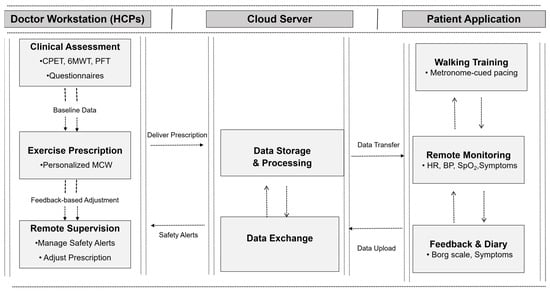
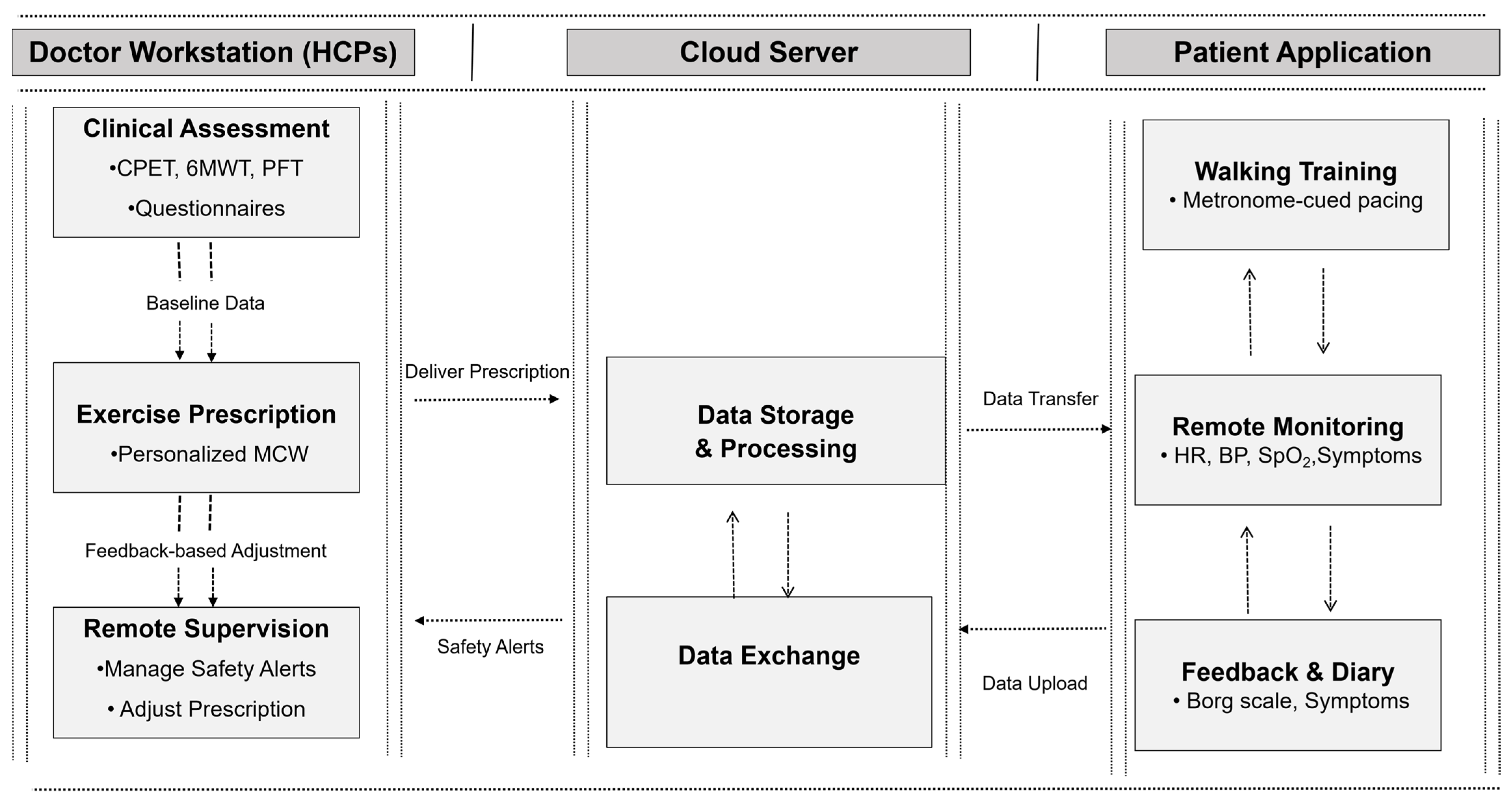
Participants in the IG were enrolled in a home-based walking program supported by a personalized metronome-cued walking mHealth system (developed in collaboration with Zhejiang University, Hangzhou, China), developed in collaboration with Zhejiang University [18]. As illustrated in Figure 1, the proposed system adopts a three-tier architecture comprising a Doctor Workstation (for healthcare professionals (HCPs)), a Cloud Server, and a Patient Application. First, HCPs conduct clinical assessments (including CPET (MasterScreen CPET, Erich Jaeger GmbH, Hoechberg, Germany), 6MWT, PFT (MasterScreen COPD, Erich Jaeger GmbH, Hoechberg, Germany), and questionnaires) to collect patients’ baseline data. Based on these data, a personalized exercise prescription (e.g., metronome-cued walking (MCW)) is generated and delivered to the Patient Application via the Cloud Server. During the walking training, the Patient Application actively performs remote monitoring by collecting vital signs (e.g., HR, BP, SpO2 (Yuwell, Jiangsu Yuyue Medical Equipment & Supply Co., Ltd., Danyang, China)) and symptoms, along with subjective feedback (e.g., Borg scale) via e-diaries. These data are seamlessly uploaded to the Cloud Server for storage, processing, and data exchange. Crucially, if abnormal physiological data are detected, the Cloud Server automatically transmits safety alerts to the Doctor Workstation. This closed-loop mechanism allows HCPs to maintain remote supervision of patients and make timely, feedback-based adjustments to the exercise prescription, thereby ensuring both the safety and efficacy of the rehabilitation process (Figure 1 and Table 1).
Figure 1.
The overall architecture of the proposed system.
Table 1.
Description of system applications.
The platform consists of three main components: the Doctor Workstation for clinical assessment, exercise prescription, and remote supervision; the Cloud Server for data storage, processing, and exchange; and the Patient Application for walking training guidance, remote monitoring, and patient feedback. The arrows indicate the direction of data transmission and the closed-loop feedback mechanism. Horizontal dotted arrows across columns represent real-time data transmission and command delivery between the doctor workstation, cloud server, and patient application. Vertical dashed arrows within the “Doctor Workstation” column denote sequential clinical workflows (from clinical assessment to prescription formulation, and feedback-based adjustment). Bidirectional vertical dashed arrows columns indicate continuous data exchange, real-time feedback loops, and daily cycling among walking training, remote monitoring, and diary feedback.
Assessment Module: Baseline assessments included cardiopulmonary exercise testing (CPET), pulmonary function testing [19], the 6 min walking test (6MWT) [20], the COPD Assessment Test (CAT) [21], the modified Medical Research Council (mMRC) dyspnea scale [22], the Hospital Anxiety and Depression Scale (HADS) [23], and the Clinical COPD Questionnaire (CCQ) [24].
Prescription Module: Rehabilitation specialists created individualized walking exercise prescriptions based on baseline assessments. The prescription covered exercise intensity, frequency and duration. A built-in metronome provided rhythmic auditory stimulation to regulate walking speed. Walking speed (m/min) was calculated using the formula, namely Walking speed = (VO2 − 3.5)/0.1 [25], based on oxygen consumption derived from CPET. Stride frequency (steps/min) was calculated as: Stride frequency = Walking speed / Step distance. CPET was used to estimate individual exercise capacity and to determine the prescribed walking speed. The initial target walking speed was derived from CPET-estimated VO2 and set at 70% of the maximal baseline speed. Subsequent adjustments to exercise duration were based on Borg dyspnea scores.
Feedback Module: Patients reported symptoms such as dyspnea and fatigue after each exercise session, enabling remote monitoring by healthcare professionals.
Safety Supervision Module: Key parameters, including heart rate, blood pressure, oxygen saturation, and symptoms, were monitored. Automated alerts were triggered if abnormal values were detected.
The mobile application consisted of three components: a doctor interface, cloud storage, and a patient interface. After enrollment, doctors uploaded personalized walking prescriptions to the application (Appendix A Figure A1). Patients performed the prescribed walking exercises at home at the set time and duration.
Exercise intensity was monitored using the Borg scale (0–10) for perceived exertion during each session [26]. Walking duration was adjusted based on Borg scores:
Score ≥ 7: walking time reduced by 6 min.
Score 4–6: walking time unchanged.
Score < 4: walking time increased by 6 min.
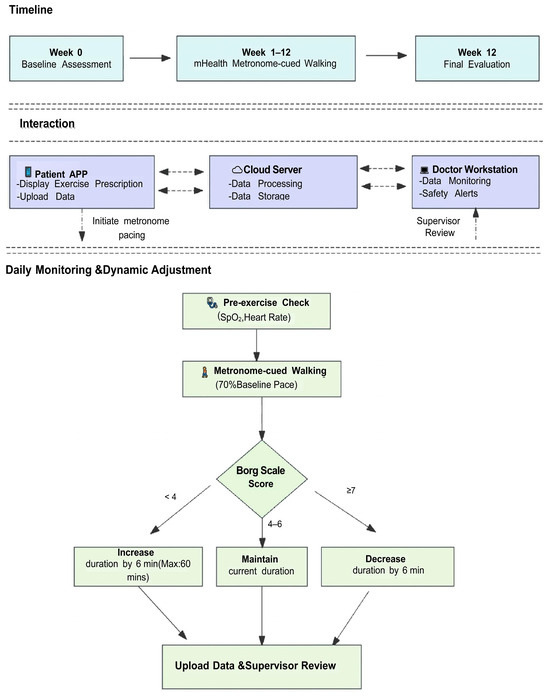
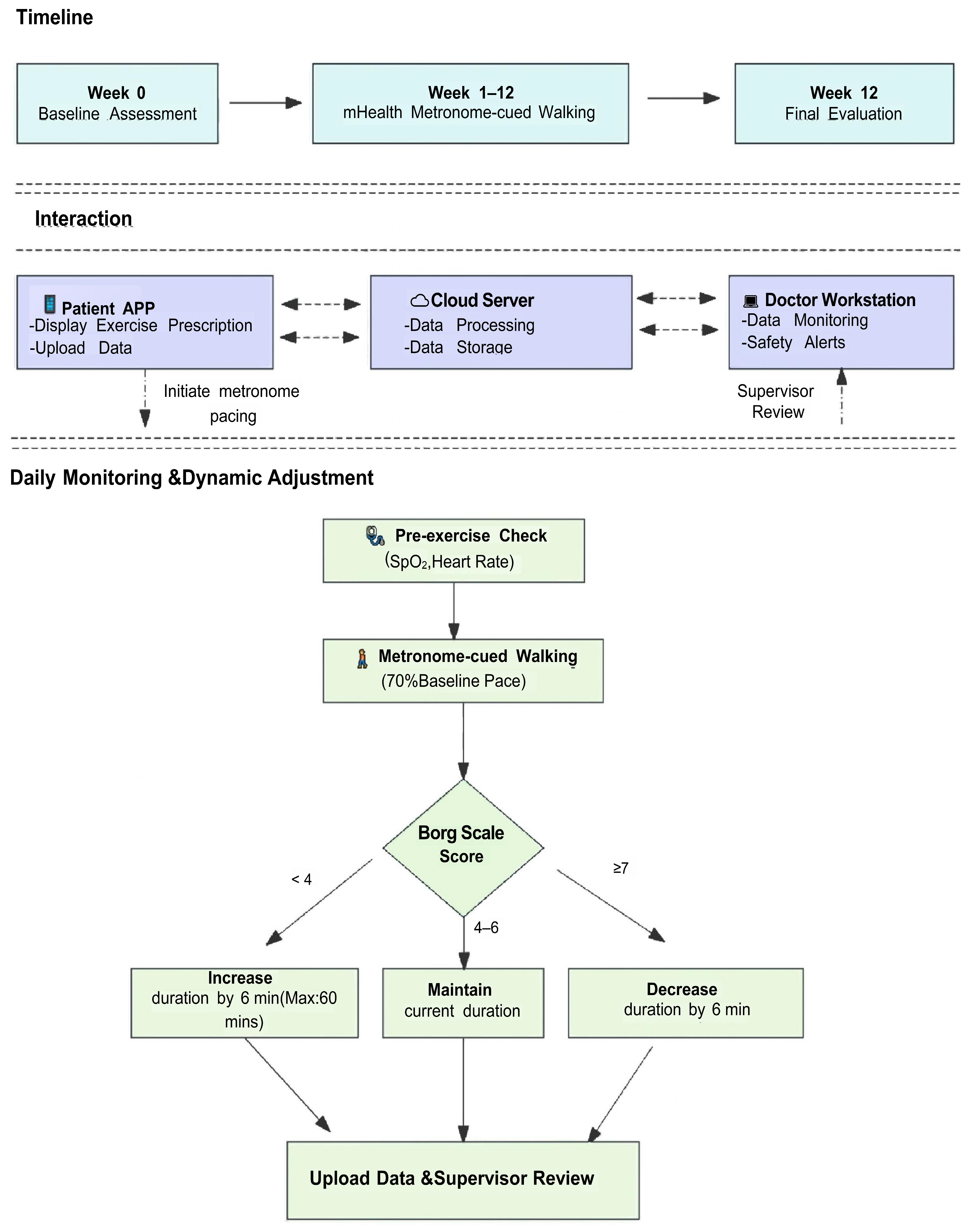
As illustrated, the overall intervention spanned 12 weeks. During daily practice, a closed-loop interaction was established: the system automatically dispensed the exercise prescription to the Patient Application, while the patient’s daily exercise data and safety alerts were uploaded to the Cloud Server for the supervisor to review using the Doctor Workstation. In terms of daily monitoring and dynamic adjustment, patients were required to perform a pre-exercise check (including SpO2 and heart rate). Subsequently, they initiated the metronome-cued walking at an initial pace of 70% of their baseline maximum speed. Crucially, the walking duration was dynamically adjusted based on the patient’s perceived exertion. After each session, patients rated their dyspnea using the Borg scale (0–10). If the score was <4, the exercise duration for the next session was increased by 6 min (up to a maximum of 60 min). If the score was between 4 and 6, the current duration was maintained. If the score was ≥7, the duration was decreased by 6 min. Finally, all post-exercise data were uploaded to allow the supervisor to perform a safety review.
A detailed workflow of the mHealth intervention, including the timeline, system interaction, and daily dynamic adjustment, is illustrated in Figure 2.
Figure 2.
Flowchart of the mHealth-based metronome-cued walking intervention. The framework illustrates the intervention process across three dimensions. The timeline displays the 12-week study duration from baseline to the final evaluation. The interaction panel depicts the data flow among the Patient Application, Cloud Server, and Doctor Workstation, highlighting the delivery of the exercise prescription and the review performed by the clinical supervisor. The daily monitoring and dynamic adjustment section details the patient’s daily routine: conducting pre-exercise vital sign checks (SpO2 and heart rate), engaging in metronome-cued walking at 70% of the baseline pace, and dynamically adjusting the exercise duration (±6 min) based on the Borg Dyspnea Scale score, followed by uploading data for the supervisor to review.
2.3.2. Control Group (CG)
Participants in the CG received standard care, including routine medical follow-up, lifestyle advice, medication management, and dietary guidance, without being subject to the mHealth-based walking intervention.
2.3.3. Adherence and Remote Monitoring
Adherence to the metronome-cued walking program was monitored through the mHealth system, which automatically recorded each training session initiated by participants in the IG. For each session, the system logged the date, walking duration, and Borg scale scores reported upon completion. A training session was considered “compliant” when participants completed the prescribed walking duration while maintaining the recommended step rate synchronized with the metronome. Real-time remote monitoring was enabled via the system’s Doctor Workstation, allowing the research team to review each participant’s training logs on a weekly basis. If no training record was detected for three consecutive days, a research assistant contacted the participant by phone to ensure engagement. The adherence rate was defined as the number of completed training sessions divided by the total number of prescribed sessions (36 sessions, based on 3 sessions per week over 12 weeks).
2.4. Outcome Measures
All outcome assessments were conducted at baseline and at week 12 by trained assessors blinded to group allocation.
Primary outcome:
Exercise capacity was assessed using the 6 min walking distance (6MWD). The test was performed in a 30 m indoor corridor by trained personnel, strictly following the clinical practice guidelines of the American Thoracic Society (ATS) [20]. A positive response was defined as an improvement in 6MWD exceeding the minimum clinically important difference (MCID) of +35 m [27].
Secondary outcomes:
Health-related quality of life was assessed using the COPD Assessment Test (CAT) and the Clinical COPD Questionnaire (CCQ). Specifically, we used the official simplified Chinese version of the CAT (available at www.catestonline.org); the CCQ followed the official Chinese version (www.ccq.nl).
Dyspnea severity was assessed using the modified Medical Research Council (mMRC) dyspnea scale. The mMRC dyspnea scale utilized the standard descriptions from the Guidelines for the Diagnosis and Treatment of COPD in China (2021 Revision) [28].
Psychological status was assessed using the Hospital Anxiety and Depression Scale (HADS) (specifically the Chinese version validated by Leung et al. [29]).
All questionnaires were administered in Chinese and self-completed by participants whenever possible. For those with literacy or comprehension difficulties, trained researchers provided neutral interview assistance and verified the completeness of the responses without influencing the participants’ choices.
Safety was ensured by recording the incidence of intervention-related adverse events throughout this study.
2.5. Statistical Analysis
Statistical analyses were performed using SPSS version 23.0 (IBM, Armonk, NY, USA). Graphs were created using GraphPad Prism version 8.4.0 (GraphPad Software, San Diego, CA, USA). Continuous variables with a normal distribution were expressed as mean ± standard deviation (SD); non-normally distributed variables were reported as median (interquartile range). Categorical variables were compared using the Pearson χ2 test or Fisher’s exact test, as appropriate. Within-group comparisons (baseline vs. week 12) were analyzed using the paired t-test for normally distributed data or the Wilcoxon signed-rank test for non-normally distributed data. Between-group differences in changes from baseline were analyzed using independent t-tests or the Mann–Whitney U tests, as appropriate. A two-tailed p-value < 0.05 was considered statistically significant.
To minimize potential confounding and selection bias inherent to the non-randomized, self-selected design, an analysis of covariance (ANCOVA) was performed on the primary outcome (6MWD at 12 weeks). Group (intervention vs. control) was entered as the fixed factor, while baseline 6MWD, age, and FEV1% predicted were adjusted as covariates. The estimated marginal means, adjusted mean differences, 95% confidence intervals (CIs), and partial eta-squared were calculated.
All analyses were conducted on the completer population, defined as participants who completed the 12-week follow-up assessment. Accordingly, this study did not employ an intention-to-treat approach, and missing post-intervention data were not imputed.
3. Results
3.1. Participant Disposition
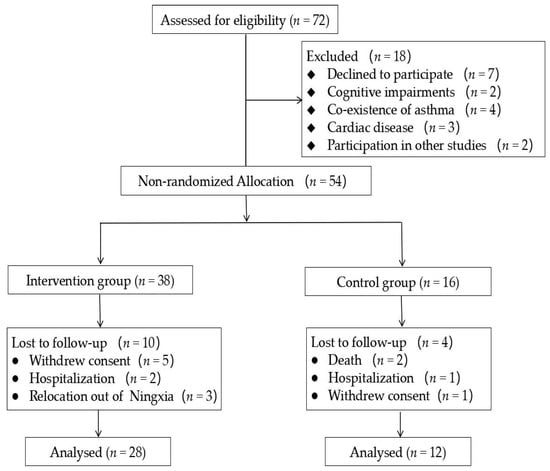
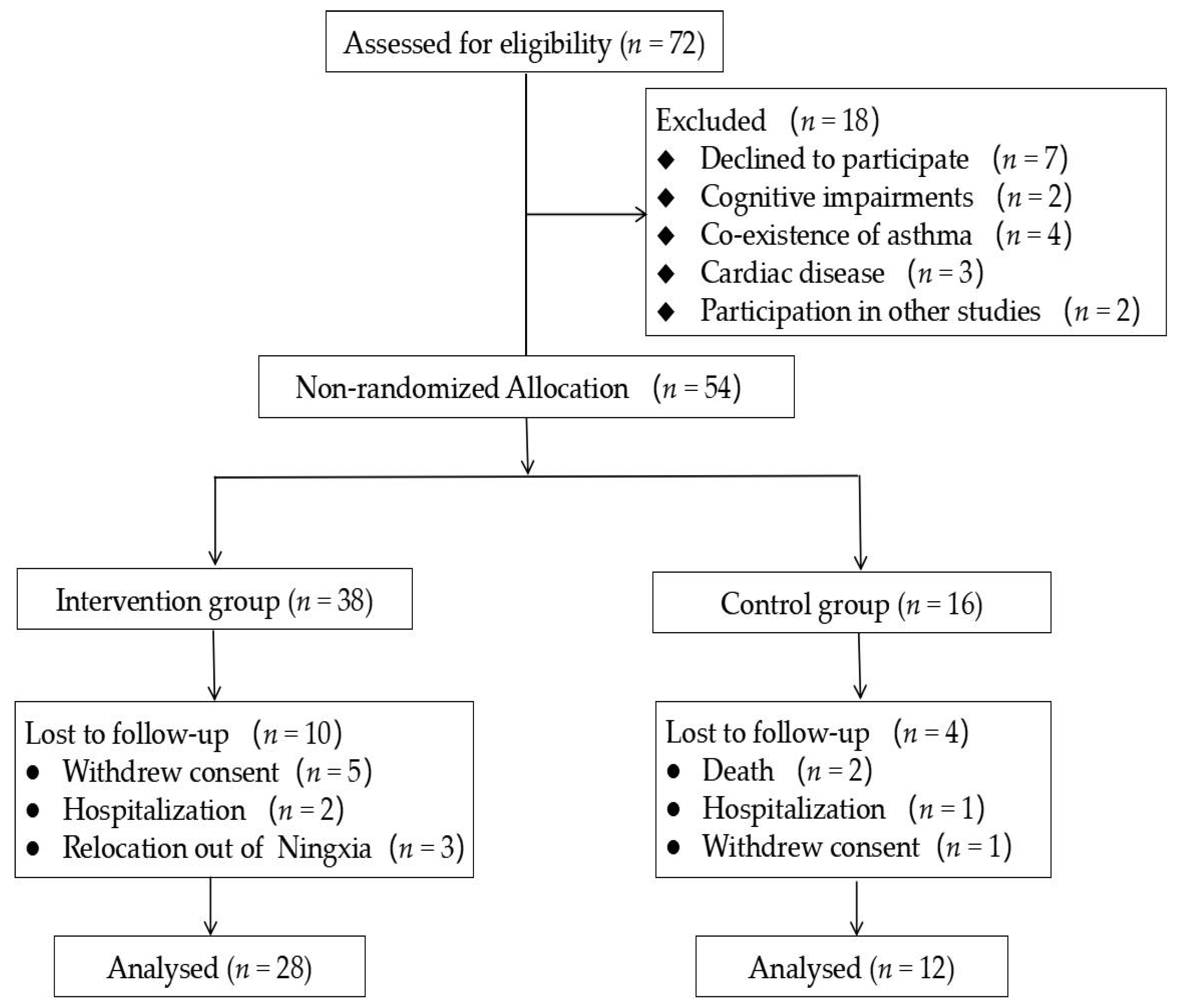
A total of 72 patients with stable COPD were assessed for eligibility. Of these, 18 were excluded for the following reasons: seven declined to participate, two had cognitive impairments, four had coexisting asthma, three had cardiac disease, and two were already enrolled in other studies. A total of 54 participants were initially enrolled. During the 12-week study period, 14 participants were lost to follow-up or had missing data due to hospitalization (n = 3), withdrawal of consent (n = 6), relocation out of Ningxia (n = 3), or death (n = 2). Finally, 40 participants completed the study and were included in the final analysis: 28 in the intervention group (IG) and 12 in the control group (CG). A participant flow diagram is presented in Figure 3. The 14 participants who did not complete the study were not included in the primary outcome analyses because post-intervention data were missing. Given the pilot nature of the study, no imputation methods were applied for missing data, and only completers were analyzed.
Figure 3.
A participant flow diagram.
3.2. Baseline Characteristics
The baseline demographic and clinical characteristics of the study participants are summarized in Table 2. All participants were male. There were no significant differences between the two groups at baseline in terms of age, body mass index (BMI), pulmonary function (FEV1% predicted, FVC% predicted), exercise capacity (6MWD), symptom scores (CAT, CCQ, mMRC), psychological status (HADS) or BODE index (all p > 0.05). Regarding medication use, the most common treatments were long-acting β2 agonists (LABAs), long-acting muscarinic antagonists (LAMAs), and inhaled corticosteroids (ICSs). The proportion of participants using these medications, as well as long-term oxygen therapy, was similar between the two groups. These findings indicate that the two groups were well-matched at baseline.
Table 2.
Baseline demographic and clinical characteristics of the study participants.
3.3. Effectiveness of Home-Based Walking Training
After the 12-week intervention, significant improvements were observed in the IG compared to the CG across multiple outcome measures.
3.3.1. Exercise Capacity
Exercise capacity, assessed by the patients’ 6MWD, increased significantly in the IG, with a mean improvement of 35.32 m (95% CI: 27.84 to 42.80). In contrast, a slight decrease was observed in the CG (mean change: −8.50 m; 95% CI: −17.52 to 0.52). The between-group difference in 6MWD change was statistically significant (p < 0.001). After adjusting for age, FEV1% predicted, and baseline 6MWD using ANCOVA, the intervention group still achieved a significantly higher 6MWD at 12 weeks compared to the control group, with an estimated marginal mean of 497.26 m (95% CI: 490.15 to 504.36) versus 453.24 m (95% CI: 442.36 to 464.12). The adjusted mean difference between the two groups was 44.02 m (95% CI: 30.99 to 57.05, F = 47.038, p < 0.001, Partial Eta2 = 0.573), demonstrating a robust and clinically meaningful treatment effect (Table 3).
Table 3.
Comparison of 12-week 6MWD between the two groups before and after adjusting for confounders.
3.3.2. Quality of Life and Symptom Scores
Health-related quality of life and symptom scores also improved significantly in the IG relative to the CG:
CAT score: −2.21 vs. +0.33 (p = 0.004);
CCQ score: −0.13 vs. +0.10 (p = 0.007);
mMRC dyspnea scale: −0.54 vs. 0.00 (p = 0.014).
3.3.3. Psychological Status
Psychological symptoms improved significantly in the IG compared to the CG:
HADS-Anxiety score: −1.11 vs. +0.92 (p = 0.001);
HADS-Depression score: −1.18 vs. +0.17 (p = 0.031).
3.3.4. BODE Index
No significant difference was observed in the BODE index between the two groups after the intervention (p > 0.05).
Detailed results for all outcome measures are presented in Table 4.
Table 4.
A 12-week personalized walking intervention yielded significant improvements across multiple outcomes.
3.4. Response to 6MWD in the Intervention Group
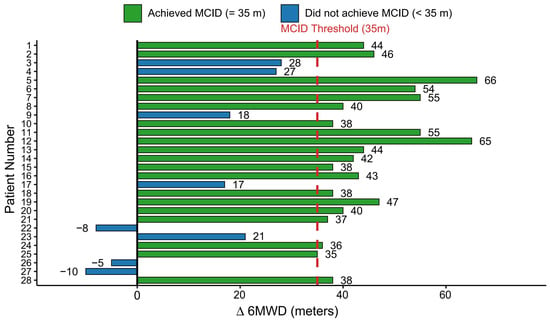
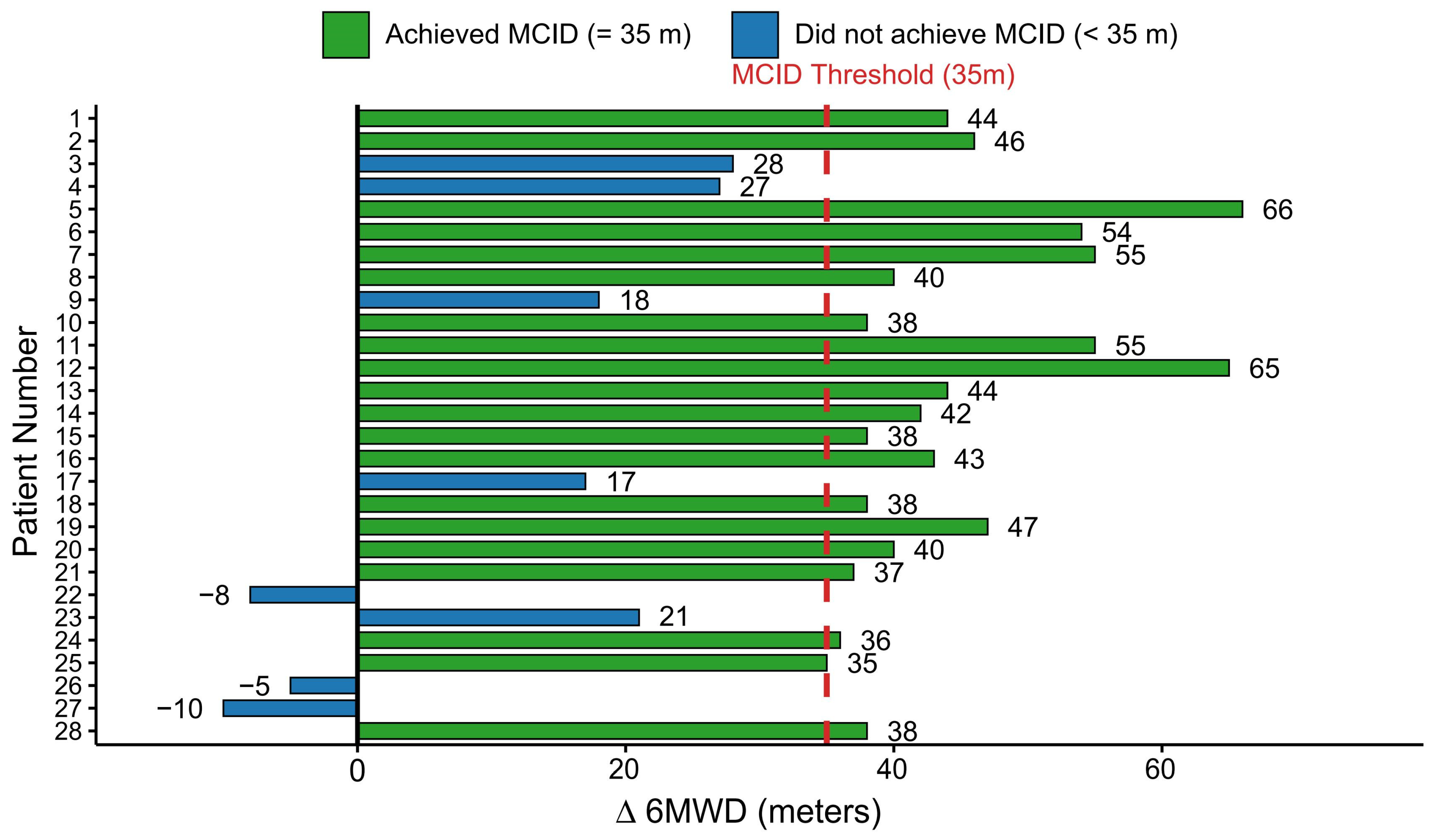
Among the 28 participants in the IG, 19 (67.86%) achieved a clinically significant improvement in 6MWD that exceeded the minimum clinically important difference (MCID) of 35 m, with a maximum improvement of 65 m. One participant (3.57%) improved by exactly 35 m, and five participants (17.86%) showed improvement below the MCID. Three participants (10.71%) experienced a decrease in 6MWD after the 12-week intervention. This distribution of 6MWD changes is illustrated in Figure 4.
Figure 4.
Individual changes in 6 min walk distance (Δ6MWD).
The red dashed line represents the minimal clinically important difference (MCID) threshold of 35 m. Green bars indicate patients who achieved or exceeded the MCID, while blue bars indicate those who did not. Exact change values are shown at the end of each bar.
3.5. Adherence
The overall mean adherence rate in the IG was 84.2% (range: 58.3–100%). Regarding application usage, participants logged a median of 32.5 active days (interquartile range: 28–35) over the 12-week period, with an average of 2.8 completed sessions per week. The average duration of each exercise session was 36.4 ± 11.2 min. No participant was lost to follow-up due to technology-related difficulties. These data indicate that the mHealth system achieved satisfactory real-world engagement and that remote monitoring was feasible in this COPD population.
3.6. Safety
The Metronome-Cued Walking mHealth System was well tolerated, and no serious adverse events (SAEs) were reported during the study period. A total of five (n = 5) mild, non-serious adverse events occurred during the initial week of training, including transient lower-limb muscle soreness (n = 2) and mild fatigue (n = 3). All symptoms resolved spontaneously within 24 h and were assessed by the study physician as normal physiological adaptations rather than a safety issue. The monitoring module of the mHealth system was programmed to detect physiological abnormalities based on five predefined warning thresholds. Across all logged home exercise sessions, no safety alerts were triggered. Consequently, no exercise sessions were suspended, and no walking prescriptions were modified or discontinued for safety reasons during the 12-week study period.
4. Discussion
In this study, we developed and evaluated a personalized, home-based metronome-cued walking mHealth system for patients with stable COPD. The results suggested that this 12-week intervention was associated with improvements in exercise capacity, alleviated dyspnea, and enhanced both health-related quality of life and psychological well-being. Specifically, the intervention group achieved a mean increase of 35.32 m in 6 min walk distance (6MWD), with 68% of participants exceeding the minimum clinically important difference (MCID) of +35 m. These preliminary results suggest that the mHealth system may be a feasible adjunctive tool for COPD home-based management, which warrants further validation in larger, randomized studies.
4.1. Improvement in Exercise Capacity
The observed 35.32 m improvement in 6MWD in our study exceeds the recently established MCID for exercise interventions in respiratory conditions, which a comprehensive meta-analysis of 42 studies involving 13,949 participants estimated to be between 24 and 26 m [30]. These preliminary findings are within the range reported for various exercise modalities in COPD. A network meta-analysis performed by Xie et al. demonstrated that continuous aerobic training, interval training, and resistance training all significantly improved 6MWD, with mean differences ranging from 33.3 to 84.5 m [31]. The 35.32 m improvement in our study is comparable to the effects of qigong (33.3 m) and continuous aerobic training (55.2 m), suggesting that metronome-cued walking may have effects comparable to these established interventions.
The observed improvements could be partly attributed to the rhythmic auditory cueing provided by the metronome. Research has shown that metronome-paced walking can optimize gait patterns and regulate walking speed, potentially reducing the oxygen cost of walking and improving exercise efficiency in patients with COPD [31]. This mechanism aligns with findings that interval training, which involves structured alternation between high and low intensity, ranked highest for improving 6MWD among exercise modalities [14]. Our system, which allowed real-time adjustments of training duration based on Borg scale scores, might similarly offer interval-like benefits while maintaining individualized exercise prescription.
Despite the overall positive outcomes, we observed inter-individual variability in response: approximately 28.6% of participants in the intervention group (8 out of 28) did not achieve the MCID for 6MWD, with three of them (10.7%) experiencing a decline in walking distance. Such variation is well-documented in exercise-based COPD interventions. We identified several potential contributing factors, including baseline functional status (where a ‘ceiling effect’ may limit gains in patients with higher initial 6MWD) [3], psychological barriers (specifically dyspnea-related kinesiophobia, which can restrict exercise intensity) [32], and adherence variability among participants. While our current sample size precludes a robust subgroup analysis to statistically identify these predictors, we have highlighted this as an area for future research. Larger-scale studies should systematically explore baseline characteristics, such as frailty, nutritional status, and psychological resilience, to better distinguish responders from non-responders in metronome-cued walking interventions.
4.2. Impact on Physical Activity and Quality of Life
The improvements in the CAT, the CCQ, and the mMRC scores in our intervention group reflect potential enhancements in both symptom burden and health-related quality of life. These findings are consistent with a large body of evidence demonstrating that home-based pulmonary rehabilitation programs can achieve outcomes comparable to center-based programs [8,11]. A recent scoping review of 44 studies reported that telemonitoring and telerehabilitation interventions led to improvements in health-related quality of life in 84% of studies compared to pre-intervention levels, as well as that they were as effective as standard care [10].
The integration of physical activity monitoring with goal setting and health coaching, as implemented in our system, aligns with the “treatable traits” paradigm for chronic airways disease management. A recent systematic review and meta-analysis of 236 studies (25,278 participants) identified physical inactivity as a highly prevalent and clinically relevant treatable trait in COPD, with daily step counts significantly associated with 6MWD and mMRC scores [33]. The authors concluded that physical activity satisfies the core criteria for a treatable trait—being clinically relevant, measurable, and treatable—supporting its inclusion in routine disease evaluation and management [33].
4.3. Psychological Benefits
The improvement in Hospital Anxiety and Depression Scale (HADS) scores in our intervention group highlights a potential psychological benefit of the metronome-cued walking program. These findings are supported by recent meta-analyses demonstrating that mind–body exercise interventions significantly reduce anxiety and depression in elderly COPD patients, with standardized mean differences of −0.59 and −0.34, respectively [34]. While our intervention was not designed as a mind–body exercise, the structured nature of metronome-cued walking combined with mHealth feedback might provide similar psychological benefits through enhanced self-efficacy, reduced dyspnea-related fear, and increased sense of control over the exercise process.
4.4. Adherence and Safety
The absence of intervention-related serious adverse events in our study provides preliminary evidence of the short-term safety of the metronome-cued walking program when appropriately prescribed based on individual exercise capacity. Adherence to home-based exercise programs in COPD can be challenging, but our findings suggest that the combination of personalized prescription, real-time feedback, and mHealth support might facilitate sustained engagement. Research by Cerini et al. on a home-based exercise program (HOMEX) found that 70% of participants continued with training until study end, with self-perceived improvement in strength and integration of training into daily routine identified as key facilitators of long-term motivation [35]. These insights are broadly consistent with our system design, which emphasizes individualized exercise prescription and integration of training into daily activities.
4.5. Comparison with Digital Health Interventions
Our metronome-cued walking mHealth system can be classified as a composite digital intervention combining a mobile application with physiological feedback (App + Sensor). A recent network meta-analysis comparing various digital health intervention modalities found that composite digital interventions ranked second (SUCRA = 66.8%) for improving daily step counts, while wearable only ranked highest for improving 6MWD (SUCRA = 90.3%) [36]. However, the authors noted that the certainty of evidence was low, and digital health interventions should be viewed as complementary rather than full replacements for traditional rehabilitation [36]. Our pilot results are consistent with this perspective, suggesting that personalized, home-based interventions may help extend the reach of pulmonary rehabilitation.
From an economic perspective, telerehabilitation has been shown to be a cost-effective alternative to center-based pulmonary rehabilitation, with an internal rate of return of 134% over five years [37]. Burge et al. reported that program completion was associated with a significant reduction in total healthcare costs in the following 12 months, regardless of whether rehabilitation was delivered via telerehabilitation or center-based models [37]. These findings suggest possible economic benefits of scaling up home-based programs, though this requires further investigation in our specific context.
4.6. Clinical Implications
If confirmed in larger trials, the findings of this pilot study may have several clinical implications. First, the metronome-cued walking approach provides a simple, reproducible method for regulating exercise intensity during home-based walking, which could address a key challenge in unsupervised rehabilitation. Second, the integration of mHealth technology enables real-time monitoring and feedback, potentially facilitating early detection of adverse responses and promoting safe exercise progression. Third, the personalized prescription based on baseline 6MWD and CPET data ensures that exercise intensity is appropriately tailored to individual functional capacity, which may enhance both safety and efficacy.
Given the high prevalence of physical inactivity in COPD and its association with adverse outcomes [33], interventions that might promote physical activity while maintaining safety are urgently needed. Our system offers a potential strategy that could be tested in various healthcare settings, which might eventually expand access to pulmonary rehabilitation for patients who face barriers to center-based programs.
4.7. Limitations
Several limitations should be acknowledged. First, in this study, we utilized a non-randomized, single-center prospective design. The allocation was partially influenced by patient preference, which may introduce selection bias. Although we performed ANCOVA to adjust for key baseline covariates (including age, lung function, and baseline exercise capacity) and confirmed that the treatment effect remained robust, potential unmeasured confounders may still exist. Future randomized controlled trials with larger cohorts are warranted to validate our findings. Participants highly motivated to use mHealth tools might differ from those opting for standard care regarding health literacy or self-management beliefs, potentially confounding the subjective outcomes (CAT, CCQ, mMRC, and HADS). Second, the relatively small sample size (n = 40) and the unbalanced group distribution (28 vs. 12) may limit the statistical power and increase the risk of Type II errors. Consequently, this study should be viewed as a pilot investigation, and the findings require validation through larger-scale, multicenter randomized controlled trials (RCTs). Third, our study population consisted entirely of male participants. This gender distribution was not a result of intentional selection bias, as patients were enrolled based on their willingness and strict inclusion/exclusion criteria without gender-based restrictions. Instead, this reflects the epidemiological characteristics of COPD in China and specifically in the Ningxia region. According to national surveys, the prevalence of COPD is significantly higher in men (11.9%) than in women (5.4%) [38], and in Ningxia, the prevalence among males (13.0%) is also markedly higher than in females (5.4%) [39]. While our cohort reflects the real-world recruited population at our center, the lack of female participants may limit the generalizability of the findings to all genders. Future multi-center studies should aim to include more female patients to verify the universal efficacy of the mHealth system. Fourth, we acknowledge that employing a “standard care only” control group, rather than an active control, is a limitation that may have amplified the observed between-group differences. Participants in the control group were managed with standard therapy and lifestyle counseling but lacked a supervised exercise regimen. Although this comparison provides some indication of the program’s potential clinical utility, the multifaceted nature of the intervention—comprising individualized exercise prescription, metronome pacing, and remote monitoring—precludes us from isolating the independent effect size of the mHealth platform itself. We recognize that factors such as enhanced patient engagement, regular follow-up contacts, and expectancy effects (the Hawthorne effect) within the intervention group may have contributed to the treatment outcomes. Therefore, we emphasize the need for future randomized controlled trials utilizing active control groups to more precisely delineate the specific efficacy of metronome-cued walking. Fifth, the study duration of 12 weeks does not allow assessment of the long-term sustainability of the observed improvements. Sixth, while the metronome-cued walking approach is innovative, the mechanisms underlying its benefits, particularly whether rhythmic auditory cueing directly improves gait efficiency or primarily enhances adherence, remain to be elucidated. Seventh, our analyses were conducted on the completer population only, and no intention-to-treat analysis was performed because post-intervention outcome data were unavailable for the 14 participants who discontinued the study (25.9% of the enrolled sample). The absence of imputation for missing data may have introduced attrition bias and affected the precision of the estimated intervention effects. Future larger trials should incorporate an intention-to-treat analysis with appropriate strategies for handling missing data. Finally, the cost-effectiveness of this intervention compared to other digital health modalities requires further investigation.
4.8. Future Directions
Given the exploratory nature of this pilot study, future research should focus on larger, multi-center randomized controlled trials to confirm the efficacy and cost-effectiveness of this metronome-cued walking mHealth system. Long-term follow-up studies are needed to assess the durability of the observed improvements and the optimal strategies for maintaining engagement. Additionally, comparative effectiveness studies evaluating this system against other digital health modalities, such as wearable-only interventions or synchronous tele-rehabilitation, would help position this approach within the broader landscape of pulmonary rehabilitation options. Exploring the potential mechanisms of metronome-cued walking—including whether benefits are mediated through improved gait efficiency, reduced dyspnea perception, or enhanced self-efficacy—would also provide valuable insights for intervention optimization.
5. Conclusions
In conclusion, this pilot study provides preliminary evidence that a personalized, home-based metronome-cued walking mHealth system may be associated with improvements in exercise capacity, dyspnea, health-related quality of life, and psychological well-being in patients with stable COPD. The program appeared safe in this small sample. The system addresses some barriers to center-based pulmonary rehabilitation and may offer a complementary strategy worth testing in future definitive trials.
Author Contributions
Conceptualization, Y.Z. (Yumin Zhou), N.D. and J.C.; Methodology, P.Z. and Y.L.; Software, W.J. and L.S.; Validation, J.A. and N.D.; Formal analysis, F.W.; Investigation, Y.H.; Resources, Y.Z. (Yi Zhang); Data curation, S.W.; Writing—original draft, S.W.; Writing—review & editing, Y.J. and J.C.; Visualization, S.W.; Supervision, Y.Z. (Yi Zhang); Project administration, Y.H.; Funding acquisition, J.C. All authors have read and agreed to the published version of the manuscript.
Funding
This work was supported by grants from the National Natural Science Foundation of China (No. 82460200); Ningxia Key Research and Development Project (No. 2023BEG02021 and No. 2025BEG02002); National Science and Technology Major Project of China (No. 2024ZD0528905); Ningxia Autonomous Region Scientific and Technological Infrastructure Construction Project (No. 2025DPC05027); Talent Recognition under the Hua Tuo Plan in Wuhu City (HTRCRD202431); and High-Level Talent Introduction Program of Wannan Medical College (GCCRCJB202320).
Institutional Review Board Statement
The study was conducted in accordance with the Declaration of Helsinki and was approved by the Ethics Committee of the General Hospital of Ningxia Medical University (No. 2020-338, approved on 1 April 2020).
Informed Consent Statement
Informed consent was obtained from all subjects involved in the study.
Data Availability Statement
The data presented in this study are available on request from the corresponding author; the data are not publicly available due to privacy and ethical restrictions.
Acknowledgments
The authors would like to thank the working members of the General Hospital of Ningxia Medical University, the Affiliated Yijishan Hospital of Wannan Medical College, Zhejiang University and the First Affiliated Hospital of Guangzhou Medical University.
Conflicts of Interest
The authors declare no conflicts of interest.
Abbreviations
The following abbreviations are used in this manuscript:
| 6MWD | 6 min walk distance |
| COPD | chronic obstructive pulmonary disease |
| MCID | minimal clinically important difference |
| FEV1 | forced expiratory volume in 1 s |
| FVC | forced vital capacity |
| CAT | COPD Assessment Test |
| mMRC | modified British Medical Research Council |
| HADS | Hospital Anxiety and Depression Scale |
| CCQ | Clinical COPD Questionnaire |
| HCPs | health care providers |
Appendix A
Figure A1.
The remote deployment and home management of personalized walking prescriptions in mobile applications.
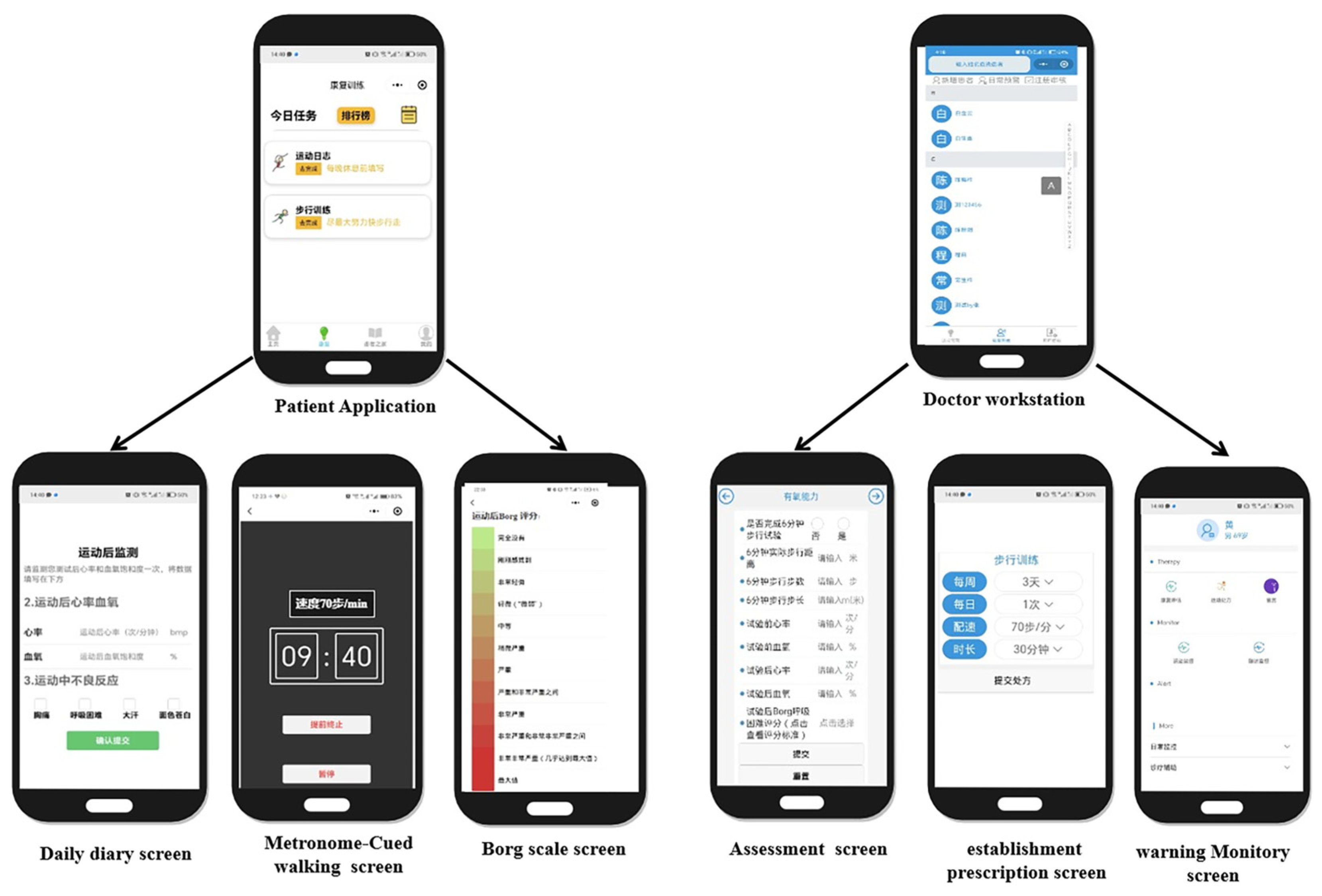
The mobile application consists of three main components: the Patient Application serves as the primary interface for patients, delivering the training program and collecting feedback data to ensure proper engagement and progress tracking; the Cloud Server acts as the central hub for data exchange and processing, facilitating seamless communication between the Patient Application and the Doctor Workstation; and the Doctor Workstation is mainly used for safety monitoring and adjusting prescriptions as needed to ensure that personalized and safe training is provided for each patient.
Screen 1 (Patient Application): 康复训练 (Rehabilitation Training); 今日任务(Today’s Tasks); 排行榜 (Leaderboard); 运动日志 (Exercise Log); 步行训练 (Walking Training).
Screen 2 (Doctor workstation): 通讯录 (Contacts); 医生 (Doctors); 患者 (Patients).
Screen 3 (Daily diary screen): 运动期监测 (Monitoring after exercise); 运动后心率血氧 (Post-exercise heart rate and oxygen saturation); 运动中不良反应 (Adverse reactions during exercise; 胸痛 (Chest pain); 呼吸困难 (Dyspnea); 大汗 (Profuse sweating); 面色苍白 (Pale complexion).
Screen 4 (Metronome-Cued walking screen): 速度70步/min (Speed: 70 steps/min); 继续/停止 (Continue/Stop); 暂停 (Pause).
Screen 5 (Borg Scale screen): 运动后Borg评分 (Post-exercise Borg Scale) rating from 完全没有(None) to 极度严重 (extremely severe).
Screen 6 (Assessment screen): 有氧能力 (Aerobic Capacity assessment form); 是否完成六分钟步行试验? (Is the 6-Minute Walk Test completed?); 六分钟步行距离 (6-Minute Walk Distance); 6分钟步行步长 (6-Minute Walk Step Length); 6MWT前后的心率 (Pre/Post-6MWT HR); 6MWT前后的血氧 (Pre/Post-6MWT SpO2); 6MWT前后的Borg评分 (Borg score before and after 6MWT).
Screen 7 (establishment prescription screen): 步行训练处方 (Walking Training prescription; 每日 (Daily: 1 time); 每周 (Weekly: 3 days); 配速 (Pace: 70 steps/min); 时长 (Duration: 30 min).
Screen 8 (warnin Monitory screen): 运动监督 (Exercise Supervision); 随访监督 (Follow-up Supervision); 预警 (Alert).
References
- Fan, Y.; Chen, Q.; Sun, H.; Bärnighausen, T.; Wang, C.; Yang, T.; Chen, S. Economic evaluations of screening and case-finding for Chronic Obstructive Pulmonary Disease (COPD): A systematic review. npj Prim. Care Respir. Med. 2026, 36, 7. [Google Scholar] [CrossRef] [Scilit] [PubMed]
- Rochester, C.L.; Alison, J.A.; Carlin, B.; Jenkins, A.R.; Cox, N.S.; Bauldoff, G.; Bhatt, S.P.; Bourbeau, J.; Burtin, C.; Camp, P.G.; et al. Pulmonary Rehabilitation for Adults with Chronic Respiratory Disease: An Official American Thoracic Society Clinical Practice Guideline. Am. J. Respir. Crit. Care Med. 2023, 208, e7–e26. [Google Scholar] [CrossRef] [Scilit] [PubMed]
- Spruit, M.A.; Singh, S.J.; Garvey, C.; ZuWallack, R.; Nici, L.; Rochester, C.; Hill, K.; Holland, A.E.; Lareau, S.C.; Man, W.D.; et al. An official American Thoracic Society/European Respiratory Society statement: Key concepts and advances in pulmonary rehabilitation. Am. J. Respir. Crit. Care Med. 2013, 188, e13–e64. [Google Scholar] [CrossRef] [Scilit] [PubMed]
- McCarthy, B.; Casey, D.; Devane, D.; Murphy, K.; Murphy, E.; Lacasse, Y. Pulmonary rehabilitation for chronic obstructive pulmonary disease. Cochrane Database Syst. Rev. 2015, 2015, Cd003793. [Google Scholar] [CrossRef] [Scilit] [PubMed]
- Rochester, C.L.; Vogiatzis, I.; Holland, A.E.; Lareau, S.C.; Marciniuk, D.D.; Puhan, M.A.; Spruit, M.A.; Masefield, S.; Casaburi, R.; Clini, E.M.; et al. An Official American Thoracic Society/European Respiratory Society Policy Statement: Enhancing Implementation, Use, and Delivery of Pulmonary Rehabilitation. Am. J. Respir. Crit. Care Med. 2015, 192, 1373–1386. [Google Scholar] [CrossRef] [Scilit] [PubMed]
- Lindenauer, P.K.; Stefan, M.S.; Pekow, P.S.; Mazor, K.M.; Priya, A.; Spitzer, K.A.; Lagu, T.C.; Pack, Q.R.; Pinto-Plata, V.M.; ZuWallack, R. Association Between Initiation of Pulmonary Rehabilitation After Hospitalization for COPD and 1-Year Survival Among Medicare Beneficiaries. JAMA 2020, 323, 1813–1823. [Google Scholar] [CrossRef] [Scilit] [PubMed]
- Cox, N.S.; Oliveira, C.C.; Lahham, A.; Holland, A.E. Pulmonary rehabilitation referral and participation are commonly influenced by environment, knowledge, and beliefs about consequences: A systematic review using the Theoretical Domains Framework. J. Physiother. 2017, 63, 84–93. [Google Scholar] [CrossRef] [Scilit] [PubMed]
- Holland, A.E.; Mahal, A.; Hill, C.J.; Lee, A.L.; Burge, A.T.; Cox, N.S.; Moore, R.; Nicolson, C.; O’Halloran, P.; Lahham, A.; et al. Home-based rehabilitation for COPD using minimal resources: A randomised, controlled equivalence trial. Thorax 2017, 72, 57–65. [Google Scholar] [PubMed]
- Cox, N.S.; Dal Corso, S.; Hansen, H.; McDonald, C.F.; Hill, C.J.; Zanaboni, P.; Alison, J.A.; O’Halloran, P.; Macdonald, H.; Holland, A.E. Telerehabilitation for chronic respiratory disease. Cochrane Database Syst. Rev. 2021, 1, Cd013040. [Google Scholar] [PubMed]
- Sanchez-Ramirez, D.C.; Pol, M.; Loewen, H.; Choukou, M.A. Effect of telemonitoring and telerehabilitation on physical activity, exercise capacity, health-related quality of life and healthcare use in patients with chronic lung diseases or COVID-19: A scoping review. J. Telemed. Telecare 2024, 30, 1097–1115. [Google Scholar] [PubMed]
- Alamer, S.; Robinson-Barellla, A.; Cooper, M.; Nazar, H.; Husband, A. Barriers and facilitators of adherence to treatment interventions for COPD amongst individuals from minority ethnic communities: Meta-ethnography. PLoS ONE 2025, 20, e0318709. [Google Scholar] [CrossRef] [Scilit] [PubMed]
- Brown, S.E.; Wootton, S.; Dale, M.T.; Alison, J.A.; Chan, A.S.L.; Varnfield, M.; Yang, I.; Cunich, M.; McKeough, Z.J. Mobile health pulmonary rehabilitation (m-PR): A randomised controlled equivalence trial. Thorax 2026, 81, 302–310. [Google Scholar] [PubMed]
- Thaut, M.H.; McIntosh, G.C.; Hoemberg, V. Neurobiological foundations of neurologic music therapy: Rhythmic entrainment and the motor system. Front. Psychol. 2014, 5, 1185. [Google Scholar] [PubMed]
- Bernardi, E.; Pomidori, L.; Cassutti, F.; Cogo, A. Home-Based, Moderate-Intensity Exercise Training Using a Metronome Improves the Breathing Pattern and Oxygen Saturation During Exercise in Patients with COPD. J. Cardiopulm. Rehabil. Prev. 2018, 38, E16–E18. [Google Scholar] [PubMed]
- Pomidori, L.; Contoli, M.; Mandolesi, G.; Cogo, A. A simple method for home exercise training in patients with chronic obstructive pulmonary disease: One-year study. J. Cardiopulm. Rehabil. Prev. 2012, 32, 53–57. [Google Scholar] [CrossRef] [Scilit] [PubMed]
- Strassmann, A.; Guler, M.; Steurer-Stey, C.; Lana, K.D.; Carron, T.; Braun, J.; Giroud, P.; Peytremann-Bridevaux, I.; Puhan, M.A.; Frei, A. Nationwide implementation of the self-management program “Living well with COPD”: Process and effectiveness evaluation using a mixed-methods approach. Patient Educ. Couns. 2022, 105, 670–678. [Google Scholar] [PubMed]
- Zhou, H.; Li, C.; Niu, F.; Liu, W.; Qiu, X.; Yang, G.; Zhang, H.; Yan, J. Barriers and facilitators to adherence to home-based pulmonary rehabilitation in patients with chronic obstructive pulmonary disease: A mixed-methods systematic review. BMC Nurs. 2025, 24, 1279. [Google Scholar] [PubMed]
- Deng, N.; Sheng, L.; Jiang, W.; Hao, Y.; Wei, S.; Wang, B.; Duan, H.; Chen, J. A home-based pulmonary rehabilitation mHealth system to enhance the exercise capacity of patients with COPD: Development and evaluation. BMC Med. Inform. Decis. Mak. 2021, 21, 325. [Google Scholar] [PubMed]
- Balady, G.J.; Arena, R.; Sietsema, K.; Myers, J.; Coke, L.; Fletcher, G.F.; Forman, D.; Franklin, B.; Guazzi, M.; Gulati, M.; et al. Clinician’s Guide to cardiopulmonary exercise testing in adults: A scientific statement from the American Heart Association. Circulation 2010, 122, 191–225. [Google Scholar] [PubMed]
- Holland, A.E.; Spruit, M.A.; Troosters, T.; Puhan, M.A.; Pepin, V.; Saey, D.; McCormack, M.C.; Carlin, B.W.; Sciurba, F.C.; Pitta, F.; et al. An official European Respiratory Society/American Thoracic Society technical standard: Field walking tests in chronic respiratory disease. Eur. Respir. J. 2014, 44, 1428–1446. [Google Scholar] [CrossRef] [Scilit] [PubMed]
- Jones, P.W.; Harding, G.; Berry, P.; Wiklund, I.; Chen, W.H.; Kline Leidy, N. Development and first validation of the COPD Assessment Test. Eur. Respir. J. 2009, 34, 648–654. [Google Scholar] [CrossRef] [Scilit] [PubMed]
- Bestall, J.C.; Paul, E.A.; Garrod, R.; Garnham, R.; Jones, P.W.; Wedzicha, J.A. Usefulness of the Medical Research Council (MRC) dyspnoea scale as a measure of disability in patients with chronic obstructive pulmonary disease. Thorax 1999, 54, 581–586. [Google Scholar] [CrossRef] [Scilit] [PubMed]
- Snaith, R.P. The Hospital Anxiety And Depression Scale. Health Qual. Life Outcomes 2003, 1, 29. [Google Scholar] [CrossRef] [Scilit] [PubMed]
- van der Molen, T.; Willemse, B.W.; Schokker, S.; ten Hacken, N.H.; Postma, D.S.; Juniper, E.F. Development, validity and responsiveness of the Clinical COPD Questionnaire. Health Qual. Life Outcomes 2003, 1, 13. [Google Scholar] [CrossRef] [Scilit] [PubMed]
- Nici, L.; Donner, C.; Wouters, E.; Zuwallack, R.; Ambrosino, N.; Bourbeau, J.; Carone, M.; Celli, B.; Engelen, M.; Fahy, B.; et al. American Thoracic Society/European Respiratory Society statement on pulmonary rehabilitation. Am. J. Respir. Crit. Care Med. 2006, 173, 1390–1413. [Google Scholar] [CrossRef] [Scilit] [PubMed]
- Mador, M.J.; Rodis, A.; Magalang, U.J. Reproducibility of Borg scale measurements of dyspnea during exercise in patients with COPD. Chest 1995, 107, 1590–1597. [Google Scholar] [CrossRef] [Scilit] [PubMed]
- Puhan, M.A.; Mador, M.J.; Held, U.; Goldstein, R.; Guyatt, G.H.; Schünemann, H.J. Interpretation of treatment changes in 6-minute walk distance in patients with COPD. Eur. Respir. J. 2008, 32, 637–643. [Google Scholar] [CrossRef] [Scilit] [PubMed]
- Chronic Obstructive Pulmonary Disease Group of Chinese Thoracic Society; Chronic Obstructive Pulmonary Disease Committee of Chinese Association of Chest Physician. Guidelines for the diagnosis and management of chronic obstructive pulmonary disease (revised version 2021). Chin. J. Tuberc. Respir. Dis. 2021, 44, 170–205. [Google Scholar]
- Leung, C.M.; Ho, S.; Kan, C.S.; Hung, C.H.; Chen, C.N. Evaluation of the Chinese version of the Hospital Anxiety and Depression Scale. A cross-cultural perspective. Int. J. Psychosom. 1993, 40, 29–34. [Google Scholar] [PubMed]
- Daynes, E.; Barker, R.E.; Jones, A.V.; Walsh, J.A.; Nolan, C.M.; Man, W.D.; Singh, S.J.; Greening, N.J.; Houchen-Wolloff, L.; Evans, R.A. Determining the minimum important differences for field walking tests in adults with long-term conditions: A systematic review and meta-analysis. Eur. Respir. Rev. 2025, 34, 240198. [Google Scholar] [PubMed]
- Xie, J.; Guo, J.; Wang, B. Optimal Exercise Modalities and Doses for Alleviating Dyspnea Symptoms and Enhancing Exercise Capacity in Patients with Chronic Obstructive Pulmonary Disease: A Network and Dose-Response Meta-analysis. Arch. Phys. Med. Rehabil. 2025, 106, 1594–1602. [Google Scholar] [CrossRef] [Scilit] [PubMed]
- Saka, S.; Gurses, H.N.; Bayram, M. Effect of inspiratory muscle training on dyspnea-related kinesiophobia in chronic obstructive pulmonary disease: A randomized controlled trial. Complement. Ther. Clin. Pract. 2021, 44, 101418. [Google Scholar] [CrossRef] [Scilit] [PubMed]
- Griffiths, B.; Alajmi, R.; Clifton, I.J.; Birch, R.J.; Peckham, D.; Price, O.J. Physical inactivity in chronic airways disease: An important candidate in the treatable traits paradigm. Eur. Respir. Rev. 2026, 35, 250165. [Google Scholar] [CrossRef] [Scilit] [PubMed]
- Yan, Z.; Zhang, T.; Ding, Z.; Tao, B.; Shu, J.; Yu, M.; Liang, Q.; Yan, J. Effects of a mind-body exercise intervention on anxiety, depression and quality of life in elderly patients with chronic obstructive pulmonary disease: A systematic evaluation and META analysis. Complement. Ther. Med. 2025, 93, 103237. [Google Scholar] [CrossRef] [Scilit] [PubMed]
- Cerini, T.; Kunz, R.; Dalla Lana, K.; Radtke, T.; Polhemus, A.; Puhan, M.A.; Frei, A. Evaluation of the Implementation of a Home-Based Exercise Training Program for People with COPD: A Mixed-Methods Study. Front. Rehabil. Sci. 2021, 2, 743588. [Google Scholar] [PubMed]
- Xu, Y.; Liao, M.; Bai, J. Comparative efficacy of different digital health intervention modalities versus traditional pulmonary rehabilitation on daily step counts and exercise capacity in patients with COPD: A systematic review and network meta-analysis. Front. Public Health 2026, 14, 1774368. [Google Scholar] [CrossRef] [Scilit] [PubMed]
- Burge, A.T.; Cox, N.S.; Holland, A.E.; McDonald, C.F.; Alison, J.A.; Wootton, R.; Hill, C.J.; Zanaboni, P.; O’Halloran, P.; Bondarenko, J.; et al. Telerehabilitation Compared with Center-based Pulmonary Rehabilitation for People with Chronic Respiratory Disease: Economic Analysis of a Randomized Controlled Clinical Trial. Ann. Am. Thorac. Soc. 2025, 22, 47–53. [Google Scholar] [CrossRef] [Scilit] [PubMed]
- Wang, C.; Xu, J.; Yang, L.; Xu, Y.; Zhang, X.; Bai, C.; Kang, J.; Ran, P.; Shen, H.; Wen, F.; et al. Prevalence and risk factors of chronic obstructive pulmonary disease in China (the China Pulmonary Health [CPH] study): A national cross-sectional study. Lancet 2018, 391, 1706–1717. [Google Scholar] [CrossRef] [Scilit] [PubMed]
- Qiu, J.; Zhang, Y.N.; Chen, J.; Luo, T.; Yu, X.H.; Wang, J.C.; Tan, H.; Lu, X.L.; Zhang, J. Prevalence of chronic obstructive pulmonary disease in Ningxia Hui Autonomous Region of China. Chin. J. Tuberc. Respir. Dis. 2013, 36, 265–268. [Google Scholar]

Disclaimer/Publisher’s Note: The statements, opinions and data contained in all publications are solely those of the individual author(s) and contributor(s) and not of MDPI and/or the editor(s). MDPI and/or the editor(s) disclaim responsibility for any injury to people or property resulting from any ideas, methods, instructions or products referred to in the content. |
© 2026 by the authors. Licensee MDPI, Basel, Switzerland. This article is an open access article distributed under the terms and conditions of the Creative Commons Attribution (CC BY) license.