


Abstract
Despite growing evidence of racial and institutional discrimination on minoritized communities and its negative effect on health, there are still gaps in the current literature identifying health disparities among minoritized communities. This review aims to identify health barriers faced by relatively less studied migrant subgroups including documented temporary foreign workers and refugees residing in high-income Organisation for Economic Co-operation and Development (OECD) countries focusing on the structural origins of differential health outcomes. We searched Medline, CINAHL, and Embase databases for papers describing health barriers for these groups published in English between 1 January 2011 and 30 July 2021. Two independent reviewers conducted a title, abstract, and full text screening with any discrepancies resolved by consensus or a third reviewer. Extracted data were analyzed using an inductive thematic analysis. Of the 381 articles that underwent full-text review, 27 articles were included in this review. We identified housing conditions, immigration policies, structural discrimination, and exploitative labour practices as the four major emerging themes that impacted the health and the access to healthcare services of our study populations. Our findings highlight the multidimensional nature of health inequities among migrant populations and a need to examine how the broader context of these factors influence their daily experiences.
1. Introduction
The proportion of international migrants has risen over the past five decades worldwide, with an estimated 272 million people living in a country other than their country of birth [1]. Notably, countries such as Canada have adopted immigration as a key means to support population, economic, and cultural growth [1,2]. For instance, Canada issued over 98,310 documented temporary foreign worker permits in 2019, and resettled 30,087 refugees, the highest number of any country worldwide [2].
Evidence of the differential health outcomes of migrants compared to the native-born population have long been well-established in both the United States and Canada [3,4].
In fact, the phenomena of racial and institutional discrimination on minoritized communities and its negative effects on health has been documented as early as the 1990s when the structural origins of poor health outcomes (e.g., poor regulation protections from pesticides) were identified [5]. However, despite growing evidence, public discourse and the medical literature community has been slow to identify structural racism as a root cause of health disparities [6,7]. This is certainly true regarding many reviews and research published to date. For example, Parajuli and Horey [8], Lane et al. [9], and Cheng et al. [10] revealed that more often than not, major themes regarding barriers to healthcare access pointed to individual characteristics and cultural factors (e.g., nutrition deficits, families’ conceptualization of life in Canada, and health literacy) as the primary drivers of disparities. Even the identified systemic barriers are limited to factors such as a lack of care-provider cultural competency, service time constraints, and policy issues regarding funding limits and the inadequate design of the healthcare system. Moreover, there are acknowledged gaps for subgroups of migrants; specifically, Chowdhury et al. [11] and Salami et al. [12] reported a dearth of literature on the health of migrants with disabilities and of documented temporary workers outside the agricultural sector.
The overarching goal of this study was to identify health barriers faced by relatively less-studied migrant subgroups including documented temporary foreign workers and refugees with a particular focus on the structural origins of differential health outcomes. These data will be used to inform the development a proposed newcomer health clinic in Southern New Brunswick, Canada, aimed to provide improved healthcare access to newcomers. Due to the limited literature available within Canada, we broadened the scope to documented migrants residing in high-income Organisation for Economic Co-operation and Development (OECD) countries. We also focused on research published in the past decade to provide an update on the literature. For the purposes of this review, the term structural factors is used to describe the term structural racism as conceptualized by Krieger [13] (p. 645): “the totality of ways in which societies foster discrimination, via mutually reinforcing [inequitable] systems… (e.g., in housing, education, employment, earnings, benefits, credit, media, healthcare, criminal justice, etc.) that in turn reinforce discriminatory beliefs, values, and distribution of resources”.
2. Materials and Methods
2.1. Study Design
Thus, to provide timely access to evidence-based health information, we used a review methodology guided by the Cochrane Handbook for systematic Reviews of Interventions [14]. This included defining a research question, conducting a search based on predetermined eligibility criteria and search strategy, selecting articles, extracting data, and a knowledge synthesis. A protocol was not registered for this review. A preliminary review of the literature was conducted to identify a list of key terms used to describe our sample and phenomenon of interest. (See Supplemental Materials (Figure S1) for the full list of key terms in the search string). Using the key terms identified, we conducted a comprehensive search to help inform the scope of pre-existing literature and find gaps in knowledge. The PICoS framework (Table 1), an alternative version of PICO modified for qualitative studies, was used to design the research question and the inclusion and exclusion criteria [15].
Table 1.
PICoS Framework Identifying the Main Focus of Study.
2.2. Search Strategy
The search strategy included a combination of subject headings and synonyms for each category under the PICoS framework (see Supplemental Materials for the full search strategy). The criterion for selecting the search terms was to include the preselected articles found in our preliminary search. An extensive list of terms was used to ensure the search was comprehensive. We searched three electronic databases, Medline, Cumulative Index of Nursing & Allied Health Literature (CINAHL), and Embase, based on their ready access to evidence-based content on the research topic, and robust search capability with controlled vocabulary and keywords. Searches were conducted on 19 July 2021 with a date limitation of 1 January 2011 to July 2021.
2.3. Inclusion and Exclusion Criteria
Qualitative and quantitative peer-reviewed primary studies published from 1 January 2011 to July 2021 were chosen to give priority to the more recent knowledge synthesis and to ensure a wide range of papers could be included, due to the lack of research in this area. Other inclusion criteria included research with (1) peer-reviewed articles written in English, (2) conducted in a high-income OECD country, and (3) whose study population of interest was documented temporary foreign workers and/or refugees. We chose to include studies looking at both the perspectives of the population in question or actors working in the field of migrant health (see Appendix A for actors working in the field of migrant health). We also chose to only include papers whose topic of interest was primarily health barriers and excluded those that did not have a specific focus on health barriers. We focused on articles written in English due to the language capabilities of the authors. In addition, we only included articles from high-income OECD countries to allow a better comparison to the country in which the results of this paper will be used (Canada). Papers that were not primary research, such as reviews, presentations, and editorial articles, were excluded to ensure rigor. Additionally, papers were excluded if the sample population was listed as a general migrant population or did not specify if it included other groups such as economic immigrants, nondocumented migrants, or groups not included in our population of interest. The full list of inclusion and exclusion criteria is presented in Table 2.
Table 2.
Inclusion and Exclusion Criteria for Selection of Papers Included.
2.4. Data Selection
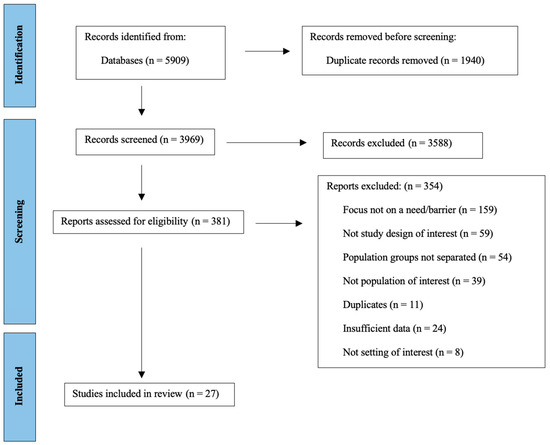
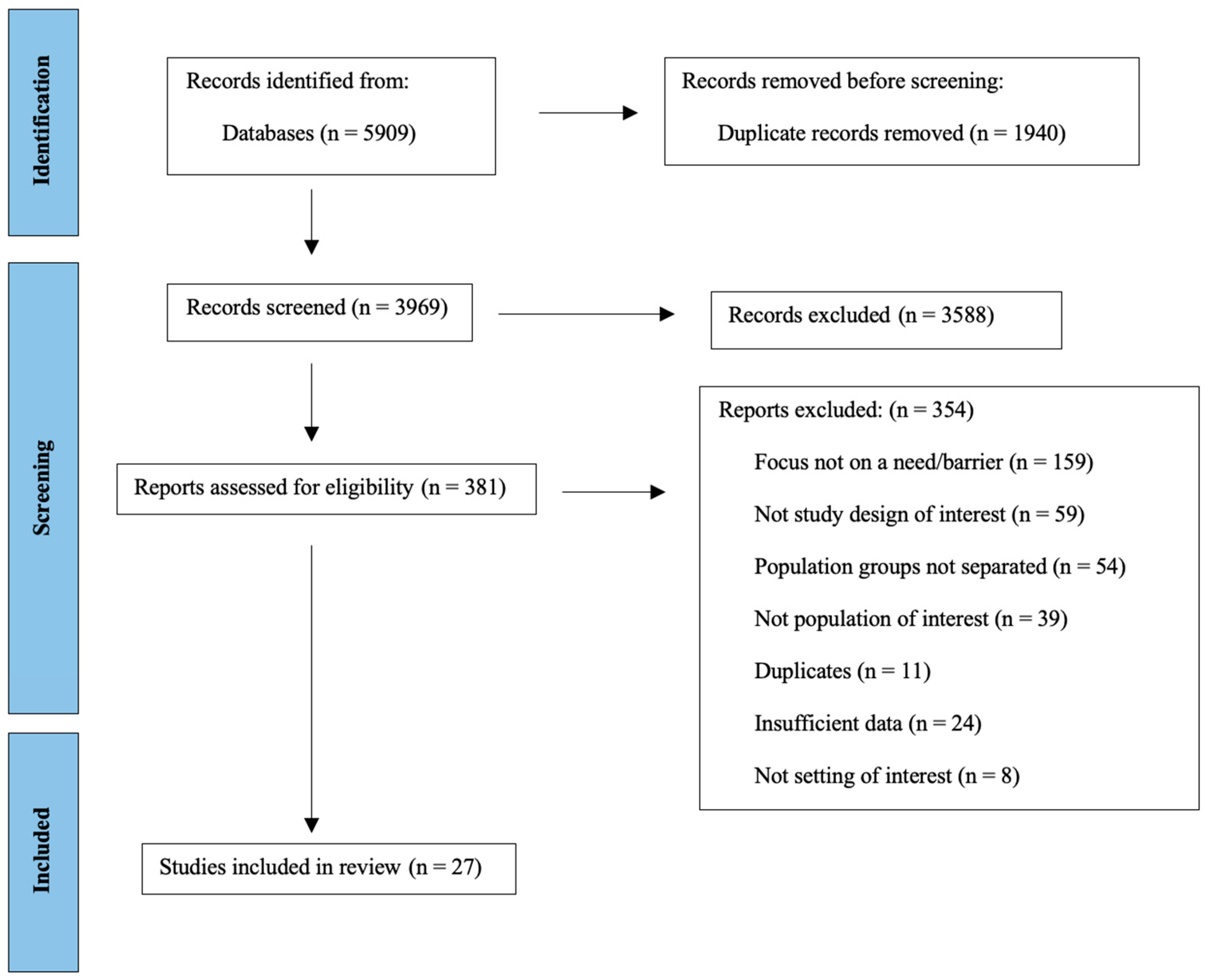
A search of the electronic databases identified a total of 5905 articles. Figure 1 outlines the selection process of articles as per the PRISMA guidelines. All search results were imported into Covidence. After removing duplicates (n = 1940), 3969 articles were identified. A pilot exercise using the same 10 abstracts and full-text articles was conducted to calibrate and ensure a standardization between author 1 and author 2. Then, author 1 and author 2 independently performed both title and abstract screening and full-text review; 277 conflicts were identified, which were resolved either by discussion or a third reviewer; the inter-rater reliability rate was 90.4% (3588/3969). Of the 381 articles that underwent full-text review, 27 articles were included in this review.
Figure 1.
PRISMA flowchart of paper inclusion.
2.5. Data Extraction and Analysis
We developed an extraction tool adopted from the Cochrane handbook [14]. Extracted data included authors, publication year, study design, study location, research question, participant characteristics, size, and main findings (Appendix A). To systematically identify and synthesize findings across all included studies, we used a thematic analysis [16]. We used NVivo 12 Pro software to carry out the coding process. The first phase of analysis included familiarization, during which each paper was read multiple times, and any potential data of interest regarding health barriers were highlighted. For qualitative studies, the data of interest included interview quotations and paraphrases regarding barriers or needs our study population experienced in accessing healthcare. We included the perspectives of actors working in the field of migrant health to provide additional perspectives. Actors working in the field of migrant health included physicians, nurses, allied healthcare professionals, policymakers, advocacy agency workers, and others. The full list of the actors working in the field of migrant health can be found in Appendix A. For quantitative studies, the data of interest included variables significantly associated with the health status of the sample populations. Once this was done for all papers, the identified extracts were analyzed and labeled with a “code” that provided a definition or an interpretation. This process was repeated until all the papers were fully coded. The second phase comprised exploring different ways to combine the codes by drawing thematic maps and searching for unifying themes and patterns across the entire data set. Priority was given to themes addressing the structural origins of poor health outcomes. This was done for each population separately and additionally across both populations to identify the existence of similarities or differences among the two groups.
3. Results
3.1. Study Characteristics
Of the 27 papers included, 18 focused on refugee challenges, and 9 on documented temporary foreign worker challenges (see Table 3). Most studies were published from 2017 onwards (n = 22). Studies were mostly descriptive in nature, using a qualitative (n = 21), quantitative (n = 1), and mixed-methods (n = 5) approach. Most studies were conducted in Canada (n = 13), followed by the United States (n = 6), Australia (n = 3), New Zealand (n = 2), and one each from the Netherlands and Germany. Most studies discussed multiple ethnicities and presented them from various perspectives. Below, we describe in further detail the main barriers each group faced. Excerpts from selected papers demonstrating the emerging themes reported herein are presented in Table 4.
Table 3.
Selected Excerpts Demonstrating Themes Identified in the Literature.
Table 4.
Structural Barriers Identified in the Literature for Each Studied Population.
3.2. Barriers for Documented Temporary Foreign Workers
We identified nine studies in total that looked at documented temporary foreign workers; four studies examined caregivers, two examined agricultural workers, and one on various industries including meat processing, food services, hospitality, and construction. Two studies interviewed the perspectives of key informers. We discuss the four identified barriers below: housing conditions, immigration policies, structural discrimination, and exploitative labour practices.
3.2.1. Housing Conditions
Our results showed that documented temporary foreign workers across different fields lived in suboptimal and unsafe conditions, including overcrowded housing, basements, and rooms without beds or windows [17,19,20,26]. Despite the removal of the “live-in” requirement in 2014 by the Canadian government, most caregivers still lived with their employers either because of the preference of the employers or the workers could not afford the high cost of living alone [27]. Caregivers noted significant distress related to the lack of privacy from an inability to lock doors to their bedrooms, being monitored by security cameras, and being hassled by the children of their host families [17,28] There was significant psychological stress noted because of the lack of socialization due to long work hours, remoteness of the homes, and limited transportation [18,26].
3.2.2. Immigration Policies
A very common barrier identified for documented temporary foreign workers was regulations and government policies that placed them in precarious positions that directly impaired their access to care. Advocates and healthcare workers reported documented temporary foreign workers hiding their illness or choosing not to seek medical care to maintain a clean medical record necessary for a successful immigration application [17,29]. We found that many workers were aware of the exploitative working conditions but chose to accept them as they viewed obtaining permanent residency as a way towards a better future for their families [18].
The vulnerability of migrant workers to exploitative conditions was largely enabled by the absence of sufficient oversight and enforcement by regulatory bodies. Seasonal agricultural workers reported that workplace inspections were announced to the employers beforehand, which allowed hazardous and poor working conditions to continue unchecked [18,20]. Caregivers expressed that the lack of regulations exacerbated the uneven power dynamic between employer and caregiver, leaving them no choice but to tolerate hazardous work [18]. A number of immigrant service providers as well as policymakers noted that while policymakers expect the employers to take care of health needs of their workers, there is no policy mandating them to provide such services [17]. This was apparent in the numbers: despite a federal government requirement that employers are responsible for providing third-party health insurance for employees during their first three months, only 24% of caregivers in a study were found to have one [27].
In our review, only one group of documented temporary foreign workers reported significantly different experiences. Workers in the meat processing industry reported that the union provided them with an opportunity to advocate for their needs and have them resolved [20]. The union representative stressed the need for unions among documented temporary foreign workers because their precarious position left them vulnerable to exploitation [20].
3.2.3. Structural Discrimination
Our final theme regarding barriers for documented temporary foreign workers includes structural discrimination. Workers reported having limited access to social and public spheres of life due to various forms of cultural and systemic exclusions. They reported experiencing intolerance from employers and struggled with expressed feelings of “cold indifference” despite efforts to be recognized as members of the community [28] (p. 212). Workers reported experiencing racial profiling during contact with law enforcement [23]. Caregivers reported experiencing isolation and alienation due to deskilling and downward social mobility experienced in their host countries, evidenced by facing verbal abuse from employers who harbored negative stereotypes [17,28,29].
3.2.4. Exploitative Labour Practices
The most common barrier for documented temporary foreign workers examined was exploitative labour practices. We found that working conditions across all groups of workers were hazardous and unsafe, often involving contract breaches related to working hours and job descriptions. Workers were often asked to work through breaks, work without proper equipment, work overtime hours without pay, and perform tasks beyond their responsibilities and skills [17,19,20,26,27,28]. Notably, seasonal agricultural workers and caregivers reported long work hours as a major barrier to accessing health services when needed [17,20,26]. Employers were often found to use threats of job termination and deportation as leverage to maintain exploitative labor conditions [17,18,19,20,29,30]. Agricultural workers and healthcare workers reported being persuaded against or actively prevented from seeking medical care or accessing worker’s compensation by employers worried about incurring costs, with some even being harassed for reporting an injury [18,19,20,30].
3.3. Barriers for Refugees
We identified 18 studies regarding refugees: 5 studies looked at the perspectives of refugees; 8 studies considered the perspectives of actors working in the field of migrant health including but not limited to physicians, nurses, allied healthcare professionals, policymakers, and advocacy agency workers; and 5 studies examined both the perspectives of refugees and the actors working in the field of migrant health. The three main themes were: housing conditions, immigration policies, and structural discrimination.
3.3.1. Housing Conditions
Another common health barrier we found was poor housing conditions. Results showed that the social context of migrants negatively impacted the refugees’ health by limiting access to social and economic opportunities. Refugees expressed a fear of hearing and witnessing gunshots, drug activities in the neighbourhood, and animals in their houses, which not only distracted them from tending to their health but also prevented them from venturing outside their homes [21]. In instances where refugees were located far from services, many reported ignoring their illness because they were unable to navigate the city transportation [25,31,32] Information from the literature indicated that refugees with disabilities were rarely provided with adequate accommodations related to their needs such as housing with elevators for those in [33]. This in turn limited their ability to access services such as in-person language classes and healthcare facilities offered outside of their homes [33].
3.3.2. Immigration Policies
A common barrier identified by both refugees and actors working in the field of migrant health was immigration policies, specifically policies that discouraged or delayed care from taking place. Refugees and resettlement agencies described the process of applying for provincial health insurance as lengthy and difficult, which resulted in long periods of refugees being uninsured and unable to receive medical care [22,34]. They also reported having trouble finding clinics and providers who accept refugee medical assistance and reported the complexity of insurance as a barrier present at each point of access in the healthcare system [35]. Healthcare providers expressed significant challenges navigating the excessively complicated and constantly evolving policies that were hard to understand and keep track of [23,24,36]. The lack of institutional support and timely dissemination of information put the onus on individual providers to learn the workings of the complex system to ensure that their patients received appropriate medical care [36,37,38].
Healthcare providers described the healthcare system as being “reactionary” and ill-prepared to provide adequate care for the refugee population [38] (p. 5). Defragmented services resulted in poor information flow, which impeded the providers’ ability to ensure timely care and a continuity of care [37,39,40]. The underuse of available interpreter services was another significant barrier expressed by refugees, providers, and resettlement agencies [31]. Without the means of communication, refugees were sent home without being seen or left the pharmacy without understanding their prescriptions [32,36,41]. Family or community members more proficient in the language were seen to aid during instances without interpreters; however, this tended to compromise the quality of care due to faulty translations or issues disclosing private health information [25,38,42].
3.3.3. Structural Discrimination
Finally, our third most common health barrier identified by refugees was structural discrimination. Our findings show that prejudice and discrimination by the public and among care providers serves as a major barrier. Healthcare workers expressed that the negative images of refugees in the media instigated a general disposition of the public to be rude towards refugees, and that the negative attitudes also extended to the care providers [37]. Refugees reported instances of not being able to make appointments because the receptionist would hang up on the phone from not understanding them [31]. They also reported not feeling respected or valued by the healthcare system, as observed during instances where refugees experienced significant stress related to not being provided with interpreters or explanations about decisions being made about their care [25]. There were reports of healthcare workers becoming angry or making blatantly racist remarks toward refugees [25]. Discrimination was often seen in the form of a dismissal of patients because of limited communication, considering their concerns as trivial, or a dismissal of mental health concerns as resettlement stress [34,43]. In fact, refugee resettlement workers described the whole mental health system as being unavailable to non-English speaking individuals [34].
4. Discussion
The purpose of this review was to bridge the gap in the current literature by identifying health barriers faced by documented temporary foreign workers and refugees in high-income OECD countries through a focused lens on the structural origins of poor health outcomes, and to gather information to help guide the planning of a proposed newcomer health clinic in Southern New Brunswick, Canada. We discuss four common emerging themes identified for both documented temporary foreign workers and refugees, while highlighting results that confirm previous findings as well as novel ones deserving attention. Further, we discuss the implications of these findings on their use in healthcare practice and plausible future directions of research.
4.1. Housing Conditions
The link between suboptimal housing and poor health outcomes, including stress, depression, and asthma exacerbations is well established in the scientific literature [44]. Our results showed that documented temporary foreign workers and refugees experienced poor housing conditions related to overcrowding and poor hygiene, similar to prior reports [12]. Specifically, new findings from our review demonstrated that previously unstudied populations including documented temporary foreign workers in nonagricultural sectors, as well as refugees with disabilities, also identified poor housing as a key determinant of health. Moreover, this review highlighted notable differences within migrant groups that are important to distinguish in order to better develop interventions including a lack of privacy from employers among caregivers versus a lack of bedding and hygiene among agricultural workers.
4.2. Immigration Policies
A growing literature points to the impact immigration policies have on health outcomes [4,6]. Historically, created to define a national belonging and ethnicity, many immigration policies have continued to restrict the rights of migrants [4]. These include discouraging individuals from participating in paid work and denying them protection against unemployment or injuries [45]. Findings from our review demonstrated the direct effects of policy on the health of migrant communities.
In concert with previous studies, immigration policies that required a clean medical record were seen as preventing those desiring permanent residency from seeking care. Our review further explored the detailed implications of such policies, including significant delays in the process of applying for health insurance resulting in long lapses in time where refugees were ineligible for medical care. These results have significant implications and calls for a closer look at the absence of appropriate oversight by institutions that result in migrant workers being vulnerable to abuse and exploitative work conditions. Healthcare workers can also be empowered to advocate for this population in knowing this information and can further advocate for better healthcare access and may inform future policy change considerations.
Our review found a “disconnect” between service agencies and the absence of well-established referral pathways as a major deterrent for the care provision for refugees. In addition, the lack of timely dissemination of information regarding policy changes to care providers was seen as a major constraint in providing timely care. These findings go beyond previous reviews that identified barriers limited to factors within the healthcare system. Our review highlighted how immigration policies outside the healthcare system, society, and institutions in general had a direct impact on creating barriers. This finding corroborates the findings from Bailey et al. [6] (p. 1458) that states the danger of “view[ing] these problems solely as a matter of institutional and interpersonal discrimination within health-care settings” as well as the need to “understand the broad context within which health-care systems operate” (p. 1458) such as intersectoral work guided by transdisciplinary frameworks. Policymakers, shareholders, advocates, and healthcare providers can benefit from knowing this disparity and work to improve intersectoral communication. Our findings outline how creating better pathways to access care can improve health outcomes.
A noteworthy and beneficial finding of this review includes the underuse of available language interpretation services by healthcare providers. Further investigations on the nature of the low uptake in routine clinical care would benefit hospitals and policymakers in ensuring an effective implementation of this important service. In addition, the knowledge of the lack of language services available to patients is important for healthcare providers to be aware of in order to better advocate for services.
4.3. Structural Discrimination
Scholars describe a process of “othering” in which minorities are ascribed a lower status on the social hierarchy due to perceived racial and ethnic differentials [4] (p. 2101). People lower on the social hierarchy not only have limited access to social goods but also experience a physiological stress response that increases the risk of chronic diseases [45]. Several papers in our review highlighted the way migrant workers and refugees are regarded and treated as subcitizens in their host countries. This was evident through the marginal living of migrants and a general lack of regard for their health and safety echoed in many of the studies. Acknowledging the role of cultural exclusion and racism would be critical in taking the next step to improving migrant health, as a growing body of literature point to a significant association between racism and poor mental and physical health [46]. Future research may elaborate on the types of microaggression within the healthcare system and how it affects the quality of care migrants receive.
4.4. Exploitative Labour Practices
We identified a broader variety of worker occupations, including caregiver, food industry, construction, and hospitality workers. Evidence suggests that job insecurity, occupational hazards, and having no control over high workloads lead to a range of physical and mental afflictions [45]. These findings have implications for the population’s health, as these factors influence health outcomes. Awareness of the challenges faced by temporary foreign workers would allow healthcare providers to serve the population better and have a greater understanding of their needs. In our review, many workers across the board endured hazardous and unsafe working conditions. Large meat-processing factory workers were the only unionized group who reported better experiences because of the advocacy provided by the union. Our findings revealed that little is known about the presence of unions in other parts or industries in Canada. It would be interesting to conduct further research into how and why certain industries were able to establish a union, as well as further characterize how it benefits the health outcomes of documented temporary foreign workers. The present findings also indicate that the current knowledge on the health of documented temporary foreign workers is limited to those surrounding their labor practices and work experiences, with a dearth of studies exploring their use of healthcare services or their experiences in the healthcare settings. Whether that is due to a lack of use or research is an issue for future work to explore.
4.5. Limitations
Our review includes several limitations. First, although our study provided a comprehensive review of the experiences of documented temporary foreign workers and refugees in the last decade, our findings should be interpreted with the awareness that it combined studies from multiple high-income OECD countries, with variable policies, societal norms, and healthcare systems. Second, the study focused on peer-reviewed articles written in English, which might have excluded data from studies written in non-English languages. Third, the inclusion of both qualitative and quantitative research designs, although done to increase the scope of reviewed literature, may limit the interpretation of the findings. Fourth, due to the vast nature of the challenges experienced by immigrants, future research should consider conducting a systematic or meta-analysis review, which may provide further nuances and contextualize these findings. Additional future research topics may also include identifying proposed solutions to such barriers and expectant outcomes.
5. Conclusions
This review aimed to identify the health barriers faced by documented temporary foreign workers and refugees residing in OECD countries, with a particular focus on the structural origins of differential health outcomes. This was done as the existing literature highlighted the lack of recognition by the public and the majority of the research community in identifying structural origins as a cause of health disparities. In addition to corroborating prior reports, the present review identified structural racism as a direct contributor to poor health outcomes in these populations, as evidenced through studies conducted in the last decade. As there were acknowledged gaps in the literature for subgroups of migrants, we focused on those groups, namely, documented temporary foreign works and refugees. This review will contribute to the growing literature indicating the need to address systemic barriers faced by documented temporary foreign workers and refugees when accessing healthcare services. These findings may benefit healthcare providers, policymakers, and relevant stakeholders interested in developing and improving efforts to eliminate health inequity. In addition, the findings from this review will assist the authors in advocating to relevant authorities about reducing systemic barriers, as they create the proposed newcomer health clinic. Our findings can also inform the newcomer health clinic policies and procedures to make healthcare more accessible to temporary foreign workers and refugees.
Supplementary Materials
The following supporting information can be downloaded at: https://www.mdpi.com/article/10.3390/healthcare11091295/s1, Figure S1: Search strings.
Author Contributions
Conceptualization, B.Y., I.C.S., C.K. and D.T.K.N.; methodology, B.Y., I.C.S., and D.T.K.N.; software, B.Y.; validation, B.Y., C.K., I.C.S., K.B. and D.T.K.N.; formal analysis, B.Y. and C.K.; investigation, B.Y. and C.K.; resources, B.Y. and D.T.K.N.; data curation, B.Y. and C.K.; writing—original draft preparation, B.Y. and C.K.; writing—review and editing, B.Y., C.K., I.C.S., and D.T.K.N.; visualization, B.Y. and C.K.; supervision, I.C.S., D.T.K.N. and K.B.; project administration, B.Y. and C.K. All authors have read and agreed to the published version of the manuscript.
Funding
This research received no external funding. B.Y. was supported by a summer Research in Medicine studentship bursary from Dalhousie Medicine New Brunswick.
Institutional Review Board Statement
Not applicable.
Informed Consent Statement
Not applicable.
Data Availability Statement
The data that support the findings of this study are available from the first author (B.Y.), upon reasonable request.
Acknowledgments
The authors thank Jackie Phinney, Robin Parker, and Melissa Helwig, medical librarians at Dalhousie University for assisting with devising the search strategy.
Conflicts of Interest
The authors declare no conflict of interest.
Appendix A
Table A1.
Data Extraction Table: Characteristics of Reviewed Papers.
References
- McAuliffe, M.; Khadria, B. Chapter 1: Report overview: Providing perspective on migration and mobility in increasingly uncertain times. In World Migration Report; International Organization for Migration, IOM: Grand-Saconnex, Switzerland, 2019; Available online: https://worldmigrationreport.iom.int/ (accessed on 10 December 2022).
- De Maio, F.G.; Kemp, E. The Deterioration of Health Status among Immigrants to Canada. Glob. Public Health 2010, 5, 462–478. [Google Scholar] [CrossRef] [Scilit] [PubMed]
- Ben, J.; Cormack, D.; Harris, R.; Paradies, Y. Racism and Health Service Utilisation: A Systematic Review and Meta-Analysis. PLoS ONE 2017, 12, e0189900. [Google Scholar] [CrossRef] [Scilit] [PubMed]
- Viruell-Fuentes, E.A.; Miranda, P.Y.; Abdulrahim, S. More than Culture: Structural Racism, Intersectionality Theory, and Immigrant Health. Soc. Sci. Med. 2012, 75, 2099–2106. [Google Scholar] [CrossRef] [Scilit]
- Rust, G.S. Health Status of Migrant Farmworkers: A Literature Review and Commentary. Am. J. Public Health 1990, 80, 1213–1217. [Google Scholar] [CrossRef] [Scilit] [PubMed]
- Bailey, Z.D.; Krieger, N.; Agénor, M.; Graves, J.; Linos, N.; Bassett, M.T. Structural Racism and Health Inequities in the USA: Evidence and Interventions. Lancet 2017, 389, 1453–1463. [Google Scholar] [CrossRef] [Scilit]
- Heard, E.; Fitzgerald, L.; Wigginton, B.; Mutch, A. Applying Intersectionality Theory in Health Promotion Research and Practice. Health Promot. Int. 2020, 35, 866–876. [Google Scholar] [CrossRef] [Scilit] [PubMed]
- Parajuli, J.; Horey, D. Barriers to and Facilitators of Health Services Utilisation by Refugees in Resettlement Countries: An Overview of Systematic Reviews. Aust. Health Rev. 2020, 44, 132–142. [Google Scholar] [CrossRef] [Scilit] [PubMed]
- Lane, G.; Farag, M.; White, J.; Nisbet, C.; Vatanparast, H. Chronic Health Disparities among Refugee and Immigrant Children in Canada. Appl. Physiol. Nutr. Metab. 2018, 43, 1043–1058. [Google Scholar] [CrossRef] [Scilit]
- Cheng, I.-H.; Drillich, A.; Schattner, P. Refugee Experiences of General Practice in Countries of Resettlement: A Literature Review. Br. J. Gen. Pract. 2015, 65, e171–e176. [Google Scholar] [CrossRef] [Scilit]
- Chowdhury, N.; Naeem, I.; Ferdous, M.; Chowdhury, M.; Goopy, S.; Rumana, N.; Turin, T.C. Unmet Healthcare Needs Among Migrant Populations in Canada: Exploring the Research Landscape Through a Systematic Integrative Review. J. Immigr. Minor. Health 2021, 23, 353–372. [Google Scholar] [CrossRef] [Scilit]
- Salami, B.; Meharali, S.; Salami, A. The Health of Temporary Foreign Workers in Canada: A Scoping Review. Can. J. Public Health 2015, 106, e546–e554. [Google Scholar] [CrossRef] [Scilit] [PubMed]
- Krieger, N. Discrimination and Health Inequities. Int. J. Health Serv. 2014, 44, 643–710. [Google Scholar] [CrossRef] [Scilit]
- Cochrane Handbook for Systematic Reviews of Interventions. Available online: https://training.cochrane.org/handbook/current (accessed on 26 July 2021).
- Methley, A.M.; Campbell, S.; Chew-Graham, C.; McNally, R.; Cheraghi-Sohi, S. PICO, PICOS and SPIDER: A Comparison Study of Specificity and Sensitivity in Three Search Tools for Qualitative Systematic Reviews. BMC Health Serv. Res. 2014, 14, 579. [Google Scholar] [CrossRef] [Scilit] [PubMed]
- Braun, V.; Clarke, V. Thematic Analysis. In APA Handbook of Research Methods in Psychology, Volume 2: Research Designs: Quantitative, Qualitative, Neuropsychological, and Biological; Cooper, H., Camic, P.M., Long, D.L., Panter, A.T., Rindskopf, D., Sher, K.J., Eds.; American Psychological Association: Washington, DC, USA, 2012; Volume 2, pp. 57–71. [Google Scholar] [CrossRef] [Scilit]
- Vahabi, M.; Wong, J.P.-H. Caught between a Rock and a Hard Place: Mental Health of Migrant Live-in Caregivers in Canada. BMC Public Health 2017, 17, 498. [Google Scholar] [CrossRef] [Scilit] [PubMed]
- Caxaj, S.; Diaz, L. Migrant Workers’ (Non)Belonging in Rural British Columbia, Canada: Storied Experiences of Marginal Living. Int. J. Migr. Health Soc. Care 2018, 14, 208–220. [Google Scholar] [CrossRef] [Scilit]
- Salami, B.; Hegadoren, K.; Kirova, A.; Meherali, S.; Nsaliwa, C.; Chiu, Y. “And When a Certain Health Issue Happen, They Try to Cover It”: Stakeholder Perspectives on the Health of Temporary Foreign Workers and Their Families. Soc. Work Health Care 2018, 57, 13–26. [Google Scholar] [CrossRef] [Scilit]
- Cedillo, L.; Lippel, K.; Nakache, D. Factors Influencing the Health and Safety of Temporary Foreign Workers in Skilled and Low-Skilled Occupations in Canada. New Solut. J. Environ. Occup. Health Policy 2019, 29, 422–458. [Google Scholar] [CrossRef] [Scilit]
- Alwan, R.M.; Schumacher, D.J.; Cicek-Okay, S.; Jernigan, S.; Beydoun, A.; Salem, T.; Vaughn, L.M. Beliefs, Perceptions, and Behaviors Impacting Healthcare Utilization of Syrian Refugee Children. PLoS ONE 2020, 15, e0237081. [Google Scholar] [CrossRef] [Scilit]
- Vermette, D.; Shetgiri, R.; Al Zuheiri, H.; Flores, G. Healthcare Access for Iraqi Refugee Children in Texas: Persistent Barriers, Potential Solutions, and Policy Implications. J. Immigr. Minor. Health 2015, 17, 1526–1536. [Google Scholar] [CrossRef] [Scilit]
- Hahn, K.; Steinhauser, J.; Goetz, K. Equity in Health Care: A Qualitative Study with Refugees, Health Care Professionals, and Administrators in One Region in Germany. BioMed Res. Int. 2020, 2020, 4647389. [Google Scholar] [CrossRef] [Scilit]
- Newbold, B.; McKeary, M. Investigating the Diversity of Canada’s Refugee Population and Its Health Implications: Does One Size Fit All? Int. J. Migr. Health Soc. Care 2017, 13, 145–156. [Google Scholar] [CrossRef] [Scilit]
- Floyd, A.; Sakellariou, D. Healthcare Access for Refugee Women with Limited Literacy: Layers of Disadvantage. Int. J. Equity Health 2017, 16, 195. [Google Scholar] [CrossRef] [Scilit] [PubMed]
- Caxaj, C.S.; Cohen, A. “I Will Not Leave My Body Here”: Migrant Farmworkers’ Health and Safety Amidst a Climate of Coercion. Int. J. Environ. Res. Public Health 2019, 16, 2643. [Google Scholar] [CrossRef] [Scilit] [PubMed]
- Carlos, J.K.; Wilson, K. Migration among Temporary Foreign Workers: Examining Health and Access to Health Care among Filipina Live-in Caregivers. Soc. Sci. Med. 2018, 209, 117–124. [Google Scholar] [CrossRef] [Scilit] [PubMed]
- Bhuyan, R.; Valmadrid, L.; Panlaqui, E.L.; Pendon, N.L.; Juan, P. Responding to the Structural Violence of Migrant Domestic Work: Insights from Participatory Action Research with Migrant Caregivers in Canada. J. Fam. Violence 2018, 33, 613–627. [Google Scholar] [CrossRef] [Scilit]
- Hill, N.S.; Dorow, S.; Barnetson, B.; Martinez, J.F.; Matsunaga-Turnbull, J. Occupational Health and Safety for Migrant Domestic Workers in Canada: Dimensions of (Im)Mobility. New Solut. J. Environ. Occup. Health Policy 2019, 29, 397–421. [Google Scholar] [CrossRef] [Scilit]
- Cole, D.C.; McLaughlin, J.E.; Hennebry, J.L.; Tew, M.A. Precarious Patients: Health Professionals’ Perspectives on Providing Care to Mexican and Jamaican Migrants in Canada’s Seasonal Agricultural Worker Program. Rural Remote Health 2019, 19, 5313. [Google Scholar] [CrossRef] [Scilit]
- Shrestha-Ranjit, J.; Payne, D.; Koziol-McLain, J.; Crezee, I.; Manias, E. Availability, Accessibility, Acceptability, and Quality of Interpreting Services to Refugee Women in New Zealand. Qual. Health Res. 2020, 30, 1697–1709. [Google Scholar] [CrossRef] [Scilit]
- Clark, A.; Gilbert, A.; Rao, D.; Kerr, L. “Excuse Me, Do Any of You Ladies Speak English?” Perspectives of Refugee Women Living in South Australia: Barriers to Accessing Primary Health Care and Achieving the Quality Use of Medicines. Aust. J. Prim. Health 2014, 20, 92–97. [Google Scholar] [CrossRef] [Scilit]
- Mirza, M.; Heinemann, A.W. Service Needs and Service Gaps among Refugees with Disabilities Resettled in the United States. Disabil. Rehabil. 2012, 34, 542–552. [Google Scholar] [CrossRef] [Scilit]
- Shannon, P.J.; Vinson, G.A.; Cook, T.L.; Lennon, E. Characteristics of Successful and Unsuccessful Mental Health Referrals of Refugees. Adm. Policy Ment. Health 2016, 43, 555–568. [Google Scholar] [CrossRef] [Scilit] [PubMed]
- Zeidan, A.J.; Khatri, U.G.; Munyikwa, M.; Barden, A.; Samuels-Kalow, M. Barriers to Accessing Acute Care for Newly Arrived Refugees. West. J. Emerg. Med. 2019, 20, 842–850. [Google Scholar] [CrossRef] [Scilit]
- Winn, A.; Hetherington, E.; Tough, S. Caring for Pregnant Refugee Women in a Turbulent Policy Landscape: Perspectives of Health Care Professionals in Calgary, Alberta. Int. J. Equity Health 2018, 17, 91. [Google Scholar] [CrossRef] [Scilit] [PubMed]
- Ogunsiji, O.; Ng Chok, H.; Mashingaidze, G.; Wilkes, L. “I Am Still Passionate despite the Challenges”: Nurses Navigating the Care for Refugees. J. Clin. Nurs. 2018, 27, 3335–3344. [Google Scholar] [CrossRef] [Scilit]
- Richard, L.; Richardson, G.; Jaye, C.; Stokes, T. Providing Care to Refugees through Mainstream General Practice in the Southern Health Region of New Zealand: A Qualitative Study of Primary Healthcare Professionals’ Perspectives. BMJ Open 2019, 9, e034323. [Google Scholar] [CrossRef] [Scilit]
- Baauw, A.; Rosiek, S.; Slattery, B.; Chinapaw, M.; van Hensbroek, M.B.; van Goudoever, J.B.; Kist-van Holthe, J. Pediatrician-Experienced Barriers in the Medical Care for Refugee Children in the Netherlands. Eur. J. Pediatr. 2018, 177, 995–1002. [Google Scholar] [CrossRef] [Scilit] [PubMed]
- Novak, A.; Hitch, D.; Bongiovanni, L.; Mucic, A. Identification, Management and Care of Refugee Patients at a Metropolitan Public Health Service: A Healthcare Worker Perspective. Aust. Health Rev. 2021, 45, 338–343. [Google Scholar] [CrossRef] [Scilit] [PubMed]
- Kay, M.; Wijayanayaka, S.; Cook, H.; Hollingworth, S. Understanding Quality Use of Medicines in Refugee Communities in Australian Primary Care: A Qualitative Study. Br. J. Gen. Pract. 2016, 66, e397–e409. [Google Scholar] [CrossRef] [Scilit]
- Pejic, V.; Thant, T.; Hess, R.S.; Cornell, S.; DeJesus, J.; Yager, J.; Savin, D. Learning from Our Patients: Training Psychiatry Residents in Refugee Mental Health. Acad. Psychiatry 2019, 43, 471–479. [Google Scholar] [CrossRef] [Scilit]
- Guruge, S.; Sidani, S.; Illesinghe, V.; Younes, R.; Bukhari, H.; Altenberg, J.; Rashid, M.; Fredericks, S. Healthcare Needs and Health Service Utilization by Syrian Refugee Women in Toronto. Confl. Health 2018, 12, 46. [Google Scholar] [CrossRef] [Scilit]
- Hernández, D. Affording Housing at the Expense of Health: Exploring the Housing and Neighborhood Strategies of Poor Families. J. Fam. Issues 2016, 37, 921–946. [Google Scholar] [CrossRef] [Scilit] [PubMed]
- Mikkonen, J.; Raphael, D. Social Determinants of Health: The Canadian Facts; York University School of Health Policy and Management: Toronto, ON, Canada, 2010. [Google Scholar]
- Paradies, Y.; Ben, J.; Denson, N.; Elias, A.; Priest, N.; Pieterse, A.; Gupta, A.; Kelaher, M.; Gee, G. Racism as a Determinant of Health: A Systematic Review and Meta-Analysis. PLoS ONE 2015, 10, e0138511. [Google Scholar] [CrossRef] [Scilit] [PubMed]

Disclaimer/Publisher’s Note: The statements, opinions and data contained in all publications are solely those of the individual author(s) and contributor(s) and not of MDPI and/or the editor(s). MDPI and/or the editor(s) disclaim responsibility for any injury to people or property resulting from any ideas, methods, instructions or products referred to in the content. |
© 2023 by the authors. Licensee MDPI, Basel, Switzerland. This article is an open access article distributed under the terms and conditions of the Creative Commons Attribution (CC BY) license (https://creativecommons.org/licenses/by/4.0/).