


Abstract
In this paper, we derive an explicit solution to the utility maximization problem of an individual with mortality risk and subsistence consumption constraint. We adopt an exponential utility for the individual’s consumption and the martingale and duality method is employed. From the explicit solution, we exhibit how the mortality intensity and subsistence consumption constraint affect, separately and together, portfolio, consumption and life insurance purchase.
1. Introduction
In portfolio selection problems, considering some constraints create difficulties in solving the relevant optimization problems but increase the realism. Borrowing constraints restrict individual’s financing only up to a partial amount of the individual’s human capital or do not allow any amount of borrowing. Borrowing constraints lead individual to reduce investment in the risky asset and to decrease consumption. Mathematical finance literature that mainly focuses on the effects of partial borrowing constraints on optimal decisions for individuals includes [2,3,5,15,16,17]. References [12,14] consider the case where an individual cannot borrow against future labor income at all, and especially the last one investigates how the borrowing constraints and job choice flexibility affect on portfolio selection and consumption.
Subsistence consumption constraints imply that an individual must consume at least a minimum level of consumption rate, for example a minimum level of consumption rate required to keep up life. Subsistence consumption constraints also have significant effects on the optimal decisions for individuals. Restrictions on subsistence level of consumption also make an individual’s portfolio strategy less aggressive and leads decrease in consumption. References [4,18,19] study an infinitely lived individual’s consumption, portfolio strategies while considering subsistence consumption constraints. Working individuals who face subsistence consumption decide retirement wealth levels differently from those who do not have such restrictions, as the analytical results from [6,9,10,11,13] imply.
This paper is an extension of literature that investigates how the existence of subsistence consumption constraints affect individual’s lifetime investment and consumption strategy. We assume an exponential utility function for consumption and consider an individual’s mortality risk by adopting an exponential distribution for the death time. Based on martingale and duality method, we derive optimal consumption, portfolio, and life insurance strategies explicitly and exhibit how the force of mortality and subsistence level of consumption affect, separately and together, on the individual’s decision making. Numerical illustrations reveal that a strong force of mortality and a high subsistence level of consumption result in reduced consumption and small investment in the risky asset. Numerical illustrations also show that life insurance demand increases with force of mortality and decreases with subsistence level of consumption. However, the effect of subsistence consumption constraint on demand for life insurance seems to be marginal. We also observe that an individual with a large coefficient of absolute risk aversion purchases more life insurance.
This paper proceeds as follows. Section 2 introduces financial and life insurance markets and our model. The utility function and the optimization problem we seek to solve is defined in Section 3, followed by Section 4 where we use the martingale and duality method to obtain explicit solution to the optimization problem. Section 5 illustrates numerical examples from which we examine effectcs of force of mortality and subsistence consumption constraint on an individual’s decision making, and Section 6 sums up and concludes.
2. The Market and Model
We assume that the individual participates in the financial market and can hedge the mortality risk. The financial market is simply consists of a risky asset and a riskless asset (money market account). The risk factor of the risky asset and that of mortality are uncorrelated. Denote by a standard Brownian motion for a given probability space . The individual’s death time has an exponential distribution with the parameter , called mortality intensity or force of mortality. The probability density function of is given by
Denote by the -augmentation of filtration generated by the standard Brownian motion and . In financial markets, there exist a riskless asset and a risky asset whose prices are and at time t, respectively.
At time , the risky asset price follows a log-normal distribution as follows
where and . The risky asset’s mean rate of return per unit time, , and its volatility are assumed to be constants. The riskless asset price is assumed to follows
where is the risk free interest rate and it is also constant.
Let be the amount of money invested in the risky asset. If
and if is - adapted, we call a portfolio process. In this paper, we consider the case where the individual has a subsistence consumption constraint. We call the minimum consumption rate the individual must consume the subsistence level of consumption . If is the consumption rate at time t, it is satisfied that
If
and is , we call a consumption process.
We assume that life insurance contracts we are considering cover mortality risk and they are actuarially fair. We denote by and the instantaneous life insurance premium rate paid by the individual and insurance benefit paid by the insurer, respectively. Since the life insurance contracts are fair, the insurance premium paid by the policyholder during the infinitesimal time is equal to the insurance benefit multiplied by the probability of death during the infinitesimal time . Thus we have
and the bequest received by the individual’s heir is given by
where is the wealth level. The individual’s labor income rate is constantly . Thus, we have the following wealth level process
where the 3rd equality follows from (2). A control variable is replaced by the bequest . We say the the bequest process if it is - adapted and satisfies
3. Utility Function and the Optimization Problem
While living, the individual enjoys from consumption and its utility function is given by an exponential form as follows
This type of utility is called the constant absolute risk aversion (CARA) utility and we call the coefficient of absolute risk aversion. We assume that the utility of bequest is given by a constant relative risk aversion (CRRA) utility
where is the coefficient of relative risk aversion of the utility of bequest and K is the bequest motive which measures the importance of the utility of bequest (See [7]). Therefore, the individual’s lifetime discounted expected utility is given by
where is the time preference of the individual. The expected discounted future income is given by
which is the maximum amount of money (considering subsistence level of consumption) the individual can finance if there is no restriction on borrowing. We call admissible at if of (3) satisfies
Now we formulate the individual’s optimization problem. For a given initial wealth , the objective is to select the control for finding out the value function , which is defined as follows
where the set of all admissible controls at x.
4. The Martingale Method and the Solution
A dynamic programming method can be applied to solve the optimization problem (6). However, the value function’s Bellman equation relevant to this problem is highly nonlinear. We use the martingale and duality method to convert the primal optimization problem into a dual maximization problem which solves a linear equation. Let us define the market price of risk and the state price density as follows
respectively. Applying the Itô’s lemma to the product of and , which is lower bounded if (5) is satisfied, and with monotone convergence theorem we derive the following static budget constraint
for any .
To construct the dual value functioin of , let us define a convex dual function of as follows
So the convex dual function is given by
with the maximizing is given by
Analogously, we define a convex dual function of as follows
Thus we have
where the maximizing is given by
By the definitions of and and the static budget constraint (7), for any control and any , we have
where
and .
We call the dual value function. The following duality relation between and is due to Theorem 1 of [8]
Lemma 1.
If is the solution to the following minimization problem
then the value function of the primal maximization problem (6) is given by
For the pair of consumption and bequest processes given by
where , there exists a portfolio process such that and is the optimal strategy.
We define . Noting that solves the following linear equation by the Feynman–Kac formula
Let and are two distinct roots to the following equation
Then we obtain as in the following proposition.
Proposition 1.
Proof.
For , we discard the homogeneous part , which grows rapidly as z approaches 0. Similarly, we only choose the part if . With particular parts, we derive (17). The coefficients A and B are determined by the condition at . □
Theorem 1.
Suppose that is a strictly increasing function that maps onto with and are bounded for where Define
and denote by be the inverse function of Then the value function is given by
The optimal strategy is given by
and from (2) the optimal insurance premium process is given by
Proof.
The expression of the value function and the optimality of the strategy follows from Theorem 2 of [8]. □
5. Numerical Illustrations
In this section, we examine the effects of the force of mortality and the subsistence level of consumption R on decision making of the individual. The wealth level threshold corresponds to the subsistence level of consumption R. The expected value of the individual’s death time is We use and those correspond to the expected lifetime 100 year, year, and 20 year, respectively. As to the subsistence level of consumption R, we use and those correspond to the minimum percentage of the consumption rate to the income stream , , and , respectively. As to the other parameters, we use a reasonable set of values for the financial market.
Figure 1 illustrates against and R. Since R is the mininum rate the individual must consume, the wealth threshold increases with R. An individual with a large force of mortality likely tends to consume less than does an individual with a small Therefore, increases also with .
Figure 1.
The wealth level threshold against force of mortality and subsistence level of consumption. The parameters:
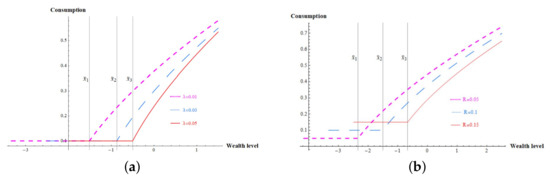
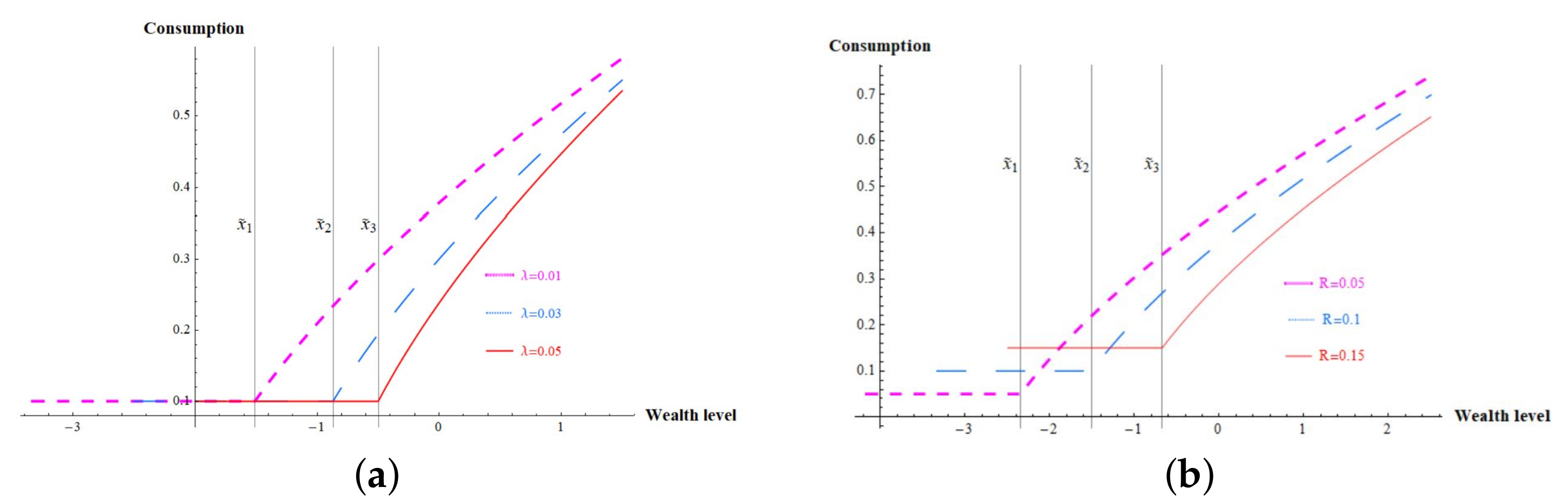
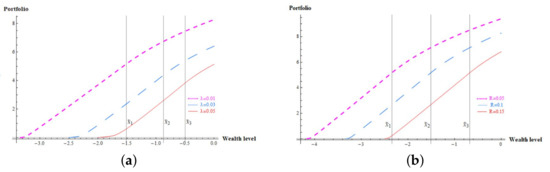
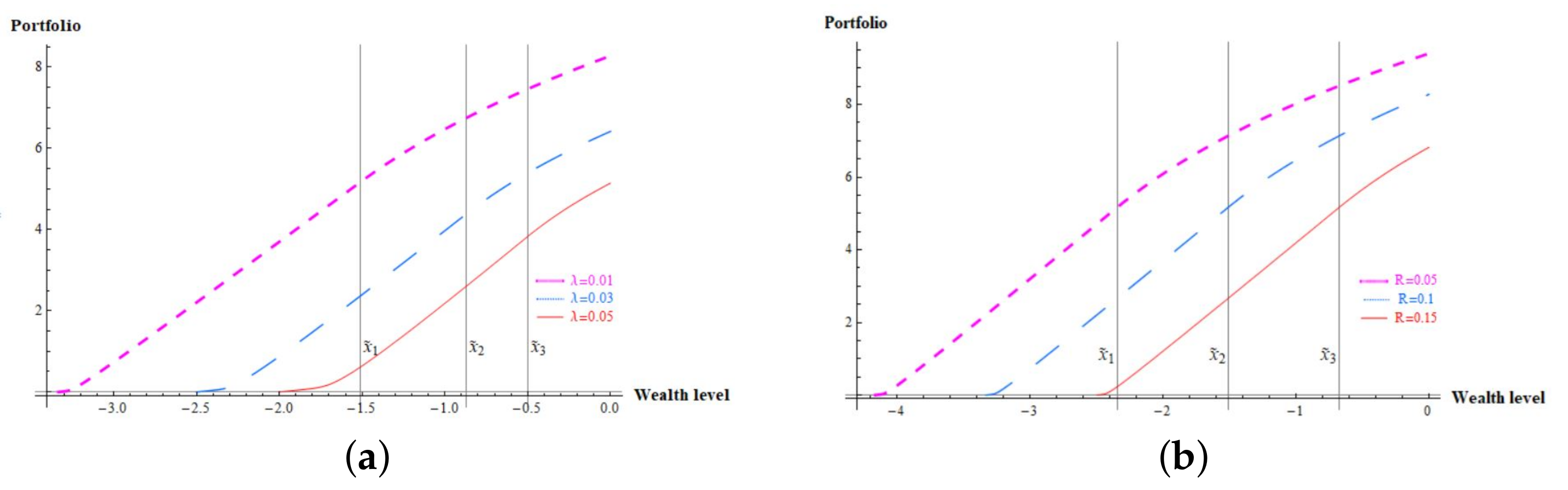
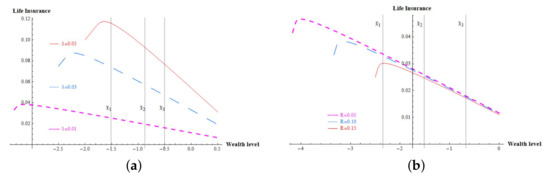
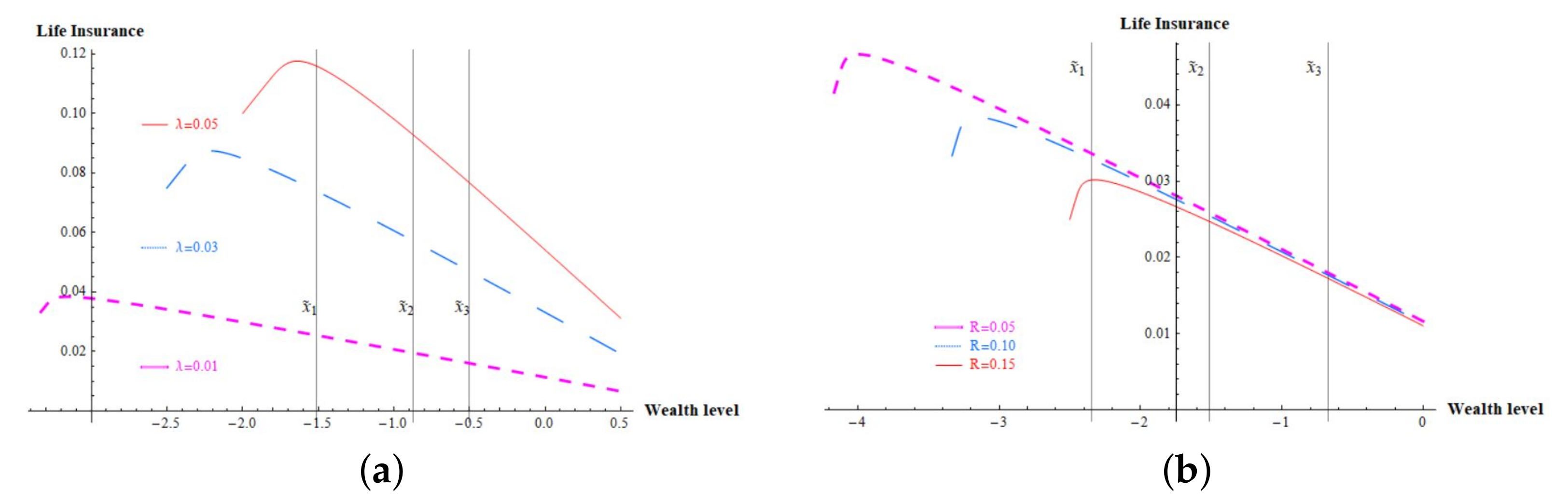
For Figure 2a,Figure 3a,Figure 4a wealth level threshold , , and stand for with , , and , respectively. For Figure 2b,Figure 3b, Figure 4b wealth level threshold , , and stand for with , and , respectively.
Figure 2.
The parameters: (a) Optimal consumption for various force of mortality. (b) Optimal consumption for various subsistence level of consumption.
Figure 3.
The parameters: (a) Optimal portfolio for various force of mortality. (b) Optimal portfolio for various subsistence level of consumption.
Figure 4.
The parameters: (a) Optimal life insurance for various force of mortality. (b) Optimal life insurance for various subsistence level of consumption.
Figure 2 shows individual’s optimal consumption for various force of mortality and subsistence level consumption R. For a given wealth level, an individual with a large force of mortality consume less than does an individual with a small force of mortality. A large force of mortality force an individual reduce consumption. The effect of R on consumption shows the same pattern as that of . A strong restriction on minimum consumption level makes an individual to decrease consumption.
Individual’s preferences for the risky asset for different force of mortality or subsistence level of consumption are exhibited in Figure 3. As we can see, a large force of mortality leads an individual to conservative investing. An individual who are more likely to be exposed to the mortality risk may have more demand for hedging the risk so the individual is not unwilling to be exposed the market risk. A large subsistence level of consumption also force an individual to reduce investment in the risky asset. An individual with a strong subsistence consumption constraint is reluctant to take more market risk which may potentially results in lack of the individual’s wealth to meet the subsistence level of consumption.
With a large mortality risk, an individual has a strong demand for life insurance coverage. This is well illustrated in Figure 4a. On the other hand, a large subsistence level of consumption leads to a less demand for life insurance coverage. However, the effect of subsistence level of consumption on life insurance demand is rather marginal, especially for higher wealth levels.
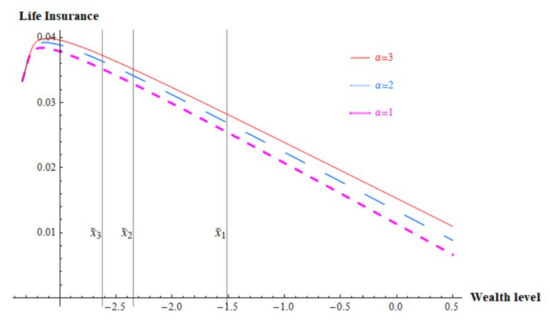
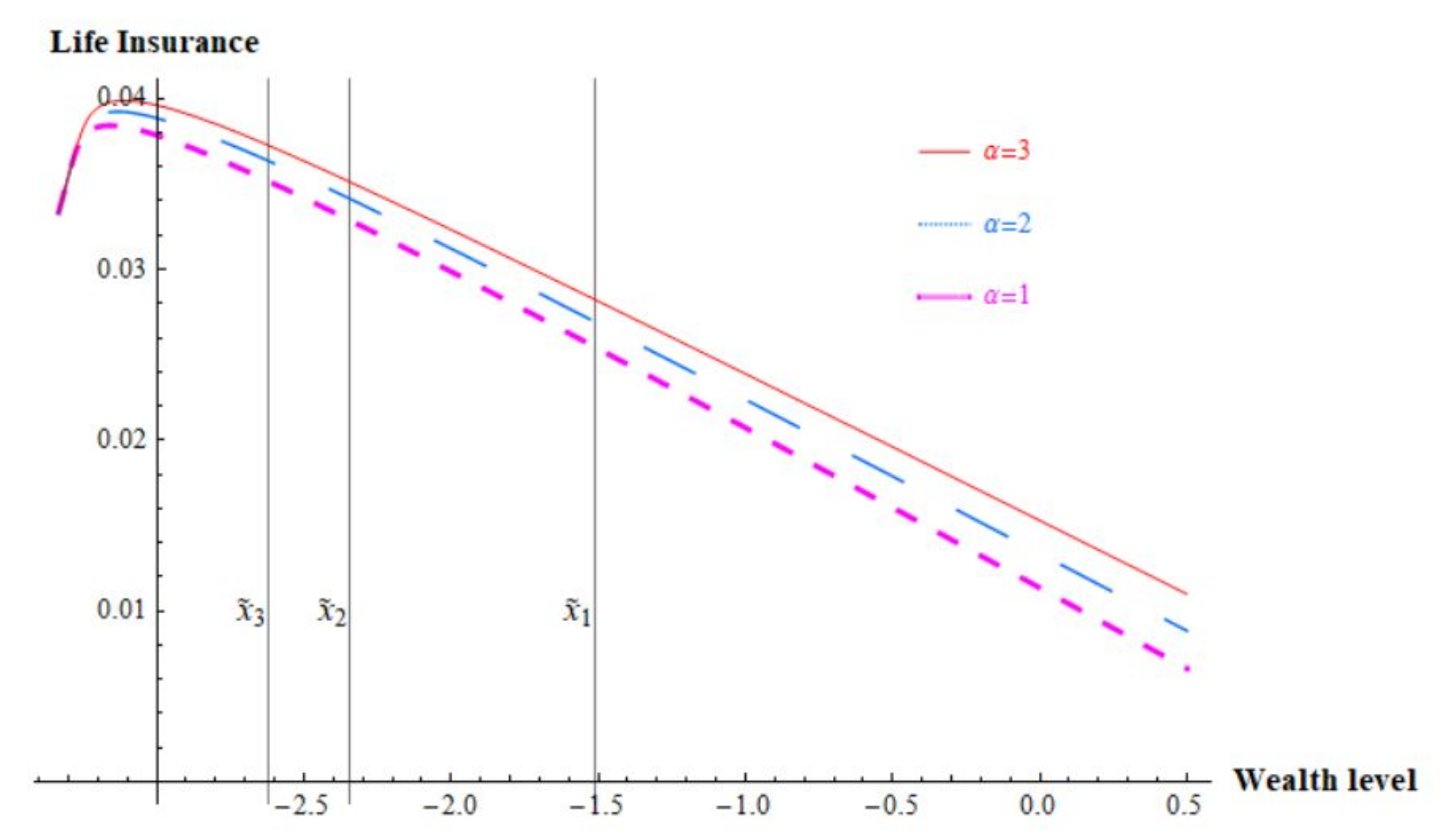
Differently from our study, Ref. [1] employs a CRRA utility to investigate effects of consumption habit on life-contingent claims using term structure of mortality intensity and labor income for considering age effects. The way how the life insurance purchase decision is affected by subsistence consumption (this paper) and consumption habit ([1]; the demand for life insurance increases with consumption habit level but also decrease with the level, if the level is very high) are different from each other. Nevertheless, both of the studies reveal that demand for life insurance increases with risk aversion. In Figure 5, we present life insurance purchase against wealth level for diffrent coefficients of absolute risk aversion. A large risk aversion tends to induce more demand for hedging instrument to mitigate income loss due to mortality.
Figure 5.
Optimal life insurance for various risk aversion. The parameters: , , ,
6. Conclusions
The purpose this paper is to examine effects of force of mortality and subsistence level of consumption on an individual’s decision making. With an exponential utility of consumption while living, we obtain optimal consumption, portfolio, and life insurance coverage strategies using the martingale and duality method. Numerical illustrations based on our explicit solution show that a strong force of mortality and a high subsistence level of consumption lead an individual to reduce exposure to the market risk and to consume less. An individual with a large mortality risk demands more life insurance coverage as an individual with a low subsistence level of consumption does. For example, during a pandemic outbreak, such as COVID-19, the force of mortality increases so the individual must lessen consumption and have lower risky asset shares, but buy more life insurance. If successful vaccines are developed, the force of mortality decreases so the individual consume more, increases long position in the risky asset, and reduce life insurance purchase. However, our numerical illustrations reveal that the effect of subsistence consumption constraint on demand for life insurance seems to be marginal. Lastly, we observe that the demand for life insurance increases with risk aversion.
Funding
This work was supported by the National Research Foundation of Korea Grant funded by the Korean Government (NRF-2019R1F1A1060853) and by the Research Grant of Kwangwoon University in 2020.
Institutional Review Board Statement
Not applicable.
Informed Consent Statement
Not applicable.
Data Availability Statement
Not applicable.
Acknowledgments
We highly appreciate the anonymous reviewers for helpful comments and valuable suggestions.
Conflicts of Interest
The author declares no conflict of interest.
References
- Boyle, P.P.; Tan, K.S.; Wei, P.; Zhuang, S.C. Annuity and Insurance Choice Under Habit Formation. Working Paper. 2020. Available online: https://ssrn.com/abstract=3570066 (accessed on 6 April 2020).
- Jang, B.G.; Lee, H.S. Retirement with risk aversion change and borrowing constraints. Financ. Res. Lett. 2016, 16, 112–124. [Google Scholar] [CrossRef] [Scilit]
- Jeon, J.; Shin, Y.H. Finite horizon portfolio selection with a negative wealth constraint. J. Comput. Appl. Math. 2019, 15, 329–338. [Google Scholar] [CrossRef] [Scilit]
- Koo, J.L.; Ahn, S.R.; Koo, B.L.; Koo, H.K.; Shin, Y.H. Optimal Consumption and Portfolio Selection with Quadratic Utility and a Subsistence Consumption Constraint. Stoch. Anal. Appl. 2016, 34, 165–177. [Google Scholar] [CrossRef] [Scilit]
- Kim, J.Y.; Shin, Y.H. Optimal Consumption and Portfolio Selection with Negative Wealth Constraints, Subsistence Consumption Constraints, and CARA Utility. J. Korean Stat. Soc. 2018, 47, 509–519. [Google Scholar] [CrossRef] [Scilit]
- Lee, H. Consumption-portfolio choice with subsistence consumption and risk aversion change at retirement. J. Inequalities Appl. 2018, 2018, 165. [Google Scholar] [CrossRef] [Scilit] [PubMed]
- Lim, B.H.; Kwak, M. Bequest motive and incentive to retire: Consumption, investment, retirement, and life insurance strategies. Financ. Res. Lett. 2016, 16, 19–27. [Google Scholar] [CrossRef] [Scilit]
- Lim, B.H.; Lee, H. Household utility maximization with life insurance: A CES utility case. Jpn. J. Ind. Appl. Math. 2020, in press. [Google Scholar] [CrossRef] [Scilit]
- Lim, B.H.; Lee, H.; Shin, Y.H. The Effects of Pre-/Post-Retirement Downside Consumption Constraints on Optimal Consumption, Portfolio, and Retirement. Financ. Res. Lett. 2018, 25, 213–221. [Google Scholar] [CrossRef] [Scilit]
- Lee, H.; Shin, Y.H. An Optimal Consumption, Investment and Voluntary Retirement Choice Problem with Disutility and Subsistence Consumption Constraints: A Dynamic Programming Approach. J. Math. Anal. Appl. 2015, 428, 762–771. [Google Scholar] [CrossRef] [Scilit]
- Lee, H.; Shin, Y.H. An Optimal Investment, Consumption-Leisure and Voluntary Retirement Choice Problem with Subsistence Consumption Constraints. Jpn. J. Ind. Appl. Math. 2016, 33, 297–320. [Google Scholar] [CrossRef] [Scilit]
- Lim, B.H.; Shin, Y.H. Optimal Investment, Consumption and Retirement Decision with Disutility and Borrowing Constraints. Quant. Financ. 2011, 11, 1581–1592. [Google Scholar] [CrossRef] [Scilit]
- Lim, B.H.; Shin, Y.H.; Choi, U.J. Optimal Investment, Consumption and Retirement Choice Problem with Disutility and Subsistence Consumption Constraints. J. Math. Anal. Appl. 2008, 345, 109–122. [Google Scholar] [CrossRef] [Scilit]
- Lee, H.; Shim, G.; Shin, Y.H. Borrowing constraints, effective flexibility in labor supply, and portfolio selection. Math. Financ. Econ. 2018, 13, 173–208. [Google Scholar] [CrossRef] [Scilit]
- Park, K.; Kang, M.; Shin, Y.H. An Optimal Consumption, Leisure, and Investment Problem with an Option to Retire and Negative Wealth Constraints. Chaos Solitons Fractals 2017, 103, 374–381. [Google Scholar] [CrossRef] [Scilit]
- Park, S.; Jang, B.G. Optimal Retirement Strategy with a Negative Wealth Constraint. Oper. Res. Lett. 2014, 42, 208–212. [Google Scholar] [CrossRef] [Scilit]
- Roh, K.; Kim, J.Y.; Shin, Y.H. An Optimal Consumption and Investment Problem with Quadratic Utility and Negative Wealth Constraints. J. Inequalities Appl. 2017, 188, 10. [Google Scholar] [CrossRef] [Scilit] [PubMed]
- Shin, Y.H.; Lim, B.H.; Choi, U.J. Optimal Consumption and Portfolio Selection Problem with Downside Consumption Constraints. Appl. Math. Comput. 2007, 188, 1801–1811. [Google Scholar] [CrossRef] [Scilit]
- Shim, G.; Shin, Y.H. Portfolio Selection with Subsistence Consumption Constraints and CARA Utility. Math. Probl. Eng. 2014, 2014, 153793. [Google Scholar] [CrossRef] [Scilit]


Publisher’s Note: MDPI stays neutral with regard to jurisdictional claims in published maps and institutional affiliations. |
© 2021 by the author. Licensee MDPI, Basel, Switzerland. This article is an open access article distributed under the terms and conditions of the Creative Commons Attribution (CC BY) license (http://creativecommons.org/licenses/by/4.0/).