Article

Epistemic Complexity of the Mathematical Object “Integral”
by
Enrique Mateus-Nieves
1,* and
Vicenç Font Moll
2
1
Mathematics Department, Externado University of Colombia, Bogotá 111711, Colombia
2
Facultat d’Educació, Universitat de Barcelona, 08007 Barcelona, Spain
*
Author to whom correspondence should be addressed.
Mathematics 2021, 9(19), 2453; https://doi.org/10.3390/math9192453
Submission received: 30 July 2021 / Revised: 4 September 2021 / Accepted: 14 September 2021 / Published: 2 October 2021

Abstract

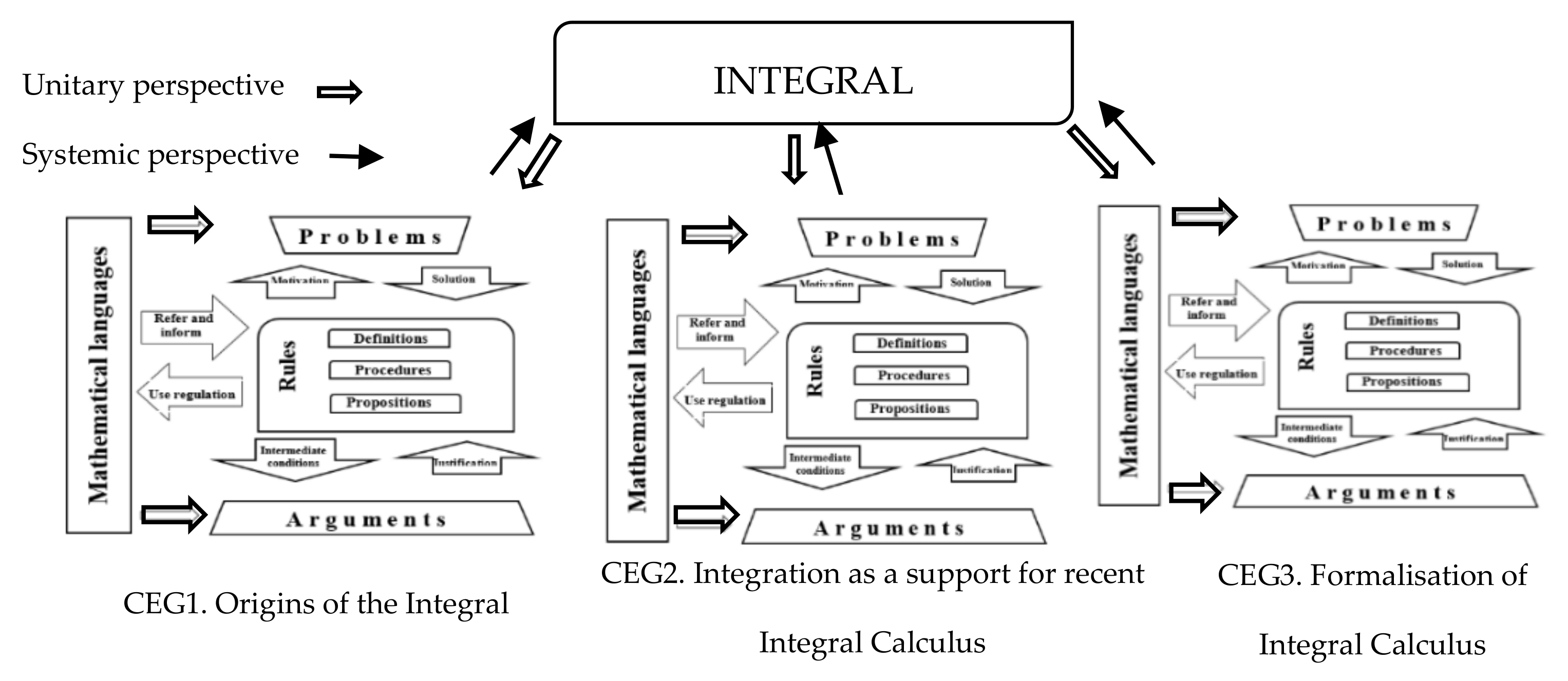
The literature in mathematics education identifies a traditional formal mechanistic-type paradigm in Integral Calculus teaching which is focused on the content to be taught but not on how to teach it. Resorting to the history of the genesis of knowledge makes it possible to identify variables in the mathematical content of the curriculum that have a positive influence on the appropriation of the notions and procedures of calculus, enabling a particularised way of teaching. Objective: The objective of this research was to characterise the anthology of the integral seen from the epistemic complexity that composes it based on historiography. Design: The modelling of epistemic complexity for the definite integral was considered, based on the theoretical construct “epistemic configuration”. Analysis and results: Formalising this complexity revealed logical keys and epistemological elements in the process of the theoretical constitution that reflected epistemological ruptures which, in the organisation of the information, gave rise to three periods for the integral. The characterisation of this complexity and the connection of its components were used to design a process of teaching the integral that was applied to three groups of university students. The implementation showed that a paradigm shift in the teaching process is possible, allowing students to develop mathematical competencies.
Keywords: complexity; articulation; epistemic configuration; integral calculus complexity; articulation; epistemic configuration; integral calculus