1. Introduction
In 1998, the parity-time (PT) symmetry firstly appeared in quantum mechanics since Bender and Boettcher pointed out that non-Hermitian Hamiltonians exhibit entirely real spectra, provided that they respect both the parity and time-reversal symmetries (usually called the parity-time symmetry) [
1]. Since then, physical systems exhibiting non-Hermitian systems with PT-symmetry have been the subject of intense investigation. In general, a necessary condition for a Hamiltonian
to be PT-symmetric is that the complex potential satisfies
where
denotes the momentum operator and V(x) is the complex potential [
1,
2]. Also, the notion of PT-symmetry has been applied to other areas of theoretical physics. In optical, R. El-Ganainy et al. developed a formalism suitable for describing coupled optical parity-time symmetric systems [
3]. K. G. Makris et al. investigated the possibility of PT-symmetric periodic potentials within the context of optics [
4]. A. Guo et al. demonstrated experimentally passive PT-symmetry breaking within the realm of optics [
5]. Y. J. He et al. reported the existence and stability of lattice solitons in PT-symmetric mixed linear-nonlinear optical lattices in Kerr media [
6].
In 2013, Ablowitz and Musslimani proposed and studied the following PT-symmetric nonlocal nonlinear Schrödinger (NLS) equation [
7]:
where the asterisk * denotes the complex conjugate,
is the sign of nonlinearity (with the plus sign being the focusing case and minus sign being the defocusing case). The nonlinear term in Equation (
1) brings a self-induced potential of the form
satisfying
. So the Hamiltonian of the Equation (
1) satisfies the PT-symmetric condition. The Equation (
1) is nonlocal as it has a term
, which means that the time evolution of
u does not only depends on the
, but
as well. Following the studying of this nonlocal PT-symmetric NLS equation, M. Li et al. applied the Nth iterated Darboux transformation to derive a chain of nonsingular localized-wave solutions of the PT-symmetric nonlocal NLS equation that can describe the soliton interactions on the continuous-wave (cw) background [
8]. M. Li et al. derived the rational solutions of the PT-symmetric nonlocal NLS equation by generalized Darboux transformation [
9]. In addition, some other PT-symmetric nonlocal integrable models have also been proposed. C. Q. Dai and W. H. Huang studied the coupled nonlinear Schrödinger equation in PT-symmetric coupled waveguides by means of the modified Darboux transformation method [
10]. A. K. Sarma et al. investigated the continuous and discrete Schrödinger systems with PT-symmetric nonlinearities [
11]. X. Y. Wen et al. studied novel higher-order rational solitons of the integrable nonlocal nonlinear Schrödinger equation with the self-induced PT-symmetric potential by the generalized perturbation N-1 fold Darboux transformation [
12]. Z. X. Zhou studied global explicit solutions for nonlocal Davey-Stewartson I equation by Darboux transformation [
13]. T. Xu et al. studied the nonsingular localized wave solutions of the partially PT-symmetric nonlocal Davey Stewartson I equation with zero background via the elementary Darboux transformation [
14]. M. Li et al. analyzed the generation mechanism of rogue waves for the discrete nonlinear Schrödinger equation from the viewpoint of structural discontinuities [
15]. K. Chen et al. showed a reduction technique that enables us to obtain solutions for the reduced local and nonlocal equation from the Ablowitz-Kaup-Newell-Suger hierarchy [
16]. M. Duanmu et al. studied dynamical systems of linear and nonlinear PT-symmetric oligomers [
17].
There are many methods in solving the integrable equations, including the Darboux transformation and Hirota bilinear method and so on. Yujia Zhang et al. investigated the interactions of vector anti-dark solitons for variable coefficients coupled NLS equation, found the double-S structure interactions [
18]. H. Q. Zhang studied a modified NLS equation in inhomogeneous fibers and obtain the dark and antidark soliton solutions with Hirota bilinear method [
19]. X. Z. Zhang propose a generalized long-water wave system study its invariant solutions and conservation laws are studied to guarantee its integrability [
20]. R. A. El-Nabulsi used matrix Lie algebra to derive some non-standard higher-order equations [
21]. Many equations posses peakons and smooth periodic waves. The most important model is the Camassa-Holm equation, which is studied by R. Camassa and D. D. Holm in 1993 [
22]. They could be seen as the negative flows of some integrable hierarchy [
23]. C. Z. Qu considered the stability of the peakon solitons of a modified Camassa-Holm equation with cubic nonlinearity [
24]. S. Y. Lou extended the Camassa-Holm type equations to nonlocal case and constructed the AB peakon equations including the AB Camassa-Holm equation and the AB Degasperis-Procesi equation [
25]. The nonlocal case of the integrable system attract lots of attentions in recent years.
The soliton equations with self-consistent sources (SESCS) play an important role in many fields of physics. The nonlinear Schrödinger equation with self-consistent sources (NLSESCS) describes the soliton propagation in a medium with both resonant and nonresonant nonlinearities and it also describes the nonlinear interaction of high-frequency electrostatic waves with ion acoustic waves in plasma [
26].
In Reference [
26], Claude studied the following system of coupled equation
with the initial-boundary value problem:
This system occurs in plasma physics as the small amplitude limit of the general wave equations in a fluid-type warm electros/cold ions plasma.
To study the solution of NLSESCS, Y. J. Shao constructed a generalized Darbous transformation with an arbitrary function of
t to study the soliton and positon solution of NLSESCS [
27]. It has abundant applications in nonlinear envelope pulsed in fibers, pressure pulses in artery vessels, nonlinear Rossby waves in atmosphere, and matter waves in dilute-gas Bose-Einstein condensates [
28]. The SESCS were first studied by Mel’nikov [
29]. Since then, the SESCS have attracted some attention. A systematic way to construct the SESCS and their zero-curvature representations was proposed. Y. B. Zeng et al. studied the mKdV hierarchy with self-consistent sources by integral-type Darboux transformation [
30]. Y. H. Huang et al. studied Camassa-Holm equation with self-consistent sources and its solutions [
31]. Y. Q. Yao et al. studied the Qiao-Liu equation with self-consistent sources and its solutions [
32].
In this paper, we construct the generalized Darboux transformation for the parity-time symmetric nonlocal nonlinear Schrödinger equation with self-consistent sources (PTNNLSESCS) and further reveal the soliton solution and the rational soliton phenomena on the cw background. The soliton solutions obtained in this work can display the profiles of the dark and antidark solitons. Also, we dicuss the degenerate cases in which only one dark or antidark soliton survives. We get the rogue wave solution of the PTNNLSESCS in some specially chose situations.
This paper is organized as follows: In
Section 2, we review elementary Darboux transformation of the PT-symmetric NLS equation and derive the generalized Darboux transformation of the PTNNLSESCS. In
Section 3, we derive the soliton solutions and discuss the degenerate cases for the PTNNLESCS. In
Section 4, we derive the rational soliton solutions, rogue wave solutions and analysis the degenerate case for the PTNNLESCS. In
Section 5, the conclude is given.
2. Elementary Darboux Transformation for the PTNNLSESCS
In this section we recall the successively iterated Darboux transformation of Equation (
1) and construct the first-order generalized Darboux transformation with an arbitrary function of
c(
z) for the PTNNLSESCS. The Darboux transformation, which comprises the eigenfunction and potential transformations, can be used to recursively generate solutions including the soliton solutions, rational solutions from a trivial solution which can further provide an algebraic basis to analyze the asymptotic behavior of the solutions.
The Lax pair of Equation (
1) can be written in the form [
8]
where
(the superscript T represents the vector transpose) is the vector eigenfunction,
is the spectral parameter, and Equation (
1) satisfies the compatibility condition
.
In Reference [
8], the Nth iterated elementary Darboux transformation for Equation (
1) can be constituted by the eigenfunction
and the Darboux transformation
where N represents the iterated time. The new eigenfunction
is required to satisfy the Lax pair in Equations (
2a) and (2b) with
and
instead of
and
, respectively. The functions
and
can be determined from
where
and
are the solutions of Equations (
2a) and (2b) with
and
, respectively. In particular, the functions
and
can be obtained in the determinant form
with
where the block matrices
It is well known that the AKNS equation with self-consistent sources (AKNSESCS) is defined as [
27]
where
are n distinct complex constants,
(hereafter, we use superscripts (1) and (2) to denote the first and second elements of a two-dimensional vector respectively). In this paper, we only consider the PT-symmetric nonlocal NLS equation with one source.
With the reduction
and
the PTNNLSESCS can be constructed from AKNSESCS
The Lax pair of Equation (9) can be written in the form
Based on the Darboux transformation for the AKNS equation, we derive the generalized Darboux transformations of Equation (9).
Theorem 1. Let , and be two solutions of Equation (10) with and , then the Darboux transformation for Equation (9) is defined aswhereand represents the entry of matrix of the first row and second column. Proof. Let
, according to Equation (9) we know
and
After some calculations we have
from Equation (11c), we obtain
we find that
so
□
From Theorem 1, we can obtain different types solutions of Equation (9). Next, we will use the generalized Darboux transformation to construct the soliton solutions and rational solutions on a cw background.
3. Soliton Solutions of the PTNNLSESCS
In this section we construct the soliton solutions on the cw background. It is not difficult to find that Equation (9) admits the plane-wave solution
where
and
are two real parameters. In the following, we take
, using
and
to denote the real and imaginary parts of
, respectively. We take
and
to derive the soliton solutions of the PTNNLSESCS. Inserting Equation (
17) into the Lax pair (10), we obtain
where
,
and
are arbitrary nonzero complex parameters. Then, with substitution of (18) into the Darboux transformations (11), the solution can be written as
where
and
In this section, we take
c(
z) as a real arbitrary function of
z. It can be proved that the solution (19) has no singularity if and only if the following condition is satisfied:
We make an asymptotic analysis to better understand the solitonic behavior in the solution (19) under the condition (20) as follows.
(i) Along the line
as
, we have
with
and
where the plus sign corresponds to
as
or
as
and the minus sign corresponds to
as
or
as
.
(ii) Along the line
as
, we have
with
and
, where the plus sign corresponds to
as
or
as
and the minus sign corresponds to
as
or
as
.
The above asymptotic analysis shows three different types of elastic interactions. The associated parametric conditions are given in
Table 1. The asymptotic soliton
represents the antidark soliton for
or dark soliton for
on a cw background and both the antidark soliton and dark solitons are localized along the line
, while the asymptotic soliton
also represents the antidark soliton for
or dark soliton for
on the same cw background. In this case, both the antidark soliton and dark soliton solitons are localized along the line
. In particular, for the degenerate case
, the asymptotic soliton
disappear as
. Similarly, for the degenerate case
, the only surviving asymptotic soliton is
.
The heights of the antidark solitons or the depth of the dark solitons from the cw background for
and
, that is
respectively. The envelope velocity of
and
, that is
and
respectively. There exists a phase shift between
and
and its absolute value can be calculated by
which means that the phase shift depends on both
and
.
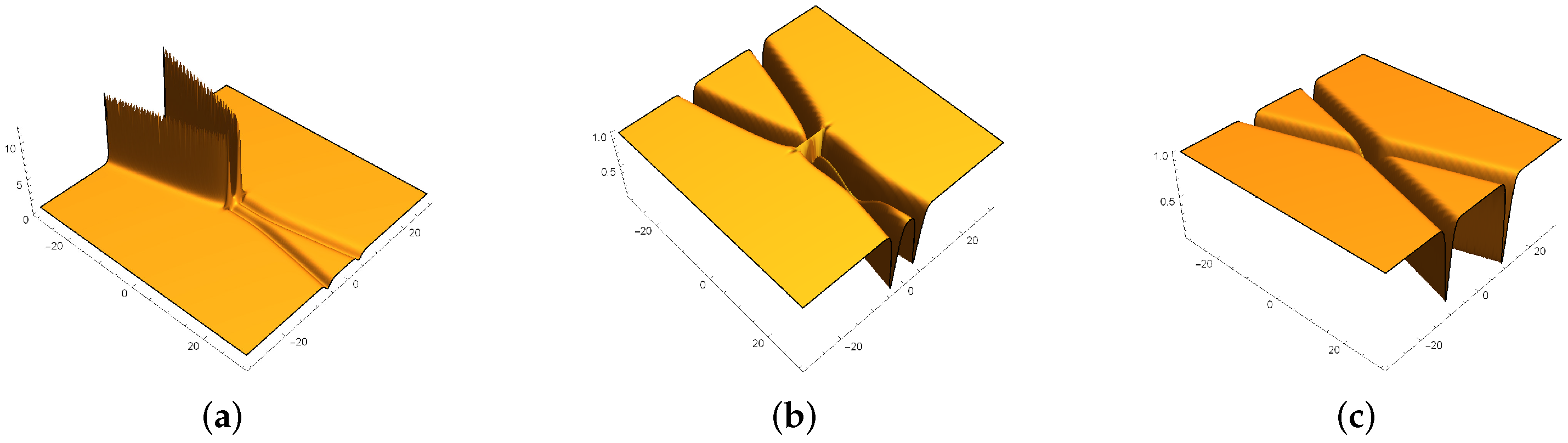
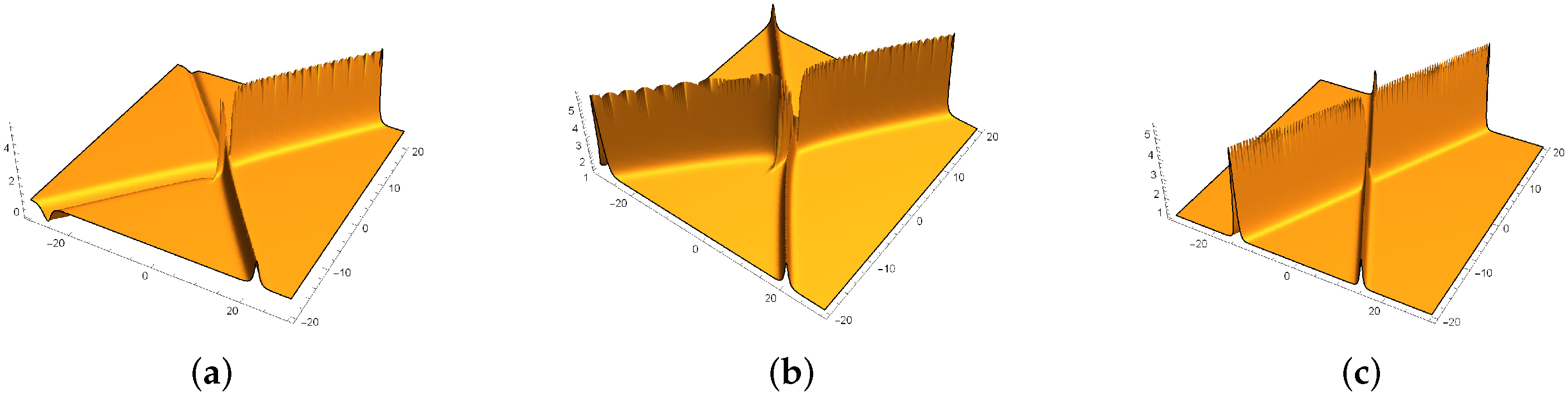
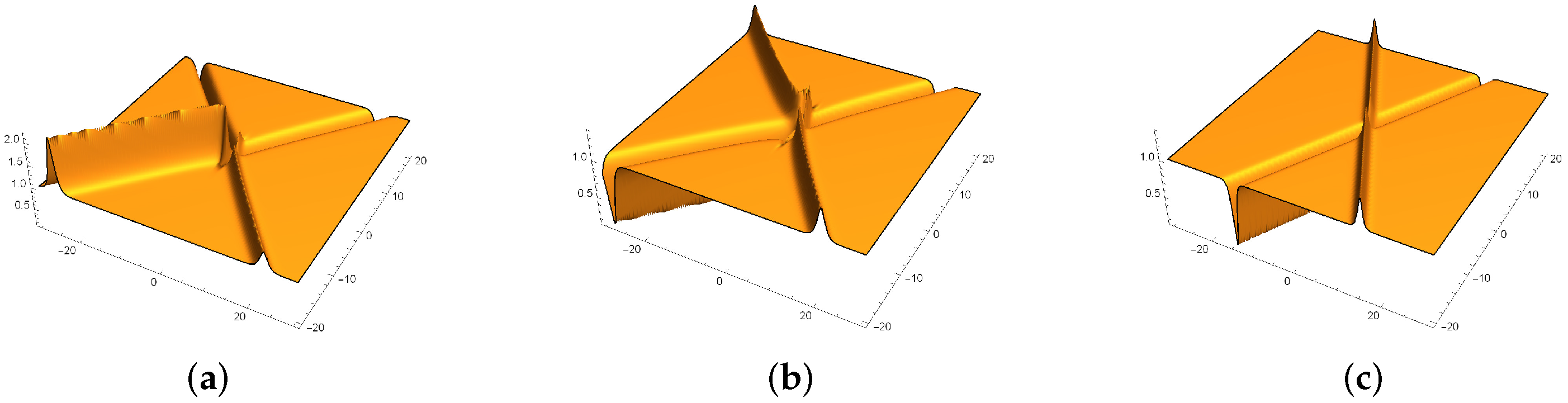
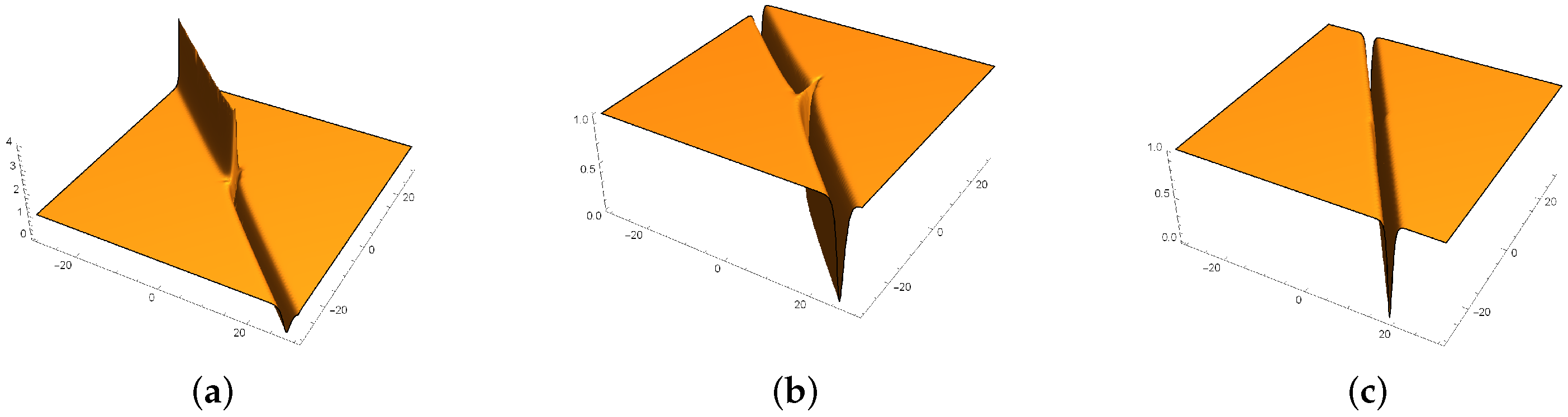
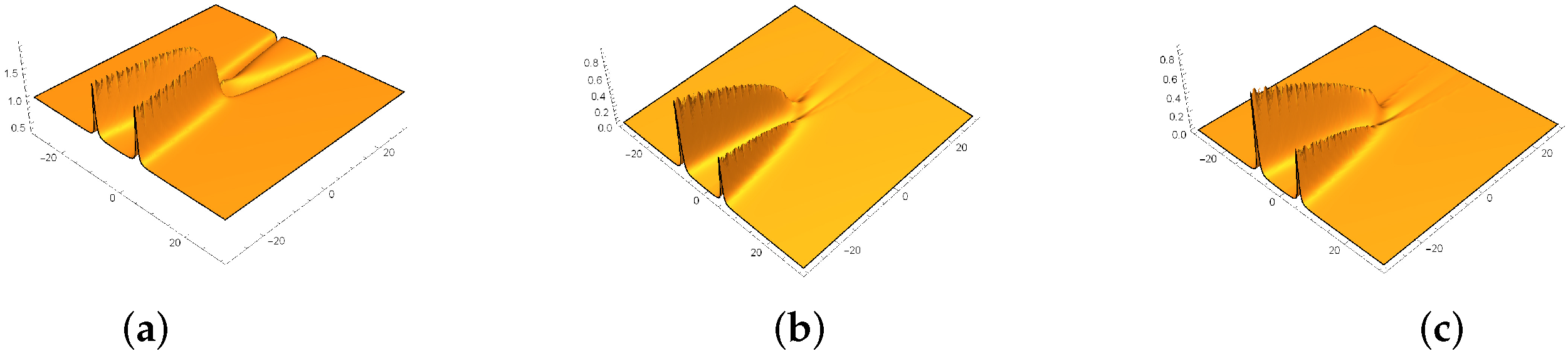
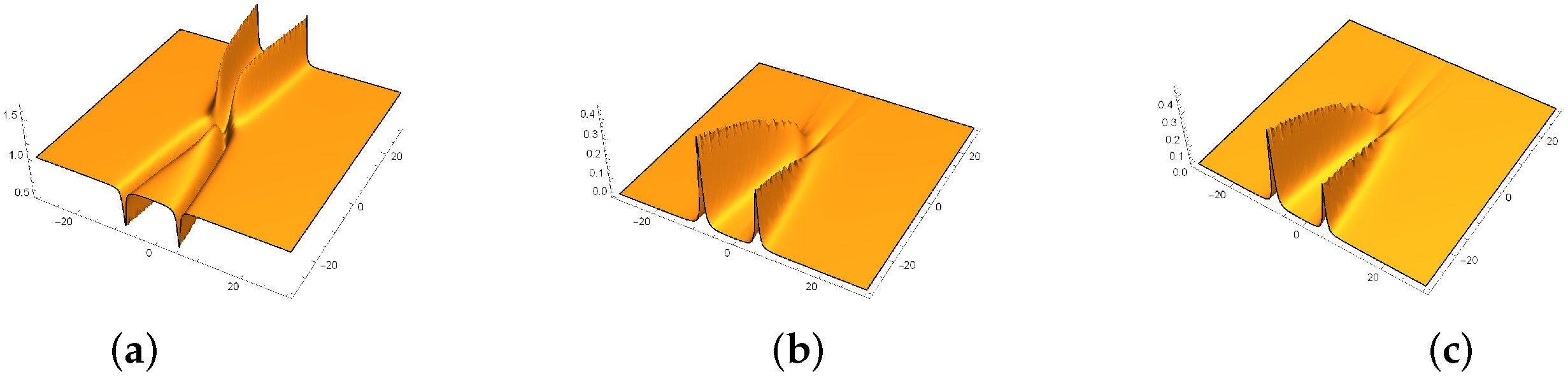
In any of these interactions, the interacting solitons can completely recover their individual shapes and velocities upon an interaction and have only the phase shifts for their envelopes. The
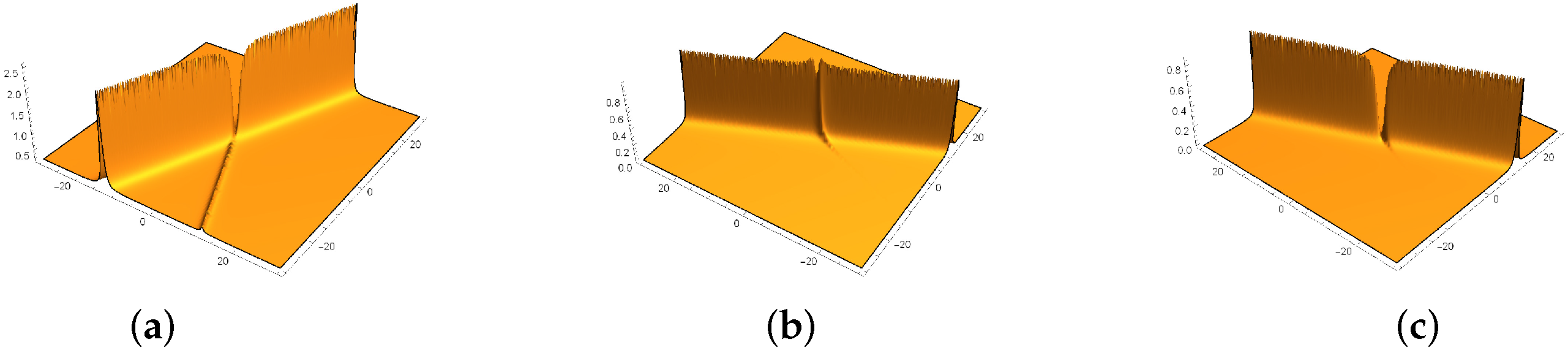
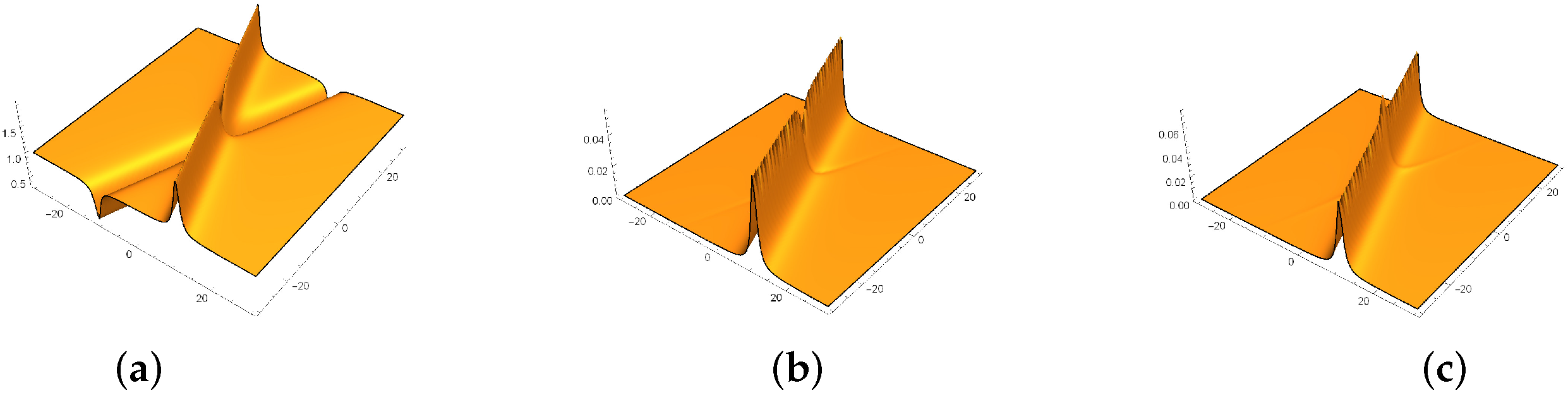
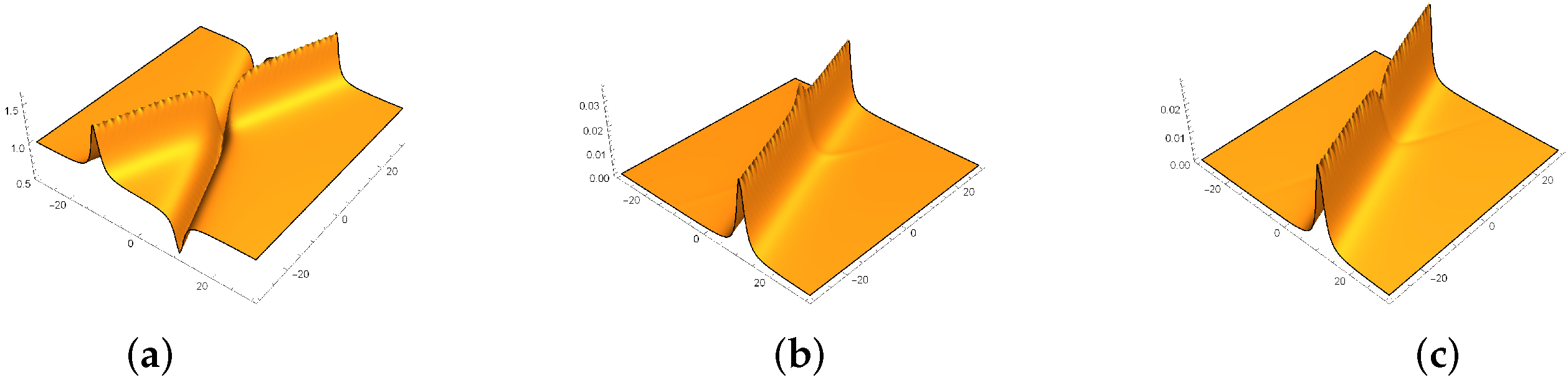
Figure 1,
Figure 2 and
Figure 3 suggest that the solution (
19a) under the condition (
20) can describe the elastic soliton interactions on the cw background. The elastic interactions may occur between two antidark solitons, two dark solitons, or dark and antidark solitons. The existence of the antidark soliton or the dark soliton can be decided by the sign of
c(
z) [see
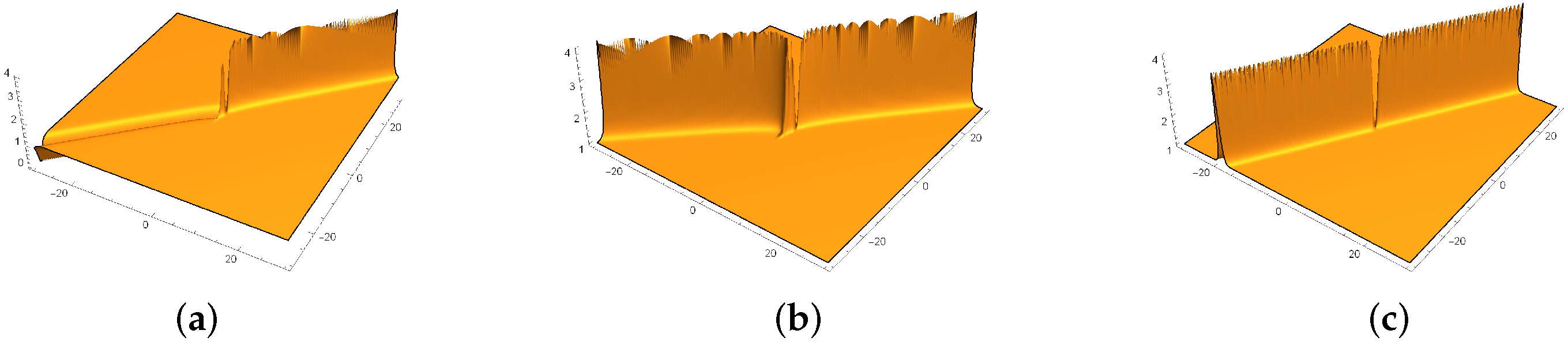
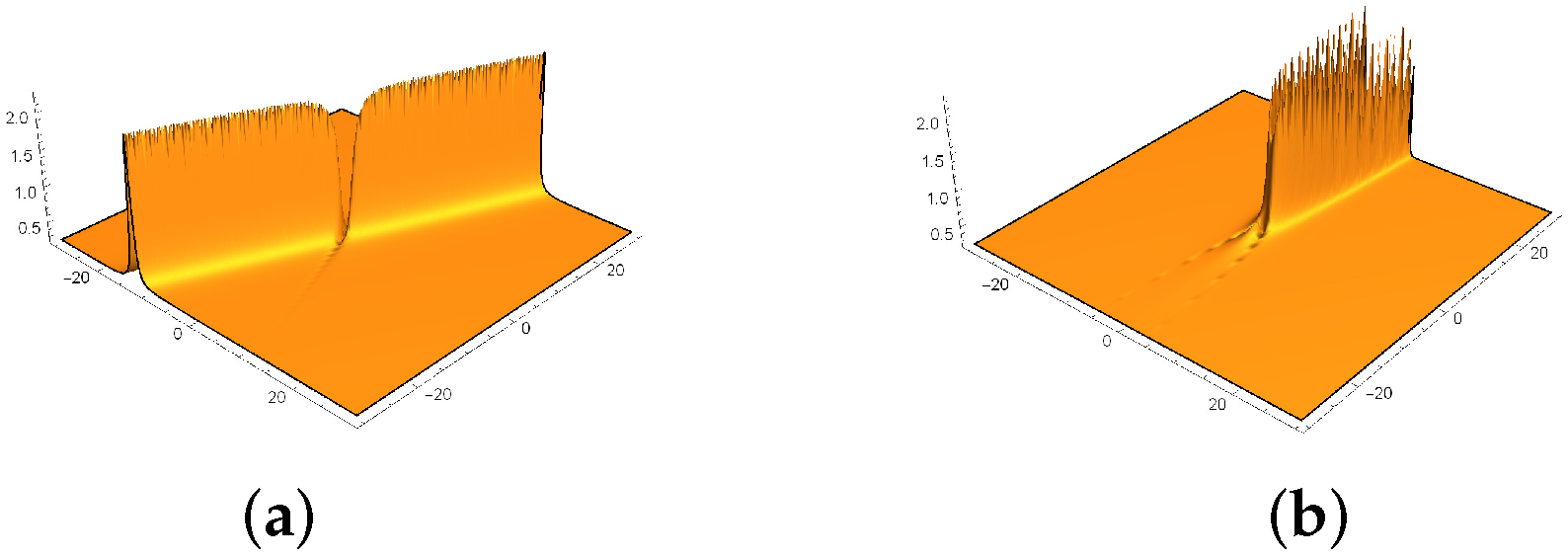
Figure 1a–c]. Particularly taking
, the asymptotic solitons
disappears as
, but
still exists and represent antidark solitons for
or dark solitons for
[see
Figure 4]. However, the solution (
19a) in this degenerate case cannot be regarded as the conventional single soliton because there exists a phase shift between
and
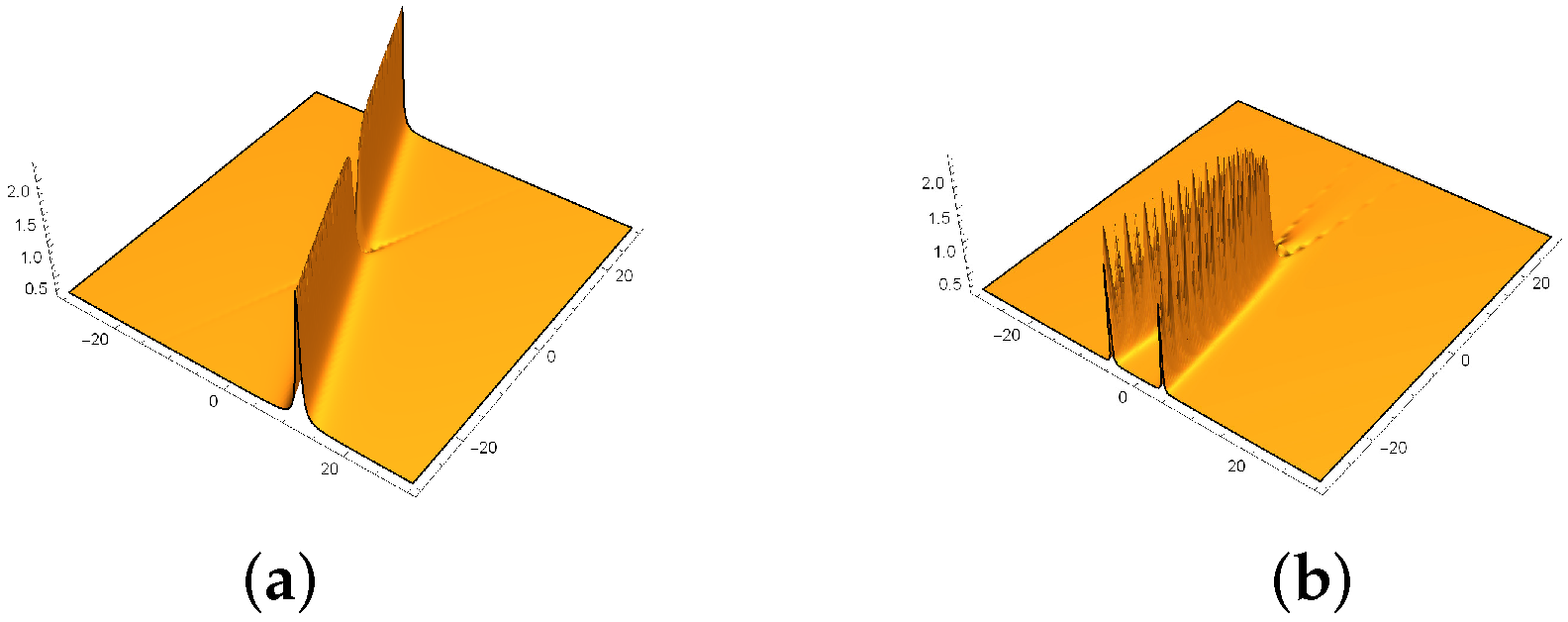
. Similarly, for the degenerate case
, one can find that only the pair of asymptotic solitons
exists as
and there is also a phase shift between
and
[see
Figure 5]. Associated with
and
,
can represent antidark solitons and dark solitons, respectively.
4. Rational Solutions of the PTNNLSESCS
In this section we construct the rational solutions of the PTNNLSESCS on the cw background. Equation (9) admits plane-wave solution
. We take
to derive the rational solitons and rogue wave solutions. Inserting them into the Lax pair (10), by eigenvalue method we obtain
where
is an arbitrary complex parameter.
Then, with substitution of (25) into the Darboux transformations (11), we obtain the first-order rational soliton solution as follows:
where
and
. The solution in Equation (26) has no singularity if and only if the following condition is satisfied:
Under this condition, we perform an asymptotic analysis of the solution in Equation (26) so as to clarify the dynamical behavior underlying the solution.
(i) when
. Firstly, we obtain the asymptotic expression of the solution in Equation (26) along the line
as
as follows:
Secondly, we derive the asymptotic expression of the solution in Equation (26) along the line
as
as follows:
The above asymptotic analysis shows three different types of elastic interactions. The associated parametric conditions are given in
Table 2. For the cases
and
, the intensity
can respectively exhibit the rational dark (RD) soliton beneath the cw background
and the rational antidark (RAD) soliton on top of the same background, and the valley and peak are both localized along the line
. The intensity
display the RD and RAD soliton profiles which are associated with
and
respectively. In this case, both the RD and RAD solitons are localized along the line
. In particular, for the degenerate case
, the asymptotic soliton
disappear as
. Similarly, for the degenerate case
, the only surviving asymptotic soliton is
.
The heights of the RAD soliton or the depth of the RD soliton from the cw background for and , that is and , respectively. The velocities of the RD and RAD solitons from the cw background for and , that is and , respectively.
The asymptotic analysis implies that Equation (26) can describe the elastic interactions of rational solitons as two interacting solitons retain their individual shapes, intensities and velocities as . However, different from the standard elastic interaction in the PTNNLSESCS, each soliton experiences no phase shift upon the interaction.
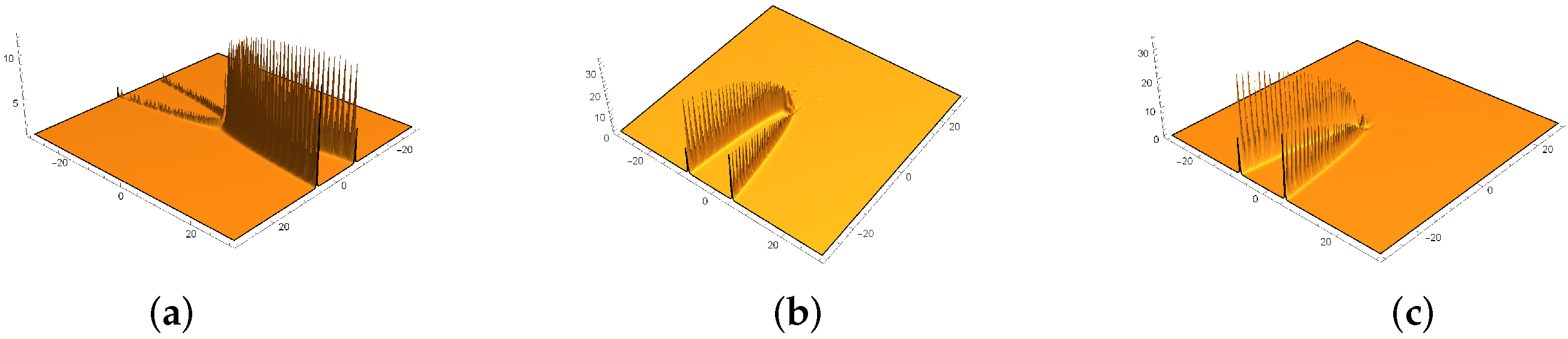
In general, Equation (26) exhibits three different types of elastic interactions between two rational solitons on a cw background, as shown in
Figure 6,
Figure 7,
Figure 8,
Figure 9,
Figure 10 and
Figure 11. More specifically, with
and
, the asymptotic soliton
and
both displays RAD solitons profile [see
Figure 6a]. With
and
, the asymptotic soliton
and
displays RAD and RD solitons profile [see
Figure 7a]. With
and
, the asymptotic soliton
and
displays RD and RAD solitons profile [see
Figure 8a]. The function
c(
z) of the solutions (26) can change the shape of the RAD or RD [see
Figure 9,
Figure 10 and
Figure 11]. The solution of
and
always diplay RAD soliton solution along the line
as
and has a constant height as
[see
Figure 6b,c], but the height change as
[see
Figure 9b,c]. The solution of
and
disappear along the line
as
.
In particular, with
the asymptotic soliton
disappear as
while
displays a RAD soliton profile [see
Figure 12]. Similarly, for the degenerate case
, the only surviving asymptotic soliton is
and it takes the shape of the RAD type [see
Figure 13]. In either of the two degenerate cases, one asymptotic soliton disappears in the far-field region, but it still affects the other one in the near-field region, that is, the surviving soliton is segmented into two pieces at some finite value of
z. Therefore, such two degenerate cases of the solution in Equation (
26a) cannot be simply regarded as the conventional single soliton.
(ii) when
, Equation (26) can be written as follows:
where
We can see that the solution of (
34a) tends to background in the
z direction as
because the denominator containing
and
has higher exponential than the molecule containing
z and
. The solution of (34a) tends to background in the x direction as
because the denominator contains
and
x, but the molecule does not contain the x. So the solution of (
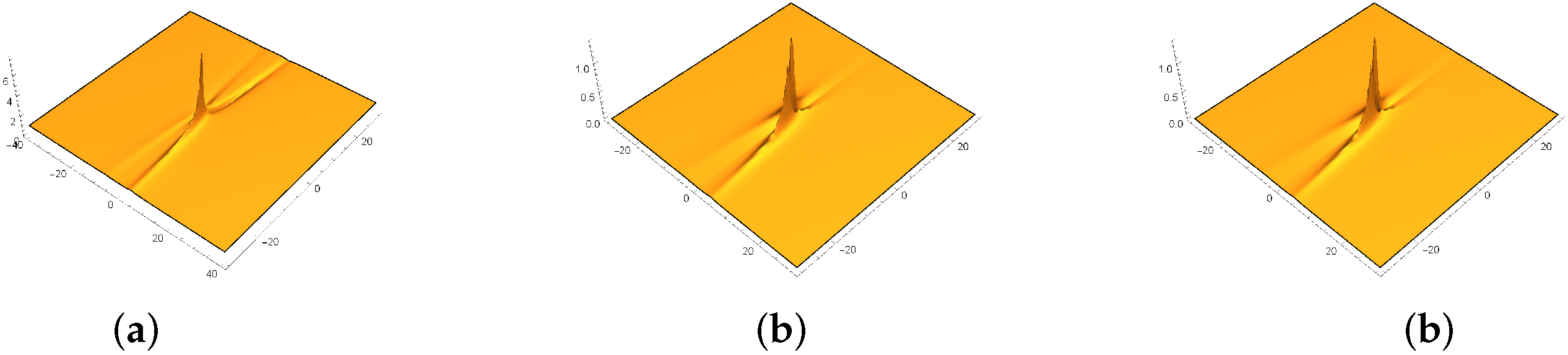
34a) would tend to background in all direction, which means that we get the rogue wave solution as shown in
Figure 14a. The solution of (34b) tends to background in the
z direction as
because the denominator containing
,
and
has higher exponential than the molecule containing
z,
and
. The solution of (34b) tends to background in the x direction as
because the denominator contains
and
x, but the molecule only contains the x. So the solution of (34b) would tend to background in all direction, which means that we get the rogue wave solution as shown in
Figure 14b. The solution of (34c) has the same reason as the solution of (34b) as shown in
Figure 14c.