The Analytical Analysis of Time-Fractional Fornberg–Whitham Equations



Abstract
1. Introduction
2. Preliminaries
3. NDM Procedure
4. NDM Implementation
5. Conclusions
Author Contributions
Funding
Acknowledgments
Conflicts of Interest
References
- Acan, O.; Firat, O.; Keskin, Y. Conformable variational iteration method, conformable fractional reduced differential transform method and conformable homotopy analysis method for non-linear fractional partial differential equations. Waves Random Complex Media 2020, 30, 250–268. [Google Scholar] [CrossRef]
- Najafi, R. Group-invariant solutions for time-fractional Fornberg-Whitham equation by Lie symmetry analysis. Comput. Methods Differ. Equ. 2020, 8, 251–258. [Google Scholar]
- Hörmann, G.; Okamoto, H. Weak periodic solutions and numerical case studies of the Fornberg-Whitham equation. arXiv 2018, arXiv:1807.02320. [Google Scholar] [CrossRef]
- Zhou, J.; Tian, L. A type of bounded traveling wave solutions for the Fornberg–Whitham equation. J. Math. Anal. Appl. 2008, 346, 255–261. [Google Scholar] [CrossRef]
- Moldabayev, D.; Kalisch, H.; Dutykh, D. The Whitham equation as a model for surface water waves. Phys. D Nonlinear Phenom. 2015, 309, 99–107. [Google Scholar] [CrossRef]
- Lenells, J. Traveling wave solutions of the Camassa–Holm and Korteweg–de Vries Equations. J. Nonlinear Math. Phys. 2004, 11, 508–520. [Google Scholar] [CrossRef]
- Camassa, R.; Holm, D. An integrable shallow wave equation with peaked solitons. Phys. Rev. Lett. 1993, 71, 1661–1664. [Google Scholar] [CrossRef]
- Lenells, J. Traveling wave solutions of the Camassa–Holm equation. J. Differ. Equ. 2005, 217, 393–430. [Google Scholar] [CrossRef]
- Liu, Z.; Chen, C. Compactons in a general compressible hyperelastic rod. Chaos Soliton Fractals 2004, 22, 627–640. [Google Scholar] [CrossRef]
- Parkes, E.J.; Vakhnenko, V.O. Explicit solutions of the Camassa–Holm equation. Chaos Solitons Fractals 2005, 26, 1309–1316. [Google Scholar] [CrossRef]
- Whitham, G.B. Variational methods and applications to water waves. Philos. Trans. R. Soc. Lond. Ser. A Math. Phys. Sci. 1967, 299, 6–25. [Google Scholar]
- Fornberg, B.; Whitham, G.B. A numerical and theoretical study of certain nonlinear wave phenomena. Philos. Trans. R. Soc. Lond. Ser. A Math. Phys. Sci. 1978, 289, 373–404. [Google Scholar]
- Purohit, S.D. Solutions of fractional partial differential equations of quantum mechanics. Adv. Appl. Math. Mech. 2013, 5, 639–651. [Google Scholar] [CrossRef]
- Singh, J.; Kumar, D.; Kumar, S. New treatment of fractional Fornberg–Whitham equation via Laplace transform. Ain Shams Eng. J. 2013, 4, 557–562. [Google Scholar] [CrossRef]
- Iyiola, O.S.; Ojo, G.O. On the analytical solution of Fornberg–Whitham equation with the new fractional derivative. Pramana 2015, 85, 567–575. [Google Scholar] [CrossRef]
- Kumar, D.; Singh, J.; Baleanu, D. A new analysis of the Fornberg-Whitham equation pertaining to a fractional derivative with Mittag-Leffler-type kernel. Eur. Phys. J. Plus 2018, 133, 70. [Google Scholar] [CrossRef]
- Gupta, P.K.; Singh, M. Homotopy perturbation method for fractional Fornberg–Whitham equation. Comput. Math. Appl. 2011, 61, 250–254. [Google Scholar] [CrossRef]
- Abidi, F.; Omrani, K. Numerical solutions for the nonlinear Fornberg-Whitham equation by He’s method. Int. J. Mod. Phys. B 2011, 25, 4721–4732. [Google Scholar] [CrossRef]
- Li, Q.; Sun, S.; Han, Z.; Zhao, Y. On the existence and uniqueness of solutions for initial value problem of nonlinear fractional differential equations. In Proceedings of the 2010 IEEE/ASME International Conference on Mechatronic and Embedded Systems and Applications, Qingdao, China, 15–17 July 2010; pp. 452–457. [Google Scholar]
- Bacani, D.B.; Tahara, H. Existence and uniqueness theorem for a class of singular nonlinear partial differential equations. Publ. Res. Inst. Math. Sci. 2012, 48, 899–917. [Google Scholar] [CrossRef]
- Dannan, F.M.; Saleeby, E.G. An existence and uniqueness theorem for n-th order functional differential equations. Int. J. Pure Appl. Math. 2013, 84, 193–200. [Google Scholar] [CrossRef]
- Gao, X.; Lai, S.; Chen, H. The stability of solutions for the Fornberg–Whitham equation in L1(R) space. Bound. Value Probl. 2018, 2018, 142. [Google Scholar] [CrossRef]
- Shen, C.; Gao, A. Optimal distributed control of the Fornberg–Whitham equation. Nonlinear Anal. Real World Appl. 2015, 21, 127–141. [Google Scholar] [CrossRef]
- Jajarmi, A.; Yusuf, A.; Baleanu, D.; Inc, M. A new fractional HRSV model and its optimal control: A non-singular operator approach. Phys. A Stat. Mech. Its Appl. 2019, 547, 123860. [Google Scholar] [CrossRef]
- Tuan, N.H.; Baleanu, D.; Thach, T.N.; O’Regan, D.; Can, N.H. Approximate solution for a 2-D fractional differential equation with discrete random noise. Chaos Solitons Fractals 2020, 133, 109650. [Google Scholar] [CrossRef]
- Anh Triet, N.; Van Au, V.; Dinh Long, L.; Baleanu, D.; Huy Tuan, N. Regularization of a terminal value problem for time fractional diffusion equation. Math. Methods Appl. Sci. 2020, 43, 3850–3878. [Google Scholar] [CrossRef]
- Tuan, N.H.; Baleanu, D.; Thach, T.N.; O’Regan, D.; Can, N.H. Final value problem for nonlinear time fractional reaction–diffusion equation with discrete data. J. Comput. Appl. Math. 2020, 376, 112883. [Google Scholar] [CrossRef]
- Şenol, M.; Iyiola, O.S.; Kasmaei, H.D.; Akinyemi, L. Efficient analytical techniques for solving time-fractional nonlinear coupled Jaulent–Miodek system with energy-dependent Schrödinger potential. Adv. Differ. Equ. 2019, 2019, 462. [Google Scholar] [CrossRef]
- Akinyemi, L.; Iyiola, O. Exact and approximate solutions of time-fractional models arising from physics via Shehu transform. Math. Methods Appl. Sci. 2020. [Google Scholar] [CrossRef]
- Akinyemi, L.; Iyiola, O.S. A reliable technique to study nonlinear time-fractional coupled Korteweg–de Vries equations. Adv. Differ. Equ. 2020, 2020, 1–27. [Google Scholar] [CrossRef]
- Shah, R.; Khan, H.; Baleanu, D.; Kumam, P.; Arif, M. The analytical investigation of time-fractional multi-dimensional Navier–Stokes equation. Alex. Eng. J. 2020, in press. [Google Scholar] [CrossRef]
- Jan, R.; Xiao, Y. Effect of partial immunity on transmission dynamics of dengue disease with optimal control. Math. Methods Appl. Sci. 2019, 42, 1967–1983. [Google Scholar] [CrossRef]
- Jan, R.; Xiao, Y. Effect of pulse vaccination on dynamics of dengue with periodic transmission functions. Adv. Differ. Equ. 2019, 1, 368. [Google Scholar] [CrossRef]
- Mahmood, S.; Shah, R.; Arif, M. Laplace Adomian Decomposition Method for Multi Dimensional Time Fractional Model of Navier-Stokes Equation. Symmetry 2019, 11, 149. [Google Scholar] [CrossRef]
- Shah, R.; Khan, H.; Farooq, U.; Baleanu, D.; Kumam, P.; Arif, M. A New Analytical Technique to Solve System of Fractional-Order Partial Differential Equations. IEEE Access 2019, 7, 150037–150050. [Google Scholar] [CrossRef]
- Shah, R.; Khan, H.; Kumam, P.; Arif, M. An analytical technique to solve the system of nonlinear fractional partial differential equations. Mathematics 2019, 7, 505. [Google Scholar] [CrossRef]
- Shah, R.; Khan, H.; Baleanu, D.; Kumam, P.; Arif, M. A novel method for the analytical solution of fractional Zakharov–Kuznetsov equations. Adv. Differ. Equ. 2019, 2019, 1–14. [Google Scholar] [CrossRef]
- Khan, H.; Farooq, U.; Shah, R.; Baleanu, D.; Kumam, P.; Arif, M. Analytical Solutions of (2+ Time Fractional Order) Dimensional Physical Models, Using Modified Decomposition Method. Appl. Sci. 2020, 10, 122. [Google Scholar] [CrossRef]
- Shah, R.; Farooq, U.; Khan, H.; Baleanu, D.; Kumam, P.; Arif, M. Fractional view analysis of third order Kortewege-De Vries equations, using a new analytical technique. Front. Phys. 2020, 7, 244. [Google Scholar] [CrossRef]
- Khan, Z.H.; Khan, W.A. N-transform-properties and applications. NUST J. Eng. Sci. 2008, 1, 127–133. [Google Scholar]
- Rawashdeh, M.S.; Maitama, S. Solving nonlinear ordinary differential equations using the NDM. J. Appl. Anal. Comput. 2015, 5, 77–88. [Google Scholar]
- Rawashdeh, M.S.; Maitama, S. Solving PDEs using the natural decomposition method. Nonlinear Stud. 2016, 23, 63–72. [Google Scholar]
- Khan, H.; Shah, R.; Kumam, P.; Arif, M. Analytical Solutions of Fractional-Order Heat and Wave Equations by the Natural Transform Decomposition Method. Entropy 2019, 21, 597. [Google Scholar] [CrossRef]
- Rawashdeh, M.S.; Maitama, S. Solving coupled system of nonlinear PDE’s using the natural decomposition method. Int. J. Pure Appl. Math. 2014, 92, 757–776. [Google Scholar] [CrossRef]
- Khan, H.; Shah, R.; Baleanu, D.; Kumam, P.; Arif, M. Analytical Solution of Fractional-Order Hyperbolic Telegraph Equation, Using Natural Transform Decomposition Method. Electronics 2019, 8, 1015. [Google Scholar] [CrossRef]
- Rawashdeh, M.S. The fractional natural decomposition method: Theories and applications. Math. Methods Appl. Sci. 2017, 40, 2362–2376. [Google Scholar] [CrossRef]
- Shah, R.; Khan, H.; Mustafa, S.; Kumam, P.; Arif, M. Analytical Solutions of Fractional-Order Diffusion Equations by Natural Transform Decomposition Method. Entropy 2019, 21, 557. [Google Scholar] [CrossRef]
- Miller, K.S.; Ross, B. An Introduction to the Fractional Calculus and Fractional Differential Equations; Wiley: New York, NY, USA, 1993. [Google Scholar]
- Hilfer, R. Applications of Fractional Calculus in Physics; World Sci. Publishing: River Edge, NJ, USA, 2000. [Google Scholar]
- Agarwal, R.; Lakshmikantham, V.; Nieto, J. On the concept of solution for fractional differential equations with uncertainty. Nonlinear Anal. Theory Methods Appl. 2010, 72, 2859–2862. [Google Scholar] [CrossRef]
- Belgacem, F.B.M.; Silambarasan, R. Maxwell’s equations solutions by means of the natural transform. Int. J. Math. Eng. Sci. Aerosp. 2012, 3, 313–323. [Google Scholar]
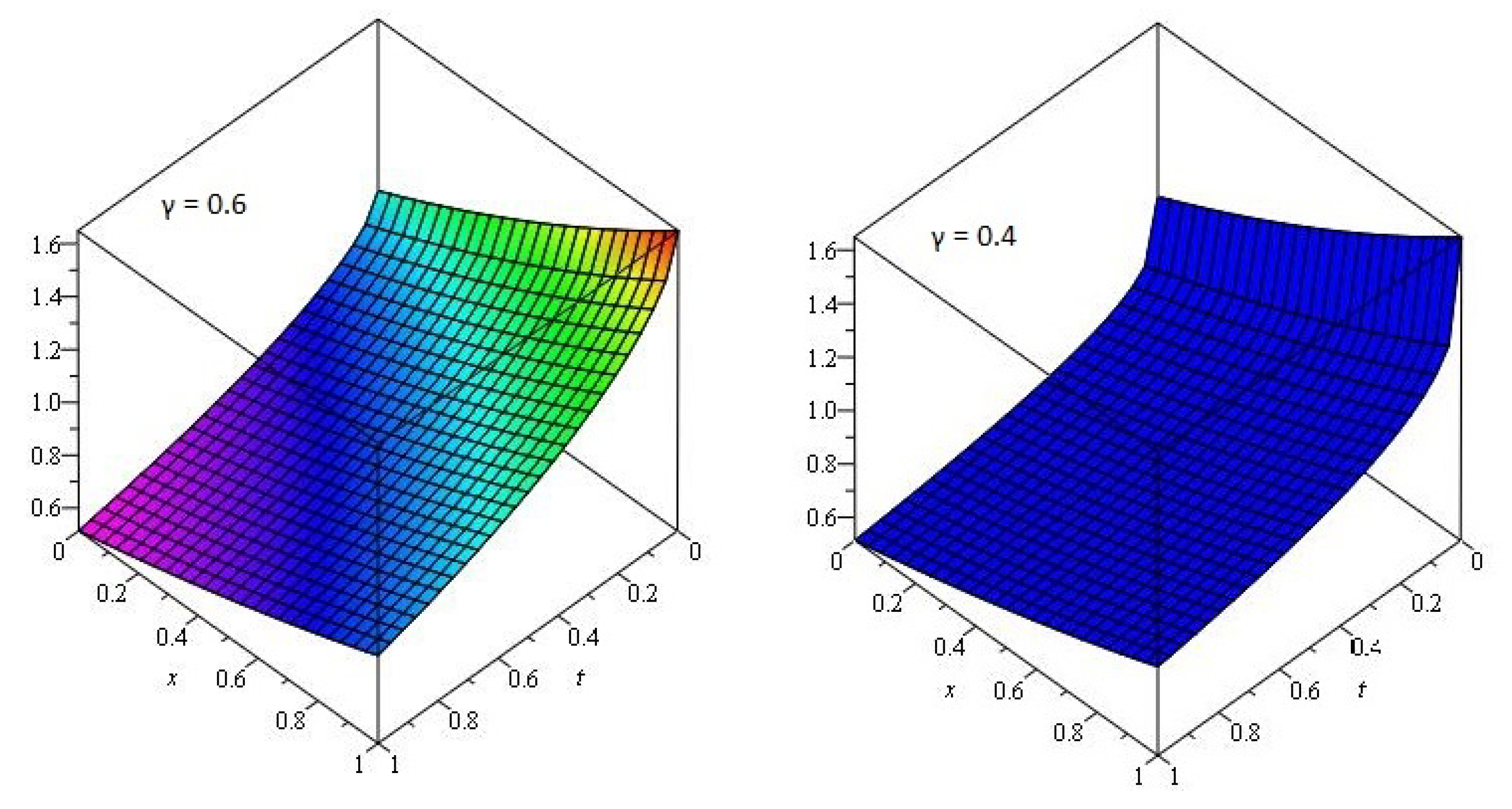

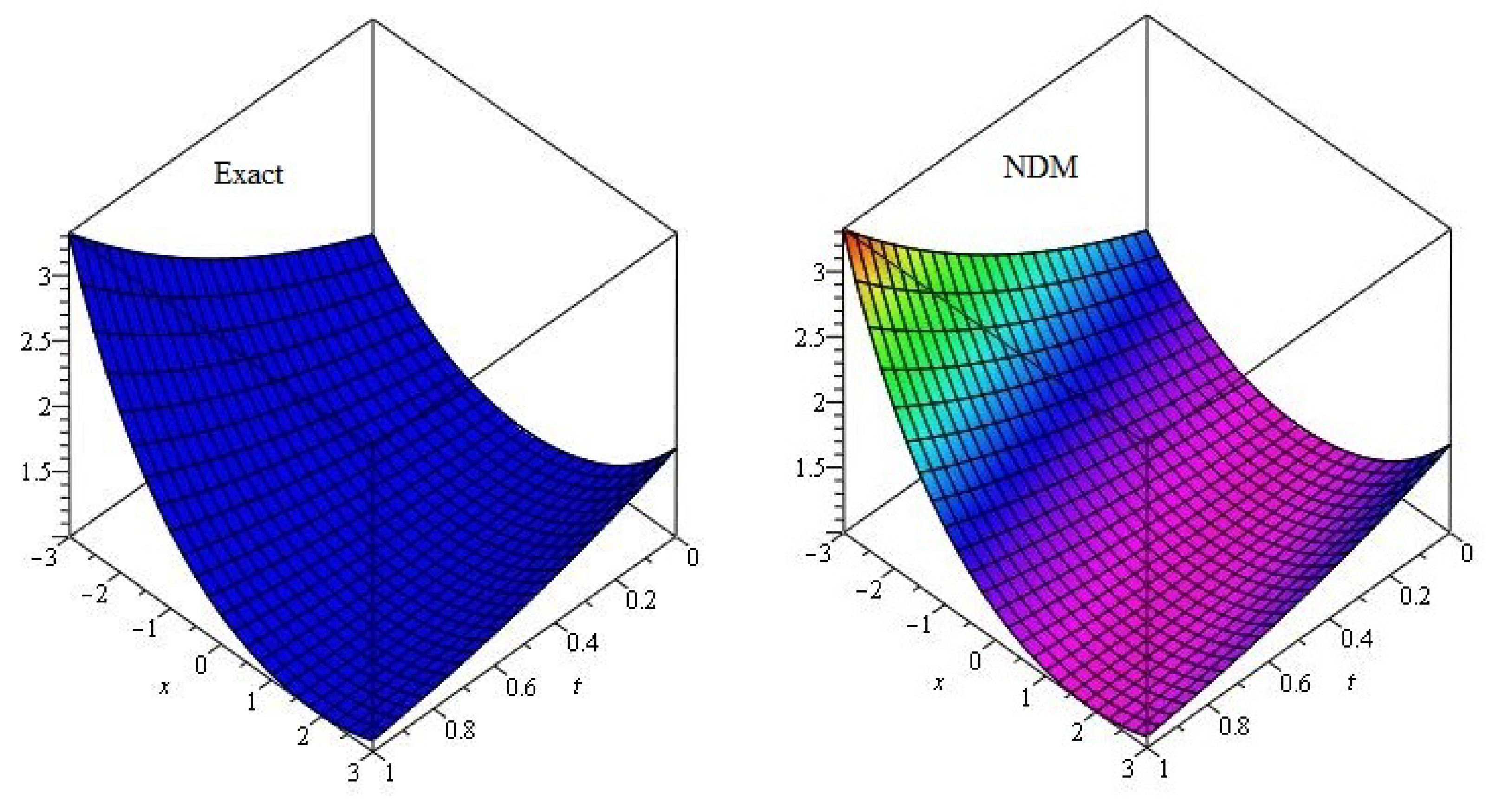
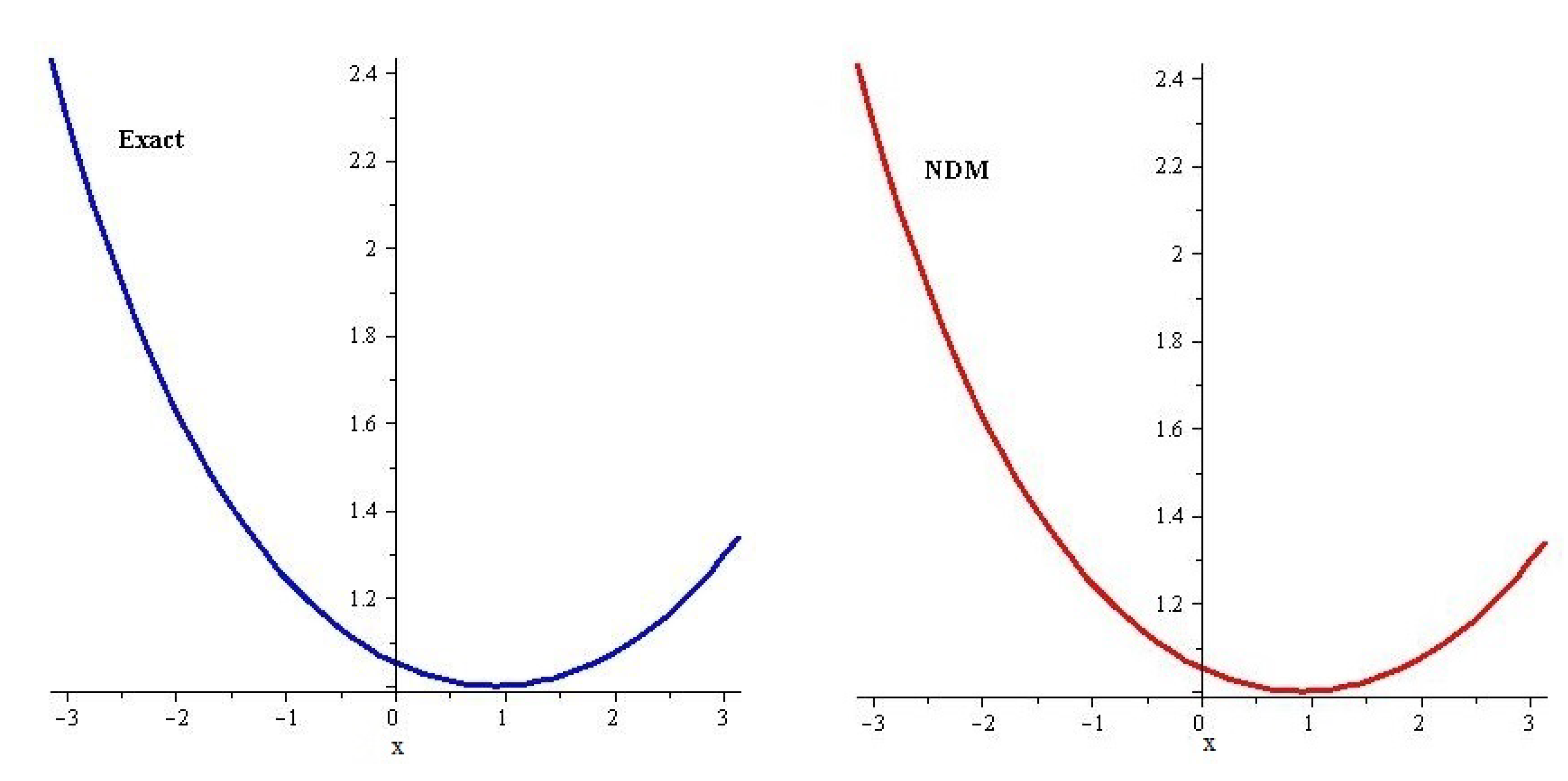

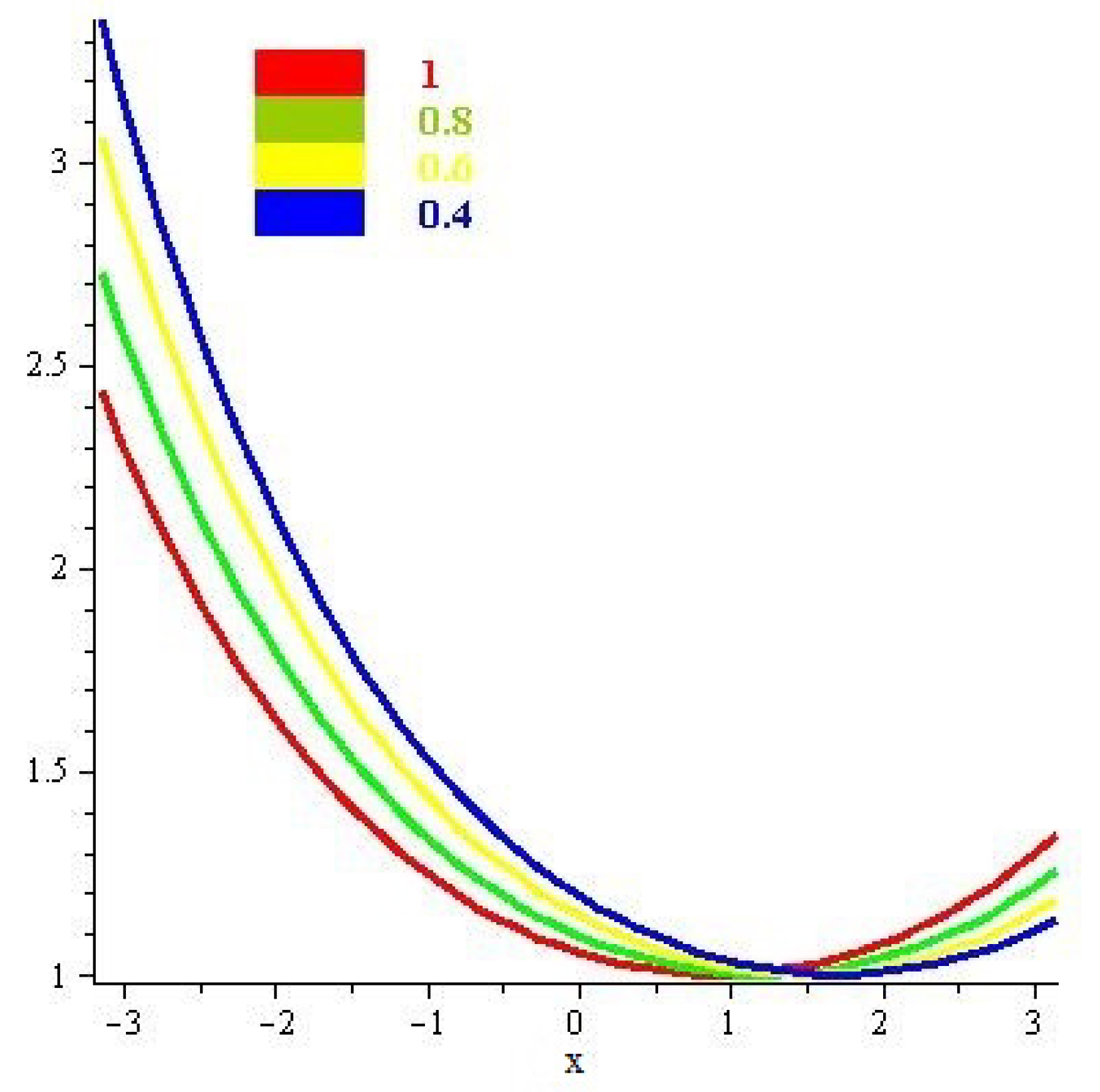

| t | x | NDM ( | Exact | NDM (AE) | ||
|---|---|---|---|---|---|---|
| 0.2 | 0.5 | 1.168497921 | 1.229840967 | 1.266952492 | 1.267018708 | 6.620 × 10 |
| 1.0 | 1.500381030 | 1.579147061 | 1.626799201 | 1.626884224 | 8.500 × 10 | |
| 1.5 | 1.926527377 | 2.027664962 | 2.088851523 | 2.088960694 | 1.090 × 10 | |
| 2.0 | 2.473710118 | 2.603573348 | 2.682138447 | 2.682278626 | 1.400 × 10 | |
| 0.4 | 0.5 | 1.123744786 | 1.197168588 | 1.250129766 | 1.25023725 | 1.070 × 10 |
| 1.0 | 1.442916867 | 1.537194895 | 1.605198393 | 1.60533640 | 1.380 × 10 | |
| 1.5 | 1.852741931 | 1.973797315 | 2.061115536 | 2.06129274 | 1.770 × 10 | |
| 2.0 | 2.378967730 | 2.534405920 | 2.646524735 | 2.64675227 | 2.270 × 10 | |
| 1 | 0.5 | 1.039959208 | 1.124099772 | 1.201030155 | 1.20114746 | 1.84 × 10 |
| 1.0 | 1.335334055 | 1.443372678 | 1.542153245 | 1.542390265 | 2.370 × 10 | |
| 1.5 | 1.714602867 | 1.853327204 | 1.980163963 | 1.980468303 | 3.004 × 10 | |
| 2.0 | 2.201593661 | 2.379719235 | 2.542580858 | 2.542971638 | 3.900 × 10 |
| x | t | NDM | LDM | NDM | LDM | NDM | LDM | |
|---|---|---|---|---|---|---|---|---|
| 0.1 | 1.259 × 10 | 4.021 × 10 | 5.006 × 10 | 2.158 × 10 | 2.833 × 10 | 4.973 × 10 | ||
| 0.2 | 1.408 × 10 | 4.171 × 10 | 5.916 × 10 | 2.249 × 10 | 2.978 × 10 | 5.227 × 10 | ||
| 0.3 | 1.411 × 10 | 4.174 × 10 | 6.148 × 10 | 2.272 × 10 | 3.131 × 10 | 5.496 × 10 | ||
| 0.4 | 1.356 × 10 | 4.119 × 10 | 6.153 × 10 | 2.273 × 10 | 3.291 × 10 | 5.777 × 10 | ||
| 0.2 | 0.5 | 1.276 × 10 | 4.039 × 10 | 6.107 × 10 | 2.268 × 10 | 3.460 × 10 | 6.074 × 10 | |
| 0.6 | 1.186 × 10 | 3.949 × 10 | 6.096 × 10 | 2.267 × 10 | 3.638 × 10 | 6.385 × 10 | ||
| 0.7 | 1.095 × 10 | 3.858 × 10 | 6.164 × 10 | 2.274 × 10 | 3.824 × 10 | 6.712 × 10 | ||
| 0.8 | 1.007 × 10 | 3.771 × 10 | 6.337 × 10 | 2.291 × 10 | 4.020 × 10 | 7.057 × 10 | ||
| 0.9 | 9.288 × 10 | 3.691 × 10 | 6.626 × 10 | 2.320 × 10 | 4.226 × 10 | 7.418 × 10 | ||
| 1.0 | 8.576 × 10 | 3.622 × 10 | 7.038 × 10 | 2.361 × 10 | 4.443 × 10 | 7.799 × 10 |
© 2020 by the authors. Licensee MDPI, Basel, Switzerland. This article is an open access article distributed under the terms and conditions of the Creative Commons Attribution (CC BY) license (http://creativecommons.org/licenses/by/4.0/).
Share and Cite
Alderremy, A.A.; Khan, H.; Shah, R.; Aly, S.; Baleanu, D. The Analytical Analysis of Time-Fractional Fornberg–Whitham Equations. Mathematics 2020, 8, 987. https://doi.org/10.3390/math8060987
Alderremy AA, Khan H, Shah R, Aly S, Baleanu D. The Analytical Analysis of Time-Fractional Fornberg–Whitham Equations. Mathematics. 2020; 8(6):987. https://doi.org/10.3390/math8060987
Chicago/Turabian StyleAlderremy, A. A., Hassan Khan, Rasool Shah, Shaban Aly, and Dumitru Baleanu. 2020. "The Analytical Analysis of Time-Fractional Fornberg–Whitham Equations" Mathematics 8, no. 6: 987. https://doi.org/10.3390/math8060987
APA StyleAlderremy, A. A., Khan, H., Shah, R., Aly, S., & Baleanu, D. (2020). The Analytical Analysis of Time-Fractional Fornberg–Whitham Equations. Mathematics, 8(6), 987. https://doi.org/10.3390/math8060987