


Abstract
Active disturbance rejection control (ADRC) is attractive because it estimates and compensates a lumped “total disturbance” with limited plant information, but privacy-sensitive networked deployment, measurement-noise amplification, and actuator saturation remain insufficiently addressed together. This paper proposes a Differentially Private Probabilistic ADRC (DP-PADRC) framework for nonlinear SISO systems under saturation. In contrast to adaptive ADRC schemes that schedule gains from raw residuals, and unlike model-based differentially private filters that rely on explicit stochastic plant models, the proposed method combines a linear ESO with a lightweight uncertainty surrogate computed from clipped and privatized innovations. The resulting controller is not Bayesian; rather, it is probabilistic in the sense that second-moment information from the released innovation stream is explicitly used to calibrate observer bandwidth and disturbance compensation. We further incorporate a saturation-aware gate so that scheduling remains well behaved when the commanded and applied inputs differ. An ISS-type mean-square bound is derived for the closed loop, making the dependence on the disturbance derivative, measurement-noise variance, clipping level, and privacy parameters explicit. We also discuss the composition of privacy loss across repeated tuning windows and quantify the privacy-induced perturbation of the scheduling signal. Simulation-based nonlinear servo benchmarks show improved tracking/noise robustness over fixed-gain LADRC and a nonlinear ADRC baseline, while clarifying the privacy–performance trade-off and the scope of the method.
MSC:
62R07
1. Introduction
Active disturbance rejection control (ADRC) has emerged as a widely used paradigm in control engineering because it can achieve robust tracking and disturbance attenuation with limited reliance on accurate plant models. Its core idea is to represent the unknown internal dynamics, unmodeled nonlinearities, and external disturbances as a total disturbance and to estimate it online with an extended state observer (ESO), enabling real-time disturbance compensation [1,2,3]. In particular, the bandwidth-parameterization viewpoint makes ADRC attractive for industrial tuning, since both transient speed and noise sensitivity can be intuitively adjusted through observer/controller bandwidths [4,5].
Despite its practical success, two obstacles are repeatedly encountered when ADRC is deployed in modern cyber-physical systems. First, aggressive observer bandwidth improves disturbance estimation speed, but it also amplifies measurement noise and can cause high-frequency oscillations in the control input, especially when the noise characteristics change over time [6,7]. Second, real actuators are subject to magnitude and rate constraints; when saturation occurs, the mismatch between commanded and applied inputs effectively behaves as an additional perturbation, potentially creating transient peaking and degrading the disturbance estimation loop if not handled carefully [8,9]. These issues become more critical in networked implementations where sensor streams and residual signals are logged or transmitted for remote monitoring, fleet-level analytics, and auto-tuning.
At the same time, networked and data-driven control pipelines raise a new concern: privacy. Observer innovations (residuals) and tracking errors can reveal sensitive information about the plant, usage patterns, or the operating environment. Differential privacy (DP) offers a rigorous approach to protecting such information by injecting carefully calibrated randomness so that the released data changes little when a single event changes [10,11]. DP has been studied in filtering and control contexts, including differentially private filtering and privacy-aware Kalman filtering [12,13], and broader connections between privacy and dynamical feedback systems have been systematically discussed [14,15]. However, most DP-enabled control designs are model-based and do not directly address ADRC’s disturbance-centric cancellation structure, where estimation bandwidth, noise amplification, and saturation interact strongly.
This paper bridges ADRC and differential privacy by co-designing the privacy mechanism with the tuning logic of the observer. Unlike adaptive ADRC variants that schedule bandwidth from raw residuals, the proposed method schedules from a clipped-and-privatized innovation stream and explicitly removes the known DP variance contribution before updating confidence. Unlike model-based stochastic or DP filters, it retains the ADRC disturbance-centric, model-light structure and only requires the nominal input gain and relative degree. The main contributions are (i) an uncertainty-calibrated ESO that combines a standard LESO mean estimate with a lightweight second-moment surrogate; (ii) a privacy-aware scheduling law for observer bandwidth and disturbance compensation; (iii) a saturation-aware gate with an explicit recovery-time interpretation; and (iv) an ISS-type mean-square bound that exposes the roles of , and the scheduled bandwidth range.
The remainder of the paper is organized as follows: Section 2 reviews ADRC, DP control, and nearby robust-control alternatives. Section 3 introduces the problem formulation, assumptions, the total-disturbance model, and DP preliminaries. Section 4 presents the proposed DP-PADRC algorithm together with the privacy and robustness analysis. Section 5 reports simulation results and an analytic privacy-sensitivity design sweep. Section 6 concludes the paper.
2. Related Work
2.1. ADRC and Disturbance Estimation in Control Engineering
Active disturbance rejection control (ADRC) advocates that unknown internal dynamics and exogenous perturbations can be actively estimated and compensated online, rather than being treated only through conservative robustness margins. Early formulations introduced the idea of augmenting the plant with a “total disturbance” state and reconstructing it via an extended state observer (ESO) [16]. This disturbance-as-a-state viewpoint was developed into a coherent design methodology and demonstrated on engineering problems [2]. A widely cited synthesis later articulated ADRC as a bridge between PID practice and modern state-space feedback, emphasizing observer-based disturbance estimation as the key enabler of model-light robust control [1].
A distinctive thread in the ADRC literature is the explicit tuning philosophy based on scaling and bandwidth parameterization, which turns parameter selection into choosing observer and controller bandwidths with transparent transient implications [4]. Related work also framed disturbance estimation and cancellation as an alternative control design paradigm that can unify seemingly different controller structures [17]. The broader argument that disturbance rejection should be regarded as a central objective in feedback design—both conceptually and in tuning practice—was advocated and illustrated in application-driven studies [18]. Complementary perspectives further strengthened this message by analyzing disturbance rejection as a unifying principle across control architectures [19].
Beyond methodology, theoretical investigations have clarified the relationship between time-domain formulations and frequency-domain interpretations for ADRC and ESO-based loops [5]. Systematic reviews also consolidated modeling assumptions and stability arguments behind different ADRC variants, including linear and nonlinear ESOs [3]. On the analysis side, rigorous convergence properties of ESOs for uncertain nonlinear systems were established in observer-centric treatments [20], and convergence of nonlinear ADRC for uncertain MIMO systems was further studied with global/semi-global guarantees under suitable conditions [21].
On the implementation and adoption side, comprehensive simulation-based discussions have highlighted practical considerations such as discretization, measurement noise, and the role of bandwidth selection in performance/robustness trade-offs [6]. Experimental and industrial case studies illustrate the robustness and ease-of-tuning of ADRC across mechatronic and process-control settings [22]. Implementation-oriented reports and application notes also discuss practical deployment details (e.g., sampling, quantization, and engineering tuning workflows) [23]. Practical refinements to LADRC emphasize real-world issues, including measurement noise sensitivity and the engineering interpretation of tuning parameters [7]. More recently, industry-friendly reformulations (e.g., error-based structures) have aimed to reduce deployment friction by integrating previously separated blocks (tracking profiles, observers, feedback, and disturbance rejection) into compact structures compatible with standard control function blocks [24].
Despite these advances, aggressive disturbance compensation can drive actuators into saturation, where cancellation assumptions degrade and transient performance may deteriorate. This motivates integrating saturation handling into ADRC implementations. The anti-windup literature provides systematic augmentation and stability tools for actuator saturation [8], and stability/stabilization results for saturated linear systems are well developed in the control theory literature [9]. These perspectives motivate saturation-aware modifications of disturbance-estimation-based controllers, especially when additional perturbations (e.g., privacy noise) may amplify transient control effort [25,26,27].
2.2. Differential Privacy in Dynamical Systems and Feedback
Differential privacy (DP) is a formal privacy notion that bounds how much the output distribution of an algorithm can change when a single individual’s data is modified [10]. Canonical mechanisms enforce DP by injecting random noise calibrated to a notion of sensitivity, with foundational analyses and mechanisms (including the Gaussian mechanism used in this paper) established in early work and consolidated in standard references [28]. A unified treatment of DP definitions, mechanisms, and composition theorems remains the main reference point for DP in algorithmic settings [11].
A key challenge in control and signal-processing applications is that dynamical systems repeatedly reveal correlated signals over time, and privacy loss must be accounted for across multiple releases. Advanced composition results characterize how privacy degrades under repeated queries and provide tight bounds that underpin iterative mechanisms [29]. Alternative accounting frameworks, such as Rényi differential privacy, offer convenient composition properties and tighter privacy analyses for heterogeneous or repeated mechanisms [30]. On the mechanism side, analytical calibration of Gaussian noise improves the privacy–accuracy trade-off compared with classical tail-bound tuning, which is particularly relevant when strict privacy budgets require careful noise scaling [31].
Within dynamical systems, Le Ny and Pappas developed differentially private filtering frameworks that quantify the estimation-performance degradation induced by privacy mechanisms [12]. They also studied privacy-aware Kalman filtering and its design trade-offs, highlighting how DP noise interacts with estimation error and system dynamics [13]. These results provide an important conceptual precedent: privacy is enforced through controlled stochastic perturbations, while system-theoretic performance is maintained by redesigning estimators/filters.
In feedback and networked control, tutorial and survey contributions have clarified how DP interacts with stability, observability, and performance metrics, and have positioned DP as a principled framework for privacy guarantees in cyber-physical systems [14]. A complementary review emphasizes broad connections between privacy goals and dynamical feedback systems, including the conceptual mismatch between worst-case privacy definitions and average-case–control metrics [15]. For distributed algorithms, DP has been studied for average consensus with explicit characterization of obstructions, trade-offs, and optimal algorithm design [32]. In distributed control systems, performance loss induced by DP has been quantified, and mechanism design principles (including entropy-minimizing perturbations) have been developed for linear distributed feedback [33]. Follow-up work further analyzed entropy-minimizing mechanisms and performance trade-offs in linear distributed control systems under DP constraints [34]. Related lines also address DP in distributed constrained optimization, which is relevant when control design is posed as a distributed optimization problem [35], and privacy mechanism design via information-theoretic objectives such as Fisher information [36]. Finally, privacy in feedback for optimal control has been explored through differentially private LQG and LQ formulations, which highlight explicit privacy–optimality trade-offs in classical quadratic settings [37]. Recent results on differentially private linear-quadratic control further deepen this connection by formalizing privacy constraints in multi-agent LQ control design [38].
2.3. Gap and Positioning of This Work
Existing DP control formulations predominantly rely on explicit plant models and design privacy mechanisms around estimation or optimization objectives (e.g., DP filtering, DP consensus, DP LQG/LQ control) [12]. In contrast, ADRC emphasizes model-light disturbance estimation and cancellation, with tuning guided by bandwidth parameterization and disturbance-centric feedback design [1,18]. The specific novelty of the present work is therefore not “stochastic estimation” in the Bayesian sense, but the co-design of (i) a clipped-and-privatized innovation channel, (ii) a second-moment uncertainty surrogate for tuning, and (iii) a saturation-aware scheduler within an ADRC architecture.
Recent robust-control alternatives further clarify this positioning. Fixed-time equivalent-input-disturbance designs and prescribed-time/unknown-input observers provide strong disturbance-estimation guarantees, but they rely on more explicit model structure and do not address privacy of released signals [39,40]. Passivity-based and filtered-observer IDA-PBC designs offer an important nonlinear/model-based alternative for robust tracking of underactuated or nonlinear plants, again without a DP release channel [41,42,43]. Application-driven robust alternatives such as predictive fuzzy structural control likewise target uncertainty attenuation rather than privacy-aware feedback co-design [44]. Table 1 summarizes these differences in a more structured way.
Table 1.
Structured positioning of the present work relative to representative nearby literature.
The resulting technical gap is the coupled effect of privacy noise, observer bandwidth, and actuator saturation. In ADRC, larger observer bandwidth improves disturbance-estimation speed but amplifies measurement noise and can increase control effort; in DP, stronger privacy (smaller ) requires larger noise variance, which can perturb any tuning signal built from released residuals. Existing ADRC practice-oriented implementations [7] and DP filtering/control designs [15] do not address this coupled loop explicitly. The present work does so by embedding the DP mechanism into the innovation channel and calibrating the scheduler against both saturation and privacy-induced uncertainty. For low-order perturbed plants such as the reduced servo model used in Section 5.1, robust controllers can often be implemented without explicitly estimating the disturbance, for example by enforcing conservative uncertainty margins or using sliding, passivity-based, or -type designs. The proposed method is therefore not positioned as the only feasible controller for such plants. Its intended contribution is narrower: when an ADRC architecture is desirable because an innovation or total-disturbance channel is useful for monitoring and auto-tuning, DP-PADRC shows how to protect and exploit that channel while accounting for privacy noise and actuator saturation. This distinction is consistent with the positioning in Table 1.
3. Preliminaries
3.1. Notation and Problem Setup
Let denote the set of real numbers. For a vector , denotes the Euclidean norm and denotes the infinity norm. For a signal , define . The identity matrix of dimension n is . We use for continuous time and for discrete-time samples with sampling period (i.e., ). The reference is denoted by and the tracking error is . For a scalar and a bound , define the saturation operator
For a vector and a clipping threshold , define the -clipping operator
When , reduces to scalar clipping . (Throughout, the clipping threshold C is a scalar and is unrelated to the output matrix C appearing in Equation (7); the intended meaning is clear from context.)
We consider a single-input single-output (SISO) nonlinear system with (known) relative degree n that can be expressed in the generalized ADRC form
where is the output, is the input, is an unknown exogenous disturbance, is an unknown (possibly time-varying) input gain with known sign, and . The term aggregates unknown internal dynamics and unmodeled nonlinearities. Following the ADRC philosophy, fix a nominal gain and define the total disturbance
which yields the input-output relation
We adopt standard ADRC regularity conditions: is bounded and piecewise continuously differentiable with bounded derivative , and is bounded away from zero with the same sign as .
Assumptions Used in the Analysis
We use the following assumptions in our paper:
Assumption 1.
The total disturbance is bounded and piecewise continuously differentiable, and there exists such that except at isolated switching times.
Assumption 2.
The input gain preserves sign and remains away from zero: and for all t.
Assumption 3.
The measurement noise is zero-mean with bounded second moment, , and the reference derivatives up to order n are bounded.
Assumption 4.
The scheduled parameters satisfy , , and , and they are piecewise constant on each sampling interval .
Assumption 1 is the standard ADRC regularity condition used to justify that the lumped disturbance is trackable rather than constant. It does not mean ; rather, is treated as an unknown input to the extended-state dynamics. Assumption 2 is mild when the nominal control direction is known, but if the sign changes or approaches zero, the cancellation term (Equation (12)) can be misaligned and the present stability claim no longer applies. Assumptions 1–4, therefore, delimit the regime in which the proposed privacy-aware tuning should be interpreted.
3.2. Extended-State Model
Considering the augmented state
Then Equation (5) can be written as
where , , and are given by the ADRC companion structure
The pair is observable, and the extended state is treated as an additional state to be estimated online.
Two modeling remarks are important. First, Equation (7) keeps the term explicitly; the commonly used nominal shorthand is only a local design approximation employed for pole placement when varies slowly relative to the observer dynamics. The analysis below never requires . Second, LESO-type observers can handle bounded stochastic and piecewise-smooth disturbances because these enter the innovation channel as bounded-energy perturbations; abrupt switching or impulsive disturbances appear as large but short-lived innovation bursts, which reduce confidence and scheduled bandwidth in DP-PADRC. Exact reconstruction of Dirac-like impulses is outside the bounded- model class and is now stated explicitly as a limitation. The linear extended state observer (LESO) uses the measured output
where is measurement noise, to construct an estimate :
where is the observer gain. A common tuning rule places observer poles at with multiplicity :
Let . LADRC applies disturbance compensation via
where is a stabilizing virtual control for . For reference tracking we use
where makes Hurwitz (often ).
Actuator Saturation and Disturbance Interpretation
Practical actuators impose magnitude constraints; we consider
where is the actuator limit. Saturation changes the effective closed-loop disturbance seen by the virtual channel. Rewriting Equation (5) yields
where includes the saturation mismatch. Section 4 exploits Equation (15) to design saturation-aware coupling between observer scheduling and disturbance compensation.
Equation (15) is an exact identity, not a heuristic approximation. Hence, saturation enters the same matched channel as the total disturbance, with mismatch magnitude bounded by
This motivates driving the observer with the applied input rather than ; doing so avoids injecting an artificial bias into the plant input channel, while the remaining saturation effect is handled explicitly through and the gate introduced in Section 4.4. Privacy noise acts only through the scheduler and therefore does not create an additional plant-side bias term. At sampling times , we use the observer innovation (residual)
where denotes the one-step-ahead output prediction. For LESO-type observers, (the pre-update output estimate), so Equation (17) matches the innovation used later for gain scheduling and privacy protection.
3.3. Differential Privacy and Stability Notions
In networked deployments, the innovation sequence (or functions of it) may be shared externally for monitoring or tuning. To protect sensitive information in such streams, we adopt -differential privacy.
Definition 1.
Let denote the domain of data objects. A randomized mechanism satisfies -differential privacy if for any adjacent and any measurable set .
We consider event-level adjacency for an innovation sequence : two sequences are adjacent if they differ at a single time index by a bounded amount. To enforce bounded sensitivity, we apply clipping before adding noise. The released (shared) innovation is
with a vector analogue using in Equation (2). For scalar clipping, the -sensitivity satisfies , and a sufficient Gaussian-noise calibration is
In a control loop, the privacy perturbation behaves as an additional stochastic noise source injected into the monitoring/tuning channel; DP-PADRC explicitly accounts for this variance in the observer confidence and bandwidth adaptation laws (Section 4).
4. Methodology
4.1. Architecture, Threat Model, and Design Objectives
We consider the nonlinear SISO plant described in Section 3, where the unknown internal dynamics, exogenous disturbances, and input-gain mismatch are aggregated into the total disturbance in Equation (4), yielding the generalized integrator-chain relation in Equation (5). The controller follows the ADRC principle: estimate the extended state online and compensate the disturbance in real time. In contrast to classical ADRC deployments, we explicitly address two modern constraints that frequently co-occur in networked control engineering: actuator saturation and privacy of shared diagnostic/tuning signals.
DP-PADRC is implemented at the edge (embedded controller). At runtime it receives the measured output in Equation (9) and computes a command , which is then clipped by the actuator constraint to produce the applied input as in Equation (14). Importantly, the observer is driven by the applied input , not the pre-saturation command , so that saturation does not introduce a fictitious input channel into the disturbance estimate. This choice is consistent with the saturation-as-disturbance viewpoint in Equation (15) and reduces the risk of transient peaking in when the actuator saturates.
In many cyber-physical deployments, internal residual-like signals (observer innovations, tracking errors, or tuning statistics) are logged or transmitted to external infrastructure (cloud monitoring, digital twins, fleet analytics, or auto-tuning services). Such signals may reveal sensitive operational information. We therefore assume that a discrete-time innovation/residual sequence is shared outside the controller and must be protected. DP-PADRC enforces -differential privacy (Section 3) for this shared stream by releasing a clipped-and-noised innovation. The local controller is allowed to use and directly for stabilization; privacy is required for the released innovation channel and any statistics computed from it. A key design decision is that DP-PADRC drives its adaptive tuning logic using the privatized innovation, so that any exported tuning trajectories (e.g., scheduled bandwidths) inherit the same DP guarantee by post-processing.
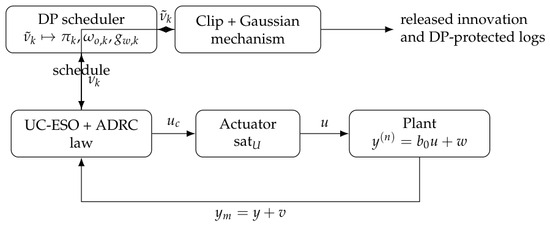
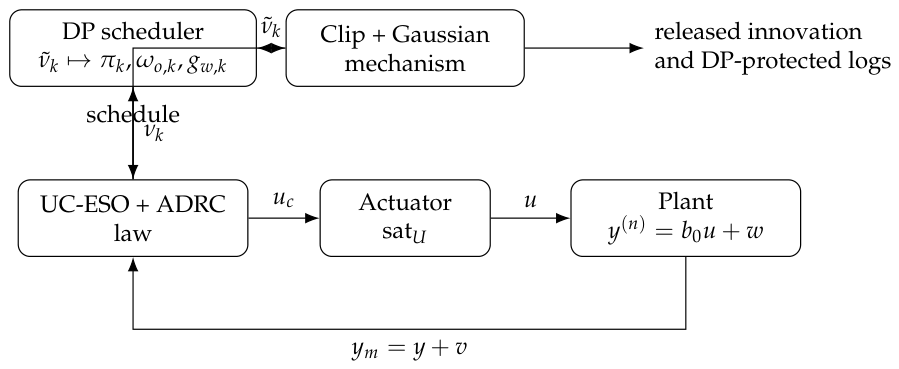
The closed loop aims to achieve accurate tracking while rejecting the total disturbance under bounded disturbances, measurement noise, and actuator saturation, while simultaneously enforcing -DP for the released innovation stream. Equivalently, the design targets small tracking error , bounded closed-loop signals for bounded w, , and v, and privacy protection for the externally shared tuning/monitoring channel. In DP-PADRC, (i)–(ii) are addressed by a time-varying-bandwidth ESO and disturbance-compensated feedback, while (iii) is enforced by a Gaussian mechanism acting on a clipped innovation sequence. The resulting privacy noise is not treated as an unmodeled perturbation: it is explicitly accounted for in an uncertainty surrogate, which then modulates the observer bandwidth and disturbance compensation strength so that the controller remains stable and avoids noise-induced chattering even when privacy is strict. Algorithm 1 gives a general pipeline of our proposal. Figure 1 summarizes the same architecture at the signal-flow level and makes the privacy interface explicit.
| Algorithm 1 DP-PADRC with DP innovation release and confidence-aware scheduling |
|
Figure 1.
Overview of the proposed DP-PADRC architecture. The local control loop uses the applied input u and measured output , while the adaptive scheduler is driven by the clipped and privatized innovation stream.
The remainder of Section 4 specifies the observer and uncertainty surrogate, the differentially private innovation mechanism, and the saturation-aware gain scheduling and control synthesis that together form the DP-PADRC algorithm.
4.2. Uncertainty-Calibrated ESO and Privacy-Aware Uncertainty Surrogate
To avoid ambiguity, we use uncertainty-calibrated ESO (UC-ESO) for the estimator developed here. The observer is not Bayesian and does not propagate a full posterior distribution. Instead, it combines a standard LESO mean estimate with a lightweight second-moment surrogate used only for scheduling. We keep the word "probabilistic" in the title to emphasize the explicit use of variance information in the tuning channel.
DP-PADRC maintains two coupled internal objects: (i) a mean estimate of the extended state defined in Equation (6), and (ii) a lightweight uncertainty surrogate that quantifies, online, how reliable the correction channel of the observer currently is. The role of this second object is central in privacy-sensitive deployments: because we intentionally inject privacy noise into shared residuals, the controller must be aware of the induced variability and should avoid interpreting it as evidence that larger bandwidth is always beneficial.
Mean estimator with time-varying bandwidth. We adopt the linear extended state observer (LESO) structure but allow its bandwidth to vary over time. Specifically, the mean estimator is
where follow Equation (8), is the nominal gain, and is the applied (post-saturation) input in Equation (14). Using (rather than ) is important: when saturation is active, the discrepancy would otherwise appear to the observer as an artificial disturbance, biasing and potentially leading to peaking. This implementation aligns the observer with the true plant channel and leaves saturation effects to be handled explicitly by scheduling and compensation weights. The gain vector is chosen via repeated-pole placement at , i.e., . This gives the closed form
We denote and . In DP-PADRC, is held piecewise constant on each sampling interval , which avoids high-frequency gain switching and leads to a well-posed switched-observer interpretation.
Although the observer (Equation (21)) runs in continuous time, in a digital controller it is natural to evaluate diagnostic signals at sampling times . We define the (local) innovation sample as
where is the observer state right before incorporating the new sample. For an LESO, is precisely the output estimation error (including measurement noise); hence, its magnitude and energy provide a direct, model-free indicator of the effective noise/mismatch entering the correction channel. This makes the innovation an appropriate signal to drive adaptive bandwidth selection; however, in privacy-sensitive settings, it must be sanitized before being shared or used in externally visible tuning logs.
Uncertainty surrogate. Let denote the privatized innovation produced by the DP mechanism in Section 4.3. DP-PADRC tracks an exponentially weighted moving average (EWMA) of the squared privatized innovations:
with initialization . The parameter sets the adaptation time constant: larger reacts faster to regime changes (e.g., sudden noise increases), while smaller yields smoother gain scheduling. The surrogate is deliberately scalar, which keeps the method lightweight and easy to tune even for high relative degree n.
Because includes a known privacy noise variance (determined by and clipping in Section 4.3), we also form an effective innovation-energy estimate that removes the expected privacy contribution:
This step is crucial for calibration: without it, stronger privacy (larger ) would be misinterpreted as a genuine increase in plant/noise uncertainty, causing unnecessary conservatism even when the physical measurement quality is unchanged. Finally, we map to a bounded confidence index via
where is a nominal innovation-energy level chosen by the designer. Intuitively, indicates that the innovation energy is consistent with nominal noise and a well-behaved observer correction channel, while indicates increased uncertainty (from measurement noise, abrupt disturbance changes, discretization effects, or residual DP artifacts).
Proposition 1
(Privacy-induced perturbation of the uncertainty surrogate). Let
Then obeys
with and
If , then
Moreover, because and is -Lipschitz on ,
where is the confidence index obtained from clipped innovations without DP noise. The same perturbation bound propagates to and up to the affine gains in Equations (40) and (41).
Proof.
Expanding Equation (24) with Equation (36) and subtracting gives Equation (28). Since and , moment bound Equation (29) follows from and . The scalar recursion (Equation (28)) is stable for , which yields Equation (30); Equation (31) then follows from the Lipschitz property of and the fact that the projection is non-expansive. □
Remark 1
(Scope of the scalar uncertainty surrogate). The scalar EWMA surrogate is appropriate for the SISO problem studied here, because the innovation is scalar. For higher-order or MIMO systems, a channel-wise or matrix-valued innovation-energy surrogate should replace Equation (24); the present manuscript now states this explicitly and does not claim that one scalar can represent all directional uncertainties in general.
4.3. Differentially Private Innovation Release
DP-PADRC enforces differential privacy for the shared innovation stream used for monitoring and auto-tuning. The motivation is that innovations (residuals) often carry richer information than the raw output in transient regimes: they reflect both plant dynamics and operating conditions, and they are routinely exported in industrial supervisory layers. In our proposal, the innovation sequence is sanitized before leaving the local controller and, importantly, before driving any externally visible scheduling/tuning logic. This ensures that both the released innovations and any signals derived from them (e.g., scheduled bandwidth trajectories) inherit a formal DP guarantee. Let the innovation sequence over a horizon T be
We adopt event-level adjacency: two sequences and are adjacent if they differ at exactly one time index (i.e., for all ). This captures the common operational scenario where one time-stamped event (a sample, a user action, or a single operating-point perturbation) is regarded as the atomic private contribution. Under this notion, the change is localized in time, which allows strong privacy without accumulating a horizon-dependent sensitivity factor.
4.3.1. Clipping to Bound Sensitivity
To make sensitivity finite and tunable, we clip the innovation before adding noise. For scalar innovations, we use the clipping operator introduced in Section 3:
with threshold . Define the deterministic vector-valued function
Under event-level adjacency, only one coordinate of can change, and the maximum change in that coordinate is bounded by . Hence the -sensitivity satisfies
For vector innovations (e.g., MIMO outputs or stacked residuals), DP-PADRC uses -clipping from Equation (2); the same bound holds under event-level adjacency.
4.3.2. Gaussian Mechanism for Innovation Release
The privatized innovation released at each time is
and the full released transcript is . Equivalently,
The noise scale is calibrated using the Gaussian-mechanism condition in Equation (20) with sensitivity bound Equation (35). This yields a direct privacy knob: smaller (stronger privacy) requires larger , which increases uncertainty in the released innovation and, through Section 4.2, leads to more conservative gain scheduling. Two basic statistical properties of Equation (36) are useful for subsequent tuning logic:
which motivates the variance correction (Equation (25)) used when forming the confidence index.
Proposition 2
(DP guarantee for the released innovation transcript). Let be the mechanism that maps to via Equation (37) with fixed clipping threshold C and Gaussian noise scale satisfying Equation (20) with . Under event-level adjacency, satisfies -differential privacy in the sense of Equation (18). Moreover, any signal computed from (including in Equation (24), in Equation (25), in Equation (26), and the scheduled parameters in Algorithm 1) inherits the same guarantee by post-processing.
Proof.
The map in Equation (34) has -sensitivity at most by Equation (35). Applying the standard Gaussian mechanism to therefore gives -DP when Equation (20) holds. All subsequent quantities are deterministic functions of the released transcript and are therefore protected by the post-processing property of differential privacy. □
Remark 2
(Correlation and repeated releases). The DP guarantee is stated on the whole transcript and therefore remains valid even when the physical innovation samples are temporally correlated; temporal correlation affects utility, not the correctness of the Gaussian-mechanism proof. If the mechanism is invoked over M disjoint tuning windows, basic composition gives -DP, while advanced composition or Rényi-DP accounting can provide less conservative lifetime budgets [29,30].
Practical note on choosing C and what is protected. Clipping controls sensitivity but also introduces bias when . In DP-PADRC, C is chosen so that clipping is rare under nominal operation (e.g., several standard deviations above expected innovation magnitude). The clipping bias is quantified by the nonnegative term , which implies that clipping can only decrease confidence and therefore only makes the scheduler more conservative. If clipping becomes frequent, the released signal remains private but can distort the uncertainty surrogate and lead to conservative scheduling; this effect is detectable because saturates at . Finally, the privacy guarantee here applies to the released innovation transcript and any downstream statistics derived from it; DP-PADRC does not claim privacy for other channels (e.g., raw or the applied input u) unless they are also explicitly privatized.
4.4. Saturation-Aware Scheduling and ISS-Type Robustness
For clarity, the scheduling law implemented in Algorithm 1 is written explicitly as
Table 2 summarizes the main tuning parameters and their qualitative effect.
Table 2.
Interpretation of the main DP-PADRC scheduling parameters.
Remark 3
(Gate recovery after deep saturation). If after a saturation event the unsaturated command satisfies , then the gate (Equation (39)) reaches any target level within:
provided . Thus larger speeds recovery near the origin but weakens saturation sensitivity, while smaller makes the gate more conservative after large peaks.
Theorem 1
(ISS-type mean-square bound). Consider DP-PADRC under Assumptions 1–4. Let , , and . Then there exist and positive constants (depending on , , , , κ, , and the nominal feedback polynomial) such that the quadratic Lyapunov candidate satisfies:
on each sampling interval , where is the confidence index obtained from clipped innovations without DP noise. Consequently,
for some class- function β and positive constants . Using Equation (20),
Proof.
For fixed scheduled gains, the nominal ADRC tracking/observer error dynamics are linear in with additive inputs , v, and the saturation mismatch , and are exponentially stable because the controller and observer polynomials are Hurwitz. The scheduling law only changes the gains within the compact set defined by Assumption 4 and is piecewise constant on each sampling interval. The term therefore enters as a bounded multiplicative perturbation of the frozen-gain dynamics. Applying Young’s inequality to the perturbation terms yields Equation (43). Bound Equation (44) follows Grönwall’s inequality together with Proposition 1. Equation (45) is obtained by substituting (20) into the privacy term. □
Remark 4
(Interpretation). The bound separates three effects. Faster scheduling (larger admissible observer bandwidth) improves disturbance-tracking transients but increases the sensitivity constants multiplying measurement noise; stricter privacy (smaller ε or smaller C) enlarges the last term through ; and saturation enters only through the exact mismatch . This is the sense in which the present paper characterizes the privacy–performance trade-off.
5. Experiments
We evaluate the proposed DP-PADRC controller in simulation under nonlinear dynamics, time-varying measurement noise, and actuator saturation. All results are computed over s with sampling period ms. Unless otherwise stated, the actuator bound is in Equation (14), the nominal gain is , and the extended order is (i.e., ). For randomized tests, metrics are averaged over 50 Monte Carlo runs with independent measurement-noise seeds. The present validation is simulation-based rather than hardware experimental; accordingly, Figure 1 should be read as the closed-loop evaluation setup used throughout this section. Scenarios S1 and S2 are Monte Carlo simulations, while Scenario S3 is an analytic privacy-sensitivity design sweep derived from Section 4.4.
5.1. Testbed, Controllers, and Metrics
All experiments are conducted in simulation on a nonlinear, time-varying, saturation-limited benchmark that intentionally stresses the three interacting factors targeted in this paper: (i) unknown and time-varying disturbances (including gain variation), (ii) measurement-noise regime changes, and (iii) input saturation. The simulation horizon is s with sampling period ms. The measured output is sampled at , and both the control input and the sampled measurement noise are applied using a zero-order hold over . Unless explicitly stated otherwise, the initial condition is , and the observer is initialized at . The common numerical settings are collected in Table 3, while the controller-specific tuning is summarized later in Table 4.
Table 3.
Common simulation settings shared by all scenarios and controllers.
Table 4.
Controller configurations and tuning used in all experimental scenarios.
- Benchmark plant and uncertainties.
We simulate a second-order nonlinear servo-like plant
where the time-varying input gain is
and the baseline exogenous disturbance is
The term models a smooth nonlinear effect (e.g., friction-like nonlinearity). This benchmark contains both matched uncertainty (via and gain variation) and nonlinear internal dynamics, making it suitable for evaluating ADRC-type disturbance estimation and compensation. The benchmark is intended as a digital servo surrogate rather than a detailed hardware replica: the linear part has a natural frequency of approximately rad/s, while the nonlinear term mimics smooth friction/current-limitation effects. The disturbance in Equation (48) uses low-frequency components and rad/s, well below the nominal bandwidth range in Table 4; this is meant to represent slowly varying load torque, friction drift, or supply variation rather than impacts. Fast impulsive loads are outside Assumption 1 and are discussed only qualitatively in Section 3.
From a realistic viewpoint, y may be interpreted as a normalized angular position and u as a normalized drive command after the inner power stage. The terms and represent an elastic/load stiffness and viscous damping, respectively; their values give a nominal natural frequency rad/s and damping ratio , which corresponds to an underdamped servo/load axis. The multiplicative gain variation in Equation (47) models slow changes in effective torque constant, supply level, or load coupling, while is a smooth bounded friction-like term. The saturation bound in Table 3 represents the finite drive range. Thus, Equation (46) should be read as a normalized reduced-order servo benchmark with matched nonlinear uncertainty, not as an abstract linear perturbation only. The same ADRC representation also covers a more detailed voltage-driven servo model with electrical dynamics, which is a higher-order engineering system than Equation (46). For example, consider
where is the shaft angle, i is motor current, is the voltage command, are positive physical constants, is nonlinear friction, and is an unknown load torque. Taking and , differentiating the mechanical equation once and substituting the electrical equation gives the input–output form
where contains damping, stiffness, friction derivative, back-emf, current-state, load-derivative, and parameter-mismatch terms. Therefore, DP-PADRC can be applied structurally by using relative degree and the extended state . This higher-order model is included to clarify applicability beyond the reduced benchmark; a full numerical or hardware campaign for Equation (49) would require separate parameter identification and is left for future work.
- Scenario definitions (references, noise, and load steps).
Scenario S1 and the privacy study (S3) use a smooth reference
and a time-varying measurement-noise standard deviation
with and held constant on . Scenario S2 uses an aggressive step reference
a constant noise level , and a load step added to the disturbance:
- Ground-truth total disturbance for evaluation.
To compute consistently with the total-disturbance definition (Equation (4)), we use the identity and define the ground-truth total disturbance (for ) as
where is the applied (post-saturation) input. This definition matches the observer target in Section 3 and ensures that estimation error is assessed against the same disturbance quantity that the controller compensates.
- Controllers and tuning rules.
We compare fixed-bandwidth LADRC, a standard nonlinear ADRC (NADRC) baseline, P-ADRC (adaptive scheduling without privacy), and the proposed DP-PADRC. For LADRC and P/DP-PADRC, the observer and controller gains are generated from the repeated-pole polynomials and (Section 3), with (applied input) used in the observer for all methods to avoid bias under saturation. For NADRC, we implement a commonly used nonlinear error function
in both the nonlinear ESO correction and nonlinear error feedback; its parameters are tuned on Scenario S1 and then kept fixed across scenarios. DP-PADRC uses the DP mechanism (Equation (36)) with , clipping threshold C, and calibrated by Equation (20). Table 4 summarizes all controller parameters.
For fairness, the baseline parameters were selected once on Scenario S1 and then frozen across scenarios so that the comparison probes robustness to changing operating conditions rather than scenario-specific re-tuning. This protocol can be conservative for NADRC in Scenario S2, and we now state that limitation explicitly. P-ADRC and DP-PADRC share identical non-private parameters; the only difference is the privacy layer. We do not include a DP-Kalman baseline because it requires an explicit stochastic state-space model, covariance tuning, and a different estimation objective than the model-light ADRC setting considered here. The non-private ablation P-ADRC therefore isolates the incremental effect of privacy within the same ADRC architecture.
Relative to fixed-gain LADRC, DP-PADRC adds one scalar clipping operation, one Gaussian sample, one EWMA update, and two affine scheduling updates per sampling instant. Hence the online complexity remains with memory, i.e., the same order as LADRC; for the SISO case , the additional cost is constant-time and therefore compatible with embedded implementation provided a pseudo-random generator is available.
- Evaluation metrics.
Tracking performance is assessed using the tracking error . We report the tracking RMSE
and the integral absolute error . Disturbance-estimation accuracy is measured by
where is computed from Equation (55). Control effort is summarized by the energy
and saturation frequency is reported as
For step responses in Scenario S2, we additionally report rise time (10–90%), overshoot (percentage above the final value), and 2% settling time , computed from the output trajectory .
- Visualization of scenario signals.
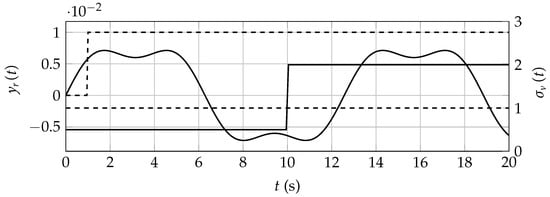
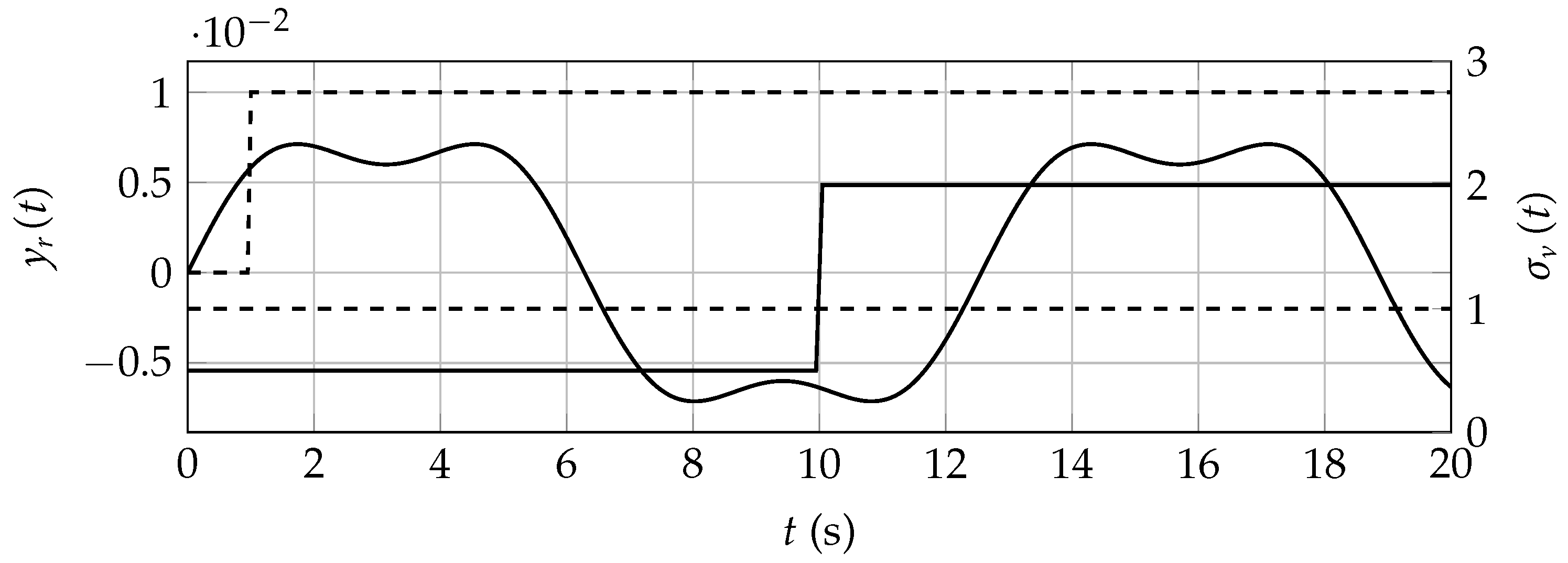
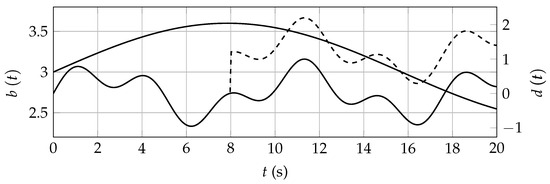
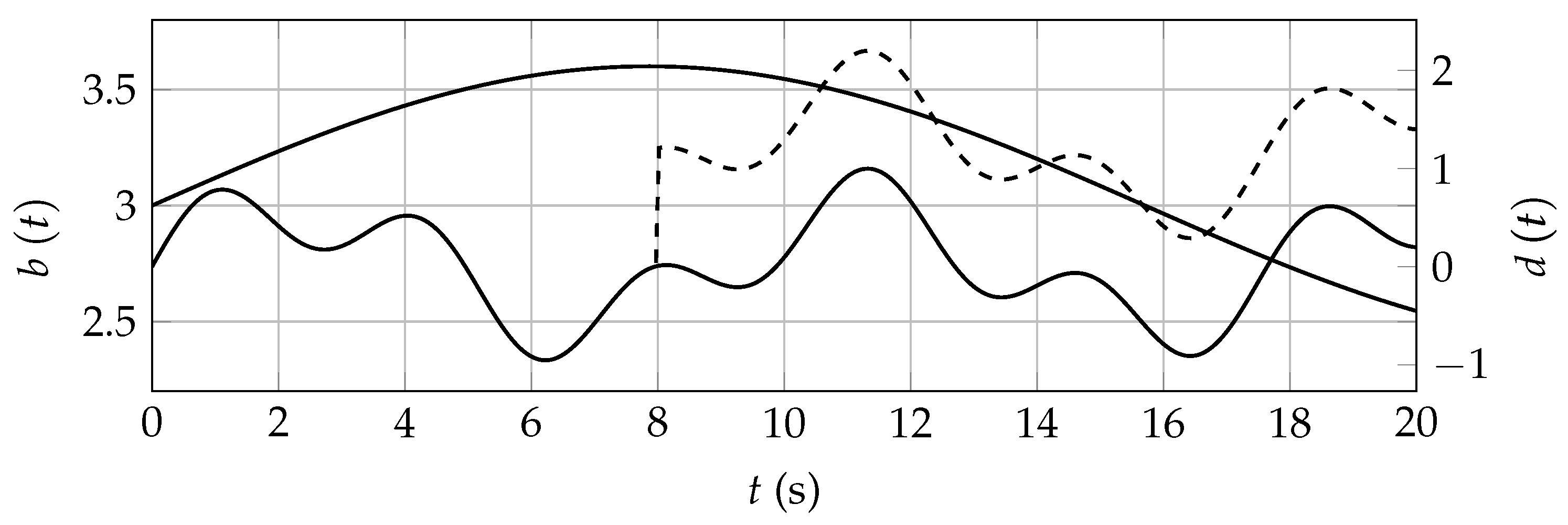
To provide context for later results, Figure 2 shows the references and noise schedules, and Figure 3 shows the time-varying gain and disturbances used in the benchmark. In both figures, different curves are distinguished by line style (solid versus dashed), and their meaning is specified in the captions (no legends are used).
Figure 2.
Scenario-defining reference and noise schedules. Solid curve on the left axis: sinusoidal reference in Equation (51) (Scenario S1 and S3). Dashed curve on the left axis: unit-step reference in Equation (53) (Scenario S2). Solid curve on the right axis: time-varying noise standard deviation in Equation (52) (Scenario S1/S3). Dashed curve on the right axis: constant noise standard deviation (Scenario S2).
Figure 3.
Plant-side uncertainty signals. Solid curve on the left axis: time-varying input gain in Equation (47) (all scenarios). Solid curve on the right axis: baseline disturbance in Equation (48) (Scenario S1 and S3). Dashed curve on the right axis: augmented disturbance with a load step at s in Equation (54) (Scenario S2).
5.2. Scenario S1: Tracking Under Time-Varying Measurement Noise
Scenario S1 evaluates the ability of each controller to maintain tracking performance when the measurement noise level changes abruptly during operation. The plant is Equation (46) with time-varying gain (Equation (47)) and baseline disturbance (Equation (48)). The reference is the smooth multi-sine in Equation (51). Measurement noise is Gaussian and piecewise stationary with standard deviation given by Equation (52), where the noise level increases by a factor of four at s. This scenario is specifically chosen to stress the bandwidth-selection dilemma: a high observer bandwidth improves disturbance estimation in the low-noise interval, but tends to amplify noise and produce oscillatory control in the high-noise interval.
For each method we run 50 Monte Carlo trials with independent noise seeds. DP-PADRC uses and clipping threshold in Equation (36), with calibrated by Equation (20). In addition to the tracking and estimation metrics defined in Section 5.1, we report a control-variation index (a proxy for chattering),
computed from the applied input .
Table 5 shows that fixed-bandwidth LADRC suffers from both higher tracking error and substantially higher control variation when measurement noise becomes large, consistent with the known sensitivity of high-gain observers to sensor noise. NADRC improves upon LADRC but remains sensitive to the noise change, as its nonlinear correction still injects high-frequency content into the disturbance-estimation loop when tuned aggressively. In contrast, P-ADRC and DP-PADRC adapt their observer and controller aggressiveness through confidence-aware scheduling; both achieve significantly lower tracking error and lower . The gap between P-ADRC and DP-PADRC reflects the fundamental privacy–performance coupling: stricter privacy requires larger injected noise, which reduces confidence and thus lowers scheduled bandwidth and compensation strength. Importantly, the variance correction (Equation (25)) prevents the scheduler from interpreting privacy noise as a physical noise increase, avoiding excessive conservatism.
Table 5.
Scenario S1 performance (mean ± std over 50 runs). DP-PADRC improves tracking and disturbance-estimation accuracy relative to fixed-gain LADRC and NADRC, and reduces the control-variation index (Equation (61)) in the high-noise regime. Relative to P-ADRC, DP-PADRC shows a modest performance degradation due to privacy-induced conservatism.
To make the scheduling behavior explicit, Table 6 reports interval averages before and after the noise switch. For scheduled methods, the averages are computed from the piecewise-constant values on each sampling interval. Here is the confidence index (Equation (26)) (for DP-PADRC it uses the corrected effective energy (Equation (25))), and is the disturbance-compensation weight. Since Scenario S1 uses a smooth reference and moderate actuator limit, saturation is rare and the scheduling is primarily driven by the noise-dependent confidence index rather than by saturation gating.
Table 6.
Scenario S1 scheduling statistics. is the average observer bandwidth in each interval. is the average disturbance-compensation weight. is the average confidence index; it is not defined for fixed-gain baselines. After s, the increased measurement noise reduces confidence and leads to smaller and , mitigating chattering.
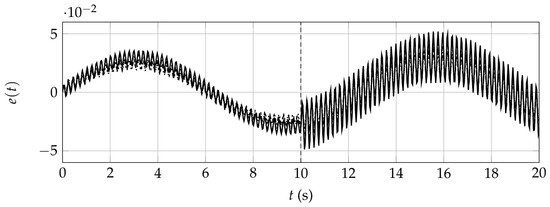
Figure 4 visualizes a representative trial. Before the noise increase, all methods track the reference well, with P-ADRC and DP-PADRC exhibiting the smallest error due to faster and cleaner disturbance estimation. After the switch at s, LADRC and NADRC show visibly larger high-frequency oscillations in , while P-ADRC and DP-PADRC remain smoother. The slight increase in DP-PADRC error relative to P-ADRC is consistent with Table 5 and arises from the privacy-induced reduction in observer bandwidth and compensation weight.
Figure 4.
Scenario S1 representative tracking error. Solid: LADRC. Dashed: NADRC. Dotted: P-ADRC (no DP). Dash-dotted: DP-PADRC. The thin vertical dashed line indicates the noise increase at s. DP-PADRC suppresses high-frequency oscillations after the switch by reducing scheduled aggressiveness.
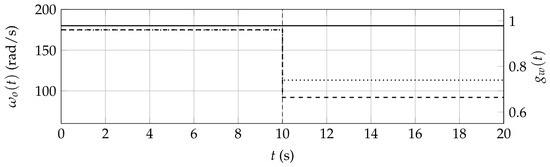
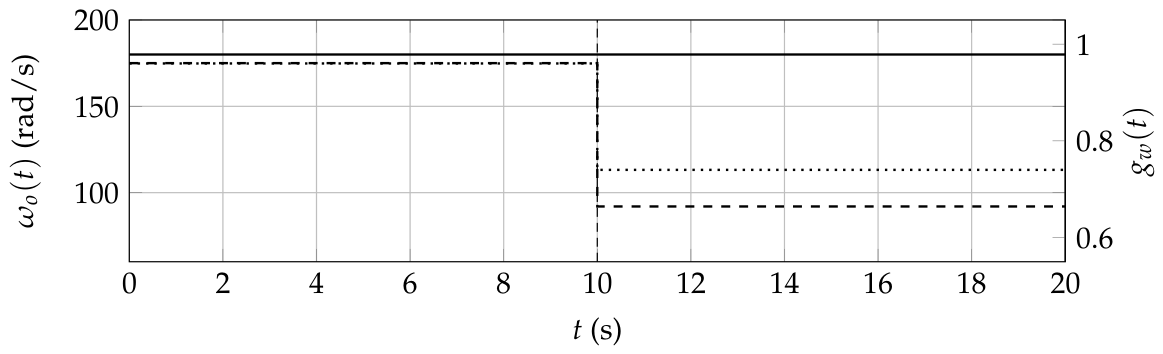
Finally, Figure 5 shows the scheduled gains in DP-PADRC. The observer bandwidth is high in the low-noise interval, enabling rapid disturbance estimation and tight tracking. After the noise switch, confidence decreases and DP-PADRC reduces and , which directly limits noise injection through the observer correction channel and prevents overly aggressive disturbance cancellation. In contrast, LADRC keeps fixed, which explains the increase in and the oscillatory error behavior after s.
Figure 5.
Scenario S1 scheduled gains. Solid (left axis): LADRC fixed observer bandwidth (no scheduling). Dashed (left axis): DP-PADRC scheduled , reduced after s when measurement noise increases. Dotted (right axis): DP-PADRC disturbance-compensation weight , also reduced after s. The vertical dashed line marks the noise switch time.
5.3. Scenario S2: Step Tracking Under Saturation and Load Disturbance
Scenario S2 focuses on constraint-dominated transients: a fast step command induces large initial control effort and frequent saturation, and an additional load step tests disturbance rejection when the closed loop is already near its actuator limits. This setting is representative of motion-control and servo applications where aggressive setpoint changes and sudden load variations occur, and where the observer–controller interaction can produce undesirable peaking if saturation is not handled explicitly.
- Scenario configuration.
The plant is Equation (46) with time-varying gain (Equation (47)). The reference is the unit step in Equation (53), and an additional load step is injected into the disturbance at s as in Equation (54). Measurement noise is Gaussian with constant standard deviation (Figure 2). The actuator is constrained by in Equation (14). We perform 50 Monte Carlo runs to capture variability under measurement noise, and report mean ± std.
- Metrics for step response and load-step rejection.
In addition to and , we compute standard step indices: rise time (10–90%), overshoot , and 2% settling time . To quantify load-step rejection, we define
and a recovery time as the smallest such that for all . We also report to expose how aggressively each controller attempts to act beyond the saturation limit.
Table 7 shows that the fixed-bandwidth designs (LADRC, NADRC) produce larger overshoot and longer settling times in the presence of saturation. This behavior is consistent with disturbance-compensation loops that are tuned aggressively: the observer attempts to cancel disturbances quickly, the controller commands large inputs, and saturation breaks the intended cancellation, resulting in peaking and a slower return to the target. In contrast, both scheduled methods reduce overshoot markedly. P-ADRC is slightly faster (smaller ) because it can maintain higher confidence without privacy noise, while DP-PADRC is slightly more conservative due to the privacy-calibrated uncertainty, which mildly increases rise time but further reduces overshoot and control energy.
Table 7.
Scenario S2 step-response indices (mean ± std over 50 runs). DP-PADRC achieves substantially smaller overshoot and shorter settling time than fixed-bandwidth LADRC and NADRC under actuator saturation, while also reducing saturation frequency and control energy.
Table 8 confirms that the scheduled designs handle the load step more gracefully. In particular, DP-PADRC reduces the peak tracking error induced by the load step and shortens the recovery time relative to fixed-gain LADRC/NADRC. The reduction in is important: it indicates that the saturation-aware gating and variance-weighted compensation avoid the large disturbance-estimate excursions that otherwise occur when the actuator saturates and the observer/controller attempt to “fight” the constraint. Moreover, DP-PADRC yields a smaller than the other methods, reflecting the intended behavior of the scheduler: when saturation is active, aggressiveness is decreased so that the unsaturated command does not grow excessively beyond U.
Table 8.
Scenario S2 load-step rejection and peaking indicators (mean ± std over 50 runs). and are defined in Equation (62). highlights observer peaking; shows how far the commanded input exceeds the actuator limit. DP-PADRC reduces peak error and recovery time relative to fixed-bandwidth baselines and limits command peaks via saturation-aware scheduling.
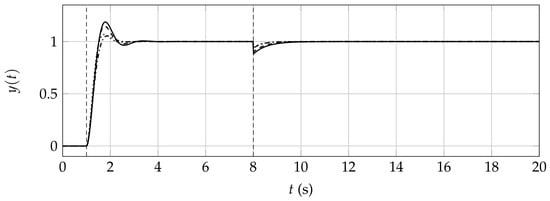
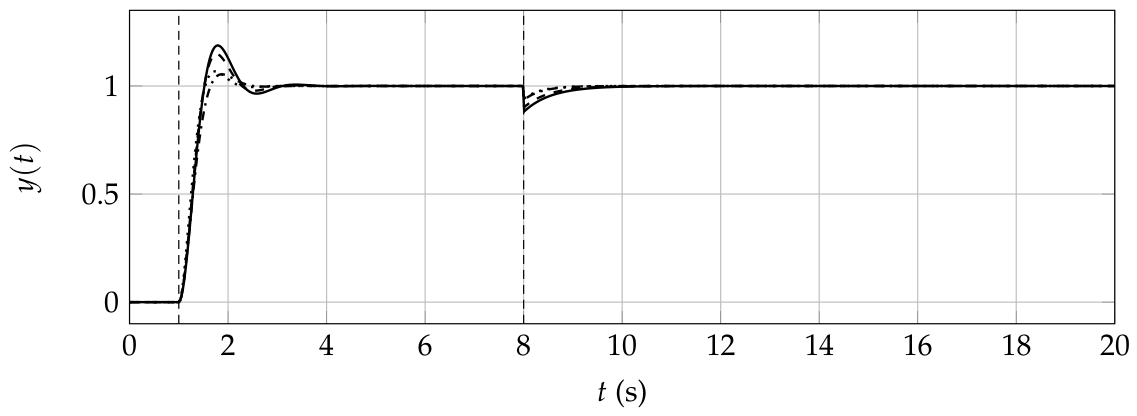
Figure 6 shows representative output trajectories. The fixed-gain baselines exhibit pronounced overshoot after the command step and a larger deviation at the disturbance step time. Scheduled methods achieve a visibly smoother transient and a faster recovery after s. The step time s and load-step time s are indicated by vertical dashed lines.
Figure 6.
Scenario S2 representative output trajectories. Solid: LADRC. Dashed: NADRC. Dotted: P-ADRC (no DP). Dash-dotted: DP-PADRC. Vertical dashed lines indicate the reference step at s and the load step at s. Scheduled methods reduce overshoot after the command step and recover faster from the load disturbance under saturation.
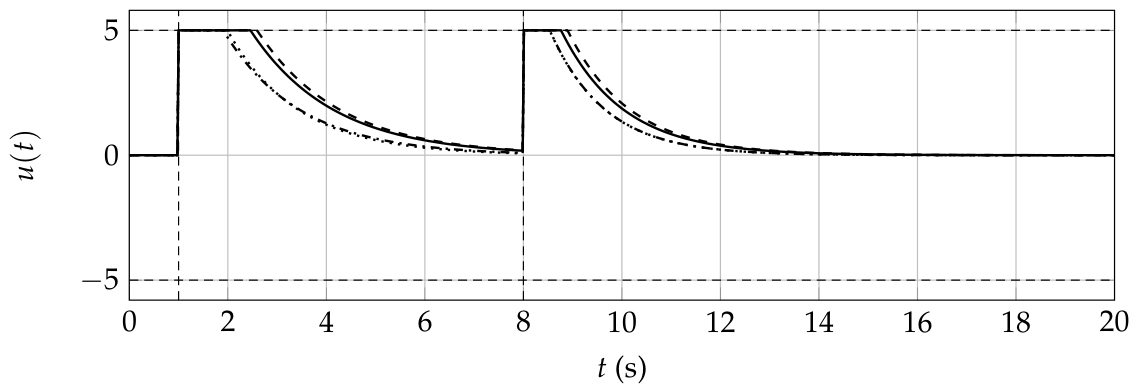
Figure 7 visualizes the applied inputs and highlights saturation behavior. The horizontal dashed lines denote the actuator limits with . LADRC and NADRC stay saturated longer and exhibit larger post-saturation oscillations, which is consistent with their larger in Table 7 and larger in Table 8. DP-PADRC produces shorter saturation plateaus and smoother decay, reflecting the saturation-aware gating and conservative compensation when confidence is reduced.
Figure 7.
Scenario S2 representative applied input trajectories. Solid: LADRC. Dashed: NADRC. Dotted: P-ADRC (no DP). Dash-dotted: DP-PADRC. Horizontal dashed lines indicate actuator limits with . Vertical dashed lines indicate the reference step at s and the load step at s. Scheduled methods (P/DP-PADRC) reduce saturation duration and post-saturation oscillations, consistent with lower Sat (%) and smaller .
5.4. Scenario S3: Analytic Privacy-Sensitivity Sweep
To make the privacy knob more explicit without claiming an exhaustive new Monte Carlo campaign, we report the analytic design sweep implied by Proposition 1 and Theorem 1. For the nominal parameters in Table 4, Table 9 lists the Gaussian noise scale and the resulting bound on the privacy-induced perturbation of the effective innovation-energy estimator. The table formalizes the expected trend also observed in Scenario S1: decreasing increases and therefore pushes the scheduler toward more conservative bandwidth selection. Conversely, for the perturbation bound becomes small relative to the nominal innovation scale, so DP-PADRC approaches the non-private P-ADRC behavior. We emphasize that Table 9 is a conservative analytic design chart rather than a substitute for a full experimental sweep.
The current study remains limited to simulation-based SISO benchmarks. Hardware validation and genuinely higher-order or MIMO case studies are important next steps and are now stated explicitly as future work rather than being implied by the present results.
6. Conclusions
This paper proposed DP-PADRC, a differentially private and uncertainty-calibrated active disturbance rejection control framework for nonlinear systems with actuator saturation. By releasing clipped innovations through a Gaussian -DP mechanism and explicitly incorporating the induced privacy variance into an EWMA-based confidence index, the proposed method schedules observer/controller bandwidths and disturbance compensation in a principled, privacy-aware manner. A saturation-aware gating strategy further mitigates transient peaking and estimation drift when input constraints are active. The revised manuscript now makes three points more explicit: (i) the estimator is uncertainty-calibrated rather than Bayesian, (ii) the closed loop admits an ISS-type mean-square bound whose privacy term depends explicitly on , , C, and the measurement-noise level, and (iii) clipping bias, repeated privacy composition, and gate recovery can all be quantified at the design level. The current validation remains limited to simulation-based SISO benchmarks; hardware validation and higher-order/MIMO extensions are important future directions. We also added the higher-order voltage-driven servo formulation in Equations (49) and (50) to clarify structural applicability, while avoiding unsupported new performance claims beyond the simulated cases reported in Table 5, Table 6, Table 7, Table 8 and Table 9 and Figure 4, Figure 5, Figure 6 and Figure 7.
Author Contributions
Conceptualization, J.D. and P.H.; Methodology, J.D. and P.H.; Software, J.D.; Formal analysis, J.D. and P.H.; Investigation, J.D. and P.H.; Writing—review & editing, P.H. All authors have read and agreed to the published version of the manuscript.
Funding
This research received no external funding.
Data Availability Statement
The original contributions presented in this study are included in the article. Further inquiries can be directed to the corresponding author.
Conflicts of Interest
The authors declare no conflicts of interest.
References
- Han, J. From PID to Active Disturbance Rejection Control. IEEE Trans. Ind. Electron. 2009, 56, 900–906. [Google Scholar] [CrossRef] [Scilit]
- Han, J. Active Disturbance Rejection Control and Its Applications. Control Decis. 1998, 13, 19–23. (In Chinese) [Google Scholar]
- Huang, Y.; Xue, W. Active Disturbance Rejection Control: Methodology and Theoretical Analysis. ISA Trans. 2014, 53, 963–976. [Google Scholar] [CrossRef] [Scilit]
- Gao, Z. Scaling and Bandwidth-Parameterization Based Controller Tuning. In Proceedings of the American Control Conference (ACC), Denver, CO, USA, 4–6 June 2003; Academia: San Francisco, CA, USA, 2003; Volume 6, pp. 4989–4996. [Google Scholar] [CrossRef] [Scilit]
- Zheng, Q.; Gao, Z. Active Disturbance Rejection Control: Between the Formulation in Time and the Understanding in Frequency. Control Theory Technol. 2016, 14, 250–259. [Google Scholar] [CrossRef] [Scilit]
- Herbst, G. A Simulative Study on Active Disturbance Rejection Control (ADRC) as a Control Tool for Practitioners. Electronics 2013, 2, 246–279. [Google Scholar] [CrossRef] [Scilit]
- Ahi, B.; Haeri, M. Linear Active Disturbance Rejection Control from the Practical Aspects. IEEE/ASME Trans. Mechatron. 2018, 23, 2909–2919. [Google Scholar] [CrossRef] [Scilit]
- Zaccarian, L.; Teel, A.R. Modern Anti-Windup Synthesis: Control Augmentation for Actuator Saturation; Princeton University Press: Princeton, NJ, USA, 2011. [Google Scholar]
- Tarbouriech, S.; Garcia, G.; Gomes da Silva, J.M., Jr.; Queinnec, I. Stability and Stabilization of Linear Systems with Saturating Actuators; Springer: Berlin/Heidelberg, Germany, 2011. [Google Scholar] [CrossRef] [Scilit]
- Dwork, C. Differential Privacy. In Automata, Languages and Programming (ICALP), Proceedings of the 33rd International Colloquium, ICALP 2006, Venice, Italy, 10–14 July 2006; Springer: Berlin/Heidelberg, Germany, 2006; pp. 1–12. [Google Scholar]
- Dwork, C.; Roth, A. The Algorithmic Foundations of Differential Privacy. In Foundations and Trends in Theoretical Computer Science; Now Publishers Inc.: Hanover, MA, USA, 2014; Volume 9, pp. 211–407. [Google Scholar]
- Le Ny, J.; Pappas, G.J. Differentially Private Filtering. IEEE Trans. Autom. Control 2014, 59, 341–354. [Google Scholar] [CrossRef] [Scilit]
- Le Ny, J.; Pappas, G.J. Differentially Private Kalman Filtering. In Proceedings of the 2012 50th Annual Allerton Conference on Communication, Control, and Computing (Allerton), Monticello, IL, USA, 1–5 October 2012; IEEE: New York, NY, USA, 2012; pp. 1618–1625. [Google Scholar] [CrossRef] [Scilit]
- Cortés, J.; Dullerud, G.E.; Han, S.; Le Ny, J.; Mitra, S.; Pappas, G.J. Differential Privacy in Control and Network Systems. In Proceedings of the 2016 IEEE 55th Conference on Decision and Control (CDC), Las Vegas, NV, USA, 12–14 December 2016; IEEE: New York, NY, USA, 2016; pp. 4252–4272. [Google Scholar] [CrossRef] [Scilit]
- Han, S.; Pappas, G.J. Privacy in Control and Dynamical Systems. Annu. Rev. Control. Robot. Auton. Syst. 2018, 1, 309–332. [Google Scholar] [CrossRef] [Scilit]
- Han, J. A Class of Extended State Observers for Uncertain Systems. Control Decis. 1995, 10, 85–88. (In Chinese) [Google Scholar]
- Gao, Z.; Huang, Y.; Han, J. An Alternative Paradigm for Control System Design. In Proceedings of the 40th IEEE Conference on Decision and Control (CDC), Orlando, FL, USA, 4–7 December 2001; IEEE: New York, NY, USA, 2001; Volume 5, pp. 4578–4585. [Google Scholar] [CrossRef] [Scilit]
- Gao, Z. Active Disturbance Rejection Control: A Paradigm Shift in Feedback Control System Design. In Proceedings of the American Control Conference (ACC), Minneapolis, MN, USA, 14–16 June 2006; IEEE: New York, NY, USA, 2006; pp. 2399–2405. [Google Scholar] [CrossRef] [Scilit]
- Gao, Z. On the Centrality of Disturbance Rejection in Automatic Control. ISA Trans. 2014, 53, 850–857. [Google Scholar] [CrossRef] [Scilit]
- Guo, B.Z.; Zhao, Z.L. On the Convergence of an Extended State Observer for Nonlinear Systems with Uncertainty. Syst. Control Lett. 2011, 60, 420–430. [Google Scholar] [CrossRef] [Scilit]
- Guo, B.Z.; Zhao, Z.L. On Convergence of the Nonlinear Active Disturbance Rejection Control for MIMO Systems. SIAM J. Control Optim. 2013, 51, 1727–1757. [Google Scholar] [CrossRef] [Scilit]
- Zheng, Q.; Gao, Z. Active Disturbance Rejection Control: Some Recent Experimental and Industrial Case Studies. Control Theory Technol. 2018, 16, 301–313. [Google Scholar] [CrossRef] [Scilit]
- Zheng, Q.; Gao, Z. On Practical Applications of Active Disturbance Rejection Control. In Proceedings of the 29th Chinese Control Conference (CCC), Beijing, China, 29–31 July 2010; IEEE: New York, NY, USA, 2010; pp. 6095–6100. [Google Scholar]
- Madoński, R.; Shao, S.; Zhang, H.; Gao, Z.; Yang, J.; Li, S. General Error-Based Active Disturbance Rejection Control for Swift Industrial Implementations. Control Eng. Pract. 2019, 84, 218–229. [Google Scholar] [CrossRef] [Scilit]
- Lv, J.; Wang, C.; Xie, L. Adaptive distributed observer design for nonlinear multiagent systems. Automatica 2026, 183, 112625. [Google Scholar] [CrossRef] [Scilit]
- Lv, J.; Wang, C.; Xie, L. Distributed output-feedback leader-following consensus of nonlinear multiagent systems. Automatica 2025, 177, 112281. [Google Scholar] [CrossRef] [Scilit]
- Yang, D.; Wang, M.; Chen, Z.; Gao, H. A causal learning framework integrating LASSO and information theory for source localization in power system forced oscillations. Adv. Eng. Inform. 2026, 72, 104441. [Google Scholar] [CrossRef] [Scilit]
- Dwork, C.; McSherry, F.; Nissim, K.; Smith, A. Calibrating Noise to Sensitivity in Private Data Analysis. In Theory of Cryptography, Proceedings of the Third Theory of Cryptography Conference, TCC 2006, New York, NY, USA, 4–7 March 2006; Springer: Berlin/Heidelberg, Germany, 2006; pp. 265–284. [Google Scholar] [CrossRef] [Scilit]
- Kairouz, P.; Oh, S.; Viswanath, P. The Composition Theorem for Differential Privacy. IEEE Trans. Inf. Theory 2017, 63, 4037–4049. [Google Scholar] [CrossRef] [Scilit]
- Mironov, I. Rényi Differential Privacy. In Proceedings of the 2017 IEEE 30th Computer Security Foundations Symposium (CSF), Santa Barbara, CA, USA, 21–25 August 2017; IEEE: New York, NY, USA, 2017; pp. 263–275. [Google Scholar]
- Balle, B.; Wang, Y.X. Improving the Gaussian Mechanism for Differential Privacy: Analytical Calibration and Optimal Denoising. In Proceedings of Machine Learning Research, Proceedings of the 35th International Conference on Machine Learning (ICML), Stockholm, Sweden, 10-15 July 2018; JMLR: Norfolk, MA, USA, 2018; Volume 80, pp. 403–412. [Google Scholar]
- Nozari, E.; Tallapragada, P.; Cortés, J. Differentially Private Average Consensus: Obstructions, Trade-offs, and Optimal Algorithm Design. Automatica 2017, 81, 221–231. [Google Scholar] [CrossRef] [Scilit]
- Huang, Z.; Wang, Y.; Mitra, S.; Dullerud, G.E. On the Cost of Differential Privacy in Distributed Control Systems. In Proceedings of the 3rd ACM International Conference on High Confidence Networked Systems (HiCoNS), Berlin, Germany, 15–17 April 2014; Association for Computing Machinery: New York, NY, USA, 2014; pp. 105–114. [Google Scholar] [CrossRef] [Scilit]
- Wang, Y.; Huang, Z.; Mitra, S.; Dullerud, G.E. Differential Privacy in Linear Distributed Control Systems: Entropy Minimizing Mechanisms and Performance Tradeoffs. IEEE Trans. Control Netw. Syst. 2017, 4, 118–130. [Google Scholar] [CrossRef] [Scilit]
- Han, S.; Topcu, U.; Pappas, G.J. Differentially Private Distributed Constrained Optimization. IEEE Trans. Autom. Control 2017, 62, 50–64. [Google Scholar] [CrossRef] [Scilit]
- Farokhi, F.; Sandberg, H. Ensuring Privacy with Constrained Additive Noise by Minimizing Fisher Information. Automatica 2019, 99, 275–288. [Google Scholar] [CrossRef] [Scilit]
- Hale, M.; Jones, A.; Leahy, K. Privacy in Feedback: The Differentially Private LQG. In Proceedings of the 2018 Annual American Control Conference (ACC), Milwaukee, WI, USA, 27–29 June 2018; IEEE: New York, NY, USA, 2018; pp. 3386–3391. [Google Scholar]
- Yazdani, K.; Jones, A.; Leahy, K.; Hale, M.T. Differentially Private LQ Control. IEEE Trans. Autom. Control 2023, 68, 1061–1068. [Google Scholar] [CrossRef] [Scilit]
- Lu, Q.; Wu, X.; She, J.; Guo, F.; Yu, L. Disturbance rejection for systems with uncertainties based on fixed-time equivalent-input-disturbance approach. IEEE/CAA J. Autom. Sin. 2024, 11, 2384–2395. [Google Scholar] [CrossRef] [Scilit]
- Zhang, J.; Zhao, X.; Zheng, G.; Zhu, F.; Dinh, T.N. On Distributed Prescribed-Time Unknown Input Observers. IEEE Trans. Autom. Control 2025, 70, 4743–4750. [Google Scholar] [CrossRef] [Scilit]
- Guerrero-Sánchez, M.E.; Hernández-González, O.; Valencia-Palomo, G.; López-Estrada, F.R.; Rodríguez-Mata, A.E.; Garrido, J. Filtered Observer-Based IDA-PBC Control for Trajectory Tracking of a Quadrotor. IEEE Access 2021, 9, 114821–114835. [Google Scholar] [CrossRef] [Scilit]
- Guerrero-Sánchez, M.E.; Montoya-Morales, J.R.; Valencia-Palomo, G.; Hernández-González, O. Robust IDA-PBC for non-separable PCH systems under time-varying external disturbances. Nonlinear Dyn. 2025, 113, 3499–3510. [Google Scholar] [CrossRef] [Scilit]
- Guerrero-Sánchez, M.E.; Valencia-Palomo, G.; Hernández-González, O. Interconnection and damping assignment-passivity-based control for boosting robust performance in under-actuated mechanical systems. Appl. Math. Model. 2026, 157, 116852. [Google Scholar] [CrossRef] [Scilit]
- Zhang, C.; Li, T.; Mohammadzadeh, A. A Predictive fuzzy structural control with an online adaptation mechanism for active rotary inertia driver system. Eng. Struct. 2025, 343, 121033. [Google Scholar] [CrossRef] [Scilit]

Disclaimer/Publisher’s Note: The statements, opinions and data contained in all publications are solely those of the individual author(s) and contributor(s) and not of MDPI and/or the editor(s). MDPI and/or the editor(s) disclaim responsibility for any injury to people or property resulting from any ideas, methods, instructions or products referred to in the content. |
© 2026 by the authors. Licensee MDPI, Basel, Switzerland. This article is an open access article distributed under the terms and conditions of the Creative Commons Attribution (CC BY) license.