


Abstract
Metastructures, waveguides composed of multiple unit cells (meta-atoms), have gained significant attention for controlling wave propagation in engineering applications, especially in the context of elastic and acoustic waves. However, existing metastructures often lack sufficient tunable functionality to dynamically control both elastic vibration and acoustic wave transmission using a single external parameter. This study introduces a phase-change material (PCM)-embedded meta-atom, where a core mass is connected to an outer shell by Archimedean spiral bridges. The solid–liquid phase transition of PCM induces a notable change in the effective shear modulus, enabling dynamic wave control. The mechanism for bandgap formation transitions from Bragg scattering in the solid PCM state to local resonance in the liquid state. Core rotation, driven by the phase transition, is key to generating flat bands and low-frequency locally resonant bandgaps at high temperatures. Temperature-dependent, mode-selective transmission behavior is observed, with transverse vibrations and acoustic waves exhibiting opposite blocking and transmission characteristics at the same frequency. This design provides a promising approach for decoupling sound and vibration management, using temperature control driven by the PCM phase transition. The work contributes to multifunctional metastructures with applications in adaptive noise control, structural health monitoring, and tunable vibration isolation systems.
Keywords:
metastructure; phase-change material; multifunctionality; tunability; sound and vibration; bandgap MSC:
74Hxx; 74H45
1. Introduction
Modern engineering systems are increasingly operated as multiphysics platforms in which vibration and acoustic phenomena interact. Typical examples include compressors and fan modules in household appliances, as well as pumps used in underwater infrastructures, which are driven at high rotational speeds to deliver large flow rates and improve efficiency. Such operating conditions often introduce dynamic instabilities, such as rotational imbalance and structural resonance [1]. In underwater environments, fluid-induced damping and hydrodynamic pressure coupling further lead to complex and nonlinear structural responses, including unpredictable resonances and multimodal energy transfer between the structure and the surrounding fluid [2]. These interactions cause local stress concentrations and cyclic fatigue, which degrade structural reliability and may eventually lead to failure [3,4]. To mitigate such complex vibration responses, conventional approaches have primarily relied on energy dissipation mechanisms, such as viscoelastic dampers, which have been widely adopted for structural and seismic vibration control applications [5]. In addition, vibrations generated during operation couple with the surrounding medium and radiate noise, which deteriorate the acoustic environment in both air and water, potentially affecting human health or marine ecosystems [6,7]. Therefore, mitigating vibration and noise arising from such multiphysics interactions requires moving beyond conventional single-performance-oriented design, e.g., stiffness or efficiency optimization, toward structures that can simultaneously control multiple physical responses within a single system, i.e., multifunctional systems.
Considerable efforts have been devoted to realizing multifunctionality in multiphysics systems. Yang et al. designed a metasurface with multiple bumps that compensates phase distortion and achieves cloaking under electromagnetic, acoustic, and water waves simultaneously [8]. Zhou et al. proposed an ultrathin metasurface composed of metallic resonators on a Polydimethylsiloxane (PDMS) substrate with cavities, enabling stealth performance in both microwave and underwater acoustic regimes [9]. Xu et al. developed a metamaterial-based absorber that combines a porous coating with an internal rotating core to induce multimodal interference, thereby achieving simultaneous absorption of airborne sound and structural vibration [10]. Farouk et al. proposed an acousto-elastic metamaterial that exploits local resonance to block low-frequency mechanical vibrations while simultaneously enabling energy harvesting through piezoelectric transduction [11]. Chen et al. developed a hybrid acousto-elastic metamaterial aimed at simultaneously controlling low-frequency sound in air and vibration in solids. By integrating membranes and silicone-rubber cladding to induce low-frequency local resonances, they achieved concurrent enhancement of sound and vibration transmission loss within a compact unit cell design [12]. Gu et al. proposed a lightweight metastructure that simultaneously achieves broadband low-frequency sound absorption and vibration isolation by combining spiral slits, micro-perforations, and resonant coupling in a sandwich configuration [13]. Shao et al. developed a gradient-symmetric multilayer metamaterial with concurrent broadband sound absorption and vibration suppression by integrating Helmholtz resonators for acoustic attenuation and equivalent spring–mass mechanisms for vibration control [14]. These studies demonstrated that distinct wave phenomena can be controlled within a single structure.
On the other hand, in all of these existing works, the constituent material properties and geometries remain fixed during operation, and thus the performance stays static rather than becoming tunable in response to external stimuli or environmental changes. In this work, tunability is defined as the ability of a structure to reversibly adjust its physical response according to external conditions. Multifunctionality is defined as the capability of a single structure to simultaneously control multiple distinct physical responses. Figure 1 schematically illustrates the concepts of multifunctionality and tunability used in this study. Here, multifunctionality refers to the simultaneous control of different physical responses, such as vibration and acoustic responses, while tunability refers to the ability to modify these responses through an external stimulus, such as temperature variation. For example, a single structure that maximizes vibration isolation at low (or room) temperature and enhances acoustic attenuation at high temperature can be considered as a realization of a tunable multifunctional device.
Figure 1.
Conceptual illustration of multifunctionality and tunability in a single structure. Here, multifunctionality involves the concurrent control of vibration and acoustic responses, while tunability enables the adjustment of these responses through temperature variation, such as enhancing vibration isolation at low temperatures and improving acoustic attenuation at high temperatures.
Realizing tunability requires an external control parameter that can alter material properties or reconfigure structural characteristics. Electrical, magnetic, optical and thermal excitations have been widely explored for this purpose. Oh et al. proposed an active elastic waveguide in which periodically embedded piezoelectric inclusions within a silicon matrix enable electrical control of the effective stiffness and mass density, thereby modulating elastic wave propagation paths [15]. Similarly, Elefante et al. developed an electrically tunable elastic metamaterial whose bandgaps can be opened, widened, or shifted in real time by adjusting the electrical impedance of an external shunting circuit [16]. Zhang et al. investigated electrically tunable bandgaps in functionally graded piezoelectric plates by periodically connecting external shunting circuits. They demonstrated that the locally resonant bandgaps of guided waves can be tuned by modifying the electrical boundary conditions or material gradation [17]. Zhou et al. investigated electrically tunable flexural wave propagation in phononic crystals composed of steel and electrorheological elastomer pillars on a thin plate. By applying an external electric field, they demonstrated controllable shifts in bandgap boundaries as well as the creation of tunable defect modes for elastic wave confinement and guiding [18]. Magnetically controlled systems have also been reported. For instance, Chen et al. designed a membrane-type metasurface with mass-attached unit cells, whose reflection angle and focusing behavior are tuned by varying the magnetically controlled height of the attached masses [19], and Xia et al. realized dynamic acoustic metasurface based on levitated magnetic cores with cavity heights continuously tuned by the magnetic field strength [20]. Li et al. investigated magnetically programmable phononic crystals composed of hard-magnetic soft materials. By applying an external magnetic field, they demonstrated tunable shifts in bandgap onset, cutoff frequencies, and bandwidth, showing that elastic wave propagation can be actively controlled through magnetic field-induced changes in material properties and anisotropy [21]. Pierce et al. demonstrated magnetically tunable elastic metastructures by exploiting the magneto-mechanical coupling of magneto-active elastomers, enabling active modulation of elastic bandgap frequencies without changing the structural topology [22]. Dudek et al. proposed an active magneto-mechanical metamaterial based on a lattice structure with embedded permanent magnets, whose wave transmission characteristics and phononic band structure can be remotely tuned by controlling the magnitude and direction of an external magnetic field [23]. In the optical regime, Fan et al. introduced a terahertz metamaterial whose resonance frequency is tuned by photoexciting carriers, and thereby modifying the electrical conductivity [24]. Zhao et al. demonstrated an optically tunable all-silicon metamaterial absorber, where photo-induced carriers enable dynamic modulation of resonance frequency and absorption bandwidth without altering the structural geometry [25]. Li et al. proposed an optically tunable terahertz metasurface in which photoexcitation of a semiconductor layer enables dynamic modulation of reflected wave amplitude [26]. The tunability is achieved by altering the resonance response of the metasurface through optically induced changes in material properties [26]. All these electrical, magnetic, and optical approaches provide broad tuning ranges and rapid response times. However, they generally require auxiliary control circuits, power supplies, and sensors, which increase system complexity, maintenance demands, and potentially compromise long-term stability.
In contrast, heat directly modifies intrinsic material properties of a target structure, such as its mass density, stiffness, and acoustic impedance, without requiring complex control circuits, providing an effective and energy-efficient tuning mechanism. As a result, thermal excitation has been increasingly used to achieve tunable control of wave propagation. Yang et al. reported that temperature-induced stiffness variations can reconfigure band structures and alter wave propagation paths [27]. Dai et al. developed a temperature-controlled underwater acoustic topological insulator based on a triangular lattice, where the large contrast in mass density and sound speed between the solid (ice) and liquid phases of water enables shifts in Dirac point frequencies and tunable bandgap locations [28]. These studies demonstrate that thermal tuning offers a straightforward and low-power approach for realizing tunable structures. Therefore, by utilizing temperature-dependent material properties, tunability can be achieved without external circuits or active power input, enabling simple and robust multifunctional systems.
Among thermally driven mechanisms, phase-change materials (PCMs) are of particular interest. During the solid–liquid transition, PCMs absorb or release latent heat and exhibit substantial variations in thermal properties, e.g., mass density, viscosity, and thermal conductivity [29]. Due to these significant thermophysical changes, PCMs have been widely employed in passive thermal control and energy systems, including building insulation [30], cooling of electronic devices [31], solar-thermal energy storage [32], and battery thermal management [33]. In these applications, the phase transition phenomenon of the PCMs is exploited to regulate heat flow or stabilize temperature through reversible changes in thermal properties. Although PCMs have traditionally been used in thermal engineering, their pronounced temperature-dependent properties also provide opportunities for wave control applications when integrated with acoustic or elastic metastructures.
From a wave control perspective, PCMs exhibit distinct behaviors in their solid and liquid states. As temperature increases, a PCM undergoes a solid-to-liquid transition. In the liquid state, not only is shear modulus lost and shear waves cannot propagate, but changes in mass density also modify the longitudinal (compression) and transverse wave velocities [34]. These temperature-dependent changes provide a key mechanism to adjust bandgap formation, resonance frequencies, and wave propagation paths in acoustic and elastic systems. Recent studies have demonstrated that PCM-enabled tunable phononic crystals and acoustic metamaterials can attenuate or transmit waves depending on temperature. Guo et al. used paraffin and water as PCMs and incorporated graphene-reinforced composites to investigate temperature-induced changes in dispersion characteristics [35]. In a one-dimensional (1D) panel configuration, they showed that acoustic bandgap widths can be widened or narrowed significantly as temperature varies, which is driven by changes in wave velocities and mass density through the phase transition. They further explored multiple-PCM configurations by exploiting the difference in phase transition temperatures between water and paraffin, and extended the concept to a two-dimensional (2D) system where a multiple PCM-embedded unit cell functions as a tunable waveguide [36]. Jin et al. utilized the water–ice phase transition to design temperature-reconfigurable acoustic filters, beam splitters, and lenses, showing that thermal excitation modifies the acoustic impedance contrast between the PCM and the surrounding structure, which in turn enables tunability [37]. Li et al. embedded PCM within a PDMS panel to realize temperature-controlled metasurfaces that maintain robust wave propagation performance over curved geometries [38]. Herein, ethylene carbonate was chosen to better match the acoustic impedance of the PDMS material [38]. While paraffin-based PCMs have also been actively studied in electromagnetic metamaterials [39,40], most existing studies primarily focus on modulating bandgap characteristics for a single physical response, such as elastic vibration or acoustic wave propagation. Consequently, the potential of PCM-enabled metastructures to achieve coordinated and functionally distinct control of multiple wave phenomena within a unified structural configuration has received comparatively limited attention.
Motivated by this research gap, this study proposes a PCM-embedded tunable multifunctional metastructure that simultaneously controls its vibration and acoustic performance in response to temperature. By exploiting the solid–liquid phase transition of the PCM, the proposed metastructure achieves both tunability and multifunctionality within a single structural configuration. The thermal tunability of the wave dispersion characteristics is examined through Bloch-mode analysis of the PCM-embedded meta-atom at two representative temperatures: (solid PCM) and (liquid PCM). In addition, time-harmonic finite element (FE) simulations are performed on metastructures constructed by arranging the meta-atom in 1D and 2D configurations to investigate the multifunctional vibration and acoustic wave propagation performances. All numerical analyses are performed using 2D FE models under normal-incidence assumptions, which are sufficient to capture the in-plane wave propagation phenomena of interest in this study. Finally, the influence of key geometric parameters of the proposed meta-atom on wave control characteristics, such as transmission loss, bandgap location, and bandgap width, is systematically investigated. Notably, the proposed design produces opposite transmission responses for transverse vibration and acoustic waves at the same frequency by switching the PCM state with temperature. This single-parameter thermal tuning provides a practical route to decouple sound and vibration management in a unified metastructure.
The remainder of the paper is organized as follows: Section 2 introduces the design and functionality of the PCM-embedded meta-atom, detailing its configuration and the temperature-dependent material properties of the PCM that enable tunable wave control. The governing equations for both low (20 °C) and high (80 °C) temperature states are presented, followed by the Bloch-mode FE formulation and transmission loss calculation methods. Section 3 presents a series of investigations into the temperature-triggered tunability of the meta-atom, analyzing the mechanism at the unit-cell and 1D waveguide levels. Based on these findings, a novel 2D tunable multifunctional metastructure is devised. Finally, Section 4 concludes the paper, summarizing the key findings and potential applications of the tunable metastructure.
2. PCM-Embedded Tunable Multifunctional Meta-Atom
In this section, the configuration of the meta-atom is discussed, including the core mass connected to an outer shell by Archimedean spiral bridges. Next, the temperature-dependent material properties of the PCM are explored, emphasizing their impact on dynamic wave control. The governing equations for both low (20 °C) and high (80 °C) temperatures are presented, followed by a Bloch-mode FE analysis to investigate the wave propagation behavior. The section also includes transmission loss calculations for both sound and vibration and concludes with the implementation details used for the analysis. This section provides the theoretical and computational foundation for understanding how the PCM phase transition enables tunable multifunctionality in the metastructure.
2.1. Configuration of the PCM-Embedded Meta-Atom
In this study, a unit cell consisting of a core mass embedded between two structural panels is proposed as the meta-atom, as illustrated in Figure 2a. The core is connected to the outer shell, consisting of the left and right panels, through slender bridges, which are designed using an Archimedean spiral configuration (Figure 2b). The spiral geometry allows for a significantly longer bridge length within the limited unit cell space, which can reduce the effective stiffness and increase the rotational motion of the core. The change in effective stiffness enhances the dynamics of wave propagation through the meta-atom.
Figure 2.
Geometry and parameterization of the PCM-embedded meta-atom with a spiral bridge connected to the outer shell: (a) Geometry of the meta-atom with the PCM. (b) Definition of the Archimedean spiral bridge parameters.
As a specific example, when the effective stiffness decreases, it can lead to a shift in bandgap formation and wave transmission toward lower-frequency regimes, particularly under temperature changes. The unique design of the spiral bridge meta-atom is especially effective in amplifying the difference in wave propagation behavior at low and high temperatures, particularly when the PCM undergoes a solid–liquid phase transition. By altering the bridge curvature, the spiral bridge design increases the sensitivity of the wave response of meta-atom against temperature changes, thereby improving its ability to control wave propagation as the PCM transitions between solid and liquid states.
In this context, a comprehensive parametric study was conducted to analyze the influence of various bridge configurations on wave propagation characteristics through the meta-atom in Appendix A. By comparing the dynamic responses of meta-atoms with different bridge configurations, it is observed that the spiral bridge configuration significantly enhances wave propagation dynamics. This analysis confirms that, as discussed earlier, the meta-atom with spiral bridge can more effectively enhance the wave propagation dynamics in response to the solid–liquid phase transition of PCM, particularly under temperature variations.
The overall geometric parameters of the meta-atom are selected so that the Bragg scattering-induced bandgaps fall within a physically relevant frequency range. In underwater environments, ambient noise spans a broad frequency spectrum, with significant contributions in the mid-frequency range from approximately 500 Hz to several tens of kilohertz, as reported by Hildebrand [41]. Accordingly, the operating frequency of the proposed metastructure is chosen in the kilohertz range. Considering that the Bragg bandgap frequency scales with the unit-cell size, the meta-atom dimension is set to so that the resulting bandgaps fall within this target frequency regime.
The geometric parameters defining the meta-atom are as follows: the size of the square meta-atom is , the core diameter is , the thickness of the structural outer shell is , and the thickness of the bridges is . The Archimedean spiral is characterized by an inner radius , outer radius , number of turns , and total rotation angle . These geometric parameters are selected based on deformation and connectivity requirements. The core size provides sufficient clearance for rotational motion, whereas the spiral-bridge dimensions are chosen to provide effective mechanical connectivity between the core and the outer shell and sufficient compliance to promote rotational resonance. The material properties of steel and acrylic used in the structural regions are listed in Table 1. The region highlighted in blue in Figure 2a corresponds to the PCM, and its temperature-dependent material properties are described in Section 2.2.
Table 1.
Mechanical properties of the constituent materials used in the meta-atom.
2.2. Temperature-Dependent Material Properties of the PCM
The temperature-dependent material properties of the PCM are modeled using experimentally fitted empirical relations for paraffin reported in the literature [35]. In this study, dissipative effects, such as material damping and viscous losses in the liquid PCM, are intentionally neglected. The primary objective is to investigate wave-blocking mechanisms governed by impedance mismatch and bandgap formation induced by the phase transition of the PCM. Since these mechanisms are governed primarily by stiffness and density contrasts rather than by energy dissipation, excluding dissipative effects enables a clearer interpretation of the underlying physical behavior.
In general, the longitudinal wave velocity in an isotropic elastic medium is governed by the elastic moduli and mass density and can be expressed as , where , , and denote the bulk modulus, shear modulus, and mass density, respectively. Based on experimentally fitted data, Equations (1)–(3) describe the temperature-dependent longitudinal wave velocity (), transverse wave velocity (), and mass density (), respectively.
Figure 3 shows the temperature-dependent longitudinal and transverse wave velocities, as well as the mass density, obtained from Equations (1)–(3). All material properties exhibit steep variations within the phase transition range of 42–48 . The temperature range of 42–48 corresponds to the phase transition interval of the paraffin PCM reported in Ref. [35], and this interval is directly reflected in the experimentally fitted material properties used in the present study. These abrupt changes give rise to different physical behaviors in the low temperature (solid) and high temperature (liquid) states. The phase transition is modeled by the presence or absence of shear stiffness, which is captured by the transverse (shear) wave velocity. A nonzero transverse wave velocity indicates a solid PCM with finite shear modulus, whereas a zero value indicates a fully liquid PCM with vanishing shear modulus. Due to these distinct phase-dependent behaviours, two representative temperatures are considered, i.e., 20 °C (solid) and 80 °C (liquid). To further examine the wave propagation behavior under spatially varying temperature fields, where solid and liquid phases coexist within a meta-atom, additional analyses are presented in Appendix B.
Figure 3.
Temperature-dependent longitudinal and transverse wave velocities and mass density of the PCM (paraffin), obtained from Equations (1)–(3). The sharp variations in the phase transition range of 42–48 °C are clearly observed. The values are obtained from experimentally fitted empirical relations reported in Ref. [35].
As mentioned earlier, the PCM behaves as a solid below approximately 42 °C. To numerically model elastic wave propagation in the solid PCM, the solid-state mass density , Young’s modulus , and Poisson’s ratio are required. The mass density is directly obtained from Equation (3). Under the plane strain assumption, the elastic material properties and , are computed using Equations (4) and (5), which are derived in Appendix C. These material properties characterize the elastic wave propagation behavior of the solid PCM in the low-temperature regime.
Above approximately 48 °C, the PCM transitions to a liquid state. In the liquid state, the shear modulus of the PCM vanishes, and the medium no longer supports transverse wave propagation. Therefore, modeling acoustic (longitudinal) wave propagation in the liquid PCM requires only the liquid-state mass density and the sound speed . The mass density is again obtained from Equation (3). Since the transverse wave velocity becomes zero in the liquid state, the sound speed coincides with the longitudinal wave velocity given by Equation (1). The resulting PCM properties at 20 °C (solid) and 80 °C (liquid) are summarized in Table 2. Note that dissipative effects, such as material damping and viscous losses in the liquid PCM, are not included in the present material model to focus on phase transition-driven wave control.
Table 2.
Material properties of the PCM at 20 °C (solid) and 80 °C (liquid), derived from experimentally fitted empirical relations reported in Rnoef. [35]. The sound speed of the solid PCM is calculated using Equations (1) and (2), where superscripts “solid, l” and “solid, t” indicate longitudinal and transverse wave velocities, respectively.
2.3. Governing Equations
This section describes the governing equations corresponding to the two temperature-dependent states of the PCM, i.e., the solid state at low (room) temperature (20 °C) and the liquid state at high temperature (80 °C). At low temperature, the PCM remains in the solid phase. Thus, the entire meta-atom, including the central core, spiral bridge, outer shell, and PCM region, can be modeled solely using the elastic wave equation. For the structural domain consisting of the rigid core, bridge, and outer shell, the Navier equation in Equation (6) is considered:
Here, is the Cauchy stress tensor obtained from the linear elastic constitutive law with Young’s modulus and Poisson’s ratio . is the angular frequency of the harmonic excitation, is the mass density of the structural material (i.e., steel or acrylic), as listed in Table 1, and is the displacement vector in Cartesian coordinates.
In addition, for the solid-state PCM domain, the same Navier equation should be solved, but with the material properties of solid PCM:
Here, is the Cauchy stress tensor of the solid PCM, and the corresponding material properties and are listed in Table 2.
Then, as shown in Section 2.2, once the temperature exceeds the phase transition threshold, the PCM loses its shear modulus and behaves as a liquid. In this state, the structural and acoustic dynamics should be solved in a coupled manner. In Figure 4, the grey and blue regions represent the structural domain and the liquid-state PCM, i.e., the acoustic domain, respectively. The structural domain is governed by the Navier equation, i.e., Equation (6), and the acoustic domain is modeled using the Helmholtz equation,
Figure 4.
Schematic of the coupled acoustic–structural model, illustrating the structural domain and the liquid-state PCM domain . The coupling interface and outward normal vector on the interface are indicated.
Here, and denote the acoustic pressure and the angular frequency, respectively. Since the PCM domain behaves acoustically like a pure fluid at high temperature, the following acoustic–structure coupling conditions must be imposed along the interface between the liquid-state PCM and the surrounding structural domain. The continuity of normal acceleration is imposed by
where denotes the outward unit normal vector. In addition, the traction acting on the structural boundary must balance the acoustic pressure, leading to the following condition
which ensures that the mechanical stress in the solid domain remains consistent with the acoustic loading in the liquid-state PCM. All governing equations and coupling conditions used for the FE analysis of the meta-atom are summarized in Table 3.
Table 3.
Summary of the governing equations and acoustic–structure coupling boundary conditions for the FE analysis of the PCM-embedded tunable multifunctional meta-atom.
2.4. Bloch-Mode FE Analysis
Bloch-mode analysis is employed to evaluate the dispersion characteristics of periodically arranged meta-atoms. In this study, the Bloch-mode analysis is conducted using the FE method with periodic boundary conditions (PBCs), which are applied to represent the periodic repetition of the meta-atom. The dispersion relation is obtained by solving the eigenvalue problem expressed in Equation (11),
where and denote the global stiffness and mass matrices, respectively, and is the global degree-of-freedom (DOF) vector containing the discretized structural displacement and acoustic pressure , i.e., with being the position vector.
The PBCs for modeling the periodic meta-atoms are imposed based on the Floquet–Bloch theorem, which defines the spatial phase relationship of the structural displacement and acoustic pressure fields across the meta-atom. This condition is given by
where is the lattice translation vector representing the spatial periodicity of the meta-atom (with ), and is the Bloch wave vector. The first Brillouin zone of the square lattice is shown in Figure 5a. Because the proposed meta-atom is not fully symmetric, the irreducible Brillouin zone formally coincides with the full first Brillouin zone.
Figure 5.
Bloch-mode FE model and Brillouin zone representation: (a) First Brillouin zone in the plane. For the dispersion analysis under normal incidence, the Bloch wave vector is restricted to the direction (). (b) FE model of the PCM-embedded meta-atom, showing the interior domain , the acoustic–structure interface (red curve), and the left and right boundaries and , where PBCs are applied. Also, and represent the unit tangential and outward normal vectors, respectively.
In this study, however, only normally incident waves are considered, and thus the Bloch wave vector is restricted to the direction with , corresponding to wave propagation along the -axis. This restriction allows us to focus on the fundamental wave propagation characteristics under normal incidence. The subsequent transmission loss analysis is conducted under the same incidence condition, ensuring consistency between the dispersion analysis and the finite-structure simulations. Therefore, the Bloch-mode analysis is performed only along the -direction, with varying from 0 to , i.e., along the path with . Let the reduced set of DOFs after applying the PBCs be denoted by of size m, whereas the original DOF vector has size n. The two are related by , where is the transformation matrix imposing the periodicity, expressed as
with the subscripts “” and “” denoting the internal domain and left boundary, respectively, as represented in Figure 5b. Here, denotes the identity matrix corresponding to the DOF subvector .
Substituting Equation (13) into Equation (11) and applying Galerkin projection yields the reduced FE system for dispersion analysis of the meta-atom,
where and denote the condensed stiffness and mass matrices, respectively, and the superscript “H” denotes the conjugate transpose operator. Finally, by sweeping along the path (from 0 to ) and solving the eigenvalue problem in Equation (14), the dispersion characteristics of the meta-atom can be obtained.
2.5. Transmission Loss Calculation
In this section, sound and vibration transmission loss are presented as quantities for evaluating the wave propagation characteristics of the proposed PCM-embedded meta-atom. Unlike sound, vibration is decomposed into longitudinal and transverse components for a more detailed analysis.
2.5.1. Sound Transmission Loss
Sound transmission loss (STL) is a widely used parameter for quantifying the ability of a structure to block incident acoustic energy. It represents the logarithmic ratio between the incident acoustic power and the transmitted power, and therefore serves as an effective indicator of the acoustic shielding performance of a structure. In this study, STL is adopted to evaluate and compare the acoustic attenuation performance of the proposed metastructure, which consists of a waveguide formed by periodically arranged meta-atoms.
To quantitatively assess the acoustic performance of the proposed metastructure, the theoretical STL of a homogeneous infinite plate under normal incidence, which is referred to as the mass law, is used as the baseline model. According to the classical mass law [42], the STL is expressed as
where is the frequency of the incident sound wave, m [] is the area mass density of the plate, and [] and [] denote the mass density and sound speed of the surrounding medium, respectively.
Since the mass law is derived under the assumption of a normally incident plane wave, the 1D time-harmonic waveguide simulations of the metastructure presented in Section 3.2 are likewise performed under normal incidence to ensure consistent comparison. Figure 6 illustrates the computational domain for STL evaluation, where the plane acoustic wave is incident on the left boundary of the inlet region and propagates through the periodically arranged meta-atoms. The transmitted wave then exits through the outlet region .
Figure 6.
Computational domain for STL evaluation under normal incidence. A plane acoustic wave is incident on the left boundary. Here, and denote the inlet (incident) and outlet (transmitted) regions, respectively.
The incident and transmitted acoustic powers are obtained by integrating the acoustic intensity over and , respectively. STL is then computed as
where [] and [] denote the total incident and transmitted acoustic powers, and [] is the acoustic intensity. The acoustic intensity is generally defined as
where is the complex acoustic pressure, is the particle velocity, and denotes the real-part operator. Under the assumption of a normally incident plane wave in a homogeneous medium, the intensity magnitude simplifies to
which is equivalent to the real part of under plane wave conditions. This simplified form is used throughout the present study to compute the acoustic powers in and .
2.5.2. Vibration Transmission Loss
In addition to the STL, the vibration attenuation performance of the metastructure is quantified using the vibration transmission loss (VTL). VTL is defined as the logarithmic ratio between the incident and transmitted vibration amplitudes within the elastic domain,
where and represent the spatially integrated mean-squared displacement amplitudes in the inlet (incident) and outlet (transmitted) structural regions, respectively. To distinguish between different vibration modes, two types of VTL are defined as follows:
- (a)
- Longitudinal VTL ()
The longitudinal transmission loss corresponds to the attenuation of the motion induced by normal (compressional) excitation. Only the -component of the displacement field is considered,
- (b)
- Transverse VTL ()
The transverse transmission loss corresponds to the attenuation of shear-induced vibration. Only the -component of the displacement field is considered,
By evaluating the transmission loss under longitudinal and transverse excitation independently, the vibration attenuation performance of the metastructure can be characterized with respect to different wave polarizations.
2.6. Implementation Details
All numerical simulations in this study are performed using COMSOL Multiphysics 6.2. The structural domain is modeled using the Solid Mechanics module, and the acoustic domain is modeled using the Pressure Acoustics module. The two domains are coupled along the interface by imposing the acoustic–structure coupling conditions for normal acceleration and acoustic pressure described in Equations (9) and (10). For the structural domain, the DOFs consist of the displacement components and . Because the strain field is obtained from the spatial derivatives of these displacement components, second-order Lagrange elements are employed to ensure an accurate representation of the deformation. In contrast, the acoustic domain contains only the scalar pressure field as its DOF, and thus, first-order Lagrange elements are used to maintain computational efficiency while retaining sufficient accuracy for the pressure field. All simulations employed triangular finite elements. The mesh size is chosen such that the maximum element size does not exceed one-sixth of the shortest wavelength in the frequency range of interest, thereby satisfying standard resolution requirements for coupled acoustic–structural FE analysis. The Bloch-mode analysis is performed using an eigenfrequency study with the ARPACK solver, and the time-harmonic transmission loss analysis is conducted in the Frequency-Domain interface using the MUMPS solver. All simulations are performed under a lossless assumption, without material damping or viscous losses.
3. Mechanistic Investigations of the PCM-Embedded Meta-Atom and Metastructure
In this section, the PCM-embedded meta-atom and metastructure are comprehensively investigated across multiple structural scales, starting from the unit-cell level and progressively extending to 1D and 2D waveguide configurations, in order to elucidate the underlying physical mechanisms, verify the thermally tunable behavior, and demonstrate multifunctional controllability over both acoustic and vibration responses. Section 3.1 presents a detailed investigation of the meta-atom at the unit-cell level based on its band structure (dispersion curve). By examining the dispersion characteristics and the corresponding Bloch eigenstates, the temperature-dependent behaviors induced by the solid–liquid transition of the PCM are characterized, clarifying the operating mechanisms of the meta-atom. Section 3.2 extends the unit-cell level analysis to a 1D waveguide composed of periodically arranged meta-atoms. Time-harmonic analysis is performed to verify whether the temperature-induced changes in wave propagation behavior observed at the unit-cell level persist when the meta-atoms are assembled into a waveguide configuration. Finally, Section 3.3 introduces a novel 2D tunable multifunctional metastructure based on the proposed PCM-embedded meta-atoms. Numerical simulations of the 2D metastructure demonstrate its ability to achieve temperature-dependent simultaneous control of both acoustic waves and elastic vibrations, thereby validating the thermally tunable multifunctionality of the proposed metastructure.
3.1. Unit-Cell Dispersion and Mode Characterization of the Meta-Atom
The presence of the core within the meta-atom gives rise to two primary types of structural vibration modes, i.e., translational and rotational modes. To analyze the translation-dominated behavior in detail, the band structure is first examined, and a translational polarization factor is defined, which allows the longitudinal and transverse characteristics to be quantified independently. The factor is defined as
where and denote the displacement components parallel and perpendicular to the incident direction, respectively, and represents the structural domain excluding the PCM region, i.e., the core and the spiral bridge only, as depicted in Figure 4. The translational polarization factor measures the proportion of longitudinal motion within the total displacement field. Values of approaching 1 indicate strongly longitudinal (compressional) behavior, whereas values approaching 0 indicate predominantly transverse (shear-like) behavior.
In addition to the translational modes, rotational modes also arise due to the compliant connection of the spiral bridge between the core and the outer shell, as well as the asymmetric geometry of the meta-atom. To identify the bands in which rotation-dominated behavior appears, a rotational polarization factor is introduced and defined as
where denotes the boundary of the core on which rotational motion is evaluated, is the displacement vector, and and are the outward unit normal and tangent vectors on , respectively, as illustrated in Figure 5b. The rotational polarization factor takes values between 0.5 and 1. The lower bound of 0.5 arises because even in the case of purely translational motion of the core, displacement components parallel to the core boundary contribute to tangential motion over portions of the boundary. In this study, a mode is classified as rotation-dominated when , which indicates that tangential motion significantly exceeds the normal component along the core boundary. By tracking how and vary with frequency and temperature, the translation-dominated and rotation-dominated bands can be clearly identified, which enables a systematic analysis of the temperature-dependent modal behavior.
3.1.1. Translation-Dominated Modes and Associated Bandgap Characteristics
Numerical investigations are performed for two PCM states, i.e., the solid state at and the liquid state at 80 °C. Figure 7a shows the dispersion relation of the meta-atom in solid-state PCM. The orange curves indicate branches with a translational polarization factor , which are dominated by longitudinal motion, whereas the green curves correspond to and are dominated by transverse motion.
Figure 7.
Band structures and Bloch eigenstates of the PCM-embedded meta-atom: (a) Band structure at , with four representative modes . (b) Band structure at , with four representative modes . (c–f) Eigenstates of the structural displacement field corresponding to and , respectively. (g–j) Eigenstates of the structural displacement and acoustic pressure fields corresponding to and , respectively. Here, top and bottom panels show the structural displacement and the acoustic pressure fields, respectively.
At room temperature (20 °C), the dispersion curve exhibits a bandgap in a relatively high-frequency range. This bandgap originates from Bragg scattering, which occurs when the wavelength of the propagating waves becomes comparable to the characteristic length scale of the meta-atom and leads to constructive and destructive interference. Because longitudinal and transverse waves have different phase velocities, their Bragg-type bandgaps appear at distinct frequencies. Although the meta-atom contains a steel core supported by a slender spiral bridge, it is largely filled with solid-state PCM, whose effective stiffness remains high compared with that in the liquid state. As a result, the meta-atom vibrates in a bulk-like manner, and Bragg scattering remains the dominant mechanism responsible for bandgap formation.
To examine this behavior in more detail, the Bloch eigenstates are evaluated at representative points along the path of the Brillouin zone (Figure 7c–f). For , the outer shell undergoes predominantly transverse motion, while the core exhibits a weak rotational component. The eigenstates and occur at nearly identical frequencies. Mode is characterized by compressional motion in the longitudinal direction, whereas shows a bending-like deformation that resembles a first-order flexural mode. For , the core and outer shell oscillate out of phase along the longitudinal direction. Notably, unlike , the outer shell in vibrates opposite to the direction of wave propagation, which is consistent with a negative group velocity even though the mode is longitudinally dominant.
Figure 7b shows the band structure when the PCM is in the liquid state. Compared with the solid-state case, most branches shift toward lower frequencies, and the spectrum exhibits multiple narrow bandgaps as well as several flat bands. This behavior is characteristic of locally resonant dynamics, which becomes dominant once the PCM loses its shear modulus and no longer contributes to the effective shear stiffness of the meta-atom.
To investigate the emergence of these locally resonant features, the eigenstates are examined at the symmetry points of the Brillouin zone (Figure 7g–j). Unlike the solid-state case, the liquid-state configuration requires a coupled acoustic–structure interaction modeling. Therefore, both the structural displacement field and the acoustic pressure field are considered, since the liquid PCM interacts intrinsically with the surrounding structural components, i.e., core, bridge, and outer shell.
For , the outer shell vibrates mainly in the transverse direction while the core undergoes rotational motion. The corresponding pressure field is strongly concentrated near the rotating core, and the two acoustic subdomains separated by the spiral bridge oscillate out of phase. For , the vibration is localized primarily in the spiral bridge, whereas the core and outer shell exhibit small amplitudes. Consistently, the pressure field shows an out-of-phase distribution across the two subdomains.
Notably, for , the core undergoes more pronounced rotation than in , which induces alternating compression and expansion of the outer shell through the spiral bridge. In contrast, also features core rotation, similar to and , but it is governed by a fundamentally different mechanism. Specifically, the rotational motion is strongly localized in the core, while the outer shell remains nearly motionless. In summary, in the liquid state, the spiral bridge becomes much more compliant, which enables large-amplitude core rotation. Consequently, torsion-induced local resonance, which is absent in the solid-state configuration, becomes a key mechanism that governs the dispersion characteristics and gives rise to multiple flat bands and the associated narrow bandgaps.
Overall, the solid-state configuration exhibits bulk-type dynamics dominated by Bragg scattering, whereas the liquid-state configuration is governed by torsion-induced local resonances associated with core rotation. These observations motivate a more detailed investigation of the rotation-dominated modes to fully understand the thermally tunable dynamic behavior of the proposed meta-atom.
3.1.2. Rotation-Dominated Modes and Locally Resonant Bandgaps
As discussed in Section 3.1.1, several flat bands emerge in the low-frequency regime when the PCM is in the liquid state. This multiple flat band behavior can be interpreted using an equivalent rotational resonator model that consists of the spiral bridge and the core. The spiral bridge can be approximated as an equivalent rotational spring whose torsional stiffness scales as , where , , and denote the Young’s modulus, thickness, and effective length of the spring, respectively. When the PCM liquefies, its shear modulus decreases sharply, which reduces the tangential stiffness around the core. Consequently, decreases, and the rotational resonance frequency, which depends on the core polar moment of inertia , shifts toward lower frequencies.
To verify that the low-frequency flat bands indeed originate from core rotation, the rotational polarization factor defined in Equation (23) is applied to the dispersion curves in Figure 7a,b. The resulting distributions are shown as a color map in Figure 8a,b. Figure 8c–g further present the structural displacement fields for representative modes in which rotational motion is dominant.
Figure 8.
Band structures and rotational modes (eigenstates) of the PCM-embedded meta-atom: (a) Band structure at , colored by the rotational polarization factor, with a representative rotational mode . (b) Band structure at , colored by the rotational polarization factor, with the representative modes . (c–g) Eigenstates of the structural displacement field corresponding to , and , respectively.
The modes in the solid state are first examined. Mode exhibits a rotational motion of the core. Here, a primary rotational mode is defined as a mode in which the rotation is predominantly governed by the motion of the core itself, rather than being induced by deformation of the surrounding structural components. Based on this definition, mode is classified as a primary rotational mode. However, since the PCM is in the solid state, the core remains strongly coupled to the surrounding structural components, i.e., the PCM and the spiral bridge. As a result, the motion of the core is transmitted to the outer shell, and strong localization is not achieved, leading to accompanying vibration of the outer shell.
More interesting behavior appears when the PCM is in the liquid state. In particular, the liquid-state modes and in Figure 7 correspond to the rotational modes and in Figure 8, respectively. Mode represents a rotational mode that does not lie on a flat band. In this mode, the core rotates due to the alternating compression and expansion of the outer shell transmitted through the spiral bridge. Since the rotation is driven primarily by the surrounding structural components rather than by the core itself, this mode is referred to as a secondary rotational mode. This secondary rotation does not produce strong localization, and therefore transverse waves are not effectively blocked but can still propagate through the meta-atom. This behavior will be revisited in the 1D waveguide analysis of a metastructure consisting of a finite array of meta-atoms in Section 3.2.
Mode lies on a flat band. In this mode, the outer shell remains nearly motionless, whereas the core undergoes a predominantly self-contained rotational motion. This mode is referred to as a primary rotational mode, and the solid-state mode falls into the same category. These results indicate that primary rotational modes exist in both temperature states and that their resonant frequencies can be tuned through the solid–liquid transition of the PCM. The corresponding wave propagation behavior in a 1D finite metastructure, evaluated at the resonant frequencies of (solid state) and (liquid state), is provided in Appendix D, where the localization effect is clearly demonstrated.
Finally, mode shows that the spiral bridge vibrates more strongly than the core, which indicates that energy localization can also be induced by bridge deformation rather than by core rotation alone. Mode , which corresponds to in Figure 7, exhibits a highly localized rotational motion of the core while the outer shell remains nearly motionless, representing an extreme case of torsion-induced localization in the liquid state of the PCM. As will be discussed in Section 3.2.2, this strongly localized mode can interact with nearby propagating modes in a finite metastructure and produces a pronounced dip in the transmission loss spectrum through a Fano-like resonant tunnelling mechanism [43].
3.2. Mechanistic Linkage Between the Dispersion Characteristics and Transmission of a Finite 1D Waveguide
In this section, the 1D waveguide-level analysis of the metastructure is presented. First, the effect of the number of meta-atoms on the transmission characteristics is investigated. Additionally, a detailed analysis of the dispersion characteristics of the meta-atom is provided, based on the band structure and Bloch eigenstates, and how these properties influence the transmission behavior of the 1D waveguide composed of the meta-atoms.
3.2.1. Impact of the Meta-Atom Count on the Transmission Characteristics of a Finite Waveguide
In Section 3.1, the meta-atom modes were classified as translation- or rotation-dominated, and the dominant bandgap mechanism was shown to shift from Bragg scattering at to local resonance at . The rotation-mode investigation further confirmed that the resonance frequencies of a given rotational mode can be tuned by changing the PCM state.
Here, to examine whether these observations remain valid when the analysis is extended from the unit-cell level to a 1D waveguide metastructure, time-harmonic simulations are performed for waveguides composed of multiple meta-atoms arranged along the incident wave propagation direction. Bragg scattering arises from constructive and destructive interference and therefore depends strongly on the number of periodic cells, whereas local resonance shows only weak dependence on the number of cells [44]. Accordingly, a parametric study is conducted by varying the number of repeated meta-atoms in the 1D waveguide to assess how the number of meta-atoms affects wave propagation, including the location and width of the bandgaps. The overall configuration is shown in Figure 9a.
Figure 9.
Effect of the number of meta-atoms in a finite 1D metastructure: (a) Schematic of the finite waveguide model with periodically arranged meta-atoms and PMLs at both ends. (b) Frequency response of VTLL under longitudinal excitation along the x-direction. (c) Frequency response of VTLT under transverse excitation along the y-direction. (d) Frequency response of STL under normally incident plane-wave excitation along the x-direction. Here, the top and bottom panels show the responses at (solid state of the PCM) and (liquid state of the PCM), respectively, and different line styles correspond to different numbers of meta-atoms.
To analyze the vibration response, steel blocks (shown in red) are placed at the inlet and outlet of the elastic domain, and perfectly matched layers (PMLs) are applied at both ends to suppress reflections. The two arrows in the left elastic domain indicate the prescribed input displacement, where the orange and green arrows correspond to longitudinal and transverse excitations, respectively. For the acoustic analysis, the same geometric configuration is used, but the side domains are filled with water instead of steel, and PMLs are again applied at both ends. The material properties of water are set to a mass density of and a sound speed of . Acoustic excitation is imposed by prescribing on the boundary indicated by the orange arrow.
Figure 9b–d show the frequency responses of , , and STL, computed using Equations (20), (21), and (16), respectively. As the number of meta-atoms increases, the overall transmission loss level generally increases in all cases, which is expected because the finite array provides a longer attenuation path and resembles a sandwich panel-like configuration. More importantly, the sensitivity to the number of meta-atoms differs between the two temperature states. In the solid state (), the bandgaps are Bragg scattering-driven, and thus the transmission loss level within the blocking regions increases noticeably as more meta-atoms are added. In contrast, in the liquid state (), the dominant bandgaps are mainly governed by local resonance, and the transmission loss level shows a much weaker dependence on the array length. This behavior is consistent with the general distinction that Bragg-type attenuation strengthens with the number of periodic cells, whereas locally resonant attenuation is less dependent on the number of cells.
To quantitatively determine an appropriate number of meta-atoms, the bandgaps obtained from the unit-cell dispersion analysis are used as the reference for the infinite periodic limit. For the finite metastructures, the lower and upper bandgap bounds are extracted from the transmission loss curves (Figure 9) as the onset and termination frequencies of the high-attenuation regions, as illustrated in Figure 10. The bandgap center frequency is defined as , where N denotes the number of meta-atoms. The relative error is then evaluated as
Figure 10.
Identification of bandgap boundaries from the transmission loss curves. The left panel shows representative transmission loss curves for finite metastructures, from which the lower and upper bound frequencies () are identified as the onset and termination of the high-attenuation region, respectively. The right panel shows the corresponding dispersion relation used as the reference in the infinite periodic limit. These bounds are used to determine the bandgap center frequency. The shaded green region represents the transverse-wave bandgap obtained from the dispersion analysis, demonstrating consistency between the transmission loss results (left panel) and the dispersion relation (right panel).
Here, denotes the bandgap center frequency in the infinite periodic limit obtained from the unit-cell dispersion analysis. The error falls below 1% for . Therefore, five meta-atoms are adopted in the subsequent analyses.
3.2.2. Mechanistic Linkage Between Unit-Cell Dispersion and Transmission in a Finite Waveguide
To examine whether the modal characteristics identified at the unit-cell level also emerge in a finite 1D waveguide metastructure, the transmission loss results for the case of five meta-atoms are extracted from Figure 9b–d and summarized in Figure 11. Figure 11a shows the corresponding band structures (dispersion curves) of the meta-atom, whereas Figure 11b–d present the frequency responses of , , and STL, respectively.
Figure 11.
1D waveguide analysis of the metastructure with five meta-atoms: (a) Band structure (dispersion curve) of the meta-atom. (b) Longitudinal vibration transmission loss under displacement excitation along the x-direction. (c) Transverse vibration transmission loss under displacement excitation along the y-direction. (d) Sound transmission loss under normally incident plane-wave excitation, together with the theoretical mass-law prediction. Top and bottom panels show the results at (solid state of the PCM) and (liquid state of the PCM), respectively.
Starting with Figure 11b, the response shows that the frequencies at which the longitudinal transmission loss increases correspond closely to the bandgap locations in the dispersion curves of Figure 11a for both temperature states. The response in Figure 11c shows a consistent correspondence. This agreement between the bandgap frequencies and the transmission loss features confirms that the unit-cell dispersion characteristic remains valid when extended to the finite 1D waveguide configuration.
A noticeable feature in the liquid-state results () is a sharp dip in transmission loss near 3.2 kHz in the transverse response , as shown in Figure 11c. This dip, marked by , corresponds to the strongly localized rotational mode identified in Section 3.1.2. In the dispersion curve of Figure 11a, is located within a transverse-polarization bandgap, where the background transverse wave is strongly attenuated. The coexistence of a broad blocking band and a narrow transmission window is a characteristic signature of Fano-like resonant tunneling, which arises from interference between the localized rotational mode and nearby propagating modes in the finite waveguide [43]. As a result, although the surrounding frequency range exhibits high transmission loss due to the transverse-polarization bandgap, the metastructure becomes partially transparent at the resonance associated with .
The roles of the other rotational modes can also be clarified. In the response in Figure 11c, the solid-state case () exhibits a frequency window near 10.2 kHz in which the transverse wave is transmitted with only minor attenuation. This feature corresponds to the rotational mode discussed in Section 3.1.2. Although is classified as a primary rotational mode characterized by core rotation, the presence of solid-state PCM leads to strong mechanical coupling between the core and the surrounding structure. Consequently, the rotational motion is not sufficiently localized, and the energy is distributed across the entire meta-atom. As a result, the transverse wave can propagate through the metastructure with little attenuation.
In the liquid-state dispersion curve (bottom panel) in Figure 11a, a wide transverse-polarization bandgap appears between approximately 0.4 and 1.5 kHz. The response in Figure 11c shows a matching broad blocking region over the same frequency range. Near 0.4 kHz, which is marked as , drops sharply. This drop indicates that the primary rotational mode creates a narrow transmission window embedded within the otherwise blocking band. This behavior is analogous to that of the rotational mode in the solid state. These observations confirm that low-frequency blocking and transmission can be controlled through rotational mode-induced local resonances and that the resulting response is tunable with temperature.
The STL response in Figure 11d shows trends similar to , which is expected because acoustic waves propagate primarily through longitudinal motion. In the solid state of the PCM, the STL in the high-frequency bandgap region, i.e., above approximately 7 kHz, exceeds the mass-law prediction. In the liquid state of the PCM, the STL in the locally resonant bandgap around 3 kHz is also higher than the mass-law level. Here, for the mass-law estimate, the area mass density is set to the actual areal mass density of the metastructure.
Figure 11 examined the effects of temperature on , , and , and the peaks and dips in the transmission loss responses were interpreted in terms of the corresponding Bloch eigenstates of the meta-atom identified in Section 3.1. However, these frequency-domain transmission loss curves do not directly show how the structural displacement and acoustic pressure fields are distributed along the entire 1D waveguide, both inside and outside the metastructure. To address this limitation, time-harmonic simulations are performed for the 1D waveguide at and . Rather than presenting results over the full frequency range, Figure 12 reports the field distributions only at 3.2 kHz, where the multifunctional behavior across elastic vibrations and acoustic waves, as well as the temperature-tunable response, are most clearly observed.
Figure 12.
Structural displacement and acoustic pressure fields at 3.2 kHz in the 1D metastructure with five meta-atoms: (a) Structural displacement field under longitudinal displacement excitation. (b) Structural displacement field under transverse displacement excitation. (c) Structural displacement and acoustic pressure fields under acoustic pressure excitation. For each case, the top and bottom panels correspond to and , respectively.
Figure 12 shows the structural displacement and acoustic pressure fields at 3.2 kHz for three excitation types at both temperature states. Under longitudinal displacement excitation (Figure 12a), the displacement amplitude remains nearly uniform along the waveguide at both and . This indicates that longitudinal waves are transmitted with only moderate attenuation and are only weakly affected by the PCM phase transition. Under transverse displacement excitation (Figure 12b), the temperature dependence becomes pronounced. At , the transverse wave decays rapidly inside the metastructure and becomes negligible in the outlet region, which indicates effective blocking. In contrast, at , the transverse wave propagates through the metastructure, and a clear wavefront is observed in the outlet region, indicating transmission at the same frequency. Under acoustic pressure excitation (Figure 12c), the response becomes complementary to the transverse-excitation case. At , the acoustic wave propagates through the metastructure with little distortion. In contrast, at , the pressure field is strongly confined near the entrance and barely reaches the outlet region, which indicates strong acoustic blocking and attenuation.
These spatial field distributions are fully consistent with the transmission loss trends in Figure 11 and confirm that the proposed PCM-embedded meta-atom and metastructure can independently switch between attenuation and transmission for different wave types, i.e., elastic vibrations and acoustic waves, using temperature as a single external control parameter.
3.3. 2D Tunable Multifunctional Metastructure Based on the PCM-Embedded Meta-Atom
The unit-cell and 1D waveguide investigations in Section 3.1 and Section 3.2 revealed that the proposed PCM-embedded meta-atom exhibits temperature-dependent bandgaps and rotation-induced local resonances, which enable independent and temperature-programmable control of both elastic vibrations and acoustic waves. Building on these findings, this section proposes a novel 2D tunable multifunctional metastructure that uses the same meta-atom as a building block. The aim is to realize a single structure that can switch, in a temperature-controlled manner, between transmission and attenuation for each wave type. Using the 1D transmission loss results at 3.2 kHz as a design guideline, the 2D metastructure is configured to achieve the following target behavior. When the PCM is in the solid state at 20 °C, the metastructure suppresses transverse elastic waves while allowing acoustic waves to transmit. When the PCM transitions to the liquid state at 80 °C, the metastructure transmits transverse elastic waves while attenuating acoustic waves. In this way, the metastructure enables temperature-programmable and functionally decoupled control of vibration and sound.
Figure 13 illustrates the configuration of the devised 2D metastructure. The lower region serves as the incident medium, which is modeled as an elastic steel domain for transverse-wave excitation and as a water domain for acoustic-wave excitation. In both cases, a plane wave impinges on the metastructure, and the transmitted field propagates into an upper hemispherical region. This region is surrounded by a PML to suppress artificial reflections and to approximate an unbounded domain. For transverse excitation, a harmonic displacement of amplitude is applied at the bottom boundary of the incident region along the negative x-direction. For acoustic excitation, a normally incident plane-wave radiation condition with is applied at the bottom boundary, propagating in the positive y-direction. The lateral boundaries of the incident region and the metastructure are truncated using PMLs to eliminate spurious reflections.
Figure 13.
Thermally tunable vibration and acoustic responses of the 2D PCM-embedded metastructure at the excitation frequency : (a) Structural displacement field under transverse excitation. (b) Acoustic pressure field under plane wave incidence. In each panel, the left and right column panels correspond to and , respectively.
Figure 13a presents the displacement field under transverse-wave excitation at 3.2 kHz for both temperature states. When the PCM is solid (), the displacement amplitude in the upper hemispherical region is very small, indicating effective vibration shielding. When the PCM becomes liquid (), a clear wavefront is observed in the upper region, confirming that the transverse wave is transmitted. Figure 13b shows the corresponding acoustic pressure fields under plane-wave excitation. At , the acoustic wave propagates through the metastructure with a well-defined wavefront in the upper region, whereas at the pressure field is strongly attenuated and remains confined near the entrance of the metastructure, indicating effective acoustic blocking.
Although the 2D metastructure exhibits overall behavior consistent with the 1D array results, the transmitted wavefront observed in Figure 13 is not perfectly uniform, particularly under transverse excitation at . This feature can be interpreted based on the irreducible Brillouin zone analysis. The incident plane wave is primarily aligned with the direction, and therefore the dominant transmission behavior follows the band characteristics along this path. However, in a 2D periodic structure, wave propagation is not restricted to a single direction, and additional propagation paths associated with other regions of the Brillouin zone can also contribute to the transmitted response. In particular, for the target frequency of 3.2 kHz, the dispersion relation at room temperature shown in Figure 14a indicates that a bandgap exists for transverse waves along the direction. However, this bandgap is not a complete bandgap, and propagating modes are present along other directions within the Brillouin zone, such as the direction. As a result, partial transmission can still occur through these directions, leading to a non-uniform transmitted wavefront. A similar trend is observed at high temperature, as shown in Figure 14b. The band structure near 3.2 kHz remains strongly direction-dependent, and propagating longitudinal modes are available over parts of the irreducible Brillouin zone. This directional dependence contributes to the observed transmission behavior in the 2D metastructure.
Figure 14.
Band structure of the proposed meta-atom evaluated along the path of the irreducible Brillouin zone at (a) room temperature () and (b) high temperature (.
These 2D results are consistent with the 1D transmission loss characteristics reported in Figure 11 and Figure 12, demonstrating that the PCM-embedded meta-atom can serve as a basic building block for a temperature-controlled multifunctional metastructure. The proposed 2D configuration provides a practical realization of thermally tunable and functionally independent control of elastic vibrations and acoustic waves within a single structural design.
4. Conclusions
In this study, a PCM-embedded meta-atom and metastructure are proposed and analyzed to achieve temperature-dependent, tunable, and multifunctional control of elastic vibrations and acoustic waves. The proposed meta-atom consists of a core mass connected to an outer shell by Archimedean spiral bridges, where the spiral geometry combined with the PCM enables temperature-driven modulation of the effective translational and rotational stiffness. The coupled acoustic–structure interaction behavior is investigated through FE analyses, including Bloch-mode analysis and transmission loss evaluation. The underlying mechanisms of the thermally tunable meta-atom are systematically examined from the unit-cell level to the 1D waveguide level. In addition, a novel 2D metastructure is devised, and its thermally tunable and multifunctional control of elastic vibrations and acoustic waves is demonstrated.
The numerical investigations showed that the solid–liquid phase transition of the PCM reduces the effective shear modulus. As the PCM liquefies, the dominant attenuation mechanism shifts from Bragg scattering to local resonance, which leads to the emergence of multiple flat bands and shifts the bandgaps toward lower frequencies. The transmission loss analysis further revealed distinct temperature-dependent behaviors across different wave types. The longitudinal response exhibited only modest temperature dependence, whereas the transverse and acoustic responses showed clear tunability. At low temperature, transverse waves are strongly suppressed while acoustic waves are transmitted, whereas at high temperature transverse waves are transmitted while acoustic waves are blocked. This contrast arises from the change in the dominant attenuation mechanism. At low temperature, Bragg scattering-based bandgaps appear at different frequencies for transverse and acoustic waves because their phase velocities differ. At high temperature, the response is governed by locally resonant modes induced by the loss of shear modulus in the liquid-state PCM and the associated rotational motion of the core. As a result, the proposed PCM-embedded metastructure can switch, in a temperature-controlled manner, between vibration and acoustic transmission, which enables selective control of multiple physical fields and wave modes within a single design. The proposed behaviors are demonstrated at a representative operating frequency of approximately 3.2 kHz, which falls within the mid-frequency range relevant to practical underwater acoustic and vibration environments.
These findings indicate that the temperature-dependent properties of PCMs suggest a promising route to multifunctional metastructures with tunable wave control performance. Despite the promising results, several limitations of the present study should be acknowledged. First, dissipative effects, such as material damping and viscous losses in the liquid PCM, are not included in the current model, as the focus of this work is on elucidating the fundamental wave insulation mechanisms associated with the phase transition. Second, the analysis is restricted to 2D configurations, and extending the framework to fully 3D structures may introduce additional effects that require further investigation. Finally, the present study is based solely on numerical simulations, and practical implementation and experimental validation require further investigation. Finally, the present study is based on numerical simulations, and practical implementation aspects require further study. Future work will extend the present study by adopting inverse design methodologies, such as topology optimization [45,46,47], to achieve temperature-dependent multifunctional performance. In particular, multi-objective formulations will be considered to tailor distinct wave attenuation characteristics at different temperature states and to further enhance the tunability and multifunctionality of the proposed metastructure.
Author Contributions
Conceptualization, J.H.; Methodology, H.J.; Software, H.J.; Validation, J.H.; Investigation, H.J.; Writing—original draft, H.J.; Writing—review & editing, J.H.; Funding acquisition, J.H. All authors have read and agreed to the published version of the manuscript.
Funding
This research was supported by Basic Science Research Program through the National Research Foundation of Korea (NRF) funded by the Ministry of Education (RS-2025-00561030).
Data Availability Statement
The original contributions presented in this study are included in the article. Further inquiries can be directed to the corresponding author.
Conflicts of Interest
The authors declare no conflict of interest.
Appendix A. Parametric Study on the Influence of Bridge Curvature of the Meta-Atom
To demonstrate the design flexibility of the proposed meta-atom, this appendix investigates how the bridge geometry connecting the core and the outer shell influences its dynamic behavior. Four bridge configurations are considered, as shown in Figure A1, and the corresponding geometric parameters are summarized in Table A1. For Type 1, no parameters are listed in Table A1 because this configuration represents a straight bridge that cannot be described by an Archimedean spiral geometry.
Figure A1.
Four meta-atom configurations with different bridge curvatures. Types 2–4 are defined by the Archimedean spiral geometry, whereas Type 1 represents a straight bridge without curvature.
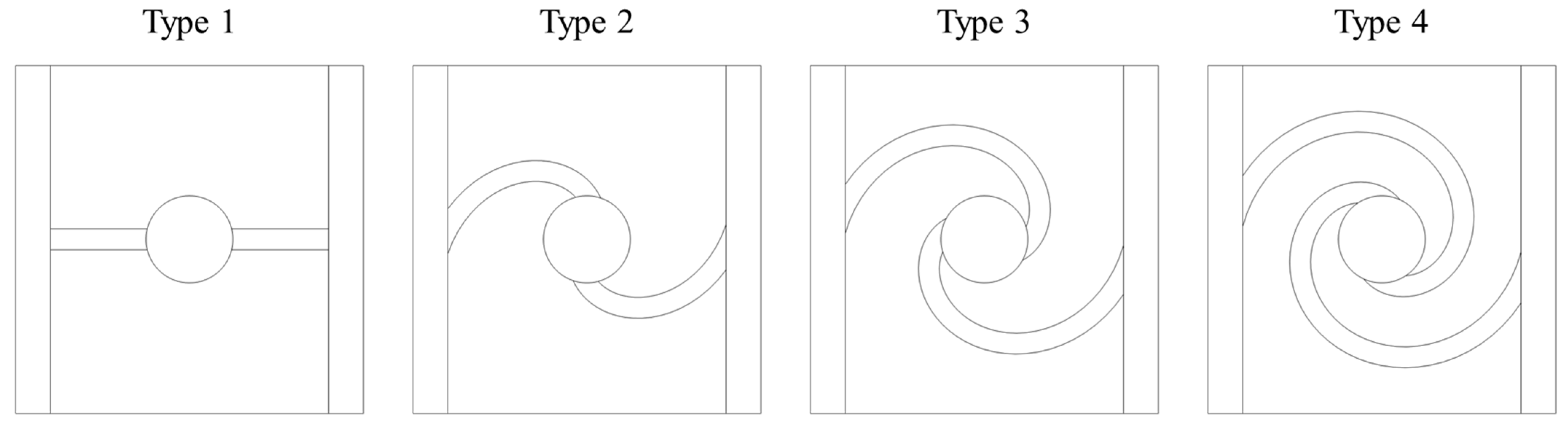
Table A1.
Geometrical parameters of the bridge configurations used to define the meta-atom designs. The spiral bridges are described by the Archimedean spiral parameter and , while Type 1 corresponds to a straight bridge.
To compare the dynamic characteristics of the different bridge geometries, the same analysis procedure described in Section 3.1 is applied, and the dispersion curves are plotted using the translational polarization factor defined in Equation (22). Figure A2 shows that, at room temperature (), the longitudinal and transverse bandgap locations remain nearly unchanged across the bridge configurations. This behavior is expected because the stiffness contrast among the core and outer shell (steel), the bridge (acrylic), and the solid PCM is relatively small.
In contrast, when the PCM is in liquid state () at high temperature, the dispersion curves exhibit an increasing number of branches as the bridge curvature increases. A higher curvature produces a longer bridge path, which reduces the effective stiffness of the meta-atom. If the effective stiffness and mass are denoted by and , the resonance frequencies scale as . A decrease in stiffness therefore shifts the resonance frequencies to lower values and brings additional higher-order modes into the same frequency range. For all bridge types, the high-temperature dispersion curves show a longitudinal-wave asymptote with a similar slope (dashed lines in Figure A2), which reflects the longitudinal-wave group velocity. The Bloch eigenstates at the point of the Brillouin zone confirm that this asymptote is mainly associated with the longitudinal motion of the outer shell. As the curvature increases, higher-order deformation becomes more pronounced in the bridge, and the eigenstates gradually shift from shell-dominated motion to bridge-dominated motion.
As discussed in Section 3.1.2, the phase transition of the PCM to the liquid state activates rotational resonance of the core, which leads to the emergence of flat bands. This tendency becomes more pronounced as the bridge curvature increases, since stronger rotational coupling between the bridge and the core produces additional flat bands within the same frequency range. To verify that these flat bands originate from rotational resonance, the rotational polarization factor defined in Equation (23) is applied, and the results are presented in Figure A3. At room temperature (), all bridge types yield nearly identical results, which is consistent with Figure A2. At high temperature (), however, the influence of bridge curvature becomes evident. For Type 1, a flat band associated with a rotational mode appears near 1.6 kHz, whereas the corresponding mode shifts to approximately 0.4 kHz for Type 3. For Type 2 and Type 4, no distinct flat band is formed. Instead, rotation-dominated modes appear near 2 kHz and 0.6 kHz, respectively.
Figure A2.
Comparison of the band structures of the meta-atom for the four bridge types. Orange and green curves indicate the branches dominated by longitudinal and transverse wave modes, respectively. Top and bottom panels correspond to and , respectively.
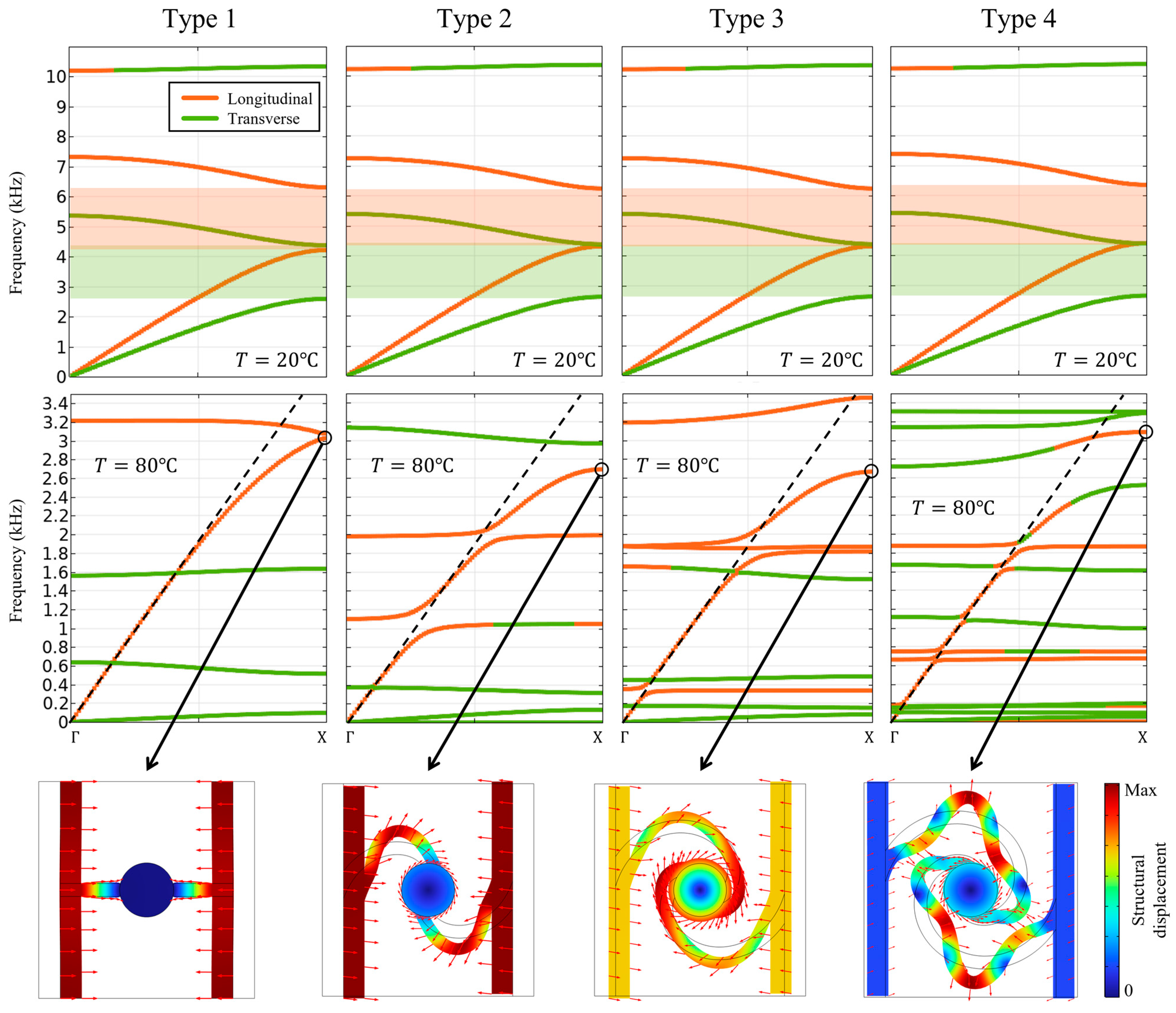
As shown in Figure A4, only Type 1 and Type 3 exhibit consistent rotation-dominated eigenstates at all points marked by the star, triangle, and circle symbols in Figure A3. This indicates that a single rotational mode is sustained along the path. In contrast, Type 2 and Type 4 show mode coupling (hybridization) between rotational motion and longitudinal or transverse motion. This coupling leads to band crossings between and X and prevents the formation of a distinct flat band [48,49,50]. The different coupling behavior is attributed to differences in the bridge attachment location and curvature.
Figure A3.
Band structures of the meta-atom for the four bridge types, colored by the rotational polarization factor . The color scale highlights the evolution of the rotation-dominated modes over the frequency range. Top and bottom panels correspond to and , respectively.
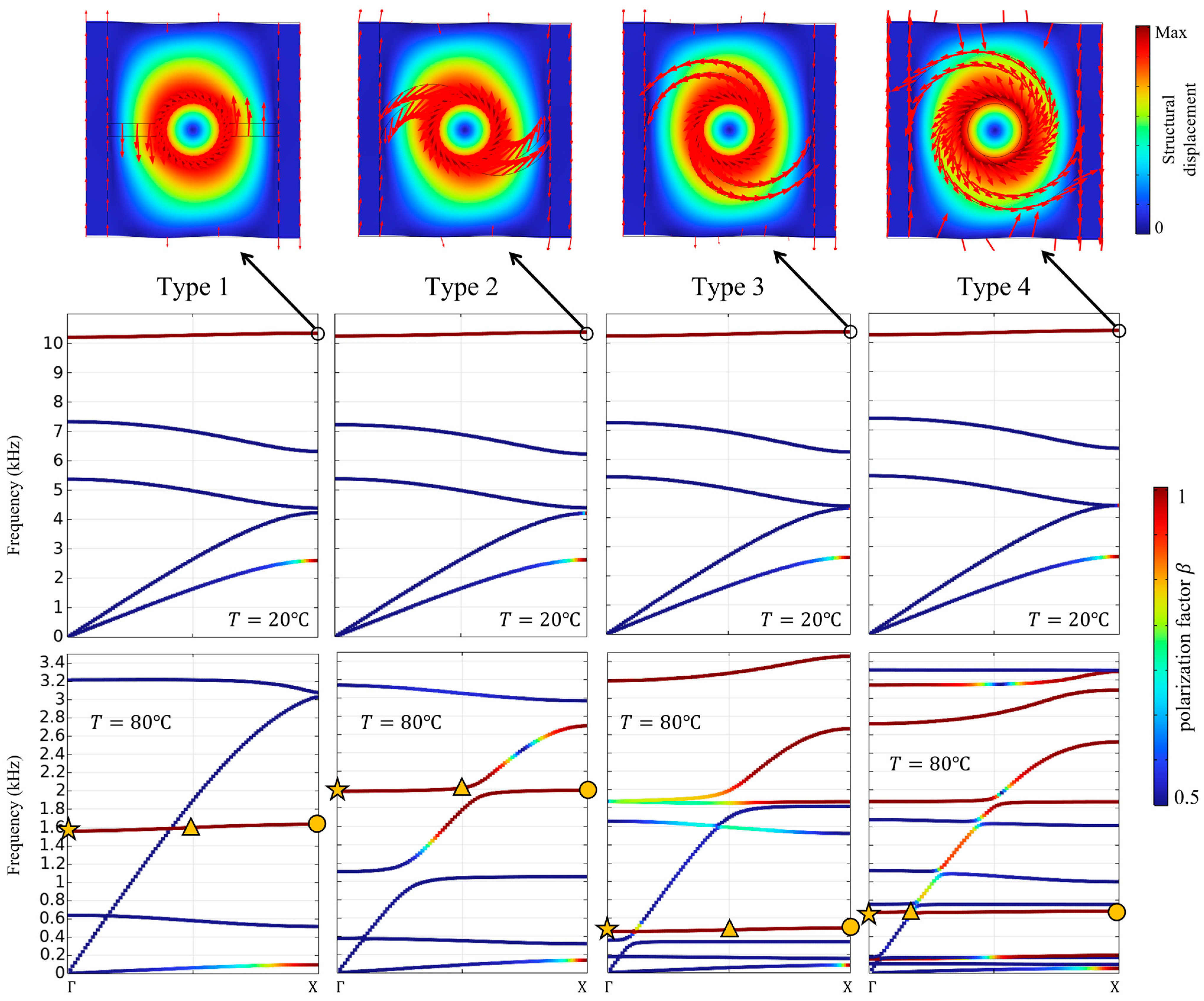
These results confirm that varying the bridge geometry provides an effective means of tuning the dynamic response of the meta-atom, thereby demonstrating the design flexibility of the proposed configuration. A more extensive exploration of the design-parameter space is beyond the scope of the present study and is left for future work. Based on the parametric investigations above, the following guidelines are suggested for PCM-embedded metastructures with thermally tunable wave control:
- (a)
- Lower the locally resonant bandgap frequencies by reducing the effective rotational stiffness of the core, for example by increasing the spiral-bridge curvature or effective length to facilitate core rotation in the liquid-PCM state.
- (b)
- Induce flat bands and strong localization by designing the spiral bridge to support rotation-dominated modes with weak coupling to the translational motion of the outer shell. Strong coupling can hybridize modes and obscure flat bands.
- (c)
- Maximize temperature-induced contrast by selecting geometries where Bragg-type bandgaps dominate for solid PCM, while rotation-induced local resonances emerge after liquefaction.
Figure A4.
Bloch eigenstates corresponding to the star, triangle, and circle markers in Figure A3 for the four bridge types at . The plots illustrate the rotational motion of the core and the influence of bridge curvature on the rotational modes.
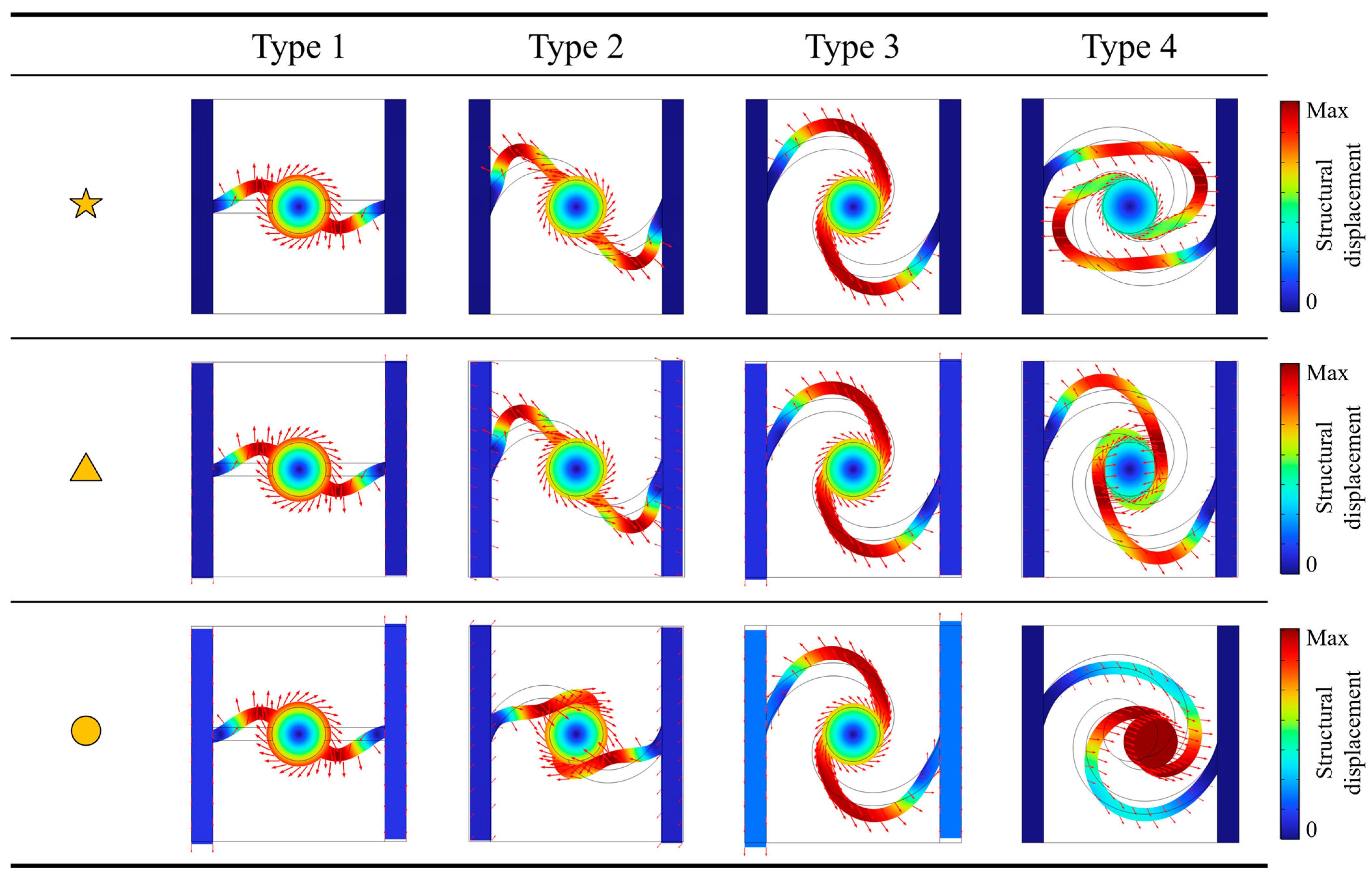
Appendix B. Band Structure Analysis Under Solid–Liquid Coexistence Conditions
In this appendix, the band structure of the proposed meta-atom is further investigated under spatially varying temperature fields, in contrast to the uniform temperature conditions considered in the main text, i.e., room temperature and high temperature. A temperature gradient is introduced within the unit cell by assuming the presence of a heat source either at the core or in the surrounding region, which leads to a solid–liquid coexistence state of the PCM. The corresponding band structures are analyzed to examine the effect of such intermediate phase conditions from a mechanistic point of view.
- Case 1: Radially decreasing temperature field (80 °C → 20 °C)
Figure A5a,b illustrate the spatial distributions of temperature and shear modulus , respectively. The temperature decreases approximately linearly from 80 °C at the core region to 20 °C toward the outer region, resulting in a transition from liquid PCM near the core to solid PCM in the outer region. The shear modulus, which is the most critical property affected during the phase transition, vanishes near the core center, indicating a fully liquid state. In contrast, the PCM in the outer region remains solid and provides structural support to the spiral bridges. As a result, the effective length of the bridges is reduced, which leads to an increase in the effective stiffness of the system. Consequently, the rotation-induced flat bands observed in the low-frequency range disappear, and the multiple narrow bandgaps associated with local resonance are shifted toward higher frequencies. This interpretation is further supported by the corresponding eigenstates , , and in Figure A5e–g, respectively.
Figure A5.
Band structure analysis of the meta-atom under a spatially varying temperature field with a radially decreasing temperature distribution from 80 °C near the core to 20 °C toward the outer region. (a) Temperature distribution and (b) corresponding shear modulus distribution. (c–g) Band structure and selected Bloch eigenstates.
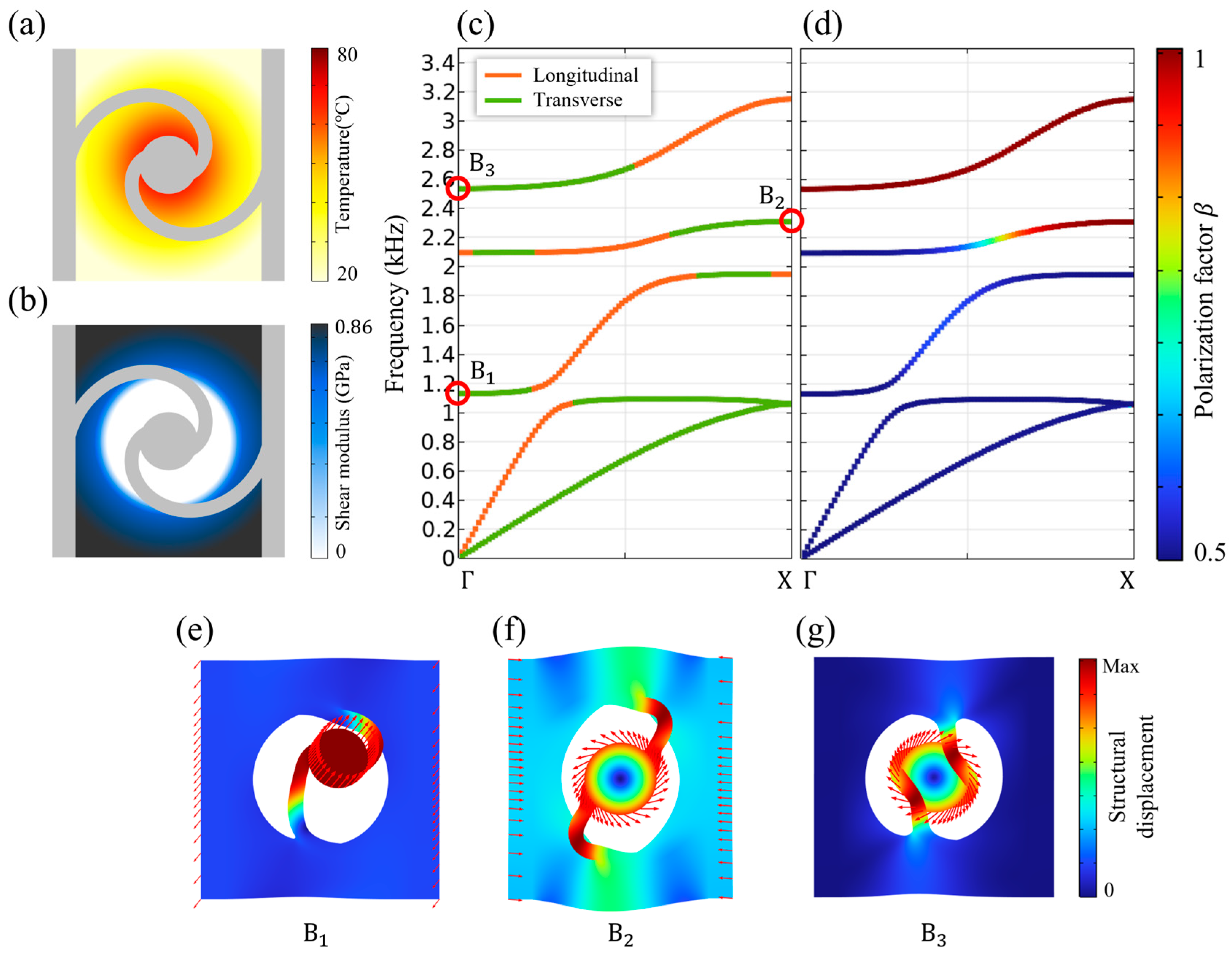
- Case 2: Radially increasing temperature field (20 °C → 80 °C)
In contrast to Case 1, the temperature increases approximately linearly from 20 °C at the core region to 80 °C toward the outer region. This leads to a configuration in which the PCM near the core remains solid, whereas the surrounding PCM transitions toward the liquid state. This results in a configuration in which the core is effectively surrounded by a compliant PCM region, leading to an apparent increase in the effective core diameter. As shown in Figure A6c,d, the resulting band structure does not exhibit significant qualitative changes compared to Figure 8b, although a slight upward shift in the overall frequency range is observed. This behavior can be explained as follows. Although the surrounding solid PCM increases the effective core radius, the increase in effective mass remains limited because the density of PCM is much lower than that of the steel core. Instead, the slight decrease in the effective bridge length leads to an increase in the effective stiffness, resulting in an overall upward shift in the band structure. This interpretation is further supported by the corresponding eigenstates , , , and shown in Figure A6e–h, respectively.
Figure A6.
Band structure analysis of the meta-atom under a spatially varying temperature field with a radially increasing temperature distribution from 20 °C near the core to 80 °C toward the outer region. (a) Temperature distribution and (b) corresponding shear modulus distribution. (c–h) Band structure and selected Bloch eigenstates.
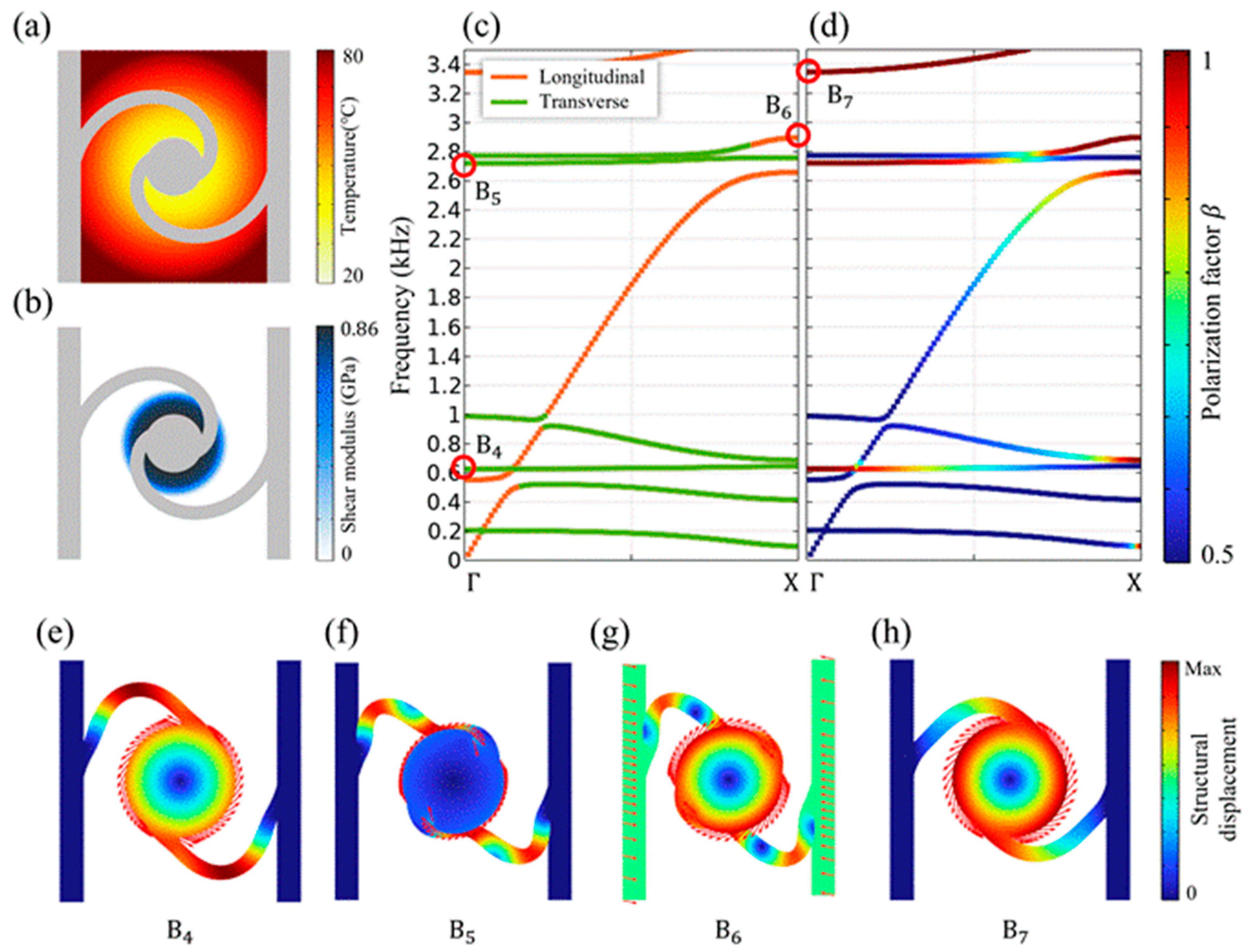
These two cases demonstrate that the same analysis framework used in the main text remains valid even when spatial temperature variations are introduced within the unit cell. The results show that the proposed meta-atom can be systematically analyzed under intermediate phase conditions in which solid and liquid PCM coexist, and that the resulting band structure can be consistently interpreted in terms of changes in effective stiffness and geometric constraints.
Appendix C. Derivation of Elastic Material Properties of PCM
This appendix presents the procedure used to derive the equivalent elastic properties of the solid-state PCM, i.e., the Young’s modulus and Poisson’s ratio , from the longitudinal wave speed , transverse wave speed , and mass density given in Equations (1)–(3).
For a linear, isotropic elastic medium, the bulk modulus and shear modulus can be computed from the longitudinal and transverse wave speeds as,
These expressions are applicable to both the solid and liquid states of the PCM. In the liquid state, the transverse wave speed vanishes (), and therefore the shear modulus becomes , which indicates the loss of shear modulus.
For the solid-state PCM, under the 2D plane strain assumption, the bulk modulus and shear modulus are related to the equivalent Young’s modulus and Poisson’s ratio by
Rearranging Equations (A3) and (A4) with respect to and gives
Finally, substituting Equations (A1) and (A2) into Equations (A5) and (A6) yields Equations (4) and (5), which are used to compute the temperature-dependent elastic properties of the solid-state PCM.
Appendix D. Validation of Bloch Eigenstates via 1D Waveguide-Level Analysis
Section 3.2 showed that the transmission loss trends from the 1D waveguide-level analysis agree well with the band structure results in Figure 7, which confirms the consistency between the unit-cell and waveguide-level responses across temperature and excitation conditions. To further validate this correspondence, Figure A7 presents the structural displacement and acoustic pressure fields at the frequencies associated with the rotational modes and , at which pronounced dips in were observed in Figure 11c.
Figure A7a shows the acoustic pressure and structural displacement fields at approximately 10.2 kHz, which corresponds to mode when the PCM is in the solid state. This frequency coincides with the flat band in the dispersion curve, which was identified in Section 3.1.2 as a core-dominated rotational mode. As discussed in Section 3.2.2, this rotational resonance is accompanied by a pronounced dip in , which indicates reduced transverse wave attenuation. The field distributions in Figure A7a show that the core undergoes strong localized rotation under all three excitation types. In particular, under transverse excitation, the rotational motion couples to the waveguide response and allows the wave to pass through the metastructure with relatively small attenuation.
Figure A7b shows the corresponding fields for mode at 0.4 kHz when the PCM is in the liquid state. Consistent with the unit-cell analysis, clear core rotation is observed under all three excitation types. In the high-temperature case, exhibited a pronounced dip near this frequency. However, unlike the solid-state case in Figure A7a, the field distribution indicates that the transverse wave is only partially transmitted, with a non-negligible attenuation still present through the metastructure. This behavior is consistent with the locally resonant rotational mode identified in the dispersion analysis and can be interpreted as partial resonant tunneling rather than a fully transparent transmission state.
Figure A7.
Structural displacement and acoustic pressure fields in the 1D metastructure at the frequencies of the rotational modes: (a) Mode at 10.2 kHz and (b) Mode at 0.4 kHz and . For each case, the left, middle, and right panels correspond to longitudinal, transverse, and acoustic excitations, respectively.
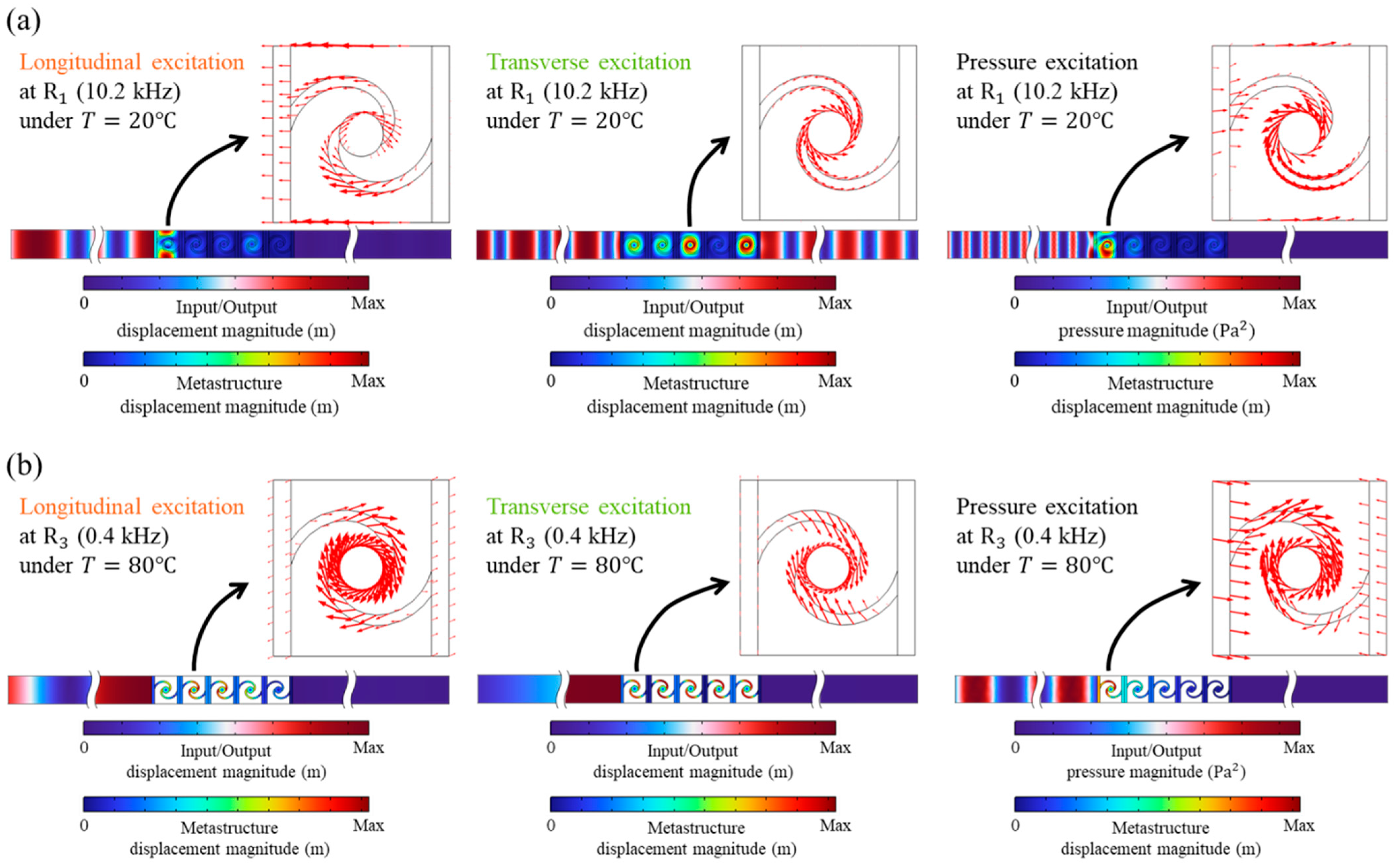
References
- Zhou, S.; Shi, J. Active balancing and vibration control of rotating machinery: A survey. Shock Vib. Dig. 2001, 33, 361–371. [Google Scholar] [CrossRef] [Scilit]
- Syuhri, S.N.H.; Zare-Behtash, H.; Cammarano, A. Investigating the Influence of Fluid-Structure Interactions on Nonlinear System Identification. Vibration 2020, 3, 521–544. [Google Scholar]
- Li, X.; Hu, Y.; Han, Z. Fatigue condition assessment of subsea pipelines under vortex induced vibration and cyclical lateral displacement. Energy Sources Part A Recover. Util. Environ. Eff. 2023, 45, 9941–9957. [Google Scholar] [CrossRef] [Scilit]
- Owusu, D.; Amuzuvi, C.; Attachie, J. Vibration-induced Thermal Fault Analysis and Optimisation of Induction Motors Using Artificial Intelligence. Am. J. Artif. Intell. 2025, 9, 91–106. [Google Scholar] [CrossRef] [Scilit]
- Xu, Y.; Mao, M.; Huang, X.H.; Guo, Y.Q.; Yang, Y.; Dong, Y.R.; Shah, S.A.A.; Gao, X.; Usman, M.; Jeong, S.H. Comparative investigation of dynamic damping and fracture in viscoelastic dampers with two different interfacial bonding types: Molecular dynamics simulations and device tests. J. Build. Eng. 2025, 116, 114582. [Google Scholar] [CrossRef] [Scilit]
- Münzel, T.; Schmidt, F.P.; Steven, S.; Herzog, J.; Daiber, A.; Sørensen, M. Environmental Noise and the Cardiovascular System. J. Am. Coll. Cardiol. 2018, 71, 688–697. [Google Scholar] [CrossRef] [Scilit]
- Erbe, C.; Marley, S.A.; Schoeman, R.P.; Smith, J.N.; Trigg, L.E.; Embling, C.B. The Effects of Ship Noise on Marine Mammals—A Review. Front. Mar. Sci. 2019, 6, 606. [Google Scholar] [CrossRef] [Scilit]
- Yang, Y.; Wang, H.; Yu, F.; Xu, Z.; Chen, H. A metasurface carpet cloak for electromagnetic, acoustic and water waves. Sci. Rep. 2016, 6, 20219. [Google Scholar] [CrossRef] [Scilit]
- Zhou, Y.; Chen, J.; Chen, R.; Chen, W.; Fan, Z.; Ma, Y. Ultrathin Electromagnetic–Acoustic Amphibious Stealth Coats. Adv. Opt. Mater. 2020, 8, 2000200. [Google Scholar] [CrossRef] [Scilit]
- Xu, S.; Sun, P.; Wang, X.; Zhao, C.; Huang, Z. Metamaterial-based absorbers for simultaneous absorption of air-borne sound and structural vibration. Int. J. Mech. Sci. 2024, 265, 108915. [Google Scholar] [CrossRef] [Scilit]
- Farouk, A.; Maged, S. Acoustic Metamaterial for Simultaneous Noise Filteringand Energy Harvesting from Ambient Vibrations. In Proceedings of the 2021 International Mobile, Intelligent, and Ubiquitous Computing Conference; MIUCC 2021; IEEE: Piscataway, NJ, USA, 2021; pp. 149–154. [Google Scholar]
- Chen, C.; Guo, Z.; Liu, S.; Feng, H.; Qiao, C. Hybrid acousto-elastic metamaterials for simultaneous control of low-frequency sound and vibration. J. Appl. Phys. 2021, 129, 054902. [Google Scholar] [CrossRef] [Scilit]
- Gu, T.; Wen, Z.; He, L.; Yu, M.; Li, Y.; Li, Y.; Jin, Y. A lightweight metastructure for simultaneous low-frequency broadband sound absorption and vibration isolation. J. Acoust. Soc. Am. 2023, 153, 96–104. [Google Scholar] [CrossRef] [Scilit]
- Shao, H.; Yang, Y.; Di, W.; Zhang, H.; Jiang, D. Simultaneous Broadband Sound Absorption and Vibration Suppression in Gradient-Symmetric Multilayer Metamaterials. Appl. Sci. 2025, 15, 12628. [Google Scholar] [CrossRef] [Scilit]
- Hwan Oh, J.; Kyu Lee, I.; Sik Ma, P.; Young Kim, Y. Active wave-guiding of piezoelectric phononic crystals. Appl. Phys. Lett. 2011, 99, 083505. [Google Scholar] [CrossRef] [Scilit]
- Elefante, G.; De Bellis, M.L.; Bacigalupo, A. Electrically-tunable active metamaterials for damped elastic wave propagation control. Int. J. Solids Struct. 2023, 276, 112306. [Google Scholar] [CrossRef] [Scilit]
- Zhang, Y.; Xu, J.; Li, Z.; Huang, K. Tunability of bandgaps in functionally graded piezoelectric plates with periodically shunting circuits. Eur. J. Mech. A/Solids 2025, 113, 105701. [Google Scholar] [CrossRef] [Scilit]
- Zhou, X.; Xu, Y.; Wang, L. Tuning flexural elastic wave propagation in electroactive phononic crystals. J. Appl. Phys. 2018, 123, 225103. [Google Scholar] [CrossRef] [Scilit]
- Chen, X.; Liu, P.; Hou, Z.; Pei, Y. Magnetic-control multifunctional acoustic metasurface for reflected wave manipulation at deep subwavelength scale. Sci. Rep. 2017, 7, 9050. [Google Scholar] [CrossRef] [Scilit]
- Xia, P.; Shi, J.; Chu, H.; Zhou, X.; Liu, X.; Lai, Y. Dynamic acoustic metasurfaces based on magnetic levitation. Phys. Rev. Appl. 2024, 21, 054023. [Google Scholar] [CrossRef] [Scilit]
- Li, B.; Yan, W.; Gao, Y. Tunability of Band Gaps of Programmable Hard-Magnetic Soft Material Phononic Crystals. Acta Mech. Solida Sin. 2022, 35, 719–732. [Google Scholar] [CrossRef] [Scilit]
- Pierce, C.D.; Willey, C.L.; Chen, V.W.; Hardin, J.O.; Berrigan, J.D.; Juhl, A.T.; Matlack, K.H. Adaptive elastic metastructures from magneto-active elastomers. Smart Mater. Struct. 2020, 29, 065004. [Google Scholar] [CrossRef] [Scilit]
- Dudek, K.K.; Iglesias Martínez, J.A.; Hirsinger, L.; Kadic, M.; Devel, M. Active magneto-mechanical metamaterial with the wave transmission and Poisson’s ratio controlled via the magnetic field. J. Sound Vib. 2025, 595, 118784. [Google Scholar] [CrossRef] [Scilit]
- Fan, K.; Strikwerda, A.C.; Zhang, X.; Averitt, R.D. Three-dimensional broadband tunable terahertz metamaterials. Phys. Rev. B –Condens. Matter Mater. Phys. 2013, 87, 161104. [Google Scholar] [CrossRef] [Scilit]
- Zhao, X.; Wang, Y.; Schalch, J.; Duan, G.; Cremin, K.; Zhang, J.; Chen, C.; Averitt, R.D.; Zhang, X. Optically Modulated Ultra-Broadband All-Silicon Metamaterial Terahertz Absorbers. ACS Photonics 2019, 6, 830–837. [Google Scholar] [CrossRef] [Scilit]
- Li, J.; Zhang, Y.; Li, J.; Yan, X.; Liang, L.; Zhang, Z.; Huang, J.; Li, J.; Yang, Y.; Yao, J. Amplitude modulation of anomalously reflected terahertz beams using all-optical active Pancharatnam-Berry coding metasurfaces. Nanoscale 2019, 11, 5746–5753. [Google Scholar] [CrossRef] [Scilit] [PubMed]
- Yang, S.; Zhou, X.; Wang, Y.F. Tunable band gap and wave guiding in periodic grid structures with thermal sensitive materials. Compos. Struct. 2022, 290, 115536. [Google Scholar] [CrossRef] [Scilit]
- Dai, H.; Xia, B.; Yu, D. Temperature-controlled tunable underwater acoustic topological insulators. J. Appl. Phys. 2019, 125, 235105. [Google Scholar] [CrossRef] [Scilit]
- Farid, M.M.; Khudhair, A.M.; Razack, S.A.K.; Al-Hallaj, S. A review on phase change energy storage: Materials and applications. Energy Convers. Manag. 2004, 45, 1597–1615. [Google Scholar] [CrossRef] [Scilit]
- Aghoei, M.M.; Astanbous, A.; Khaksar, R.Y.; Moezzi, R.; Behzadian, K.; Annuk, A.; Gheibi, M. Phase change materials (PCM) as a passive system in the opaque building envelope: A simulation-based analysis. J. Energy Storage 2024, 101, 113625. [Google Scholar] [CrossRef] [Scilit]
- Bianco, V.; De Rosa, M.; Vafai, K. Phase-change materials for thermal management of electronic devices. Appl. Therm. Eng. 2022, 214, 118839. [Google Scholar] [CrossRef] [Scilit]
- Mofijur, M.; Mahlia, T.M.I.; Silitonga, A.S.; Ong, H.C.; Silakhori, M.; Hasan, M.H.; Putra, N.; Ashrafur Rahman, S.M. Phase change materials (PCM) for solar energy usages and storage: An overview. Energies 2019, 12, 3167. [Google Scholar] [CrossRef] [Scilit]
- Wazeer, A.; Das, A.; Abeykoon, C.; Sinha, A.; Karmakar, A. Phase change materials for battery thermal management of electric and hybrid vehicles: A review. Energy Nexus 2022, 7, 100131. [Google Scholar] [CrossRef] [Scilit]
- Guo, L.; Zhao, S.; Guo, Z.; Zhang, Y.; Yang, J.; Kitipornchai, S. Phase transition-based tunable phononic crystals and metamaterials: A review. Thin-Walled Struct. 2026, 218, 113984. [Google Scholar] [CrossRef] [Scilit]
- Guo, L.; Zhao, S.; Yang, J.; Kitipornchai, S. Phase change enabled high bandgap tunability in graphene-reinforced phononic crystals. Mech. Syst. Signal Process. 2024, 215, 111406. [Google Scholar] [CrossRef] [Scilit]
- Guo, L.; Zhao, S.; Yang, J.; Kitipornchai, S. Adaptive waveguide control based on graphene-reinforced phase-change phononic crystals. Mech. Syst. Signal Process. 2025, 241, 113556. [Google Scholar] [CrossRef] [Scilit]
- Jin, Y.; Yang, T.; Dahotre, N.B.; Neogi, A. Multifunctional phononic meta-material actuated by the phase transition in water. Phys. Scr. 2023, 98, 065008. [Google Scholar] [CrossRef] [Scilit]
- Li, M.; Guo, H.; Su, G.; Liu, Y.; Lu, T. Switchable and Flexible Underwater Acoustic Metasurface Based on Phase-Change Materials. Int. J. Mech. Sci. 2025, 110924. [Google Scholar] [CrossRef] [Scilit]
- Xing, X.C.; Cao, Y.; Tian, X.Y.; Wu, L. A Thermo-Tunable Metamaterial as an Actively Controlled Broadband Absorber. Engineering 2023, 20, 143–152. [Google Scholar] [CrossRef] [Scilit]
- Ghassemiparvin, B.; Ghalichechian, N. W-band true-time delay phase shifters using paraffin microactuators. In Proceedings of the IET Conference Publications; Institution of Engineering and Technology: London, UK, 2018; pp. 163–166. [Google Scholar]
- Hildebrand, J.A. Anthropogenic and natural sources of ambient noise in the ocean. Mar. Ecol. Prog. Ser. 2009, 395, 5–20. [Google Scholar] [CrossRef] [Scilit]
- Kim, Y. Sound Propagation; Wiley: Hoboken, NJ, USA, 2010; ISBN 9780470825839. [Google Scholar]
- Nguyen, H.Q.; Wu, Q.; Chen, H.; Chen, J.J.; Yu, Y.K.; Tracy, S.; Huang, G.L. A Fano-based acoustic metamaterial for ultra-broadband sound barriers. Proc. R. Soc. A Math. Phys. Eng. Sci. 2021, 477, 20210024. [Google Scholar] [CrossRef] [Scilit]
- Moghaddaszadeh, M.; Ragonese, A.; Hu, Y.; Guo, Z.; Aref, A.; Zhou, C.; Ren, S.; Nouh, M. Local resonance bandgap control in a particle-aligned magnetorheological metamaterial. Commun. Mater. 2023, 4, 94. [Google Scholar] [CrossRef] [Scilit]
- Li, W.; Hu, J.; Lu, G.; Huang, X. Topology optimization of acoustic bandgap crystals for topological insulators. Eng. Comput. 2024, 40, 2581–2594. [Google Scholar] [CrossRef] [Scilit]
- Jung, J.; Goo, S.; Kook, J. Design of a local resonator using topology optimization to tailor bandgaps in plate structures. Mater. Des. 2020, 191, 108627. [Google Scholar] [CrossRef] [Scilit]
- Park, S.U.; Hyun, J. Level-set topology optimization of electrode-patterned piezoelectric metasurfaces for far-field ultrasonic focusing via the Kirchhoff–Helmholtz integral method. Thin-Walled Struct. 2026, 224, 114720. [Google Scholar] [CrossRef] [Scilit]
- Chen, Y.; Kadic, M.; Wegener, M. Roton-like acoustical dispersion relations in 3D metamaterials. Nat. Commun. 2021, 12, 3278. [Google Scholar] [CrossRef] [Scilit] [PubMed]
- Zhu, Z.; Gao, Z.; Liu, G.G.; Ge, Y.; Wang, Y.; Xi, X.; Yan, B.; Chen, F.; Shum, P.P.; Sun, H.X.; et al. Observation of multiple rotons and multidirectional roton-like dispersion relations in acoustic metamaterials. New J. Phys. 2022, 24, 123019. [Google Scholar] [CrossRef] [Scilit]
- Wang, K.; Chen, Y.; Kadic, M.; Wang, C.; Wegener, M. Nonlocal interaction engineering of 2D roton-like dispersion relations in acoustic and mechanical metamaterials. Commun. Mater. 2022, 3, 35. [Google Scholar] [CrossRef] [Scilit]
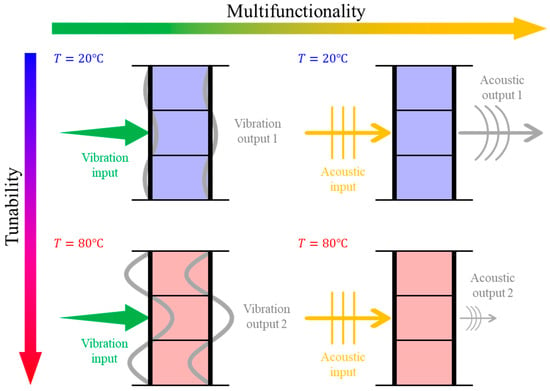
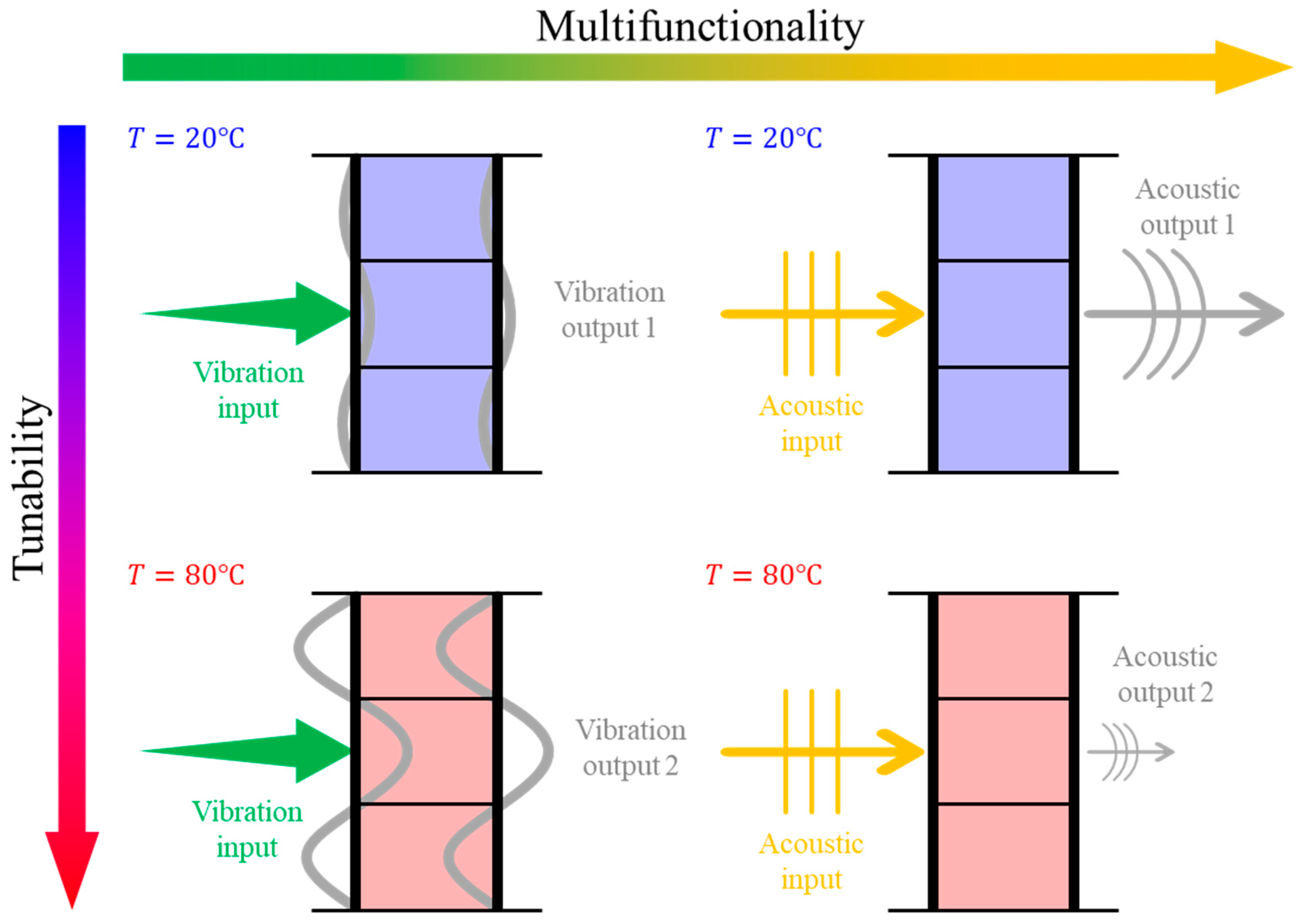
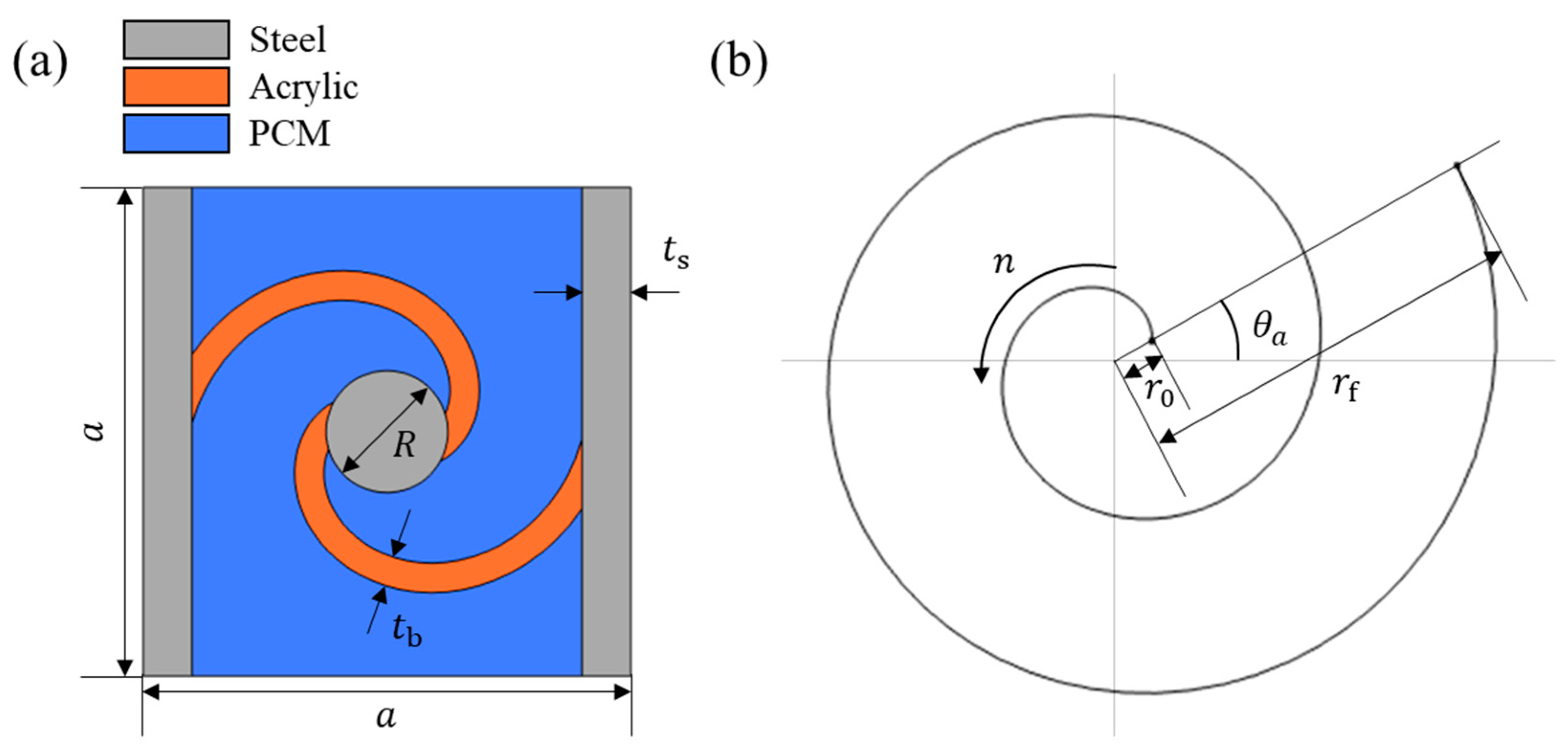
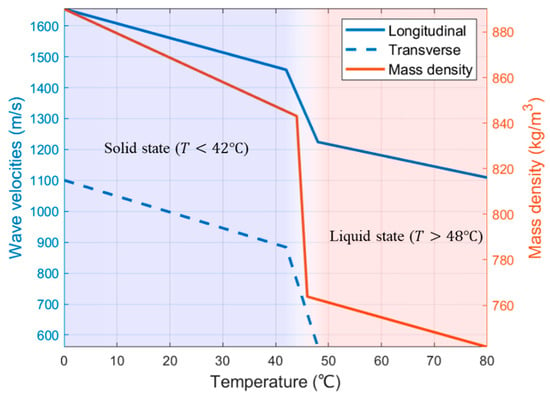
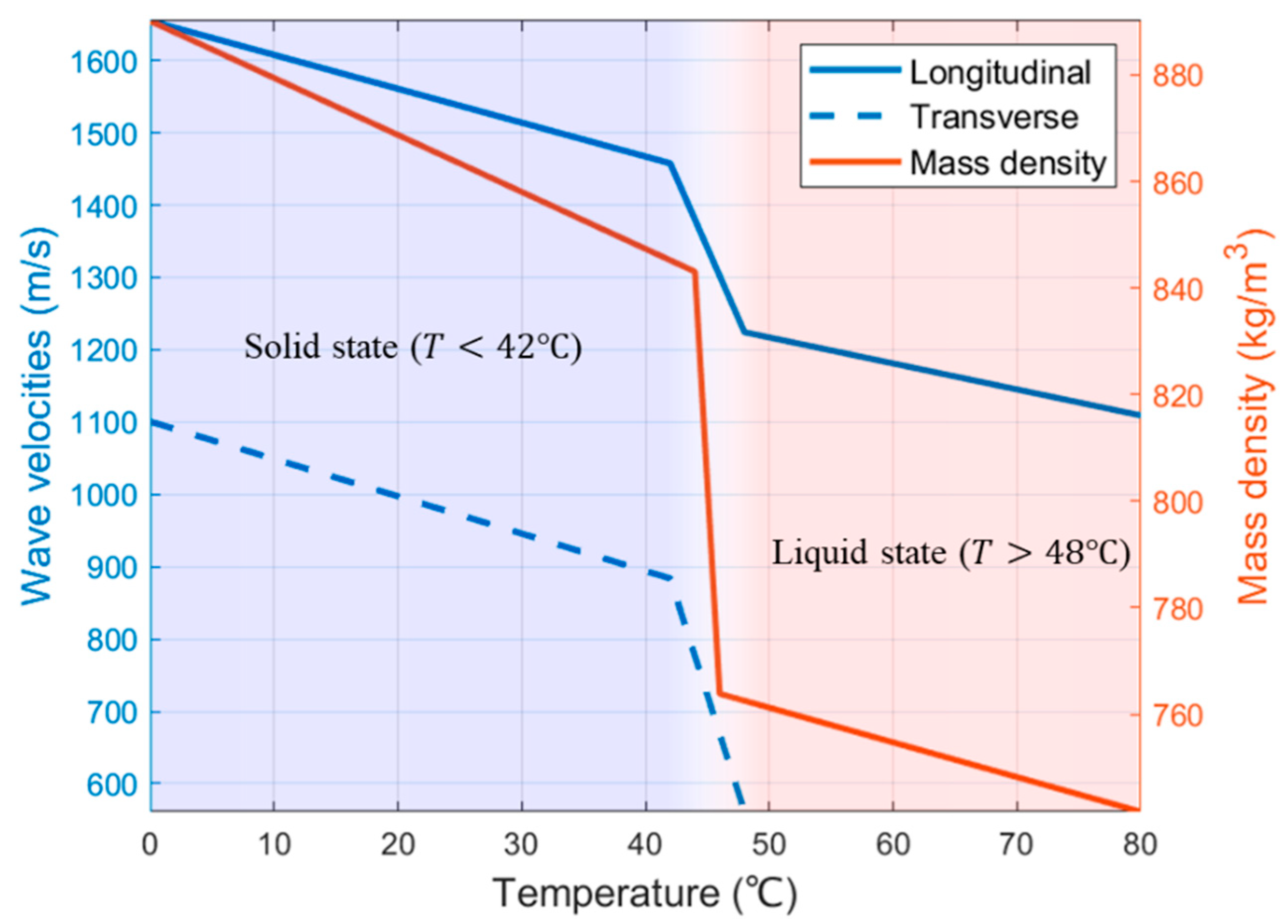
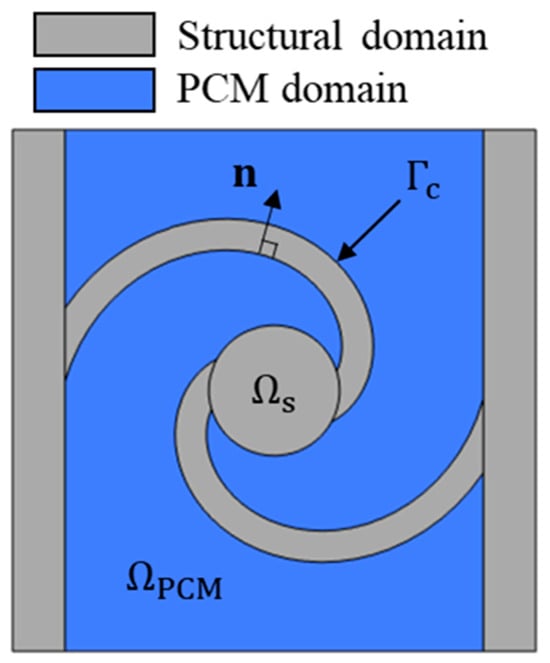
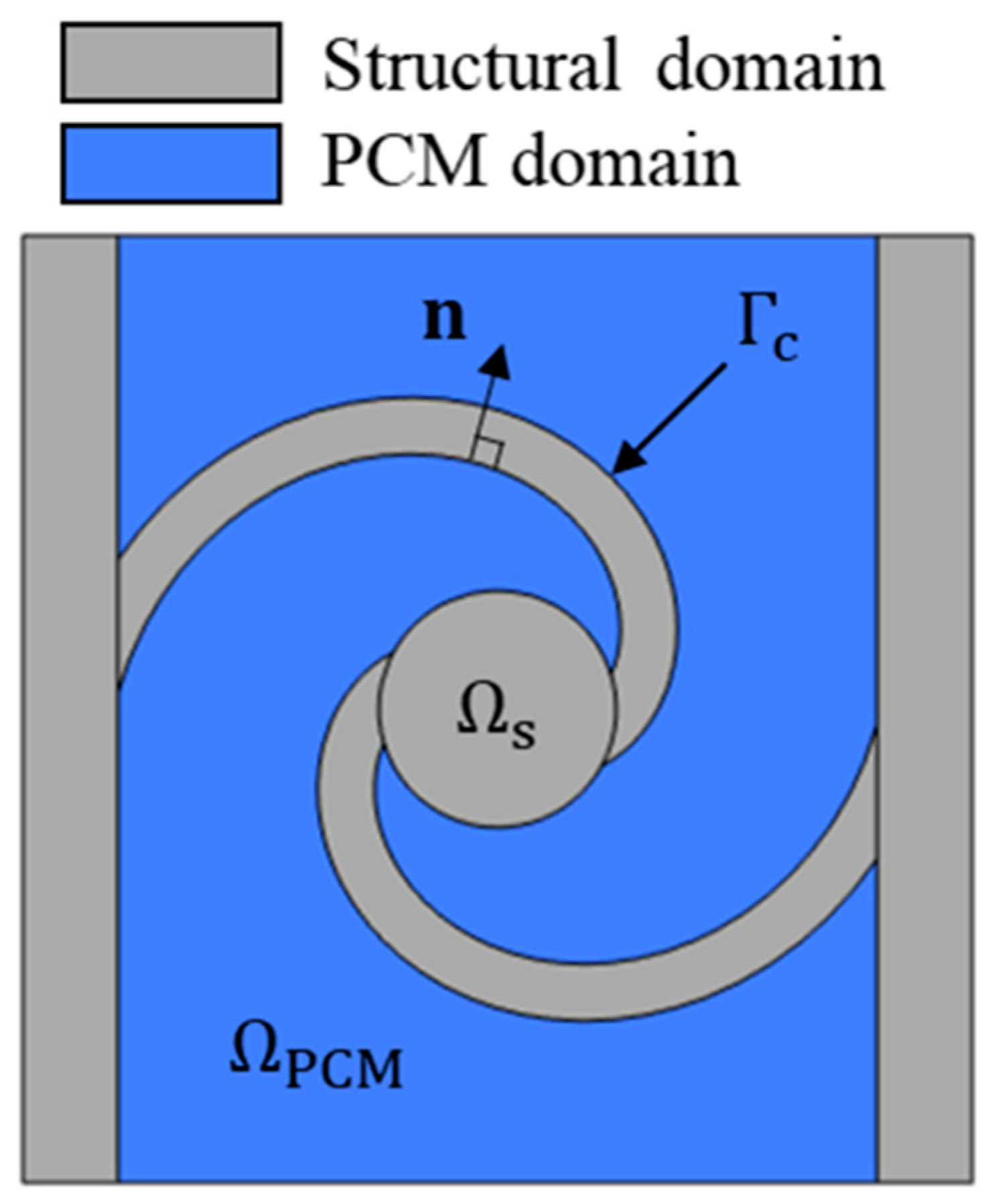
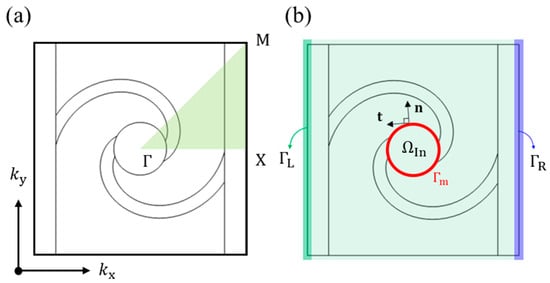
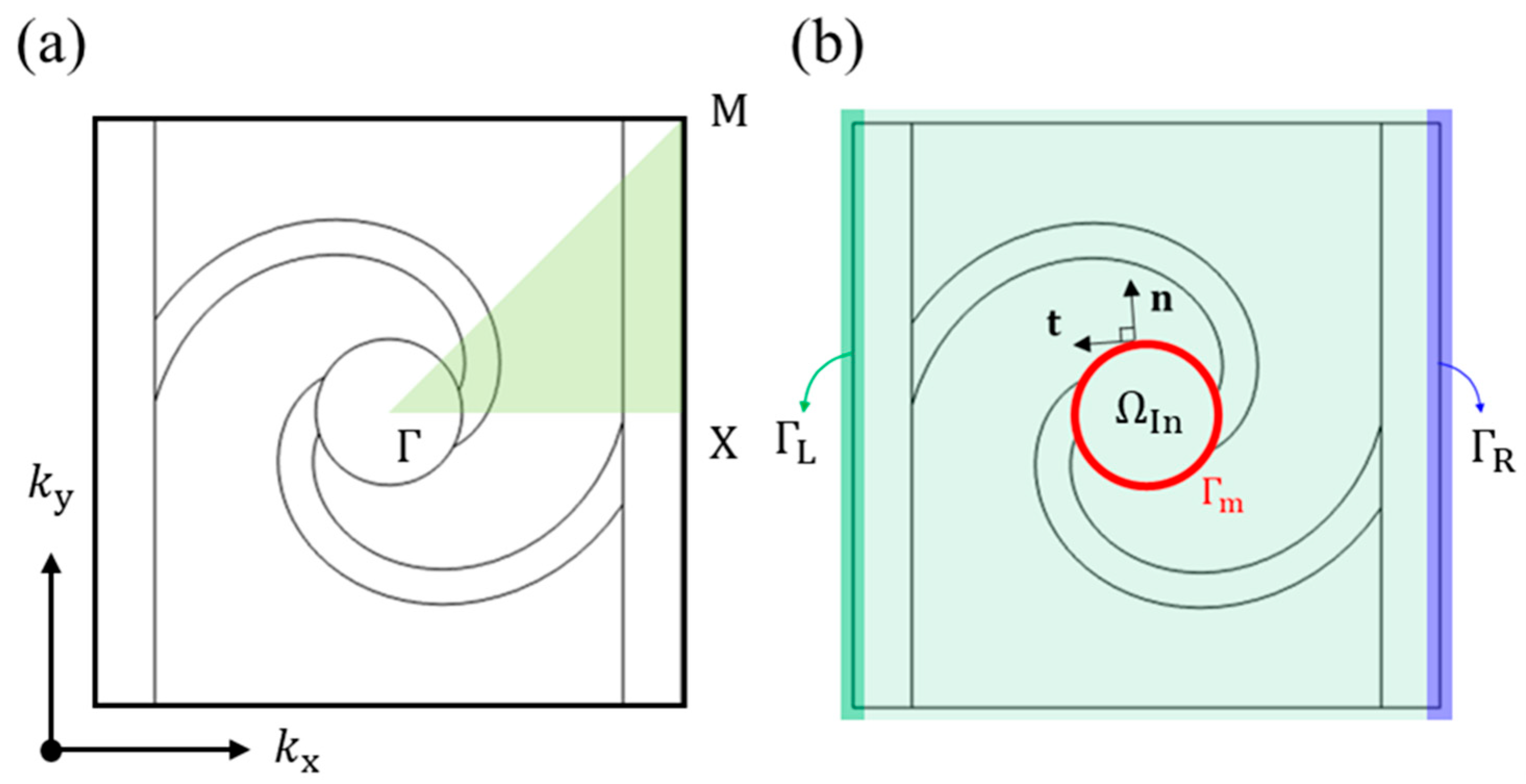
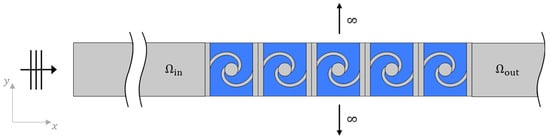
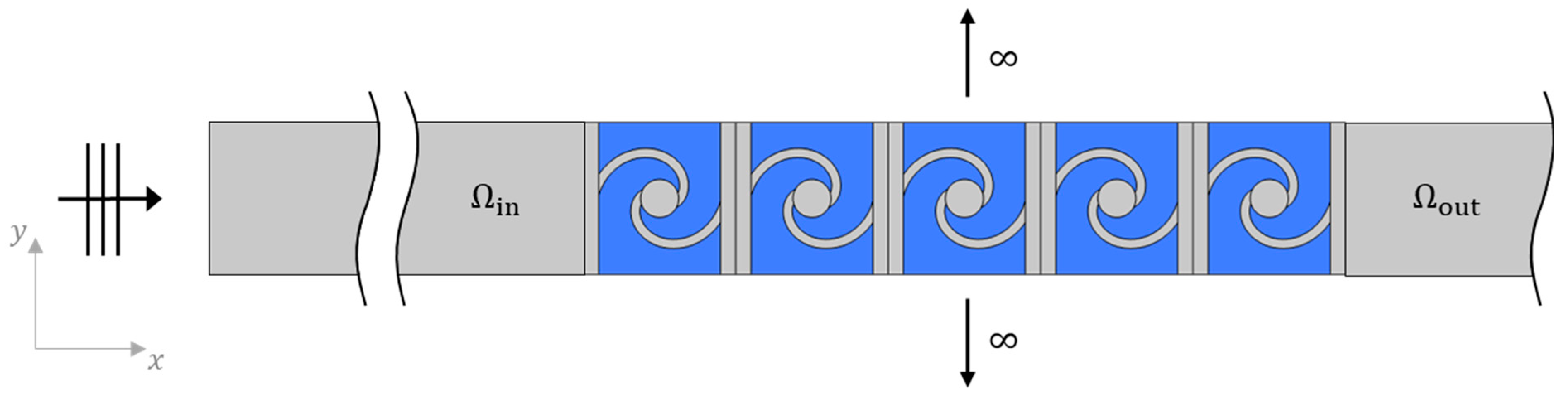
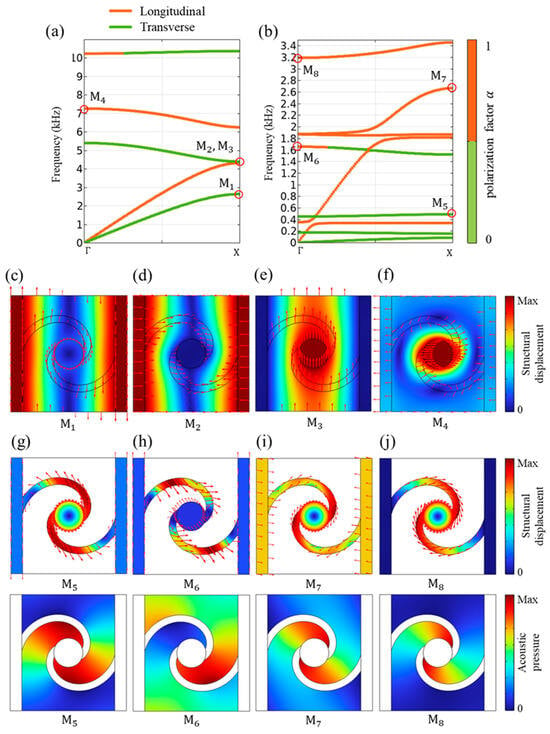
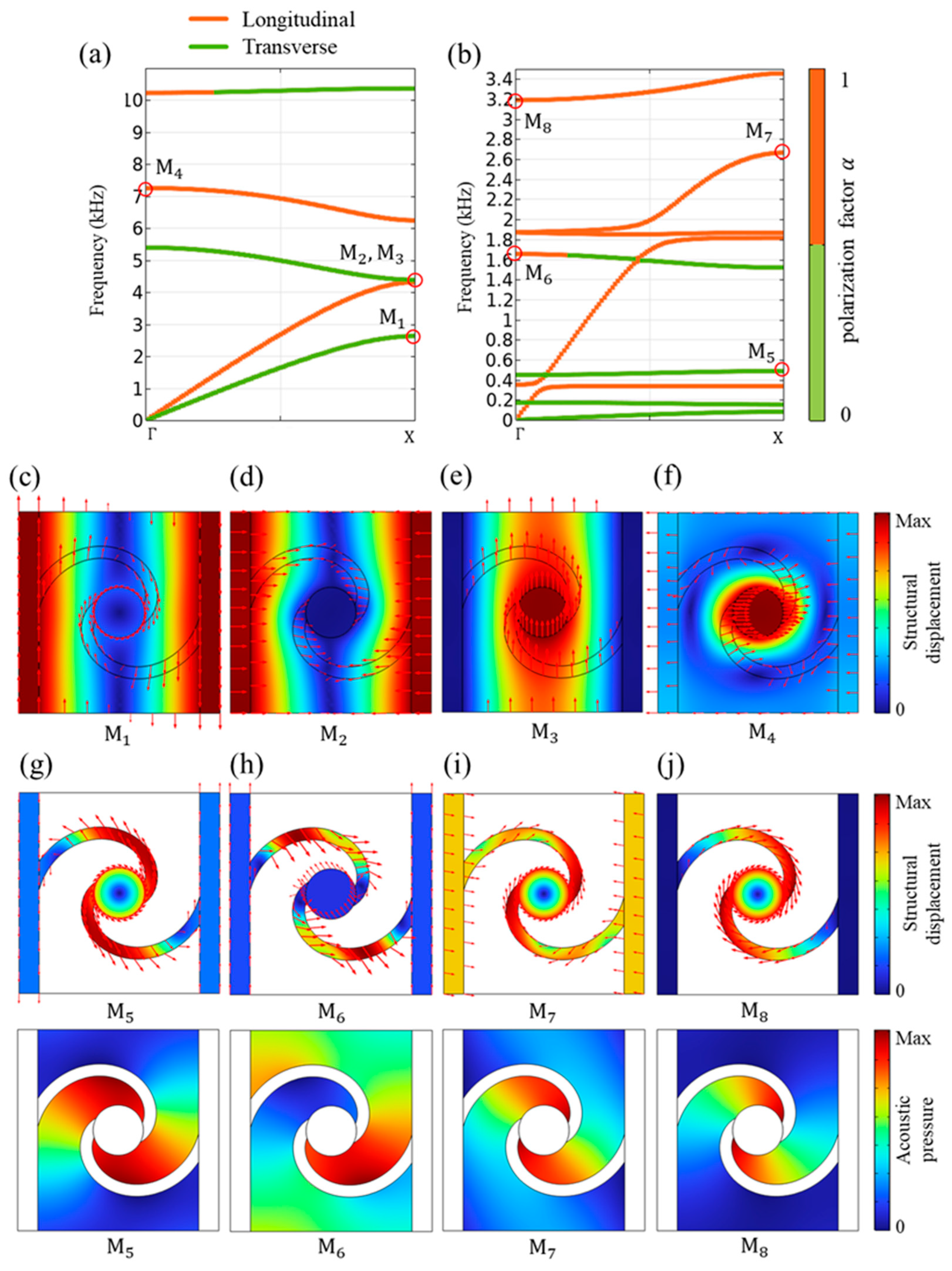
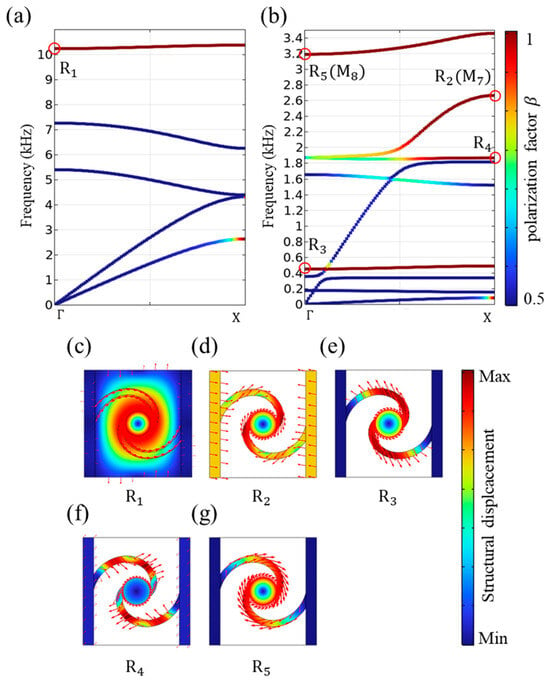
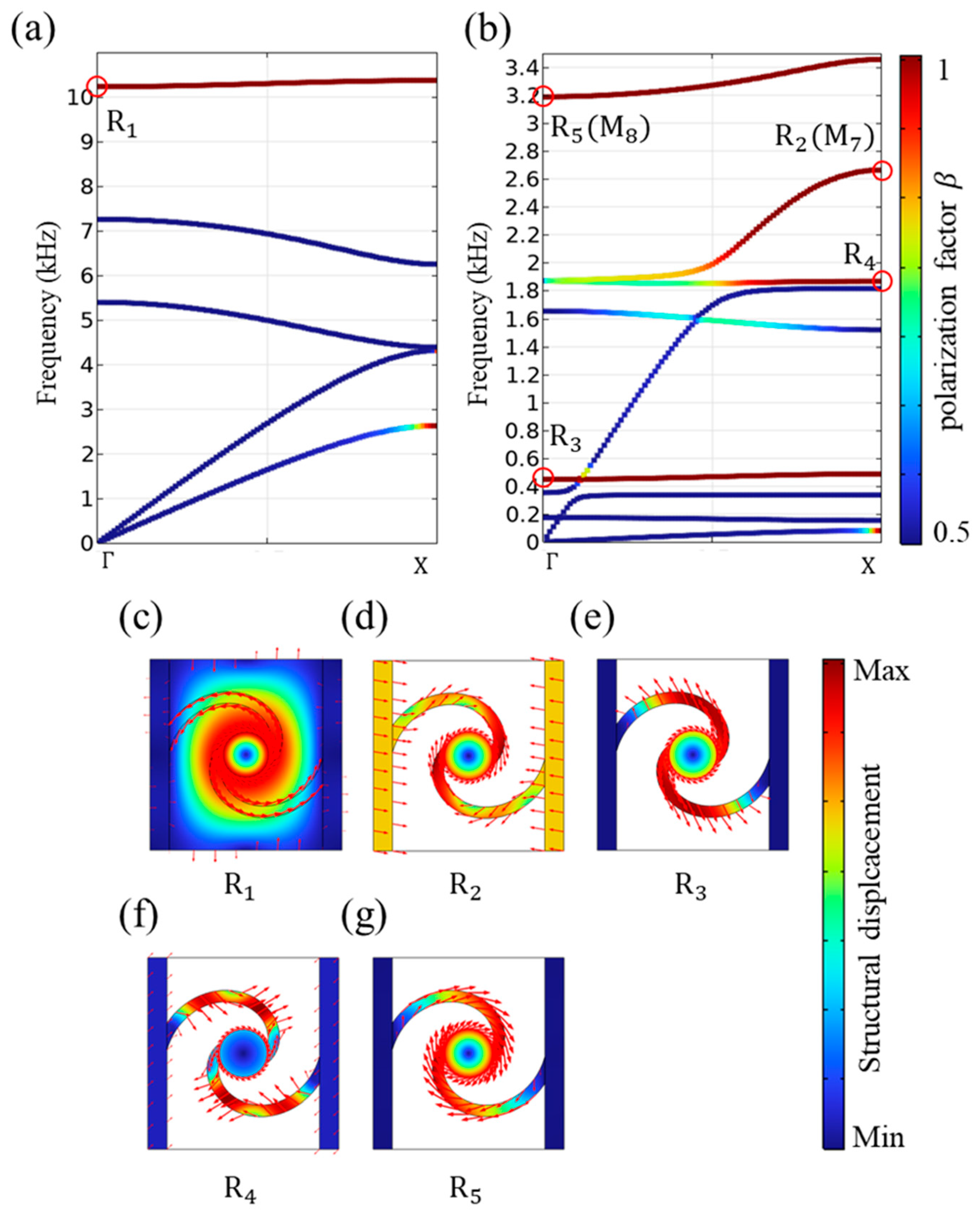
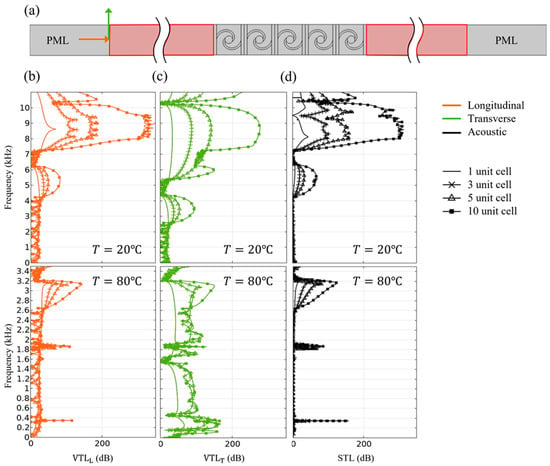
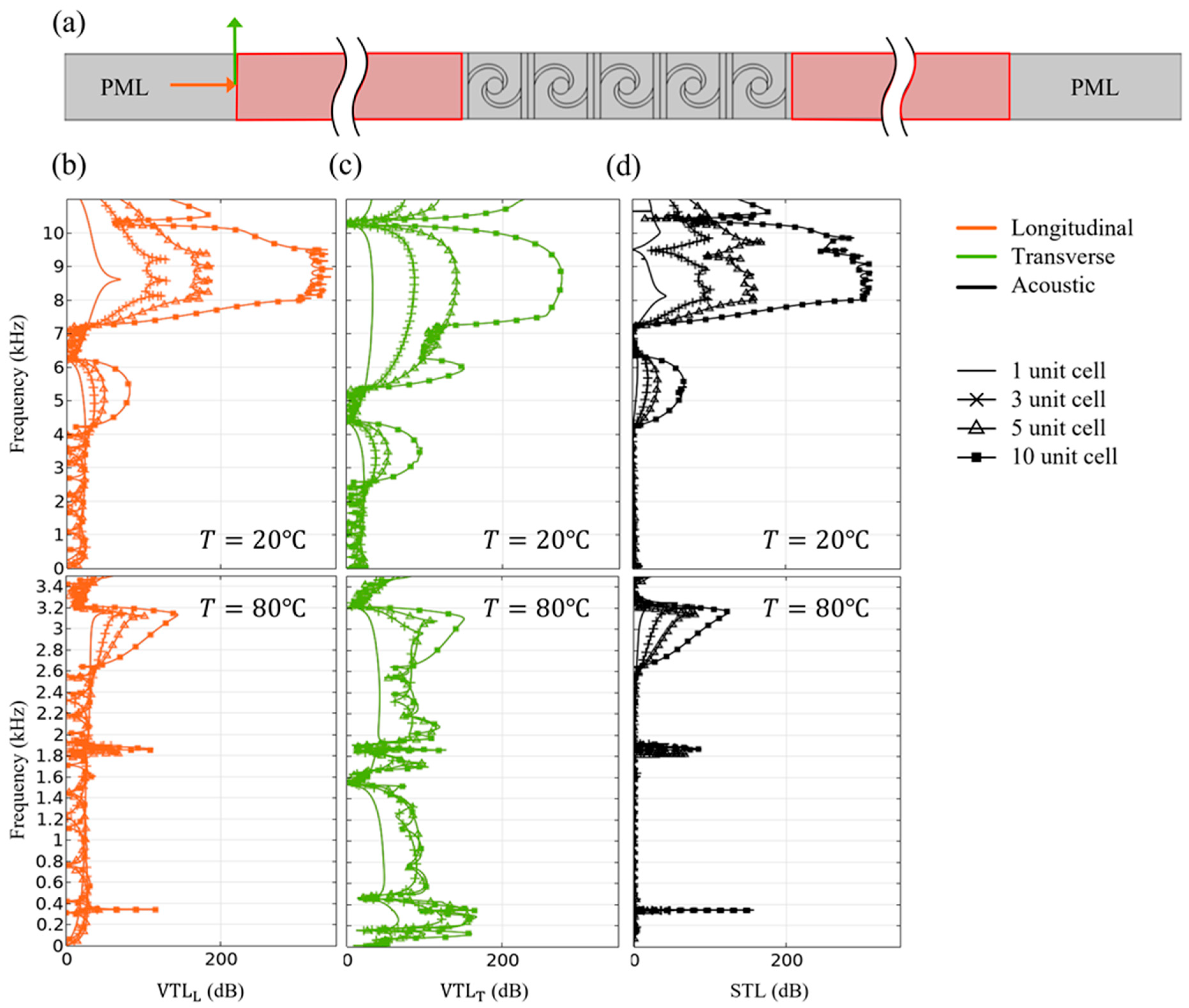
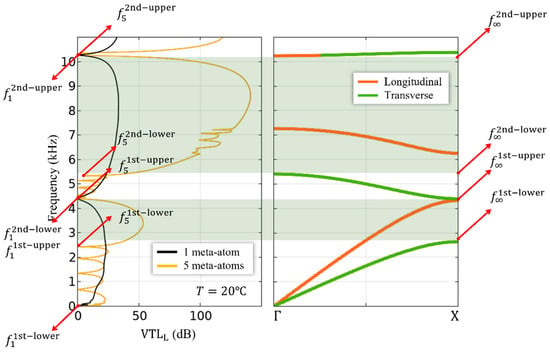
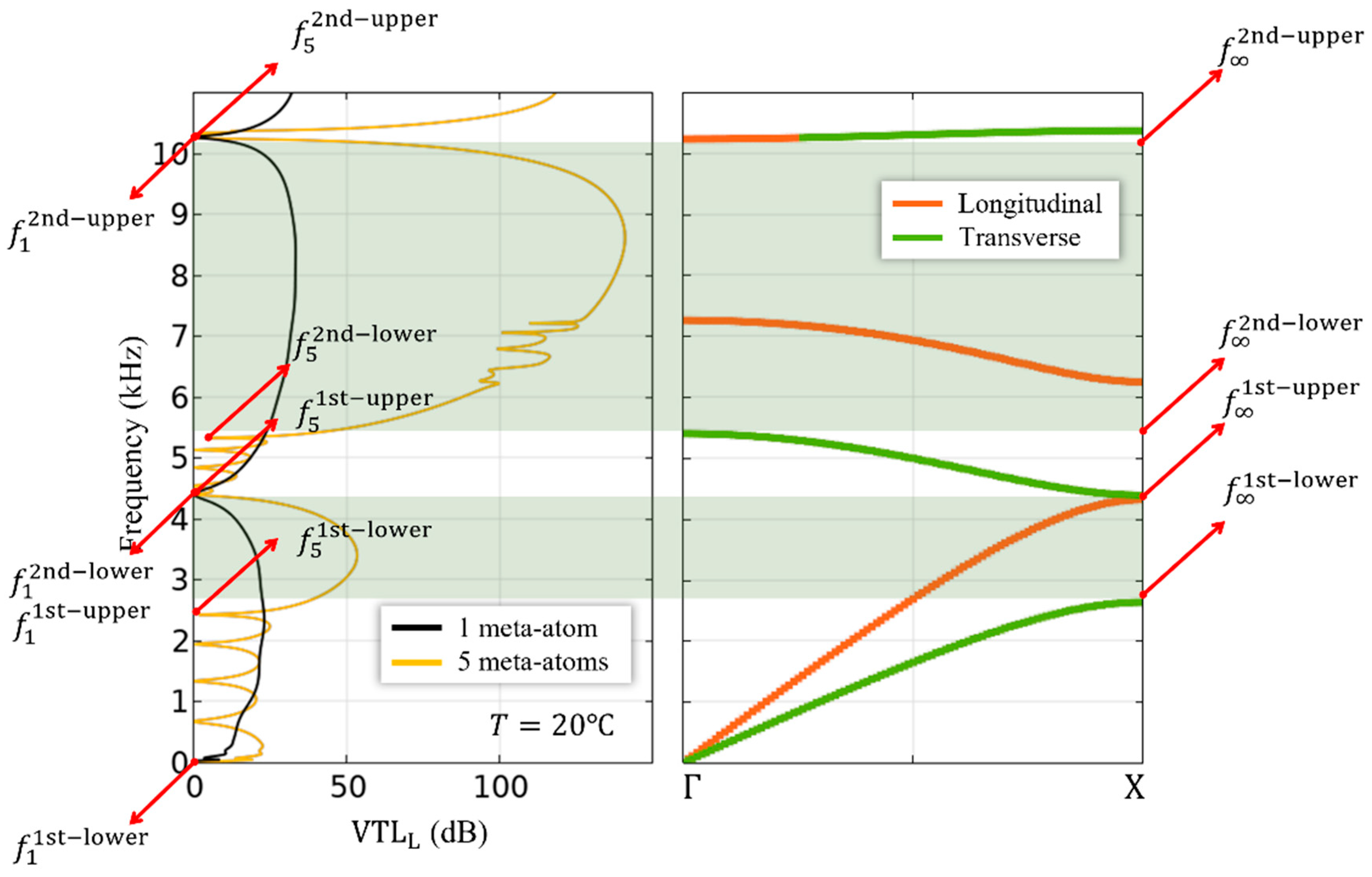
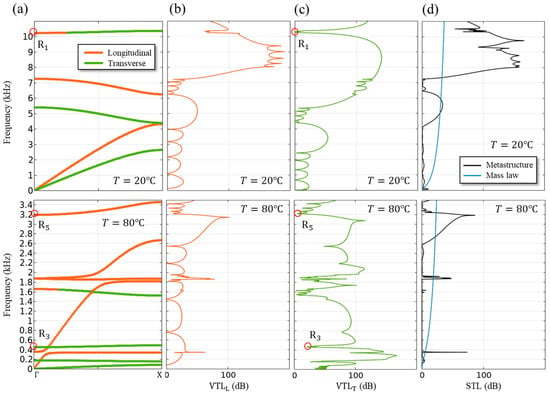
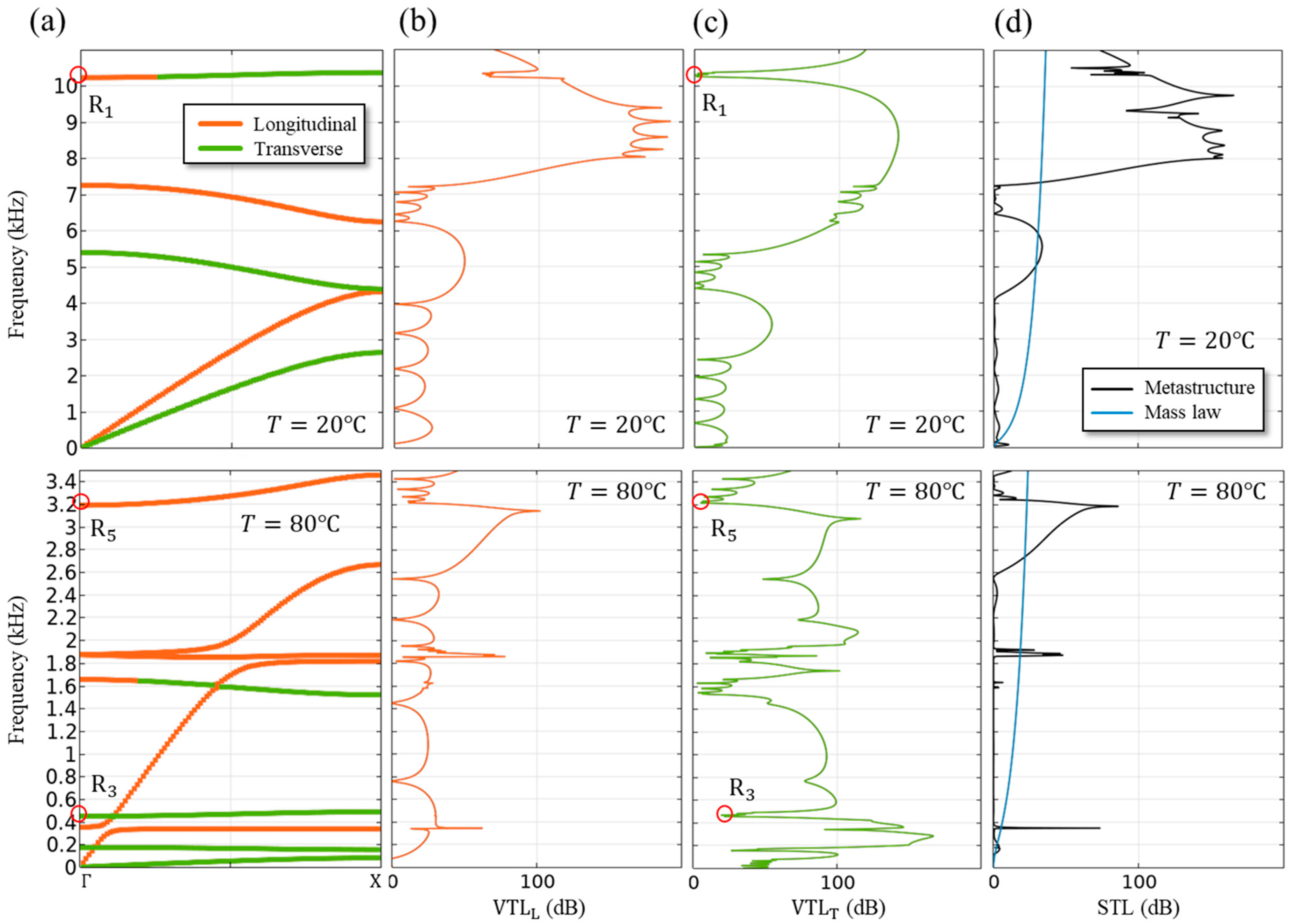
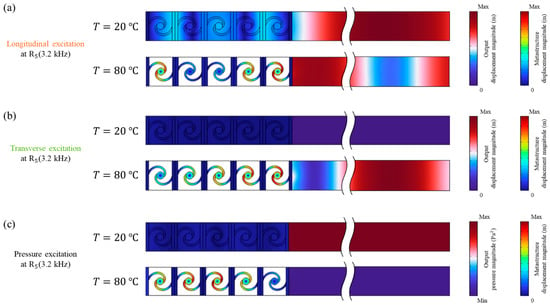
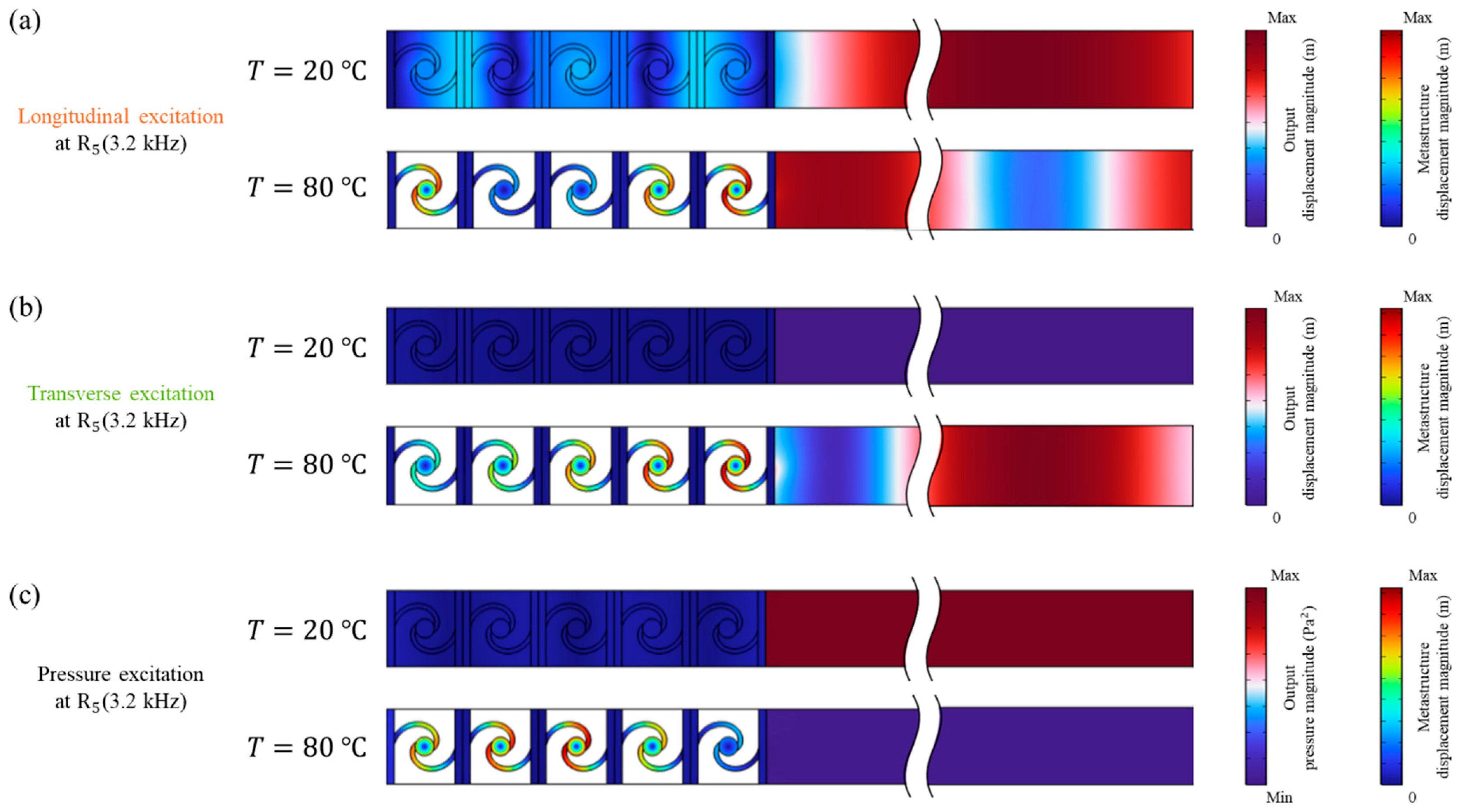
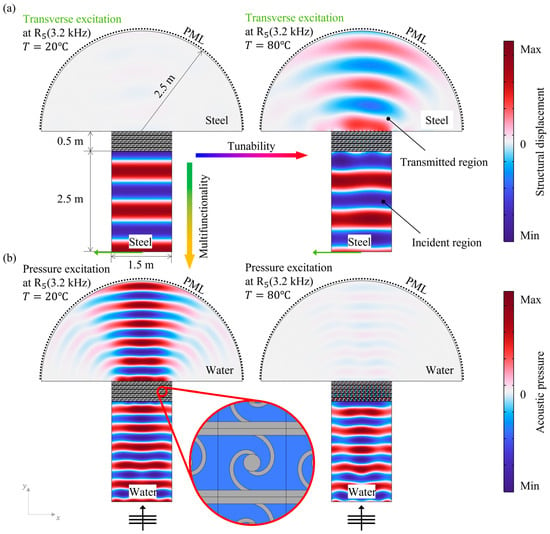
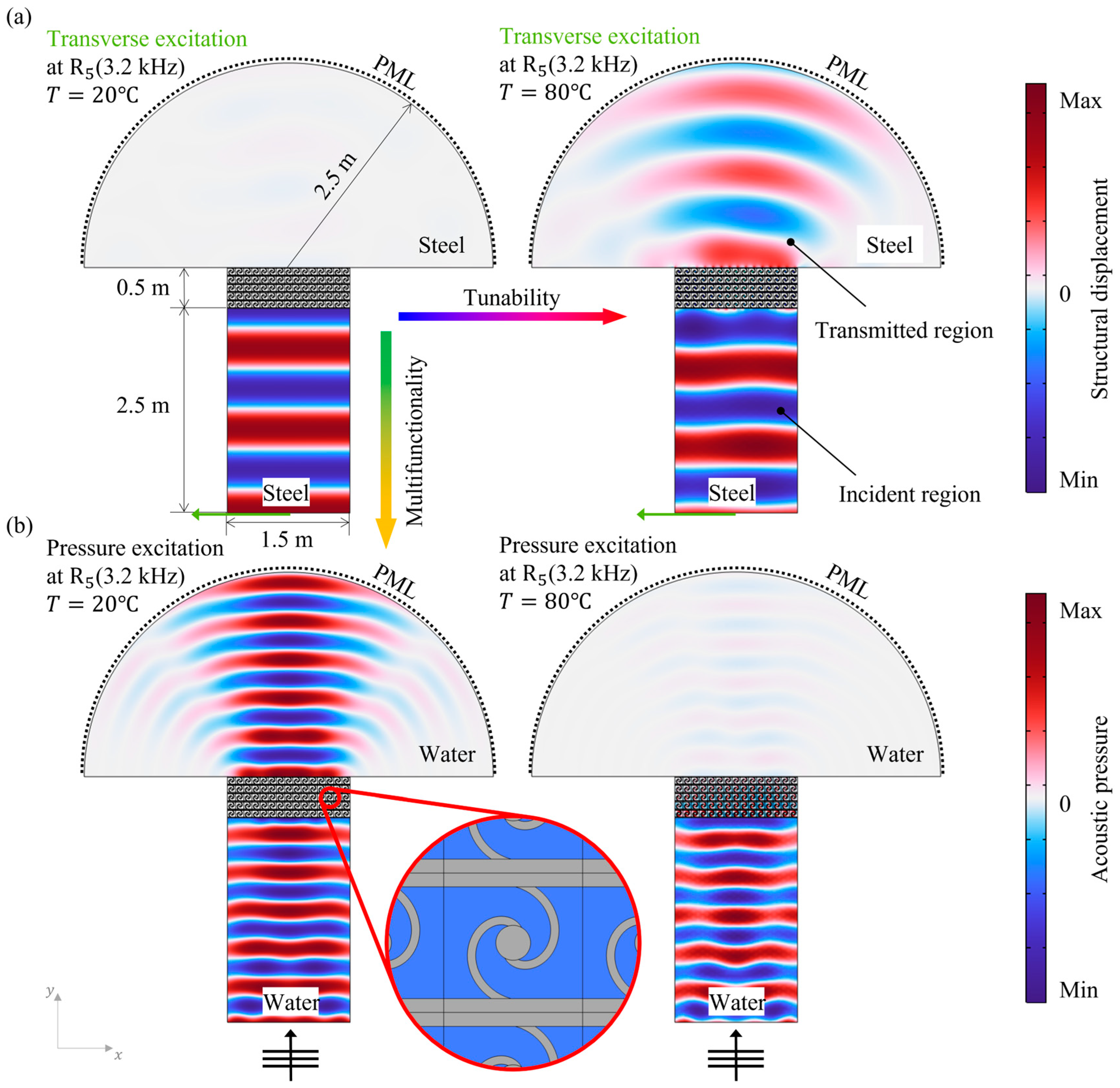
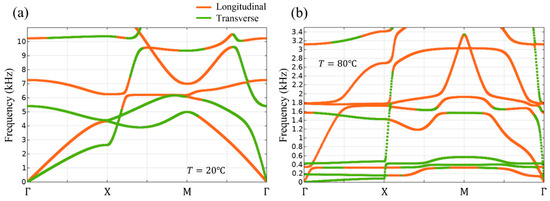
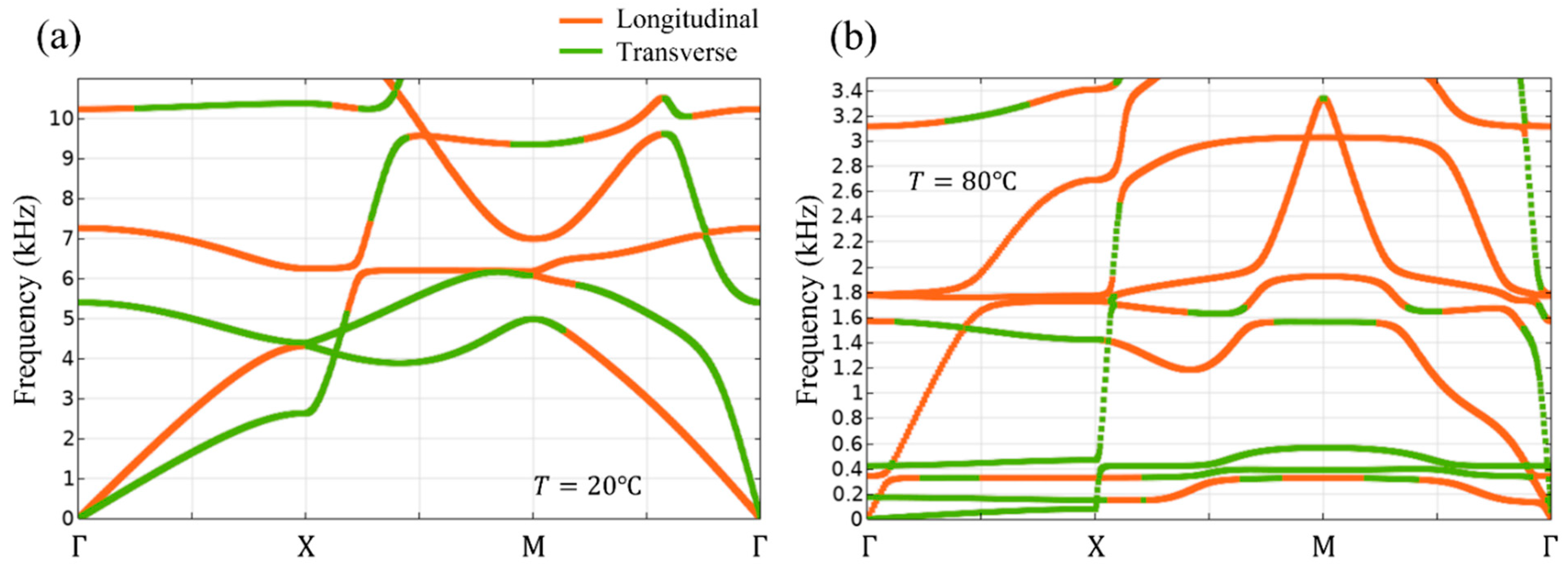

Disclaimer/Publisher’s Note: The statements, opinions and data contained in all publications are solely those of the individual author(s) and contributor(s) and not of MDPI and/or the editor(s). MDPI and/or the editor(s) disclaim responsibility for any injury to people or property resulting from any ideas, methods, instructions or products referred to in the content. |
© 2026 by the authors. Licensee MDPI, Basel, Switzerland. This article is an open access article distributed under the terms and conditions of the Creative Commons Attribution (CC BY) license.