1. Introduction
The approximation of functions on unbounded intervals via positive linear operators has been a subject of continuous research for many years. One of the earliest and most important constructions in this direction is the Szász–Mirakyan operator, which provides approximation of functions on the interval . Since its introduction, The operator and its extensions have been widely examined in the literature, and different modifications have been proposed in order to improve approximation properties or to preserve certain test functions.
One of the early contributions to approximation by positive linear operators on infinite intervals is due to [
1]. Later, quantitative estimates and rates of convergence were studied in [
2]. A significant development in the theory of positive linear operators is the idea of preserving special test functions. This approach has led to various modified operators with improved approximation behavior. In the setting of Szász–Mirakyan-type operators, several modifications have been proposed to obtain better approximation properties. For instance, such developments were studied in [
3]. Further generalizations and convergence results for positive linear operators can be found in [
4].
Another important direction is the construction of operators preserving exponential-type functions. A class of Szász–Mirakyan operators preserving the function
was introduced in [
5]. Later, Durrmeyer-type modifications preserving exponential functions were considered in [
6], and approximation properties of such operators in different settings were investigated in [
7]. In a recent study, Ulusoy Ada and Aral [
8] examined weighted approximation by Szász–Mirakyan–Durrmeyer operators that reproduce exponential functions. Related recent developments on exponential-type preserving operators can also be found in [
9,
10,
11].
Recent studies have also focused on distribution-based generalizations of Szász-type operators. An example of such an approach can be found in [
12]. Other recent contributions involve beta-type, gamma-type, and Appell-type modifications; see, for instance, the works in [
13,
14,
15], where different integral and exponential generalizations were analyzed on unbounded intervals.
Among the exponential-type modifications, a Szász–Mirakyan operator preserving the function
was introduced in [
16], and quantitative approximation results were obtained by using moment-generating functions. Their construction shows that preserving suitable exponential functions leads to improved approximation behavior. Other related results on exponential-type and Kantorovich or bivariate modifications can be found in [
17,
18,
19,
20].
Motivated by this approach, we construct a new family of Szász–Mirakyan-type operators. While the above construction preserves a single exponential function
, the operators proposed here are designed to preserve two exponential functions simultaneously. This leads to a more flexible exponential reproduction structure and provides a continuous transition between different exponential behaviors, a feature not present in earlier exponential-preserving Szász–Mirakyan constructions. Moreover, for special choices of the parameter sequence, the proposed operators reduce to the operator introduced in [
16] as well as to the classical Szász-type operators. We study the basic moments of the operators, establish quantitative approximation results, and derive Voronovskaja-type asymptotic formulas. In addition, a saturation-type result is obtained and several numerical examples are presented to illustrate the theoretical findings.
2. Definition of the Operators
In what follows, we work with the space of continuous functions for which the limit exists and is finite. This space is equipped with the uniform norm .
For
and
, let
denote the Poisson-type basis functions.
Let
be fixed and define
For each
, we formulate the operator
by
Let
be a sequence with
for all
. Based on the operators
and
, we define a new sequence
by
Since both
and
are positive linear operators, the same properties hold for
. In addition, the constant function is reproduced. Indeed, for
we have
which implies
. Consequently,
The operators
can be viewed as a particular example of mixed positive linear operators obtained as a convex combination of two basic operators. In general, the approximation properties of such mixed operators are closely related to the corresponding properties of their constituent operators. In this framework, the present construction provides a concrete example in which the convergence behavior, moment estimates, and asymptotic properties of
are derived from those of
and
, combined through the parameter sequence
.
Remark 1. The operators admit a natural probabilistic representation. Indeed, let K be a Poisson random variable with parameterThen Consequently, the operators can be written as a convex combination of two Poisson-type expectationswhere and are Poisson random variables with parameters and , respectively. This representation clarifies that is a mixed operator obtained as a convex combination of two Poisson-type operators. 3. Exponential Reproduction Properties
For a fixed
, the operators
reproduce the function
, that is,
Indeed, using the definition of
,
Since
, we get
Finally, by the definition of
,
.
Proposition 1. For all , the operators satisfyand Proof. The statement follows directly from the definition of together with the result obtained above. □
Remark 2. The sequence plays the role of a weighting parameter that controls the transition between the two underlying operators and .
In the extreme cases, if , then , while if , then . Thus, the operators reduce to the corresponding single exponential-type operators.
For intermediate values , the operators provide a continuous transition between these two cases. In particular, the contribution of each exponential behavior is regulated by , allowing a gradual interpolation between the corresponding exponential behaviors.
This mechanism explains the flexibility of the proposed operators and shows how the parameter sequence can be used to tune the approximation behavior depending on the structure of the function to be approximated.
This transition mechanism provides additional flexibility in approximation problems involving functions with multiple exponential components. In contrast to classical operators preserving a single exponential function, the operators allow a balanced treatment of different exponential behaviors through the parameter sequence . This makes the proposed construction more suitable for approximating functions that simultaneously exhibit different exponential decay rates.
Remark 3. The operators and are closely related to the exponential functions and , respectively. In particular, these operators are constructed in such a way that they reproduce the corresponding exponential behavior.
However, the combined operators do not reproduce these exponential functions exactly in general. Instead, they approximate them with an error of order . More precisely, for , This shows that the operators provide a good approximation for these exponential functions, while allowing a balance between the two exponential behaviors.
Remark 4. For the operators , the first and second central moments are given by Using the definition , we obtainand In particular, for fixed , we have 4. Main Results
Denote by the Banach space consisting of all real-valued continuous functions on that admit a finite limit at infinity, endowed with the supremum norm.
General convergence results for positive linear operators on this space were obtained by Boyanov and Veselinov [
1]. Subsequently, Holhoş [
2] established the following theorem, which yields a uniform estimate in terms of exponential test functions.
Theorem 1 ([
2]).
Suppose that is a sequence of positive linear operators satisfying the following equalitiesthen In Theorem 1, the modulus of continuity is defined by
5. Quantitative Approximation
A uniform estimate for the approximation error of the operators in is obtained below in terms of the exponential modulus of continuity.
Theorem 2. For every ,whereMoreover, the quantities and satisfy Proof. The argument relies on the exponential test function method. We first apply the general inequality for positive linear operators, and then estimate the quantities and using the explicit formulas of the operators.
Since each
is positive, linear, and preserves constants, the standard exponential-test-function estimate yields
It remains to bound
and
.
From the explicit formula of
obtained above, we write
Moreover,
and
Hence
Therefore,
Using
for
and
, we obtain
Consequently,
Similarly,
Using the corresponding explicit formula obtained above, we have
Hence
Using
for
and
, we get
Taking supremum over
and using
and
, we obtain
and therefore
In conclusion, the bounds for and inserted into the above estimate yield the desired result. □
Remark 5. If for all , then the operator sequence reduces toIn this case, the operators coincide with the modified Szász–Mirakyan operators studied by Gupta and Malik [16]. Consequently, the quantitative estimate obtained in the above theorem reduces to the corresponding convergence result established for that operator. This shows that the present operator family genuinely extends that construction. Remark 6. If for all , thenIn this case, the operator preserves the exponential function exactly. The approximation behavior then corresponds to that of a Szász–Mirakyan-type operator associated with the parameter (see [21]). Remark 7. The parameter sequence provides a transition between two different exponential regimes. While the choice yields the Gupta–Malik operator preserving , and leads to an operator preserving , intermediate values of produce a convex combination of these two operators and thus an interpolation between the two exponential behaviors. This flexibility is reflected both in the quantitative estimate of the main theorem and in the explicit boundswhich show how the convergence rate depends on the choice of . 6. Voronovskaya-Type Asymptotic Formula
The asymptotic behavior of the operators is studied in this part. First, we obtain a first-order Voronovskaya-type limit relation. Then, we refine this result by deriving a second-order asymptotic expansion.
Theorem 3. Let for all and assume that as . If , then for each fixed we have Proof. Fix
. For
, the Taylor expansion of
f around
x yields
where
for some
lying between
x and
t.
Applying the operator
to the above identity and using its linearity, we obtain
where
From the known moment formulas of the Poisson-type kernel, we have
Consequently,
Using the expansion
it follows, for fixed
x, that
We now estimate the remainder term. From the definition of
and the mean value form of the remainder, we have
where
lies between
x and
t.
Using the exponential-type modulus of continuity for
, we get
Since
is 1-Lipschitz on
, it follows that
Therefore,
Applying
and using positivity, we obtain
for a positive constant
.
Using the fourth central moment of the Poisson kernel (see, e.g., [
22]),
Choosing
gives
Finally, multiplying (
1) by
n and letting
n go to infinity, we get the desired result. □
Remark 8. The above result can be seen as an extension of the classical Voronovskaya theorem for Szász–Mirakyan operators. In the classical case, the asymptotic formula involves the term In contrast, for the operators , the coefficient of depends on the parameter θ, leading to the term This shows that the asymptotic behavior of is influenced by the parameter sequence , which allows a continuous transition between different operator structures. Hence, the obtained Voronovskaya-type formula reflects the specific structure of the proposed operators.
Remark 9. If , then and Theorem 3 reduces to the Voronovskaya-type result corresponding to the modified Szász–Mirakyan operators studied by Gupta and Malik. In this case, the limit formula takes the formwhich coincides with the asymptotic behavior obtained in [16]. Remark 10. If , then and Theorem 3 yieldswhich corresponds to the Voronovskaya-type asymptotic formula for a Szász–Mirakyan-type operator preserving the exponential function . Remark 11. For intermediate choices of with , Theorem 3 describes a continuous transition between the above two extreme cases. The parameter θ explicitly controls the contribution of the first-order term in the limit formula, while the coefficient of remains unchanged. This highlights the role of the sequence as a genuine shape parameter in the asymptotic behavior of the operators .
Theorem 4. Assume that and that with as . Then, for every fixed ,where Proof. Fix
. The Taylor expansion of
f at
x up to order four gives, for
,
where
denotes the remainder term. As in the proof of Theorem 3,
is given by the mean value form of the remainder.
Applying the operator
to the above expansion and using linearity, we arrive at
where
.
For
, recall that
Since
we obtain
and therefore
By using the central moments of the Poisson-type kernel up to order four (see, e.g., [
22]) together with (
3), a straightforward computation gives
Passing to the operators
and using the assumptions
and
, we obtain
We next control the remainder term. Since
by positivity of
we have
Using the exponential modulus inequality for
, for any
,
Moreover, the map
is 1-Lipschitz on
, hence
. Therefore,
Multiplying by
yields
From the sixth central moment of the Poisson-type kernel (see, e.g., [
22]), it follows that
Choosing
yields
Multiplying (
2) by
n, subtracting
, and multiplying once more by
n, we obtain the required limit. □
Theorem 4 gives a refined pointwise asymptotic description of the operators under stronger smoothness assumptions on the function f. In particular, when higher derivatives of f exist, the theorem identifies the next term after the first-order behavior in the asymptotic expansion. This shows that a more precise pointwise rate of convergence can be obtained beyond the first Voronovskaya-type formula. An important feature here is that this refinement is derived by using polynomial central moments of the operators. In particular, the control of the remainder term is reduced to the estimate of the fourth central moment, which is sufficient for the proof.
7. A Saturation-Type Result
The next result characterizes the saturation class of the operators by determining all functions for which the approximation error is of order .
Theorem 5. Let and assume that . If andthen f must be of the formfor some constants . Proof. Fix
. The assumption
implies that
Conversely, by Theorem 3,
Combining these relations, we obtain
For
, this reduces to
Denote
. Then
g satisfies
whose solution is
for some constant
. By integrating, we arrive at
with suitable constants
. Continuity at
extends this representation to the whole interval
. □
Remark 12. The above result shows that a convergence rate faster than can only be achieved for a very restricted class of functions. In fact, the conditionimplies that f must be of the form Thus, this condition is highly restrictive and holds only for functions with a very specific structure. In particular, for general functions, the rate of approximation cannot be improved beyond order .
This result reflects a saturation phenomenon for the operators , showing that is the optimal rate of convergence in this setting.
8. Numerical Results and Applications
Here, we present numerical examples that show the approximation behavior of the operators
defined in
Section 2.
The aim of these examples is not to provide a numerical proof of the theoretical results, but rather to visualize the convergence properties and the influence of the parameters involved.
As a test function, we consider
This choice is motivated by the fact that it combines a polynomial term, which reveals the typical behavior of Szász–Mirakyan-type operators, together with exponential terms that are closely related to the reproduction properties discussed in
Section 3.
We first fix the parameter
and compare the graphs of
f and
for different values of
n.
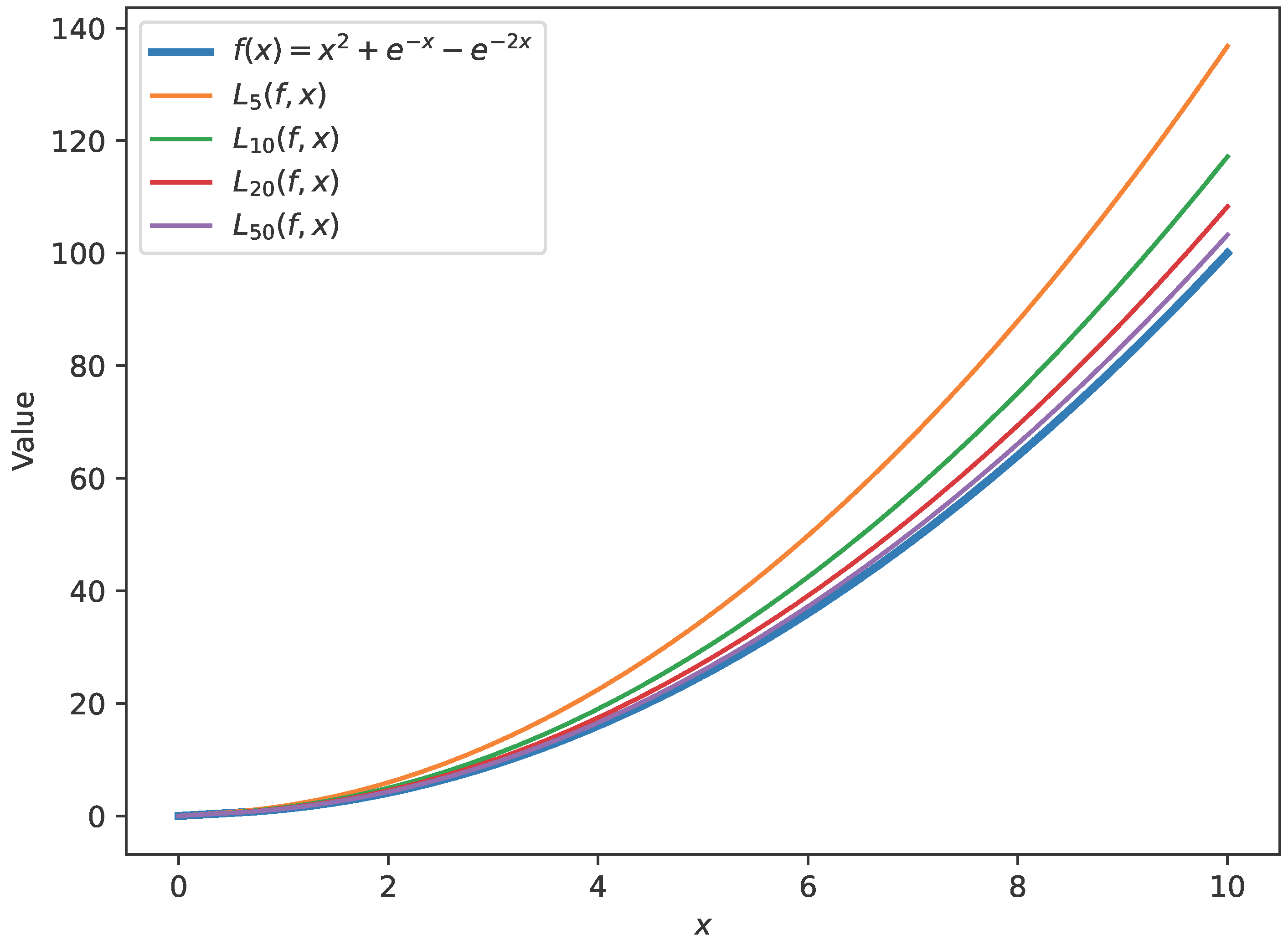
Figure 1 shows that, for moderate values of
n, the operators
provide a good approximation to
f, and the quality of approximation improves as
n increases. The separation of the curves for smaller values of
n clearly illustrates the convergence process.
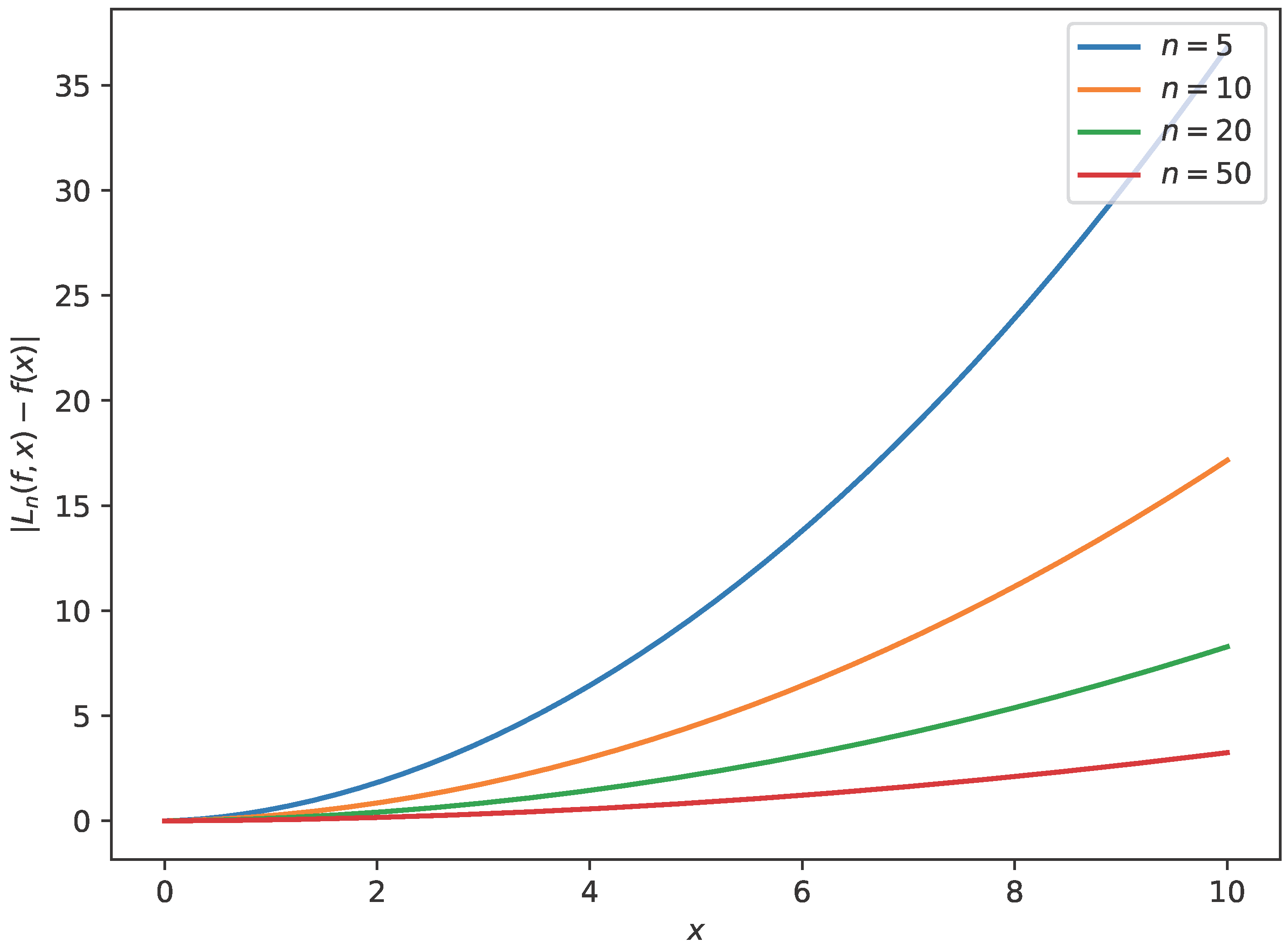
In order to further emphasize the convergence behavior, we plot in
Figure 2 the absolute approximation error
for the same values of
and
n. The error is observed to decrease as
n increases, in accordance with the theoretical approximation results derived in the previous sections.
This behavior is consistent with the theoretical rate of convergence and confirms that the operators provide stable and reliable approximation. Moreover, the graphical results illustrate how the approximation error is distributed over the interval, showing that the operators perform particularly well on regions where the function exhibits exponential behavior.
To complement the graphical illustrations, we present pointwise absolute errors at selected nodes in
Table 1. The numerical values clearly show that the approximation error decreases as
n increases, which is consistent with the theoretical convergence results.
In order to further demonstrate the usefulness of the proposed operators, we briefly compare their approximation behavior with that of the classical Szász–Mirakyan operators.
It is well known that the classical Szász operators do not reproduce exponential functions exactly. In contrast, the operators are constructed to incorporate exponential behavior through the parameters and the underlying structure of the operators and .
For test functions containing exponential terms, such as
the proposed operators provide a flexible approximation framework that incorporates different exponential behaviors through the parameter sequence
. In this sense, the numerical results and graphical illustrations show that the operators
offer a competitive alternative to the classical Szász operators.
This comparison highlights the advantage of the exponential-preserving framework and confirms that the proposed operators are more suitable for approximating functions with mixed polynomial and exponential components.
The proposed operators may also be useful in applications involving functions with exponential decay or growth, which frequently arise in probability theory, physics, and engineering. For example, in signal processing, exponentially decaying signals appear in various contexts such as damping and transient responses. In many such cases, combinations of exponential terms with different decay rates are involved. The flexibility of the operators , provided by the parameter sequence , allows a more effective approximation of such functions compared to classical operators designed to preserve only a single exponential behavior.
9. Conclusions
A new family of Szász–Mirakyan-type operators based on a convex combination structure is introduced. The proposed operators are designed to reproduce two exponential functions and provide a continuous transition between different exponential behaviors. Basic moments, quantitative approximation results, and Voronovskaja-type asymptotic formulas were obtained. It was also shown that, for suitable choices of the parameter sequence, the operators reduce to the Gupta–Malik operator and to classical Szász-type constructions.
In this paper, we analyzed the role of the parameter sequence in controlling the transition between different exponential behaviors. The numerical results support the theoretical findings and illustrate the convergence behavior of the operators and reflect the role of the parameter sequnece . The proposed construction provides a flexible framework for approximating functions involving multiple exponential components.
The present work also suggests several directions for future research. One possible extension is to consider convex combinations of more than two operators in order to preserve a richer class of exponential functions. Another natural direction is to investigate Kantorovich, Durrmeyer, or Baskakov-type variants of the proposed operators, which may be useful in approximation problems on different function spaces. These directions may lead to further developments of the proposed framework.