Active Earth Pressure in Unsaturated Retaining Walls Influenced by Vegetation Root
Abstract
1. Introduction
2. Modeling of Root Reinforcement and Transpiration
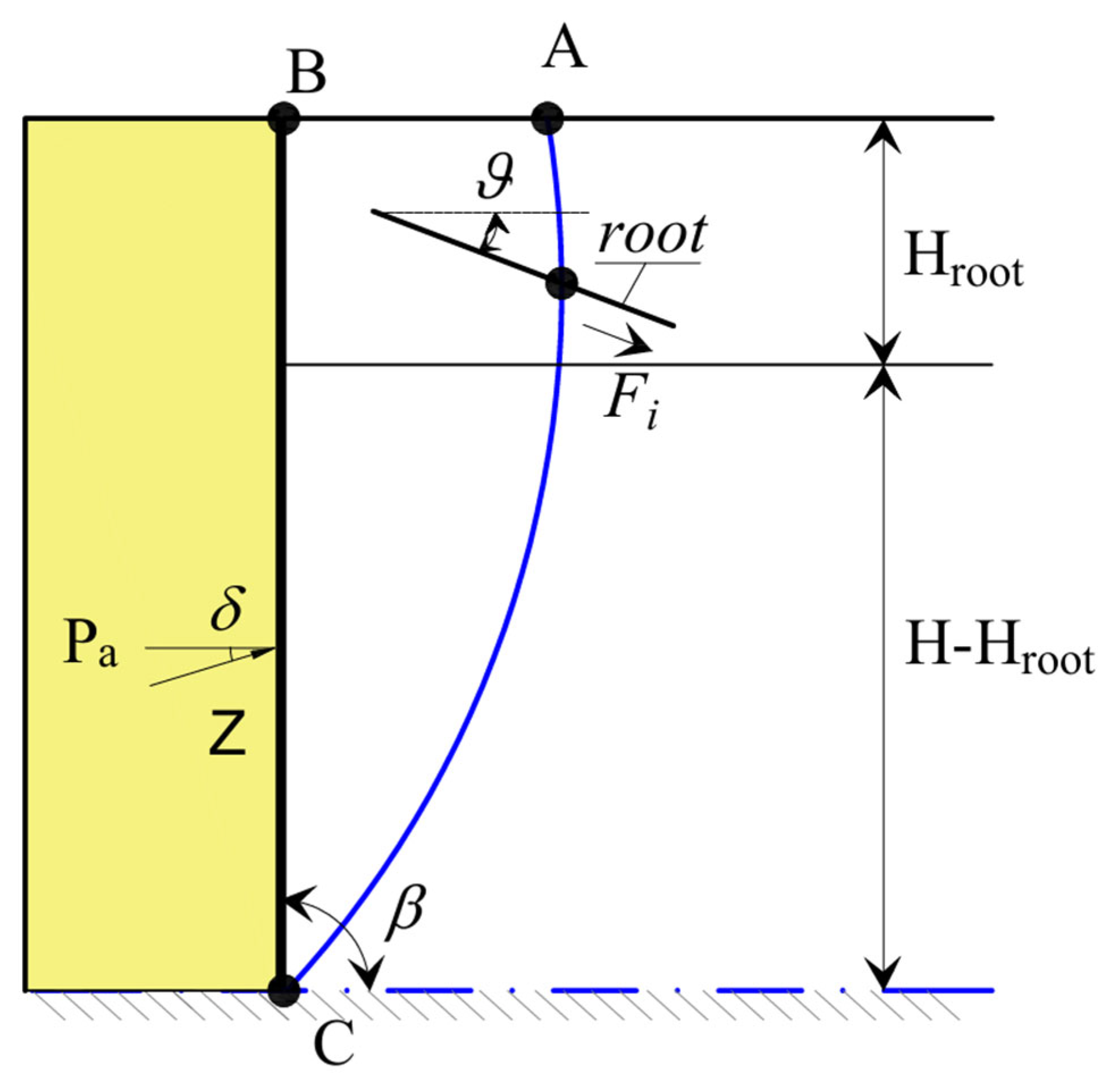
2.1. Mechanical Mechanism of Root Pull-Out Resistance
2.2. Influence of Plant Transpiration on the Hydraulic State of Backfill Soil
2.2.1. Physical Nature of Transpiration
2.2.2. Governing Equation for Transpiration-Induced Flow
2.2.3. Two-Layer Analytical Solution for the Root and Non-Root Zones
2.3. Formulation of Transpiration-Induced Suction Stress
2.4. Energetic Interpretation of Vegetation Effects
3. Active Earth Pressure with Vegetation Effects
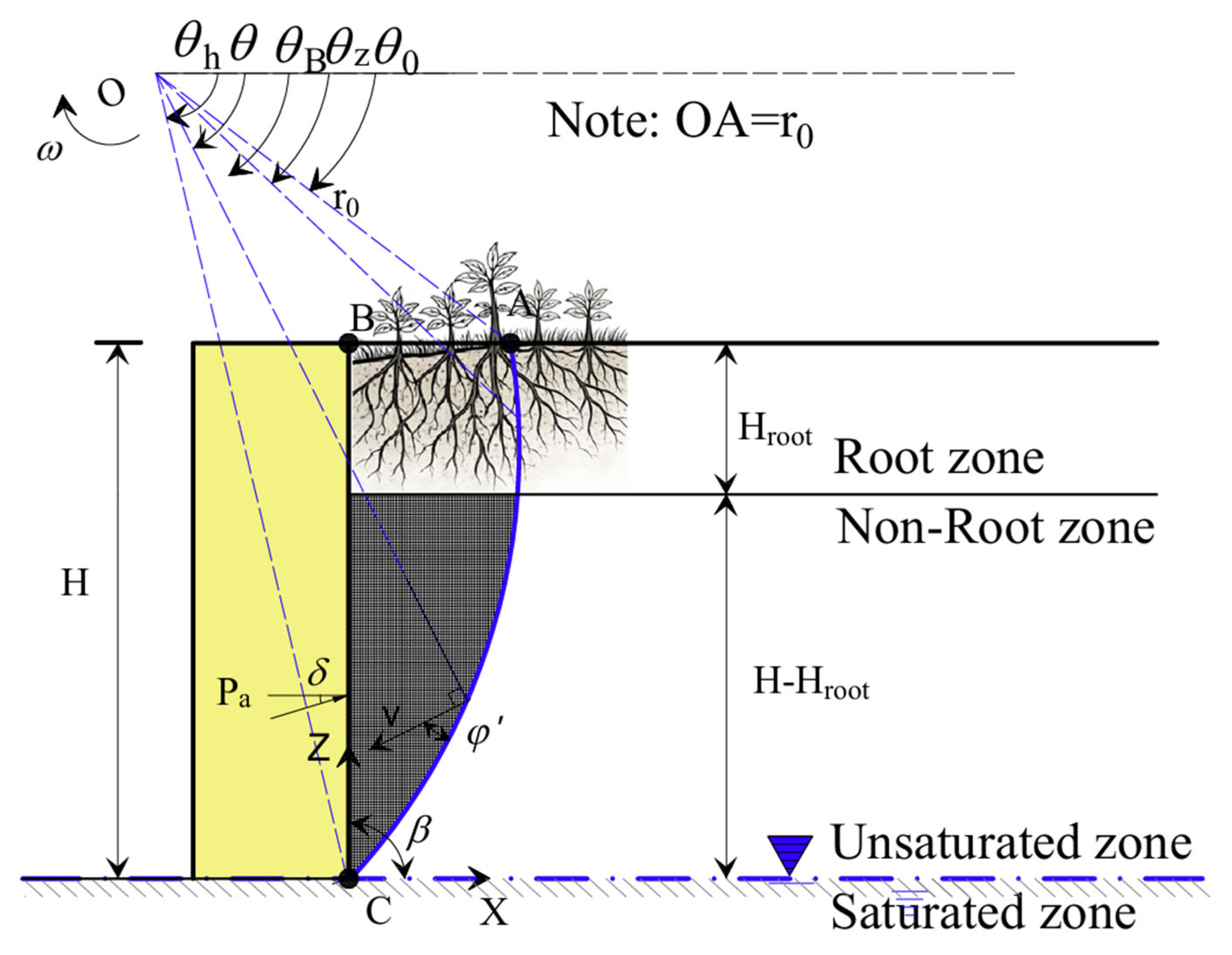
3.1. Theoretical Framework and Failure Mechanism
3.2. Power Balance Equation and Energy Dissipation Analysis
3.3. Work of Soil Self-Weight and Cohesive Energy Dissipation
3.4. Formulation of Energy Dissipation Due to Root Pull-Out
3.5. Formulation of Energy Dissipation Due to Transpiration-Induced Suction Stress
3.6. Expressions for Active Earth Pressure and Its Coefficient
4. Parametric Design Charts and Discussion for Vegetated Retaining Walls
4.1. Study Framework, Parameter Ranges and Benchmark Checks
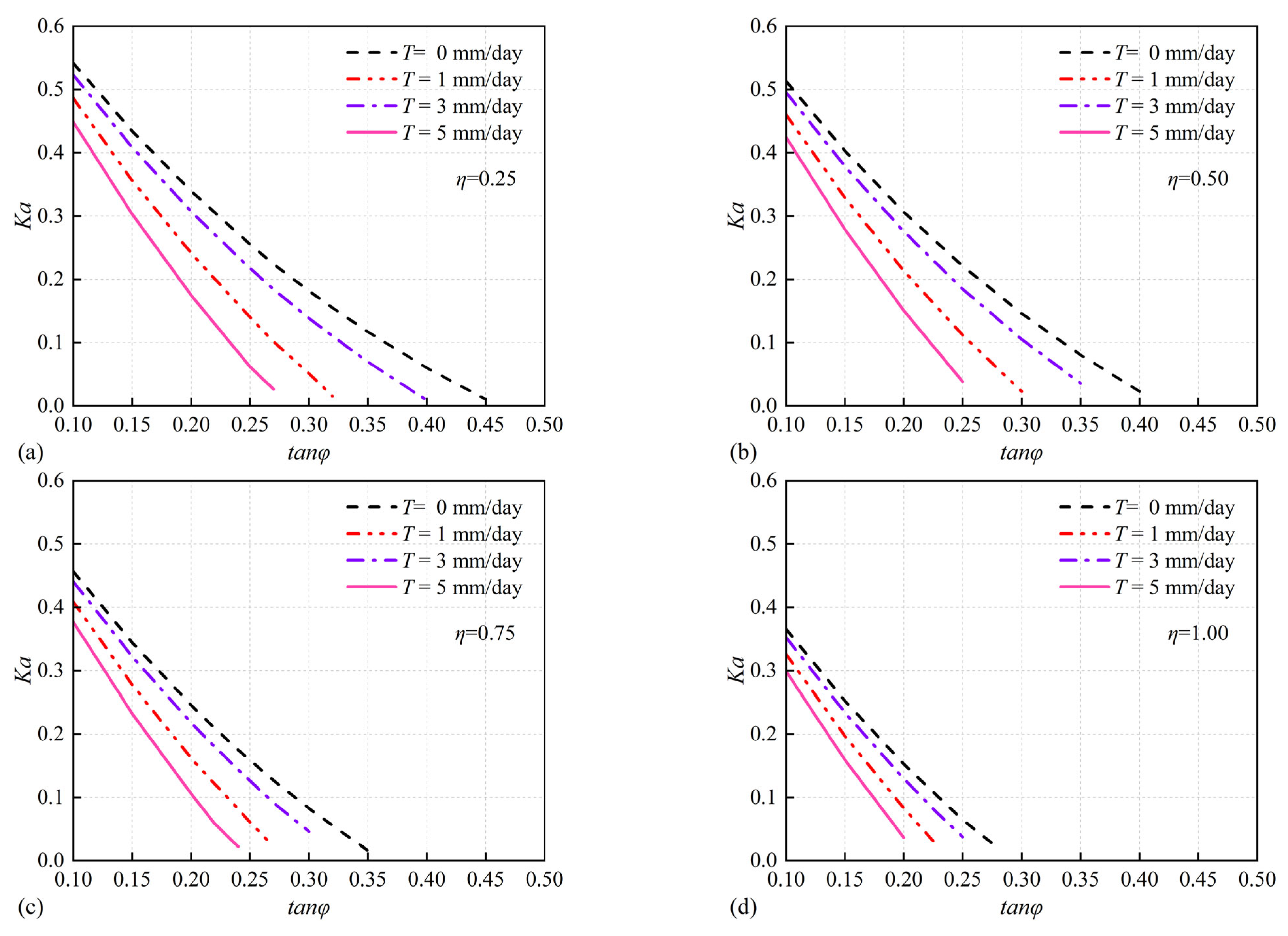
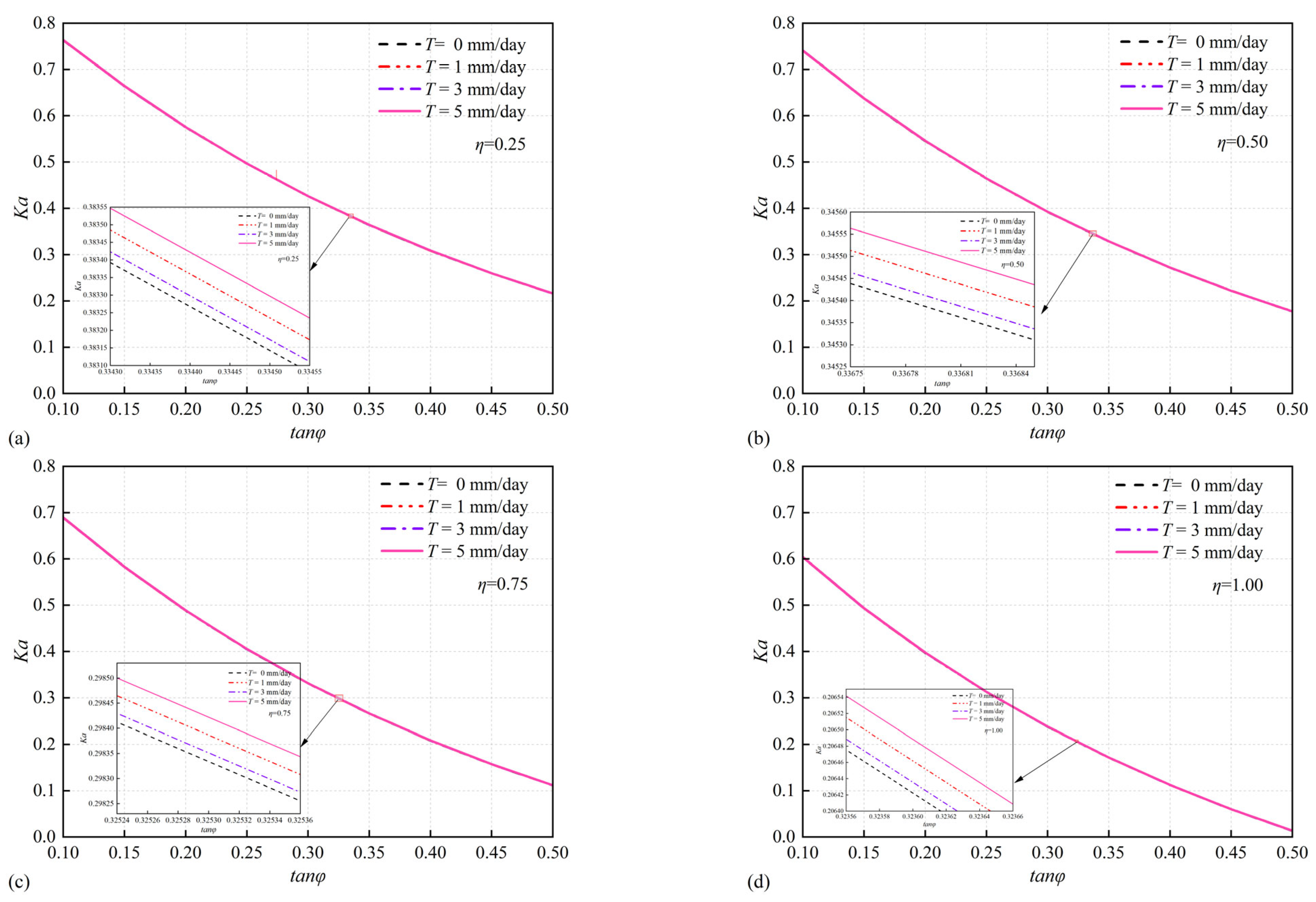
4.2. Frictional Strength Effects and Coupled Vegetation Actions
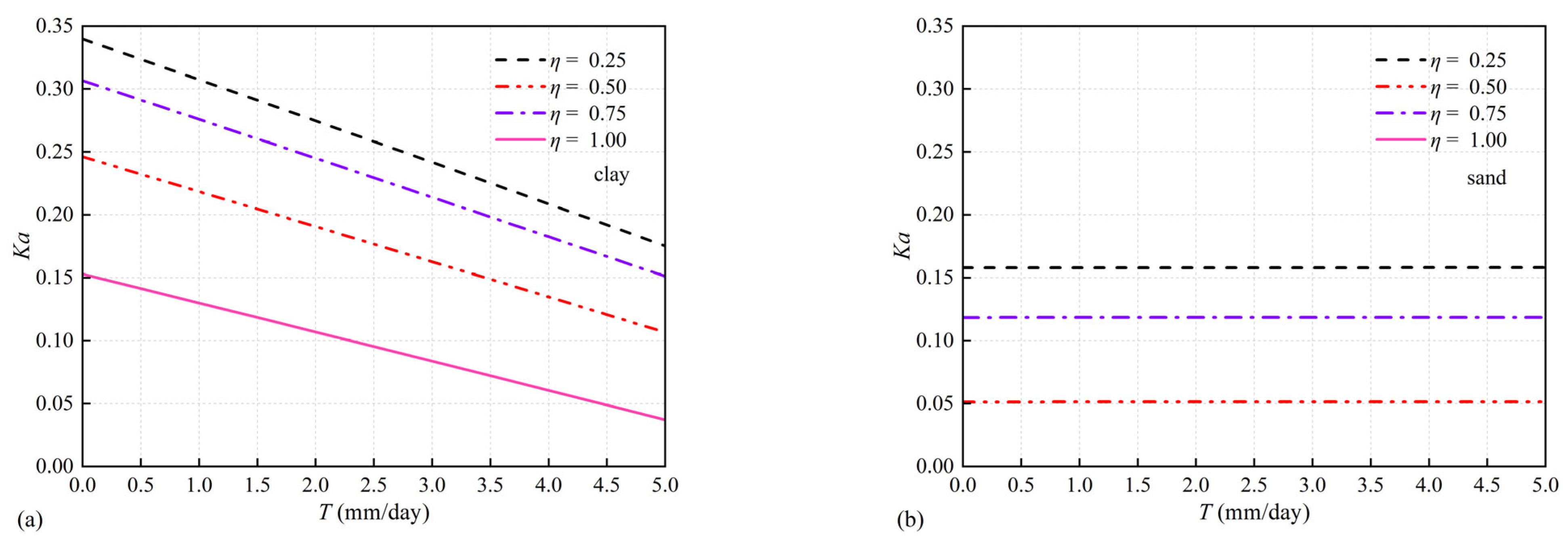
4.3. Sensitivity to Transpiration Rate: –T Curves at Multiple Rooting Heights
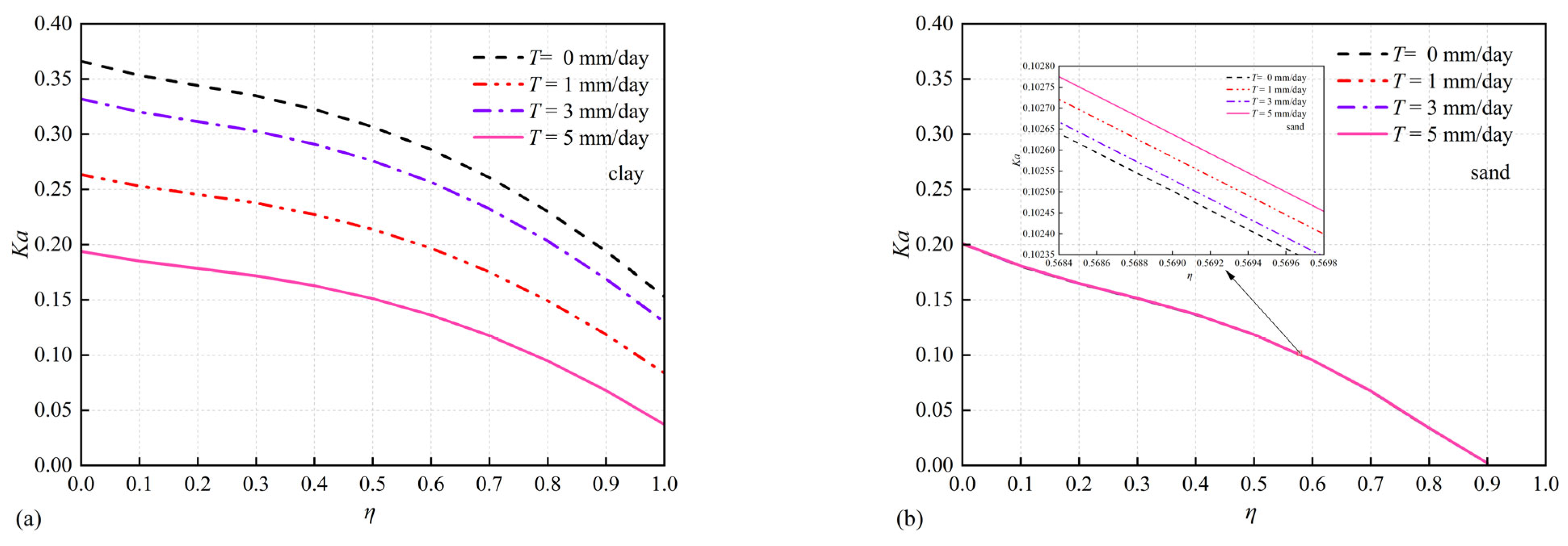
4.4. Rooting-Height Effectiveness and Diminishing Returns Under Varying Transpiration
4.5. Root Architecture Controls: RAR–Diameter Trade-Off and Equivalent Configurations
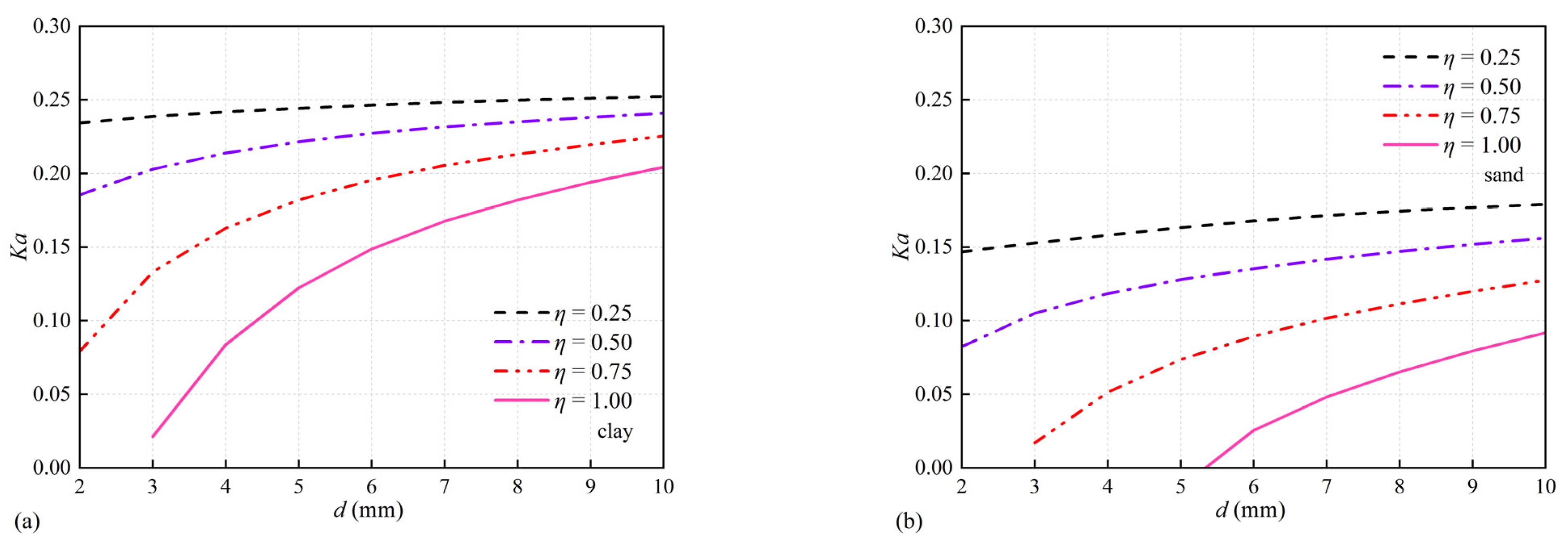
4.5.1. Constant RAR, Varying d
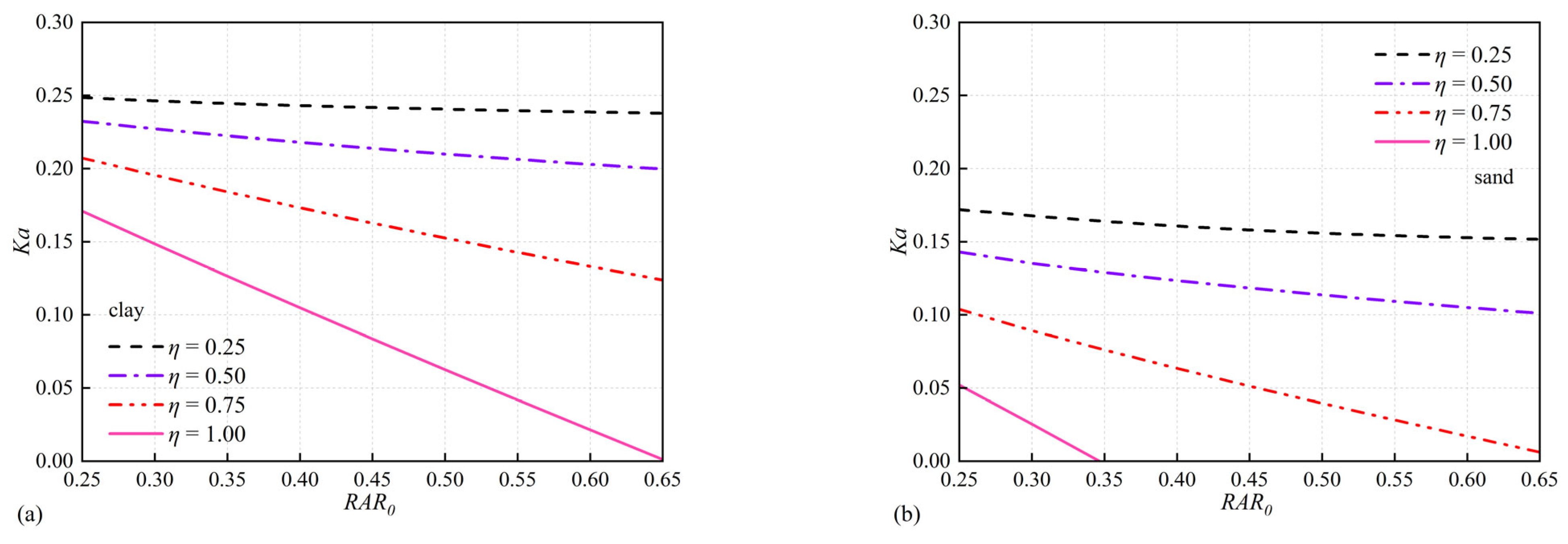
4.5.2. Constant d, Varying RAR
4.6. Engineering Stability Insights, Limitations, and Recommended Use of the Charts
5. Conclusions
- The parametric results show that, for both soil types, Ka decreases monotonically with increasing tanφ′, which is consistent with the classical trend of active earth pressure. Vegetation provides an additional reduction in Ka by introducing extra internal dissipation, although the extent of this benefit depends strongly on the hydraulic characteristics of the backfill.
- The influence of transpiration is markedly soil-dependent. In low-permeability clay, Ka decreases systematically as the transpiration rate T increases, indicating that transpiration-induced suction can be effectively mobilized under the adopted steady-state hydraulic condition. By contrast, in high-permeability sand, the variation in Ka with T is negligible within the investigated range, suggesting that transpiration-driven suction does not play a dominant stabilizing role in such backfills.
- The rooting height also has a clear effect on wall stability. Increasing the normalized rooting height, η = Hroot/H, consistently reduces Ka. However, this reduction is generally nonlinear, and the marginal benefit gradually diminishes as η becomes larger. This is because the critical deformation zone is concentrated near the wall, so extending the rooted depth further downward contributes progressively less to the most mobilized part of the failure mechanism.
- Root architecture shows a clear trade-off between root size and root density. At a constant RAR, increasing the root diameter d tends to increase Ka, because the corresponding decrease in root number density reduces the total pull-out dissipation. In contrast, when d is fixed, increasing RAR enhances root density and the integrated pull-out work along the failure surface, leading to a monotonic decrease in Ka.
Author Contributions
Funding
Data Availability Statement
Conflicts of Interest
References
- Cheng, Z.; Zhou, D.; Chen, Q.; Gu, S. Safety Analysis of Subway Station under Seepage Force Using Continuous Velocity Field. Mathematics 2025, 13, 2541. [Google Scholar] [CrossRef] [Scilit]
- Xie, Y.; Zhou, D.; Liao, H.; Zhu, J. Failure Mode of Tunnel Face under Transient Unsaturated Seepage with Temperature Influence. Mathematics 2025, 13, 1311. [Google Scholar] [CrossRef] [Scilit]
- Greenwood, J.R.; Norris, J.E.; Wint, J. Assessing the contribution of vegetation to slope stability. Geotech. Eng. 2004, 157, 199–207. [Google Scholar] [CrossRef]
- Lann, T.; Bao, H.; Lan, H.; Zheng, H.; Yan, C.; Peng, J. Hydro-mechanical effects of vegetation on slope stability: A review. Sci. Total Environ. 2024, 926, 171691. [Google Scholar] [CrossRef] [Scilit]
- Shan, J.T.; Yang, X.L.; Xia, L.; Long, G.H.; Yang, B.Y.; Ren, L.W. Influence of plant root reinforcement on 3D geosynthetic slopes. J. Cent. South Univ. 2026. [Google Scholar] [CrossRef] [Scilit]
- Lobmann, M.T.; Geitner, C.; Wellstein, C.; Zerbe, S. The influence of herbaceous vegetation on slope stability—A review. Earth-Sci. Rev. 2020, 209, 103328. [Google Scholar] [CrossRef] [Scilit]
- Wu, T.H. Root reinforcement of soil: Review of analytical models, test results, and applications. Can. Geotech. J. 2013, 50, 259–274. [Google Scholar] [CrossRef] [Scilit]
- Waldron, L.J. The shear resistance of root-permeated homogeneous and stratified soil. Soil Sci. Soc. Am. J. 1977, 41, 843–849. [Google Scholar] [CrossRef] [Scilit]
- Wu, T.H.; McKinnell, W.P.; Swanston, D.N. Study of soil-root interaction. J. Geotech. Eng. 1988, 114, 1351–1375. [Google Scholar] [CrossRef] [Scilit]
- Smethurst, J.A.; Clarke, D.; Powrie, W. Observed and modelled seasonal changes in pore water pressure in a grass-covered cut slope. Géotechnique 2006, 56, 523–537. [Google Scholar] [CrossRef] [Scilit]
- Leung, A.K.; Ng, C.W.W. Analyses of groundwater flow and plant evapotranspiration in a vegetated soil slope. Can. Geotech. J. 2013, 50, 1204–1218. [Google Scholar] [CrossRef] [Scilit]
- Feng, S.; Liu, H.W.; Ng, C.W.W. Analytical analysis of the mechanical and hydrological effects of vegetation on shallow slope stability. Comput. Geotech. 2020, 119, 103335. [Google Scholar] [CrossRef] [Scilit]
- Switala, B.M.; Wu, W. Modelling the hydrological effects of vegetation on slope stability. Géotechnique 2018, 68, 592–604. [Google Scholar]
- Ng, C.W.W.; Zhang, Q.; Ni, J.; Li, Z. A new three-dimensional theoretical model for analysing the stability of vegetated slopes with different root architectures and planting patterns. Comput. Geotech. 2021, 132, 104020. [Google Scholar] [CrossRef] [Scilit]
- Liu, H.W.; Feng, S.; Ng, C.W.W. Analytical analysis of hydraulic effect of vegetation on shallow slope stability with different root architectures. Comput. Geotech. 2016, 80, 115–120. [Google Scholar] [CrossRef] [Scilit]
- Yang, X.L.; Yin, J.H. Slope stability analysis with nonlinear failure criterion. J. Eng. Mech. 2004, 130, 267–273. [Google Scholar] [CrossRef] [Scilit]
- Yang, X.L.; Huang, F. Collapse mechanism of shallow tunnel based on nonlinear Hoek-Brown failure criterion. Tunn. Undergr. Space Technol. 2011, 26, 686–691. [Google Scholar] [CrossRef] [Scilit]
- Yang, X.L.; Wang, J.M. Ground movement prediction for tunnels using simplified procedure. Tunn. Undergr. Space Technol. 2011, 26, 462–471. [Google Scholar] [CrossRef] [Scilit]
- Lu, N.; Godt, J.W.; Wu, D.T. A closed-form equation for effective stress in unsaturated soil. Water Resour. Res. 2010, 46, W05515. [Google Scholar] [CrossRef] [Scilit]
- Lu, N.; Likos, W.J. Suction stress characteristic curve for unsaturated soil. J. Geotech. Geoenvironmental Eng. 2006, 132, 131–142. [Google Scholar] [CrossRef] [Scilit]
- Cheng, P.; Wu, L.; Zhang, H.; Zhou, J. Inclusion of root water absorption and reinforcement in upper bound limit stability analysis of vegetated slopes. Comput. Geotech. 2024, 170, 106175. [Google Scholar] [CrossRef] [Scilit]
- Li, Z.W.; Yang, X.L. Three-dimensional active earth pressure under transient unsaturated flow conditions. Comput. Geotech. 2020, 123, 103559. [Google Scholar] [CrossRef] [Scilit]
- Van Genuchten, M.T. A closed-form equation for predicting the hydraulic conductivity of unsaturated soils. Soil Sci. Soc. Am. J. 1980, 44, 892–898. [Google Scholar] [CrossRef] [Scilit]
- Gardner, W.R. Some steady-state solutions of the unsaturated moisture flow equation with application to evaporation from a water table. Soil Sci. 1958, 85, 228–232. [Google Scholar] [CrossRef] [Scilit]
- Fredlund, D.G.; Rahardjo, H. Soil Mechanics for Unsaturated Soils; Wiley: New York, NY, USA, 1993. [Google Scholar]
- Bischetti, G.B.; Chiaradia, E.A.; Simonato, T.; Speziali, B.; Vitali, B.; Vullo, P.; Zocco, A. Root strength and root area ratio of forest species in Lombardy (Northern Italy). Plant Soil 2005, 278, 11–22. [Google Scholar] [CrossRef] [Scilit]
- De Baets, S.; Poesen, J.; Reubens, B.; Wemans, K.; De Baerdemaeker, J.; Muys, B. Root tensile strength and root distribution of typical Mediterranean plant species and their contribution to soil shear strength. Plant Soil 2008, 305, 207–226. [Google Scholar] [CrossRef] [Scilit]
- Fan, C.C.; Su, C.F. Role of roots in the shear strength of root-reinforced soils with high moisture content. Ecol. Eng. 2008, 33, 157–166. [Google Scholar] [CrossRef] [Scilit]
- Mickovski, S.B.; Hallett, P.D.; Bransby, M.F.; Davies, M.C.; Sonnenberg, R.; Bengough, A.G. Mechanical reinforcement of soil by willow roots: Impacts of root properties and root failure mechanisms. Soil Sci. Soc. Am. J. 2009, 73, 1276–1285. [Google Scholar] [CrossRef] [Scilit]
- Li, Z.W.; Yang, X.L. Stability assessment of 3D reinforced soil structures under steady unsaturated infiltration. Geotext. Geomembr. 2022, 50, 371–382. [Google Scholar] [CrossRef] [Scilit]
- Yuan, F.; Lu, Z. Analytical solutions for vertical flow in unsaturated, rooted soils with variable surface fluxes. Vadose Zone J. 2005, 4, 1210. [Google Scholar] [CrossRef] [Scilit]
- Ng, C.W.W.; Liu, H.W.; Feng, S. Analytical solutions for calculating pore-water pressure in an infinite unsaturated slope with different root architectures. Can. Geotech. J. 2015, 52, 1981–1992. [Google Scholar] [CrossRef] [Scilit]
- Wu, L.Z.; Zhang, L.M. Analytical solution to 1D coupled water infiltration and deformation in unsaturated soils. Int. J. Numer. Anal. Methods Geomech. 2009, 33, 773–790. [Google Scholar] [CrossRef] [Scilit]
- Yang, X.L.; Yin, J.H. Upper bound solution for ultimate bearing capacity with a modified Hoek-Brown failure criterion. Int. J. Rock Mech. Min. Sci. 2005, 42, 550–560. [Google Scholar] [CrossRef] [Scilit]
- Yang, X.L.; Li, L.; Yin, J.H. Seismic and static stability analysis for rock slopes by a kinematical approach. Geotechnique 2004, 54, 543–549. [Google Scholar] [CrossRef]
- Hou, C.T.; Yang, X.L. Three-dimensional face stability of tunnels in unsaturated soils with nonlinear soil strength. Int. J. Geomech. 2021, 21, 06021006. [Google Scholar] [CrossRef] [Scilit]
- Zhang, Z.L.; Yang, X.L. Seismic stability analysis of slopes with cracks in unsaturated soils using pseudo-dynamic approach. Transp. Geotech. 2021, 19, 100583. [Google Scholar] [CrossRef] [Scilit]
- Vahedifard, F.; Leshchinsky, B.A.; Mortezaei, K.; Lu, N. Active earth pressures for unsaturated retaining structures. J. Geotech. Geoenviron. Eng. 2015, 141, 04015048. [Google Scholar] [CrossRef] [Scilit]
- Zhong, J.H.; Yang, X.L. Seismic stability of three- dimensional slopes considering the nonlinearity of soils. Soil Dyn. Earthq. Eng. 2021, 140, 106334. [Google Scholar] [CrossRef] [Scilit]
- Hou, C.T.; Yang, X.L. 3D stability analysis of tunnel face with influence of unsaturated transient flow. Tunn. Undergr. Space Technol. 2022, 123, 104414. [Google Scholar] [CrossRef] [Scilit]
- Giadrossich, F.; Schwarz, M.; Cohen, D.; Preti, F.; Or, D. Mechanical interactions between neighbouring roots during pullout tests. Plant Soil 2013, 367, 391–406. [Google Scholar] [CrossRef] [Scilit]
- Kamchoom, V.; Leung, A.K.; Ng, C.W.W. Effects of root geometry and transpiration on pull-out resistance. Géotechnique Lett. 2014, 4, 330–336. [Google Scholar] [CrossRef] [Scilit]
- Zhong, J.H.; Yang, X.L. Two-dimensional face stability analysis in rock masses governed by the Hoek–Brown strength criterion with a new multi-horn mechanism. International J. Min. Sci. Technol. 2023, 33, 963–976. [Google Scholar] [CrossRef] [Scilit]
- Ng, C.W.W.; Kamchoom, V.; Leung, A.K. Centrifuge modelling of the effects of root geometry on transpiration-induced suction and stability of vegetated slopes. Landslides 2016, 13, 925–938. [Google Scholar] [CrossRef] [Scilit]
- Lu, N.; Godt, J. Infinite slope stability under steady unsaturated seepage conditions. Water Resour. Res. 2008, 44, W11404. [Google Scholar] [CrossRef] [Scilit]
- Yang, X.L.; Li, Z.W. Upper bound analysis of 3D static and seismic active earth pressure. Soil Dyn. Earthq. Eng. 2018, 108, 18–28. [Google Scholar] [CrossRef] [Scilit]
- Chok, Y.K.; Jaksa, M.B.; Kaggwa, W.S.; Griffiths, D.V. Assessing the influence of root reinforcement on slope stability by finite elements. Int. J. Geo-Eng. 2015, 6, 12. [Google Scholar] [CrossRef] [Scilit]
- Xu, S.; Zhou, D. An analytical framework for assessing the unsaturated bearing capacity of strip footings under transient infiltration. Mathematics 2023, 11, 3480. [Google Scholar] [CrossRef] [Scilit]
- Kang, X.D.; Zhou, D. Analytical Solution for Bearing Capacity of Reinforced Strip Footings on Unsaturated Soils under Steady Flow. Mathematics 2023, 11, 3746. [Google Scholar] [CrossRef] [Scilit]





| Soil | c′/γH | φ (°) | γ (kN/m3) | ks (m/s) | n | α (m−1) |
|---|---|---|---|---|---|---|
| Sand | 0 | 30 | 20 | 3 × 10⁻⁵ | 4 | 1 |
| Clay | 0–0.15 | 20 | 20 | 5 × 10⁻⁸ | 2 | 0.05 |
| Reference | φ | |||||||
|---|---|---|---|---|---|---|---|---|
| 15° | 20° | 25° | 30° | 35° | 40° | 45° | ||
| 0 | Yang and Li | 0.5888 | 0.4902 | 0.4057 | 0.3332 | 0.2710 | 0.2174 | 0.1714 |
| This study | 0.5877 | 0.4890 | 0.4044 | 0.3318 | 0.2691 | 0.2149 | 0.1683 | |
| 1/3 | Yang and Li | 0.5569 | 0.4591 | 0.3776 | 0.3092 | 0.2514 | 0.2024 | 0.1607 |
| This study | 0.5567 | 0.4588 | 0.3771 | 0.3085 | 0.2501 | 0.1999 | 0.1585 | |
| 1/2 | Yang and Li | 0.5458 | 0.4490 | 0.3693 | 0.3030 | 0.2474 | 0.2003 | 0.1604 |
| This study | 0.5451 | 0.4481 | 0.3683 | 0.3018 | 0.2461 | 0.1992 | 0.1581 | |
| 2/3 | Yang and Li | 0.5372 | 0.4418 | 0.3642 | 0.3002 | 0.2467 | 0.2016 | 0.1634 |
| This study | 0.5357 | 0.4439 | 0.3621 | 0.2978 | 0.2463 | 0.2014 | 0.1621 | |
| 1 | Yang and Li | 0.5269 | 0.4356 | 0.3629 | 0.3040 | 0.2556 | 0.2152 | 0.1811 |
| This study | 0.5224 | 0.4347 | 0.3563 | 0.3043 | 0.2563 | 0.2162 | 0.1809 |
| tanφ′ | Ka T = 0 mm/day |
ΔKa (%)
T = 1 mm/day |
ΔKa (%)
T = 3 mm/day |
ΔKa (%)
T = 5 mm/day | |
|---|---|---|---|---|---|
| η = 0.25 | 0.1 | 0.7632 | 0.0017 | 0.0049 | 0.0082 |
| 0.2 | 0.5753 | 0.0036 | 0.0113 | 0.0189 | |
| 0.3 | 0.4262 | 0.0068 | 0.0204 | 0.0340 | |
| 0.4 | 0.3085 | 0.0113 | 0.0334 | 0.0554 | |
| η = 0.50 | 0.1 | 0.7026 | 0.0018 | 0.0055 | 0.0091 |
| 0.2 | 0.5148 | 0.0045 | 0.0130 | 0.0218 | |
| 0.3 | 0.3657 | 0.0082 | 0.0243 | 0.0407 | |
| 0.4 | 0.2480 | 0.0141 | 0.0419 | 0.0698 | |
| η = 0.75 | 0.1 | 0.6291 | 0.0022 | 0.0064 | 0.0105 |
| 0.2 | 0.4415 | 0.0054 | 0.0154 | 0.0256 | |
| 0.3 | 0.2924 | 0.0109 | 0.0311 | 0.0516 | |
| 0.4 | 0.1747 | 0.0212 | 0.0607 | 0.1010 | |
| η = 1.00 | 0.1 | 0.5472 | 0.0026 | 0.0073 | 0.0122 |
| 0.2 | 0.3598 | 0.0067 | 0.0192 | 0.0317 | |
| 0.3 | 0.2107 | 0.0152 | 0.0437 | 0.0721 | |
| 0.4 | 0.0930 | 0.0409 | 0.1173 | 0.1947 |
Disclaimer/Publisher’s Note: The statements, opinions and data contained in all publications are solely those of the individual author(s) and contributor(s) and not of MDPI and/or the editor(s). MDPI and/or the editor(s) disclaim responsibility for any injury to people or property resulting from any ideas, methods, instructions or products referred to in the content. |
© 2026 by the authors. Licensee MDPI, Basel, Switzerland. This article is an open access article distributed under the terms and conditions of the Creative Commons Attribution (CC BY) license.
Share and Cite
Wu, R.; Wu, C.; Xia, L.; Long, G.; Ren, L. Active Earth Pressure in Unsaturated Retaining Walls Influenced by Vegetation Root. Mathematics 2026, 14, 995. https://doi.org/10.3390/math14060995
Wu R, Wu C, Xia L, Long G, Ren L. Active Earth Pressure in Unsaturated Retaining Walls Influenced by Vegetation Root. Mathematics. 2026; 14(6):995. https://doi.org/10.3390/math14060995
Chicago/Turabian StyleWu, Renxing, Chaoguang Wu, Long Xia, Guihua Long, and Liwei Ren. 2026. "Active Earth Pressure in Unsaturated Retaining Walls Influenced by Vegetation Root" Mathematics 14, no. 6: 995. https://doi.org/10.3390/math14060995
APA StyleWu, R., Wu, C., Xia, L., Long, G., & Ren, L. (2026). Active Earth Pressure in Unsaturated Retaining Walls Influenced by Vegetation Root. Mathematics, 14(6), 995. https://doi.org/10.3390/math14060995