


Abstract
Reliable data transmission over noisy channels requires effective error-correcting codes. While classical algebraic constructions, such as Bose–Chaudhuri–Hocquenghem (BCH) codes, remain industry standards, structured alternatives based on discrete wavelet transforms offer potential benefits in terms of implementation complexity and error resilience. This study presents a comparative analysis of BCH and wavelet-based linear block codes, focusing on their error-correction capability and overall performance under realistic wireless channel conditions. This work evaluates both coding schemes across five channel models: additive white Gaussian noise (AWGN), Rayleigh fading, sinusoidal attenuation, multiplicative Gaussian noise, and a composite Rayleigh-plus-sinusoid channel. Performance is assessed using bit error rate (BER), frame error rate (FER), and decoding reliability across a range of signal-to-noise ratios. Results show that wavelet codes achieve error-correction performance comparable to or slightly better than BCH in most channels. Notably, they demonstrate a consistent advantage in scenarios with periodic or slow-varying interference, outperforming BCH starting from the 1.5 dB SNR threshold where the wavelet code achieves a BER reduction of up to 48% and a 37.5% improvement in FER, significantly enhancing decoding reliability in structured noise environments. These findings indicate that wavelet-based codes are not only viable but, in specific practical environments characterized by structured noise, represent a superior alternative for robust and reliable communication systems.
MSC:
94B05
1. Introduction
Error-correcting codes are fundamental to reliable digital communication and storage, enabling data integrity in the presence of noise, interference, and channel distortions. The field was pioneered by Hamming’s seminal work on error detection and correction [1] and significantly advanced by the algebraic constructions of Bose, Ray-Chaudhuri, and Hocquenghem, who introduced BCH codes with provable error-correction capabilities [2,3]. These cyclic linear codes, defined over finite fields, guaranty a prescribed minimum Hamming distance and support efficient decoding via algorithms such as Berlekamp–Massey [4,5], which has led to their widespread adoption in digital communication and storage systems [6,7]. In particular, BCH codes are extensively used in NAND flash memory to mitigate errors caused by cell wear and inter-cell interference [8,9].
At the same time, virtually all modern communication and storage systems operate not on raw analog signals, but on their digital representations obtained after preprocessing. This preprocessing often includes transforming the signal into an alternative basis—such as through wavelet analysis. The theoretical foundations of wavelet transforms were established by Daubechies [10], enabling compact, time–frequency localized signal representations that have been adopted in standards such as JPEG 2000 [11] and numerous hardware signal processing architectures.
To apply wavelets in coding, it became necessary to extend them to discrete alphabets. A pivotal step in this direction was taken by Fekri, Mersereau, and Schafer [12], who demonstrated how to construct wavelet transforms over finite fields. This made it possible to interpret wavelet filtering as a linear operation on code symbols and the decomposition process itself as codeword generation. Building on this framework, linear wavelet codes were developed and subsequently implemented in real-world systems, including the ADV612 hardware video codec [13] and error-resilient architectures for NAND flash memory [14].
In prior work [15], it was shown that, under specific conditions, such linear wavelet codes are algebraically equivalent to classical cyclic codes, including BCH codes. However, this equivalence holds only for carefully chosen parameters and is not universal. This raises two areas of research:
(1) Analyses of wavelet code constructions based on practical filters (e.g., Daubechies filters), without enforcing algebraic equivalence to a known code.
(2) Analyses of the inherent structure of wavelet codes, emphasizing localization and hierarchical decomposition. These properties provide advantages in channels where interference is temporally or spectrally localized, such as in the presence of sinusoidal disturbances.
To address this question, this work conducted a comparative evaluation of linear wavelet codes and classical BCH codes under realistic channel conditions [16], including additive white Gaussian noise (AWGN), Rayleigh fading, and sinusoidal interference. Performance is assessed using standard metrics—bit error rate (BER) and frame error rate (FER)—across a wide range of signal-to-noise ratios (SNRs). All simulations are performed under reproducible conditions (fixed random seeds and identical channel realizations).
This study addresses a critical gap by evaluating wavelet-based linear codes within noisy communication channels, a context previously unexamined in the literature. Unlike prior research focused on signal decomposition, this work provides the first systematic comparison of wavelet-derived constructions against BCH codes using standard error-correction metrics. By establishing a performance baseline across diverse channel models, these findings demonstrate the practical viability of wavelet-based coding for robust wireless systems.
The remainder of the paper is organized as follows: Section 2 provides comprehensive review of the related literature; Section 3 describes the constructions of BCH codes and linear wavelet codes; Section 4 presents the channel models used in the study; Section 5 details the experimental methodology and reports the results; Section 6 discusses the observed performance characteristics and their practical implications, and Section 7 concludes the paper and outlines directions for future work.
2. Literature Review
Modern wireless communication systems require high-performance error-correction methods capable of adapting to dynamically changing channel conditions. This review focuses on two key research directions: the development of classical Bose–Chaudhuri–Hocquenghem (BCH) codes and the application of linear codes based on wavelet transforms.
BCH codes remain a cornerstone in coding theory due to their rigid algebraic structure and high implementation efficiency. This choice as a benchmark is further justified by the results in [17], where short-length linear block codes (, ) were evaluated over the BI-AWGN channel using near-optimal Ordered Statistics Decoding (OSD). As illustrated in Figure 4 of the cited study [17], BCH codes significantly outperform their counterparts; for instance, at a Word Error Rate (WER) of , the BCH code demonstrates a coding gain of approximately 0.35 dB over LDPC codes and more than 1.2 dB over Polar and Reed–Muller codes. These findings confirm that BCH codes provide the most stringent performance baseline in short-packet communication scenarios, such as those encountered in 5G and Internet of Things (IoT) systems, making them an ideal reference for validating the effectiveness of new wavelet-based constructions. Furthermore, recent investigations into primitive BCH codes by Bossert et al. (2022) have shown that these constructions often possess superior weight distributions and minimum distances compared to Reed–Muller and Polar codes [18]. The authors also demonstrated that soft-decision decoding using dual code information can achieve performance close to maximum likelihood limits, even in channels without intrinsic reliability information.
The behavior of BCH codes under fading conditions was further examined by Faisal Rasheed Lone et al. (2013) in a study comparing BCH and Reed–Solomon codes over Rayleigh fading channels [19]. Simulation results demonstrated that BCH codes achieve lower bit error rates (BER) for comparable redundancy levels. However, the authors emphasize a fundamental limitation of BCH codes: the fixed error-correcting capability t, beyond which decoding fails. In practical cognitive radio scenarios, the challenge of blind parameter recognition for these codes is also significant. Han et al. (2026) addressed this by proposing a high-speed generator matrix estimation method based on Gaussian elimination and soft-decision LLR analysis, which significantly outperforms traditional Fourier-based recognition algorithms in noisy environments [20].
An alternative approach to mitigating this limitation was proposed by Alyaa Al-Barrak et al. (2017) [21]. By exploiting multipath propagation as a source of diversity, the authors introduced a Column Weight Multipath Combiner (CWMC) that combines multiple received signal copies. Their results show that a BCH code with , enhanced by CWMC, can outperform a higher-complexity BCH code with without introducing additional redundancy.
The effectiveness of error-correcting codes strongly depends on accurate channel modeling. In the survey by Yu Zhang, Xinzhe Pi, and Meiyun Xie (2025), channel impairments are classified into additive and multiplicative components [22]. Additive white Gaussian noise (AWGN) represents the thermal noise floor present in all communication systems, while Rayleigh fading models non-line-of-sight (NLOS) conditions common in urban and indoor environments.
Structured electromagnetic interference is often modeled as sinusoidal noise. Such interference arises from industrial equipment or power lines and exhibits pronounced spectral characteristics that cannot be captured by white noise models. Combined Rayleigh and sinusoidal interference is discussed in the context of advanced fading models, such as Fluctuating Two-Ray (FTR) and Two-Wave with Diffuse Power (TWDP), as described by Maryam Olyaee et al. (2024) [23]. These models account for multiple dominant propagation paths with amplitude fluctuations.
The use of wavelet transforms in coding theory is motivated by their ability to provide time diversity without a significant loss of spectral efficiency. In the work of Felipe O.S. Gama, Luiz F.Q. Silveira, and Andrés O. Salazar (2017) wavelet coefficient matrices (WCM) are employed as channel encoders [24]. Each information bit is multiplied by a row of an orthogonal WCM, distributing its energy across multiple transmitted symbols and improving robustness to localized interference and temporal fading. The authors also propose an adaptive scheme based on Markov chains, where the code rate and modulation are adjusted according to the channel state. Simulation results show that wavelet coding allows auxiliary information transmission without degrading the main control data stream.
The advantages of wavelet localization are further highlighted in multicarrier systems; as shown in [25], replacing the standard Fast Fourier Transform (FFT) with a Discrete Wavelet Transform (DWT) in OFDM architectures eliminates the need for a cyclic prefix and reduces the Peak-to-Average Power Ratio (PAPR) by more than 1 dB while improving overall BER. However, the practical efficiency of such schemes often depends on the transform’s handling of finite data lengths. To address this, an improved periodic DWT was proposed in [26], which utilizes polynomial approximation to mitigate boundary effects. This modification leads to a faster decay of wavelet coefficients, significantly improving reconstruction quality and data compression ratios in finite-length signal processing.
Wavelet-based codes have also been studied in the context of information security. Robust code constructions combining spline-wavelet decomposition with nonlinear bent functions have been proposed to enhance resistance against algebraic manipulation detection (AMD) attacks [27]. The authors point out that classical linear codes are vulnerable to algebraic manipulation detection (AMD) attacks, where carefully chosen error vectors may bypass detection. In [28], a specialized algorithm for generating these bent functions was introduced. By leveraging the wavelet transform and trace functions, this method guarantees the construction of maximally nonlinear functions with a computational speed that exceeds traditional heuristic approaches (such as Hill Climbing) by several orders of magnitude, making it highly suitable for high-speed cryptographic applications. The integration of bent functions increases nonlinearity and reduces the probability of error masking compared to classical Kerdock codes [29]. At the same time, higher-order spline constructions introduce increased computational complexity, requiring optimized hardware implementations.
Multiplicative Gaussian noise is commonly used to model random variations in channel gain caused by multipath propagation and shadowing. In the context of wavelet coding, Felipe Gama et al. (2017) emphasize that such effects represent a primary source of performance degradation in wireless sensor networks [24]. The inherent energy-spreading property of wavelet-based codes makes them particularly suitable for mitigating these impairments.
In summary, current research aims to balance the algebraic efficiency of BCH codes in stable channels with the adaptive properties of wavelet-based constructions in non-stationary environments. The use of realistic channel models is essential for an objective comparison of these coding approaches.
3. Basic Concepts and Types of Codes
This section is devoted to describing the mathematical foundation upon which this research is based.
3.1. Linear Codes
A linear block code of length n and dimension k over a finite field is a k-dimensional linear subspace of the vector space . The elements of are called codewords.
Messages longer than k symbols are partitioned into consecutive non-overlapping blocks of k symbols each. Each block is treated as a vector in and encoded independently as a codeword in . In this work, only binary linear block codes over are considered.
It is a well-known fact [4,6,7] that a linear block code can correct up to errors, where is the minimum Hamming distance of the code . The minimum distance of a block code is the smallest among the Hamming distances between all pairs of distinct codewords in C, denoted by :
Let be a linear block code of length n and dimension k, where denotes the finite field of order q (in this work, ). The code is fully characterized by a generator matrix , such that every codeword can be expressed as for some information vector . Equivalently, is the null space of an parity-check matrix , satisfying , and a vector is a valid codeword if and only if .
Decoding is carried out by means of syndrome-based lookup. Let be a linear block code with parity-check matrix . For any received vector , its syndrome is defined as Two vectors have the same syndrome if and only if they belong to the same coset of in [6]. This fundamental fact underlies syndrome decoding.
Recall that a coset of is a set of the form for some . Syndrome decoding proceeds by identifying, within the coset associated with the observed syndrome , the error pattern of minimum Hamming weight. The decoded codeword is then obtained as .
In practice, this is implemented using a precomputed standard array (or coset table), which maps each possible syndrome to its associated minimum-weight error vector. For codes with moderate redundancy, the table size remains manageable (e.g., entries for binary codes), and since the table is constructed once and reused across all decoding instances, its generation cost is negligible in real-world scenarios. Critically, the table operates as a hash map: syndrome ↦ error pattern, enabling lookup complexity during decoding. This makes syndrome decoding highly efficient for short-to-moderate length codes, despite its exponential memory requirement in the worst case.
3.2. BCH Codes and Their Decoding
BCH codes are a fundamental class of cyclic codes defined over finite fields, known for their guaranteed minimum distance determined by algebraic construction.
The theory was established through independent work by Alexis Hocquenghem (1959) [2] and by Raj Chandra Bose with Dijen K. Ray-Chaudhuri (1960) [3]. Their combined contribution provided the first explicit method for constructing cyclic codes with predetermined error-correction capability, making BCH codes essential for reliable digital communication systems. For a designed error-correction capability of t errors, a primitive BCH code of length (with integer ) possesses dimension and minimum distance . This explicit design property makes BCH codes particularly suitable for applications requiring predictable error-correction performance under bounded noise conditions.
While the algebraic construction of BCH codes via minimal polynomials of consecutive powers of a primitive element in is classical and widely documented [7], it is omitted here as it does not directly contribute to the comparative analysis of decoding performance under realistic channel impairments, which is the focus of this work.
Although syndrome-based decoding is theoretically applicable to BCH codes, its practical use is limited to very short block lengths due to the exponential memory cost of the standard array (). Instead, algebraic decoding algorithms are employed. The most prominent is the Berlekamp–Massey algorithm (BM), which efficiently reconstructs the error locator polynomial from the syndrome sequence [4,5]. The algorithm operates by iteratively updating the shortest linear feedback shift register (LFSR) consistent with the observed syndromes. Once is obtained, error locations are identified via Chien search, and for binary codes, error values are trivially set to one.
The BM decoder exhibits a computational complexity of in time per codeword and in memory, offering a highly efficient alternative to table-based methods. This favorable complexity profile underpins the widespread adoption of BCH codes in real-world systems, for example in satellite communications (DVB-S2 standard) [30], NAND flash memory controllers [8], and optical transport networks (OTN) [31].
3.3. The Construction of Linear Codes Based on the Wavelet Transformation
Wavelet transforms provide a natural framework for constructing linear block codes. In the discrete setting a signal is decomposed via the discrete wavelet transform (DWT) into a coarse approximation and successive detail components. At decomposition level m, the signal is represented as
where denotes the approximation at scale , and captures the detail (high-frequency) information at scale . This decomposition is realized through convolution with a low-pass scaling filter and a high-pass wavelet filter , followed by downsampling; the corresponding reconstruction uses dual filters and .
In the simplest and most commonly used case the DWT splits the input vector into two equal-length sequences: the scaling (approximation) coefficients and the wavelet (detail) coefficients . The full output of the transform,
is then interpreted as a codeword of length n. Here, the first symbols constitute the information part, while the remaining symbols serve as structured redundancy derived from the signal’s high-frequency content. Thus, the code parameters are with , and the rate is fixed at for a single-level decomposition. The encoding process is described by multiplying an information word by a generating matrix.
For coding purposes, the analysis filters and are treated as vectors over and extended periodically to length n. These vectors generate circulant matrices that encode the translation-invariant structure of the wavelet decomposition. Specifically, the circulant matrix associated with a vector is defined as
The matrices and are used to construct the generator and parity-check matrices of the code.
A linear block code is then defined by the generator matrix
and the parity-check matrix
where is the elementary cyclic shift matrix of size , and the scalars satisfy . For the binary field () employed in this work, this condition necessitates . The dual filters are selected to fulfill the biorthogonality conditions
along with the exact recovery condition
It is important to emphasize that the filter coefficients are not obtained by mapping from to via quantization. Instead, the wavelet filters are constructed directly over by satisfying conditions (8) and (9) within the finite field domain; this ensures that the resulting generator matrix retains the structural properties of a discrete wavelet transform.
Equations (8) and (9) also guarantee the orthogonality condition , confirming that the code is linear and well-defined. The resulting code is cyclic due to the circulant structure of the underlying matrices, which facilitates efficient syndrome-based decoding. As demonstrated in [13], this framework not only encompasses well-known cyclic codes (such as BCH) for specific filter configurations but also enables the synthesis of new linear codes whose algebraic properties are inherently linked to the wavelet decomposition process.
4. System Model and Channel Description
This work considers a digital communication system employing binary phase-shift keying (BPSK) modulation and linear block coding over a discrete-time channel subject to both multiplicative and additive impairments. The transmission chain consists of encoding, modulation, channel propagation, demodulation, and decoding.
4.1. Encoding and Modulation
Let the information message be represented by a vector , where denotes the binary field. The encoder maps to a codeword , where is a linear block code of length n and with k information bits ().
The codeword is then modulated using binary phase-shift keying (BPSK):
The resulting symbol sequence is transmitted over the channel.
4.2. Channel Model
The received signal is modeled as
where:
- is the multiplicative fading coefficient at time i;
- is additive white Gaussian noise (AWGN);
- is an optional deterministic sinusoidal interference, included only in specific experimental configurations.
Each component is defined as follows.
4.2.1. Additive White Gaussian Noise (AWGN)
The noise sequence consists of independent and identically distributed (i.i.d.) Gaussian random variables:
where is the signal-to-noise ratio in decibels, defined as the ratio of the average symbol energy to the one-sided noise power spectral density. This normalization is standard for BPSK.
4.2.2. Multiplicative Fading Models
The fading process is modeled according to one of the following scenarios:
- 1.
- Ideal (AWGN-only) channel: for all i;
- 2.
- Rayleigh fading: The channel coefficient is given bywhere denotes the circularly symmetric complex Gaussian distribution with zero mean and variance . The magnitude follows the Rayleigh distribution with a probability density functionwhere . This model represents a non-line-of-sight (NLOS) propagation environment with no dominant path, where the received signal results from the superposition of numerous scattered waves;
- 3.
- Sinusoidal attenuation: The channel gain varies periodically aswhere controls the depth of attenuation, is the normalized frequency, and is the initial phase;
- 4.
- Multiplicative Gaussian fading: The channel gain is modeled aswhere is the standard deviation;
- 5.
- Constant attenuation: , where is a fixed constant.
4.2.3. Deterministic Sinusoidal Interference
An optional interference term may be introduced:
with amplitude , normalized frequency , and phase . This component models external periodic disturbances. By default, all simulations are conducted with (i.e., ), except for a dedicated composite channel scenario.
4.3. Demodulation and Decoding
At the receiver, hard-decision demodulation is applied to convert the continuous received signal into a binary sequence:
The resulting binary vector represents the received (noise-corrupted) codeword and serves as input to the decoder. A frame is declared erroneous if the decoded message differs from the transmitted .
5. Simulations Setup and Results
5.1. Simulation Methodology
All simulations were performed in MATLAB (Version 9.13.0.2049777, R2022b). For BCH codes, the built-in implementation provided by the Communications Toolbox was used. For wavelet-based codes, custom encoding and decoding functions were developed, operating with precomputed generator and parity-check matrices specific to the chosen code parameters. These matrices were generated offline and remained fixed throughout all simulations to ensure consistency.
Each test involved the transmission of 10,000 independent frames. A frame corresponds to a single information block of k bits, which is encoded into a codeword of length n. To ensure a fair and reproducible comparison, the same initial state of the random number generator was used for both code families in all channel scenarios, guaranteeing identical realizations of information sequences and channel noise.
The performance was evaluated using two standard metrics:
- Bit Error Rate (BER): the ratio of incorrectly decoded information bits to the total number of transmitted information bits;
- Frame Error Rate (FER): the ratio of frames containing at least one uncorrected bit error to the total number of transmitted frames.
Simulations were conducted across five distinct channel models: AWGN, Rayleigh fading, sinusoidal attenuation, multiplicative Gaussian noise, and a composite Rayleigh-plus-sinusoid channel. The signal-to-noise ratio (SNR) was varied from 0 dB to 3.5 dB in steps of 0.5 dB. This range was selected to cover both severely degraded channel conditions (0–1.5 dB), typical of low-power or interference-limited scenarios, and more favorable regimes (2.0–3.5 dB), representative of moderately reliable communication links.
For a meaningful comparison, codes with identical minimum distance () and nearly identical block lengths were selected: BCH and a wavelet-based code. The slight difference in block length arises from the structural constraints of BCH codes () versus the dyadic nature of the wavelet-based construction ().
The code, including the developed custom functions, can be found at https://github.com/SVBoyk0/Simulation-of-wavelet-linear-codes-in-MATLAB.git (accessed on 8 March 2026).
5.2. Performance Evaluation
This subsection presents the experimental results in the form of histograms showing BER and FER as functions of SNR for both code families under each of the five channel models.
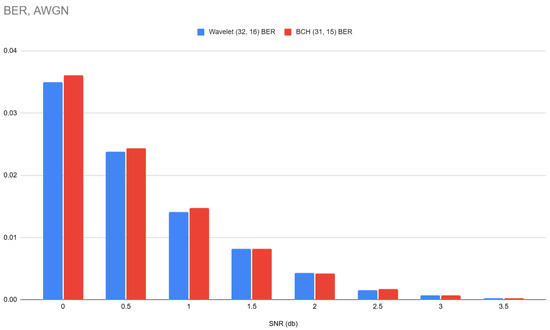
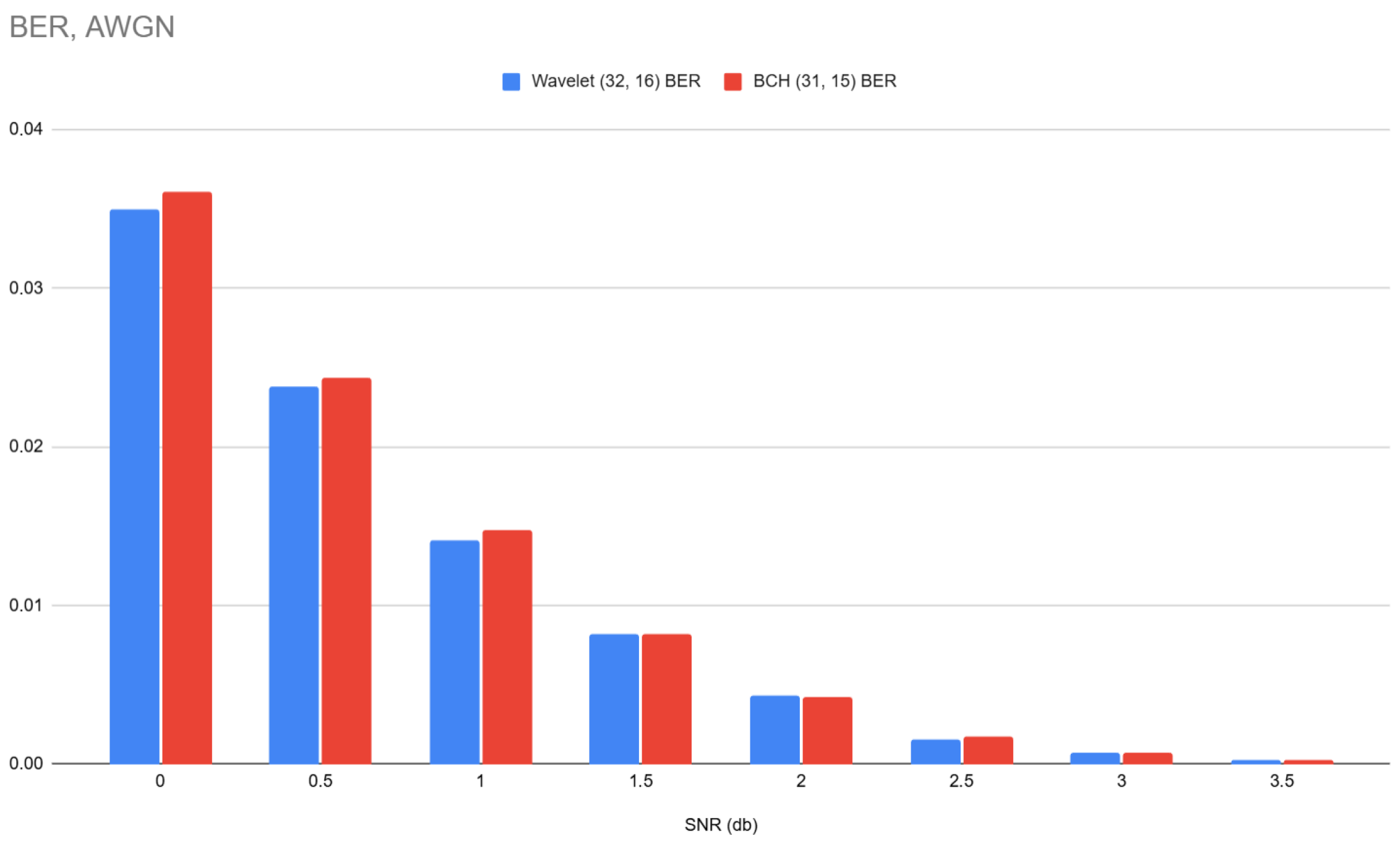
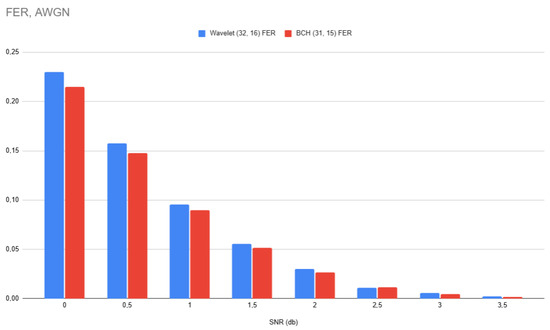
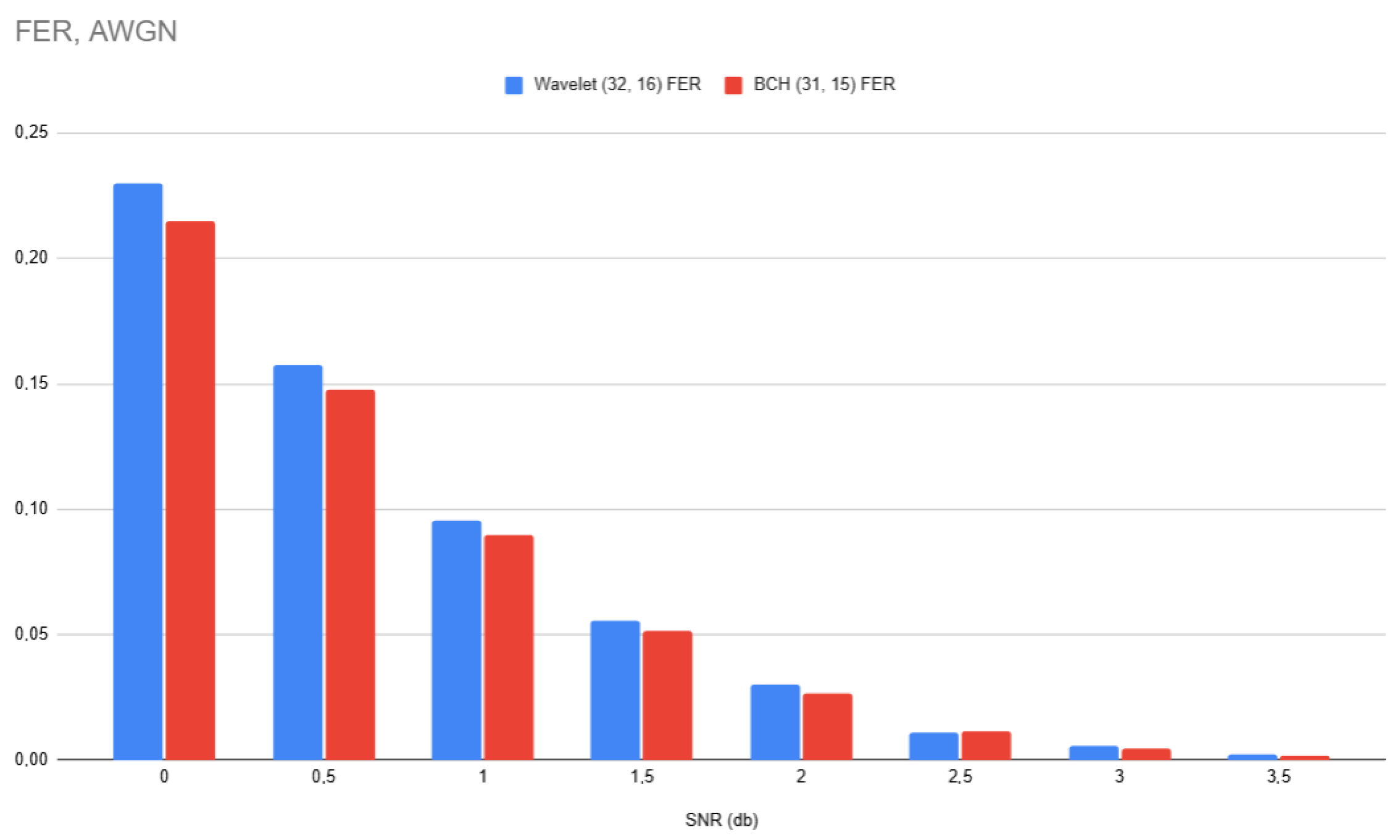
The evaluation begins with the additive white Gaussian noise (AWGN) channel, serving as the baseline for performance in the absence of multiplicative distortion. As illustrated in Figure 1 and Figure 2, the wavelet-based code exhibits a lower bit-error rate (BER) across the majority of the tested SNR range, though its performance advantage diminishes and slightly yields to the BCH code at the dB threshold. In terms of frame-error rate (FER), the BCH code maintains a marginal but consistent advantage, particularly within the mid-range SNR values (1.0–2.5 dB). These quantitative results, detailed in Table 1, indicate that while the wavelet construction offers competitive bit-level resilience, the algebraic structure of the BCH code provides slightly higher reliability at the frame level in purely stochastic noise environments.
Figure 1.
Bit Error Rate (BER) performance in AWGN channel.
Figure 2.
Frame Error Rate (FER) performance in AWGN channel.
Table 1.
BER and FER performance of Wavelet (32, 16) and BCH (31, 16) codes in AWGN channel.
These findings are further corroborated by the numerical results summarized in Table 1, which provides the exact BER and FER values for both codes at each SNR point. The observed advantage of the wavelet-based construction in the AWGN channel suggests that its structural properties—derived directly from the wavelet decomposition—offer competitive and, in this scenario, slightly superior resilience to uncorrelated Gaussian noise compared to the algebraically optimized BCH code of equivalent theoretical correction capability.
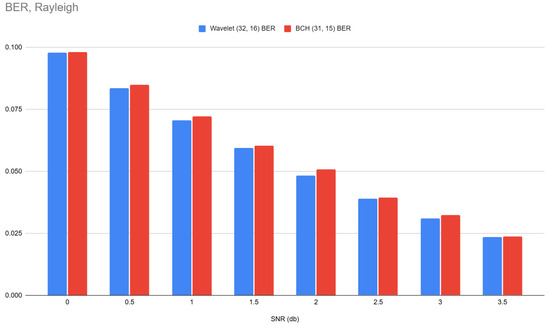
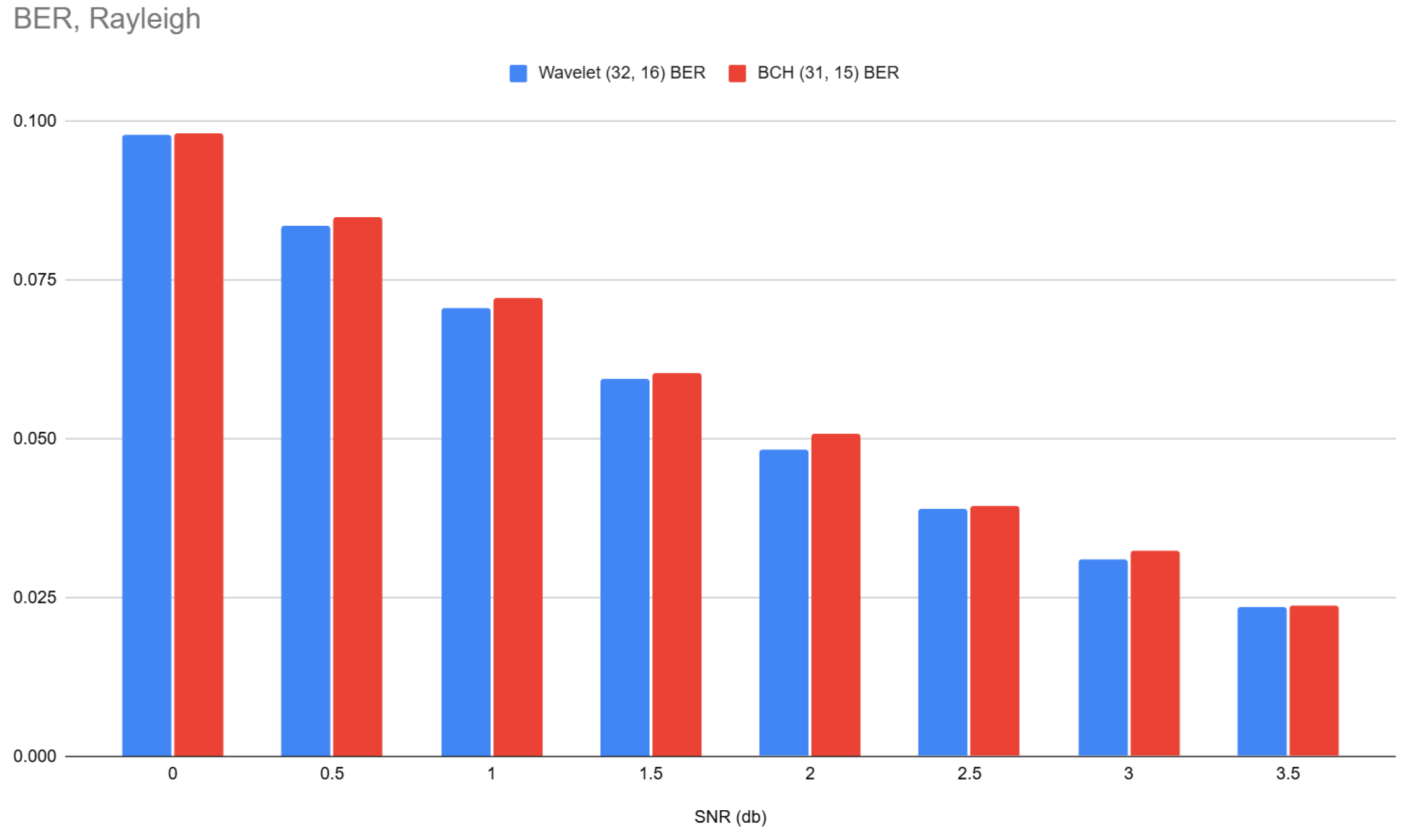
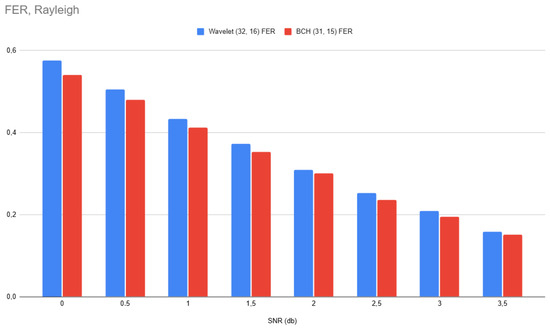
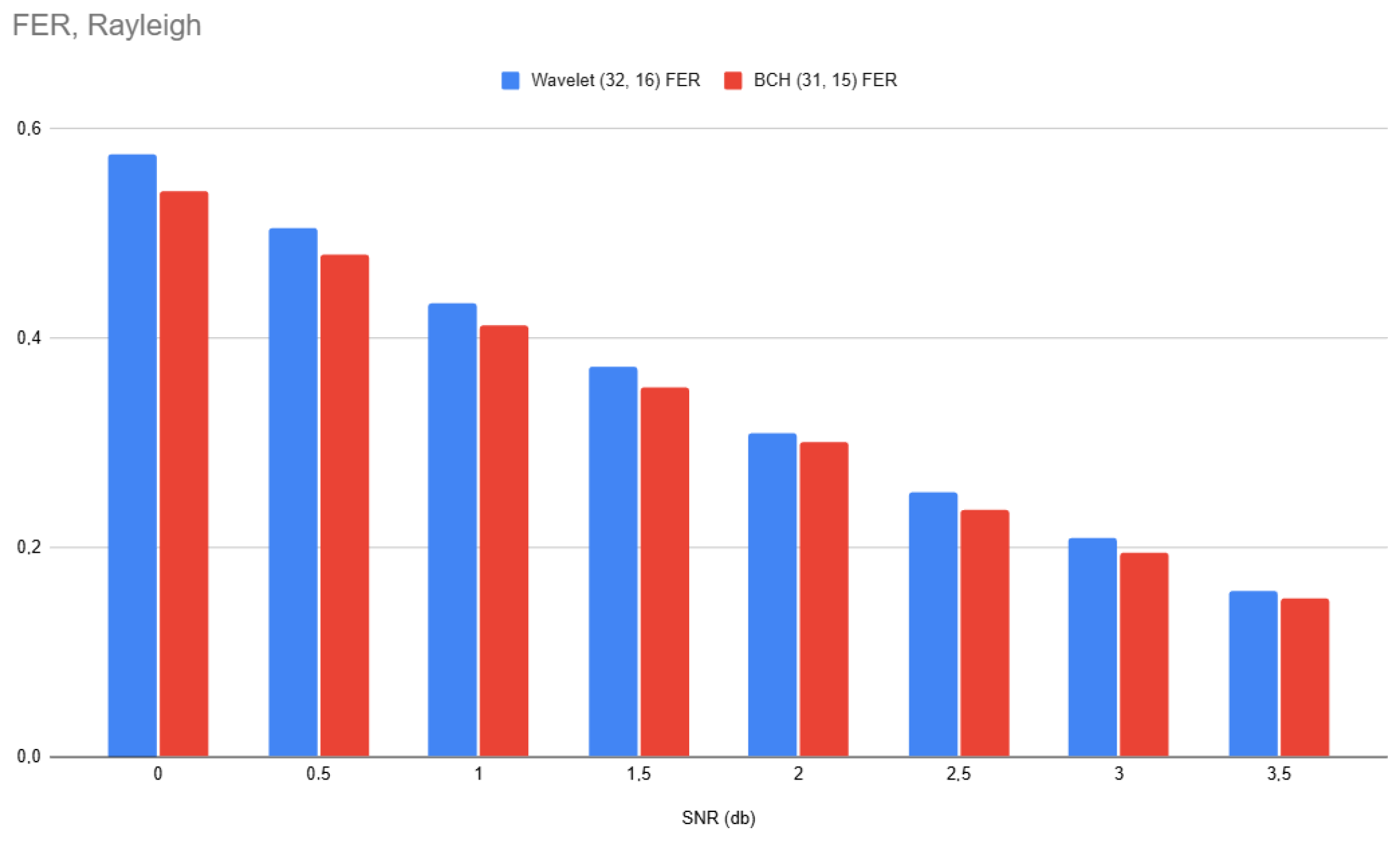
The results for the Rayleigh fading channel are presented in Figure 3 and Figure 4. The wavelet-based code achieves a slightly lower Bit Error Rate (BER) compared to the BCH code across the SNR range. However, its Frame Error Rate (FER) is consistently slightly higher, indicating that while the average number of bit errors is reduced, the wavelet code experiences a marginally greater proportion of completely unrecoverable frames under Rayleigh fading conditions.
Figure 3.
Bit Error Rate (BER) performance in Rayleigh fading channel.
Figure 4.
Frame Error Rate (FER) performance in Rayleigh fading channel.
These observations are confirmed by the numerical data in Table 2, which shows consistently lower BER but higher FER values for the wavelet code compared to BCH in the Rayleigh fading channel.
Table 2.
BER and FER performance of Wavelet (32, 16) and BCH (31, 16) codes in Rayleigh fading channel.
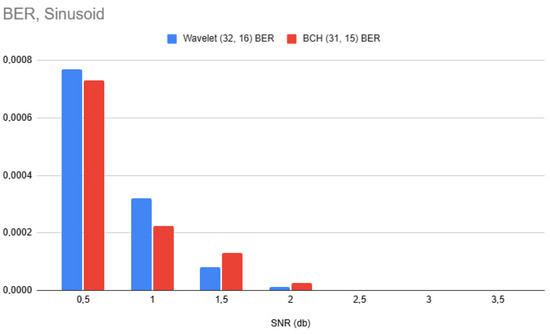
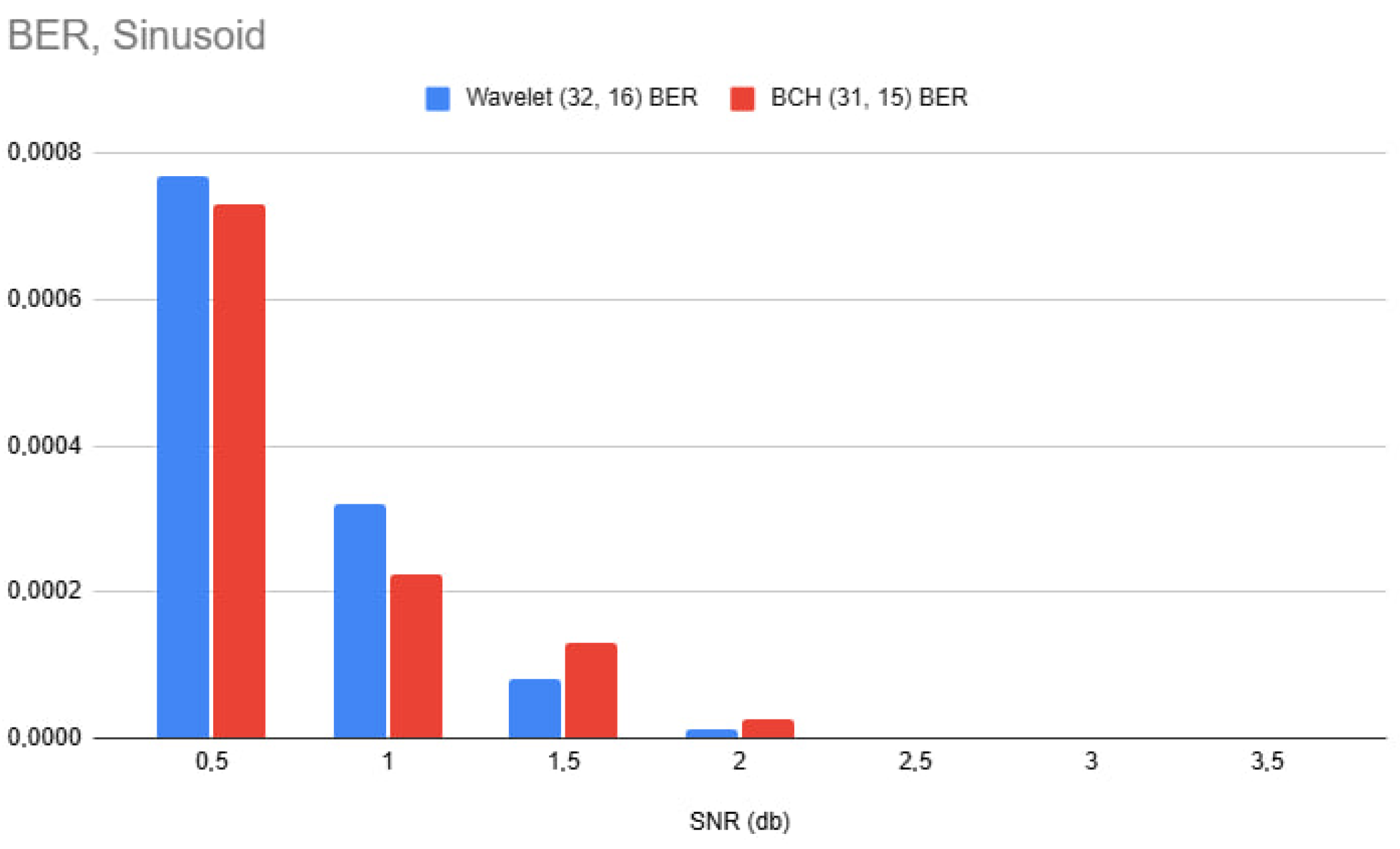
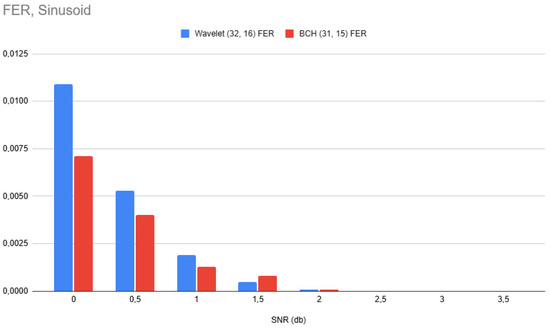
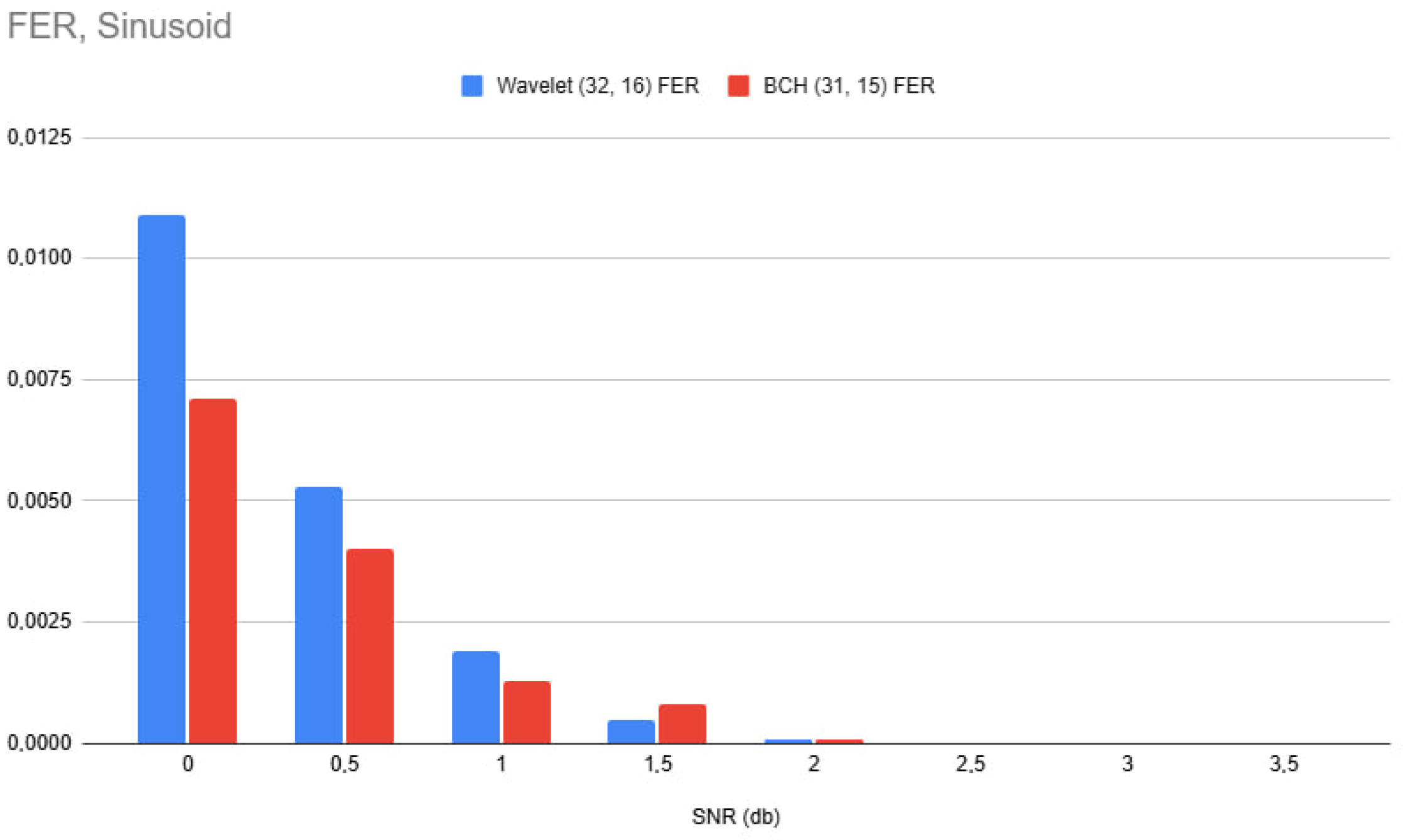
The results for the sinusoidal attenuation channel are presented in Table 3 and Figure 5 and Figure 6. A performance crossover is observed as the SNR increases: while the BCH code shows a slight advantage at very low SNR values (0–1.0 dB), the wavelet-based code demonstrates superior error-correction capability starting from 1.5 dB. Specifically, at 1.5 dB, the wavelet code achieves a BER that is approximately 38% lower than that of the BCH code. Furthermore, as shown in Figure 6, the wavelet-based construction achieves a 37.5% lower FER (0.0005 vs. 0.0008) at the 1.5 dB threshold, while at all other SNR points, its frame-level performance is either equivalent or slightly inferior to the BCH baseline. Both schemes reach the error-free transmission threshold at SNR ≥ 2.5 dB, where BER and FER values drop to zero across all tested frames.
Table 3.
BER and FER performance of Wavelet (32, 16) and BCH (31, 16) codes in sinusoidal attenuation channel.
Figure 5.
Bit Error Rate (BER) performance in sinusoidal attenuation channel.
Figure 6.
Frame Error Rate (FER) performance in sinusoidal attenuation channel.
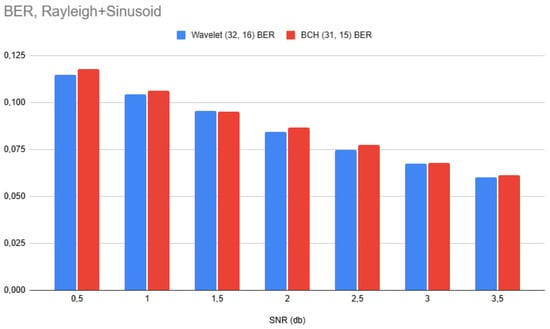
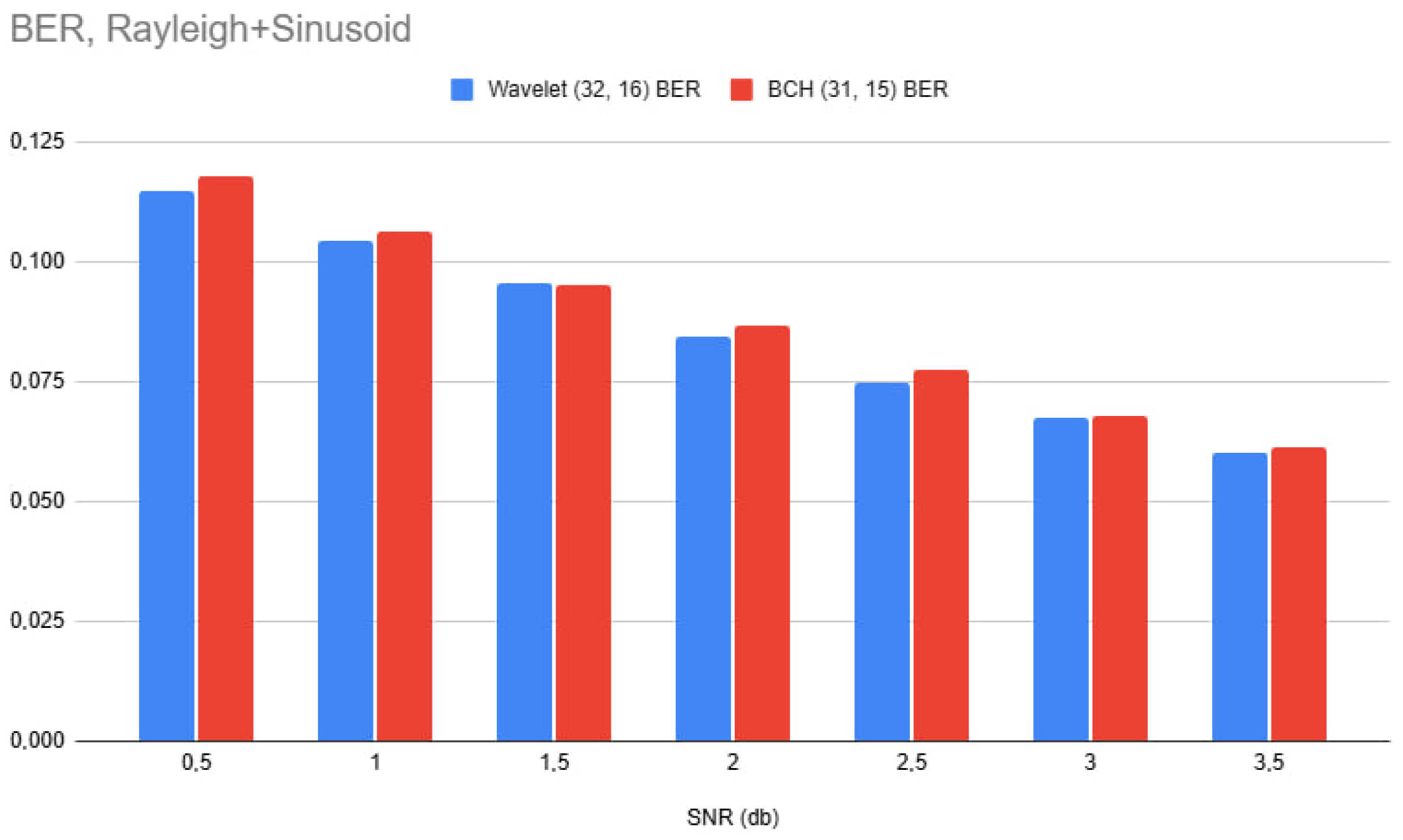
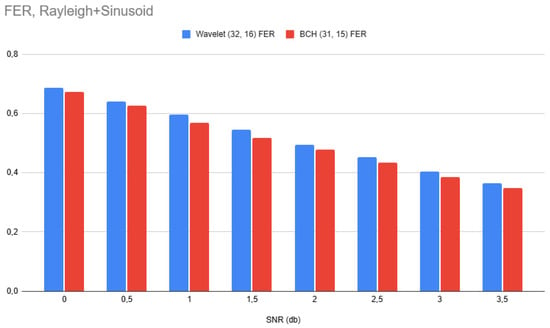
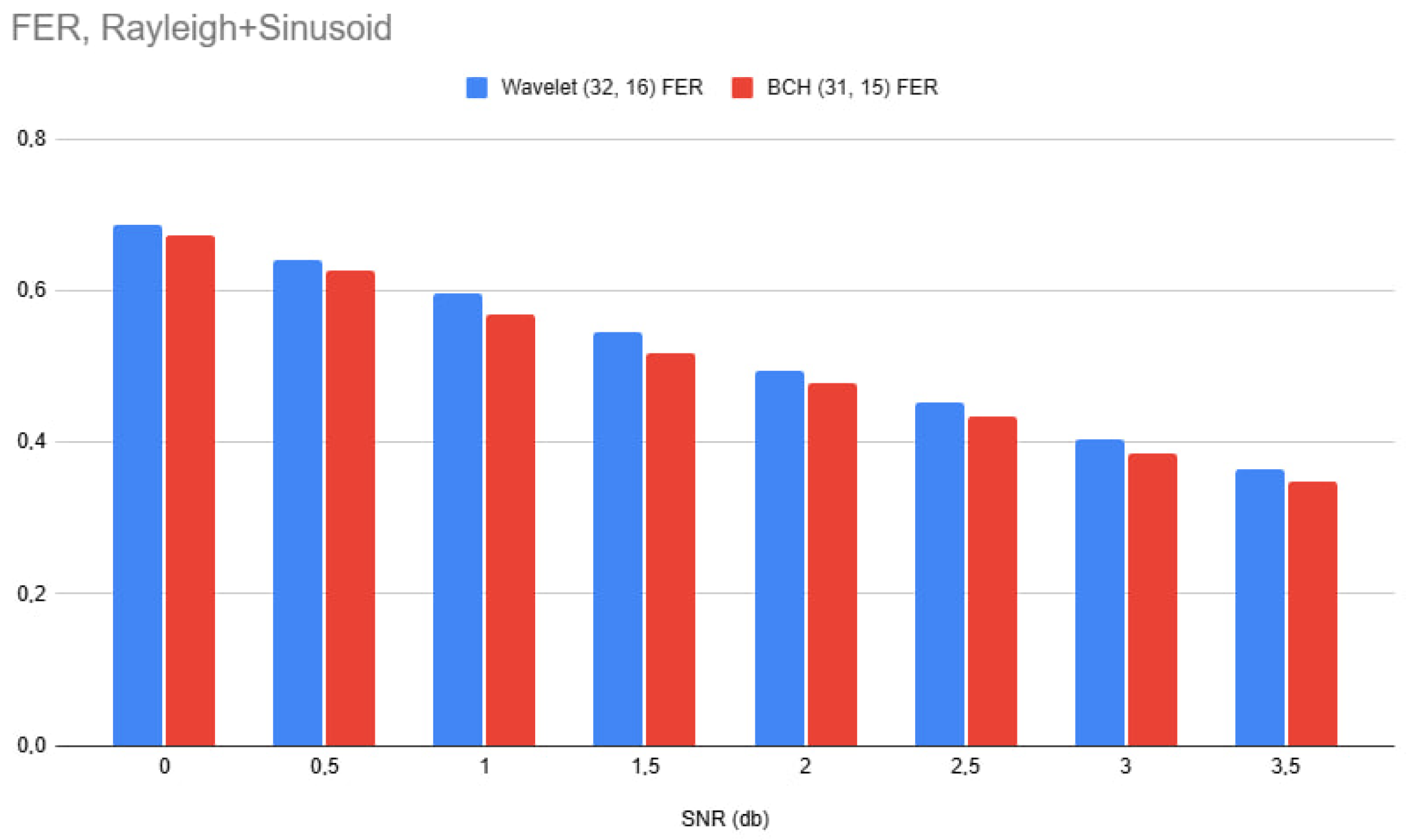
The results for the composite Rayleigh-plus-sinusoid channel are presented below. As shown in Figure 7 and Figure 8, the wavelet-based code achieves a slightly lower Bit Error Rate (BER) across the entire SNR range, while its Frame Error Rate (FER) is consistently marginally higher compared to the BCH code. This indicates that although the average number of bit errors is reduced, the wavelet code experiences a slightly greater proportion of completely failed frames in this composite channel.
Figure 7.
Bit Error Rate (BER) performance in composite Rayleigh-plus-sinusoid channel.
Figure 8.
Frame Error Rate (FER) performance in composite Rayleigh-plus-sinusoid channel.
Exact BER and FER values for both codes are provided in Table 4.
Table 4.
BER and FER performance of Wavelet (32, 16) and BCH (31, 16) codes in composite Rayleigh-plus-sinusoid channel.
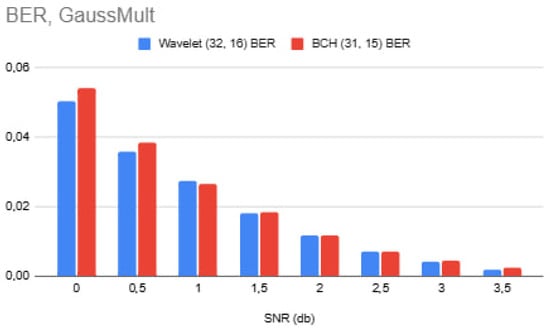
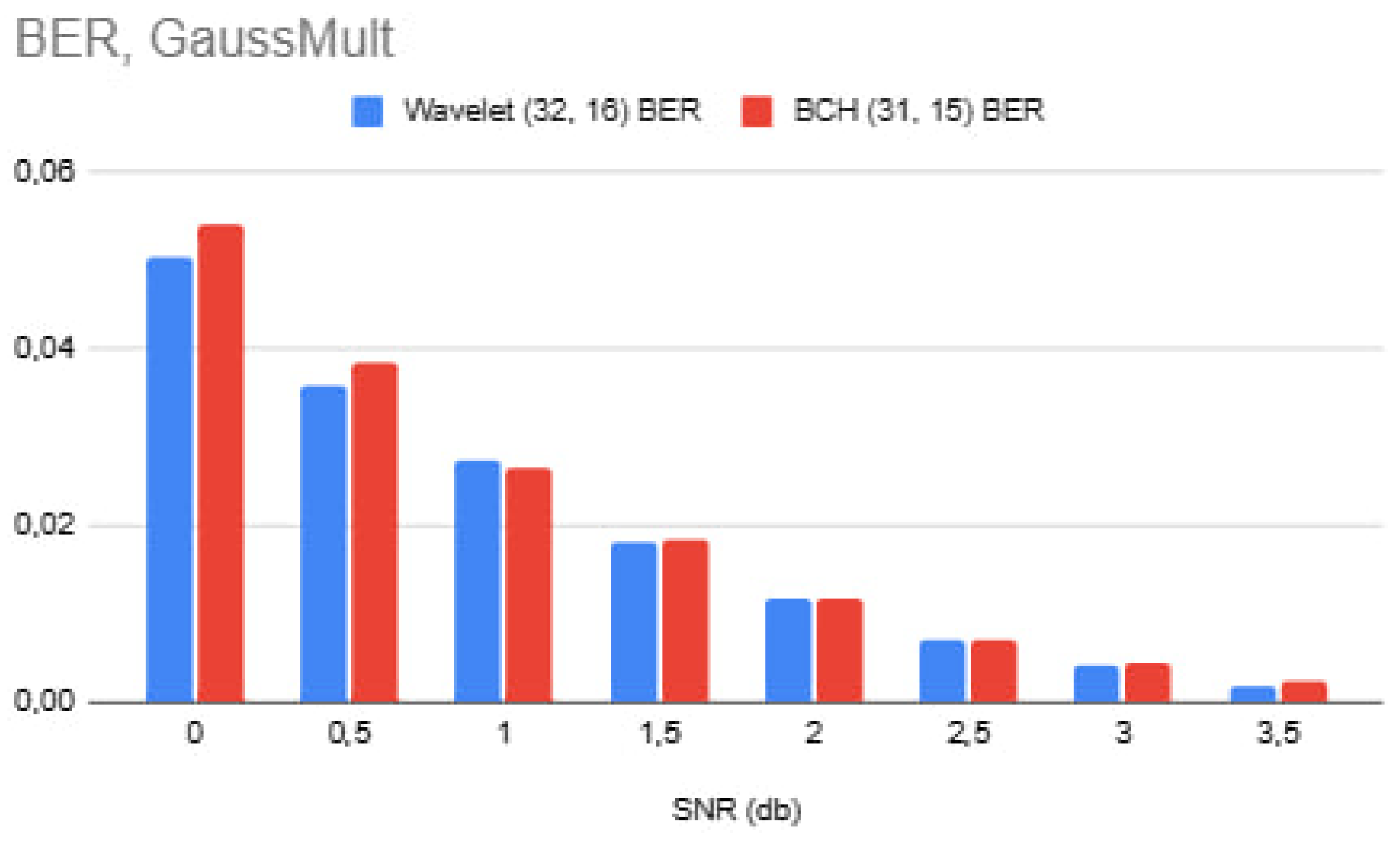
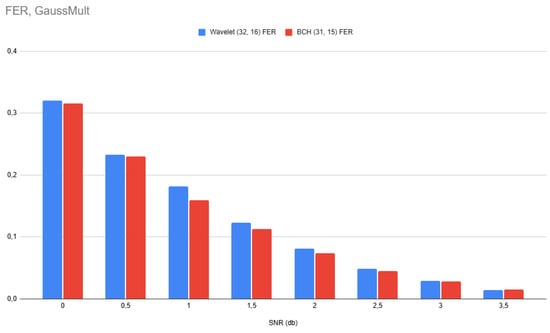
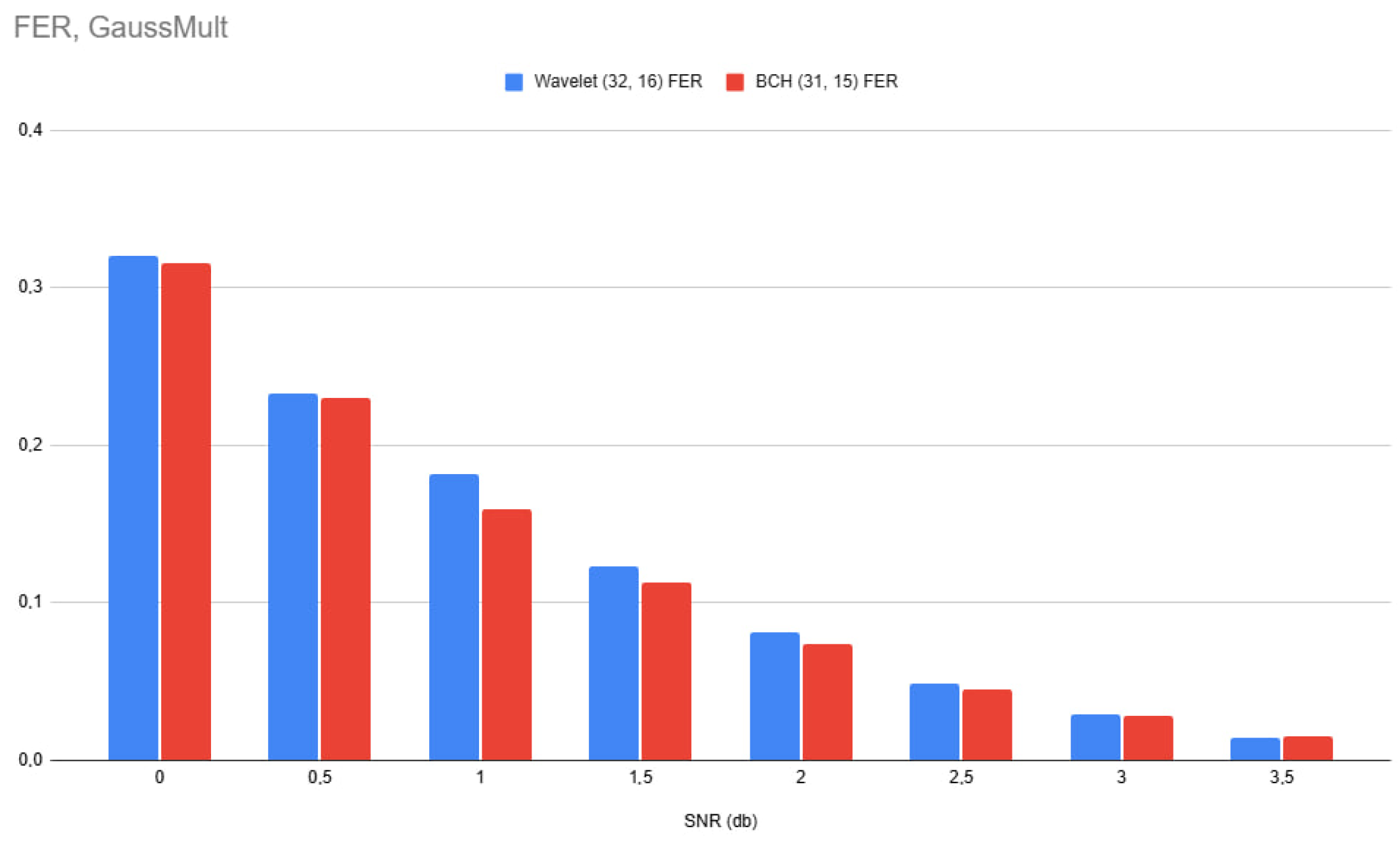
The results for the multiplicative Gaussian noise channel, illustrated in Figure 9 and Figure 10, reveal a competitive interplay between the two codes. Across nearly the entire SNR range (specifically at 0–0.5 dB and 1.5–3.5 dB), the wavelet-based code achieves slightly lower BER values compared to the BCH code. However, the BCH code maintains a consistent advantage in Frame Error Rate (FER) from 0.0 dB up to 3.0 dB. A crossover in FER performance is only observed at the highest tested SNR of 3.5 dB, where the wavelet code finally outperforms the BCH code in both metrics.
Figure 9.
Bit Error Rate (BER) performance in multiplicative Gaussian noise channel.
Figure 10.
Frame Error Rate (FER) performance in multiplicative Gaussian noise channel.
These observations are supported by the numerical data in Table 5, which shows a slight crossover in performance between the two codes around SNR = 1.0 dB.
Table 5.
BER and FER performance of Wavelet (32, 16) and BCH (31, 16) codes in multiplicative Gaussian noise channel.
6. Discussion
The experimental results confirm that wavelet-based linear block codes are a viable and competitive alternative to classical BCH codes in practical communication scenarios. Despite differences in algebraic origin and block length— versus —both codes were designed with identical minimum distance (), enabling a fair comparison of their error-correction performance under realistic channel conditions.
In the AWGN channel, the wavelet code demonstrates consistently lower BER across the tested SNR range, though the BCH code maintains a marginal advantage in FER due to its rigid algebraic structure. In the sinusoidal attenuation channel, the advantage of the wavelet-based construction becomes most prominent at the dB SNR threshold, where it outperforms the BCH baseline in both metrics, achieving a 38% reduction in BER and a 37.5% improvement in FER. At higher SNR values, such as dB, the wavelet code continues to show a substantial BER gain (up to 48%), while its FER performance remains equivalent to that of the BCH code. In the composite Rayleigh-plus-sinusoid channel, the wavelet code shows slightly lower BER but marginally higher FER compared to BCH, indicating a trade-off in error distribution rather than a clear performance gain. Similarly, in pure Rayleigh fading, the BCH code exhibits slightly lower FER, while BER remains nearly identical—a expected outcome given the algebraic robustness of BCH codes against burst errors.
Nevertheless, across all five channel models, the wavelet-based construction maintains a performance level that is either comparable to or, in specific scenarios such as AWGN and sinusoidal interference, superior to the classical BCH code. These results validate the practical relevance of wavelet-derived codes as effective alternatives in real-world communication systems, especially those prone to periodic disturbances.
A defining characteristic observed throughout the study is the trade-off between bit-level and frame-level reliability: while the wavelet codes consistently yield a lower average BER across most noise types, they frequently exhibit a slightly higher FER compared to their BCH counterparts. This suggests that while the wavelet construction is more efficient at reducing the total volume of bit errors, the algebraic structure of the BCH code remains more effective at concentrating and correcting errors within a single codeword to achieve successful frame recovery.
7. Limitation
The main limitation of the current work is the focus on fixed-rate codes and the lack of a systematic algorithm for generating wavelet matrices with a predefined minimum distance. However, this is mitigated by the flexibility of the framework, which allows to create codes based on wavelet signals, similar to any existing cyclic linear code.
In addition, the proposed schemes demonstrate reduced efficiency in extremely low SNR modes; however, this remains a fundamental problem for most direct error correction methods when interference exceeds the theoretical bandwidth of the code.
8. Conclusions
This work demonstrates that linear block codes derived from wavelet filter banks are a viable alternative to classical algebraic codes such as BCH. With identical minimum distance () and comparable code rates, the wavelet-based code achieves performance that is either on par with or superior to the BCH code across five distinct channel models. The most significant improvement is observed in the pure sinusoidal interference channel; notably at 1.5 dB, the wavelet code outperforms the BCH baseline in both BER and FER, achieving a substantial 37.5% reduction in frame errors. While consistent BER gains are present in the AWGN case, the BCH code retains a slight advantage in FER, highlighting a trade-off between the wavelet code’s bit-level resilience and the block-level efficiency of classical algebraic constructions.
Furthermore, in the multiplicative Gaussian noise channel at 3.5 dB, the wavelet code achieves a 16.5% gain in bit-level reliability, eventually outperforming the BCH code in both BER and FER metrics. While the BCH code maintains a marginal advantage in Frame Error Rate (FER) in AWGN and Rayleigh environments due to its rigid algebraic structure, the consistent gains in bit-level resilience highlight the potential of wavelet-derived codes.
Future work will focus on developing methods to construct wavelet-based codes with larger minimum distances, thereby increasing their error-correction capability. Given that wavelet transforms are already employed in practical systems such as JPEG 2000 image compression, the proposed coding approach could be naturally integrated into existing signal processing pipelines for joint source-channel coding or embedded error resilience.
Author Contributions
Conceptualization, A.L.; methodology, S.B. and A.L.; software, S.B.; validation, S.B.; formal analysis, S.B.; investigation, S.B. and A.L.; resources, S.B.; data curation, S.B.; writing—original draft preparation, A.L. and S.B.; supervision, A.L.; project administration, A.L.; funding acquisition, A.L. All authors have read and agreed to the published version of the manuscript.
Funding
This research was funded by the Ministry of Science and Higher Education of the Russian Science Foundation (Project “Goszadanie” No. 075-00003-24-02, FSEE-2024-0003).
Data Availability Statement
The data presented in this study are available on request from the corresponding author due to it possible future commercial implementation.
Conflicts of Interest
The authors declare no conflict of interest.
References
- Hamming, R.W. Error detecting and error correcting codes. Bell Syst. Tech. J. 1950, 29, 147–160. [Google Scholar] [CrossRef] [Scilit]
- Hocquenghem, A. Codes correcteurs d’erreurs. Chiffres 1959, 2, 147–156. [Google Scholar]
- Bose, R.C.; Ray-Chaudhuri, D.K. On a class of error correcting binary group codes. Inf. Control 1960, 3, 68–79. [Google Scholar] [CrossRef] [Scilit]
- Berlekamp, E.R. Algebraic Coding Theory; McGraw-Hill: New York, NY, USA, 1968. [Google Scholar]
- Massey, J.L. Shift-register synthesis and BCH decoding. IEEE Trans. Inf. Theory 1969, 15, 122–127. [Google Scholar] [CrossRef] [Scilit]
- MacWilliams, F.J.; Sloane, N.J.A. The Theory of Error-Correcting Codes; Elsevier: Amsterdam, Amsterdam, 1977. [Google Scholar]
- Lin, S.; Costello, D.J. Error Control Coding: Fundamentals and Applications, 2nd ed.; Pearson Prentice Hall: Upper Saddle River, NJ, USA, 2004. [Google Scholar]
- Micheloni, R.; Marelli, A.; Eshghi, K. (Eds.) Error correction in NAND flash memory: An overview of BCH and LDPC codes. In Inside NAND Flash Memory; Springer: Boston, MA, USA, 2010; pp. 135–172. [Google Scholar]
- Yaakobi, E.; Ma, J.; Grupp, L.; Siegel, P.H. Error Characterization and Coding Schemes for Flash Memories. In Proceedings of the 2010 IEEE GLOBECOM Workshops (GC Wkshps), Miami, FL, USA, 6–10 December 2010; pp. 1738–1743. [Google Scholar] [CrossRef] [Scilit]
- Daubechies, I. Ten Lectures on Wavelets; SIAM: Philadelphia, PA, USA, 1992. [Google Scholar]
- ISO/IEC 15444-1:2000; Information Technology—JPEG 2000 Image Coding System: Core Coding System (Part 1). International Organization for Standardization: Geneva, Switzerland, 2000.
- Fekri, F.; Mersereau, R.M.; Schafer, R.W. Theory of wavelet transform over finite fields. In Proceedings of the 1999 IEEE International Conference on Acoustics, Speech, and Signal Processing (ICASSP); IEEE: Phoenix, AZ, USA, 1999; Volume 3, pp. 1213–1216. [Google Scholar]
- Levina, A.; Taranov, S. Creation of codes based on wavelet transformation and its application in ADV612 chips. Int. J. Wavelets Multiresolut. Inf. Process. 2017, 15, 1750014. [Google Scholar] [CrossRef] [Scilit]
- Levina, A.; Taranov, S.; Kaplun, D.I.; Boyvalenkov, P. Wavelet Codes and Their Implementation for Protection of NAND Flash Memory. In Proceedings of the 2019 PhotonIcs & Electromagnetics Research Symposium—Spring (PIERS-Spring), Rome, Italy, 17–20 June 2019; pp. 3753–3758. [Google Scholar] [CrossRef] [Scilit]
- Levina, A.; Boyko, S. Comparison of wavelet-based codes with linear cyclic codes. In Proceedings of the 14th Mediterranean Conference on Embedded Computing (MECO), Budva, Montenegro, 10–14 June 2025. [Google Scholar] [CrossRef] [Scilit]
- Proakis, J.G.; Salehi, M. Digital Communications, 5th ed.; McGraw-Hill: New York, NY, USA, 2008. [Google Scholar]
- Van Wonterghem, J.; Alloum, A.; Boutros, J.J.; Moeneclaey, M. Performance Comparison of Short-Length Error-Correcting Codes. In Proceedings of the 2016 IEEE Symposium on Communications and Vehicular Technology (SCVT), Mons, Belgium, 22 November 2016. [Google Scholar]
- Bossert, M.; Schulz, R.; Bitzer, S. On Hard and Soft Decision Decoding of BCH Codes. IEEE Trans. Inf. Theory 2022, 68, 7107–7124. [Google Scholar] [CrossRef] [Scilit]
- Lone, F.R.; Puri, A.; Kumar, S. Performance Comparison of Reed Solomon Code and BCH Code over Rayleigh Fading Channel. Int. J. Comput. Appl. 2013, 71, 23–26. [Google Scholar]
- Han, S.; Ge, Y.; Shi, Y.; Renjie, Y. A Fast Method for Estimating Generator Matrixes of BCH Codes. Electronics 2026, 15, 244. [Google Scholar] [CrossRef] [Scilit]
- Al-Barrak, A.; Al-Sherbaz, A.; Kanakis, T.; Crockett, R. Enhancing BER Performance Limit of BCH and RS Codes Using Multipath Diversity. Computers 2017, 6, 21. [Google Scholar] [CrossRef] [Scilit]
- Zhang, Y.; Pi, X.; Xie, M. Channel Modeling and Interference Analysis in IEEE 802.11a Wireless Communication Systems. J. Netw. Netw. Appl. 2025, 4, 178–189. [Google Scholar]
- Olyaee, M.; Hashemi, H.; Romero-Jerez, J.M. Channel Fading Models for 5G and 6G. In 5G and 6G Enhanced Broadband Communications; Olyaee, M., Ed.; IntechOpen: London, UK, 2024. [Google Scholar] [CrossRef] [Scilit]
- Gama, F.O.S.; Silveira, L.F.Q.; Salazar, A.O. Adaptive Wavelet Coding Applied in a Wireless Control System. Sensors 2017, 17, 2901. [Google Scholar] [CrossRef] [Scilit] [PubMed]
- Zerdoumi, Z.; Fodil, M.; Fadila, B.; Bentaleb, N. Enhancing OFDM Performance Using Wavelet Transform Techniques in Wireless Systems. Eurasia Proc. Sci. Technol. Eng. Math. 2025, 38, 354–360. [Google Scholar] [CrossRef] [Scilit]
- Zhang, Z. The Improvement of the Discrete Wavelet Transform. Mathematics 2023, 11, 1770. [Google Scholar] [CrossRef] [Scilit]
- Levina, A.; Ryaskin, G. Robust Code Constructions Based on Bent Functions and Spline Wavelet Decomposition. Mathematics 2022, 10, 3305. [Google Scholar] [CrossRef] [Scilit]
- Shibakin, I.V.; Levina, A. Algorithm for Generation of Bent Functions Using Wavelet Transform. Bezop. Inf. Tehnol. 2025, 32, 106–121. [Google Scholar] [CrossRef] [Scilit]
- Kerdock, A.M. A class of low-rate nonlinear binary codes. Inform. Control 1972, 20, 182–187. [Google Scholar] [CrossRef] [Scilit]
- European Telecommunications Standards Institute (ETSI); Digital Video Broadcasting (DVB). Second Generation Framing Structure, Channel Coding and Modulation Systems for Broadcasting, Interactive Services, News Gathering and Other Broadband Satellite Applications (DVB-S2X); ETSI EN 302 307-2 V1.3.1; ETSI: Sophia Antipolis, France, 2025. [Google Scholar]
- International Telecommunication Union (ITU). Interfaces for the Optical Transport Network (OTN); ITU-T Recommendation G.709/Y.1331; ITU: Geneva, Switzerland, 2020. [Google Scholar]

Disclaimer/Publisher’s Note: The statements, opinions and data contained in all publications are solely those of the individual author(s) and contributor(s) and not of MDPI and/or the editor(s). MDPI and/or the editor(s) disclaim responsibility for any injury to people or property resulting from any ideas, methods, instructions or products referred to in the content. |
© 2026 by the authors. Licensee MDPI, Basel, Switzerland. This article is an open access article distributed under the terms and conditions of the Creative Commons Attribution (CC BY) license.