


Abstract
Critical infrastructure projects are essential for societal well-being and economic prosperity. These projects are characterized by significant complexities and uncertainties, including weather conditions, design challenges, and regulatory constraints, which can hinder their ability to meet time, cost, and quality goals. To address the risks that can disrupt such projects, comprehensive risk assessment frameworks are necessary to support decision-makers in managing them. This paper introduces a novel methodological framework for risk assessment in municipal water supply projects. The framework decomposes overall project risk into specific risk criteria to evaluate the impact of each activity on the project’s global risk. It integrates the fuzzy analytical hierarchy process with a fuzzy multi-objective resource-constrained scheduling problem to enhance risk assessment. The practical applicability of the framework is demonstrated through a case study conducted with the Municipal Department of Water Systems in a metropolitan area in southern Tamaulipas, Mexico. The results confirm the effectiveness of the proposed methodology as a robust tool for assessing risks in municipal water supply projects.
Keywords:
risk assessment; critical infrastructure projects; municipal water supply projects; fuzzy analytical hierarchical process; resource constrained scheduling problem; fuzzy multi-objective optimization MSC:
90B90
1. Introduction
Efficient municipal water supply is crucial for safeguarding public health, supporting economic development, protecting the environment, and enhancing the overall quality of life in communities, playing a fundamental role in society and being essential for the well-being and prosperity of residents [1,2]. In Mexico, the Municipal Public Works Department (MPWD) in each metropolitan area is responsible for water services delivered to local customers (drinking-water delivery and wastewater treatment). The public operation of water services takes the form of a management entity with financial autonomy and moral authority and faces several challenges including the increasing difficulty of receiving public funding, overutilization of debt, higher production and operating costs, and the greater likelihood of cost overruns during construction projects. The MPWD has the responsibility for the construction, operation, and maintenance of the water utility, and the collection of tariff revenues from the users.
Municipal water supply projects are municipal critical infrastructure projects [3,4], characterized by their complexity and uncertainties, where uncertainty about weather conditions, design and engineering challenges, regulatory issues, and different site conditions are typical existing risks causing projects to fail to achieve their time, cost, and quality goals [5,6]. Moreover, as water supply projects are in essence construction and investment projects, their planned schedules are often disrupted by risk factors [7].
While construction projects are inherently unique and heavily influenced by environmental and contextual processes, they are also surrounded by inherent uncertainty [8]. Therefore, strong efforts must be made to effectively analyze and model risk factors to achieve financial responsibility, particularly given that municipal water supply projects involve substantial public investment. Accurate risk analysis ensures the prudent allocation of these resources to financially sustainable projects, allowing for the identification of potential cost overruns and the development of strategies to mitigate them. Additionally, understanding and managing risks is essential for the successful completion of such projects. Without a comprehensive risk assessment, unexpected challenges and obstacles may arise during project execution, leading to delays, increased costs, or even project failure. Proper risk assessment also helps identify potential external risks associated with water supply projects, including environmental, regulatory, and political factors. These uncertainties render the risk assessment process a complex multi-criteria decision-making problem, where judgments about the likelihood and impacts of risk factors are often qualitative and inherently fuzzy [9,10].
For critical infrastructure projects, it is essential to consider all factors and criteria that may influence the project. In practice, however, managerial decisions regarding risk assessment are frequently based on experience, intuition, and informal rules of thumb to anticipate adverse events. This reliance on subjective judgment is a primary reason many municipal infrastructure projects fail [11]. As a result, there is an increasing need for logical and systematic risk assessment procedures rather than heuristic approaches.
Developing effective risk assessment methodologies remains a significant challenge in municipal infrastructure projects. Various approaches have been adopted to address project complexity and risks under uncertainty [12]. However, despite the rapid pace of urbanization, the expansion of cities, and the critical importance of risk management in municipal water supply projects, there is a notable lack of research in this field [2,13,14].
The main novelty of this paper is the proposal of a methodological framework to support risk assessment in municipal water supply projects. The framework decomposes overall project risk into specific risk criteria to evaluate the impact of each activity on the project’s global risk.
From a methodological point of view, the main contribution lies in the integrated and sequential coupling of Fuzzy Analytic Hierarchy Process (FAHP) with a fuzzy multi-objective resource-constrained scheduling problem, rather than using FAHP in isolation as a standalone prioritization tool. While FAHP is commonly employed to determine the relative importance of risk criteria [15], this study extends its utility by propagating the fuzzy weights derived from FAHP directly into the optimization model as inputs for scheduling decisions. This creates a bidirectional linkage between risk prioritization and project scheduling, enabling a more dynamic and context-sensitive risk assessment. Specifically, the fuzzy weights from FAHP inform the objective functions and constraints of the Fuzzy multi-objective resource-constrained scheduling problem, allowing the model to reflect not only which risks are more critical, but also how they interact with resource allocation, activity durations, and project objectives under uncertainty. This integration transforms risk assessment from a static evaluation into a decision-support tool that directly influences project execution strategies. The case study in a real-world municipal water system context further validates this novel integration, demonstrating its practical value in a sector where such combined approaches remain underexplored.
Additionally, this paper contributes to the existing literature as follows:
- It proposes a new analytical framework for risk assessments of municipal water supply projects, a type of critical infrastructure.
- It develops a risk breakdown structure specific to municipal water supply projects.
- It makes use of the FAHP to qualitatively estimate the overall risk of each project activity, accounting for multiple risk criteria and their impact on time, cost, and quality goals.
- It introduces a novel fuzzy bi-objective resource-constrained scheduling model to determine the optimal project schedule and resource allocation strategy to minimize the makespan and the overall risk of the project.
The rest of this paper is organized as follows. Section 2 presents a review of risk assessment methodologies on municipal infrastructure projects. Afterward, the methodology is presented in Section 3. Section 4 presents a case study as the application of the proposed methodology. Finally, conclusions are presented in Section 5.
2. Related Works
2.1. Risk Assessment Frameworks and Methods in Construction and Investment Projects
Risk, defined as uncertain events with the potential for negative impact [16], is a central concept in project management and particularly critical in construction and investment projects [7]. Effective risk assessment enables organizations to anticipate adverse events and develop strategies that align with project objectives [17,18]. The risk assessment process typically involves identifying, evaluating, prioritizing, mitigating, and monitoring risks, using both quantitative and qualitative methods [19].
The qualitative approaches often rely on expert judgment to assess the probability and impact of risk factors [20]. On the other hand, quantitative methods assign numerical values, often through probability and impact assessments [21]. The Analytic Hierarchy Process (AHP) has been used in risk assessment due to its ability to capture quantitative and qualitative criteria for balancing decision-making analysis. For example, Mohammad and Jamal [5] utilized the AHP to structure project risk into hierarchical levels, aiding decision-making during the bidding phase. Similarly, Zayed et al. [22] applied AHP to assess and prioritize risks in highway construction projects, calculating risk indices at both macro and micro levels. Dey [23] proposed a conceptual risk management framework that integrates AHP with a risk map to enhance risk management strategies.
Methodological advancements have extended the applicability of AHP. For instance, it has been combined with Data Envelopment Analysis (DEA) for prioritizing bridge maintenance activities [9] and with fuzzy logic to address uncertainties influenced by subjective parameters [10,24]. Li and Zou [11] applied FAHP to Public–Private Partnership (PPP) projects, enabling more nuanced risk rankings for infrastructure developments such as expressways and water treatment plants. Haghighi and Ashrafi [21] introduced a framework based on interval type-2 fuzzy sets to manage project risks in the gas industry.
Recently, artificial intelligence and machine learning have emerged as powerful tools for risk assessment [25]. These include applications such as probability analysis models [26], Bayesian networks [27,28], fault tree analysis [29,30], and artificial neural networks [24]. Bai and Li [31] used neural networks to model risk in software projects, capturing complex, nonlinear relationships between risk factors. Similarly, Mhatre et al. [32] employed system dynamics and the Interpretive Ranking Process to model critical risk factors in construction projects. These approaches enable precise risk evaluations and proactive mitigation strategies, significantly improving risk management across various project types.
2.2. Risk Assessment Frameworks of Municipal Infrastructure Projects
Risk assessment methodologies for municipal infrastructure projects, particularly water supply systems, have advanced significantly in recent years. Freas et al. [17] introduced a threshold-scenario framework to evaluate vulnerabilities in water systems, addressing critical factors such as climate change and demographic shifts. Zeng et al. [33] developed a hierarchical risk management model for Build-Operate-Transfer water projects in China, offering tailored strategies to address their unique challenges. Similarly, Hatmoko and Susanti [34] identified and categorized 66 perceived risks in public sector municipal projects, grouping them into 11 primary categories, including financial, political, and force majeure risks.
Recent advancements have also emphasized asset-specific risk management. For instance, Shahata et al. [35] proposed a risk-informed prioritization model for rehabilitation projects across road, sewer, and water systems. Their approach integrates risk and performance criteria to guide decision-making effectively.
The analysis of the published literature highlights the growing diversity of risk assessment frameworks and methodologies, with a noticeable trend toward blending multi-criteria decision-making techniques, fuzzy logic, and artificial intelligence. These approaches offer nuanced and comprehensive analyses that address the inherent complexity and uncertainty of municipal infrastructure projects.
2.3. Gaps in the Literature
Despite significant advancements in risk assessment methodologies for infrastructure projects, critical gaps remain. First, existing applications of multi-criteria decision-making techniques such as FAHP typically conclude with static risk prioritization, failing to connect these results to project scheduling decision [15,22]. Second, while fuzzy logic has been extensively applied to both risk assessment and scheduling problems independently, limited research exists on propagating fuzzy risk weights into optimization models that directly influence project execution [21]. Third, the literature on municipal water supply projects (despite their critical importance to urban populations and their substantial public investment) remains notably underdeveloped [2,34]. Finally, existing frameworks lack a bidirectional linkage between risk prioritization and resource-constrained scheduling, preventing risk assessment from functioning as a dynamic decision-support tool that adapts to project constraints and uncertainties. This study addresses these gaps by proposing a novel methodological framework that sequentially couples FAHP with a fuzzy multi-objective resource-constrained scheduling problem, demonstrated through a case study of a municipal water supply project in Mexico.
3. Proposed Methodology
The aim of this paper is to propose a methodological framework to support risk assessment in municipal water supply projects. The proposed methodology uses analytical models to support the risk assessment process. According to the literature, the construction of analytical models for risk assessment typically involves four key stages [24,36]: (1) risk identification, (2) risk assessment, (3) risk prioritization, and (4) risk mitigation. The proposed methodology aligns with and integrates these stages to develop a comprehensive risk assessment framework through a quantification process. This framework provides a novel approach for conducting an in-depth analysis of the risks inherent in municipal water supply projects.
As noted by Galway [16], two essential characteristics define an effective project risk analysis: (i) accuracy, which ensures precise estimations of key outcomes such as project duration and costs, and (ii) structured thinking, which promotes systematic consideration of various project dimensions. Structured thinking involves quantifying probabilities and impacts, fostering discussions among stakeholders with diverse perspectives, and grounding the methodology in established literature.
From a general perspective, the proposed framework (Figure 1) follows the foundational principles and steps of a standard risk assessment process. The framework begins by identifying and cataloging potential risks that may affect the activities involved in municipal water supply projects. Next, these risks are assessed using the FAHP to estimate the overall risk for each activity, accounting for the previously identified risk criteria and their impact on time, cost, and quality goals. Finally, a fuzzy bi-objective optimization model is employed to determine the optimal schedule and resource allocation strategy, aiming to minimize both the project makespan and overall risk.
Figure 1.
Methodological Approach.
The remainder of this section elaborates on each step of the proposed methodology.
3.1. Identify the Activities of Municipal Water Supply Projects and Their Potential Risks
The first step is to collect data on municipal water supply projects and potential risks. It requires identifying the set of risk criteria affecting the execution of municipal water supply projects execution. Data on risks is usually unavailable, so the experience, knowledge, and intuition of experts in identifying them are important. To identify the risks, the following techniques were applied:
- Delphi method: Holding regular meetings with the MPWD to identify and investigate the risks. Two questions served as the basis for the semi-structured interview: which risks have been encountered during the development of previous municipal water supply projects? And how have those risks been managed?
- Literature review: Review of the existing literature on construction, infrastructure projects, and municipal water supply risks. For instance, Doomah and Jahmeerbacus [37] identified late clearances from authorities, inadequate design (particularly for climate change), and a lack of experienced local contractors as prevalent risks in water infrastructure projects. Similarly, Abaza and Kisi [38] documented a cost overrun of USD 3.6 million (6.3% of the contract value) in a water transmission project, attributed to improper risk management. Senić et al. [39] quantifies risks in complex road infrastructure projects across seven categories: design, external, resource, employer, contractor, engineer, and project.
Initially, thirty-one risks were identified. To determine the most relevant among them, experts were asked to evaluate each risk based on its Probability of Occurrence and its Impact on the Project, using the following five-point scales:
- Probability of Occurrence: How frequently does the risk occur? (1 = never occurs; 2 = somewhat likely; 3 = likely; 4 = very likely; 5 = always occurs).
- Impact of the Risk: When the risk occurs, what is the magnitude of its impact on the project? (1 = very low impact; 2 = low impact; 3 = medium impact; 4 = high impact; 5 = very high impact).
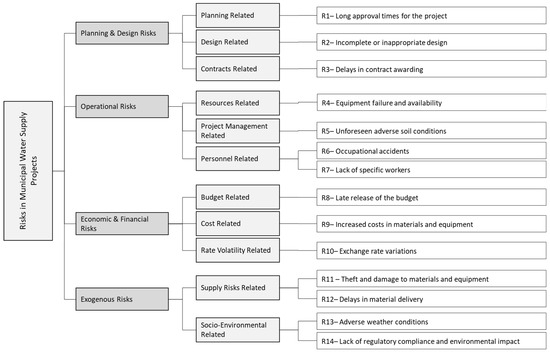
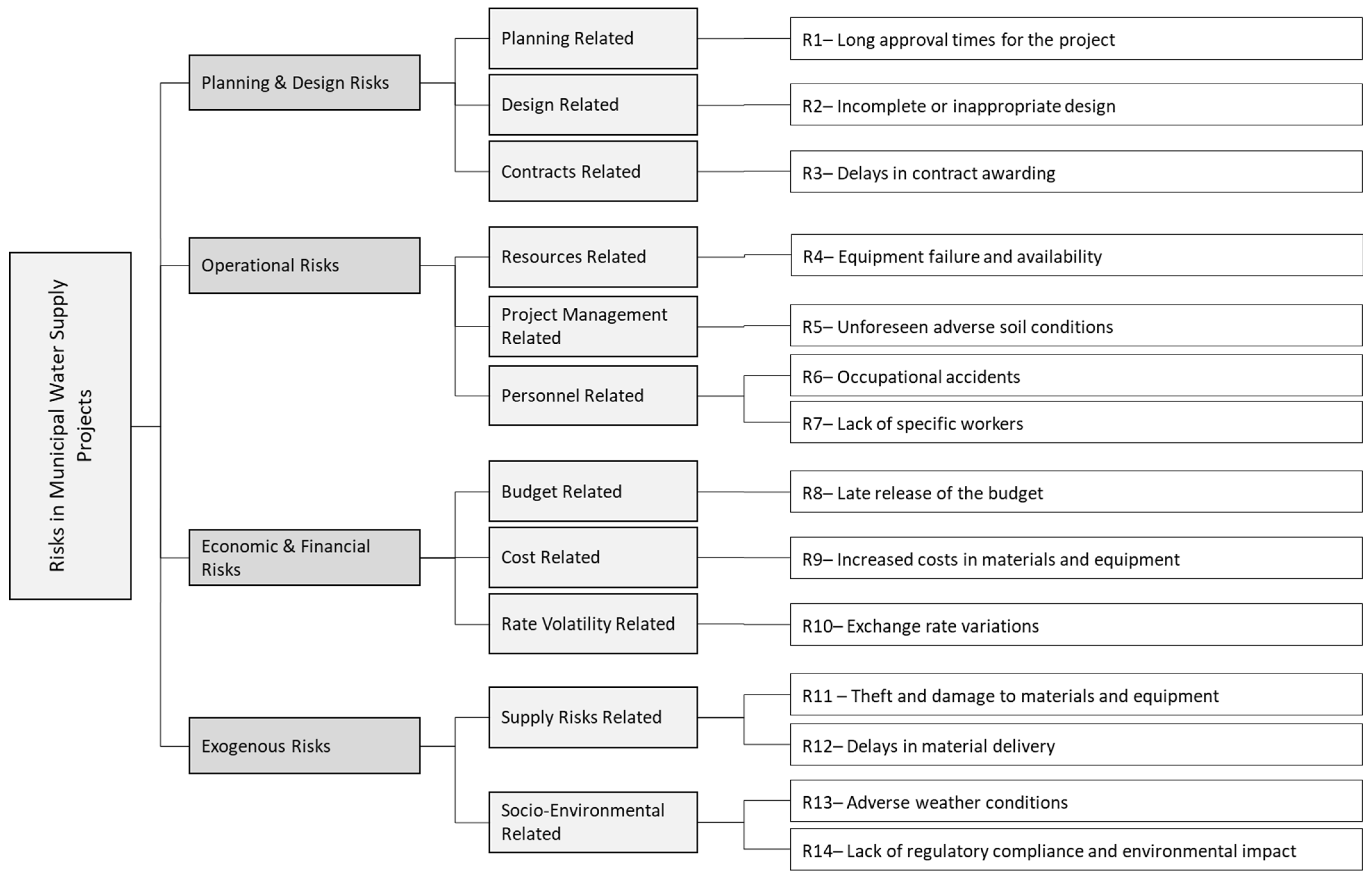
Figure 2 presents the resulting risk breakdown structure for municipal water supply projects, as identified and validated by the experts. This structure classifies risks into four categories and fourteen relevant subcategories. This list, although not exhaustive, considers the more common risks identified in literature and in the five experts’ experience.
Figure 2.
Risk breakdown structure of municipal water supply projects.
Regarding the impact categories, three dimensions are universally recognized as the core metrics for project success [37,40,41,42]: cost, time, and quality. Their selection is grounded in both foundational project management principles and the specific characteristics of water infrastructure. Doomah and Jahmeerbacus [37] explicitly identify cost increases, longer duration, and quality decrease as the key project dimensions affected by risks. Similarly, Shrestha et al. [42] define project success as completing projects within scheduled timeframes and budgets while achieving better quality.
3.2. Assess the Risk of the Activities and the Overall Risk of the Project
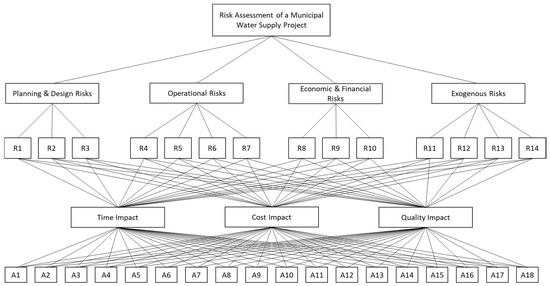
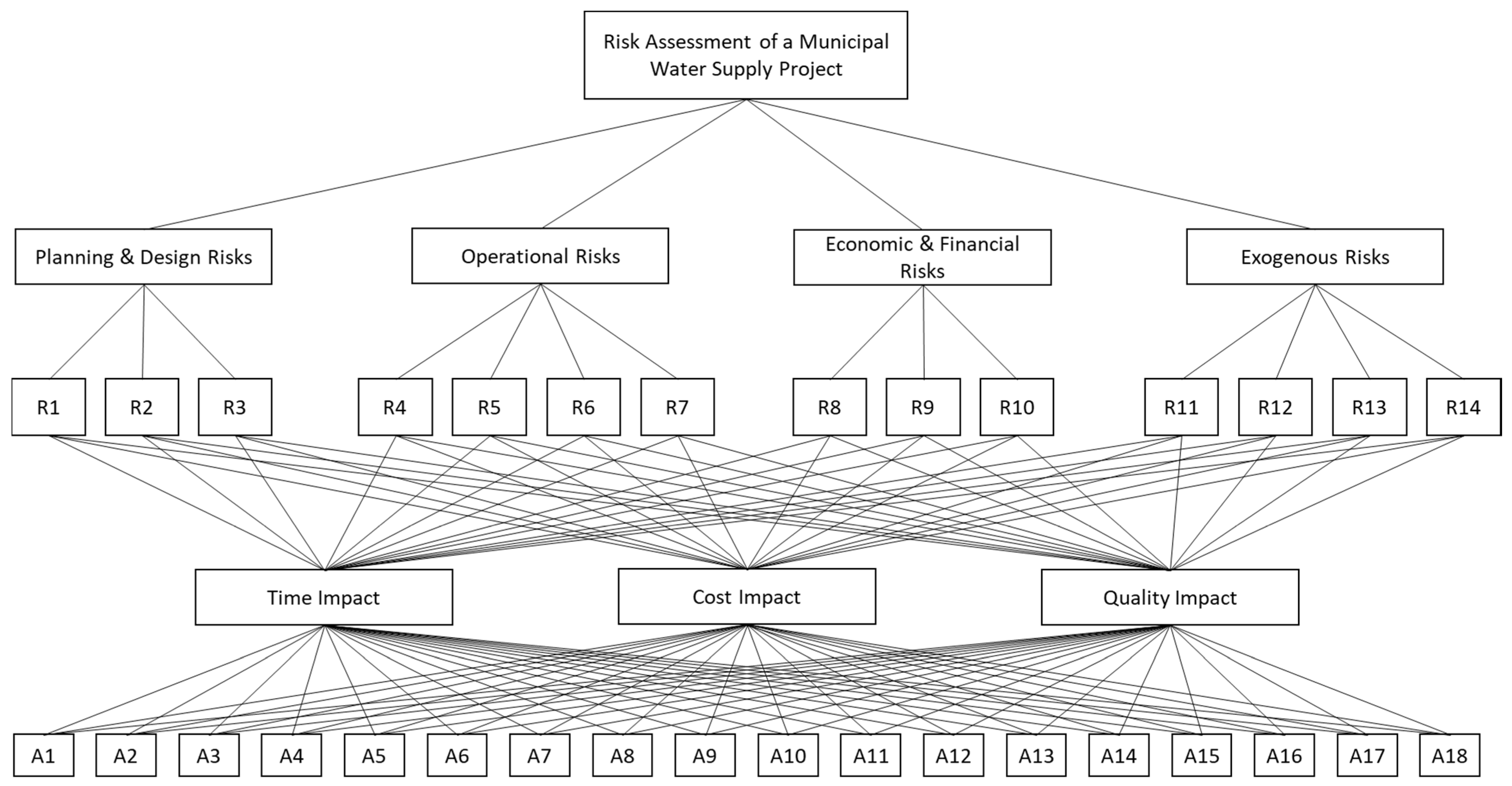
The second step starts with defining the hierarchical structure of risks according to the adopted classification. The hierarchical model structure has five levels (see Figure 3). The objective of the model is to assess risk for municipal water supply projects. On the second level are the main risk categories to be considered (i.e., planning and design risks, operational risks, economic and financial risks, and exogenous risks); on the third level are the related risks to each category; on the fourth level comes the type of impacts or disruptions that these risks can cause on the project; finally, the fifth level list the project activities. The questionnaires for the pairwise comparison are then administered to the experts to evaluate the risks associated with the project activities. The aim of this step is to identify activities of a water supply project by their risk level and their impact on time, cost, and quality during the construction phase. Based on the relative importance of risk categories and their impact on project activities, we can estimate their effect on the project’s overall risk.
Figure 3.
Hierarchical model structure.
In the literature, the AHP has garnered increasing attention in project management as a technique for analyzing complex situations and formulating appropriate decisions [6,43]. However, given the uncertainties inherent in the construction of critical infrastructure projects, the FAHP is better suited for conducting the risk assessment. For a detailed explanation of FAHP computations and methodologies, readers are referred to [15].
3.3. Formulate the Resource Allocation Strategy to Mitigate the Overall Risk
The third step of the methodological risk assessment framework focuses on implementing strategies to mitigate or manage identified risks. Typically, managerial decisions for risk mitigation involve one or more of the following approaches [44]: (i) reducing the overall risk, (ii) sharing the risk with other partners, or (iii) contracting additional insurance for the dominant risk categories. To make these decisions, project managers must evaluate the expected risk reduction against the associated costs, using analytical methods.
In the context of municipal water supply projects, various optimization models can be used to mitigate risk and enhance robustness to uncertainties. Since project implementation is inherently a dynamic process of resource consumption [45], ensuring sufficient resource allocation is critical for the timely and successful completion of activities. Accordingly, the decision problem can be framed as a resource-constrained project scheduling problem (RCPSP), with the objective of allocating resources and scheduling activities to minimize the project makespan and overall risk.
The RCPSP is a class of scheduling problems in which limited resources are allocated to activities subject to precedence constraints. Each activity has a defined start time, due date, and penalty for delays or deviations from the planned schedule. The primary objective is typically to minimize the project makespan. For comprehensive reviews of models and methods related to project management and scheduling, readers are referred to [46].
The RCPSP takes a baseline schedule with a predefined timetable as input. However, the dynamic nature of infrastructure projects, such as municipal water supply systems, introduces significant uncertainties. These include late budget releases, material delivery delays, equipment breakdowns, and variations in activity durations. Such disruptions can cause deviations from the baseline schedule, resulting in significant additional expenses. Consequently, providing project managers with reliable, feasible, robust work plans (i.e., insensitive to adverse events) is critical.
The proposed RCPSP model seeks to assign resources to project activities to minimize both the project duration (makespan) and the overall risk. Under ideal conditions, with sufficient resources, the project can be executed on time with minimal risk. However, when resources are scarce and activities compete for allocation, project managers must strategically allocate resources and reschedule activities. This requires balancing trade-offs to prevent excessive delays or cost overruns, particularly since certain activities may contribute disproportionately to overall project risk.
As resources are more constrained, deviations from the planned schedule increase, amplifying the overall project risk. Thus, the optimization model aims to minimize the overall project risk while keeping the makespan low. In a municipal project, the budget is liberated gradually, and the project manager must decide how to assign (allocate) the budget (and other resources) to activities at each period within the projection duration.
Due to the complexity and vagueness inherent in resource allocation and scheduling decisions, the RCPSP is modeled as a fuzzy multi-objective optimization problem. This approach accounts for uncertainties by aiming to maximize general aspiration criteria rather than rigidly satisfying constraints. The fuzzy optimization framework enables nuanced evaluation of trade-offs among competing objectives, balancing project risk and schedule performance in the face of uncertainty.
To formulate the RCPSP as a multi-objective fuzzy optimization model, the following assumptions, indices, parameters, and decision variables are considered:
Assumptions:
- The number of resources consumed by each activity is fixed and known in advance.
- Each activity has a normalized base probability of risk, which increases when there’s a deviation from the planned schedule.
- The normalized risk level of each activity comes from the fuzzy AHP evaluation.
- Precedence relationships must be considered.
- The number of available resources is considered fuzzy, since it depends on the allocation of resources by the MPWD.
- The duration of each activity is considered fuzzy.
- In both cases, triangular fuzzy numbers are adopted due to their simplicity, computational efficiency, and suitability for capturing expert judgments in risk assessment contexts. Triangular fuzzy numbers are particularly effective when the available information is limited or when experts find it more intuitive to provide three-point estimates (minimum, most likely, maximum) rather than four-point intervals required by trapezoidal fuzzy numbers. This aligns well with the subjective and imprecise nature of risk evaluations in critical infrastructure projects. Moreover, triangular fuzzy numbers maintain essential fuzzy properties while reducing complexity in the fuzzy multi-objective optimization problem.
- The model has two objectives: (i) minimizing the project makespan (Z1), and (ii) minimizing the overall risk (Z2).
Indices and Sets:
- N set of activities in the project: j = 1, 2, 3, …, n.
- P(j) subset of activities that are predecessors of activity j.
- R set of resource types: k = 1, 2, 3, …, r.
- t time-period, t = 1, 2, …, T.
Parameters:
- fuzzy number of periods required to perform activity j. A triangular fuzzy number is assumed of the type .
- fuzzy availability of resource k at the beginning of period t. A triangular fuzzy number is assumed of the type .
- consumption of resource type k required to perform activity j.
- earliest possible period in which activity j should start, assuming that there are no resource constraints.
- overall risk level associated with activity j when executed with a deviation of one period from its initial schedule. These values are estimated by the fuzzy AHP.
Decision Variables:
- 1 if activity j starts on period t, and 0 otherwise.
The mathematical model is formulated as
Subject to
The objective function is twofold: in Equation (1), it minimizes the project’s makespan, while in Equation (2), it minimizes the project’s overall risk. Constraints (3) ensure that all activities must start on time t. Constraints (4) establish the relationship between activities, where an activity cannot start its execution before the activities of its set of predecessor activities are completed. Constraints (5) ensure that only available resources are consumed at each period. This constraint can be explained as follows: if at the beginning of period t there are akt units of resource k available, then activity j, with a completion time t + dj − 1, uses this resource, since its starting time is in period t. Finally, Constraints (6) establish the nature of the decision variables.
The objective functions and the constraints are fuzzified using a decreasing linear ramp membership function between the thresholds for the project makespan, and for the overall risk. Where, and represents the optimum lower and upper bounds, respectively. These thresholds are calculated as follows:
- is obtained by minimizing (1), (3)~(6), with in Equation (5), and in Equation (4), with the intention that the project makespan be as small as possible.
- is obtained by minimizing (2), (3)~(6), where in Equation (5), and in Equation (4), with the intention that the project overall risk be as small as possible.
- is obtained by minimizing (1), (3)~(6), with in Equation (5), and in Equation (4), with the intention that the project makespan be as large as possible.
- is obtained by minimizing (2), (3)~(6), where in Equation (5), and in Equation (4), with the intention that the project overall risk be as large as possible.
Fuzzy decision-making can be categorized into two approaches: symmetric and asymmetric. In symmetric multi-objective fuzzy decision-making, the weights assigned to objectives and constraints are equal. Conversely, in the asymmetric approach, objectives and constraints hold different weights, reflecting their varying levels of importance [47]. The choice between symmetric and asymmetric models depends on selecting appropriate operators, and Zimmermann [48] identified eight key criteria to guide this selection process.
In this study, we assume both objective functions are equally important, i.e., the weight for λ1 and λ2 is the same, but this weight is more important than the weights ( and ) of the fuzzy constraints; thus the objective function of the crisp formulation is λ1 + λ2, and is added as a constraint. The crisp formulation follows the weighted additive model proposed by Tiwari et al. [49], which maximizes the additive value of the objectives’ membership functions.
The crisp formulation is expressed as
Subject to
4. A Case Study
In Mexico, the MPWD plays an important role in the planning, development, and maintenance of municipal government infrastructure and public services (including roads, streets, bridges, sidewalks, sewer systems, and drinking water), contributing to the general well-being of residents. The MPWD in the south region of Tamaulipas encompasses three municipalities (Tampico, Madero, and Altamira) and is responsible for supplying water to more than 4.8 million customers. In addition, MPWD is responsible for executing municipal water supply projects throughout the zone. Nowadays, due to the complex and variable environments of projects, especially municipal infrastructure projects, one of the most vital criteria for successfully completing water supply projects is risk management. Identifying, evaluating, and responding to risks that water supply projects may encounter are vital. Accordingly, ignoring the risks can impose extra costs and time, and cause projects to fail, leading to water scarcity.
4.1. Identifying Risks and Activities
After several meetings with the committee responsible for coordinating municipal water supply projects within the MPWD, we have decided to use 14 criteria to evaluate the overall risk of these projects. Each criterion defines a risk dimension in municipal water supply projects: long approval times for the project (R1), incomplete or inappropriate design (R2), and delays in contract awarding (R3) were considered as planning and design risk indicators; equipment failure (R4), unforeseen adverse soil conditions (R5), occupational accidents (R6), and lack of specific workers (R7) as operational risks indicators; late release of the budget (R8), increased costs in materials and equipment (R9), and exchange rate variations (R10) as economic and financial risk indicators; theft and damage to materials and equipment (R11), delays in material delivery (R12), adverse weather conditions (R13), and lack of regulatory compliance and environmental impact (R14) as exogenous risks indicators. The risk criteria were verified by experts to capture the MPWD’s perception of the associated risk for each activity of a municipal water supply project. These criteria will be used to assess a project’s overall risk.
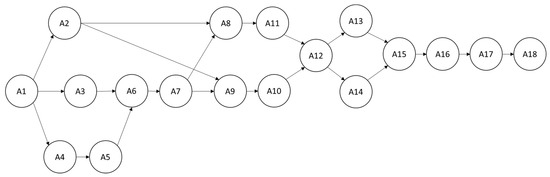
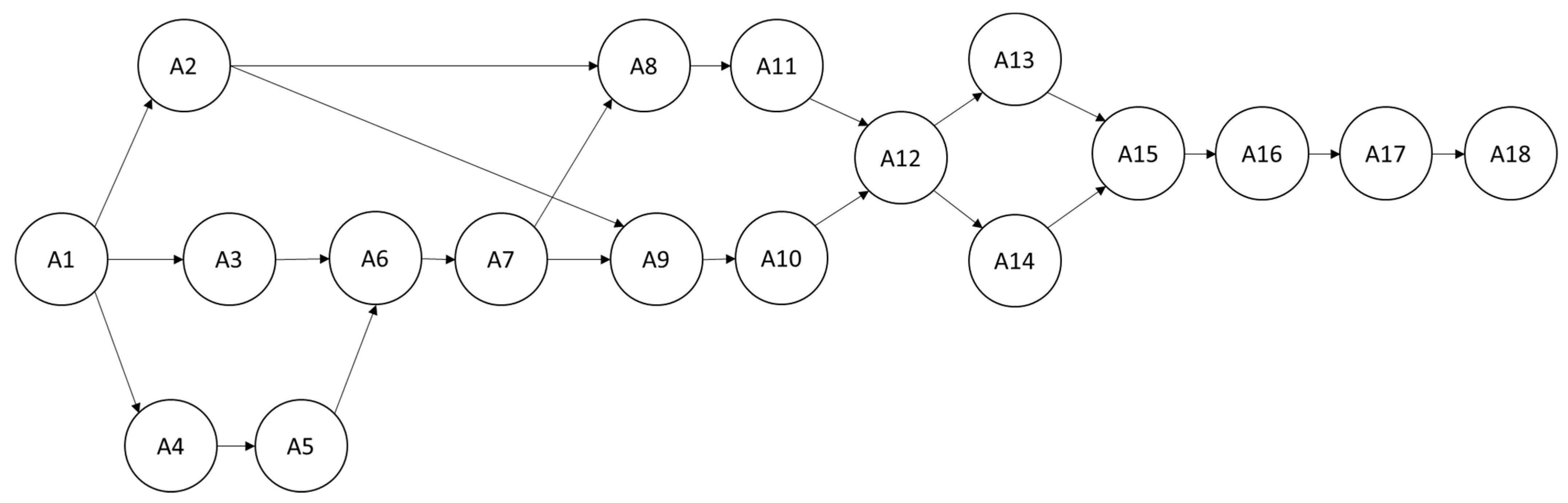
The standard project activities considered during the construction of municipal water supply projects, along with the related problem data, are listed in Table 1, while Figure 4 shows the project network.
Table 1.
Duration and precedence relations of project activities.
Figure 4.
Project network of a municipal water supply project.
4.2. Prioritizing Activities According to Their Risks
A brainstorming session was conducted at the MPWD to rank risk criteria through expert evaluation. The panel comprised five experts with extensive experience in designing and implementing critical infrastructure projects: the Director of Urban Development, the Project Manager, the Quality Manager, the Construction Supervisor, and a Superintendent. Initially, the experts evaluated the relative importance of the risk criteria using the AHP’s standard scale. The pairwise comparison results were first examined for consistency. After verifying consistency, the fuzzy matrices corresponding to each expert’s evaluations were generated.
A pairwise comparison matrix was constructed following the methodology proposed by [50] to calculate the weights of risk criteria. For a detailed explanation of the computational process for deriving the consistency index (CI) and consistency ratio (CR), readers are referred to [51]. Table 2 presents the CR for the panel of experts concerning the criteria used to evaluate risk factors. Additionally, Table 3 displays the fuzziness values for the Director of Urban Development, calculated using the membership function defined by [52].
Table 2.
Consistency ratio for the five experts regarding the risk categories.
Table 3.
Fuzzy values from the pairwise comparison—Opinion of the Director of Urban Development.
Table 4 shows the combined fuzzy importance matrix for the risk categories, based on the pairwise comparisons from the panel of experts.
Table 4.
Fuzzy comparison among risk categories—Final Matrix.
Applying the extent analysis method proposed by [15], the crisp normalized weight vector regarding the risk criteria is given by . A preliminary analysis reveals that, for the MPWD, economic and financial risks (EFR) and planning and design risks (PDR) are the most relevant risk categories during the construction of municipal water supply projects.
Similar computations were performed to determine the relative importance of each risk within its corresponding risk category, as well as the relative importance of each type of impact associated with each risk (see Table 5).
Table 5.
Priorities of Risk Categories, Risks, and Impact of risk.
Finally, the overall relative risk level for each activity in a water supply project is shown in Table 6.
Table 6.
Weighting of the type of impact to evaluate the overall risk of project activities.
4.3. Project Schedule and Resource Allocation Strategy
To determine the optimal project schedule and resource allocation strategy that minimize both the project makespan and overall risk, the RCPSP described above was solved. Using the computational procedure outlined for the bi-objective fuzzy optimization problem, the lower and upper bounds for each optimization criterion were obtained, and the corresponding crisp model was solved. The fuzzy bi-objective RCPSP was implemented in OPL CPLEX v12 on an HP Z800 Workstation equipped with an Intel Xeon X5647 processor (2.93 GHz) and 12 GB of RAM.
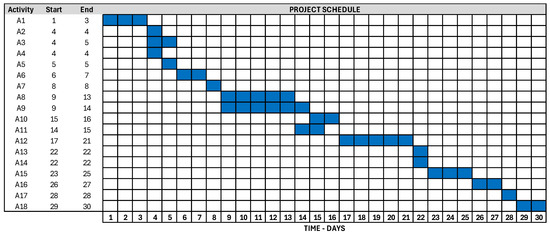
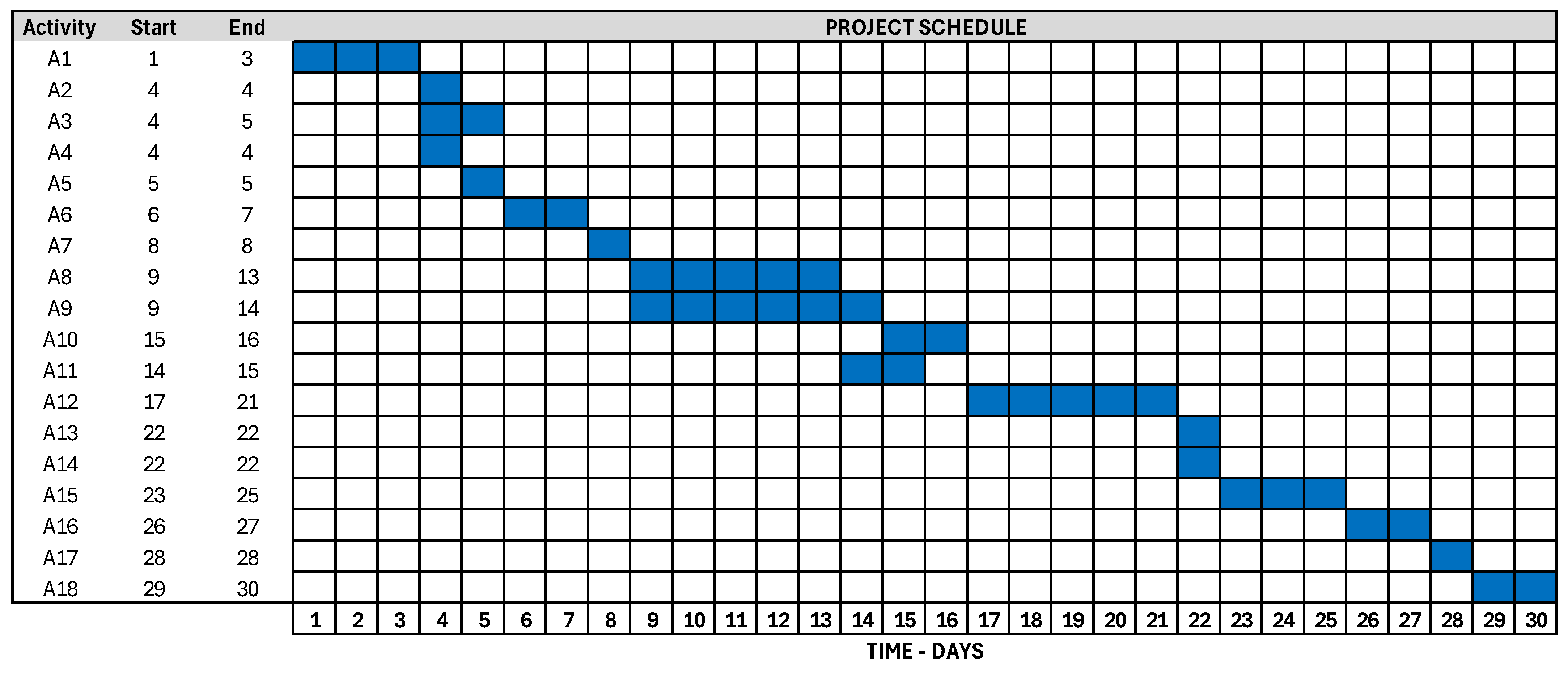
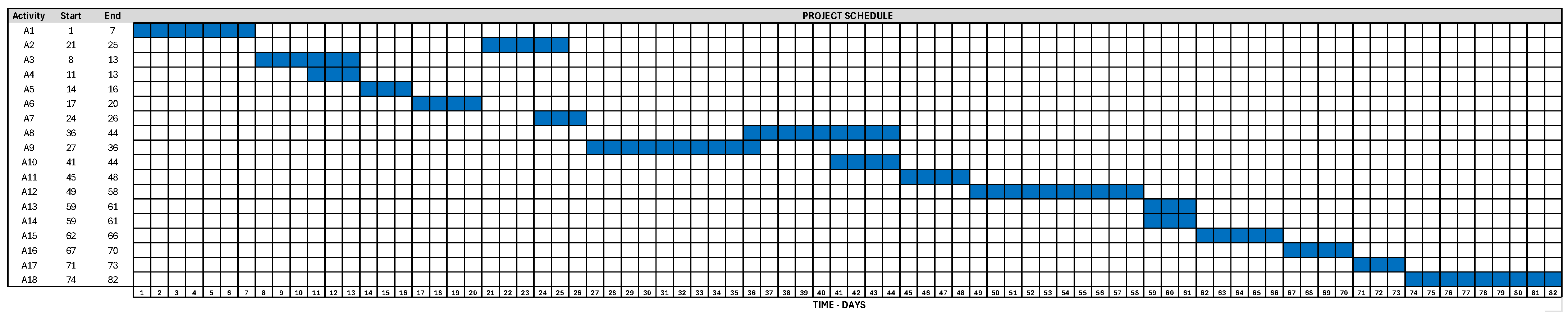
From the analysis of both Figure 5 and Figure 6, it is inferred that when there are no resource constraints and the activity duration is short, the project can be completed in 30 days. Conversely, when resource constraints and activity durations are high, it may take up to 82 days to complete the project.
Figure 5.
Project schedule for (makespan = 30).
Figure 6.
Project schedule for (makespan = 82).
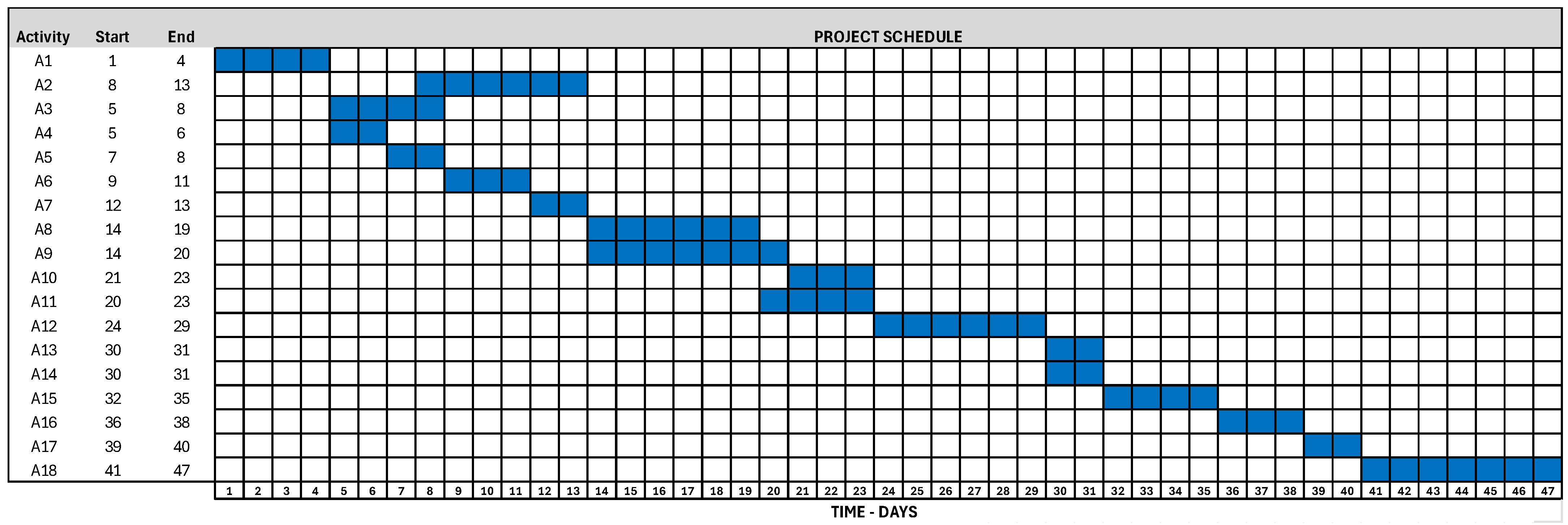
Figure 7 shows the final project schedule, considering fuzzy activity durations and fuzzy resource availability. In this case, it takes 47 days to complete the project, with an overall risk equal to 4.488, with , and respectively.
Figure 7.
Project Schedule with fuzzy activity duration times and fuzzy resource availability.
4.4. Implications for Engineering Managers
This research introduces a novel methodological framework to support risk assessment in municipal water supply projects, offering actionable insights for decision-makers in Municipal Public Works Departments. The findings of this research underscore the critical importance of integrating advanced analytical tools to address the inherent uncertainties in such infrastructure projects and provide strategic recommendations to enhance project resilience and efficiency:
- Systematic Risk Assessment: Municipal water supply projects face multifaceted uncertainties, including long approval times for the project, adverse weather conditions, design complexities, and regulatory constraints. These risks frequently disrupt schedules and escalate costs. The proposed framework combines FAHP with fuzzy bi-objective optimization to decompose, evaluate, and prioritize risk, empowering managers with actionable insights into individual and cumulative risk impacts.
- Addressing Uncertainty: Municipal infrastructure projects often operate under fluctuating resource availability and uncertain activity durations. The use of fuzzy-logic-based models addresses these ambiguities, enabling robust project scheduling and resource allocation strategies. In resource-constrained environments, where competition among project activities intensifies delays and risks, these models provide a structured approach to mitigate challenges. The proposed risk assessment framework prioritizes activities and allocates resources efficiently, balancing minimizing project makespan with reducing overall risk exposure.
- Enhancing Municipal Infrastructure Project Management: The proposed framework shifts municipalities from reactive to proactive risk management by integrating data-driven decision-making into infrastructure projects. This analytical approach enables municipalities to achieve more resilient infrastructure outcomes, optimize resource utilization, and effectively mitigate potential disruptions.
5. Conclusions and Further Research
Municipal water supply systems are critical infrastructure, essential to public health, economic development, and community sustainability. These systems ensure equitable access to clean water, supporting fundamental needs such as sanitation, public health, and economic activities. However, constructing and maintaining these systems often entails significant risks, including geotechnical challenges, adverse weather conditions, complex designs, and regulatory issues. Such risks, if unmanaged, can compromise the integrity, safety, and sustainability of these projects.
The proposed methodology, integrating fuzzy AHP with a fuzzy bi-objective resource-constrained scheduling problem, offers a robust framework for addressing these challenges. The fuzzy AHP method calculates normalized overall risk levels for project activities, evaluating cost, time, and quality impacts based on fourteen risk criteria across four categories. This risk assessment feeds into an optimization model that determines optimal project schedules in environments characterized by uncertainty and resource constraints. The framework accounts for three primary sources of uncertainty: the vagueness of risk factors, imprecise estimates of activity duration, and fluctuating resource availability.
Applied successfully to a case study in a metropolitan area of southern Tamaulipas, Mexico, this methodology demonstrated its utility for assessing risks in critical infrastructure projects and for optimizing decision-making. By systematically addressing uncertainties, it provides a reliable tool for reducing technical and economic inefficiencies, mitigating risks, and promoting sustainable development.
While demonstrating its effectiveness as a risk assessment framework for municipal water supply projects, this study acknowledges four main limitations. First, reliance on expert judgment introduces subjectivity that may affect the consistency and reproducibility of results. Second, the integration of FAHP with fuzzy multi-objective resource-constrained scheduling increases computational complexity, potentially limiting practical application for project managers without specialized training in fuzzy optimization techniques. Third, although the sequential coupling of methods represents methodological advancement, the current model does not incorporate real-time risk monitoring or dynamic updating of risk weights as projects progress. Fourth, the framework does not consider interdependence among critical infrastructure sectors (e.g., energy, transportation, telecommunications), which may influence project risks in interconnected urban systems.
These limitations suggest several avenues for future research. First, integrating objective historical data with expert judgment could reduce subjectivity in risk weight determination, potentially through machine learning algorithms that learn from completed project outcomes. Second, developing user-friendly decision-support tools would address computational complexity and enhance practical applicability for project managers. Third, incorporating dynamic risk updating mechanisms would transform the current static assessment into an adaptive decision-support system. Finally, extending the methodology to address interdependence among critical infrastructure systems (e.g., energy and transportation) would provide a more holistic approach to urban development planning.
Author Contributions
Conceptualization, J.M.-O. and M.D.G.; methodology, J.M.-O., M.D.G. and J.P.; software, C.R.L.-D.; validation, J.M.-O. and M.D.G.; formal analysis, J.M.-O., M.D.G., J.P. and C.R.L.-D.; investigation, J.M.-O., M.D.G., J.P. and C.R.L.-D.; data curation, J.M.-O. and C.R.L.-D.; writing—original draft preparation, M.D.G.; writing—review and editing, J.M.-O.; visualization, J.P. and C.R.L.-D. All authors have read and agreed to the published version of the manuscript.
Funding
This research received no external funding.
Data Availability Statement
The original contributions presented in this study are included in the article. Further inquiries can be directed to the corresponding author.
Conflicts of Interest
The authors declare no conflicts of interest.
References
- Miao, Z.; Xu, Z. Analysis of common problems and technical points in quality management of city water supply and drainage construction quality. J. Archit. Res. Dev. 2018, 2, 31–34. [Google Scholar] [CrossRef] [Scilit]
- Trindade, B.C.; Gold, D.F.; Reed, P.M.; Zeff, H.B.; Characklis, G.W. Water pathways: An open source stochastic simulation system for integrated water supply portfolio management and infrastructure investment planning. Environ. Model. Softw. 2020, 132, 104772. [Google Scholar] [CrossRef] [Scilit]
- Giannopoulos, G.; Dorneanu, B.; Jonkeren, O. Risk Assessment Methodology for Critical Infrastructure Protection; JRC78292—EUR 25745 EN; Publications Office of the European Union: Luxembourg, 2013. [Google Scholar] [CrossRef]
- Liu, W.; Song, Z. Review of studies on the resilience of urban critical infrastructure networks. Reliab. Eng. Syst. Saf. 2020, 193, 106617. [Google Scholar] [CrossRef] [Scilit]
- Karamoozian, A.; Wu, D.; Chen, C.P.; Luo, C. An approach for risk prioritization in construction projects using analytic network process and decision making trial and evaluation laboratory. IEEE Access 2019, 7, 159842–159854. [Google Scholar] [CrossRef] [Scilit]
- Darko, A.; Chan, A.P.C.; Ameyaw, E.E.; Owusu, E.K.; Pärn, E.; Edwards, D.J. Review of application of analytic hierarchy process (AHP) in construction. Int. J. Constr. Manag. 2019, 19, 436–452. [Google Scholar] [CrossRef] [Scilit]
- Afzal, F.; Yunfei, S.; Nazir, M.; Bhatti, S.M. A review of artificial intelligence based risk assessment methods for capturing complexity-risk interdependencies: Cost overrun in construction projects. Int. J. Manag. Proj. Bus. 2021, 14, 300–328. [Google Scholar] [CrossRef] [Scilit]
- Marques, G.; Gourc, D.; Lauras, M. Multi-criteria performance analysis for decision making in project management. Int. J. Proj. Manag. 2011, 29, 1057–1069. [Google Scholar] [CrossRef] [Scilit]
- Wang, Y.M.; Liu, J.; Elhag, T.M. An integrated AHP–DEA methodology for bridge risk assessment. Comput. Ind. Eng. 2008, 54, 513–525. [Google Scholar] [CrossRef] [Scilit]
- Raian, S.; Ali, S.M.; Sarker, M.R.; Sankaranarayanan, B.; Kabir, G.; Paul, S.K.; Chakrabortty, R.K. Assessing sustainability risks in the supply chain of the textile industry under uncertainty. Resour. Conserv. Recycl. 2022, 177, 105975. [Google Scholar] [CrossRef] [Scilit]
- Li, J.; Zou, P.X. Fuzzy AHP-based risk assessment methodology for PPP projects. J. Constr. Eng. Manag. 2011, 137, 1205–1209. [Google Scholar] [CrossRef] [Scilit]
- Liu, J.; Zhao, X.; Yan, P. Risk paths in international construction projects: Case study from Chinese contractors. J. Constr. Eng. Manag. 2016, 142, 05016002. [Google Scholar] [CrossRef] [Scilit]
- Parlindungan, D.R.; Setiadi, R.; López, M. Critical Risk Factors of PPP Water Supply Project in Indonesia. Indones. J. Plan. Dev. 2022, 7, 21–32. [Google Scholar] [CrossRef] [Scilit]
- Gan, Y.; Yu, H. Design method of municipal water supply and drainage pipeline based on BIM technology. In Civil Engineering and Disaster Prevention; Zende, A.M., Ren, X., Gao, Q., Eds.; CRC Press: Boca Raton, FL, USA, 2024; pp. 270–275. [Google Scholar]
- Zhu, K.J.; Jing, Y.; Chang, D.Y. A discussion on extent analysis method and applications of fuzzy AHP. Eur. J. Oper. Res. 1999, 116, 450–456. [Google Scholar] [CrossRef] [Scilit]
- Galway, L. Quantitative Risk Analysis for Project Management. A Critical Review. RAND Corporation WR-112-RC. 2004. Available online: https://www.rand.org/content/dam/rand/pubs/working_papers/2004/RAND_WR112.pdf (accessed on 25 November 2025).
- Freas, K.; Bailey, B.; Munévar, A.; Butler, S. Incorporating climate change in water planning. J. Am. Water Works Assoc. 2008, 100, 92–99. [Google Scholar] [CrossRef] [Scilit]
- Bognár, F.; Benedek, P. A novel AHP-PRISM risk assessment method—An empirical case study in a nuclear power plant. Sustainability 2022, 14, 11023. [Google Scholar] [CrossRef] [Scilit]
- Aven, T. Risk assessment and risk management: Review of recent advances on their foundation. Eur. J. Oper. Res. 2016, 253, 1–13. [Google Scholar] [CrossRef] [Scilit]
- Kaplan, S.; Garrick, B.J. On the quantitative definition of risk. Risk Anal. 1981, 1, 11–27. [Google Scholar] [CrossRef] [Scilit]
- Haghighi, M.H.; Ashrafi, M. A new qualitative and quantitative analytical approach for risk management in energy project time-cost trade-off problem under interval type-2 fuzzy uncertainty: A case study in the gas industry. Energy Rep. 2022, 8, 12668–12685. [Google Scholar] [CrossRef] [Scilit]
- Zayed, T.; Amer, M.; Pan, J. Assessing risk and uncertainty inherent in Chinese highway projects using AHP. Int. J. Proj. Manag. 2008, 26, 408–419. [Google Scholar] [CrossRef] [Scilit]
- Dey, P.K. Managing project risk using combined analytic hierarchy process and risk map. Appl. Soft Comput. 2010, 10, 990–1000. [Google Scholar] [CrossRef] [Scilit]
- Luo, N.; Yu, H.; You, Z.; Li, Y.; Zhou, T.; Jiao, Y.; Han, N.; Liu, C.; Jiang, Z.; Qiao, S. Fuzzy logic and neural network-based risk assessment model for import and export enterprises: A review. J. Data Sci. Intell. Syst. 2023, 1, 2–11. [Google Scholar] [CrossRef]
- Zheng, S.X.; Nishimura, S.I.; Shibata, T.; Yimeng, C.H. Quantitative risk assessment for overtopping of earth-fill dams in Japan using machine learning algorithms. Int. J. Disaster Risk Reduct. 2024, 13, 104892. [Google Scholar] [CrossRef] [Scilit]
- Flage, R.; Aven, T.; Berner, C.L. A comparison between a probability bounds analysis and a subjective probability approach to express epistemic uncertainties in a risk assessment context—A simple illustrative example. Reliab. Eng. Syst. Saf. 2018, 169, 1–10. [Google Scholar] [CrossRef] [Scilit]
- Kabir, S.; Papadopoulos, Y. Applications of Bayesian networks and Petri nets in safety, reliability, and risk assessments: A review. Saf. Sci. 2019, 115, 154–175. [Google Scholar] [CrossRef] [Scilit]
- Yin, J.; Khan, R.U.; Afzaal, M.; Nawaz, R.; Shanshan, X.; Jamal, A. A fuzzy bayesian quantitative risk assessment for language and communication induced accidents in maritime operations. Ocean Coast. Manag. 2024, 259, 107449. [Google Scholar] [CrossRef] [Scilit]
- Kang, J.; Sun, L.; Soares, C.G. Fault Tree Analysis of floating offshore wind turbines. Renew. Energy 2019, 133, 1455–1467. [Google Scholar] [CrossRef] [Scilit]
- Masalegooyan, Z.; Piadeh, F.; Behzadian, K. A comprehensive framework for risk probability assessment of landfill fire incidents using fuzzy fault tree analysis. Process Saf. Environ. Prot. 2022, 163, 679–693. [Google Scholar] [CrossRef] [Scilit]
- Bai, L.; Li, F. The Model of Project Risk Assessment Based on BP Neural Network Algorithm. In Proceedings of the 3rd International Conference on Computer Science and Network Technology, Dalian, China, 12–13 October 2013. [Google Scholar]
- Mhatre, T.N.; Thakkar, J.J.; Maiti, J. Modelling critical risk factors for Indian construction project using interpretive ranking process (IRP) and system dynamics (SD). Int. J. Qual. Reliab. Manag. 2017, 34, 1451–1473. [Google Scholar] [CrossRef] [Scilit]
- Zeng, S.X.; Wan, T.W.; Tam, C.M.; Liu, D. Identifying risk factors of BOT for water supply projects. Proc. Inst. Civ. Eng.-Water Manag. 2008, 161, 73–81. [Google Scholar] [CrossRef] [Scilit]
- Hatmoko, J.U.D.; Susanti, R. Risk management of West Semarang water supply PPP project: Public sector perspective. IPTEK J. Proc. Ser. 2017, 3, 48–54. [Google Scholar] [CrossRef] [Scilit]
- Shahata, K.; El-Zahab, S.; Zayed, T.; Alfalah, G. Rehabilitation of municipal infrastructure using risk-based performance. Autom. Constr. 2022, 140, 104335. [Google Scholar] [CrossRef] [Scilit]
- Zholonko, T.; Grebinchuk, O.; Bielikova, M.; Kulynych, Y.; Oviechkina, O. Methodological tools for investment risk assessment for the companies of real economy sector. J. Risk Financ. Manag. 2021, 14, 78. [Google Scholar] [CrossRef] [Scilit]
- Doomah, Z.; Jahmeerbacus, S. Exploring the early lifecycle risk factors–Project dimensions–Resilience nexus in water infrastructure projects in small island developing states. Phys. Chem. Earth 2025, 141, 104075. [Google Scholar] [CrossRef] [Scilit]
- Abaza, M.; Kisi, K. Improper risk management outcomes and lessons learned from an EPC water transmission project. J. Constr. Eng. Manag. 2024, 150, 05024012. [Google Scholar] [CrossRef] [Scilit]
- Senić, A.; Simić, N.; Dobrodolac, M.; Stojadinović, Z. Development of a Hybrid Model for Risk Assessment and Management in Complex Road Infrastructure Projects. Appl. Sci. 2025, 15, 2736. [Google Scholar] [CrossRef] [Scilit]
- Shtub, A.F.; Bard, J.F.; Globerson, S.; Globerson, S. Project Management: Engineering, Technology and Implementation, 2nd ed.; Prentice Hall: Hoboken, NJ, USA, 1994. [Google Scholar]
- Mishra, A.K.; Singh, N.K. A review on time and cost issues of infrastructure projects. J. Adv. Res. Const. Urban. Arch. 2018, 3, 32–46. [Google Scholar] [CrossRef] [Scilit]
- Shrestha, P.P.; Shrestha, S.; Basnet, P. Budget and Schedule-Related Critical Success Factors for Design-Build Water and Wastewater Projects: Principal Component Analysis. Buildings 2025, 15, 1653. [Google Scholar] [CrossRef] [Scilit]
- Lyu, H.M.; Yin, Z.Y.; Zhou, A.; Shen, S.L. MCDM-based flood risk assessment of metro systems in smart city development: A review. Environ. Impact Assess. Rev. 2023, 101, 107154. [Google Scholar] [CrossRef] [Scilit]
- Zhang, Y.; Fan, Z.P. An optimization method for selecting project risk response strategies. Int. J. Proj. Manag. 2014, 32, 412–422. [Google Scholar] [CrossRef] [Scilit]
- Zhong, Y.; Chen, Z.; Zhou, Z.; Hu, H. Uncertainty Analysis and Resource Allocation in Construction Project Management. Eng. Manag. J. 2018, 30, 293–305. [Google Scholar] [CrossRef] [Scilit]
- Hazir, Ö.; Ulusoy, G. A classification and review of approaches and methods for modeling uncertainty in projects. Int. J. Prod. Econ. 2020, 223, 107522. [Google Scholar] [CrossRef] [Scilit]
- Zimmermann, H.J. Fuzzy programming and linear programming with several objective functions. Fuzzy Sets Syst. 1978, 1, 45–55. [Google Scholar] [CrossRef] [Scilit]
- Zimmermann, H.J. Fuzzy Set Theory—And Its Applications, 4th ed.; Springer: New York, NY, USA, 2001. [Google Scholar] [CrossRef] [Scilit]
- Tiwari, R.N.; Dharmar, S.; Rao, J.R. Fuzzy goal programming—An additive model. Fuzzy Sets Syst. 1987, 24, 27–34. [Google Scholar] [CrossRef] [Scilit]
- Saaty, R.W. The analytic hierarchy process—What it is and how it is used. Math. Model. 1987, 9, 161–176. [Google Scholar] [CrossRef] [Scilit]
- Sarkis, J. A strategic decision framework for green supply chain management. J. Clean. Prod. 2003, 11, 397–409. [Google Scholar] [CrossRef] [Scilit]
- Lee, A.H. A fuzzy supplier selection model with the consideration of benefits, opportunities, costs and risks. Expert Syst. Appl. 2009, 36, 2879–2893. [Google Scholar] [CrossRef] [Scilit]




Disclaimer/Publisher’s Note: The statements, opinions and data contained in all publications are solely those of the individual author(s) and contributor(s) and not of MDPI and/or the editor(s). MDPI and/or the editor(s) disclaim responsibility for any injury to people or property resulting from any ideas, methods, instructions or products referred to in the content. |
© 2026 by the authors. Licensee MDPI, Basel, Switzerland. This article is an open access article distributed under the terms and conditions of the Creative Commons Attribution (CC BY) license.