


Abstract
Accurate image similarity assessment is a key problem in computer vision, particularly in segmentation and classification problems. Classical Hausdorff and Fréchet metrics provide pointwise distance values and do not allow similarity to be evaluated in the form of intervals, which limits their applicability in problems where uncertainty plays a significant role. In this study, a combined approach to computing distances between images based on fuzzy Fréchet and Hausdorff metrics is developed. Two theorems are proved demonstrating that, for convex polygonal contours, the fuzzy Hausdorff distance coincides with the fuzzy Fréchet distance. This result makes it possible to replace the computation of the fuzzy Hausdorff metric with the simpler fuzzy discrete Fréchet metric. A method and algorithms for determining the fuzzy discrete Fréchet distance and a combined distance between convex polygons are proposed; their computational complexity is evaluated, and an application example is provided. The results show that the combined fuzzy metric reduces computation time by at least a factor of two compared to the direct computation of the fuzzy Hausdorff metric, while preserving similarity assessment accuracy. The proposed approach can be applied to shape analysis, segmentation evaluation, and similarity modeling in image classification systems. Future research directions include extending the method to non-convex polygons and arbitrary geometric objects.
MSC:
54E35; 03E72; 68U10
1. Introduction
Image comparison is a fundamental problem in computer vision and digital image processing. Similarity assessment methods can be applied at all levels of analysis, ranging from image enhancement and contour extraction to segmentation, classification, and clustering [1]. A key component of these processes is the definition of a distance between images or their structural representations, which enables the quantitative evaluation of their similarity.
Traditionally, classical metrics—most notably the Hausdorff and Fréchet metrics—have been used for this purpose. These metrics provide pointwise distance measures between curves (in particular, polygonal shapes) or regions [2]. The Hausdorff metric evaluates the maximum deviation between point sets, whereas the Fréchet metric accounts for the ordering of points along curves and is more sensitive to the geometric structure of objects. However, both metrics yield a single numerical distance value, which is insufficient for problems where fuzziness, uncertainty, or admissible similarity intervals are essential, such as in multi-level classification models.
A common approach to overcoming this limitation is the use of fuzzy metrics. Fuzzy counterparts of classical metrics allow distances to be represented not by a single value but by a range of values, enabling more adequate modeling of uncertainty in data. In recent years, there has been significant progress in the theory of fuzzy metric spaces, including new definitions of fuzzy norms, fuzzy distances, and their applications in computer vision. In particular, several studies have addressed the fuzzy Fréchet metric and its discrete variants, as well as the fuzzy Hausdorff metric [3,4,5]. Nevertheless, a comprehensive approach that simultaneously exploits both metrics for distance evaluation between geometric objects remains insufficiently developed.
Existing works do not provide a unified methodology that combines fuzzy Fréchet and fuzzy Hausdorff metrics, nor do they offer efficient algorithms for computing distances between images represented by polygonal shapes. Moreover, mathematical relationships between these two metrics in the fuzzy setting have not been formally established. This limits their practical applicability, especially in image processing tasks where both accuracy and computational efficiency are crucial [6].
In this paper, a novel method for computing distances between images based on fuzzy Fréchet and fuzzy Hausdorff metrics is proposed for the case of convex polygons. Two theorems are proved establishing the equivalence of the fuzzy Hausdorff metric and the fuzzy Fréchet metric for convex contours. This result significantly simplifies computation, as replacing the fuzzy Hausdorff metric with the fuzzy discrete Fréchet metric reduces computational costs without losing accuracy. Based on these theoretical findings, a combined fuzzy metric, corresponding algorithms, and an illustrative application example are developed.
The main contributions of this work are as follows:
- The equivalence of the fuzzy Hausdorff metric and the fuzzy Fréchet metric for convex polygons is proved.
- A combined fuzzy metric integrating the characteristics of both metrics is proposed.
- A method and algorithms for computing the fuzzy discrete distance between images are developed.
- The computational complexity of the algorithms is analyzed, demonstrating at least a twofold speedup.
- An example illustrating the application of the proposed algorithms is presented.
The remainder of the paper is organized as follows. Section 2 reviews related work. Section 3 presents the mathematical formulation of the problem, along with the proposed methods and algorithms. Section 4 discusses the results, and Section 5 concludes the paper and outlines directions for future research.
2. Related Work
The problem of defining distances between geometric objects has a long history in the mathematical analysis of curves and in computer vision applications. Classical Fréchet and Hausdorff metrics have been extended in numerous directions, including approximation, discretization, generalization to complex structures, and adaptation to real-world applications.
The first fundamental results related to the Fréchet distance between curves were obtained by Alt and Godau [7], who investigated its computation and theoretical properties. Subsequent research focused on accelerating the computation of the discrete Fréchet distance. In particular, Bringmann and Mulzer [8] proposed a subquadratic-time approximation algorithm, while Filtser [9] and Chan and Rahmati [10] developed new approximation techniques and improved methods for discrete computation of this metric. Other studies addressed the construction of middle curves based on the Fréchet metric or the development of algorithms for closed curves, which is particularly important for the analysis of polygonal contours [11,12].
In the works of Berezsky and Zarichnyi [13,14], generalizations of the Fréchet metric to weighted trees and Gromov-type modification were investigated. These studies demonstrate that the Fréchet metric is suitable for analyzing complex structures; however, most existing results concern either classical metric spaces or their certain modifications [15]. Fuzzy counterparts of these approaches have not been considered.
The Hausdorff distance is traditionally used to compare point sets and is widely applied in computer vision. Recent studies include work based on the Gromov–Hausdorff distance, which measures dissimilarity between metric spaces [16]. Numerous contributions focus on approximating this metric, including the computation of the Gromov–Hausdorff distance for metric trees, subsets of Euclidean spaces, and p-metric spaces [17,18,19].
Although these studies significantly extend the theoretical foundation, they remain focused on classical rather than fuzzy metrics. An important result states that, for convex bodies in Euclidean space, the Fréchet distance coincides with the Hausdorff distance. This fact underlies several modern shape analysis methods; however, it has not yet been generalized to fuzzy versions of these metrics.
The concept of fuzzy metric spaces has been actively developed since the seminal works of George and Veeramani [5]. In recent years, a substantial body of research has addressed the properties of fuzzy metric spaces, including compactness, continuity, and modular structures. Several studies investigate relationships between fuzzy norms and quasi-concave functions, as well as new Mazur–Ulam-type theorems for fuzzy spaces [20,21,22,23,24,25,26].
Nevertheless, these works are primarily concerned with general theoretical properties of fuzzy metric spaces and do not provide algorithms or methods for computing fuzzy metrics between shapes or images.
Only a limited number of studies directly address fuzzy analogues of the Fréchet and Hausdorff metrics [27,28]. In [3], a fuzzy Fréchet metric between curves was introduced, while subsequent works [4,29] proposed discrete versions of the fuzzy Fréchet metric. Although these studies establish the basic conceptual framework, they do not provide a general method for computing the fuzzy Hausdorff metric, nor do they present detailed algorithms applicable to the comparison of geometric shapes.
Furthermore, there is a lack of research establishing theoretical relationships between fuzzy versions of the Fréchet and Hausdorff metrics, which restricts their applicability in image analysis problems.
Similarity metrics are widely used in segmentation and clustering problems [30,31,32,33,34,35,36]. Several studies address fuzzy clustering, classification based on fuzzy features, and shape analysis using Fréchet or Hausdorff metrics. Additionally, metrics have been applied to segmentation quality assessment, skeleton similarity analysis, and the evaluation of biomedical object structures [37,38,39,40,41,42,43,44,45].
Mushtaq et al. [46] propose Einstein-ordered aggregation operators for q-rung orthopair fuzzy hypersoft sets to support multi-criteria group decision-making. They apply the approach to prioritize thermal energy storage techniques under uncertainty.
The article [47] provides a useful survey of recent achievements in the theory of fuzzy metric spaces and their applications.
Among the modern works devoted to the application of metric spaces in image analysis, we mention [48].
Despite these advances, existing works rely either on classical metrics or on isolated fuzzy approaches, without proposing a comprehensive method that integrates fuzzy Hausdorff and fuzzy Fréchet metrics into a unified combined framework supported by efficient algorithms.
Based on the conducted review, three key research gaps can be identified:
- The absence of a combined fuzzy metric integrating the properties of fuzzy Hausdorff and fuzzy Fréchet metrics.
- The absence of algorithms for the practical computation of fuzzy metrics in the case of polygonal shapes.
- The absence of theoretical results establishing the equivalence of fuzzy Fréchet and fuzzy Hausdorff metrics, despite the fact that such equivalence has been proven for their classical counterparts.
3. Materials and Methods
3.1. Mathematical Problem Formulation
Let (X, d) be a metric space. In this space, two images I1 and I2 are given.
The images I1 and I2 are represented by regions A ⊂ X and B ⊂ X, respectively.
For the two given images, it is necessary to perform preprocessing to reduce noise and enhance contrast using the algorithms described in [1]. Subsequently, edge (contour) detection will be applied to the enhanced images.
Denote by ∂A the boundary of region A, and by ∂B the boundary of region B.
The interior of region A is denoted by OA, and the interior of region B by OB.
Then the images can be written as
I1 = ∂A ∪ OA, I2 = ∂B ∪ OB.
We assume that the boundaries ∂A and ∂B are smooth, strictly convex curves. Recall that a convex curve is called strictly convex if it does not contain any straight-line segments. This assumption does not reduce the generality of the problem, since any convex curve, including polygonal ones, can be approximated arbitrarily closely by strictly convex curves.
Furthermore, in the metric space (X, d), one can define a fuzzy Fréchet metric MF(x, y, t) and a fuzzy Hausdorff metric MH(A, B, t) (see the definitions below).
The objective is to determine a fuzzy distance MC(x, y, t) between the images I1 and I2, based on the fuzzy Fréchet metric MF(x, y, t) and the fuzzy Hausdorff metric MH(A, B, t).
3.2. Theorems on the Equivalence of the Fuzzy Fréchet and Fuzzy Hausdorff Metrics for Convex Polygons
Let X be a non-empty set. Recall that a function d:X × X → ℝ is called a metric on X if, for all x, y, z ∈ X, the following conditions are satisfied:
- Non-negativity
d(x, y) ≥ 0;
- 2.
- Identity of indiscernibles
d(x, y) = 0 if and only if x = y;
- 3.
- Symmetry
d(x, y) = d(y, x);
- 4.
- Triangle inequality
d(x, y) ≤ d(x, z) + d(z, y).
In a metric space, the Fréchet distance between closed curves can be defined.
Let S1 = {z ∈ ℂ||z| = 1} denote the unit circle in the complex plane ℂ.
A parameterized closed curve in a metric space X is defined as a continuous mapping γ: S1→X. The Fréchet distance between two closed curves γ1, γ2 ∈ (X, d) is defined as the value
where α1, α2 range over the set of all homeomorphisms of S1 onto S1.
The set of all closed curves in ℝ2 is denoted by C(ℝ2).
Formula (1) defines a metric in the set C(ℝ2).
Let X = ℝ2. In [7], it was proved that for convex compact bodies A, B ⊂ ℝ2, the following equality holds:
where dH denotes the Hausdorff metric, defined by
dF(∂A, ∂B) = dH(A, B),
This result is established for the standard Euclidean metric on ℝ2.
The convex hull of a set A ⊂ ℝ2 is denoted by Conv(A) and is defined as
Conv(A) = ⋂ {B ⊃ A∣B is convex}.
Suppose now that X is a linear space. Recall that a norm in X is a function x ↦ : X → ℝ satisfying the following conditions:
- ⟺ x = 0;
- ;
- .
Examples of norms on ℝn include the Lp-norms , defined by
where x = (x1, …, xn) and p ≥ 1. If p = ∞, then by definition
Each norm on X induces a metric on X defined by
Let now denote an arbitrary norm on ℝ2. Recall that a norm is called strictly convex if the unit circle {x ∈ ℝ2 = 1} contains no straight-line segments.
The following theorem is a version of Theorem [40] for an arbitrary norm on ℝ2.
Theorem 1.
Formula (2) holds for every metric on ℝ2 induced by an arbitrary norm .
Proof.
First, note that the proof in [42] remains valid if the Euclidean norm is replaced by a strictly convex norm. In the case of an arbitrary norm , we approximate it by a strictly convex norm of the form
Then, equality (2) for the strictly convex norm (3) yields, in the limit as α → 0, equality (2) for the norm . This finishes the proof.□
We now proceed to the fuzzy version.
The notion of a fuzzy metric uses the notion of a t-norm, i.e., an associative, commutative, monotone, continuous operation *: [0, 1] × [0, 1] → [0, 1], for which 1 is a neutral element [5].
A function M: X × X × (0; ∞) → [0, 1] is called a fuzzy metric in the sense of George and Veeramani if the following conditions hold:
- M(x, y, t) > 0;
- M(x, y, t) = 1 for all t > 0 if and only if x = y;
- M(x, y, t) = M(y, x, t);
- M(x, y, t) ∗ M(y, z, t) ≤ M(x, z, t + s);
- the function M(x, y, −): [0,∞) → [0, 1] is continuous.
Let X be a linear space, for example, X = ℝ2.
A fuzzy norm on X is a function
satisfying the following conditions (see [49]):
N: X × [0, ∞) → [0, 1]
- N(x, 0) = 0 for all x ∈ X;
- [N(x, t) = 0 for all t ] ⟺ x = 0;
- for all t ≥ 0, x ∈ X, λ ≠ 0;
- N(x + y, t + s) ≥ min{N(x, t), N(y, s)} for all x, y ∈ X, t, s ≥ 0;
- for all x ∈ X, ;
- the function N(x, ·) is continuous for each x ∈ X.
Example.
If is a norm on X, then
defines a fuzzy norm on X.
Any fuzzy norm N determines a fuzzy metric M by the formula M(x, y, t) = N(x − y, t).
Let us recall the definition of the fuzzy Fréchet metric (see [3]). If , , are parameterized curves in a fuzzy metric space , then the fuzzy Fréchet distance between these curves is calculated by the formula:
Let us now recall the fuzzy version of the Hausdorff metric [27]. For each nonempty subset A in X and each point x in X, we put
Now we define
for all .
We are able to prove a fuzzy version of a result of Godau [7].
Theorem 2.
Let A, B be compact convex bodies in ℝ2, and let N be a fuzzy norm on ℝ2. Then
MH(A, B, t) = MF(∂A, ∂B, t).
Here M denotes the fuzzy metric on ℝ2 induced by the fuzzy norm N,
Accordingly, MH and MF are the fuzzy Hausdorff and fuzzy Fréchet metrics generated by the fuzzy metric M.
Proof.
Thus, it is necessary to prove two inequalities: (1) MF ≥ MH; (2) MF ≤ MH.
Proof of inequality (1) MF ≥ MH.
Assume that N is a fuzzy norm on ℝ2. It induces a fuzzy metric defined by
Let A and B be two compact convex regions. We prove the inequality
MH(A, B) ≥ MF(∂A, ∂B).
Let 0 < r < 1. Assume that
MF(∂A, ∂B, t) ≥ 1 − r.
Then for every a ∈ ∂A there exists b ∈ ∂B such that
M(a, b, t) ≥ 1 − r.
Now choose an arbitrary point a ∈ A.
There exist points a′, a″ ∈ ∂A such that
a = αa′ + (1 − α)a″, α ∈ (0, 1).
There exist points b′, b″ ∈ ∂B such that
M(a′, b′, t) ≥ 1 − r, M(a″, b″, t) ≥ 1 − r.
Let
b = αb′ + (1 − α)b″.
Then
(by property 4 from the definition of fuzzy norm)
(by property 3 from the definition of fuzzy norm)
M(a, b, t) = N(a − b, t) = N(αa′ + (1 − α)a″ − (αb′ + (1 − α)b″), t) =
= N(α(a′ − b′) + (1 − α)(a″ − b″), αt + (1 − α)t) ≥
= N(α(a′ − b′) + (1 − α)(a″ − b″), αt + (1 − α)t) ≥
Hence, it follows that
MH(A, B, t) ≥ MF(∂A, ∂B, t).
Proof of inequality (2) MF ≤ MH.
Let C = Conv(A ∪ B), then ∂C is a convex curve. Since the fuzzy metric is a continuons function [50], and the set ∂C is compact, for every there is at which the maximum of is attained. Similarly, for every , there is , at which the maximum of the function is attained.
Next, we follow the construction from the proof of Theorem 1 from [50]. Let , be the tangent lines to A and B at a and b, respectively.
We are going to estimate .
Let , then
where .
Now let , where is as in Figure 1, which is an analogue of Figure 4 from [50]. Also, we assume that is a point on and the vector is parallel to .
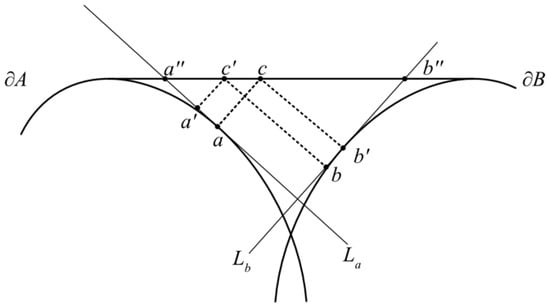
Figure 1.
Estimation of .
Therefore , for some , and therefore
We conclude that , for any and therefore
Similarly,
We conclude that
Next, we establish a correspondence between points of ∂A and ∂C, and between ∂C and ∂B.
For each a ∈ ∂A, there exists a unique point φ(a) ∈ ∂C such that a attains the maximum of the distance MF(φ(a), ·, t).
Similarly, for each b ∈ ∂B, there exists a unique point ψ(b) ∈ ∂C such that b attains the maximum of the distance MF(ψ(b), ·, t).
Then
α = ψφ−1: ∂A → ∂B has the property that
MF(x, α(x), t) ≤ MH(A, B, t).
This proves the inequality MF ≤ MH.
Hence, MH(A, B) = MF(∂A, ∂B). □
Remark 1.
The condition of convexity is essential even in the case of ordinary Fréchet and Hausdorff distances.
In [50] the authors consider planar curves where the arclength between any two points on the curve is at most their Euclidean distance multiplied by a constant k (called the k-straight curves). It is proved that the Fréchet distance of such curves is at most (1 + k) multiplied by their Hausdorff distance. It is an open question whether a counterpart of this result is valid in the realm of fuzzy metric spaces.
Therefore, the distance MC(x, y, t) between images I1 and I2, based on the fuzzy Fréchet metric MF(x, y, t) and the fuzzy Hausdorff metric MH(A, B, t), is equal to 2MF(x, y, t).
3.3. Method for Determining the Distance Between Images Based on Fuzzy Fréchet and Hausdorff Metrics
Based on the introduced metrics—namely, the fuzzy Fréchet metric and the fuzzy discrete Fréchet metric—a method for computing the discrete fuzzy Fréchet distance between convex polygons is developed.
The method consists of the following steps:
- Two arbitrary polygonal curves
γ1: [0, n] → X, γ2: [0, m] → X are given.
For each polygonal curve, the following corresponding sequences are defined:
σ(γ1) = {γ1(1), γ1(2), …, γ1(n)},
σ(γ2) = {γ2(1), γ2(2), …, γ2(m)}.
σ(γ2) = {γ2(1), γ2(2), …, γ2(m)}.
These sequences satisfy conditions (1–4).
- 2.
- The parameter t is specified by a sequence
σ(t) = {t1, t2, …, tq}.
- 3.
- The set L is constructed as
L = ((i1, j1), (i2, j2), …, (ik, jk)).
- 4.
- We compute
- 5.
- The discrete fuzzy Fréchet distance is determined as
3.4. Algorithms for Determining the Distance Between Images Based on Fuzzy Fréchet and Hausdorff Metrics
We consider algorithms for computing the discrete Fréchet distance.
We interpret the discrete Fréchet distance as the Fréchet distance between polygonal curves.
A polygonal curve is defined as a mapping p: [0, 1] → ℝk such that the interval [0, 1] is partitioned by points 0 = t0 < t1 < … < tn−1 < tn = 1, and the function p is linear on each subinterval [ti, ti+1], for i = 0, 1, …, n − 1.
Suppose that
is another polygonal curve, and 0 = τ0 < τ1 < … < τm−1 < τm = 1 is the corresponding partition of the interval.
g: [0, 1] → ℝk
The relationship between the functions f and g is described by a sequence of pairs of non-negative integers:
such that
and
L = ((0, 0),(a1, b1), …, (aq−1, bq−1), (aq, bq)),
ai+1 = ai or ai+1 = ai + 1, bi+1 = bi or bi+1 = bi + 1,
aq ≥ n, bq ≥ m.
By the definition, the length of L is the value
The discrete Fréchet distance between polygonal curves f and g is then defined as
Below, the pseudocode of this algorithm is presented.
Function dF(P,Q): real;
input: polygonal curves P = (u1, …, um) and Q = (v1, …, vn).
return: _dF (P,Q)
ca : array [1..m, 1..n] of real;
function c(i, j): real;
begin
if ca(i, j) > −1 then return ca(i, j)
elsif i = 1 and j = 1 then ca(i, j) := d(u1, v1)
elsif i > 1 and j = 1 then ca(i, j) := max{ c(i − 1, 1), d(ui, v1) }
elsif i = 1 and j > 1 then ca(i, j) := max{ c(1, j − 1), d(u1, vj) }
elsif i > 1 and j > 1 then ca(i, j) :=
max{min(c(i − 1, j), c(i − 1, j − 1), c(i, j − 1)), d(ui, vj) }
else ca(i, j) = 1
return ca(i, j);
end; /* function c */
begin
for i = 1 to m do for j = 1 to n do ca(i, j) := −1.0;
return c(m, n);
end.
In the pseudocode, the notation is as follows: m and n denote the number of segments of the curves P and Q, respectively, and d denotes the Euclidean distance between the vertices (node points) of the curves P and Q.
Pseudocode for computing the fuzzy discrete Fréchet distance MdF
Function MdF(P, Q, t): real
Input: polygonal curves P = (u1, …, um) and Q = (v1, …, vn);
σ(P) = {p(1), p(2), …, p(m)};
σ(Q) = {q(1), q(2), …, q(n)};
σ(t) = {t1, t2, …, tq}.
Function dF (computation of the discrete Fréchet distance)
begin
if fdF < ti, then MdF = dF
else MdF = ∞
end.
In [7] it was proven that the computation time of the discrete Fréchet distance is . In Big-O notation, this is . The computation time of the fuzzy discrete Fréchet distance differs from that of the discrete Fréchet distance by the additional comparison operation of the distance . Therefore, , where is the time required to perform the comparison operation for the distance . Since this comparison takes constant time, . Hence, , and in Big-O notation, .
Let us estimate the computational complexity of the fuzzy discrete Hausdorff distance.
Let us denote:
where r and s are the numbers of points in the sets and , respectively,
is a fuzzy metric for fixed .
Then is the fuzzy Hausdorff metric for fixed .
Therefore, the fuzzy metric is equal to
Accordingly,
The computation consists of the following steps:
- computation of with time ,
- computation of with time ,
- one comparison for .
Therefore,
Then:
where is the time of one operation.
By summing Equations (4) and (5), we obtain:
If , then we have:
And in Big-O notation:
It should be noted that and .
4. Example of Application
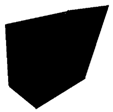
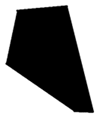
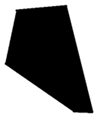
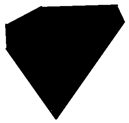
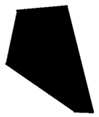
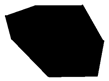
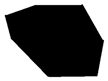
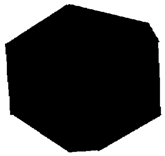
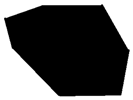
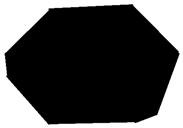
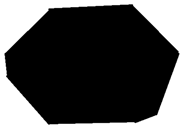
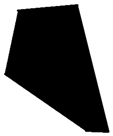
Computer experiments were conducted using polygons as an example. The dataset consists of a set of grayscale images with a resolution of 174 × 120 pixels. During processing, threshold segmentation is applied to separate the background from the object. At the next stage, contour extraction is performed.
The software module was implemented in the Java programming language in combination with the OpenCV library. The hardware configuration is as follows: Intel(R) Core(TM) i5-7200U CPU @ 2.50 GHz (2.71 GHz), 8 GB RAM, 100 GB HDD. The operating systems used were Windows, Linux, and macOS. The software environment includes Java 8+, OpenCV 3.0, and IntelliJ IDEA- 2025.3.3.
Table 1 presents the results of computer experiments on computing the discrete Fréchet and Hausdorff distances, as well as the computation time. Table 2 presents the results of computer experiments on computing the fuzzy discrete distance between polygons for different values of the parameter t.

Table 1.
Discrete distance between polygons.
Table 2.
Fuzzy discrete distance between polygons.
In Table 1, the first column presents the discrete Fréchet distance between convex polygons. The second column shows the combined discrete distance, which incorporates both the discrete Fréchet distance and the discrete Hausdorff distance. The combined discrete distance is equal to twice the discrete Fréchet distance. Smaller values of the discrete Fréchet distance correspond to polygons that are more similar to each other, and vice versa.
The computation time for the combined distance between polygons is reduced by at least a factor of two due to Theorems 1 and 2 proved in this study. Computer experiments (Table 1) showed that the computation time for the combined distance between polygons decreased by more than twofold.
Table 2 presents the fuzzy discrete distance between polygons. In addition, a parameter t is introduced, whose value specifies a threshold for the Fréchet distance. Polygons whose distance is less than the value of t (i.e., those satisfying the fuzzy Fréchet distance condition) are marked with the symbol “+”, whereas polygons whose distance exceeds the value of t are marked with the symbol “–“.
In [51], a discrete fuzzy Fréchet metric was introduced; however, no method or algorithms for computing the Fréchet distance were developed. In [4], only a method for computing the fuzzy discrete Fréchet distance was proposed, while no method for computing the fuzzy Hausdorff metric was presented.
The obtained results demonstrate that the proposed approach provides both theoretical and practical advantages compared to existing methods that employ classical or fuzzy counterparts of the Fréchet and Hausdorff metrics.
4.1. Theoretical Significance of the Results
The theorems proved in this study establish a fundamental relationship between the fuzzy Fréchet metric and the fuzzy Hausdorff metric for convex polygonal regions. An analogous result is known for classical (non-fuzzy) metrics in the case of convex bodies; however, until now, no fuzzy counterpart of this result has been formulated. Thus, the proposed theoretical proofs extend the current understanding of fuzzy metric spaces and introduce new elements into the theory of fuzzy norms and metrics.
An important feature of the obtained results is the possibility of replacing the more complex fuzzy Hausdorff metric with the computationally simpler fuzzy discrete Fréchet metric. This provides a rigorous mathematical foundation for constructing a combined fuzzy metric that integrates the properties of both metrics.
4.2. Comparison with Existing Approaches
Previous studies on fuzzy metric spaces have predominantly focused on general theoretical properties of metrics, their topological characteristics, and abstract generalizations [20,21,22,23,24,25,26]. Only a limited number of works have addressed the fuzzy Fréchet metric, while the fuzzy Hausdorff metric has almost no algorithmic implementations [3,4,27,28]. Moreover, none of the existing studies has proposed a unified approach or established a theoretical equivalence between these metrics in the fuzzy setting.
In contrast, the proposed method provides:
- Rigorous mathematical proofs of the equivalence of fuzzy metrics;
- Application of the derived theorems to real geometric objects;
- Practical algorithms with evaluated computational complexity;
- A demonstration of effectiveness through numerical experiments.
In addition, the presented example confirms that the combined fuzzy metric reduces computation time by at least a factor of two. This improvement is particularly significant when compared to classical implementations of the fuzzy Hausdorff metric, which require substantially higher computational resources and are therefore rarely used in real-world systems due to their high complexity.
4.3. Practical Advantages of the Method
The proposed method has several key practical advantages:
- Improved computational efficiency.
The transition from the fuzzy Hausdorff metric to the fuzzy discrete Fréchet metric makes it possible to significantly reduce computational complexity. The combined metric, which uses twice the value of the fuzzy Fréchet distance, produces the same result while requiring substantially less computation time.
- 2.
- Ability to operate with similarity intervals.
Unlike classical metrics, fuzzy metrics allow similarity to be expressed in terms of intervals rather than single-point distances. This feature is more suitable for classification, clustering, and applications involving fuzzy or uncertain data.
- 3.
- Guaranteed correctness for convex objects.
For convex polygons, which frequently occur in computer vision applications, the proposed method yields strictly justified and theoretically sound results.
4.4. Limitations of the Study
Despite its strengths, the proposed approach has several limitations that require further investigation:
- Convexity constraint.
The proved theorems and the developed algorithms are applicable only to convex polygons. For non-convex objects, the fuzzy Fréchet and fuzzy Hausdorff metrics may differ significantly, and establishing their equivalence is a non-trivial problem.
- 2.
- Dependence on discretization.
Since the implementation is based on the discrete version of the Fréchet metric, the accuracy of the method depends on the quality of the discretization of polygonal contours.
4.5. Application Potential
The obtained results open up opportunities for applying the proposed method in the following areas:
- Image clustering based on fuzzy distance intervals;
- Segmentation quality assessment in biomedical systems;
- Structural shape comparison in object recognition tasks;
- Geometric analysis in computer graphics;
- Decision-making systems based on fuzzy metric spaces.
Due to its low computational complexity, the combined fuzzy metric can be effective even for large-scale datasets and real-time or streaming data analysis.
The discussion confirms that the proposed approach represents a novel and effective solution to the problem of computing fuzzy distances between images. It combines rigorous mathematical proofs, algorithmic efficiency, and practical applicability, making it a promising direction for further development in the theory of fuzzy metrics and their applied implementations.
5. Conclusions
In this paper, a new approach to assessing image similarity based on fuzzy Fréchet and fuzzy Hausdorff metrics is proposed. Two theorems are proved establishing the equivalence of the fuzzy Hausdorff metric and the fuzzy Fréchet metric for convex polygonal contours. This result makes it possible to define a combined fuzzy metric that generalizes the properties of both metrics and provides a correct evaluation of fuzzy distances between images within a range of values.
Based on the obtained theoretical results, a method and algorithms for computing the fuzzy discrete Fréchet metric, as well as the combined fuzzy metric, are developed. The presented application example demonstrates that the combined metric reduces computation time by at least a factor of two compared to the direct computation of the fuzzy Hausdorff metric, while preserving evaluation accuracy.
The main results of the study are as follows:
- Proving the equivalence of the fuzzy Fréchet and fuzzy Hausdorff metrics for convex objects;
- Developing a combined fuzzy metric as an efficient tool for similarity assessment;
- Designing algorithms with low computational complexity.
Future research is planned to focus on extending the proposed method to non-convex polygons and arbitrary geometric objects, as well as on the development of adaptive fuzzy models. This will broaden the applicability of the proposed approach in computer vision, shape analysis, biomedical visualization, and intelligent systems for processing fuzzy data.
Author Contributions
Conceptualization, O.B. and M.Z.; methodology, O.B.; software, M.B.; validation, M.B.; formal analysis, M.Z.; investigation, O.B. and M.B.; resources, O.B. and M.B.; data curation, V.T.; writing—original draft preparation, O.B. and M.Z.; writing—review and editing, O.B. and M.Z.; visualization, V.T.; supervision, O.B.; project administration, O.B.; funding acquisition, O.B. All authors have read and agreed to the published version of the manuscript.
Funding
This research received no external funding.
Data Availability Statement
The original contributions presented in this study are included in the article.
Acknowledgments
During the preparation of this manuscript/study, the authors used ChatGPT-5 for the purposes of improving English. The authors have reviewed and edited the output and take full responsibility for the content of this publication.
Conflicts of Interest
The authors declare no conflicts of interest.
References
- Gonzalez, R.C.; Woods, R.E. Digital Image Processing; Pearson Education: New York, NY, USA, 2018; p. 1020. [Google Scholar]
- Deza, M.M.; Deza, E. Encyclopedia of Distances; Springer: Berlin/Heidelberg, Germany, 2014; p. 731. [Google Scholar]
- Bazylevych, L.; Berezsky, O.; Zarichnyi, M. Fréchet fuzzy metric. Mat. Stud. 2022, 57, 210–215. [Google Scholar] [CrossRef]
- Berezsky, O.M.; Berezkyi, M.O.; Zarichnyi, M.M. A method for determining the fuzzy discrete Fréchet distance. Radio Electron. Comput. Sci. Control 2025, 4, 41–49. [Google Scholar] [CrossRef]
- George, A.; Veeramani, P. On Some Results in Fuzzy Metric Spaces. Fuzzy Sets Syst. 1994, 64, 395–399. [Google Scholar] [CrossRef]
- Vinurajkumar, S.; Anandhavelu, S. An enhanced fuzzy segmentation framework for extracting white matter from T1-weighted MR images. Biomed. Signal Process. Control 2022, 71, 103093. [Google Scholar] [CrossRef]
- Godau, M. On the Complexity of Measuring the Similarity Between Geometric Objects in Higher Dimensions. Ph.D. Thesis, Freie Universität Berlin, Berlin, Germany, 1998. [Google Scholar] [CrossRef]
- Bringmann, K.; Mulzer, W. Approximability of the discrete Fréchet distance. J. Comput. Geom. 2016, 7, 46–76. [Google Scholar] [CrossRef]
- Filtser, O. Universal approximate simplification under the discrete Fréchet distance. Inf. Process. Lett. 2018, 132, 22–27. [Google Scholar] [CrossRef]
- Chan, T.M.; Rahmati, Z. An improved approximation algorithm for the discrete Fréchet distance. Inf. Process. Lett. 2018, 138, 72–74. [Google Scholar] [CrossRef]
- Ahn, H.-K.; Alt, H.; Buchin, M.; Oh, E.; Scharf, L.; Wenk, C. Middle curves based on discrete Fréchet distance. Comput. Geom. 2020, 89, 101621. [Google Scholar] [CrossRef]
- Vodolazskiy, E. Discrete Fréchet distance for closed curves. Comput. Geom. 2023, 111, 101967. [Google Scholar] [CrossRef]
- Berezsky, O.; Zarichnyi, M. Fréchet distance between weighted rooted trees. Mat. Stud. 2017, 48, 165–170. [Google Scholar] [CrossRef]
- Berezsky, O.; Zarichnyi, M. Gromov–Fréchet distance between curves. Mat. Stud. 2018, 50, 88–92. [Google Scholar] [CrossRef]
- Colijn, C.; Plazzotta, G. A metric on phylogenetic tree shapes. Syst. Biol. 2018, 67, 113–126. [Google Scholar] [CrossRef] [PubMed]
- Tuzhilin, A.A. Who invented the Gromov–Hausdorff distance? arXiv 2016, arXiv:1612.00728. [Google Scholar]
- Smith, Z.; Wan, Z. Gromov–Hausdorff distances on p-metric spaces and ultrametric spaces. arXiv 2020, arXiv:1912.00564. [Google Scholar]
- Majhi, S.; Vitter, J.; Wenk, C. Approximating Gromov–Hausdorff distance in Euclidean space. arXiv 2019, arXiv:1912.13008. [Google Scholar] [CrossRef]
- Agarwal, P.K.; Fox, K.; Nath, A.; Sidiropoulos, A.; Wang, Y. Computing the Gromov–Hausdorff distance for metric trees. ACM Trans. Algorithms 2018, 14, 24. [Google Scholar] [CrossRef]
- Changqing, L.; Yanlan, Z. On completion of principal fuzzy metric spaces. Fuzzy Sets Syst. 2025, 505, 109261. [Google Scholar] [CrossRef]
- Huang, H. Properties of several metric spaces of fuzzy sets. Fuzzy Sets Syst. 2024, 475, 108745. [Google Scholar] [CrossRef]
- Brydun, V.; Savchenko, A.; Zarichnyi, M. Fuzzy metrization of the spaces of idempotent measures. Eur. J. Math. 2020, 6, 98–109. [Google Scholar] [CrossRef]
- Wu, X.; Chen, G. Answering an open question in fuzzy metric spaces. Fuzzy Sets Syst. 2020, 390, 188–191. [Google Scholar] [CrossRef]
- Paknazar, M.; De la Sen, M. Some new approaches to modular and fuzzy metric and related best proximity results. Fuzzy Sets Syst. 2020, 390, 138–159. [Google Scholar] [CrossRef]
- Font, J.J.; Galindo, J.; Macario, S.; Sanchís, M. Mazur–Ulam type theorems for fuzzy normed spaces. J. Nonlinear Sci. Appl. 2017, 10, 4499–4506. [Google Scholar] [CrossRef]
- Cabello Sánchez, J.; Morales González, D. A natural correspondence between quasiconcave functions and fuzzy norms. Fuzzy Sets Syst. 2023, 466, 108413. [Google Scholar] [CrossRef]
- Zhang, G.; Shi, Y.; Yao, W. Convexity structures of the Hausdorff fuzzy quasi-metric spaces. Inf. Sci. 2025, 718, 122406. [Google Scholar] [CrossRef]
- Khastan, A.; Rodríguez-López, R.; Shahidi, M. New metric-based derivatives for fuzzy functions and some of their properties. Fuzzy Sets Syst. 2022, 436, 32–54. [Google Scholar] [CrossRef]
- Berezsky, O.; Zarichnyi, M. Metric methods in computer vision and pattern recognition. In Advances in Intelligent Systems and Computing V, CSIT 2020; Springer: Cham, Switzerland, 2020; Volume 1293. [Google Scholar] [CrossRef]
- Ralević, N.M.; Paunović, M.V.; Iričanin, B.D. Fuzzy metric space and applications in image processing. Math. Monogr. 2020, 48, 103–117. [Google Scholar] [CrossRef]
- Ralević, N.M.; Karaklić, D.; Pištinjat, N. Fuzzy metric and its applications in removing image noise. Soft Comput. 2019, 23, 12049–12061. [Google Scholar] [CrossRef]
- Soto-Hidalgo, J.M.; Sánchez, D.; Chamorro-Martínez, J.; Martínez-Jiménez, P.M. Color comparison in fuzzy color spaces. Fuzzy Sets Syst. 2020, 390, 160–182. [Google Scholar] [CrossRef]
- Zhan, J.; Goh, E.S.; Sunar, M.S. Low-light image enhancement: A comprehensive review on methods, datasets, and evaluation metrics. J. King Saud. Univ. Comput. Inf. Sci. 2024, 36, 102234. [Google Scholar] [CrossRef]
- Golestaneh, P.; Zekri, M.; Sheikholeslam, F. Fuzzy wavelet extreme learning machine. Fuzzy Sets Syst. 2018, 342, 90–108. [Google Scholar] [CrossRef]
- Bloch, I. Fuzzy skeleton and skeleton by influence zones: A review. In Skeletonization: Theory, Methods and Applications; Saha, P.K., Borgefors, G., Sanniti di Baja, G., Eds.; Academic Press: Cambridge, MA, USA, 2017; pp. 71–87. [Google Scholar] [CrossRef]
- Berezsky, O.; Zarichnyi, M.; Pitsun, O. Development of a metric and methods for quantitative estimation of biomedical image segmentation. East.-Eur. J. Enterp. Technol. 2017, 6, 4–11. [Google Scholar] [CrossRef][Green Version]
- Berezsky, O.M.; Pitsun, O.Y. Evaluation methods of image segmentation quality. Radio Electron. Comput. Sci. Control 2018, 1, 41–61. [Google Scholar] [CrossRef]
- Leski, J.M. Fuzzy c-ordered-means clustering. Fuzzy Sets Syst. 2016, 286, 114–133. [Google Scholar] [CrossRef]
- Saha, I.; Sarkar, J.P.; Maulik, U. Integrated rough fuzzy clustering for categorical data analysis. Fuzzy Sets Syst. 2019, 361, 1–32. [Google Scholar] [CrossRef]
- Rendon, N.; Giraldo, J.H.; Bouwmans, T.; Rodríguez-Buritica, S.; Ramirez, E.; Isaza, C. Uncertainty clustering internal validity assessment using Fréchet distance for unsupervised learning. Eng. Appl. Artif. Intell. 2023, 124, 106635. [Google Scholar] [CrossRef]
- Javadian, M.; Malekzadeh, A.; Heydari, G.; Bagheri Shouraki, S. A clustering fuzzification algorithm based on ALM. Fuzzy Sets Syst. 2020, 389, 93–113. [Google Scholar] [CrossRef]
- Campomanes-Álvarez, C.; Campomanes-Álvarez, B.R.; Guadarrama, S.; Ibáñez, O.; Cordón, O. An experimental study on fuzzy distances for skull–face overlay in craniofacial superimposition. Fuzzy Sets Syst. 2017, 318, 100–119. [Google Scholar] [CrossRef]
- Bustince, H.; Marco-Detchart, C.; Fernández, J.; Wagner, C.; Garibaldi, J.M.; Takác, Z. Similarity between interval-valued fuzzy sets taking into account the width of the intervals and admissible orders. Fuzzy Sets Syst. 2020, 390, 23–47. [Google Scholar] [CrossRef]
- Ahmady, M.; Mirkamali, S.S.; Pahlevanzadeh, B.; Pashaei, E.; Rahmani Hosseinabadi, A.A.; Slowik, A. Facial expression recognition using fuzzified Pseudo Zernike moments and structural features. Fuzzy Sets Syst. 2022, 443, 155–172. [Google Scholar] [CrossRef]
- Das, A.; Mohapatra, S.K.; Mohanty, M.N. Design of a deep ensemble classifier with a fuzzy decision method for biomedical image classification. Appl. Soft Comput. 2022, 115, 108178. [Google Scholar] [CrossRef]
- Mushtaq, I.; Siddique, I.; Eldin, S.M.; Majdoubi, J.; Gurmani, S.H.; Samar, M.; Zulqarnain, R.M. Prioritization of thermal energy storage techniques based on Einstein-ordered aggregation operators of q-rung orthopair fuzzy hypersoft sets. Front. Energy Res. 2023, 11, 1119463. [Google Scholar] [CrossRef]
- Moussaoui, A.; Radenović, S. Fuzzy metric spaces: A survey on fixed point results, contraction principles and simulation functions. Fixed Point Theory Algorithms Sci. Eng. 2025, 2025, 24. [Google Scholar] [CrossRef]
- Gregori, V.; Morillas, S.; Sapena, A. Examples of fuzzy metrics and applications. Fuzzy Sets Syst. 2011, 170, 95–111. [Google Scholar] [CrossRef]
- Bag, T.; Samanta, S.K. Operator’s Fuzzy Norm and Some Properties. Fuzzy Inf. Eng. 2015, 7, 151–164. [Google Scholar] [CrossRef]
- Alt, H.; Knauer, C.; Wenk, C. Comparison of Distance Measures for Planar Curves. Algorithmica 2004, 38, 45–58. [Google Scholar] [CrossRef]
- Berezkyi, M.; Berezsky, O.; Zarichnyi, M. Discrete Fréchet fuzzy metric. Mat. Stud. 2026; 1, in press. [Google Scholar]





Disclaimer/Publisher’s Note: The statements, opinions and data contained in all publications are solely those of the individual author(s) and contributor(s) and not of MDPI and/or the editor(s). MDPI and/or the editor(s) disclaim responsibility for any injury to people or property resulting from any ideas, methods, instructions or products referred to in the content. |
© 2026 by the authors. Licensee MDPI, Basel, Switzerland. This article is an open access article distributed under the terms and conditions of the Creative Commons Attribution (CC BY) license.