


Abstract
In this study, we construct a prestack over the site of open subsets of the complex plane. Its total category has the set of objects canonically isomorphic to the set of all spaces of pseudoanalytic functions, and this is over all open subsets of the complex plane with respect to all the possible generating pairs. This is carried out by defining suitable morphisms between the spaces of pseudoanalytic functions over the same open subset using pseudodifferentiation, and, accordingly, obtaining for each open subset of the complex plain a category whose objects are the spaces of pseudoanalytic functions defined on the subset. It is shown that assigning to open sets the appropriate categories of spaces of pseudoanalytic functions along with suitable restriction functors for inclusions of open subsets results in a 2-presheaf satisfying the gluing of morphisms. A sufficient condition for a descent datum to be effective is presented, relating the effectiveness of a descent datum to the admissibility of coefficients of a Carleman–Bers–Vekua equation.
MSC:
30G20; 32C25
1. Introduction
The main question considered in the present paper is whether the set of all spaces of pseudoanalytic functions can be naturally equipped with a unifying structure, to which one possible answer is provided by the theory of prestacks. In particular, one constructs a prestack over the site of open subsets of the complex plane whose total category has the set of objects canonically isomorphic to the set of all spaces of pseudoanalytic functions. Some of these ideas are presented cursorily and without proofs in the report [1], whose contents are expanded upon here with proofs.
In [2], Y. Rodin applies sheaf theory to the study of generalized-analytic/pseudoanalytic functions of Bers–Vekua theory (see [3,4,5]), using the sheaf which, to each open subset of a domain, assigns the space of generalized-analytic functions defined over it with respect to a globally given pair of coefficients. In the present work, we consider the assignment to each open subset of the complex plane of a (small) category whose set of objects consists of all the spaces of pseudoanalytic functions defined with respect to all possible generating pairs over the open subset and whose morphisms are given locally by chains of pseudodifferentiations. This assignment, along with the appropriate restriction functors for open inclusions, defines a (strict) 2-presheaf on the category of open subsets of the complex plane and it is shown that this 2-presheaf, or rather its associated fibred category (see [6,7,8]), is a prestack. A sufficient condition is also given for a descent datum to be effective, relating the effectiveness of a descent datum to the admissibility of a pair of coefficients of the Carleman–Bers–Vekua equation.
Section 2 introduces the main notations and considers some classical notions, such as characteristic coefficients of a generating pair, from the sheaf-theoretic viewpoint, and states a Lemma used later in the paper.
In Section 3, we introduce the notion of a category of spaces of pseudoanalytic functions defined on an open subset of the plane, and we interpret some classical results of the theory of pseudoanalytic functions in terms of these categories. Afterwards, the assignment of these categories to open subsets is extended to a 2-presheaf, and it is shown that for this 2-presheaf, the gluing of morphisms is satisfied and so the associated fibred category is a prestack. Next, the effectiveness of a descent datum of this prestack is related to the admissibility of coefficients of an appropriate Carleman–Bers–Vekua equation.
We do not use the sign ′ to denote the (complex) derivative of a function; moreover, below, no function is assumed to be complex-differentiable.
2. Preliminaries
2.1. Notation and Terminology
For the set of generating pairs (for the definition used here, see [4], p. 3), over an open subset , the following notation is used:
For , the associated space of -pseudoanalytic functions is denoted by and the corresponding pseudodifferentiation with respect to this pair is denoted by . If generating pairs and are equipotent (see [4,5]), meaning they define the same space of pseudoanalytic functions, this is denoted by the symbol , which is an equivalence relation, so
If is a successor pair to (see [4]), we denote this relation by . The relation ≼ on is, in general, neither reflexive nor transitive. If we have a finite ordered chain of generating pairs from with each being a successor to the previous one, that is,
then we may consider the composition of the corresponding pseudodifferentiation maps between the appropriate spaces of pseudoanalytic functions
for which we use the following shorthand notation
By definition, for any , the following holds:
we use such compositions later.
2.2. Auxiliary Results
One may consider the presheaf
assigning the following map to each morphism corresponding to an open inclusion :
Due to the fact that being a generating pair is a local property, this presheaf is a sheaf of sets (see [9]). For each open subset , consider the map assigning to generating pairs over U their characteristic coefficients (see [4,5]):
which is well-defined since, for a generating pair , the function is nowhere vanishing. Denote the following compositions by :
where is the projection map onto the k-th component
The assignment together with natural restrictions is a sheaf on , and the following Proposition holds.
Proposition 1.
The collection of maps
constitutes a morphism of sheaves of sets
Proof.
For and a section ,
due to the fact that restricting to a subset commutes with all the operations involved in defining the characteristic coefficients; hence, the diagram
in which vertical maps are restrictions, is commutative. □
It follows that the collections of maps for define sheaf morphisms . The following Lemma relies on the fact that two generating pairs are equipotent if and only if they have the same first two characteristic coefficients [4,5], which follows from the fact that a function is -pseudoanalytic if and only if it satisfies the Carleman–Bers–Equation [4,10],
and this Lemma also uses the notion of admissibility (see [5]).
Lemma 1.
Let be an open cover of , an open subset, and let be generating pairs on the members of the cover such that, for all ,
Also let the functions resulting from gluing together the coefficients (for which see the proof) be admissible; then, there exists a generating pair defined on U, , such that, for each ,
Proof.
The condition
means that for each ,
from which, in virtue of the previous Proposition, follows
Thus, we have collections of continuous functions
coinciding on the intersections ; therefore, there exists a unique pair of continuous functions
such that
Since, by the hypothesis, they are admissible, there exists a generating pair such that
according to [5]; this generating pair satisfies the following:
and
for each , which means that for each ,
□
3. The 2-Presheaf of Spaces of Pseudoanalytic Functions
Section 3.1 introduces the notion of a category of spaces of pseudoanalytic functions defined on an open subset of the plane, considers some of the properties of this category, and interprets some classical results in this setting. Section 3.2 extends the assignment of these categories to an open subset to a 2-presheaf and shows that this 2-presheaf satisfies the gluing of morphisms, meaning that the associated fibred category is a prestack. Next, the effectiveness of a descent datum is brought into relation with the admissibility of the coefficients of an appropriate Carleman–Bers–Vekua equation.
3.1. The Category of Spaces of Pseudoanalytic Functions Defined on an Open Subset
For an open subset , define the category of spaces of pseudoanalytic functions defined on U as follows: Let consist of all the spaces of pseudoanalytic functions defined on U, i.e.,
which is the image of the following map:
where denotes the power set of the set , and so is a set. The morphisms in are based on the notion of a map locally given by pseudodifferentiations, which is defined as follows: Let and be sets of pseudoanalytic functions defined by, respectively, , and let
be an open cover. Let there be given on each a finite chain of generating pairs, i.e., an ordered tuple:
such that, if the sequence contains no fewer than two members,
These data are denoted by
where
Also, let the following conditions hold:
and for each and ,
which allows one to glue together the maps
into the map
uniquely defined by the condition
This map is well-defined due to the following: the equality
implies that the collection of maps
define uniquely the map and the locality of pseudoanalyticity implies that . We will say that a map
is locally given by pseudodifferentiations, or is l.p.d., if it can be given as above. Let the set of morphisms between the objects for nonequipotent and consist of l.p.d. maps, i.e.,
whereas for equipotent , i.e., when , let the set of morphisms contain, besides l.p.d. maps, also the identity map. Thus,
and let the composition of composable morphisms in be given by the usual composition of maps, which is well-defined due to the following Proposition:
Proposition 2.
For the composition of
holds:
and so is a category.
Proof.
The statement is obvious if either of the maps is an identity; so, let neither nor be identities, with being given by an open cover and the collection
and be given by and
For any , one has
Thus, the composition of the maps and is representable by the data
therefore,
□
For a fixed generating pair, the set of pseudoanalytic functions with respect to it with pointwise addition and scalar multiplication naturally is an -vector space, and we always imply the sets of pseudoanalytic functions to be equipped with this structure. One has the following:
Proposition 3.
The category is a subcategory of , the category of -vector spaces and -linear maps.
Proof.
Naturally, one has
Let us now consider a morphism given by the following data,
and two elements of its domain together with a pair of numbers . For each , due to the -linearity of pseudodifferentiation,
Thus, the restrictions to each element of the cover of their domain of the two functions and are equal and therefore
(this equality would also follow from these functions being equal only on any one of the covering elements, since, by the Carleman theorem (see [4]), in that case too, they would be equal on the whole domain). It follows that the map
is -linear and, therefore,
□
Remark 1.
Naturally, these categories are small: for each open subset , there is a natural bijection
sending each equivalence class of generating pairs to the corresponding space of pseudoanalytic functions, so the collection of objects is a set, which is also clear from the definition, and so too is the collection of morphisms between any two objects a set, and so the collection of all morphisms
is also a set.
Lemma 2.
In the category , only the identity morphisms
are isomorphisms.
Proof.
For any non-identity morphism
and for any -constant pseudoanalytic function f different from 0 (such as F and G themselves) and for an open covering on the elements of which is representable by a chain of pseudodifferentiations, due to the -linearity of pseudodifferentiation, the following holds:
which means that and so has a nontrivial kernel; therefore, it is not injective and thus cannot be invertible in this category. □
Using Bers’s result on generating sequences [4,5], one can show that, after restricting to an appropriate open subset, for any object, there are objects such that the sets of (nontrivial) morphisms between them are nonempty.
Proposition 4.
For each , there exists an open subset and sequences of generating pairs
such that, for each ,
Proof.
A generating pair restricted to an appropriately chosen open subset can be embedded into a generating sequence ([4], p. 41), which means the existence of a sequence
such that for each ,
Correspondingly, each pseudodifferentiation is a morphism in , and one may consider the following diagram of the shape
thus, for each , there are morphisms of :
and also morphisms for given by usual pseudodifferentiation, without composition, and for given by the identity map. Therefore, for the sequences of generating pairs
for each , the following holds:
□
The following Proposition relates periodic generating sequences to cones and cocones over diagrams of a certain shape in the categories of spaces of pseudoanalytic functions; we denote by the category associated with the totally ordered set . For the morphism corresponding to , we use the notation . Consider a generating sequence on an open subset with minimal period :
then each is, together with appropriately chosen morphisms, a cone and a cocone to certain diagrams.
Proposition 5.
For a periodic generating sequence with minimal period , each object
together with the appropriate morphisms (these are given in the proof; the dependence on j is not expressed in the notation)
is a cone to the diagram
and a cocone to
Proof.
For each , define morphisms
and
For each , the following holds:
and
Hence, one has the following commutative diagrams:
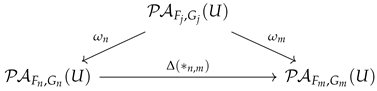 and
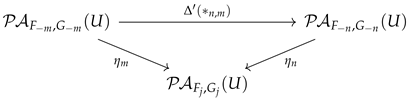 the first of which form faces of a cone with the vertex to and the second of a cocone to with the same vertex. □
3.2. The Prestack of Spaces of Pseudoanalytic Functions and Effectiveness of a Descent Datum
The assignment
can be extended to a (strict) 2-presheaf
as follows: to each (or, more precisely, the corresponding morphism), assign the functor
acting on morphisms in the manner described below:
To a morphism given by the covering and the collection
assign the morphism given by the covering , where and the collection
this map is well-defined since for each , the implication
holds and the equality
implies
with identity maps being sent to corresponding identity maps. Therefore, one has
In the following 2 Propositions, it is shown that is a prestack.
Proposition 6.
is a strict 2-presheaf.
Proof.
One has to show that for the composition of morphisms in , the composition of the associated restriction functors
and the restriction functor
are equal; for objects , the following holds:
for a morphism given by and
The morphism is given by
with and , which is the same as ; therefore,
and, by definition,
which means that is a strict 2-presheaf. □
Theorem 1.
The 2-presheaf is a prestack.
Proof.
Consider two objects over : and the associated presheaf of sets on U:
Assigning the following set to each open subset :
and assigning the following map to each inclusion (its associated morphism) of open subsets :
one has to show that this construction is a sheaf. For an open covering and a collection of compatible sections
define a map
as follows: for , let be defined by the condition
It is well-defined due to
and the fact that for each, , which, because of the locality of pseudoanalyticity, means
Check that this map is a morphism in ; for each , let the morphism in
be given by the open covering and the collection
Denote ; one has the covering of V:
Check that the collection
defines a morphism in for and the compatibility on follows from the construction, since for fixed , the corresponding collection defines . Consider and , and for the corresponding intersections , the maps
from the fact that
and
it follows that the domains and codomains of these chains of pseudodifferentiations coincide. For each element , the following holds:
Thus, the collection
defines a morphism in ; for each element and each , one has
Therefore, this morphism is equal to and so
for each and a section , the following holds:
therefore, on the entire and so
For any morphism having this property , a section , and any :
so and, therefore, a section of the presheaf having this property is unique, which means that it is a sheaf and so is a prestack. □
Below, we give a sufficient condition for a descent datum to be effective. Consider a descent datum, i.e., a covering , an object in the fibre over each , and for each pair , consider an isomorphism in the category between the appropriate restrictions
that is, an invertible morphism in this category:
but, by Lemma 2, each must be the identity morphism, which means that for each
which in turn means that the generating pairs are equipotent:
Therefore, if the associated first two characteristic coefficients, i.e., coefficients of the appropriate Carleman–Bers–Vekua equations, glue into admissible functions, then the conditions of Lemma 1 are fulfilled, so there is a generating pair such that
For each , we thus have the corresponding object , for which the following holds:
for each , meaning that the descent datum
is effective.
Hence, from the fact that the 2-presheaf is a prestack, the associated fibred category
is a prestack over ; for its total category, we use the notation
so, an object of is given by an open subset and a space of pseudoanalytic functions over it is given by , so is a pair
If , then the set of morphisms between and is empty, whereas if , then each morphism between and is given by a morphism
so,
in , and for morphisms between and and morphisms between and , with , which are given by, respectively, the morphisms:
the composition is given by the following composition:
A globally defined generating pair naturally induces a section of the prestack :
So, for example, the sheaf of holomorphic functions naturally induces a section
Equipotent generating pairs define the same section and, vice versa, if two generating pairs define the same section, then they are equipotent, so for generating pairs ,
hence, this assignment factors through the map
4. Conclusions and Possibility of Future Research
One saw how and in what sense the set of all spaces of pseudoanalytic functions defined on open subsets of the plane can be equipped with the structure of a prestack, which can be used as a unifying structure and allows one to lift the structure of the site from the base category of open subsets of the plane with the natural Grothendieck topology to the total category of the associated fibred category. This makes it possible to consider the category of sheaves on the latter site, i.e., the associated topos. Understanding the latter may contribute to the better understanding of the introduced prestack. One may attempt to extend the assignment of pseudoanalytic functions of the second kind to pseudoanalytic functions of the first kind to a (pre)sheaf.
On the whole, the results allow a more global approach to the theory of pseudoanalytic functions whose theory is of great importance locally both for mathematics and its applications. In the future, the authors might attempt to apply this approach to certain problems of the theory of pseudoanalytic functions and its applications in mathematical physics.
Author Contributions
Conceptualization, G.G. and I.S.; methodology, I.S.; writing—original draft preparation, I.S.; writing—review and editing, G.G.; supervision, G.G.; project administration, G.G.; funding acquisition, G.G. All authors have read and agreed to the published version of the manuscript.
Funding
This work was supported by the Shota Rustaveli National Science Foundation (Grant N FR22-354).
Institutional Review Board Statement
The conducted research is not related to either human or animal use.
Data Availability Statement
No new data were created or analyzed in this study.
Acknowledgments
This research was supported by Shota Rustaveli National Science Foundation Grant N FR22-354. The first author was partially supported by the EU through the H2020-MSCA-RISE-2020 project EffectFact, Grant Agreement ID: 101008140.
Conflicts of Interest
The authors declare no conflicts of interest.
References
- Sikharulidze, I. Prestack of Spaces of Pseudoanalytic Functions. Rep. Qual. 2025, 4, 195–199. [Google Scholar]
- Rodin, Y.L. Generalized Analytic Functions on Riemann Surfaces; Springer: Berlin/Heidelberg, Germany, 1987. [Google Scholar] [CrossRef] [Scilit]
- Akhalaia, G.; Giorgadze, G.; Jikia, V.; Kaldani, N.; Makatsaria, G.; Manjavidze, N. Elliptic Systems on Riemann Surefaces; Lecture Notes of TICMI; Tbilisi University Press: Tbilisi, Georgia, 2012; Volume 13, pp. 1–147. [Google Scholar]
- Bers, L. Theory of Pseudo-Analytic Functions; New York University: New York, NY, USA, 1950. [Google Scholar]
- Bers, L. An Outline of The Theory of Pseudoanalytic functions. Bull. Am. Math. Soc. 1956, 62, 291–331. [Google Scholar] [CrossRef] [Scilit]
- Mac Lane, S.; Moerdijk, I. Sheaves in Geometry and Logic; Universitext; Springer: Berlin/Heidelberg, Germany, 1992. [Google Scholar] [CrossRef] [Scilit]
- Moerdijk, I. Introduction to the Language of Stacks and Gerbes. arXiv 2002, arXiv:math/0212266. [Google Scholar] [CrossRef] [Scilit]
- Vistoli, A. Notes on Grothendieck topologies, fibered categories and descent theory. arXiv 2004, arXiv:math/0412512. [Google Scholar] [CrossRef] [Scilit]
- Godement, R. Topologie algéBrique et Théorie des Faisceaux; Hermann: Paris, France, 1973. [Google Scholar]
- Vekua, I. Generalized Analytic Functions; Pergamon: Oxford, UK, 1962. [Google Scholar] [CrossRef] [Scilit]
Disclaimer/Publisher’s Note: The statements, opinions and data contained in all publications are solely those of the individual author(s) and contributor(s) and not of MDPI and/or the editor(s). MDPI and/or the editor(s) disclaim responsibility for any injury to people or property resulting from any ideas, methods, instructions or products referred to in the content. |
© 2026 by the authors. Licensee MDPI, Basel, Switzerland. This article is an open access article distributed under the terms and conditions of the Creative Commons Attribution (CC BY) license.