2. Materials and Methods
In this section, we discuss the types of knowledge required to organize a personalized intelligent tutoring process, as well as the theories, methods, and tools for its modeling, representation, evolution, and use in intelligent educational processes.
2.1. Knowledge, Needed for Organization of Intelligent Tutoring
Educational knowledge is multidimensional, describing what learners know, what they should learn, how to use it, how certain the knowledge and results of tutoring are, and how to regulate tutoring and assessment.
According to the type of semantics, learning knowledge in almost all domains can be classified as declarative and procedural. Declarative (or conceptual) knowledge can often be learned through explanation or reading, whereas practice is the most effective way for learning procedural knowledge.
Tutoring domains involving real-world data, human behavior, or inference almost always contain not only crisp but also fuzzy or probabilistic knowledge—either in the content or the reasoning or during decision making.
Probabilistic and fuzzy knowledge are frequently used in the educational domain, as learning is uncertain and variable, students learn at different rates, and the same teaching method can produce different outcomes. Probabilistic reasoning helps educators to interpret test scores and to adapt instruction based on likelihoods, not absolutes. Probabilistic knowledge can also be an important part of domain knowledge. Hypothesis testing and experimental uncertainty in science, for example, can be represented using probability. Probabilistic models are used in intelligent tutoring systems, learning analytics, and LLMs.
Fuzzy knowledge is imprecise, graded, or vague knowledge. Fuzzy knowledge is based on degrees of membership instead of binary categories. Modeling fuzziness is important in education, as education involves partial understanding, gradual skill development, subjective judgments, as well as linguistic terms (e.g., “good”, “adequate”, “excellent”). Fuzzy learner knowledge can include partial mastery or overlapping skill levels. Motivation, engagement, and confidence are not directly measurable and can be represented as fuzzy concepts. Fuzzy logic is widely used to model student understanding, affective states, and pedagogical decisions.
According to the ways in which knowledge is learned, expressed, and transferred in education, knowledge can be classified as either explicit or implicit. Explicit knowledge is written in textbooks, syllabi, manuals, and lesson plans. It is relatively easy to teach through formal instruction, learn through direct study, and assess using conventional evaluation methods. Implicit knowledge, in contrast, is developed through observation, practice, modeling, and real-life interaction rather than through direct instruction. It is difficult to articulate and measure and is typically acquired informally and gradually, including through the use of statistical and machine learning approaches.
2.2. Description Logic and Ontologies
Description Logic (DL) provides a formal foundation for defining and reasoning over ontologies. DL is a family of formal knowledge representation logics designed to represent knowledge in a machine-processable way using concepts, properties, relationships, axioms, and instances [
20]. Precise semantics modeling and automated logic-based reasoning are strengths of DL-based knowledge representation. The general architecture of the DL knowledge base [
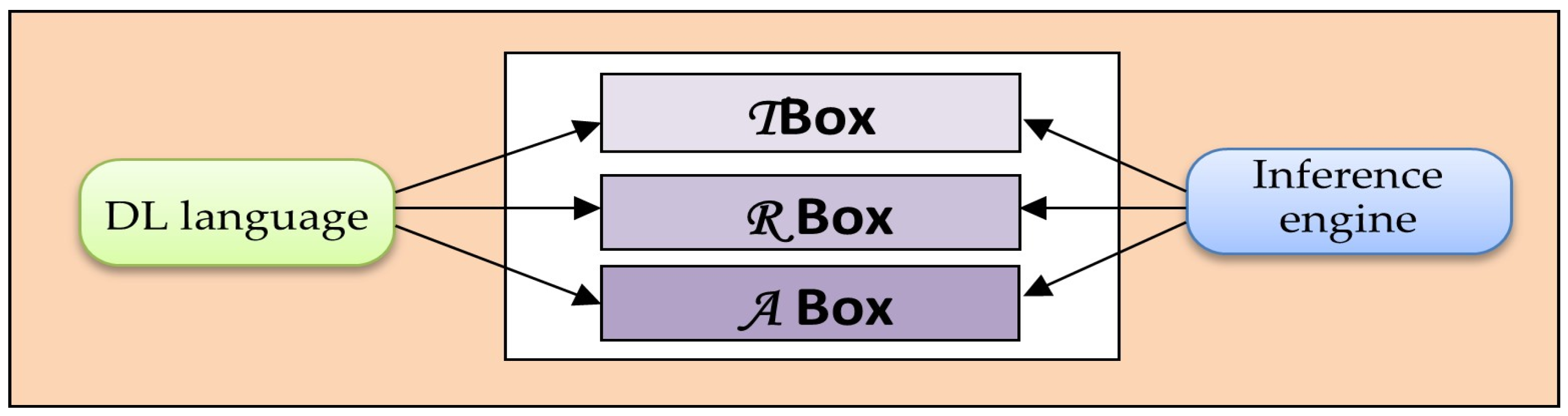
21] includes TBox, ABox, and RBox (
Figure 1).
TBox (Terminological Box) defines the conceptual schema of the domain. It contains concept (class) definitions, concept hierarchy’s axioms (subsumption axioms) and equivalence axioms.
RBox (Role Box) defines properties and constraints on roles (relationships). This includes domain and range restrictions, role hierarchies, role characteristics (e.g. Transitive, Symmetric, Functional, etc.).
ABox (Assertional Box) stores facts about individuals.
The DL family is a hierarchy of logics used to represent knowledge in a formal, decidable, and structured way, especially in ontologies (e.g., OWL) [
22]. The DL family consists of related logics, most of which extend some previous one with additional expressive power. The base logic is
(Attributive Language).
The AL variant of description logic allows the following constructors:
The semantics of AL is given by an interpretation:
where Δ
I is a non-empty domain and ⋅
I is an interpretation function
Semantic definitions of AL constructors:
ALC extends
AL by adding negation:
ALC extensions:
ALC + R+ = S − adding transitive roles
ALCN = ALC + (qualified) number restrictions:
The meaning of the fundamental DL constructors is illustrated in
Table 1.
ALCN’ is often used in knowledge representation, ontologies, and description logics behind OWL. Description Logic SHOIN(D) is a very important DL variant because it balances high expressiveness with decidability [
23]. SHOIN(D) is the logical foundation of OWL DL, one of the most widely used ontology languages in the Semantic Web.
We systematized DL features important for practice and corresponding DL fragments in
Table 2.
As it is shown in the tables above, DLs are built incrementally (e.g., EL → ALC → SHOIN → SROIQ). This gives possibilities to use the best logical variant, balancing between expressiveness and efficiency.
Automated reasoning is the ability of a DL-based computer system to derive new knowledge automatically from existing knowledge using formal logic. Common DL reasoning tasks are consistency checking, concept satisfiability, subsumption, classification, instance checking, and query answering [
24].
The ontology is a formal, explicit, and shared representation of knowledge about a domain, specifying what entities exist, how they are related, and the rules that govern them, in a manner that is both machine-processable and human-understandable.
Ontology is a concept that can be approached from two perspectives: the philosophical perspective and the computer science perspective. In philosophy, ontology is a branch of metaphysics concerned with being. In philosophy, ontology includes discussions about what kinds of entities exist, how they are related, and the nature of reality. Ontologies can be used for development of coherent knowledge models in both philosophy and computer science. However, in computer science, such models not only maintain conceptual soundness but are also designed to be technically usable by software systems. Thus, computer science provides tools and technologies for modeling real-world knowledge, while the philosophical perspective helps ensure the logical soundness and conceptual quality of these models. The OntoClean ontology evaluation methodology [
25], for example, bridges the philosophical and computational perspectives by using formal ontological principles to assess and improve the conceptual and logical quality of knowledge models used in intelligent educational systems.
Ontology in computer science is formally defined as a tuple:
where:
C is a finite set of concepts (classes);
R is a finite set of relations (roles);
A is a set of attributes;
I is a set of individuals (instances).
In classical ontologies, membership is binary: x ∈ C or x C.
Most modern ontologies are expressed in OWL, and most OWL variants are grounded in description logics. OWL bridges DL theory and real-world applications. OWL family languages are grounded on valuable members of the DL family. We systematize classical OWL family languages, expressiveness, and DL variants in
Table 3.
A DL reasoner is a software system that performs automated logical inference using DL reasoning procedures over DL-based ontologies (typically implemented in some OWL variant) [
33]. Most of the DL reasoners use Tableau algorithms [
34]. Hyper-tableau algorithms [
35] are optimized tableau algorithms that can detect cycles and reduce nondeterminism and redundancy.
Many reasoners have been developed and tested, but some of them are not optimized or are no longer supported. Information about well-working classical DL reasoners, used algorithms, logics, and complexity is shown in
Table 4.
Balancing expressiveness and computational complexity is one of the core design decisions in DL ontologies. It is important to use desirable DL variants and avoid usage of OWL Full if it is possible.
EL is a lightweight logic, used for development of big ontologies where scalability and fast reasoning are more important than full expressiveness. The EL logic is optimized for large ontologies and classifications, expressed by OWL 2 EL sublanguage [
40]. Optimized reasoners such as FaCT++, Pellet, and Racer support EL reasoning.
EL++ extends
EL, adding role hierarchies, transitivity, and other features, and is the basis for OWL 2 EL.
DL-Lite is the underlying logic of the OWL 2 QL sublanguage. However, OWL 2 QL language employs algorithms optimized for query rewriting and query answering over databases, which results in polynomial reasoning complexity.
DL reasoners vary significantly in their capabilities. Therefore, evaluation against specific requirements is necessary before selecting a reasoner for a particular application [
41]. Important ontology design principles, related to the need to decrease reasoning complexity, are:
The use of OWL Profiles as design targets;
separation of TBox and ABox reasoning. Push complex logic into rules (not in DL ontologies), if possible;
ontology decomposition into layers (use EL for designing large core taxonomies and OWL DL for smaller logically complex sub-ontologies).
One of the main limitations of classical Description Logics lies in their restriction to crisp knowledge representation, where assertions are either completely true or completely false, thus preventing the direct modeling of vagueness, uncertainty, or partial truth. To handle non-crisp knowledge (vagueness, uncertainty, degrees, probabilities), several extensions and hybrid approaches (such as fuzzy or probabilistic DLs) have been developed.
2.3. Fuzzy Description Logic for Representing Non-Crisp Knowledge in Ontologies
Classical OWL ontologies can be used for modeling only crisp knowledge and use classical description logic, where things are either true or false. This is a rigorous restriction, as, in most real domains, an important amount of knowledge is non-crisp. Fuzzy ontologies, on the other hand, deal with imprecision, uncertainty, and gradual membership [
42]. Fuzzy set theory and fuzzy extensions of description logics are used for reasoning with imprecise or vague knowledge [
43].
A fuzzy set F over a domain U is defined as [
44]:
where:
A fuzzy concept Cf is a fuzzy set over a domain U: Cf: U → [0, 1]
Hypertension(x) = 0.7 indicates that individual x belongs to the concept Hypertension with degree 0.7.
A fuzzy relation R
f between two domains U and V is defined as [
45]:
where R
f (x,y) represents the degree to which relation R holds between x and y.
Example: hasSymptom(p,s) = 0.8
A fuzzy individual is an entity that belongs to one or more concepts with a degree of membership.
Example: Student(John) = 0.8
A fuzzy axiom is a statement that holds to a certain degree.
Example: TallPerson ⊑ Athlete(0.8)
Fuzzy DL uses the following basic fuzzy logic operators to handle partial truth values (between 0 and 1,
Table 5).
Fuzzy DL has four frequently used variants, each tweaking how truth values combine depending on what they are caring about: smoothness, strictness, probability-like behavior, interpretability [
46] (
Table 6).
A fuzzy ontology can represent both fuzzy and crisp knowledge. It can be defined as a tuple: Of = (C, R, I, A, Cf, Rf, If, Af, μ), where:
C is a set of crisp concepts, Cf is a set of fuzzy concepts;
R is a set of classical relations, Rf is a set of fuzzy relations;
I is a set of individuals, If is a set of fuzzy individuals;
A is a set of axioms, Af is a set of fuzzy axioms;
μ is a set of membership functions.
Fuzzy ontologies use fuzzy extensions of description logics to handle degrees of truth. For example, a fuzzy subsumption axiom states that the subsumption relationship between two concepts holds to a certain degree [
47,
48]. Example: C ⊑ D = α.
Fuzzy DLs’ reasoning is based on Fuzzy Expansion Rules [
49]. These rules generalize classical DL rules by attaching degrees to assertions. Fuzzy expansion rules are tableau rules that decompose complex fuzzy concepts, propagate degree constraints, and detect clashes (inconsistencies).
There are only a few reasoners implementing fuzzy DL. FIRE (Fuzzy Inference Reasoner) [
50] is an old reasoner that supports fuzzy rules and weak TBox reasoning. The most mature fuzzy DL reasoning tool is fuzzyDL [
51]. It supports fuzzy-ALC and fuzzy-SHOIN and can handle satisfiability, consistency, and instance checking. It is difficult to use because it has no graphical interface.
The fuzzy OWL 2 approach [
52,
53] encodes fuzziness via annotations and works by reducing fuzzy reasoning to crisp DL. Pellet or HermiT’s extensions can be used to reason with Fuzzy OWL 2-annotated ontologies.
Usually, fuzzy reasoning over large ontologies becomes inefficient because of the high (exponential or higher) computational complexity. FDL tools are difficult to use, and their efficiency when working on big or logically complex ontologies is insufficient compared to crisp DL reasoning tools like HermiT, Pellet, or FaCT++. There is significant academic research related to fuzzy ontologies, but they are relatively rarely used in practical systems. Most practical ontology-based systems prefer crisp ontologies because:
There are only a few tools for fuzzy ontologies, and these tools are not standardized, optimized, and well supported;
Fuzzy DL reasoning complexity is higher compared to the corresponding crisp DL and, in some cases, effectiveness is unpredictable;
Developers are more familiar with crisp ontologies.
2.4. Probabilistic Extensions of Description Logics
Classical DLs lack the expressive power to capture uncertainty. Probabilistic DLs address this limitation by extending DLs and OWL with probabilistic semantics that support reasoning about uncertain concept memberships, role assertions, and axioms.
Probabilistic DLs extend classical DLs by attaching probabilities to some of the axioms, concept memberships, role assertions, or interpretations (possible worlds). Many approaches do so by integrating Bayesian models [
54], distribution semantics [
55], possible-worlds semantics, or Markov/logical networks into DLs.
A probabilistic ontology is a formal ontology in which probabilities are associated with some of the concepts, relations, or axioms, including assertions about individuals. Probabilistic entailment measures how likely a statement is to be true. It is important for handling uncertainty in many domains such as semantic search, question answering, medical diagnosis, etc.
In distribution semantics, words or concepts are represented as vectors in a semantic space. Each axiom is annotated with a probability, meaning that the axiom is true with specified probability. Independent random choices determine which axioms hold. Each choice defines a classical DL ontology [
56]. This semantic is used in DISPONTE [
57,
58]. The Bayesian semantic is the most common approach. Systems using Bayesian semantics define meaning by probabilities over beliefs. Reasoning style in Bayesian semantics-based ontologies is probabilistic inference, whereas DISPONTE uses classical DL reasoning per world.
PR-OWL [
59] is a language (and upper ontology), extending OWL by adding Bayesian probabilities. PR-OWL proposes syntactic constructs for defining random variables and dependencies between random variables. Probabilities are computed using Bayesian inference. The Protégé PR-OWL plugin can support PR-OWL. PR-OWL can handle complex relational uncertainty. Well-studied probabilistic extensions, its semantics, and implementation are summarized in
Table 7.
Probabilistic DLs significantly increase reasoning complexity in comparison to its corresponding crisp DLs [
60,
61]. Reasoning in probabilistic ontologies requires both DL inference and probabilistic inference (which is often P-hard), especially when there is a need to consider many possible worlds. Expressive Bayesian DLs [
62] (e.g., P-SHIQ) and Markov Logic-based DLs are often undecidable. Moreover, probabilistic inference is computationally more demanding than satisfiability checking.
Probabilistic DL reasoners/frameworks are PR-OWL/MEBN reasoners, BayesOWL, ProbLog-based DL systems, and P-SHIQ, DISPONTE frameworks (BUNDLE, TRILL). Practical reasoners often use approximate reasoning (marginalization, sampling) to decrease computational complexity. Well-working probabilistic reasoners, reasoning styles, and complexity are summarized in
Table 7.
The probabilistic OWL reasoner TRILL is based on Pellet. It uses both exact and approximate reasoning. The PR-OWL reasoner uses Bayesian inference over ontologies and is based on strong probabilistic semantics. It is good for causal and diagnostic reasoning.
BayesOWL [
63] is based on Bayesian networks mapping, performs BN inference, has limited expressivity, and also is used mostly on a research level.
Challenges and limitations of usage of probabilistic ontologies are related to [
64]:
High computational complexity;
Specifics in ontology design and maintenance;
Need for large datasets to estimate statistical probabilities;
Lack of standardization across tools working with different probabilistic models;
Difficulties related to integration in LMS platforms.
Probabilistic ontologies are more difficult for use, as they have higher reasoning complexity, require more complex frameworks (e.g., Bayesian networks, Markov logic) and tools for their development, and uses are more limited, immature, and less standardized.
2.5. Statistical and Knowledge Extraction Approaches in Educational Systems
Learning analytics (LA) is an approach focused on extracting, analyzing, and interpreting data from educational systems, typically using statistical and computational methods, to understand and improve learning processes and outcomes. LA can support management of not explicitly specified knowledge about learners, having probabilistic nature. LA refers to the systematic collection, analysis, and interpretation of learner-related data to understand and optimize learning processes and environments. It can be used for transforming raw educational data into information about learners. This is very useful for personalization [
65]. Important LA techniques are:
Descriptive Analytics, which summarize student behavior using statistics Diagnostic Analytics, which identify reasons for difficulties;
Predictive Analytics, which predict outcomes like course completion, mastery level, or dropouts;
Prescriptive Analytics, which aims to suggest actions: remedial resources, personalized learning paths.
Machine learning (ML) is a branch of artificial intelligence that focuses on developing algorithms and models for automatic extraction of implicit knowledge from data without being explicitly programmed for every situation. Machine learning can support personalized learning by automated dynamic extraction of knowledge about the learner’s skills, preferences, and behavior to update learner profile ontologies. Extracted knowledge, rules, or predictions can be used in the process of building and continuously updating learner models. ML can be used in personalized education to identify patterns in learners’ interactions, performance, and preferences. These patterns are useful for resource recommendation, adjusting difficulty levels, predicting learning outcomes, and providing targeted interventions, thereby supporting more individualized and effective learning experiences. ML also can be used for discovering personalization rules from data [
66].
3. Results
The results of this study are presented with a focus on making easier and effective development of well-working hybrid knowledge bases for personalized and intelligent education rather than on the performance of any IES. We propose a hybrid AI-driven architecture that combines human knowledge, formal logic, and data-driven learning and explain in detail ways of integration of these tightly coupled but functionally distinct technologies. Component-based development and reuse of ontologies is an important step to achieve effective creation of knowledge bases, based on the proposed conceptual model. We propose a structured metadata framework for classification of entities, used in the systems, based on the proposed knowledge base architecture. Its main purpose is to support searching and reuse of developed ontologies or other knowledge base components. Another objective is to demonstrate that the layered systems of mapped ontologies, rules, learning analytics, and ML collectively can constitute a coherent knowledge base that can support personalized and adaptive learning in IESs. Our other goals are to propose ways for decreasing knowledge base development time and cost and demonstrate that goal-oriented ontology-based knowledge bases for IESs can be constructed in a reasonable time with reasonable effort.
3.1. The Proposed Hybrid Layered Knowledge Base’s Architecture for Knowledge Modeling in Education
As a result of the analysis of knowledge, used and needed for personalization in education, we used our previous research and practical experience as tutors to identify the following requirements of knowledge models supporting personalized and adaptive educational systems:
to enable effectiveness of knowledge management;
to enable representation of both declarative and procedural knowledge;
to enable representation of both implicit and explicit knowledge;
to enable representation of crisp, vague and, probabilistic knowledge;
to enable clarity of knowledge and explainability;
to ensure well-structured knowledge, needed for personalized and adaptive learning management;
to enable dynamic management of included knowledge;
to enable reuse of knowledge;
to enable effective use of knowledge management tools.
Depending on their purpose and context of application, educational ontologies should balance formal expressiveness with pedagogical relevance, interoperability, and adaptability to heterogeneous educational environments. Conceptual clarity, formal correctness, extensibility, reusability, and alignment with existing standards (e.g., Bloom’s taxonomy, IEEE LOM) are very important for educational ontologies.
We systematized the main requirements for educational ontologies in five aspects in
Table 8.
Ontologies are a strong foundation for knowledge modeling, but they are not sufficient on their own for personalized learning. Ontologies are mostly static or slowly evolving. Personalized learning needs dynamic adaptation based on real-time learner behavior and progress. Learner knowledge and performance are often uncertain or probabilistic, but ontological models have limited handling of uncertainty.
For effective personalized learning, ontologies should be combined with:
teaching strategies, expressed effectively by sequencing rules;
learning analytics (to infer and predict learner needs);
machine learning techniques for extracting and storing implicit knowledge.
Ontologies can give a shared, machine-understandable model of tutoring knowledge, pedagogy, interface, and learners for IESs or ITSs to enable adaptation, reasoning, personalization, and interoperability [
12,
13,
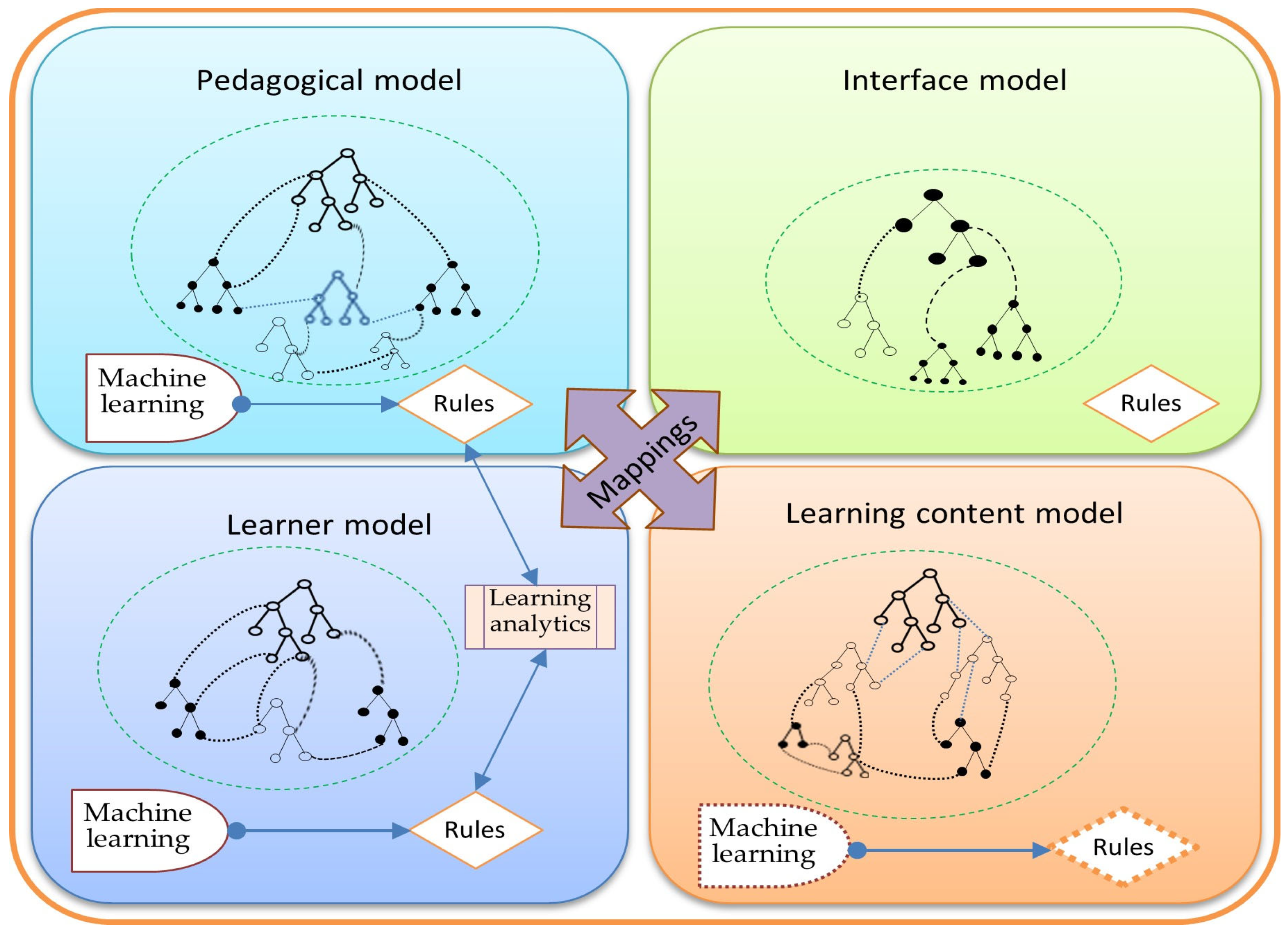
14]. Most research includes (some of) four ontologies in knowledge base models in IESs or ITSs, corresponding to the main components of the knowledge base model: domain ontology, pedagogical ontology, learner ontology, and interface ontology. Our conceptual model of knowledge base architecture (see
Figure 2) contains the four main models of the typical architecture of an ontology-based ITS and differs from most other research in this field by proposing systems of mapped ontologies in the place of every single ontology. Our model of knowledge base architecture also includes possibilities for storing procedural knowledge (as rules), imprecise or probabilistic knowledge (using fuzzy or probabilistic extensions of DL), and implicit knowledge by usage of learning analytics (LA) or machine learning (ML). We will discuss alignments between ontologies, as well as strengths and drawbacks of such complex knowledge base models.
3.1.1. Tutoring Domain Ontologies
Declarative knowledge included in learning objects can be naturally organized in ontologies. Domain ontologies represent structured knowledge about learning content, including subjects, curricula, and course content (learning concepts, their properties, and relationships). Educational domain ontologies can be used for supporting semantic search, navigation, personalized tutoring, and resource recommendation, enabling learning content reuse and interoperability between systems.
Organizing tutoring domain knowledge using layered ontological systems is important because in such a way complex knowledge can be represented in a well-structured, modular, and evolvable way, separating general from specific entities. Layered models define roles and responsibilities of layers, ensuring interchangeability or evolution of specific ontology implementations. The number of layers and ontologies in every layer cannot be strictly specified. It depends on every specific implementation.
The upper layer of the tutoring domain model includes upper-level domain ontology. This ontology represented very general concepts applicable in the tutoring domain (and possibly across many related domains). Upper-level domain ontology is used mainly for proposing definitions of very general concepts or alignment of multiple domain ontologies and integration across platforms and repositories.
Cross-domain ontologies are formal semantic models that represent shared knowledge across multiple related subject domains (e.g., mathematics, computer science, and physics). An example of cross-domain ontology is natural sciences ontology. The main goal of cross-domain ontologies is to enable interoperability and interdisciplinary learning in e-learning systems and curriculum alignment. Cross-domain ontologies are most frequently used in lifelong learning, professional education, and for ensuring personalized recommendations across subjects.
Core Domain Ontologies include generic concepts of a tutoring subject, shared by all sub-domains of a field, structured independently of tutoring theories or educational tasks. Examples are core computer science ontology and ACM computing classification.
Educational domain ontologies are semantics-based models of a single tutoring subject. Examples are the school geometry ontology, computer science ontology, programming in C++ ontology, and biology or physics ontology. They can represent complex relationships between specific domain concepts and are most frequently used in IESs or ITSs for supporting adaptive personalized learning and tutoring. Educational domain ontologies can be classified as coarse-grained ontologies and fine-grained ontologies.
Coarse-Grained Ontologies represent simple classifications of course subtopics and concepts course organization. They mainly represent Shallow tutoring domain hierarchies and are useful in curriculum planning, learning paths and course organization tasks.
Fine-Grained Ontologies propose detailed representation of concepts and relationships. They are most frequently useful in performance-based personalized learning. Fine-grained ontologies usually are small formal ontologies, representing rich semantics and suitable for complex logical reasoning.
Sub-Domain (Specialized) Ontologies focus on a specific sub-area (for example, on a concrete tutoring course terminology). Whereas upper and core ontologies usually are simple classification hierarchies, sub-domain ontologies typically include rich semantic relations and constraints. Most of the specialized ontologies are intended for (or used in) specific educational tasks.
Examples of task-oriented subdomain ontologies are:
Assessment-linked domain ontologies, frequently used for automatic quiz generation.
Competency-based domain ontologies, which are developed or used for mapping domain concepts to skills and competencies (in competency-based education) or connecting concepts and assessment items.
Prerequisite and dependency ontologies representing explicit learning dependencies and used for adaptive sequencing or knowledge gap detection.
Problem-solving domain ontologies, modeling problems, solution methods, and strategies.
Domain ontologies model reality, and reality is often vague, gradual, and partially true. Fuzziness allows modeling partial membership in concepts, degrees of truth for relations, and linguistic values instead of exact numbers. In some domains such as medicine and healthcare, environmental science, risk assessment, and social and behavioral sciences, fuzziness is especially important. Medical concepts, for example, are often vague. Students should understand fuzzy concepts (e.g., “High blood pressure”, “Mild pain”), fuzzy properties, and fuzzy reasoning about diseases, symptoms, tests, and treatments. Fuzzy ontologies capture expert intuition more accurately. Fuzzy ontologies are a good tool for modeling vague knowledge in many practical domains.
Learning domain ontologies also propose knowledge, useful for semantic search and educational content recommendation. Ranking algorithms calculates similarity scores between query vectors and document vectors (e.g., cosine similarity). Crisp ontological models ensure semantic correctness and partially semantically propose a higher relevant rank, even if exact words do not appear.
Fuzzy DLs are very useful in domains where fuzzy linguistic concepts (young, hot, expensive) are frequently used. Fuzzy reasoning is very useful in systems for personalized recommendation (of learning content, learning activities, etc.).
Probabilistic DL reasoning is most native for estimating uncertainty about facts, whereas Fuzzy DL reasoning fits well when gradual truth and vague concepts are used.
3.1.2. Learner Modeling Ontologies
Learner profile ontologies represent the semantic model that contains information about learner characteristics, knowledge state and competencies, preferences and behavior, learning context, and learner’s goals. Learner profile ontologies contain knowledge, needed for personalized content recommendation, adaptive sequencing of topics, difficulty adjustment of learning tasks, understanding of learning analytics and prediction. Learner profile ontologies typically are aligned to some domain ontologies and learning domain ontologies (pedagogical ontologies).
Upper-level learner ontologies model static learner attributes related to identity and demographic properties. These ontologies are often lightweight, privacy-sensitive, and linked to institutional systems. Educational systems should use one upper-level learner’s ontology. Standardization of upper learner ontologies is not difficult and can be in the base of systems interoperability.
All the other learner ontologies are tack-specific or context-specific and should be dynamically added in the learner profile by dynamic mapping to upper learner ontology or other ontologies depending on the educational tasks. The group of task–specific learner ontologies can include:
Knowledge and Competency ontology, modeling concepts for representation of learner’s knowledge, mastery level, prerequisite status, and competencies. It should be mapped to pedagogical ontology, modeling general competencies, and to some learner domain ontologies.
Cognitive and Learning Characteristics ontologies model the learner’s cognitive abilities and related preferences. This includes learning styles, learning disabilities, and learner’s memory capacity.
Affective and Motivational State ontology includes characteristics related to engagement, motivation, confidence, and frustration. It is very important for adaptive tutoring and includes mainly fuzzy or probabilistic knowledge.
Learning Preferences and Styles of Ontologies.
Social and Collaborative Ontologies modeling learner roles, collaboration styles, and peer interactions.
Accessibility and Special Needs Ontologies modeling accessibility requirements, assistive technology, learning constraints, etc.
In adaptive learning, some of the learner profile ontologies are continuously updated during learner interacts with the system to capture the learner‘s progress and evolution of the learning context.
Some learner characteristics are uncertain, gradual, or imprecise. So, Fuzzy DLs and fuzzy ontologies can be very useful for user profiling.
Learning styles are not binary. Fuzzy dimensions are better descriptions, for example: learner is visual = 0.8 and learner is verbal = 0.3. Fuzzy ontologies give possibilities for learners to belong to multiple styles simultaneously.
Probabilities in learner model ontologies are powerful for handling uncertainty about the learner especially for:
estimating possible knowledge state;
estimating cognitive level;
estimating probability to have specific learning style;
estimating probability to have specific learning problems or difficulties (e.g., dyslexia, autism, etc.).
A Bayesian model is good for representing directed dependencies in learner ontologies. Learner model ontologies are typically limited in size and scope, which helps ensure acceptable system performance even under conditions of high reasoning complexity.
Standardization of ontologies is very important for its usability. There are some standardized reusable ontologies, containing information about learners: IMS LIP (Learner Information Package), PAPI Learner, Open learner model ontologies [
67], xAPI learner models [
68], FOAF (basic identity), OntoULP [
69].
3.1.3. Pedagogical Knowledge Modelling Ontologies
We propose a layered ontology system for modeling pedagogical knowledge. Such a system separates pedagogical knowledge into distinct yet interconnected layers, in which the ontologies at each layer have clearly defined semantic roles, are linked to ontologies in other layers, and can evolve independently. This structure enables pedagogical theory to be explicitly distinguished as general, domain-specific, contextual, or task-oriented. The number of layers and ontologies within each layer cannot be fixed a priori; instead, two, three, or more layers may be established depending on the specific implementation.
General (cross-domain) pedagogical ontologies comprise terminology used for tutoring across multiple subject areas and are often taxonomy-based. They provide a formal representation of domain-independent pedagogical knowledge. Typical examples include general skills and competence frameworks (e.g., ESCO), subject classification ontologies, and general curriculum ontologies. These ontologies are primarily employed for domain-independent modeling of teaching strategies and learning processes and are usually mapped to domain and learner ontologies. They can support alignment and interoperability among heterogeneous pedagogical models.
Mid-Level Pedagogical Ontologies are reusable across domains and describe pedagogical theories. Examples are Bloom’s Taxonomy ontology or Outcome-Based education ontology.
Specialized (Low-Generality) pedagogical ontologies are context-specific and task-focused. Examples are problem-based learning ontology, collaborative learning ontology, and skill assessment ontology. These ontologies can be used in ITS for supporting specific approaches of adaptive and personalized learning.
Other task-oriented pedagogical ontologies are outcome-based education ontologies, instruction-oriented ontologies, used in tasks, related to selection of teaching and learning activities, including instructional planning, learning activity sequencing, teaching strategy selection.
Other specific type pedagogical ontologies are developed for structuring, sequencing and presentation of learning content. They also can be structured in levels, including:
Core ontology of learning object structure ontologies representing general concepts, describing structure of learning content, including concepts as learning object, content fragment and media element.
SCORM learning objects standard ontology, describing reusable content components important for tasks such as content reuse, modular authoring, and interoperability.
Structural-level ontologies, modeling learning content structure, including content granularity including course, module, lesson topic, micro-learning unit. Purpose: adaptive chunking, personalized pacing, and micro-learning delivery.
Procedural-level ontologies, modeling learning content sequencing and navigation, including prerequisites, nex content, optional path, and conditional sequence, which can be used mainly for adaptive sequencing, mastery-based progression, and competency-driven navigation.
Presentation modality ontologies, including concepts such as textual, visual, auditory, interactive, and multimodal content, are used for accessibility, learning preference adaptation, and device-aware delivery.
Accessibility and inclusive presentation ontologies, modeling presentation constraints for diverse learners.
The inclusion or exclusion of task-specific pedagogical ontologies in practical realizations of knowledge models depends on the degree of task specificity. Certain forms of pedagogical knowledge are inherently non-crisp: mastery may be partial, understanding can develop gradually, the effectiveness of instructional strategies is often probabilistic, and decisions typically rely on contextual factors and professional judgment.
Probabilities can be used to capture:
likelihood that one concept implies understanding of another;
uncertain prerequisite relationships;
effectiveness of a strategy depending on a learner type;
likelihood of success depending on a teaching method.
So, Bayesian models can be natural for modeling pedagogical knowledge about predicting mastery levels, learning outcomes, etc. Bayesian networks-based models also are well-developed and most widely used (comparing to other probabilistic models). They propose a natural way for supporting causal relationships and in this way are very suitable for learner knowledge tracing.
Fuzzy ontological models are natural for:
The lower computational complexity is its main strength compared to probabilistic approaches.
Procedural knowledge is process-oriented, which makes it harder to represent in pure OWL. An example is the problem-solving ontology that describes problems, solutions, and steps (solution procedures). Procedural knowledge can be represented in ontologies by modeling processes, actions, and constraints, but effective solutions usually combine ontologies with rule systems. These ontologies can be used for skill acquisition and in practical training. An example of procedural ontology is ontology, modeling some algorithm execution steps. Procedural knowledge is usually part of the pedagogical model, but some scientific domains (such as, for example, algebra) also use a grand amount of procedural knowledge. This type of knowledge can be naturally represented by rules.
3.1.4. User Interface Modeling Ontologies
Interface ontologies in the e-learning system’s knowledge base are important for flexible interaction between learners, learning systems, and tutors. They provide a semantic description of user interface elements, interaction patterns, and presentation logic, enabling adaptive user interfaces. They can be classified as:
presentation-oriented interface ontologies, classifying visual and structural UI elements;
interaction-oriented interface ontologies classifying user actions and events, tracking learning behavior;
adaptive interface ontologies, focused on personalization, adaptive UI generation, and context awareness;
accessibility-oriented interface ontologies, focused on specialized inclusive design;
device and platform interface ontologies, supporting flexible multi-device delivery, with emphasis on mobile learning.
Interface ontologies should be mapped to some of the pedagogical and learner ontologies and act as a semantic bridge between pedagogy and user experience.
3.1.5. Inter and Intra-Model Ontology Mappings
Mappings are often required between ontologies at different layers within an ontological model. These mappings are primarily class–subclass mappings, in which a specific concept is linked to a more general one. Property mappings may also be employed, aligning specific relationships with more general predicates. Most initial hierarchical alignments should be proposed or validated by domain experts and stored in repositories for future reuse. In addition to mappings between general and specific ontologies, educational systems frequently require mappings between ontologies that represent different conceptual models. Typical examples include mappings between pedagogical ontologies (teaching design, activities, and assessments) and learner profile ontologies (skills, preferences, progress, traits). These ontologies do not describe the same concepts at different levels of abstraction but rather complementary perspectives of the learning process. These mappings are usually not expressed by equivalence or hierarchical relations. They are usually represented by semantic relations (object properties linking concepts across ontologies). Initial inter-model alignments should be proposed or evaluated by experts and stored in repositories for future reuse.
Dynamic educational ontology mapping refers to the automated generation of runtime alignments between ontologies, used in educational systems to respond to the changes in curricula, learner’s state, contexts, or evolving data. Dynamic mappings are necessary in education because educational environments are highly dynamic and new mappings are needed to correspond to the changes. For example, when a student, having learning difficulties come into the course, information about his educational problems can be extracted by LA or ML techniques, and specific learning difficulties ontology should be mapped to learner profile ontology; when learning goals evolve, additional mappings should be done, etc.
During personalized learning, extracting information about the learner’s changes and adjusting mappings between domain ontology and changed learner model ontology are needed.
Dynamic mappings can improve interoperability between IESs, lead to better personalization, or support personalized learning pathways.
LLMs can ensure contextual, semantic, and adaptive understanding, which is very important for dynamic mappings. LLMs can generate mappings at runtime and update mappings when ontologies evolve [
70]. So, LLMs are a very useful tool for dynamic ontology mapping. Educational systems interoperability, for example, requires dynamic mapping of learning domain ontologies of different systems to support learning content reuse. For example: “Basic Programming” (School) can be mapped to “Introduction to Algorithms” (University). The type of such alignments is mainly equivalence alignments.
3.1.6. Description Logic and Rule-Based Reasoning
Description Logics (DLs) and rules can complement each other in educational systems to achieve improved personalization and adaptation. DLs are well suited for representing conceptual knowledge, whereas rules are more appropriate for specifying instructional actions and controlling learner behavior. Rule-based reasoning is particularly effective for handling procedural decisions and action-oriented processes.
Rules are very important for supporting pedagogical decision-making, learner diagnosis, content sequencing (working with learning paths), or feedback selection. Operational pedagogy contains mostly procedural knowledge and can be naturally represented by rules. Pedagogical rules can encode learning theory and express teaching decisions.
During assessment, teachers usually use assessment rules to determine the correctness of answers and grading. Personalization can also be guided by using adaptation and personalization rules to tailor learning paths. For example, rules for selecting the best content for a specific learning style or difficulty level can be defined and used.
Domain rules define valid knowledge relationships and content correctness. Examples are prerequisite rules: if Concept A is not mastered, Concept B cannot be taught.
Meta-rules can also be useful during rule applications. Meta-rules (control rules) are rules about when other rules apply. Examples of meta-rules are conflict resolution rules, as well as rules for stating rule priority.
Rules are very important for avoiding contradictory behavior.
Rules, developed manually by experts or automatically by usage of ML, should be annotated and stored in e-learning modeling repositories for future usage.
3.1.7. Statistics-Based and Implicit Knowledge Extraction Techniques in Ontology-Based Models: Machine Learning, Learning Analytics
Statistical techniques are very useful for extracting implicit knowledge from a grand amount of data about learners, stored in educational systems. The role of LA is to collect, analyze, and interpret educational data in order to support improved learning outcomes. In adaptive educational systems, LA techniques are most frequently applied to learner data within the pedagogical model. The implicitly extracted knowledge is then used to adapt the learning process by:
content adaptation, suggesting easier or advanced resources or alternative formats;
path adaptation, adjusting sequencing of activities or modules;
feedback adaptation, providing targeted hints, explanations, or encouragement;
social adaptation—recommend peer collaboration based on learner behavior.
In a pedagogical model, ML can help to optimize instructional decisions and teaching strategies. ML can also help by learning effective teaching strategies from students’ experiences. ML can be used for learning the optimal order of instructions and, in this way, help in adaptive sequencing. ML can also be used for predicting when a learner is confused or when motivation is dropping.
In domain modeling, ML is useful in some complex or ill-structured domains, or when there is a grand amount of frequently changed resources to be manipulated. ML is also useful in domains where there is no single correct solution and probabilistic reasoning is commonly required, such as medical diagnosis. LLMs, as statistics-based machine learning techniques, play an increasingly important role in ontology development by facilitating and partially automating tasks that have traditionally required extensive manual effort and expert involvement. LLMs can identify domain concepts, relations, and synonyms in educational content and also generate initial simple variants of OWL ontologies. In this way, LLMs can reduce manual effort in ontology conceptualization. LLMs can assist in detecting semantic inconsistencies (but not logical) or suggesting missing concepts or relations during interactive ontology evaluation. LLMs can also help in matching equivalent concepts across ontologies, resolving naming conflicts and semantic mismatches.
In hybrid rule- and ML-based approaches, rules constrain or validate ML outputs.
Technologies, most useful for the development of hybrid knowledge bases, are systematized in
Table 9.
3.1.8. Evaluation and Validation of the Proposed Hybrid Conceptual Model
LA can also be used to generate and refine rules for the pedagogical model or for the learner model. This is a key mechanism for data-driven pedagogy.
Rules in ontology-based educational systems encode pedagogical intent, enforce correctness, and provide explainability. Rules are most effective when they are combined with statistical or machine learning-based (neural) reasoning. ML-based reasoning is inductive reasoning, opposite to ontology-based reasoning, which is deductive reasoning.
In the learner model, ML helps in extracting, updating, and predicting learners’ characteristics automatically from data. Techniques such as classification, regression, clustering, and deep learning can be used for predicting dropout risk or future success.
The evaluation of the proposed hybrid symbolic–neural knowledge model is conducted across several aspects, ensuring both conceptual soundness and practical effectiveness.
Firstly, the evaluation against requirements is performed. Nine requirements were defined at the beginning of this section. The first four requirements are specific to the educational domain and, from a theoretical perspective, are satisfied, considering the described elements of the model and its characteristics, which are thoroughly discussed in
Section 2. Clarity, good structuring, and explainability of knowledge are also important properties of ontology-based knowledge models.
Enabling dynamic management of the included knowledge is particularly challenging, as ontological models are predominantly static, and (semi-) automatic ontology evolution or mapping mechanisms are required. In our previous research [
71,
72,
73,
74,
75], we addressed this issue, and the results indicate that expert evaluation remains essential after applying automated ontology management techniques and should be conducted in each specific application context. To enhance the automated manageability of knowledge, we incorporated machine learning and large language model components into the conceptual model; however, their usability and efficiency are still under investigation. So, we can ensure some expert validation of the elements of the proposed hybrid conceptual model and its relationships, performed by four researchers, based on our previous research, presented in scientific publications [
71,
72,
73,
74,
75,
76,
77,
78,
79], and also in scientific reports of the Bulgarian FNI funded scientific project “Modeling and Research of Intelligent Educational Systems and Sensor Networks” (ISOSeM), 2020–2025, isosem.bas.bg. Additional validation steps include the use of representative use cases, which demonstrate how the proposed model can be applied to the development of concrete knowledge bases for intelligent educational systems.
The use of smaller, modular ontologies can improve the maintainability of the model and support more effective knowledge reuse. Semantic correctness of the employed ontologies and their mappings should not be evaluated at the level of the conceptual model as a whole but rather for each ontology and alignment, using automated reasoning engines. These evaluation procedures are not easy and require expert knowledge. So, it is of great importance to increase the reusability of developed ontologies, alignments, and support easy finding and selection of other entities included in the model. To ensure standardization of terminology and knowledge reuse, we extract and classify metadata schema for describing elements of the proposed conceptual model and its relationships.
3.2. Metadata for Classification of Entities, Used in the Proposed Knowledge Base Architecture
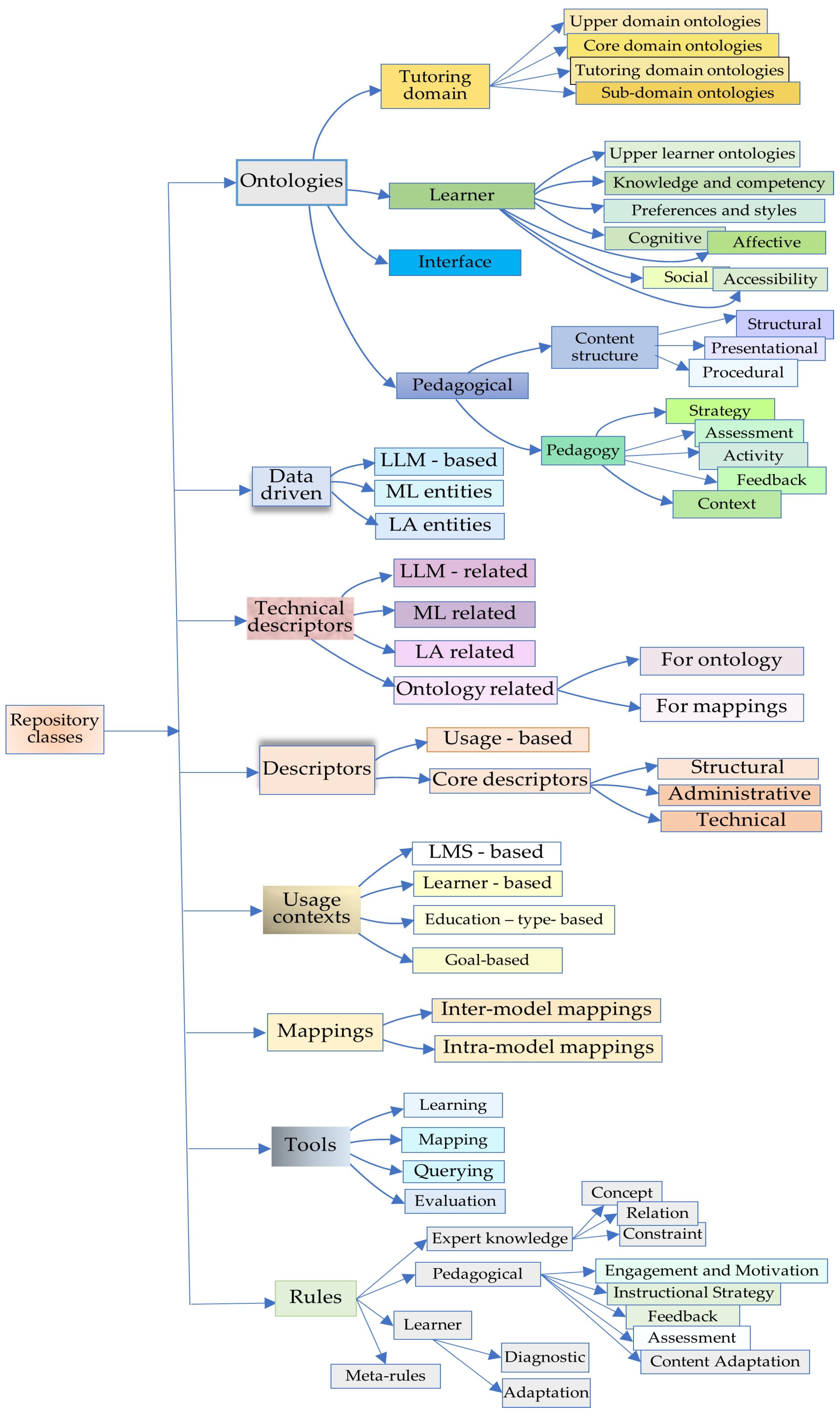
Reusable ontologies should be stored in repositories, equipped with tools for easy semantic search, evaluation, recommendation, or mapping. Well-structured metadata are crucial for supporting searching and reuse. Based on our research related to the proposed model of hybrid knowledge base architecture, we extract valuable parameters for description of all the components, needed for development of knowledge bases, following this conceptual model. We systematize and classify important metadata, needed for describing all the entities, stored in a repository, to ensure its finding and selection for every specific task in every context. We group all extracted metadata into eight upper-level classes, each corresponding to a main physical or logical entity within the repository: ontologies, rules, mappings, data-driven (ML, Analytics), ontology management tools, core descriptors, technical descriptors, and usage contexts (see
Figure 3).
Our semantic model, structuring metadata for describing knowledge base entities in the repository, classify stored ontologies both according to the represented knowledge (including domain, level, structure, and complexity), usage context, and specific ontology properties. Multi-criteria classification of ontologies with respect to the modeled domain, generality, language, size, and complexity of knowledge is a challenging task, as many of these characteristics are closely interrelated and education is a complex, multi-domain field. We propose specific classification, driven by the ITS model (tutoring domain, pedagogy, or learner profile) where every ontology will be used. This is a purpose-based classification of ontologies in education. It groups educational ontologies according to the primary function they serve within learning systems. This facilitates task-oriented searching and selection.
Other dimensions, related to ontology classification, are represented by object properties (see
Figure 3). Each ontology is characterized by a set of object properties (technical descriptors): Has_Globality, Has_Domain Has_DL_variant, Has_Language, Has_Mappings, and Has_Complexity, which capture its key characteristics.
Tutoring domain ontologies (as belonging to the Tutoring_Domain subclass of the Ontology class) were classified as:
Upper (Foundational) domain ontologies, with interoperability and aligning purposes (purpose is object property). Instances are, for example, DOLCE and SUMO.
Core domain ontologies capturing generic concepts of tutoring domain or interdomain relationships. An instance is, for example, core computer science ontology.
Domain ontologies and course domain ontologies are ontologies, modeling concepts and relations, defined in the course domain or in the specified course. An example is object-oriented programming ontology.
Course sub-domain ontologies are described by their narrow subject area, semantics richness, and typical usage contexts and relationships.
Every ontology belonging to the tutoring domain class should be described by usage of object properties, related to typical applications, typical mappings, language, logic, etc., or data properties, related to size, number of mappings, etc. Mappings between domain ontologies and upper (foundational) ontologies, other related domain ontologies, application, task-oriented pedagogical ontologies, or learner ontologies, should be also stored in the repository after careful annotation.
Learner model ontologies were classified according to the type of represented knowledge as:
upper learner profile ontologies;
knowledge and competency ontologies;
learning preferences and style;
cognitive and metacognitive ontologies;
affective and motivational ontologies;
social and collaborative ontologies;
accessibility and special needs ontologies (including dyslexia, dyscalculia, and autism).
Each learner ontology is characterized by a set of descriptors: Has_DL_variant, Has_Language, Has_Mappings, Has_Privacy-sensitivity, Has_Complexity, etc.
Mappings between learner ontologies and other ontologies define semantic correspondences that enable interoperability, personalization, and knowledge reuse in technology-enhanced learning systems. Learner ontologies are commonly aligned with upper (foundational) ontologies, domain ontologies, competency and skill ontologies, learning objects or educational content ontologies, as well as other pedagogical ontologies.
Pedagogical ontologies are classified as learning content structure and presentation ontologies and pedagogy ontologies.
Learning content structure and presentation ontologies describe how educational content is organized, structured, and delivered to learners. They formalize the relationships between different types of learning materials (e.g., lessons, modules, exercises, and media) and specify presentation rules, sequencing, and navigation paths. Learning content structure and presentation ontologies subclasses are:
core ontologies of learning objects structure ontologies describing learning objects, content fragments, media elements; modeling learning standards, and curricula.
structural-level content models of the learning content;
procedural-level content sequencing and navigation ontologies;
presentation modality ontologies (textual, visual, auditory, interactive, multimodal content).
accessibility ontologies;
inclusive presentation ontologies;
device and situation-aware ontologies.
There are also specific learning content structure and presentation ontologies for autism and other special educational needs as dyslexia. Specific learning content structure ontologies for dyslexia, for example, not only define the hierarchy and relationships between learning materials but also formalize presentation rules that address the specific reading, cognitive, and perceptual needs of dyslexic learners.
Pedagogical ontologies are formal, explicit representations of teaching and learning knowledge. They describe the methods, strategies, principles, and processes used in education, enabling systems to model, reason about, and adapt instructional activities.
Pedagogical ontologies class’s subclasses are:
instructional strategy ontologies;
learning activity ontologies;
assessment and evaluation;
feedback ontologies;
learning objective and outcome ontologies;
context-aware pedagogical ontologies;
affective and motivational ontologies;
collaboration and social learning ontologies;
learning theory ontologies;
A pedagogical ontology is characterized by a set of descriptors, as Has_DL_variant, Has_Language, Has_Mappings, and Has_Complexity.
We also use descriptors for annotating ontologies according to the recommended tasks of use as ontologies for interoperability, personalization, resource recommendation, accessibility, content sequencing, assessment, and reuse of learning content.
We also propose specific ontology properties, important for ontology description, as software objects: language, version, developer, license, underlined logic, etc.
Descriptors can be classified according to their target objects as technical, usage-related, and know.
Rules are classified according to the models for which they were designed: expert knowledge rules, pedagogical rules, student model rules, meta-rules.
Expert knowledge rules represent the subject-matter knowledge that the ITSs use. They can be classified as concept rules, procedural rules, and constraint rules. Concept rules define concepts, facts, and relationships within the tutoring domain. Example: IF a triangle has three equal sides, THEN it is an equilateral triangle.
Procedural rules describe how to solve problems step by step. Example: IF solving a quadratic equation, THEN apply the quadratic formula.
Constraint rules specify valid or invalid states in problem-solving. Example: IF denominator = 0, THEN the solution is invalid.
Pedagogical rules guide teaching and assessment. They can include teaching strategy rules, feedback rules, sequencing rules, engagement and motivation rules, content adaptation rules, and assessment rules.
Student model rules manage and update the learner model. They can include knowledge diagnosis rules, inferring student mastery or misconceptions, progress update rules, and affect or behavior rules.
Meta-knowledge rules are for reasoning about other rules and knowledge. They can include rule selection rules or adaptation rules, and they modify system behavior over time. Example: IF feedback is ineffective, THEN change strategy.
Mappings are classified according to the place of mapped ontologies in the proposed model of knowledge base architecture. The type of mapping relation (equivalence, subsumption or other relation) is represented as an object property.
Statistical or ML entities are classified according to the type of used algorithms.
Ontology management tools are classified according to their purpose and technical and usability properties.
Core descriptors and technical descriptors are additional concepts, used for describing ontologies and tools.
The metadata classification was verified by three colleagues (educators) and by students. A total of fifteen students participated in the verification process. Students worked in two groups. The first group consists of 10 students, and the second of 5 students. The first student’s proposal was to provide Bulgarian language labels to metadata elements. During evaluation, the first group proposed 12 new metadata elements, corrections in English labeling of 8 metadata elements, 7 structural corrections, and also Bulgarian language labels of all the metadata elements. The second student’s group discussed both the author’s proposal and first group’s corrections and added 4 new metadata elements, 16 proposal corrections of Bulgarian labels, and 5 corrections, related to proposed corrections of the first group. The metadata classification was discussed and evaluated in both face-to-face (classroom) and distance (online) formats.
3.3. Cross-Ontology Integration and Validation
Ontology alignment is a formal, machine-readable specification of mappings. The main idea of alignments is to support automated reasoning and inference over mapped ontologies. Ontology alignment may cause reasoning problems. The significance and frequency of logical problems coming from alignment between ontologies depend on the way of usage of mapped ontologies and mapping types.
Ontology integration is the process of enabling interoperability between two or more ontologies. Cross-ontology integration is critical when a system of mapped ontologies is used. Ontologies may differ in vocabulary (different terms for example can be used to label the same concept), in structure (hierarchies, relations), in used language (OWL, RDF, SKOS), or granularity. Integration can be achieved by ontology merging or ontology mediation. Ontology merging creates a single unified ontology from multiple sources. This process includes resolving redundancies and conflicts, which typically requires the involvement of domain experts. In most tasks within IES, full merging of mapped ontologies is unnecessary. Instead, reasoning relies only on the local consequences of the mappings. This can reduce both the complexity of the mapping process and the reasoning overhead over the mapped ontologies. Ontology mediation employs an intermediate or upper ontology. Each domain ontology maps only to the mediator, not directly to each other. As upper ontologies are standardized, this guarantees consistent semantics and reduces mapping complexity.
Ontology mediation is required when multiple autonomous ontologies must interoperate; strong logical consistency is mandatory and some of the ontologies evolve independently. In this case, validation only of changed ontologies and mappings is required before running cross-ontology reasoning.
Different type of mappings also leads to different type and frequency of inconsistencies. Equivalence or subsumption class mappings are most frequently sources of inconsistency. Property mappings rarely cause global ontology inconsistency because they usually affect only ABox reasoning. However, domain/range conflicts or property characteristic clashes are common sources of inconsistency even for property mappings.
As a result of our analysis of ontology mapping specifics, in our model of knowledge base architecture, we clearly distinguish between intramodel and intermodal mappings. For example, mappings between knowledge and competency ontologies and corresponding tutoring domain ontologies are intermodal mappings. Intramodel mappings are these, specified between ontologies in one and the same model. For example, mappings between domain ontologies or between two or more pedagogical ontologies are intramodel mappings. More specifically, mappings between accessibility and special needs ontologies and learning recourse presentation ontologies are intramodel mappings.
A better approach for intramodel mappings is typically to employ automatic ontology matching tools (such as LogMap, AML, or MELT) to generate mapping candidates, followed by human validation and, if necessary, consistency checking using DL reasoners such as Pellet or HermiT. Aligning ontologies with established vocabularies (as upper domain ontologies or established general user profile ontologies as FOAF) and ontology mediation are best practices in ontology mapping.
Mappings across models (for example, between learner and pedagogical ontology) are intermodal mappings. These mappings live at different conceptual levels (for example, learner ontology level and domain ontologies level), and mappings should be relational, not taxonomic. They express interaction between entities in different models.
Inter-model mappings usually are added by defining manually semantic relations (object properties) and specifying its domain and range. Object property mappings rarely lead to inconsistencies than class equivalence because they do not assert identity and preserve ontological categories, but they still propagate domains/ranges, or disjointness caused contradictions. Reasoners can be used to find and fix possible conflicts.
Using LLMs in ontology mapping is increasingly effective, especially for semantic mediation [
80]. Careful prompt design can allow LLMs to outperform some traditional matchers. Manual evaluation and consistency checking using reasoners are required when satisfiability of the merged ontology is needed, because LLMs are statistically based systems and do not have the capability to perform formal (logic-based) reasoning.
3.4. Illustrative Case Study: Personalized Tutoring for Children with Dyslexia
The main personalization goal in dyslexia-related educational context is to perform specific adaptation of content, pacing, modality, and feedback in the way of making learning easier, interesting, and effective for dyslexia learners. Ontologies and rules can help in the automation of the adapting process. With the right strategies, dyslexic learners can learn effectively and succeed, and personalization aims to follow the best strategy for every learner. Dynamic automation is very important because dyslexia involves heterogeneous profiles, not a single deficit. Adaptation directions are:
Adaptation of learning content: provide audio, video versions of texts (multimodal content); format text using clear and specifically colored fonts (e.g., sans-serif, larger spacing).
Instructional adaptation: short, clear instructions; break tasks into small, manageable steps; frequent repeating, checking understanding. More frequently.
Reading, writing, and spelling adaptations: reading guides (rulers, line trackers), reduce reading or writing amount, allow alternative ways to respond (oral, visual, digital), use of speech-to-text tools.
Assessment adaptations: allow extra time, offer oral or practical assessments, break tests into sections, read questions aloud.
Memory and organization: provide checklists and planners, model tasks step-by-step; provide written and visual reminders, word prediction software.
We will show how to combine educational ontologies and adaptation rules to personalize reading, writing, learning, and testing to cope with dyslexia-type learning difficulties.
The learner ontology can be easily developed by mapping selected upper-level learner ontology (FOAF or other) to DyslexiaType learning difficulties ontology and CognitiveProfile and preferences ontology. Performance metrics, such as ErrorRate, ReadingSpeed, and ComprehensionLevel can be easily added.
As content-based personalization, direction to deep understanding of standardized specific knowledge will not be performed; there is no need to use specific layered tutoring domain ontologies. A small domain-specific ontology may be used instead to model important domain terminology, which the learner should understand. A specific learning content structure and presentation ontology also is needed. It should represent the general detailed structure of the learning content (e.g., syllables, phonemes, vocabulary), specific for dyslexics, difficulty levels, important prerequisite relations, classification of multisensory resources (text, audio, video, Images, interactive activities), and also concepts related to specific formatting and presentation of textual content for dyslexia learners. The ontology type is simple a hierarchy, and it can be easily developed by mapping and adaptation of some of available resource structure ontologies.
The pedagogical ontology will be a very simple classification, including concepts as TeachingStrategy (including MultisensoryInstruction, repetition, ScaffoldedLearning, etc.), FeedbackType (immediate, corrective, encouraging), AssessmentMethod (formative, diagnostic, etc.). Pedagogical and dyslexia learner ontologies also can be used for annotation of educational objects.
Important intermodel mappings are between learner characteristics of dyslexia and pedagogical concepts supporting automatic adaptation of instruction, content, and assessment to the specific learner’s needs. These alignments link learner needs to pedagogical strategies, enabling personalized lesson sequencing, accessible content rendering, and assessment adaptation. Although these mapping relations are not formally standardized, they are widely agreed upon within educational psychology. Storing them in a shared repository would make the mappings reusable and interoperable, thereby supporting more efficient and consistent future development of personalized tutoring systems for learners with dyslexia.
Rules can be used to link learner data to instructional decisions. Example rules: IF phonological deficit is high, then increase audio support and syllable segmentation; IF comprehension improves, then gradually reduce scaffolding.
Rules also can be used to link difficulties to pedagogical strategies.
As dyslexia-related characteristics are gradual, uncertain, and context-dependent, using fuzzy ontologies in this adaptive tutoring model is appropriate. For example, the learner’s deficits naturally are not binary and PhonologicalDeficit ∈ [0.0–1.0]; TaskDifficulty is usually estimated as Easy, Medium, Hard, etc. Using fuzzy ontologies will enable gradual instructional tuning. On the other hand, it will increase reasoning complexity and decrease the performance of knowledge-based reasoning. The discussed ontologies are not very big, so we do not expect significant effects on the performance of the educational system.
Machine learning technologies can be especially useful in dyslexia tutoring because they enable the detection of individual dyslexia profiles and severity levels through data-driven analysis. By continuously analyzing learner data, ML systems can identify distinct patterns of difficulty that correspond to different dyslexia types (e.g., phonological, surface, or mixed profiles).
Intelligent tools and assistants, including LLMs-based ones, are very useful for supporting personalized dyslexia tutoring. Speech recognition and reading aloud tools and multimodal learning assistants are especially useful for personalized dyslexia tutoring. As dyslexia is a different way of processing languages, and LLMs are language re-representation systems, they can be especially useful in personalizing dyslexia tutoring. LLMs can multiple times re-explain without showing impatience or from a new angle. When LLMs are well integrated in the educational environment, they can propose adaptation using analogies instead of rules, recommend a different modality, or decide when to switch modality.
Advantages of usage of the proposed model of hybrid knowledge base architecture for personalizing learning in the context of participation of dyslexia learners are explainable personalization, reusability of learning knowledge (including ontologies), and interoperability with educational systems.
Difficulties, related to development of a practical personalized tutoring system for dyslexia learners, are not so related to building the needed knowledge base as to the integration of knowledge management tools in practical educational systems and development of specialized learning content for dyslexia learners. Adaptive should be developed by applying specific text simplification methods, using controlled vocabularies, presentation adaptation (using dyslexia-friendly fonts and colors), using multimodal content, navigation adaptation, clear task structure, feedback adaptation, etc.
3.5. Illustrative Case Study: Knowledge Base for Tutoring Medical Students
Medical educations require learning of grand amount of factual knowledge. Medical students may have heterogeneous prior knowledge and all should understand and learn complex, hierarchical concepts and meet competency-based standards. The medical domain also requires clinical reasoning, not just factual recall. Personalization of medical education should be based on a learner’s knowledge, skills, gaps, and goals.
A tutoring knowledge base for medical education must support:
conceptual understanding, depending on every specific course (anatomy, physiology, pathology);
clinical reasoning and decision-making in most of the courses (not only deductive, but in some cases probabilistic or fuzzy);
procedural and skills training (mainly rule-based);
learner-specific knowledge-based adaptation (knowledge gaps, pace, misconceptions);
evidence-based pedagogical strategies;
importance of collaboration, communication, and social activities.
So, richness of domain knowledge and types of reasoning procedures are essential for medical education.
An ontology-based adaptive tutoring knowledge base should enable structured representation of medical domain knowledge (which is sometimes vague, causal, temporal, probabilistic, or context-dependent), explainable personalization, and alignment with curricula and competencies (e.g., outcomes-based education).
Hierarchically structured domain ontologies are an especially powerful technique in biology and medicine, because in these domains, knowledge is complex, layered, and prerequisite-heavy. Concepts are naturally organized from general to specific, relationships between concepts are explicit (e.g., is-a, part-of, causes, treats), and a structured “map” of medical knowledge is of great importance for tutoring. So, building of a tutoring domain as a system of mapped ontologies, including upper biological ontology, middle-level (core) medical ontology (including clinical sciences, diagnostics, therapeutics, professional practice, etc.), and specific medical branch and course ontologies on the lower levels is essential for knowledge and competency-based personalization. There are good upper or middle-level ontologies in the medical domain. BFO (Basic Formal Ontology), for example, is a standardized ontology for medical ontologies mediation. This can make easier medical domain ontologies development and integration.
Top-level pedagogical ontology includes core pedagogical concepts and relations, as instruction, practice, assessment, feedback, etc., and can be standardized or reused from other educational systems. Other task-related pedagogical ontologies should be mapped to a top-level pedagogical ontology. An example is the InstructionalStrategy ontology and classified general educational strategies such as CaseBasedLearning, ProblemBasedLearning, SimulationBasedTraining, ProceduralSkillsTraining, ReflectivePractice, etc. Every specific course can use only some of these strategies by mapping specific strategy ontologies to InstructionalStrategy ontology. The general LearningObjective ontology, LearningActivity, FeedbackStrategy, and AssessmentModel ontologies can be dynamically mapped in the same way according to every specific educational context.
Top-level learner ontology is a high-level conceptual framework that defines the core concepts and relationships used to describe a learner, independent of any specific subject, course, or learning system. It typically encompasses personal data and general attributes related to cognitive abilities, skills, knowledge, goals, preferences, and similar characteristics. This ontology represents learner profiles at an abstract level and often serves as a foundation for developing more specialized learning ontologies. The top-level learner ontology can be used without modification in various personalized educational systems.
Middle-level medical learner ontology is mapped to top-level learner ontology and includes terminology for mapping to specific learner profile ontologies, related to knowledge and competence state, skill state, learning history and evidence, goals and intentions, etc., according to the educational context.
User profile ontologies are also mapped to ontologies in other models. Examples are mappings of concepts, describing medical knowledge to medical domain ontology, describing learning activities to some pedagogical ontology, etc.
An assessment measures learner performance on one or more learning objectives or concepts. Assessment scores are interpreted using rules. Assessment results update the learner state by transforming evidence of performance into changes in system information about the learner’s knowledge, skills, and other traits in the learner profile. Learning analytics use learning history to extract implicit knowledge for future updating of information in the learner profile. Updated learner state influences pedagogical strategy and can lead to changes in pedagogical ontologies. In such a way, rules, ontologies, and learning analytics work together.
Personalization in user interface model is not crucial, and it can be postponed to a later stage of the system development.
To avoid limitations of pure ontological models, such as reduced explainability, difficulties in extraction of data dependencies, and privacy and fairness concerns, ML methods should often be combined with ontologies, learning analytics, and probabilistic models in hybrid medical education systems. An example of interactions between models and technologies in medical tutoring is:
- -
a student misdiagnoses a myocardial condition;
- -
the educational system detects the misconception through learning analytics and updates the learner model to include information about the error;
- -
the pedagogical model then selects a targeted explanation, and the domain model provides relevant links to the underlying pathophysiology.
3.6. Mathematical Foundation of Techniques Supporting Personalized Tutoring and Learning
Machine learning, rule systems, ontologies, and learning analytics, working together in ITSs, are formally integrated in one coherent mathematical framework. A practical personalized intelligent educational system can be modeled as a knowledge-driven decision system under uncertainty:
where:
denotes an educational domain knowledge (ontology + rules);
is latent learner state (evaluated by ML or learning analytics);
is observable learning evidence;
are instructional actions (selected by usage of decision theory);
denotes pedagogical utility, used for practical realization of personalized tutoring.
Systems, based on tightly integrated listed above technologies, can support symbolic, statistical, model-based, and analytical data and knowledge management.
Ontologies have mathematical ground, as they are logical structures based on DL.
Rules can operate on ontological entities. Example: IF (Ci ⊑ Cj ∧ Si < τ) ⇒ Ak
Rule-based systems have a formal basis in first-order logics (FOL), horn clauses, and description logic rule language.
Machine learning works usually over learner states data and can generate predictions and rules. Its mathematical grounds are Bayesian inference, optimization, and neural models. It is used for evaluating and predicting the student’s state. ML focuses on making predictions and decisions automatically. ML uses linear algebra objects (vectors and matrices) as the basis of many of its data representation techniques.
Learning analytics are used for analyzing data about how learners study and then adapting learning experiences to fit each person’s needs. LA focuses on understanding and monitoring learning. It is primarily descriptive and diagnostic. LA uses mathematical methods for calculating counts, averages, percentages, variances, standard deviations, measurement of tendencies, frequency distributions, etc.
Integration of all these technologies is achieved by treating ontologies as formal logics-based knowledge models and rules as formal constraints and priors, machine learning systems as probabilistic models and inference, and analytics as statistical knowledge extraction and feedback.
4. Discussion
Layered ontological models are especially important for education because tutoring systems must reason simultaneously about knowledge, pedagogy, individual learners, and user interface, and these concerns naturally operate at different abstraction levels. Layering makes the reasoning accurate, adaptable, explainable, and maintainable. We refer to the four components as (sub-) models of the conceptual model of hybrid knowledge base, and the focus of our research is on the internal layered architecture of the knowledge inside every one of these (sub-) models.
Neither ontologies nor rules or ML alone are sufficient for supporting intelligent and adaptive learning. The IES becomes powerful when these technologies are working together. Ontologies constrain and contextualize ML, ML learns data related to the operation and evolution of IES, and rules enforce safety, ethics, and policy and also guide and supervise ML. Analytics validate both rules and ML. Both analytics and ML feed back into ontologies. New data and patterns suggest new concepts, relations, or rule refinements. A combination of rules and ontologies ensures explainability, layered and mapped ontologies, and interoperability and reusability of knowledge, and ML and analytics ensure new dynamic data for adaptivity.
Many real situations in e-learning require a combination of probabilistic and vague knowledge. This is a very complex tack on the point of its practical realization. Fuzzy and probabilistic reasoners are not compatible, and there are valuable syntactic differences between fuzzy and probabilistic ontology languages. Combining vagueness and randomness also will increase significantly computational complexity of reasoning. Combinations of fuzzy and probabilistic knowledge can be done only in research-level systems [
81]. Fuzzy or probabilistic ontologies are rarely used for representing of pedagogical knowledge not because uncertainty is unimportant but because of a combination of theoretical, technical, and practical barriers. This includes lack of mature standards, related to fuzzy or probabilistic ontology languages, high reasoning complexity and performance cost, and limited tool support.
The scalability of fuzzy models is better than in probabilistic models. Fuzzy description logic reasoning is typically more scalable and remains closer in complexity to classical DL reasoning, whereas probabilistic DL reasoning is inherently more computationally demanding and often intractable. Therefore, in educational contexts, we recommend the preferential use of fuzzy extensions over probabilistic approaches.
4.1. Significance of AI-Driven Hybrid Layered Ontology-Based Knowledge Model
The proposed conceptual model of layered organization of educational ontologies in knowledge bases for usage in the context of personalized tutoring in IESs is a structured approach that organizes knowledge in models and levels, improving its reusability, interoperability, performance, and maintainability.
The use of a layered ontology-based knowledge base is important for personalized education because it organizes knowledge into clear levels, making adaptation, reuse, and reasoning more effective. Each layer has a specific role, which together support accurate and scalable personalization. Layered structure separates general concepts from domain-specific details. Upper (foundational) ontology stores universal concepts which are used in various tasks. DOLCE (or DOLCE + DnS Ultralite) is often preferred as upper ontology in education. Domain and task ontologies stores education-specific concepts and can be updated or replaced over time.
Important strength of layered architecture is modularity. The upper layer provides common semantics, making mapping between heterogeneous ontologies easier. Changes in one layer (e.g., course structure) do not break other layers. This leads to easier maintenance and extension of the knowledge base over time.
Layered ontologies allow alignment with existing standards, including LOM, SCORM, and xAPI for learning objects. This enables data exchange between LMSs, learning analytics platforms, and competency frameworks.
The proposed conceptual model encourages development and usage of small subdomain ontologies and task-oriented ontologies. Development of smaller ontologies reduces complexity and keeps ontologies simpler, easier to understand and can increase reasoning effectiveness. This leads to faster development and maintenance, better accuracy and consistency, and also to easier validation.
Development of task-oriented ontologies can ensure the best high-quality knowledge for supporting specific goals. This can improve reasoning efficiency and ensure easier reuse across systems, as different educational systems usually support closely related tasks.
Upper ontologies define general, domain-independent concepts (such as learner, knowledge level, preference, learning style, task, goal, skill, context), which helps systems personalize behavior in a structured and consistent way and also enhance standardization and knowledge reuse. Usage of standardized upper ontologies supports interoperability, and data sharing enhances scalability and maintainability.
Core tutoring domain ontologies provide reusable, domain-specific concepts that sit between upper ontologies and course domain ontologies. They capture the essential structure of scientific domains without being tied to a single tutoring course. OntoMathEdu, for example, is a core educational mathematical ontology [
82]. Using previously developed core tutoring domain ontologies reduces efforts in domain ontology development and ensures reusability of resources between courses in every scientific domain.
The pedagogical model encodes both general and specific pedagogical knowledge, including various teaching strategies, and ensures application of the most appropriate tutoring methods in every specific context. Core educational ontologies capture education-specific concepts and reduce modeling effort. Examples are IEEE LOM modeling standardized metadata and xAPI, focused on activity and analytics. Core educational ontologies define the essential educational concepts, such as learning resources, activities, outcomes, and assessments. This enables semantic interoperability and reuse across learning systems. Core educational ontologies do not model personalization or adaptivity and must be mapped to learner models and tack-oriented pedagogical ontologies for personalized tutoring. Ontologies also should be used in combination with appropriate pedagogical rules, analytics, and other AI methods. The proposed architecture enables all these mappings and combinations. Once developed or adapted, core or specific ontologies or other resources can be stored in educational repositories for future reuse.
A layered ontology-based architecture enables educational systems to be easily extensible by separating domain knowledge, learner modeling, and application logic, as well as by distinguishing between general and domain-specific knowledge. Adding new subjects, courses, or skills only affects lower layers. Upper and core domain layers remain stable, supporting large-scale system evolution. Layered ontologies make it easier to track versions, dependencies, and updates.
Reasoning engines operate on relevant layers instead of the entire knowledge base, and in this way, reasoning and adaptation are more efficient. Faster inference leads to real-time adaptation for learners.
4.2. Comparison of Our Hybrid AI-Driven Knowledge Base Architecture with Other Knowledge Bases Using Single Ontologies
There is substantial research on ontology usage across various tutoring domains [
5,
6,
7,
9,
12,
14,
15,
16,
17]. We make a short comparison of our knowledge base architecture to other ontology-based ones on the basis of theoretical knowledge about the technologies employed in the models under comparison.
Monolithic ontology is often static, tightly coupled to the application, and difficult to evolve or replace. It is easier to replace or maintain one or more modules of a set of mapped ontologies.
Systems that rely on single ontologies in their knowledge models are limited in their ability to handle noisy or incomplete learning data, due in part to the relative immaturity of tools for working with probabilistic or fuzzy ontologies. In systems that employ a layered hybrid AI knowledge base architecture, probabilistic models (such as Bayesian networks or neural networks) can be used to manage uncertainty and extract rules from educational data.
The hybrid AI-driven knowledge base architecture ensures effective handling of different knowledge types (rule-based inference for pedagogy, ontological representations for conceptual knowledge, learning analytics and ML for dynamic knowledge extraction).
Systems based on layered hybrid knowledge bases are more adaptable, as they can learn from interactions and update recommendation strategies dynamically based on learned data. ML also can capture new patterns not explicitly encoded in ontology.
The hybrid hierarchical knowledge base architecture supports automated knowledge extraction, updating, and refinement through ML and analytics, whereas single ontology models offer limited automation and depend heavily on manual updates, making adaptation slow. Important aspects for comparison of the two types of models are systematized in
Table 10.
According to technologies used for knowledge representation in intelligent adaptive education, there are also rule-based systems, machine learning-based systems, data-driven/statistical systems, and hybrid systems (usually using ontologies, ML, and/or LLMs).
4.3. Comparison with Other Approaches
4.3.1. Rule-Based Systems
Rule-based systems use explicit IF–THEN rules to model subject knowledge, student behavior, and instructional decisions. They are the earliest and most classical expert systems-based form of ITSs [
83,
84,
85]. The inference engine executes rules using forward chaining or backward chaining (as in expert systems).
Significant differences between rule-based and ontology-based systems lie in the structure of the knowledge base and the supported reasoning capabilities. The use of explicitly specified rules results in low reusability of knowledge across different systems, as new situations typically require the creation of additional rules. Moreover, introducing a new rule often necessitates modifications to many existing rules, making rule-based ITSs difficult to extend and maintain. Because rules encode knowledge implicitly rather than through an explicit conceptual structure, rule-based systems are generally unsuitable for modeling complex, real-world domains that rely on well-structured conceptual knowledge.
The reasoning mechanism of rule-based systems does not automatically detect inconsistencies and cannot guarantee logical soundness.
Strengths of rule-based systems are easy development, explainability, effective pedagogical control, and relatively small datasets, needed for working. Limitations are poor scalability, limited personalization, difficult maintenance (rules can interact unpredictably), fixed strategies, and absence of possibilities for automated knowledge updates.
Rule-based systems are better for domains where knowledge is mostly procedural and do not suit structured, concept-rich curricula.
4.3.2. Machine Learning-Based IES
Machine learning-based IESs do not store knowledge explicitly as rules or ontologies. Instead, knowledge is modeled implicitly through learned parameters, probabilities, and representations derived from learner data. Domain knowledge is decomposed into knowledge components and skills. Skill-to-problem mappings are stored in databases or feature matrices. Student knowledge is stored as numeric parameters usually representing probabilities. Explicit concept labels are not used at the reasoning level. Teaching strategy is stored as parameters of the system model.
Machine learning-based tutoring systems use machine learning models to learn educational knowledge by analyzing learner data rather than relying only on predefined rules or expert-authored knowledge [
86]. These systems adapt their behavior based on knowledge learned from student interactions. Knowledge tracing plays an important role in the intelligent tutoring system in capturing the knowledge states of students [
87].
Modern ML-based knowledge base architectures often use deep learning for knowledge tracing and transformer models for sequence modeling. Neural networks-based architectures can support both predictions and pedagogical decisions.
ML-based ITSs are better for large-scale and ill-defined domains. ML algorithms are good for predicting learner knowledge and performance over time. All the knowledge in ML-based ITSs is implicit, and explainability of decisions or results is low.
Advantages of ML-based ITSs are their high scalability and adaptability. It is not needed to encode knowledge manually: systems learn knowledge from data. On the other hand, explainability of ML decisions and alignment with pedagogy are challenges.
Reasoning in ML-based systems is mainly data-driven or statistical. That is why ML-based systems sometimes are called data-driven or statistical ITSs.
A comparison of IE-driven knowledge model types is presented in
Table 11.
Strictly single-model approaches, using only ontologies, only rules, or only machine learning (ML), have been and are still used in personalized education, but their prevalence and suitability vary by context. Ontology-only systems were common in early and domain-focused ITSs, especially where knowledge is well structured and stable. Nevertheless, even in such systems, rules are frequently employed to support reasoning and pedagogical decision-making. ML-only systems are increasingly common in large-scale platforms (e.g., recommender systems, learning analytics, MOOCs). Rule-based systems were used in classical ITSs to implement procedural tutoring and well-defined pedagogical strategies. However, strict rule-based personalization is now relatively rare due to poor scalability, low reusability, and high maintenance cost.
4.3.3. Hybrid IES
Most modern ITSs adopt hybrid architectures. Hybrid ITSs provide better overall domain coverage by combining symbolic and data-driven approaches.
The ontology-based approach is more suitable when clear curriculum structure is very important, when explainability is required, or when it is important to apply strictly specific pedagogical theory. The ontology-based approach also should be used when it is important to ensure interoperability across systems, or when data availability is limited.
LLMs are most frequently used inside reasoning frameworks that mix multiple paradigms. In multiparadigm ITSs, LLM-based reasoning is frequently used for explanation, linguistic reasoning, hint, or other types of textual content generation. Rule-based reasoning is used for checking syntax, constraints, and safety. ML is used for making analytics and predictions
Neuro-symbolic ITSs combine symbolic reasoning (explicit knowledge, rules, logic, ontologies, constraints, pedagogy rules) with neural networks (learning from data) [
88]. Neural reasoning is used for pattern recognition, language understanding, uncertainty handling, or for reasoning, based on a massive amount of data. In neuro-symbolic models, neural components learn environment changes from data, symbolic components represent explicit knowledge and reason, constrain, and explain knowledge or the system’s behavior. In such a way, neural and symbolic components complement each other. Neuro-symbolic models for personalized education (including adaptive tutoring systems) are emerging and promising, but they are not yet mature, widely deployed, or standardized in real-world education settings. They are still in research, early prototypes, and specialized pilots rather than mainstream products.
4.4. Methodology for Development of Hybrid AI-Driven Knowledge Bases, Following the Proposed Conceptual Model
Based on our previous expertise and the use cases, we propose a short methodology for creating a robust, flexible, and hybrid AI-driven knowledge base capable of supporting personalized and adaptive education. The methodology consists of the following steps and sub-steps:
Conceptual modeling, including:
Definition of the scope of the educational domain (tutoring domain, learner types, etc.), learning objectives, and pedagogical strategies.
Identification of the key entities for the knowledge base, including learners, learning content, domain concepts, and instructional processes.
Mapping these entities to a layered ontology structure aligned with the IES model, distinguishing general pedagogical knowledge, domain-specific knowledge, and learner-specific profiles.
Identifying the needed statistics-based AI technologies and their relationships to symbolic AI technologies.
Ontology design and formalization, including:
Development of formal ontologies representing pedagogical, domain, and learner knowledge using description logics (DLs) for reasoning over concepts, relationships, and constraints (from scratch or by modification of similar ones).
Definition of explicit mappings (or reuse alignments from repository) between layers, such as class–subclass links between general strategies and specific instructional actions, and property mappings for learner–content interactions.
Encoding adaptive rules that guide sequencing, feedback, and personalization within the system.
Integration of data-driven techniques, including:
Collection of educational data from learner interactions, assessments, and system logs.
Applying machine learning algorithms and learning analytics to extract implicit knowledge, identify learning patterns, and refine pedagogical decision rules. Use LLMs for semantic verification or symbolic AI techniques for initial evaluation.
Using the extracted knowledge to augment and update the ontology, enabling a hybrid symbolic–statistical reasoning framework.
Iterative evaluation and refinement, including:
Validation of the hybrid knowledge base through simulated tutoring scenarios and real learner interactions.
Assessing alignment between inferred learner states, adaptive interventions, and pedagogical objectives.
Iterative refinement of ontologies, rules, and models based on evaluation results to improve personalization and learning outcomes.
Deployment and reuse, including:
Usage of modular architecture for the hybrid knowledge base ensures reusability of knowledge and interoperability between educational systems.
Maintenance of repositories of ontologies, mappings, and adaptive rules for future extensions and domain transfer.
4.5. Summarization of Results
Based on the analysis of knowledge used in the educational domain for supporting intelligent tutoring, we conclude that such knowledge is multidimensional. Both declarative and procedural knowledge should be incorporated into the knowledge base of an intelligent educational system. In addition, the educational knowledge base should include not only crisp knowledge but also fuzzy and probabilistic knowledge. Beyond explicit knowledge, the processes of acquiring, representing, and transferring implicit knowledge are also essential for personalized and intelligent tutoring (RQ1).
Whereas classical ontologies are well suited for representing crisp declarative knowledge, rule-based systems are more appropriate for procedural knowledge, and fuzzy or probabilistic ontologies can be used to model vague or uncertain knowledge. In addition to the reasons discussed in
Section 2, machine learning-based techniques are often more effective for handling non-crisp or implicit knowledge. Therefore, symbolic approaches (including ontology-based and rule-based methods) should be combined with machine learning technologies in the development of a knowledge base for a high-quality personalized educational system.
In this research, we propose a hybrid layered knowledge base architecture to organize these different types of knowledge using the most appropriate technologies, and we discuss how these components work together (RQ2). The proposed AI-driven knowledge base architecture is a modern generalization of hybrid IESs’ knowledge bases. It shows how data, metadata, and knowledge-based intelligent technologies should work together to enhance personalized education. The explicit representation of relationships between different types of knowledge and the most suitable technologies for their representation is one of the main strengths of the proposed model. In addition, its modular design and clear knowledge structure establish a foundation for scalability and knowledge reuse.
Knowledge reuse is essential for the development of such complex knowledge bases. All ontologies, alignments, and other well-functioning components should be standardized, stored in repositories, and described using suitable metadata to support future selection, searching, and recommendation. To support knowledge reuse, we propose metadata schema for classification of entities, needed for development of knowledge bases for personalized education (RQ4).
Another approach to reducing the complexity of knowledge bases for personalized education is a careful analysis of the requirements associated with the development of each specific personalized system. Although the conceptual model demonstrates a high level of knowledge base complexity, the use cases show that concrete systems may rely on only a specific subset of the discussed components and can therefore be much simpler and easier to develop (RQ3).
4.6. Limitations of the Research
The proposed conceptual model of layered knowledge base architecture defines a general architectural structure and not prescribes concrete preferable technologies or mapped ontologies. Creating a layered system of mapped ontologies requires careful abstraction and mapping between layers. Selecting an upper ontology for education depends on specific goals, scope, and technical constraints. This research is not addressed to recommend any upper ontology. Domain and application layers may become too tightly coupled, reducing reusability.
The knowledge base architecture does not include ways to measure actual benefits of personalization or system interoperability. The research also does not discuss problems, related to standardization across domains or educational systems. Lack of consensus on upper-layer standards can lead to the needs of customization of upper or core ontologies, which can decrease interoperability. Educational concepts vary by country, institution, and curriculum. The research does not discuss such specific standardization problems.
This research also remains mostly theoretical, as it does not present new ways or approaches for the integration of intelligent technologies or complex hybrid knowledge models into practical educational systems. This work focuses primarily on clarifying the structure of hybrid knowledge bases, outlining approaches to achieve effective personalization, and supporting efficient development of ontology-based models. It also does not discuss important problems related to privacy and security in data and knowledge management in personalized education systems.
Our approach relies on explicit ontological modeling of learners, pedagogical strategies, domain knowledge, and learning content. While this provides a structured framework for reasoning and adaptation, it assumes that these entities and their relationships can be fully formalized, which may not capture all nuances of human learning. Epistemologically, we infer learner knowledge and pedagogical effectiveness from observable interactions and system feedback. This relies on a constructivist and probabilistic view of learning but inherently limits the system’s ability to account for tacit, context-dependent, or non-observable aspects of learning. As a result, some educational phenomena, such as informal learning, emotional factors, or complex decision-making by instructors, may not be fully represented or reasoned about within the current framework.
4.7. Future Directions of Research
One of the future directions of our research will be focused on the automation of educational ontology development and maintenance, using both classical ontology learning tools and LLMs. We will search for the best ways to combine classical ontology learning techniques and modern LLM-based for (semi-) automatic development of pedagogical ontologies, learner ontologies, and tutoring domain ontologies, covering various scientific areas.
Another research direction involves the development of a specialized repository for storing standardized educational ontologies and related components, meeting requirements related to the proposed knowledge base architecture. This will include development of appropriate repository architecture, selecting and integrating tools for maintenance, sharing, searching, and reusing ontologies, mappings, and related technologies. The proposed metadata schema will be realized through the development of an OWL ontology intended to formally specify all components necessary for the development of knowledge bases in personalized education. The resulting ontology will be stored in a specialized repository for educational semantic technologies and used for supporting standardization, semantic search, and reuse.
We will also perform a multidimensional search of well-developed educational ontologies in freely available online repositories and evaluate them against specific requirements corresponding to different types of educational ontologies. When necessary, the selected ontologies will be customized and subsequently stored in the developed educational ontology repository.