


Abstract
In this study, we developed an SIR-like mathematical model of disease transmission dynamics. Hantavirus is a neglected tropical disease, and this paper presents a mathematical model of hantavirus transmission among rodents and its effect on the number of hantavirus-infected humans. We review an existing SIR-SIR model of hantavirus transmission and analyze it in a standard mathematical epidemiology framework. The original SIR-SIR model is summarized, with emphasis on its structural assumptions, epidemiological interpretation, and analytical results, including the derivation of the basic reproduction number and the characterization of the stability of the disease-free and endemic equilibria. A critical evaluation of the original SIR-SIR model highlights several biological limitations of the baseline model, notably, the unrealistic assumption of homogeneous transmission and the absence of ecological seasonality. To address these gaps, an improved model incorporating periodic forcing in rodent recruitment and disease transmission is proposed. The use of sine and cosine functions introduces a biologically motivated phase shift between rodent recruitment and transmission, reflecting the fact that birth pulses and peak contact rates rarely occur simultaneously in natural rodent populations. The reproduction number for the extended system is constructed using a Floquet-style argument for DFE stability. A theorem connecting the stability of the DFE with the seasonal component is presented, resembling the well-known rule for non-seasonal hantavirus transmission but with more realistic assumptions. Numerical simulations demonstrate that seasonal variation can generate oscillatory outbreak patterns that more closely reflect empirical rodent population dynamics and human risk profiles. Overall, the results underscore the importance of ecological realism in zoonotic disease modeling and provide a foundation for more accurate prediction and control of the disease, especially in NTD elimination programs.
Keywords:
SIR-like ODE model; hantavirus transmission; forced-periodic solution; Floquet argument for stability; neglected tropical diseases; NTD elimination programs MSC:
92-10; 92D30; 34C25; 34D20; 37N25
1. Introduction
Many human infectious diseases are zoonotic. They are transmitted by animals or initially appear as an animal disease. Certain organisms, including bacteria, viruses, parasites, and fungi, can transmit these diseases [1]. Examples of important zoonoses include zoonotic influenza, Salmonellosis, West Nile virus, Plague, Rabies, Brucellosis, Dengue, and hantavirus. Both wild and domestic animals can transmit disease to humans. Wild animals, such as bats, rats, mice, mosquitoes, and macaques, as well as domestic animals, can spread zoonotic diseases to humans. Most zoonoses have spread to more than 35 diseases in rats and mice. Humans can contract these diseases directly through rodent handling, contact with rodent excreta (saliva, urine, or feces), or rodent bites. These diseases can also be transmitted to humans indirectly through other organisms, such as fleas, mites, or ticks that feed on infected rodents [2]. Among zoonotic diseases transmitted by rodents, hantavirus disease is caused by the Hantaan virus. More than one rodent species, including rats and mice, can transmit hantaviruses.
Mathematical models play an essential role in understanding the ecological and epidemiological drivers of hantavirus persistence. Some mathematical studies on hantavirus and other zoonoses were conducted in [3,4,5,6,7,8,9,10,11,12,13]. Recently, the authors of [14] proposed a mathematical model for the transmission of hantavirus among rodents and its effect on the number of infected humans under autonomous assumptions. The study revealed that the basic reproduction number is determined entirely by rodent parameters. Importantly, this result implies that human-focused interventions alone cannot eliminate the disease when rodent transmission remains supercritical.
However, the autonomous formulation neglects an important biological feature of hantavirus ecology: seasonality. Rodent recruitment typically occurs in seasonal birth pulses, while contact rates and infection prevalence often peak at different times due to dispersal, density-dependent behavior, and environmental constraints. In such settings, the classical disease-free equilibrium is replaced by a time-periodic disease-free state, and stability can no longer be assessed using instantaneous Jacobian eigenvalues.
The objective of this study is to extend the autonomous hantavirus model into a periodically forced (non-autonomous) framework and provide a rigorous stability analysis of the disease-free state under seasonal rodent recruitment and transmission. We introduce time-periodic recruitment and transmission rates for rodents, allowing for biologically motivated phase shifts between these processes. Using a Floquet-style argument, we derive an explicit seasonal effective reproduction number that governs the stability of the disease-free periodic orbit.
The contribution of this work is not limited to introducing periodic coefficients into an existing hantavirus model. Rather, we provide an explicit Floquet-style stability analysis of the disease-free state in a seasonal zoonotic SIR–SIR system with an asymmetric transmission structure. Due to triangular coupling between rodent and human infections, the linearized infected subsystem admits a scalar reduction, allowing the seasonal stability threshold to be expressed in closed form as a time-averaged effective reproduction number. This yields a transparent, biologically interpretable criterion that links ecological seasonality, rodent population dynamics, and disease persistence. The results extend the classical autonomous threshold theory to periodic environments while preserving its epidemiological meaning.
We organized the manuscript as follows. Section 2 discusses the materials and methods, including a brief review of [14]. It explains the strengths and weaknesses of the existing model and proposes improvements. The section also presents an extended model that considers the seasonal effects of rodent recruitment rate and infection rate on the dynamics of the infected human population. We discuss the results in Section 3. Section 4 illustrates the theoretical results visually with numerical examples.
2. Materials and Methods
The materials used to conduct the research include a mathematical model, specifically a system of differential equations that represents the transmission dynamics of hantavirus. This mathematical model is developed through mathematical modeling, which translates the transmission mechanism into mathematical concepts—in this case, the system of differential equations (for a detailed description of the method, see [15,16,17]).
2.1. Research Design
This study adopts a theoretical–analytical research design grounded in deterministic compartmental modeling and non-autonomous dynamical systems theory. The research proceeds through four structured stages:
- Baseline Model IdentificationWe begin with the autonomous SIR–SIR hantavirus transmission model developed in [14], which describes rodent-to-rodent transmission and rodent-to-human spillover under constant demographic and epidemiological rates. This model serves as the analytical and biological baseline.
- Seasonal Model ExtensionTo incorporate ecological realism, we introduce periodic forcing into the rodent recruitment rate and rodent-to-rodent transmission rate. These rates are modeled as smooth periodic functions with a common period, allowing for a phase shift between recruitment and transmission. All other model components are retained from the baseline framework to ensure comparability.
- Analytical Stability FrameworkBecause the resulting system is non-autonomous, classical equilibrium-based stability analysis is no longer applicable. The disease-free equilibrium of the autonomous model is replaced with a disease-free periodic orbit, whose stability is analyzed using Floquet theory. By linearizing the infected subsystem around this periodic orbit, we derive a Floquet multiplier that determines local asymptotic stability.
- Threshold Characterization and InterpretationExploiting the model’s asymmetric transmission structure, the linearized infected subsystem admits a scalar reduction. This allows the Floquet multiplier to be expressed in closed form, yielding a seasonal effective reproduction number. This quantity generalizes the basic reproduction number of the autonomous model and provides a clear epidemiological threshold for disease persistence.
- Numerical simulationsNumerical simulations illustrate the analytical results and demonstrate how seasonal forcing induces periodic outbreak patterns in the human population via rodent dynamics. The simulations serve as validation and visualization tools rather than as a substitute for analytical results.
2.2. Modeling Assumptions and Scope
Following [14], human infection occurs solely through contact with infected rodents, and no human-to-human transmission is assumed. Multiple transmission routes from rodents to humans are aggregated into a single effective rate in order to focus on the role of rodent ecology in disease persistence.
In this study, since the hantavirus model is periodically forced, the disease-free equilibrium is replaced with a disease-free periodic solution. Consequently, its stability cannot be determined by the instantaneous eigenvalues of the Jacobian matrix. Instead, we employ a Floquet-style argument by linearizing the infected subsystem around the disease-free periodic orbit and analyzing the associated linear periodic system. In accordance with the framework developed and elaborated by [18,19,20], the spectral radius of the monodromy matrix over one forcing period defines the basic reproduction number in a periodic environment—that is, . The disease-free periodic state is locally asymptotically stable if and only if . This approach is different from the method for analyzing autonomous differential equations. The following Table 1 compares the non-seasonal and seasonal models, showing that the Floquet-style argument is the correct generalization of the classical DFE stability proof (see the Appendix A for details).
Table 1.
Inter-concept comparison between DFE stability analysis for autonomous and periodic (seasonal) models (see [18,19,20] for details).
Recent work has clarified that classical time-averaged reproduction numbers may fail to capture invasion thresholds in periodically forced epidemic systems [20]. The authors demonstrated that Floquet-based linear operator formulations provide the correct persistence criterion for general periodic models, while averaging approaches may overestimate or underestimate outbreak potential. Following this framework, we derive a Floquet-style stability threshold for the disease-free periodic solution, ensuring consistency with the rigorous theory of seasonal epidemic invasion.
2.3. Mathematical Model
Structurally, the model follows [14] in an SIR-SIR form, describing one-way transmission between rodent populations. The model assumes a pure zoonotic transmission from rodent to human, with two routes of infection: a direct rodent bite and an indirect contamination from rodent excreta. In the current work, the two human transmission routes are aggregated into a single effective transmission term. This allows the present study to focus on the impact of seasonal rodent ecology—recruitment and rodent-to-rodent transmission—on disease persistence and stability, without introducing additional structural complexity that would obscure the Floquet analysis. Proper reduction from dual transmission routes to a single effective rate is presented in [14], in which the authors can simplify the two routes of infection into a mathematical model represented by the following system of differential equations:
where
| ; | Recruitment rates (human; rodent); |
| Number of contacts with rodent; | |
| Probability of successful contact (direct/indirect contact); | |
| ; | Probability of successful contact (human; rodent); |
| ; | Death rates (human; rodent); |
| ; | Recovery rates (human; rodent). |
The model is simple, yet it has strengths and weaknesses. The authors have presented a rigorous mathematical analysis by discussing stability analysis, Lyapunov functions, and global stability in relation to the basic reproduction number . This article not only includes local analysis but also demonstrates global convergence using the Lyapunov function, illustrating how deep comprehensive mathematical analysis can be. From a practical point of view, the article provides important formulas for various intervention strategies. The article also includes numerical simulations that strengthen the analytical results. These numerical simulations confirm theoretical findings and visually depict system dynamics leading to an endemic equilibrium. Moreover, sensitivity analysis using LHS-PRCC [21] to identify the most influential parameters for intervention prioritization is also discussed in [14].
However, there are also some weaknesses. The model is too simplistic and biologically unrealistic if the transmission rate is assumed to be homogeneous. Biologically, when a mouse is infected for less than 1 month, it will have a very high viral load (during the acute phase of transmission). After more than a month of infection, the viral load will decrease, but it will still be able to spread (chronic transmission phase). The homogeneous model does not account for transmission variability, which is essential for effective control strategies. The model does not consider seasonal effects on the rodent population. Research in [22] suggests that contact between rodents and between rodents and humans increases during certain seasons, such as during harvest or rainy seasons. In Section 2.5, we extend the model in Equations (1)–(6) by adding varying recruitment and transmission rates to mimic a periodic effect of the rodent seasonal environment.
2.4. Brief Analysis of the Existing Model
The equilibria are found whenever , resulting in the disease-free equilrium (DFE) and the endemic equilibrium (EE), i.e.,
where
Meanwhile, the basic reproduction number is . The authors show that if the disease will eventually die out and the DFE is stable, while if then the disease will become endemic and the stable EE appears. Furthermore, the authors also show that the EE can be proved globally stable using the LaSalle principle in The graphical illustration can be seen in the numerical simulation section.
The authors found in their analysis of the model that if the basic reproduction number is greater than one, then it is impossible to eliminate hantavirus disease completely in the system solely by focusing on interventions targeting humans, such as vaccination and curative measures, without also addressing interventions in the rodent population. Hence, interventions for humans alone are insufficient for hantavirus elimination, and this provides important policy guidance. However, the authors argue that we can still decrease the density of infected humans through interventions. Hence, they suggest that a combination of interventions is needed to achieve effective control of hantavirus. Their paper also provides quantitative tools for public health planners to calculate necessary intervention targets, such as the culling level for contact reduction. The article’s public health message is clear: intervention in rodent populations is necessary. The minimum formula for other types of interventions is also provided to facilitate combining interventions to curtail the disease (see Table 1 in their paper).
2.5. Proposed Model of Periodic Forcing of Rodent Recruitment and Infection
The proposed modified model is an SIR-like equation with time-dependent (seasonal) rodent recruitment and contact rates. The model is basically similar to the system of Equations (1)–(6) above, but here, to facilitate the seasonal effect of the environment, we change the constants and with seasonal functions:
We use these functions with the intention of modeling a phase shift between two seasonal processes. The sinusoidal forms of and represent a minimal and widely used approximation of seasonal forcing in ecological and epidemiological models. The periodic forcing in recruitment and transmission induces a T-periodic Jacobian in the infected subsystem, and therefore, DFE stability is governed by Floquet multipliers of the corresponding monodromy matrix.
Rodent recruitment typically exhibits seasonal birth pulses driven by rainfall, temperature, and food availability, while rodent-to-rodent contact and transmission rates often peak at different times due to dispersal, population density, or behavioral changes. We deliberately model rodent recruitment and rodent-to-rodent transmission using phase-shifted periodic functions, and , rather than identical sinusoidal forms. The use of sine and cosine functions allows these processes to be periodic while permitting a biologically realistic phase shift between recruitment and transmission. This is meaningful because biological evidence shows that seasonality is rarely perfectly synchronous across ecological systems.
For example, rodent reproduction () has a peak at a certain time of the year, and rodent-to-rodent transmission () peaks later or earlier. Biological observation shows that rodent recruitment commonly peaks during the rainy season for tropical rodents and spring/early summer in temperate rodents (rodent birth pulse). Meanwhile, the rodent contact/transmission rate often peaks later, when juveniles disperse, population density increases, and food scarcity increases aggression. This evidence is well supported in the field ecology literature [22]; thus, a phase shift between and can be biologically realistic. Following [14], the two human transmission routes (direct bite/contact and indirect exposure to rodent excreta) are aggregated into a single effective transmission term. This approach allows the present study to focus on the impact of seasonal rodent ecology—recruitment and rodent-to-rodent transmission—on disease persistence and stability.
Hence, the non-autonomous system of the hantavirus transmission now becomes the following:
To analyze the model above, first we apply the method of freezing a non-autonomous system, which involves treating time as a parameter and temporarily converting the system into a family of autonomous systems, allowing us to analyze equilibria and their stability at each fixed time. It is one of the standard tools in non-autonomous dynamical systems, geometric singular perturbation, and climate–epidemiology models. This system does not have true equilibria in general because an equilibrium exists only if the solution remains constant over time. We use this method because, in the case of non-autonomous systems, equilibria generally move over time, stability changes over time, and bifurcations also occur along curves in time. The system’s long-term behavior is not determined by fixed points but by pullback attractors, forward attractors, etc. Hence, freezing allows us to define equilibria that would not otherwise exist. True equilibria require time independence, while frozen equilibria exist at each instant (see Section 4 for a numerical example). Secondly, we use a Floquet-style argument to analyze the stability of DFE in our system and compare it with numerical analysis to observe how changes in the seasonal amplitudes ε and ζ affect the long-term behavior of the system.
3. Results and Discussion
Since the model includes seasonal forcing, the system is non-autonomous. To find equilibrium points of Equations (8)–(13), we first consider the autonomous counterpart by setting the seasonal amplitudes to zero (ε = ζ = 0). Under this assumption, we obtain two equilibria: the disease-free equilibrium (DFE) and the endemic equilibrium (EE). In this case, we seek constant equilibria where all time derivatives are zero. Because the system is seasonal, i.e., and , a true fixed equilibrium exists only if we “freeze” the seasonality. In this case, it happens when ε = ζ = 0, which means and . Consequently, the system at hand can be considered as
To determine the DFE, if we take then from the rodent equation, we have and Meanwhile, if we take then from the human equation, we have and For this reason, the DFE is given by . It is important to note that the DFE is a biologically relevant equilibrium whenever the basic reproduction number Furthermore, the endemic equilibrium EE is given by by assuming Hence, from the rodent subsystem, we have and On the other hand, by assuming , from the human subsystem, we have which exists only if . Compared to the original model in [14], the resulting equilibrium points are similar if we freeze the system. Therefore, by freezing the system, we expect to obtain similar dynamics with only a small variation, which will be discussed in the numerical simulation section.
With seasonal rodent recruitment and rodent transmission, and , the system explicitly depends on t, so the true constant equilibria in the usual sense do not exist; what we usually obtain as the equilibrium is often a periodic solution or quasi-periodic solution, a disease-free periodic orbit (rodent population oscillating without infection) and an endemic periodic orbit (rodent and human infection oscillating with the seasons). When we “freeze” the parameters (ε = ζ = 0) to compute the equilibrium DFE and EE, we are really analyzing the underlying autonomous system, not the fully seasonal equilibria. The resulting qualitative behavior might be slightly different from the true dynamics.
When we define the basic reproduction number as a result of the frozen system, then for small seasonal amplitudes, this is still a good approximation of the true time-dependent threshold number (basic reproduction number), i.e., if , then infection tends to die out, and trajectories approach a disease-free periodic orbit; otherwise, infection persists in a seasonal endemic regime. However, the dynamics around that regime can be different from the autonomous case (pure convergence vs. oscillations, resonance, etc.). In the autonomous model, DFE is globally asymptotically stable if . Otherwise, EE is globally asymptotically stable. In the seasonal model, the DFE of the frozen system is replaced with a disease-free periodic orbit or regular oscillation (see the numerical section), and its stability is analyzed using Floquet theory instead of eigenvalues. The endemic equilibrium is replaced with an endemic periodic orbit. The following sections discuss a Floquet-style argument for DFE stability and provide numerical illustrations.
3.1. Discussion on a Floquet-Style Argument for DFE Stability
Since there is no feedback from the recovered compartments, we can consider only the four equations of the susceptible and infected compartments in Equations (8)–(13), while the dynamics of the recovered compartments are determined by the dynamics of the infected compartments. Hence, we can derive the equilibrium (or the periodic orbit, in this case) and its stabilities by following four steps: 1. the derivation of the disease-free periodic orbit; 2. the linearization of infections; 3. the derivation of the Floquet multipliers; and 4. connecting Floquet multipliers to a Floquet-style threshold.
Step 1. The derivation of the disease-free periodic orbit. The disease-free equilibrium of the autonomous case is replaced with a disease-free periodic orbit. By definition, a disease-free equilibrium corresponds to the complete absence of infection in both populations; that is, and for all . Substituting into the system of Equations (8)–(13), we determine that the human-susceptible compartment reduces to the constant solution , while the rodent-susceptible compartment satisfies the scalar linear non-autonomous differential equation.
where is a T-periodic recruitment function with period . This equation is a linear ODE with continuous periodic forcing. Standard results from the theory of linear periodic differential equations guarantee the existence of a unique positive T-periodic solution, denoted by , which absorbs all other solutions. Consequently, the disease-free equilibrium of the seasonal system is given by the periodic orbit.
where , and is the unique positive T-periodic solution of the rodent equation above. The stability of this disease-free periodic orbit cannot be determined by instantaneous Jacobian eigenvalues. Instead, it is governed by the Floquet multipliers of the linearized infected subsystem, which is analyzed in subsequent steps (see also the numerical simulation).
Step 2. Linearization of the infected states. In this step, we linearize the infected states and around the periodic orbit. We assume that the infection is small, such as and , resulting in
and
It is important to note that the stability is governed by since the derivative of in the second equation is decoupled from and is affected by but it dies out if approaches zero. Thus, we can focus on the first term of derivative,
with , which is a T-periodic function.
Step 3. Floquet analog of the basic reproduction number. In this step, we compute the solution of the linear ODE above, which has the solution
This solution has a Floquet multiplier over one period
Certainly, the DFE is asymptotically stable if , resulting in the following consequences:
Next, we evaluate the condition needed for the stability of the DFE, i.e., , which is equivalent to . If we define the seasonal effective reproduction number as
then we have the following results:
Step 4. Connecting Floquet multipliers to a Floquet-style threshold. This implies Theorem 1, which asserts that can be considered as the Floquet analog of the ordinary basic reproduction number (the case of a non-seasonal basic reproduction number).
Theorem 1:
The DFE periodic orbit is stable if . On the other hand, the DFE periodic orbit is unstable if.
3.2. On the Model-Specific Contribution of the Analysis
To clarify the mathematical contribution and scope of the present work, we emphasize that the novelty of this study lies not merely in introducing periodic coefficients but in the explicit analytical treatment of disease-free stability in a seasonal zoonotic SIR–SIR system with an asymmetric transmission structure. Unlike generic periodic epidemic models, the hantavirus system considered here has a triangular infection structure, in which rodent infection dynamics are autonomous of human infection, while human infection is driven by rodent prevalence. This structural asymmetry allows the linearized infected subsystem around the disease-free periodic orbit to be reduced to a scalar linear periodic equation governing rodent infection. Consequently, the Floquet multiplier determining disease-free stability can be computed explicitly as
leading to a closed-form seasonal effective reproduction number.
This result provides a transparent and biologically interpretable Floquet analog of the classical basic reproduction number. In contrast to abstract next-generation operator approaches, the threshold condition here is expressed directly in terms of time-averaged transmission and recruitment processes, making the link between ecology and epidemic persistence explicit. Moreover, the analysis demonstrates the following:
- Seasonal forcing replaces equilibria with periodic orbits, but the threshold-type stability structure persists.
- Human-side interventions alone cannot stabilize the disease-free periodic orbit if rodent transmission remains supercritical, even under seasonal variation.
- Phase shifts between rodent recruitment and transmission enter the stability criterion through the periodic susceptible profile, highlighting mechanisms absent in autonomous models.
Thus, the manuscript emphasizes a model-specific, analytically explicit Floquet stability framework for zoonotic disease dynamics, bridging autonomous epidemic theory and realistic seasonal ecology.
Our analytical methodology corresponds with contemporary developments in periodic epidemic theory, notably the comparative framework formulated by Mitchell and Kribs [20], which identified Floquet-based reproduction numbers as the suitable generalization of for seasonal systems. The emergence of delayed outbreak amplification in our model exemplifies the specific dynamical behavior that time-averaged formulations fail to capture, underscoring the necessity of explicitly considering periodic transmission structures.
Empirical evidence strongly supports the role of climate-driven ecological forcing in shaping the timing of hantavirus outbreaks [23]. During the Four Corners outbreak in 1993, a major El Niño event caused more rain and plant growth, which promptly helped the increase in rodent reservoir populations before they spread to humans. There were increased occurrences of hantavirus in 1993 and again in 1998–1999 after periods of high ENSO activity (Figure 1 in [24]). This sequence of events demonstrates that ecological amplification occurs subsequently among environmental variables, host demographics, and transmission intensity. The structure of phase-shifted seasonal in our model captures this cascade mechanistically, providing a dynamic explanation for the observed outbreak clustering following climatic perturbations.
4. The Numerical Illustrations of the DFE and EE Stability
To illustrate and validate the analytical results derived in the previous sections, we present numerical simulations of the proposed SIR-like hantavirus model under both autonomous and seasonal settings. The numerical experiments are designed to (i) confirm the stability properties predicted by the reproduction numbers and and (ii) demonstrate how seasonal forcing in rodent populations induces periodic dynamics in human infections.
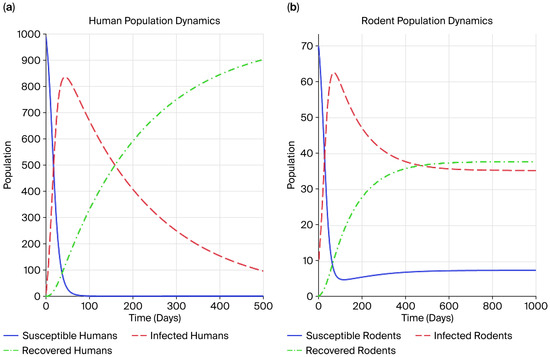
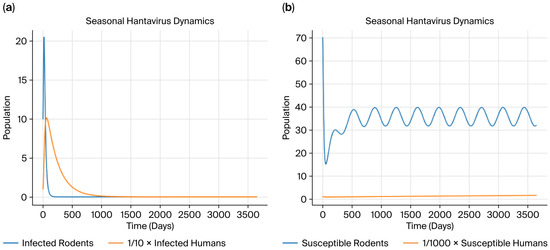
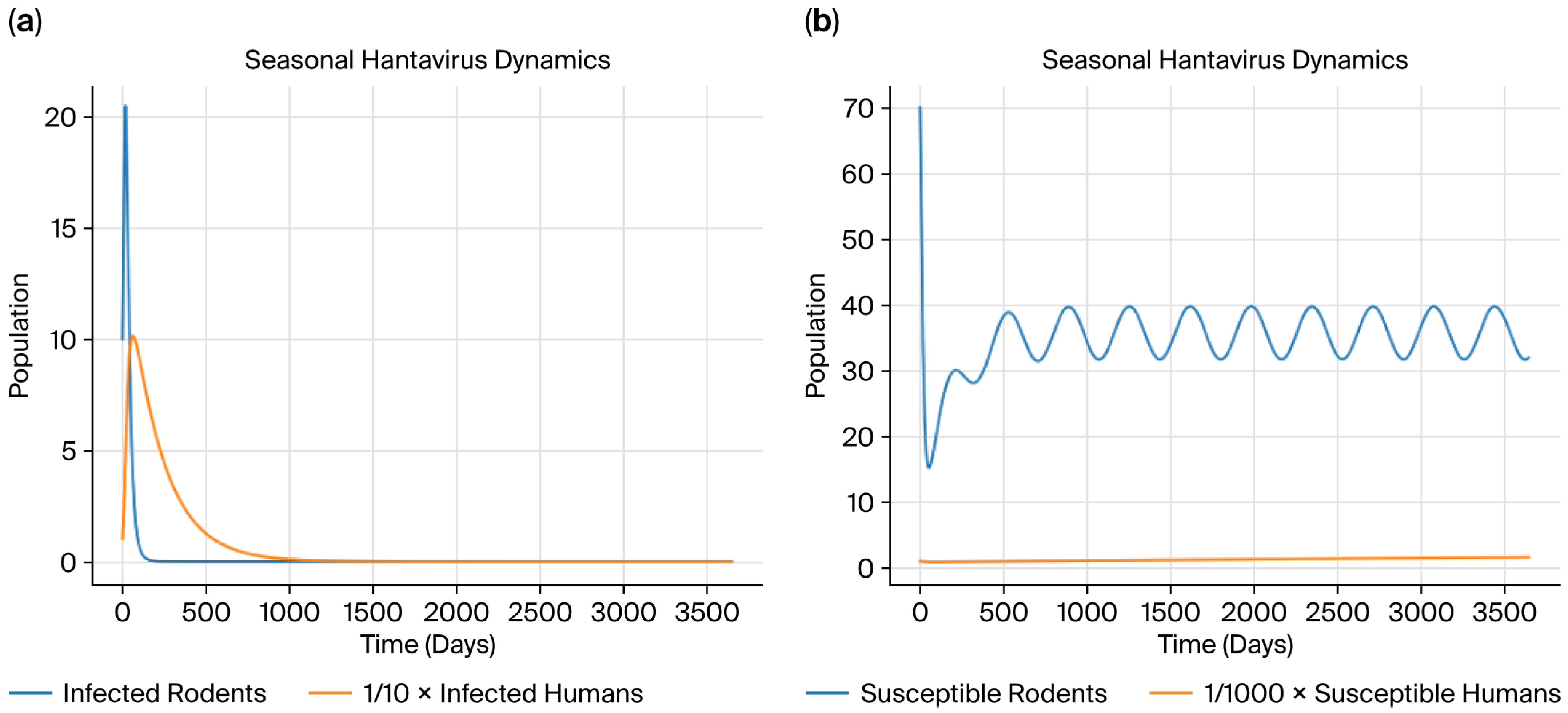
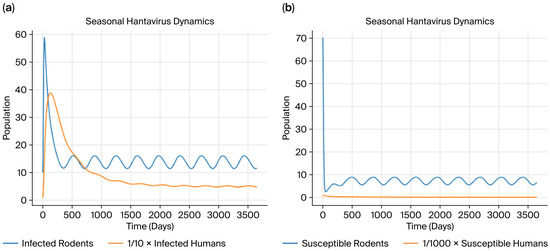
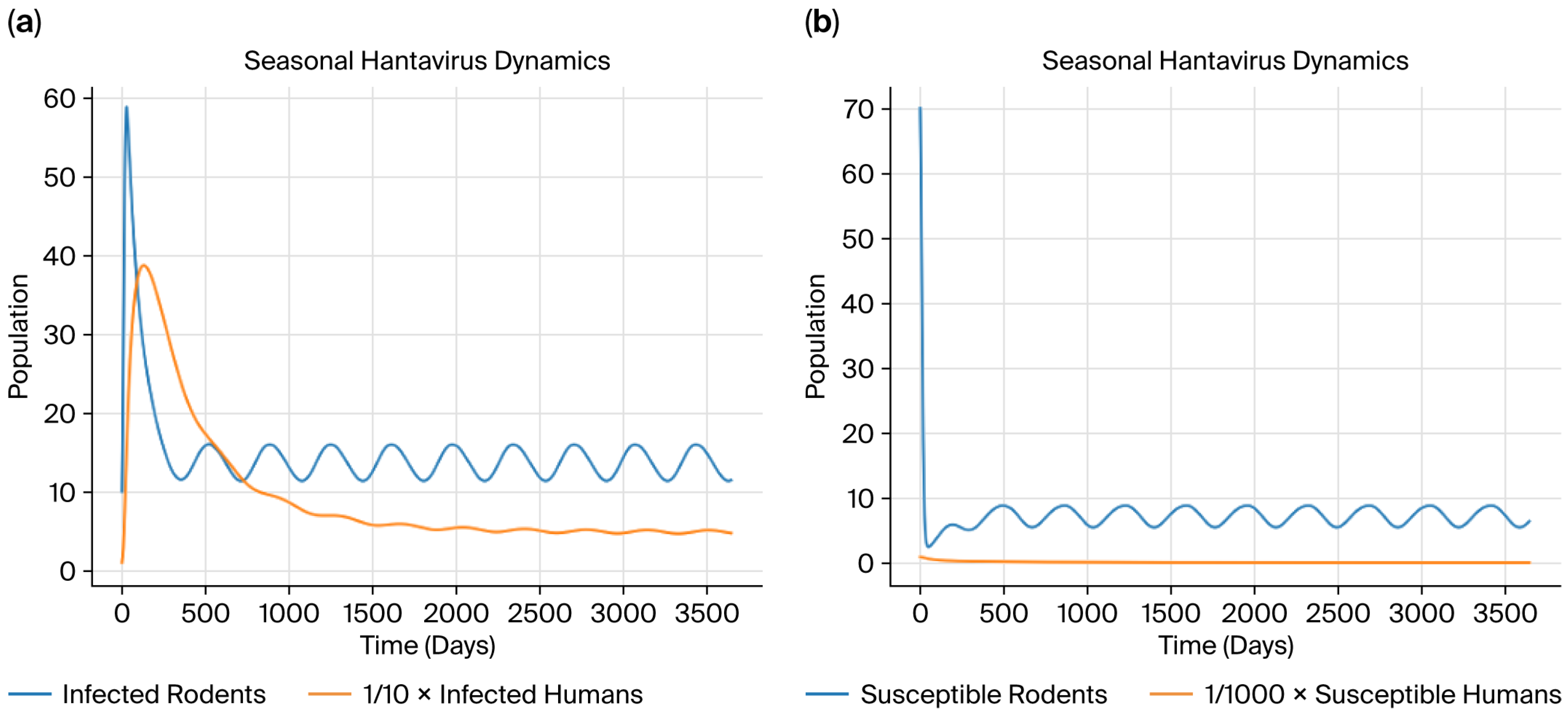
All simulations were performed using biologically plausible parameter values consistent with those used in the literature. Initial conditions were chosen away from equilibrium to clearly illustrate convergence or divergence behavior. The numerical results are not intended for parameter estimation, but rather for qualitative validation of the theoretical analysis. For the simulation, we use the following data set as the baseline: , . The figures indicate the stability of the equilibria. The results are shown in Figure 1, Figure 2, Figure 3 and Figure 4.
Figure 1.
The dynamics of the original SIR-SIR model from the work in [14] for human population (a) and rodent population (b). The modelare rewritten in Section 2.2 and briefly covered in Section 2.3 of this paper.
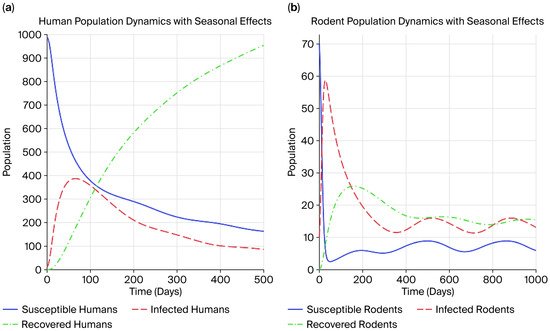
Figure 2.
The dynamics of the modified SIR-like model with seasonal recruitment for human population (a) and rodent popuation (b) The figures indicate the stability of the periodic equilibrium (or it may be just an ordinary/damping oscillation).
Figure 3.
The dynamics of the modified SIR-like model with seasonal recruitment and transmission for the case (. The figures indicate the stability of the endemic periodic orbit , while also show the graphs of infected populations (a) and susceptible populations (b).
Figure 4.
The dynamics of the modified SIR-like model with seasonal recruitment and transmission for the case . (. The figures indicate the instability of the DFE orbit , while also show the graphs of infected populations (a) and susceptible populations (b).
Figure 1 illustrates the dynamics of the original autonomous SIR–SIR model studied in [14], reproduced here for comparison. Two scenarios are shown, corresponding to and . When , all infected compartments decay to zero, and the solution converges to the disease-free equilibrium (DFE). When , the system converges to a unique endemic equilibrium (EE). This figure establishes the baseline threshold behavior of the autonomous model. It confirms the classical result that the basic reproduction number fully determines long-term dynamics and serves as a reference point for interpreting the seasonal model.
Figure 2 presents simulations of the modified model with seasonal rodent recruitment and transmission rates. Rodent population variables exhibit periodic oscillations driven by seasonal recruitment. Human infection levels respond to these oscillations but do not exhibit sustained endemic behavior when the threshold condition is subcritical, and the oscillations may be damped or persistent depending on parameter values. This figure demonstrates that seasonality alone alters transient dynamics, replacing equilibrium behavior with oscillatory responses. This motivates the need for a non-autonomous stability framework.
Figure 3 illustrates the dynamics of the fully seasonal model (seasonal recruitment and transmission) under conditions where the seasonal effective reproduction number satisfies . This reveals that infected compartments decay to zero over time, and susceptible rodent populations converge to a periodic orbit rather than a constant equilibrium. Human infection disappears asymptotically, despite seasonal fluctuations in rodent demography. This figure provides numerical confirmation of Theorem 1, showing that the disease-free periodic orbit is asymptotically stable when . It visually demonstrates the replacement of the classical DFE with a stable disease-free periodic state.
Figure 4 presents the fully seasonal model under parameter values such that . Small perturbations away from the disease-free periodic orbit grow over time, and both rodent and human infections persist, exhibiting sustained periodic oscillations. The disease-free periodic orbit is unstable. This figure illustrates the Floquet instability mechanism predicted analytically. It confirms that exceeding the seasonal threshold leads to persistent seasonal outbreaks, thereby extending the autonomous endemic equilibrium concept to seasonal endemic periodic behavior.
5. Conclusions
In this study, we present a modified SIR-SIR epidemic model describing the transmission of hantavirus zoonosis. We propose a mathematical model in which rodents circulate hantavirus among themselves and transmit the disease to humans, but not vice versa. Rodents’ recruitment varies seasonally, and so does their ability to transmit the disease. The resulting equation resembles the SIR-SIR model in an SIR-like form. The reproduction number for the extended system, which we call the seasonal effective reproduction number (denoted ), is constructed using a Floquet-style argument for DFE stability, and we derive the closed-form seasonal-effective reproduction number. This result provides a transparent and biologically interpretable Floquet analog of the classical basic reproduction number.
A theorem connecting the stability of the DFE with the is presented, which resembles the well-known rule for the non-seasonal hantavirus transmission, but with more realistic assumptions. Numerical simulations demonstrate that seasonal variation can generate oscillatory outbreak patterns that more closely reflect empirical rodent population dynamics and human risk profiles. In all simulations, seasonal forcing is applied exclusively to rodent recruitment and rodent-to-rodent transmission rates, while the human transmission rate is held constant. We found that seasonal rodent ecology is sufficient to generate periodic human outbreaks.
In general, we categorize the findings into analytical guarantees (Floquet-style stability criterion; avoidance of averaging failure) and numerical discoveries (transient amplification windows; prediction of delayed outbreak risk). Analytically, we establish a Floquet-style stability criterion showing that disease invasion is governed by the dominant multiplier of the periodic linearized system, yielding a rigorous persistence threshold for seasonal dynamics and avoiding the inaccuracies of heuristic averaging. Numerically, simulations demonstrate that delayed seasonal coupling reshapes the outbreak timing and intensity, with peak human infection risk emerging after ecological drivers rather than simultaneously. Structurally, the model incorporates phase-shifted ecological forcing and explicit rodent–human spillover. Appendix B presents a brief comparison table of our results against the existing literature in epidemiology, which provides a sharper biological implication of our results.
The results underscore the importance of ecological realism in zoonotic disease modeling and provide a foundation for more accurate prediction and control of the disease. Further investigation can focus on the search for a limit cycle in the model, which may provide a clearer, more realistic description of the dynamics of the disease and explain the persistent rhythm of fluctuations. In the current work, the two human transmission routes are aggregated into a single effective transmission term. This allows the present study to focus on the impact of seasonal rodent ecology—recruitment and rodent-to-rodent transmission—on disease persistence and stability, without introducing additional structural complexity that would obscure the Floquet analysis. An explicit separation of these human transmission routes under seasonal forcing is left for future investigation.
Author Contributions
Conceptualization, A.K.S., D.A., M.R.; methodology, A.K.S., M.R.; software, A.K.S., R.N.P.; validation, A.K.S., D.A.; formal analysis, A.K.S., M.R.; investigation, A.K.S., H.H.; resources, A.K.S., H.H.; data curation D.A., H.H.; writing—original draft preparation, A.K.S., H.H., R.N.P.; writing—review and editing, A.K.S., H.H.; visualization, A.K.S., H.H., R.N.P.; supervision, A.K.S.; project administration, H.H.; funding acquisition, A.K.S. All authors have read and agreed to the published version of the manuscript.
Funding
This research was supported by the Ministry of Higher Education, Science, and Technology of the Republic of Indonesia (Kemendiktisaintek) under the “Penelitian Fundamental Regular” scheme (Grant No. 1521/UN6.3.1/PT.00/2025).
Data Availability Statement
No external data were used in this study. All information necessary to reproduce the results is provided within the manuscript.
Acknowledgments
The figures were generated using Python (Version 3.12) via Online Python and Google Colaboratory (accessed 14 December 2025). The authors gratefully acknowledge Ibu Sumiati, SKM, M.Epid., from the East Jakarta Health Office (Sudinkes Jakarta Timur) for valuable discussions.
Conflicts of Interest
The authors declare no conflicts of interest.
Appendix A. The Four Stages of Floquet-Style Argument for DFE Stability
We summarize the method to analyze the stability of “DFE” in a seasonal ODE from various sources, e.g., [18,19,20]. There are four steps: 1. the derivation of the disease-free periodic orbit; 2. the linearization of infections; 3. the derivation of the Floquet multipliers; and 4. the derivation of the Floquet-style threshold as the corresponding basic reproduction number.
- Derivation of the disease-free periodic orbit
We consider a non-autonomous periodic system and with period , where contains infected compartments (and others). The disease-free equilibrium (DFE) is not a constant, but it is a periodic solution or () in the full model, due to the seasonally oscillating susceptible class. Hence, its stability is associated with a periodic orbit, instead of a fixed point.
- 2.
- Linearization at the DFE
We linearize the infected sub-system around the disease-free equilibrium and . This is a linear periodic system. Hence, the stability of the DFE is governed entirely by the stability of this periodic system.
- 3.
- Derivation of Floquet multipliers
The Floquet theory asserts that there exists a fundamental matrix solution such that The matrix is called the monodromy matrix whose eigenvalues are the Floquet multipliers. Furthermore, the Floquet stability criterion asserts that the DFE is linearly stable if and only if for all i. This statement replaces the classical eigenvalue test for stability in autonomous systems.
- 4.
- Connecting Floquet multipliers to Floquet-style threshold
For epidemic models, we can show that the linearized infected system can be written in the form where is the new infection term, and is the transition plus removal terms. Further, it can be concluded that “the spectral radius of a next-generation-type operator over one period equals the dominant multiplier” [18,19,20]. This fact can be written as . Thus, all Floquet multipliers satisfy DFE is locally asymptotically stable. This is the Floquet-style argument for the DFE stability condition.
Appendix B. Comparison Table Among Three Seasonal Epidemic Models
Appendix B summarizes the conceptual distinctions among classical seasonal SIR models, periodic operator-based epidemic models, and the present SIR–SIR hantavirus framework. Classical seasonal SIR formulations typically impose synchronous seasonal forcing directly on transmission parameters and rely on time-averaged next-generation matrices to define invasion thresholds, an approach known to be inaccurate in general periodic settings. Periodic operator models commonly provide rigorous invasion criteria. The work studied by Mitchell and Kribs [20] used Floquet or monodromy operators to provide invasion criteria for systems with general periodic coefficients. However, they are primarily theoretical and do not encode specific ecological mechanisms underlying seasonality. On the other hand, the present model integrates phase-shifted seasonal forcing of rodent demography and transmission within an explicit rodent–human spillover structure, allowing ecological delay to be represented in a mechanistic way. While the stability threshold is derived analytically using Floquet theory, numerical simulations are used to explore outbreak timing, revealing delayed spillover risk relative to ecological drivers. In short, the table highlights how the present framework combines rigorous periodic stability analysis with biologically interpretable seasonal structure. The framework extends existing approaches toward ecologically grounded zoonotic modeling.
| Feature | Classical Seasonal SIR (Time-Averaged R0) | Periodic Operator Models (e.g., Mitchell & Kribs [20]) | Present SIR–SIR Hantavirus Model |
| Seasonal forcing | Typically synchronous in transmission | General periodic coefficients | Phase-shifted demography and transmission |
| Threshold method | Time-averaged next-generation matrix | Floquet/monodromy operator | Floquet-style stability criterion |
| Validity of averaging | Often inaccurate | Proven rigorous | Avoids averaging failure |
| Host structure | Single population | Often single or abstract classes | Explicit rodent–human spillover |
| Ecological delay | Not represented | Not mechanistically modeled | Explicit seasonal lag |
| Dynamical outcomes | Regular oscillations | Persistence vs. extinction | Transient amplification windows |
| Public-health relevance | Limited timing insight | Mainly theoretical | Predicts delayed outbreak risk |
References
- Rahman, M.T.; Sobur, M.A.; Islam, M.S.; Ievy, S.; Hossain, M.J.; El Zowalaty, M.E.; Rahman, A.T.; Ashour, H.M. Zoonotic diseases: Etiology, impact, and control. Microorganisms 2020, 8, 1405. [Google Scholar] [CrossRef] [Scilit]
- Kalaiselvan, S.; Nandagopal, B.; Ramamurthy, M.; Saravanan, N.; Rajendiran, P.; Narayanan, H.; Vadivel, K. Hantavirus diseases—A comprehensive review. Asian J. Med. Health 2023, 21, 115–128. [Google Scholar] [CrossRef] [Scilit]
- Allen, L.J.S.; Wesley, C.L.; Owen, R.D.; Goodin, D.G.; Koch, D.; Jonsson, C.B.; Chu, Y.K.; Hutchinson, J.M.S.; Paige, R.L. A habitat-based model for the spread of hantavirus between reservoir and spillover species. J. Theor. Biol. 2009, 260, 510–522. [Google Scholar] [CrossRef] [Scilit]
- Fitzgibbon, W.E.; Langlais, M.; Morgan, J.J. A mathematical model for indirectly transmitted diseases. Math. Biosci. 2007, 206, 233–248. [Google Scholar] [CrossRef] [Scilit]
- Karim, M.F.A.; Ismail, A.I.; Ching, H.B. Cellular automata modelling of hantarvirus infection. Chaos Solitons Fractals 2009, 41, 2847–2853. [Google Scholar] [CrossRef] [Scilit]
- Escudero, C.; Buceta, J.; de la Rubia, F.; Lindenberg, K. Effects of internal fluctuations on the spreading of hantavirus. Phys. Rev. E 2004, 70, 061907. [Google Scholar] [CrossRef] [Scilit] [PubMed]
- Allen, L.J.S.; Langlais, M.; Phillips, C.J. The dynamics of two viral infections in a single host population with applications to hantavirus. Math. Biosci. 2003, 186, 191–217. [Google Scholar] [CrossRef] [Scilit]
- Allen, L.J.S.; McCormack, R.K.; Jonsson, C.B. Mathematical models for hantavirus infection in rodents. Bull. Math. Biol. 2006, 68, 511–524. [Google Scholar] [CrossRef] [Scilit]
- Aslan, I.H.; Baca-Carrasco, D.; Lenhart, S.; Velasco-Hernandez, J.X. An age structure model with impulse actions for leptospirosis in livestock cattle. J. Biol. Syst. 2021, 29, 75–105. [Google Scholar] [CrossRef] [Scilit]
- Sun, G.Q.; Li, M.T.; Zhang, J.; Zhang, W.; Pei, X.; Jin, Z. Transmission dynamics of brucellosis: Mathematical modelling and applications in China. Comput. Struct. Biotechnol. J. 2020, 18, 3843–3860. [Google Scholar] [CrossRef] [Scilit] [PubMed]
- Yusof, M.F.; Abdullah, F.A.; Ismail, A.I. Modeling and optimal control on the spread of hantavirus infection. Mathematics 2019, 7, 1192. [Google Scholar] [CrossRef] [Scilit]
- Qu, Z.; Hyman, J.M. Generating a hierarchy of reduced models for a system of differential equations modeling the spread of Wolbachia in mosquitoes. SIAM J. Appl. Math. 2019, 79, 1675–1699. [Google Scholar] [CrossRef] [Scilit]
- Parand, K.; Yousefi, H.; Fotouhifar, M.; Delkhosh, M.; Hosseinzadeh, M. Shifted boubaker lagrangian approach for solving biological systems. Int. J. Biomath. 2018, 11, 1850039. [Google Scholar] [CrossRef] [Scilit]
- Supriatna, A.K.; Napitupulu, H.; Ndii, M.Z.; Ghosh, B.; Kon, R. A mathematical model for transmission of hantavirus among rodents and its effect on the number of infected humans. Comput. Math. Methods Med. 2023, 2023, 9578283. [Google Scholar] [CrossRef] [Scilit]
- Anderson, R.M.; May, R.M.; Anderson, B. Infectious Diseases of Humans: Dynamics and Control, Revised ed.; Oxford University Press: London, UK, 1992. [Google Scholar]
- Brauer, F.; van den Driessche, P.; Wu, J. Mathematical Epidemiology; Springer: Berlin/Heidelberg, Germany, 2008. [Google Scholar]
- Diekmann, O.; Heesterbeek, J.A.P. Mathematical Epidemiology of Infectious Diseases: Model Building, Analysis and Interpretation, 1st ed.; Wiley: New York, NY, USA, 2000. [Google Scholar]
- Wang, W.; Zhao, X.Q. Threshold dynamics for compartmental epidemic models in periodic environments. J. Dyn. Differ. Equ. 2008, 20, 699–717. [Google Scholar] [CrossRef] [Scilit]
- Bacaër, N. Approximation of the Basic Reproduction Number R0 for Vector-Borne Diseases with a Periodic Vector Population. Bull. Math. Biol. 2007, 69, 1067–1091. [Google Scholar] [CrossRef] [Scilit] [PubMed]
- Mitchell, C.; Kribs, C. A Comparison of Methods for Calculating the Basic Reproductive Number for Periodic Epidemic Systems. Bull. Math. Biol. 2017, 79, 1846–1869. [Google Scholar] [CrossRef] [Scilit] [PubMed]
- Marino, S.; Hogue, I.B.; Ray, C.J.; Kirschner, D.E. A methodology for performing global uncertainty and sensitivity analysis in systems biology. J. Theor. Biol. 2008, 254, 178–196. [Google Scholar] [CrossRef] [Scilit]
- Mills, J.N.; Childs, J.E. Ecologic studies of rodent reservoirs: Their relevance for human health. Emerg. Infect. Dis. 1998, 4, 529–537. [Google Scholar] [CrossRef] [Scilit]
- Buceta, J.; Escudero, C.; de la Rubia, F.J.; Lindenberg, K. Outbreaks of Hantavirus induced by seasonality. Phys. Rev. E 2004, 69, 021906. [Google Scholar] [CrossRef] [Scilit] [PubMed]
- Hjelle, B.; Glass, G.E. Outbreak of Hantavirus Infection in the Four Corners Region of the United States in the Wake of the 1997–1998 El Nino–Southern Oscillation. J. Infect. Dis. 2000, 181, 1569–1573. [Google Scholar] [CrossRef] [Scilit] [PubMed]

Disclaimer/Publisher’s Note: The statements, opinions and data contained in all publications are solely those of the individual author(s) and contributor(s) and not of MDPI and/or the editor(s). MDPI and/or the editor(s) disclaim responsibility for any injury to people or property resulting from any ideas, methods, instructions or products referred to in the content. |
© 2026 by the authors. Licensee MDPI, Basel, Switzerland. This article is an open access article distributed under the terms and conditions of the Creative Commons Attribution (CC BY) license.