


Abstract
This paper analyzes the performance of a two-stage sequential hybrid MTS/MTO production system in which the order decoupling point is positioned between the manufacturing and assembly stages. In this configuration, the production control task separates into an upstream inventory control problem and a downstream order control problem. To address these jointly, this study examines a combined Kanban-POLCA (Paired-cell Overlapping Loops of Cards with Authorization) approach that applies Kanban to inventory control and POLCA to order control. The feasibility and behavior of this integrated system are evaluated through a simulation experiment. The results show that the considered control factors and their combinations significantly affect system performance, with the combined Kanban-POLCA system achieving superior results compared to the initial POLCA-POLCA system. Based on these findings, this paper outlines theoretical and practical implications that provide guidelines for designing and combining pull systems in two-stage production environments.
MSC:
90B30
1. Introduction
Two-stage assembly-to-order production systems are commonly encountered in practice [1,2]. In these systems, the customer order decoupling point (CODP) is positioned between the manufacturing and assembly stages, where the assembly stage is replenished usually through a certain feeding policy [3]. Such systems use a combination of make-to-stock (MTS) and make-to-order (MTO) manufacturing strategies, which is also known as a sequential hybrid MTS/MTO strategy, where the end products are produced in MTO fashion, while components are produced in the MTS mode and stored as an intermediate inventory [4,5,6]. In this way, the strengths of these systems are combined, while drawbacks are mitigated, i.e., the delivery of customized products is enabled, order fulfillment lead times are shortened, and inventory costs are maintained at a relatively low level [7,8].
Industry professionals already recognize the potential of hybrid two-stage manufacturing systems. Consequently, the body of literature on this topic is increasing, and researchers are putting more effort into addressing issues encountered within these systems, such as the positioning of the CODP [9,10], parameter setting, such as cost, inventory levels, and tardiness [11,12], order acceptance/rejection [13,14], etc.
Choosing the appropriate production control (PC) system is pivotal in any type of manufacturing company, regardless of the production system configuration. The choice of an appropriate PC system for sequential hybrid MTS/MTO systems is crucial, as it significantly impacts the management of internal throughput times while keeping inventory levels low [15]. However, the number of studies addressing this issue remains low [8]. In addition, research frequently makes assumptions about these systems that may not accurately reflect real-life situations, such as full availability of parts at assembly stations, which neglects potential capacity shortages at the manufacturing stage [16], or that MTS stage is inherently a push system, while MTO is inherently a pull system [8,17,18].
Another issue with the PC system in this configuration is that its task is divided into an upstream inventory control problem and a downstream order control problem, divided by the CODP [19]. This requires that the PC system include two components that effectively address each of these problems. Thürer et al. [19] state that the CODP directly influences the choice of the control system, suggesting that Kanban can be effectively used for the inventory control problem, while systems such as POLCA, ConWIP (Constant Work-in-Process), and COBACABANA (Control of Balance by Card-Based Navigation) are designed for the order control problem. Control systems are often viewed as competing, with various studies trying to demonstrate that one system is superior to another. However, recent research indicates that combining different PC systems in a specific PC configuration can significantly enhance the performance of production systems [20,21]. Previous research has explored combinations of control mechanisms. However, these studies either apply different methods for different tasks at one stage [20,21] or combine mechanisms without explicitly grounding the design of the PC system in the structural task separation introduced by the CODP by using the same system twice for both stages (e.g., POLCA-POLCA) [16]. This overlooks the fact that it makes more sense to use different systems for each stage, depending on the type of control problem at each of the stages. In contrast to previous research, this study therefore investigates whether aligning stage-specific control mechanisms with the type of control problem leads to superior performance.
To achieve this, this paper examines a combined Kanban-POLCA approach for sequential hybrid MTS/MTO systems, which uses Kanban for inventory control (manufacturing stage) and POLCA for order control (assembly stage). The feasibility and behavior of this integrated system are evaluated through a simulation experiment, and new insights are expected to be obtained that could help both practitioners and researchers in designing control systems for two-stage MTS/MTO systems. This study thus contributes to the literature on two-stage sequential hybrid MTS/MTO production systems in several ways: (i) it explicitly links the CODP-based task separation to differentiated stage-specific PC system design; (ii) it systematically evaluates the performance of a differentiated PC system (Kanban-POLCA) against a non-differentiated established benchmark (POLCA-POLCA); and (iii) it provides managerial insight by supplying actionable guidance for practitioners designing PC systems in two-stage environments.
The remainder of this paper is organized as follows. Section 2 provides a short background on PC tasks, Kanban and POLCA. Section 3 describes the production system considered and the simulation model used to assess the performance. The results are shown and discussed in Section 4. Finally, conclusions, implications, limitations, and future research directions are presented in Section 5.
2. Background
2.1. Production Control Tasks
PC is responsible for coordinating and controlling the order lifecycle on the shop floor. Graves et al. [22] outline two fundamental tasks of the PC system: (i) determining which jobs should be released into production and when (the order release task), and (ii) deciding whether a specific workstation is authorized to start processing a particular job (the production authorization task). Hopp and Spearman [4] expand this framework and point out that the system includes three decisions: (i) controlling the release of jobs into the system, (ii) determining the sequence of processing at workstations (sequencing/dispatching task), and (iii) managing the movement of materials between workstations (material movement task). Thürer et al. [21] organize the tasks of the PC system by using the concept of the user order lifecycle. They identify three main tasks: (i) creating orders (order generation), (ii) managing the release of orders into production, and (iii) authorizing processing at workstations. Authors also note that the PC system does not need to perform every task explicitly, but only one or more tasks, while the rest can be carried out as immediate decisions (e.g., immediate generation, release, or authorization), meaning that the decision is made and executed the moment the need arises. The authors also emphasize that this approach is very common in practice and that it allows PC systems to differ according to which tasks they explicitly include, thus opening up space for combining different approaches within the same production system.
2.2. Push vs. Pull Production Control Systems
In the academic literature, one of the most prevalent classifications of PC systems is the push–pull classification. Hopp and Spearman [4,17] argue that the main difference between these two systems is the existence of an explicit work-in-progress (WIP) level limit. According to the authors, a pull production system is one that explicitly limits the level of WIP in the system. In other words, the pull production system is authorized to produce only if the level of WIP in the system has not reached a predefined threshold, while the push approach does not have such limitations. Roser [18] argues that, in addition to explicitly limiting the WIP level, the pull system must also provide a signal that triggers stock replenishment or the release of new orders into production. This signal is sent when an individual product or batch leaves the system. Signals are often visual, usually in the form of cards.
It is important to emphasize that the distinction between push and pull systems does not rely on whether a company uses an MTO or MTS strategy [4,17,18,19]. Consequently, combinations such as MTO–push and MTS–pull are possible. In an MTS production system, the signal initiates the restocking of finished or semi-finished goods, depending on the user’s penetration point. In contrast, in an MTO production system, the signal triggers the release of the next work order into the process.
There is a variety of options when choosing a pull system, such as Kanban [23], ConWIP [24], POLCA [25], COBACABANA [26], etc. Thürer et al. [19] argue that one of the most important criteria when choosing the pull PC system is the CODP, as this is where materials, parts, components or products become bound to the customer, and their flow needs to be controlled. The CODP is also the inventory/order separation point, and the PC system has to be able to uniquely identify it because the inventory control problem is different from the order control problem [19].
2.3. Kanban
Kanban is the best-known pull system [17,18,23,27], used for the inventory control problem [19]. At the end of the process, a stock of parts is placed in what is called a supermarket. All products within the Kanban loop, including those in the supermarket, must have the appropriate Kanban card attached to them. The card contains information about the part type and quantity. When the next process or customer takes a part from the supermarket, the corresponding Kanban card returns to the beginning of the loop. This method authorizes the production or ordering of an additional quantity of interchangeable parts. The most recognized Kanban system in manufacturing is called production Kanban, although other variations also exist [18]. Additionally, Kanban can be applied outside of manufacturing, for example, to authorize transportation or to reorder materials from suppliers.
2.4. POLCA
POLCA is a card-based PC system first introduced by Suri [25] within the concept of Quick Response Manufacturing (QRM), and is designed to address the order control problem [19]. Suri [28] claims that the POLCA PC system is most successfully applied in MTO production systems characterized by a higher degree of customization/production mix and smaller production volumes, i.e., high-mix/low-volume (HMLV) environments. The essence of the POLCA system is reflected in the combination of MRP logic, which provides a signal to all workstations, with card loops. A key feature is that cards in the POLCA system indicate capacity availability, meaning that a workstation cannot start work on a product or work order unless there is free capacity at the next station in the route [25]. In this way, POLCA complements MRP with an element of capacity control based on coordination between workstations. POLCA loops are established between pairs of workstations (or processes, cells, workcenters, machines, etc.), while the cards themselves are temporarily assigned to a specific product or order. In the POLCA system, each possible pair of stations has its own loop. Therefore, as the name overlapping implies, the loops overlap each other.
2.5. Discussion
The review of PC tasks highlights that PC is not a monolithic function, but rather a collection of distinct yet interrelated decision tasks that can be addressed through different mechanisms. Contemporary PC frameworks emphasize that systems may explicitly perform only a subset of tasks, which opens up the possibility of combining different control systems within the same production system, provided that their respective roles are clearly defined.
This modular view of PC is particularly relevant in sequential hybrid MTS/MTO systems, where the CODP structurally separates the system into two fundamentally different control domains. The primary challenge upstream of the CODP is inventory control, i.e., ensuring the availability of interchangeable components while avoiding excessive stock levels. The control problem shifts toward order control downstream of the CODP, where the focus is on regulating workload, coordinating capacity across workstations, and managing customer-specific order flows. As emphasized in the literature, these two problems are conceptually distinct and therefore require different control logics. Studies that combine multiple control systems typically focus on addressing different tasks within a single stage [20], replicate the same system across stages (e.g., POLCA-POLCA, see [16]), or apply different systems simultaneously in different stages, disregarding the task separation introduced by the CODP [15].
It is, therefore, evident that, although the CODP is recognized as a critical structural element in hybrid MTS/MTO systems, its implications for the differentiated design of PC systems across stages remain underexplored. To address this gap, we investigate a combined Kanban-POLCA PC system for a two-stage sequential hybrid MTS/MTO environment that incorporates inventory control at the manufacturing stage (Kanban) and order control at the assembly stage (POLCA). Accordingly, the central research question guiding the investigation is:
RQ: How does aligning stage-specific PC mechanisms with distinct inventory and order control tasks influence the performance of a two-stage hybrid sequential MTS/MTO system?
3. Method
The feasibility and behavior of the proposed system are evaluated through a discrete-event simulation experiment. This method is commonly used to evaluate PC policies due to its capacity to model complex dynamics [29], and to develop the understanding of the system’s performance over time [30]. The simulation model was developed in the programming language Python 3.11.14 using the SimPy library.
Section 3.1 gives an overview of the production system considered and job characteristics. Section 3.2 provides more detail on the PC system used in the experiment, while Section 3.3 describes the experimental setup and performance measures.
3.1. Overview of the Modeled System and Job Characteristics
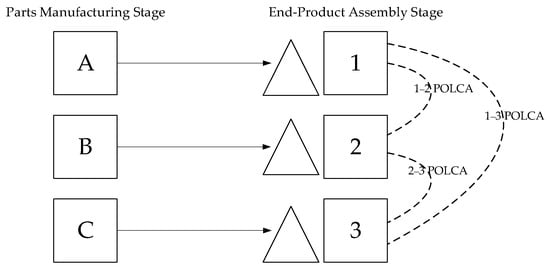
To answer our RQ, we considered a two-stage sequential hybrid MTS/MTO system shown in Figure 1, which is based on the model originally proposed by Thürer et al. [2] and later adopted by Fernandes et al. [16] to evaluate the performance of the POLCA-POLCA control system, in which POLCA is applied to both the manufacturing and assembly stages. Such production systems can be found in practice in various industrial settings where parts follow simple routings and require processing at a single station or cell [2], such as automotive assembly operations supplied by injection-molded part fabrication [16].
Figure 1.
Two-stage sequential hybrid MTS/MTO system.
Both stages consist of three stations, and each station is a single, constant-capacity resource. Each manufacturing station feeds exactly one assembly station, forming pairs: (A, 1), (B, 2), and (C, 3). Jobs progress through the assembly stage following the route determined upon their arrival in the system. The assembly stage functions as a general flow shop with a directed flow and the option to skip stations. When a job arrives, based on its route in the assembly stage, a subset of generic parts to be produced in the manufacturing stage at the appropriate stations is identified. Each part in this subset is produced in batches of one unit. The job is released to the assembly stage whenever the required part for the first assembly station in its route is available. Similar to [16], POLCA is used across all scenarios as a PC system in the assembly stage.
When a job arrives in the system, all necessary information is determined, i.e., the route through the assembly stage, processing times at all stations, and the required due date. Processing times at the stations follow a truncated 2-Erlang distribution, with a mean of 1 and a maximum of 4 after truncation. The processing time includes station setup time, while transportation times are neglected, consistent with common assumptions in related simulation studies. Jobs are assigned one of seven possible assembly routings (1, 2, 3, 1–2, 1–3, 2–3, or 1–2–3), which are assumed to be equally likely. As a result, each station is visited with a probability of 4/7, yielding an average routing length of 1.71 stations per job. Job inter-arrival times follow an exponential distribution with a mean of 0.633, which, in combination with an average processing time of one time unit and a total capacity of three single-station resources, leads to an average utilization of 90%. The due date is set by adding a uniformly distributed time allowance between 35 and 50 time units to the job’s arrival time.
3.2. Production Control
Since the CODP of the abovementioned system is positioned between the manufacturing and assembly stages, the PC tasks are separated into an inventory control problem upstream and an order control problem downstream. As mentioned previously, POLCA is consistently applied as the order control mechanism in the assembly stage. However, in addition to the baseline POLCA-POLCA system proposed by Fernandes et al. [16], Kanban is introduced as the inventory control method in the manufacturing stage, resulting in a combined Kanban-POLCA system. In this setup, Kanban supermarkets are positioned between each pair of manufacturing and assembly stations, with the assumption that they are initially full at the start of the simulation. Supermarkets were assumed to be initially full to provide comparable and neutral starting conditions across PC systems, and to avoid introducing bias due to the initial inventory depletion effect during the transient phase [31]. When an assembly station uses a part, the corresponding Kanban card is released, triggering a replenishment signal for the manufacturing station. We note that the immediate release-POLCA system is excluded from the analysis, since it yielded inferior performance compared to the POLCA-POLCA system in the same system setting [16]. The POLCA-POLCA system is retained as the benchmark in the present study to ensure strict comparability with this established reference setting [16]. The goal is not to make a broad comparison of different pull systems, but rather to investigate whether aligning control mechanisms specific to each stage with distinct inventory and order control tasks leads to better performance than applying a single, uniform control strategy across both stages.
In both systems, loops are established between each pair of manufacturing and assembly stations, and the number of available POLCA or Kanban cards determines the WIP limit within each loop. In total, nine levels are considered in this study: 14, 16, 18, 20, 22, 24, 26, 28, and infinity.
In addition, two types of POLCA card types are analyzed, following Fernandes et al. [16]: (i) unit-based POLCA, where each POLCA card represents one job regardless of processing time or complexity, and (ii) load-based POLCA, where each card corresponds to a predefined workload level expressed as the processing time at the next station in the job’s route. In this model, workload is defined based on the second workstation in the routing, as shown by Fernandes et al. [32], to yield the best overall performance. Both card quantification approaches are included to ensure comparability with the baseline POLCA-POLCA systems to avoid attributing performance differences to the choice of POLCA card type rather than to the PC system itself.
Following Hopp and Spearman’s [4] description of the key PC tasks (see Section 2.1), the sequencing of jobs at workstations is explicitly considered in this study. Accordingly, in the assembly stage, a dispatching rule is applied whenever a station becomes idle. This decision-making process includes workstation release, job ranking, POLCA card and part availability checking, and card assignment, referred to as integrated decision making. This approach is adopted because it is simpler to implement in practice [33], and naturally aligns with the moment when a station becomes idle, at which point a decision regarding the next job must be made. Specifically, when a station becomes idle, the following logic is followed:
- All jobs waiting in the queue whose next required operation is at the considered workstation are identified.
- These jobs are ranked according to the selected dispatching rule.
- Starting from the highest-ranked job, feasibility is checked sequentially by verifying: (i) the availability of the required POLCA card for the corresponding assembly loop and (ii) the availability of the required part from the related manufacturing station.
- The first job satisfying both conditions is selected, the corresponding POLCA card is assigned, the job is removed from the queue, and the assembly operation begins.
- If a job fails either feasibility condition in step 3, the next job in the ranked list is examined.
- If no job satisfies both conditions, the workstation remains idle until a POLCA card or the required part becomes available, at which point the procedure is repeated.
Upon completion of assembly, the POLCA card is released back to its loop, and the job proceeds to the next workstation in its route (or exits the system if all operations are completed). The four dispatching rules considered are:
- First Come, First Served (FCFS): Jobs are prioritized by their arrival order, with the longest-waiting job getting precedence.
- Shortest Processing Time (SPT): Jobs with the shortest processing times at the next workstation are prioritized.
- Earliest Release Date (ERD): The ERD of a job at each assembly station is estimated by backward scheduling from the job’s due date, subtracting the estimated average processing times of all downstream assembly stations along the job’s route. Jobs with earlier ERD values are prioritized without enforcing a waiting constraint, as strict ERD enforcement has been shown to cause unnecessary waiting and congestion under high-load conditions [34].
- Modified Earliest Release Date (MERD): Jobs are divided into urgent (with elapsed ERD) and non-urgent categories. Urgent jobs are prioritized by SPT, while non-urgent jobs follow the ERD rule if no urgent jobs are present.
3.3. Experimental Setup and Performance Measures
To examine the impact of different control systems on system performance, the effects of four experimental factors were considered: (i) two PC systems (Kanban-POLCA or POLCA-POLCA), (ii) four dispatching rules in the assembly stage (FCFS, SPT, ERD, and MERD), (iii) two types of POLCA cards (unit-based or load-based), and (iv) nine WIP levels (14, 16, 18, 20, 22, 24, 26, 28 and infinity). The factors and their corresponding levels are summarized in Table 1.
Table 1.
Experimental factors and levels.
A full factorial design was employed, resulting in 144 unique scenarios. Each scenario was simulated using 30 independent replications. Each replication lasted 30,000 time units, with the first 4000 time units treated as a warm-up period and performance data collected over the remaining simulation horizon. The warm-up period follows standard steady-state simulation practice to mitigate start-up bias in performance estimates [35], with its duration being consistent with that of the previous simulation studies of similar two-stage hybrid MTS/MTO systems [16]. Its adequacy was confirmed through preliminary pilot runs that verified the stabilization of key performance measures. Extending the warm-up period in additional test runs did not affect the observed performance measures, indicating that steady-state conditions were reached within the selected warm-up duration. System performance was evaluated using four indicators: (i) mean total throughput time (MTT), (ii) mean assembly throughput time (MAT), (iii) percentage of tardy orders (PTO), and (iv) mean tardiness (MTD). Average results were computed for each scenario at the end of the simulation.
4. Results
This section presents the simulation results obtained for the Kanban-POLCA and combined POLCA-POLCA systems. Section 4.1 provides an initial statistical analysis of the results. The performance results for throughput-time-related measures are presented in Section 4.2, while due-date-related performance measures are reported in Section 4.3. A discussion of the results is provided in Section 4.4.
4.1. Statistical Analysis
To provide an initial indication of the performance impact of the experimental factors, the simulation results were analyzed using an analysis of variance (ANOVA) [36,37], which was selected due to its robustness for different input distributions [38]. The analysis considers the main effects of all four factors as well as their interactions. A significance level of α = 0.05 was applied. Table 2 presents the ANOVA results for the throughput-time-related performance measures, namely mean total throughput time (MTT) and mean assembly throughput time (MAT).
Table 2.
ANOVA results for throughput-time-related performance measures.
The results indicate that most main effects are statistically significant. In addition, most two-way and three-way interactions are statistically significant, while no significant four-way interactions are observed. Table 3 presents the ANOVA results for the due-date-related performance measures, percentage of tardy orders (PTO), and mean tardiness (MTD).
Table 3.
ANOVA results for due-date-related performance measures.
The results reported in Table 3 indicate that all main effects are statistically significant for both due-date-related performance measures. In addition, most two-way and three-way interaction effects are statistically significant, while for MTD, a statistically significant four-way interaction is also observed.
Across all four performance measures, the PC system exhibits substantial effect sizes (partial η2 ≈ 0.89, 0.97, 0.32, and 0.34 for MTT, MAT, PTO, and MTD, respectively), indicating that the choice between the Kanban-POLCA and POLCA-POLCA systems is a dominant determinant of performance. Given the central role of this factor in this study, a Scheffé post hoc multiple comparison procedure was applied at a significance level of α = 0.05 to obtain the first indication of the size and direction of the performance differences between the Kanban-POLCA and POLCA-POLCA systems. The results, reported in Table 4, indicate statistically significant performance differences between the PC systems for all performance measures.
Table 4.
Results for Scheffé multiple comparison procedure: PC systems.
In addition to the large main effect associated with the PC system, several other factors (most notably the dispatching rule) and their interaction effects also exhibit high partial η2 values, indicating that performance differences are influenced by the combined effects of the experimental factors. These effects are examined further in Section 4.2, Section 4.3 and Section 4.4.
4.2. Results for Throughput-Time-Related Performance Measures
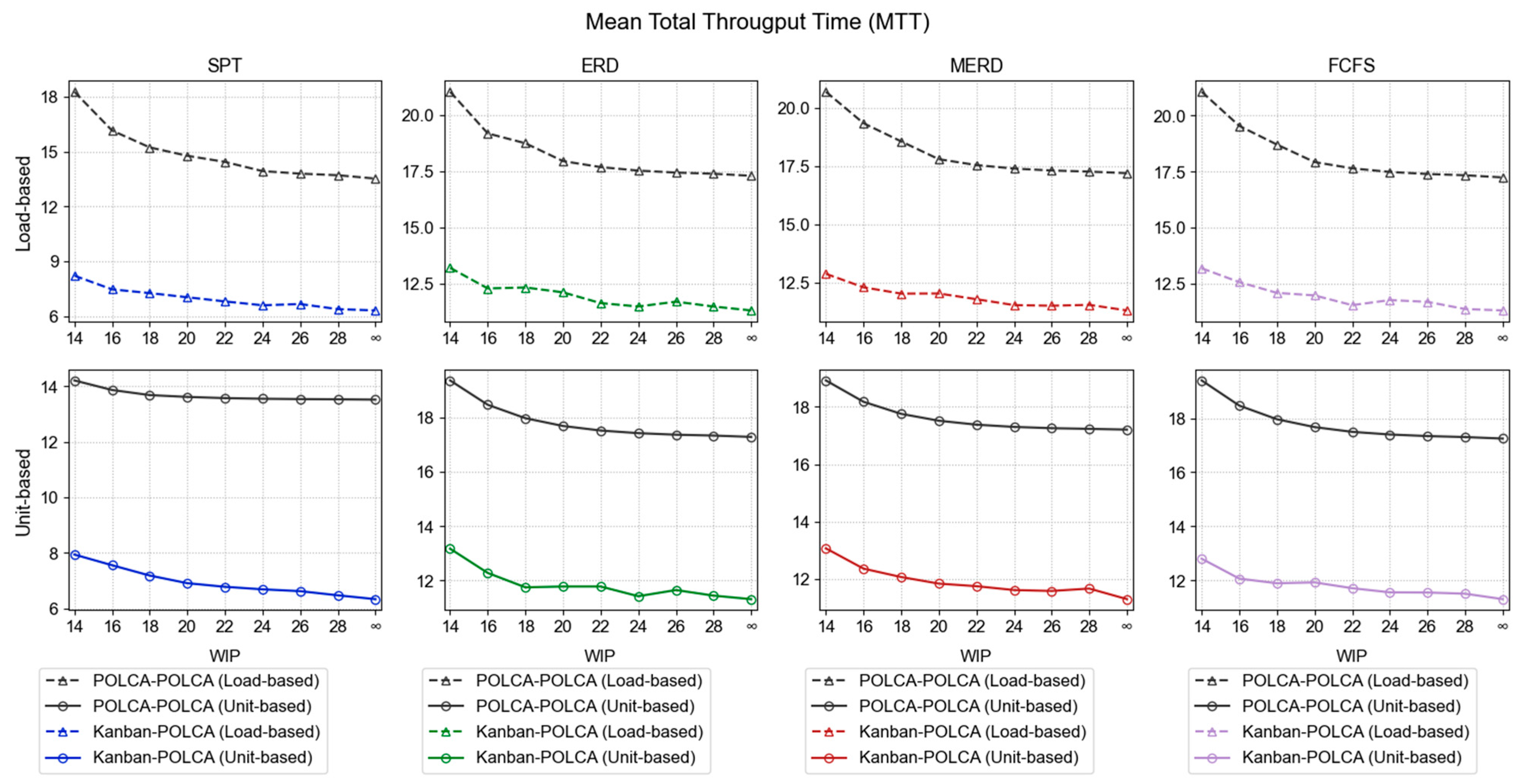
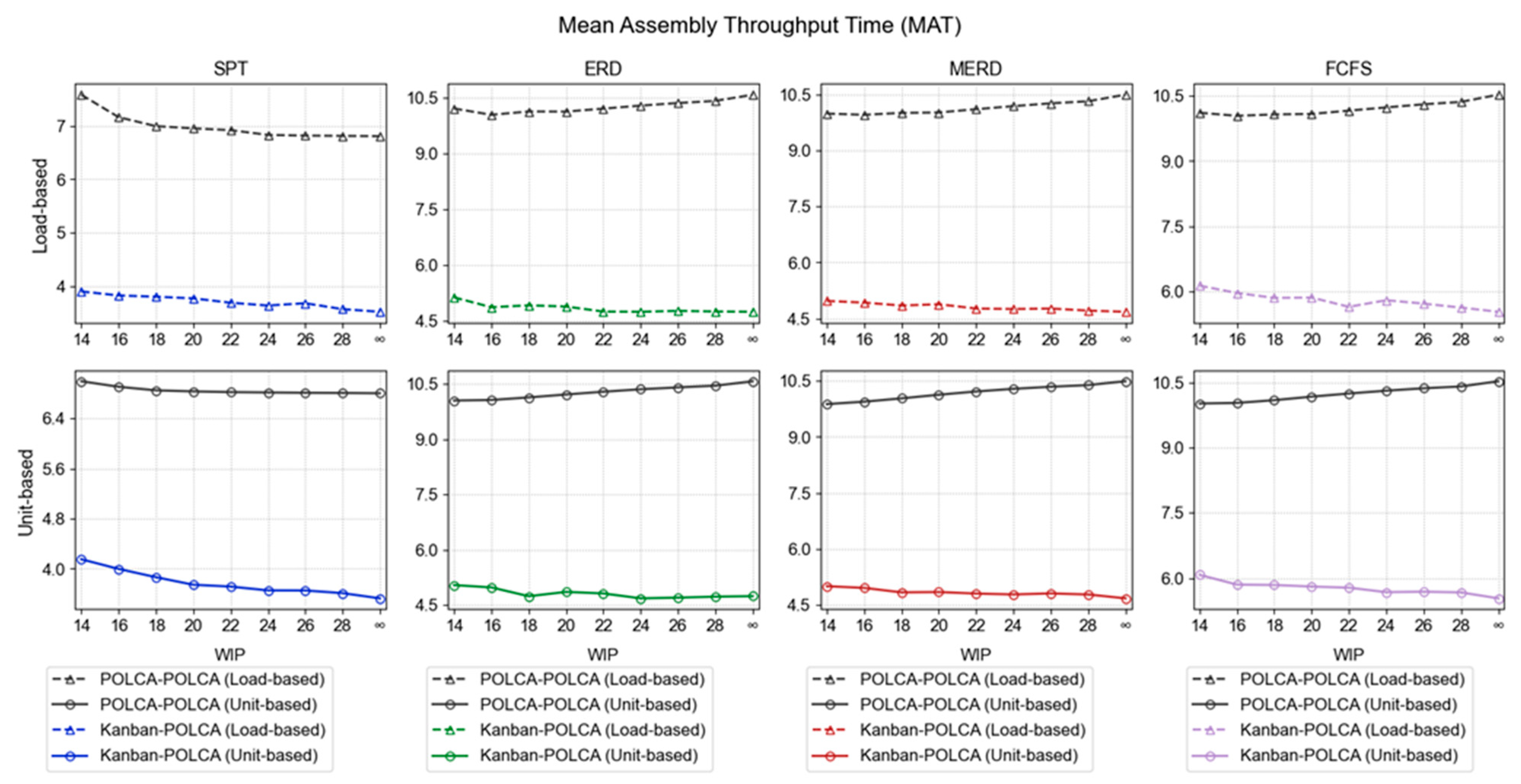
Figure 2 and Figure 3 present the MTT and MAT for the POLCA-POLCA and combined Kanban-POLCA systems. The WIP level is shown on the x-axis, while the corresponding performance measure values are shown on the y-axis. The legend identifies the PC system associated with each curve. Each column represents a specific job dispatching rule in the assembly stage, and each row corresponds to a POLCA card type.
Figure 2.
Mean total throughput time (MTT) for Kanban-POLCA and POLCA-POLCA across WIP levels, dispatching rules, and POLCA card types. Lower values indicate better results.
Figure 3.
Mean assembly throughput time (MAT) for Kanban-POLCA and POLCA-POLCA across WIP levels, dispatching rules, and POLCA card types. Lower values indicate better results.
Across all WIP levels, dispatching rules, and POLCA card types, the combined Kanban-POLCA results in lower MTT and MAT values than the POLCA-POLCA system. This pattern is observed consistently across all four dispatching rules, indicating that the improvement in throughput time achieved by the Kanban-POLCA is robust with respect to the dispatching rule used in the assembly stage. Similar trends are observed for both unit-based and load-based POLCA cards, although the absolute MTT and MAT values differ between card types.
4.3. Results for Due-Date-Related Performance Measures
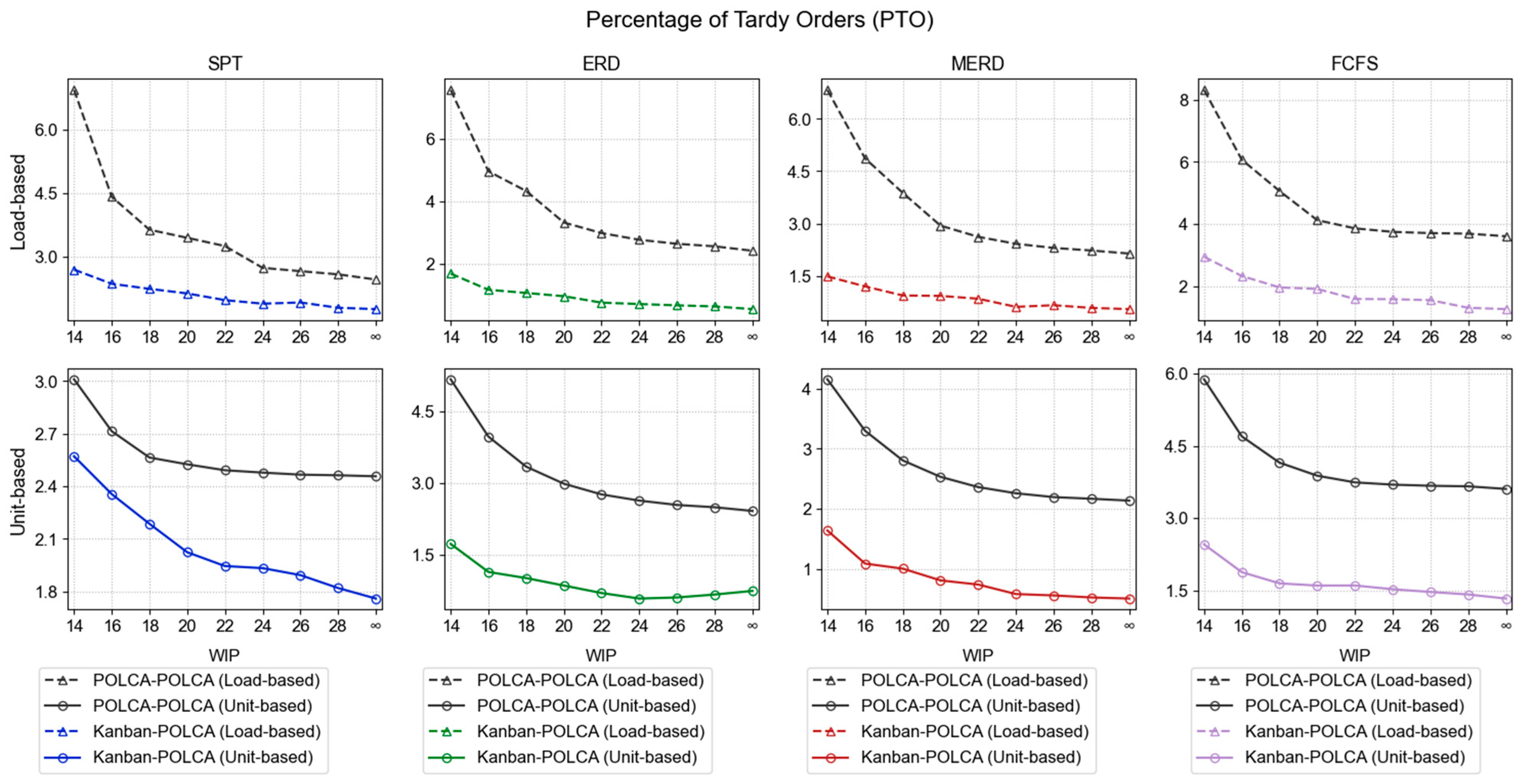
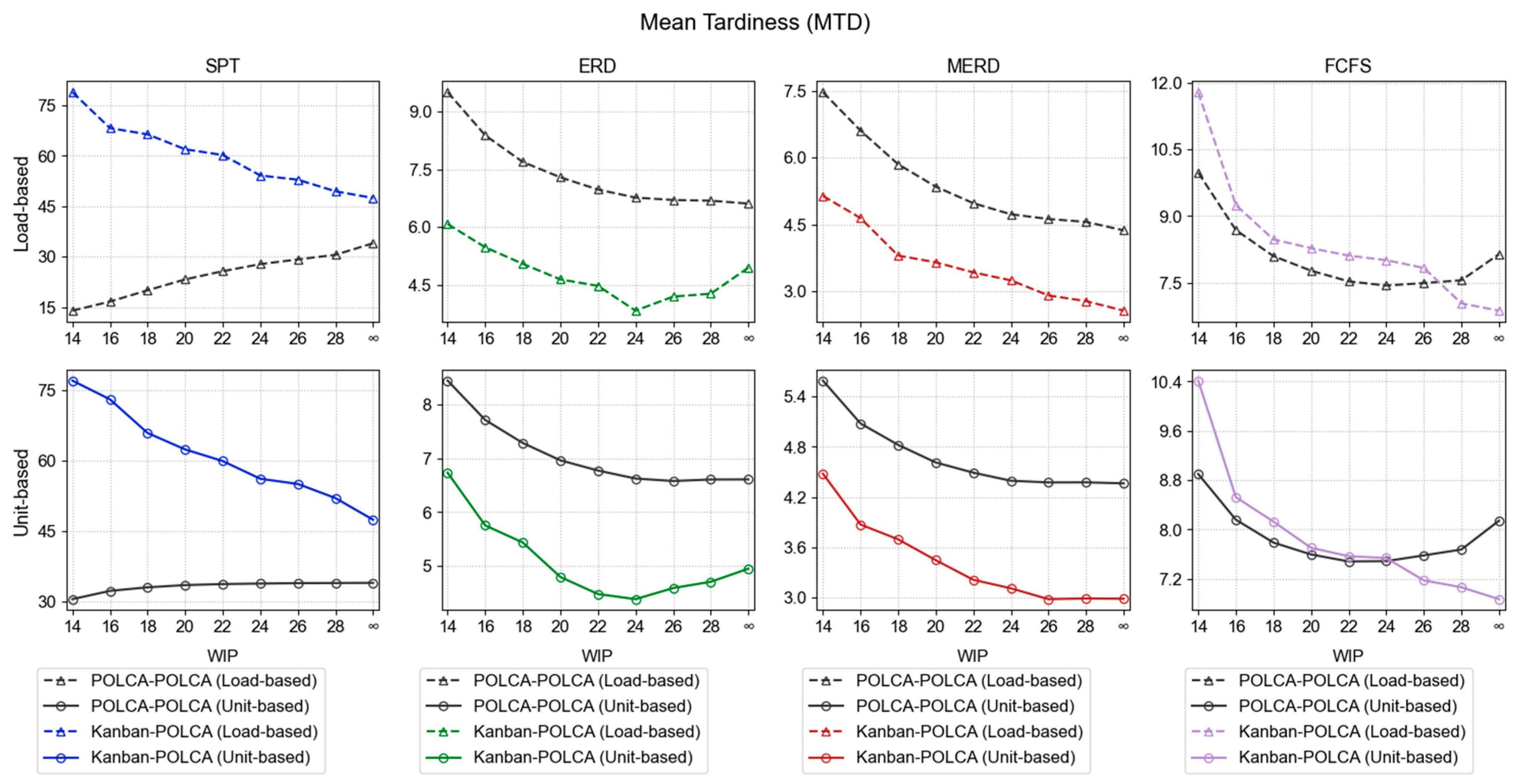
Figure 4 and Figure 5 present the PTO and MTD for the two PC systems. For both, PTO decreases as WIP increases, with diminishing marginal improvements at higher WIP levels. Across all dispatching rules, POLCA card types, and WIP levels, the combined Kanban-POLCA system consistently achieves lower PTO values than the POLCA-POLCA system. However, notable exceptions are observed for MTD measure under the SPT and FCFS dispatching rules, where the POLCA-POLCA system exhibits lower MTD despite higher PTO values. Under ERD and MERD, the combined Kanban-POLCA system consistently outperforms the POLCA-POLCA system across all WIP levels.
Figure 4.
Percentage of tardy orders (PTO) for Kanban-POLCA and POLCA-POLCA across WIP levels, dispatching rules, and POLCA card types. Lower values indicate better results.
Figure 5.
Mean tardiness (MTD) for Kanban-POLCA and POLCA-POLCA across WIP levels, dispatching rules, and POLCA card types. Lower values indicate better results.
4.4. Discussion of Results
The simulation results indicate that the combined Kanban-POLCA system achieves better performance compared to the baseline POLCA-POLCA system for almost all performance measures. The most pronounced improvements are observed for MTT and MAT, where substantial reductions are achieved. The lower MTT in the Kanban-POLCA system is primarily driven by higher part availability at the manufacturing–assembly interface, where parts are replenished as the generic inventory in Kanban supermarkets, which reduces the time from order arrival to the moment the first required part becomes available for assembly. Once orders become assembly-ready, the Kanban-POLCA system also yields lower MAT, indicating that jobs spend less time progressing through the assembly stage after the initial part is obtained, compared to the POLCA-POLCA system. This improvement is not limited to the first assembly operation. A higher availability of generic parts further reduces waiting for parts at subsequent assembly stations along a job’s route, as required components are more likely to be readily available when needed, rather than being tied to job-specific manufacturing completion as in the POLCA-POLCA system. As a result, interruptions and blocking within the assembly stage are reduced, leading to shorter assembly throughput times.
The values of PTO are also lower under the Kanban-POLCA system. However, an exception to this general trend is observed for the MTD measure under the SPT rule (Figure 5, first column) and the FCFS rule (Figure 5, last column) up to a certain WIP level (24 or 26, depending on the POLCA card type). In these cases, the baseline POLCA-POLCA system achieves lower mean tardiness despite the Kanban-POLCA system exhibiting a substantially lower PTO. This behavior is consistent with the significant two- and three-way interaction effects identified for MTD, which exhibit large partial η2 values in the statistical analysis (see Section 4.1, Table 3), and can be explained by differences in how the two systems regulate job progression through the assembly stage. In the POLCA-POLCA system, parts are produced on a job-by-job basis, which implicitly synchronizes the advancement of jobs across assembly stations and limits extreme overtaking. As a result, delays are evenly distributed across orders, leading to lower mean tardiness. In contrast, the Kanban-POLCA system relies on generic part availability, which increases flow flexibility but weakens job-specific synchronization. Under FCFS and SPT dispatching rules—which do not account for due-date urgency—this flexibility allows a small subset of jobs to be repeatedly postponed in favor of others. These jobs accumulate disproportionately large delays, increasing mean tardiness even as the overall proportion of tardy orders decreases. Dispatching rules that incorporate due-date awareness (ERD and MERD) counteract this effect by protecting urgent jobs from excessive postponement, allowing the Kanban-POLCA system to outperform the POLCA-POLCA system across all WIP levels. As WIP increases, higher inventory levels in the Kanban-POLCA system further stabilize flow and reduce the likelihood of extreme delays, leading to declining MTD values. In the POLCA-POLCA system, increasing WIP primarily amplifies congestion, resulting in increasing MTD.
5. Conclusions
With respect to our RQ, this study examined the performance of a combined Kanban-POLCA PC approach in a two-stage sequential hybrid MTS/MTO production system, where the CODP is positioned between manufacturing and assembly stages. By explicitly distinguishing between the upstream inventory control problem and the downstream order control problem, this study compared the proposed Kanban-POLCA system with the baseline POLCA-POLCA system through a simulation experiment. Four main control dimensions were investigated: (i) the PC system configuration, (ii) dispatching rules in the assembly stage, (iii) POLCA card types, and (iv) WIP levels.
The results demonstrate that separating inventory and order control by applying Kanban in the manufacturing stage and POLCA in the assembly stage leads to substantial performance improvements compared to the POLCA-POLCA system. In particular, the combined Kanban-POLCA system consistently achieves lower total and assembly throughput times across all dispatching rules, POLCA card types, and WIP levels. Improvements in due-date-related measures are also observed, with the combined system achieving lower PTO across all experimental settings.
However, the analysis also reveals nuanced trade-offs. Under FCFS and SPT dispatching rules, the baseline POLCA-POLCA system exhibits lower MTD despite a higher PTO. This behavior can be explained by differences in how the two systems regulate job progression through the assembly stage when dispatching rules do not account for due-date information. In contrast, dispatching rules that incorporate due-date awareness (ERD and MERD) consistently favor the combined Kanban-POLCA system, highlighting the importance of aligning dispatching logic with the chosen PC system.
From a theoretical perspective, this study contributes to the literature on sequential hybrid MTS/MTO systems by explicitly linking the CODP-based task separation to differentiated stage-specific PC system design. It demonstrates that combining pull-based PC systems tailored to distinct control problems yields superior performance compared to applying a single method uniformly across stages. The results support prior conceptual arguments that Kanban is better suited for inventory control, while POLCA is more effective for order control, and extend existing work by explicitly evaluating their joint application. From a practical standpoint, the findings provide actionable guidance for practitioners designing PC systems in two-stage environments, emphasizing the benefits of aligning control mechanisms with the nature of upstream and downstream decision problems rather than relying on a single, unified approach.
The main limitation of this study is the simplicity of the production system modeled in the experiment, which disregards the need for coordination when a single manufacturing station feeds multiple assembly stations. Additionally, the model does not account for structural complexities, such as alternative routings, shared resources, or the higher variability often observed in real-world environments. Another limitation is the assumption that the WIP levels for manufacturing and assembly stages are the same, despite the differences in processing times. Finally, this study is limited to comparing the Kanban-POLCA system with the established POLCA-POLCA benchmark, and does not explore additional pull-based control combinations, such as Kanban–Kanban or CONWIP-based systems. Although these limitations were required to keep our study focused, they may affect the generalizability of the findings. For example, increased structural complexity or heterogeneous WIP settings could introduce additional coordination dynamics that alter the relative performance of the Kanban-POLCA and POLCA-POLCA systems, while shared resources or alternative routes may intensify congestion effects and interaction loops that the current simplified structure does not fully capture, potentially affecting the magnitude of the observed performance differences.
Future research could therefore extend this work in several directions. First, more complex environments could be examined to investigate the robustness of the Kanban-POLCA system, including alternative routing structures, shared resources, more heterogeneous processing times, and different demand patterns. Second, empirical validation and experimentation with adaptive or dynamically tuned control parameters could provide further insights into the practical implementation of combined Kanban-POLCA systems in real industrial settings. Third, while this study focuses on the comparison between Kanban-POLCA and the established POLCA-POLCA benchmark to isolate the effect of stage-specific control alignment, future research could extend the analysis to additional configurations (e.g., Kanban–Kanban or CONWIP–based systems) to explore broader comparative dynamics across pull-based control systems.
Author Contributions
Conceptualization, N.T., I.T. and B.S.; methodology, N.T., I.T., M.T. and D.S. (Dragoslav Slović); software, N.T.; validation, N.T., I.T., M.T., M.G., D.S. (Dragana Stojanović), B.S. and D.S. (Dragoslav Slović); writing—original draft preparation, N.T., I.T. and M.G.; writing—review and editing, M.T. and D.S. (Dragana Stojanović). All authors have read and agreed to the published version of the manuscript.
Funding
This research received no external funding.
Data Availability Statement
The original contributions presented in this study are included in the article. Further inquiries can be directed to the corresponding author.
Conflicts of Interest
The authors declare no conflicts of interest.
References
- Atan, Z.; Ahmadi, T.; Stegehuis, C.; Kok, T.D.; Adan, I. Assemble-to-Order Systems: A Review. Eur. J. Oper. Res. 2017, 261, 866–879. [Google Scholar] [CrossRef] [Scilit]
- Thürer, M.; Fernandes, N.O.; Stevenson, M. Parts Feeding in Two-Stage Assembly System: An Assessment by Simulation. J. Ind. Prod. Eng. 2019, 36, 493–501. [Google Scholar] [CrossRef] [Scilit]
- Schmid, N.A.; Limère, V. A Classification of Tactical Assembly Line Feeding Problems. Int. J. Prod. Res. 2019, 57, 7586–7609. [Google Scholar] [CrossRef] [Scilit]
- Hopp, W.J.; Spearman, M.L. Factory Physics: Third Edition; Waveland Press: Long Grove, IL, USA, 2011; ISBN 978-1-4786-0904-9. [Google Scholar]
- Jia, Y.; Weng, W.; Fujimura, S. A Hybrid MTS-MTO Production Model with a Dynamic Decoupling Point for Flexible Flow Shops. In Proceedings of the 2017 IEEE/ACIS 16th International Conference on Computer and Information Science (ICIS), Wuhan, China, 24–26 May 2017; pp. 803–807. [Google Scholar]
- Harfeldt-Berg, M.; Olhager, J. The Customer Order Decoupling Point in Empirical Operations and Supply Chain Management Research: A Systematic Literature Review and Framework. Int. J. Prod. Res. 2024, 62, 6380–6399. [Google Scholar] [CrossRef] [Scilit]
- Gupta, D.; Benjaafar, S. Make-to-Order, Make-to-Stock, or Delay Product Differentiation? A Common Framework for Modeling and Analysis. IIE Trans. 2004, 36, 529–546. [Google Scholar] [CrossRef] [Scilit]
- Peeters, K.; Van Ooijen, H. Hybrid Make-to-Stock and Make-to-Order Systems: A Taxonomic Review. Int. J. Prod. Res. 2020, 58, 4659–4688. [Google Scholar] [CrossRef] [Scilit]
- Sun, X.Y.; Ji, P.; Sun, L.Y.; Wang, Y.L. Positioning Multiple Decoupling Points in a Supply Network. Int. J. Prod. Econ. 2008, 113, 943–956. [Google Scholar] [CrossRef] [Scilit]
- Cid Yáñez, F.; Frayret, J.-M.; Léger, F.; Rousseau, A. Agent-Based Simulation and Analysis of Demand-Driven Production Strategies in the Timber Industry. Int. J. Prod. Res. 2009, 47, 6295–6319. [Google Scholar] [CrossRef] [Scilit]
- Almehdawe, E.; Jewkes, E. Performance Analysis and Optimization of Hybrid Manufacturing Systems under a Batch Ordering Policy. Int. J. Prod. Econ. 2013, 144, 200–208. [Google Scholar] [CrossRef] [Scilit]
- Renna, P. Comparison of Dynamic Decoupling Point and Dynamic Buffer Level for Flexible Flow Shops in a Hybrid MTS–MTO Production Model. Appl. Sci. 2024, 14, 7975. [Google Scholar] [CrossRef] [Scilit]
- Kalantari, M.; Rabbani, M.; Ebadian, M. A Decision Support System for Order Acceptance/Rejection in Hybrid MTS/MTO Production Systems. Appl. Math. Model. 2011, 35, 1363–1377. [Google Scholar] [CrossRef] [Scilit]
- Yousefnejad, H.; Rabbani, M.; Manavizadeh, N. A Simulation-Optimization Model For Capacity Coordination In Make To Stock/Make To Order Production Environments. Interdiscip. J. Manag. Stud. 2019, 12, 235–253. [Google Scholar] [CrossRef] [Scilit]
- Rocha, F.; Silva, E.; Lopes, Â.; Dias, L.; Pereira, G.; Fernandes, N.O.; Carmo-Silva, S. Materials Flow Control in Hybrid Make-to-Stock/Make-to-Order Manufacturing. In Computational Logistics; Corman, F., Voß, S., Negenborn, R.R., Eds.; Lecture Notes in Computer Science; Springer International Publishing: Cham, Switzerland, 2015; Volume 9335, pp. 559–568. ISBN 978-3-319-24263-7. [Google Scholar]
- Fernandes, N.O.; Thürer, M.; Mirzaei, N.; Ferreira, L.P.; Silva, F.J.G.; Carmo-Silva, S. POLCA Control in Two-Stage Production Systems. Procedia Manuf. 2020, 51, 1491–1496. [Google Scholar] [CrossRef] [Scilit]
- Hopp, W.J.; Spearman, M.L. To Pull or Not to Pull: What Is the Question? M&SOM 2004, 6, 133–148. [Google Scholar] [CrossRef] [Scilit]
- Roser, C. All about Pull Production: Designing, Implementing, and Maintaining Kanban, CONWIP, and Other Pull Systems in Lean Production; AllAboutLean; AllAboutLean.com Publishing: Offenbach, Germany, 2021; ISBN 978-3-96382-028-1. [Google Scholar]
- Thürer, M.; Stevenson, M.; Protzman, C. Card-Based Control Systems for a Lean Work Design: The Fundamentals of Kanban, ConWIP, POLCA, and COBACABANA; CRC Press, Taylor & Francis Group: Boca Raton, FL, USA, 2016; ISBN 978-1-4987-4694-6. [Google Scholar]
- Thürer, M.; Fernandes, N.O.; Stevenson, M. Material Flow Control in High-Variety Make-to-Order Shops: Combining COBACABANA and POLCA. Prod. Oper. Manag. 2020, 29, 2138–2152. [Google Scholar] [CrossRef] [Scilit]
- Thürer, M.; Fernandes, N.O.; Lödding, H.; Stevenson, M. Material Flow Control in Make-to-Stock Production Systems: An Assessment of Order Generation, Order Release and Production Authorization by Simulation. Flex. Serv. Manuf. J. 2025, 37, 1–37. [Google Scholar] [CrossRef] [Scilit]
- Graves, R.J.; Konopka, J.M.; Milne, R.J. Literature Review of Material Flow Control Mechanisms. Prod. Plan. Control. 1995, 6, 395–403. [Google Scholar] [CrossRef] [Scilit]
- Ohno, T. Toyota Production System: Beyond Large-Scale Production; Productivity Press: Cambridge, MA, USA, 1988; ISBN 978-0-915299-14-0. [Google Scholar]
- Spearman, M.L.; Woodruff, D.L.; Hopp, W.J. CONWIP: A Pull Alternative to Kanban. Int. J. Prod. Res. 1990, 28, 879–894. [Google Scholar] [CrossRef] [Scilit]
- Suri, R. Quick Response Manufacturing: A Companywide Approach to Reducing Lead Times; Productivity Press: Portland, OR, USA, 1998; ISBN 978-1-56327-201-1. [Google Scholar]
- Land, M.J. Cobacabana (Control of Balance by Card-Based Navigation): A Card-Based System for Job Shop Control. Int. J. Prod. Econ. 2009, 117, 97–103. [Google Scholar] [CrossRef] [Scilit]
- Shingo, S. A Study of the Toyota Production System from an Industrial Engineering Viewpoint, 1st ed.; Productivity Press: Cambridge, MA, USA, 1989; ISBN 978-0-915299-17-1. [Google Scholar]
- Suri, R. The Practitioner’s Guide to POLCA: The Production Control System for High-Mix, Low-Volume and Custom Products; CRC Press: Boca Raton, FL, USA, 2018; ISBN 978-1-138-21064-6. [Google Scholar]
- Fernandes, N.O.; Djabi, S.; Thürer, M.; Ávila, P.; Ferreira, L.P.; Carmo-Silva, S. The DDMRP Replenishment Model: An Assessment by Simulation. Mathematics 2025, 13, 3483. [Google Scholar] [CrossRef] [Scilit]
- Tako, A.A.; Robinson, S. Model Development in Discrete-Event Simulation and System Dynamics: An Empirical Study of Expert Modellers. Eur. J. Oper. Res. 2010, 207, 784–794. [Google Scholar] [CrossRef] [Scilit]
- Pourbafrani, M.; Lücking, N.; Lucke, M.; van der Aalst, W.M.P. Steady State Estimation for Business Process Simulations. In Proceedings of the Business Process Management Forum; Di Francescomarino, C., Burattin, A., Janiesch, C., Sadiq, S., Eds.; Springer Nature: Cham, Switzerland, 2023; pp. 178–195. [Google Scholar]
- Fernandes, N.O.; Thürer, M.; Stevenson, M.; Carmo Silva, S. Load-Based POLCA: An Assessment of the Load Accounting Approach. In Recent Advances in Information Systems and Technologies; Rocha, Á., Correia, A.M., Adeli, H., Reis, L.P., Costanzo, S., Eds.; Advances in Intelligent Systems and Computing; Springer International Publishing: Cham, Switzerland, 2017; Volume 570, pp. 397–405. ISBN 978-3-319-56537-8. [Google Scholar]
- Fernandes, N.O.; Thürer, M.; Stevenson, M. On the Integration of Card-Allocation and Dispatching Decisions in POLCA Systems: An Assessment by Simulation. Prod. Plan. Control. 2023, 34, 1225–1232. [Google Scholar] [CrossRef] [Scilit]
- Thürer, M.; Fernandes, N.O.; Stevenson, M.; Silva, C.; Carmo-Silva, S. POLC-A: An Assessment of POLCA’s Authorization Element. J. Intell. Manuf. 2019, 30, 2435–2447. [Google Scholar] [CrossRef] [Scilit]
- Robinson, S. Simulation: The Practice of Model Development and Use; Wiley: Chichester, UK, 2004; ISBN 978-0-470-84772-5. [Google Scholar]
- Montgomery, D.C. Design and Analysis of Experiments, 10th ed.; Wiley: Hoboken, NJ, USA, 2020; ISBN 978-1-119-49247-4. [Google Scholar]
- Boumaaraf, B.; Boumaaraf, H.; Slimani, M.E.-A.; Tchoketch_Kebir, S.; Ait-cheikh, M.S.; Touafek, K. Performance Evaluation of a Locally Modified PV Module to a PV/T Solar Collector under Climatic Conditions of Semi-Arid Region. Math. Comput. Simul. 2020, 167, 135–154. [Google Scholar] [CrossRef] [Scilit]
- Schmider, E.; Ziegler, M.; Danay, E.; Beyer, L.; Bühner, M. Is It Really Robust?: Reinvestigating the Robustness of ANOVA Against Violations of the Normal Distribution Assumption. Methodology 2010, 6, 147–151. [Google Scholar] [CrossRef] [Scilit]

Disclaimer/Publisher’s Note: The statements, opinions and data contained in all publications are solely those of the individual author(s) and contributor(s) and not of MDPI and/or the editor(s). MDPI and/or the editor(s) disclaim responsibility for any injury to people or property resulting from any ideas, methods, instructions or products referred to in the content. |
© 2026 by the authors. Licensee MDPI, Basel, Switzerland. This article is an open access article distributed under the terms and conditions of the Creative Commons Attribution (CC BY) license.