


Abstract
Chaotic systems, with their characteristics of high sensitivity to initial conditions, pseudo-randomness, and ergodicity, provide high-quality pseudo-random sequences. Graph theory, through mechanisms such as vertex mapping, path traversal, and graph partitioning, can enhance data confusion and diffusion capabilities. This research designs an image encryption method that combines graph theory and chaotic systems. Firstly, a four-dimensional discrete chaotic system is constructed based on the Hénon map, and its chaotic characteristics and high complexity over a wide range of parameters and initial values are verified using Lyapunov exponents and permutation entropy. Secondly, an encryption framework based on a dynamic adjacency matrix from graph theory is proposed: image pixels are mapped to a dynamic graph structure, and sparse adjacency matrices are generated using chaotic sequences to achieve pixel scrambling based on graph traversal; then, chaotic sequences are used for feedback diffusion with pixel values to enhance the confusion effect. Multiple sets of experiments verify its effectiveness and robustness in terms of key sensitivity, statistical analysis, resistance to differential attacks, and resistance to cropping attacks.
Keywords:
four-dimensional discrete chaos; wide-range chaos; dynamic adjacency matrix; sparse matrices MSC:
05CXX; 37NXX; 94A60
1. Introduction
Against the backdrop of the current global digital wave, multimedia data such as images and videos have become core carriers for information expression and transmission. Their security during transmission and storage forms the cornerstone of the modern information society. However, multimedia data, especially images, have characteristics such as large data volume, high correlation between pixels, and significant redundancy, posing severe challenges of low efficiency and insufficient security when traditional text encryption algorithms (like AES and DES) are directly applied [1,2]. Therefore, designing new, efficient, secure encryption schemes specifically tailored for the characteristics of image data has become a crucial and highly active research direction in the field of information security [3,4].
The integration of chaotic systems and graph theory has emerged as a promising approach to addressing cryptographic challenges. Chaotic systems are particularly valuable because of their inherent properties, such as extreme sensitivity to initial conditions and control parameters, which produce random-like behavior and long-term unpredictability. These characteristics align closely with the core principles of confusion and diffusion in cryptography, making such systems excellent natural sources for generating high-quality pseudo-random sequences [5,6]. Research in chaos-based image encryption has progressed significantly since these attributes were identified, primarily advancing along two key dimensions.
One major focus has been the design of novel chaotic systems with superior performance. For instance, Zhu et al. [1] developed a one-dimensional fractional chaotic map that exhibits continuous strong chaotic behavior across an extensive parameter range, effectively avoiding the periodic windows common in traditional one-dimensional maps and thereby providing a more reliable randomness foundation for encryption. Chen et al. [7] constructed a four-dimensional chaotic system with higher complexity by introducing nonlinear terms and feedback controllers, significantly enhancing the unpredictability of the key sequence. These studies collectively aim to fundamentally strengthen the security of the encryption kernel by improving the dynamic complexity (Lyapunov exponent, permutation entropy) of the chaotic system [8]. A second focus is optimizing the structure and efficiency of encryption algorithms. Beyond the simple “scrambling–diffusion” architecture [9,10], researchers have introduced various techniques like DNA encoding [11,12], dynamic S-box generation, and parallel computing to enhance both security and execution speed [13].
Simultaneously, graph theory serves as a powerful mathematical framework for describing complex relational structures among elements, and its application in cryptography continues to expand [14]. It offers a special means to model the topological organization of data—for instance, by defining participant access structures in secret sharing schemes [15]—and enables deeply nonlinear rearrangement of data positions through operations such as vertex mapping and path-based traversals (Depth-First Search or random walks [16]). By representing image pixels as graph vertices and establishing edges according to defined rules, the process of graph traversal can directly produce highly disordered pixel scrambling sequences [17,18]. This approach moves beyond conventional scrambling techniques that rely on cyclic row and column shifts, introducing more intricate global dependencies shaped by the underlying graph topology [19].
Although previous work has made significant progress, existing hybrid chaos–graph theory encryption frameworks still face several key bottlenecks that require breakthrough solutions. A primary limitation is the lack of a dynamic coupling mechanism. In most current schemes, chaotic systems are merely used to generate scrambling sequences or diffusion keys, while the graph structure itself remains static or is generated by predefined rules [20]. This separation prevents the dynamic nature of chaos from achieving deep, synergistic integration with the topological properties of the graph, thereby failing to produce a “1 + 1 > 2” fusion effect that could significantly enhance cryptographic security.
Furthermore, these frameworks often suffer from limited system robustness. While many chaotic systems exhibit high complexity, their chaotic behavior remains highly sensitive to minor changes in parameters and initial conditions. Under small perturbations, such systems risk degrading into periodic states, which poses a potential threat to security in practical applications [21]. This fragility is compounded by the fact that many schemes focus on single-dimensional encryption, targeting either pixel values or positions independently. The absence of a unified framework capable of synchronously perturbing both spatial locations and numerical correlations restricts the resistance of the final ciphertext to statistical analysis and differential attacks [22,23].
The security of an image encryption scheme should stem from multiple layers of mutually reinforcing confusion and diffusion mechanisms [24]. Therefore, this paper aims to design and implement a new image encryption architecture that deeply integrates a dynamic graph theory model with a high-performance chaotic system [25]. The core idea is to use a four-dimensional discrete system with stable hyperchaotic characteristics over a wide parameter range as the dynamic engine, not only to drive the diffusion encryption of pixel values but also to generate a unique graph structure (adjacency matrix) for each encryption instance in real time and dynamically. This graph structure is directly evolved from chaotic sequences and, in turn, guides the pixel scrambling process based on graph traversal.
The innovations of this paper are mainly reflected in three aspects:
(1) Based on the Hénon map, a new four-dimensional discrete chaotic system is constructed by introducing the hyperbolic tangent function and nonlinear cross-feedback terms. Dynamic analysis confirms that the system can maintain highly complex chaotic states over a broad range of parameters and initial values.
(2) A graph-driven scrambling and chaotic feedback diffusion encryption architecture is designed. The encryption process consists of two stages: (1) scrambling image pixels using a sparse adjacency matrix and (2) performing diffusion by combining the scrambled image matrix with other keystreams generated by the chaotic system.
(3) Through systematic simulation experiments and security analysis, the scheme is verified to exhibit outstanding performance in key sensitivity, histogram uniformity, near-zero correlation of adjacent pixels, information entropy close to the ideal value of 8, NPCR and UACI approaching ideal values, and resistance to cropping attacks.
The structure of this paper is divided as follows. In Section 2, the basic theories of graph theory are discussed. Section 3 details the constructed four-dimensional chaotic system and its dynamic characteristic analysis. Section 4 systematically elaborates on the design of the encryption framework based on dynamic graphs and chaotic systems and the specific algorithm steps. In Section 5, we verify the effectiveness and superiority of the scheme through detailed experimental simulations and multi-angle security analysis. Finally, the conclusion of this paper is summarized.
2. Basic Theory of Graph Theory
Graph theory is a branch of mathematics that studies graph structures and their properties, showing wide application value in fields such as computer science, communication networks, and cryptography in recent years. The basic structure of a graph consists of a vertex set and an edge set, denoted as G = (V, E), where V represents the vertex set and E represents the edge set [14]. The following characteristics of graphs are particularly important in encryption applications:
(1) Vertex Mapping: Different parts of data (such as image pixels and audio sampling points) can be mapped to vertices in the graph, utilizing the graph’s topology to rearrange the positions of data elements to achieve a scrambling effect. For example, in image encryption, each pixel can be regarded as a vertex in the graph, and the pixel’s position coordinates (x, y) correspond to the vertex identifier.
(2) Path Traversal: Algorithms like Depth-First Search (DFS), Breadth-First Search (BFS), or random walks are used to traverse the vertices of the graph, generating scrambling sequences. This traversal sequence has highly nonlinear characteristics, capable of significantly disrupting the original statistical properties of the data [18]. Research shows that scrambling operations based on graph traversal can effectively reduce the correlation between image pixels and improve the encryption effect.
(3) Graph Partitioning: Dividing the complete graph into multiple subgraphs, such as via graph wavelet filter techniques, can decompose data into subbands of different frequencies, and then process each subband separately [17]. This method achieves a multi-scale representation of data while maintaining the main features of the data, providing a basis for hierarchical encryption [22].
(4) Graph Isomorphism and Subgraph Matching: These NP-hard problems can be used to design asymmetric encryption schemes, improving the system’s resistance to attacks [19]. The computational complexity of the graph isomorphism problem ensures that determining whether two graphs are isomorphic is extremely difficult even when the graph size is not large [25]. This characteristic is very suitable for constructing encryption schemes resistant to quantum computing.
3. Establishment and Dynamical Analysis of the Chaotic System
This section constructs a new four-dimensional discrete chaotic system based on the Hénon map. By analyzing the dynamical characteristics of the system, it is found that this system maintains a chaotic state over a large interval of parameters and initial values. Moreover, it can maintain high complexity in all dimensions and has good pseudo-random characteristics.
3.1. Construction of the Chaotic System Based on the tanh Function
Based on the Hénon map, dimensionality is increased by adding nonlinear terms and cross-feedback terms to obtain the new discrete chaotic system as follows:
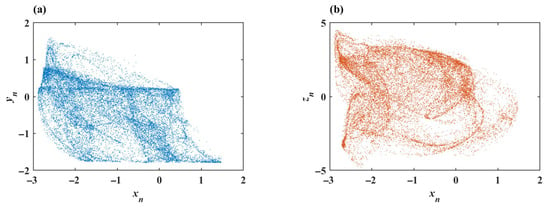
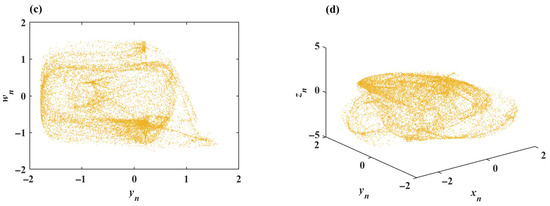
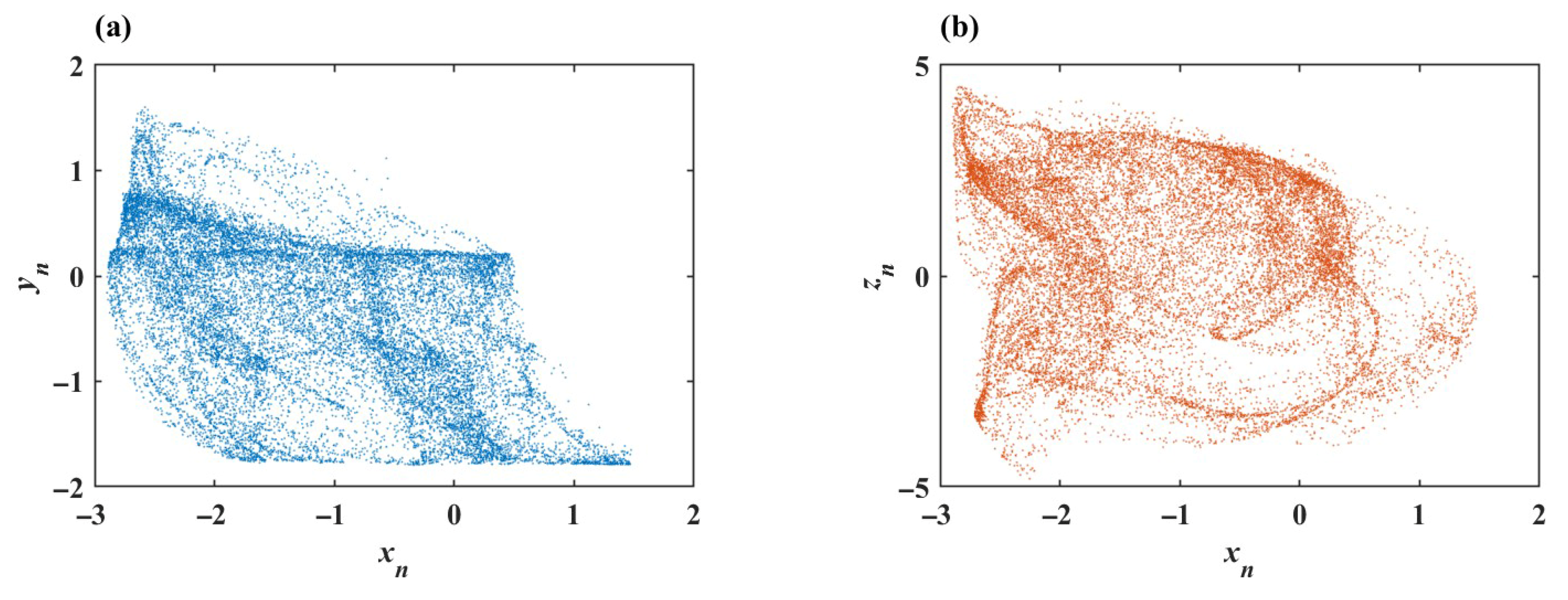
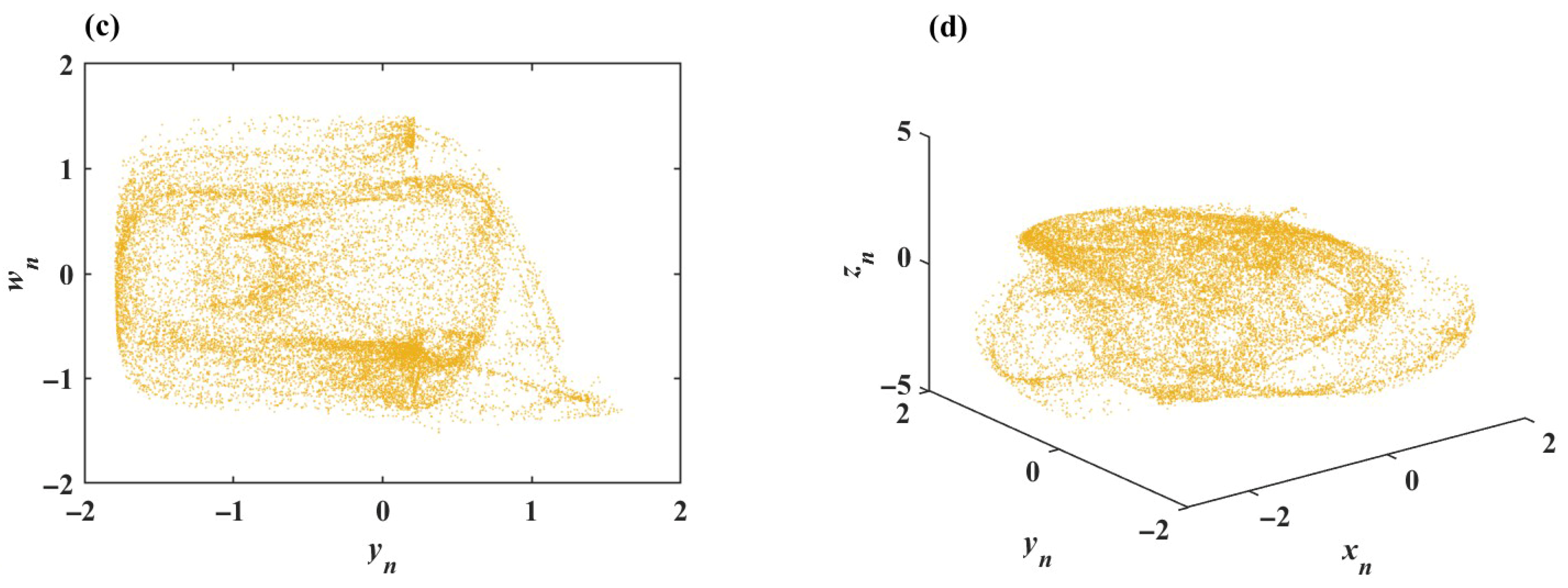
where is the hyperbolic tangent function, which can effectively control the boundedness of the system, and are the system control parameters. When the initial values of system (1) are and the parameter values are , the system exhibits chaotic behavior with complex pseudo-random properties. Its attractor phase diagrams are shown in Figure 1.
Figure 1.
System phase diagram. (a) plane. (b) plane. (c) plane. (d) space.
Figure 1 shows the chaotic attractor in two-dimensional and three-dimensional planes, indicating that the system has good ergodicity and a complex topological structure.
3.2. Influence of Parameters on the System
As parameters change, the state of the system also changes. Here, the Lyapunov exponent is introduced to judge the current state of the system. The Lyapunov exponent refers to the average rate of exponential separation or convergence of two trajectories generated by two very close parameter values. A positive Lyapunov exponent is a criterion for judging whether the system is chaotic. When the largest calculated Lyapunov exponent is greater than 0, the current system is in a chaotic state.
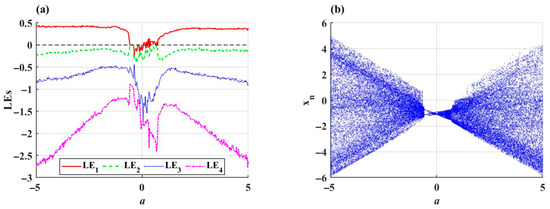
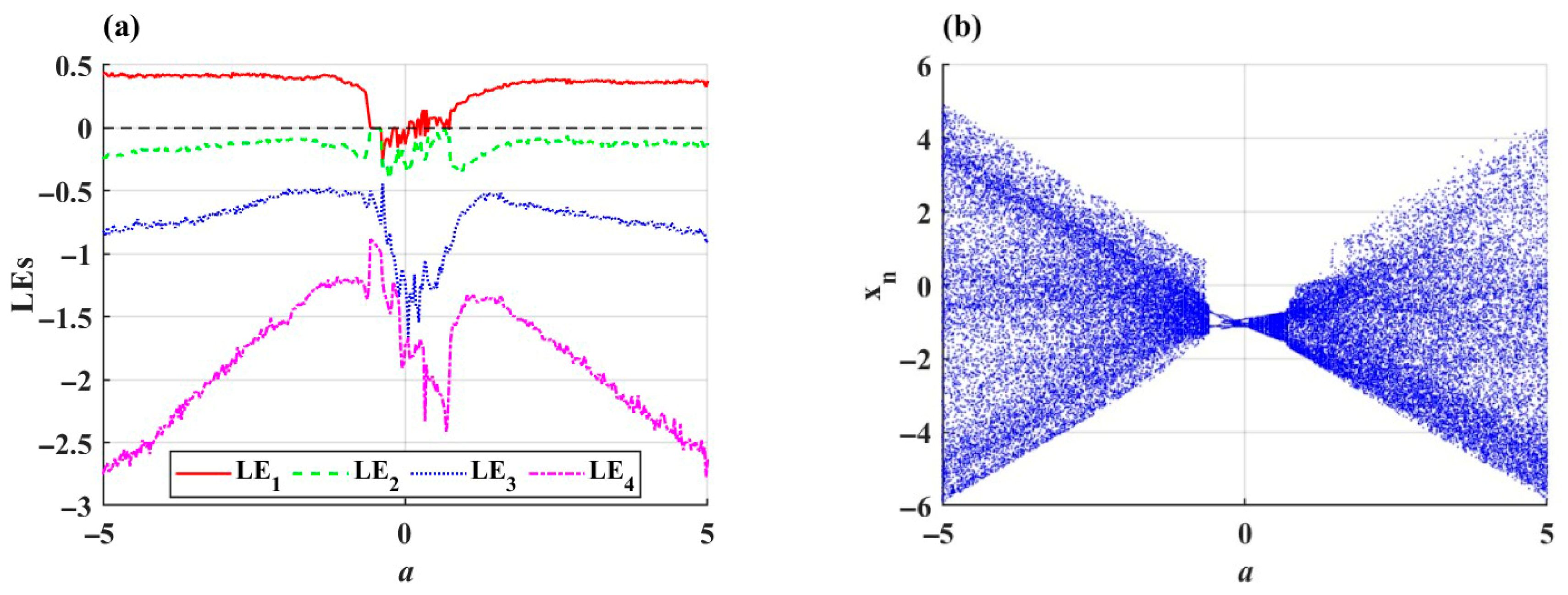
Set the initial values of the system as and parameter values as , where . Use the Wolf method to calculate the Lyapunov exponents of the system and plot the Lyapunov exponent spectrum, as shown in Figure 2a. As the parameter value changes, the system undergoes transitions from chaos → period → chaos, and exhibits a chaotic state over a large parameter range, which is less common in previous chaotic systems. This indicates that the system has strong disorder and stability, maintaining a chaotic state even when parameter values change. As shown in Figure 2b, the bifurcation diagram of system (1) is shown, corresponding to the Lyapunov exponent spectrum, indicating a large chaotic interval. Interestingly, as the parameter value increases, the bifurcation range also continuously expands, indicating that the ergodic range is also expanding as the parameter increases.
Figure 2.
The impact of parameter on the system. (a) Lyapunov exponent spectrum. (b) Bifurcation diagram.
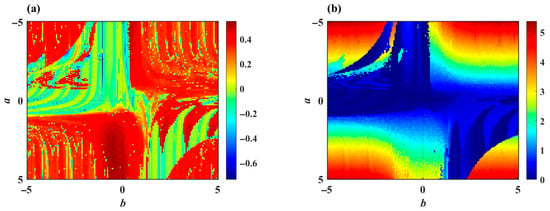
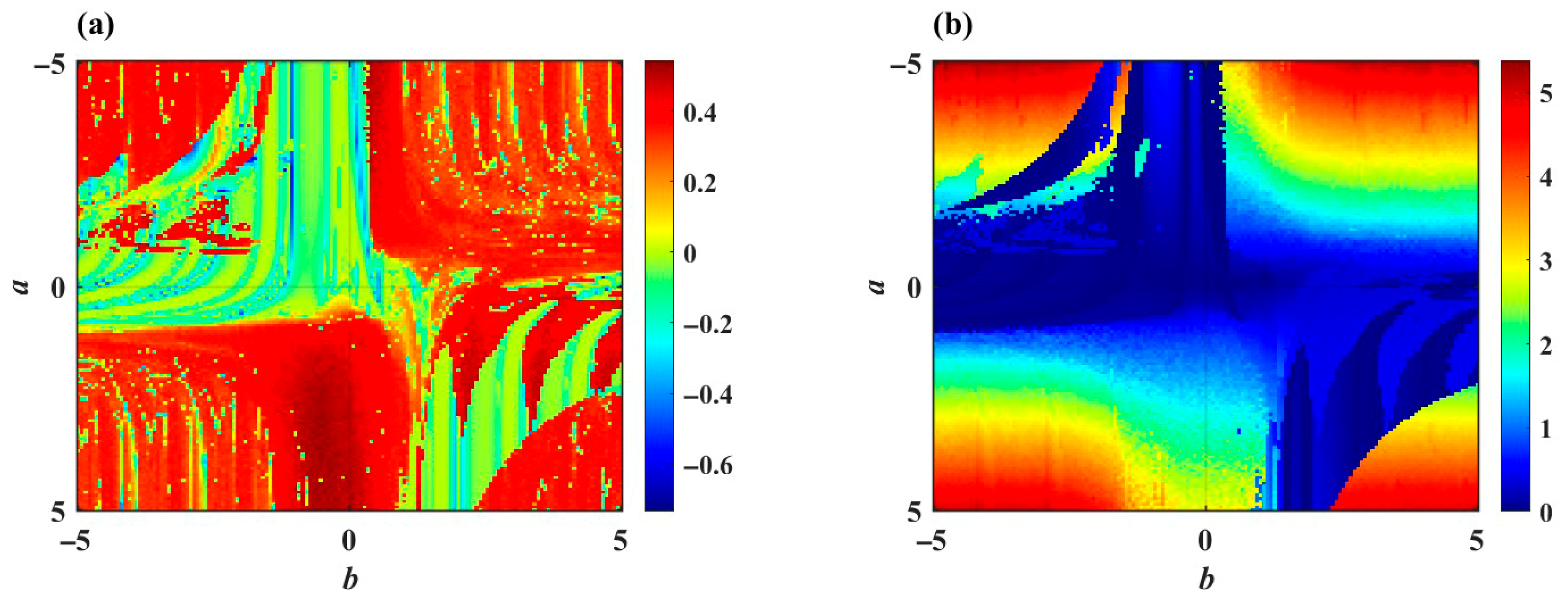
Under the influence of parameter , the system exhibits diverse dynamical characteristics. To verify the changes in the system’s dynamics under the influence of multiple parameters, keep the initial values and parameters unchanged, let , and plot the image of the maximum Lyapunov exponent change and the two-dimensional bifurcation diagram of the system, as shown in Figure 3. In Figure 3a, the deep-red area has the largest value, and the deep-blue area has the smallest value. In the plane, red and yellow areas occupy a large area, indicating a large chaotic interval for the system. Figure 3b, the two-dimensional bifurcation diagram, corresponds to Figure 3a, where different colors represent the standard deviation in different states. A larger value indicates stronger chaotic intensity. The chaotic intensity increases as parameters and increase simultaneously.
Figure 3.
Two-parameter dynamics. (a) Plot of the maximum Lyapunov exponent in two dimensions. (b) Bifurcation diagram in two dimensions.
3.3. System State Variation with Initial Values
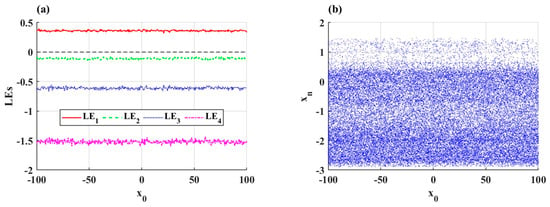
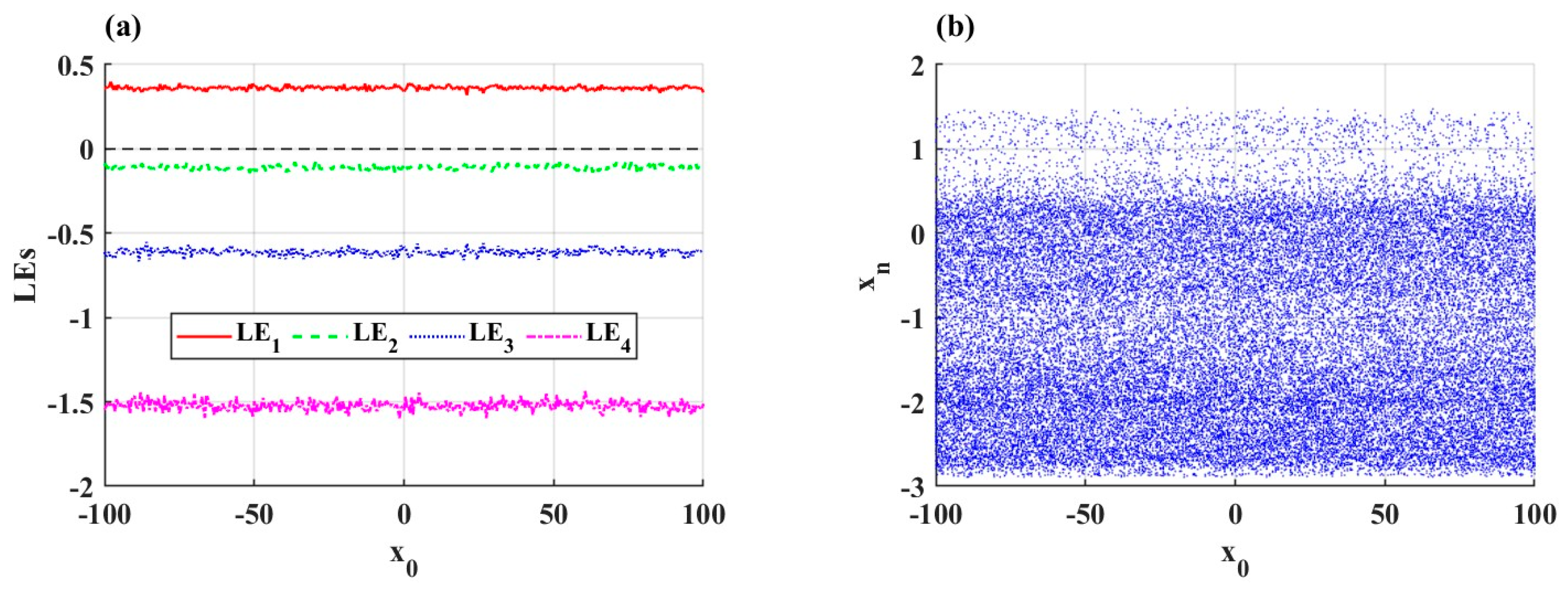
In traditional systems, chaotic behavior is greatly affected by initial values. A tiny change in the initial value may cause a drastic change in the dynamical state. If the system can maintain chaos over a wider range of initial values, it has stronger stability compared to a small interval. This paper presents a hyperchaotic system with a wide initial value range. Next, verification is carried out using Lyapunov exponent spectrum, bifurcation diagram, and basin of attraction.
Set the system initial values as and parameter values as , where . Plot the Lyapunov exponent spectrum and bifurcation diagram of system (1) as the initial value changes, as shown in Figure 4. The system remains in a chaotic state within the range , indicating a large chaotic interval. The system state does not change with the change in the initial value, indicating that this system has good chaotic properties and stability. Moreover, the bifurcation diagram is consistent with the Lyapunov exponent spectrum; the system remains chaotic throughout.
Figure 4.
The influence of initial value on the system. (a) Lyapunov exponent spectrum. (b) Bifurcation diagram.
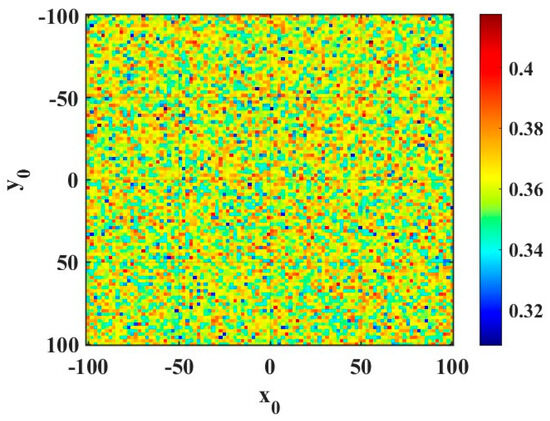
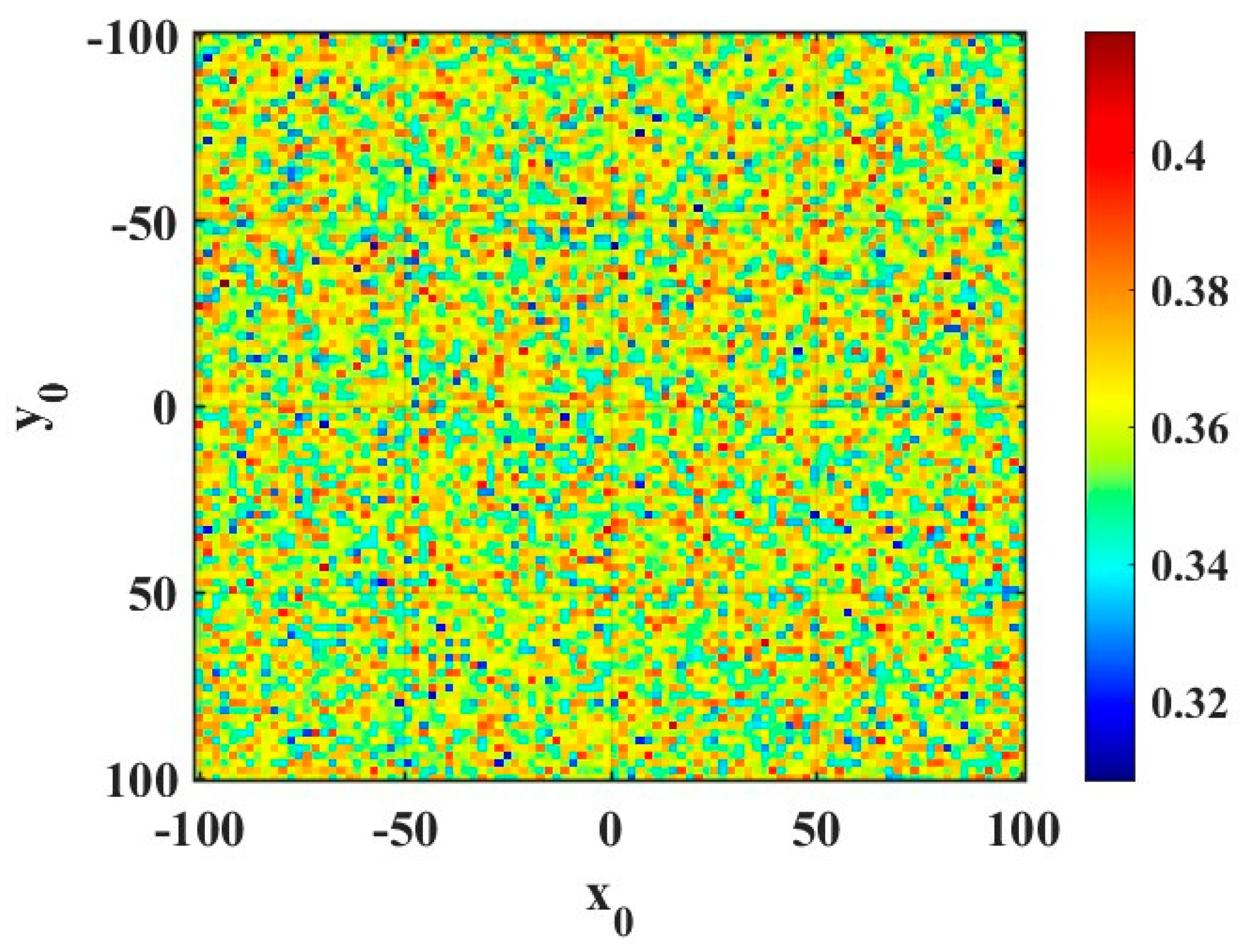
Under the influence of a single initial value, the system remains chaotic. Will it have the same property under the influence of two initial values? Next, plot the image of the maximum Lyapunov exponent as the initial values and change, as shown in Figure 5. The system is in a chaotic state over the entire plane, with a maximum value of 0.4178 and a minimum value of 0.3082. The system maintains a stable chaotic state within this interval, exhibiting strong stability, and has great application potential in the field of chaotic information security.
Figure 5.
Maximum Lyapunov exponent diagram on the plane.
3.4. Complexity Analysis
The complexity of a chaotic system describes how close the system is to a random sequence. The higher the complexity, the closer the sequence is to a random sequence, and the higher the security when applied to encryption algorithms. This paper uses the permutation entropy (PE) complexity algorithm. Its core idea is to convert a time series into a symbolic sequence of ordinal patterns and then calculate its Shannon entropy to measure the regularity or randomness of the system.
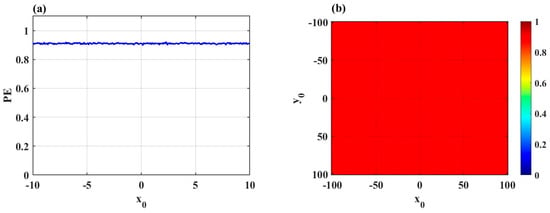
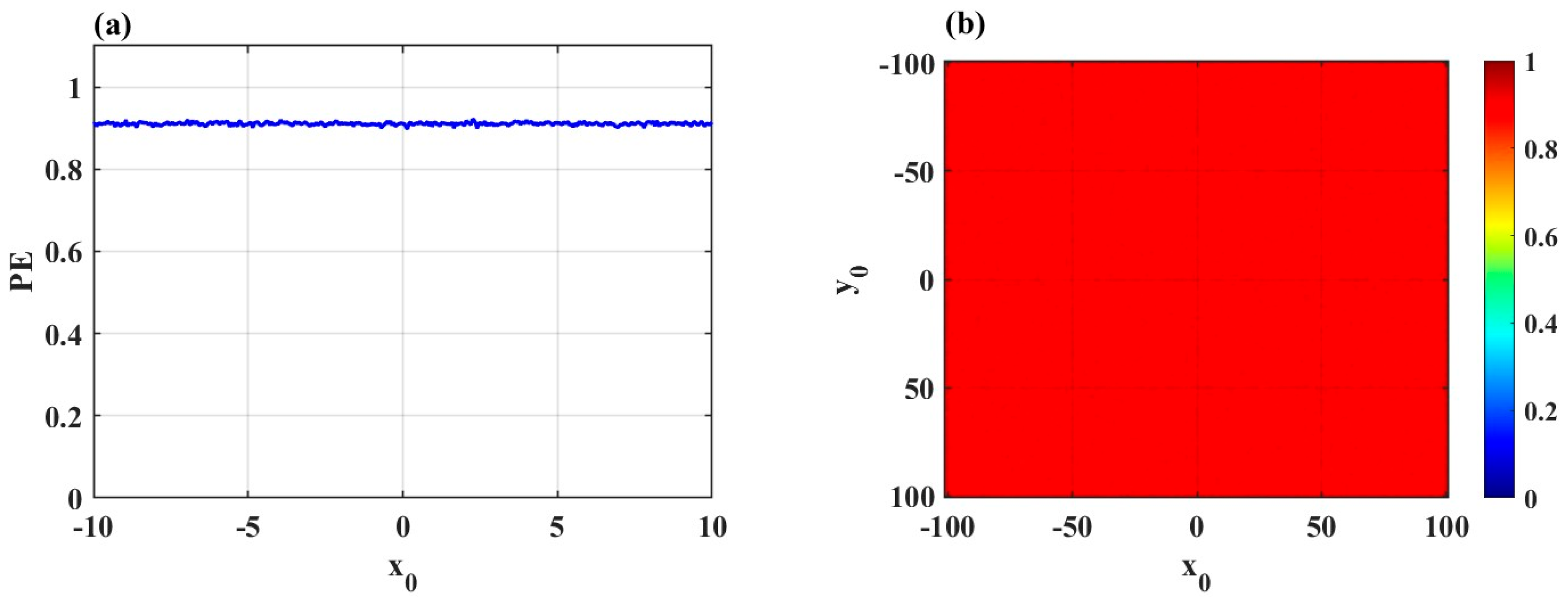
Keep the initial values and parameters consistent with the previous section, where . Plot the permutation entropy complexity image as the initial value changes, as shown in Figure 6a. The system maintains a high-complexity state throughout the entire interval, with a maximum value of 0.922 and a minimum value of 0.898. Sequences that are always highly complex are rare in previous chaotic systems. It presents high randomness and high stability, corresponding to the Lyapunov exponent spectrum.
Figure 6.
PE complexity analysis (a) Initial value . (b) Initial value plane.
Under the influence of a single initial value, the system is always in a high-complexity state. Does it have the same property under the influence of two initial values? Next, set , and plot the two-dimensional PE image as the two initial values change, as shown in Figure 6b. The entire plane is filled with deep-red areas, with a maximum value of 0.922, and a minimum value of 0.882. The system maintains a high-complexity state within the interval, showing good stability. Under the influence of two initial values, the system still maintains widespread high-complexity properties.
4. Encryption Framework Combining Graph Theory and Chaotic Systems
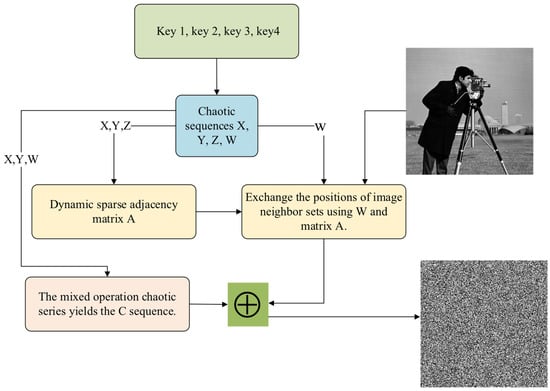
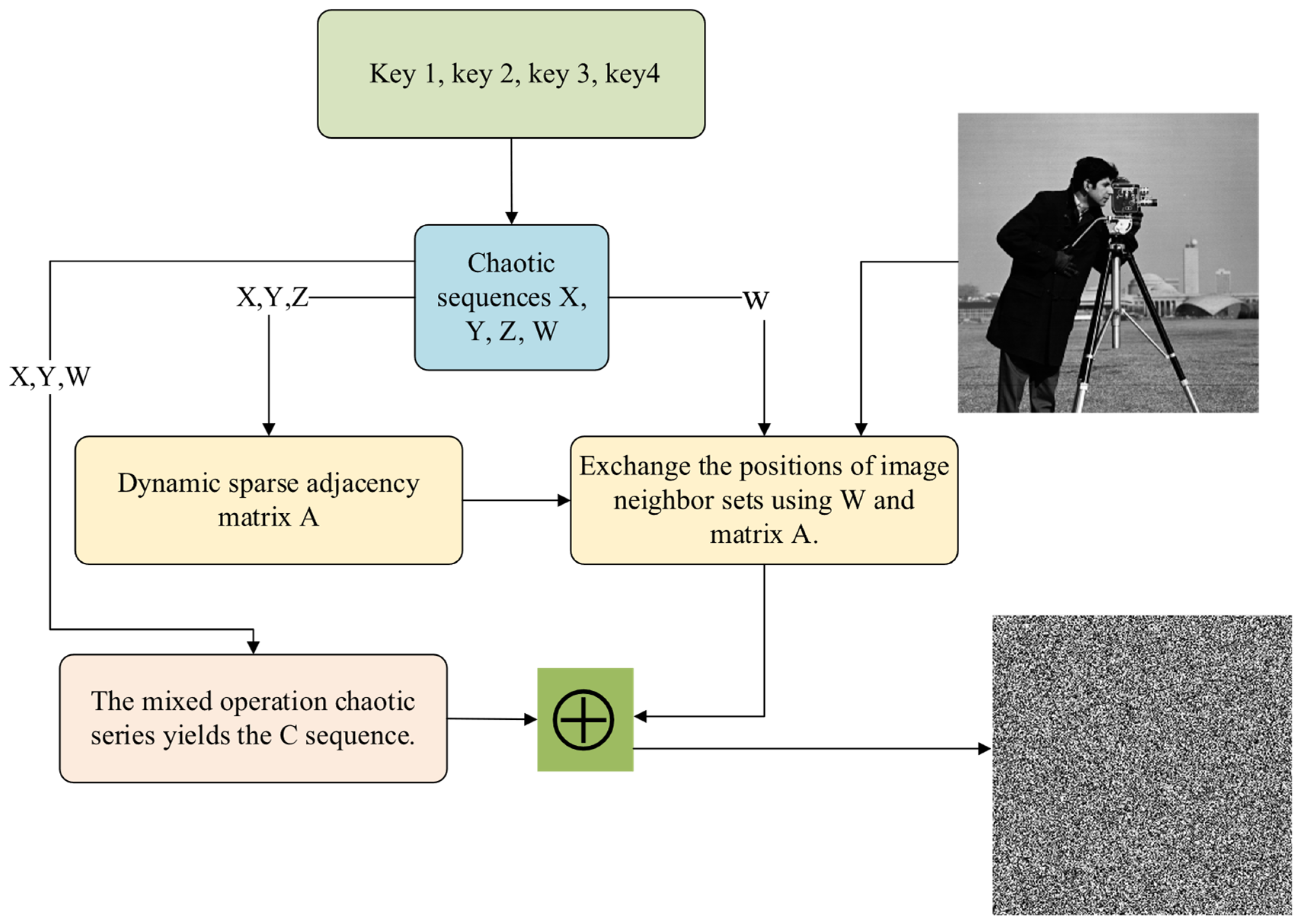
This section proposes an image encryption algorithm based on graph theory structures and a four-dimensional discrete chaotic system. The algorithm adopts a double-layer encryption architecture of “scrambling–diffusion”, innovatively introducing a dynamic graph structure to guide pixel scrambling operations and utilizing a four-dimensional chaotic system to generate high-strength random sequences. As shown in Figure 7, the encryption process includes five core steps: chaotic sequence generation, dynamic graph construction, graph-driven scrambling, feedback diffusion, and final ciphertext image generation.
Figure 7.
Encryption flowchart.
4.1. Chaotic Sequence Preprocessing
Chaotic systems are excellent sources of pseudo-random sequences in cryptography. This algorithm introduces a nonlinear improvement to the chaotic system of system (1). Its discrete iterative mathematical model is defined as follows:
where after each iteration, the state values are mapped to the (0,1) interval via the modulo 1 operation (mod(⋅, 1)), serving as normalized chaotic sequences. To avoid transient effects, the algorithm first generates a chaotic sequence of length (where is the total number of image pixels and is the average graph connectivity). The first 1500 iterated values are discarded, and the subsequent state values are retained to form four chaotic sequences , providing a random source for subsequent graph construction and diffusion.
4.2. Dynamic Graph Structure Construction
4.2.1. Graph Model Representation of Image Pixels
To combine graph theory with chaotic encryption, the core of the algorithm is to map the two-dimensional image into a one-dimensional pixel vector and then abstract it into a directed graph , where is the vertex set, each pixel corresponds to a vertex in the graph, the total number of vertices is , and E represents the edge set. The connection relationships between vertices are dynamically determined by chaotic sequences. For each vertex , (average connectivity, usually set to 4) outgoing edges are constructed, pointing to other vertices pseudo-randomly selected by the chaotic sequences.
This construction method transforms the pixel positions of the image into topological connection information of the graph, facilitating subsequent scrambling operations.
4.2.2. Dynamic Adjacency Matrix Generation
The connection relationships of the graph are represented by an sparse adjacency matrix. indicates the existence of an edge from vertex to vertex . The specific process is as follows:
Step 1: Generate repeated row vertex indices.
where means repeating each element of array times.
Step 2: Generate target column vertex indices.
where is the floor function and is the absolute value function. By mixing the chaotic sequences with the above operations, a vector colidx of length is obtained, where each element is an integer in the interval.
Step 3: Generate the dynamic sparse adjacency matrix.
where the function generates an sparse adjacency matrix from the row and column coordinates. indicates an edge from vertex to vertex . The function greatly saves memory space, allowing the computer to handle larger images.
4.3. Graph-Driven Pixel Scrambling Strategy
Step 1: Generate an initial pixel index vector representing the current pixel positions, used for scrambling.
Step 2: Use a loop to iterate through all vertices of the sparse matrix , and find the outgoing edge neighbors for each vertex , expressed as
Use the pseudo-random sequence to select a vertex from the neighbor set, and swap the values of and .
Scramble the image pixels according to the new .
where represents the original image and represents the scrambled pixel positions.
4.4. Feedback Diffusion Encryption Strategy
Use the scrambled pixel matrix to perform expansion, couple with the chaotic sequence key stream, take the modulus to generate 8-bit integer values, and finally perform XOR with the key stream generated by the chaotic sequence to obtain the encrypted image.
where
where and are integer key streams generated from chaotic sequences and is the ciphertext value of the previous pixel (or a key value dependent on the previous ciphertext), indicating that the current pixel encryption is associated with historical ciphertext. The function is the XOR operation, resulting in the final encrypted image.
In summary, the pseudo-code of the encryption algorithm, Algorithm 1, is as follows.
| Algorithm 1: Dynamic Adjacency Matrix and Chaos-Based |
| Input: I (M × N image), chaotic initial values, parameters, deg Output: C (encrypted image) Steps: 1. Chaotic Sequence Preprocessing: - Generate sequences X, Y, Z, W of length T = deg × L + 1500 (discard first 1500 points). - Iterate using system (2) and normalize to (0, 1) via modulo 1. 2. Dynamic Adjacency Matrix Construction: - Row indices: rowidx = repelem([1:L]T, deg) - Column indices: colidx = mod(floor(abs(X + Y + Z) × L), L) + 1 - Sparse matrix: A = sparse(rowidx, colidx, 1, L, L) 3. Graph-Driven Scrambling: - Initialize pixel indices: plidx = [1:L]T - For each vertex i = 1 to L: neigh = {j | A(i, j) = 1} If neigh not empty, select j = neigh[mod(floor(W[i] × |neigh|), |neigh|) + 1] Swap plidx[i] and plidx[j] - Apply scrambling: P = I(plidx) //Rearrange pixels 4. Feedback Diffusion: - Initialize: wkey_0 = floor(abs(W[1]) × 255) - For i = 1 to L: v_i = floor(abs(X[i]) × 255), wv_i = floor(abs(Y[i]) × 255) wkey_i = wkey_0 (if i = 1) or C[i − 1] (if i > 1) temp = mod((P[i] × 255) + v_i + wkey_i, 256) C[i] = bitxor(uint8(temp), wv_i) - Reshape: C = reshape(C, M, N) Return C |
4.5. Decryption Algorithm
Step 1: Inverse feedback diffusion. Proceed in the reverse order of encryption, applying the inverse diffusion equation as
Step 2: Inverse scrambling. According to the obtained during the scrambling process, calculate its inverse mapping, and use the inverse mapping to restore the pixels to their original spatial positions.
Step 3: Image reconstruction. Use the function to reshape the vector into an two-dimensional matrix, obtaining the decrypted image.
5. Experimental Simulation and Security Analysis
The algorithm was implemented in the MATLAB 2023a environment. To evaluate its security properties, tests and analyses were conducted across NIST test, key sensitivity, key space, statistical characteristics, resistance to differential attacks, and resistance to shear attacks.
5.1. NIST Test
The NIST-SP800 test, developed by the National Institute of Standards and Technology’s Information Technology Laboratory, can be used to evaluate whether sequences generated by a system are suitable for pseudo-random sequence generators. This test effectively verifies whether a chaotic system can efficiently produce key streams with pseudo-random characteristics.
To ensure statistical accuracy in the testing, the data generated during the preprocessing of the chaotic sequence was divided into 100 groups, each containing 106 bits, and subjected to 15 test items. As shown in the table, the p-values from these 15 tests are all greater than the significance level . Since the data was divided into 100 groups for testing, the confidence interval for the pass rate is calculated using the formula , where , , and , resulting in a confidence interval of [0.9602, 1.0198]. The pass rates in Table 1 all fall within this confidence interval, meeting the requirements of the NIST test. In summary, the chaotic sequences generated by the constructed system satisfy the conditions of the NIST test, exhibit strong pseudo-randomness, and can be used as a pseudo-random sequence generator.
Table 1.
NIST test results.
5.2. Experimental Simulation
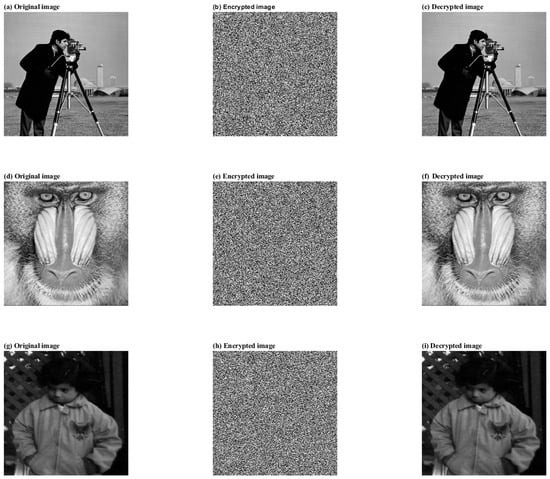
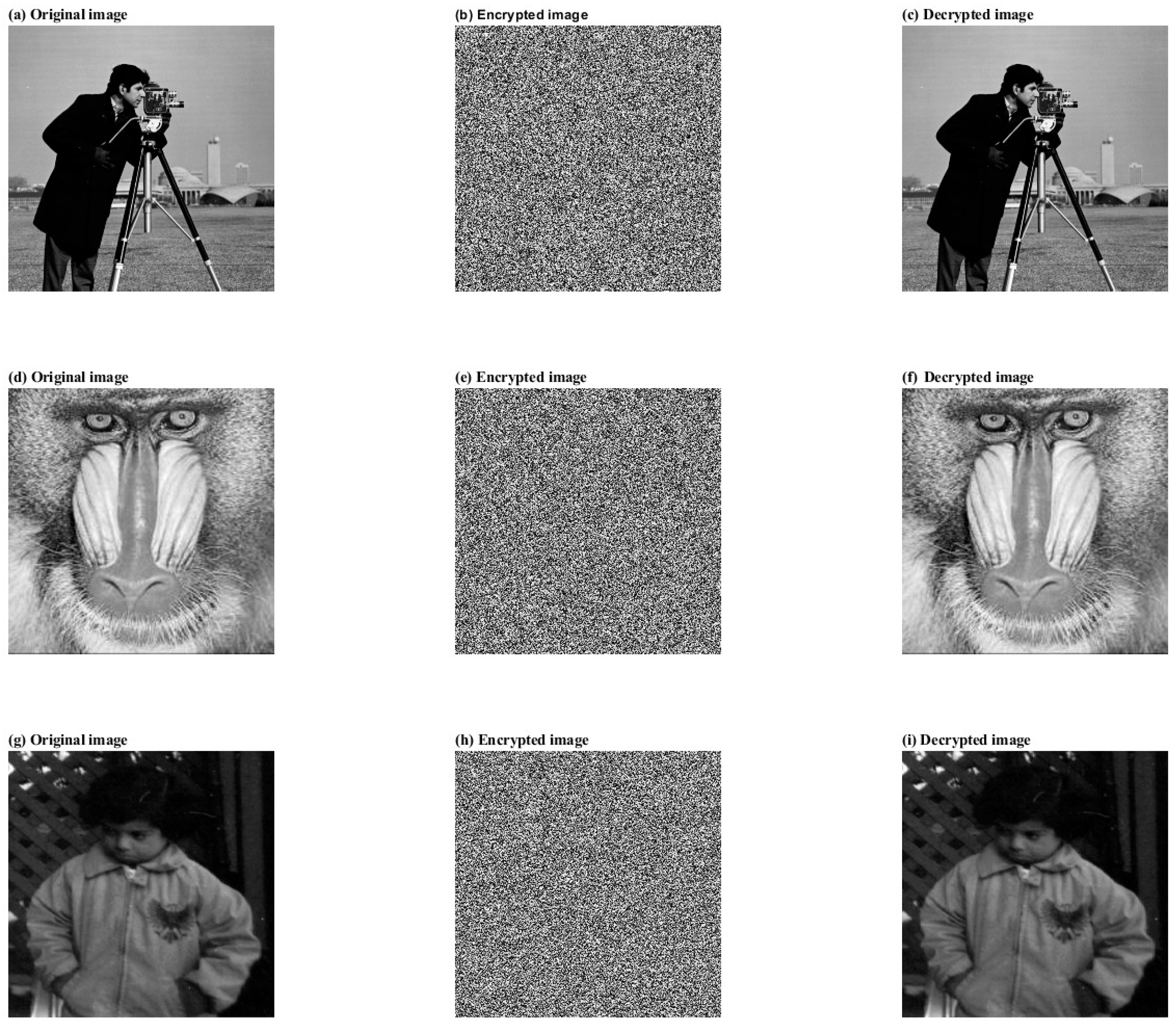
To verify the effectiveness of the algorithm, encryption and decryption are performed on three grayscale images to verify the effectiveness of the encryption and lossless decryption. Select the initial values of the chaotic system as and parameter values as . The encryption and decryption results for three different images are shown in Figure 8.
Figure 8.
Encryption and decryption effects of three images.
From Figure 8, it can be seen that after encryption, the algorithm can effectively conceal the basic information of the original image, resulting in an encrypted image with no discernible information. The images obtained after decryption are consistent with the original images, indicating that the encryption process is reversible and lossless.
5.3. Key Sensitivity Analysis
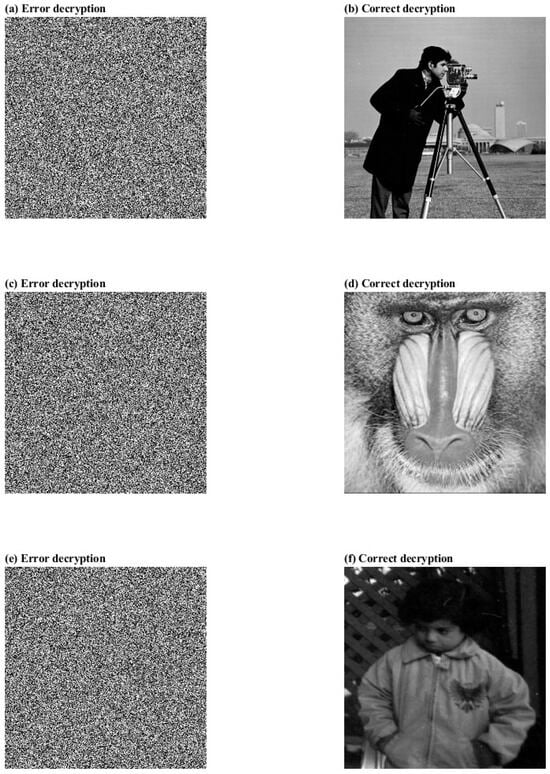
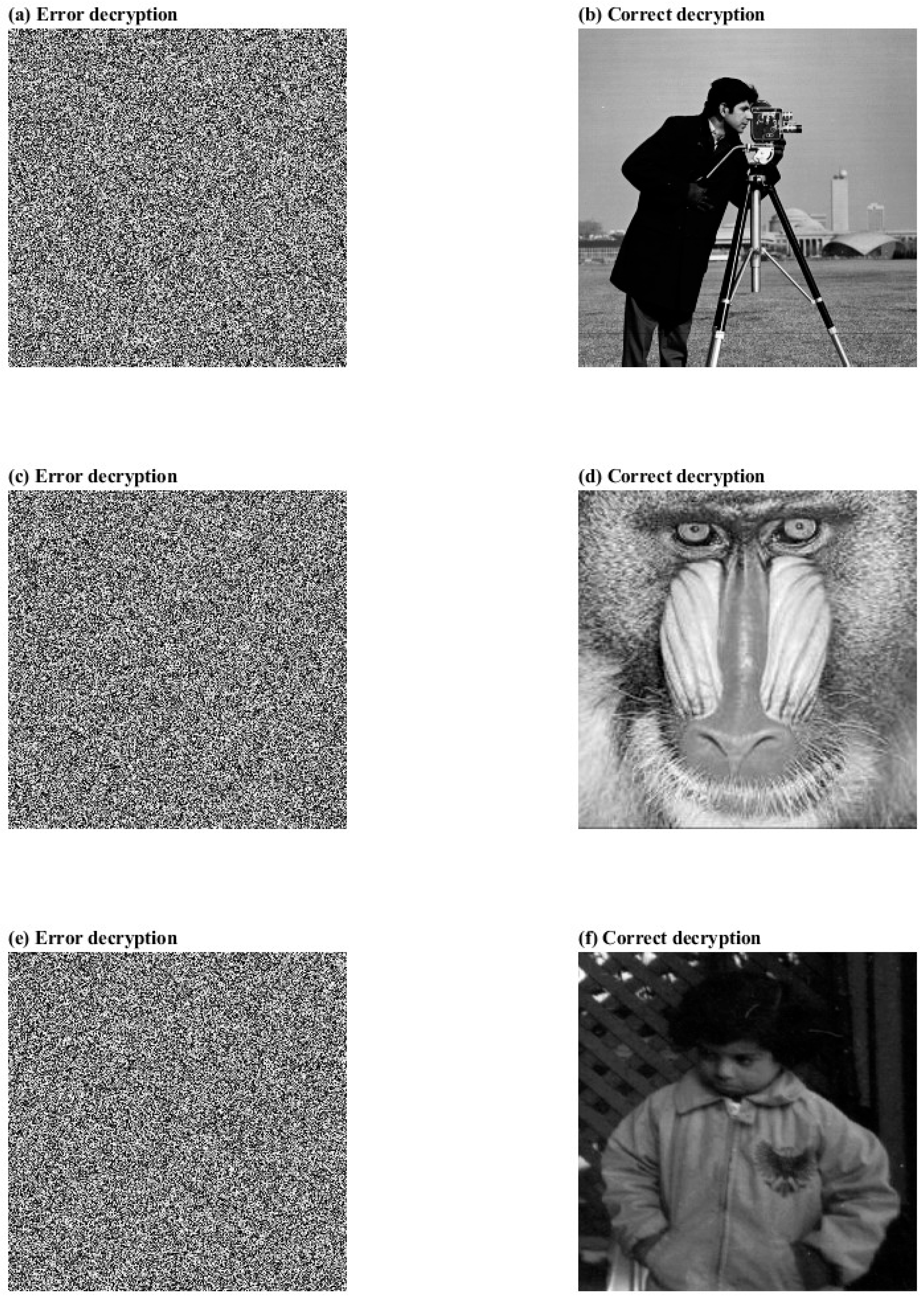
In image encryption, key sensitivity is an important indicator for evaluating the security of an encryption algorithm. If a tiny change in the key leads to decryption failure, it can effectively resist attacks. Taking the three encrypted images as examples, the initial key of the encryption algorithm was increased by . The experimental results of decryption with the wrong initial key and the correct initial key are shown in Figure 9, where the left image is the image decrypted with the wrong key and the right image is the image decrypted with the correct key.
Figure 9.
The impact of key changes on decryption.
After a minute change in the initial value, the decrypted image shows no features of the original image and is completely different from the image decrypted with the correct key. This indicates that the algorithm is highly sensitive to the key and can effectively resist brute-force attacks.
5.4. Key Space Analysis
The size of the key space is a crucial metric for measuring an encryption scheme’s resistance to brute-force attacks. This scheme combines graph theory parameters and the initial conditions of the chaotic system. The key consists of the initial conditions and system parameters of the four-dimensional chaotic system. Assuming each parameter uses double-precision floating-point numbers (with approximately precision), the key space can reach , far exceeding that of traditional encryption algorithms. This enables effective resistance against brute-force attacks. Even considering computational precision limitations, the actual effective key space is sufficient to ensure security.
5.5. Statistical Analysis
5.5.1. Histogram Analysis
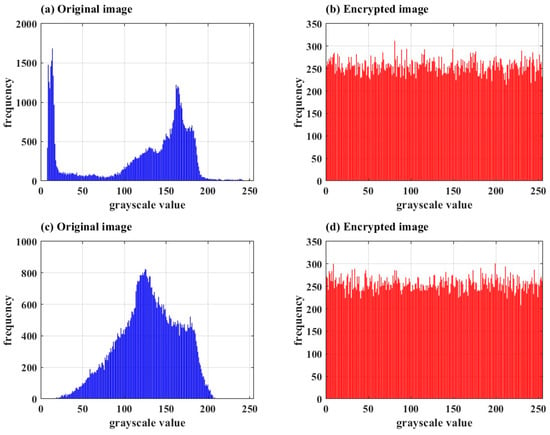
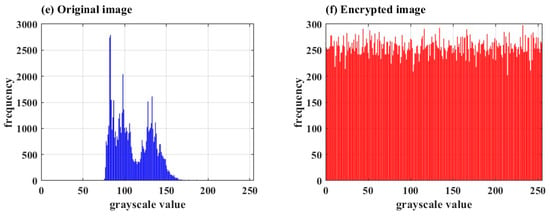
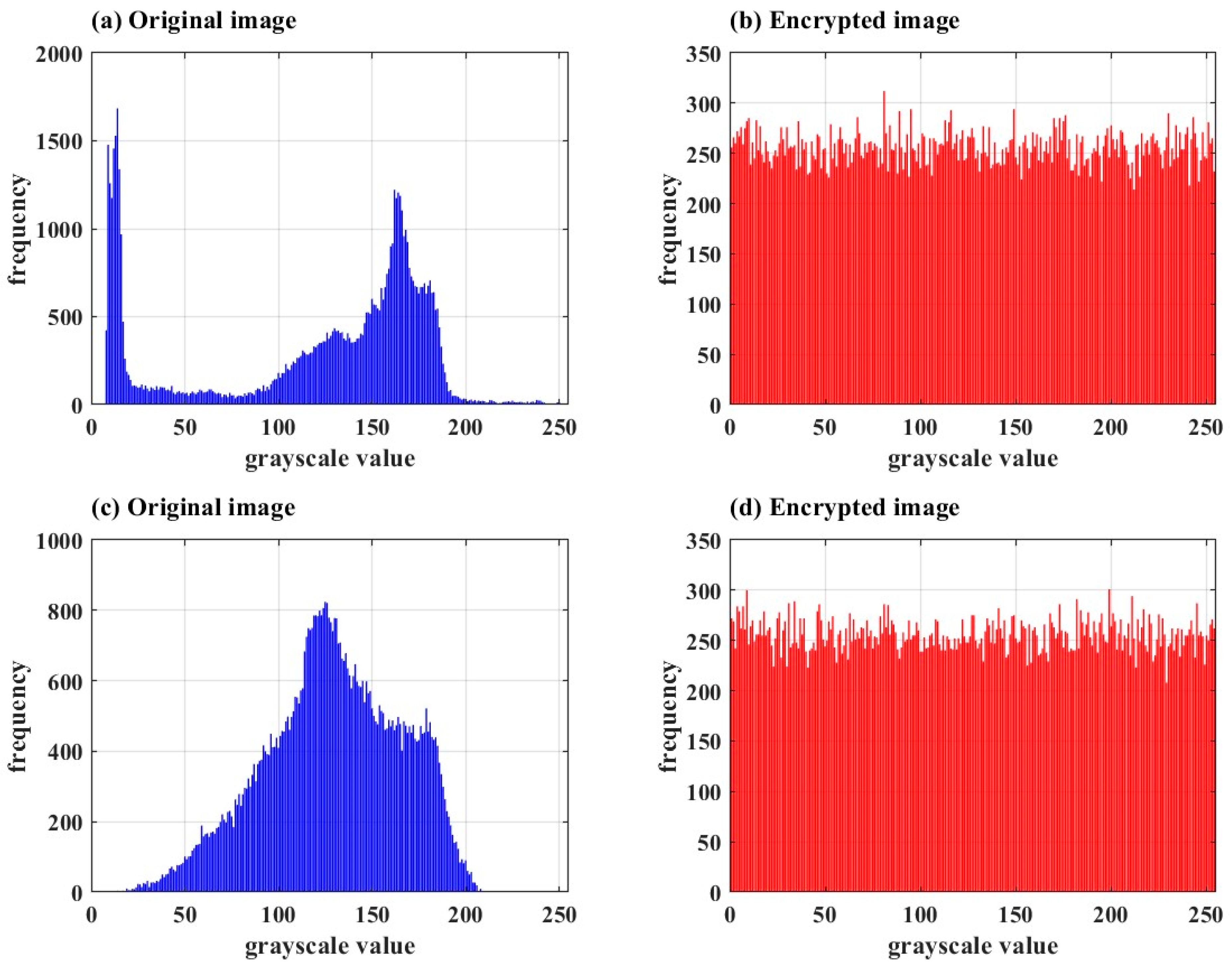
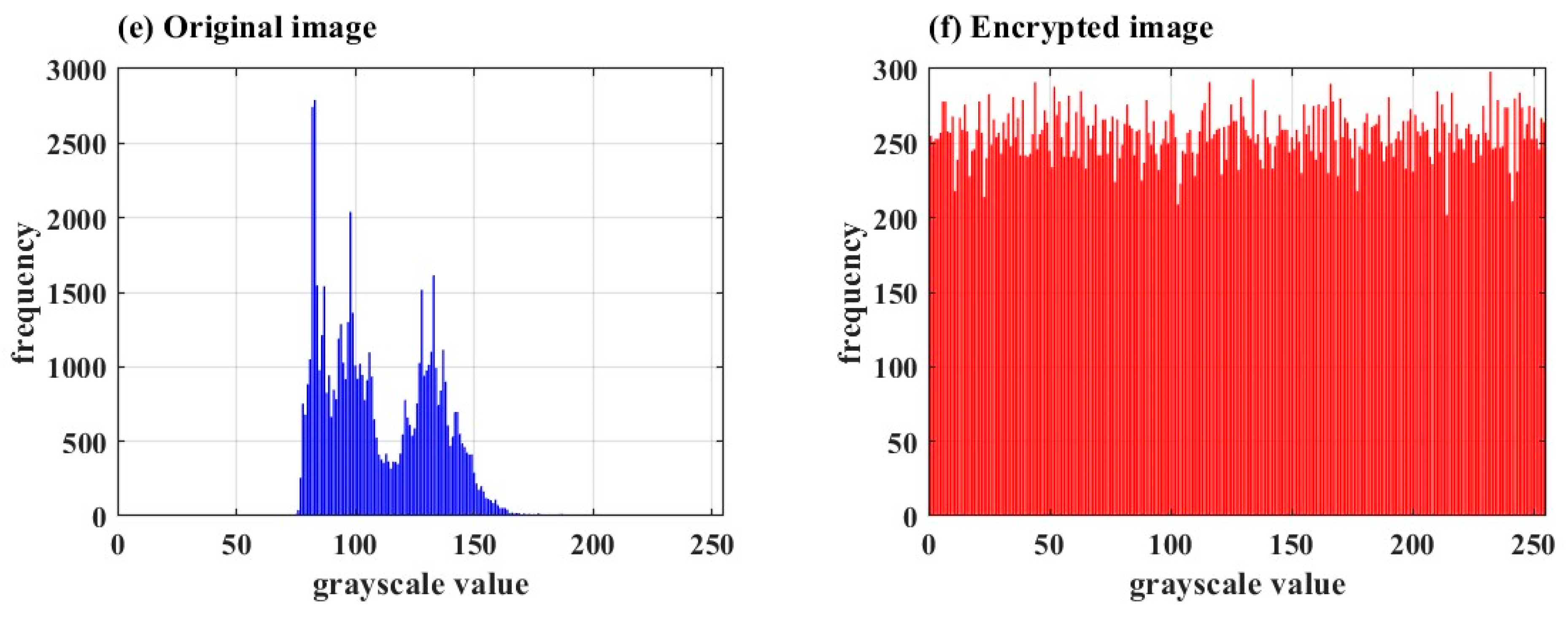
A histogram reflects the statistical distribution characteristics of the original and encrypted images. The histograms of the original and encrypted images for the three test images are plotted, as shown in Figure 10. Among them, Figure 10a,c,e are the plaintext images, whose pixel distributions exhibit certain statistical features. Figure 10b,d,f are the histograms of the encrypted images. The histograms of the encrypted images are uniformly distributed, making it impossible to extract any statistical features from them. This effectively encrypts the statistical characteristics of the original image, providing good resistance against statistical analysis attacks.
Figure 10.
Histogram analysis of three images before and after encryption.
5.5.2. Adjacent-Pixel Correlation Analysis
Adjacent pixels in a plaintext image usually have high correlation, with a coefficient close to 1. Image encryption needs to eliminate this correlation to resist statistical attacks effectively. In this paper, the correlation coefficients of three images are calculated in horizontal, vertical, and diagonal directions, as shown in Table 2.
Table 2.
Correlation coefficients before and after encryption.
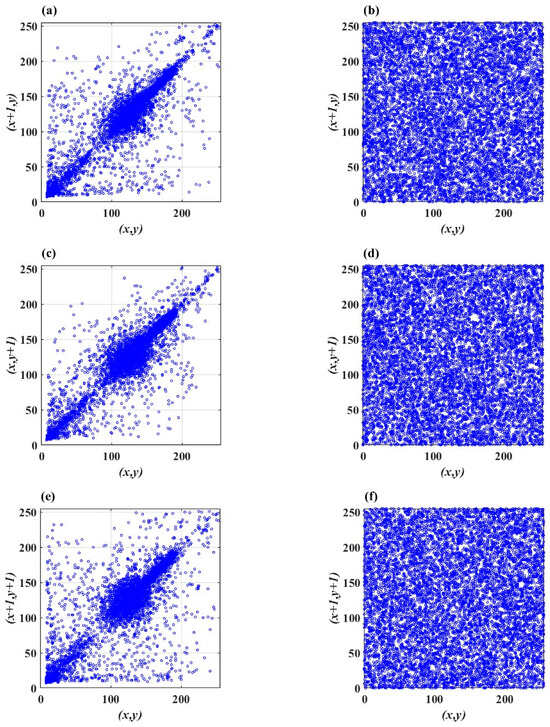
In Table 2, the correlation coefficient of the plaintext image is close to 1, indicating a strong correlation, while the correlation coefficient of the ciphertext image is close to 0. This demonstrates that the encryption scheme effectively reduces the correlation between the original image and its encrypted version. Compared with other references, the proposed scheme exhibits weaker correlation. For convenience, the “cameraman” image was selected, and scatter plots of adjacent pixels in the horizontal, vertical, and diagonal directions were generated, as shown in Figure 11. The correlation coefficients of the original image in different directions are close to 1, indicating a high correlation. After encryption, the correlation distribution of the ciphertext image becomes uniform, showing almost no correlation. This indicates that the method effectively reduces the correlation between adjacent samples, achieving a satisfactory encryption effect and demonstrating strong security.
Figure 11.
Correlation analysis. (a,b) Horizontal direction. (c,d) Vertical direction. (e,f) Diagonal direction.
5.6. Information Entropy Analysis
Information entropy is a quantitative measure of information content. An entropy value closer to 8 indicates less information content in the image and stronger randomness [30]. This paper calculates the information entropy of the three images before and after encryption, as shown in Table 3. The information entropy of the encrypted images reaches a high level. Compared with other literature, the entropy values are higher, indicating better encryption performance.
Table 3.
Information entropy.
5.7. Analysis of Resistance to Differential Attack
An attacker may use different plaintext images where the value of a specific pixel is altered, encrypt them with the same algorithm, and attempt to deduce the encryption algorithm by analyzing the relationships and differences between the resulting ciphertext images. If a change in a plaintext pixel leads to significant changes in the ciphertext image, the algorithm can resist differential attacks well. NPCR (Number of Pixels Change Rate) and UACI (Unified Average Changing Intensity) measure the resistance of the ciphertext image to differential attacks. The calculation formulas are as follows [31]:
where and are the pixel values at the -th row and -th column of the ciphertext images obtained by encrypting the original plaintext image and the plaintext image with one modified pixel value, respectively, using the same encryption algorithm. The calculated NPCR and UACI values after encryption are shown in the table below. Ideally, the theoretical values for NPCR and UACI are close to 100% and 33.3333% respectively for a 256-graylevel image [32]. Table 4 shows that altering a single pixel value causes most pixel values in the encrypted image to change. Compared with other literature, this algorithm achieves high NPCR and UACI values, proving its high sensitivity to plaintext changes and good resistance to differential attacks.
Table 4.
NPCR values and UACI values.
5.8. Resistance to Cropping Attack Analysis
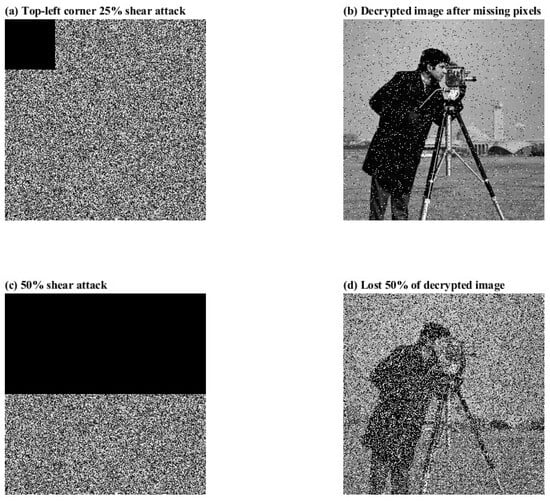
During image transmission, data is susceptible to cropping attacks, which can lead to data loss. In our approach, we intentionally discard portions of the ciphertext image and then attempt to decrypt the incomplete ciphertext. For convenience, we used the “cameraman” image and removed two different sets of ciphertext data: the top-left 25% of the data and the entire top half of the ciphertext data. Figure 12 shows the decrypted images. From the figure, it can be observed that when a small amount of data is lost, the decrypted image can still largely restore the original image. Quantitative comparisons were performed: when 25% of the data from the top-left corner is lost, the PSNR is 19.89 and the SSIM is 0.4510. When a larger amount of data is lost (e.g., the top half), the PSNR drops to 11.01 and the SSIM to 0.0836. However, the general content of the image remains discernible to the naked eye. This demonstrates that the proposed algorithm possesses a strong resistance to cropping attacks.
Figure 12.
Cameraman image decryption effect with partial data loss.
6. Conclusions
This paper presents an image encryption scheme that combines a generated pseudo-random chaotic sequence with a graph structure transformation mechanism. The designed four-dimensional discrete chaotic system demonstrates strong ergodicity and parameter robustness, providing a reliable key stream for encryption. In the encryption architecture, a dynamic graph model enables complex pixel scrambling, while a feedback-based diffusion mechanism further disrupts statistical patterns. Experimental results indicate that the algorithm exhibits high key sensitivity and a sufficiently large key space to resist brute-force attacks. It effectively flattens the histogram distribution, significantly reduces pixel correlation, and achieves information entropy close to that of an ideal. In terms of attack resistance, the algorithm shows a notable diffusion effect even with minor plaintext modifications and can recover recognizable images under partial data loss. Overall, this work offers a novel and secure solution for image encryption, with both theoretical relevance and application potential.
Author Contributions
Conceptualization, H.C.; Resources, Z.Z.; Data curation, G.L.; Writing—review & editing, H.C., W.X., Z.Z. and G.L.; Funding acquisition, H.C. All authors have read and agreed to the published version of the manuscript.
Funding
This work was supported by the Natural Foundation of Xinjiang Uygur Autonomous Region Grant No. 2022D01C02, the Guangxi Center for Applied Mathematics (Grant No. Guike: AD25069086), and the Construction Project of the Key Laboratory Platform for Applied Mathematics at Changji University (Changji University Document [2024] No. 46).
Data Availability Statement
The image data used in this article are all sourced from the built-in image data of MATLAB 2023a software. The file names of the image data are cameraman.tif, mandrill.jpg, and pout.tif.
Conflicts of Interest
The authors declare no conflicts of interest.
References
- Zhu, S.; Deng, X.; Zhang, W.; Zhu, C. Image encryption scheme based on newly designed chaotic map and parallel DNA coding. Mathematics 2023, 11, 231. [Google Scholar] [CrossRef] [Scilit]
- Pandey, K.; Sharma, D. Novel image encryption algorithm utilizing hybrid chaotic maps and Elliptic Curve Cryptography with genetic algorithm. J. Inf. Secur. Appl. 2025, 89, 103995. [Google Scholar] [CrossRef] [Scilit]
- Chai, X.; Zheng, X.; Gan, Z.; Han, D.; Chen, Y. An image encryption algorithm based on chaotic system and compressive sensing. Signal Process. 2018, 148, 124–144. [Google Scholar] [CrossRef] [Scilit]
- Wang, S.C.; Wang, C.H.; Xu, C. An image encryption algorithm based on a hidden attractor chaos system and the Knuth–Durstenfeld algorithm. Opt. Lasers Eng. 2020, 128, 105995. [Google Scholar] [CrossRef] [Scilit]
- Hameed, B.A.; Gbashi, E.K. A review of Chaotic Maps used for Generating Secure Random Keys. BIO Web Conf. 2024, 97, 00070. [Google Scholar] [CrossRef] [Scilit]
- Özpolat, E.; Çelik, V.; Gülten, A. Hyperchaotic System-Based PRNG and S-Box Design for a Novel Secure Image Encryption. Entropy 2025, 27, 299. [Google Scholar] [CrossRef] [Scilit] [PubMed]
- Tang, C.; Tu, X.; Lu, X.; Zhang, Q.; Zhang, X. Improved AES image encryption algorithm based on Four-dimensional chaotic system. Syst. Eng. Electron. 2023, 4040–4051. [Google Scholar]
- Tutueva, A.V.; Karimov, A.I.; Moysis, L.; Volos, C.; Butusov, D.N. Construction of one-way hash functions with increased key space using adaptive chaotic maps. Chaos Solitons Fractals 2020, 141, 110344. [Google Scholar]
- Fridrich, J. Symmetric ciphers based on two-dimensional chaotic maps. Int. J. Bifurc. Chaos 1998, 8, 1259–1284. [Google Scholar] [CrossRef] [Scilit]
- Chen, G.; Mao, Y.; Chui, C.K. A symmetric image encryption scheme based on 3D chaotic cat maps. Chaos Solitons Fractals 2004, 21, 749–761. [Google Scholar] [CrossRef] [Scilit]
- Liu, L.; Zhang, Q.; Wei, X. A RGB image encryption algorithm based on DNA encoding and chaos map. Comput. Electr. Eng. 2012, 38, 1240–1248. [Google Scholar] [CrossRef] [Scilit]
- Chai, X.; Fu, X.; Gan, Z.; Lu, Y.; Chen, Y. A color image cryptosystem based on dynamic DNA encryption and chaos. Signal Process. 2019, 155, 44–62. [Google Scholar] [CrossRef] [Scilit]
- Zhang, Y.; Tang, Y. A plaintext-related image encryption algorithm based on chaos. Multimed. Tools Appl. 2018, 77, 6647–6669. [Google Scholar] [CrossRef] [Scilit]
- Stinson, D.R. Cryptography: Theory and Practice; Chapman and Hall/CRC: Boca Raton, FL, USA, 2005. [Google Scholar]
- Akdim, M.; Drissi, A. A comprehensive review of graph theory applications in secret sharing schemes. J. Comb. Math. Comb. Comput. 2024, 123, 61–73. [Google Scholar] [CrossRef] [Scilit]
- Cormen, T.H.; Leiserson, C.E.; Rivest, R.L.; Stein, C. Introduction to Algorithms; MIT Press: Cambridge, MA, USA, 2022. [Google Scholar]
- Karypis, G.; Kumar, V. A fast and high quality multilevel scheme for partitioning irregular graphs. SIAM J. Sci. Comput. 1998, 20, 359–392. [Google Scholar] [CrossRef] [Scilit]
- Diaconis, P.; Graham, R.L. Spearman’s footrule as a measure of disarray. J. R. Stat. Soc. Ser. B Stat. Methodol. 1977, 39, 262–268. [Google Scholar] [CrossRef] [Scilit]
- Babai, L. Graph isomorphism in quasipolynomial time. In Proceedings of the Forty-Eighth Annual ACM Symposium on Theory of Computing, Cambridge, MA, USA, 19–21 June 2016; pp. 684–697. [Google Scholar]
- Liu, H.; Wang, X. Color image encryption based on one-time keys and robust chaotic maps. Comput. Math. Appl. 2010, 59, 3320–3327. [Google Scholar] [CrossRef] [Scilit]
- Vs, V.; Muni, S.S.; Panda, A.K.; Mondal, B. Degn–Harrison map: Dynamical and network behaviours with applications in image encryption. Chaos Solitons Fractals 2025, 192, 115987. [Google Scholar] [CrossRef] [Scilit]
- Wang, W.; Tan, H.; Sun, P.; Pang, Y.; Ren, B. A novel digital image encryption algorithm based on wavelet transform and multi-chaos. In Wireless Communication and Sensor Network, Proceedings of the International Conference on Wireless Communication and Sensor Network (WCSN 2015), Taipei, Taiwan, 12 December 2015; World Scientific Publishing Co.: Singapore, 2016; pp. 711–719. [Google Scholar]
- Alvarez, G.; Li, S. Some basic cryptographic requirements for chaos-based cryptosystems. Int. J. Bifurc. Chaos 2006, 16, 2129–2151. [Google Scholar] [CrossRef] [Scilit]
- Pareek, N.K.; Patidar, V.; Sud, K.K. Diffusion–substitution based gray image encryption scheme. Digit. Signal Process. 2013, 23, 894–901. [Google Scholar] [CrossRef] [Scilit]
- McKay, B.D.; Piperno, A. Practical graph isomorphism, II. J. Symb. Comput. 2014, 60, 94–112. [Google Scholar] [CrossRef] [Scilit]
- Ullah, A.; Jamal, S.S.; Shah, T. A novel construction of substitution box using a combination of chaotic maps with improved chaotic range. Nonlinear Dyn. 2017, 88, 2757–2769. [Google Scholar] [CrossRef] [Scilit]
- Khan, J.S.; Ahmad, J. Chaos based efficient selective image encryption. Multidimens. Syst. Signal Process. 2019, 30, 943–961. [Google Scholar] [CrossRef] [Scilit]
- Zhou, S.; Zhang, H.; Zhang, Y.; Zhang, H. Novel hyperchaotic image encryption method using machine learning-RBF. Nonlinear Dyn. 2024, 112, 18527–18550. [Google Scholar] [CrossRef] [Scilit]
- Chai, X.; Fu, J.; Gan, Z.; Lu, Y.; Zhang, Y.; Han, D. Exploiting semi-tensor product compressed sensing and hybrid cloud for secure medical image transmission. IEEE Internet Things J. 2022, 10, 7380–7392. [Google Scholar] [CrossRef] [Scilit]
- Khan, J.; Ahmad, J.; Hwang, S.O. An efficient image encryption scheme based on: Henon map, skew tent map and S-Box. In Proceedings of the 2015 6th International Conference on Modeling, Simulation, and Applied Optimization (ICMSAO), Istanbul, Turkey, 27–29 May 2015; pp. 1–6. [Google Scholar]
- Wei, C.; Li, G. Encryption Algorithm of Video Image Encryption Algorithm Combining Hyperchaotic System and Logistic Mapping. Comput. Eng. 2022, 48, 263–271. [Google Scholar]
- Farsana, F.J.; Devi, V.R.; Gopakumar, K. An audio encryption scheme based on Fast Walsh Hadamard Transform and mixed chaotic keystreams. Appl. Comput. Inform. 2023, 19, 239–264. [Google Scholar] [CrossRef] [Scilit]

Disclaimer/Publisher’s Note: The statements, opinions and data contained in all publications are solely those of the individual author(s) and contributor(s) and not of MDPI and/or the editor(s). MDPI and/or the editor(s) disclaim responsibility for any injury to people or property resulting from any ideas, methods, instructions or products referred to in the content. |
© 2026 by the authors. Licensee MDPI, Basel, Switzerland. This article is an open access article distributed under the terms and conditions of the Creative Commons Attribution (CC BY) license.