Article

Inverse Operator over Index Matrices

by
Veselina Bureva
1,*,†,
Krassimir Atanassov
2,*,†,
Vassia Atanassova
2,† and
Ivo Umlenski
2,†
1
Department of Computer Systems and Technologies, Burgas State University “Prof. Dr Assen Zlatarov”, 1 Professor Y. Yakimov Blvd., 8010 Burgas, Bulgaria
2
BioInformatics and Mathematical Modelling Department, Institute of Biophysics and Biomedical Engineering, Bulgarian Academy of Sciences, Acad. G. Bonchev Str., Block 105, 1113 Sofia, Bulgaria
*
Authors to whom correspondence should be addressed.
All authors contributed equally to this work.
Mathematics 2026, 14(4), 615; https://doi.org/10.3390/math14040615
Submission received: 12 January 2026 / Revised: 4 February 2026 / Accepted: 5 February 2026 / Published: 10 February 2026
(This article belongs to the Special Issue Advanced Intelligent Algorithms for Decision Making Under Uncertainty)

Abstract

Index matrices are an extension of the ordinary matrices with explicitly assigned index sets on both their rows and columns, forming an advanced mathematical structure used for specialized data modeling and problem-solving. In the present paper, a new operator, called “Inverse” operator, is defined over hierarchical index matrices with a description of its software implementation. This operator has no analogue in the classical theory of matrices. Its application allows various restructuring of datasets with multiple criteria, in order to outline data stratifications in the best possible way serving the particular decision maker’s needs. As an illustrative example for the new operator, a dataset of the recorded blood donors in Bulgaria is provided, with discussions of the different stratifications and perspectives in which the dataset can be rearranged using the “Inverse” operator.

1. Introduction

The concept of index matrix (IM) was introduced in 1984 and described in details in [1] in 1987, with the entire research (before 2014) published in [2], where different extensions and modifications of the concept of an IM are described. A recent detailed overview and bibliographic survey on index matrices was made in [3].
IMs differ from the mathematical concept matrix, coined in the 1850s by James Joseph Sylvester [4], in that their rows and columns are indexed by labels that are elements from an index set. This “indexability” of the matrix elements by their row and column has opened vast opportunities for introduction of relations, operations and operators over the IMs. They do not exist in the classical matrix theory, which does not support even a simple operation such as the addition of matrices of unequal dimensions.
Standardly, the elements of the IMs have a numerical nature; for instance, they can be elements of the set { 0 , 1 } , real or complex numbers. The augmented index matrix calculus, however, permits more diverse forms of the elements, which has given rise to one of the modifications of the concept IMs, namely the extended index matrix (EIM), defined as follows. Let I be a fixed set of indices and X be a fixed set of objects. Beyond the standard IMs with the above-discussed elements, EIMs allow the elements to be logical variables, propositions or predicates, etc. (see [2]). There is no restriction for the elements of the EIM to be of only one data type, also some elements of the EIM are allowed to be IMs themselves.
Let the operation : X × X X be fixed, and ∘ may denote any operation depending on the set X , e.g., if X is the set of real numbers, then ∘ may be any from summation, subtraction, multiplication, division, etc. If X is the set { 0 , 1 } , then the operation may be any of the operators max , min ; if X is a set of variables, then ∘ may be any of the logical operations conjunction, disjunction, implication, etc.
An EIM with index sets K and L ( K , L I ) and elements from the set X is called the object (see, [2,5]) of the following form:
[ K , L , { a k i , l j } ] l 1 l j l n k 1 a k 1 , l 1 a k 1 , l j a k 1 , l n k i a k i , l 1 a k i , l j a k i , l n k m a k m , l 1 a k m , l j a k m , l n ,
where K = { k 1 , k 2 , , k m } , L = { l 1 , l 2 , , l n } , and for any 1 i m , and 1 j n : a k i , l j X .
The hierarchical IM (HIM) is an EIM with all of its elements being IMs themselves. This concept has been discussed in detail in [2].
For example, let
Z = l 1 l 2 l 3 k 1 a b c k 2 d e f
be an EIM, where a , b , c , d , e , f can be 0, 1, real numbers, complex numbers, variables, predicates, even whole IMs. When all elements are real, complex, etc. numbers, then the EIM is a standard IM; when these elements are only 0 or 1, the EIM is a ( 0 , 1 ) -IM; when these elements are propositions, predicates, or the logical constants “true” and “false”, the EIM is a logical IM; when each one of these elements is an IM, then the EIM is a HIM. But the EIM can contain elements of different types—this is the case with some types of data bases.
In [2], for the IMs A = [ K , L , { a k i , l j } ] and B = [ P , Q , { b p r , q s } ] , operations that are analogous to the usual matrix operations of addition and multiplication are defined, alongside other, specific ones. Here, we give only three operations that will be used in what follows: the binary operations “Addition” and “Termwise multiplication”, and the unary operation “Transposition”. These operations are necessary for the exposition below, as they will be used in the investigation of the properties of the newly defined “Inverse” operator, which itself has no analogue in the classical matrix calculus.
For the comparison with the case with binary operations between standard matrices, the binary operations have a more complex form: a primary operation that defines the form of the resultant index matrix, and a secondary operation (the above mentioned ∘), following the primary one in subscript, that defines the operation between the elements of the resultant index matrix. Given that “Transposition” is a unary operation, it remains unaltered from the standard, as its members do not change their values but only their positions (indices by row and column).
1. Addition
A ( ) B = [ K P , L Q , { c t u , v w } ] ,
where
c t u , v w = a k i , l j , i f   t u = k i K   a n d   v w = l j L Q o r   t u = k i K P   a n d   v w = l j L ; b p r , q s , i f   t u = p r P   a n d   v w = q s Q L o r   t u = p r P K   a n d   v w = q s Q ; a k i , l j b p r , q s , i f   t u = k i = p r K P a n d   v w = l j = q s L Q 0 , o t h e r w i s e
For a clearer idea of the result of operation “Addition” ( ) , the following geometrical interpretation of the operation is given:
Mathematics 14 00615 i001
2. Termwise multiplication
A ( ) B = [ K P , L Q , { c t u , v w } ] ,
where
c t u , v w = a k i , l j b p r , q s ,
for t u = k i = p r K P and v w = l j = q s L Q .
The following geometrical interpretation of operation “Termwise multiplication” ( ) gives a clear visual idea of the result of the operation:
Mathematics 14 00615 i002
3. Transposition
A T = [ L , K , { a l j , k i } ] = k 1 k i k m l 1 a l 1 , k 1 a l 1 , k i a l 1 , k m l j a l j , k 1 a l j , k i a l j , k n l n a l n , k 1 a l n , k i a l n , k m ,
where a l j , k i = a k i , l j for 1 i m , 1 j n . We can mention that this is the standard operation “Transposition” from matrix calculus, which switches the row and column indices of the matrix; see [6].
In a series of research, multiple aspects of index matrices and their augmented matrix calculus have been investigated. The applications of index matrices in their standard and extended forms, as well as in the form of intuitionistic fuzzy index matrices, have been recently flourishing.
On a more theoretical level, intuitionistic fuzzy IMs were applied to graph theory [7], an interpretation of interval-valued intuitionistic fuzzy Hamiltonian cycle [8], to linear regression analysis [9] and to solving some types of equations [10]. On a more practical level, they were employed in applications of index matrices and intuitionistic fuzziness to decision-making problems in a petrol refinery [11] and for solving diverse transportation problems [12,13].
Apart from the intuitionistic fuzzy index matrices, standard index matrices are also applied in various fields. A notable theoretical contribution to decision-making is the aggregation of expert value assignments using index matrices [14]. Another series of publications explores the applicability of index matrices to power electronics, for instance in modeling and the simulation of a buck DC-DC converter [15], electronic components [16] and electronic circuits [17].
By far the widest range of applications of index matrices appears to be in the decision-making support method called InterCriteria Analysis (ICA), where index matrices are employed in both the input and the output of the algorithm. While in most of the ICA research, binary matrices of data are standardly being utilized, there are further investigations of the possibilities of integrating three-dimensional index matrices in an auxiliary technique for ICA, [18]. Further, the ICA-driven index matrix applications are multifaceted and involve medicine (see [19,20,21]), ecology (see [22,23]), economics and finance (see [24,25]) and others.
In 2015, internal operations over three-dimensional extended index matrices were explored [26], and, additionally, three-dimensional intuitionistic fuzzy index matrices were studied [27], along with their basic operations and modal operators [28]. Later, scaled aggregation operations over two- and three-dimensional index matrices were further proposed and researched [29] and recently elaborated for the case of 3D extended intuitionistic fuzzy index matrices with application to image data processing [30].
The present paper is structured as follows: Section 2 contains the definition of the novel “Inverse” operator that is proposed here for the first time. Several basic properties of the new operator are postulated and proven. Section 3 formulates an illustrative example for the application of the new operator, followed by a description of its program implementation in Section 4. Section 5 presents a discussion of the different data stratifications with the new operator in the context of the illustrative dataset, and finally, Section 6 contains a conclusion with a direction of future research.

2. An “Inverse” Operator over Hierarchical Index Matrices

Definition 1.
The index matrix
A = [ K , L , { a k i , l j } ] ,
where sets K and L are as the above ones, will be called a hierarchical index matrix (HIM), when for every i , j ( 1 i m , 1 j n ) :
a k i , l j = [ P , Q , { b p r , q s k i , l j } ] ,
where
P = { p 1 , , p u } , Q = { q 1 , , q v } .
Therefore, all elements of A are IMs with identical index sets.
Example 1.
For example, the elements a , , f of the EIM Z from Section 1 can be the following IMs
a = p 1 p 2 q 1 g a h a q 2 i a j a q 3 m a n a , b = p 1 p 2 q 1 g b h b q 2 i b j b q 3 m b n b , c = p 1 p 2 q 1 g c h c q 2 i c j c q 3 m c n c
d = p 1 p 2 q 1 g d h d q 2 i d j d q 3 m d n d , e = p 1 p 2 q 1 g e h e q 2 i e j e q 3 m e n e , f = p 1 p 2 q 1 g f h f q 2 i f j f q 3 m f n f .
Now, we define the “Inverse” operator over the IM A as follows.
Definition 2.
The “Inverse” operator over the IM A is defined as
I ( A ) = [ P , Q , { c p r , q s } ] = q 1 q s q v p 1 a p 1 , q 1 a p 1 , q s a p 1 , q v p r a p r , q 1 a p r , q s a p r , q v p u a p u , q 1 a p u , q s a p u , q v ,
where
c p r , q s = [ K , L , { d k i , l j p r , q s } ]
and for every k i K , l j L , p r P , q s Q :
d k i , l j p r , q s = b p r , q s k i , l j .
Example 2.
For example, if we apply operator I over above HIM Z, we will obtain the following HIM:
I ( Z ) = p 1 p 2 q 1 r s q 2 t u q 3 v w ,
where
r = l 1 l 2 l 3 k 1 g a g b g c k 2 g d g e g f , s = l 1 l 2 l 3 k 1 h a h b h c k 2 h d h e h f , t = l 1 l 2 l 3 k 1 i a i b i c k 2 i d i e i f
u = l 1 l 2 l 3 k 1 j a j b j c k 2 j d j e j f , v = l 1 l 2 l 3 k 1 m a m b m c k 2 m d m e m f , w = l 1 l 2 l 3 k 1 n a n b n c k 2 n d n e n f .
Therefore, EIM Z is a HIM.
Following [2], we can mention that HIMs Z and I ( Z ) can also be represented in the form of a standard IM, as follows:
l 1 , p 1 l 1 , p 2 l 2 , p 1 l 2 , p 2 l 3 , p 1 l 3 , p 2 k 1 , q 1 g a h a g b h b g c h c k 1 , q 2 i a j a i b j b i c j c k 1 , q 3 m a n a m b n b m c n c k 2 , q 1 g d h d g e h e g f h f k 2 , q 2 i d j d i e j e i f j f k 2 , q 3 m d n d m e n e m f n f .
The IM above can be transformed in a bijective manner to the following IM:
p 1 , l 1 p 1 , l 2 p 1 , l 3 p 2 , l 1 p 2 , l 2 p 2 , l 3 q 1 , k 1 g a g b g c h a h b h c q 1 , k 2 g d g e g f h d h e h f q 2 , k 1 i a i b i c j a j b j c q 2 , k 2 i d i e i f j d j e j f q 3 , k 1 m a m b m c n a n b n c q 3 , k 2 m d m e m f n d n e n f .
After this example, we are ready to investigate the first basic property of the new operator.
Theorem 1.
For each IM A satisfying (1)–(5):
I ( I ( A ) ) = A .
Proof. 
Let the above IM A be given. Then
I ( I ( A ) ) = I I l j l f k i q s q e p r b p r , q s k i , l j p d b p d , q e k i , l j k g q s q e p r b p r , q s k g , l f p d b p d , q e k g , l f
= I q s q e p r l j l f k i b p r , q s k i , l j k g b p r , q s k g , l f p d l j l f k i b p d , q e k i , l j k g b p d , q e k g , l f
= l j l f k i q s q e p r b p r , q s k i , l j p d b p d , q e k i , l j k g q s q e p r b p r , q s k g , l f p d b p d , q e k g , l f = A .
These equalities are correct because in the HIM A, e.g., the k-indices in composition with p-indices can be represented as a sequence k 1 , p 1 , , k 1 , p u , k 2 , p 1 , , k m , p u , and after rearranging and grouping the separate members of the sequence and changing the places of the members of the pairs, we will bijectively obtain the sequence p 1 , k 1 , , p 1 , k m , p 2 , k 1 , , p u , k m . We proceed analogously with the l- and q-indices. Now, having in mind (5), IMs a k i , l j from (2) are transformed to IMs c p r , q s from (4), and IM A from (1) are transformed to the IM I ( A ) from (3), and vice versa.
This completes the proof of the theorem.  □
Remark 1.
The “Inverse” operator is defined to operate with the hierarchy of rows and the hierarchy of columns simultaneously, but for practical purposes, it would be appropriate to define two auxiliary operators, “Inverse by Row” and “Inverse by Column”, whose combined (sequential) application, regardless of the order (i.e., Mathematics 14 00615 i003 or Mathematics 14 00615 i004), would lead to the “Inverse” operator proposed in the paper.
Such auxiliary operators would give some additional perspectives on the data stratification in some specific cases.
The idea can be illustrated on the following scheme using the index sets K , L , P and Q, indicating in bold where the inversion takes place:
L Q K P ( Inverse by Row ) Q L K P ( Inverse   by Column ) Inverse L Q P K Q L P K
Now, we will re-define, with respective modifications, the binary operations “Addition” and ”Termwise multiplication” from Section 1 over HIMs A and B, while the unary operation “Transposition” preserves its form.
Let the operation , * : X × X X be fixed, where ∘ and * both denote any operation depending on the set X , as discussed in Section 1, with no requirement for them to be different from or dual to one another.
Let M be the set of all HIMs (see Definition 1). Therefore, from Theorem 1 we immediately see that the operator I : M M is a bijective one.
Let
A = [ K A , L A , { a k i A , l j A } ] , B = [ K B , L B , { b k i B , l j B } ] ,
where
a k i A , l j A = [ P , Q , { c p r , q s k i A , l j A } ] , b k i B , l j B = [ P , Q , { c p r , q s k i B , l j B } ] .
We are now ready to re-define ”Addition” and “Termwise multiplication” (respectively labeling them with 1’ and 2’):
1’. Addition
A ( * ) B = [ K A K B , L A L B , { d k i , l j } ] ,
where the secondary operation { , } is a binary operation between index matrices, while the ternary operation * : X X is a binary operation between the elements of those IMs, and
d k i , l j = [ P , Q , { e p r , q s k i , l j } ] = a k i A , l j A b k i B , l j B .
If • is the operation ⊕, then
e p r , q s k i , l j = c p r , q s k i A , l j A , i f   k i = k i A K A   a n d   l j A L A L B o r   k i = k i A K A K B   a n d   l j A L A c p r , q s k i B , l j B , i f   k i = k i B K B   a n d   l j B L B L A o r   k i = k i B K B K A   a n d   l j B L B c p r , q s k j A , l j A * c p r , q s k i B , l j B , i f   k i = k i A = k i B K A K B a n d   l j = l j A = l j B L A L B e * , o t h e r w i s e ,
where e * is the unit element of X with respect to the operation *.
If • is the operation ⊗, then
e p r , q s k i , l j = c p r , q s k j A , l j A * c p r , q s k i B , l j B .
2’. Termwise multiplication
A ( * ) B = [ K A K B , L A L B , { d k i , l j } ] ,
where
d k i , l j = [ P , Q , { e p r , q s k i , l j } ] = a k i A , l j A b k i B , l j B
for k i = k i A = k i B K A K B and l j = l j A = l j B L A L B .
If • is the operation ⊕, then e p r , q s k i , l j is obtained by Formula (6), while if • is the operation ⊗, then e p r , q s k i , l j is obtained by Formula (7).
Theorem 2.
For every two IMs  A , B M  and for  { , }
I ( A ( * ) B ) = I ( A ) ( * ) I ( B ) , I ( A ( * ) B ) = I ( A ) ( * ) I ( B ) .
Proof. 
Let = . For the given IMs A and B, for the first equality we have
I ( A ( * ) B ) = I ( [ K A K B , L A L B , { d k i , l j } ] ) = [ P , Q , { [ K A K B , L A L B , { e p r , q s k i , l j } ] } ] = [ P , Q , { [ K A , L A , { c p r , q s k i A , l j A } ] * [ K B , L B , { c p r , q s k i B , l j B } ] = I ( A ) ( * ) I ( B ) .
The remaining case for = is checked analogically.  □
Theorem 3.
For any HIM A
( I ( A ) ) T = I ( A T ) .
Proof. 
Let a HIM A be given that satisfies (1)–(5). Then
( I ( A ) ) T = [ P , Q , { c p r , q s } ] T = [ Q , P , { c q s , p r } ] = I ( [ L , K , { a l j , k i } ] ) = I ( A T ) .
This completes the proof.  □

3. Illustrative Example

Index matrices have long ago been identified as an appropriate tool for handling multiple scenarios in decision-making [31].
An illustrative example that served as an inspiration for the novel operator over index matrices and the above-presented theoretical setting has come from the area of transfusion haematology and the records of blood donation activity in Bulgaria. We illustrate the “Inverse” operator over hierarchical index matrices with a dataset retrieved from the information system of the Bulgarian National Centre of Transfusion Haematology, where data for blood donors have been recorded against a number of distinct parameters.
Specifically for the needs of our illustrative example, we have opted for four groups of parameters organized in two bilevel hierarchies, one for the rows and one for the columns of the HIM:
  • K-labels ( k i , i { 1 , , 9 } ): Year (from the period 2016–2024),
  • L-labels ( l j , j { 1 , , 8 } ): Donor’s blood group from the ABO and Rh(D) systems (i.e., O−, O+, A−, A+, B−, B+, AB−, AB+),
  • P-labels ( p r , r { 1 , , 28 } ): Regions (28 regional subdivisions (centres/departments) of transfusion haematology in Bulgaria),
  • Q-labels ( q s , s { 1 , , 4 } ) Type of donor/donation ( q 1 —male/voluntary; q 2 —male/replacement; q 3 —female/voluntary; q 4 —female/replacement).
For each combination of parameters, the dataset contains the value b p r , q s k i , l j , which quantifies the number of donors who donated blood of type l j in year k i in region p r that can be categorised as one of the q s type. Each of these parameters is important to trace, as blood donation activity has been found to significantly differ in the different regions of Bulgaria, over the 9-year period between 2016 and 2024 (which includes the global COVID-19 pandemics), with respect to donor’s sex, motivation of donation (voluntary or replacement), and donor’s blood group according to the ABO and Rh(D) blood systems.
In Section 5, we will discuss in more detail some meaningful, actually usable parameter combinations grouped by decision intent, not just analytics convenience.
On this basis, the following hierarchical index matrix is created with the data stratified by year and region (hierarchy by rows) and by blood group and donors’ sex and type of donation (hierarchy by columns):
l 1 l 8 k 1 q 1 q 4 p 1 b p 1 , q 1 k 1 , l 1 b p 1 , q 4 k 1 , l 1 p 28 b p 28 , q 1 k 1 , l 1 b p 28 , q 4 k 1 , l 1 q 1 q 4 p 1 b p 1 , q 1 k 1 , l 8 b p 1 , q 4 k 1 , l 8 p 28 b p 28 , q 1 k 1 , l 8 b p 28 , q 4 k 1 , l 8 k 9 q 1 q 4 p 1 b p 1 , q 1 k 9 , l 1 b p 1 , q 4 k 9 , l 1 p 28 b p 28 , q 1 k 9 , l 1 b p 28 , q 4 k 9 , l 1 q 1 q 4 p 1 b p 1 , q 1 k 9 , l 8 b p 1 , q 4 k 9 , l 8 p 28 b p 28 , q 1 k 9 , l 8 b p 28 , q 4 k 9 , l 8
This stratification allows for the data to be visualized, selected and aggregated in different ways and meaningfully create different reports regarding versatile combinations of selected parameters of the dataset of blood donors.

4. Program Implementation of the Operator I

The current section discusses the program implementation of the “Inverse” operator over hierarchical index matrices and the new operations, presented in Section 2. The operator is implemented to swap the column indices and row indices, effectively changing the levels of hierarchy of the indices. An option for transposing the HIM is included, so that the row indices become column indices and vice versa, preserving the respective hierarchies. The “Inverse” operator applied over a transposed hierarchical index matrix is implemented so that it turns over the hierarchy levels by swapping the row indices on the lower level with the row indices on the upper level, and the column indices on the lower level with the column indices on the upper level. In the end, the operations “Termwise multiplication” and ”Addition” are implemented.
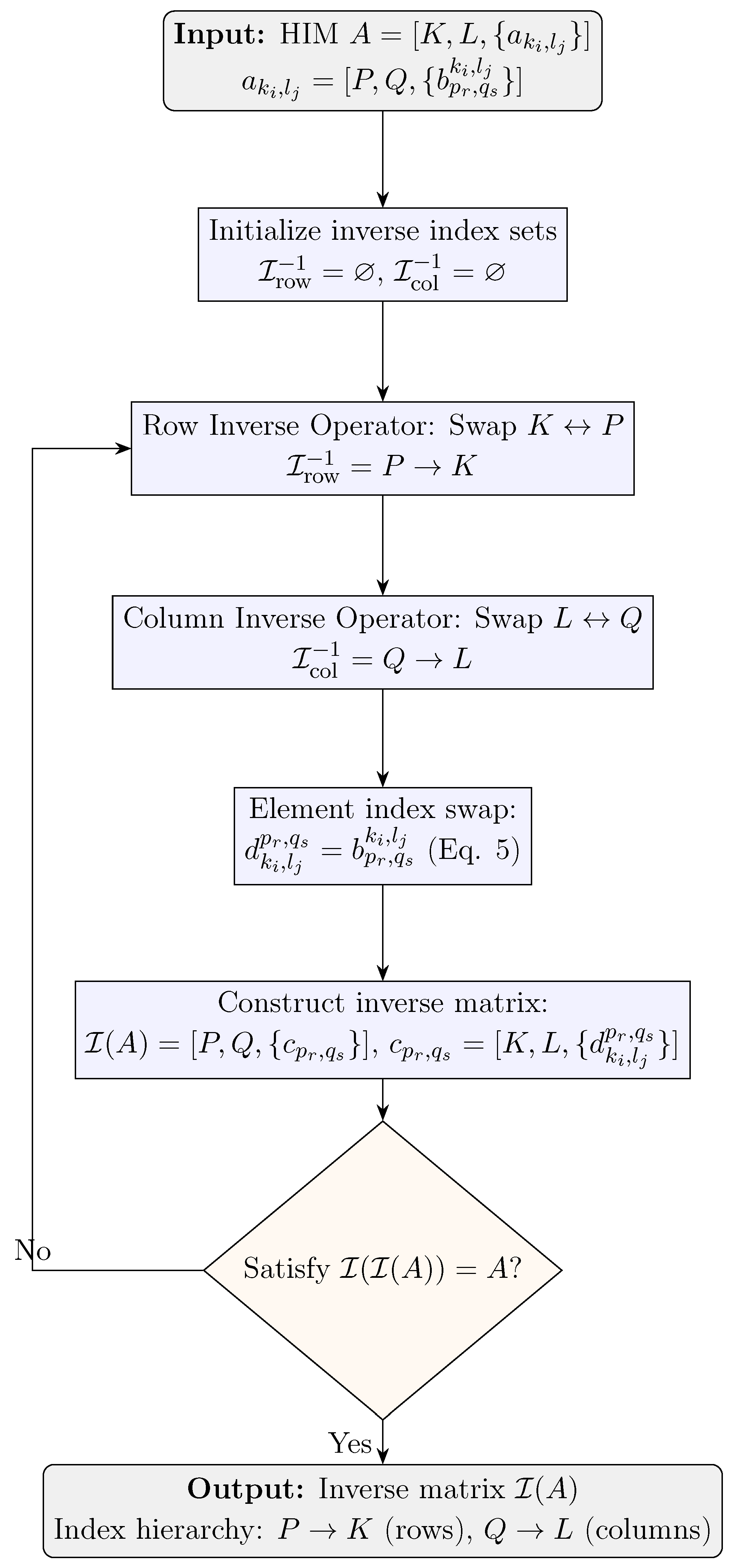
The algorithmic flowchart, representing the “Inverse” operator application, is given in Figure 1. Step 1 of the flowchart presents the HIM loading process. At Step 2, the inverse HIM’s indexing sets are initialized. Thereafter the “Inverse” operator is applied succe“ively to swap the row indices (Step 3) and column indices (Step 4). In the next two steps, the elements’ indices are swapped (Step 5), and the inverse HIM is constructed (Step 6). If the desired result is obtained, the program ends. If more swapping operations are needed, the program returns to Step 3, “Row inverse operator”, and continues functioning. In this case, the inversing procedure is repeated; otherwise it returns the output.
The software is written using the programming language C# 12 and Windows Forms (.NET Core 12) [32,33,34]. The application is created using .NET Core 8, which is a free, open-source, cross-platform framework developed by Microsoft. Additional libraries for Excel files proceeding are used (namely, ExcelDataReader 3.7). The proposed program implementation reads an Excel file and transforms it in the form of a hierarchical index matrix.
The input dataset is loaded in the previously programmatically implemented datagridview control. The datagridview control has assigned hierarchies for the column headers and for the row headers. The data operations are implemented programmatically to represent the obtained results in specially generated datagridview controls with added header hierarchies. The program implementation is published as a self-contained .exe file.
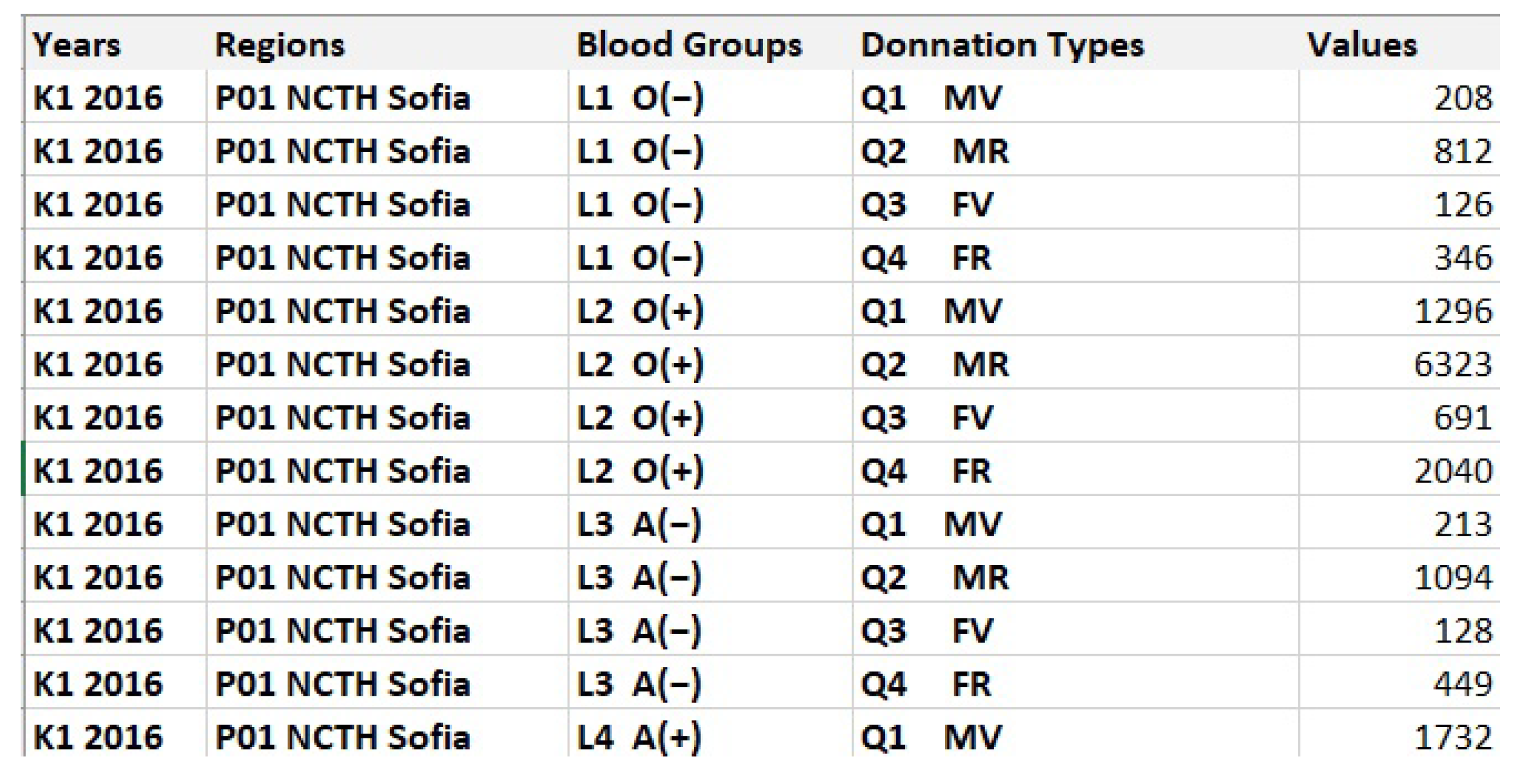
Let us describe the program implementation functionalities for the dataset described in the previous section. Firstly, we have an Excel file that contains five columns—Years, Regions, Blood Groups, Types of Donor/Donation and Quantity—and 8064 rows of data. A small part of the input file is presented in Figure 2.
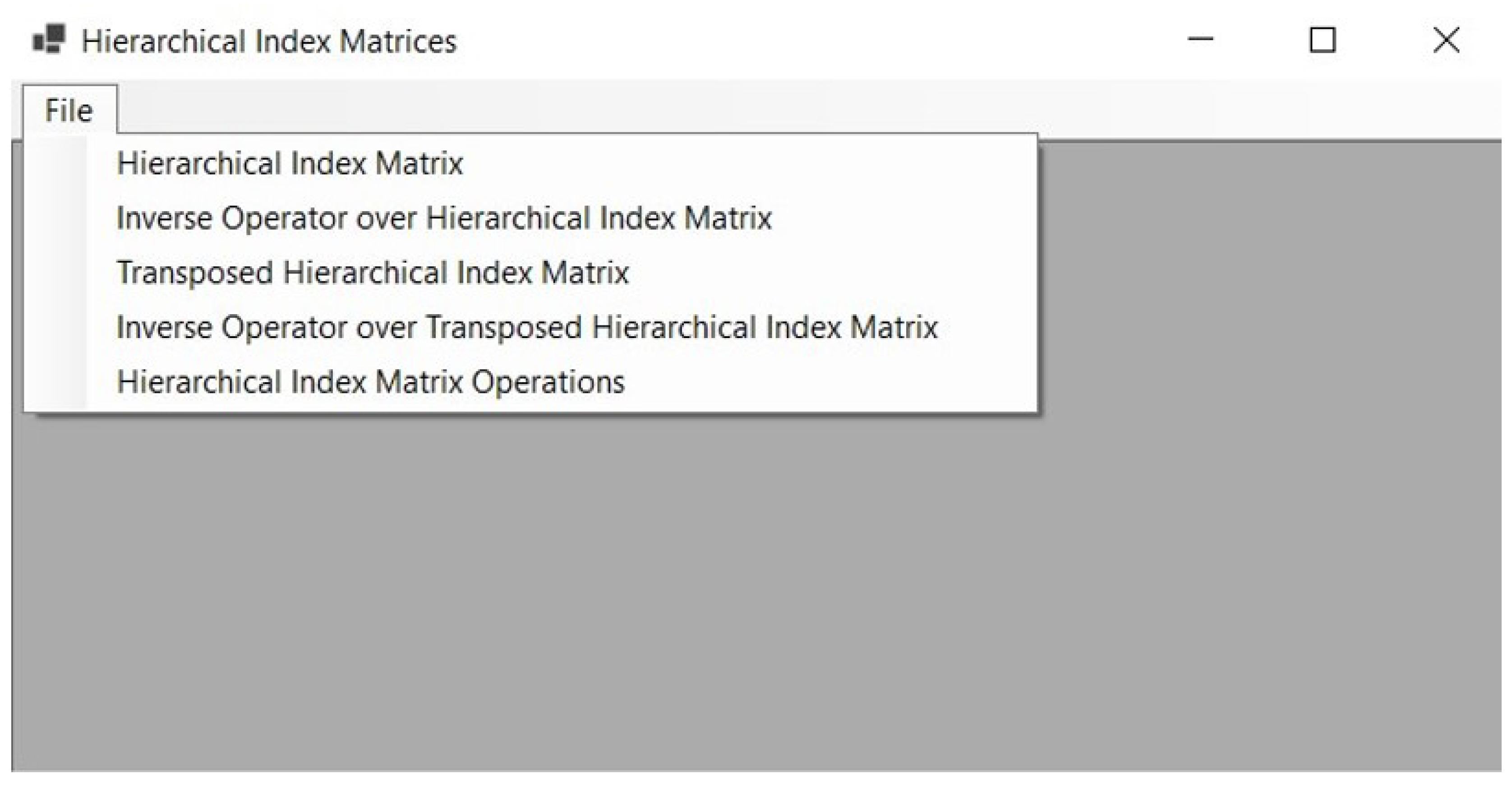
The program implementation is created using the notation for Multiple Document Interface. Thereafter, it has one main form and additional children forms. At the beginning, the start screen with the main form is loaded. It allows the user to opt for hierarchical index matrix generation using the menu strip options (Figure 3).
The File menu contains five options: Hierarchical Index Matrix, Inverse Operator over Hierarchical Index Matrix, Transposed Hierarchical Index Matrix, Inverse Operator over Transposed Hierarchical Index Matrix and Hierarchical Index Matrix Operations. For the first four options, the program reads the input Excel file, transforms it and constructs a hierarchical index matrix. Thereafter, the result is loaded into the datagridview control. Certain events of the datagridview control are overwritten to obtain two header columns and two header rows, as the standard datagridview control allows one header column only. The multiple-headers for column indices are used. The row indices are implemented using the Column 0 and Column 1 of the datagridview control. Finally, Hierarchical Index Matrix Operations presents an example for “Addition” and “Termwise multiplication” using the external Excel files containing HIMs.
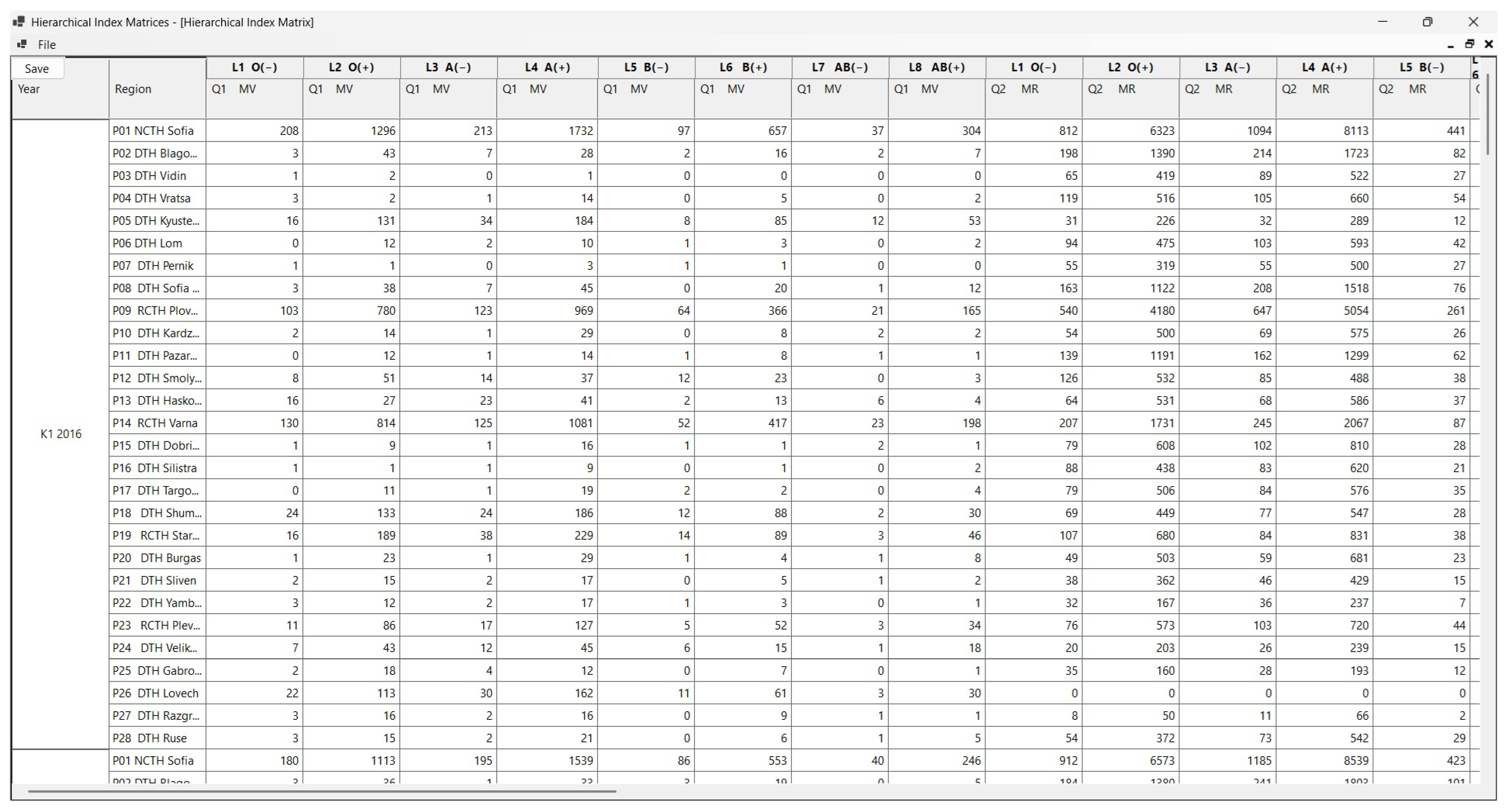
If the user selects the Hierarchical Index Matrix menu option, the input Excel file is loaded and transformed into a hierarchical index matrix (Figure 4). The column indices include donation types → blood types, the row indices are presented by years → regions. Using the scroll bars horizontally and vertically, the whole hierarchical index matrix can be observed. The 0-values represent lack of data for the selected combination of row and column indices.
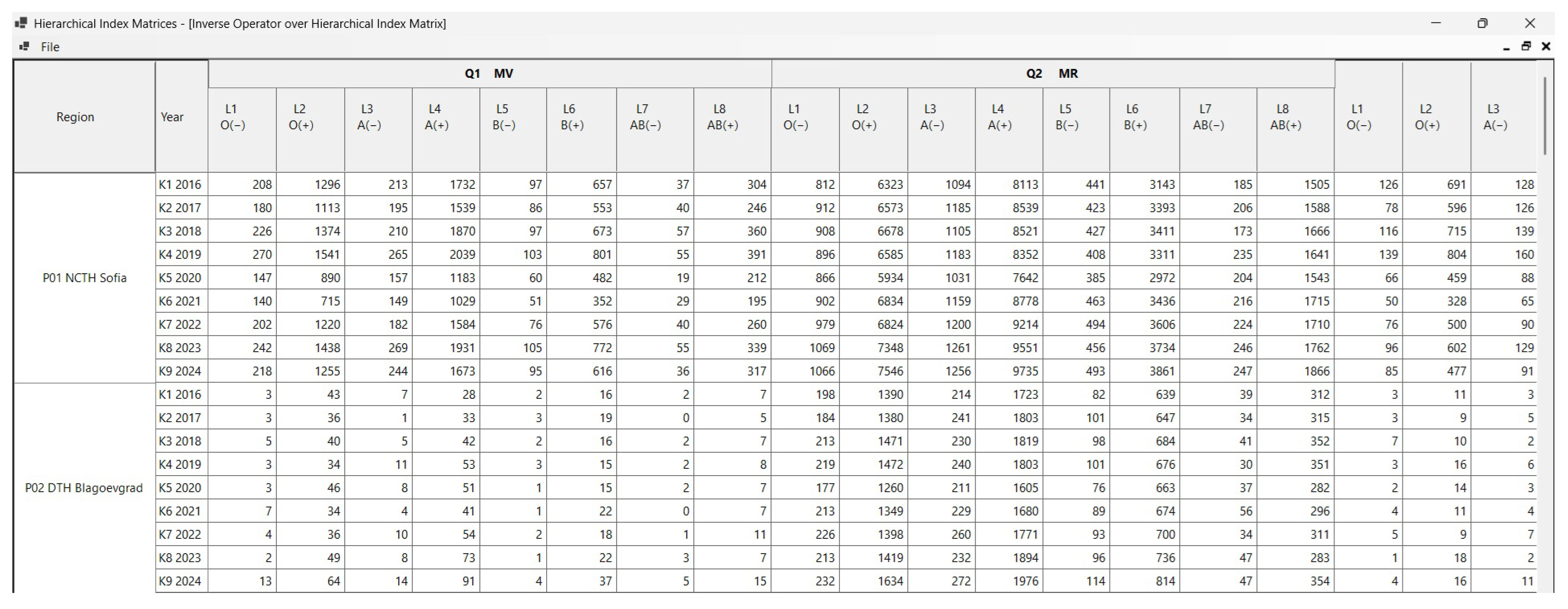
If the user selects the second option—Inverse Operator over Hierarchical Index Matrix—the HIM’s column indices and row indices are rotated. The result is presented in Figure 5. The column indices are grouped in the form blood groups → donation types, while the row indices are grouped in the form regions → years. Using the horizontal and vertical scroll bars, the result of performing the “Inverse” operator over a HIM can be observed completely.
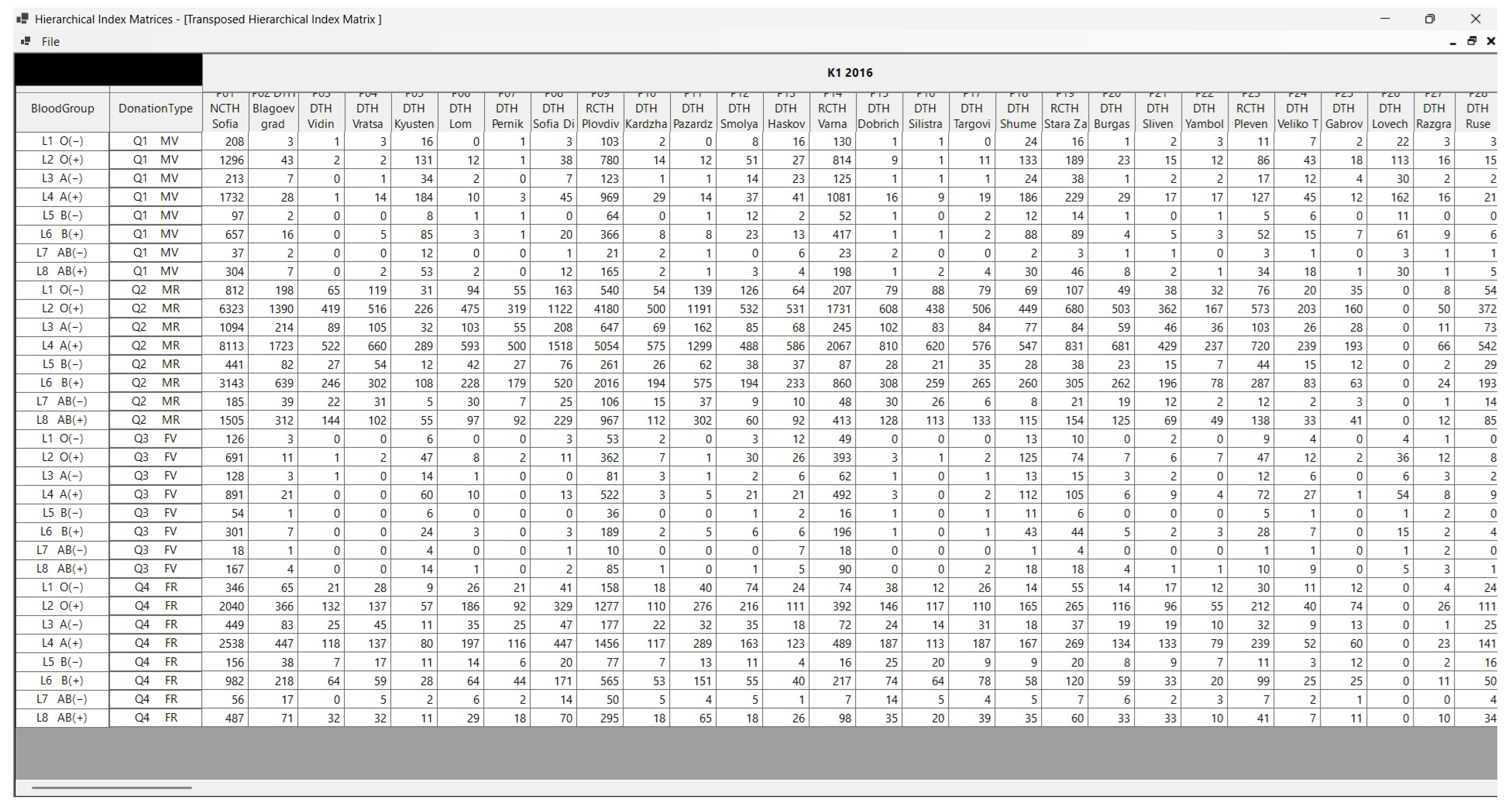
The third option of the File menu is Transposed Hierarchical Index Matrix. In this case, the first header row’s indices of the standard HIM are swapped with the first header column’s indices and second header row’s indices of the standard HIM are swapped with the second header column’s indices (Figure 6). The column indices are grouped in the form years → regions, while the row indices are grouped in the form donation types → blood groups. Using the scroll bars, all the years and regions can be displayed.
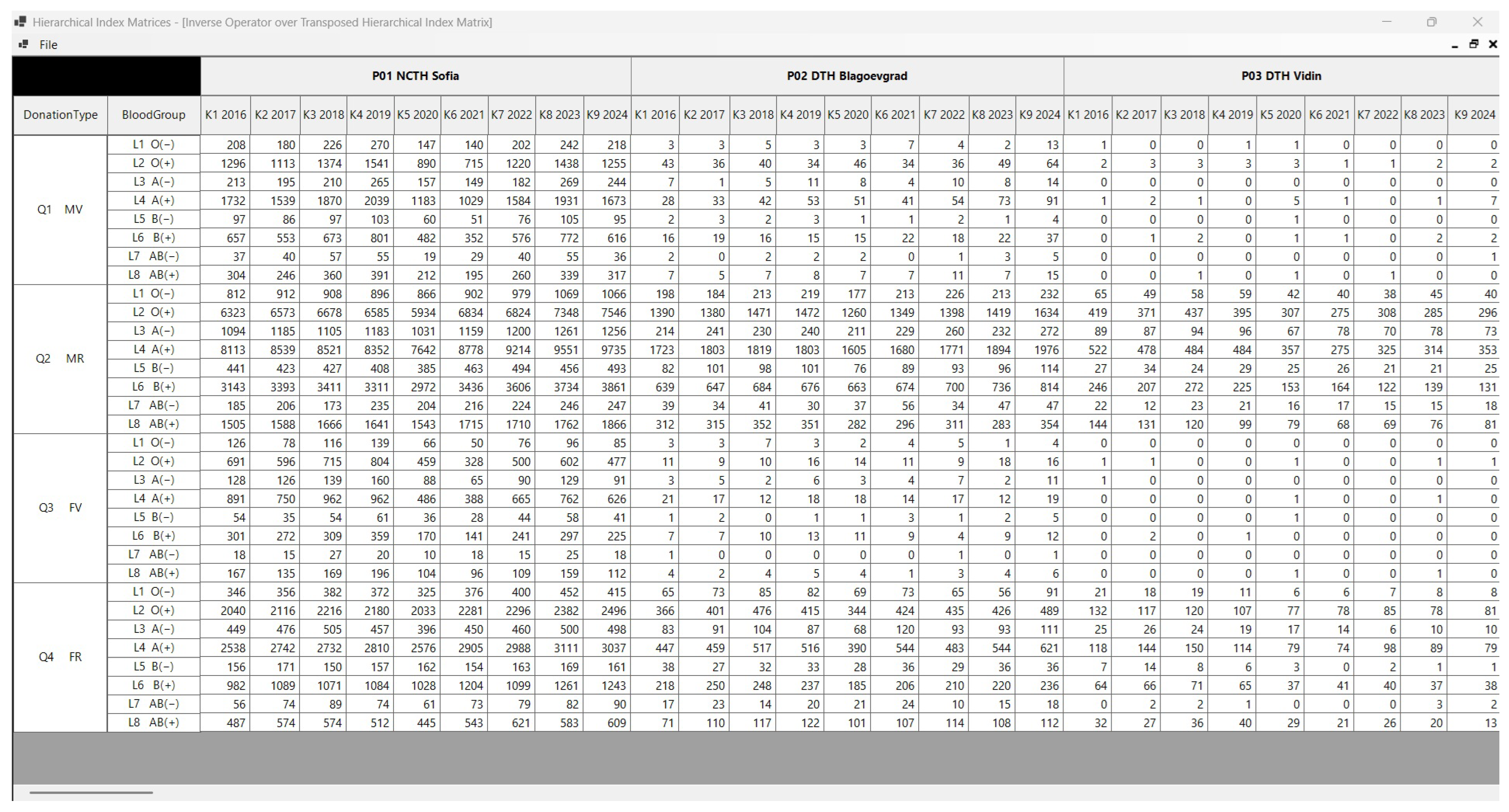
The fourth option of the File menu opens a report containing the Inverse Operator over Transposed Hierarchical Index Matrix (Figure 7). The column indices are grouped in the form regions → years, while the row indices are grouped in the form blood group → donation types. Using the scroll bars, all the regions and blood groups can be displayed.
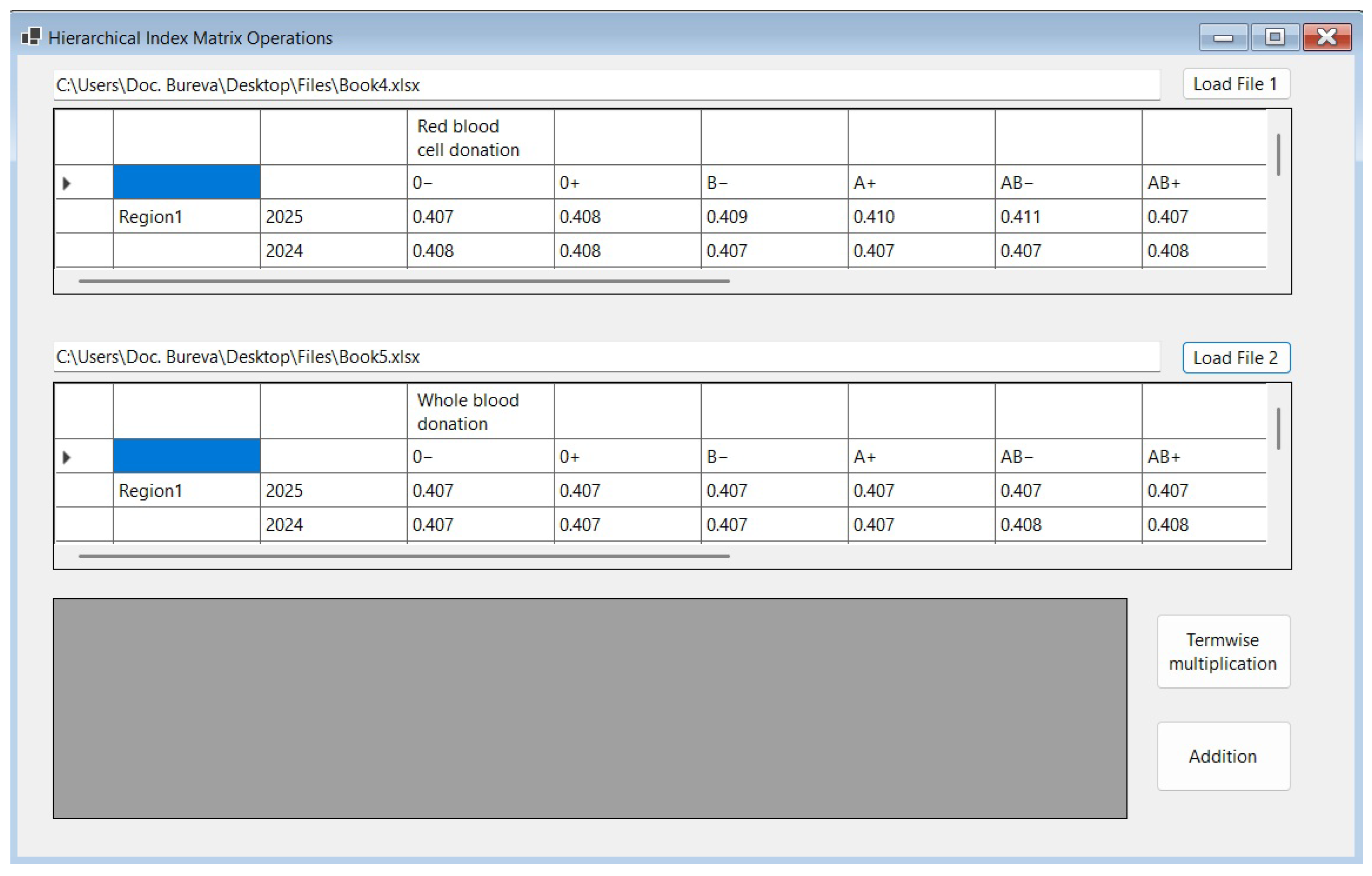
The fifth option of the File menu provides capabilities for loading two hierarchical index matrices from Excel files and performing the operations “Addition” and “Termwise multiplication” over these (Figure 8).
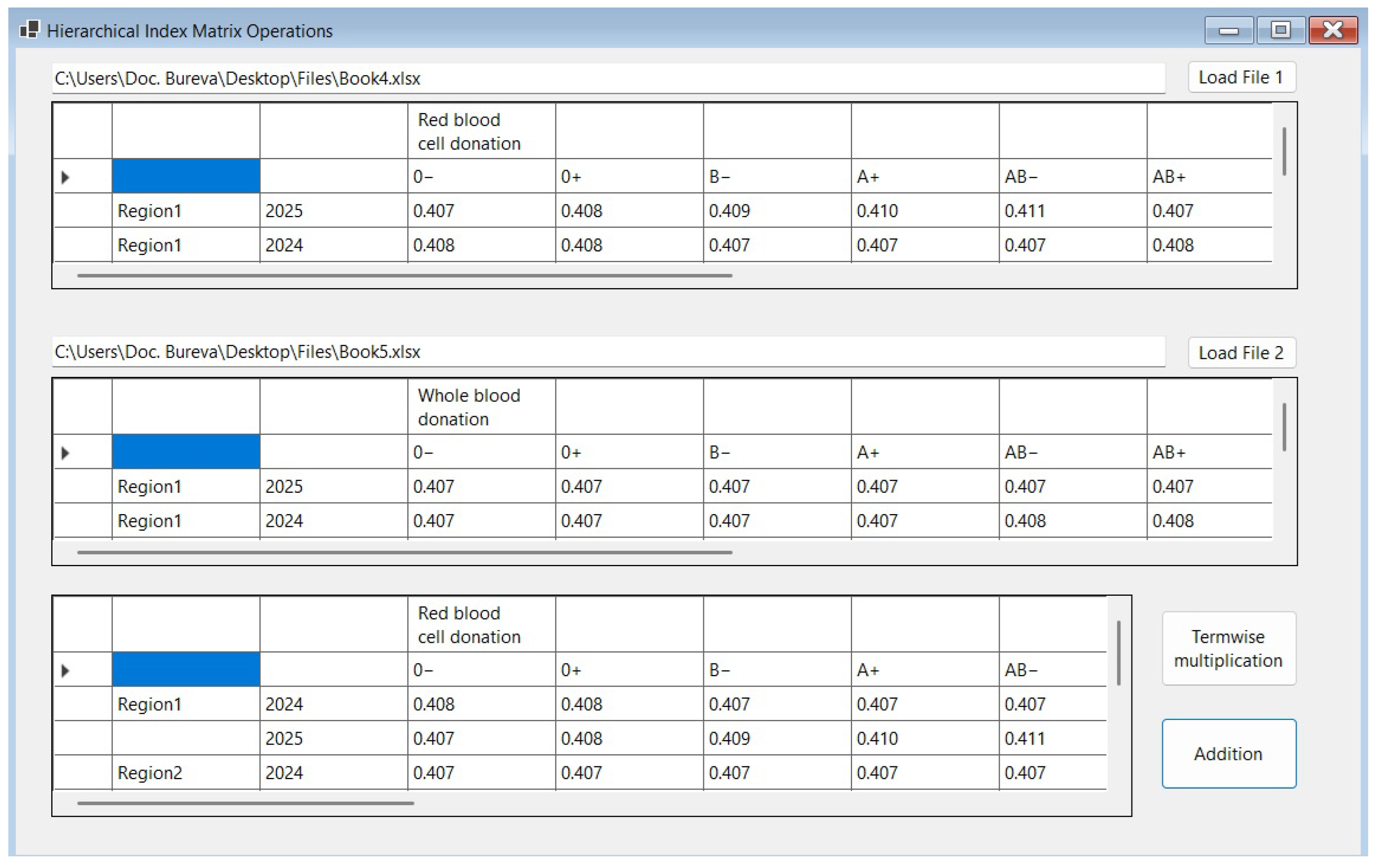
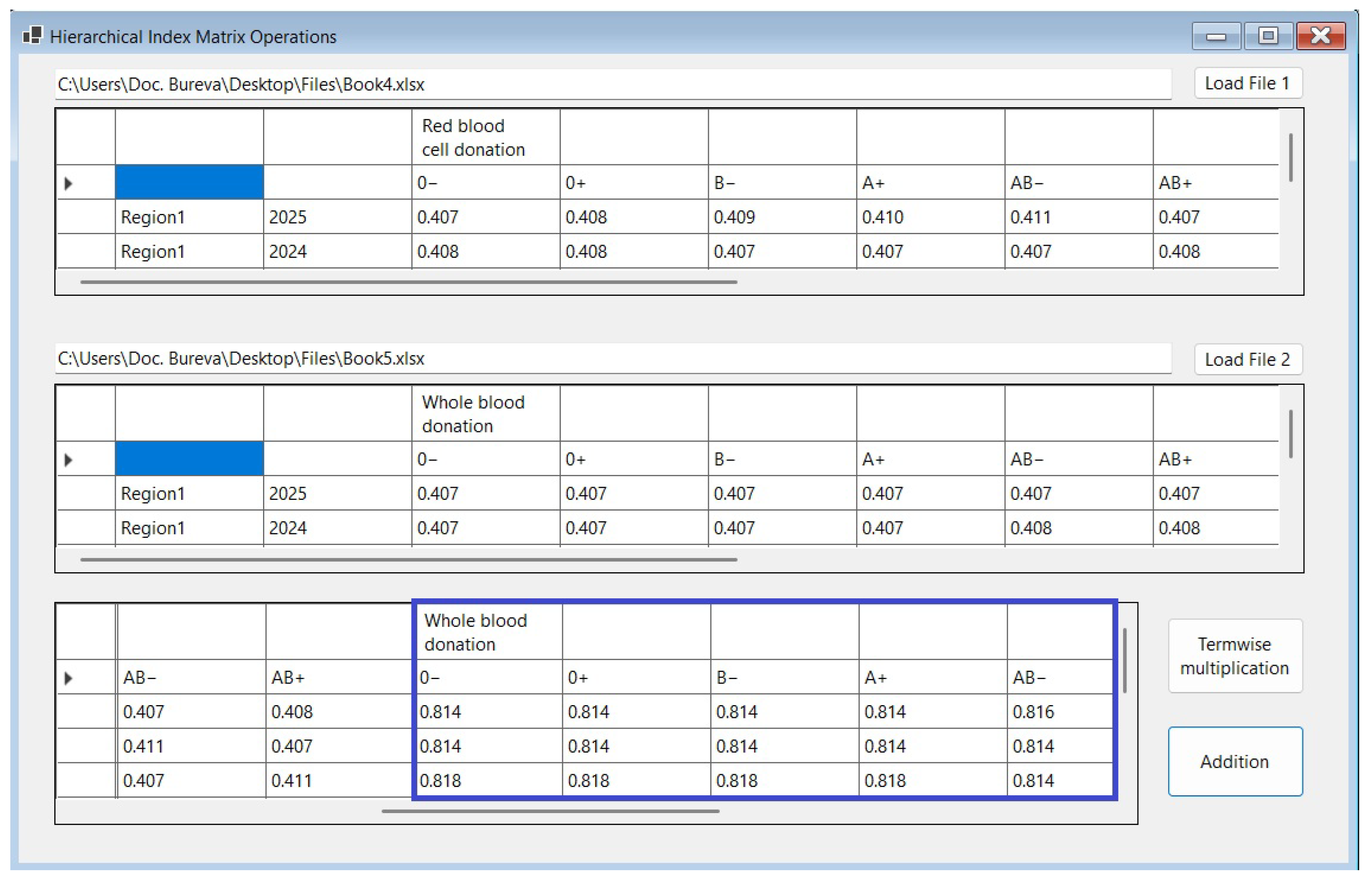
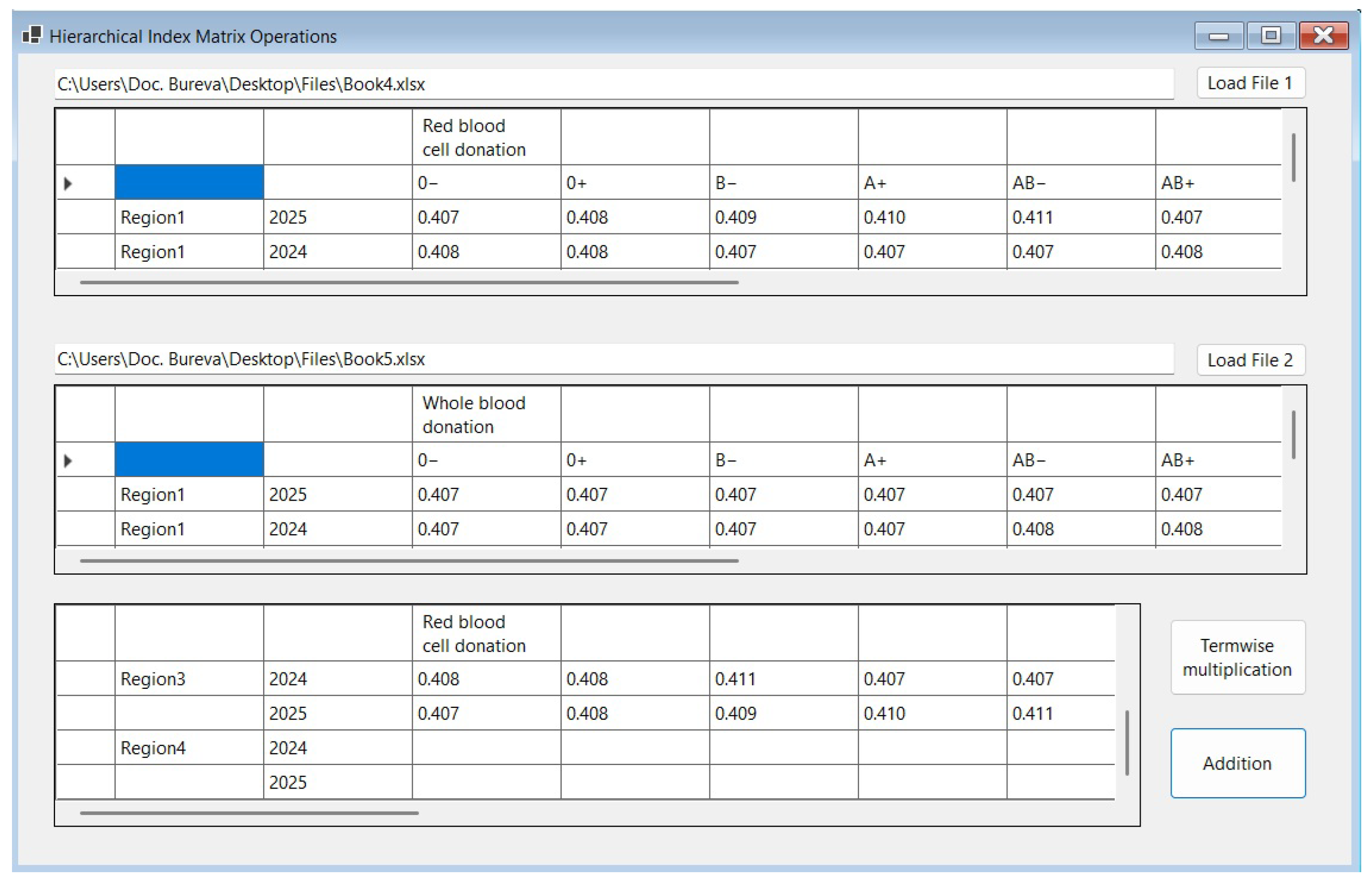
For the particular dataset from the illustrative example, the operation “Termwise multiplication” is not relevant, but we will discuss the relevant operation “Addition”, as presented in more detail in Figure 9, Figure 10 and Figure 11:
  • Cells contained in just one of the input HIMs are imputed in the resultant HIM (Figure 9).
  • Identically indexed rows and columns (framed in blue) of the two HIMs are aggregated (Figure 10).
  • Cells that are not contained in the input HIMs are assigned with null values in the resultant HIM (Figure 11).

5. Discussion

On the basis of such a rich, multi-dimensional dataset, with data from all structural subdivisions of the national transfusion system of Bulgaria over a relatively long period, and with possible stratification of demographic and haematological data, decision makers at the national and regional levels can generate detailed reports and support their policies, including planning of human resources, supplies and consumables, donor recruitment programs, risk management plans, and other institutional decision-making processes.
For instance, in accomplishment of the target for strategic supply and inventory planning, it is necessary to answer the question if the right quantities of blood per blood group are available in the right places over time. Likewise, a number of other data stratifications can help reveal different patterns, trends and conclusions based on the data. The following data stratifications that can be produced by combinations of inverse and transpose operators over the dataset are particularly promising for careful research and analysis.
  • Blood Group × Region × Year. This data stratification detects regional imbalances in critical blood groups such as the rare blood groups (such as AB– and the universal donor O–), while identifying persistent shortages vs. one-off shocks. Key derived indicators on this basis include the year-on-year growth or decline per blood group and the regional self-sufficiency ratio, while typical resultant decisions may include redistribution of inventory across regions, increased collection targets in specific regions, and investments in regional processing capacity.
  • Blood Group × Year. When aggregated on the national level, this data stratification may reveal the long-term trends in rare vs. common blood groups and give an early warning of demographic shifts. This may result in decisions regarding the national donor recruitment priorities, rare donor registry expansion, and long-term agreements for import/export of specific blood and blood products.
  • Donor Type × Region × Year. This data stratification helps in the identification of regions over-reliant on replacement donors (of both sexes), and flags cultural or access barriers for women donors (for both types of donation intention). Careful analysis of the data may lead to the development of region- and gender-specific recruitment campaigns in underperforming regions. This is an important aspect to consider, as a higher proportion of replacement donations often signals stress for the healthcare system, while voluntary blood donors are a safer and more sustainable resource. It is noteworthy that the ultimate goal of the World Health Organization is the transition to 100% of voluntary blood donation on a global scale [35], while Bulgaria (with an approximately 15% share on the national level reported for the year 2023 [36]) is still very far from this target.
  • Donation Type × Blood Group × Region. Analysis of the data in this stratum is important, as replacement donation availability may vary by blood group and region, and certain blood groups may be disproportionately replacement-based. It is particularly worth analysing the situation with the universal blood donors (O–) and rare blood groups, as the regional characterization may help in case of reserves depletion in certain regions to develop logistic plans and routing of missing blood and blood products from neighbouring regions with adequate availability.

6. Conclusions

Index matrices are a formalism that upgrades the classical concept of matrices, allowing augmented matrix calculus and possibilities for operations beyond those available for regular matrices. Its application to datasets exhibits its embedded mechanisms to operate with data on both structural and content levels. The introduction of the “Inverse” operator over hierarchical index matrices, whose elements are themselves index matrices, permits various modes of restructuring the input datasets in ways that allow the users to select the most usable and appropriate stratifications and visualizations of the data. This operator further allows nesting of additional hierarchical levels of data parameters, even though we have shown its operation over two bilevel hierarchies of data parameters.
The “Inverse” operator is considered specifically appropriate to use in cases of missing data, as the resultant differently restructured datasets can produce various perspectives of the missing data—if, how and where they get concentrated or diffused along the whole dataset—which would allow or require different approaches towards parameter reduction (removal of rows or columns), data imputation, or other approaches to handling missing or uncertain data, depending on their extent and nature. This new tool in index-matrix-based research can open new perspectives for the theoretical study of intuitionistic fuzzy index matrices and a wide range of their applications.

Supplementary Materials

The following supporting information can be downloaded at: https://www.mdpi.com/article/10.3390/math14040615/s1.

Author Contributions

Conceptualization, V.A., K.A. and V.B.; methodology, K.A.; software, V.B.; validation, V.A.; formal analysis, V.A. and V.B.; investigation, K.A. and I.U.; resources, K.A.; data curation, I.U.; writing—original draft preparation, V.B., K.A., V.A. and I.U.; writing—review and editing, V.B., K.A. and V.A.; visualization, V.B. and V.A.; supervision, K.A. All authors have read and agreed to the published version of the manuscript.

Funding

This research was funded by Bulgarian National Science Fund, Grant number KP-06-N72/8 from 14 December 2023, titled “Intuitionistic fuzzy methods for data analysis with an emphasis on the blood donation system in Bulgaria”.

Institutional Review Board Statement

The anonymized dataset is used with the approval of the Research Ethical Commission of the Institute of Biophysics and Biomedical Engineering at the Bulgarian Academy of Sciences, Protocol 2 of 29 February 2024.

Data Availability Statement

The original contributions presented in this study are included in the article/Supplementary Material. Further inquiries can be directed to the corresponding authors.

Acknowledgments

The authors are grateful to the Bulgarian National Centre of Transfusion Haematology for the provision of the anonymized dataset of blood donors for the illustrative example in the paper. Blood collection in the Bulgarian National Centre of Transfusion Haematology is performed under strict compliance with all requirements outlined in Ordinance 18/2004 of the Bulgarian Ministry of Health regarding blood samples, test reagents, and test erythrocytes used for determining blood group characteristics. The authors are thankful for the detailed and constructive feedback of the anonymous reviewers, including the suggested flowchart in Figure 1, and their remarks and recommendations that significantly improved the quality of the paper.

Conflicts of Interest

The authors declare no conflicts of interest.

References

  1. Atanassov, K. Generalized Index Matrices. Comptes Rendus L’Academie Bulg. Sci. 1987, 40, 15–18. [Google Scholar]
  2. Atanassov, K. Index Matrices: Towards an Augmented Matrix Calculus; Springer: Cham, Switzerland, 2014. [Google Scholar]
  3. Todorova, S. Review of the publications on index matrices. Annu. Inform. Sect. Union Sci. Bulg. 2023, 12, 32–62. (In Bulgarian) [Google Scholar]
  4. Sylvester, J.J. Additions to the articles in the September Number of this Journal “On a new Class of Theorem” and “On Pascal’s Theorem”. London, Edinburgh, Dublin Philos. Mag. 1860, 37, 363–369. [Google Scholar] [CrossRef][Green Version]
  5. Atanassov, K. Extended Index Matrices. In Intelligent Systems’ 2014; Angelov, P., Atanassov, K., Doukovska, L., Hadjiski, M., Jotsov, V., Kacprzyk, J., Kasabov, N., Sotirov, S., Szmidt, E., Zadrozny, S., Eds.; Springer: Cham, Switzerland, 2015; Volume 322, pp. 305–317. [Google Scholar] [CrossRef]
  6. Andrilli, S.; Hecker, D. Elementary Linear Algebra, 6th ed.; Academic Press: Amsterdam, The Netherlands, 2022. [Google Scholar]
  7. Parvathi, R.; Thilagavathi, S.; Thamizhendhi, G.; Karunambigai, M.G. Index Matrix Representation of Intuitionistic Fuzzy Graphs. Notes Intuit. Fuzzy Sets 2014, 20, 100–108. Available online: https://ifigenia.org/images/7/7f/NIFS-20-2-100-108.pdf (accessed on 4 February 2026).
  8. Traneva, V.; Tranev, S. On Index-Matrix Interpretation of Interval-Valued Intuitionistic Fuzzy Hamiltonian Cycle. Stud. Comput. Intell. 2022, 986, 329–348. [Google Scholar] [CrossRef]
  9. Traneva, V.; Tranev, S. Intuitionistic Fuzzy Index Matrices in Linear Regression Analysis. J. Mult. Valued Log. Soft Comput. 2024, 43, 549–559. [Google Scholar]
  10. Todorova, S. On the Solutions of Some Equations with Intuitionistic Fuzzy Index Matrices. In Uncertainty and Imprecision in Decision Making and Decision Support–New Advances, Challenges, and Perspectives (Selected Papers from BOS/SOR-2022, Held on 13–15 October 2022, and IWIFSGN-2022, Held on 13–14 October 2022, Warsaw, Poland); Lecture Notes in Networks and Systems; Springer: Cham, Switzerland, 2023; Volume 793, pp. 32–38. [Google Scholar] [CrossRef]
  11. Traneva, V.; Tranev, S. Intuitionistic Fuzzy Index-Matrix Selection for the Outsourcing Providers at a Refinery. Lect. Notes Netw. Syst. 2022, 308, 119–128. [Google Scholar] [CrossRef]
  12. Traneva, V.; Tranev, S. Index-Matrix Interpretation of a Two-Stage Three-Dimensional Intuitionistic Fuzzy Transportation problem. Stud. Comput. Intell. 2022, 1044, 187–213. [Google Scholar] [CrossRef]
  13. Traneva, V.; Tranev, S. Two-Stage Three-Dimensional Transportation Optimization under Elliptic Intuitionistic Fuzzy Quadruples: An Index-Matrix Interpretation. Axioms 2025, 14, 849. [Google Scholar] [CrossRef]
  14. Vassilev, P.; Ribagin, S.; Todorova, L. On an Aggregation of Expert Value Assignments Using Index Matrices. Notes Intuit. Fuzzy Sets 2017, 23, 75–78. Available online: https://ifigenia.org/images/d/d3/NIFS-23-4-75-78.pdf (accessed on 4 February 2026).
  15. Hinov, N.; Gocheva, P.; Gochev, V. Index Matrix-Based Modeling and Simulation of Buck Converter. Mathematics 2023, 11, 4756. [Google Scholar] [CrossRef]
  16. Gochev, V.; Hinov, N.; Gocheva, P. Mathematical Modelling of Basic Electronic Components with Index Matrices. In Proceedings of the 2019 International Conference on Information Technologies, InfoTech 2019, Varna, Bulgaria, 19–20 September 2019; pp. 1–4. [Google Scholar] [CrossRef]
  17. Hinov, N.; Gocheva, P.; Gochev, V. Mathematical Modelling of Electronic Circuits with Index Matrices. In Proceedings of the 2019 International Conference on Information Technologies, InfoTech 2019, Varna, Bulgaria, 19–20 September 2019; pp. 1–4. [Google Scholar] [CrossRef]
  18. Vassilev, P.; Todorova, L.; Andonov, V. An Auxiliary Technique for InterCriteria Analysis via a Three Dimensional Index Matrix. Notes Intuit. Fuzzy Sets 2015, 21, 71–76. Available online: https://ifigenia.org/images/a/ac/NIFS-21-2-071-076.pdf (accessed on 4 February 2026).
  19. Jekova, I.; Vassilev, P.; Stoyanov, T.; Pencheva, T. InterCriteria Analysis: Application for ECG Data Analysis. Mathematics 2021, 9, 854. [Google Scholar] [CrossRef]
  20. Angelova, S.; Angelova, M.; Raikova, R. Estimating Surface EMG Activity of Human Upper Arm Muscles Using InterCriteria Analysis. Math. Comput. Appl. 2024, 29, 8. [Google Scholar] [CrossRef]
  21. Andreev, N.; Sotirova, E.; Ribagin, S. Intercriteria Analysis of Data from the Centers for Transfusion Haematology in Bulgaria. Comptes Rendus L’Academie Bulg. Sci. 2019, 72, 982–990. [Google Scholar] [CrossRef]
  22. Fidanova, S.; Zhivkov, P.; Roeva, O. InterCriteria Analysis Applied on Air Pollution Influence on Morbidity. Mathematics 2022, 10, 1195. [Google Scholar] [CrossRef]
  23. Georgieva, V.; Angelova, N.; Roeva, O.; Pencheva, T. InterCriteria Analysis of Wastewater Treatment Quality. J. Int. Sci. Publ. Ecol. Saf. 2016, 10, 365–376. Available online: https://www.scientific-publications.net/get/1000017/1465310141100241.pdf (accessed on 4 February 2026).
  24. Kacprzyk, A.; Sotirov, S.; Sotirova, E.; Shopova, D.; Georgiev, P. Application of Intercriteria Analysis in the Finance and Accountancy Positions. Notes Intuit. Fuzzy Sets 2017, 23, 84–90. Available online: https://ifigenia.org/images/0/04/NIFS-23-4-84-90.pdf (accessed on 4 February 2026).
  25. Danailova-Veleva, S.; Doukovska, L.; Vassilev, P. InterCriteria Analysis of the Global Competitiveness Report for the Financial System EU Countries. In Proceedings of the 2022 IEEE International Conference on Intelligent Systems, Warsaw, Poland, 12–14 October 2022; pp. 1–5. [Google Scholar] [CrossRef]
  26. Traneva, V. Internal Operations over 3-Dimensional Extended Index Matrices. Proc. Jangjeon Math. Soc. 2015, 18, 547–569. [Google Scholar] [CrossRef]
  27. Traneva, V. On 3-Dimensional Intuitionistic Fuzzy Index Matrices. Notes Intuit. Fuzzy Sets 2014, 20, 59–64. Available online: https://ifigenia.org/images/e/e0/NIFS-20-4-59-64.pdf (accessed on 4 February 2026).
  28. Traneva, V. More Basic Operations and Modal Operators over 3-Dimensional Intuitionistic Fuzzy Index Matrices. Notes Intuit. Fuzzy Sets 2014, 20, 17–25. Available online: https://ifigenia.org/images/d/d9/NIFS-20-5-17-25.pdf (accessed on 4 February 2026).
  29. Traneva, V.; Tranev, S.; Stoenchev, M.; Atanassov, K. Scaled Aggregation Pperations over Two- and Three-Dimensional Index Matrices. Soft Comput. 2018, 22, 5115–5120. [Google Scholar] [CrossRef]
  30. Shi, X.; Kosari, S.; Rangasamy, P.; Nivedhaa, R.K.; Rashmanlou, H. Scaled Aggregation Operations over Three-Dimensional Extended Intuitionistic Fuzzy Index Matrices. J. Intell. Fuzzy Syst. 2025, 48, 123–139. [Google Scholar] [CrossRef]
  31. De Tré, G.; Zadrożny, S.; Sotirov, S.; Atanassov, K. Using Index Matrices for Handling Multiple Scenarios in Decision Making. Notes Intuit. Fuzzy Sets 2017, 23, 103–110. Available online: https://ifigenia.org/images/9/9a/NIFS-23-2-103-110.pdf (accessed on 4 February 2026).
  32. Skeet, J. C# in Depth, 4th ed.; Manning: Shelter Island, NY, USA, 2019. [Google Scholar]
  33. Sarcar, V. Simple and Efficient Programming with C: Skills to Build Applications with Visual Studio and .NET; Apress: Berkeley, CA, USA, 2022. [Google Scholar]
  34. Panjuta, D.; Jabbarzadeh, J. Learning C# Through Small Projects; Springer: Cham, Switzerland, 2024. [Google Scholar]
  35. Fordham, J.; Dhingra, N. (Eds.) Towards 100% Voluntary Blood Donation: A Global Framework for Action; World Health Organization: Geneva, Switzerland, 2010. Available online: https://www.ncbi.nlm.nih.gov/books/NBK305667/pdf/Bookshelf_NBK305667.pdf (accessed on 4 February 2026).
  36. Atanassova, V.; Umlenski, I.; Nikolov, N.; Andreev, N.; Vassilev, P.; Atanassov, K.; Pencheva, T.; Ribagin, S.; Vasileva, V.; Dimitriev, A.; et al. “Drop by Drop”: Current Data for the Blood Group Distributions and Indicators of Blood Donation Activity in Bulgaria in 2023. J. Bulg. Acad. Sci. 2025, 138, 3–15. Available online: https://journ.bas.bg/shr/articles/701-800/p_770_1.pdf (accessed on 4 February 2026). (In Bulgarian)
Figure 1. Flowchart of the “Inverse” operator for hierarchical index matrices (HIMs).
Mathematics 14 00615 g001
Figure 2. Input data in an Excel file.
Mathematics 14 00615 g002
Figure 3. Start screen with listed File menu options.
Mathematics 14 00615 g003
Figure 4. Hierarchical index matrix.
Mathematics 14 00615 g004
Figure 5. “Inverse” operator over hierarchical index matrix.
Mathematics 14 00615 g005
Figure 6. Transposed hierarchical index matrix.
Mathematics 14 00615 g006
Figure 7. “Inverse” operator over transposed hierarchical index matrix.
Mathematics 14 00615 g007
Figure 8. Loaded hierarchical index matrices from Excel files.
Mathematics 14 00615 g008
Figure 9. Addition—data that is contained in only one of the input hierarchical index matrices.
Mathematics 14 00615 g009
Figure 10. Addition—application of the operation to identically indexed cells (framed in blue) of the two hierarchical index matrices.
Mathematics 14 00615 g010
Figure 11. Addition—application of the operation to differently indexed cells of the two hierarchical index matrices.
Mathematics 14 00615 g011
Disclaimer/Publisher’s Note: The statements, opinions and data contained in all publications are solely those of the individual author(s) and contributor(s) and not of MDPI and/or the editor(s). MDPI and/or the editor(s) disclaim responsibility for any injury to people or property resulting from any ideas, methods, instructions or products referred to in the content.