


Abstract
This paper introduces polynomial F-contractions, a novel category of contractive mappings within metric spaces. This concept synthesizes two powerful generalizations of the Banach contraction principle: the F-contractions originally developed by Wardowski and the polynomial-type contractions studied very recently by Jleli et al. We formulate fixed point theorems for this new class of mappings in complete metric spaces, which extends and unifies several established theorems in fixed point theory. We first prove our main result for continuous mappings and then extend it to a broader class of mappings that are not necessarily continuous but satisfy the Picard continuity condition. The significance and novelty of our results are highlighted through illustrative examples and further supported by applications to a fractional boundary value problem.
Keywords:
polynomial F-contraction; F-contraction; polynomial contraction; Picard-continuous mapping; boundary value problem; fractional derivatives MSC:
47H10; 54H25; 34A08
1. Introduction
A foundational concept in metric fixed point theory is the Banach contraction principle (BCP) [1], which provides a robust method for ensuring that solutions exist and are unique for many problems in mathematical analysis. This principle ensures that a single fixed point exists for any contraction mapping operating on a complete metric space. Its simplicity and broad applicability have inspired a vast body of research aimed at extending and generalizing its core tenets. Over the years, a wide range of generalizations has been developed, which can be broadly divided into two main directions: those that modify the contractive condition (see, e.g., [2,3,4,5,6]), and those that generalize the underlying metric structure (see, for instance, [7,8,9,10]). Recent applications of generalized contractions extend beyond pure analysis into real-world optimization and control. For example, Belhenniche et al. [11] employed a dynamic programming framework built upon advanced contractive-type mappings to solve optimal water storage problems in irrigation systems, illustrating how abstract fixed-point theory can inform resource management models.
In 2012, Wardowski [12] marked a significant advancement within the first direction by introducing the concept of F-contraction and obtained a generalization to BCP. An F-contraction is defined as a mapping T that adheres to the inequality for a given and an appropriate function F. This framework provides a novel way to generalize the Banach condition and has been the subject of extensive study. In [13], Secelean extended the iterated function system (IFS) theory by replacing classical Banach contractions with the more general concept of F-contractions. The author first simplified the definition of an F-contraction, and then proved that an IFS composed of such mappings has a unique attractor. Thereafter, Piri and Kumam [14] extended the theory of F-contractions by weakening the conditions on the function F, replacing one of the Wardowski’s conditions with the continuity assumption. This defined a larger family for which the authors proved a fixed point theorem, thus generalizing Wardowski’s result. In 2021, Karmakar et al. [15] introduce the notions of F-contractions and Hardy-Rogers type F-contractions via w-distances in the setting of orthogonal metric spaces. For more work related to F-contractions we refer the reader to [16,17,18,19,20,21,22,23].
More recently, Jleli et al. [24] introduced another interesting generalization of Banach contractions called polynomial contractions. A mapping T is classified as a polynomial contraction if it adheres to the inequality: . This approach replaces the simple distance function in the contraction inequality with a polynomial expression of distances, allowing for a more flexible and powerful contractive condition. Jleli et al. showed that fixed point results can still be obtained for these mappings even without continuity, by substituting the continuity requirement with the less strict condition of Picard-continuity. In a related development, Moumen et al. [25] extended the classic polynomial contraction by defining polynomial -contractions and established fixed point theorems for these new mappings.
Motivated by the parallel development of two powerful generalizations in fixed point theory, namely F-contractions and polynomial contractions, a natural and compelling question arises: can these two distinct approaches be unified within a single, more comprehensive framework? The main objective of this work is to answer this question affirmatively by introducing a unified concept, termed a polynomial F-contraction, which combines the structural elegance of F-contractions with the algebraic flexibility of polynomial contractions. Although classical F-contractions are effective, they are largely restricted to conditions involving a single distance term of the form . In contrast, many nonlinear problems, particularly those arising in differential and integral equations, naturally involve higher-order distance terms or polynomial combinations of distances. The proposed polynomial F-contraction fills this gap by providing a more flexible algebraic framework that incorporates polynomial-type expressions into the F-contraction structure. Within the setting of complete metric spaces, we formally define this new class of mappings and establish its fundamental fixed point theorems, thereby extending the applicability of F-contraction techniques to problems beyond the reach of standard formulations.
The organization of this paper is summarized below. Section 2 is devoted to revisiting the core definitions and foundational ideas of F-contractions and polynomial contractions. In Section 3, we introduce the definition of a polynomial F-contraction and present our main fixed point theorems, first for continuous mappings and then for Picard-continuous mappings. Thereafter, we derive several corollaries and provide two illustrative examples to show the scope and significance of the main results. An application to a fractional boundary value problem is presented in Section 4. We conclude in Section 5 with a summary and suggestions for future research directions.
2. Preliminaries
This section reviews the essential definitions and preliminary findings that provide the foundation for our study. Throughout this paper, will denote a metric space. We start with the idea of an F-contraction, a concept originally presented by Wardowski [12].
Definition 1
([12]). Let be the set of all functions that satisfy the following properties:
- (F1) F is strictly monotone increasing:
- (F2) The limit condition at zero holds:
- (F3) F is polynomially bounded near zero:
- We say that is an F-contraction if there exist an and such that for all , the following implication is true:
Remark 1
([12]). By combining condition with inequality (1), one can easily deduce that any F-contraction must be continuous.
In his seminal work [12], Wardowski presented a new extension of the BCP, which can be formulated as follows:
Theorem 1
([12]). Let be a complete metric space and let be an F-contraction with respect to a function . Then T admits a unique fixed point . Moreover, for every initial point , the iterative sequence converges to .
To refine the understanding of the conditions imposed on the function F, subsequent research has explored the properties of these axioms. The following lemma, presented by Secelean [13], provides crucial insight by reformulating one of the key axioms, , into a more direct and simplified form, thus clarifying the behavior of the function F near zero.
Lemma 1
([13]). Let be an increasing function, and let be a sequence in .
- (i)
- If , then .
- (ii)
- If, in addition, , then the converse holds: implies .
The Lemma 1 of Secelean shows that condition in Definition 1 can be equivalently reformulated in the following simpler form:
Further expanding the theory, Piri and Kumam [14] addressed the constraints of axiom . They provided a crucial insight by demonstrating that the specific power-law condition could be replaced by the much simpler requirement of continuity for the function F. This relaxation significantly broadened the family of admissible functions, thereby widening the applicability of the F-contraction framework. In fact, they replaced the condition by the following one:
- F is continuous.
We define as the set of all real functions on that meet requirements , and :
These reformulations by Secelean and Piri & Kumam lead to a more streamlined set of axioms for the function F. The collection of all functions that satisfy these updated conditions forms the basis for the subsequent analysis in this paper. We now present several examples of functions that are members of this class.
Example 1.
For , let be defined as follows.
- .
- Then .
We now turn our attention to a different, yet equally significant, generalization of the BCP known as a polynomial contraction, introduced by Jleli et al. [24].
Definition 2
([24]). Let be a metric space. A mapping is called a polynomial contraction if there exist a constant , a positive integer , and non-negative functions
such that, for all , the following inequality holds:
In the study of fixed point theory, the continuity of the mapping is a common requirement. However, many significant results have been achieved by relaxing this condition. One of the most effective weaker conditions is that of Picard-continuity, which ensures that the mapping behaves well with respect to its own iterative sequence. The formal definition is as follows:
Definition 3.
Let be a metric space and let be a self-mapping. The mapping T is said to be Picard-continuous if, for every and every , the convergence
implies
3. Main Results
We begin this section by introducing the central concept of this paper, which we call a polynomial F-contraction. This novel class of mappings is designed to synergistically combine the structural elegance of F-contractions with the algebraic flexibility of polynomial conditions. The formal definition is as follows:
Definition 4.
Let be a metric space and let be a self-mapping. The mapping T is called a polynomial F-contraction if there exist a function , a constant , a positive integer , and non-negative functions
such that, for all with , the following inequality holds:
For compactness, let the polynomial expression be denoted as . The inequality can then be written as:
Remark 2.
The polynomial F-contraction framework is a true generalization, as it contains both F-contractions and polynomial contractions as special cases.
- If , , and is a constant function with value 1, this definition reduces to the standard F-contraction (Definition 1).
- If we choose , the definition will reduce to the standard polynomial contraction with (Definition 2).
Having established the formal definition of a polynomial F-contraction, we now turn to proving its fundamental properties. The primary objective is to demonstrate that this new class of mappings guarantees the existence and uniqueness of a fixed point under appropriate conditions. Our first main result, presented in the theorem below, addresses the case where the mapping T is continuous.
Theorem 2.
Let be a complete metric space and let be a continuous polynomial F-contraction. Assume that each coefficient function is uniformly continuous. Moreover, suppose that there exist an index and a constant such that
Then T admits a unique fixed point . Furthermore, for every initial point , the Picard iterative sequence converges to .
Proof.
Fix an arbitrary point and construct the Picard iteration defined by
Since the existence of an n such that implies that is a fixed point of T, we can assume without loss of generality that
and consequently . Let From the assumptions, we deduce that
Since T satisfies the polynomial F-contractive condition, applying it to the pair gives
It can be shown by induction that
Taking the limit as , we find that diverges to . Invoking property of the function F, we can conclude that
From the hypothesis , we have
From (3), we must have , which implies
To show that is Cauchy, assume for the sake of contradiction that it is not. Then there exist and two subsequences and such that, for each ,
Moreover, choosing as the smallest index satisfying the above condition, we have
By the triangle inequality,
Since , letting yields
Now, from the hypothesis, we have
Passing to the limit inferior as and using the above convergence, we obtain
Hence, the sequence is bounded below by a positive constant. Consequently, there exists a subsequence (still denoted by ) such that
The same argument applies to the sequence . Indeed,
Since , the pairs and are asymptotically close. By the uniform continuity of each function and the convergence , it follows that
Therefore,
On the other hand, in view of (4), there exists , such that
Next, we claim that If we suppose the contrary, then there must exist a such that
Due to the hypothesis, we conclude that
In view of (7) and (8), we conclude that
This contradiction leads to the validity of the relation . Therefore, we apply the polynomial F-contraction condition with and and obtain
Taking the limit in the inequality as and making use of , (5) and (6), we get
This leads to the inequality , which is impossible since . Hence, the sequence must be Cauchy.
By completeness of , the Cauchy sequence converges to a limit . The continuity of T allows us to pass the limit through the function in the relation :
Thus, , and is a fixed point of T.
To establish uniqueness, suppose are two fixed points. Then . Applying the contractive condition to and , we have
This implies , a contradiction. Thus . □
Remark 3.
Polynomial F-contractions, like polynomial contractions and unlike F-contractions, are not necessarily continuous. The following proposition (Proposition 1) gives the necessary conditions under which polynomial F-contractions are continuous.
Proposition 1.
Let be a metric space and let be a polynomial F-contraction. Assume that the coefficient functions are continuous. Moreover, suppose that there exist an index and a constant such that
and that Then the mapping T is continuous on X.
Proof.
Assume that is a sequence in X with . We prove that . Let . Since we assume , the polynomial simplifies to . By the continuity of () and of the metric d, we have
Hence, by condition (F2),
If eventually, the proof is complete. Otherwise, assuming for infinitely many n, the polynomial F-contractive inequality yields
By letting , we obtain
Using condition again, we get
From the hypothesis, we have the lower bound
Since and , we must have , which implies . Thus, T is continuous. □
The proof of Theorem 2 relies on the continuity of the mapping T to establish that the limit of the Picard sequence is indeed a fixed point. However, the continuity of T is not always given a priori. The following corollary demonstrates that under a specific, easily verifiable condition on the coefficient functions namely, that the constant term is zero, the continuity of the mapping is actually a direct consequence of the polynomial F-contraction condition itself. This allows us to secure the same conclusion as Theorem 2 without needing to assume continuity from the outset.
Corollary 1.
Let be a complete metric space, and let be a polynomial F-contraction. Suppose that the coefficient functions are uniformly continuous, that for all , and that there exist an index and a constant such that
Then T admits a unique fixed point , and, for every , the iterative sequence converges to .
Proof.
By Proposition 1, the stated assumptions guarantee the continuity of T. Consequently, all hypotheses of Theorem 2 are fulfilled. The conclusion then follows immediately. □
Corollary 2.
Let be a complete metric space and let be an F-contraction with respect to a function . Then T admits a unique fixed point . Moreover, for every initial point , the iterative sequence converges to .
Proof.
The polynomial F-contraction inequality
reduces to the standard F-contraction inequality
Furthermore, the condition on the coefficients in Theorem 2 is satisfied by choosing , since . We can set . All conditions of Theorem 2 being satisfied. Hence, the desired conclusion is now immediate □
An F-contraction is the special case of a polynomial F-contraction where we set:
- The polynomial degree .
- The coefficient functions and for all .
- With these settings, the polynomial expression becomes
Corollary 3.
Let be a complete metric space and let be a continuous polynomial contraction. Assume that the coefficient functions are uniformly continuous and that there exist an index j and a constant such that
Then T admits a unique fixed point . Moreover, for every , the iterative sequence converges to .
Proof.
A polynomial contraction is the special case of a polynomial F-contraction where we set the function for . This function and the polynomial contraction inequality is
Let . The inequality is . Applying the function to both sides gives
Rearranging the terms
Let . Since , we have , which implies . The inequality becomes
This is precisely the definition of a polynomial F-contraction with . The condition on the coefficients is given in the statement of the corollary. Therefore, by Theorem 2, the desired conclusion is immediate. □
Corollary 4.
Let be a complete metric space and let be a continuous self-mapping. Assume that there exist a constant and a continuous function for some constant , such that for all with , the following inequality holds:
Then T admits a unique fixed point . Moreover, for every , the Picard iterative sequence converges to .
Proof.
Applying Theorem 2 with polynomial degree and coefficient functions
we see that the coefficient condition is satisfied for , since . Hence, the conclusion follows immediately. □
Corollary 5.
Let be a compact metric space and let be a continuous polynomial F-contraction. Assume that each coefficient function is continuous. Moreover, suppose that there exist an index and a constant such that
Then T admits a unique fixed point . Furthermore, for every initial point , the Picard iterative sequence converges to .
Proof.
The stated assumptions ensure that the coefficient functions are uniformly continuous (since are continuous and X is compact). Hence, all the hypotheses of Theorem 2 are satisfied, and the conclusion follows immediately. □
We now support Theorem 2 by presenting an example of a mapping that satisfies the polynomial F-contraction condition with respect to some but is neither a polynomial contraction nor an F-contraction with respect to such F.
Example 2.
Let be the complete metric space where and is the standard Euclidean metric. Define the mapping by:
We demonstrate that T is a polynomial F-contraction but fails to satisfy the standard F-contraction condition with respect to .
To verify that T is a polynomial F-contraction, define the polynomial by choosing the coefficient functions:
Then . The polynomial F-contraction condition requires the existence of with such that
Since for all , the right-hand side of the contraction condition inequality above is strictly positive. Hence, there exists a constant satisfying the inequality. To estimate τ analytically, let be the ratio
Since for all , it follows that . Thus, for all . Since is compact, the continuous function attains its supremum λ on the set , that is,
We can easily prove by contradiction that Indeed, assume, for contradiction, that . By the definition of the supremum, there must exist a sequence of distinct pairs such that . Since is compact, this sequence has a convergent subsequence, say . By the continuity of on S, we must have . Substituting the expression for :
This equality holds if and only if (the fixed point) and , which implies . However, the contraction condition is only required for . Since the limit point lies on the diagonal , the supremum is not attained on the set S. Because for all , and the supremum is approached only at the fixed point where the condition is not applied, we conclude that the supremum must be strictly less than 1:
By setting , we obtain a constant that satisfies the polynomial F-contraction inequality for all . This analytical argument, rooted in the properties of compact metric spaces, rigorously verifies the claim.
T is not an F-contraction with respect to because an F-contraction would require
Or equivalently
which converted to the Banach contraction given mapping as follows
However, as , we have
which violates the condition .
Similarly, T is not a polynomial contraction. A polynomial contraction would require
Let’s analyze the ratio
Taking , this ratio equals 1. Therefore, it cannot be bounded by a constant .
The mapping T is continuous and the other conditions of Theorem 2 can be verified easily. Hence, T admits a unique fixed point.
The previous theorem and its corollaries established the existence of a unique fixed point for continuous polynomial F-contractions. However, the requirement of continuity can be relaxed. The following theorem extends this result to a broader class of mappings where continuity is not assumed but instead satisfy the weaker condition of being Picard-continuous.
Theorem 3.
Let be a complete metric space and let be a Picard-continuous polynomial F-contraction. Assume that the coefficient functions are uniformly continuous. Moreover, suppose that there exist an index and a constant such that
Then T admits a unique fixed point . Furthermore, for every initial point , the Picard iterative sequence converges to .
Proof.
Our initial step is to prove that the Picard sequence constitutes a Cauchy sequence. The proof is identical to the one presented in Theorem 2. Since the metric space is complete, it follows that there is a point for which
Next, using the Picard-continuity of T, we obtain
Equivalently, this can be written as
By the uniqueness of limits, it follows that
Finally, we prove that the fixed point is unique using the same reasoning as in Theorem 2. □
Next, we illustrate Theorem 3 by presenting an example of a mapping that is Picard-continuous but not continuous. Consequently, the mapping satisfies the assumptions of Theorem 3 while failing to meet the Theorems 1 and 2 conditions.
Example 3.
We consider the set together with the absolute value metric, defined by for all . We define as
The mapping T is not continuous at , since , but . Therefore, T is not F-contraction (due to Remark 1).
The mapping is Picard-continuous because for any starting point , the Picard sequence converges to . If , the sequence is . If , the sequence is . In both cases, , and since the sequence is eventually constant, , satisfying the condition.
To show it is a polynomial F-contraction, let and define the coefficient functions as
The contraction condition requires
for some with , which is equivalent to
Hence, we only need to analyze the situation in which and , yielding and .
The other side is
The minimum of on is (at ). The condition becomes , which implies . Choosing satisfies the inequality.
Since T is a Picard-continuous polynomial
F-contraction and we can select , Theorem 3 ensures the existence of a unique fixed point, specifically .
Remark 4.
The corollaries derived from our first main theorem (Corollaries 1–4) can be analogously established from Theorem 3. The proofs follow the same logic, as the core fixed point argument is unaffected by replacing the continuity assumption with the weaker condition of Picard-continuity.
4. Application to a Fractional Boundary Value Problem
In the preceding sections, we established the theoretical foundation for polynomial F-contractions, proving the existence and uniqueness of fixed points in a general metric space setting. To demonstrate the practical utility and power of these abstract results, we now apply our main theorem (Theorem 2) to a concrete problem in mathematical analysis. This section is dedicated to solving a nonlinear fractional boundary value problem (BVP) involving the Caputo fractional derivative. We will show that the existence of a unique solution to the problem, described by Equations (9) and (10), can be guaranteed by reformulating it as a fixed point problem for an integral operator and proving that this operator is a polynomial F-contraction.
Consider the fractional-order differential equation described as follows:
subject to the boundary conditions
where is the Caputo fractional derivative of order , and is a continuous function.
4.1. Preliminaries on Fractional Calculus
Fractional calculus, the study of derivatives and integrals of non-integer order, has emerged as an indispensable tool for modeling complex phenomena in science and engineering (see, e.g., [26,27,28]).
For a given function , its Caputo fractional derivative is defined as
where (in our case, ).
BVPs involving fractional derivatives are particularly important, as they describe systems with memory and hereditary properties. It is a classical result that the BVP associated with (9) subject to the boundary conditions (10) can be transformed into the following Fredholm integral equation.
where denotes the Green’s function associated with the problem and is defined by
The associated Green’s function is continuous and non-negative on . A key property is that its integral is bounded. It can be shown that
4.2. Existence and Uniqueness Theorem
The following theorem presents the main result of this application. It specifies a nonlinear Lipschitz-type condition for the function f that is sufficient to ensure the integral operator is a polynomial F-contraction. This, in turn, guarantees that the BVP given by Equations (9) and (10) admits a unique continuous solution.
Theorem 4.
Proof.
Consider the complete metric space , where . We define an operator based on the equivalent integral Equation (11)
The BVP admits a solution precisely when the operator T has a fixed point. The proof proceeds by showing that T is a polynomial F-contraction.
Let . We estimate the distance
Using the assumption on the function f, we have
Taking the supremum over on both sides, we get
Using the property of the Green’s function, , we obtain
Let . From the theorem’s assumption, , so we have . Since , we have
Choose and (by setting ), we get
Let . Since , we have . The inequality becomes
This is the form of a polynomial F-contraction. Moreover, the coefficient condition in Theorem 2 is fulfilled by taking . Since , we may choose . Therefore, all the assumptions of Theorem 2 are satisfied, and it follows that the operator T admits a unique fixed point, which corresponds to a unique continuous solution of the fractional BVP. □
4.3. Numerical Illustration
The following example serves as a numerical validation of Theorem 4, showcasing the existence and uniqueness of a solution for a fractional boundary value problem with a specific nonlinear term.
Example 4.
Consider the fractional boundary value problem
with boundary conditions
where the nonlinearity is given by
The term is added as a non-homogeneous source term to ensure a non-trivial solution. For any , the Lipschitz-type condition is satisfied by the first term:
Thus f satisfies condition (12) with . Take (so that ). Then
and clearly . Define the operator T on by
where is the Green function associated with the problem. Following the proof of Theorem 4, we obtain
Choosing and setting , the inequality becomes
With the identification (i.e. , , ) and , all hypotheses of Theorem 2 are satisfied. Consequently, the operator T is a polynomial F-contraction on the complete metric space , and therefore the fractional BVP admits a unique continuous solution.
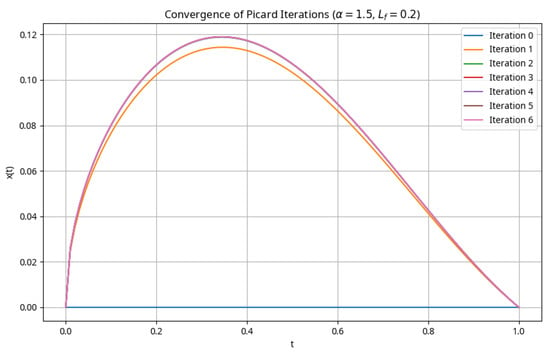
To numerically illustrate the convergence, we apply the Picard iteration starting with . The results, measured by the maximum difference between successive iterations, , are presented in Table 1 and Figure 1.
Table 1.
Convergence of the Picard Iteration for the Fractional BVP ().
Figure 1.
Convergence of the first six Picard Iterations for the Fractional BVP (, ). The sequence of functions rapidly converges to the unique fixed point (solution).
The numerical results confirm the theoretical prediction of rapid convergence, with the error decreasing exponentially, reaching an accuracy of within six iterations. This strong numerical evidence reinforces the applicability and reproducibility of the results derived from the Polynomial F-contraction theory.
5. Conclusions
This paper introduced polynomial F-contractions, a unified framework merging F-contractions with polynomial-type conditions. We established fundamental fixed point theorems (Theorems 2 and 3) for both continuous and Picard-continuous mappings in complete metric spaces, effectively generalizing several landmark results in the literature. Our findings were validated through an application to a nonlinear fractional boundary value problem. We proved that the associated integral operator functions as a polynomial F-contraction, ensuring a unique solution. Numerical results further confirmed the theory, demonstrating rapid, exponential convergence of the Picard sequence to the fixed point. Future research will focus on extending this concept to generalized metric structures (e.g., b-metric and partial metric spaces) and exploring its utility in complex dynamical modeling and optimal control problems such as those arising in water resource management [11].
Author Contributions
Formal analysis, B.Y., O.O. and A.A.; Funding acquisition, B.Y.; Investigation, B.Y., O.O. and A.A.; Methodology, B.Y.; Project administration, K.A.; Writing—original draft, H.N.S.; Writing—review and editing, A.E.H., K.A. and H.S. All authors have read and agreed to the published version of the manuscript.
Funding
The authors extend their appreciation to the Deanship of Research and Graduate Studies at King Khalid University for funding this work through Large Research Project under grant number RGP2/171/46.
Data Availability Statement
The original contributions presented in this study are included in the article.
Conflicts of Interest
The authors declare no conflicts of interests.
References
- Banach, S. Sur les opérations dans les ensembles abstraits et leur applications aux équations intégrales. Fundam. Math. 1922, 3, 133–181. [Google Scholar] [CrossRef] [Scilit]
- Boyd, D.W.; Wong, J.S.W. On nonlinear contractions. Proc. Am. Math. Soc. 1969, 20, 458–464. [Google Scholar] [CrossRef]
- Ćirić, L. A generalization of Banach’s contraction principle. Proc. Am. Math. Soc. 1974, 45, 267–273. [Google Scholar] [CrossRef] [Scilit]
- Meir, A.; Keeler, E. A theorem on contraction mappings. J. Math. Anal. Appl. 1969, 28, 326–329. [Google Scholar] [CrossRef] [Scilit]
- Reich, S. Fixed points of contractive functions. Boll. Unione Mat. Ital. 1972, 5, 26–42. [Google Scholar]
- Suzuki, T. Fixed point theorem for asymptotic contractions of Meir–Keeler type in complete metric spaces. Nonlinear Anal. 2006, 64, 971–978. [Google Scholar] [CrossRef] [Scilit]
- Bakhtin, I.A. The contraction mapping principle in almost metric spaces. Funct. Anal. Gos. Ped. Inst. Unianowsk 1989, 30, 26–37. [Google Scholar]
- Czerwik, S. Contraction mappings in b-metric spaces. Acta Math. Inform. Univ. Ostrav. 1993, 1, 5–11. [Google Scholar]
- Matthews, S.G. Partial metric topology. Ann. N. Y. Acad. Sci. 1994, 728, 183–197. [Google Scholar] [CrossRef] [Scilit]
- Branciari, A. A fixed point theorem of Banach–Caccioppoli type on a class of generalized metric spaces. Publ. Math. 2000, 57, 31–37. [Google Scholar] [CrossRef] [Scilit]
- Belhenniche, A.; Pena, D.; Aguiar, A.P.; de Pinho, M.R. A General Dynamic Programming Approach to the Optimal Water Storage Management for Irrigation. Math. Methods Appl. Sci. 2026, 49, 1987–1997. [Google Scholar] [CrossRef] [Scilit]
- Wardowski, D. Fixed points of a new type of contractive mappings in complete metric spaces. Fixed Point Theory Appl. 2012, 2012, 94. [Google Scholar] [CrossRef] [Scilit]
- Secelean, N.A. Iterated function systems consisting of F-contractions. Fixed Point Theory Appl. 2013, 2013, 277. [Google Scholar] [CrossRef] [Scilit]
- Piri, H.; Kumam, P. Some fixed point theorems concerning F-contraction in complete metric spaces. Fixed Point Theory Appl. 2014, 2014, 210. [Google Scholar] [CrossRef] [Scilit]
- Karmakar, S.; Garai, H.; Dey, L.K.; Chanda, A. Solution to second order differential equations via F-w-contractions. Fixed Point Theory 2021, 22, 2. [Google Scholar] [CrossRef] [Scilit]
- Karapinar, E.; Cvetković, M. On the New Trends Regarding Nonlinear Contractions. In Changes and Innovations in Social Systems; Springer Nature: Cham, Switzerland, 2025; pp. 41–64. [Google Scholar]
- Cosentino, M.; Vetro, P. Fixed point results for F-contractive mappings of Hardy–Rogers type. Filomat 2014, 28, 715–722. [Google Scholar] [CrossRef] [Scilit]
- Abbas, M.; Anjum, R.; Anwar, R. A note on the fixed point theorem of F-contraction mappings in rectangular M-metric space. Appl. Gen. Topol. 2023, 24, 343–358. [Google Scholar] [CrossRef] [Scilit]
- Wardowski, D.; Van Dung, N. Fixed points of F-weak contractions on complete metric spaces. Demonstr. Math. 2014, 47, 146–155. [Google Scholar] [CrossRef] [Scilit]
- Klim, D.; Wardowski, D. Fixed points of dynamic processes of set-valued F-contractions. Fixed Point Theory Appl. 2015, 2015, 22. [Google Scholar] [CrossRef] [Scilit]
- Dey, L.K.; Kumam, P.; Senapati, T. Fixed point results concerning α–F-contraction mappings in metric spaces. Appl. Gen. Topol. 2019, 20, 81–95. [Google Scholar] [CrossRef] [Scilit]
- Bashir, S.; Saleem, N.; Husnine, S.M. Fixed point results of a generalized reversed F-contraction mapping and its application. AIMS Math. 2021, 6, 8728–8741. [Google Scholar] [CrossRef] [Scilit]
- Vetro, F. F-contractions of Hardy–Rogers type and application to multistage decision. Nonlinear Anal. Model. Control 2016, 21, 531–546. [Google Scholar] [CrossRef] [Scilit]
- Jleli, M.; Păcurar, C.M.; Samet, B. Fixed point results for contractions of polynomial type. Demonstr. Math. 2025, 58, 20250098. [Google Scholar] [CrossRef] [Scilit]
- Moumen, A.; Saleh, H.N.; Albala, H.; Aldwoah, K.; Saber, H.; Hassan, E.I.; Hassan, T.S. On Polynomial φ-Contractions with Applications to Fractional Logistic Growth Equations. Fractal Fract. 2025, 9, 366. [Google Scholar] [CrossRef] [Scilit]
- Saber, H.; Almalahi, M.A.; Albala, H.; Aldwoah, K.; Alsulami, A.; Shah, K.; Moumen, A. Investigating a nonlinear fractional evolution control model using w-piecewise hybrid derivatives: An application of a breast cancer model. Fractals Fract. 2024, 8, 735. [Google Scholar] [CrossRef] [Scilit]
- Saber, H.; Albala, H.; Aljaaidi, T.; Jawarneh, Y.; Moumen, A.; Aldwoah, K. Fractional order modeling of prostate cancer with pulsed treatment and the impact of effector cell killing and cell competition. Sci. Rep. 2025, 15, 12580. [Google Scholar] [CrossRef] [Scilit]
- Hamza, E.A.; Osman, O.; Ali, A.; Alsulami, A.; Aldwoah, K.; Mustafa, A.; Saber, H. Fractal-fractional-order modeling of liver fibrosis disease and its mathematical results with subinterval transitions. Fractals Fract. 2024, 8, 638. [Google Scholar] [CrossRef] [Scilit]

Disclaimer/Publisher’s Note: The statements, opinions and data contained in all publications are solely those of the individual author(s) and contributor(s) and not of MDPI and/or the editor(s). MDPI and/or the editor(s) disclaim responsibility for any injury to people or property resulting from any ideas, methods, instructions or products referred to in the content. |
© 2026 by the authors. Licensee MDPI, Basel, Switzerland. This article is an open access article distributed under the terms and conditions of the Creative Commons Attribution (CC BY) license.