Distributed Event-Triggered Fixed-Time Time-Varying Formation Control for Multi-Agent Systems

Abstract
1. Introduction
- Compared with the multi-agent system in [28], to handle unknown nonlinear functions and unknown time-varying disturbances in the system dynamics, a novel fixed-time disturbance observer is designed. This observer accurately estimates the agents’ lumped disturbances within a fixed time independent of initial states, effectively overcoming the limitation of traditional asymptotic or finite-time observers whose convergence time depends on initial conditions, thereby enhancing system reliability and response speed under unknown initial conditions.
- Different from the multi-agent system framework in [29], the system studied in this paper incorporates time-varying characteristics. As the relative positions or velocities between agents vary over time, the formation control strategy dynamically updates to regulate agent motion and maintain the target formation state. A real-time feedback mechanism enables continuous adaptation to time-varying requirements.
- Compared with the multi-agent system in [30], this work integrates event-triggered communication mechanisms, dynamic surface control techniques, and fixed-time control theory to construct a distributed formation control law that relies solely on local information. This strategy ensures high-precision tracking of time-varying formation trajectories while significantly reducing communication and computational resource consumption, making it suitable for resource-constrained practical applications.
2. Preliminaries and Problem Formulation
2.1. Graph Theory
2.2. Important Lemmas
2.3. Dynamic Model Description
3. Formation Control Design
3.1. Fixed-Time Disturbance Observer Design
3.2. Distributed Event-Triggered Fixed-Time Formation Control Law Design
4. Main Result
5. Numerical Simulation
5.1. Three-Dimensional Simulation
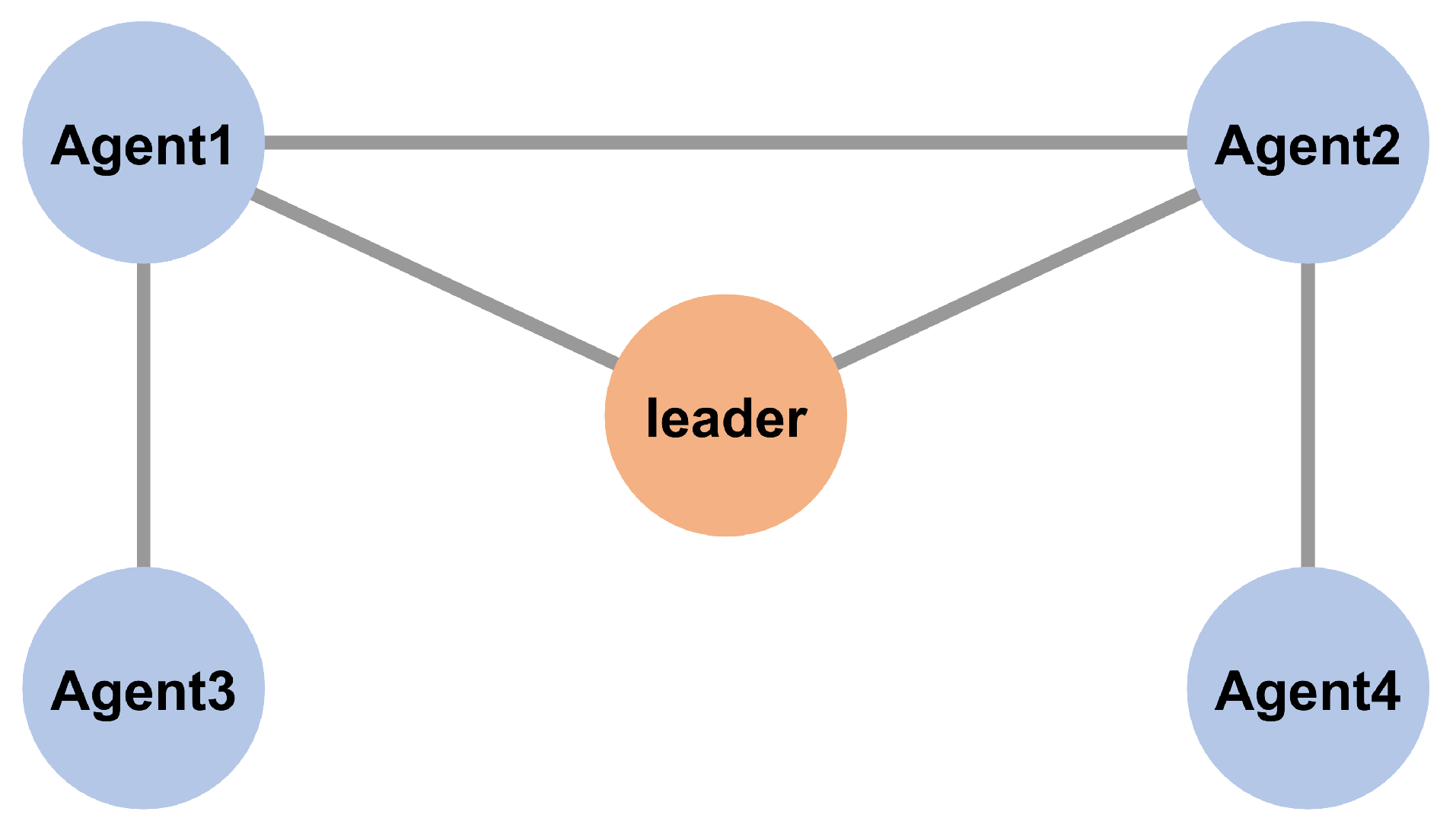
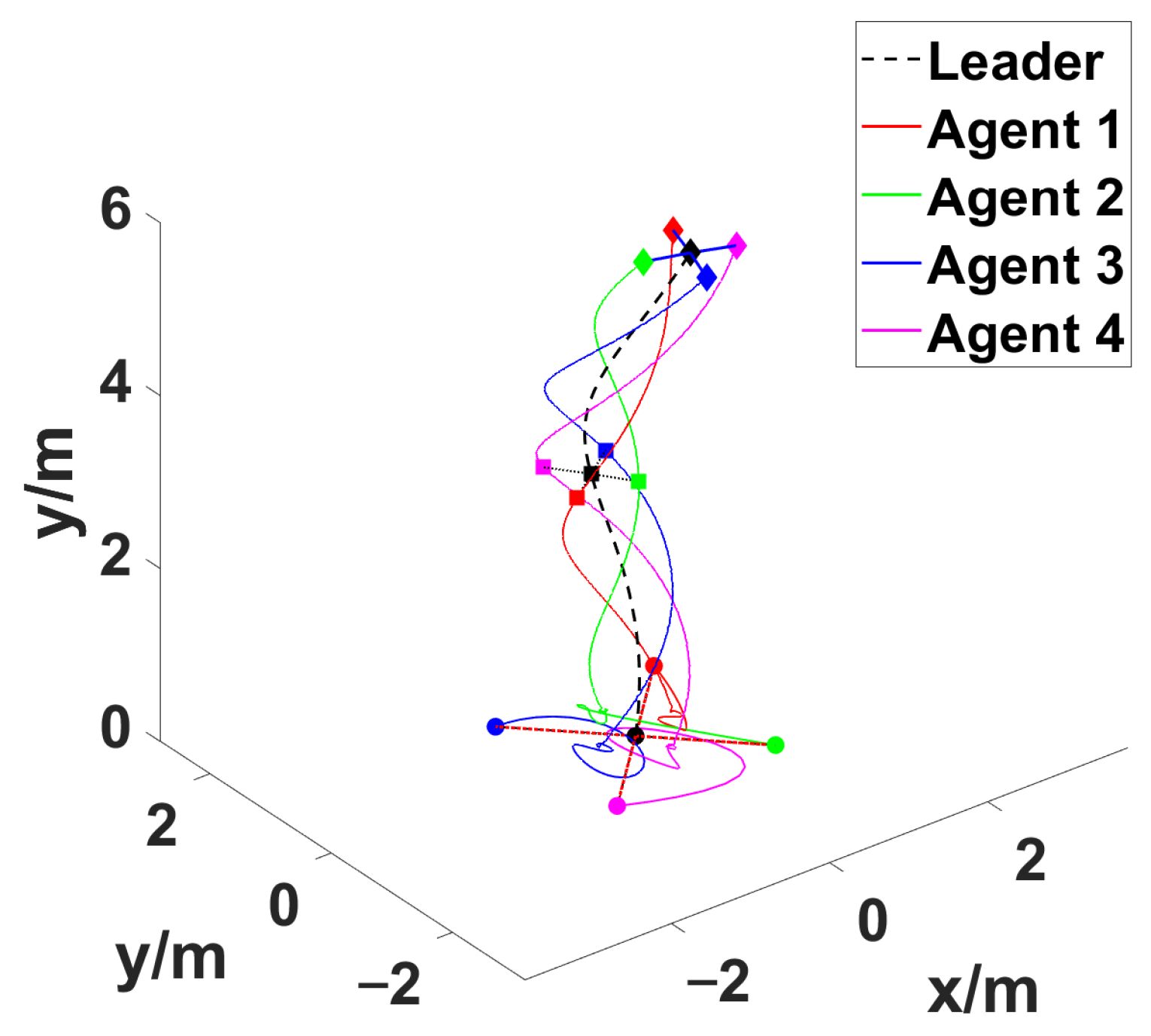
- Followers: The initial positions of the follower agents are set as , , , and , and all velocity components of all followers are zero.
- Leader: Position and velocity at origin.
5.2. Contrast Experiment
6. Conclusions
Author Contributions
Funding
Data Availability Statement
Conflicts of Interest
References
- Tang, J.; Duan, H.; Lao, S. Swarm intelligence algorithms for multiple unmanned aerial vehicles collaboration: A comprehensive review. Artif. Intell. Rev. 2023, 56, 4295–4327. [Google Scholar] [CrossRef]
- Hamidi, H.; Kamankesh, A. An approach to intelligent traffic management system using a multi-agent system. Int. J. Intell. Transp. Syst. Res. 2018, 16, 112–124. [Google Scholar] [CrossRef]
- Marco, K.; Goyal, S.; Kaur, R. Underwater wireless sensor network-based static and mobile node deployment using jellyfish optimization algorithm. Int. J. Distrib. Sens. Netw. 2025, 2025, 9964297. [Google Scholar] [CrossRef]
- Qu, X.; Li, C.; Jiang, S.; Liu, G.; Zhang, R. Multi-agent reinforcement learning-based cooperative encirclement control of autonomous surface vehicles against multiple targets. J. Mar. Sci. Eng. 2025, 13, 1558. [Google Scholar] [CrossRef]
- Olfati-Saber, R.; Fax, J.A.; Murray, R.M. Consensus and cooperation in networked multi-agent systems. Proc. IEEE 2007, 95, 215–233. [Google Scholar] [CrossRef]
- Liu, Y.; Liu, J.; He, Z.; Li, Z.; Zhang, Q.; Ding, Z. A survey of multi-agent systems on distributed formation control. Unmanned Syst. 2024, 12, 913–926. [Google Scholar] [CrossRef]
- Chen, Q.; Wang, Y.; Jin, Y.; Wang, T.; Nie, X.; Yan, T. A survey of an intelligent multi-agent formation control. Appl. Sci. 2023, 13, 5934. [Google Scholar] [CrossRef]
- Farooq, A.; Xiang, Z.; Chang, W.J.; Aslam, M.S. Recent advancement in formation control of multi-agent systems: A review. Comput. Mater. Contin. 2025, 83, 3. [Google Scholar] [CrossRef]
- Yan, C.; Zhang, W.; Guo, H.; Zhu, F.; Qian, Y. Distributed adaptive time-varying formation control for Lipschitz nonlinear multi-agent systems. Trans. Inst. Meas. Control 2022, 44, 272–285. [Google Scholar] [CrossRef]
- Ren, Y.; Zhang, K.; Jiang, B.; Cheng, W.; Ding, Y. Distributed fault-tolerant time-varying formation control of heterogeneous multi-agent systems. Int. J. Robust Nonlinear Control 2022, 32, 2864–2882. [Google Scholar] [CrossRef]
- Mohamed, A.; Marino, M.; Watkins, S.; Jaworski, J.; Jones, A. Gusts encountered by flying vehicles in proximity to buildings. Drones 2023, 7, 22. [Google Scholar] [CrossRef]
- Guo, S.; Chen, M.; Pang, W. Path planning for autonomous underwater vehicles based on an improved artificial jellyfish search algorithm in multi-obstacle ocean current environment. IEEE Access 2023, 11, 31010–31023. [Google Scholar] [CrossRef]
- Zhu, B.; Karimi, H.R.; Zhang, L.; Zhao, X. Neural network-based adaptive reinforcement learning for optimized backstepping tracking control of nonlinear systems with input delay. Appl. Intell. 2025, 55, 129. [Google Scholar] [CrossRef]
- Li, J.; Du, J.; Chang, W.J. Robust time-varying formation control for underactuated autonomous underwater vehicles with disturbances under input saturation. Ocean Eng. 2019, 179, 180–188. [Google Scholar] [CrossRef]
- Qu, X.R.; Liang, X.; Hou, Y.H. Fuzzy state observer-based cooperative path-following control of autonomous underwater vehicles with unknown dynamics and ocean disturbances. Int. J. Fuzzy Syst. 2021, 23, 1849–1859. [Google Scholar] [CrossRef]
- Amato, F.; Ambrosino, R.; Ariola, M. Finite-Time Stability and Control; Springer: London, UK, 2014. [Google Scholar]
- Yu, J.; Yu, S.; Li, J.; Yan, Y. Fixed-time stability theorem of stochastic nonlinear systems. Int. J. Control 2019, 92, 2194–2200. [Google Scholar] [CrossRef]
- Yao, Q. Disturbance observer-based robust fixed-time integrated trajectory tracking control for space manipulator. Robotica 2022, 40, 3214–3232. [Google Scholar] [CrossRef]
- Zhang, D.; Hu, J.; Cheng, J.; Wu, Z.G.; Yan, H. A novel disturbance observer based fixed-time sliding mode control for robotic manipulators with global fast convergence. IEEE/CAA J. Autom. Sin. 2024, 11, 661–672. [Google Scholar] [CrossRef]
- Yan, F.; Chen, G. Distributed consensus and coordination control of networked multi-agent systems. In Consensus and Synchronization in Complex Networks; Springer: Berlin/Heidelberg, Germany, 2012; pp. 51–68. [Google Scholar]
- Wang, J.; Du, J.; Li, J. Distributed finite-time velocity-free robust formation control of multiple underactuated AUVs under switching directed topologies. Ocean Eng. 2022, 266, 112967. [Google Scholar] [CrossRef]
- Chen, Q.; Jin, Y.; Wang, T.; Wang, Y.; Yan, T.; Long, Y. UAV formation control under communication constraints based on distributed model predictive control. IEEE Access 2022, 10, 126494–126507. [Google Scholar] [CrossRef]
- Li, J.; Du, J.; Li, Y.; Xu, G. Distributed robust prescribed performance 3-D time-varying formation control of underactuated AUVs under input saturations and communication delays. IEEE J. Ocean. Eng. 2023, 48, 649–662. [Google Scholar] [CrossRef]
- Ong, P.; Cortés, J. Performance-barrier-based event-triggered control with applications to network systems. IEEE Trans. Autom. Control 2023, 69, 4230–4244. [Google Scholar] [CrossRef]
- Kim, J.H.; Yoo, S.J. Distributed event-triggered adaptive output-feedback formation tracking of uncertain underactuated underwater vehicles in three-dimensional space. Appl. Math. Comput. 2022, 424, 127046. [Google Scholar] [CrossRef]
- Wang, H.; Su, B. Event-triggered formation control of AUVs with fixed-time RBF disturbance observer. Appl. Ocean Res. 2021, 112, 102638. [Google Scholar] [CrossRef]
- Zhao, W.; Xia, Y.; Zhai, D.H.; Cui, B. Adaptive event-triggered coordination control of unknown autonomous underwater vehicles under communication link faults. Automatica 2023, 158, 111277. [Google Scholar] [CrossRef]
- Huang, D.; Huang, T.; Qin, N.; Li, Y.; Yang, Y. Finite-time control for a UAV system based on finite-time disturbance observer. Aerosp. Sci. Technol. 2022, 129, 107825. [Google Scholar] [CrossRef]
- Guo, T.; Liu, Y.; Hu, H.X. Adaptive connectivity-preserving formation control with a dynamic event-triggering mechanism. J. Frankl. Inst. 2025, 362, 107331. [Google Scholar] [CrossRef]
- Wang, F.; Lai, G. Fixed-time control design for nonlinear uncertain systems via adaptive method. Syst. Control Lett. 2020, 140, 104704. [Google Scholar] [CrossRef]
- Liu, M.R.; Wu, L.B.; Wang, H.Q.; Guo, L.D.; Huang, S.J. Disturbance observer-based nonsingular fixed-time fuzzy adaptive event-triggered output feedback control of uncertain nonlinear systems. Fuzzy Sets Syst. 2025, 498, 109132. [Google Scholar] [CrossRef]



| Aspect | Reference [28] | Reference [29] | Reference [30] | This Work |
|---|---|---|---|---|
| System Complexity | Only random disturbances | Only unknown nonlinearities | Only unknown nonlinearities | Both random disturbances and unknown nonlinearities, and the model can be used for coordinate transformation |
| Disturbance and Nonlinearity Handling | Disturbance observer | Adaptive | Adaptive | Disturbance observer |
| Convergence Time | Finite-time | Asymptotic | Fixed-time | Fixed-time |
| Triggering Mechanism | Time-triggered | Event-triggered | Time-triggered | Event-triggered |
| Formation Type | Static formation | Static formation | Static formation | Time-varying formation |
| Computational Complexity | No processing | No processing | No processing | Dynamic surface technique |
| Agent 1 | Agent 2 | Agent 3 | Agent 4 | |
|---|---|---|---|---|
| 0 | 0 | 0 | 0 | |
| 0 | 0 | 0 | 0 |
| Agent 1 | Agent 2 | Agent 3 | Agent 4 | |
|---|---|---|---|---|
| d (10, 10, 10) | d (10, 10, 10) | d (10, 10, 10) | d (10, 10, 10) | |
| d (10, 10, 10) | d (10, 10, 10) | d (10, 10, 10) | d (10, 10, 10) | |
| d (0.1, 0.1, 0.1) | d (0.1, 0.1, 0.1) | d (0.1, 0.1, 0.1) | d (0.1, 0.1, 0.1) | |
| d (40, 40, 40) | d (40, 40, 40) | d (40, 40, 40) | d (40, 40, 40) | |
| d (2.5, 2.5, 2.5) | d (2.5, 2.5, 2.5) | d (2.5, 2.5, 2.5) | d (2.5, 2.5, 2.5) | |
| d (2.5, 2.5, 2.5) | d (2.5, 2.5, 2.5) | d (2.5, 2.5, 2.5) | d (2.5, 2.5, 2.5) | |
| d (10, 10, 10) | d (10, 10, 10) | d (10, 10, 10) | d (10, 10, 10) | |
| d (0.5, 0.5, 0.5) | d (0.5, 0.5, 0.5) | d (0.5, 0.5, 0.5) | d (0.5, 0.5, 0.5) | |
| d (0.5, 0.5, 0.5) | d (0.5, 0.5, 0.5) | d (0.5, 0.5, 0.5) | d (0.5, 0.5, 0.5) | |
| d (0.1, 0.1, 0.1) | d (0.1, 0.1, 0.1) | d (0.1, 0.1, 0.1) | d (0.1, 0.1, 0.1) | |
| d (0.2, 0.2, 0.2) | d (0.2, 0.2, 0.2) | d (0.2, 0.2, 0.2) | d (0.2, 0.2, 0.2) | |
| a | d (0.1, 0.1, 0.1) | d (0.1, 0.1, 0.1) | d (0.1, 0.1, 0.1) | d (0.1, 0.1, 0.1) |
| 0.01 | 0.01 | 0.01 | 0.01 | |
| 0.01 | 0.01 | 0.01 | 0.01 |
| Performance Metric | Proposed Method | Comparative Method | Improvement |
|---|---|---|---|
| Convergence Time (s) | 0.639 | 1.262 | 49.3% faster |
| Average Error (post-convergence) | 0.000603 | 0.000569 | – |
| Maximum Absolute Error (post-convergence) | 0.002663 | 0.002427 | – |
| Control Input Variance (post-convergence) | 4.959149 | 4.852426 | – |
| Average Triggering Interval (s) | 0.0238 | 0.0123 | 93.4% longer |
| Total Triggering Count | 1265 | 1667 | 24.1% reduction |
Disclaimer/Publisher’s Note: The statements, opinions and data contained in all publications are solely those of the individual author(s) and contributor(s) and not of MDPI and/or the editor(s). MDPI and/or the editor(s) disclaim responsibility for any injury to people or property resulting from any ideas, methods, instructions or products referred to in the content. |
© 2026 by the authors. Licensee MDPI, Basel, Switzerland. This article is an open access article distributed under the terms and conditions of the Creative Commons Attribution (CC BY) license.
Share and Cite
Yue, H.; Zhao, Y.; Wang, J.; Xue, D. Distributed Event-Triggered Fixed-Time Time-Varying Formation Control for Multi-Agent Systems. Mathematics 2026, 14, 588. https://doi.org/10.3390/math14040588
Yue H, Zhao Y, Wang J, Xue D. Distributed Event-Triggered Fixed-Time Time-Varying Formation Control for Multi-Agent Systems. Mathematics. 2026; 14(4):588. https://doi.org/10.3390/math14040588
Chicago/Turabian StyleYue, Hongyun, Yi Zhao, Jiaqi Wang, and Dongpeng Xue. 2026. "Distributed Event-Triggered Fixed-Time Time-Varying Formation Control for Multi-Agent Systems" Mathematics 14, no. 4: 588. https://doi.org/10.3390/math14040588
APA StyleYue, H., Zhao, Y., Wang, J., & Xue, D. (2026). Distributed Event-Triggered Fixed-Time Time-Varying Formation Control for Multi-Agent Systems. Mathematics, 14(4), 588. https://doi.org/10.3390/math14040588