


Abstract
Let R be a commutative ring with nonzero identity. A proper ideal I of R is cube-difference factor absorbing primary (cdf-primary) if, for all , implies or . This is the cubic counterpart of square-difference factor absorbing primarity, and it lies strictly between the cdf-absorbing and the cdf-semiprimary conditions. A recurring theme throughout is the protective role played by the prime 3, which has no counterpart in the quadratic theory and already separates the two conditions at the level of : is sdf-primary but not cdf-primary, whereas is cdf-primary but not sdf-primary. We characterize the cdf-primary radical ideals of an arbitrary commutative ring without any finiteness or comaximality assumption: a radical ideal is cdf-primary if and only if at most one of its minimal primes has a residue domain whose fraction field contains a primitive cube root of unity and, if there is one, every other minimal prime contains 3. We also show that the radical of a cdf-primary ideal is always cdf-primary. Over , for , the ideal is cdf-primary exactly when n is a prime power, or with prime, or n is squarefree with no prime factor congruent to 1 modulo 3. We also treat a weak variant and the behavior of cdf-primarity under the standard ring constructions.
Keywords:
cdf-primary ideal; cdf-absorbing ideal; cdf-semiprimary ideal; cdf-zero pair; primitive cube root of unity; ZPI-ring; Dedekind domain; localization MSC:
13A15; 11A41; 13B30; 13F05; 13F10
1. Introduction
Throughout this paper, all rings are commutative with nonzero identity, and R denotes such a ring. For a ring R and an ideal I, let denote the radical of I. An element is a prime element if it is nonzero, is not a unit, and generates a prime ideal. We write for the group of units and for the characteristic; for a field F, we also write for its multiplicative group. The nilradical of R is . For a prime power q, we write for the field with q elements so that for a prime p. For a positive integer n, we write and for the localization of at the prime . We write for the set of prime ideals of R and for the fraction field of an integral domain D. For a prime ideal P of R, we call the residue domain at P—the residue field when P is maximal—and the residue characteristic.
We follow [1] for standard terminology. We also use polynomial and formal power series rings, and the localization of R at a multiplicatively closed set S with and , together with the extended ideal . A nonzero integer n is squarefree if for every prime p; equivalently, .
A ring R is called a ZPI-ring if every proper ideal of R can be expressed as a finite product of prime ideals. This corresponds to a general Z.P.I.-ring in the terminology of [2], where the unqualified term is reserved for rings in which such factorizations are unique. Throughout this paper, we use ZPI-ring in this general sense. By [2] (see also [3]), this holds exactly when R is a finite direct product of Dedekind domains (fields included) and special principal ideal rings—that is, local principal ideal rings whose maximal ideal is nonzero and nilpotent. In a ZPI-ring, every primary ideal is a prime power (Result 1 and Corollary 1 [2]). The distinct minimal primes of a proper ideal are moreover pairwise comaximal, and every proper ideal factors as with its distinct minimal primes; both follow from the structure theorem, since a special principal ideal ring has a single prime, the minimal primes of a proper ideal of a Dedekind domain are the distinct maximal ideals occurring in its factorization—the single prime when the ideal is zero—and primes coming from different direct factors are comaximal. The exponents need not be unique. They are unique for a nonzero proper ideal of a Dedekind domain but not in general: in for every , and in for every . We fix one such factorization throughout. Note that an arbitrary product of primes need not consist of minimal primes: in , .
Prime and primary ideals have been generalized in many directions; see for example [4,5]. These conditions have recently been studied in other settings as well: for submodules [6], and relative to an expansion function of ideals, both for square differences [7] and for cube differences [8]. Anderson, Badawi, and Coykendall [9] recently introduced square-difference factor absorbing (sdf-absorbing) ideals, exploiting the factorization . A proper ideal I is sdf-absorbing if, for nonzero , implies or . Khashan, Yetkin Çelikel, and Tekir [10] then introduced square-difference factor absorbing primary (sdf-primary) ideals, where implies or , so that one factor is kept in I while the other is relaxed to the radical .
The cubic counterpart, exploiting , was developed in [11,12]. The former introduces cdf-absorbing ideals. A proper ideal I is cdf-absorbing if implies or . The latter introduces cdf-semiprimary ideals, again proper, in which each of the two alternatives is relaxed to , so that one asks for or . This paper treats the intermediate case, keeping in I and relaxing to . Thus, in the first alternative, cdf-primarity requires itself to lie in I, whereas cdf-semiprimality requires only . The two conditions are different: in is cdf-semiprimary but not cdf-primary (Example 2), because for and , the factor lies in but not in I. A proper ideal I is cdf-primary if
This is the cubic analogue of the sdf-primary condition, but it behaves differently for a reason that is purely arithmetic. Viewed as a quadratic in a, the polynomial has discriminant . Since is a square modulo, a prime exactly when , the residue of p modulo 3 decides, for such p, whether the polynomial can vanish modulo p without . The primes 2 and 3 fall outside this criterion and are treated directly. Lemma 1 and Corollary 1 record the three cases. For , the divisibility must be carried by the factor ; for , the two factors vanish together, which is the exceptional case; and for , the factor can carry it alone. It is this exceptional behavior of 3, which we call its protective role, that makes cdf-primary, while , which is sdf-primary by Example 5 [10], is not. The two conditions are in fact incomparable, being cdf-primary but not sdf-primary (Remark 25).
The three cubic classes form a strict hierarchy, cdf-absorbing ⊊ cdf-primary ⊊ cdf-semiprimary (Proposition 1, Examples 1 and 2). Every primary ideal is cdf-primary (Proposition 2), but is cdf-primary without being primary or prime (Example 3); the condition therefore acquires content once primarity fails. We also introduce a weak variant, together with the cdf-zero pairs that witness failures of cdf-primarity, and show it to be incomparable with cdf-semiprimarity (Remark 7). In two classes of rings, every proper ideal is cdf-primary but for opposite reasons: in characteristic 3, the second alternative always holds (Proposition 3, strengthening the semiprimary statement of [12]), and in a Boolean ring, the first (Proposition 4). The class is moreover stable under passage to (I:e) at an idempotent and under finite intersections of ideals with a common radical (Propositions 5 and 6). If is cdf-primary, then I is cdf-semiprimary (Lemma 3); ordered by inclusion, the cdf-primary ideals of R have as maximal elements exactly the maximal ideals of R (Remark 5).
Cdf-primarity, that is, the property of being cdf-primary, depends only on the quotient (Lemma 5), whereas the weak variant does not (Remark 8)—which is why parts (1) and (5) of Theorem 7 have no weak analogue. For an arbitrary radical ideal, the quotient description and localization yield the central result of this paper: an explicit criterion, the -condition, which records which of the minimal primes are of Type B—their residue domain having a fraction field that contains a primitive cube root of unity (Definition 4)—and which of the remaining ones contain 3 (Theorem 1). Moreover, if a proper ideal I of any ring is cdf-primary, then is cdf-primary and even cdf-absorbing (Theorem 2, Remark 14); hence the criterion, applied to the minimal primes of I, is a necessary condition for every cdf-primary ideal. In ZPI-rings, we make it explicit when 3 is a unit and when is maximal (Proposition 10, Theorem 3). The contrast with the quadratic theory persists: here, 3 plays the protective role that 2 plays there; the residue characteristics decide the types over but not over a general ZPI-ring (Remark 21); and where forces every sdf-primary ideal to be primary (Proposition 2 [10]), does not (Remark 15).
Over , this gives a complete classification: for , the ideal is cdf-primary precisely when n is a prime power, or for a prime , or n is squarefree with no prime factor congruent to 1 modulo 3 (Theorem 6, the squarefree case being Theorem 5). For Dedekind domains, we prove the cubic analogue of one implication of Theorem 4 [10] (Theorem 4); the converse fails as stated, and any genuine characterization must also constrain the non-radical ideals (Remark 22). Finally, cdf-primarity pulls back along every ring homomorphism and pushes forward along a surjection whose kernel lies inside the ideal (Proposition 12); it transfers through every construction that leaves unchanged—quotients, the ideal of , idealization, amalgamated algebras, and in —in each case for the same reason (Theorem 7). Localization requires a separate argument (Theorem 8, Proposition 13), and for a product of two proper ideals, we give a partial transfer result together with the exact criterion and its extension to finite products (Theorem 9, Propositions 14 and 15).
To our knowledge, the following have no direct counterpart in the quadratic papers [9,10] or in the earlier cubic papers [11,12]: the reduction to the zero ideal of (Lemma 5); the notion of Type B prime and the criterion of Theorem 1, with its consequence Theorem 2; Propositions 9 and 10; Theorems 3, 5 and 6; and the exact product criterion of Proposition 14 with its extension to finite products, Proposition 15. The incomparability with sdf-primarity (Remark 25) and the weak variant of Section 3 are likewise specific to the cubic setting.
2. Definition and Basic Properties
Definition 1.
A proper ideal I of R is a cube-difference factor absorbing primary (cdf-primary) ideal of R if, for all ,
We record two immediate consequences of the definition.
Remark 1.
- (1)
- Replacing b by shows that I is cdf-primary if and only if implies or .
- (2)
- Every prime ideal P is cdf-primary. Indeed, if , then , so or . In fact, P is cdf-absorbing.
The examples below rest on the behavior of modulo a prime, which falls into three cases according to the residue of that prime modulo 3.
Lemma 1.
Let p be a prime.
- (a)
- If , then for all with ; consequently, for such a and b, if and only if .
- (b)
- If , then if and only if , for all .
- (c)
- If , then for every b with , there is an a with and .
Proof.
Throughout, is cyclic of order , and any root of in satisfies , since .
Case , including : Here, , so has no element of order 3. A root of lies in , since , and its order divides 3; order 3 being impossible, , whence in and , contrary to . So, has no root in . Now, if with , then dividing by would make such a root; hence, . Since and p is prime, it follows that if and only if . This gives (a).
Case : Since , we have . So, . This gives (b).
Case : Fix b with . Here, , so contains an element of order 3, that is, a primitive cube root of unity (i.e., , , so ). Then, gives and (since and ). This gives (c). □
The equivalence in Lemma 1(a) survives the loss of the hypothesis , although the non-divisibility does not. We record that unrestricted form; parts (b) and (c) repeat Lemma 1, the latter in the weaker existential form used below, so that the three residue classes can be cited together.
Corollary 1.
Let p be a prime.
- (a)
- If , then for all we have if and only if .
- (b)
- If , then if and only if , for all .
- (c)
- If , then does not imply : there are with and .
Proof.
Part (a): If , Lemma 1(a) gives . Since p is prime and with the second factor not divisible by p, we obtain . If instead , then , so (using in the last step). Either way, .
Part (b) is Lemma 1(b). For part (c), take and let a be as in Lemma 1(c); then, , so , while . □
Remark 2.
Part (b) of Corollary 1 does not extend to higher powers of 3: for and , we have , while , so divides but not .
The cdf-absorbing, cdf-primary and cdf-semiprimary conditions are related by the following implications.
Proposition 1.
Let I be a proper ideal of R. If I is cdf-absorbing, then I is cdf-primary; and if I is cdf-primary, then I is cdf-semiprimary:
Proof.
Both implications follow from : for the first, apply it to the second alternative; for the second, apply it to the first. □
Neither implication of Proposition 1 is reversible, as Examples 1 and 2 will show. Before turning to them, we record the main source of cdf-primary ideals on which the first of these two examples rests.
Proposition 2.
Every primary ideal is cdf-primary.
Proof.
Let I be primary and . If , the second alternative holds. Otherwise, for all , so by the primary condition applied to , we obtain , and the first alternative holds. □
Example 1.
The ideal is cdf-primary but not cdf-absorbing.
I is not cdf-absorbing. Taking and gives , yet and , so neither factor is absorbed by I.
I is cdf-primary. In the principal ideal domain , the primary ideals are and the prime powers [1], so is primary; and every primary ideal is cdf-primary by Proposition 2.
Example 2.
The ideal in (with ) is cdf-semiprimary but not cdf-primary.
I is not cdf-primary. Take and . Then, , yet (since ) and (since ). Neither alternative of Definition 1 holds.
I is cdf-semiprimary. Let and be elements of R with . Since , the integer 2 divides each component of the cube difference. Corollary 1(a), applied with , therefore gives . Consequently, , which is the first alternative in the definition of a cdf-semiprimary ideal. Thus, I is cdf-semiprimary.
The converse of Proposition 2 is false, as the following example shows.
Example 3.
The ideal is cdf-absorbing, hence cdf-primary, but not primary.
By the description of the primary ideals of given in Example 1, and since is neither 0 nor a prime power, is not primary. For the other assertion, note that , so Corollary 1(a) applies to both prime factors: if , then and , whence . The first alternative therefore always holds.
The next two examples show how differently a prime and the prime 3 behave when paired with a prime .
Example 4.
The ideal is not cdf-primary. Here, and . Since , Lemma 1(c) applies, the relevant primitive cube roots of unity in being 2 and 4. Taking and (so that ), we obtain , while and . Neither alternative of the cdf-primary condition holds.
Example 5.
The ideal is cdf-primary. Here, and . Suppose , i.e., . Since 3 is prime and , it divides one of the two factors, and by Corollary 1(b), either alternative gives ; consequently, as well. For the 7-part: since 7 is prime and , either or . In the first case, and give , so . In the second case, and give , so . In all cases, one alternative of the cdf-primary condition holds.
The contrast rests on Corollary 1(b). Since and are equivalent, the prime 3 cannot separate the two alternatives; once it divides the product, it divides both factors, in particular whichever one 7 divides. The prime 2 is under no such constraint, and in , it does separate them. We refer to this behavior of 3—its inability to distinguish the two alternatives, and hence its harmlessness alongside a prime —as the protective role of 3.
The defining conditions of the three classes are compared in Table 1; in each row, I is a proper ideal of R and .
Table 1.
Comparison of the cdf-absorbing, cdf-primary, and cdf-semiprimary conditions.
The Table 1 omits the primary ideals, which are not a link in the chain, since by Proposition 2, they lie inside the cdf-primary class but are incomparable with the cdf-absorbing ideals. The ideal is primary but not cdf-absorbing (Example 1); conversely, is cdf-absorbing but not primary (Example 3).
The Table 1 also omits one of the four conditions obtained by placing each of the two factors in I or in , namely the dual condition
It lies between the cdf-absorbing and the cdf-semiprimary conditions, again because , and for radical I, it coincides with them (Lemma 2). Every primary ideal satisfies it: if I is primary and , then or . Over , every cdf-primary ideal satisfies it. By Theorem 6, it suffices to check the three forms of n; write and . Form (i) is primary, and in form (iii), the ideal is cdf-absorbing, since each prime factor of n divides d by Corollary 1(a),(b). For with , if , then and by Corollary 1(b); if , then , so , and otherwise , so . The dual condition does not imply cdf-primarity: satisfies it, because gives by Corollary 1(a) and by Corollary 1(b), so that ; yet is not cdf-primary (Remark 12). Whether cdf-primarity implies the dual condition in an arbitrary ring is open (Section 7).
In characteristic 3, the cube difference is itself a cube, and this already forces the cdf-primary condition on every proper ideal. More generally, the same conclusion holds for any proper ideal I satisfying .
Proposition 3.
Let I be a proper ideal of R. If , then I is cdf-primary. In particular, if , then every proper ideal of R is cdf-primary.
Proof.
Suppose that . Since and , we have .
As is radical, it follows that . Therefore, .
Thus, the second alternative of Definition 1 holds, and hence I is cdf-primary. If , then for every proper ideal I, so the final assertion follows. □
Remark 3.
Proposition 3 strengthens (Proposition 2.7 [12]), which establishes the cdf-semiprimary conclusion for every proper ideal of a ring of characteristic 3. Proposition 3 does not require ; it is enough that for the proper ideal I, and the stronger cdf-primary conclusion follows. This conclusion is also reflected in Lemma 4, which shows that when ,
The proof above directly establishes the second alternative of Definition 1. The first alternative (, not merely ) may fail. In with , the pair , has , while .
Boolean rings form a second class of rings all of whose proper ideals are cdf-primary. Here, in contrast with the case, it is the first alternative that holds.
Proposition 4.
Every proper ideal of a Boolean ring is cdf-primary.
Proof.
In a Boolean ring, for all a. Hence, whenever . The first alternative of Definition 1 holds. □
When I is its own radical, the cdf-absorbing, cdf-primary and cdf-semiprimary conditions have nothing left to distinguish them.
Lemma 2.
Let I be a proper ideal of R. If I is radical, that is , then the conditions cdf-absorbing, cdf-primary and cdf-semiprimary coincide for I.
Proof.
Since , all three conditions read: implies or . □
A one-sided version of the collapse survives without the radical hypothesis.
Lemma 3.
If the radical of a proper ideal I of R is cdf-primary, then I is cdf-semiprimary.
Proof.
Let . Then, , so the cdf-primarity of gives or . Both alternatives place their factor in , which is the cdf-semiprimary condition for I. □
Read modulo ; the two alternatives can be told apart precisely when .
Lemma 4.
Let I be a proper ideal of R. The following conditions are equivalent:
- (1)
- For all : .
- (2)
- .
- (3)
- .
Proof.
(1) ⇒ (2): Setting gives , so (1) yields .
(2) ⇒ (1): Since , we have for all , and . Thus, if and only if . Since is a radical ideal, if and only if . Hence, .
(2) ⇔ (3): says that in , that is, ; and is proper, so the characteristic is not 1. □
The cdf-primary condition is inherited by the ideal quotient at an idempotent e outside I.
Proposition 5.
Let I be cdf-primary and an idempotent. Then, is a cdf-primary ideal of R.
Proof.
The ideal is proper since (as ). We claim . Since e is idempotent, for all , so . Hence, if and only if , which means if and only if , i.e., . Thus, .
Now, let . Then, . By the cdf-primarity of I, applied to the pair , either or , where the last equality again uses . In the first case, . In the second, . □
Remark 4.
Both hypotheses on e are used. That makes proper, and idempotence enters three times: in , in and in . The first of these is the essential one, since it supplies the inclusion ; the opposite inclusion holds for every e, but equality can fail without idempotence. In with and , for instance, while .
Like the primary condition, the cdf-primary condition is stable under finite intersections of ideals sharing a common radical.
Proposition 6.
Let and let be cdf-primary ideals of R with a common radical for all . Then, is cdf-primary with .
Proof.
The ideal I is proper, being contained in the proper ideal . Since for each i, we have . Conversely, for any , choose with and set , which exists because there are finitely many ; then, for all i, so and . Hence, .
Now, suppose and . Then, there exists i with . Since is cdf-primary and , we obtain . Hence, I is cdf-primary. □
Ordered by inclusion, the cdf-primary ideals of R have an easily described set of maximal elements.
Remark 5.
Every maximal ideal is prime, hence cdf-primary by Remark 1(2), and every cdf-primary ideal is proper and therefore contained in a maximal ideal. A maximal ideal M is therefore a maximal element, since any cdf-primary ideal containing M is proper and hence equals M. Conversely, a maximal element J of the family is proper, hence contained in some maximal ideal M; since M is itself cdf-primary, the maximality of J forces . The maximal elements are therefore exactly the maximal ideals of R, and in particular, they always exist. The family is also closed under unions of chains: if is a nonempty chain of cdf-primary ideals, then is a proper ideal because for every α, and if , then for some α, so or , the last inclusion holding because and the radical is monotone.
Combined with Proposition 6, this gives the following structure. For a prime ideal P of R, let be the set of cdf-primary ideals with radical P. It is closed under finite intersections by Proposition 6 and under unions of nonempty chains: the union L of such a chain is cdf-primary, and gives , so . Its largest element is P: every member is contained in its radical P, and P itself lies in , being prime (Remark 1(2)).
The quotients provide useful examples of cdf-primary ideals. The proper ideals of are of the form , where and . As will be shown in Section 6, is cdf-primary in if and only if is cdf-primary in . Together with the characterization that will be established in Section 5, this determines the cdf-primary ideals of . In particular, it will follow that every proper ideal of and is cdf-primary, since the corresponding divisors are prime powers. When , the ideal is . Since is not cdf-primary (Example 4), whereas is cdf-primary (Example 5), the result in Section 6 will imply that is cdf-primary in but not in .
3. Weakly Cdf-Primary Ideals
Definition 2.
A proper ideal I of R is weakly cdf-primary if, for all ,
The pairs that violate the cdf-primary condition recur throughout, so we name them.
Definition 3.
Let I be a proper ideal of R. A cdf-zero pair of I—the “zero” refers to vanishing modulo I, not to a or b—is a pair with , , and .
Comparing Definitions 1 and 3, we see that a proper ideal I is cdf-primary if and only if it has no cdf-zero pair.
Remark 6.
If is a cdf-zero pair of I, then so is , and . Indeed, , , and holds if and only if , which fails by hypothesis; and would give .
Every cdf-primary ideal is weakly cdf-primary. The zero ideal is vacuously weakly cdf-primary, since is impossible.
The weak condition can be read off from the cdf-zero pairs alone.
Proposition 7.
A proper ideal I of R is weakly cdf-primary if and only if every cdf-zero pair of I satisfies in R.
Proof.
Suppose I is weakly cdf-primary, and let be any cdf-zero pair of I so that , and . If was nonzero, the weak condition would give or , contradicting the choice of the pair; hence, .
Conversely, suppose every cdf-zero pair of I has vanishing cube difference, and let with . If neither nor , then is a cdf-zero pair with , which is contrary to the hypothesis. So, one of the two alternatives holds, and I is weakly cdf-primary. □
Thus, for a weakly cdf-primary ideal, cdf-primarity can fail only at pairs whose cube difference is zero in R—not merely zero modulo I. Since , this can be restated in terms of zero-divisors of R: for a cdf-zero pair, gives and gives , so says that these two nonzero elements annihilate each other. Hence, I is weakly cdf-primary if and only if for every cdf-zero pair of I; the annihilators are taken in R and not in , which is consistent with Remark 8 below. The next three examples exhibit ideals that are weakly cdf-primary but not cdf-primary. In the first two, the ideal is zero and the weak condition holds vacuously; the ideal is radical in Example 6 and not in Example 7. In the third, the ideal is nonzero, and the condition has to be checked on pairs that actually occur.
Example 6.
In , is radical () and weakly cdf-primary but not cdf-primary. It is vacuously weakly cdf-primary, as noted above. To see that is not cdf-primary, take and . Then, , and since , we have in , so . However, and ; since , we have . Hence, is a cdf-zero pair. So, the collapse of cdf-absorbing, cdf-primary and cdf-semiprimary for radical ideals (Lemma 2) does not extend to the weak condition.
Example 7.
In , with is weakly cdf-primary but not cdf-primary. Again, is vacuously weakly cdf-primary. To see that it is not cdf-primary, take and . Then, , so . Yet , so ; and , which is not in . Hence, is a cdf-zero pair.
Example 8.
In , let , with . This ideal is not cdf-primary, but it is weakly cdf-primary. The pair of Example 7, read in , shows that I is not cdf-primary: lies in I, while and does not lie in . For weak cdf-primarity, note that 20 is the only nonzero element of , so it suffices to show that forces . For modulo 5, we have , hence by Corollary 1(a). For modulo 8, we have ; since for even c and for odd c modulo 8, both a and b must be odd and then . By the Chinese Remainder Theorem, , that is, . The verification is not vacuous: and give and .
Proposition 8.
For a ring R, the following are equivalent.
- (1)
- Every weakly cdf-primary proper ideal of R is cdf-primary; that is, the weak and the ordinary conditions coincide for all proper ideals of R.
- (2)
- The zero ideal of R is cdf-primary: implies or .
Condition (2) holds if cubing is injective on R (as on ) or if R is a domain; for reduced R, it holds exactly when satisfies the -condition.
Proof.
(1) ⇒ (2): The zero ideal is vacuously weakly cdf-primary, hence cdf-primary by (1). (2) ⇒ (1): let I be weakly cdf-primary and suppose is a cdf-zero pair of I. By Proposition 7, ; moreover, because , and . So, , and , which makes a cdf-zero pair of the zero ideal, contradicting (2). Hence, I has no cdf-zero pair and is cdf-primary.
If cubing is injective, gives . If R is a domain, gives , so or . If R is reduced, its zero ideal is radical and Theorem 1 applies. □
The rings in the three examples above are quotients of on which cubing is not injective, and none of them satisfies (2): the zero ideals of and are not cdf-primary (Examples 6 and 7), and neither is that of by the pair . Injectivity of cubing is sufficient for (2) but not necessary: cubing is not injective on , where with , yet 9 is a prime power, so every proper ideal of is cdf-primary (see the discussion closing Section 2), and in , the two conditions agree.
The two weakenings of the cdf-primary condition considered so far—relaxing the first alternative to the radical, and restricting attention to nonzero cube-differences—are independent of one another.
Remark 7.
The classes cdf-semiprimary and weakly cdf-primary are incomparable.
cdf-semiprimary weakly cdf-primary. The ideal is cdf-semiprimary but not weakly cdf-primary. For the first assertion, is cdf-primary (Example 5), so is cdf-semiprimary by Lemma 3. To see that is not weakly cdf-primary, take and . Then, , while and with , so .
weakly cdf-primary cdf-semiprimary. The zero ideal of serves again. It is vacuously weakly cdf-primary, and since it is radical, it is cdf-semiprimary if and only if it is cdf-primary (Lemma 2). Example 6 shows that it is not.
The six classes considered so far fit into a single diagram of implications.
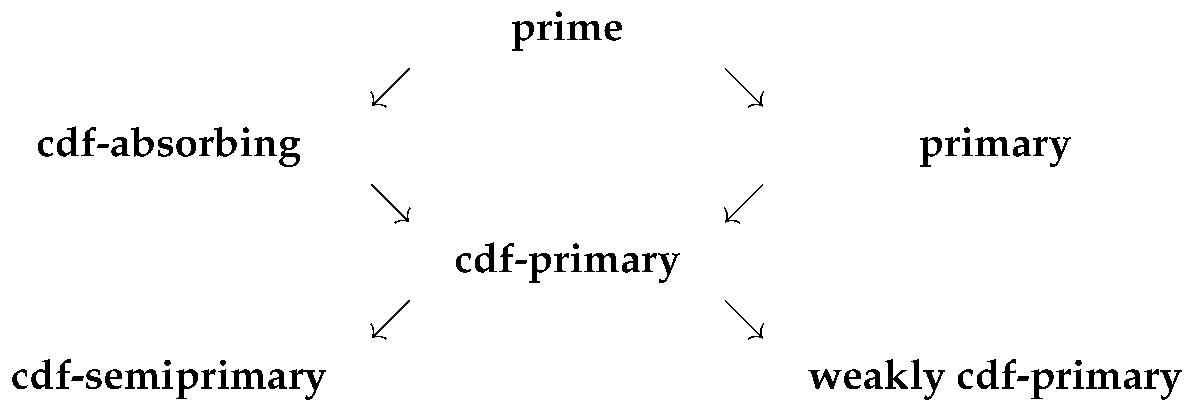
Read from the top down and from left to right, the arrows are justified by Remark 1(2); the standard implication that a prime ideal is primary; Proposition 1; Proposition 2; Proposition 1 again; and, for the last arrow, the fact that Definition 2 restricts the hypothesis of Definition 1. All six are strict.
The witnesses follow: for prime ⊊ cdf-absorbing and for primary ⊊ cdf-primary (Example 3; is not prime); for prime ⊊ primary (Example 1 describes the primary ideals of ); for cdf-absorbing ⊊ cdf-primary (Example 1); for cdf-primary ⊊ cdf-semiprimary (Example 2); and the zero ideal of for cdf-primary ⊊ weakly cdf-primary (Example 6).
Neither row of two is joined by an arrow in either direction: primary and cdf-absorbing are incomparable (Examples 1 and 3; witnesses and ), and so are cdf-semiprimary and weakly cdf-primary (Remark 7; witnesses and the zero ideal of ). Outside the diagram, cdf-primary and sdf-primary ideals are incomparable as well with witnesses and (Remark 25).
4. Characterizations for an Arbitrary Commutative Ring
The cdf-primary condition offers two alternatives of different natures: one asks for membership in I and the other only in . We begin by showing that both are already visible in the quotient . For a radical ideal of an arbitrary ring, that observation becomes an explicit criterion on the residue domains of the minimal primes. The consequences for the radical of an arbitrary ideal are recorded at the end of the section together with the limits of the criterion for non-radical ideals and the proof that the radical of a cdf-primary ideal is cdf-primary.
Lemma 5.
Let I be a proper ideal of R and write . The following are equivalent.
- (1)
- I is cdf-primary.
- (2)
- The zero ideal of is cdf-primary in ; that is, for all with , either or .
- (3)
- For every and all with and , one has .
- (4)
- There is no triple with P a prime of R containing I, , and .
Proof.
Let be the quotient map and set , ; since is surjective, every pair of elements of arises in this way. Then, if and only if ; if and only if ; and if and only if . Reading Definition 1 through these three equivalences turns (1) into (2).
We next prove (1) ⇔ (4) and (1) ⇔ (3) both by contraposition. Write as the intersection of the primes containing I, which identifies with the primes of . Then, says precisely that for at least one prime . A failure of cdf-primarity is a pair with , and ; by the previous sentence, this is the same as a triple as in (4); and this same failure is likewise, transported to along and , which is the same as a violation of (3). Hence, (1) ⇔ (4) and (1) ⇔ (3), which with (1) ⇔ (2) above gives the lemma. □
Remark 8.
The reduction in Lemma 5(2) has no counterpart for the weak condition, because weak cdf-primarity is not determined by the quotient ring. Read in , the integers and underlying Example 6 give with , while and ; so is not weakly cdf-primary in . The zero ideal of , by contrast, is weakly cdf-primary, vacuously. Yet and are the same ring. The obstruction is that the hypothesis refers to R and not to .
Consequently, no characterization of the weak condition can depend on the isomorphism class of alone, and the weak analogues of parts (1) and (5) of Theorem 7 both fail. Part (1) allows any and fails already at , where is the zero ideal of and hence weakly cdf-primary for every I, while I itself need not be, as shows; and part (5) fails at in , where and give , a nonzero element of the ideal, while lies outside the ideal and outside its radical. What the weak condition does admit is the intrinsic reformulation of Proposition 7, which speaks about pairs in R rather than about .
By Lemma 5(4), a failure of cdf-primarity is witnessed by a single prime above I. The dichotomy that governs a single prime is whether the fraction field of its residue domain contains a primitive cube root of unity; we name it next.
Definition 4.
A prime ideal P of R is of Type B if has a solution with and and of Type A otherwise. Equivalently, P is of Type B exactly when contains a primitive cube root of unity, i.e., when has a root in other than 1.
The two formulations agree. Given and as in the first, dividing by makes a root of , and this root differs from 1 because . Conversely, write a root as with and ; then, , is a solution, since , and because . In the first formulation, the requirement is redundant, since any solution with has it automatically: were zero, the equation would reduce to and hence, being a domain, force , contrary to .
Remark 9.
Five observations are worth recording separately.
- (1)
- A prime P containing 3 is of Type A, whatever its residue domain. Indeed, means (Lemma 4 applied to P), and in characteristic 3, the identity holds, so a solution with would make a nonzero element whose square is zero, which a domain does not have.
- (2)
- When is the prime field , P is of Type B exactly when and of Type A exactly when , by Lemma 1(a), (b) and (c); item (1) covers the case as well.
- (3)
- Item (2) is the case of the following uniform criterion. When is a finite field , the group is cyclic of order , so a primitive cube root of unity is present exactly when , and P is of Type B precisely then. For , the characteristic need not decide the type, since can occur while : a prime with residue field or is of Type B, whereas one with residue field or , of the same characteristics, is of Type A.
- (4)
- When has characteristic 0, Type B holds exactly when is a square in : there, t is a root of precisely when , and is not a root because . Thus, a prime with residue domain or is of Type B, while one with residue domain , or is of Type A.
- (5)
- Type B is a property of the fraction field (equivalently, of the homogeneous equation in of Definition 4); it asks for a root of in , not in itself. A root lying in makes P of Type B, and the converse holds whenever is integrally closed (for instance a field, a unique factorization domain or a Dedekind domain), because ω is integral over , being a root of the monic polynomial . The converse fails in general: in , the prime is of Type B, since contains (take and in Definition 4), whereas , so that has no root in .
For a radical ideal, cdf-primarity is decided by the types of its minimal primes and by which of them contain 3: a prime of Type B is tolerated only if every other minimal prime contains 3. This is the content of Theorem 1, which requires neither the finiteness of the set of minimal primes nor any comaximality. Its proof compares with the residue domains of the primes involved, and we first record what that comparison yields.
Lemma 6.
Let be a nonempty family of distinct prime ideals of R, and let . For put , a domain, and for , write for the image of x under the quotient map . Given , say that P satisfies if , and that it satisfies if . Then, the following apply:
- (1)
- if and only if every satisfies , and if and only if every satisfies ;
- (2)
- if and only if every satisfies or .Moreover, for every prime ideal P of every ring A, with :
- (3)
- P is of Type B if and only if there are with and ;
- (4)
- if and only if there is a with .
Informally, records equality of a and b at P, and records vanishing of the quadratic factor there; the proof below simply unwinds Definitions 1 and 4 one prime at a time.
Proof.
An element of R lies in I exactly when it lies in every , that is, when its image in every vanishes. Applied to and to , this criterion gives (1). Applied to , it says that for every P; since is a domain and , this holds precisely when each P satisfies or , which is (2).
Part (3) is the first formulation of Definition 4 with the requirement dropped; the paragraph following that definition shows the requirement to be redundant.
For (4), says exactly that in D. If it holds, take , so that ; if it fails, in D and for every . □
We say that a nonempty set of prime ideals of R satisfies the -condition if at most one member of is of Type B and, when is of Type B, every with contains 3. Since a prime containing 3 is of Type A (Remark 9(1)), this is the same as demanding that for every Type B member P of , every other member contains 3. Throughout, Type B refers to the fraction field of the residue domain, equivalently to the homogeneous equation of Definition 4 in ; this is weaker than asking for a root of in itself, as Remark 9(5) explains. We can now prove the criterion announced above.
Theorem 1.
Let R be a ring, let I be a proper radical ideal of R, and let be the set of minimal primes of I. The following are equivalent.
- (1)
- I is cdf-primary.
- (2)
- For every of Type B, every with contains 3.
- (3)
- The set satisfies , and if , then for all .
Thus, I is cdf-primary if and only if satisfies the -condition. Moreover, if for some nonempty set of primes that satisfies the -condition, then I is cdf-primary; here, need be neither finite nor consist of minimal primes, and its members need not be comaximal.
Proof.
Since I is proper and radical, the cdf-primary condition on I reads: or . Every prime containing I contains a minimal prime of I, so the radical ideal I, the intersection of the primes containing it, is the intersection of ; and because I is proper.
Sufficiency is explained next in the general form. Let be a nonempty set of primes with satisfying the -condition, and use the notation of Lemma 6. Let with ; by Lemma 6(2), every satisfies or . Suppose toward a contradiction that neither nor . Then, by Lemma 6(1), some fails and some fails . Since every member satisfies or Q, at P, it is that holds and at it is ; the latter gives , so , which is nonzero because fails. Necessarily , since by the same disjunction, no member can fail both. Now, and , so P is of Type B by Lemma 6(3); and gives by Lemma 6(4). This violates the -condition for . Hence, or , and I is cdf-primary. Applied to , this shows that the -condition for implies (1).
(1) ⇒ (2): Suppose I is cdf-primary, and suppose toward a contradiction that (2) fails: some is of Type B while some , , has . The ideals P and are distinct minimal primes of I and hence incomparable. Let ; it is multiplicatively closed, since P and are prime, and , . As , we have , so is cdf-primary in by Theorem 8 (whose proof is elementary and does not use the results of this section, so there is no circularity). Put and .
The primes of T containing J correspond to the primes of R with and , i.e., . By prime avoidance, or , and the minimality of P and over I then forces or . So, M and N are the only primes of T containing J; since P and are incomparable, neither contains the other, so both are maximal and . Consequently, . Moreover, J is radical: if , then for some ; hence, , so and . Thus, .
The residue ring is the localization of at the image of S, which does not contain 0; it is a domain lying between and and has the same fraction field. So, M is of Type B, because P is. Also, the preimages of M and N in R are P and , whence , as . By Lemma 6(3),(4), applied to the primes M and N of T, choose in with and with . Since and , the Chinese Remainder Theorem gives an isomorphism , and so elements whose images are and , respectively. Then, maps to , so ; maps to , so ; and maps to , so . This contradicts the cdf-primarity of J. Hence, (2) holds.
(2) ⇒ (3): Suppose (2) holds. If , say with , then (2) applied to requires ; but a prime containing 3 is of Type A (Remark 9(1)), so , which is a contradiction. So, . If , condition (2) applied to is exactly the remaining clause of (3).
(3) ⇒ (1): Condition (3) says that satisfies the -condition, and , so I is cdf-primary by the sufficiency argument above. This closes the cycle (1) ⇒ (2) ⇒ (3) ⇒ (1). □
Remark 10.
When the minimal primes are finitely many and pairwise comaximal, as happens in a ZPI-ring, the localization in the proof of (1) ⇒ (2) is not needed: for , the Chinese Remainder Theorem yields directly, and it does so over in the explicit form of Remark 23. More generally, if with pairwise incomparable primes, then : a prime containing contains some , so every minimal prime of I is among the , and each is minimal because any prime with contains some , forcing , hence and . Pairwise comaximal distinct primes are pairwise incomparable, so Theorem 1 applies to the intersection of finitely many pairwise comaximal primes, with in place of . For infinite families, the intersection of the members need not have them as minimal primes, which is why the last sentence of Theorem 1 states sufficiency only.
Depending on the size of and on whether the remaining minimal primes contain 3, four mutually exclusive and exhaustive cases arise, each of which Theorem 1 decides.
Corollary 2.
Let I be a proper radical ideal of R and the set of Type B primes in :
- (1)
- If every minimal prime of I is of Type A, then I is cdf-primary.
- (2)
- If exactly one minimal prime of I is of Type B and every other minimal prime contains 3, then I is cdf-primary.
- (3)
- If two or more minimal primes of I are of Type B, then I is not cdf-primary.
- (4)
- If exactly one minimal prime of I is of Type B and some other minimal prime does not contain 3, then I is not cdf-primary.
Proof.
Immediate from the equivalence (1) ⇔ (3) of Theorem 1: cases (1) and (2) are the two ways the -condition can hold, and cases (3) and (4) are the two ways it can fail. □
Remark 11.
In case (1) of Corollary 2, where every minimal prime of I is of Type A, the first alternative of Definition 1 always holds. The argument applies to any nonempty family of Type A primes with , in the notation of Lemma 6; take . Let with . If failed for some , so that , then part (2) of that lemma would force there, that is, ; part (3) would then show P to be of Type B, contrary to the assumption. So, holds for every , and by part (1).
Example 9.
In , the prime , for a prime number p, is of Type B exactly when by Remark 9(2), the residue field at being the prime field ; the minimal primes of a nonzero radical ideal of being the primes with p dividing it, Corollary 2 recovers Examples 3, 4 and 5 at once. Six representative cases are collected in Table 2.
By Remark 11, the first alternative always holds for , which is therefore even cdf-absorbing. In , the presence of does not rescue the ideal, since case (2) asks that every prime other than the Type B one contain 3; in , the only such prime is itself, which is of Type A because it contains 3. Theorem 5 below turns these case-by-case verdicts into a complete criterion for squarefree n.
Table 2.
Six representative cases for cdf-primary ideals over the integers.
Theorem 1 also reaches non-radical ideals through their radicals: an ideal I and its radical lie in the same primes and hence have the same minimal primes.
Corollary 3.
Let I be a proper ideal of a ring R. Then, is cdf-primary if and only if the set of minimal primes of I satisfies the -condition; when I is itself radical, this says that I is cdf-primary if and only if satisfies the -condition.
Proof.
The ideal is proper and radical, and , the primes containing I being those containing . Theorem 1 applied to gives the first assertion; when I is radical, we have , which gives the second. □
A primary ideal is cdf-primary in any ring (Proposition 2), whereas Corollary 3 only gives information about its radical, which is prime. The hypothesis that I be primary cannot, however, be weakened to “ is prime”: an embedded prime can destroy cdf-primarity, as the next example shows.
Example 10.
Let F be a field with . The ideal in has prime radical and is not primary, and it is not cdf-primary. Here, , so is prime, but I is not primary, since it has the embedded prime ; indeed, , , yet , so the primary condition fails.
Take and . Then,
while (as I is generated in degree 2 and x has degree 1), and takes the value at , so , i.e., . This last step is the only one that uses , and it must, because in characteristic 3, every proper ideal is cdf-primary (Proposition 3). Thus, is a cdf-zero pair, and I is not cdf-primary despite having the single minimal prime .
Remark 12.
In the second assertion of Corollary 3, the restriction to radical I cannot be lifted: for non-radical I, the -condition need not suffice for I itself to be cdf-primary, even when . For example, has with minimal primes and . Since and , both primes are of Type A (Remark 9(1) and (2)) and . Yet is not cdf-primary: the pair of Example 6, read in , has , while and .
Here, , and the two alternatives fail for different reasons. The first fails at the primary component : the two entries of the pair are congruent modulo , since , but . The second fails at , where as well, so that because ; hence, .
Necessity is a different matter. By Theorem 2, the cdf-primarity of I implies that of in every ring, so by Corollary 3, the -condition on is necessary for I itself. It is not sufficient: shows this with , and the ideal with (Remark 18, with Remark 24). For , the non-radical case is nevertheless settled completely by Theorem 6.
Example 11.
Theorem 1 applies in rings whose minimal primes are not comaximal, and they are even infinite in number.
(a) Let F be a field containing a primitive cube root of unity ω (for instance ; then, ), and let in . Then, , and these primes are not comaximal, since . Their residue domains and have fraction fields containing ω, so both primes are of Type B and I is not cdf-primary by Corollary 2(3). An explicit cdf-zero pair is , : one finds , and , so that
using , while and , because and .
(b) Let in . Again, and these primes are not comaximal. Their residue domains and are of Type A: if , in lowest terms, satisfied , then would give and , so f and g would be constants in , and has no root in . So, I is cdf-primary by Corollary 2(1) and indeed cdf-absorbing by Remark 11.
(c) Let with . For each i, let ; the map sending and for is well defined and surjective with kernel , so is prime with residue domain . Every element of R has the form (finite sum) with and , and it lies in every only if for all i, which forces it to be 0; so is radical. A prime of R cannot omit two of the , since , so it contains for some i; and shows that the are pairwise incomparable. Hence, is infinite, and these primes are not pairwise comaximal, as they all lie in . The residue fields contain no primitive cube root of unity by the argument of (b) together with the fact that has no root in . So, every minimal prime is of Type A, and is cdf-primary by Corollary 2(1); it is not primary, since while neither factor is nilpotent.
Theorem 2.
Let I be a proper ideal of an arbitrary ring R. If I is cdf-primary, then satisfies the -condition. Consequently, is cdf-primary and indeed cdf-absorbing.
Proof.
Once the -condition for is known, Corollary 3 shows that is cdf-primary, and Lemma 2 shows that, being radical, it is cdf-absorbing. So, suppose the -condition fails for : there are distinct with P of Type B and . We use the localization at and its ideals , and from the proof of (1) ⇒ (2) of Theorem 1. The following facts were established there without using that I is radical: J is a proper cdf-primary ideal of T by Theorem 8; M and N are the only primes of T containing J, and they are maximal and comaximal; is a field with the same fraction field as , so that M is of Type B, and . Only the final assertion of that proof used radicality, and it is not needed here.
Step 1: is a product of two local rings with nil maximal ideals. Put , and write for the images of ; these are the only primes of C, both maximal, so . As , write with and . Then, , so for some . Expanding shows that , say . Put ; then, , and , so e is an idempotent and with and . The primes of A correspond to the primes of C containing e, that is, to alone (as shows ), and likewise B has the single prime . Thus, A and B are local rings whose maximal ideals and are nil with residue fields and .
Step 2: lifting a root of to A. Let . Since M is of Type B, there is with and . Moreover, in , because by Remark 9(1) and M contracts to P; hence, , since . Choose lifting and put ; as is nil, for some . Define . We claim that for every j, is defined, and . For , this is clear. If it holds for j, then , so is a unit of the local ring A and is defined; the correction lies in , so ; and since g is monic quadratic,
Choose j with and put : then and , so is a unit of A.
Step 3: a cdf-zero pair. In , put and . Then, and . Also, , and because and N contracts to , so 3 is a unit of B and no power of vanishes; thus, . So, is a cdf-zero pair of the zero ideal of , and J is not cdf-primary by Lemma 5(2). This contradicts the cdf-primarity of J and proves the theorem. □
5. ZPI-Rings, Dedekind Domains and the Integers
We now make the results of the previous section explicit for ZPI-rings and for . Since every proper ideal of a ZPI-ring is a finite product of primes, Theorem 1 becomes a statement about the prime factorization of I; over , where the residue field at the maximal ideal is , Remark 9(2) turns the Type A/Type B dichotomy into a congruence condition modulo 3.
Proposition 9.
Let R be a ZPI-ring and a proper ideal, the being its distinct minimal primes. If I is cdf-primary, then is cdf-primary.
Proof.
The radical of I is the intersection of its minimal primes, and in a ZPI-ring, these are pairwise comaximal (Section 1). Their powers are comaximal as well, since raising to the power gives . Comaximal ideals meet in their product, so and the Chinese Remainder Theorem gives . This splitting is used twice below: its surjectivity produces the pair , and the equality recognizes when lies in I.
Since are the minimal primes of , Theorem 1 applies to and says that is cdf-primary if and only if the -condition holds for . We show that this condition holds whenever I is cdf-primary.
Suppose for contradiction that the -condition fails. In its equivalent form (2) of Theorem 1, this means that there exists a prime of Type B and a prime (with ) satisfying . We construct a cdf-zero pair of I itself, contradicting I cdf-primary.
We first produce with
Note first that , since a prime containing 3 is of Type A (Remark 9(1)). Two cases arise, according to whether is maximal.
Case 1: is maximal. Then, is a field, so it is its own fraction field and a root of —a priori guaranteed only in —already lies in . We lift to a root of in . Write , so that and . The root is simple: the derivative of g at is , and , which is a unit of the field because , so is a unit there. We may therefore lift by Newton’s method. (This is Hensel’s lemma for the simple root of g in the local ring A with nilpotent maximal ideal: is a unit in because and ; hence, is a unit of A for every lift of .) Start from any reducing to and set . Suppose . Then, , a unit modulo the nilpotent ideal N and hence a unit of A, so the step is defined; and , so and the induction continues. Since g is quadratic, writing gives the exact identity
As is a unit of A, the element h is a multiple of , so is a multiple of . Hence, implies ; since , induction gives for every m. This vanishes once ; taking such an m and writing , we obtain with in A and . The iteration stops after finitely many steps, namely as soon as , because ; and the lifted root is not congruent to 1, because while in the field . Let be any preimage of and put . Then, , while because ; so (†) holds.
Case 2: is not maximal. By the structure theorem of [2] recalled in Section 1, write with each a Dedekind domain or a special principal ideal ring. Every prime of R has the form for some index with Q a prime of . Such a prime is maximal unless with a Dedekind domain that is not a field, since the nonzero primes of a Dedekind domain and the unique prime of a special principal ideal ring are maximal. Write in this form; as it is not maximal, , so ; products of ideals in a finite product of rings are formed componentwise, and , so for every , and no lifting through a nilpotent ideal is required here. Definition 4 supplies with , and ; lifting them to gives (†), since makes the first congruence a statement modulo .
In either case, we now have satisfying (†). Choose such that
Each of c and d is prescribed by one residue modulo each of the ideals , so such a pair exists by the surjectivity of recorded at the start of the proof. We check that is a cdf-zero pair of I.
. Indeed, for modulo , we have by (†), and modulo for , we have ; so lies in every , hence in .
. Indeed, modulo we have by (†), and .
. Indeed, modulo we have , so ; since , this gives , and .
This contradicts the cdf-primarity of I. Hence, the -condition holds, and is cdf-primary by Theorem 1. □
The converse fails: a cdf-primary radical does not force I itself to be cdf-primary, as Remark 24 shows.
Remark 13.
Theorem 2 shows that the ZPI hypothesis of Proposition 9 can be dropped altogether: the cdf-primarity of I passes to in every ring, in particular whenever is Artinian, or more generally a finite product of local rings with nil maximal ideals (for instance a semiperfect ring of dimension 0, such as the non-Artinian ring over a field F). The proof of Proposition 9 rests on two mechanisms: at an idempotent prime no lifting is needed, and at a maximal prime, a simple root of lifts through a nilpotent ideal. In the proof of Theorem 2, the same lifting is carried out in the two local factors of a localization at two minimal primes, where nilpotency can be replaced by nilness, and this is what removes the global splitting of . The proof above is kept because it exhibits an explicit cdf-zero pair of I in R itself.
Remark 14.
In a ZPI-ring, the radical of a cdf-primary ideal I is in fact cdf-absorbing, since is cdf-primary by Proposition 9 and radical, so that Lemma 2 applies. This is a cubic analogue of Theorem 1 [10], which states that an sdf-primary ideal has an sdf-absorbing radical. By Theorem 2, we obtain the conclusion in every ring: the radical of a cdf-primary ideal is cdf-absorbing, which is the full cubic analogue of Theorem 1 [10].
We now describe the cdf-primary ideals of a ZPI-ring in which 3 is a unit; the description is complete.
Proposition 10.
Let R be a ZPI-ring with and a proper ideal, the being its distinct minimal primes.
- (1)
- If I is cdf-primary, then either , in which case is primary (case (a)), or and the set is empty, so that every is of Type A (case (b)).
- (2)
- The converse of (1) holds in part: if and I is radical, then I is cdf-primary; and in case (a), the ideal I is primary and hence cdf-primary by Proposition 2.
- (3)
- If , then I is cdf-primary if and only if I is radical and .
In particular, every cdf-primary ideal in a ZPI-ring with is either primary or radical with at least two minimal primes, which are all of Type A.
Proof.
Since , no prime ideal of R contains 3; in particular, for every i.
Part (1): If , then is a prime power, and such an ideal is primary in a ZPI-ring. Indeed, passing to the component in which lives, we find that is either a domain (when is the zero prime of a Dedekind component) or a local ring whose maximal ideal is nilpotent, so that every zero-divisor is nilpotent; in both cases, the zero ideal is primary. So, I is primary, which is case (a), whatever the type of .
If , we show . Since I is cdf-primary, is cdf-primary by Proposition 9. The radical is the intersection of the minimal primes of I, and in a ZPI-ring, these are pairwise comaximal (Section 1), so Theorem 1 applies and gives the -condition for in its equivalent form (2): for every Type B prime , every other () must satisfy . But for every i, as recorded at the outset; since , some with always exists for any candidate , and it cannot satisfy . So, no can be of Type B, i.e., . Case (b) holds.
Part (2): If and I is radical, then is the intersection of its minimal primes, and the are distinct and pairwise comaximal (Section 1), so Theorem 1 gives I cdf-primary directly. The assertion about case (a) is the first argument of Part (1): for , the ideal is primary; hence, it is cdf-primary by Proposition 2.
Part (3): Let . If I is radical and , then I is cdf-primary by Part (2). Conversely, let I be cdf-primary; then, by Part (1), and it remains to show that I is radical. Suppose not. Then, . The ideals are pairwise comaximal, so by the Chinese Remainder Theorem, and a nonzero nilpotent element of the product has a nonzero nilpotent component in some factor . Taking a suitable power of that component, we obtain an index i and an element with and (let be least with the m-th power of the component zero, and lift its -st power). Since , there is an index . By the Chinese Remainder Theorem, choose with and , and for all . Then, , because and in the other components; , so ; and , so would force , which is contrary to . Thus, is a cdf-zero pair of I, which is a contradiction. Hence, I is radical. □
Remark 15.
For sdf-primary ideals, forces primarity (Proposition 2 [10]). The cubic analogue fails, and Proposition 10 shows exactly how. In a ZPI-ring, a proper ideal is primary precisely when : one direction is the argument for case (a) in the proof above, which uses neither nor cdf-primarity, and the other holds because a primary ideal has prime radical [1] and hence a single minimal prime. Cases (a) and (b) are therefore, respectively, the primary and the non-primary cdf-primary ideals. Case (b) does occur. In , where , the ideal has minimal primes and , which are both of Type A since ; it is radical with , so Theorem 1 makes it cdf-primary, while keeps it from being primary.
For a ZPI-ring R with , case (b) is vacuous exactly when no two distinct comaximal primes of R are both of Type A: the minimal primes of a proper ideal are pairwise comaximal, and conversely two distinct comaximal primes P and Q are the minimal primes of the proper radical ideal , which Proposition 10(2) makes cdf-primary when both are of Type A.
The radical hypothesis in Proposition 10(2) cannot be dropped (this is Proposition 10(3)). In , the ideal has and , yet is a cdf-zero pair of I. Indeed, , while and (compare Example 13).
Three configurations of 3 are worth treating individually— in R, , and maximal—although, as Remark 19 notes below, they do not exhaust the possibilities. The first is settled by Proposition 3, since then every proper ideal is cdf-primary. In the second, Proposition 10 describes the cdf-primary ideals completely. In the third, is itself of Type A (Remark 9(1)), and its maximality forces every prime containing 3 to equal ; this turns the companion clause of Theorem 1(3) into a bound on r and on the shape of I. This gives the following.
Theorem 3.
Let R be a ZPI-ring in which is a maximal ideal, and let be a proper ideal, the being its distinct minimal primes.
- (i)
- If I is cdf-primary, then satisfies , and if , then , hence by the maximality of for all . In that case, , and or , where is the remaining index and .
- (ii)
- If I is radical, the -condition is sufficient as well: I is cdf-primary if and only if the -condition of Theorem 1(3) holds for .
Proof.
In a ZPI-ring, the minimal primes of a proper ideal are pairwise comaximal (Section 1), so the minimal primes of are comaximal. Since is the intersection of the minimal primes of I, we have . By Theorem 1, is cdf-primary if and only if the -condition holds.
Part (i): By Proposition 9, is cdf-primary; by the equivalence recorded above, the -condition for therefore holds.
For the remaining assertions of (i): if , the -condition gives for every , and being maximal, this forces . As the values are distinct, at most one index differs from , so : if , then , and if , say with remaining index , then with ; here, and are comaximal, being powers of the comaximal minimal primes and of I (Section 1), so their product equals their intersection.
Part (ii): If I is radical, then , and Theorem 1 applies to I directly, its minimal primes being comaximal; so I is cdf-primary if and only if the -condition holds. □
Remark 16.
Part (ii) of Theorem 3 is restricted to radical ideals for a reason: for a non-radical ideal, the -condition may hold without implying cdf-primarity. The -condition sees only , that is, divisibility to the first power, whereas I prescribes the exponents . Consider , whose minimal primes and satisfy the -condition, and write and , so that . At the prime 3, the two factors can share the exponent. Indeed, , so implies (Corollary 1(b)), and if moreover , then s is divisible by 3 but not by 9 (Remark 2). Hence, can hold with , that is, with neither nor . At a prime with , no such sharing is possible, since gives ; so 7 divides at most one of d and s. Now, the first alternative for I requires and , and the second requires and . For , we have and , so , while and : the factor 9 is split between d and s, the factor 7 lies entirely in d, and neither alternative holds. For a squarefree ideal, this cannot happen, because each prime is needed only to the first power and if and only if . This is why the -condition suffices for radical ideals and why the exponent of 3 in a cdf-primary ideal that is not primary is at most 1 (Theorem 6). The same example appears in Remark 18, and Remark 24 describes the obstruction at a general prime.
Remark 17.
The bound in Theorem 3(i) rests on both features of that case. It needs : when , there is no bound on r at all. In , for instance, is cdf-primary for any distinct primes with , by Theorem 5(i), so r may be taken arbitrarily large; , whose minimal primes include , already has . The bound also needs the maximality of : without it, several primes may contain 3 (Remark 19), and the companion clause then bounds r only by 1 plus the number of primes containing 3 (Proposition 11)—which gives no bound at all when infinitely many primes contain 3. In the ZPI-ring , the element lies in every prime , q irreducible; for distinct monic irreducibles , the radical ideal has the minimal primes , of Type B, and , which contain 3; so I is cdf-primary by Theorem 1 with arbitrary.
Remark 18.
For non-radical I, the -condition remains necessary, by Theorem 3(i), but it is no longer sufficient. In , the ideal has minimal primes , of Type B, and , which contains 3 and is therefore of Type A (Remark 9(1)), so the condition holds; yet is a cdf-zero pair, since while and . Remark 24 explains where the obstruction comes from.
Remark 19.
The three configurations listed before Theorem 3 do not exhaust all ZPI-rings: the ideal may be a nonzero proper ideal that is not maximal. For example, let , which is a Dedekind domain and hence a ZPI-ring. Here, , so Dedekind’s factorization criterion, applicable because is the full ring of integers of , shows that 3 splits as with and distinct. None of the three configurations applies to such R: , 3 is not a unit, and is not maximal.
Proposition 11.
Let R be a ZPI-ring and I a proper ideal with distinct minimal primes , and let denote the set of primes of R that contain 3.
- (1)
- If I is radical, then I is cdf-primary if and only if the -condition holds for : at most, one is of Type B, and if is, then for all .
- (2)
- If I is cdf-primary, the same -condition holds. In particular, if some is of Type B, then all other lie in , and so whenever is finite.
Proof.
In a ZPI-ring, the minimal primes of I are pairwise comaximal, and . Part (1) is Theorem 1 applied to . For (2), is cdf-primary by Proposition 9, with the same minimal primes, so (1) applied to gives the -condition; the bound holds because the with are distinct elements of . □
Every prime containing 3 is of Type A (Remark 9(1)), so for a ZPI-ring R such as in the previous remark, the primes Q and above 3 play the protective role that plays in Theorem 3, and the bound of Proposition 11(2) is attained there: for a prime P of above 7, which is of Type B, the radical ideal satisfies the -condition and has . For non-radical I, the -condition is only necessary, as in Remark 18. We do not attempt here a version of Theorem 3 covering an arbitrary factorization of .
The next result is a partial cubic analogue of the characterization of Dedekind domains by sdf-primary ideals in Theorem 4 [10]. It follows directly from Theorem 3(ii); we state it for products of distinct maximal ideals so that it mirrors the quadratic result. We prove it for a Dedekind domain in which 3 is a prime element; the converse fails (Remark 22).
Theorem 4.
Let R be a Dedekind domain in which 3 is a prime element, and let be a proper ideal of R that is a product of finitely many distinct maximal ideals. Then, I is cdf-primary if and only if either no is of Type B, or exactly one is and every other , if there is one, equals .
Proof.
Since I is proper, we have , the empty product being R. The , being distinct maximal ideals, are pairwise comaximal, so , and I is radical, being an intersection of primes. By Remark 10, the are precisely the distinct minimal primes of I, and the factorization , all of whose exponents are 1, is of the form required by Theorem 3. A Dedekind domain is a ZPI-ring, and since 3 is a prime element, the ideal is a nonzero prime, hence maximal, the nonzero primes of a Dedekind domain being maximal; so R satisfies the hypothesis of Theorem 3. As I is radical, part (ii) of that theorem applies to I: it is cdf-primary if and only if the set satisfies and, when , for every .
Suppose I is cdf-primary. Then, the -condition holds, so and only two cases arise. If , no is of Type B. If , then for every , so and, being maximal and proper, ; the being distinct, exactly one of them is then of Type B and every other equals . In either case, satisfy the condition of the theorem.
Conversely, suppose they satisfy it. If no is of Type B, then . If exactly one is, say , and every other equals , then , again because the values are distinct, and for every . In either case, the -condition holds, so I is cdf-primary. □
Remark 20.
In Theorem 4, the hypothesis on 3 cannot be dropped. In the Dedekind domain , the ideal factors as with and is therefore not prime (Remark 19); here, . Since , the prime 7 splits as well; let P be a prime above it, so that ; then, P is of Type B, since (Remark 9(2)). Now, P and Q are distinct maximal ideals, hence comaximal, and , so is cdf-primary (Example 5 with Lemma 5(2)). Yet the prime remaining beside P is Q, which contains 3 without equaling ; so the equivalence of Theorem 4 fails in a Dedekind domain in which 3 is not a prime element.
Remark 21.
In Theorem 4, Type B cannot be replaced by the condition ; the two agree whenever is the prime field (Remark 9(2)), but it may differ otherwise. In , where 3 is a prime element, the prime has , yet P is of Type B, since and (Remark 9(3)). The maximal ideals and are comaximal, so ; since is of Type B while , Corollary 2(4) shows that I is not cdf-primary, even though no residue characteristic is congruent to 1 modulo 3.
Remark 22.
Say that a ring satisfies the criterion of Theorem 4 if the equivalence stated there holds in it for every proper ideal that is a product of finitely many distinct maximal ideals; by Remark 10, those ideals are then the minimal primes of the product, so the condition depends on the ideal alone. Theorem 4 says that a Dedekind domain in which 3 is a prime element satisfies the criterion. The converse of that statement is false, the reason being that the criterion constrains only ideals that are products of distinct maximal ideals—all of them radical—and a ring may in addition have very few of these.
Theorem 1 already decides cdf-primarity for every product of distinct maximal ideals in every ring. When is maximal, that theorem yields exactly the criterion; so the criterion can fail only when is not maximal. This is what happens in Remark 20, where is not even prime. It happens again in , where 3 is prime but . The ideal has quotient and is cdf-primary for the same reason as in that remark, while is of Type B and the remaining prime is not . The criterion is in any case a weak requirement. The next two examples show that it can hold for rings far from Dedekind and that it can do so in two opposite ways.
Take first , which is a Noetherian local domain that is not a field. Here, 3 is a prime element, since is a domain, and is the unique maximal ideal, so the only product of distinct maximal ideals is itself and the criterion holds with . Yet , so R is not Dedekind.
The ring misses being Dedekind for the opposite reason. It is a Noetherian domain of dimension 1, being a quotient of that is finite over , and it has infinitely many maximal ideals. Moreover, is a field, so 3 is a prime element and is maximal, whence the criterion holds automatically. Yet i is integral over R without lying in R, so R is not integrally closed and hence not Dedekind.
Neither nor an infinite supply of maximal ideals will therefore rescue the converse. A characterization along these lines must say something about the non-radical ideals as well, and finding the right condition is the open question.
For squarefree n, the ideal is radical with pairwise comaximal minimal primes, so Theorem 1 applies directly and the -condition becomes an explicit condition on the prime factorization of n. This settles the squarefree case; Theorem 6 below extends the classification to every n, and its proof rests on the squarefree case treated here.
Theorem 5.
Let be a squarefree integer. Then, is cdf-primary if and only if one of the following holds:
- (i)
- No prime factor of n is congruent to 1 modulo 3; or
- (ii)
- or , where is prime.
The two cases are mutually exclusive, since a prime factor rules out (i).
Proof.
Since , write with and the distinct primes. Then, is a radical ideal whose minimal primes are pairwise comaximal, so Theorem 1 applies: is cdf-primary if and only if the -condition holds for .
Each residue domain is a prime field, so is of Type B exactly when (Remark 9(2)), and it is exactly when . The -condition therefore reads: at most, one prime factor of n is congruent to 1 modulo 3, and if exactly one is, say , then every other prime factor equals 3.
If , this says that no prime factor is congruent to 1 modulo 3, which is (i). If , then and every other prime factor is 3; the being distinct, there is at most one such, so or , which is (ii). Conversely, if (i) holds, then . If (ii) holds, then puts its index in , while keeps the only other possible factor out of it, so with ; and supplies the companion clause. In either case, the -condition holds. □
The proof of Theorem 1 constructs a cdf-zero pair whenever the -condition fails (directly by the Chinese Remainder Theorem when the two relevant minimal primes are comaximal, Remark 10); over , it can be made explicit in the following normalized form with , which produces the witnesses used elsewhere in this paper.
Remark 23.
Suppose is squarefree and satisfies neither (i) nor (ii). The failure of (i) gives a prime with ; the failure of (ii) then means . Since n is squarefree, so is ; were 3 its only prime factor, we would have , so n has a prime divisor dividing , and since . Put and let represent a primitive cube root of unity modulo q, which exists because and is cyclic (see the proof of Lemma 1(c)). By the Chinese Remainder Theorem, choose with
Then, , since , while because . At p, we have , so , which is nonzero because ; and at every remaining prime , we have , hence . Every prime factor of n therefore divides , and n is squarefree, so . On the other hand, gives , and gives . Since , the pair is a cdf-zero pair of .
For , this is the pair of Example 4; for , this is the pair of Example 6, read in as in Remark 8; and for , the pair is .
The criterion is easy to apply; the smallest instances of its two cases—the second split according as or —and of failure, are the following.
Example 12.
Among the ideals with squarefree:
Cdf-primary, case (i) (all prime factors ): , 3, 5, 6, 10, 11, 15, 17, 22, 23, 29, 30, 33, 34, …
Cdf-primary, case (ii) with ( prime): , 13, 19, 31, 37, 43, …
Cdf-primary, case (ii) with : , 39, 57, 93, 111, 129, …
Not cdf-primary (a prime alongside another prime ): , 26, 35, 38, 42, 62, 65, 70, 74, 77, 78, 86, …
In each case, the verdict is read off from the prime factorization of n by Theorem 5. Note that cdf-primarity is not preserved on passing from n to a multiple: and are cdf-primary while and are not, the prime 7 being protected by 3 but not by 2.
Remark 24.
The converse of Proposition 9 fails: cdf-primary does not imply that I is cdf-primary—only that I is cdf-semiprimary (Lemma 3). The witness used earlier in the paper is (Remark 18), whose radical is cdf-primary by Theorem 5(ii). The smallest witness is . Its radical is cdf-primary by Theorem 5(i), while is not cdf-primary by Theorem 6, and Case 2 of that theorem’s proof supplies the witness . No smaller one exists. A witness must be non-squarefree, since otherwise ; and the non-squarefree integers below 18, namely and 16, are all cdf-primary. Remark 7 shows, by means of the pair that is not even weakly cdf-primary and hence not cdf-primary.
The obstruction is one of exact divisibility, and it has nothing to do with the type of 7. By Corollary 1(b) and Remark 2, divisibility by 3 links and only at the first power, and here while , which is one power short of what requires. The second alternative fails for a reason that operates at every prime with : from , one obtains . So, for , forces . The analogous pair defeats for exactly the same reason (Remark 12), and there every prime is of Type A.
Before extending the criterion to all n, we record how the cubic condition compares with the quadratic one.
Remark 25.
The cubic and the quadratic conditions are incomparable. By Example 5 [10], for , the ideal is sdf-primary in precisely when or for an odd prime q. Thus, is sdf-primary but not cdf-primary (Example 4), while is cdf-primary (Example 5) but not sdf-primary: for and , we have , yet neither nor lies in . The discrepancy comes from the splitting of modulo a prime together with the protective role of 3: by Theorem 1, a prime of Type B tolerates other primes only if they contain 3, whereas in the quadratic theory, that role falls to 2.
We can now drop the squarefree hypothesis. The criterion below contains Theorem 5: for squarefree n, its form (iii) is condition (i) there, while forms (i) and (ii) restrict to and with prime, which is condition (ii) there when and condition (i) there otherwise.
Theorem 6.
Let be an integer. Then, is cdf-primary if and only if one of the following holds:
- (i)
- for a prime p and some ;
- (ii)
- for a prime and some ;
- (iii)
- n is squarefree and no prime factor of n is congruent to 1 modulo 3.
The three forms overlap: with a prime and satisfies both (ii) and (iii), and a prime satisfies both (i) and (iii).
Proof.
Throughout, a and b denote arbitrary integers, and we write and , so that ; the ideal is proper because . Recall that , where denotes the product of the distinct prime factors of n. We write for the p-adic valuation on .
Suppose first that n has one of the three forms. In case (i), the ideal is primary, hence cdf-primary by Proposition 2, and in case (iii), the ideal is cdf-primary by Theorem 5, whose condition (i) is exactly (iii). For case (ii), let with and suppose . Then, , so or ; these two are equivalent by Lemma 1(b), so both hold. If , then divides d, because and ; the first alternative holds. Otherwise, , so forces , and together with , again by , this gives , the radical being because ; the second alternative holds.
Suppose now that n has none of the three forms. Since (i) fails, n has at least two distinct prime factors. We show that fails to be cdf-primary in each of three cases.
Case 1: some prime with coexists with a prime , . Suppose were cdf-primary. Now, is a principal ideal domain, hence a ZPI-ring, and is maximal because 3 is prime; writing , the ideal is proper and the are its distinct minimal primes. So, Theorem 3(i) would give the -condition for those primes. But is of Type B by Remark 9(2) while , so the condition fails.
Case 2: . The construction rests on Remark 2: divisibility by 3 links and only at the first power, so the exponent of 3 in n can be met by the two factors together without being met by either alone (compare Remark 16); the specializations are listed in Remark 26. Put and ; as n is not a power of 3, we have . Take
Since , we have , so 9 divides both and , whence ; equivalently, with and d both divisible by 3, so the bracket is . Let ℓ be any prime dividing m; then, , by the choice , and , so . Consequently, , and for every such ℓ; as the primes dividing n are 3 and so are those dividing m, this gives . On the other hand, gives , while each divides but not s, so . Thus, is a cdf-zero pair.
Case 3: and Case 1 does not apply. We claim that some prime satisfies and that n has a further prime factor . Indeed, if some had , then every other prime factor of n would be 3, since Case 1 fails. As n is not a prime power, this gives with , and forces , so , which is form (ii), contrary to assumption. Hence, no prime factor of n is , and since (iii) fails, n is not squarefree: some prime p has , and because . If every prime factor of n other than p were 3, then, since bounds the exponent of 3 by 1, we would have or , which are both excluded; so, ℓ exists.
Now, set (the least integer with ; Remark 26 lists the specializations) and , and take
Here, , since precisely when . As , we obtain , so ; and every prime satisfies , since . Hence, . Also, gives . Finally, , so , and gives ; as , we obtain . Thus, is a cdf-zero pair.
The three cases are exhaustive: Case 1 covers every n having a prime factor alongside a prime factor outside , and if Case 1 does not apply, then falls under Case 2 and under Case 3. Case 2 may also apply when Case 1 does; its construction does not presuppose that Case 1 fails. □
Remark 26.
The two constructions in the proof specialize to several of the witnesses used earlier in the paper. For , Case 2 gives and , hence ; for , it gives , and for , it gives . For , Case 3 gives , , and , hence .
Remark 27.
Two consequences are worth recording. First, form (ii) cannot be relaxed to with and , since by Case 2 of the proof, no such ideal is cdf-primary. Over , this sharpens Theorem 3(i) when , where the exponent of was only required to be at least 1. Second, a cdf-primary ideal of that is not primary is either of the form or squarefree with every prime factor .
Example 13.
The ideal shows Case 3 of the proof at work. Here, with , so both minimal primes are of Type A and the -condition holds; what fails is exact divisibility—not the type of a prime. Take and , the pair of Example 7 with the roles interchanged, which is read in . Then, , while and . Here, is divisible by 2 but not by 4, so the first alternative fails by one power of 2, and , so the second fails, too. Thus, is a cdf-zero pair and is not cdf-primary, as Theorem 6 predicts.
Remark 28.
Theorem 6 extends to every principal ideal domain R in which 3 is a prime element, for instance . For a nonzero non-unit , the ideal is cdf-primary if and only if, up to a unit factor, one of the following holds: (i) for a prime element π and some ; (ii) for a prime element π not associated to 3 and some ; (iii) n is a product of pairwise non-associate prime elements, none of which generates a prime ideal of Type B. Indeed, R is a unique factorization domain, so the π-adic valuations replace the p-adic ones; 3 being a prime element, and are equivalent for , by the identity and the primality of 3; and in the proof of Theorem 6, the condition is replaced throughout by “ is of Type B” (over the two agree by Remark 9(2)). Case 1 uses Theorem 3(i), whose hypothesis holds since is maximal in the one-dimensional domain R; Cases 2 and 3 are unchanged, with and in place of the displayed integers. For example, in , the ideal is cdf-primary, though neither primary nor squarefree, while is not; and is not cdf-primary, because is of Type B (Remark 21).
6. Behavior Under Ring Constructions
We begin with the two directions in which cdf-primarity travels along a ring homomorphism. All ring homomorphisms are assumed to preserve the identity.
Proposition 12.
Let be a ring homomorphism.
- (1)
- If is cdf-primary in , then is cdf-primary in R.
- (2)
- If f is surjective and I is a cdf-primary ideal of R with , then is cdf-primary in .
Proof.
(1) The ideal is proper, since . Suppose . Then, , so either or . The first case gives . For the second case, we use that always: if , then for some n, so , i.e., . Applying this to gives .
(2) First, is proper: if with , then , forcing . Now, let with . Write and with (using surjectivity). Then, , so (since ). By the cdf-primarity of I, either or , giving or . (The equality holds, since f is surjective with : the inclusion is immediate, and the reverse follows because if , then .) □
The transfer results below involve two constructions whose notation we fix first. Recall that denotes the idealization of an R-module M with multiplication , and its ideal [13]. The amalgamated algebra of [14], attached to a ring homomorphism and an ideal J of , is , with .
Most of the standard constructions leave the quotient ring unchanged, and for those, cdf-primarity transfers for a single reason.
Theorem 7.
Let I be a proper ideal of R. Each of the following ideals is cdf-primary if and only if I is cdf-primary in R.
- (1)
- in for any ideal .
- (2)
- in the polynomial ring for an indeterminate x.
- (3)
- in the idealization for any R-module M.
- (4)
- in the amalgamated algebra for any ring homomorphism and any ideal J of .
- (5)
- in , for any ring T.
Proof.
In parts (2)–(5), the displayed ideal is, as the list below shows, the kernel of a surjection onto and is therefore proper; in part (1), is proper in because I is proper in R. In particular, is proper in if and only if I is proper in R: the unit lies in exactly when . By Lemma 5(2), a proper ideal is cdf-primary precisely when the zero ideal of the quotient it determines is cdf-primary; so the property depends only on the isomorphism class of that quotient. In each part, the quotient by the displayed ideal is isomorphic to :
- (1)
- by the third isomorphism theorem.
- (2)
- Evaluation at 0 gives a surjection , , whose kernel is exactly .
- (3)
- The first projection gives a surjective ring homomorphism , with kernel .
- (4)
- The first projection gives a surjection , with kernel .
- (5)
- The first projection gives a surjection with kernel .
The conclusion then follows in each part. Part (1) contains Proposition 12(2): in the notation of that proposition, the isomorphism carries to . □
Part (5), applied to the second factor, shows likewise that is cdf-primary in if and only if L is cdf-primary in T, for an ideal L of T. Taking f to be the identity in part (4) gives the amalgamated duplication: the ideal is cdf-primary in if and only if I is cdf-primary in R.
Localization and products with both factors proper can change the quotient and so require separate arguments.
Theorem 8.
If I is cdf-primary in R and S is multiplicatively closed with , then is cdf-primary in .
Proof.
Since , the ideal is proper in : were with and , some would give . Let with . Then, , so there exists with . Set and in R. Then, , and since I is an ideal, . Since , the cdf-primarity of I yields one of the following two cases.
In the first case, . Then, .
In the second case, write . Then, , so there exists with . Since , we obtain
giving . Since
the second alternative holds for . □
For an ideal A of R, write for the set of A-zero-divisors of R. The converse of Theorem 8 holds under the regularity condition , which ensures that the localization map reflects membership in I and . For a proper ideal, one has , so the condition implies ; and for , neither I nor is proper, so neither is cdf-primary. The two results therefore give an equivalence.
Proposition 13.
Let I be an ideal of R and multiplicatively closed. If and is cdf-primary, then I is cdf-primary.
Proof.
We first record that as well. Suppose and , so that for some m. Since , an induction on m shows that implies for every ; applied to , this yields and hence .
Next, I is proper: if , then , which is not proper, contradicting the cdf-primarity of . Now, let , so that . By cdf-primarity of , one of the following two alternatives holds.
In the first case, , that is, for some . Since , the implication holds for every ; applied to , it gives .
In the second case, , that is, for some n, so there exists with . Since by the observation recorded at the outset, the implication holds for every ; it gives , hence . □
Remark 29.
As noted before Proposition 13, if , then I is cdf-primary if and only if is cdf-primary in . The regularity condition cannot be dropped from Proposition 13. Take , and . Then, , because 5 is a unit of , and this ideal is primary in the local ring , hence cdf-primary. But is not cdf-primary (Theorem 6, Case 2; the pair of Remark 26). Here, , since while .
The cdf-primarity of a product ideal passes to the factors; the converse needs more, and part (2) below assumes that is radical and contains 3.
Theorem 9.
Let be proper ideals of () and .
- (1)
- If I is cdf-primary, then so are and .
- (2)
- If is radical with and is cdf-primary, then I is cdf-primary.
Proof.
Throughout, we use that .
(1) We show is cdf-primary; the argument for is symmetric. Let . Then, , so by the cdf-primarity of I either , giving , or , giving .
(2) Let and satisfy , so that and . Since , expanding the cube gives , so and therefore . Now, use that is cdf-primary: if , then . If instead , then Lemma 4, applied to with and , gives ; so the second alternative holds for I. □
Theorem 9 is not sharp: the converse of part (1) fails—both factors of are cdf-primary, being primary and prime, while the product is not (Example 2)—and the hypotheses of part (2) are far from necessary. The radicality of cannot be dropped, however. In , the ideal has and a cdf-primary second factor, yet , give , , and . Part (2) is the reduced characteristic-3 case of Proposition 14, as explained after the proof of that proposition. The exact criterion, which subsumes both parts, is the following.
Proposition 14.
Let be proper ideals of () and write . Then, is cdf-primary in if and only if and are both cdf-primary and, for each of the two orderings and , cubing is injective on or .
Proof.
By Lemma 5(2), the cdf-primarity of is the cdf-primarity of the zero ideal of ; cubes, the form and the nilradical are all computed componentwise, and . A failure—that is, a cdf-zero pair of that zero ideal in the sense of Definition 3—is thus a pair of elements , with for , such that for some index i and for some index j.
If can be taken, the two components at that index form a failure for alone, again by Lemma 5(2); conversely, a failure for extends to one for the product by putting in the other component. So, cdf-primary forces and cdf-primary, and we may assume both from now on, in which case every failure has .
Fix such an ordering . The demand at i is that carry with , that is, that cubing not be injective on . At j, the second alternative fails, by the choice of j; since is cdf-primary, the first alternative must hold there, so and . This element lies outside for some choice of precisely when : for one direction, take ; for the other, note that forces for every . Since , this says . The two demands sit in different components and may therefore be met at once; explicitly, a pair exhibiting the non-injectivity of cubing on , combined with at j, is a failure. So, a failure at the ordering exists exactly when cubing fails to be injective on and , which is the negation of the stated condition at that ordering. □
Theorem 9(2) is the case where is reduced by characteristic 3. Every requirement of Proposition 14 is then met. The ideal is cdf-primary by hypothesis. So is , because has characteristic 3, so that Proposition 3 applies to its zero ideal and Lemma 5(2) transports the conclusion back to . Finally, cubing on is the Frobenius endomorphism, and it is injective because is reduced: gives and hence . The ordering is therefore covered by the first clause of the criterion, and the ordering by the second, since . The criterion can be met in other ways: is cdf-primary in although neither factor contains 3, because cubing is injective on and on .
Proposition 15.
Let , let be a proper ideal of for , and write . Then, is cdf-primary in if and only if every is cdf-primary and, for every ordered pair with , cubing is injective on or .
Proof.
By Lemma 5(2), we pass to the zero ideal of , where everything is computed componentwise and . Write . A cdf-zero pair is then a pair of tuples , with for all k such that for some i and for some j.
Suppose the stated condition holds and a cdf-zero pair exists with indices i and j as above. If , the components at i form a cdf-zero pair of the zero ideal of , contradicting the cdf-primarity of . If , then cubing is not injective on because with ; so, the condition forces . The zero ideal of is cdf-primary, and , so either or . The second case is excluded by the choice of j. In the first, since 3 is nilpotent, which is again a contradiction. So, the product is cdf-primary.
Conversely, suppose the product is cdf-primary. Each is cdf-primary, because a cdf-zero pair of extends to one of the product by putting for . Suppose that for some , cubing is not injective on and . Choose in with , put , and take all other coordinates equal to 0. Then, the cubes agree componentwise, , and because . This is a cdf-zero pair, which is a contradiction. Hence, the stated condition holds. □
For , this is Proposition 14. Over , it can be made explicit. Cubing is injective on exactly when n is squarefree and has no prime factor congruent to 1 modulo 3: a prime gives a nontrivial cube root of unity modulo p, and a prime power with gives the nonzero element whose cube is 0 modulo , while for squarefree n with all primes , the cubing map is injective modulo each prime p, being the Frobenius map when and a bijection of when , since then . By the Chinese Remainder Theorem, it suffices to look at the prime-power factors of n, and exactly when n is a power of 3. Together with Theorem 6, this decides every ideal of with all . For instance, is cdf-primary, since , whereas is not, since (Examples 4 and 5). The three-factor ideal is cdf-primary, cubing being injective on , , .
7. Open Questions
We record the remaining open questions.
- (1)
- Does cdf-primarity imply the dual condition or of Section 2 in an arbitrary ring? It does over and for primary ideals, and the dual condition does not imply cdf-primarity (); the general implication is open.
- (2)
- What has to be added to the criterion of Theorem 4—some demand on the non-radical ideals, presumably—to characterize Dedekind domains this way? As stated, the criterion has no converse: it is automatic once is maximal, and Remark 22 exhibits non-Dedekind rings satisfying it.
- (3)
- By Theorem 2 and Corollary 3, the cdf-primarity of any proper ideal I forces the -condition on , but for non-radical ideals, this is not sufficient (Remark 18). A complete description of the cdf-primary ideals is available when R is a ZPI-ring with (Proposition 10), when R is a principal ideal domain in which 3 is a prime element (Theorem 6 and Remark 28), and for finite products of such rings when the cubing condition of Proposition 15 can be evaluated, for instance in . It is missing for a general ZPI-ring. Two cases are typical: ZPI-rings in which factors into several maximal ideals, such as , where Proposition 11 settles only the radical case and bounds r by ; and Dedekind domains in which 3 is a prime element but which are not principal ideal domains, where Theorem 4 treats only products of distinct maximal ideals.
- (4)
- Is there a useful S-version of the cdf-primary condition, relative to a multiplicatively closed set, and a counterpart for submodules, in the spirit of [15]?
8. Conclusions
We introduced cdf-primary ideals: whenever lies in I, either the factor lies in I or the factor lies in . The condition is implied by both the primary and the cdf-absorbing conditions and implies the cdf-semiprimary one (Section 2), and it is incomparable with the quadratic sdf-primary condition of [10]: is sdf-primary but not cdf-primary, while is cdf-primary but not sdf-primary.
The central tool is the reduction to the zero ideal of and, for radical ideals, the type of the minimal primes. A prime is of Type B when the fraction field of its residue domain contains a primitive cube root of unity, and a radical ideal in any ring is cdf-primary exactly when its minimal primes contain at most one Type B prime and, if one occurs, all the others contain 3 (Theorem 1). The prime 3 thus plays a protective role with no counterpart in the quadratic theory. By Theorem 2, the radical of any cdf-primary ideal is cdf-primary, indeed cdf-absorbing, so the -condition on the minimal primes is necessary for every cdf-primary ideal. It is not sufficient for non-radical ideals, because the exponents impose divisibility conditions that the factors and can meet jointly without either meeting them alone; this is the obstruction of exact divisibility (Remarks 16 and 24).
With these results, the cdf-primary ideals are described completely in the following settings: ZPI-rings in which 3 is a unit (Proposition 10); the integers, and more generally principal ideal domains in which 3 is a prime element (Theorem 6 and Remark 28); and finite products, where the question reduces to the factors (Propositions 14 and 15). Cdf-primarity transfers through quotients, the ideal of , idealization and amalgamation, and passes to localizations (Section 6). What remains is the non-radical case for ZPI-rings in which factors, the converse direction of the characterization of Dedekind domains, and the questions listed in Section 7.
Author Contributions
Conceptualization, G.Y.; Methodology, G.Y.; Validation, Y.Ş. and E.Ö.A.; Formal analysis, G.Y. and Y.Ş.; Investigation, G.Y. and Y.Ş.; Resources, G.Y., Y.Ş. and E.Ö.A.; Writing—original draft, Y.Ş.; Writing—review and editing, G.Y., Y.Ş. and E.Ö.A.; Supervision, G.Y. and E.Ö.A.; Project administration, G.Y. All authors have read and agreed to the published version of the manuscript.
Funding
Yasemin Şimşek is supported by the Scientific and Technological Research Council of Türkiye (TÜBİTAK), Science Fellowships and Grant Programmes Directorate (BİDEB), under the 2211-E National PhD Scholarship Program (Application No. 1649B032305557).
Data Availability Statement
No new data were created or analyzed in this study. Data sharing is not applicable to this article.
Conflicts of Interest
The authors declare no conflicts of interest.
References
- Atiyah, M.F.; Macdonald, I.G. Introduction to Commutative Algebra; Addison-Wesley: Reading, MA, USA, 1969. [Google Scholar]
- Wood, C.A. On general Z.P.I.-rings. Pac. J. Math. 1969, 30, 837–846. [Google Scholar] [CrossRef] [Scilit]
- Gilmer, R.W. Multiplicative Ideal Theory. In Pure and Applied Mathematics; Marcel Dekker: New York, NY, USA, 1972; Volume 12. [Google Scholar]
- Anderson, D.D.; Bataineh, M. Generalizations of prime ideals. Comm. Algebra 2008, 36, 686–696. [Google Scholar] [CrossRef] [Scilit]
- Badawi, A. On weakly semiprime ideals of commutative rings. Beitr. Algebra Geom. 2016, 57, 589–597. [Google Scholar] [CrossRef] [Scilit]
- Khashan, H.A.; Yetkin Çelikel, E. Square-difference factor absorbing submodules of modules over commutative rings. An. Ştiinţ. Univ. “Ovidius” Constanţa Ser. Mat. 2025, 33, 41–65. [Google Scholar] [CrossRef] [Scilit]
- Draoui, K. Sdf-absorbing δ(0)-ideals of commutative rings. Ric. Mat. 2026, 75, 1621–1640. [Google Scholar] [CrossRef] [Scilit]
- Yeşilot, G.; Tekir, Ü.; Yetkin Çelikel, E. Cdf-absorbing δ(0)-ideals of commutative rings. Preprints 2026. [Google Scholar] [CrossRef] [Scilit]
- Anderson, D.F.; Badawi, A.; Coykendall, J. Square-difference factor absorbing ideals of a commutative ring. J. Algebra Appl. 2026, 2650198. [Google Scholar] [CrossRef] [Scilit]
- Khashan, H.A.; Yetkin Çelikel, E.; Tekir, Ü. Square-difference factor absorbing primary ideals of commutative rings. J. Algebra Appl. 2025, 2750082. [Google Scholar] [CrossRef] [Scilit]
- Farshadifar, F. Cubes-difference factor absorbing ideals of a commutative ring. Palest. J. Math. 2026, 15, 237–242. [Google Scholar]
- Draoui, K. On cube-difference factor absorbing semiprimary ideals. Bol. Soc. Mat. Mex. 2026, 32, 37. [Google Scholar] [CrossRef] [Scilit]
- Anderson, D.D.; Winders, M. Idealization of a module. J. Commut. Algebra 2009, 1, 3–56. [Google Scholar] [CrossRef] [Scilit]
- D’Anna, M.; Finocchiaro, C.A.; Fontana, M. Amalgamated algebras along an ideal. In Commutative Algebra and Its Applications; Fontana, M., Kabbaj, S.-E., Olberding, B., Swanson, I., Eds.; Walter de Gruyter: Berlin, Germany, 2009; pp. 155–172. [Google Scholar]
- Ansari-Toroghy, H.; Pourmortazavi, S.S. On S-primary submodules. Int. Electron. J. Algebra 2022, 31, 74–89. [Google Scholar] [CrossRef] [Scilit]

Disclaimer/Publisher’s Note: The statements, opinions and data contained in all publications are solely those of the individual author(s) and contributor(s) and not of MDPI and/or the editor(s). MDPI and/or the editor(s) disclaim responsibility for any injury to people or property resulting from any ideas, methods, instructions or products referred to in the content. |
© 2026 by the authors. Licensee MDPI, Basel, Switzerland. This article is an open access article distributed under the terms and conditions of the Creative Commons Attribution (CC BY) license.