


Abstract
We study classes of finite groups and their closure operators from a categorical and topological point of view. We show that the Gaschütz product, which is associative and unital on formations, is a bifunctor on the category of subgroup-closed formations, making the latter a monoidal category, and that the closure operators on the universe of finite groups form a complete lattice whose joins can be described through closed classes. We then use the correspondences of Kuratowski and Alexandrov between additive closure operators and topologies. The operators , and induce pairwise distinct Alexandrov topologies which are all contractible, because the trivial group is a least element of each of the associated preorders; by contrast, and induce disconnected spaces with contractible components. Finally, neither the formation operator nor the Fitting class operator is finitely additive, so neither of them is the closure operator of a topology on the universe of finite groups; in both cases, the obstruction comes from the synthesis operator, , respectively, .
Keywords:
formations of finite groups; closure operators; monoidal categories; Alexandrov topology; homotopy of posets MSC:
20D10; 20D35; 18C35; 18D10; 55U10
1. Introduction
The theory of formations provides a natural framework for analyzing classes of finite groups, especially in studying soluble groups. Formations capture closure under quotients and subdirect products, and their local definitions connect to deep structural results such as the Gaschütz-Lubeseder-Schmid theorem. Many of these constructions exhibit a functorial or structural character, suggesting that categorical methods can offer a deeper understanding of their behavior (see the classical references [1,2,3,4]).
Closure operators such as (subgroups), (quotients), (subnormal subgroups), (subdirect products) and (joins of subnormal subgroups) are the basic tools for generating and comparing such classes: formations are the classes closed under and , and Fitting classes those closed under and . The question addressed in this paper is which of these operators are closure operators of a topology on the universe of isomorphism types of finite groups and what the resulting spaces look like. By Kuratowski’s theorem, this happens exactly when the operator is finitely additive; if it is additive on arbitrary families, the topology is of Alexandrov type and is determined by a preorder on (Theorem 1).
Our results are as follows. In Section 3, we show that the Gaschütz product, which is associative and unital on all formations, is a bifunctor on the category of subgroup-closed formations, which is therefore a monoidal category (Theorem 2). In Section 4, we prove that closure operators form a complete lattice and describe its joins through closed classes (Propositions 2 and 3); this allows us to treat the formation operator and the Fitting class operator uniformly. In Section 5, we show that , and induce pairwise distinct Alexandrov topologies on which are all contractible, the reason being that the trivial group is a least element of each of the associated preorders (Lemma 4 and Theorem 3); by contrast, and give disconnected spaces (Proposition 6). Finally, neither nor is finitely additive, so neither of them is the closure operator of a topology on (Proposition 7 and Corollary 1); in both cases, the obstruction comes from the synthesis operator, , respectively, .
2. Preliminaries
In this section, we collect the main notions from category theory, classes of groups, formations and closure operators that will be used throughout this paper. Standard definitions (categories, functors, natural transformations) are omitted or only briefly recalled, as the intended readership is already familiar with them. Instead, we emphasize the specific categorical and algebraic concepts that are central to our framework.
Categories. A posetal category is a category in which every hom-set contains at most one morphism. Such a structure corresponds to a preordered set, where if a morphism exists. In our context, where objects are isomorphism classes of groups, this preorder is in fact a partial order. The existence of morphisms in both directions, and , implies and , which in turn implies . This satisfies anti-symmetry, ensuring the underlying structure is a poset. Limits in a posetal category correspond to infima, and colimits to suprema.
A monoidal category is a category equipped with a bifunctor , a distinguished object I and natural isomorphisms (associator, left and right unitors) satisfying the standard coherence conditions. We will apply these structures in Section 3 when studying the category of formations.
Classes of groups. A class of groups is a collection of groups closed under isomorphism. In line with standard conventions in the theory of formations, we will assume throughout this paper that any non-empty class of groups contains the trivial group . Examples include:
- (1)
- : the class of all abelian groups.
- (2)
- : the class of all soluble groups.
- (3)
- : the class of all supersoluble groups.
- (4)
- : the class of all finite groups.
- (5)
- : the class of all groups.
Notation for small classes. In accordance with this convention, for groups , we write for the class of all groups isomorphic to 1 or to some . Such classes (for instance, ) are used below only as test objects for closure operators; they are classes in the above sense but in general not formations (e.g., is -closed but not -closed, since ).
Remark 1.
Although is included above for motivational purposes, it is a proper class, not a set, and most of the machinery we invoke below (in particular the theory of the -residual, Lemma 1 and the Gaschütz–Lubeseder–Schmid theorem) is developed in [1] exclusively for finite groups. To keep the categorical and topological constructions on firm set-theoretic footing, we fix, for the remainder of this paper, as the ambient universe unless explicitly stated otherwise. All categories (, , ), closure operators, and topological spaces considered below are understood relative to . We retain only as an informal point of reference in the introduction and conclusion. Since classes are closed under isomorphism, a class of finite groups is determined by the set of isomorphism types it contains. We therefore identify, throughout, the universe with the countable set of isomorphism types of finite groups, classes of finite groups with subsets of and closure operators (defined below) with maps . For the topological statements (Theorem 1 and Section 5), closure operators must be defined on all subsets of , including those not containing 1 (e.g., singletons ); all operators listed below are given by formulas that make sense, and define closure operators, on arbitrary subsets, and the convention is only needed where residuals are involved (Section 3).
Closure operations. A map that sends a class of groups to a class of groups is an operation if it satisfies:
- (1)
- .
- (2)
- (extensivity).
- (3)
- If , then (monotonicity).
- An operation is a closure operator if it is also:
- (4)
- for all classes (idempotency).
- A class is -closed if . Closure operators are classical tools in both topology and algebra. Their study from a categorical point of view goes back to works such as [5,6], and more recent developments include closure operators in posetal categories [7].
Standard closure operators in group theory include:
In words: , and consist of the subgroups, the epimorphic images and the subnormal subgroups of -groups, respectively. is the class of finite subdirect products of -groups: since , the natural homomorphism is injective, and its image projects onto each factor . is the class of finite direct products of -groups. is the class of groups generated by finitely many subnormal -subgroups; when the are normal in G, the subgroup they generate is the normal product , and this is the only situation that occurs in our counterexamples. is the class of Frattini extensions of -groups, i.e., groups having a quotient in by a normal subgroup contained in the Frattini subgroup. Finally, since a normal subgroup K of G satisfies if and only if K is a p-group, is the class of p-group-by- groups, i.e., extensions of a normal p-subgroup by an -group.
All these operators are closure operators. For and see Chapter II, Section 1 in [1]. For and , extensivity and monotonicity are clear (take , resp. ). For idempotency of , recall that if and , then , because every maximal subgroup of G contains N and the maximal subgroups of are exactly the with M maximal in G; hence, if via , then and , so . For , if K is a normal p-subgroup of G and is a normal p-subgroup of with , then and is a power of p, so .
For example, if , then:
- (1)
- contains all subgroups of , namely and 1.
- (2)
- contains all quotients of , again and 1.
- (3)
- , since all subgroups of are normal.
Formations of groups. A non-empty class of finite groups is called a formation:
- (1)
- If and , then ( is -closed or it is closed under quotients).
- (2)
- If with and for , then ( is -closed or it is closed under subdirect products).
Typical examples are abelian, nilpotent and soluble groups, as well as p-groups or soluble groups of restricted derived length.
A formation is locally defined if there exists a function assigning to each prime p a formation such that iff for every chief factor of G which is a p-group, one has . The Gaschütz–Lubeseder–Schmid theorem asserts that a formation is saturated, that is, if , then if and only if it is locally defined. See Chapter IV in [1].
Fitting classes. A class of finite groups is a Fitting class if it is -closed and -closed; equivalently, is closed under normal subgroups and under products of normal -subgroups (Chapter IX in [1]). Typical examples are the classes of nilpotent groups, of p-groups and of soluble groups.
Additivity, Kuratowski and Alexandrov topologies. Recall from Remark 1 that classes are identified with subsets of , so a closure operator is a map .
Definition 1.
A closure operator is finitely additive if for all classes , and completely additive if
for every family of classes, I an arbitrary index set. Completely additive operators are finitely additive. Unless stated otherwise, additive means completely additive.
Remark 2.
For any closure operator , any family and each , the inclusion gives by monotonicity; hence always holds, and (finite or complete) additivity amounts to the reverse inclusion. In Section 5, every positive result is a statement of complete additivity, and every negative result is a failure of finite additivity, so the distinction between the two notions never leaves a gap in our conclusions.
The link with topology is given by the following classical facts, see [8] for part (1) and [9,10] for part (2).
Theorem 1
(Kuratowski; Alexandrov). Let T be a set.
- (1)
- The assignment is a bijection between topologies on T and finitely additive closure operators on (maps satisfying , extensivity, idempotency and finite additivity). The closed sets of τ are exactly the -closed sets.
- (2)
- Under this bijection, τ is an Alexandrov topology (arbitrary intersections of open sets are open, equivalently arbitrary unions of closed sets are closed) if and only if is completely additive. In this case, defining the specialization preorder by if and only if , one hasthe closed sets are the down-sets and the open sets are the up-sets of ⪯; conversely, every preorder on T arises in this way from exactly one Alexandrov topology.
In particular, a closure operator that is not finitely additive is not the closure operator of any topology on , while a finitely additive one determines a topology that need not be of Alexandrov type. We return to these notions in Section 5, where the operators , and play a central role.
3. The Category of Group Classes and the Gaschütz Product on Formations
In this section, we establish the categorical framework that underpins our topological analysis. By formalizing the universe of group classes as a category, , we gain access to the precise language of limits, colimits and universal properties, which will be essential for interpreting our results. We then focus on the subcategory of formations, , and demonstrate that it possesses a rich algebraic structure via the Gaschütz product ∘: associative and unital at the level of objects on all of (Proposition 1 and Remark 4) and genuinely monoidal—with ∘ acting as a bifunctor—on the subcategory of subgroup-closed formations (Theorem 2). We make this distinction precise below.
Definition 2.
The category of group classes, denoted , is the posetal category whose objects are all classes of groups and where a unique morphism exists if and only if .
- The categorical structure of directly reflects the well-known properties of the underlying complete lattice of group classes. We summarize them here as they form the foundational setting for our analysis.
Remark 3.
As a posetal category whose order is given by class inclusion, is both complete and cocomplete. Arbitrary intersections serve as limits (infima) and arbitrary unions serve as colimits (suprema). The class of all finite groups (the whole universe , see Remark 1) is the terminal object. Following the convention established in Section 2, the trivial class is the initial object among non-empty classes. Finally, when equipped with intersection as its product, becomes a cartesian monoidal category with unit object .
In addition to intersection, one may also define a product of classes, motivated by extension theory.
Definition 3.
Let and be classes of groups, we define a product as follows:
Groups in are called -by- groups. For example, if is the class of abelian groups and the class of nilpotent groups, then consists of the abelian-by-nilpotent groups, that is, groups having an abelian normal subgroup with nilpotent quotient.
The product is natural, but it is poorly suited to our purposes for two reasons.
(a) It is not associative. One always has : if with , and with and , then , and . The reverse inclusion fails in general, because an -subgroup that is normal in M need not be normal in G. For instance, let and . The Klein four-group lies in and , so . On the other hand, the normal subgroups of are 1, and , so the only normal subgroup of in is 1, and since has no normal subgroup of order at most 2 with quotient of order at most 3. Hence, . Associativity does hold under additional closure conditions, e.g., if is -closed and is -closed, see, for example, Chapter II, Lemma 1.10 in [1].
(b) It does not interact well with residuals. For formations and , the class is -closed but need not be -closed, i.e., need not be a formation (Chapter IV, Section 1 in [1]), and there is no general formula for the -residual of a group in terms of the - and -residuals.
The Gaschütz product ∘ introduced below repairs both defects: is a formation whenever and are, it satisfies the residual formula , from which associativity follows, and it coincides with whenever is -closed (Proposition 1); for example, (Example 1).
The category of formations. We now restrict attention to formations of finite groups.
Definition 4.
The category is the full subcategory of whose objects are formations.
The simple product does not, in general, preserve the property of being a formation. W. Gaschütz introduced a modified product that does.
Lemma 1.
Let be an -closed class and G a finite group. Then, the set
partially ordered by inclusion, has a unique minimal element, denoted by and called the -residual of G. It is a characteristic subgroup of G, and if is a formation and is an epimorphism, then .
Proof.
(Chapter II, Lemma 2.4 in [1]). □
Definition 5.
Let be a class of groups and a formation. The Gaschütz product of with is denoted and defined by
Proposition 1.
Let be a class of groups and let and be formations. Then:
- (1)
- ; if , then ; and if is -closed, then .
- (2)
- If is a formation, then is a formation.
- (3)
- If is a formation, then for every .
- (4)
- .
- (5)
- and .
In particular, ∘ is an associative operation on formations with two-sided unit .
Proof.
These facts are known, cf. Chapter IV, Section 1 in [1], in particular Theorem 1.8; we include short proofs in order to make the hypotheses explicit. Throughout, we use Lemma 1.
(1) If , then , and , so . If , then (recall that non-empty classes contain 1). Finally, let be -closed and , say , , . Then, by minimality of the residual, and because ; hence .
(2) Let and . Then, , so is -closed. Now, let with and . As before, for , and ; since is -closed, .
(3) Put , which is characteristic in , hence normal in G. Since , we have , so and (the residual exists by (2)). Conversely, put . Then, , so .
(4) Note that is a formation by (2). For every , using (3) for the formation ,
(5) if and only if , and . □
Remark 4.
By Proposition 1(2),(4),(5), the formations form a monoid under ∘ with unit . This is a statement about objects only. A monoidal structure on the (posetal) category requires in addition that ∘ be a bifunctor, which in a posetal category means that ∘ is monotone in each variable; once this holds, the associator and unitors are identities and all coherence diagrams commute trivially. Monotonicity in the first variable holds on all of (if then clearly ). In the second variable, only gives , and passing from to requires to be closed under (normal) subgroups. This is the new categorical content of Theorem 2 below: on subgroup-closed formations, ∘ is a genuine bifunctor and is closed under it.
Definition 6.
Let denote the full subcategory of whose objects are formations that are -closed, i.e., closed under arbitrary subgroups.
Theorem 2.
is a monoidal category: it is a full subcategory of , closed under ∘, on which the Gaschütz product ∘ is a genuine bifunctor.
Proof.
Let . Then:
- (1) Monotonicity in the first variable. If , then, for any group H, , so .
- (2) Monotonicity in the second variable. Suppose and , i.e., . Since , the residuals satisfy . As is -closed and is a subgroup of , we get , that is, . Hence, .
- (3) Closure of under ∘. Let and let be an arbitrary subgroup. Since and is -closed, it followsThen, . We have then with quotient in , so by minimality of the residual,Since is -closed and , it follows that , that is, . Hence, is -closed, so .
- (4) Associativity and the unit laws hold by Proposition 1(4), (5) and . Since is posetal, the associator and unitors are identities and all coherence diagrams commute trivially, so is a (strict) monoidal category. □
Example 1.
The formation of nilpotent groups is -closed, so . By Proposition 1(1), is the class of groups G having a nilpotent normal subgroup with nilpotent quotient; since such a subgroup lies in the Fitting subgroup , this is the class of groups with nilpotent, i.e., of Fitting length at most 2. By Theorem 2, ; in particular is subgroup-closed.
Let us verify the computations for and . The normal subgroups of are 1, , and , with quotients , , and 1; only the last two are nilpotent, so . Since is not nilpotent (its Sylow 3-subgroups are not normal), ; indeed , , and has Fitting length 3. On the other hand, the normal subgroups of are 1, and , and is nilpotent whereas is not, so and .
This illustrates both parts of Theorem 2. Subgroup-closure of (part (3)) shows that no group containing a subgroup isomorphic to belongs to . Monotonicity in the second variable (part (2)) applied to gives ; accordingly, , since , whereas , since .
As a further example, since is -closed, is the formation of abelian-by-nilpotent groups, and it belongs to by Theorem 2. Viewing as a monoidal category opens the possibility of importing categorical techniques, such as internal hom-objects or monoidal functors, into the theory of formations; we return to this in Section 6.
This concludes our formalization of the universe of group classes. However, to analyze these classes, we must understand the tools that act upon them. In the following section, we shift our perspective from the objects to the operations themselves. We will formalize the collection of closure operators as a category, , and establish its structure as a complete lattice. This is not merely a categorical exercise; it provides the essential machinery, namely, the well-definedness of the join operation, that will be crucial for constructing and comparing the operators for Formations and Fitting classes in our subsequent topological analysis.
4. A Categorical Perspective on Closure Operators
At this point, we move from studying individual closure operators to examining them collectively as a category. By treating them as objects of a category, we can apply categorical reasoning to study their algebraic structure, relationships and universal properties.
The category of closure operators. Fix the universe , see Remark 1.
Definition 7.
The category of closure operators, denoted , is defined as follows:
- (1)
- Objects: closure operators .
- (2)
- Morphisms: for , there exists a unique morphism if and only if for all classes . We denote this by .
Thus, is a posetal category, and its morphisms reflect the relative strength of closure operators.
Proposition 2.
The category forms a complete lattice:
- (1)
- The identity operator is the least element.
- (2)
- The constant operator (which maps and any non-empty class to S) is the greatest element.
- (3)
- Arbitrary meets of closure operators exist. For a non-empty family they are computed pointwise:The meet of the empty family is, by definition, the greatest element . (The pointwise formula cannot be used for : it would send every class, including ∅, to , which violates the condition .) Arbitrary joins also exist but are not in general computed as the pointwise union. Defining , the operation U satisfies extensivity and monotonicity but need not be idempotent. The join is instead the smallest closure operator dominating U:whose existence follows from the pointwise meet construction above, applied to the (non-empty, since is an upper bound) set of closure operators dominating every .
Proof.
For any closure operator , extensivity implies and therefore for any operator . Consequently, the identity operator is the least element of the lattice.
The codomain of is a subset of group classes in . This implies that for all non-empty classes . The condition also holds for ∅. Thus, for any operator . Consequently, the constant operator is the greatest element of the lattice.
Let be a non-empty family of closure operators (for the empty family, the meet is by definition). We define their meet , pointwise as . We must verify that is a closure operator:
- (1)
- Extensivity: for all i, so .
- (2)
- Monotonicity: If , then for all i. Therefore, , which implies .
- (3)
- Idempotency: . Since for all i, by monotonicity, . Therefore, . The reverse inclusion follows from extensivity. Thus, is idempotent.
The join, , is defined as in the statement: the meet of the set of upper bounds of . This set is non-empty (it contains ), so by the pointwise-meet part of this proposition, is a well-defined closure operator. By construction for all i, and is the smallest such operator, since any satisfies . Note that need not equal the pointwise union U defined above: U itself may fail to be idempotent, so can be strict.
Since has a least element and a greatest element and admits all arbitrary meets and joins, it forms a complete lattice. □
The following description of joins is what makes the classical constructions of formations and Fitting classes precise inside .
Proposition 3.
Let be a non-empty family of closure operators and . Then:
- (1)
- a class is -closed if and only if it is -closed for every ;
- (2)
- for every class ,
- (3)
- consequently, if is a class with and for all , then .
Proof.
Let be the family of classes that are -closed for every i. It contains ∅ and , and it is closed under arbitrary intersections: if for all k, then by monotonicity, and the reverse inclusion is extensivity. Define . Then, , is extensive and monotone, and , whence ; so . For with , we have , hence for all i. If satisfies for all i, then , so contains and . Thus, is the least upper bound of the , i.e., , which proves (2). If , then ; conversely, if then for all i. This proves (1), and (3) follows from (2). □
Remark 5.
We write and (joins in ). By Proposition 3, a non-empty class is -closed if and only if it is a formation, and is the formation generated by , i.e., the smallest formation containing ; likewise, the non-empty -closed classes are exactly the Fitting classes, and is the Fitting class generated by . Note that these joins are not computed as pointwise unions such as , which are in general not idempotent. Proposition 3(3) is the preservation principle we shall use in Section 5: to show that or is contained in a class , it suffices to check that contains and is closed under each constituent operator.
The categorical treatment of closure operators is well developed, see, for instance, [11,12], where closure spaces and dual operators are studied in broad generality. Our approach adapts these ideas to the setting of group classes.
On composition of closure operators. Given two closure operators , their functional composition need not be idempotent and thus may fail to be a closure operator. Some composites are closure operators. For instance, , since a subgroup of a quotient is a quotient of the subgroup K; consequently, , so , the operator of taking sections, is idempotent (a section of a section is a section) and is a closure operator. Others are not. Consider and . Then, is the class of direct products of copies of , and , and it contains . The subgroup has order 18 and trivial centre: an element of commutes with and , where is a 3-cycle, so both its coordinates lie in , and it commutes with , a transposition, so both coordinates are trivial. The only groups of order 18 in are and , both with non-trivial centre. Hence, but . So is not idempotent, and it is not a closure operator. Since , the same example shows .
In practice, group theorists often consider the closure generated by a family of operations, i.e., the smallest closure operator containing all of them.
This approach overcomes the limitations of composition and still allows one to combine closure properties effectively. (e.g., formations are defined as classes closed under and ).
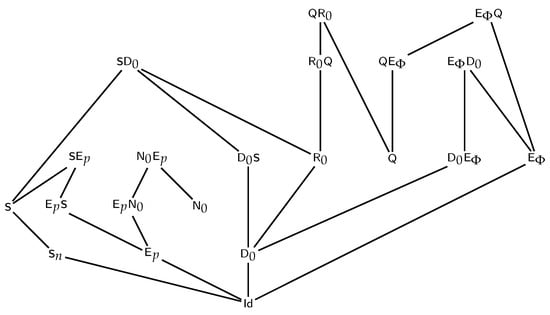
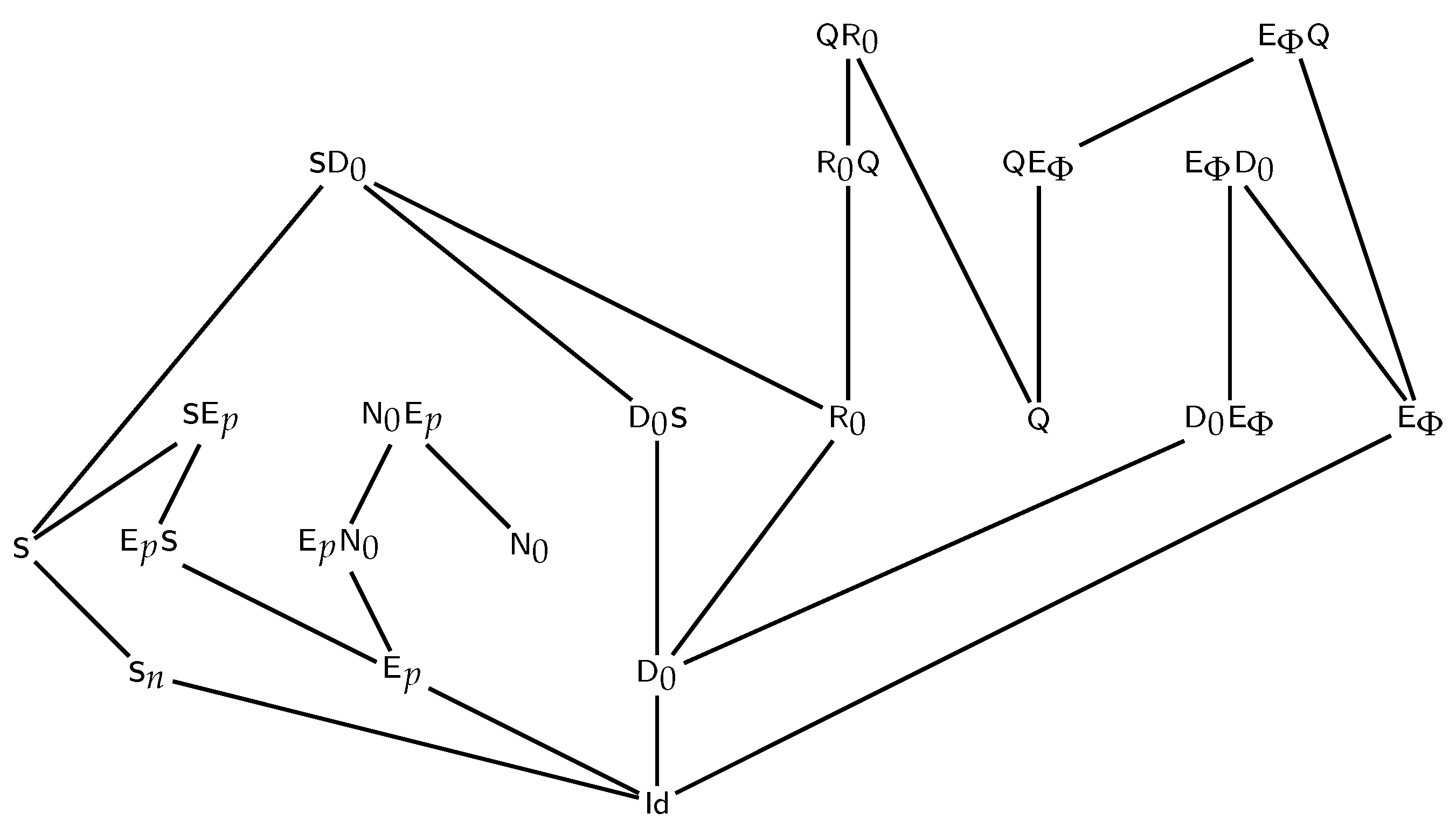
Figure 1 displays some inclusions between closure operations and their composites, ordered pointwise by ⪯ as in ; the relations shown are classical and follow from (Chapter II, Lemmas 1.17 and 1.18 in [1]). Composites of closure operators are operations in the sense above but need not be idempotent (for instance, is not, whereas is; see the preceding paragraph), so the diagram lives in the poset of operations, of which is a subposet; this is precisely why joins, rather than composites, are used to combine operators. The figure is included for orientation. Of the relations it displays, only the following are used later: for every (Proposition 2), (comparison of topologies in Section 5) and the position of , , and as the constituents of and (Section 5.2). The remaining relations, e.g., , and , illustrate that composites of closure operators can be comparable without being equal (for , this is shown in the preceding paragraph), the “local algebraic friction” discussed in Section 5.1.
Figure 1.
Hasse diagram of some inclusions among closure operations and their composites, ordered pointwise by ⪯ (see Chapter II, Lemmas 1.17 and 1.18 in [1]).
Adjunctions arising from closure operators. A closure operator naturally determines a reflection of the category of group classes into the subcategory of closed classes. This categorical perspective clarifies its universal property.
Proposition 4.
Let be a closure operator on . Define the functor
where denotes the full subcategory of consisting of -closed classes. Then, is left adjoint to the inclusion functor .
Proof sketch.
For any class of groups and any -closed class , we have if and only if . This bijective correspondence of morphisms is precisely the adjunction . □
Proposition 5.
Let be a closure operator and the full subcategory of consisting of the -closed classes. Then, is finitely additive if and only if is closed under binary unions computed in , equivalently, if and only if the inclusion functor preserves binary coproducts; and is completely additive if and only if i preserves all coproducts. In both cases, this is a strictly stronger property than the automatic preservation of colimits by the left adjoint .
Proof.
In , the coproduct of a family of -closed classes is , so i preserves it if and only if is -closed. If is (finitely, resp. completely) additive and the are -closed, then . Conversely, suppose that is closed under the corresponding unions, and let be arbitrary classes. By extensivity, , and the latter class is -closed by hypothesis. By monotonicity and idempotency,
The reverse inclusion always holds (Remark 2). □
Remark 6.
Proposition 5 gives the precise categorical content behind additivity: it is not an automatic consequence of being a left adjoint (Proposition 4 holds for every closure operator, additive or not) but the strictly stronger, non-automatic condition that the inclusion i also preserves the corresponding colimits. Lemma 3 below verifies complete additivity for , while for the same lemma yields two -closed classes whose union is not -closed. Note that the test classes and used there are not themselves -closed; the closed classes are their closures and . Indeed, consists of p-groups and of q-groups, so , whereas . Hence, is not -closed.
Example 2.
For the operator , the associated adjunction says the smallest subgroup-closed class containing is , and for , the adjunction asserts the smallest quotient-closed class containing is .
These adjunctions exemplify how closure operators act as reflections, projecting arbitrary classes into the subcategory of closed classes. From this perspective, closure operators reveal their universal role within group theory in a clear and elegant way.
Having established that the category of closure operators CL forms a complete lattice, and having clarified their universal role as reflections, we are now fully equipped for our main investigation. The completeness of CL guarantees that we can meaningfully combine operators using the join (∨), Proposition 3 describes these joins through closed classes and Proposition 5 identifies the categorical meaning of additivity. We now turn to the topological structures that these operators induce on the universe of groups.
5. Global Topological Invariance Versus Local Algebraic Difference
We now determine which of the closure operators of Section 2 are closure operators of topologies on (Theorem 1), and we study the resulting spaces. We begin with a simple lemma that will provide all our counterexamples.
Lemma 2.
Let p be a prime and let denote the class of all finite p-groups (including 1). Then, is -, -, -, -, - and -closed. In particular, is both a formation and a Fitting class.
Proof.
Closure under , , and is clear from orders. If with and each a p-group, then G embeds in the p-group , so is -closed. For , we first show that every subnormal p-subgroup K of a group G is contained in , by induction on the length n of a chain . If , then is a p-group and . If , the induction hypothesis applied to gives ; since is characteristic in , it is a normal p-subgroup of G, so . Now, if with each a subnormal p-subgroup, then , so G is a p-group. □
Lemma 3.
The closure operators and are completely additive. By contrast, , and are not even finitely additive.
Proof.
Positive part. Each of the six operators has the form
for a suitable relation on , namely: for , if ; for (resp. ), if G is isomorphic to a subgroup (resp. a subnormal subgroup) of H; for , if G is an epimorphic image of H; for , if for some with ; and for , if for some normal p-subgroup K of G. For any operator of the form (2) and any family ,
The essential point is that membership of G in is witnessed by a single group of . For instance, if , there is with and ; then, for some , and the same N shows . The argument for is identical, with a normal p-subgroup K in place of N.
Negative part. Let be primes and consider the classes and ; they contain the trivial group, in accordance with our convention, and no further closure property is required of them in Definition 1. Let , and . Then, , , , and . Hence:
- (a)
- , taking and in the definition of ;
- (b)
- , since and are normal, hence subnormal, subgroups of G and ;
- (c)
- , since .
- On the other hand, let . Since and is -closed (Lemma 2), monotonicity gives , and similarly . As , G is neither a p-group nor a q-group, so . Hence, . □
Remark 7.
The argument above uses only that consists of p-groups. One has the class of elementary abelian p-groups, but is larger in general: it consists of the p-groups generated by elements of order p, and for it contains, for instance, the dihedral group of order 8, which is generated by two (subnormal) subgroups of order 2.
The Alexandrov topologies on the universe of groups. By Lemma 3 and Theorem 1, each completely additive operator determines an Alexandrov topology on , whose closed sets are the -closed classes and whose specialization preorder is given by if and only if , where denotes the singleton subset of (see Remark 1); equivalently, for the relation of (2). Explicitly:
- (1)
- for , if and only if G is isomorphic to a subgroup of H;
- (2)
- for , if and only if G is isomorphic to a subnormal subgroup of H;
- (3)
- for , if and only if G is an epimorphic image of H;
- (4)
- for , if and only if G is a Frattini extension of H, i.e., with , ;
- (5)
- for , if and only if for some normal p-subgroup K of G.
- In all cases, the open sets are the up-sets of ⪯. In cases (1)–(3), the trivial group is the least element of ⪯; this is not so in cases (4) and (5), where the only group G with or for is , and for one has exactly when G is a p-group.
Additive closure operators naturally induce Alexandrov topologies, a connection that has found applications beyond group theory, for example, in algebraic geometry and logic [13,14].
Contractibility. The following elementary lemma isolates the property responsible for contractibility. We prove it directly, without appealing to results specific to finite spaces such as McCord’s theorem Proposition 1.2.4 in [15] or [16], since is countably infinite.
Lemma 4.
Let T be a set with an Alexandrov topology whose specialization preorder ⪯ has a least element or a greatest element. Then, T is contractible; in particular, it is path-connected and all its homotopy groups are trivial.
Proof.
Recall that the open sets of T are the up-sets of ⪯, and give its usual topology and the product topology.
Suppose first that m is a least element. Define by for and . Let be open. If , then , because U is an up-set and for all x; hence, . If , then . Here is open in for the subspace topology, since ; therefore, is open in .
Suppose now that M is a greatest element. Define and for . Let be open. If , then . Otherwise, , since U is an up-set and
which is open, as is open in .
In both cases, H is continuous, and is constant, so T is contractible. □
Theorem 3.
The spaces , and are contractible. Consequently, they are path-connected, all their homotopy groups vanish for and the three spaces are homotopy equivalent.
Proof.
In each case, the trivial group is a least element of the specialization preorder, so Lemma 4 applies. □
Path-connectedness can also be seen directly: for , one has in each of the three preorders, and comparable points are joined by the path , for .
Comparison of topologies. Although homotopy equivalent, the three topologies are pairwise distinct. Since for every class , every -closed class is -closed (if , then ). The converse fails: the subnormal subgroups of are 1, and , so is -closed but not -closed. Hence, , having strictly more closed sets, is strictly finer than . On the other hand, is incomparable with both: is -closed (hence -closed) but not -closed, since ; and is -closed but neither -closed nor -closed, since it does not contain .
The operators and . The hypothesis of Lemma 4 cannot be dropped: the following proposition shows that the two remaining completely additive operators of Lemma 3 induce spaces that are not even connected.
Proposition 6.
Let and let if , and if . Let be the set of groups A with , respectively . Then, is the topological disjoint union of the clopen subspaces
each of which is contractible. Since is infinite, is homotopy equivalent to a countably infinite discrete space; in particular, it is neither connected nor contractible.
Proof.
(i) ρ is constant along . For , let with . As recalled in Section 2, , hence . For , let K be a normal p-subgroup of G. Then, is a normal p-subgroup of , so ; conversely, the preimage L of is normal in G and is a power of p, so . Thus, and . In both cases, implies .
(ii) Each G lies below , and . Taking , resp. , gives , and by (i), , resp. .
By (ii), is the disjoint union of the sets , . By (i), each is both an up-set and a down-set of , hence open and closed. The subspace topology on the open set is the Alexandrov topology of the restricted preorder, in which A is a greatest element by (ii); so is contractible by Lemma 4. A disjoint union of clopen contractible subspaces is homotopy equivalent to the discrete space on its set of components. Finally, is infinite, since it contains for every prime r (with in the case of ). □
5.1. What the Homotopical Results Do and Do Not Say
Lemma 4 provides a precise criterion behind Theorem 3. Call a completely additive closure operator on anchored if its specialization preorder has a least or a greatest element. Then:
- (1)
- if is anchored, is contractible (Lemma 4);
- (2)
- , and are anchored at the trivial group, so their spaces are contractible (Theorem 3);
- (3)
- and are completely additive but not anchored, and their spaces are disconnected, although each component is anchored and contractible (Proposition 6).
- Algebraically, the anchor for , and is the trivial group, which is a subgroup, a subnormal subgroup and a quotient of every group; for and the relevant invariants and cannot be changed by the corresponding extensions, which splits the space into components.
These results should be read with care. Contractibility is a statement about homotopy type only. The topologies , and are pairwise distinct, and the well-known non-commutativity of the operators (for instance, , see Section 4, and more generally the relations in Figure 1), which we informally call local algebraic friction, is not reflected in their common homotopy type, simply because the homotopy type of an anchored Alexandrov space is trivial regardless of the rest of its specialization preorder. In other words, the local differences between these operators are invisible to the homotopy type rather than resolved by it; they are detected by finer data, such as the topologies themselves or the specialization preorders.
5.2. Formations and Fitting Classes: A Shared Topological Opacity
We now apply the framework to the formation operator and the Fitting class operator (Section 4). Each is the join of a completely additive “restriction” operator (, resp. ) and a non-additive “synthesis” operator (, resp. ).
Proposition 7.
Neither nor is finitely additive.
Proof.
Let be primes, , and , as in the proof of Lemma 3. By Lemma 2, is a formation and a Fitting class containing , so and by Proposition 3(3); similarly, . Since G is neither a p-group nor a q-group, and . On the other hand, by Lemma 3(a),(b) and since and ,
Hence, and . □
Corollary 1.
There is no topology τ on whose Kuratowski closure operator coincides with , i.e., such that for every class ; and the same holds for . In particular, Lemma 4 and Theorem 3 do not apply to or .
Proof.
The closure operator of any topology is finitely additive (Theorem 1(1)); apply Proposition 7. □
Corollary 1 is a statement about representability by a topology in the sense of Kuratowski, and nothing more. It does not exclude other topological or categorical representations of and . For instance, by Proposition 3, the -closed classes (the formations together with ∅) and the -closed classes are closed under arbitrary intersections, so and are closure spaces in the sense of Čech [17], and they can be studied with the general theory of closure operators and closure spaces [6,12].
Thus, formations and Fitting classes behave alike in this respect, which we refer to as a shared topological opacity: in both cases, the restriction operator (, resp. ) is completely additive, and the failure of additivity of the join is witnessed by the synthesis operator (, resp. ), which is dominated by the join and whose counterexample survives in it because the classes of p-groups and of q-groups are closed under the join. We do not claim a general theorem to the effect that a join with a non-additive operator is always non-additive; the statement above concerns these two operators.
6. Conclusions
By combining categorical and topological tools, this paper has developed a framework for the study of group classes, formations and closure operators. The category of group classes is complete and cocomplete; the Gaschütz product is associative and unital on formations, and it is a bifunctor, hence a (strict, posetal) monoidal structure, on the category of subgroup-closed formations. Closure operators form a complete lattice whose joins are described by closed classes, which yields a uniform treatment of the formation and Fitting class operators.
On the topological side, , and are completely additive and induce Alexandrov topologies on the universe of finite groups which are pairwise distinct but all contractible, because the trivial group is a least element of each specialization preorder; and are completely additive as well, but their spaces are disconnected, with contractible components. Finally, the formation operator and the Fitting class operator are not finitely additive, so neither is the closure operator of a topology on the universe of finite groups; in both cases, the obstruction is located in the synthesis operator, , respectively, .
These results illustrate how categorical and topological methods can provide a common language for algebraic constructions in finite group theory, continuing a tradition that goes back to the categorical foundations laid out in [3,4].
Future Directions
Several natural questions emerge from this work. First, the operators and , although not topological, define closure spaces; it would be interesting to know whether invariants of closure spaces, or of the complete lattices of formations and of Fitting classes, distinguish these two dual structures. Second, since is monoidal, one may ask whether it is closed, i.e., whether admits a right adjoint, and whether monads or algebra structures can be developed within it. Third, although the spaces induced by , and are contractible, finer invariants, such as the homology of specific subposets (for example, the non-trivial groups, or the groups of a given formation), may still capture structural features that are invisible from the global viewpoint.
Author Contributions
Investigation, I.G.G. and L.A.M.C.; writing—original draft preparation, I.G.G. and L.A.M.C.; writing—review and editing, I.G.G. and L.A.M.C. All authors have read and agreed to the published version of the manuscript.
Funding
On behalf of all authors, the corresponding author states that we did not receive any specific grant from funding agencies in the public, commercial, or not-for-profit sectors.
Data Availability Statement
The original contributions presented in this study are included in the article. Further inquiries can be directed to the corresponding author.
Conflicts of Interest
The authors declare no conflicts of interest.
References
- Doerk, K.; Hawkes, T. Finite Soluble Groups; Walter de Gruyter: Berlin, Germany, 1992. [Google Scholar]
- Ballester-Bolinches, A.; Ezquerro, L.M. Classes of Finite Groups; Springer: Berlin/Heidelberg, Germany, 2006. [Google Scholar]
- Lane, S.M. Categories for the Working Mathematician. In Graduate Texts in Mathematics, 2nd ed.; Springer: Berlin/Heidelberg, Germany, 1998. [Google Scholar]
- Borceux, F. Handbook of Categorical Algebra, Vol. 1–3; Cambridge University Press: Cambridge, UK, 1994. [Google Scholar]
- Castellini, M. Categorical Closure Operators. In Birkhäuser, Progress in Mathematics; De Gruyter Brill: Basel, Switzerland, 2003; Volume 274. [Google Scholar]
- Dikranjan, D.; Tholen, W. Categorical Structure of Closure Operators: With Applications to Topology, Algebra and Discrete Mathematics; Springer: Berlin/Heidelberg, Germany, 2010. [Google Scholar]
- Abdalla, M.; Janelidze, G. An Order-Theoretic Perspective on Categorical Closure Operators. Quaest. Math. 2018, 41, 529–539. [Google Scholar] [CrossRef] [Scilit]
- Kuratowski, K. Sur l’Opération A de l’Analysis Situs; Fundamenta Mathematicae: Warszawa, Poland, 1922. [Google Scholar]
- Alexandroff, P. Diskrete Räume. Mat. Sb. (N.S.) 1937, 2, 501–519. [Google Scholar]
- Arenas, F.G. Alexandroff spaces. Acta Math. Univ. Comen. (N.S.) 1999, 68, 17–25. [Google Scholar]
- Dikranjan, D.; Tholen, W. Dual Closure Operators and Their Applications. 2014. Available online: https://tholen.mathstats.yorku.ca/files/2021/01/Dclop-20June2014.pdf (accessed on 20 October 2026).
- Janelidze, G.; Sobral, M. Topics in the categorical algebra of closure spaces. Cah. Topol. Géom. Différ. Categ. 2025, LXVI, 19–35. [Google Scholar]
- Kimura, K. Compactness of the Alexandrov topology of maximal Cohen–Macaulay modules. arXiv 2024, arXiv:2401.04987. [Google Scholar]
- Lambert, B. A Topos-Theoretic Semantics of Intuitionistic Modal Logic via Alexandrov Topologies. arXiv 2024, arXiv:2410.13078. [Google Scholar]
- McCord, M.C. Singular homology groups and homotopy groups of finite topological spaces. Duke Math. J. 1966, 33, 465–474. [Google Scholar] [CrossRef] [Scilit]
- Barmak, J. Algebraic Topology of Finite Topological Spaces and Applications; Springer: Berlin/Heidelberg, Germany, 2011. [Google Scholar]
- Čech, E. Topological Spaces; Frolík, Z., Katětov, M., Revised Eds.; Academia: Prague, Czech Republic; John Wiley & Sons: Hoboken, NJ, USA, 1966. [Google Scholar]
Disclaimer/Publisher’s Note: The statements, opinions and data contained in all publications are solely those of the individual author(s) and contributor(s) and not of MDPI and/or the editor(s). MDPI and/or the editor(s) disclaim responsibility for any injury to people or property resulting from any ideas, methods, instructions or products referred to in the content. |
© 2026 by the authors. Licensee MDPI, Basel, Switzerland. This article is an open access article distributed under the terms and conditions of the Creative Commons Attribution (CC BY) license.