


Abstract
Defect categorization is essential to product quality assurance during the production of magnetic random access memory (MRAM). Nevertheless, traditional defect detection techniques continue to face difficulties in large-scale deployments, such as a lack of labeled examples with complicated defect shapes, which results in inadequate identification accuracy. In order to overcome these problems, we create the MARMset dataset, which consists of 39,822 photos and covers 14 common defect types for MRAM defect detection and classification. Furthermore, we present a baseline framework (GAGBnet) for MRAM defect classification, including a global attention module (GAM) and an attention-guided block (AGB). Firstly, the GAM is introduced to enhance the model’s feature extraction capability. Secondly, inspired by the feature enhancement strategy, the AGB is designed to incorporate an attention-guided mechanism during feature fusion to remove redundant information and focus on critical features. Finally, the experimental results show that the average accuracy rate of this method on the MARMset reaches 92.90%. In addition, we test on the NEU-CLS dataset to evaluate cross-dataset generalization, achieving an average accuracy of 98.60%.
MSC:
68T07
1. Introduction
Traditional embedded storage devices are attempting to meet the high performance, low power consumption, and high reliability requirements of automotive electronics, industrial control, the Internet of Things, and artificial intelligence as semiconductor processing continues to push toward physical limits. Self-rotating torque magnetic random access memory, with its non-volatility, zero static power consumption, high integration density and good compatibility with CMOS processes, has become a promising candidate for the next-generation on-chip cache and general-purpose memory. Any minor process defect in the MRAM manufacturing process may lead to device parameter drift or failure. Defect detection plays a very important role in the production process [1,2,3,4,5,6]. In order to guarantee yield and dependability, reliable defect recognition methods and high-quality sample databases are essential. The advancement of deep learning technology in recent years has reduced the need for manual intervention and increased classification accuracy, offering a viable alternative for fault identification and classification. However, the lack of sample datasets and the diversity of data are the primary causes of the difficulties defect classification systems encounter. Automated inspection is severely hampered by the MRAM manufacturing line data’s multi-source heterogeneity, high noise levels, numerous workpieces, and wide range of fault scales with frequent overlaps. Consequently, the development of standardized high-quality defect datasets and MRAM defect identification intelligence have substantial technical and application value to enhance production quality management and contemporary industrial production efficiency.
Conventional approaches, which frequently only allow for binary classification or approximate localization, rely on manually created features and thresholds. In complicated contexts and circumstances involving vast amounts of data, these techniques are vulnerable to missed detections and false positives. However, deep learning-based defect classification models demonstrate advantages in feature representation and end-to-end learning, significantly alleviating these issues [7,8]. Cheon et al. [9] propose a deep learning-based automatic defect classification method that can automatically classify various types of wafer surface damage. The effectiveness of the proposed method is verified on a real-world dataset, achieving high defect classification performance. Fan et al. [10] use the Vision Transformer (ViT) to implement data augmentation to study the classification of wafer defect images, alleviating class imbalance and effectively improving the defect classification performance of a deep learning-based convolutional neural network. Alves et al. [11] combine infrared thermal imaging with a CNN model to automatically identify multi-class defects in photovoltaic modules for fault detection. Their research demonstrates that data augmentation methods can effectively improve model performance on imbalanced datasets. It also shows excellent recognition performance in photovoltaic module defect classification, demonstrating its promising application in large-scale photovoltaic power plants. Zhang et al. [12] address the defect recognition challenges in robotic arc welding caused by class imbalance and feature similarity. A lightweight EfficientNet-ECA network is proposed to combine with a dynamic balanced focal loss function to achieve efficient, accurate, and automated welding defect classification suitable for online factory monitoring. Shaban et al. [13] propose a photovoltaic module defect detection and classification system based on EL images. By introducing a chaotic mapping-based feature selection strategy and an improved butterfly optimization algorithm, combined with a hybrid classification model, they effectively improve the accuracy and reliability of photovoltaic module defect detection and multi-class classification. Mohammad et al. [14] propose a lightweight Vision Transformer (ViT-Tiny) framework for semiconductor wafer defect classification. It outperforms traditional CNN and mainstream Transformer models in multi-class defect recognition and maintains efficiency and robustness under limited annotation conditions. These study findings show that deep learning-based defect classification technology greatly enhances the resilience and accuracy of defect classification in intricate industrial settings, exhibiting exceptional detection performance and a wide range of possible applications.
Even though fault categorization using deep learning has advanced significantly in recent years, there are still some issues: First, when handling a high number of data samples with significant noise, pseudo-interference, wide changes in defect magnitude, and frequent overlaps, current defect classification methods perform poorly. Second, the lack of defect detection datasets makes it challenging for the few datasets to cover the wide distribution of defect samples in industrial scenarios. This impacts the model’s poor generalization ability and causes a notable drop in performance when moving from laboratory test scenarios to actual production environments.
To address these issues, we propose a defect classification model GAGBnet, designing Attention-guided block (AGB) and Global attention module (GAM). By increasing the expressiveness of defect features, utilizing context feature information to its fullest, minimizing feature information loss, and boosting the model’s defect classification performance. Meanwhile, we independently collect and construct an MRAM defect dataset (MARMset). By collecting samples from different batches and under different working conditions on real industrial production lines, it covers both common and rare defect types, ensuring the diversity and scene adaptability of the dataset and effectively addressing the scarcity of existing public datasets. It also provides the model with training and validation samples that are more in line with real industrial scenarios, enhancing the model’s generalization ability from the source of data and enabling it to perform stably in actual production environments.
The main contributions of this paper are summarized as follows:
- MRAMset: We establish a defect classification dataset for training and evaluating defect recognition models.
- GAM: We introduce a global attention module into a multi-branch, high-resolution feature stream to balance local details and global context, effectively improving inter-class separability under complex backgrounds.
- AGB: During feature fusion, we employ learnable weights to dynamically filter redundant information, mitigating noise accumulation and information dilution caused by multi-scale, multi-branch concatenation, thereby strengthening key feature representations.
- Generalization ability: On the MRAMset, our GAGBnet maintains stable performance. Furthermore, we also conduct the experiments on the public NEU-CLS dataset and the results verify the adaptability and generalization ability of the proposed model.
2. Related Works
2.1. Attention Mechanism
With its plug-and-play flexibility, the attention mechanism—a fundamental technology that directs models to suppress unnecessary information and concentrate on important features—has proven to be an effective way to optimize the performance of industrial defect detection models and has shown considerable value in defect identification tasks in a variety of industrial scenarios. SE Block [15] compressed spatial dimensions through adaptive average pooling and learns channel importance weights in fully connected layers, effectively strengthening the representation of channel features critical for defect detection. ECA-Net [16] further optimized this approach with lightweight features, significantly reducing computational complexity while retaining the discriminative power of the channel dimension, making it more suitable for the real-time requirements of industrial inspection. CBAM [17] fused channel and spatial attention to generate channel weights, then constructed a spatial attention map based on the mean and maximum values of feature maps, effectively localizing defect areas. BAM [18] further optimized feature extraction through the cascade of channel and spatial attention. Vaswani et al. [19] calculated global feature correlations to effectively capture feature correlations across the entire image, providing a core approach for global feature modeling. Multi-Head Attention [20] built on this foundation by introducing a multi-head parallel mechanism to simultaneously capture feature information from multiple subspaces, improving its adaptability to complex defect morphologies. Coordinate Attention [21] enhanced spatial perception by introducing coordinate position encoding. It excelled at balancing global modeling capabilities with computational efficiency, making it more suitable for multi-scale defect identification in industrial scenarios. DGYOLOv8 [5] integrated key features into its attention mechanism by integrating adaptive receptive field adjustments into its backbone network, effectively improving the detailed processing of defect features and the model’s detection accuracy. Liu et al. [22] proposed a steel surface defect detection method named GC-Net, which effectively enhances the model’s ability to capture global features of unstructured defects and improve the detection accuracy of multi-scale defects by integrating a global attention module and a cascaded fusion network. Based on the advantages of the above-mentioned attention mechanism in feature focusing and suppression of redundant information, we introduce the GAM module into a multi-branch, high-resolution feature stream to balance local details and global context, effectively improving the robustness and discriminability of feature representation in industrial defect classification.
2.2. Multi-Scale Feature Fusion
Multi-scale feature fusion technology and its optimization strategies provide key technologies for various tasks in computer vision. LITE-HRNET PLUS [23] addressed the real-time requirements of facial landmark detection, while the fusion block and output module of Lite-HRNet [24] were improved. To cut down on computational expenses, its feature fusion path was optimized. It was appropriate for real-time situations since accuracy and complexity were balanced. CEDNet [25] addressed the issue of feature merging delay in dense prediction tasks by designing a cascaded fusion module to achieve instantaneous interaction between layers, improving feature utilization. A centralized feature pyramid enhanced image corner feature processing and improves object detection accuracy. CrossViT [26] optimized multi-scale feature representation for image classification, employing dual branches to process image patches of different sizes and enabling branch interaction through cross-attention. This method outperformed traditional ViT [27] on ImageNet [28] at a low computational cost. SMT [29] combined the local capture of convolution with the global modeling of the Transformer, fusing multi-scale perception and a lightweight fusion module to enhance robustness and adapt to multi-class image recognition. To address the difficulty in capturing lesion details in medical image segmentation, M2SNet [30] employed a multi-scale feature subtraction unit to enhance feature differences, optimize lesion features, and effectively improve the detection performance of segmentation models. ConvNeXt [31] used an encoder to capture multi-scale features for image tampering localization, while its decoder combined pyramid pooling and aligned splicing to precisely locate tampered pixels and improve the model’s detection accuracy. BiEHFFNet [32] addressed the complex background interference in image water detection by using a dual encoder architecture based on ResNet and Swin Transformer to jointly extract local spatial details and global contextual information. We suggest the AGB module, which incorporates cross-scale feature interaction and attention guidance to improve the use of multi-scale defect features in industrial defect classification, based on the benefits of the aforementioned multi-scale feature fusion technology in capturing hierarchical features and balancing performance and computational complexity.
3. Methodology
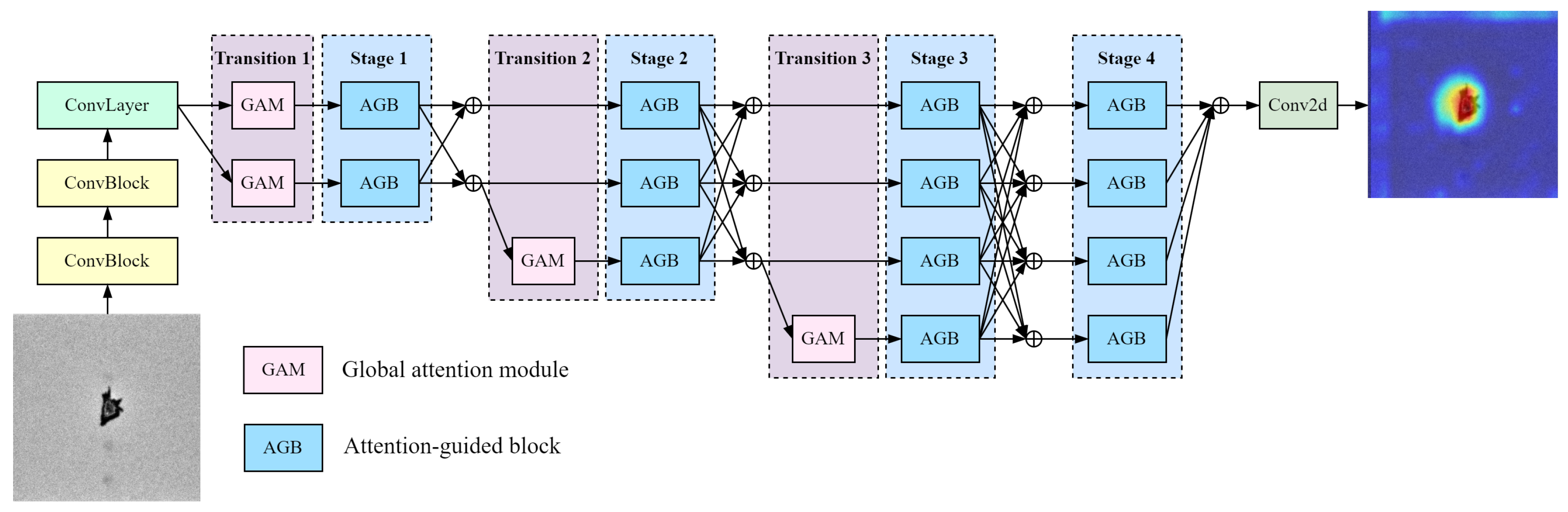
In this work, we present the proposed GAGBnet based on the previously mentioned study. As shown in Figure 1, the proposed model has two key components: the GAM and AGB module. This work adopts HRNet [33] as the baseline network for defect classification and detection, as its multi-scale architecture maintains high-resolution outputs at each stage, thereby facilitating the representation of fine-grained textures and small targets. The GAM analyzes and filters features from a global perspective, highlighting key features of defects. Subsequently, upsampling and downsampling, as well as collaborative processing with the AGB after feature fusion, further optimize the feature representation. Upsampling and downsampling adjust feature scale to meet the needs of different stages, while the AGB guides feature fusion, thereby reducing feature redundancy and yielding a more representative feature set. The feature extraction stage, composed of these operations, provides a solid foundation for the model’s subsequent operations. In subsequent stages, the model will continuously optimize and iterate features through modules. Finally, the classification head performs linear discrimination on the fused features and produces probability scores for each class.
Figure 1.
The architecture of the proposed GAGBnet for MRAM defect classification, including the GAM and the AGB.
3.1. Global Attention Module
Due to their small receptive fields, CNNs are prone to overlooking global linkages, which can result in poor separability across defect classes and incorrect classification in complicated backdrops. Long-range relationships between high-resolution, multi-branch characteristics must be modeled globally in order to increase the discriminative strength of important areas. To enhance the model’s global feature-extraction capability, a novel GAM module is designed, as shown in Figure 2. The GAM primarily comprises three processes: Pooling Downsampling (PD), Multi-head Self-attention (MHSA), and Associative Upsampling (AU). Specifically, PD first downsamples the input, then MS captures global dependencies in the downsampled space, and finally AU maps the downsampled space back to the input image size.
Figure 2.
The detail of the GAM module.
First, to reduce computational complexity and extract representative features, the PD process maps the input feature into a low-resolution space. We initially obtain a feature map via a global pooling operation . To ensure that these coarse-grained features retain key details from the original input, we introduce a Cross-Attention mechanism. This mechanism utilizes the original input to refine and enhance the pooled features , yielding . The process is defined as follows:
where, , , and denote the linear projections of the query, key, and value, respectively. d represents the number of channels. Through this operation, aggregates detailed contextual information from the high-resolution input.
After obtaining the enhanced low-dimensional feature , we utilize the MHSA to capture long-range dependencies within the features. This step allows the model to focus on global contextual information rather than being limited to local features. The calculation is defined as follows:
where is the learnable weight matrix.
The output contains high-level semantic features derived from global interaction modeling. Since the attention feature resides in a low-resolution space, directly utilizing it would lead to a loss of spatial details. Consequently, it is necessary to map it back to the original feature dimensions . To achieve this, we calculate an association matrix W between the original input and the pooled feature to guide the upsampling process:
Finally, we utilize this association matrix to project the global feature back into the high-dimensional space and perform a residual connection with the original input to obtain the final output of the module:
Through these steps, the effectively fuses global contextual information with local detailed features, enriching the feature representation.
3.2. Attention-Guided Block
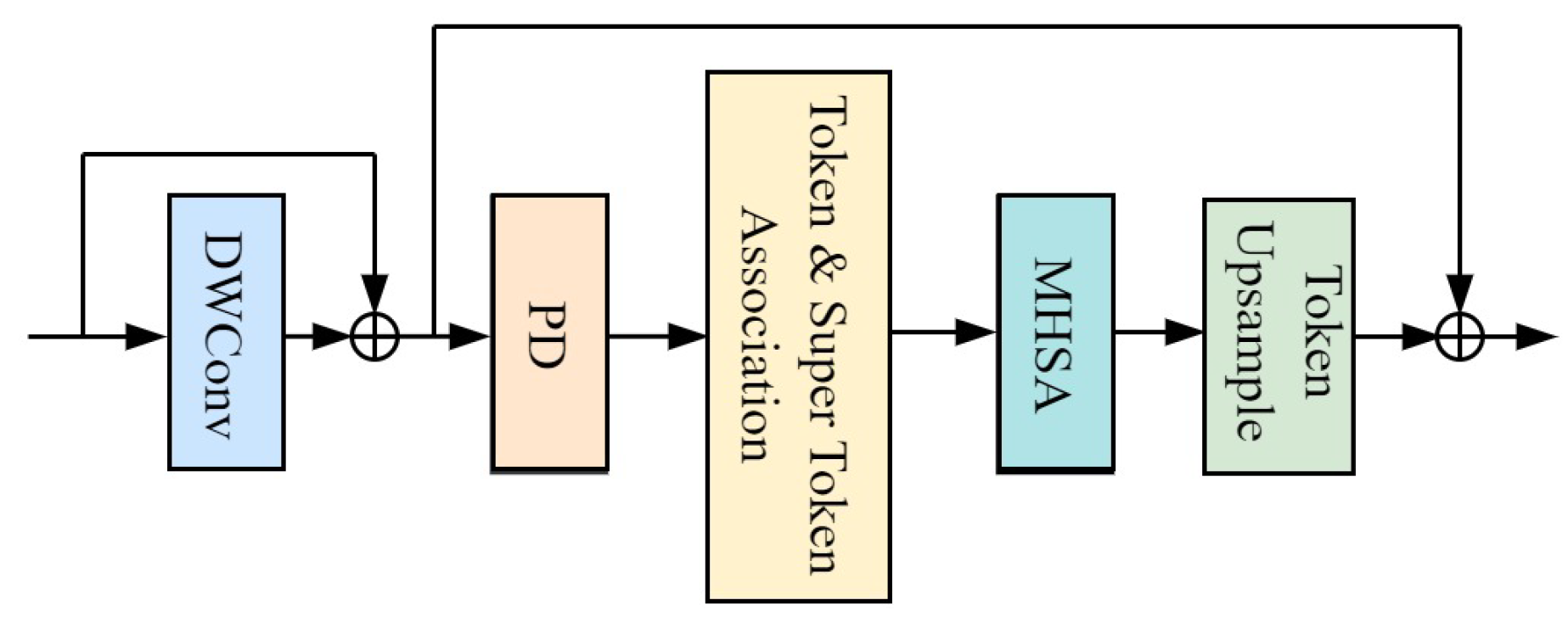
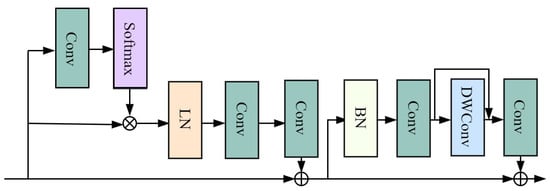
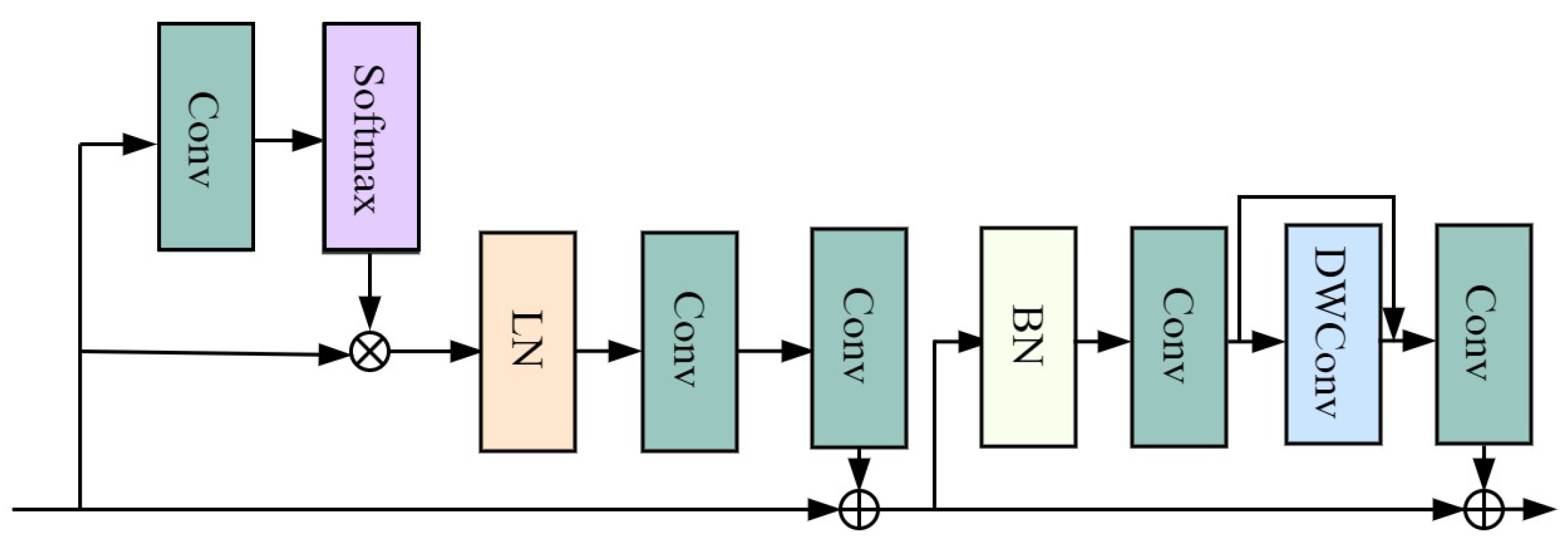
In order to bring a significant quantity of redundant information to the output of each branch in the process of encouraging information interaction, a feature fusion operation is carried out after each step. It not only diverts attention from important patterns in later phases, but it also raises computational overhead, which eventually affects the precision and effectiveness of feature extraction. To effectively solve this problem, we present the AGB module to purify and reweight fused features. As shown in Figure 3, the module takes lightweight attention as the core, automatically identifies and suppresses redundant components, and focuses attention on areas and channels that are more relevant to category discrimination, so that the representation passed to the next stage is cleaner, more stable and more discriminative, thereby significantly improving the performance of defect classification. Since the goal of the AGB is to evaluate the importance of fused feature maps and to make global selections, there is no need to focus on additional local feature extraction.
Figure 3.
The detail of the AGB module.
Assuming the input feature is . The specific definitions are as follows:
where, , , denote , , , respectively. and represent the fused features after input and the optimized output features, respectively. , , , represent layer normalization, global average pooling, multilayer perceptron, and feedforward neural network, respectively.
3.3. Loss Function
In order to quantify the difference between the model’s predicted value and the true value and evaluate the model’s accuracy, the optimal value of the model parameters is found by minimizing the loss function. This paper uses cross-entropy loss () to evaluate the model, thereby improving the model’s prediction accuracy.
Assume that the number of defect categories is K and the mini-batch size is B. For the i-th sample , the network outputs the unnormalized category score as follows:
where, and represent the logit vector and its dimension component. After softmax, the posterior probabilities for class c () are obtained, and the formula is as follows:
Among them, is the predicted probability that the i-th sample belongs to class c. The formula of the loss function is as follows:
4. Experiments and Analysis
We performed defect recognition studies on MRAMset to verify the performance of the suggested GAGBnet. The training set was used to train the GAGBnet, while the validation set was used to assess it. GAGBnet’s total performance was assessed using pertinent measures, and its performance was confirmed. To further validate the effectiveness of the proposed GAGBnet, we also evaluated it on the NEU-CLS [34] datasets. Extensive experiments demonstrated the superiority of the proposed GAGBnet.
4.1. Experimental Environment
The experiments were conducted on a workstation equipped with an Intel Xeon Platinum 8225C CPU, NVIDIA GeForce RTX 4060 Ti GPU 8 GB, and 43 GB of RAM. The defect recognition model was built using the deep learning framework PyTorch 1.11.0 in a CUDA environment, combined with Python 3.8. The image input size was 224 × 224, the batch size was 16, and the total training epochs were 200. Training and testing were performed on the processed dataset. These settings were empirically selected following widely adopted practices in defect classification and industrial vision tasks, and were found to provide stable training behavior.
4.2. Dataset
4.2.1. MARMset
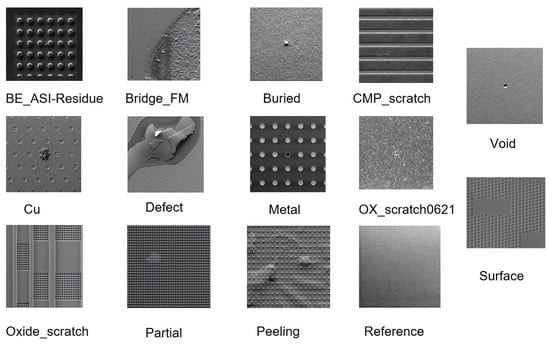
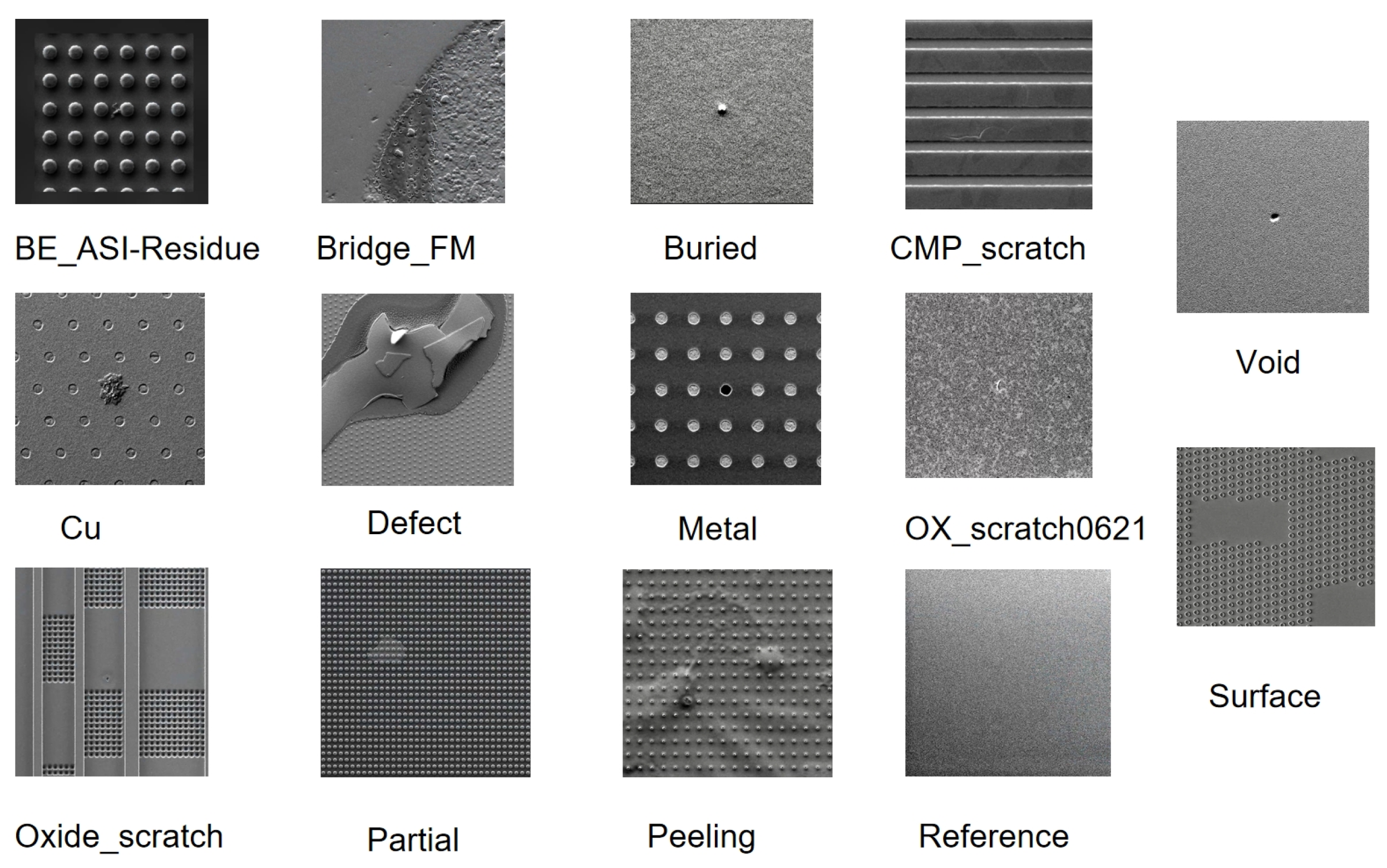
To address the scarcity of defect detection datasets for MARM, we established our own dataset, named MARMset. As shown in Figure 4, the MARMset was a typical industrial-graded image dataset designed for magnetoresistive random access memory defect detection, covering a variety of process defects commonly encountered in actual wafer manufacturing. It was randomly split into a training set and a test set with an 8:2 ratio for evaluating the performance of the proposed GAGBnet. As shown in Table 1, MARMset contained 14 defect categories and had a total of 39,822 images, including BE_ASI-Residue, Bridge_FM, Buried, CMP_scratch, Cu, Defect, Metal, OX_scratch0621, Oxide_scratch, Partial, Peeling, Reference, Void and Surface. The samples covered a wide range of process defects, ranging from microscopic material residue and metal bridges to oxide scratches and localized peeling. All defect images were high-resolution grayscale micrographs to ensure the discernibility of detailed defect areas. The number of samples in each category varied significantly. For example, CMP_scratch and Metal contained 6257 and 5327 images, respectively, while Bridge_FM only had 95 images, demonstrating a typical class imbalance. This characteristic not only reflected real-world production environments but also placed higher demands on algorithm robustness. Given the importance of MRAM defect detection for improving yield and reducing costs, MARMset could serve as a benchmark for defect classification and anomaly identification, providing a reliable data source for related industrial research.
Figure 4.
The visualization of the MRAMset category samples.
Table 1.
Distribution of defect counts in the MARMset.
4.2.2. NEU-CLS
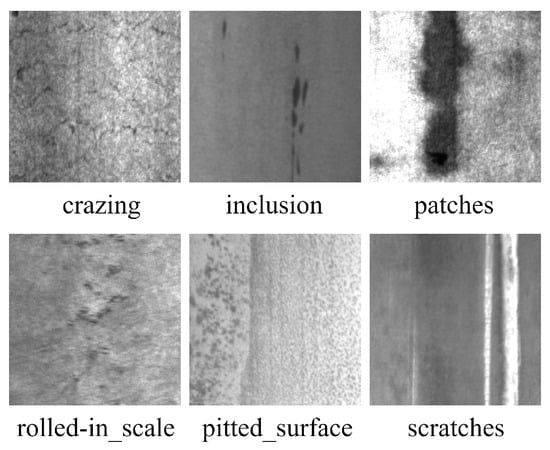
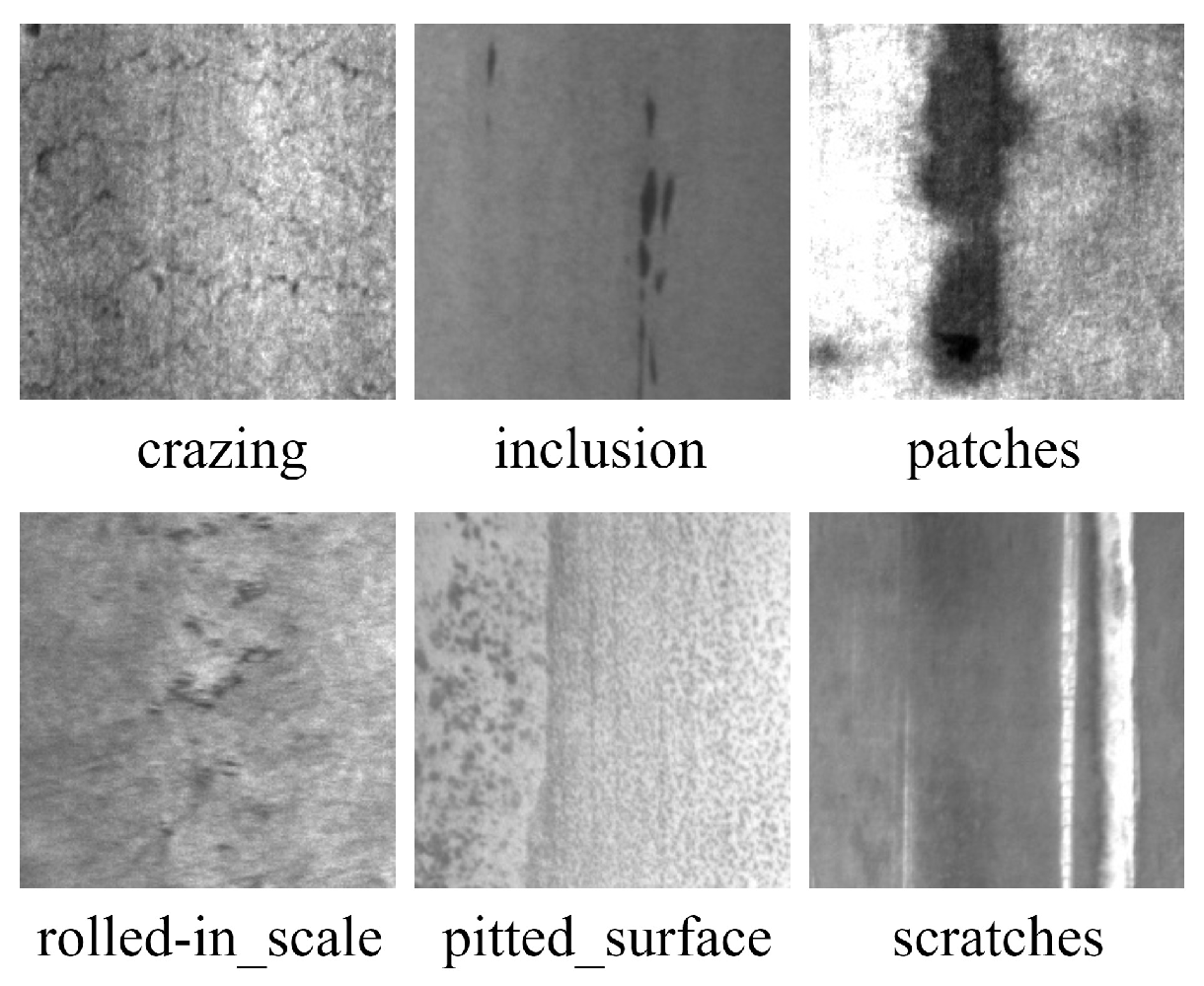
The NEU-CLS dataset [34] contained 1800 samples of hot-rolled steel surface defects. These samples represented six types of defects: crazing, inclusion, patches, pitted_surface, rolled-in_scale, and scratches. The defect kinds were displayed in Figure 5, with 300 examples per defect. The dataset was split into training and test sets in an 8:2 ratio in order to assess the proposed GAGBnet’s generalization capability.
Figure 5.
The visualization of the NEU-CLS dataset defect samples.
4.3. Evaluation Indicators
To comprehensively evaluate model performance, we used precision (P), accuracy (), recall (R), and F1-score () as evaluation metrics. Among these, , , , and are important metrics in the confusion matrix, and their formulas are as follows:
where , , , and represent true positives, false positives, true negatives, and false negatives, respectively, corresponding to the outcomes of the model’s predictions against the ground truth.
4.4. Performance Evaluation
4.4.1. Comparison with Mainstream Methods
To verify the GAGBnet’s classification performance on different defect samples, this paper conducted defect classification experiments on the MRAMset. The experimental results are shown in Table 2. On the MRAMset, the GAGBnet demonstrated good classification ability for most defect categories, with accuracy exceeding 90% for categories such as BE_ASI-Residue, CMP scratch, Cu, Metal, and Void. The experimental results show that the model proposed in this study exhibits strong effectiveness in defect classification tasks on the MRAMset, especially achieving high accuracy in multi-class defect classification.
Table 2.
The classification results of each defect category on the MRAMset.
To validate the effectiveness of our GAGBnet, we compared it with other main methods, including HRNet [33], UNet [35], SwinTransformerV2 [36], RT-DETR [37] and YOLO series [38,39,40,41]. Experiments on both the MRAM and NEU-CLS datasets were conducted without pretrained weights. The experimental results were shown in Table 3 and Table 4. We evaluated our proposed method against HRNet, UNet, SwinTransformerV2, RT-DETR, and the YOLO lightweight series on the MRAM and NEU-CLS datasets.
Table 3.
Comparisons with excellent model on the MRAMset.
Table 4.
Comparisons with other models on the NEU-CLS dataset.
Experimental results on the MRAMset showed that the proposed method achieves the highest overall performance. Our model attained an accuracy of 92.9%, a precision of 78.1%, a recall of 81.0%, and an F1-score of 78.0%, surpassing the baseline HRNet by 0.9%, 2.3%, 1.8% and 1.2%, respectively. While RT-DETR benefited from its detection-style head and achieved the highest recall 82.2%, its overall accuracy and F1-score remained lower than ours, indicating that the pure Transformer backbone was relatively sensitive to the limited data scale and fine-grained texture variations of MRAM. The lightweight YOLO family exhibited generally robust behavior, with YOLOv8n and YOLOv10s achieving competitive precision but suffering from reduced recall or F1-score. YOLOv12n reached 91.5% accuracy and 77.0% recall, yet its precision and F1-score still lagged behind our method. These results suggested that our GAGBnet attained a more favorable trade-off between recognition accuracy, false negatives, and false positives, mainly due to the fine-grained robustness introduced by multi-scale semantic enhancement and feature alignment, as well as the mitigation of class imbalanced through hard-example mining and loss reweighting.
On the NEU-CLS dataset, our GAGBnet achieved the best performance across all four metrics. UNet and SwinTransformerV2 performed very stably on NEU-CLS, reflecting their strong ability to capture global and local textures in relatively clean surface-defect imagery. YOLOv8n and YOLOv11n also achieved high accuracies of 97.5% and 98.1%, respectively, with minor differences in the high-precision regime. In contrast, YOLOv9t, constrained by its limited capacity and feature representation, yielded the lowest scores in all four metrics. Overall, our method maintains a superior balance between precision and recall and consistently delivers additional gains on top of baseline, indicating that the proposed feature modeling and training strategy provides stronger discriminative power and better generalization for fine-grained defect identification across both MRAMset and NEU-CLS datasets.
4.4.2. Ablation Experiment
To validate the effectiveness of the core components of the proposed GAGBnet, this section conducted ablation experiments to evaluate the impact of two key modules, GAM and AGB, on defect classification performance. The experiments were conducted on the MRAMset and NEU-CLS datasets, comparing the model’s performance in terms of accuracy, precision, recall and F1-score. The results are shown in Table 5.
Table 5.
Ablation experiments on MRAMset and NEU-CLS datasets.
4.4.3. Visual Analysis
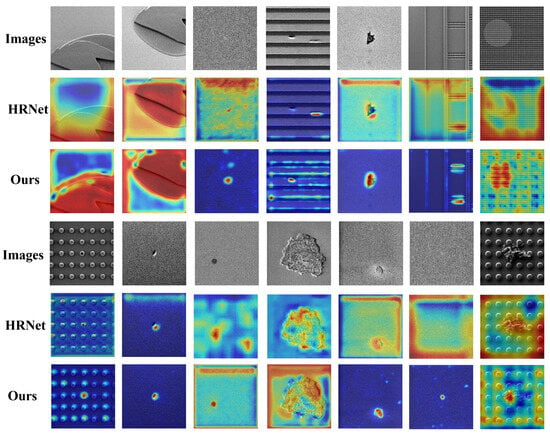
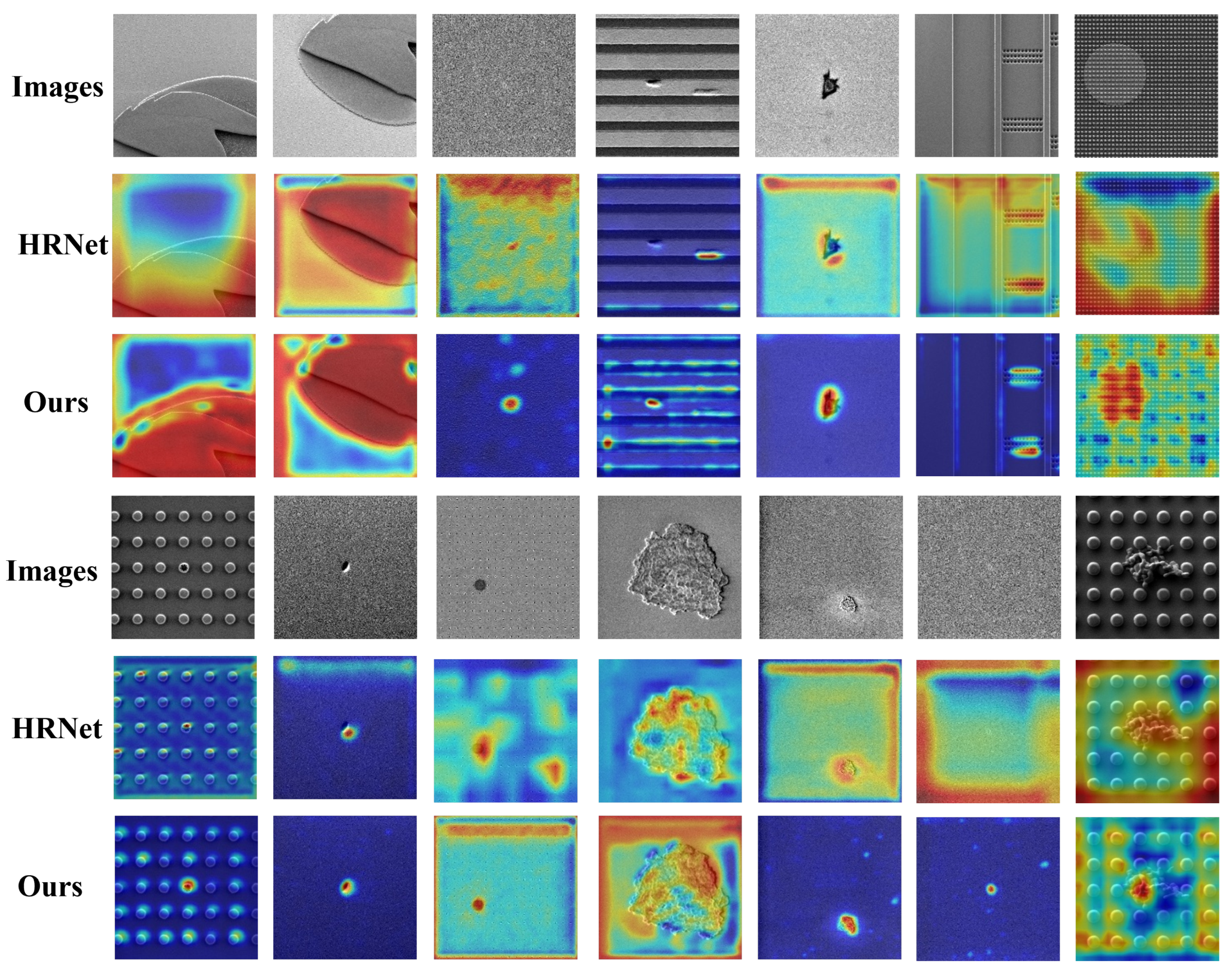
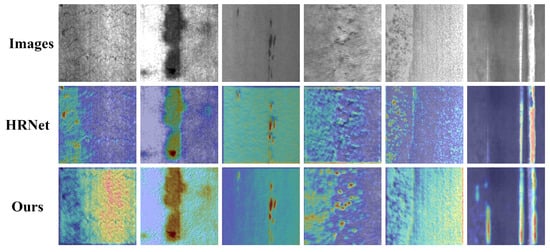
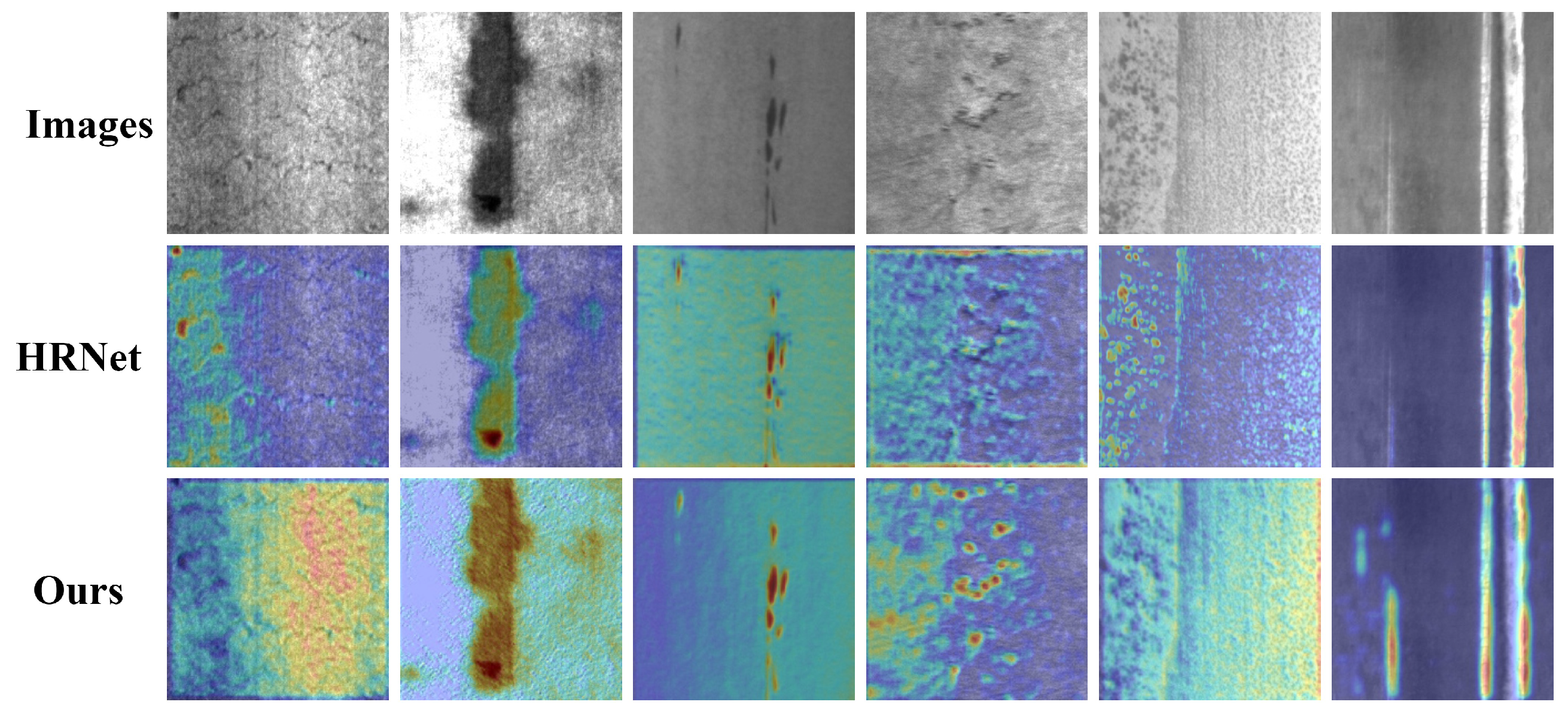
To visually compare the GAGBnet’s ability to focus on defect features, the performance of our proposed method and the baseline model was analyzed using Grad-CAM [42] feature heatmap visualization results. As shown in Figure 6 and Figure 7, the first row contained the original defect images, the second row contained the feature response map of the baseline model, and the third row contained the feature response map of our proposed GAGBnet. It could be seen that the GAGBnet’s feature response map could more accurately capture the spatial location and morphological features of defects in various defect regions. Although HRNet’s feature response was relatively scattered and the identification boundaries of some defects were not clear enough or accurate enough, further verifying the superiority of our proposed GAGBnet in defect feature representation and recognition.
Figure 6.
Qualitative comparison of defect detection outputs on the MRAMset.
Figure 7.
Visual comparison of defect detection samples on the NEU-CLS dataset.
5. Conclusions
Defect detection is a critical lever for improving product quality, yet traditional approaches struggle with MRAM defect data in large-scale applications due to limited samples, complex defect morphologies, and insufficient recognition accuracy. In this study, we construct the MARMset for defect classification to provide reliable data support. We further propose the attention-based GAGBnet for MRAM defect classification: the GAM module is introduced to enhance feature extraction, and the AGB module is incorporated during feature fusion to remove redundancy and strengthen the representation of key features. We also employ the NEU-CLS dataset to assess cross-dataset generalization. Experimental results show that the proposed model achieves an average classification accuracy of 92.9% on the MARMset and 98.6% on the NEU-CLS dataset, outperforming the comparison methods.
Although the overall performance is encouraging, defect categories with extremely limited sample sizes remain challenging due to class imbalance. The proposed approach exhibits superior classification performance, achieving higher detection accuracy and enhanced defect localization, and the released dataset offers a robust benchmark to ease the shortage of defect samples. Future work will focus on improving the recognition of rare defects through imbalance-aware learning and enhanced data augmentation strategies.
Author Contributions
Conceptualization, H.C. and J.Y.; methodology, H.C.; software, H.C.; validation, H.C.; formal analysis, H.C. and J.Y.; investigation, H.C. and J.Y.; resources, H.C. and J.Y.; data curation, H.C.; writing—original draft preparation, H.C.; writing—review and editing, J.Y.; visualization, H.C.; supervision, H.C. and J.Y.; project administration, J.Y. All authors have read and agreed to the published version of the manuscript.
Funding
This research received no external funding.
Data Availability Statement
The dataset MARMset presented in this study are available on request from the corresponding author and a publicly available defect classification dataset NEU-CLS (http://faculty.neu.edu.cn/songkechen/zh_CN/zdylm/263270/list/index.htm (accessed on 4 December 2025) was used.
Conflicts of Interest
Author Mr. Hui Chen was employed by the company Jinhua Huanhai Technology Co., Ltd. The remaining authors declare that the research was conducted in the absence of any commercial or financial relationships that could be construed as a potential conflict of interest.
References
- Liu, W.; Yuan, W. Supervised Focused Feature Network for Steel Strip Surface Defect Detection. Mathematics 2025, 13, 3285. [Google Scholar] [CrossRef] [Scilit]
- Hong, Y.; Yoo, S.B. Oasis-net: Morphological attention ensemble learning for surface defect detection. Mathematics 2022, 10, 4114. [Google Scholar] [CrossRef] [Scilit]
- Chen, Y.; Ding, Y.; Zhao, F.; Zhang, E.; Wu, Z.; Shao, L. Surface defect detection methods for industrial products: A review. Appl. Sci. 2021, 11, 7657. [Google Scholar] [CrossRef] [Scilit]
- Shi, W.; Dai, J.; Li, C.; Niu, N. YOLOv11-EMD: An Enhanced Object Detection Algorithm Assisted by Multi-Stage Transfer Learning for Industrial Steel Surface Defect Detection. Mathematics 2025, 13, 2769. [Google Scholar] [CrossRef] [Scilit]
- Zhu, G.; Qi, H.; Lv, K. DGYOLOv8: An Enhanced Model for Steel Surface Defect Detection Based on YOLOv8. Mathematics 2025, 13, 831. [Google Scholar] [CrossRef] [Scilit]
- Zhang, H.; Li, S.; Miao, Q.; Fang, R.; Xue, S.; Hu, Q.; Hu, J.; Chan, S. Surface defect detection of hot rolled steel based on multi-scale feature fusion and attention mechanism residual block. Sci. Rep. 2024, 14, 7671. [Google Scholar] [CrossRef] [Scilit]
- Gohar, I.; Yew, W.K.; Halimi, A.; See, J. Review of state-of-the-art surface defect detection on wind turbine blades through aerial imagery: Challenges and recommendations. Eng. Appl. Artif. Intell. 2025, 144, 109970. [Google Scholar] [CrossRef] [Scilit]
- Yu, Y.; Chan, S.; Tang, T.; Zhou, X.; Yao, Y.; Zhang, H. Surface defect detection of hot rolled steel based on attention mechanism and dilated convolution for industrial robots. Electronics 2023, 12, 1856. [Google Scholar] [CrossRef] [Scilit]
- Cheon, S.; Lee, H.; Kim, C.O.; Lee, S.H. Convolutional neural network for wafer surface defect classification and the detection of unknown defect class. IEEE Trans. Semicond. Manuf. 2019, 32, 163–170. [Google Scholar] [CrossRef] [Scilit]
- Fan, S.K.S.; Chiu, S.H. A new ViT-Based augmentation framework for wafer map defect classification to enhance the resilience of semiconductor supply chains. Int. J. Prod. Econ. 2024, 273, 109275. [Google Scholar] [CrossRef] [Scilit]
- Alves, R.H.F.; de Deus Junior, G.A.; Marra, E.G.; Lemos, R.P. Automatic fault classification in photovoltaic modules using Convolutional Neural Networks. Renew. Energy 2021, 179, 502–516. [Google Scholar] [CrossRef] [Scilit]
- Zhang, Y.; Zhan, Q.; Ma, Z. EfficientNet-ECA: A lightweight network based on efficient channel attention for class-imbalanced welding defects classification. Adv. Eng. Inform. 2024, 62, 102737. [Google Scholar] [CrossRef] [Scilit]
- Shaban, W.M. Detection and classification of photovoltaic module defects based on artificial intelligence. Neural Comput. Appl. 2024, 36, 16769–16796. [Google Scholar] [CrossRef] [Scilit]
- Mohammad, F.; Ryu, D. Semiconductor Wafer Map Defect Classification with Tiny Vision Transformers. arXiv 2025, arXiv:2504.02494. [Google Scholar] [CrossRef] [Scilit]
- Hu, J.; Shen, L.; Sun, G. Squeeze-and-excitation networks. In Proceedings of the IEEE Conference on Computer Vision and Pattern Recognition, Salt Lake City, UT, USA, 18–23 June 2018; pp. 7132–7141. [Google Scholar]
- Wang, Q.; Wu, B.; Zhu, P.; Li, P.; Zuo, W.; Hu, Q. ECA-Net: Efficient channel attention for deep convolutional neural networks. In Proceedings of the IEEE/CVF Conference on Computer Vision and Pattern Recognition, Seattle, WA, USA, 13–19 June 2020; pp. 11534–11542. [Google Scholar]
- Woo, S.; Park, J.; Lee, J.Y.; Kweon, I.S. Cbam: Convolutional block attention module. In Proceedings of the European Conference on Computer Vision (ECCV), Munich, Germany, 8–14 September 2018; pp. 3–19. [Google Scholar]
- Park, J.; Woo, S.; Lee, J.Y.; Kweon, I.S. Bam: Bottleneck attention module. arXiv 2018, arXiv:1807.06514. [Google Scholar] [CrossRef] [Scilit]
- Vaswani, A.; Shazeer, N.; Parmar, N.; Uszkoreit, J.; Jones, L.; Gomez, A.N.; Kaiser, Ł.; Polosukhin, I. Attention is all you need. Adv. Neural Inf. Process. Syst. 2017, 30, 5998–6008. [Google Scholar]
- Huang, Z.; Wang, X.; Huang, L.; Huang, C.; Wei, Y.; Liu, W. Ccnet: Criss-cross attention for semantic segmentation. In Proceedings of the IEEE/CVF International Conference on Computer Vision, Seoul, Republic of Korea, 27 October–2 November 2019; pp. 603–612. [Google Scholar]
- Hou, Q.; Zhou, D.; Feng, J. Coordinate attention for efficient mobile network design. In Proceedings of the IEEE/CVF Conference on Computer Vision and Pattern Recognition, Nashville, TN, USA, 20–25 June 2021; pp. 13713–13722. [Google Scholar]
- Liu, G.; Chu, M.; Gong, R.; Zheng, Z. Global attention module and cascade fusion network for steel surface defect detection. Pattern Recognit. 2025, 158, 110979. [Google Scholar] [CrossRef] [Scilit]
- Kato, S.; Hotta, K.; Hatakeyama, Y.; Konishi, Y. Lite-HRNet Plus: Fast and accurate facial landmark detection. In Proceedings of the 2023 IEEE International Conference on Image Processing (ICIP), Kuala Lumpur, Malaysia, 8–11 October 2023; IEEE: New York, NY, USA, 2023; pp. 1500–1504. [Google Scholar]
- Yu, C.; Xiao, B.; Gao, C.; Yuan, L.; Zhang, L.; Sang, N.; Wang, J. Lite-hrnet: A lightweight high-resolution network. In Proceedings of the IEEE/CVF Conference on Computer Vision and Pattern Recognition, Nashville, TN, USA, 20–25 June 2021; pp. 10440–10450. [Google Scholar]
- Quan, Y.; Zhang, D.; Zhang, L.; Tang, J. Centralized feature pyramid for object detection. IEEE Trans. Image Process. 2023, 32, 4341–4354. [Google Scholar] [CrossRef] [Scilit]
- Chen, C.F.R.; Fan, Q.; Panda, R. Crossvit: Cross-attention multi-scale vision transformer for image classification. In Proceedings of the IEEE/CVF International Conference on Computer Vision, Montreal, QC, Canada, 10–17 October 2021; pp. 357–366. [Google Scholar]
- Dosovitskiy, A. An image is worth 16x16 words: Transformers for image recognition at scale. arXiv 2020, arXiv:2010.11929. [Google Scholar]
- Deng, J.; Dong, W.; Socher, R.; Li, L.J.; Li, K.; Fei-Fei, L. Imagenet: A large-scale hierarchical image database. In Proceedings of the 2009 IEEE Conference on Computer Vision and Pattern Recognition, Miami, FL, USA, 20–25 June 2009; IEEE: New York, NY, USA, 2009; pp. 248–255. [Google Scholar]
- Lin, W.; Wu, Z.; Chen, J.; Huang, J.; Jin, L. Scale-aware modulation meet transformer. In Proceedings of the IEEE/CVF International Conference on Computer Vision, Paris, France, 1–6 October 2023; pp. 6015–6026. [Google Scholar]
- Zhao, X.; Jia, H.; Pang, Y.; Lv, L.; Tian, F.; Zhang, L.; Sun, W.; Lu, H. M2SNet: Multi-scale in multi-scale subtraction network for medical image segmentation. arXiv 2023, arXiv:2303.10894. [Google Scholar]
- Yu, Z.; Ni, J.; Zhang, J.; Deng, H.; Lin, Y. Reinforced Multi-teacher Knowledge Distillation for Efficient General Image Forgery Detection and Localization. In Proceedings of the AAAI Conference on Artificial Intelligence, Philadelphia, PA, USA, 25 February–4 March 2025; Volume 39, pp. 995–1003. [Google Scholar]
- Han, B.; Huang, X.; Xue, F. BiEHFFNet: A Water Body Detection Network for SAR Images Based on Bi-Encoder and Hybrid Feature Fusion. Mathematics 2025, 13, 2347. [Google Scholar] [CrossRef] [Scilit]
- Sun, K.; Xiao, B.; Liu, D.; Wang, J. Deep high-resolution representation learning for human pose estimation. In Proceedings of the IEEE/CVF Conference on Computer Vision and Pattern Recognition, Long Beach, CA, USA, 15–20 June 2019; pp. 5693–5703. [Google Scholar]
- Song, K.; Yan, Y. A noise robust method based on completed local binary patterns for hot-rolled steel strip surface defects. Appl. Surf. Sci. 2013, 285, 858–864. [Google Scholar] [CrossRef] [Scilit]
- Ronneberger, O.; Fischer, P.; Brox, T. U-net: Convolutional networks for biomedical image segmentation. In Proceedings of the International Conference on Medical Image Computing and Computer-Assisted Intervention, Munich, Germany, 5–9 October 2015; Springer: Berlin/Heidelberg, Germany, 2015; pp. 234–241. [Google Scholar]
- Liu, Z.; Hu, H.; Lin, Y.; Yao, Z.; Xie, Z.; Wei, Y.; Ning, J.; Cao, Y.; Zhang, Z.; Dong, L.; et al. Swin transformer v2: Scaling up capacity and resolution. In Proceedings of the IEEE/CVF Conference on Computer Vision and Pattern Recognition, New Orleans, LA, USA, 18–24 June 2022; pp. 12009–12019. [Google Scholar]
- Zhao, Y.; Lv, W.; Xu, S.; Wei, J.; Wang, G.; Dang, Q.; Liu, Y.; Chen, J. Detrs beat yolos on real-time object detection. In Proceedings of the IEEE/CVF Conference on Computer Vision and Pattern Recognition, Seattle, WA, USA, 16–22 June 2024; pp. 16965–16974. [Google Scholar]
- Wang, C.Y.; Yeh, I.H.; Mark Liao, H.Y. Yolov9: Learning what you want to learn using programmable gradient information. In Proceedings of the European Conference on Computer Vision, Milan, Italy, 29 September–4 October 2024; Springer: Berlin/Heidelberg, Germany, 2024; pp. 1–21. [Google Scholar]
- Wang, A.; Chen, H.; Liu, L.; Chen, K.; Lin, Z.; Han, J. Yolov10: Real-time end-to-end object detection. Adv. Neural Inf. Process. Syst. 2024, 37, 107984–108011. [Google Scholar]
- Khanam, R.; Hussain, M. Yolov11: An overview of the key architectural enhancements. arXiv 2024, arXiv:2410.17725. [Google Scholar] [CrossRef] [Scilit]
- Tian, Y.; Ye, Q.; Doermann, D. YOLOv12: Attention-Centric Real-Time Object Detectors. arXiv 2025, arXiv:2502.12524. [Google Scholar]
- Selvaraju, R.R.; Cogswell, M.; Das, A.; Vedantam, R.; Parikh, D.; Batra, D. Grad-cam: Visual explanations from deep networks via gradient-based localization. In Proceedings of the IEEE International Conference on Computer Vision, Venice, Italy, 22–29 October 2017; pp. 618–626. [Google Scholar]

Disclaimer/Publisher’s Note: The statements, opinions and data contained in all publications are solely those of the individual author(s) and contributor(s) and not of MDPI and/or the editor(s). MDPI and/or the editor(s) disclaim responsibility for any injury to people or property resulting from any ideas, methods, instructions or products referred to in the content. |
© 2026 by the authors. Licensee MDPI, Basel, Switzerland. This article is an open access article distributed under the terms and conditions of the Creative Commons Attribution (CC BY) license.