


Abstract
An investigation on a discrete-time infectious disease model that incorporating vertical transmission is presented in this paper. Departing from prior research centered on continuous-time frameworks, our study adopts a discrete-time formulation to better capture the complex epidemiological dynamics. We establish a model and conduct a bifurcation analysis of its equilibrium points. In particular, sufficient conditions for the local stability and the emergence of Neimark–Sacker and flip bifurcations are rigorously derived and analytically verified. As anticipated, variations in the bifurcation parameter give rise to distinct periodic regimes in the system response. To mitigate the instabilities and chaotic behaviors resulting from these bifurcations, we propose and validate two control strategies, which are Hybrid Control Method and State Feedback Control. Numerical simulations futher substantiated the analytical results, demonstrating that appropriate parameter adjustments can shift the system behavior from chaotic attractors and limit cycles toward stable equilibria. Our results show that by dynamically adjusting the intensity of prevention and control measures to mitigate unstable factors such as vertical transmission and high infection rates, or reducing the frequency of system updates to slow down the growth of infections, the epidemic can be transitioned from repeated outbreaks to a stable and manageable state.
MSC:
39A28; 39A30
1. Introduction
Throughout history, infectious diseases have posed a persistent and severe threat to human societies, driving the continuous development of countermeasures [1,2]. The recent COVID-19 pandemic and the rapid rollout of vaccines against SARS-CoV-2 stand as prime contemporary examples of this ongoing struggle. While COVlD-19 vaccines are undeniably effective public health interventions, their potential for serious adverse events also merits attention [3,4,5,6]. Concurrently, vertically transmitted infections continue to jeopardize global economic stability and public health security. This threat ranges from ancient diseases such as syphilis to modern pandemics like COVlD-19, underscoring the enduring challenge of vertical pathogen transmission [7,8,9,10,11,12,13,14,15]. Against this backdrop, numerous models have been developed to investigate the dynamics of vertical transmission. For example, Fu et al. [16] analyzed a continuous vaccination model for susceptible newborns, assuming that susceptible individuals who avoid vertical infection remain unvaccinated.
In reality, however, such infants are indeed eligible for vaccines. When this factor is taken into account, it leads to a generalized formulation of the model-specifically, a formulation in which the birth rates , and , which correspond to the compartments S, I and R, are no longer assumed to be equal [17].
While continuous systems have historically prevailed in infectious disease modeling, the adoption of discrete formulations is often justified to better reflect the temporal granularity inherent in empirical data collection. Several compelling reasons support the use of discrete systems. Firstly, the gradual transmission of many communicable diseases aligns conceptually with discrete-time processes. Secondly, surveillance data are commonly compiled periodically-for instance, on a daily or weekly basis. Lastly, demographic mechanisms fundamentally consist of sequences of discrete-state transitions. By applying forward and backward Euler discretization schemes, Liu et al. [18] showed that discrete systems can generate richer dynamical behaviors, including period-doubling bifurcations and deterministic chaos: phenomena not universally observed in continuous systems. Research on discrete epidemic systems encompasses multiple research themes. A major line of inquiry centers on identifying key epidemiological thresholds [19,20]. Another significant direction involves the analysis of disease persistence and fade-out [21,22]. Bifurcation and chaotic dynamics have garnered substantial research attention [23,24,25,26,27]. For instance, Zhang et al. [28] mathematically verified that the system exhibits both Neimark–Sacker and flip bifurcations in the absence of spatial diffusion. Importantly, flip bifurcations represent a primary route to chaos in discrete systems [29,30,31,32]. Furthermore, bifurcation diagrams constructed within discrete frameworks offer improved analytical flexibility, and may reveal nonlinear interactions that remain obscured in continuous representations.
Nevertheless, bifurcations and chaos have traditionally been considered undesirable phenomena in biological systems. Bifurcations frequently act as precursors to chaotic behavior, introducing unforeseen uncertainties into epidemic dynamics and posing substantial threats to public health security. Chaos control strategies generally fall into feedback [33,34,35] and non-feedback categories. Among these, this study focuses on state feedback and hybrid control, two methodologies proven to effectively suppress or eliminate chaos in the system. Against this backdrop, our study seeks to mitigate such detrimental dynamical effects. This paper explores the intricate dynamical features of a discrete infectious disease system. Equilibrium points and their stability properties are systematically examined, along with an analysis of the impact of vertical transmission on disease propagation dynamics. Explicit analytical conditions for various bifurcations in the discrete system are established, which in turn enables the implementation of a feedback control scheme to suppress chaos and bifurcations in the system. A comprehensive numerical experiment validates the theoretical derivation and offers practical insights for refining targeted intervention policies in public health practice.These specific suggestions may enhance population health and alleviate the economic burden of disease treatment.
Working within the Euler discretization framework, this study establishes a quantitative link between vertical transmission parameters and the type of bifurcation manifested by the system. This paper is structured as follows. Section 2 presents the mathematical system, its equilibrium points, and an analysis of their local stability. Section 3 examines the bifurcations and chaotic behaviors emerging at these equilibria. In Section 4, we employ state feedback control technique and hybrid control technique to control the system, respectively. The paper concludes with a summary in Section 5.
2. System Establishment and Stability Analysis of Equilibrium Points
On the basis of this system (1) and (2), we establish system (3). Based on the infectious disease system with vertical transmission, the continuous system can be expressed as
where , , and denote the numbers of susceptible individuals, infected patients, and recovered individuals at time t, respectively. The total population at time t is given by . The parameter represents the transmission rate during the infectious period. The constants , , and are the birth/mortality rates of the , , and compartments, respectively. The infected compartment recovers at rate r, while individuals in the recovered group lose immunity at rate (i.e., the waning immunity rate). The rate q quantifies the probability of vertical transmission from infected individuals to their offspring, which can occur via the placenta, birth canal, or lactation. The complementary probability of non-vertical transmission is denoted by p, so that . Susceptible individuals are vaccinated at rate m. All the aforementioned parameters lie within the interval .
Let , from
The domain is a positively invariant set for the system. Discrete-time modeling is well suited to epidemiology because surveillance data are typically collected at discrete intervals, and disease progression often occurs through distinct stages. Moreover, when available data are scarce or sparsely distributed, discrete systems are often simpler to formulate, interpret, and calibrate than their continuous counterparts. To account for both the discrete nature of data reporting and the intrinsic stage-transition structure of population dynamics, we employ the Euler method to discretize the epidemic system. Although the Euler discretization method has drawbacks, such as numerical instability and a strict step-size limitation, it aligns well with the biological interpretation of infectious disease dynamics [18]. After discretization, we obtain the following system:
System (3) is a discrete-time system derived via forward-Euler discretization with a fixed step size h. The parameter h represents the effective contact time between susceptible and infected individuals, which defines the time interval over which transmission can occur. It thus reflects a key intrinsic timescale in disease transmission dynamics, namely, the typical interval between an individual’s infection and the subsequent infection of the next generation of individuals [18]. The system admits two types of equilibria: a disease-free (boundary) equilibrium and a positive (endemic) equilibrium.
where
The Jacobian matrix of system (3), evaluated at an arbitrary equilibrium point, is given by
The Jacobian matrix corresponding to the equilibrium point is
hence, the characteristic polynomial can be expressed as
where
Elaydi [36] proved the stability of the equilibrium point by using the relationship between the root and the coefficient, and obtained the following theorem.
Theorem 1.
Regarding the equilibrium point , we have the following conclusion
- (1)
- If then and , is a sink;
- (2)
- If then and , or and , is a saddle point;
- (3)
- If then and , is a source;
- (4)
- If and are a pair of conjugate complex roots.
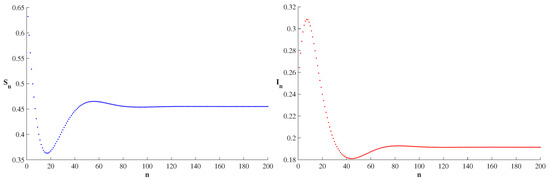
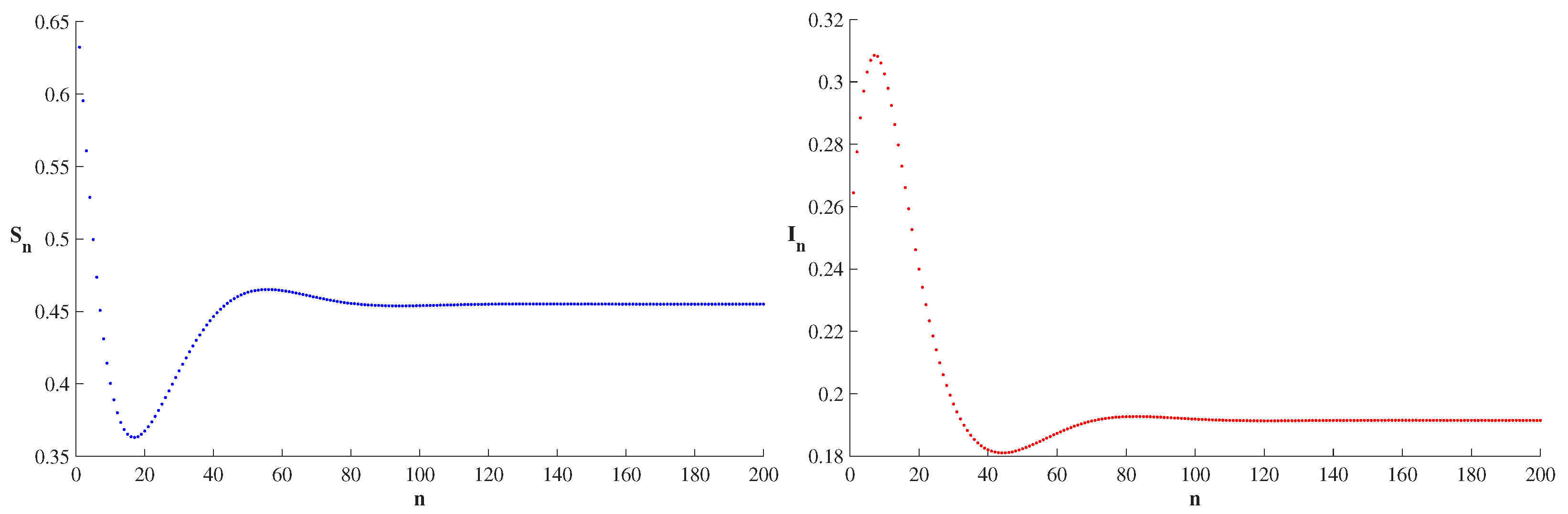
Numerical simulations are performed with the parameters set to , , , , , , , , and . Under this parameter set, the conditions of Theorem 1 are satisfied, as shown in Figure 1. The figure illustrates a sustainable outcome of epidemic control: when transmissibility is limited, recovery is rapid, and immunity wanes slowly, the disease tends toward an endemic equilibrium over time. In this scenario, the pathogen continues to circulate without causing large-scale outbreaks. This suggests that with well-designed intervention strategies, infectious diseases can be maintained at a manageable level, thereby avoiding severe societal impacts.
Figure 1.
Stability of the equilibrium point is achieved when the parameter and the initial value is (0.632, 0.264).
The Jacobian matrix of the system, evaluated at the equilibrium point , is given by
Theorem 2.
The characteristic equation of system (3), evaluated at the boundary equilibrium point , yields two eigenvalues: . Let , , and in the case of with the following conclusion:
- (1)
- If then and , is a sink;
- (2)
- If or then and , or and , is a saddle point;
- (3)
- If then and , is a source.
Obviously, the conclusions can be reached from Theorem 1.
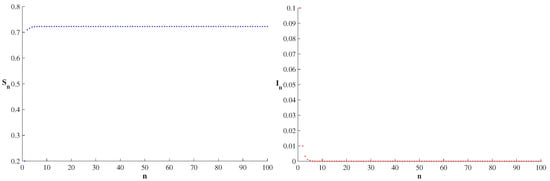
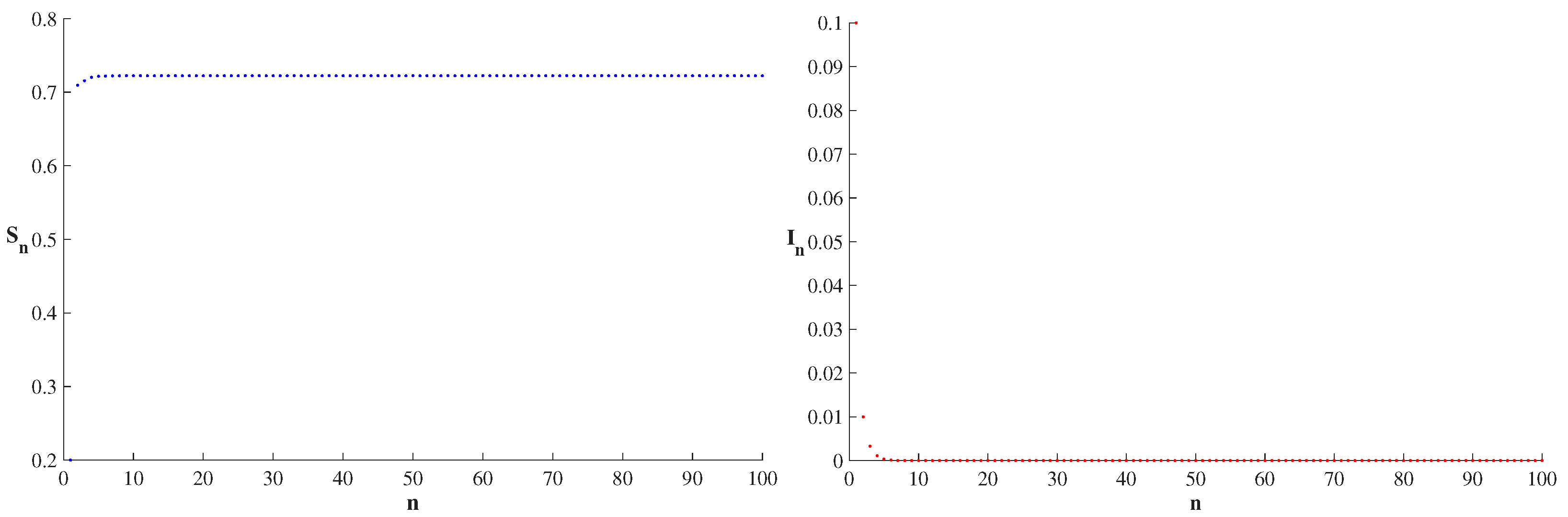
To validate the theoretical analysis, numerical simulations are conducted with the following parameter values: , , , , , , , , and . For these parameters, the conditions of Theorem 1 are satisfied, as shown in Figure 2. The figure illustrates that when favorable conditions—including low transmissibility, high vaccination coverage, minimal vertical transmission, and rapid recovery—are present, the epidemic gradually declines and eventually converges to a disease-free equilibrium without resurgence. This result demonstrates that with scientifically informed intervention strategies, infectious diseases can be eliminated or sustainably maintained below the epidemic threshold.
Figure 2.
The equilibrium point is stable when the parameter and the initial value is (0.2, 0.1).
3. Bifurcation Analysis of Positive Equilibrium Point
This section analyzes the flip and Neimark–Sacker bifurcations of the system at the equilibrium point by employing the center manifold theorem and bifurcation theory.
3.1. Neimark–Sacker Bifurcation
To rigorously establish the existence of Neimark–Sacker bifurcation and flip bifurcation at the equilibrium point in system (3), consider the coordinate shift , ; hence, the transformed system can be written as
where
Using the Taylor expansion at the point yields the following expression:
i.e.,
When h is chosen as the bifurcation parameter, then
where
it satisfies . According to Theorem 1 of (4), and are a pair of conjugate complex roots with . Under this condition, it can be shown that the system undergoes a Neimark–Sacker bifurcation. Introducing a slight perturbation to the parameter h near its critical value (i.e., setting with , the characteristic equation (Equation (6)) becomes
where
The corresponding eigenvalues are given by
Furthermore,
At this point, if , and , for all , the Neimark–Sacker bifurcation occurs at the point .
Define
Furthermore, the eigenvectors associated with these eigenvalues are given by
Theorem 3.
If , , , and in Equation (17), a Neimark–Sacker bifurcation can occur at the positive equilibrium point .
Proof.
Let , and let invertible matrix be
The corresponding inverse matrix is
To establish the existence of a Neimark–Sacker bifurcation in system (16) at the equilibrium point , the discriminant M must be calculated. Then
where
When , we conclude that system (3) undergoes Neimark–Sacker bifurcation at the equilibrium point . This completes the proof. □
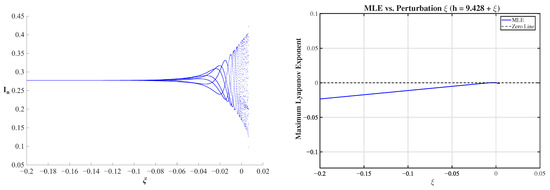
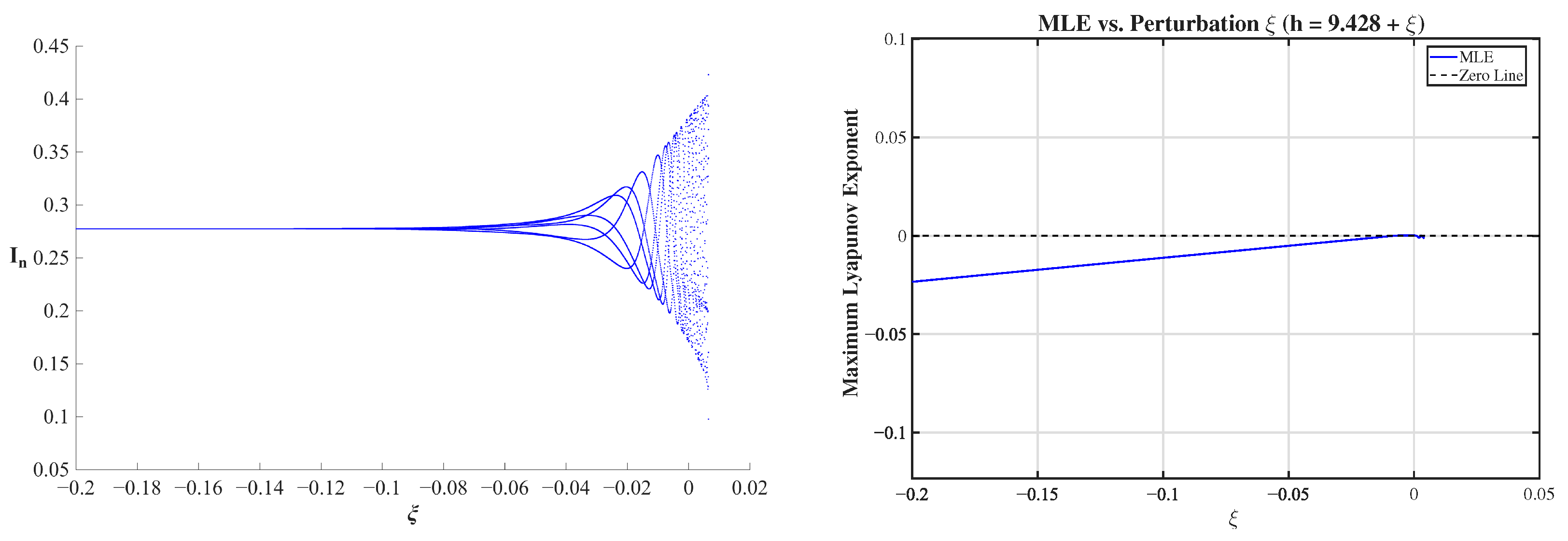
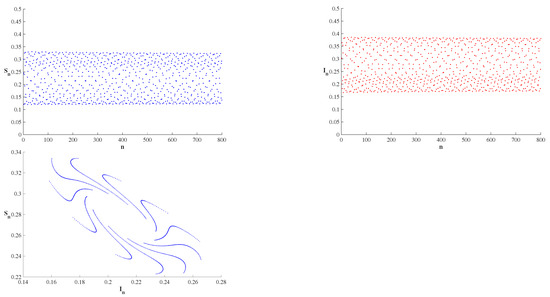
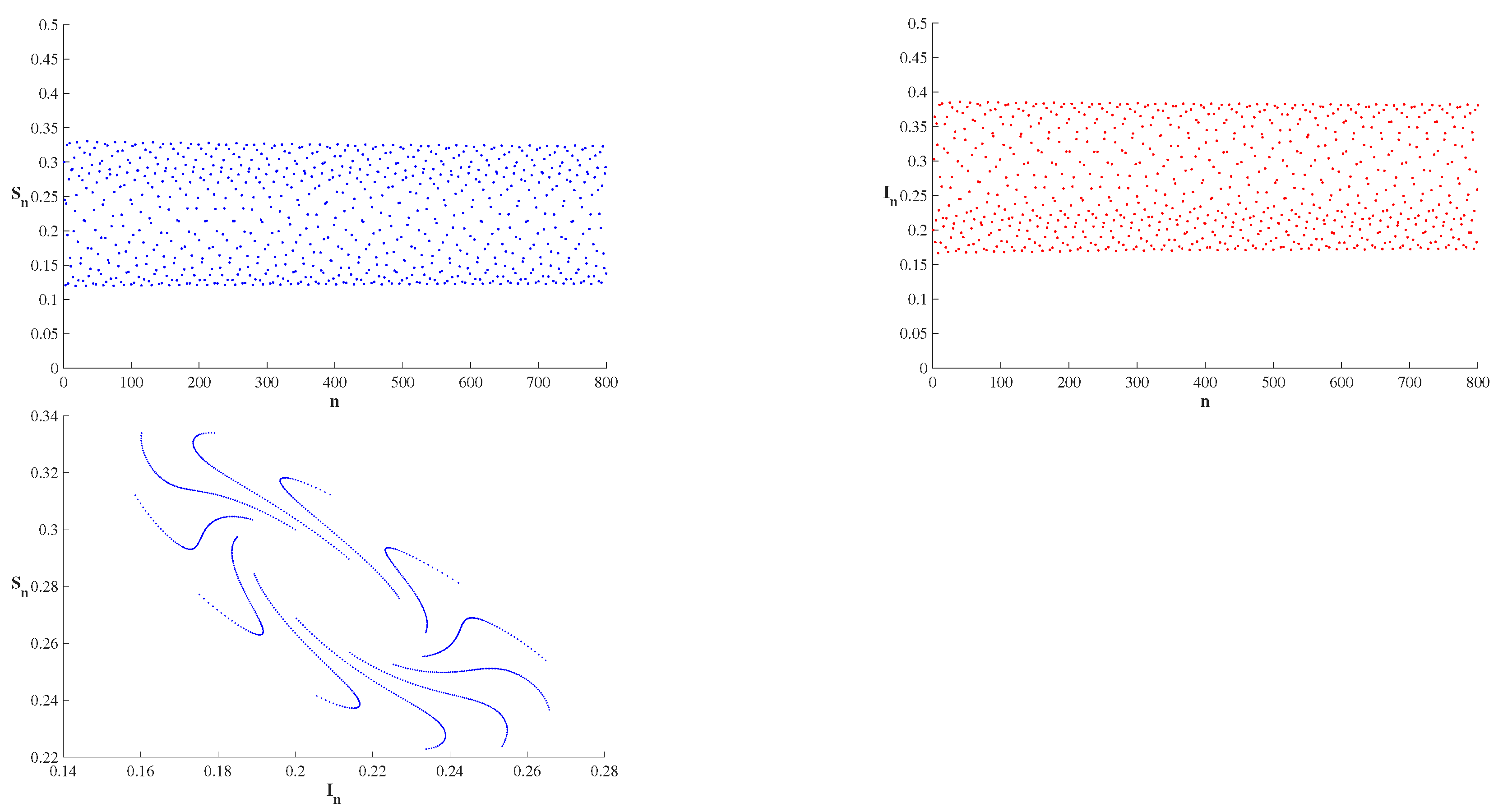
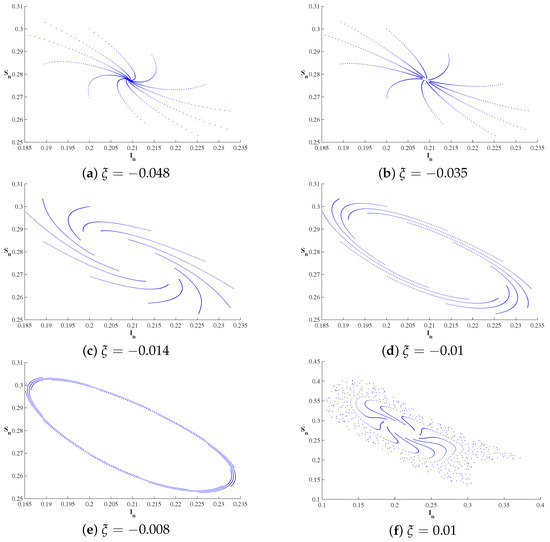
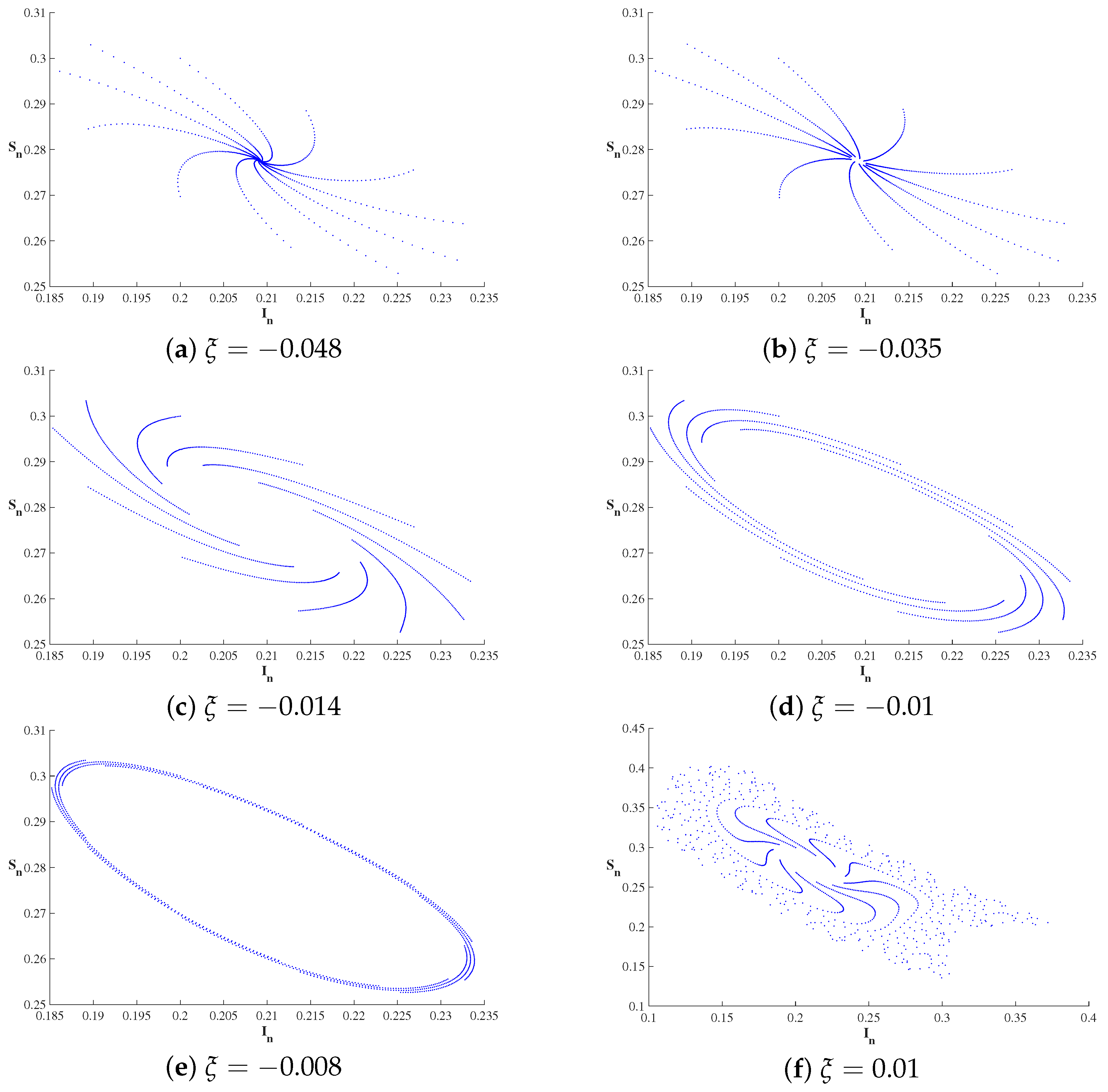
Figure 3 displays the Neimark–Sacker bifurcation diagram and the corresponding maximum Lyapunov exponent with respect to the parameter . At the bifurcation point , where the system undergoes Neimark–Sacker bifurcation, the corresponding waveform plot and phase portrait are shown in Figure 4. This emergent periodicity reflects the cyclical epidemic patterns often driven by varying control intensities. Furthermore, Figure 5 presents phase portraits simulated under different values of . The occurrence of this bifurcation indicates that the epidemic loses its stability and enters a recurrent cycle of “outbreak–decline–resurgence”. During peak outbreaks, a rapid surge in infections can overwhelm healthcare capacity. In such critical phases, interrupting mother-to-child transmission becomes paramount for protecting newborns. Key interventions—including preconception screening and treatment, intrapartum management, postpartum prophylaxis, and newborn immunization—collectively aim to reduce the vertical transmission rate, thereby mitigating intergenerational disease spread.
Figure 3.
Neimark–Sacker bifurcation and Maximum Lyapunov Exponent of system (3). Take the value of the parameter , , , , , , , , , and the initial value is .
Figure 4.
Neimark–Sacker bifurcation in . Take the value of the parameter , , , , , , , , , and the initial value is .
Figure 5.
Phase diagrams of system (3) for different values of . Take the value of the parameter , , , , , , , , , and the initial value is .
3.2. Flip Bifurcation
When
it satisfies . Thus, one eigenvalue of the linear part of system (7) is . Given that the modulus of the other eigenvalue is less than 1, we have . A small perturbation () is then introduced to the parameter h near its critical value by letting , which perturbs system (7) into the following form
The characteristic polynomial at this point is given by
The eigenvalue is
The transversal condition is
If , flip bifurcation occurs at the equilibrium point .
Suppose that an eigenvalue of matrix D is , i.e., , the eigenvector is
Let , i.e.,
The inverse matrix is given by
where , .
Theorem 4.
Let satisfy . Then, flip bifurcation occurs at when the parameter h varies in a small neighborhood of , provided that neither nor is zero. Here, and are given by and in Equation (25).
Proof.
A center manifold exists at the origin in a sufficiently small neighborhood of :
The necessary conditions for system (7) to undergo flip bifurcation are
Since the parameters satisfy and , it follows that flip bifurcation occurs at the equilibrium point . This completes the proof. □
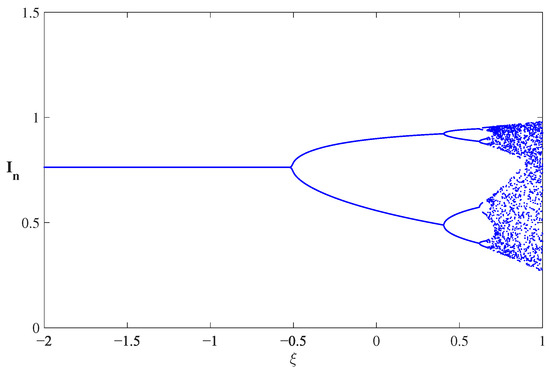
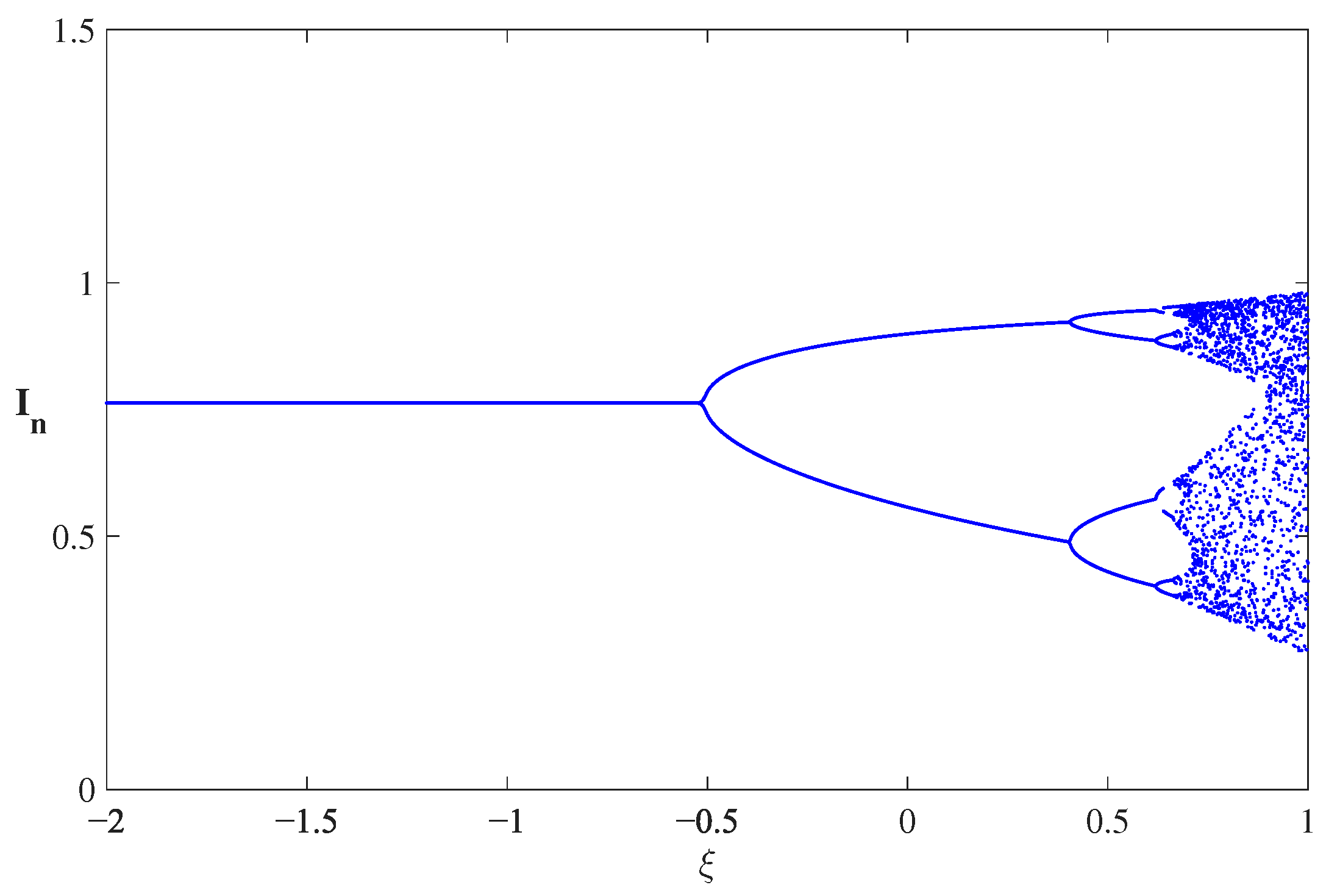
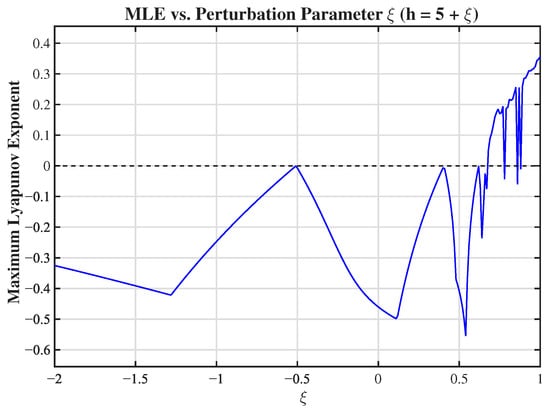
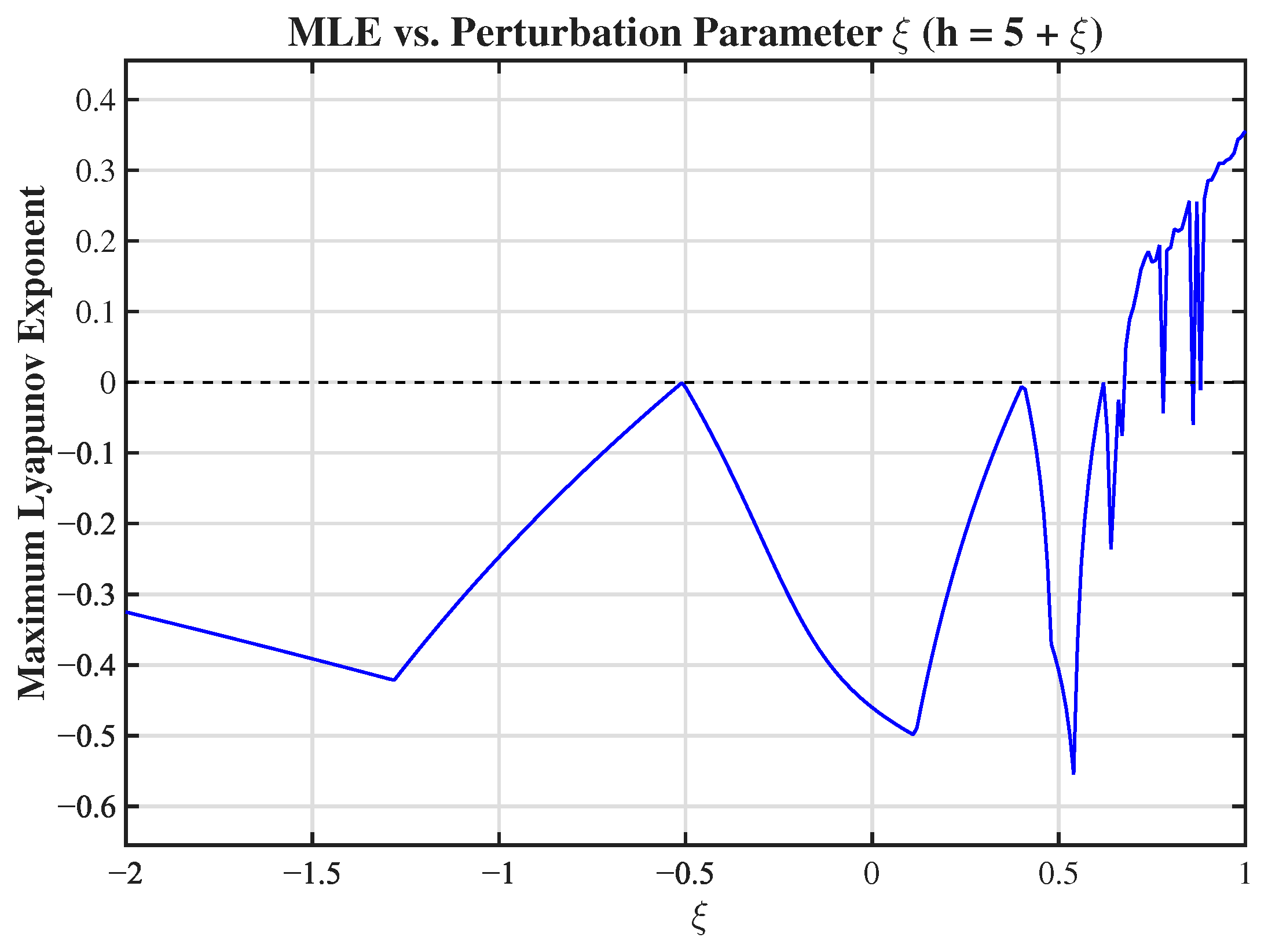
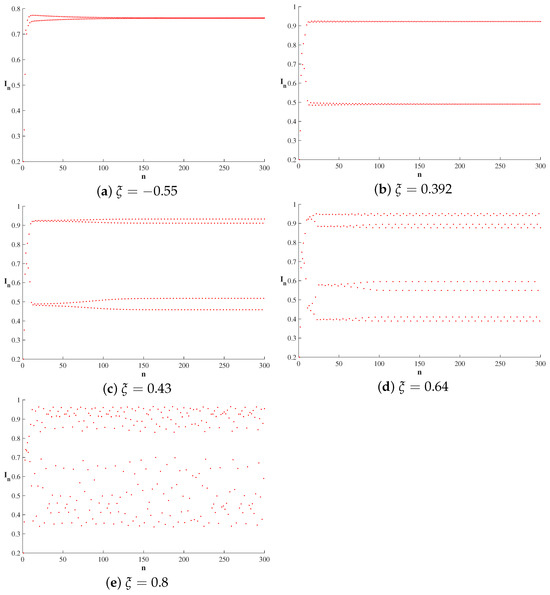
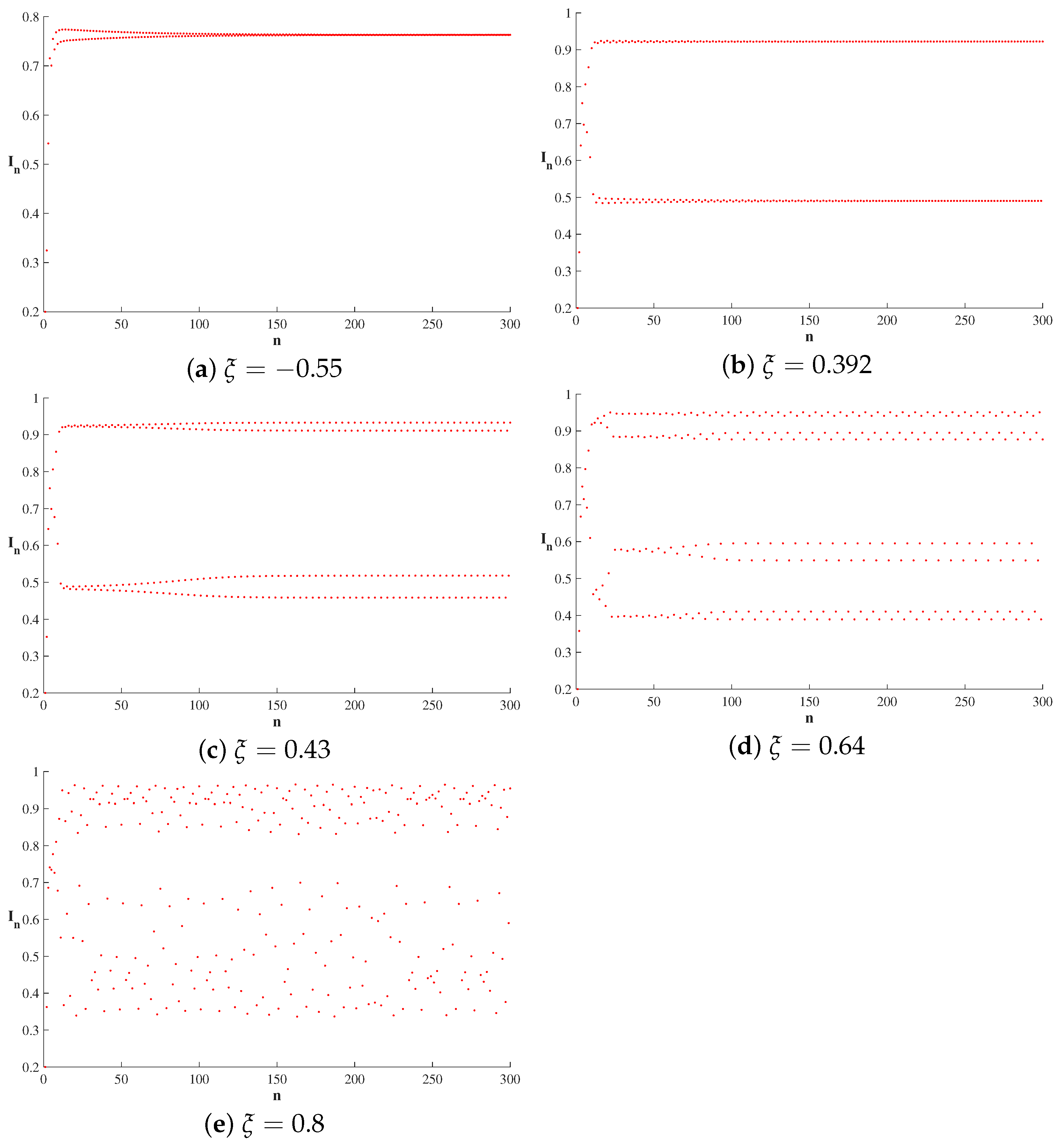
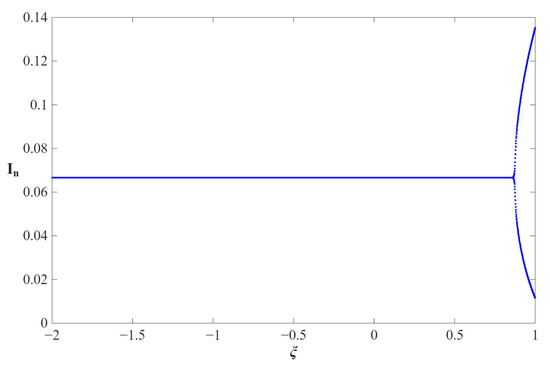
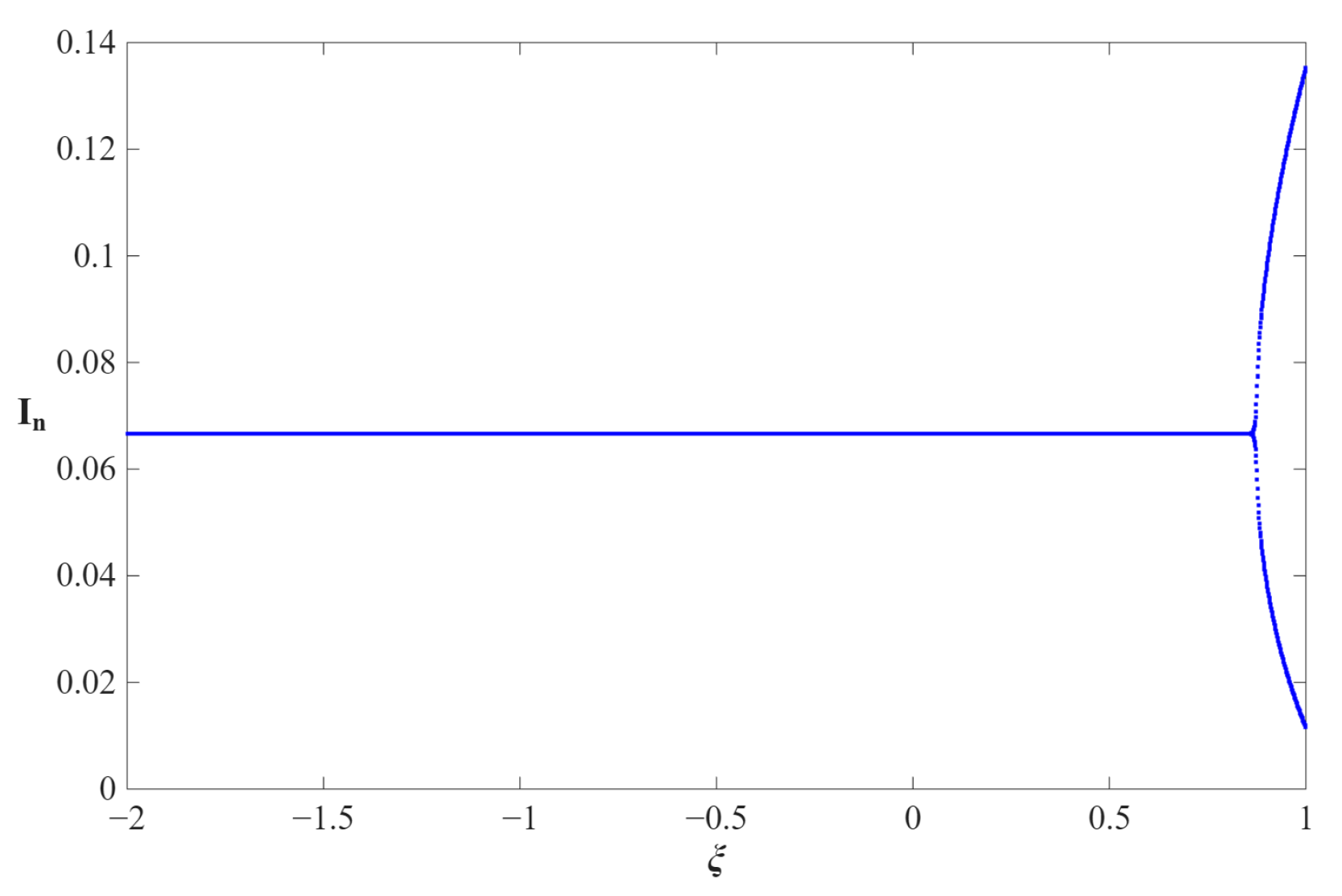
As shown in Figure 6 and Figure 7, we present the flip bifurcation diagram and the corresponding maximum Lyapunov exponent (MLE) with respect to the parameter . The results indicate that for , the MLE remains negative and system (7) stays in a stable state. At , the MLE is still negative, yet the system undergoes a flip bifurcation and enters a stable period-2 oscillation. When , the initially stable period-doubling oscillations gradually destabilize. Once exceeds , the MLE turns positive, marking the onset of chaotic dynamics. Figure 8 shows bifurcations at different periods in system (7) for selected values of . Notably, Figure 8b,c illustrate how minute variations in lead to distinctly different periodic regimes. The bifurcation diagram clearly shows that the epidemic does not remain permanently stable; rather, once certain parameters surpass critical thresholds, periodic outbreaks emerge. The key implication of the flip bifurcation is the loss of system stability, leading to recurrent epidemic waves. Effective prevention therefore relies on timely interventions—such as increasing vaccination coverage, blocking vertical transmission routes, and developing more potent therapeutics—all of which can help steer the system back toward a stable or disease-free equilibrium.
Figure 6.
Flip bifurcation of . Take the value of the parameter , , , , , , , , , and the initial value is .
Figure 7.
Maximum Lyapunov Exponent of . Take the value of the parameter , , , , , , , , , and the initial value is .
Figure 8.
Flip bifurcation analysis of system (7) for different values of . Take the value of the parameter , and the initial value is (0.3, 0.2).
4. Chaos Control
Chaos control refers to techniques that aim to stabilize unstable periodic orbits (UPOs) embedded in chaotic systems by applying small, carefully chosen perturbations. The goal is to transform the inherently irregular and unpredictable dynamics of chaotic motion into regular, predictable patterns. Several control strategies have been developed for discrete-time systems [37]. This section focuses on two such techniques: hybrid control and state feedback control.
4.1. Hybrid Control Method
The hybrid control method suppresses chaos by combining state feedback with parameter perturbation, thereby stabilizing the UPOs within the system’s chaotic attractor [38]. This combined approach ensures that the parameters of the controlled system remain stable even under substantial fluctuations. The specific form of the system under hybrid control is as follows
In system (26), the parameter fundamentally serves to attenuate the influence of the original system’s state transition rate, consequently modifying the eigenvalues of its Jacobian matrix. When assumes an appropriate value, this modification enables the system to transition from an unstable regime to a stable one. The Jacobian matrix of system (26) at is
it can be expressed as
Theorem 5.
Proof.
The characteristic equation of (28) gives
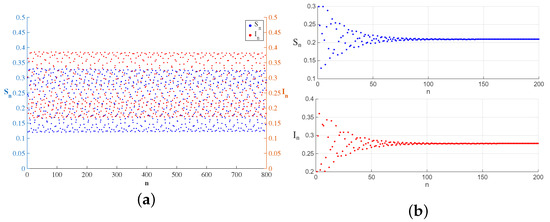
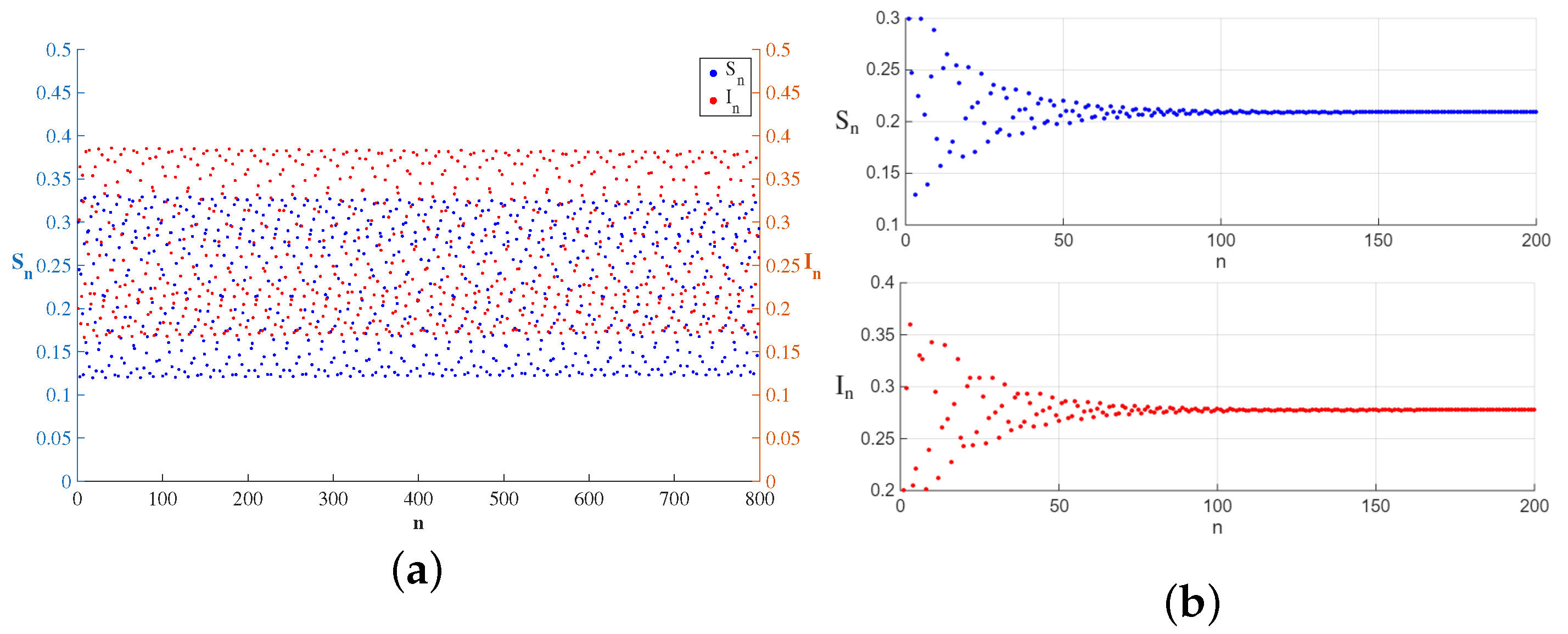
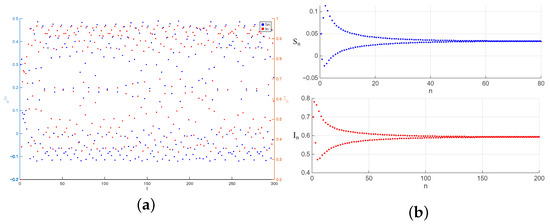
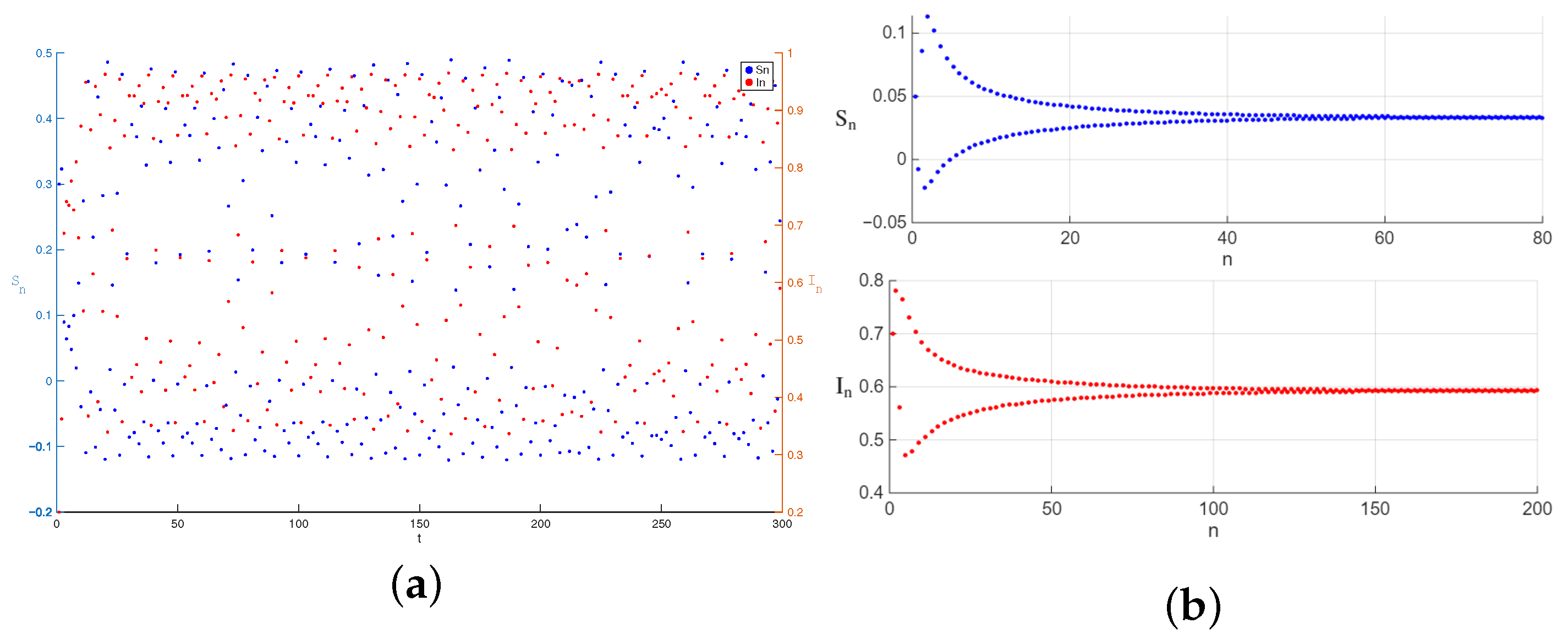
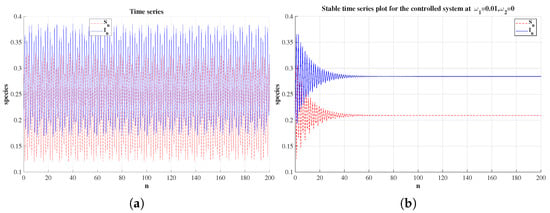
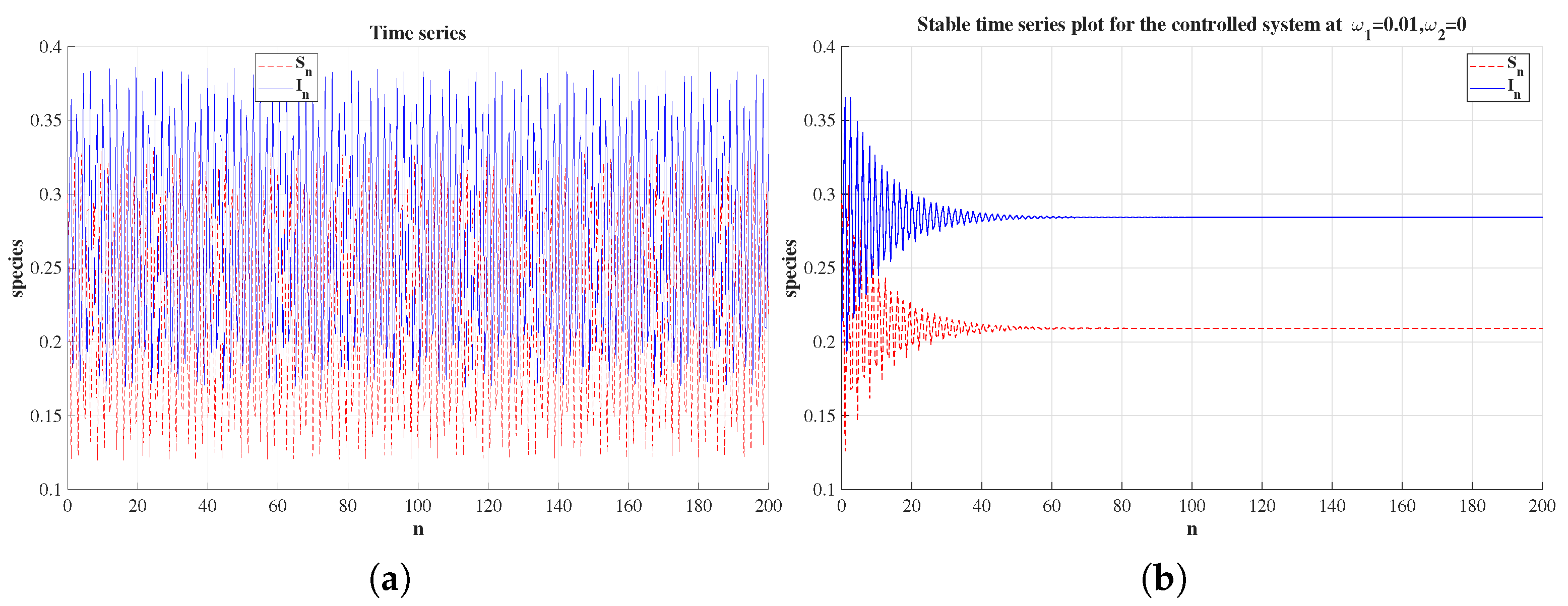
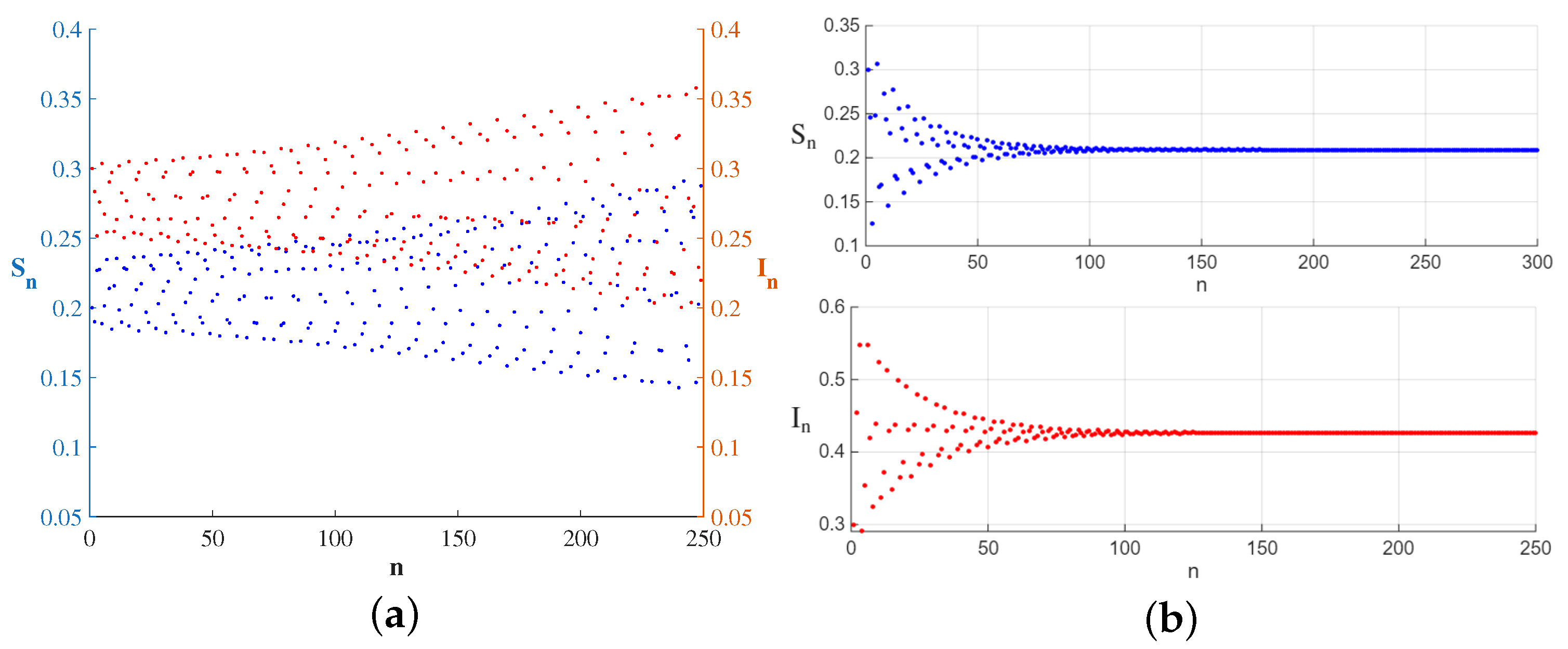
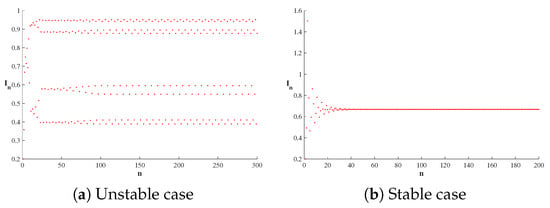
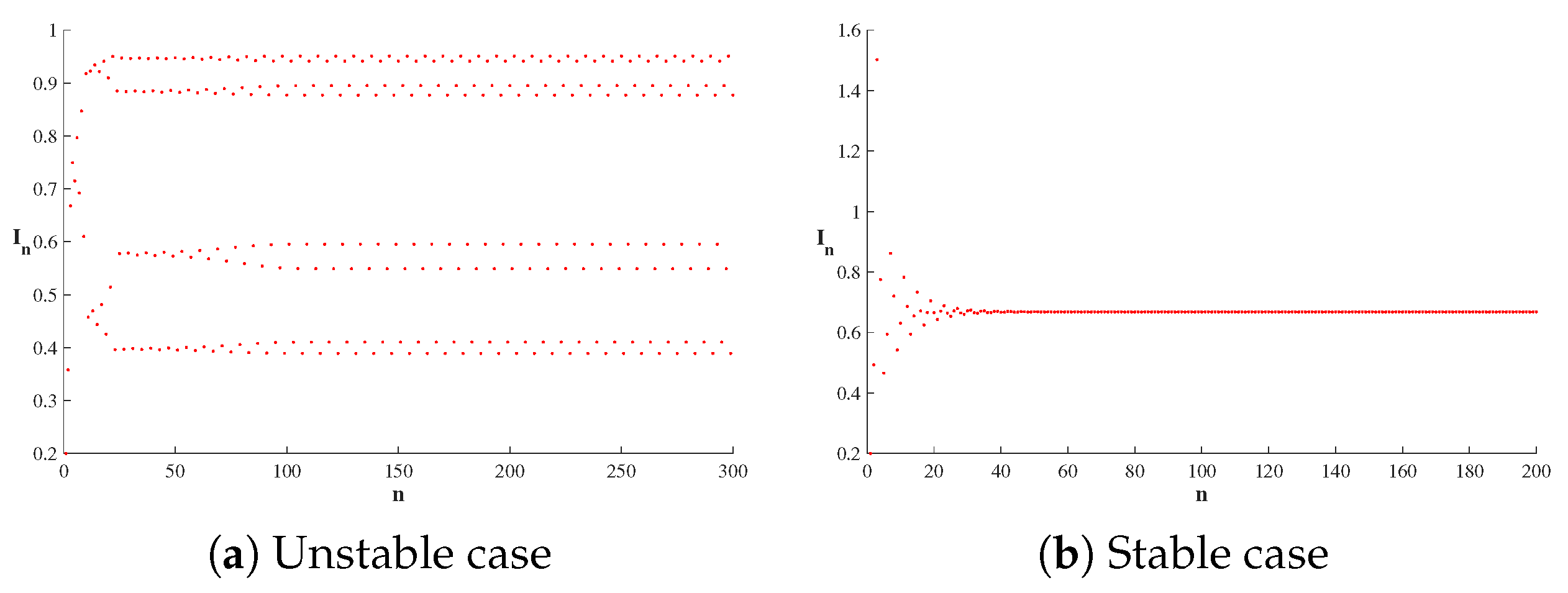
Figure 9, Figure 10, Figure 11, Figure 12 and Figure 13 show the flip and Neimark–Sacker bifurcations under control for system (33) under different parameter sets. For the Neimark–Sacker bifurcation, the parameters in the state feedback control are set to: , , , , , , , , . For the flip bifurcation, the parameters are: , , , , , , , , . In system (3), the parameter controls the system’s update frequency. In practical terms, it reflects the caution level of prevention and control measures. Its stabilization mechanism works by suppressing the eigenvalue amplification inherent to the original system. By slowing the update rate, reduces the growth rate of new infections, thereby shifting the vertical transmission dynamics from unstable periodic outbreaks to a stable, low-endemic state and ultimately achieving epidemic control.
Figure 9.
Bifurcation diagram of system (26) with respect to for .
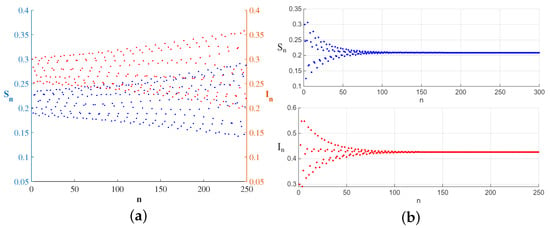
Figure 10.
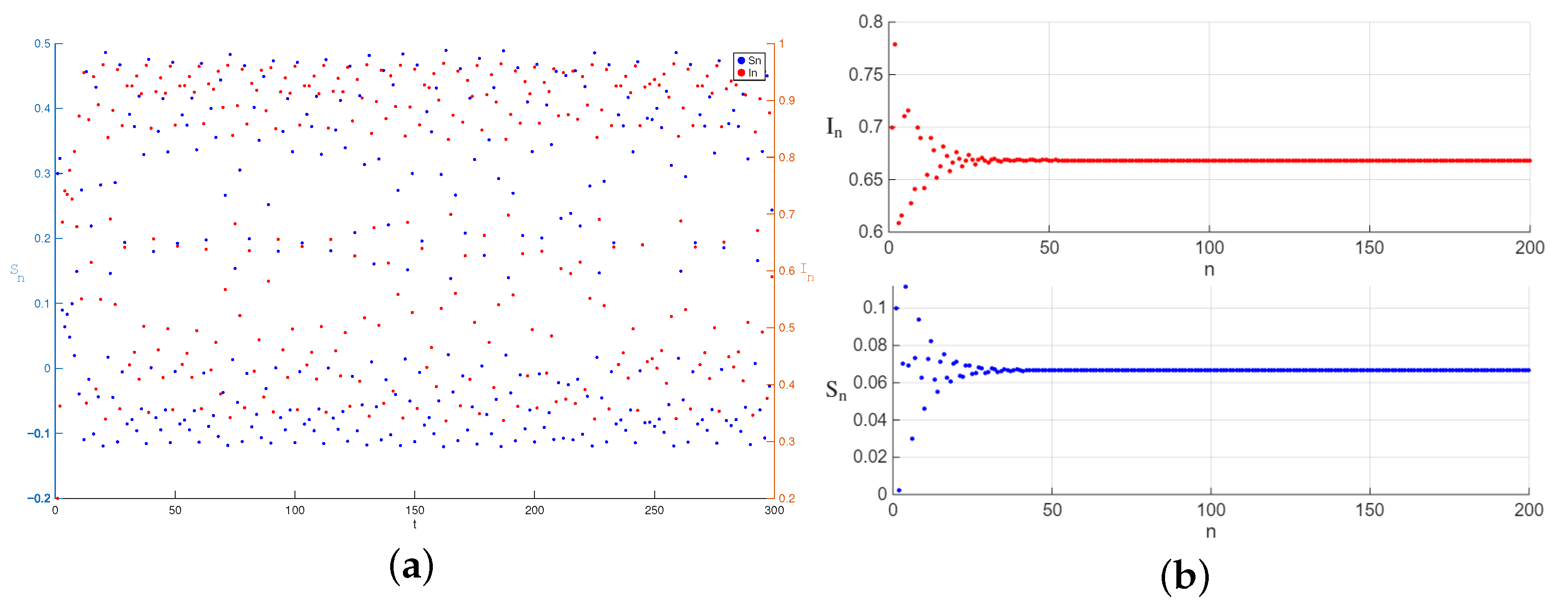
Under the parameters and , the temporal evolution of and exhibits a Neimark–Sacker bifurcation, demonstrating a transition from an unstable state (a) to a stable state (b).
Figure 11.
Bifurcation diagram for system (26), showing the flip bifurcation with respect to at .
Figure 12.
Under the parameters and , the temporal evolution of and exhibits a flip bifurcation, demonstrating a transition from an unstable state (a) to a stable state (b).
Figure 13.
Under the parameters and , the temporal evolution of and exhibits a flip (period-doubling) bifurcation, demonstrating a transition from an unstable state (a) to a stable 2-cycle (b).
4.2. State Feedback Control
Through conversion to a piecewise linear form, controller design to reduce parameter thresholds, and constrained optimization, this technique stabilizes the originally chaotic orbit around the unstable equilibrium of system (3). The specific control system is given by
Here, represents the feedback control force at the equilibrium point , where and are the corresponding feedback gains. The Jacobian matrix evaluated at is given by
The corresponding characteristic equation is
The trace and determinant of the Jacobian matrix are related to the eigenvalues and associated with the characteristic Equation (35) by
Theorem 6.
Proof.
The marginal stability line is determined by the following conditions
Under the condition , Equation (37) yields
Equation (38) expresses the first condition for marginal stability. Similarly, setting in Equation (36) yields
Similarly for , the following is obtained
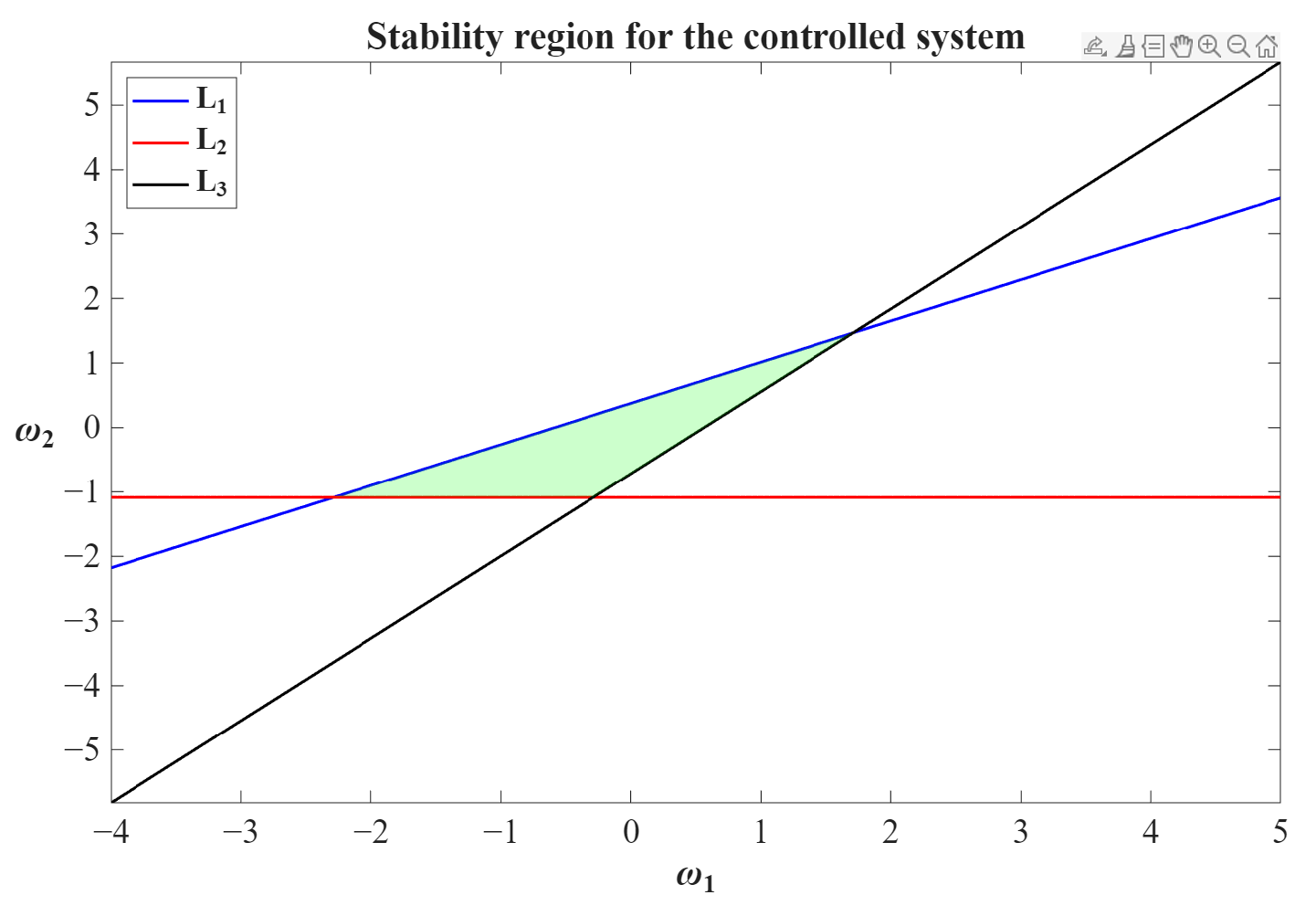
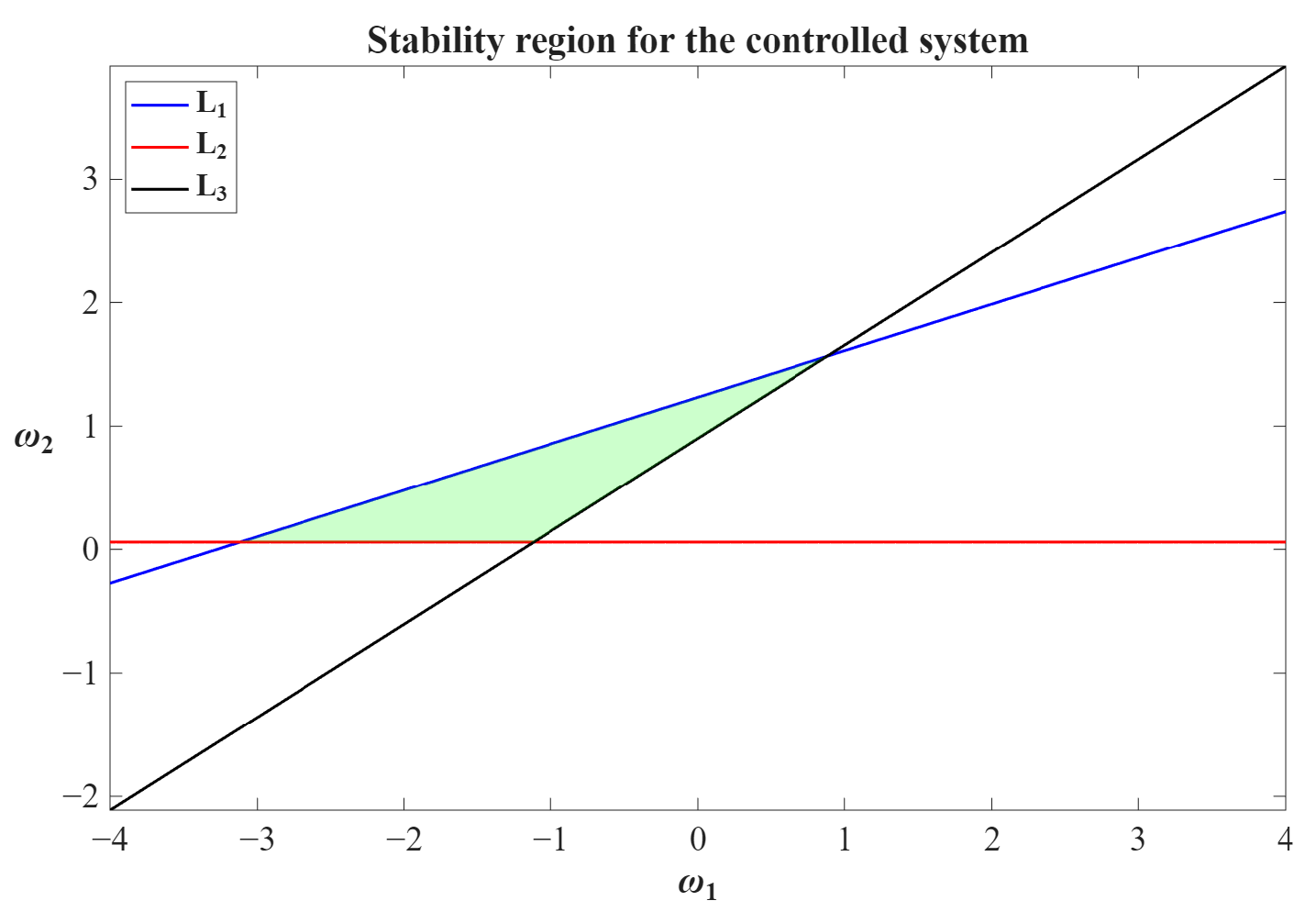
The lines , , and define the conditions for the absolute values of the eigenvalues to be less than 1. The triangular region enclosed by these line segments represents the range of stable eigenvalues. □
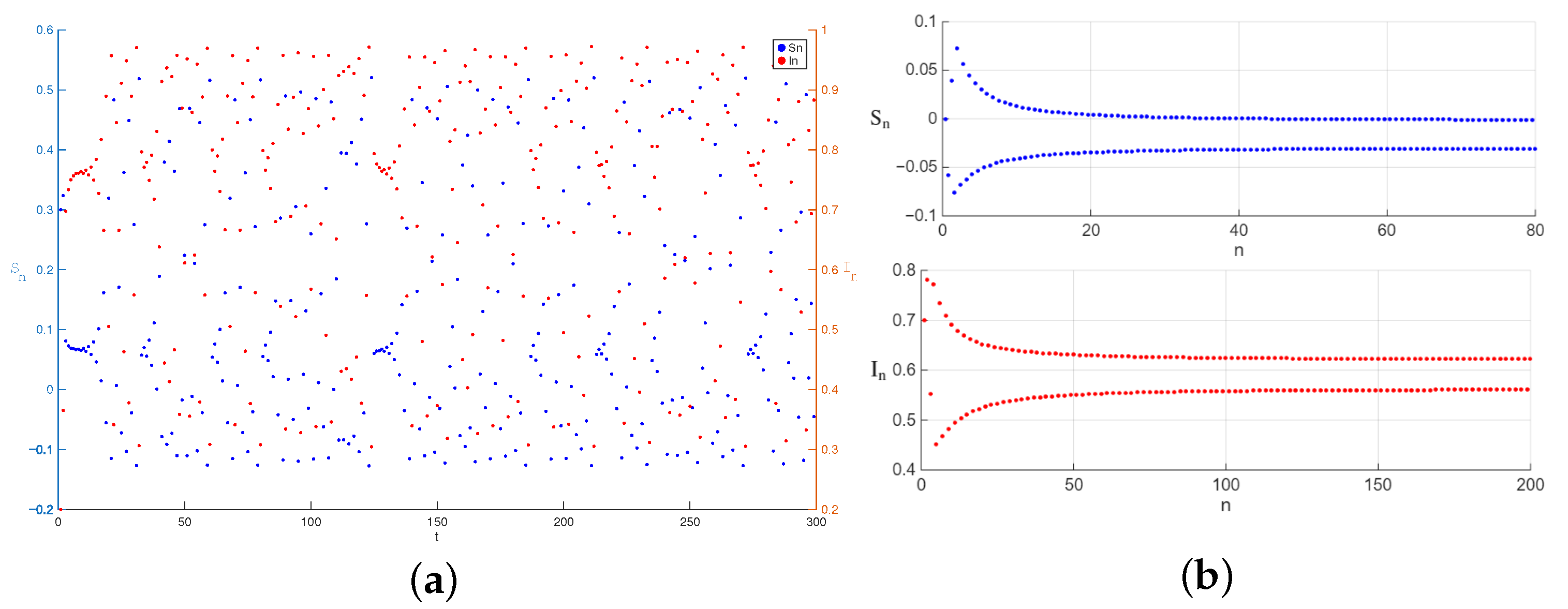
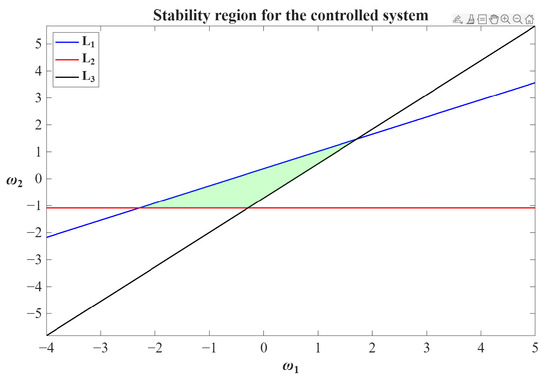
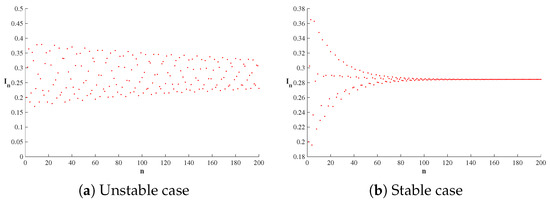
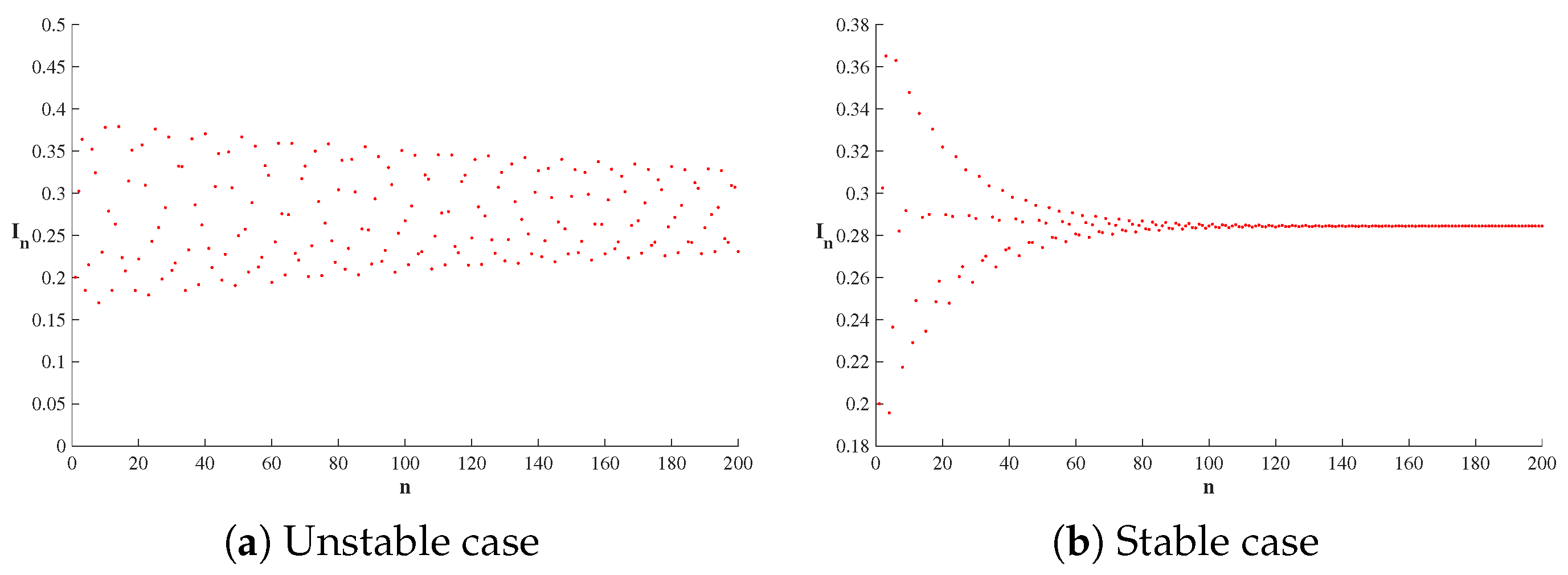
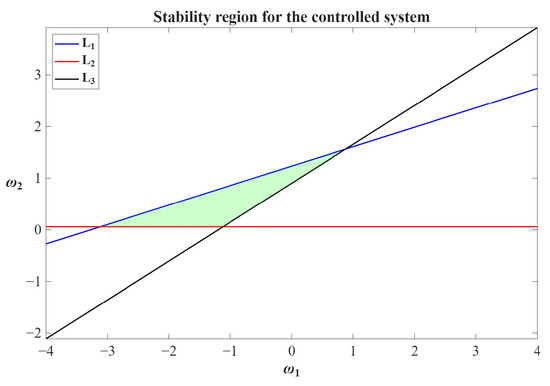
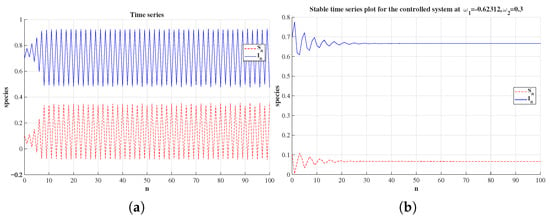
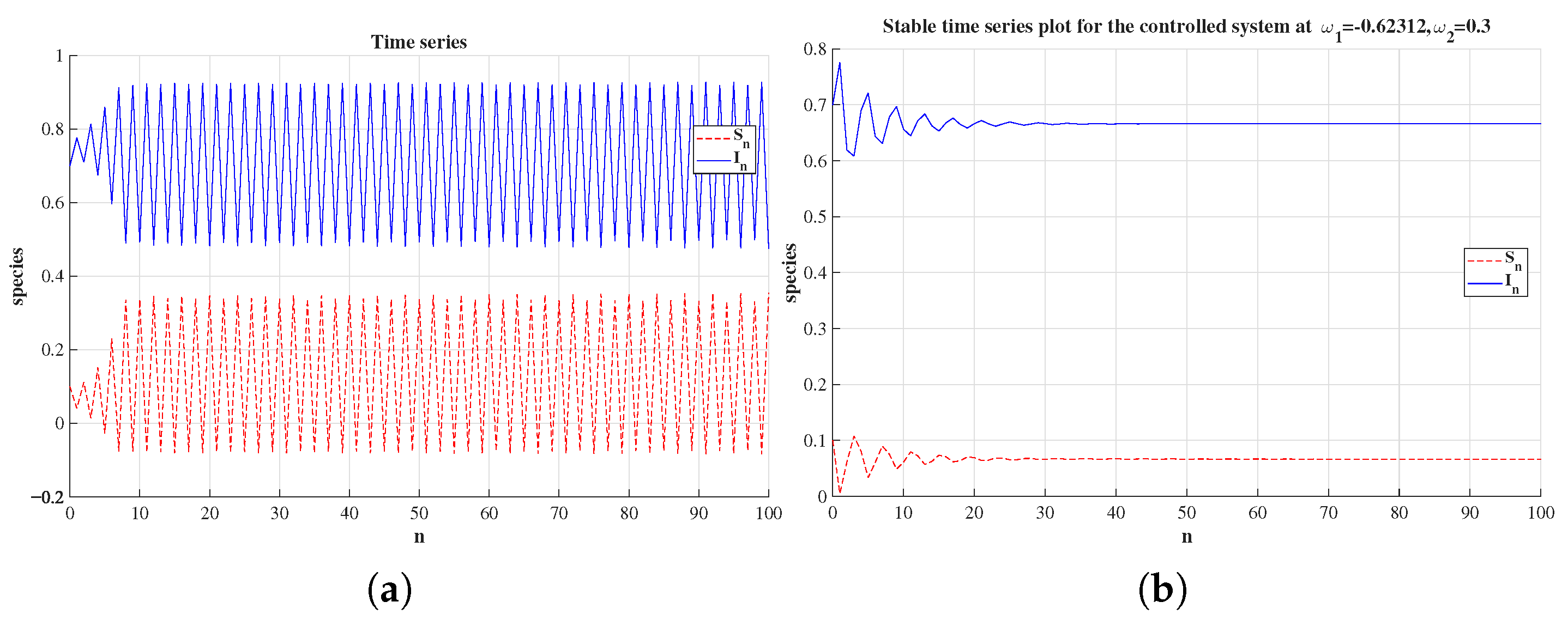
Figure 14, Figure 15, Figure 16, Figure 17, Figure 18, Figure 19, Figure 20 and Figure 21 depict the controlled Neimark–Sacker and flip bifurcations of system (33) under various parametric settings. For the Neimark–Sacker bifurcation and flip bifurcation scenario, the state feedback control technique employs two distinct parameter sets: Set 1: , , , , , , , , ; Set 2: , , , , , , , , . As illustrated in Figure 14 and Figure 18, the controlled system (33) remains stable inside the green triangular domain under the specified parameters, highlighting the crucial thresholds governing bifurcation behavior. This green stable zone defines the effective operational range of the control strategy, allowing the epidemic to be maintained in a stable and manageable regime. The temporal profiles presented in Figure 15, Figure 16 and Figure 17 and Figure 19, Figure 20 and Figure 21 demonstrate that appropriately chosen feedback gains can successfully steer the system out of instability. More specifically, Figure 15, Figure 16 and Figure 17 demonstrate the stabilization of limit cycles into steady states, while Figure 19, Figure 20 and Figure 21 illustrate the convergence of 8-period orbits and chaotic attractors toward a stable equilibrium.
Figure 14.
Stability region of the controlled system (33) under Neimark–Sacker bifurcation conditions.
Figure 15.
The time series for the flip bifurcation, obtained with feedback gains and , shows the system transitioning from an unstable state (a) to a stable state (b).
Figure 16.
With feedback gains and , the temporal evolution of during a Neimark–Sacker bifurcation shows the system transitioning from unstable (a) to stable (b).
Figure 17.
Under feedback gains and , the temporal evolution of during a Neimark–Sacker bifurcation demonstrates a transition from an unstable state (a) to a stable state (b).
Figure 18.
Stability region for the controlled system (33) under flip bifurcation conditions.
Figure 19.
The time series for the flip bifurcation at , obtained with feedback gains and , shows the system transitioning from an unstable state (a) to a stable state (b).
Figure 20.
With parameters , , and , the temporal evolution of during a flip bifurcation demonstrates a transition from an unstable state (a) to a stable state (b).
Figure 21.
With parameters , , and , the temporal evolution of during a flip bifurcation demonstrates a transition from an unstable state (a) to a stable state (b).
From an application standpoint, the use of state feedback control to stabilize this vertically transmitted infectious disease system carries significant implications: by adaptively modulating the strength of containment efforts, destabilizing influences—including maternal–fetal pathogen transmission (a source of persistent congenital infection reservoirs) and elevated infectivity (which amplifies susceptible–infectious interactions in the general population)—can be neutralized. This restores the outbreak from recurrent surges to sustained controllability. Practically, intervention entails intensifying medical treatment to reduce viral shedding duration and block perinatal transmission, alongside social distancing, when infection counts surge. Conversely, when susceptibles grow disproportionately, vaccination is scaled up to boost herd immunity thresholds in both adults and infants, supported by public health campaigns. Such balanced intervention sustains the equilibrium between infection and recovery, disrupts intergenerational disease propagation by reducing the vertical transmission rate q, and mitigates selective pressure for pathogen variants optimized for vertical spread. Ultimately, this leads to long-term epidemic stability aligned with host population resilience.
5. Conclusions
This study systematically investigated a discrete-time epidemic System that incorporates vertical transmission. The analysis included establishing the System framework, rigorously assessing the local stability of equilibria for System (3), and exploring its bifurcation behavior. This analysis revealed that Neimark–Sacker bifurcation occurs when a pair of complex conjugate eigenvalues lie on the unit circle, and flip bifurcation arises at the positive equilibrium—with the critical threshold being identified through rigorous coefficient analysis. As anticipated, variations in the bifurcation parameter give rise to distinct periodic regimes in the dynamic response of the system.
To address instabilities induced by bifurcations, we proposed and employed hybrid control and state feedback control methods to characterize, derive, and regulate the resulting chaotic dynamics. A theoretical investigation into the system’s chaotic behavior demonstrates that such phenomena—including chaotic trajectories and limit cycles—can be effectively suppressed through the implementation of these control strategies. Bifurcation diagrams visually illustrate a clear transition from chaotic and periodic regimes to stable states as parameters vary, thereby numerically validating the presence of bifurcations and chaos in the system.
Our findings further demonstrate that the chaotic dynamics induced by bifurcations can be robustly and systematically regulated using hybrid control and state feedback control methods. A theoretical analysis of the system’s chaotic behavior further confirms that both chaotic phenomena and limit cycles are effectively suppressible via these strategies. Moreover, parameter adjustments enable a clear transition observed in bifurcation diagrams: chaotic attractors and limit cycles evolve into stable equilibria, thus collectively validating the emergence of bifurcations and chaos in the system. Additionally, our results indicate that dynamically tuning the intensity of preventive and control measures to mitigate instabilities—such as vertical transmission and high infection rates—or reducing the system’s update frequency to decelerate infection growth can shift the epidemic from recurring outbreak patterns to a stable, manageable state.
Although previous studies have incorporated vertical transmission into epidemic systems, they have primarily been restricted to continuous-time dynamic frameworks. To address this gap, this paper develops a more realistic discrete system that incorporates the influence of vertical transmission and further establishes a corresponding bifurcation analysis framework. The Euler discretization method proposed in this paper demonstrates higher computational efficiency by reducing the required computational time and resources under equivalent solution accuracy, while simultaneously retaining abundant dynamic properties. This advantage effectively lowers the barrier to practical application, suggesting that research on discrete epidemic systems constitutes an important direction for future studies.
Author Contributions
Conceptualization, Y.L. and W.W.; Software, Y.L.; Validation, Y.W.; Formal analysis, W.W. and Y.W.; Investigation, Y.L. and Y.W.; Resources, W.W. and Y.W.; Data curation, Y.W.; Writing—original draft, Y.L.; Writing—review & editing, Y.L.; Visualization, Y.L.; Supervision, W.W. and Y.W.; Project administration, W.W.; Funding acquisition, W.W. and Y.W. All authors have read and agreed to the published version of the manuscript.
Funding
This research was funded the Fundamental Research Funds for the Central Universities (Grant No. 2572022DJ04).
Data Availability Statement
The original contributions presented in the study are included in the article; further inquiries can be directed to the corresponding author.
Conflicts of Interest
The authors declare no conflicts of interest.
References
- Wang, Q.; Jiang, Q.; Yang, Y.; Pan, J. The burden of travel for care and its influencing factors in China: An inpatient-based study of travel time. J. Transp. Health 2022, 25, 101353. [Google Scholar] [CrossRef] [Scilit]
- Liu, B.; Du, H.; Zhang, J.; Jiang, J.; Zhang, X.; He, F.; Niu, B. Developing a new sepsis screening tool based on lymphocyte count, international normalized ratio and procalcitonin (LIP score). Sci. Rep. 2022, 12, 20002. [Google Scholar] [CrossRef] [Scilit] [PubMed]
- Zhang, H.-Q.; Cao, B.-Z.; Cao, Q.-T.; Hun, M.; Cao, L.; Zhao, M.-Y. An analysis of reported cases of hemophagocytic lymphohistiocytosis (HLH) after COVID-19 vaccination. Hum. Vaccin. Immunother. 2023, 19, 2263229. [Google Scholar] [CrossRef] [Scilit]
- Jia, Y.; Fu, B.; Dong, L.; Zhao, M. Sweet syndrome induced by SARS-CoV-2 vaccines: A systematic review of patient-report studies. Hum. Vaccin. Immunother. 2023, 19, 2217076. [Google Scholar] [CrossRef] [Scilit]
- Xu, K.; Gao, B.; Li, J.; Xiang, Y.; Cao, L.; Zhao, M. Clinical features, diagnosis, and management of COVID-19 vaccine-associated Vogt-Koyanagi-Harada disease. Hum. Vaccin. Immunother. 2023, 19, 2220630. [Google Scholar] [CrossRef] [Scilit]
- Hu, F.; Yang, H.; Wei, S.; Hu, H.; Chen, Y.; Zhou, H. Spatial networks of China’s specialized, refined, distinctive, and innovative medical device firms based on parent-subsidiary contacts: Implications for regional health policy. Front. Public Health 2025, 13, 138. [Google Scholar] [CrossRef] [Scilit]
- Smajs, D.; Norris, S.J.; Weinstock, G.M. Genetic diversity in Treponema pallidum: Implications for pathogenesis, evolution and molecular diagnostics of syphilis and yaws. Infect. Genet. Evol. 2012, 12, 191–202. [Google Scholar] [CrossRef] [Scilit]
- Papp, J.R.; Park, I.U.; Fakile, Y.; Pereira, L.; Pillay, A.; Bolan, G.A. CDC Laboratory Recommendations for Syphilis Testing, United States, 2024. Recomm. Rep. 2024, 73, 1–32. [Google Scholar] [CrossRef] [Scilit]
- Mohapatra, R.K.; Kandi, V.; Gaidhane, A.M.; Zahiruddin, Q.S.; Rustagi, S.; Satapathy, P.; Mishra, S.; Tuglo, L.S. Global domination of the recently VoI-classified ‘JN.1’ outcompeting other variants: Comparing the vaccines’ efficacy. Clin. Infect. Pract. 2024, 22, 100358. [Google Scholar] [CrossRef] [Scilit]
- Li, P.; Faraone, J.N.; Hsu, C.C.; Chamblee, M.; Zheng, Y.M.; Carlin, C.; Bednash, J.S.; Horowitz, J.C.; Mallampalli, R.K.; Saif, L.J.; et al. Characteristics of JN.1-derived SARS-CoV-2 subvariants SLip, FLiRT, and KP.2 in neutralization escape, infectivity and membrane fusion. Cell Rep. 2024, 43, 114520. [Google Scholar] [CrossRef] [Scilit]
- National Health Service. Pregnancy and COVID-19. Available online: https://www.nhs.uk/pregnancy/keeping-well/pregnancy-and-covid-19/ (accessed on 8 June 2024).
- Virk, S.; Gangu, K.; Nasrullah, A.; Shah, A.; Faiz, Z.; Khan, U.; Jackson, D.B.; Javed, A.; Farooq, A.; DiSilvio, B.; et al. Impact of COVID-19 on pregnancy outcomes across trimesters in the United States. Biomedicines 2023, 11, 2886. [Google Scholar] [CrossRef] [Scilit] [PubMed]
- Jeong, Y.; Kim, M.-A. The coronavirus disease 2019 infection in pregnancy and adverse pregnancy outcomes: A systematic review and meta-analysis. Obstet. Gynecol. Sci. 2023, 66, 270–289. [Google Scholar] [CrossRef] [Scilit] [PubMed]
- Rodriguez-Wallberg, K.A.; Nilsson, H.P.; Røthe, E.B.; Zhao, A.; Shah, P.S.; Acharya, G. Outcomes of SARS-CoV-2 infection in early pregnancy: A systematic review and meta-analysis. Acta Obstet. Gynecol. Scand. 2024, 103, 786–798. [Google Scholar] [CrossRef] [Scilit]
- Pandit, U.; Shrestha, N.; Khanal, G. Effects of COVID-19 virus infection on pregnancy outcomes: A systematic review and meta-analysis. J. Nepal Health Res. Counc. 2023, 21, 187–196. [Google Scholar] [CrossRef] [Scilit]
- Fu, J.C.; Jing, Y.W.; Zhang, Z.H.; Zhang, S.Y. SIRS Epidemic Model with Vertical Transmission and Vaccination for Two Classes of Susceptible Individuals. J. Syst. Sci. Math. 2009, 4, 1–10. [Google Scholar]
- Zhang, H.M.; Liu, C.Y.; Wang, W.L. Stability Analysis of an SIRS Model with Vertical Transmission and Vaccination. Nat. Sci. J. Harbin Norm. Univ. 2016, 32, 1–4. [Google Scholar] [CrossRef]
- Liu, J.; Peng, B.; Zhang, T. Effect of discretization on dynamical behavior of SEIR and SIR models with nonlinear incidence. Appl. Math. Lett. 2015, 39, 60–66. [Google Scholar] [CrossRef] [Scilit]
- Qin, W.; Zhang, J.; Dong, Z. Media impact research: A discrete SIR epidemic model with threshold switching and nonlinear infection forces. Math. Biosci. Eng. 2023, 20, 17783–17802. [Google Scholar] [CrossRef] [Scilit]
- Zhu, L.; Wang, X.; Zhang, H.; Shen, S.; Li, Y.; Zhou, Y. Dynamics analysis and optimal control strategy for a SIRS epidemic model with two discrete time delays. Phys. Scr. 2020, 95, 035213. [Google Scholar] [CrossRef] [Scilit]
- Zhang, T.; Liu, J.; Teng, Z. Threshold conditions for a discrete nonautonomous SIRS model. Math. Methods Appl. Sci. 2015, 38, 1781–1794. [Google Scholar] [CrossRef] [Scilit]
- van den Driessche, P.; Yakubu, A.A. Disease Extinction Versus Persistence in Discrete-Time Epidemic Models. Bull. Math. Biol. 2019, 81, 4412–4446. [Google Scholar] [CrossRef] [Scilit]
- Cao, H.; Zhou, Y.; Ma, Z. Bifurcation analysis of a discrete SIS model with bilinear incidence depending on new infection. Math. Biosci. Eng. 2013, 10, 1399–1417. [Google Scholar] [CrossRef] [Scilit] [PubMed]
- Peng, M. Bifurcation and chaotic behavior in the Euler method for a Uçar prototype delay model. Chaos Solitons Fractals 2004, 22, 483–493. [Google Scholar] [CrossRef] [Scilit]
- Anguelov, R.; Dukuza, K.; Lubuma, J.M.S. Backward bifurcation analysis for two continuous and discrete epidemiological models. Math. Methods Appl. Sci. 2018, 41, 8784–8798. [Google Scholar] [CrossRef] [Scilit]
- Yu, X.; Liu, M.; Zheng, Z.; Hu, D. Complex dynamics of a discrete-time SIR model with nonlinear incidence and recovery rates. Int. J. Biomath. 2023, 16, 2250131. [Google Scholar] [CrossRef] [Scilit]
- Arenas, A.; Garijo, A.; Gómez, S.; Villadelprat, J. Bifurcation analysis of the Microscopic Markov Chain Approach to contact-based epidemic spreading in networks. Chaos Solitons Fractals 2023, 166, 112921. [Google Scholar] [CrossRef] [Scilit]
- Zhang, X.; Zhang, C.; Zhang, Y. Pattern dynamics analysis of a time-space discrete FitzHugh-Nagumo (FHN) model based on coupled map lattices. Comput. Math. Appl. 2024, 157, 92–123. [Google Scholar] [CrossRef] [Scilit]
- Wu, G.C.; Baleanu, D. Discrete chaos in fractional delayed logistic maps. Nonlinear Dyn. 2015, 80, 1697–1703. [Google Scholar] [CrossRef] [Scilit]
- Li, Y.; Rafaqat, M.; Zia, T.J.; Ahmed, I.; Jung, C.Y. Flip and Neimark-Sacker Bifurcations of a Discrete Time Predator-Prey Model. IEEE Access 2019, 7, 123430–123435. [Google Scholar] [CrossRef] [Scilit]
- Chen, X.; Yuan, S.; Jing, Z.; Fu, X. Bifurcation and Chaos of a Discrete-Time Mathematical Model for Tissue Inflammation. J. Dyn. Diff. Equat. 2016, 28, 281–299. [Google Scholar] [CrossRef] [Scilit]
- Singh, A.; Deolia, P. Bifurcation and Chaos in a Discrete Predator-Prey Model with Holling Type-III functional Response and harvesting Effect. J. Biol. Syst. 2021, 29, 451–478. [Google Scholar] [CrossRef] [Scilit]
- Chakraborty, K. Ecological complexity and feedback control in a prey-predator system with Holling type III functional response. Complexity 2016, 21, 346–360. [Google Scholar] [CrossRef] [Scilit]
- Auerbach, D.; Grebogi, C.; Ott, E.; Yorke, J.A. Controlling chaos in high dimensional systems. Phys. Rev. Lett. 1992, 69, 3479–3482. [Google Scholar] [CrossRef] [Scilit]
- Luo, X.S.; Chen, G.; Wang, B.H.; Fang, J.Q. Hybrid control of period-doubling bifurcation and chaos in discrete nonlinear dynamical systems. Chaos Solitons Fractals 2003, 18, 775–783. [Google Scholar] [CrossRef] [Scilit]
- Elaydi, S.N. Discrete Chaos; Chapman & Hall/CRC: Boca Raton, FL, USA, 2007. [Google Scholar]
- Din, Q. Complexity and chaos control in a discrete-time prey-predator model. Commun. Nonlinear Sci. Numer. Simul. 2017, 49, 113–134. [Google Scholar] [CrossRef] [Scilit]
- Yuan, L.G.; Yang, Q.G. Bifurcation, invariant curve and hybrid control in a discrete-time predator-prey system. Appl. Math. Model. 2015, 39, 2345–2362. [Google Scholar] [CrossRef] [Scilit]
Disclaimer/Publisher’s Note: The statements, opinions and data contained in all publications are solely those of the individual author(s) and contributor(s) and not of MDPI and/or the editor(s). MDPI and/or the editor(s) disclaim responsibility for any injury to people or property resulting from any ideas, methods, instructions or products referred to in the content. |
© 2026 by the authors. Licensee MDPI, Basel, Switzerland. This article is an open access article distributed under the terms and conditions of the Creative Commons Attribution (CC BY) license.